Suggested time allotment: 4 hours


  MODULE
                    FROM CELL TO
      1             ORGANISM

Overview

       There are different materials in the environment. There are also
diverse kinds of living things. This module will discuss different kinds of
living things and what they are made up of.

      Organ systems work together to help organisms meet their basic
needs and to survive. The digestive system helps organisms get energy from
the food they eat. The circulatory system moves the nutrients that come
from digested food, along with blood, to the different parts of the body. How
do you think do the other organ systems work together? Do plants have
organ systems, too?

       Organ systems are made up of organs that have related functions and
are grouped together. For example, the mouth, esophagus, stomach, and
intestines are organs of the digestive system. The heart, arteries and veins
are some parts that make up the circulatory system. Are there organisms
that do not have organs?

      This module introduces you to the different structures that make up
an organism. These structures are formed from the grouping together of
parts whose functions are related. You will also discover in this module that
organs are still made up of even smaller parts. Anything that happens to
these small parts will affect the functioning of the organs, organ systems,
and the whole organism.


                What are organisms? What makes them up?
Activity 1
What makes up an organism?

Objectives

           In this activity, you should be able to:

           1. identify the parts that make up an organism,
           2. describe the function of each part, and
           3. describe how these parts work together in an organism.


Materials Needed

          Writing materials
          Posters and pictures of organisms, organ systems, organs, tissues,
           and cells

Procedure

    Read the selection below and answer the questions that follow.

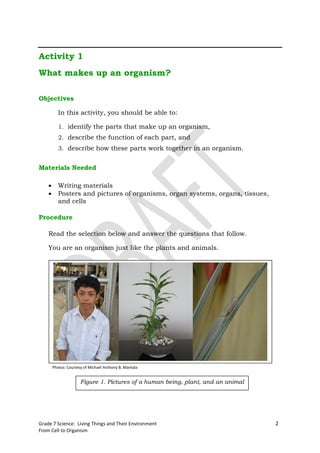
    You are an organism just like the plants and animals.


        Photos: Courtesy of Michael Anthony B. Mantala


                       Figure 1. Pictures of a human being, plant, and an animal


Grade 7 Science: Living Things and Their Environment                               2
From Cell to Organism
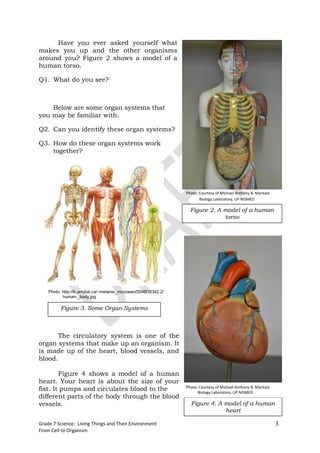
Have you ever asked yourself what
makes you up and the other organisms
around you? Figure 2 shows a model of a
human torso.

Q1. What do you see?


    Below are some organ systems that
you may be familiar with.

Q2. Can you identify these organ systems?

Q3. How do these organ systems work
    together?


                                                              Photo: Courtesy of Michael Anthony B. Mantala
                                                                     Biology Laboratory, UP NISMED

                                                                Figure 2. A model of a human
                                                                            torso


    Photo: http://fc.amdsb.ca/~melanie_mccowan/S04B36342.2/
           human-_body.jpg

         Figure 3. Some Organ Systems


       The circulatory system is one of the
organ systems that make up an organism. It
is made up of the heart, blood vessels, and
blood.

        Figure 4 shows a model of a human
heart. Your heart is about the size of your
fist. It pumps and circulates blood to the                    Photo: Courtesy of Michael Anthony B. Mantala
                                                                    Biology Laboratory, UP NISMED
different parts of the body through the blood
vessels.                                                        Figure 4. A model of a human
                                                                            heart

Grade 7 Science: Living Things and Their Environment                                                          3
From Cell to Organism
Q4. What are the parts that make up a human heart?

Q5. What will happen to the heart if any of these parts is/are injured?

Q6. What will happen to the organism?


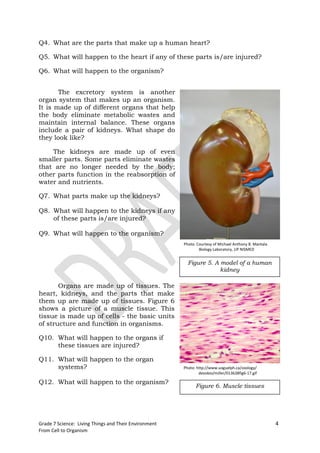
       The excretory system is another
organ system that makes up an organism.
It is made up of different organs that help
the body eliminate metabolic wastes and
maintain internal balance. These organs
include a pair of kidneys. What shape do
they look like?

    The kidneys are made up of even
smaller parts. Some parts eliminate wastes
that are no longer needed by the body;
other parts function in the reabsorption of
water and nutrients.

Q7. What parts make up the kidneys?

Q8. What will happen to the kidneys if any
    of these parts is/are injured?

Q9. What will happen to the organism?
                                                       Photo: Courtesy of Michael Anthony B. Mantala
                                                               Biology Laboratory, UP NISMED


                                                         Figure 5. A model of a human
                                                                     kidney

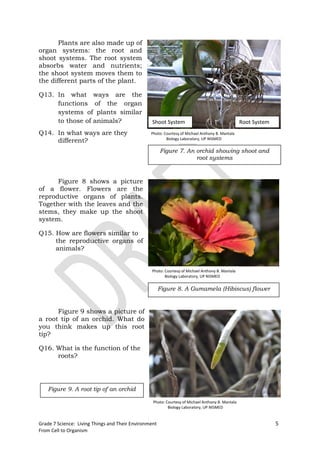
       Organs are made up of tissues. The
heart, kidneys, and the parts that make
them up are made up of tissues. Figure 6
shows a picture of a muscle tissue. This
tissue is made up of cells - the basic units
of structure and function in organisms.

Q10. What will happen to the organs if
     these tissues are injured?

Q11. What will happen to the organ
     systems?                                          Photo: http://www.uoguelph.ca/zoology/
                                                               devobio/miller/013638fig6-17.gif

Q12. What will happen to the organism?
                                                             Figure 6. Muscle tissues


Grade 7 Science: Living Things and Their Environment                                                   4
From Cell to Organism
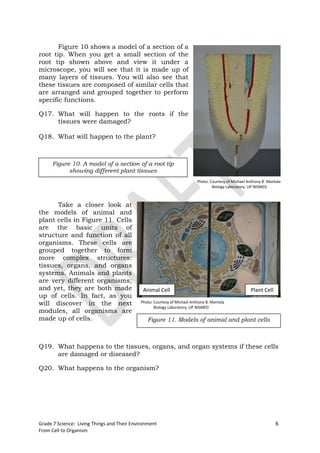
Plants are also made up of
organ systems: the root and
shoot systems. The root system
absorbs water and nutrients;
the shoot system moves them to
the different parts of the plant.

Q13. In what ways are the
     functions of the organ
     systems of plants similar
     to those of animals?                         Shoot System                                    Root System
Q14. In what ways are they                       Photo: Courtesy of Michael Anthony B. Mantala
     different?                                          Biology Laboratory, UP NISMED

                                                       Figure 7. An orchid showing shoot and
                                                                    root systems


      Figure 8 shows a picture
of a flower. Flowers are the
reproductive organs of plants.
Together with the leaves and the
stems, they make up the shoot
system.

Q15. How are flowers similar to
     the reproductive organs of
     animals?


                                                 Photo: Courtesy of Michael Anthony B. Mantala
                                                        Biology Laboratory, UP NISMED


                                                       Figure 8. A Gumamela (Hibiscus) flower


      Figure 9 shows a picture of
a root tip of an orchid. What do
you think makes up this root
tip?

Q16. What is the function of the
     roots?


    Figure 9. A root tip of an orchid

                                                  Photo: Courtesy of Michael Anthony B. Mantala
                                                          Biology Laboratory, UP NISMED


Grade 7 Science: Living Things and Their Environment                                                            5
From Cell to Organism
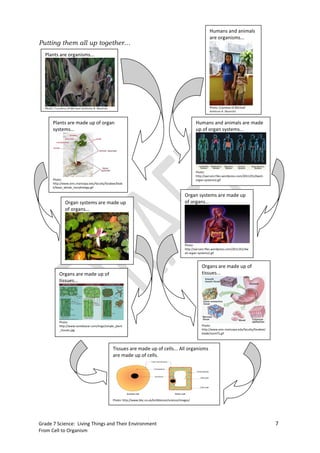
Figure 10 shows a model of a section of a
root tip. When you get a small section of the
root tip shown above and view it under a
microscope, you will see that it is made up of
many layers of tissues. You will also see that
these tissues are composed of similar cells that
are arranged and grouped together to perform
specific functions.

Q17. What will happen to the roots if the
     tissues were damaged?

Q18. What will happen to the plant?


      Figure 10. A model of a section of a root tip
            showing different plant tissues
                                                                           Photo: Courtesy of Michael Anthony B. Mantala
                                                                                   Biology Laboratory, UP NISMED


      Take a closer look at
the models of animal and
plant cells in Figure 11. Cells
are the basic units of
structure and function of all
organisms. These cells are
grouped together to form
more complex structures:
tissues, organs, and organs
systems. Animals and plants
are very different organisms;
and yet, they are both made                   Animal Cell                                              Plant Cell
up of cells. In fact, as you
will discover in the next                    Photo: Courtesy of Michael Anthony B. Mantala
                                                    Biology Laboratory, UP NISMED
modules, all organisms are
made up of cells.                               Figure 11. Models of animal and plant cells


Q19. What happens to the tissues, organs, and organ systems if these cells
     are damaged or diseased?

Q20. What happens to the organism?


Grade 7 Science: Living Things and Their Environment                                                                 6
From Cell to Organism
Humans and animals
                                                                                                                      are organisms...
Putting them all up together…
  Plants are organisms...


  Photo: Courtesy of Michael Anthony B. Mantala                                                                       Photo: Courtesy of Michael
                                                                                                                      Anthony B. Mantala


       Plants are made up of organ                                                                          Humans and animals are made
       systems...                                                                                           up of organ systems...


                                                                                                            Photo:
                                                                                                            http://aarcaro.files.wordpress.com/2011/01/dwa5-
       Photo:                                                                                               organ-systems2.gif
       http://www.emc.maricopa.edu/faculty/farabee/biob
       k/bean_whole_morphology.gif

                                                                                                     Organ systems are made up
                Organ systems are made up                                                            of organs...
                of organs...


                                                                                                     Photo:
                                                                                                     http://aarcaro.files.wordpress.com/2011/01/dw
                                                                                                     a5-organ-systems2.gif


                                                                                                                 Organs are made up of
            Organs are made up of                                                                                tissues...
            tissues...


            Photo:
            http://www.tantebazar.com/imgx/simple_plant                                                          Photo:
            _tissues.jpg                                                                                         http://www.emc.maricopa.edu/faculty/farabee/
                                                                                                                 biobk/stomTS.gif


                                                  Tissues are made up of cells... All organisms
                                                  are made up of cells.


                                                  Photo: http://www.bbc.co.uk/ks3bitesize/science/images/


Grade 7 Science: Living Things and Their Environment                                                                                                            7
From Cell to Organism
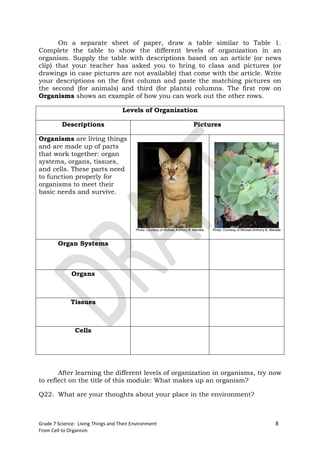
On a separate sheet of paper, draw a table similar to Table 1.
Complete the table to show the different levels of organization in an
organism. Supply the table with descriptions based on an article (or news
clip) that your teacher has asked you to bring to class and pictures (or
drawings in case pictures are not available) that come with the article. Write
your descriptions on the first column and paste the matching pictures on
the second (for animals) and third (for plants) columns. The first row on
Organisms shows an example of how you can work out the other rows.

                                    Levels of Organization

          Descriptions                                                          Pictures

Organisms are living things
and are made up of parts
that work together: organ
systems, organs, tissues,
and cells. These parts need
to function properly for
organisms to meet their
basic needs and survive.


                                          Photo: Courtesy of Michael Anthony B. Mantala   Photo: Courtesy of Michael Anthony B. Mantala


        Organ Systems


              Organs


              Tissues


               Cells


       After learning the different levels of organization in organisms, try now
to reflect on the title of this module: What makes up an organism?

Q22. What are your thoughts about your place in the environment?


Grade 7 Science: Living Things and Their Environment                                                                               8
From Cell to Organism
Reading Materials/Links/Websites


Bright Hub Education. (2009). Science Lesson Plan: Biological Organization.
Middle School Science Lessons. Retrieved January 16 2012 from
http://www.brighthubeducation.com/

Education. (2003). The Pyramid of Life (Levels of Biological Organization).
Biology Demystified: A Self-Teaching Guide. Retrieved January 16, 2012
from http://www.education.com/

Scitable by Nature Education. (2008). Biological Complexity and Integrative
Levels of Organization. Scitable Topicpage. Retrieved February 7, 2012 from
http://www.nature.com/scitable


Grade 7 Science: Living Things and Their Environment                     9
From Cell to Organism

Qtr 2 module 1 from cell to organism

  • 1.
    Suggested time allotment:4 hours MODULE FROM CELL TO 1 ORGANISM Overview There are different materials in the environment. There are also diverse kinds of living things. This module will discuss different kinds of living things and what they are made up of. Organ systems work together to help organisms meet their basic needs and to survive. The digestive system helps organisms get energy from the food they eat. The circulatory system moves the nutrients that come from digested food, along with blood, to the different parts of the body. How do you think do the other organ systems work together? Do plants have organ systems, too? Organ systems are made up of organs that have related functions and are grouped together. For example, the mouth, esophagus, stomach, and intestines are organs of the digestive system. The heart, arteries and veins are some parts that make up the circulatory system. Are there organisms that do not have organs? This module introduces you to the different structures that make up an organism. These structures are formed from the grouping together of parts whose functions are related. You will also discover in this module that organs are still made up of even smaller parts. Anything that happens to these small parts will affect the functioning of the organs, organ systems, and the whole organism. What are organisms? What makes them up?
  • 2.
    Activity 1 What makesup an organism? Objectives In this activity, you should be able to: 1. identify the parts that make up an organism, 2. describe the function of each part, and 3. describe how these parts work together in an organism. Materials Needed  Writing materials  Posters and pictures of organisms, organ systems, organs, tissues, and cells Procedure Read the selection below and answer the questions that follow. You are an organism just like the plants and animals. Photos: Courtesy of Michael Anthony B. Mantala Figure 1. Pictures of a human being, plant, and an animal Grade 7 Science: Living Things and Their Environment 2 From Cell to Organism
  • 3.
    Have you everasked yourself what makes you up and the other organisms around you? Figure 2 shows a model of a human torso. Q1. What do you see? Below are some organ systems that you may be familiar with. Q2. Can you identify these organ systems? Q3. How do these organ systems work together? Photo: Courtesy of Michael Anthony B. Mantala Biology Laboratory, UP NISMED Figure 2. A model of a human torso Photo: http://fc.amdsb.ca/~melanie_mccowan/S04B36342.2/ human-_body.jpg Figure 3. Some Organ Systems The circulatory system is one of the organ systems that make up an organism. It is made up of the heart, blood vessels, and blood. Figure 4 shows a model of a human heart. Your heart is about the size of your fist. It pumps and circulates blood to the Photo: Courtesy of Michael Anthony B. Mantala Biology Laboratory, UP NISMED different parts of the body through the blood vessels. Figure 4. A model of a human heart Grade 7 Science: Living Things and Their Environment 3 From Cell to Organism
  • 4.
    Q4. What arethe parts that make up a human heart? Q5. What will happen to the heart if any of these parts is/are injured? Q6. What will happen to the organism? The excretory system is another organ system that makes up an organism. It is made up of different organs that help the body eliminate metabolic wastes and maintain internal balance. These organs include a pair of kidneys. What shape do they look like? The kidneys are made up of even smaller parts. Some parts eliminate wastes that are no longer needed by the body; other parts function in the reabsorption of water and nutrients. Q7. What parts make up the kidneys? Q8. What will happen to the kidneys if any of these parts is/are injured? Q9. What will happen to the organism? Photo: Courtesy of Michael Anthony B. Mantala Biology Laboratory, UP NISMED Figure 5. A model of a human kidney Organs are made up of tissues. The heart, kidneys, and the parts that make them up are made up of tissues. Figure 6 shows a picture of a muscle tissue. This tissue is made up of cells - the basic units of structure and function in organisms. Q10. What will happen to the organs if these tissues are injured? Q11. What will happen to the organ systems? Photo: http://www.uoguelph.ca/zoology/ devobio/miller/013638fig6-17.gif Q12. What will happen to the organism? Figure 6. Muscle tissues Grade 7 Science: Living Things and Their Environment 4 From Cell to Organism
  • 5.
    Plants are alsomade up of organ systems: the root and shoot systems. The root system absorbs water and nutrients; the shoot system moves them to the different parts of the plant. Q13. In what ways are the functions of the organ systems of plants similar to those of animals? Shoot System Root System Q14. In what ways are they Photo: Courtesy of Michael Anthony B. Mantala different? Biology Laboratory, UP NISMED Figure 7. An orchid showing shoot and root systems Figure 8 shows a picture of a flower. Flowers are the reproductive organs of plants. Together with the leaves and the stems, they make up the shoot system. Q15. How are flowers similar to the reproductive organs of animals? Photo: Courtesy of Michael Anthony B. Mantala Biology Laboratory, UP NISMED Figure 8. A Gumamela (Hibiscus) flower Figure 9 shows a picture of a root tip of an orchid. What do you think makes up this root tip? Q16. What is the function of the roots? Figure 9. A root tip of an orchid Photo: Courtesy of Michael Anthony B. Mantala Biology Laboratory, UP NISMED Grade 7 Science: Living Things and Their Environment 5 From Cell to Organism
  • 6.
    Figure 10 showsa model of a section of a root tip. When you get a small section of the root tip shown above and view it under a microscope, you will see that it is made up of many layers of tissues. You will also see that these tissues are composed of similar cells that are arranged and grouped together to perform specific functions. Q17. What will happen to the roots if the tissues were damaged? Q18. What will happen to the plant? Figure 10. A model of a section of a root tip showing different plant tissues Photo: Courtesy of Michael Anthony B. Mantala Biology Laboratory, UP NISMED Take a closer look at the models of animal and plant cells in Figure 11. Cells are the basic units of structure and function of all organisms. These cells are grouped together to form more complex structures: tissues, organs, and organs systems. Animals and plants are very different organisms; and yet, they are both made Animal Cell Plant Cell up of cells. In fact, as you will discover in the next Photo: Courtesy of Michael Anthony B. Mantala Biology Laboratory, UP NISMED modules, all organisms are made up of cells. Figure 11. Models of animal and plant cells Q19. What happens to the tissues, organs, and organ systems if these cells are damaged or diseased? Q20. What happens to the organism? Grade 7 Science: Living Things and Their Environment 6 From Cell to Organism
  • 7.
    Humans and animals are organisms... Putting them all up together… Plants are organisms... Photo: Courtesy of Michael Anthony B. Mantala Photo: Courtesy of Michael Anthony B. Mantala Plants are made up of organ Humans and animals are made systems... up of organ systems... Photo: http://aarcaro.files.wordpress.com/2011/01/dwa5- Photo: organ-systems2.gif http://www.emc.maricopa.edu/faculty/farabee/biob k/bean_whole_morphology.gif Organ systems are made up Organ systems are made up of organs... of organs... Photo: http://aarcaro.files.wordpress.com/2011/01/dw a5-organ-systems2.gif Organs are made up of Organs are made up of tissues... tissues... Photo: http://www.tantebazar.com/imgx/simple_plant Photo: _tissues.jpg http://www.emc.maricopa.edu/faculty/farabee/ biobk/stomTS.gif Tissues are made up of cells... All organisms are made up of cells. Photo: http://www.bbc.co.uk/ks3bitesize/science/images/ Grade 7 Science: Living Things and Their Environment 7 From Cell to Organism
  • 8.
    On a separatesheet of paper, draw a table similar to Table 1. Complete the table to show the different levels of organization in an organism. Supply the table with descriptions based on an article (or news clip) that your teacher has asked you to bring to class and pictures (or drawings in case pictures are not available) that come with the article. Write your descriptions on the first column and paste the matching pictures on the second (for animals) and third (for plants) columns. The first row on Organisms shows an example of how you can work out the other rows. Levels of Organization Descriptions Pictures Organisms are living things and are made up of parts that work together: organ systems, organs, tissues, and cells. These parts need to function properly for organisms to meet their basic needs and survive. Photo: Courtesy of Michael Anthony B. Mantala Photo: Courtesy of Michael Anthony B. Mantala Organ Systems Organs Tissues Cells After learning the different levels of organization in organisms, try now to reflect on the title of this module: What makes up an organism? Q22. What are your thoughts about your place in the environment? Grade 7 Science: Living Things and Their Environment 8 From Cell to Organism
  • 9.
    Reading Materials/Links/Websites Bright HubEducation. (2009). Science Lesson Plan: Biological Organization. Middle School Science Lessons. Retrieved January 16 2012 from http://www.brighthubeducation.com/ Education. (2003). The Pyramid of Life (Levels of Biological Organization). Biology Demystified: A Self-Teaching Guide. Retrieved January 16, 2012 from http://www.education.com/ Scitable by Nature Education. (2008). Biological Complexity and Integrative Levels of Organization. Scitable Topicpage. Retrieved February 7, 2012 from http://www.nature.com/scitable Grade 7 Science: Living Things and Their Environment 9 From Cell to Organism