Which of the given thing is
“living” or :non-living”
WHY ?
 Can they grow
 Can they breath
 Can they move
 Can they eat
 Can they reproduce
WHAT ?
CELLS
Yes, every living organism is made
up of cells.
Human body can have more
than “37.2 trillions” of cells.
CELLS
Cell is basic structural and
functional unit of life.
WELCOME
New Topic is:
CELLULAR
ORGANIZATION
Cellular Organization
cell Tissue organ
Organ
system
organism
Cellular organization in Humans
Cellular organization in Plants
In this chapter we study:
 Definition of cell
 Cell organelles (cell wall, cell membrane, nucleus, vacuole, mitochondria,
chloroplast, starch grain,, cytoplasm, Golgi apparatus and endoplasmic
reticulum).
 Animal tissues (connective, nerve, muscular, epithelial)
 Plant tissues (supporting, photosynthetic, epidermal, and vascular).
 Names of organ e.g. bones, heart, lung, muscles and etc.
 Organ systems e.g. respiratory, circulatory, digestive, nervous, skeletal,
and muscular with their one line definitions.
This week outline:
Day 1 https://www.youtube.com/watch?v=URUJD5NEXC8
Reading text 1 find meaning of difficult words
Day 2 Draw labeled diagram of animal and plant cell
worksheet 1
Day 3 http://www.sheppardsoftware.com/health/anatomy/cell/index.htm
https://www.educationquizzes.com/us/middle-school-6th-7th-and-8th-
grade/science/animal-cells/
Day 4 https://www.softschools.com/quizzes/biology/cell_structure/quiz356.html
https://quizlet.com/98949422/6th-grade-plant-and-animal-cell-quiz-flash-cards/
Cell model
CELL
Miss Atifa
Miss Fakhra
Co. Teacher Miss Umm-e- Zehra
Qmaer-e-Bani Hashim Higher Secondary School
Introduction to
the Cell
Structure and
Function
Discovery of Cells
 The invention of the
lens
 Robert Hooke(1665):
observed a thin slice of
cork (dead plant cells)
with a microscope.
 He described what he
observed as “little
boxes” (cells).
Discovery of Cells
 Anton van Leeuwenhoek (1675): was the
first person to observe living cells.
Microscopes
 Magnification: refers to
the microscope’s
power to increase an
object’s apparent size
 Resolution: refers to
the microscope’s
power to show
detail clearly
The Cell Theory
Who developed the cell theory?
– Matthias Schleiden (1838):
concluded that all plants are
composed of cells
– Theodor Schwann (1839): concluded
that all animals are composed of
cells
– Rudolph Virchow (1855):
determined that cells come only
from other cells
The Cell Theory
What is the cell theory?
1. All living things are composed
of one or more cells.
2. Cells are organisms’ basic
units of structure and
function.
3. Cells come only from existing
cells.
Cell Diversity
 Size
 Shape
 Internal Organization
Cell Diversity (SIZE)
Smallest Cells:
Longest Cells:
Biggest Cells
6 inches long, 5 inches wide, 3 pounds
Cell Diversity (SHAPE)
 Cells differ widely in shape
 Most cells are roughly
cuboidal or spherical.
Cell Diversity (INTERNAL ORGANIZATION)
 Nucleus: contains DNA which directs the
activity of the cell
 Organelle: a cell component that performs
specific functions in the cell
 Eukaryotes: cells that contain a nucleus
and membrane-bound organelles
 Prokaryotes: cells that lack nuclei and
membrane-bound organelles
Eukaryotes vs. Prokaryotes
Eukaryotes (animals,
plants, fungi, protists)
Prokaryotes (bacteria) differ
greatly in structure.
Eukaryotes vs. Prokaryotes
Prokaryotes Eukaryotes
nucleus? NO (nucleoid) YES
membrane-bound
organelles?
size
NO YES (Many)
1 - 10 m 10 - 50 m
when evolved? 3.5 billion years ago 1.5 billion years ago
cytoplasm? YES YES
cell membrane? YES YES
cell wall? Some Do Plants
ribosomes? YES YES
DNA?
examples
Circular Free
Floating
Chromosomes in Nucleus
Bacteria
Plants, Animals, Fungi, and
Protists
Structural Organization of Eukaryotic and
Prokaryotic Cells
The Parts of the Cell
 Each living cell carries out the tasks of
taking food, transforming food into
energy, getting rid of wastes, and
reproducing.
 Most eukaryotic cells have
three main components:
– Cell Membrane
– Cytoskeleton
– Nucleus
Structure & Function of Organelles
The Structure and Function of the
following organelles will be discussed:
– Cell Membrane – Mitochondria
– Nucleus – Lysosomes
– Cell Wall – Peroxisomes
– Cytoplasm – Cilia and Flagella
– Cytoskeleton – Basal Bodies
– Ribosomes – Centrioles
– Endoplasmic Reticulum – Vacuoles
– Golgi Apparatus – Plastids
Cell Membrane
Structure: phospholipid
bilayer with proteins that
function as channels,
markers, and receptors
-also contains cholesterol
which provides rigidity
Function: selectively
permeable boundary
between the cell and
the external environment
Nucleus
Structure: the nucleus
is a sphere that
contains another
sphere called a
nucleolus
Function: -storage
center of cell’s DNA
-manages cell
functions
Cell Wall
Structure: rigid wall
made up of cellulose,
proteins, and
carbohydrates
Function: boundary
around the plant cell
outside of the cell
membrane that
provides structure
and support
Cytoplasm
Structure:
gelatin-like fluid that lies
inside the cell membrane
Function:
-contains salts, minerals
and organic molecules
-surrounds the organelles
Endoplasmic Reticulum
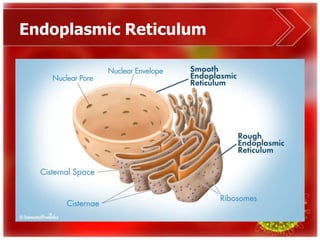
Structure: a system of membranous tubules
and sacs
Function: intercellular highway (a path along
which molecules move from one part of the cell
to another)
Two types:
– Rough Endoplasmic Reticulum
– Smooth Endoplasmic Reticulum
Endoplasmic Reticulum
Golgi Apparatus
Structure: stacked
flat sacs
Function: receives
proteins from the rER
and distributes them to
other organelles or out
of the cell
(receiving,
processing,
packaging, and
shipping)
Mitochondria
Structure: folded membrane
within an outer membrane
– The folds of the
inner membrane are
called cristae
Function: -converts energy
stored in food into usable
energy for work
– cellular respiration
Vacuoles
Structure:
a sac of fluid surrounded by a
membrane
– Very large in plants
Function:
used for temporary storage of
wastes, nutrients, and water
Chloroplast
Structure: stacked sacs
(thylakoids) that
contain chlorophyll
surrounded by a
double
membrane
Function:
photosynthesis
(conversion of light
energy to chemical
energy stored in the
bonds of glucose)
Plant Cells vs. Animal Cells
Animal Cell
Plant Cell
2nd week outline:
Day 1 Read pg. # 180 -182 heading n0. 16.2 and draw mind map to
elaborate animal and plant tissues
Day 2 https://www.youtube.com/watch?v=Ae4MadKPJC0
Day 3 Reading text 2
Day 4 PPT on human body systems
An integrated group of
cells with a common
structure and function
Tissue
What is Tissue ?
• Tissue is a cellular organizational level
intermediate between cells and a complete
organism. Hence, a tissue is an ensemble of cells,
not necessarily identical, but from the same
origin, that together carry out a specific function.
• The study of tissue is known as histology
or, in connection with disease,
histopathology.
The Importance of Tissue
• Formation of tissues has brought about a division of labour
in multicellular organisms
• Tissues become organised to form organs and
organs into organ systems
• As a result of improved organisation and higher efficiency
multicellular organisms have higher survival
• Plants are autotrophic organisms, so prepare their own
food by photosynthesis, they are stationary and do not
move from place to place, hence they do not need
much energy. Most of the tissues in plants are dead
and provide structural strength.
Importance Cont ……..
• Animals on the other hand are heterotrophic organisms,
they move in search of food and hence need more energy
compared to plants, most of the tissues they have are living.
• Hence the plants and animals are made of different types of
tissues.
• There are some tissues in plants which divide through out
their life, they divide for the growth and reproduction of the
plant
• Such ever dividing tissues are localized in certain regions of
the plant body, thus based on the dividing capacity of the
tissues they are classified into two
Importance ………
Types of Tissues
ANIMALTISSUE
Animal tissues can be grouped into four basic
types: connective, muscle, nervous, and epithelial.
PLANT TISSUE
Plant tissues are categorized broadly into three tissue systems
the epidermis, theground tissue, and the vascular tissue.
Plant tissues
Meristematic tissue: rapid cell division,
lengthening of shoots and roots
Dermal tissue: covering for the
plant body
Ground tissue: support,
photosynthesis, and storage
Vascular tissue: conduction of
water, food, and dissolved
minerals; strengthens and
supports
the plant
Plant tissues
Meristematic Tissue
 cells that do not
differentiate
 cells retain the ability
to divide
 Types:
– Apical – primary growth
at root and shoot tips
– Lateral – secondary
growth in trees and
shrubs
– Intercalary – secondary
growth in monocot
stems
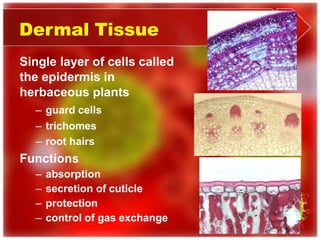
Dermal Tissue
Single layer of cells called
the epidermis in
herbaceous plants
– guard cells
– trichomes
– root hairs
Functions
– absorption
– secretion of cuticle
– protection
– control of gas exchange
Ground Tissue
PARENCHY
MA
COLLENCHY
MA
SCLERENCH
YMACharacteristi
cs
• spherical
• thin-walled
•living,
metabolizing
tissue
•elongated cells with
unevenly thickened
cell walls
• alive at maturity
•with primary and
secondary cell
walls
•dead at
functional
maturityLocatio
n
• throughout the
plant
•beneath the
epidermis in young
stems and in leaf
veins
•fibers in wood,
bark, leaves, stems
•sclereids in fruits
and seeds
Function
s
•photosynthesis
and respiration
• storage
• regeneration
•flexible
support
system
• structural
support
Appearanc
e
Vascular Tissue
 Xylem
‒ Conducts water and
dissolved minerals
from the roots
 Phloem
‒ Conducts dissolved
food materials,
carbohydrates, in
solution
 Continuous throughout
plant
All 4 types of tissues
are present in the root tip
Animal Tissues
• Multicellular (large) organisms function more
efficiently if cells become specialized for specific
functions.
• There are four types of tissues found in
animals: epithelial, connective, nerve,
and muscle tissue.
• Sponges do not have tissues.
Animal Tissues
Four Types of Animal Tissues
Epithelial tissues
 Epithelial tissue covers the whole surface of the
body. It is made up of cells that are closely packed
and are composed of one or more layers. This
tissue is specialized to form the covering or lining
of all internal and external body surfaces.
Epithelial tissue that occurs on surfaces on the
interior of the body is known as endothelium.
 Made up of continuous sheets of densely
packed cells, with little space or intercellular
material between them.
cont . . . . .
A basement membrane is usually present.
 Functions:
Forms the covering or lining of all free body surfaces,
both internal and external to protect cells from
mechanical injury and water loss.
Some has special functions of absorption,
secretion, excretion, sensation and respiration.
Connective tissues
The connective tissue is specialized to connect and
anchor various body organs
It connects the bones to each other, bind the tissues and give
support to various parts of the body by creating a packing
around the organs,
Thus the main function of the tissue are binding,
supporting and packing
The cells of the tissue are living and are separated from each
other
A homogenous gel like intercellular substance called the
medium or matrix forms the bulk of the connective tissue
Cont ……..
The space between the cells are filled with a non living matrix
which may be solid as in bone and cartilage and fluid as in
blood
Thus blood is a type of connective tissue
Blood has a fluid matrix called the plasma, in which the
RBC, WBC and platelets are suspended
The plasma contains proteins, salts and hormones
The bone is another example of a connective tissue
It is a strong and nonflexible tissue, embedded in a hard
matrix composed of calcium and phosphorus
compounds
Cont ……..
Two bones are connected to each other by another type of
connective tissue called ligament
Tissue is very elastic and has strength and contains very little
matrix
The muscles are connected to the bones by another type of
connective tissue called tendons
Tendons are fibrous with great strength and limited flexibility
Cartilage is another type of connective tissue, which has
widely spaced cells
The cartilage is seen at the surface of the joints, nose,
ear, trachea and larynx
Muscular Tissues
 The muscular tissue are made of muscle cells and these cells are
elongated and large sized , so they are also called the muscle fibres
 The movement of the body or limbs are brought about by the
contraction and relaxation of the contractile protein present in the
muscle cells.
 Most of the muscular tissue is attached to the bones and hence are
called the skeletal muscles
 The movement of the muscles can be controlled as well as
uncontrolled
 The type of muscles in which the movement is under our control are
called the voluntary muscles
 And the type of muscles where the movement cannot be
controlled are called the involuntary muscles
Muscular Tissues
Types of Muscular Tissues
 The muscular tissue can be divided into 3
1. Striated muscles
2. Smooth muscles
3. Cardiac muscles
STRIATED MUSCLES
 The muscles are also known as skeletal muscles or voluntary muscles
 The type of muscles show light and dark bands or striations when
stained, hence they are also known as striated muscles
 The cells of this tissue are long, cylindrical, unbranched and
multinucleate.
 They are attached to the bones and help in body movements
 Each muscle cell is enclosed in a distinct plasma membrane
called the sarcolemma
Types of Muscular Tissues
SMOOTH MUSCLES
These are also known as the unstriated or the involuntary
muscles
They occur as bundles which are spindle shaped and have
a single nucleus
The movement of these muscles cannot be controlled
The tissue are often seen in the walls of the alimentary
canal, visceral organs except the heart
Types of Muscular Tissues
CARDIAC MUSCLES
They show the characteristics of both the striated and
smooth muscles
The cells of this muscles are branched cylindrical and un
inucleated , the intercellular spaces are filled with the
connective tissue
They have dark and light bands on them
The muscles around the heart show rhythmic contraction
and relaxation throughout the life , and hence these
involuntary muscles are also known as the cardiac muscles
Nervous Tissues
It is a tissue which is specialized to transmit messages within th
body
Brain, spinal cord and nerves are all composed of nervous tissu
The cells of this tissue are called nerve cells or neurons
The neurons have the ability to receive stimuli within or outside
the body and to conduct impulses (signals) to different parts of
the body
The impulse travels from one neuron to another
Many nerve fibres bound together make up a nerve
The neurons have the three main parts
Types of Nervous Tissues
1. Motor Neurons/Efferent
 Accept nerve impulses from the CNS
 Transmit them to muscles or glands
2. Sensory Neurons/Afferent
 Accept impulses from sensory receptors
 Transmit them to the CNS
3. Interneurons/Association
 Convey nerve impulses between various parts of the CNS
Types of Nervous Tissues
DIFFERENCES BETWEEN
ANIMAL AND PLANT TISSUES
ANIMAL TISSUE PLANT TISSUE
Since animals are mobile so they
require more energy, hence
more living tissues are required.
Since plants are stationary so they
do not require much energy, Hence
more living tissues are not required.
Animals move from one place to
another in search of food, shelter
etc., hence they need more energy
and there more tissues are living.
In plants, most tissues provide
structural strength. Most of these
tissues are dead 9can provide
mechanical strength as easily as the
living ones and need less
maintenance.Cell growth is uniformally
distributed
Growth is limited to certain
regions
Structural organisation of organs
and organ systems is more
specialised and complex.
Structural organisation of
organs is comparatively less
complex.
Cellular organisation 6 class

Cellular organisation 6 class

  • 1.
    Which of thegiven thing is “living” or :non-living”
  • 2.
    WHY ?  Canthey grow  Can they breath  Can they move  Can they eat  Can they reproduce
  • 3.
  • 4.
    CELLS Yes, every livingorganism is made up of cells. Human body can have more than “37.2 trillions” of cells.
  • 5.
    CELLS Cell is basicstructural and functional unit of life.
  • 6.
  • 7.
    Cellular Organization cell Tissueorgan Organ system organism
  • 8.
  • 9.
  • 10.
    In this chapterwe study:  Definition of cell  Cell organelles (cell wall, cell membrane, nucleus, vacuole, mitochondria, chloroplast, starch grain,, cytoplasm, Golgi apparatus and endoplasmic reticulum).  Animal tissues (connective, nerve, muscular, epithelial)  Plant tissues (supporting, photosynthetic, epidermal, and vascular).  Names of organ e.g. bones, heart, lung, muscles and etc.  Organ systems e.g. respiratory, circulatory, digestive, nervous, skeletal, and muscular with their one line definitions.
  • 11.
    This week outline: Day1 https://www.youtube.com/watch?v=URUJD5NEXC8 Reading text 1 find meaning of difficult words Day 2 Draw labeled diagram of animal and plant cell worksheet 1 Day 3 http://www.sheppardsoftware.com/health/anatomy/cell/index.htm https://www.educationquizzes.com/us/middle-school-6th-7th-and-8th- grade/science/animal-cells/ Day 4 https://www.softschools.com/quizzes/biology/cell_structure/quiz356.html https://quizlet.com/98949422/6th-grade-plant-and-animal-cell-quiz-flash-cards/ Cell model
  • 12.
    CELL Miss Atifa Miss Fakhra Co.Teacher Miss Umm-e- Zehra Qmaer-e-Bani Hashim Higher Secondary School
  • 13.
  • 14.
    Discovery of Cells The invention of the lens  Robert Hooke(1665): observed a thin slice of cork (dead plant cells) with a microscope.  He described what he observed as “little boxes” (cells).
  • 15.
    Discovery of Cells Anton van Leeuwenhoek (1675): was the first person to observe living cells.
  • 16.
    Microscopes  Magnification: refersto the microscope’s power to increase an object’s apparent size  Resolution: refers to the microscope’s power to show detail clearly
  • 17.
    The Cell Theory Whodeveloped the cell theory? – Matthias Schleiden (1838): concluded that all plants are composed of cells – Theodor Schwann (1839): concluded that all animals are composed of cells – Rudolph Virchow (1855): determined that cells come only from other cells
  • 18.
    The Cell Theory Whatis the cell theory? 1. All living things are composed of one or more cells. 2. Cells are organisms’ basic units of structure and function. 3. Cells come only from existing cells.
  • 19.
    Cell Diversity  Size Shape  Internal Organization
  • 20.
    Cell Diversity (SIZE) SmallestCells: Longest Cells: Biggest Cells 6 inches long, 5 inches wide, 3 pounds
  • 21.
    Cell Diversity (SHAPE) Cells differ widely in shape  Most cells are roughly cuboidal or spherical.
  • 22.
    Cell Diversity (INTERNALORGANIZATION)  Nucleus: contains DNA which directs the activity of the cell  Organelle: a cell component that performs specific functions in the cell  Eukaryotes: cells that contain a nucleus and membrane-bound organelles  Prokaryotes: cells that lack nuclei and membrane-bound organelles
  • 23.
    Eukaryotes vs. Prokaryotes Eukaryotes(animals, plants, fungi, protists) Prokaryotes (bacteria) differ greatly in structure.
  • 24.
    Eukaryotes vs. Prokaryotes ProkaryotesEukaryotes nucleus? NO (nucleoid) YES membrane-bound organelles? size NO YES (Many) 1 - 10 m 10 - 50 m when evolved? 3.5 billion years ago 1.5 billion years ago cytoplasm? YES YES cell membrane? YES YES cell wall? Some Do Plants ribosomes? YES YES DNA? examples Circular Free Floating Chromosomes in Nucleus Bacteria Plants, Animals, Fungi, and Protists
  • 25.
    Structural Organization ofEukaryotic and Prokaryotic Cells
  • 26.
    The Parts ofthe Cell  Each living cell carries out the tasks of taking food, transforming food into energy, getting rid of wastes, and reproducing.  Most eukaryotic cells have three main components: – Cell Membrane – Cytoskeleton – Nucleus
  • 27.
    Structure & Functionof Organelles The Structure and Function of the following organelles will be discussed: – Cell Membrane – Mitochondria – Nucleus – Lysosomes – Cell Wall – Peroxisomes – Cytoplasm – Cilia and Flagella – Cytoskeleton – Basal Bodies – Ribosomes – Centrioles – Endoplasmic Reticulum – Vacuoles – Golgi Apparatus – Plastids
  • 28.
    Cell Membrane Structure: phospholipid bilayerwith proteins that function as channels, markers, and receptors -also contains cholesterol which provides rigidity Function: selectively permeable boundary between the cell and the external environment
  • 29.
    Nucleus Structure: the nucleus isa sphere that contains another sphere called a nucleolus Function: -storage center of cell’s DNA -manages cell functions
  • 30.
    Cell Wall Structure: rigidwall made up of cellulose, proteins, and carbohydrates Function: boundary around the plant cell outside of the cell membrane that provides structure and support
  • 31.
    Cytoplasm Structure: gelatin-like fluid thatlies inside the cell membrane Function: -contains salts, minerals and organic molecules -surrounds the organelles
  • 32.
    Endoplasmic Reticulum Structure: asystem of membranous tubules and sacs Function: intercellular highway (a path along which molecules move from one part of the cell to another) Two types: – Rough Endoplasmic Reticulum – Smooth Endoplasmic Reticulum
  • 33.
  • 34.
  • 35.
    Golgi Apparatus Structure: stacked flatsacs Function: receives proteins from the rER and distributes them to other organelles or out of the cell (receiving, processing, packaging, and shipping)
  • 36.
    Mitochondria Structure: folded membrane withinan outer membrane – The folds of the inner membrane are called cristae Function: -converts energy stored in food into usable energy for work – cellular respiration
  • 37.
    Vacuoles Structure: a sac offluid surrounded by a membrane – Very large in plants Function: used for temporary storage of wastes, nutrients, and water
  • 38.
    Chloroplast Structure: stacked sacs (thylakoids)that contain chlorophyll surrounded by a double membrane Function: photosynthesis (conversion of light energy to chemical energy stored in the bonds of glucose)
  • 39.
    Plant Cells vs.Animal Cells
  • 40.
    Plant Cells vs.Animal Cells
  • 41.
  • 42.
  • 43.
    2nd week outline: Day1 Read pg. # 180 -182 heading n0. 16.2 and draw mind map to elaborate animal and plant tissues Day 2 https://www.youtube.com/watch?v=Ae4MadKPJC0 Day 3 Reading text 2 Day 4 PPT on human body systems
  • 44.
    An integrated groupof cells with a common structure and function Tissue
  • 45.
    What is Tissue? • Tissue is a cellular organizational level intermediate between cells and a complete organism. Hence, a tissue is an ensemble of cells, not necessarily identical, but from the same origin, that together carry out a specific function. • The study of tissue is known as histology or, in connection with disease, histopathology.
  • 46.
    The Importance ofTissue • Formation of tissues has brought about a division of labour in multicellular organisms • Tissues become organised to form organs and organs into organ systems • As a result of improved organisation and higher efficiency multicellular organisms have higher survival • Plants are autotrophic organisms, so prepare their own food by photosynthesis, they are stationary and do not move from place to place, hence they do not need much energy. Most of the tissues in plants are dead and provide structural strength.
  • 47.
    Importance Cont …….. •Animals on the other hand are heterotrophic organisms, they move in search of food and hence need more energy compared to plants, most of the tissues they have are living. • Hence the plants and animals are made of different types of tissues. • There are some tissues in plants which divide through out their life, they divide for the growth and reproduction of the plant • Such ever dividing tissues are localized in certain regions of the plant body, thus based on the dividing capacity of the tissues they are classified into two
  • 48.
  • 49.
    Types of Tissues ANIMALTISSUE Animaltissues can be grouped into four basic types: connective, muscle, nervous, and epithelial. PLANT TISSUE Plant tissues are categorized broadly into three tissue systems the epidermis, theground tissue, and the vascular tissue.
  • 50.
    Plant tissues Meristematic tissue:rapid cell division, lengthening of shoots and roots Dermal tissue: covering for the plant body Ground tissue: support, photosynthesis, and storage Vascular tissue: conduction of water, food, and dissolved minerals; strengthens and supports the plant
  • 51.
  • 52.
    Meristematic Tissue  cellsthat do not differentiate  cells retain the ability to divide  Types: – Apical – primary growth at root and shoot tips – Lateral – secondary growth in trees and shrubs – Intercalary – secondary growth in monocot stems
  • 53.
    Dermal Tissue Single layerof cells called the epidermis in herbaceous plants – guard cells – trichomes – root hairs Functions – absorption – secretion of cuticle – protection – control of gas exchange
  • 54.
    Ground Tissue PARENCHY MA COLLENCHY MA SCLERENCH YMACharacteristi cs • spherical •thin-walled •living, metabolizing tissue •elongated cells with unevenly thickened cell walls • alive at maturity •with primary and secondary cell walls •dead at functional maturityLocatio n • throughout the plant •beneath the epidermis in young stems and in leaf veins •fibers in wood, bark, leaves, stems •sclereids in fruits and seeds Function s •photosynthesis and respiration • storage • regeneration •flexible support system • structural support Appearanc e
  • 55.
    Vascular Tissue  Xylem ‒Conducts water and dissolved minerals from the roots  Phloem ‒ Conducts dissolved food materials, carbohydrates, in solution  Continuous throughout plant
  • 56.
    All 4 typesof tissues are present in the root tip
  • 57.
    Animal Tissues • Multicellular(large) organisms function more efficiently if cells become specialized for specific functions. • There are four types of tissues found in animals: epithelial, connective, nerve, and muscle tissue. • Sponges do not have tissues.
  • 58.
  • 59.
    Four Types ofAnimal Tissues
  • 60.
    Epithelial tissues  Epithelialtissue covers the whole surface of the body. It is made up of cells that are closely packed and are composed of one or more layers. This tissue is specialized to form the covering or lining of all internal and external body surfaces. Epithelial tissue that occurs on surfaces on the interior of the body is known as endothelium.  Made up of continuous sheets of densely packed cells, with little space or intercellular material between them.
  • 61.
    cont . .. . . A basement membrane is usually present.  Functions: Forms the covering or lining of all free body surfaces, both internal and external to protect cells from mechanical injury and water loss. Some has special functions of absorption, secretion, excretion, sensation and respiration.
  • 62.
    Connective tissues The connectivetissue is specialized to connect and anchor various body organs It connects the bones to each other, bind the tissues and give support to various parts of the body by creating a packing around the organs, Thus the main function of the tissue are binding, supporting and packing The cells of the tissue are living and are separated from each other A homogenous gel like intercellular substance called the medium or matrix forms the bulk of the connective tissue
  • 63.
    Cont …….. The spacebetween the cells are filled with a non living matrix which may be solid as in bone and cartilage and fluid as in blood Thus blood is a type of connective tissue Blood has a fluid matrix called the plasma, in which the RBC, WBC and platelets are suspended The plasma contains proteins, salts and hormones The bone is another example of a connective tissue It is a strong and nonflexible tissue, embedded in a hard matrix composed of calcium and phosphorus compounds
  • 64.
    Cont …….. Two bonesare connected to each other by another type of connective tissue called ligament Tissue is very elastic and has strength and contains very little matrix The muscles are connected to the bones by another type of connective tissue called tendons Tendons are fibrous with great strength and limited flexibility Cartilage is another type of connective tissue, which has widely spaced cells The cartilage is seen at the surface of the joints, nose, ear, trachea and larynx
  • 65.
    Muscular Tissues  Themuscular tissue are made of muscle cells and these cells are elongated and large sized , so they are also called the muscle fibres  The movement of the body or limbs are brought about by the contraction and relaxation of the contractile protein present in the muscle cells.  Most of the muscular tissue is attached to the bones and hence are called the skeletal muscles  The movement of the muscles can be controlled as well as uncontrolled  The type of muscles in which the movement is under our control are called the voluntary muscles  And the type of muscles where the movement cannot be controlled are called the involuntary muscles
  • 66.
  • 67.
    Types of MuscularTissues  The muscular tissue can be divided into 3 1. Striated muscles 2. Smooth muscles 3. Cardiac muscles STRIATED MUSCLES  The muscles are also known as skeletal muscles or voluntary muscles  The type of muscles show light and dark bands or striations when stained, hence they are also known as striated muscles  The cells of this tissue are long, cylindrical, unbranched and multinucleate.  They are attached to the bones and help in body movements  Each muscle cell is enclosed in a distinct plasma membrane called the sarcolemma
  • 68.
    Types of MuscularTissues SMOOTH MUSCLES These are also known as the unstriated or the involuntary muscles They occur as bundles which are spindle shaped and have a single nucleus The movement of these muscles cannot be controlled The tissue are often seen in the walls of the alimentary canal, visceral organs except the heart
  • 69.
    Types of MuscularTissues CARDIAC MUSCLES They show the characteristics of both the striated and smooth muscles The cells of this muscles are branched cylindrical and un inucleated , the intercellular spaces are filled with the connective tissue They have dark and light bands on them The muscles around the heart show rhythmic contraction and relaxation throughout the life , and hence these involuntary muscles are also known as the cardiac muscles
  • 70.
    Nervous Tissues It isa tissue which is specialized to transmit messages within th body Brain, spinal cord and nerves are all composed of nervous tissu The cells of this tissue are called nerve cells or neurons The neurons have the ability to receive stimuli within or outside the body and to conduct impulses (signals) to different parts of the body The impulse travels from one neuron to another Many nerve fibres bound together make up a nerve The neurons have the three main parts
  • 71.
    Types of NervousTissues 1. Motor Neurons/Efferent  Accept nerve impulses from the CNS  Transmit them to muscles or glands 2. Sensory Neurons/Afferent  Accept impulses from sensory receptors  Transmit them to the CNS 3. Interneurons/Association  Convey nerve impulses between various parts of the CNS
  • 72.
  • 73.
    DIFFERENCES BETWEEN ANIMAL ANDPLANT TISSUES ANIMAL TISSUE PLANT TISSUE Since animals are mobile so they require more energy, hence more living tissues are required. Since plants are stationary so they do not require much energy, Hence more living tissues are not required. Animals move from one place to another in search of food, shelter etc., hence they need more energy and there more tissues are living. In plants, most tissues provide structural strength. Most of these tissues are dead 9can provide mechanical strength as easily as the living ones and need less maintenance.Cell growth is uniformally distributed Growth is limited to certain regions Structural organisation of organs and organ systems is more specialised and complex. Structural organisation of organs is comparatively less complex.