Robert Hooke [1665]
 examined thin sections of a bottle cork
  under a crude microscope
 found hexagonal boxes or chambers packed
  together like a honeycomb
 Robert Hooke used
  the word 'cells' to
  describe these
  structures
Cell Theory
All living things are made up of cells.
Cells are the smallest working units of all
living things.
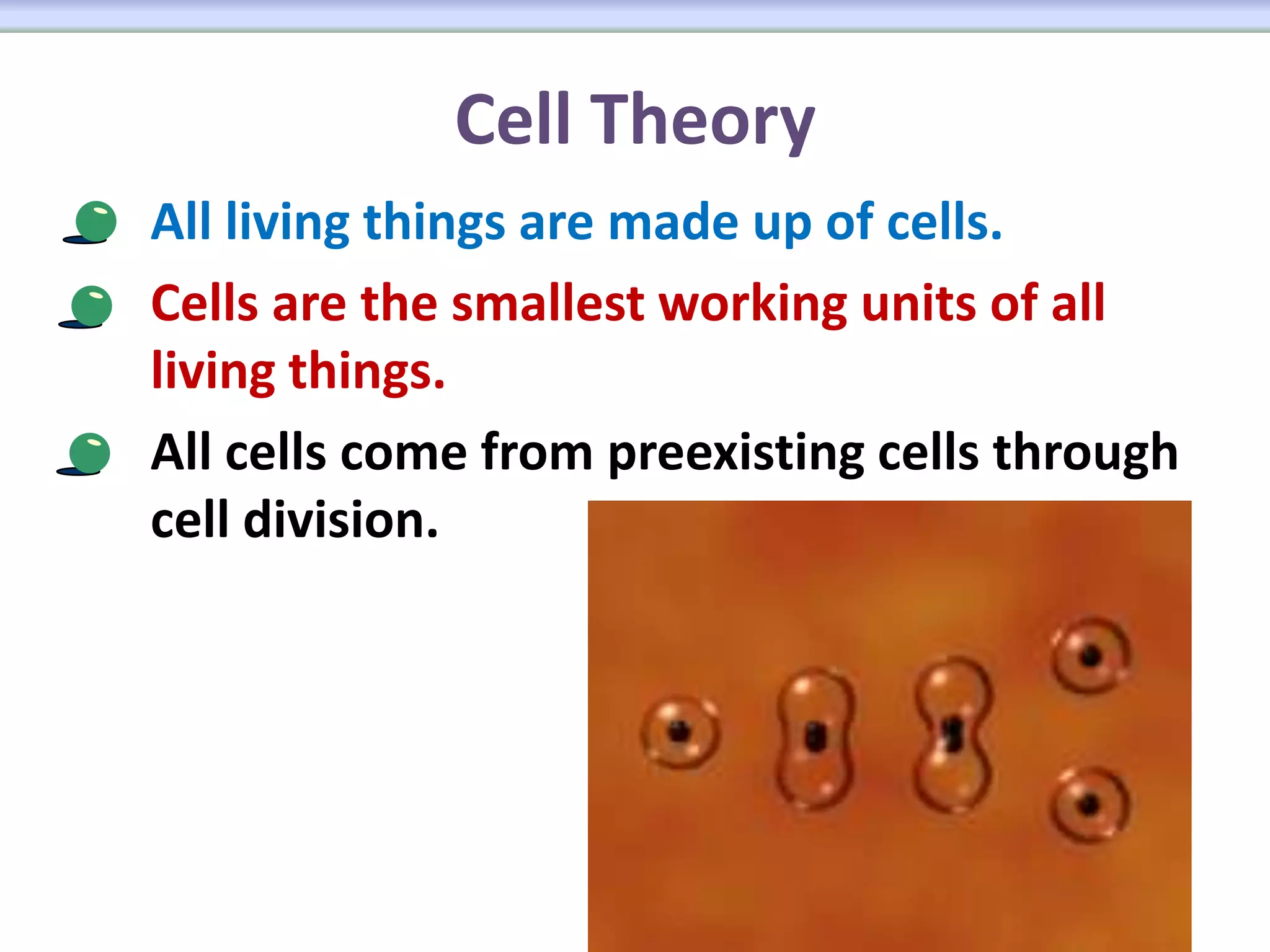
All cells come from preexisting cells through
cell division.
Definition of Cell

 A cell is the smallest
 unit that is capable
  of performing life
       functions.
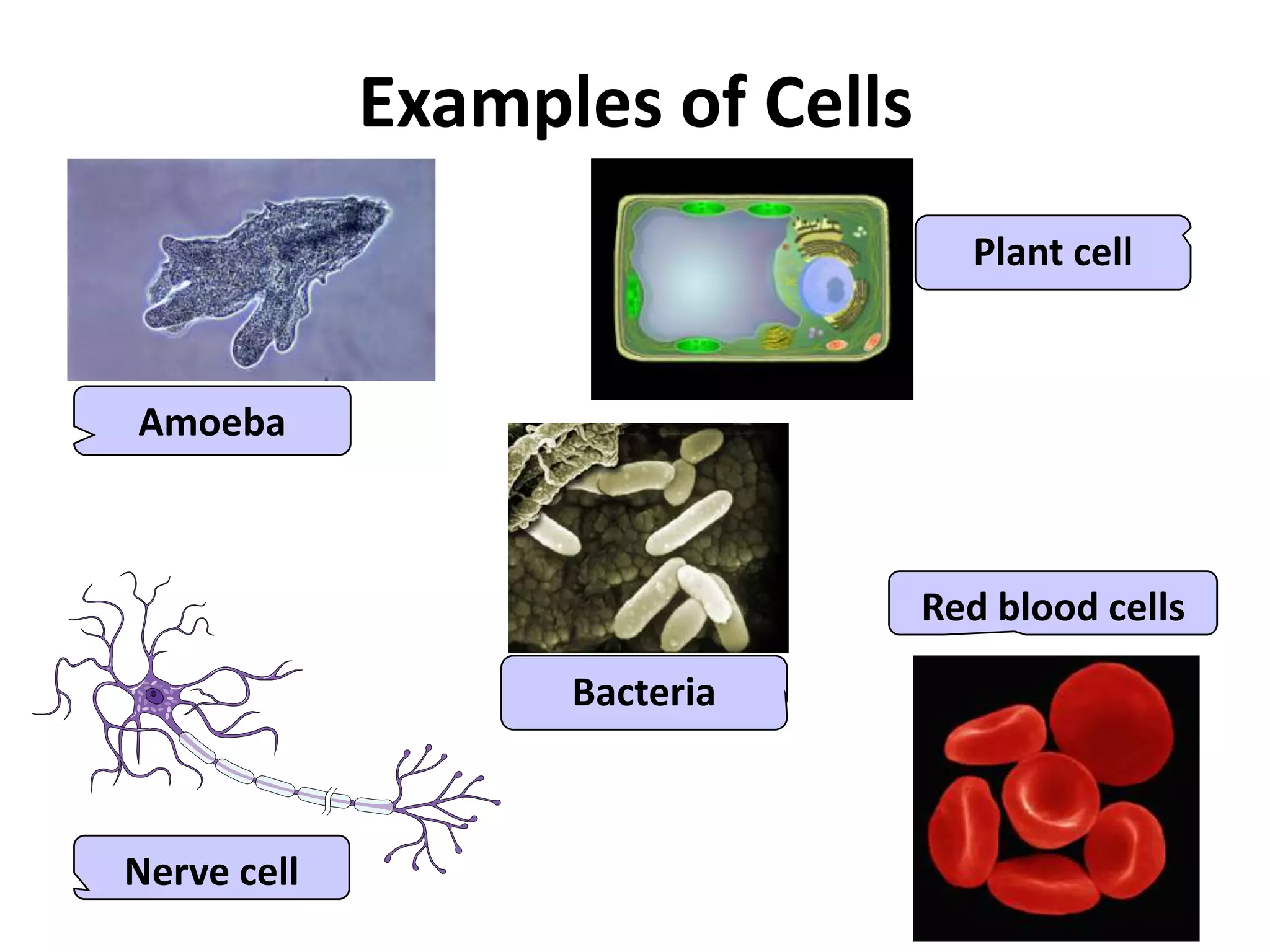
Examples of Cells
                                   Plant cell


Amoeba


                                 Red blood cells

                   Bacteria


Nerve cell
A typical animal cell
Animal cells are spherical
A typical plant cell
Plant cells are cylindrical
Which structures are common to both
               cells?
Cell membrane
 is a very thin, flexible layer round
  the cell
Functions of the cell membrane
1. keeps the cell contents
   together (like the sack)

2. controls what substances
   go in and out of the cell as
   it is semi-permeable
Cytoplasm
 is a thick liquid with particles in it

 contains ENZYMES which
  control the chemical changes
  taking place in the cell

 may contain food reserves e.g.
   starch grains
   oil droplets
Cell Parts:
Organelles
What are ‘organelles’?
 subunits in the cytoplasm that carry out a
  particular function such as the:
            nucleus
            mitochondria
Nucleus
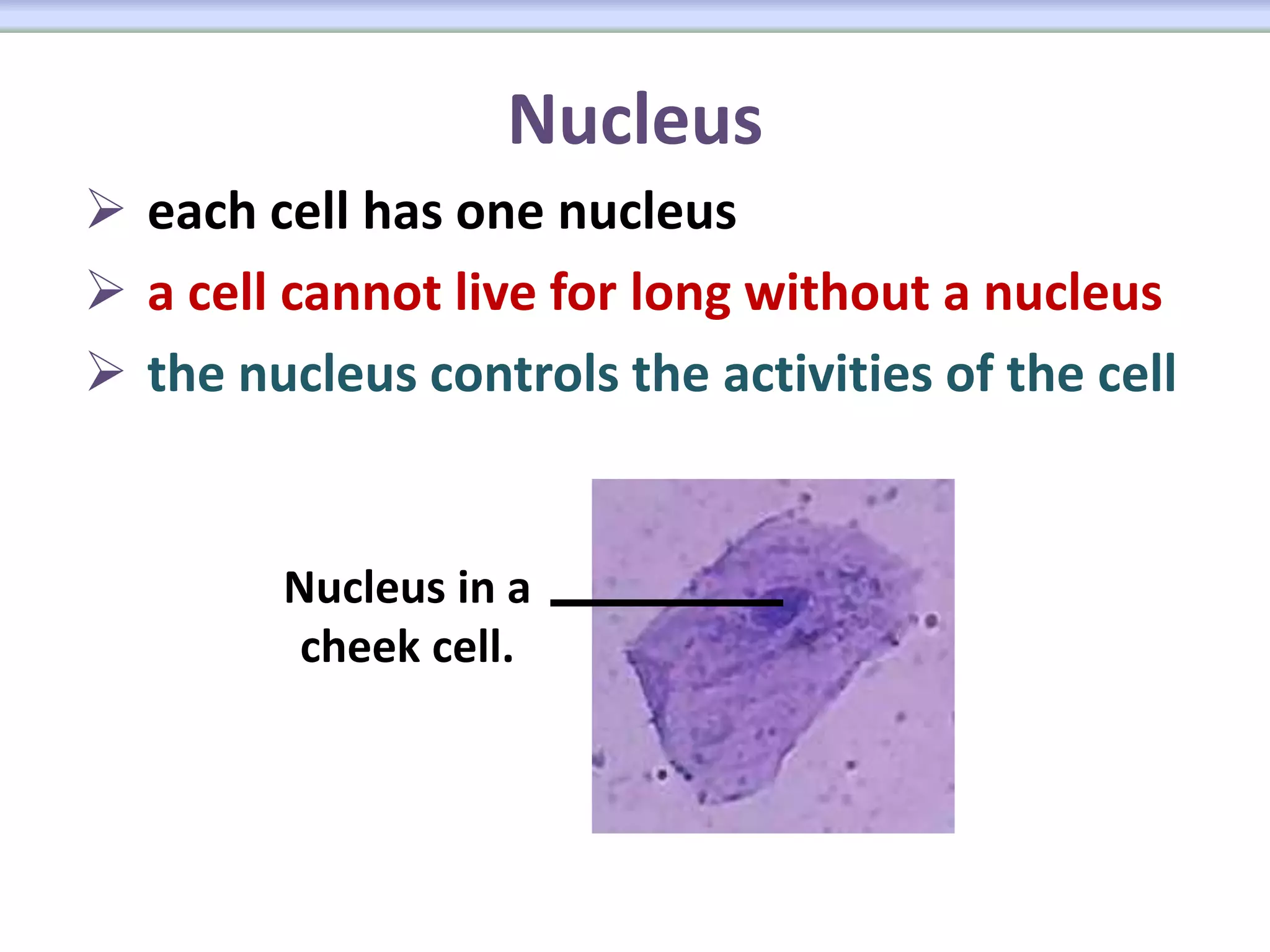
 each cell has one nucleus
 a cell cannot live for long without a nucleus
 the nucleus controls the activities of the cell


        Nucleus in a
         cheek cell.
The nucleus contains: thread-like
          structures called:
                           CELL
 chromosomes
  chromosomes          Chromosome
    contain DNA
    (deoxyribonucleic
    acid)

                              DNA
The nucleolus is a dark region in the
               nucelus
 Function of the nucleolus:
  certain chemicals are made e.g. RNA
    (ribonucleic acid) which then work in the
    cytoplasm
      nucleolus
Vacuoles
Animal cells:
 have small vacuoles that are temporary


   Amoeba engulfs
       food.                   Phagocyte engulfs
                                   bacteria.
Plant cells:
 have a large central,
  permanent vacuole full
  of SAP

SAP is a mixture of:
 sugars
 salts
 water
 pigments
Mitochondria
 are structures in which aerobic
  respiration occurs
 are called the
  ‘power houses’ of
  the cell as they
  release energy

 are usually
  sausage-shaped
Mitochondria
are seen only
    by an
  electron
 microscope
Explain why there are more mitochondria
    in muscle cells than in skin cells.

    More
mitochondria
 in muscle
cells as they
 use more
   energy.
Structures ONLY in plants
Cell wall
Chloroplasts
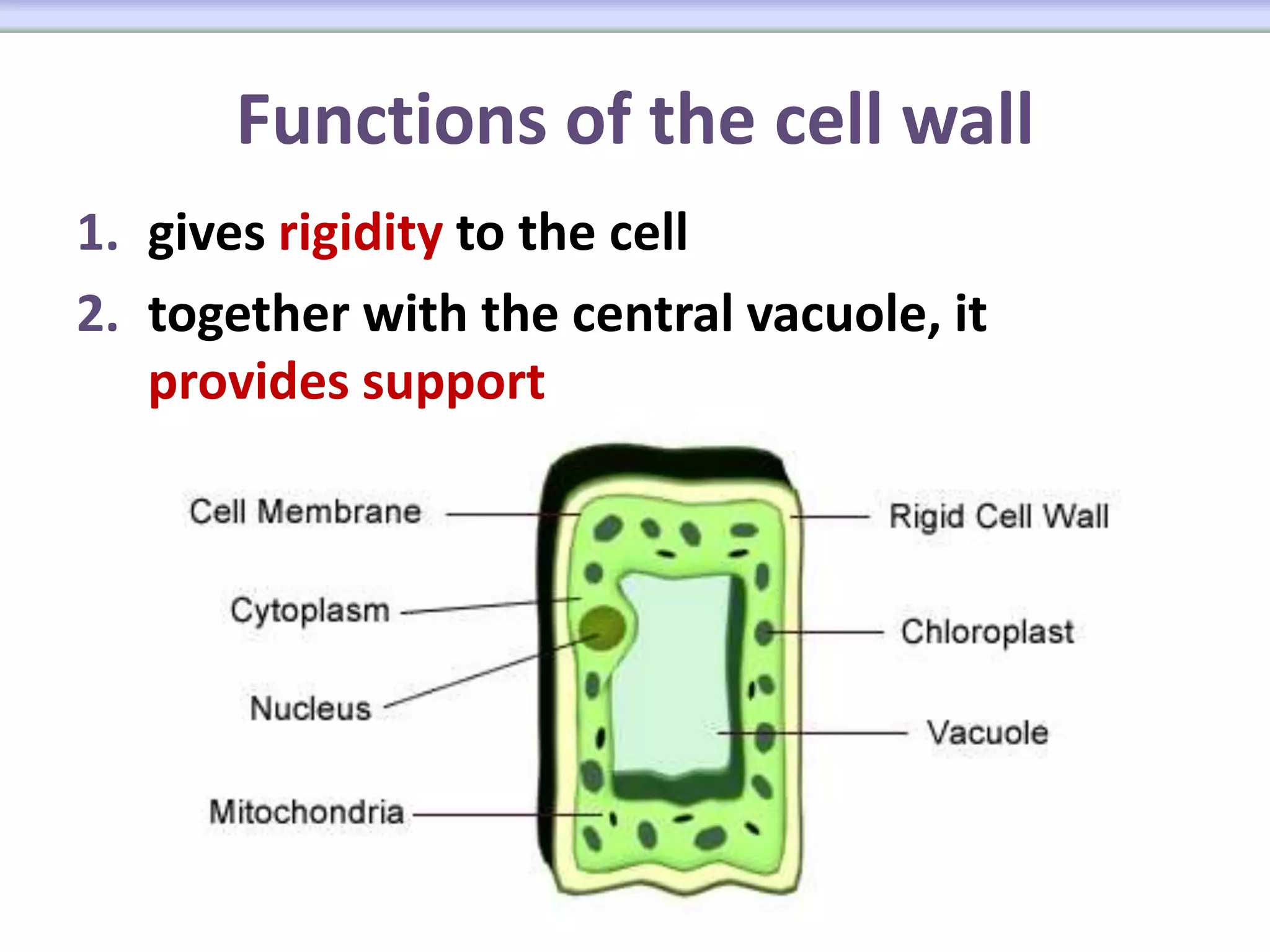
The cell wall is:
 a non-living structure surrounding the cell
  membrane

 made of cellulose

 fully permeable i.e.
  substances pass
  freely through it

                  cell membrane    cell wall
Functions of the cell wall
1. gives rigidity to the cell
2. together with the central vacuole, it
   provides support
Chloroplasts contain the green
pigment: CHLOROPHYLL
Function of chlorophyll
                 traps light for
                  photosynthesis


  chloroplast
QUESTION: SEP, 2011
Give a reason for each of the following
observations.
i) Large permanent vacuoles are present in
   plant cells. (2)

 Gives shape and rigidity to
       the plant cells.
QUESTION: SEP, 2011
Give a reason for each of the following
observations.
ii) Animal cells tend to have irregular shapes. (2)
    Cells are surrounded by a thin cell membrane
    which is not stiff.
QUESTION: SEP, 2011
Give a reason for each of the following
observations.
iii) Sperm cells are haploid. (2)

After fertilisation, the
  diploid number of
   chromosomes is
       restored.
CELL SPECIALISATION
 specialisation is the process by which cells
  change their shape to carry out a particular
  task

 specialisation happens in multicellular
  organisms
Examples of specialised animal cells:
 white blood cells
   change their shape
    to engulf bacteria

 nerve cell
   contains a long
    fibre to conduct
    impulses
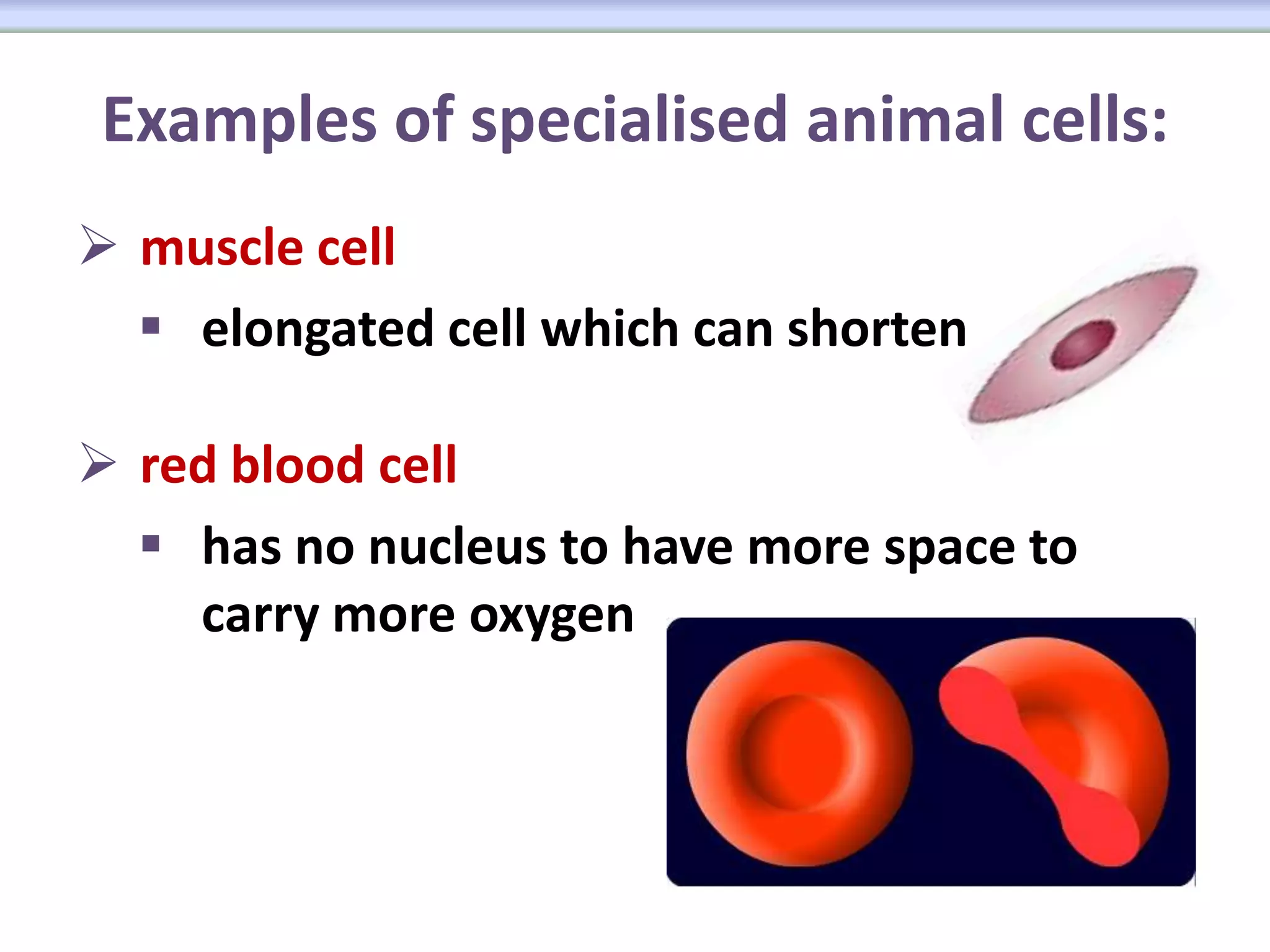
Examples of specialised animal cells:
 muscle cell
   elongated cell which can shorten

 red blood cell
   has no nucleus to have more space to
    carry more oxygen
Examples of specialised plant cells:
1. guard cells
 bean-shaped cells with a
   pore in between to
   allow gas exchange

2. palisade cells
 elongated cells with
   many chloroplasts to
   carry out
   photosynthesis
Examples of specialised plant cells:
3. epidermal cells
 transparent to
   let light pass
   through them
Tissues, Organs
       &
    Systems
Unicellular              Multicellular
 organism                  organism
one cell:                cells become
 carries out all the     differentiated
  vital functions         into tissues
 is capable to live
  on its own
Differentiated means
 cells become adapted during development
  to a specific function
Cells in a tissue
have the same structure
 and function

a tissue cannot live on its
 own
Examples of animal tissues
 muscle tissue           blood tissue


 nerve tissue
                   bone tissue
Examples of plant tissues
Photosynthetic tissue             Vascular tissue:
                                  xylem & phloem


            Epidermal tissue:
            Protects from water
            loss & pathogens
QUESTION: SEP, 2011
Blood is an animal tissue.
List TWO plant tissues and give the
function of each. (6)

Epidermal tissue:
Photosynthetic tissue:
Vascular tissue:
Question: MAY, 2010
Write the appropriate plant or animal tissue for each
of the following descriptions. (6)
                   Description                     Name of tissue
   Tissue used in the translocation of organic
   solutes.
   Tissue conducts nerve impulses.

   Tissue contracts to support and move the
   body.

   Tissue found in leaf containing numerous
   chloroplasts.
   Tissue acts as the living protective layer in
   leaf.

   Tissue carries substances round the body.
Question: MAY, 2010
Write the appropriate plant or animal tissue for each
of the following descriptions. (6)
                   Description                      Name of tissue
   Tissue used in the translocation of organic
   solutes.                                         Phloem
   Tissue conducts nerve impulses.
                                                    Nervous
   Tissue contracts to support and move the
   body.                                             Muscle
   Tissue found in leaf containing numerous
   chloroplasts.
                                                   Photosynthetic
   Tissue acts as the living protective layer in
   leaf.                                            Epidermis
   Tissue carries substances round the body.
                                                    Blood
Organism       Levels of cellular
                   organisation


System
             Organ
                     Tissue
                              Cell
Organs
  are made up of groups of tissues
Examples of
animal organs
   Heart
   Lungs
   Kidneys
   Brain
   Skin
   Ear
   Eye
   Uterus
Four plant
organs:      Flower

             Leaf
             Stem

              Root
Systems
 are made up of a group of organs


 e.g. heart + blood
  vessels make up the
  circulatory system
Examples of Systems
Skeletal
Circulatory
Immune
Respiratory
Digestive
Excretory
Reproductive
Nervous
Endocrine
Muscular
Question
To which systems of the body do the following
organs belong? Chose from the list:
  circulatory nervous reproductive breathing
  skeletal    excretory digestive

a) Gut: digestive       b) Bladder: excretory
c) Skull: skeletal      d) Heart: circulatory
e) Ears: nervous        f) Ovaries: reproductive
g) Lungs: breathing     h) Spinal cord: nervous
Organism
 results from many systems working
  together

    I am an
   organism.
Surface area
 to volume
    ratio
Why does an amoeba NOT require a
        circulatory system?
An amoeba has a LARGE surface area to
volume ratio. Materials can move within the
amoeba quickly enough due to its small
volume.
What happens to the SA:Vol ratio as
       the cube increases?
SA:Vol ratio limits cell size
Exchange of materials across surface can
 happen only in the (small / large cube).
SA:Vol ratio limits cell size
Exchange of materials across surface can
 happen only in the (small / large cube).
Large organisms need a:
1. respiratory system
   to take in O2 &
     remove CO2

1. circulatory system
   to transport
     materials to all cells
     in the body
T HE END

Cells

  • 2.
    Robert Hooke [1665] examined thin sections of a bottle cork under a crude microscope  found hexagonal boxes or chambers packed together like a honeycomb
  • 3.
     Robert Hookeused the word 'cells' to describe these structures
  • 4.
    Cell Theory All livingthings are made up of cells. Cells are the smallest working units of all living things. All cells come from preexisting cells through cell division.
  • 5.
    Definition of Cell A cell is the smallest unit that is capable of performing life functions.
  • 6.
    Examples of Cells Plant cell Amoeba Red blood cells Bacteria Nerve cell
  • 7.
  • 8.
  • 9.
  • 10.
    Plant cells arecylindrical
  • 11.
    Which structures arecommon to both cells?
  • 12.
    Cell membrane  isa very thin, flexible layer round the cell
  • 13.
    Functions of thecell membrane 1. keeps the cell contents together (like the sack) 2. controls what substances go in and out of the cell as it is semi-permeable
  • 14.
    Cytoplasm  is athick liquid with particles in it  contains ENZYMES which control the chemical changes taking place in the cell  may contain food reserves e.g.  starch grains  oil droplets
  • 15.
  • 16.
    What are ‘organelles’? subunits in the cytoplasm that carry out a particular function such as the:  nucleus  mitochondria
  • 17.
    Nucleus  each cellhas one nucleus  a cell cannot live for long without a nucleus  the nucleus controls the activities of the cell Nucleus in a cheek cell.
  • 18.
    The nucleus contains:thread-like structures called: CELL  chromosomes  chromosomes Chromosome contain DNA (deoxyribonucleic acid) DNA
  • 19.
    The nucleolus isa dark region in the nucelus  Function of the nucleolus:  certain chemicals are made e.g. RNA (ribonucleic acid) which then work in the cytoplasm nucleolus
  • 20.
    Vacuoles Animal cells:  havesmall vacuoles that are temporary Amoeba engulfs food. Phagocyte engulfs bacteria.
  • 21.
    Plant cells:  havea large central, permanent vacuole full of SAP SAP is a mixture of:  sugars  salts  water  pigments
  • 22.
    Mitochondria  are structuresin which aerobic respiration occurs  are called the ‘power houses’ of the cell as they release energy  are usually sausage-shaped
  • 23.
    Mitochondria are seen only by an electron microscope
  • 24.
    Explain why thereare more mitochondria in muscle cells than in skin cells. More mitochondria in muscle cells as they use more energy.
  • 25.
    Structures ONLY inplants Cell wall Chloroplasts
  • 26.
    The cell wallis:  a non-living structure surrounding the cell membrane  made of cellulose  fully permeable i.e. substances pass freely through it cell membrane cell wall
  • 27.
    Functions of thecell wall 1. gives rigidity to the cell 2. together with the central vacuole, it provides support
  • 28.
    Chloroplasts contain thegreen pigment: CHLOROPHYLL
  • 29.
    Function of chlorophyll  traps light for photosynthesis chloroplast
  • 30.
    QUESTION: SEP, 2011 Givea reason for each of the following observations. i) Large permanent vacuoles are present in plant cells. (2) Gives shape and rigidity to the plant cells.
  • 31.
    QUESTION: SEP, 2011 Givea reason for each of the following observations. ii) Animal cells tend to have irregular shapes. (2) Cells are surrounded by a thin cell membrane which is not stiff.
  • 32.
    QUESTION: SEP, 2011 Givea reason for each of the following observations. iii) Sperm cells are haploid. (2) After fertilisation, the diploid number of chromosomes is restored.
  • 33.
    CELL SPECIALISATION  specialisationis the process by which cells change their shape to carry out a particular task  specialisation happens in multicellular organisms
  • 34.
    Examples of specialisedanimal cells:  white blood cells  change their shape to engulf bacteria  nerve cell  contains a long fibre to conduct impulses
  • 35.
    Examples of specialisedanimal cells:  muscle cell  elongated cell which can shorten  red blood cell  has no nucleus to have more space to carry more oxygen
  • 36.
    Examples of specialisedplant cells: 1. guard cells  bean-shaped cells with a pore in between to allow gas exchange 2. palisade cells  elongated cells with many chloroplasts to carry out photosynthesis
  • 37.
    Examples of specialisedplant cells: 3. epidermal cells  transparent to let light pass through them
  • 38.
  • 39.
    Unicellular Multicellular organism organism one cell:  cells become  carries out all the differentiated vital functions into tissues  is capable to live on its own
  • 40.
    Differentiated means  cellsbecome adapted during development to a specific function
  • 41.
    Cells in atissue have the same structure and function a tissue cannot live on its own
  • 42.
    Examples of animaltissues  muscle tissue  blood tissue  nerve tissue  bone tissue
  • 43.
    Examples of planttissues Photosynthetic tissue Vascular tissue: xylem & phloem Epidermal tissue: Protects from water loss & pathogens
  • 44.
    QUESTION: SEP, 2011 Bloodis an animal tissue. List TWO plant tissues and give the function of each. (6) Epidermal tissue: Photosynthetic tissue: Vascular tissue:
  • 45.
    Question: MAY, 2010 Writethe appropriate plant or animal tissue for each of the following descriptions. (6) Description Name of tissue Tissue used in the translocation of organic solutes. Tissue conducts nerve impulses. Tissue contracts to support and move the body. Tissue found in leaf containing numerous chloroplasts. Tissue acts as the living protective layer in leaf. Tissue carries substances round the body.
  • 46.
    Question: MAY, 2010 Writethe appropriate plant or animal tissue for each of the following descriptions. (6) Description Name of tissue Tissue used in the translocation of organic solutes. Phloem Tissue conducts nerve impulses. Nervous Tissue contracts to support and move the body. Muscle Tissue found in leaf containing numerous chloroplasts. Photosynthetic Tissue acts as the living protective layer in leaf. Epidermis Tissue carries substances round the body. Blood
  • 47.
    Organism Levels of cellular organisation System Organ Tissue Cell
  • 48.
    Organs  aremade up of groups of tissues
  • 49.
    Examples of animal organs Heart Lungs Kidneys Brain Skin Ear Eye Uterus
  • 50.
    Four plant organs: Flower Leaf Stem Root
  • 51.
    Systems  are madeup of a group of organs  e.g. heart + blood vessels make up the circulatory system
  • 52.
  • 53.
    Question To which systemsof the body do the following organs belong? Chose from the list: circulatory nervous reproductive breathing skeletal excretory digestive a) Gut: digestive b) Bladder: excretory c) Skull: skeletal d) Heart: circulatory e) Ears: nervous f) Ovaries: reproductive g) Lungs: breathing h) Spinal cord: nervous
  • 54.
    Organism  results frommany systems working together I am an organism.
  • 55.
    Surface area tovolume ratio
  • 56.
    Why does anamoeba NOT require a circulatory system? An amoeba has a LARGE surface area to volume ratio. Materials can move within the amoeba quickly enough due to its small volume.
  • 57.
    What happens tothe SA:Vol ratio as the cube increases?
  • 58.
    SA:Vol ratio limitscell size Exchange of materials across surface can happen only in the (small / large cube).
  • 59.
    SA:Vol ratio limitscell size Exchange of materials across surface can happen only in the (small / large cube).
  • 60.
    Large organisms needa: 1. respiratory system  to take in O2 & remove CO2 1. circulatory system  to transport materials to all cells in the body
  • 61.