Unit B: Cells & Systems
Microscopes
The First Microscope
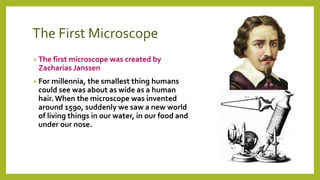
• The first microscope was created by
Zacharias Janssen
• For millennia, the smallest thing humans
could see was about as wide as a human
hair. When the microscope was invented
around 1590, suddenly we saw a new world
of living things in our water, in our food and
under our nose.
The Compound Light Microscope
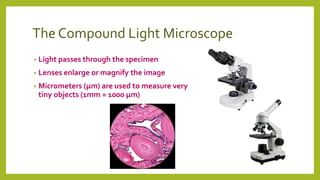
• Light passes through the specimen
• Lenses enlarge or magnify the image
• Micrometers (μm) are used to measure very
tiny objects (1mm = 1000 μm)
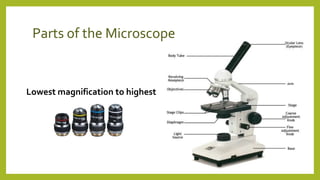
Parts of the Microscope
Lowest magnification to highest
How to use a Microscope
Estimating Measurements
• Being able to estimate the size of an
object viewed under a microscope is
an important skill. It’s important to
understand Field ofView
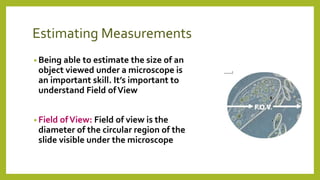
• Field ofView: Field of view is the
diameter of the circular region of the
slide visible under the microscope
Estimating Measurements
• What will happen to the Field ofView
as we increase the magnification?
Why?
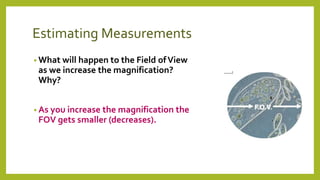
• As you increase the magnification the
FOV gets smaller (decreases).
Estimating Measurements
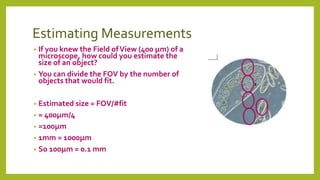
• If you knew the Field ofView (400 μm) of a
microscope, how could you estimate the
size of an object?
• You can divide the FOV by the number of
objects that would fit.
• Estimated size = FOV/#fit
• = 400μm/4
• =100μm
• 1mm = 1000μm
• So 100μm = 0.1 mm
Characteristics of
LivingThings
Characteristics of LivingThings
Biotic: Living
Abiotic: Non-Living
What is a living thing? On the surface this may seem like a simple
question, but it has been the topic of debate among scientists for
many, many years. As such, there is no single definition of what it
means for something to be alive.What is agreed upon is that all living
things carry out certain life processes.
To be classified as living, a specimen must carry out all of the following
processes. Some nonliving things may have some of these
characteristics, but only living things will exhibit all of them.
Characteristics of LivingThings
• ALL living things have 6 characteristics:
1. are made of cells
2. need energy
3. grow and develop
4. respond to the environment
5. reproduce
6. have adaptations for their environment
Characteristics of LivingThings
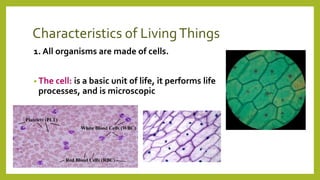
1. All organisms are made of cells.
• The cell: is a basic unit of life, it performs life
processes, and is microscopic
Characteristics of LivingThings
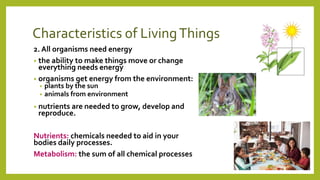
2. All organisms need energy
• the ability to make things move or change
everything needs energy
• organisms get energy from the environment:
• plants by the sun
• animals from environment
• nutrients are needed to grow, develop and
reproduce.
Nutrients: chemicals needed to aid in your
bodies daily processes.
Metabolism: the sum of all chemical processes
Characteristics of LivingThings
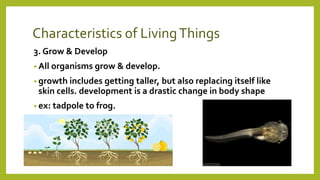
3. Grow & Develop
• All organisms grow & develop.
• growth includes getting taller, but also replacing itself like
skin cells. development is a drastic change in body shape
• ex: tadpole to frog.
Characteristics of LivingThings
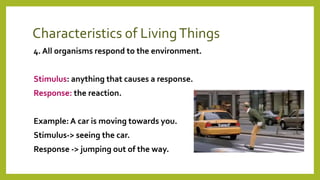
4. All organisms respond to the environment.
Stimulus: anything that causes a response.
Response: the reaction.
Example: A car is moving towards you.
Stimulus-> seeing the car.
Response -> jumping out of the way.
Characteristics of LivingThings
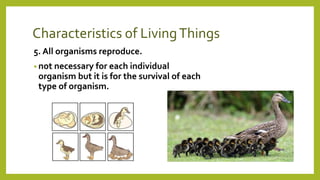
5. All organisms reproduce.
• not necessary for each individual
organism but it is for the survival of each
type of organism.
Characteristics of LivingThings
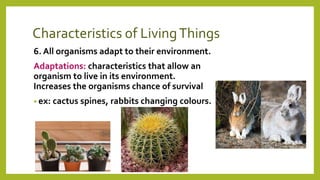
6. All organisms adapt to their environment.
Adaptations: characteristics that allow an
organism to live in its environment.
Increases the organisms chance of survival
• ex: cactus spines, rabbits changing colours.
Structures & Functions
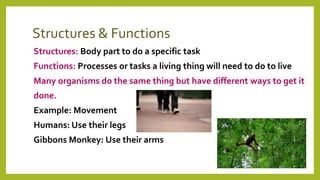
Structures: Body part to do a specific task
Functions: Processes or tasks a living thing will need to do to live
Many organisms do the same thing but have different ways to get it
done.
Example: Movement
Humans: Use their legs
Gibbons Monkey: Use their arms
Structures & Functions
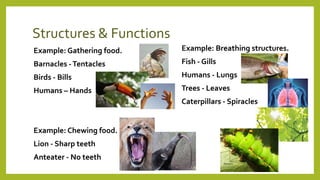
Example: Gathering food.
Barnacles -Tentacles
Birds - Bills
Humans – Hands
Example: Chewing food.
Lion - Sharp teeth
Anteater - No teeth
Example: Breathing structures.
Fish - Gills
Humans - Lungs
Trees - Leaves
Caterpillars - Spiracles
Structures & Functions
A list of a few functions living things do:
• Movement
• Food gathering
• Breathing
• Digest food
• Eat food
• Reproduction
• Waste
excretion
• See
• Communicate
Structures & Functions
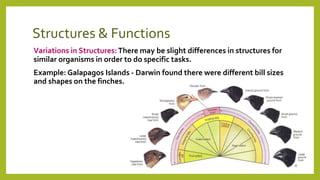
Variations in Structures:There may be slight differences in structures for
similar organisms in order to do specific tasks.
Example: Galapagos Islands - Darwin found there were different bill sizes
and shapes on the finches.
Organs & Organ Systems
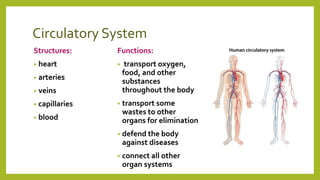
Circulatory System
Structures:
• heart
• arteries
• veins
• capillaries
• blood
Functions:
• transport oxygen,
food, and other
substances
throughout the body
• transport some
wastes to other
organs for elimination
• defend the body
against diseases
• connect all other
organ systems
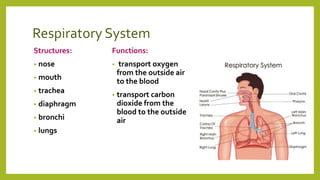
Respiratory System
Structures:
• nose
• mouth
• trachea
• diaphragm
• bronchi
• lungs
Functions:
• transport oxygen
from the outside air
to the blood
• transport carbon
dioxide from the
blood to the outside
air
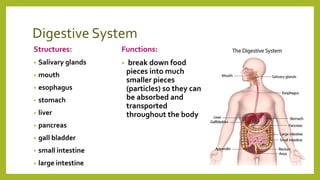
Digestive System
Structures:
• Salivary glands
• mouth
• esophagus
• stomach
• liver
• pancreas
• gall bladder
• small intestine
• large intestine
Functions:
• break down food
pieces into much
smaller pieces
(particles) so they can
be absorbed and
transported
throughout the body
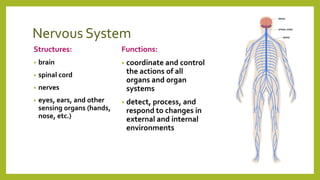
Nervous System
Structures:
• brain
• spinal cord
• nerves
• eyes, ears, and other
sensing organs (hands,
nose, etc.)
Functions:
• coordinate and control
the actions of all
organs and organ
systems
• detect, process, and
respond to changes in
external and internal
environments
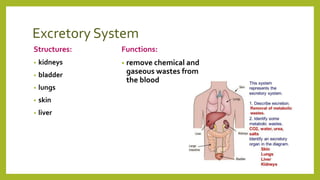
Excretory System
Structures:
• kidneys
• bladder
• lungs
• skin
• liver
Functions:
• remove chemical and
gaseous wastes from
the blood
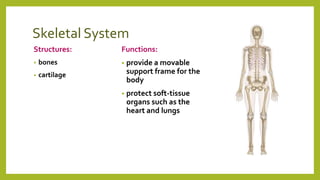
Skeletal System
Structures:
• bones
• cartilage
Functions:
• provide a movable
support frame for the
body
• protect soft-tissue
organs such as the
heart and lungs
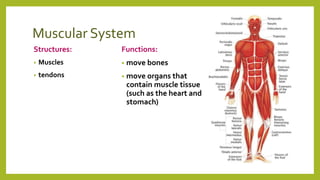
Muscular System
Structures:
• Muscles
• tendons
Functions:
• move bones
• move organs that
contain muscle tissue
(such as the heart and
stomach)
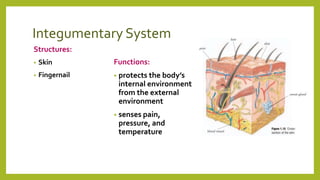
Integumentary System
Structures:
• Skin
• Fingernail
Functions:
• protects the body’s
internal environment
from the external
environment
• senses pain,
pressure, and
temperature
The Cell
Cells
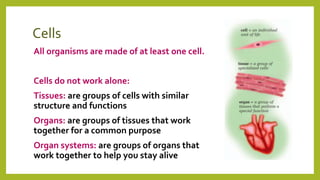
All organisms are made of at least one cell.
Cells do not work alone:
Tissues: are groups of cells with similar
structure and functions
Organs: are groups of tissues that work
together for a common purpose
Organ systems: are groups of organs that
work together to help you stay alive
Cells
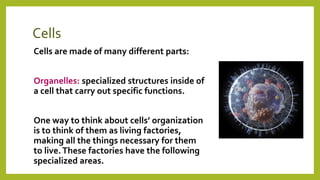
Cells are made of many different parts:
Organelles: specialized structures inside of
a cell that carry out specific functions.
One way to think about cells’ organization
is to think of them as living factories,
making all the things necessary for them
to live.These factories have the following
specialized areas.
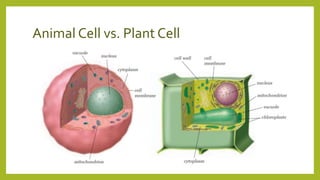
Animal Cell vs. Plant Cell
Organelles
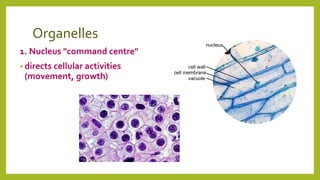
1. Nucleus "command centre"
• directs cellular activities
(movement, growth)
Organelles
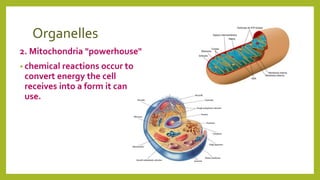
2. Mitochondria "powerhouse"
• chemical reactions occur to
convert energy the cell
receives into a form it can
use.
Organelles
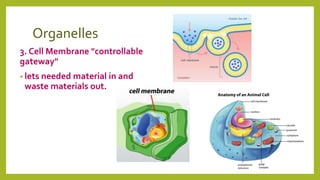
3. Cell Membrane "controllable
gateway"
• lets needed material in and
waste materials out.
Organelles
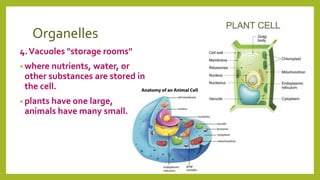
4.Vacuoles "storage rooms"
• where nutrients, water, or
other substances are stored in
the cell.
• plants have one large,
animals have many small.
Organelles
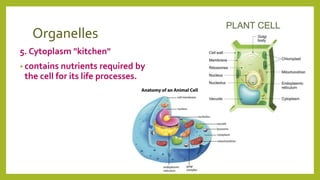
5. Cytoplasm "kitchen"
• contains nutrients required by
the cell for its life processes.
Organelles
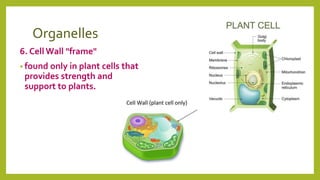
6. Cell Wall "frame"
• found only in plant cells that
provides strength and
support to plants.
Organelles
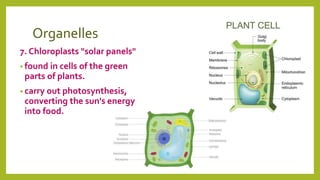
7. Chloroplasts "solar panels"
• found in cells of the green
parts of plants.
• carry out photosynthesis,
converting the sun's energy
into food.
Organelles
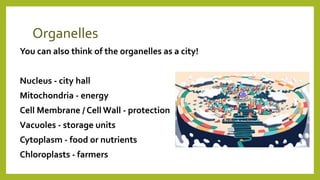
You can also think of the organelles as a city!
Nucleus - city hall
Mitochondria - energy
Cell Membrane / Cell Wall - protection
Vacuoles - storage units
Cytoplasm - food or nutrients
Chloroplasts - farmers
Unicellular vs. Multicellular
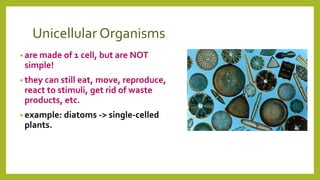
Unicellular Organisms
• are made of 1 cell, but are NOT
simple!
• they can still eat, move, reproduce,
react to stimuli, get rid of waste
products, etc.
• example: diatoms -> single-celled
plants.
Multicellular Organisms
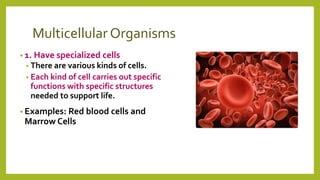
• 1. Have specialized cells
• There are various kinds of cells.
• Each kind of cell carries out specific
functions with specific structures
needed to support life.
• Examples: Red blood cells and
Marrow Cells
Multicellular Organisms
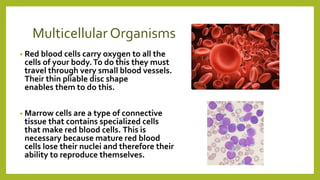
• Red blood cells carry oxygen to all the
cells of your body.To do this they must
travel through very small blood vessels.
Their thin pliable disc shape
enables them to do this.
• Marrow cells are a type of connective
tissue that contains specialized cells
that make red blood cells. This is
necessary because mature red blood
cells lose their nuclei and therefore their
ability to reproduce themselves.
Multicellular Organisms
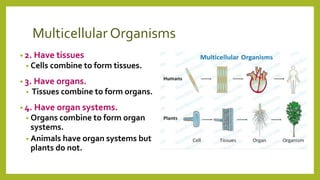
• 2. Have tissues
• Cells combine to form tissues.
• 3. Have organs.
• Tissues combine to form organs.
• 4. Have organ systems.
• Organs combine to form organ
systems.
• Animals have organ systems but
plants do not.
Amoeba
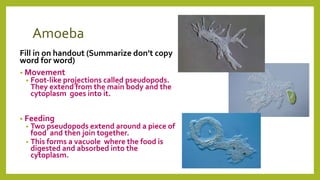
Fill in on handout (Summarize don’t copy
word for word)
• Movement
• Foot-like projections called pseudopods.
They extend from the main body and the
cytoplasm goes into it.
• Feeding
• Two pseudopods extend around a piece of
food and then join together.
• This forms a vacuole where the food is
digested and absorbed into the
cytoplasm.
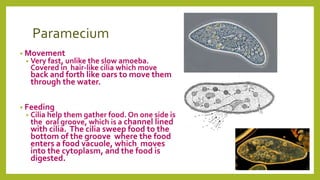
Paramecium
• Movement
• Very fast, unlike the slow amoeba.
Covered in hair-like cilia which move
back and forth like oars to move them
through the water.
• Feeding
• Cilia help them gather food. On one side is
the oral groove, which is a channel lined
with cilia. The cilia sweep food to the
bottom of the groove where the food
enters a food vacuole, which moves
into the cytoplasm, and the food is
digested.
Videos
CellTransport
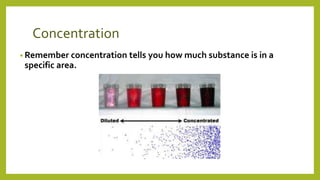
Concentration
• Remember concentration tells you how much substance is in a
specific area.
Diffusion
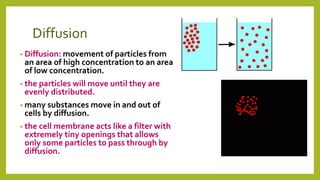
• Diffusion: movement of particles from
an area of high concentration to an area
of low concentration.
• the particles will move until they are
evenly distributed.
• many substances move in and out of
cells by diffusion.
• the cell membrane acts like a filter with
extremely tiny openings that allows
only some particles to pass through by
diffusion.
Permeable vs Impermeable
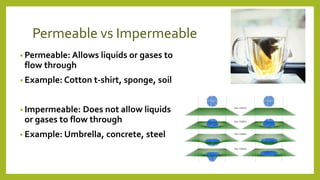
• Permeable: Allows liquids or gases to
flow through
• Example: Cotton t-shirt, sponge, soil
• Impermeable: Does not allow liquids
or gases to flow through
• Example: Umbrella, concrete, steel
Semi-Permeable
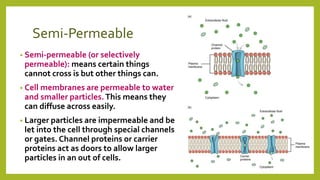
• Semi-permeable (or selectively
permeable): means certain things
cannot cross is but other things can.
• Cell membranes are permeable to water
and smaller particles.This means they
can diffuse across easily.
• Larger particles are impermeable and be
let into the cell through special channels
or gates. Channel proteins or carrier
proteins act as doors to allow larger
particles in an out of cells.
Osmosis
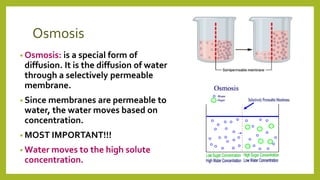
• Osmosis: is a special form of
diffusion. It is the diffusion of water
through a selectively permeable
membrane.
• Since membranes are permeable to
water, the water moves based on
concentration.
• MOST IMPORTANT!!!
• Water moves to the high solute
concentration.
Osmosis
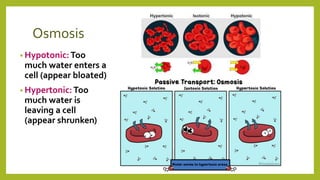
• Hypotonic:Too
much water enters a
cell (appear bloated)
• Hypertonic:Too
much water is
leaving a cell
(appear shrunken)
Specialized Cells &Tissues
Specialized Cells
• Unicellular organisms are tiny because there are limits to how
large they can grow. One of the reasons involves diffusion and
osmosis.These vital processes work well only over very short
distances.
• For example, it takes an oxygen particle a fraction of a second to
diffuse over a distance of 10 m (0.01 mm).To diffuse over a
distance of 1 mm takes several minutes!
Specialized Cells
• Like all organisms, unicellular organisms grow and develop.
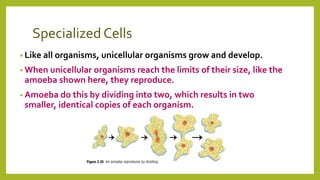
• When unicellular organisms reach the limits of their size, like the
amoeba shown here, they reproduce.
• Amoeba do this by dividing into two, which results in two
smaller, identical copies of each organism.
Specialized Cells
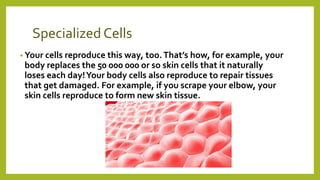
• Your cells reproduce this way, too.That’s how, for example, your
body replaces the 50 000 000 or so skin cells that it naturally
loses each day!Your body cells also reproduce to repair tissues
that get damaged. For example, if you scrape your elbow, your
skin cells reproduce to form new skin tissue.
Specialized Cells
• Specialized Cells: carry out a specific function or functions
needed to support life
• Cells combine to form tissues.
• In humans and other animals, there are four different tissue
types:
• Connective
• Epithelial
• Nervous
• Muscle
ConnectiveTissue
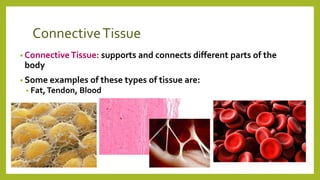
• Connective Tissue: supports and connects different parts of the
body
• Some examples of these types of tissue are:
• Fat,Tendon, Blood
EpithelialTissue
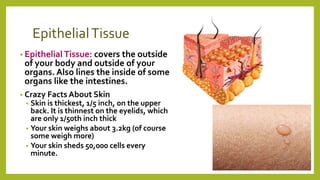
• Epithelial Tissue: covers the outside
of your body and outside of your
organs. Also lines the inside of some
organs like the intestines.
• Crazy Facts About Skin
• Skin is thickest, 1/5 inch, on the upper
back. It is thinnest on the eyelids, which
are only 1/50th inch thick
• Your skin weighs about 3.2kg (of course
some weigh more)
• Your skin sheds 50,000 cells every
minute.
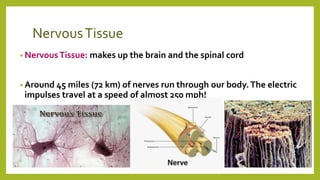
NervousTissue
• NervousTissue: makes up the brain and the spinal cord
• Around 45 miles (72 km) of nerves run through our body.The electric
impulses travel at a speed of almost 250 mph!
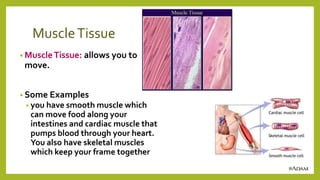
MuscleTissue
• MuscleTissue: allows you to
move.
• Some Examples
• you have smooth muscle which
can move food along your
intestines and cardiac muscle that
pumps blood through your heart.
You also have skeletal muscles
which keep your frame together
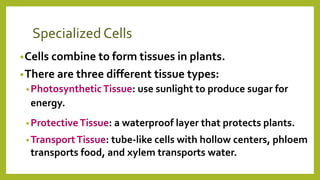
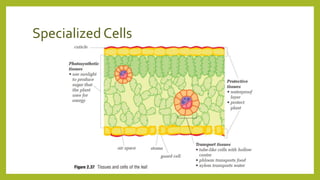
Specialized Cells
•Cells combine to form tissues in plants.
•There are three different tissue types:
•PhotosyntheticTissue: use sunlight to produce sugar for
energy.
•ProtectiveTissue: a waterproof layer that protects plants.
•TransportTissue: tube-like cells with hollow centers, phloem
transports food, and xylem transports water.
Specialized Cells
Digestive System
Digestive System
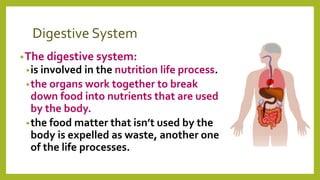
•The digestive system:
•is involved in the nutrition life process.
•the organs work together to break
down food into nutrients that are used
by the body.
•the food matter that isn’t used by the
body is expelled as waste, another one
of the life processes.
Digestive System
Main Parts of the Digestive System
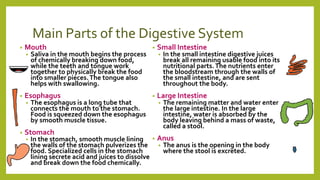
• Mouth
• Saliva in the mouth begins the process
of chemically breaking down food,
while the teeth and tongue work
together to physically break the food
into smaller pieces.The tongue also
helps with swallowing.
• Esophagus
• The esophagus is a long tube that
connects the mouth to the stomach.
Food is squeezed down the esophagus
by smooth muscle tissue.
• Stomach
• In the stomach, smooth muscle lining
the walls of the stomach pulverizes the
food. Specialized cells in the stomach
lining secrete acid and juices to dissolve
and break down the food chemically.
• Small Intestine
• In the small intestine digestive juices
break all remaining usable food into its
nutritional parts.The nutrients enter
the bloodstream through the walls of
the small intestine, and are sent
throughout the body.
• Large Intestine
• The remaining matter and water enter
the large intestine. In the large
intestine, water is absorbed by the
body leaving behind a mass of waste,
called a stool.
• Anus
• The anus is the opening in the body
where the stool is excreted.
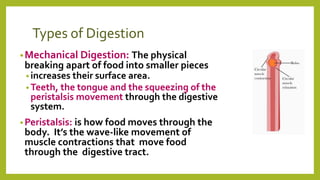
Types of Digestion
•Mechanical Digestion: The physical
breaking apart of food into smaller pieces
• increases their surface area.
• Teeth, the tongue and the squeezing of the
peristalsis movement through the digestive
system.
•Peristalsis: is how food moves through the
body. It’s the wave-like movement of
muscle contractions that move food
through the digestive tract.
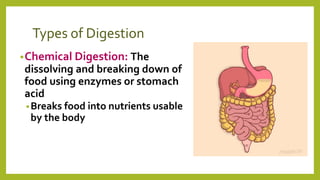
Types of Digestion
•Chemical Digestion: The
dissolving and breaking down of
food using enzymes or stomach
acid
•Breaks food into nutrients usable
by the body
More Parts of Digestive System
• All 3 of these parts secrete digestive enzymes into the first section of the
small intestine to help digest the fats that were not dissolved or digested in
the stomach.They also have other jobs...
• Pancreas
• The pancreas makes Insulin and glucagon which help control sugar levels in the
blood also come from the pancreas.
• Liver
• The liver has MANY functions that include processing harmful substances,
storing useful nutrients and makes proteins that help clot the blood.
• Gall Bladder
• The gallbladder takes acidic bile from the liver and stores it until needed for
digestion.That liquid helps digest fat.
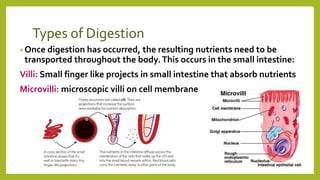
Types of Digestion
• Once digestion has occurred, the resulting nutrients need to be
transported throughout the body.This occurs in the small intestine:
Villi: Small finger like projects in small intestine that absorb nutrients
Microvilli: microscopic villi on cell membrane
Respiratory System
Respiratory System
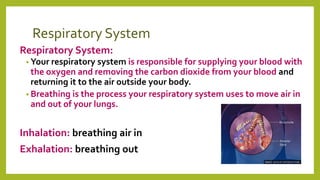
Respiratory System:
• Your respiratory system is responsible for supplying your blood with
the oxygen and removing the carbon dioxide from your blood and
returning it to the air outside your body.
• Breathing is the process your respiratory system uses to move air in
and out of your lungs.
Inhalation: breathing air in
Exhalation: breathing out
Respiratory System
Main Parts of the Respiratory System
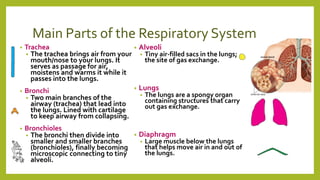
• Trachea
• The trachea brings air from your
mouth/nose to your lungs. It
serves as passage for air,
moistens and warms it while it
passes into the lungs.
• Bronchi
• Two main branches of the
airway (trachea) that lead into
the lungs. Lined with cartilage
to keep airway from collapsing.
• Bronchioles
• The bronchi then divide into
smaller and smaller branches
(bronchioles), finally becoming
microscopic connecting to tiny
alveoli.
• Alveoli
• Tiny air-filled sacs in the lungs;
the site of gas exchange.
• Lungs
• The lungs are a spongy organ
containing structures that carry
out gas exchange.
• Diaphragm
• Large muscle below the lungs
that helps move air in and out of
the lungs.
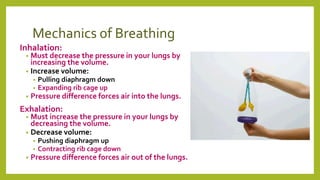
Mechanics of Breathing
Inhalation:
• Must decrease the pressure in your lungs by
increasing the volume.
• Increase volume:
• Pulling diaphragm down
• Expanding rib cage up
• Pressure difference forces air into the lungs.
Exhalation:
• Must increase the pressure in your lungs by
decreasing the volume.
• Decrease volume:
• Pushing diaphragm up
• Contracting rib cage down
• Pressure difference forces air out of the lungs.
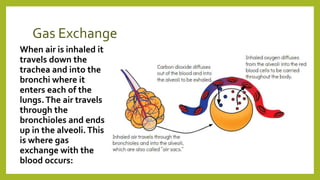
Gas Exchange
When air is inhaled it
travels down the
trachea and into the
bronchi where it
enters each of the
lungs.The air travels
through the
bronchioles and ends
up in the alveoli. This
is where gas
exchange with the
blood occurs:
Circulatory System
Circulatory System
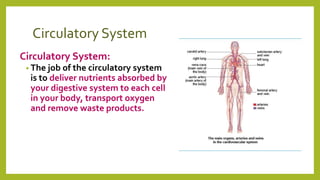
Circulatory System:
• The job of the circulatory system
is to deliver nutrients absorbed by
your digestive system to each cell
in your body, transport oxygen
and remove waste products.
Circulatory System
Circulatory System
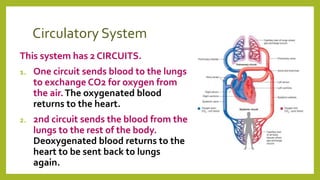
This system has 2 CIRCUITS.
1. One circuit sends blood to the lungs
to exchange CO2 for oxygen from
the air.The oxygenated blood
returns to the heart.
2. 2nd circuit sends the blood from the
lungs to the rest of the body.
Deoxygenated blood returns to the
heart to be sent back to lungs
again.
BloodVessels
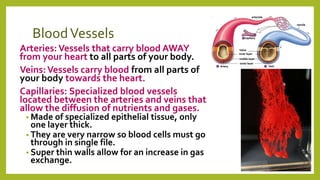
Arteries:Vessels that carry blood AWAY
from your heart to all parts of your body.
Veins:Vessels carry blood from all parts of
your body towards the heart.
Capillaries: Specialized blood vessels
located between the arteries and veins that
allow the diffusion of nutrients and gases.
• Made of specialized epithelial tissue, only
one layer thick.
• They are very narrow so blood cells must go
through in single file.
• Super thin walls allow for an increase in gas
exchange.
Blood
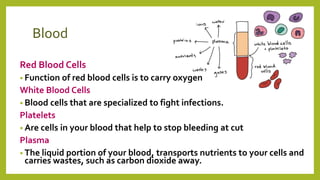
Red Blood Cells
• Function of red blood cells is to carry oxygen
White Blood Cells
• Blood cells that are specialized to fight infections.
Platelets
• Are cells in your blood that help to stop bleeding at cut
Plasma
• The liquid portion of your blood, transports nutrients to your cells and
carries wastes, such as carbon dioxide away.
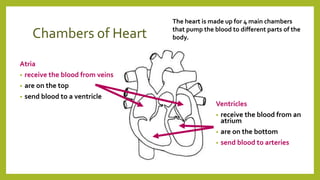
Chambers of Heart
Atria
• receive the blood from veins
• are on the top
• send blood to a ventricle
Ventricles
• receive the blood from an
atrium
• are on the bottom
• send blood to arteries
The heart is made up for 4 main chambers
that pump the blood to different parts of the
body.
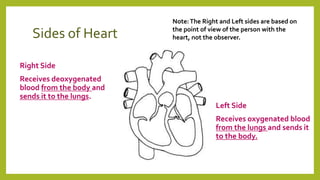
Sides of Heart
Right Side
Receives deoxygenated
blood from the body and
sends it to the lungs.
Left Side
Receives oxygenated blood
from the lungs and sends it
to the body.
Note:The Right and Left sides are based on
the point of view of the person with the
heart, not the observer.
Nervous System
Nervous System
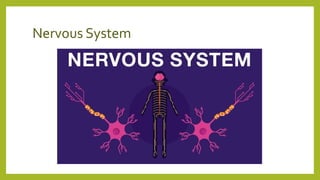
Nervous System:
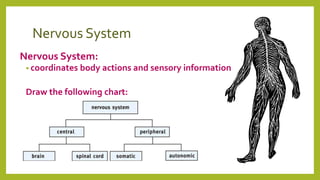
• coordinates body actions and sensory information
Draw the following chart:
Nervous System
Nervous System
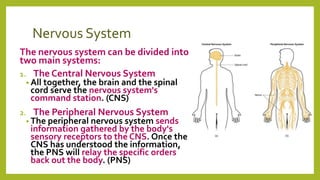
The nervous system can be divided into
two main systems:
1. The Central Nervous System
• All together, the brain and the spinal
cord serve the nervous system's
command station. (CNS)
2. The Peripheral Nervous System
• The peripheral nervous system sends
information gathered by the body's
sensory receptors to the CNS. Once the
CNS has understood the information,
the PNS will relay the specific orders
back out the body. (PNS)
Nervous System
Our peripheral nervous system is divided into two main
subsystems:
1. The Autonomic Nervous System (ANS)
• controls involuntary movement of the body.
• A few examples of things this system controls: the heart,
digestion, respiration, salivation (saliva production),
perspiration (sweating)
• For autonomic think automatic!
Nervous System
2. Somatic System
• controls voluntary movement of the body.This system allows
the mind to make conscious decisions about movement. It
connects the CNS to skeletal muscles.
• It is also responsible for controlling the involuntary movement
of reflexes.
• Somatic means relating to the body and mind.
Nervous System
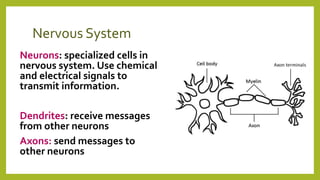
Neurons: specialized cells in
nervous system. Use chemical
and electrical signals to
transmit information.
Dendrites: receive messages
from other neurons
Axons: send messages to
other neurons
Nervous System
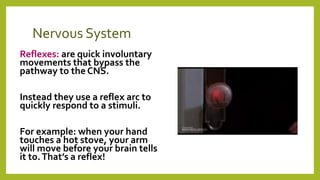
Reflexes: are quick involuntary
movements that bypass the
pathway to the CNS.
Instead they use a reflex arc to
quickly respond to a stimuli.
For example: when your hand
touches a hot stove, your arm
will move before your brain tells
it to.That’s a reflex!
Nervous System
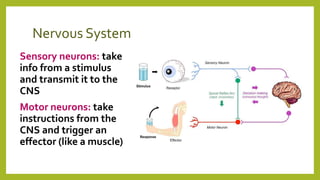
Sensory neurons: take
info from a stimulus
and transmit it to the
CNS
Motor neurons: take
instructions from the
CNS and trigger an
effector (like a muscle)
Excretory System
Excretory System
Excretory System:
• The excretory is a waste filtering and disposal
system.
• The body needs to maintain a balance in the
concentration of water, salts and nutrients. The
excretory system helps ensure no chemicals
present in unhealthy amounts.
• It also makes sure the body retains enough
water to continue all its functions.
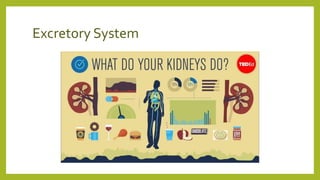
The main organ of the excretory system is the
kidneys.
Excretory System
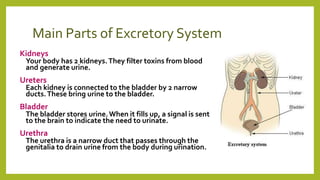
Main Parts of Excretory System
Kidneys
Your body has 2 kidneys.They filter toxins from blood
and generate urine.
Ureters
Each kidney is connected to the bladder by 2 narrow
ducts.These bring urine to the bladder.
Bladder
The bladder stores urine.When it fills up, a signal is sent
to the brain to indicate the need to urinate.
Urethra
The urethra is a narrow duct that passes through the
genitalia to drain urine from the body during urination.
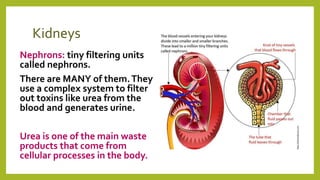
Kidneys
Nephrons: tiny filtering units
called nephrons.
There are MANY of them.They
use a complex system to filter
out toxins like urea from the
blood and generates urine.
Urea is one of the main waste
products that come from
cellular processes in the body.
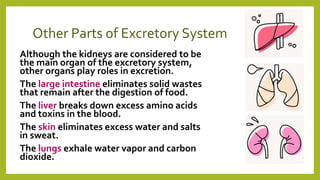
Other Parts of Excretory System
Although the kidneys are considered to be
the main organ of the excretory system,
other organs play roles in excretion.
The large intestine eliminates solid wastes
that remain after the digestion of food.
The liver breaks down excess amino acids
and toxins in the blood.
The skin eliminates excess water and salts
in sweat.
The lungs exhale water vapor and carbon
dioxide.

Unit b cells & systems

  • 1.
    Unit B: Cells& Systems
  • 2.
  • 3.
    The First Microscope •The first microscope was created by Zacharias Janssen • For millennia, the smallest thing humans could see was about as wide as a human hair. When the microscope was invented around 1590, suddenly we saw a new world of living things in our water, in our food and under our nose.
  • 4.
    The Compound LightMicroscope • Light passes through the specimen • Lenses enlarge or magnify the image • Micrometers (μm) are used to measure very tiny objects (1mm = 1000 μm)
  • 5.
    Parts of theMicroscope Lowest magnification to highest
  • 6.
    How to usea Microscope
  • 7.
    Estimating Measurements • Beingable to estimate the size of an object viewed under a microscope is an important skill. It’s important to understand Field ofView • Field ofView: Field of view is the diameter of the circular region of the slide visible under the microscope
  • 8.
    Estimating Measurements • Whatwill happen to the Field ofView as we increase the magnification? Why? • As you increase the magnification the FOV gets smaller (decreases).
  • 9.
    Estimating Measurements • Ifyou knew the Field ofView (400 μm) of a microscope, how could you estimate the size of an object? • You can divide the FOV by the number of objects that would fit. • Estimated size = FOV/#fit • = 400μm/4 • =100μm • 1mm = 1000μm • So 100μm = 0.1 mm
  • 10.
  • 11.
    Characteristics of LivingThings Biotic:Living Abiotic: Non-Living What is a living thing? On the surface this may seem like a simple question, but it has been the topic of debate among scientists for many, many years. As such, there is no single definition of what it means for something to be alive.What is agreed upon is that all living things carry out certain life processes. To be classified as living, a specimen must carry out all of the following processes. Some nonliving things may have some of these characteristics, but only living things will exhibit all of them.
  • 12.
    Characteristics of LivingThings •ALL living things have 6 characteristics: 1. are made of cells 2. need energy 3. grow and develop 4. respond to the environment 5. reproduce 6. have adaptations for their environment
  • 13.
    Characteristics of LivingThings 1.All organisms are made of cells. • The cell: is a basic unit of life, it performs life processes, and is microscopic
  • 14.
    Characteristics of LivingThings 2.All organisms need energy • the ability to make things move or change everything needs energy • organisms get energy from the environment: • plants by the sun • animals from environment • nutrients are needed to grow, develop and reproduce. Nutrients: chemicals needed to aid in your bodies daily processes. Metabolism: the sum of all chemical processes
  • 15.
    Characteristics of LivingThings 3.Grow & Develop • All organisms grow & develop. • growth includes getting taller, but also replacing itself like skin cells. development is a drastic change in body shape • ex: tadpole to frog.
  • 16.
    Characteristics of LivingThings 4.All organisms respond to the environment. Stimulus: anything that causes a response. Response: the reaction. Example: A car is moving towards you. Stimulus-> seeing the car. Response -> jumping out of the way.
  • 17.
    Characteristics of LivingThings 5.All organisms reproduce. • not necessary for each individual organism but it is for the survival of each type of organism.
  • 18.
    Characteristics of LivingThings 6.All organisms adapt to their environment. Adaptations: characteristics that allow an organism to live in its environment. Increases the organisms chance of survival • ex: cactus spines, rabbits changing colours.
  • 19.
  • 20.
    Structures & Functions Structures:Body part to do a specific task Functions: Processes or tasks a living thing will need to do to live Many organisms do the same thing but have different ways to get it done. Example: Movement Humans: Use their legs Gibbons Monkey: Use their arms
  • 21.
    Structures & Functions Example:Gathering food. Barnacles -Tentacles Birds - Bills Humans – Hands Example: Chewing food. Lion - Sharp teeth Anteater - No teeth Example: Breathing structures. Fish - Gills Humans - Lungs Trees - Leaves Caterpillars - Spiracles
  • 22.
    Structures & Functions Alist of a few functions living things do: • Movement • Food gathering • Breathing • Digest food • Eat food • Reproduction • Waste excretion • See • Communicate
  • 23.
    Structures & Functions Variationsin Structures:There may be slight differences in structures for similar organisms in order to do specific tasks. Example: Galapagos Islands - Darwin found there were different bill sizes and shapes on the finches.
  • 24.
  • 25.
    Circulatory System Structures: • heart •arteries • veins • capillaries • blood Functions: • transport oxygen, food, and other substances throughout the body • transport some wastes to other organs for elimination • defend the body against diseases • connect all other organ systems
  • 26.
    Respiratory System Structures: • nose •mouth • trachea • diaphragm • bronchi • lungs Functions: • transport oxygen from the outside air to the blood • transport carbon dioxide from the blood to the outside air
  • 27.
    Digestive System Structures: • Salivaryglands • mouth • esophagus • stomach • liver • pancreas • gall bladder • small intestine • large intestine Functions: • break down food pieces into much smaller pieces (particles) so they can be absorbed and transported throughout the body
  • 28.
    Nervous System Structures: • brain •spinal cord • nerves • eyes, ears, and other sensing organs (hands, nose, etc.) Functions: • coordinate and control the actions of all organs and organ systems • detect, process, and respond to changes in external and internal environments
  • 29.
    Excretory System Structures: • kidneys •bladder • lungs • skin • liver Functions: • remove chemical and gaseous wastes from the blood
  • 30.
    Skeletal System Structures: • bones •cartilage Functions: • provide a movable support frame for the body • protect soft-tissue organs such as the heart and lungs
  • 31.
    Muscular System Structures: • Muscles •tendons Functions: • move bones • move organs that contain muscle tissue (such as the heart and stomach)
  • 32.
    Integumentary System Structures: • Skin •Fingernail Functions: • protects the body’s internal environment from the external environment • senses pain, pressure, and temperature
  • 33.
  • 34.
    Cells All organisms aremade of at least one cell. Cells do not work alone: Tissues: are groups of cells with similar structure and functions Organs: are groups of tissues that work together for a common purpose Organ systems: are groups of organs that work together to help you stay alive
  • 35.
    Cells Cells are madeof many different parts: Organelles: specialized structures inside of a cell that carry out specific functions. One way to think about cells’ organization is to think of them as living factories, making all the things necessary for them to live.These factories have the following specialized areas.
  • 36.
    Animal Cell vs.Plant Cell
  • 37.
    Organelles 1. Nucleus "commandcentre" • directs cellular activities (movement, growth)
  • 38.
    Organelles 2. Mitochondria "powerhouse" •chemical reactions occur to convert energy the cell receives into a form it can use.
  • 39.
    Organelles 3. Cell Membrane"controllable gateway" • lets needed material in and waste materials out.
  • 40.
    Organelles 4.Vacuoles "storage rooms" •where nutrients, water, or other substances are stored in the cell. • plants have one large, animals have many small.
  • 41.
    Organelles 5. Cytoplasm "kitchen" •contains nutrients required by the cell for its life processes.
  • 42.
    Organelles 6. Cell Wall"frame" • found only in plant cells that provides strength and support to plants.
  • 43.
    Organelles 7. Chloroplasts "solarpanels" • found in cells of the green parts of plants. • carry out photosynthesis, converting the sun's energy into food.
  • 44.
    Organelles You can alsothink of the organelles as a city! Nucleus - city hall Mitochondria - energy Cell Membrane / Cell Wall - protection Vacuoles - storage units Cytoplasm - food or nutrients Chloroplasts - farmers
  • 45.
  • 46.
    Unicellular Organisms • aremade of 1 cell, but are NOT simple! • they can still eat, move, reproduce, react to stimuli, get rid of waste products, etc. • example: diatoms -> single-celled plants.
  • 47.
    Multicellular Organisms • 1.Have specialized cells • There are various kinds of cells. • Each kind of cell carries out specific functions with specific structures needed to support life. • Examples: Red blood cells and Marrow Cells
  • 48.
    Multicellular Organisms • Redblood cells carry oxygen to all the cells of your body.To do this they must travel through very small blood vessels. Their thin pliable disc shape enables them to do this. • Marrow cells are a type of connective tissue that contains specialized cells that make red blood cells. This is necessary because mature red blood cells lose their nuclei and therefore their ability to reproduce themselves.
  • 49.
    Multicellular Organisms • 2.Have tissues • Cells combine to form tissues. • 3. Have organs. • Tissues combine to form organs. • 4. Have organ systems. • Organs combine to form organ systems. • Animals have organ systems but plants do not.
  • 50.
    Amoeba Fill in onhandout (Summarize don’t copy word for word) • Movement • Foot-like projections called pseudopods. They extend from the main body and the cytoplasm goes into it. • Feeding • Two pseudopods extend around a piece of food and then join together. • This forms a vacuole where the food is digested and absorbed into the cytoplasm.
  • 51.
    Paramecium • Movement • Veryfast, unlike the slow amoeba. Covered in hair-like cilia which move back and forth like oars to move them through the water. • Feeding • Cilia help them gather food. On one side is the oral groove, which is a channel lined with cilia. The cilia sweep food to the bottom of the groove where the food enters a food vacuole, which moves into the cytoplasm, and the food is digested.
  • 52.
  • 53.
  • 54.
    Concentration • Remember concentrationtells you how much substance is in a specific area.
  • 55.
    Diffusion • Diffusion: movementof particles from an area of high concentration to an area of low concentration. • the particles will move until they are evenly distributed. • many substances move in and out of cells by diffusion. • the cell membrane acts like a filter with extremely tiny openings that allows only some particles to pass through by diffusion.
  • 56.
    Permeable vs Impermeable •Permeable: Allows liquids or gases to flow through • Example: Cotton t-shirt, sponge, soil • Impermeable: Does not allow liquids or gases to flow through • Example: Umbrella, concrete, steel
  • 57.
    Semi-Permeable • Semi-permeable (orselectively permeable): means certain things cannot cross is but other things can. • Cell membranes are permeable to water and smaller particles.This means they can diffuse across easily. • Larger particles are impermeable and be let into the cell through special channels or gates. Channel proteins or carrier proteins act as doors to allow larger particles in an out of cells.
  • 58.
    Osmosis • Osmosis: isa special form of diffusion. It is the diffusion of water through a selectively permeable membrane. • Since membranes are permeable to water, the water moves based on concentration. • MOST IMPORTANT!!! • Water moves to the high solute concentration.
  • 59.
    Osmosis • Hypotonic:Too much waterenters a cell (appear bloated) • Hypertonic:Too much water is leaving a cell (appear shrunken)
  • 60.
  • 61.
    Specialized Cells • Unicellularorganisms are tiny because there are limits to how large they can grow. One of the reasons involves diffusion and osmosis.These vital processes work well only over very short distances. • For example, it takes an oxygen particle a fraction of a second to diffuse over a distance of 10 m (0.01 mm).To diffuse over a distance of 1 mm takes several minutes!
  • 62.
    Specialized Cells • Likeall organisms, unicellular organisms grow and develop. • When unicellular organisms reach the limits of their size, like the amoeba shown here, they reproduce. • Amoeba do this by dividing into two, which results in two smaller, identical copies of each organism.
  • 63.
    Specialized Cells • Yourcells reproduce this way, too.That’s how, for example, your body replaces the 50 000 000 or so skin cells that it naturally loses each day!Your body cells also reproduce to repair tissues that get damaged. For example, if you scrape your elbow, your skin cells reproduce to form new skin tissue.
  • 64.
    Specialized Cells • SpecializedCells: carry out a specific function or functions needed to support life • Cells combine to form tissues. • In humans and other animals, there are four different tissue types: • Connective • Epithelial • Nervous • Muscle
  • 65.
    ConnectiveTissue • Connective Tissue:supports and connects different parts of the body • Some examples of these types of tissue are: • Fat,Tendon, Blood
  • 66.
    EpithelialTissue • Epithelial Tissue:covers the outside of your body and outside of your organs. Also lines the inside of some organs like the intestines. • Crazy Facts About Skin • Skin is thickest, 1/5 inch, on the upper back. It is thinnest on the eyelids, which are only 1/50th inch thick • Your skin weighs about 3.2kg (of course some weigh more) • Your skin sheds 50,000 cells every minute.
  • 67.
    NervousTissue • NervousTissue: makesup the brain and the spinal cord • Around 45 miles (72 km) of nerves run through our body.The electric impulses travel at a speed of almost 250 mph!
  • 68.
    MuscleTissue • MuscleTissue: allowsyou to move. • Some Examples • you have smooth muscle which can move food along your intestines and cardiac muscle that pumps blood through your heart. You also have skeletal muscles which keep your frame together
  • 69.
    Specialized Cells •Cells combineto form tissues in plants. •There are three different tissue types: •PhotosyntheticTissue: use sunlight to produce sugar for energy. •ProtectiveTissue: a waterproof layer that protects plants. •TransportTissue: tube-like cells with hollow centers, phloem transports food, and xylem transports water.
  • 70.
  • 71.
  • 72.
    Digestive System •The digestivesystem: •is involved in the nutrition life process. •the organs work together to break down food into nutrients that are used by the body. •the food matter that isn’t used by the body is expelled as waste, another one of the life processes.
  • 73.
  • 74.
    Main Parts ofthe Digestive System • Mouth • Saliva in the mouth begins the process of chemically breaking down food, while the teeth and tongue work together to physically break the food into smaller pieces.The tongue also helps with swallowing. • Esophagus • The esophagus is a long tube that connects the mouth to the stomach. Food is squeezed down the esophagus by smooth muscle tissue. • Stomach • In the stomach, smooth muscle lining the walls of the stomach pulverizes the food. Specialized cells in the stomach lining secrete acid and juices to dissolve and break down the food chemically. • Small Intestine • In the small intestine digestive juices break all remaining usable food into its nutritional parts.The nutrients enter the bloodstream through the walls of the small intestine, and are sent throughout the body. • Large Intestine • The remaining matter and water enter the large intestine. In the large intestine, water is absorbed by the body leaving behind a mass of waste, called a stool. • Anus • The anus is the opening in the body where the stool is excreted.
  • 75.
    Types of Digestion •MechanicalDigestion: The physical breaking apart of food into smaller pieces • increases their surface area. • Teeth, the tongue and the squeezing of the peristalsis movement through the digestive system. •Peristalsis: is how food moves through the body. It’s the wave-like movement of muscle contractions that move food through the digestive tract.
  • 76.
    Types of Digestion •ChemicalDigestion: The dissolving and breaking down of food using enzymes or stomach acid •Breaks food into nutrients usable by the body
  • 77.
    More Parts ofDigestive System • All 3 of these parts secrete digestive enzymes into the first section of the small intestine to help digest the fats that were not dissolved or digested in the stomach.They also have other jobs... • Pancreas • The pancreas makes Insulin and glucagon which help control sugar levels in the blood also come from the pancreas. • Liver • The liver has MANY functions that include processing harmful substances, storing useful nutrients and makes proteins that help clot the blood. • Gall Bladder • The gallbladder takes acidic bile from the liver and stores it until needed for digestion.That liquid helps digest fat.
  • 78.
    Types of Digestion •Once digestion has occurred, the resulting nutrients need to be transported throughout the body.This occurs in the small intestine: Villi: Small finger like projects in small intestine that absorb nutrients Microvilli: microscopic villi on cell membrane
  • 79.
  • 80.
    Respiratory System Respiratory System: •Your respiratory system is responsible for supplying your blood with the oxygen and removing the carbon dioxide from your blood and returning it to the air outside your body. • Breathing is the process your respiratory system uses to move air in and out of your lungs. Inhalation: breathing air in Exhalation: breathing out
  • 81.
  • 82.
    Main Parts ofthe Respiratory System • Trachea • The trachea brings air from your mouth/nose to your lungs. It serves as passage for air, moistens and warms it while it passes into the lungs. • Bronchi • Two main branches of the airway (trachea) that lead into the lungs. Lined with cartilage to keep airway from collapsing. • Bronchioles • The bronchi then divide into smaller and smaller branches (bronchioles), finally becoming microscopic connecting to tiny alveoli. • Alveoli • Tiny air-filled sacs in the lungs; the site of gas exchange. • Lungs • The lungs are a spongy organ containing structures that carry out gas exchange. • Diaphragm • Large muscle below the lungs that helps move air in and out of the lungs.
  • 83.
    Mechanics of Breathing Inhalation: •Must decrease the pressure in your lungs by increasing the volume. • Increase volume: • Pulling diaphragm down • Expanding rib cage up • Pressure difference forces air into the lungs. Exhalation: • Must increase the pressure in your lungs by decreasing the volume. • Decrease volume: • Pushing diaphragm up • Contracting rib cage down • Pressure difference forces air out of the lungs.
  • 84.
    Gas Exchange When airis inhaled it travels down the trachea and into the bronchi where it enters each of the lungs.The air travels through the bronchioles and ends up in the alveoli. This is where gas exchange with the blood occurs:
  • 85.
  • 86.
    Circulatory System Circulatory System: •The job of the circulatory system is to deliver nutrients absorbed by your digestive system to each cell in your body, transport oxygen and remove waste products.
  • 87.
  • 88.
    Circulatory System This systemhas 2 CIRCUITS. 1. One circuit sends blood to the lungs to exchange CO2 for oxygen from the air.The oxygenated blood returns to the heart. 2. 2nd circuit sends the blood from the lungs to the rest of the body. Deoxygenated blood returns to the heart to be sent back to lungs again.
  • 89.
    BloodVessels Arteries:Vessels that carryblood AWAY from your heart to all parts of your body. Veins:Vessels carry blood from all parts of your body towards the heart. Capillaries: Specialized blood vessels located between the arteries and veins that allow the diffusion of nutrients and gases. • Made of specialized epithelial tissue, only one layer thick. • They are very narrow so blood cells must go through in single file. • Super thin walls allow for an increase in gas exchange.
  • 90.
    Blood Red Blood Cells •Function of red blood cells is to carry oxygen White Blood Cells • Blood cells that are specialized to fight infections. Platelets • Are cells in your blood that help to stop bleeding at cut Plasma • The liquid portion of your blood, transports nutrients to your cells and carries wastes, such as carbon dioxide away.
  • 91.
    Chambers of Heart Atria •receive the blood from veins • are on the top • send blood to a ventricle Ventricles • receive the blood from an atrium • are on the bottom • send blood to arteries The heart is made up for 4 main chambers that pump the blood to different parts of the body.
  • 92.
    Sides of Heart RightSide Receives deoxygenated blood from the body and sends it to the lungs. Left Side Receives oxygenated blood from the lungs and sends it to the body. Note:The Right and Left sides are based on the point of view of the person with the heart, not the observer.
  • 93.
  • 94.
    Nervous System Nervous System: •coordinates body actions and sensory information Draw the following chart:
  • 95.
  • 96.
    Nervous System The nervoussystem can be divided into two main systems: 1. The Central Nervous System • All together, the brain and the spinal cord serve the nervous system's command station. (CNS) 2. The Peripheral Nervous System • The peripheral nervous system sends information gathered by the body's sensory receptors to the CNS. Once the CNS has understood the information, the PNS will relay the specific orders back out the body. (PNS)
  • 97.
    Nervous System Our peripheralnervous system is divided into two main subsystems: 1. The Autonomic Nervous System (ANS) • controls involuntary movement of the body. • A few examples of things this system controls: the heart, digestion, respiration, salivation (saliva production), perspiration (sweating) • For autonomic think automatic!
  • 98.
    Nervous System 2. SomaticSystem • controls voluntary movement of the body.This system allows the mind to make conscious decisions about movement. It connects the CNS to skeletal muscles. • It is also responsible for controlling the involuntary movement of reflexes. • Somatic means relating to the body and mind.
  • 99.
    Nervous System Neurons: specializedcells in nervous system. Use chemical and electrical signals to transmit information. Dendrites: receive messages from other neurons Axons: send messages to other neurons
  • 100.
    Nervous System Reflexes: arequick involuntary movements that bypass the pathway to the CNS. Instead they use a reflex arc to quickly respond to a stimuli. For example: when your hand touches a hot stove, your arm will move before your brain tells it to.That’s a reflex!
  • 101.
    Nervous System Sensory neurons:take info from a stimulus and transmit it to the CNS Motor neurons: take instructions from the CNS and trigger an effector (like a muscle)
  • 102.
  • 103.
    Excretory System Excretory System: •The excretory is a waste filtering and disposal system. • The body needs to maintain a balance in the concentration of water, salts and nutrients. The excretory system helps ensure no chemicals present in unhealthy amounts. • It also makes sure the body retains enough water to continue all its functions. The main organ of the excretory system is the kidneys.
  • 104.
  • 105.
    Main Parts ofExcretory System Kidneys Your body has 2 kidneys.They filter toxins from blood and generate urine. Ureters Each kidney is connected to the bladder by 2 narrow ducts.These bring urine to the bladder. Bladder The bladder stores urine.When it fills up, a signal is sent to the brain to indicate the need to urinate. Urethra The urethra is a narrow duct that passes through the genitalia to drain urine from the body during urination.
  • 106.
    Kidneys Nephrons: tiny filteringunits called nephrons. There are MANY of them.They use a complex system to filter out toxins like urea from the blood and generates urine. Urea is one of the main waste products that come from cellular processes in the body.
  • 107.
    Other Parts ofExcretory System Although the kidneys are considered to be the main organ of the excretory system, other organs play roles in excretion. The large intestine eliminates solid wastes that remain after the digestion of food. The liver breaks down excess amino acids and toxins in the blood. The skin eliminates excess water and salts in sweat. The lungs exhale water vapor and carbon dioxide.