Cells, tissues and organs Biology 2011 Miss Teresita Tognetti
In this unit we will learn cells and cell parts tissues, organs and organ systems
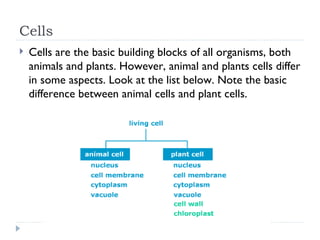
Cells Cells are the basic building blocks of all organisms, both animals and plants. However, animal and plants cells differ in some aspects. Look at the list below. Note the basic difference between animal cells and plant cells.
Cells Both animal and plants cells feature a nucleus, cell membrane, cytoplasm and vacuole (although the vacuole in animal cells is always much smaller that the vacuole in plant cells). In addition, plant cells have a cell wall and chloroplasts.
Cells Now look at a typical animal cell. The cell shown below shows a cheek cell. However, all animal cells conform to the same structure. Think about why an animal cell does not need a cell wall or chloroplasts. 

Each cell component performs a particular task.  The  cytoplasm  is important because this is where the basic reactions of the cell take place. It is water-based and substances are dissolved in it.  The  nucleus  contains all the genetic information needed to make a new copy of the cell or organism. The cell's activities are controlled by the nucleus. The  cell membrane  acts like a filter or sieve which allows certain substances to pass in and out of the cell. Small molecules, such as water and oxygen, move easily through the membrane. Chloroplasts  are found in green plant cells. They contain chlorophyll which traps sunlight energy to make food for the plant.  Cell walls  are found in plant cells. They are made of cellulose and provide a solid framework for the contents of the cell to push against. This means that plants can grow very tall without needing bones for support.  The  vacuole  contains a watery solution in which substances are stored. Vacuoles can also be used for storing waste.
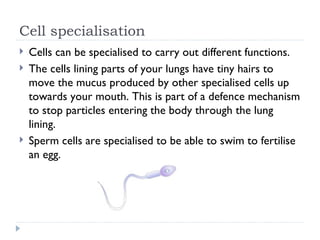
Cell specialisation Cells can be specialised to carry out different functions. The cells lining parts of your lungs have tiny hairs to move the mucus produced by other specialised cells up towards your mouth. This is part of a defence mechanism to stop particles entering the body through the lung lining. Sperm cells are specialised to be able to swim to fertilise an egg.
Cells, tissues and organs A group of cells of the same type which are performing the same function is called a tissue.  An example of tissue is muscle, which contracts to allow movement of the body.  Nerve cells communicate to send messages around the body.  In a plant, palisade cells are found in the leaf. They are specialised, containing many chloroplasts, to make food for the plant by the process of photosynthesis.
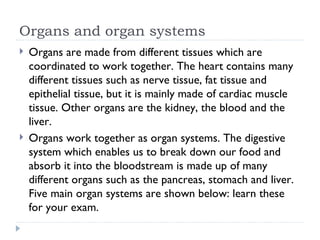
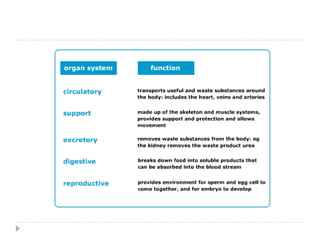
Organs and organ systems Organs are made from different tissues which are coordinated to work together. The heart contains many different tissues such as nerve tissue, fat tissue and epithelial tissue, but it is mainly made of cardiac muscle tissue. Other organs are the kidney, the blood and the liver.  Organs work together as organ systems. The digestive system which enables us to break down our food and absorb it into the bloodstream is made up of many different organs such as the pancreas, stomach and liver. Five main organ systems are shown below: learn these for your exam.
 
Quiz


Cells tissues organs

  • 1.
    Cells, tissues andorgans Biology 2011 Miss Teresita Tognetti
  • 2.
    In this unitwe will learn cells and cell parts tissues, organs and organ systems
  • 3.
    Cells Cells arethe basic building blocks of all organisms, both animals and plants. However, animal and plants cells differ in some aspects. Look at the list below. Note the basic difference between animal cells and plant cells.
  • 4.
    Cells Both animaland plants cells feature a nucleus, cell membrane, cytoplasm and vacuole (although the vacuole in animal cells is always much smaller that the vacuole in plant cells). In addition, plant cells have a cell wall and chloroplasts.
  • 5.
    Cells Now lookat a typical animal cell. The cell shown below shows a cheek cell. However, all animal cells conform to the same structure. Think about why an animal cell does not need a cell wall or chloroplasts. 

  • 6.
    Each cell componentperforms a particular task. The cytoplasm is important because this is where the basic reactions of the cell take place. It is water-based and substances are dissolved in it. The nucleus contains all the genetic information needed to make a new copy of the cell or organism. The cell's activities are controlled by the nucleus. The cell membrane acts like a filter or sieve which allows certain substances to pass in and out of the cell. Small molecules, such as water and oxygen, move easily through the membrane. Chloroplasts are found in green plant cells. They contain chlorophyll which traps sunlight energy to make food for the plant. Cell walls are found in plant cells. They are made of cellulose and provide a solid framework for the contents of the cell to push against. This means that plants can grow very tall without needing bones for support. The vacuole contains a watery solution in which substances are stored. Vacuoles can also be used for storing waste.
  • 7.
    Cell specialisation Cellscan be specialised to carry out different functions. The cells lining parts of your lungs have tiny hairs to move the mucus produced by other specialised cells up towards your mouth. This is part of a defence mechanism to stop particles entering the body through the lung lining. Sperm cells are specialised to be able to swim to fertilise an egg.
  • 8.
    Cells, tissues andorgans A group of cells of the same type which are performing the same function is called a tissue. An example of tissue is muscle, which contracts to allow movement of the body. Nerve cells communicate to send messages around the body. In a plant, palisade cells are found in the leaf. They are specialised, containing many chloroplasts, to make food for the plant by the process of photosynthesis.
  • 9.
    Organs and organsystems Organs are made from different tissues which are coordinated to work together. The heart contains many different tissues such as nerve tissue, fat tissue and epithelial tissue, but it is mainly made of cardiac muscle tissue. Other organs are the kidney, the blood and the liver. Organs work together as organ systems. The digestive system which enables us to break down our food and absorb it into the bloodstream is made up of many different organs such as the pancreas, stomach and liver. Five main organ systems are shown below: learn these for your exam.
  • 10.
  • 11.
  • 12.
  • 13.
  • 14.
  • 15.
  • 16.