Grade 7
Science
Quiz Bee
Easy
Round
1. What is the first step in
conducting experimental
method?
a. Identify the problem.
b. Formulate the hypothesis.
c. Gather enough information.
d. Make a conclusion.
Answer
a. Identify the problem.
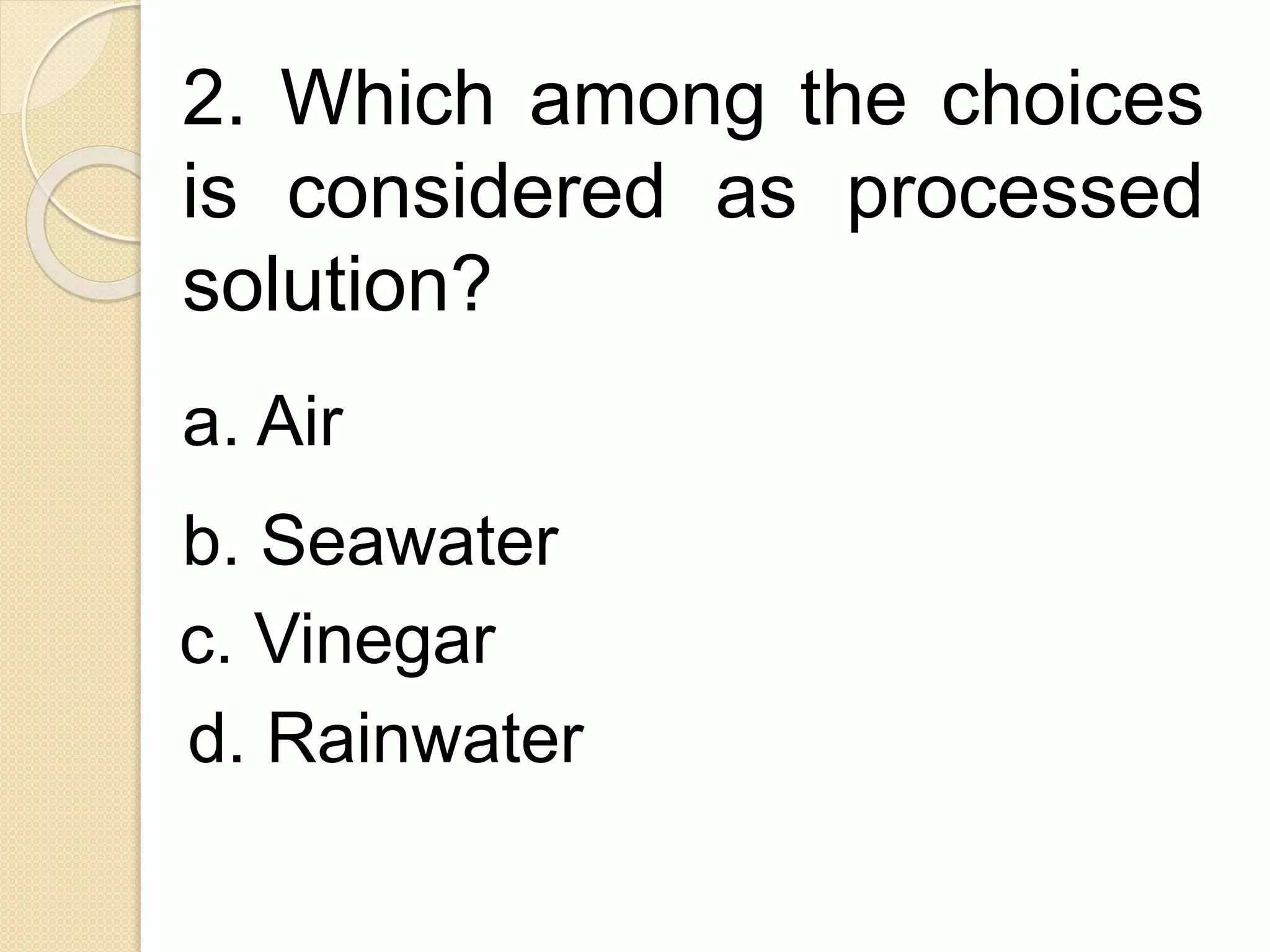
2. Which among the choices
is considered as processed
solution?
a. Air
b. Seawater
c. Vinegar
d. Rainwater
Answer
c. Vinegar
(The rest of the choices
are naturally occurring
solutions)
3. Which of the following
makes a heterogeneous
mixture?
a. Salt and Water
b. Oil and Water
c. Sugar and Water
d. Powdered juice and Water
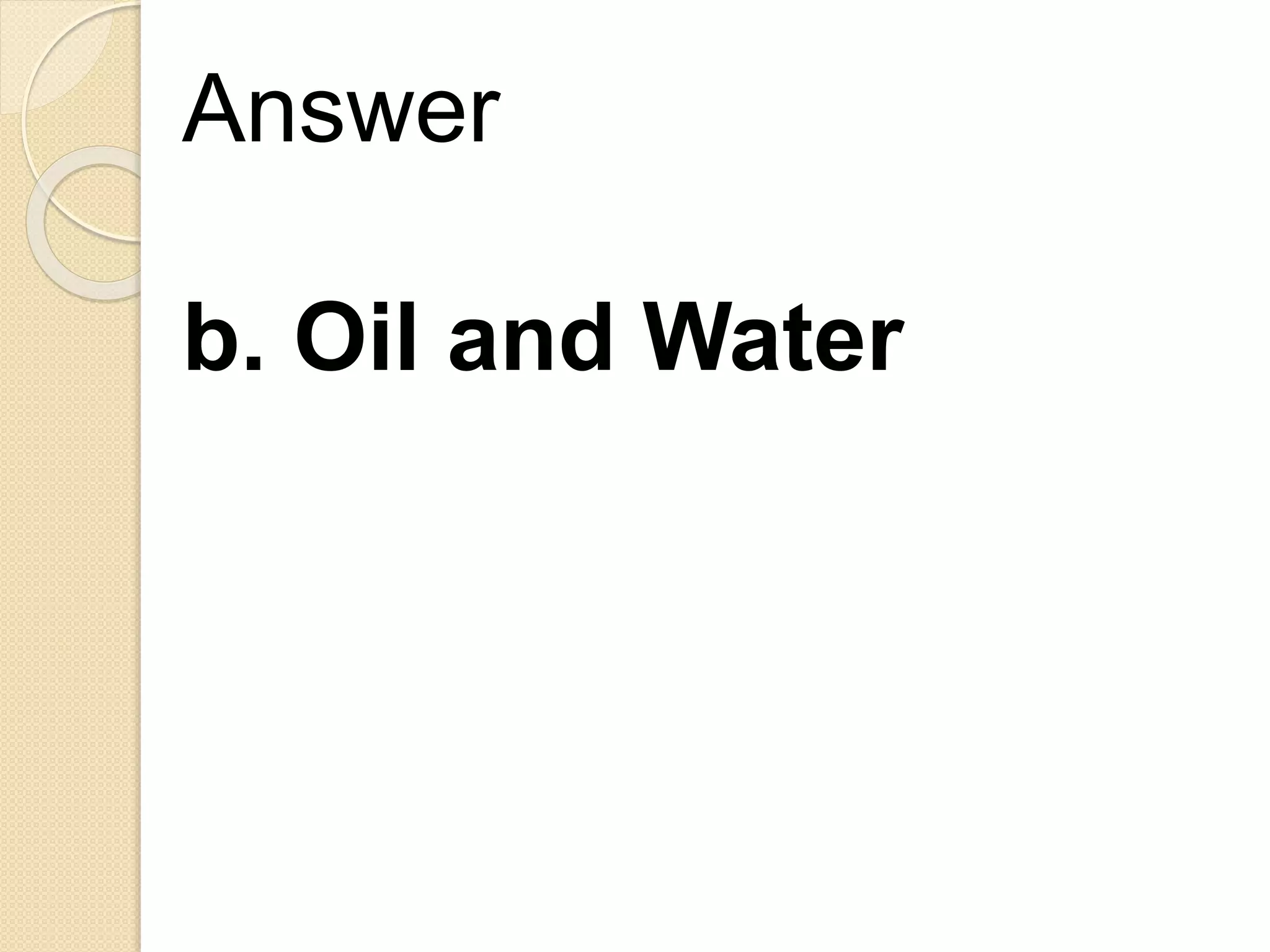
Answer
b. Oil and Water
4. It is an instrument used to
magnify the image of objects
that are too small to be seen
by unaided eyes.
a. Microscope
b. Seismograph
c. Telescope
d. Eyeglasses
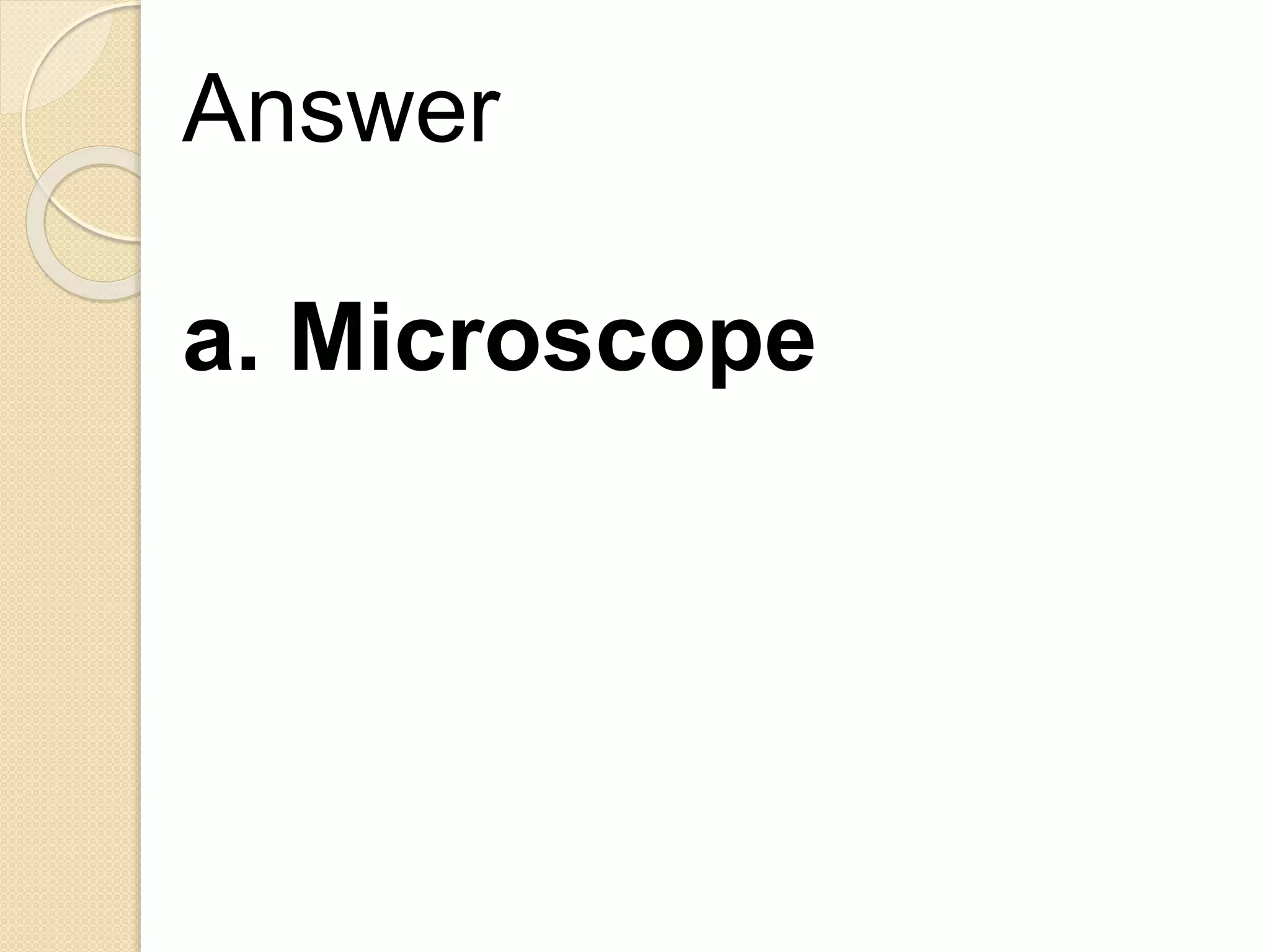
Answer
a. Microscope
5. Which of the following
parts allow different activities
of the cell to happen?
a. Nucleus
b. Vacuole
c. Centriole
d. Cytoplasm
Answer
d. Cytoplasm
6. What part of the cell stores
water and maintain its
rigidity?
a. Cell Wall
b. Vacuole
c. Mitochondrion
d. Nucleus
Answer
b. Vacuole
7. What does the slope of a
distance vs. time graph
represent?
a. acceleration
b. distance
c. displacement
d. speed
Answer
d. speed
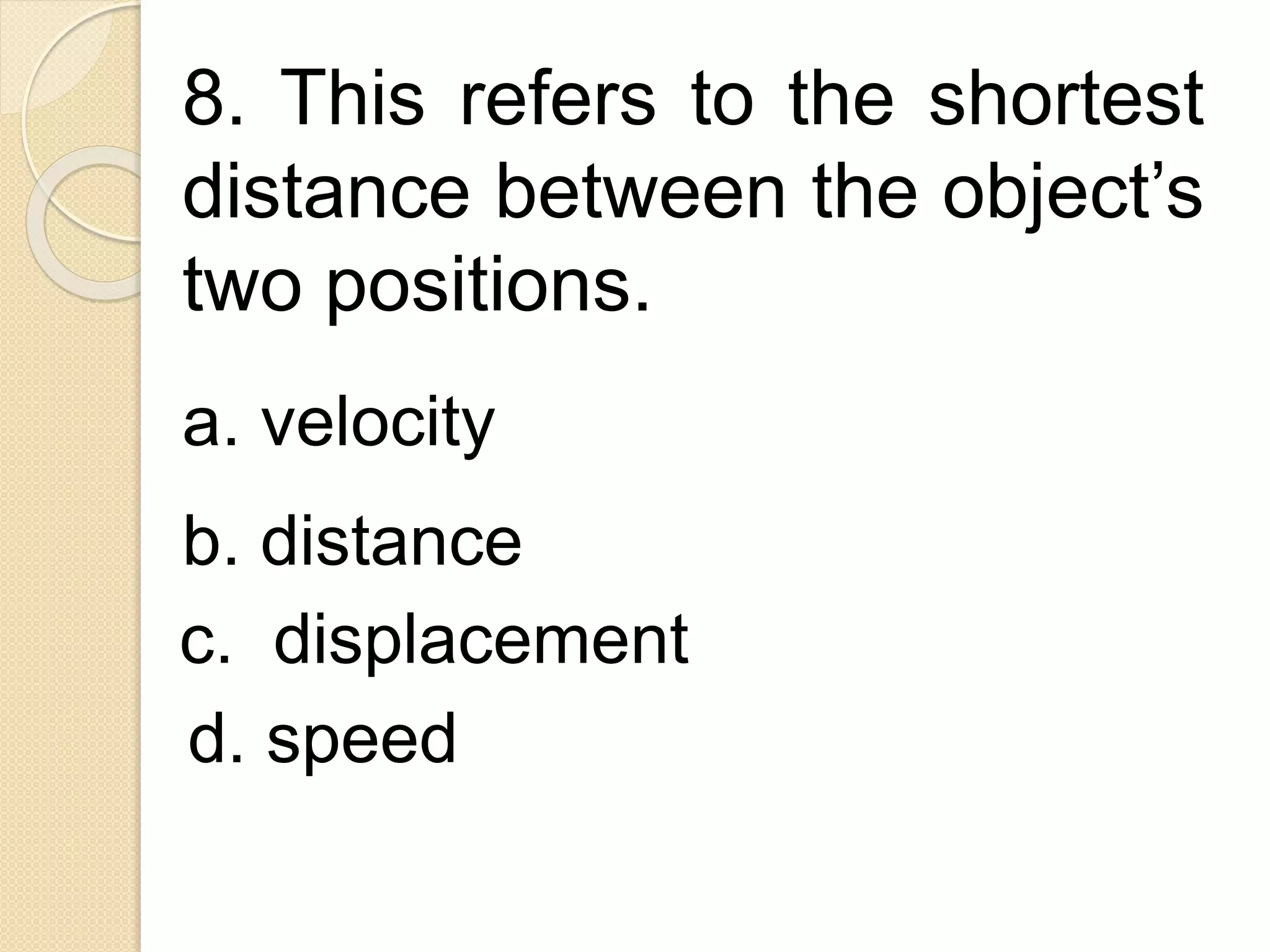
8. This refers to the shortest
distance between the object’s
two positions.
a. velocity
b. distance
c. displacement
d. speed
Answer
c. displacement
9. Which of the following
processes doesn’t account
for an increase in the
atmospheric Carbon dioxide
levels?
a. Plant respiration.
b. Photosynthetic processes.
c. Fossil fuel combustion
d. Deforestation.
Answer
b. Photosynthetic Processes
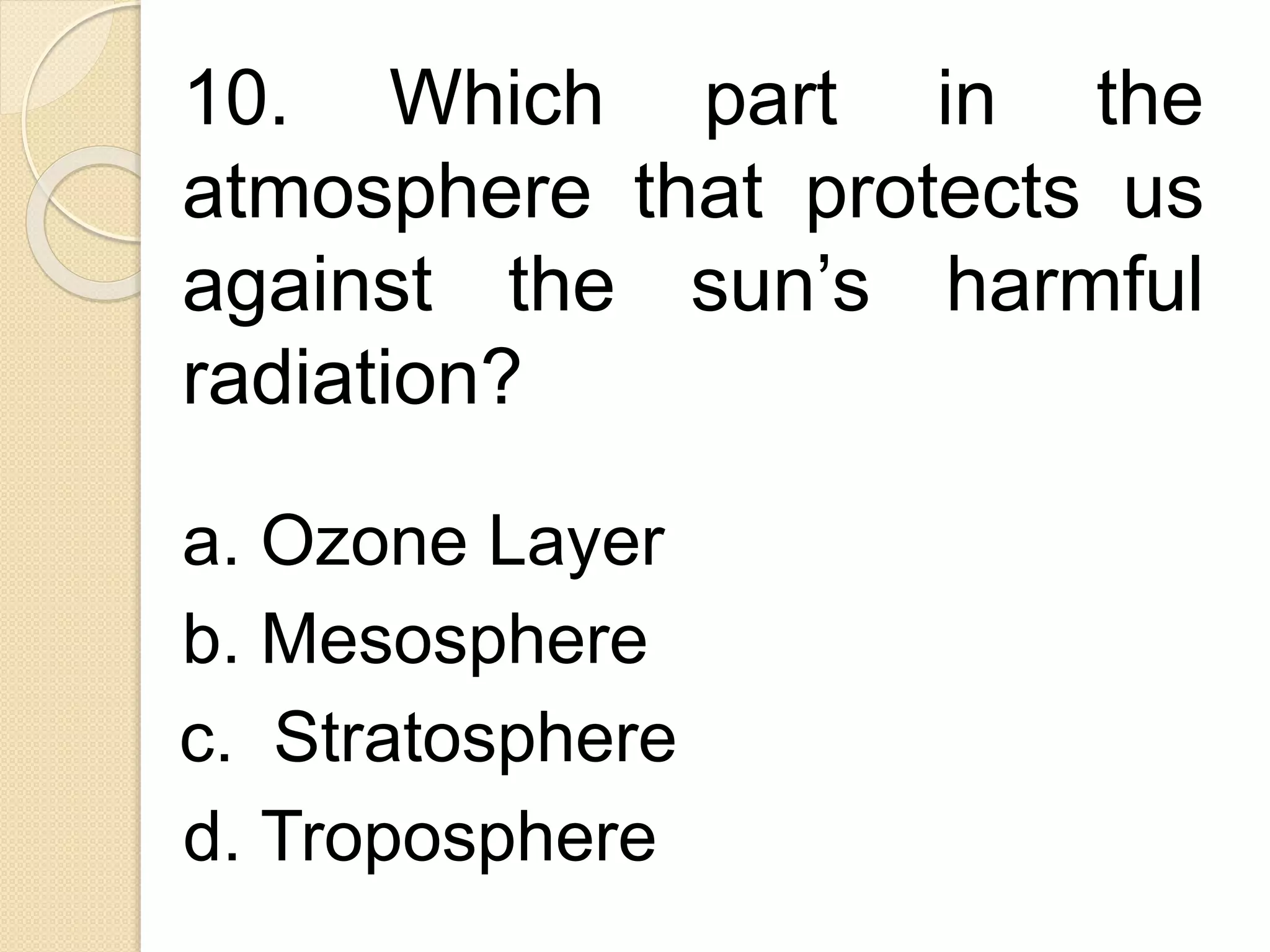
10. Which part in the
atmosphere that protects us
against the sun’s harmful
radiation?
a. Ozone Layer
b. Mesosphere
c. Stratosphere
d. Troposphere
Answer
c. Stratosphere
Average
Round
1. What is the term given
to a solid that has the
ability to be hammered into
a thin sheet?
a. Ductility
b. Malleability
c. Magnetic
d. Conductor
Answer
b. Malleability
2. It is a reaction between an
acid and a base forming salt
and water.
a. neutralization
b. acidic
c. basic
d. molarity
Answer
a. neutralization
2. The word atom is from a
Greek word meaning:
a. small
b. unseen
c. indivisible
d. visible
Answer
c. indivisible
4. How do plants benefit
from their root system?
a. They obtain water and
nutrients from the soil.
b. They provide strength and
support.
c. They manufacture food.
d. They produce flowers.
Answer
a. They obtain water
and nutrients from the
soil.
5. Which of the following is
NOT TRUE about lichens?
a. They are partly fungi and
partly algae.
b. They provide home for the
algae.
c. They act as an indicator of
pollution.
d. They are examples of fungi.
Answer
d. They are examples
of fungi.
6. The heart, brain, and
stomach are made up
of groups of:
a. organ
b. tissue
c. organelle
d. cell
Answer
b. Tissue
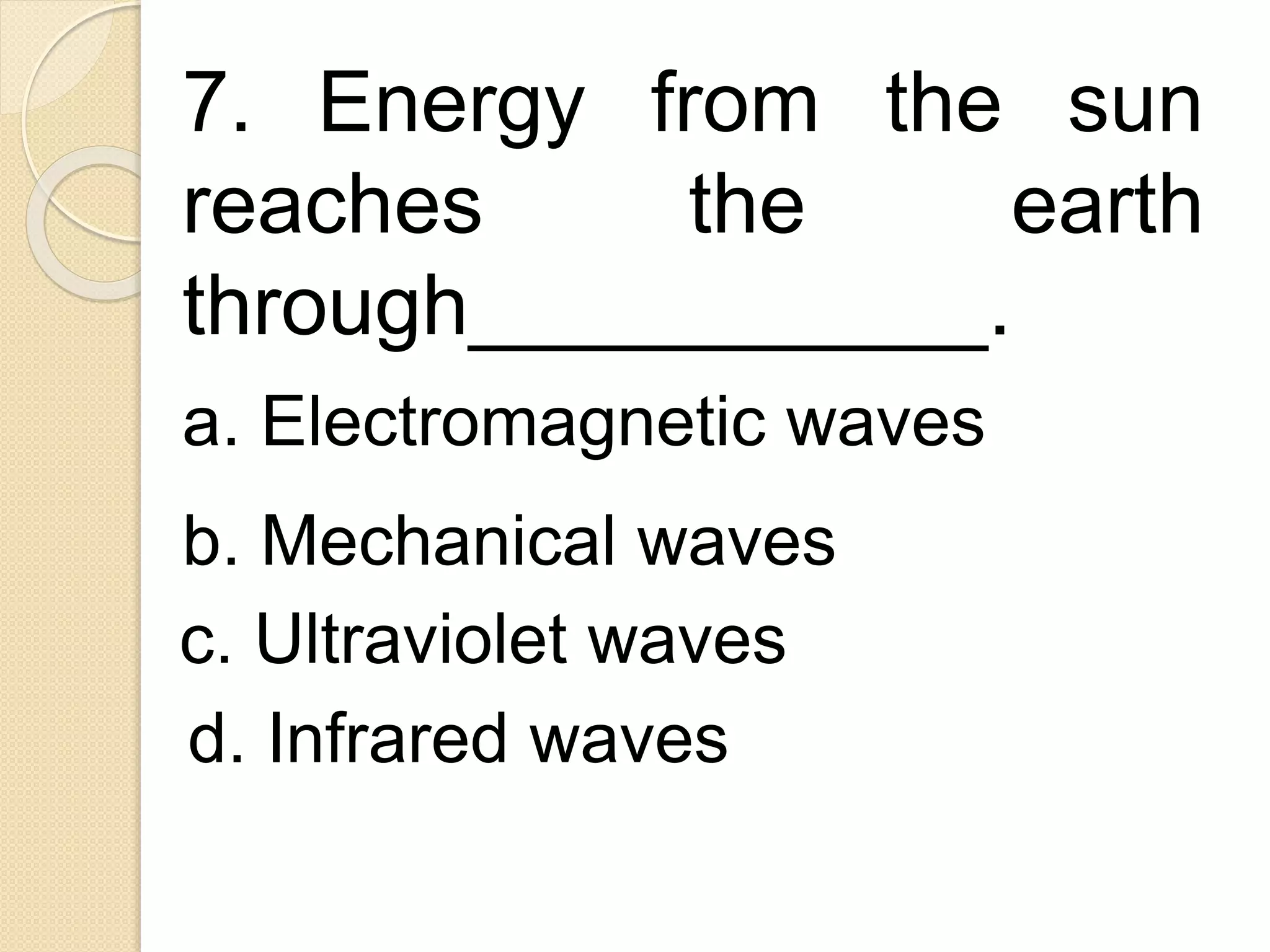
7. Energy from the sun
reaches the earth
through___________.
a. Electromagnetic waves
b. Mechanical waves
c. Ultraviolet waves
d. Infrared waves
Answer
a. Electromagnetic Waves
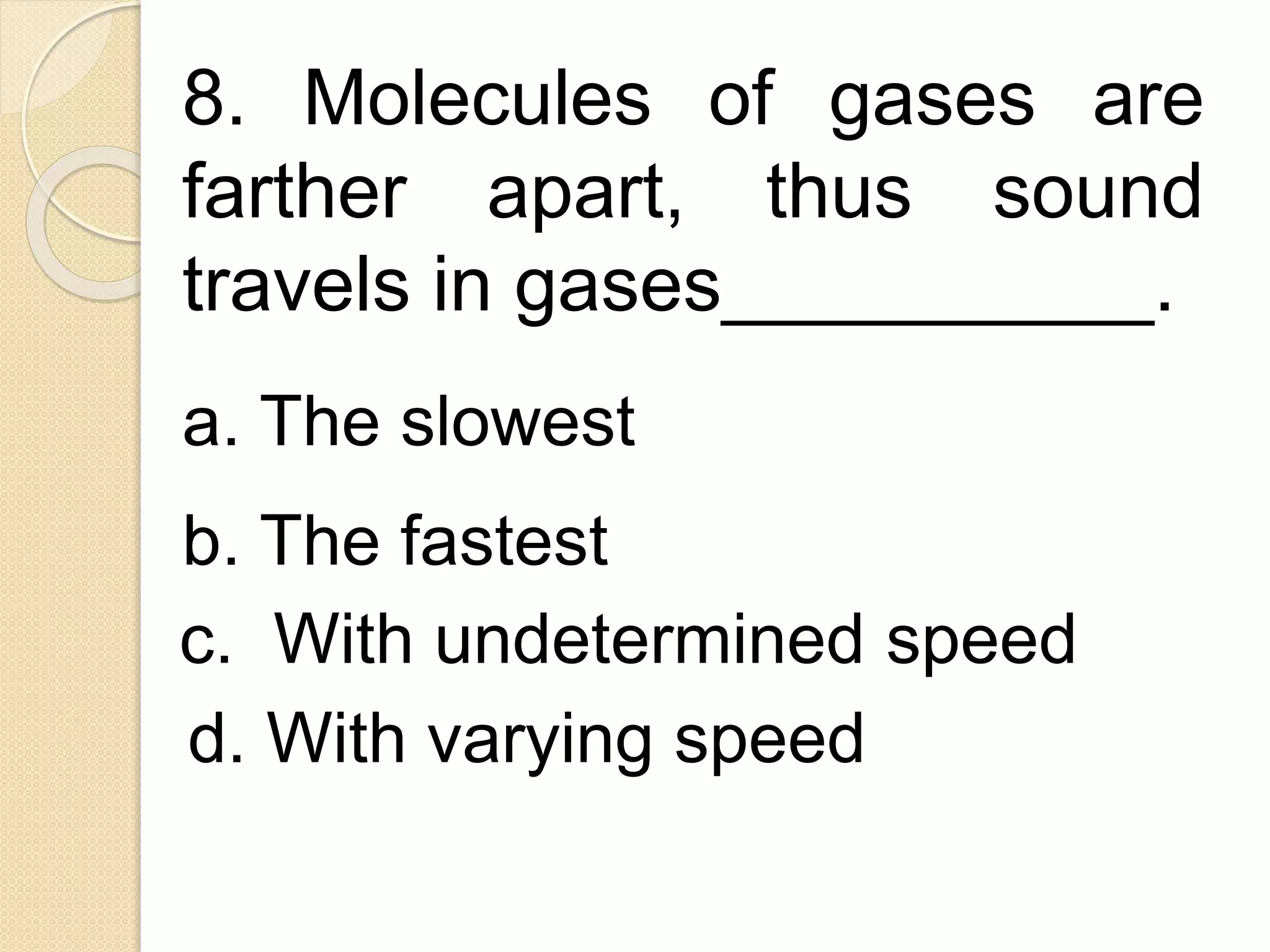
8. Molecules of gases are
farther apart, thus sound
travels in gases__________.
a. The slowest
b. The fastest
c. With undetermined speed
d. With varying speed
Answer
a. The slowest
9.Global climate change is
being attributed to the
atmospheric increase in what
two gases produced by
human activities?
a. Oxygen & Hydrogen
b. Ozone & Methane
c. Nitrous oxide & Sulfur dioxide
d. Methane & Carbon dioxide
Answer
d. Methane & Carbon dioxide
10. This natural phenomenon starts
during the summer months in the
northern hemisphere, when the
Asian continent becomes warmer
than the surrounding seas.
a. Intertropical convergence zone
b. Hanging Amihan
c. Trade Winds
d. Hanging Habagat
Answer
a. Intertropical convergence zone
Difficult
Round
1. It is a substance
consisting of the
atoms of two or more
elements that are
chemically combined
in a fixed proportion.
Answer
Compound
2. It is the kind of
compound that do
not contain carbon
and are usually found
outside the bodies of
living organisms.
Answer
Inorganic Compound
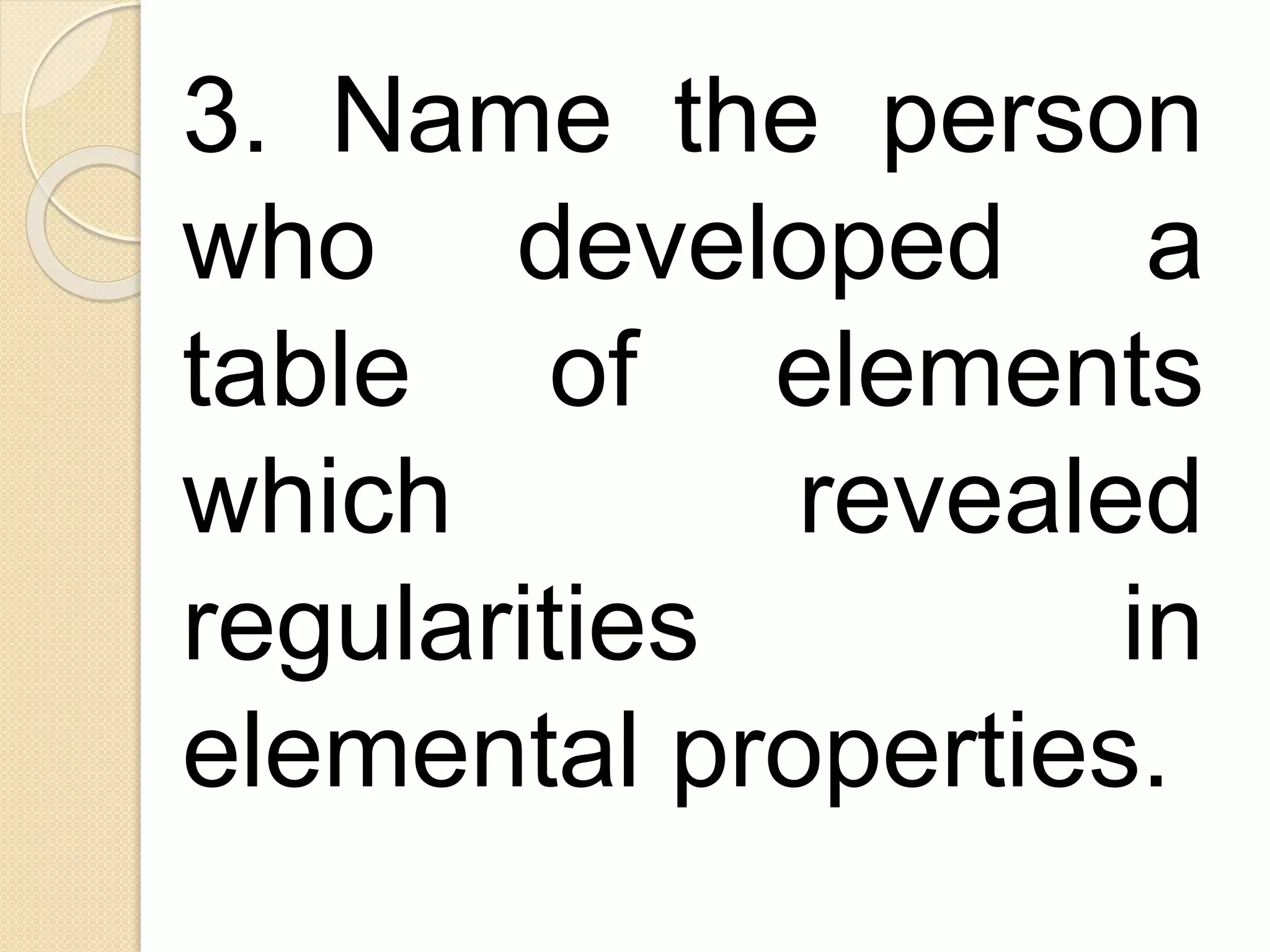
3. Name the person
who developed a
table of elements
which revealed
regularities in
elemental properties.
Answer
DMITRI MENDELEEV
4. A process in which
organisms replace or
restore their lost or
damaged body parts.
Answer
Regeneration
5. This process
involves two parents
in order to produce
offspring that have
unique combinations
of genes.
Answer
Sexual Reproduction
6. Which organelle is
referred to as “the
powerhouse of the
cell”?
Answer
Mitochondria
7. It has the highest
frequency among all
the electromagnetic
waves (EM).
Answer
Gamma Rays
8. This refers to the
emission of
electromagnetic waves
which carry energy
away from the surface
of the emitting body or
object.
Answer
Radiation
9. What is the name of the
phenomenon that causes
an accumulation of heat in
the lower atmosphere
because of the absorption
of longwave radiation from
the Earth’s surface?
Answer
Greenhouse Effect
10. What gas makes up
the majority of our
atmosphere?
Answer
Nitrogen
Clincher
Round
1. It is the interaction
among biotic
components of an
ecosystem.
Answer
Ecological Interactions
2. It is part of the cell
where the main life
activities occurs.
Answer
cytoplasm
3. A process of
transfer of pollen
from an anther to the
stigma.
Answer
pollination
4. It is often consider
a universal solvent.
Answer
water
5. A combination of
two or more
substances that are
physically combined.
Answer
Mixture
6. This is the
substance which is
dissolved in the
solvent.
Answer
Solute
7. This is the
fundamental unit of
life.
Answer
Cell
8. An area of land or
slope which drains its
water into a stream and
its tributaries.
Answer
Watershed
9. The envelope of
gases surrounding
the earth.
Answer
Atmosphere
10. The partial or complete
blocking from view of one
object by another.
Answer
Eclipse

Science 7 Quiz Bee.pptx