SCIENCE
       Grade 7
Teacher’s Guide
  (Unit 1 and Unit 2)
For Teachers


                Grade 7 Science: Matter

                        QUARTER 1

   DIVERSITY OF MATERIALS
     IN THE ENVIRONMENT


                      Department of Education


                       University of the Philippines
National Institute for Science and Mathematics Education Development
Copyright page


Quarter 1
Teacher’s Guide
Grade 7 Science: Matter
Diversity of Materials in the Environment


      Marlene B. Ferido, Jacqueline Rose M. Gutierrez, Writers.
      Ma. Cristina D. Padolina, Merle C. Tan, Reviewers.
      Rosita R. Cruz, Wilhelmina L. Dela Paz, Cecile N. Sales, Encoders.
      Alvin J. Encarnacion, Rizaldo Ramoncito S. Saliva, Artists.
      Cover Design by Alvin J. Encarnacion.


May 2012
CONTENTS
  Diversity of Materials in the Environment: Overview . . . . . . . . . . . . . . .                          i

  Module 1. Solutions             ....................................... 1

      Activity 1: What Solutions Do You Find in Your Home? . . . . . . . . . .                              2
      Activity 2: What are the Properties of Solution? . . . . . . . . . . . . . . . .                      3
      Activity 3: What is the Evidence that a Solution is Saturated? . . . . .                              4
      Activity 4: Size Matters! . . . . . . . . . . . . . . . . . . . . . . . . . . . . . . . . . . .       7
      Activity 5: How Fast does Coffee Dissolve in Hot Water?
                  In Cold Water?. . . . . . . . . . . . . . . . . . . . . . . . . . . . . . . . . .         9
      Activity 6: Which Dissolves Faster in Hot and in Cold Water:
                   Sugar or Salt . . . . . . . . . . . . . . . . . . . . . . . . . . . . . . . . . . .      10
      Pre/Post Test . . . . . . . . . . . . . . . . . . . . . . . . . . . . . . . . . . . . . . . . . . .   13

  Module 2. Substances and Mixtures . . . . . . . . . . . . . . . . . . . . . . . . . . . 17

      Activity 1: Seawater! See Water and Salts! . . . . . . . . . . . . . . . . . . . . 18
      Activity 2: Looks may be Deceiving . . . . . . . . . . . . . . . . . . . . . . . . . 20
      Activity 3: My Unknown Sample: Substance or Mixture? . . . . . . . . . 25
      Pre/Post Test . . . . . . . . . . . . . . . . . . . . . . . . . . . . . . . . . . . . . . . . . . . 26

  Module 3. Elements and Compounds . . . . . . . . . . . . . . . . . . . . . . . . . . 28

      Activity 1: Water, “Wat-er You Made Of?. . . . . . . . . . . . . . . . . . . . . .                    29
      Activity 2: The Periodic Table: It’s Element-ary! . . . . . . . . . . . . . . . .                     34
      Activity 3: The “Matter” on Labels . . . . . . . . . . . . . . . . . . . . . . . . . . .              36
      Activity 4: The Iron-y of Food. . . . . . . . . . . . . . . . . . . . . . . . . . . . . . .           38
      Pre/Post Test . . . . . . . . . . . . . . . . . . . . . . . . . . . . . . . . . . . . . . . . . . .   39

  Module 4. Acids and Bases . . . . . . . . . . . . . . . . . . . . . . . . . . . . . . . . . . 41

      Activity 1: How can You Tell if the Mixture is Acidic or Basic?. . . . . . 41
      Activity 2: Color Range, pH Scale! . . . . . . . . . . . . . . . . . . . . . . . . . . 45
      Activity 3: What Happens to a Metal when Exposed to
                  an Acidic Mixture? . . . . . . . . . . . . . . . . . . . . . . . . . . . . . . 47
      Pre/Post Test . . . . . . . . . . . . . . . . . . . . . . . . . . . . . . . . . . . . . . . . . . . 48

  Module 5. Metals and Nonmetals . . . . . . . . . . . . . . . . . . . . . . . . . . . . . . 51

      Activity 1: Which can Conduct Electricity, Metals or Nonmetals? . . . 52
      Activity 2: Acidity of the Oxides of Metals and Nonmetals . . . . . . . . 56
      Pre/Post Test . . . . . . . . . . . . . . . . . . . . . . . . . . . . . . . . . . . . . . . . . . . 57
DIVERSITY OF MATERIALS IN THE ENVIRONMENT


OVERVIEW

      This set of five modules on the Diversity of Materials in the Environment
provides many opportunities for students to increase their understanding of
solutions, substances and mixtures, elements and compounds, acids and
bases, and metals and nonmetals, through engaging them in scientific inquiry.

      There is a wide range and variety of materials on Earth. These include
natural materials, those that have been made from other materials (processed
or manufactured), and those which make up living things. In Grade 7, the
development of ideas about materials begins with awareness of solutions,
which students often encounter everyday as liquid mixtures.            Further
awareness of materials in terms of the components they are made of—
substances, elements, compounds are taken up in Modules 2, 3, and 5.
Students will also study the properties of a special group of compounds—acids
and bases in Module 4.

        These concepts will be encountered by the students in the contexts and
life situations that they are most familiar with. It is important to recognize that
the teaching of the concepts covered in this set of modules focuses more on the
„macro‟ view (the tangible and visible). Science education research recommends
that concepts be taught, initially, at the macro level only. Explanations at the
„submicroscopic‟ level (atomic or molecular level) could be shared in
appropriate doses enough to be processed by the students. The use of
chemical symbols and equations are reserved for higher grade levels much
later. The experiences gained through different activities in each module will
allow students to transform the information they obtain into a form that is
usable to them in their own personal and community context.

      The development of the modules veers away from teaching science that is
textbook-centered to that which incorporates interactive and inquiry-based
learning experiences. Inquiry is essential in learning science. When students
are engaged in inquiry, they describe objects and phenomena, “identify
questions that can be answered through scientific investigations; design and
conduct a scientific investigation; use appropriate tools and techniques to
gather, analyze, and interpret data; develop descriptions, explanations,
predictions, and models using evidence; think critically and logically to make
the relationships between evidence and explanations; recognize and analyze
alternative explanations and predictions; communicate scientific procedures
and explanations; and use mathematics in all aspects of scientific inquiry” (The
National Science Education Standards, U.S. National Research Council, 2000.
p.19).

       Research has shown that the use of inquiry and investigative skills
develop with age. In this set of modules, the students will apply the inquiry
skills they learned in earlier grades. They will plan and carry out simple science
investigations. Each student will be able to participate first-hand in looking for
evidence to answer questions they have posed at the beginning. They will have
opportunities to gather and interpret data as well as draw conclusions based
on evidence they have gathered. They will perform fair tests by identifying
variables to be changed, measured and controlled, and do repeat trials.

      The teacher needs to guide and intervene throughout the process of
investigation to improve the students‟ understanding of the concepts involved.
Gradually, the students will gain more independence in looking for evidence to
answer questions as they move from guided inquiry to full investigations.

        It is hoped that through the use of inquiry, teachers will be able to
facilitate learning of science and assess each student‟s developing
understandings and abilities. Some activities, by themselves, can be considered
as embedded assessment. There is also a pre/post test that should be
administered before and after all the activities in each module have been
completed. The teacher needs to analyze the results of these tests. The pretest
results will indicate students‟ prior knowledge and alternative conceptions (if
any). The posttest results will show the extent of students‟ comprehension of
the concepts and their capacity to demonstrate needed skills. The posttest can
also reveal students‟ misconceptions that need to be addressed in succeeding
modules.


Grade 7 Science: Matter
Diversity of Materials in the Environment                                        ii
Teacher's Guide
                                                                Module 1: Solutions

MODULE 1: SOLUTIONS


Overview

      In this module on Solutions, the activities have been sequenced in
such a way that the concepts are developed gradually from the first to the
last activity. It starts with the students being acquainted with solutions
found in their home. The second activity allows them to study the common
characteristics of solutions—appearance, number of phases observed, ability
to be dissolved in water, and ability to be filtered. In Activity 3, students
begin to distinguish a saturated from an unsaturated solution through a
guided investigation where they learn that there is a maximum amount of
solute that can dissolve in a given amount of solvent at a certain
temperature.

Key question for this module


                          What common properties do solutions have?
                                 Are solutions always liquid?
                               Will all solids dissolve in water?
                             How fast do solids dissolve in water?


       The development of inquiry skills is also gradual. In Activity 1, the
students will simply write observations and present their observations in
table form. In the second activity, students will predict, find some patterns
and draw conclusions based on the collected data in order to give the
common characteristics of solutions. Students will have the opportunity to
observe, measure, analyze data and consequently give generalizations when
they distinguish between a saturated and an unsaturated solution in
Activity 3.

       Activities 4 to 6 deal with factors affecting how fast a solid solute
dissolves in water. Students will perform a guided investigation where they
will (1) formulate specific question(s) to a testable form; (2) formulate a
hypothesis that identifies a cause and effect relationship between the
dependent and independent variables; (3) select and justify a procedure to
be used in answering the specific question(s); (4) identify the dependent and
independent variables in the investigation; (5) carry out the procedure that

Grade 7 Science: Matter
Diversity of Materials in the Environment                                        1
Teacher's Guide
                                                                Module 1: Solutions

includes a fair test, including controlling variables and doing repeated trials
to increase accuracy and reliability; (6) make observations that are relevant
to the specific question(s); (7) make measurements using appropriate
devices; (8) record and report all observations and data; (9) interpret
patterns from the data gathered; (10) infer and explain relationships from
the data; and (11) draw a conclusion from the results obtained, including a
statement to support or reject the hypothesis.


     Activity

       1        What Solutions Do You Find in Your Home?!


For the TEACHER

1.       Assign your students to go to a store or grocery and list the products
         being sold. Ask them to identify which among the products are
         solutions.

2.       Let the students describe the products in terms of color and
         appearance, odor, feel, and taste (for food products).

3.       They may also search their kitchen shelves and storage areas at home
         to identify the solutions they use at home. Let the students bring the
         product itself or the label of the used product.

4.       Bring to class other solutions which students may not recognize as
         solutions. Some examples are bronze medal, brass, stainless steel
         utensils, sterling silver jewelry, coins, and other solutions.


Grade 7 Science: Matter
Diversity of Materials in the Environment                                         2
Teacher's Guide
                                                                          Module 1: Solutions


  Activity

    2        What are the Properties of Solutions?


Table 1. Data table for Activity 2

         (1)                (2)                 (3)          (4)        (5)         (6)

    Sample                Will              Appearance     Number     Can be    Solution
    solid or          dissolve in                         of phases separated or not?
     liquid             one cup                                           by
                         water                                       filtration
                      (yes or no)                                      (yes or
                                                                         no)
 Sugar               completely             uniform       one       NO          solution
 Salt                completely             uniform       two       NO          solution
 Mongo               not at all             not uniform   two       YES           not a
 seeds                                                                          solution
 Powdered            completely             not uniform   two       NO or
 juice               or                                             some        colloid
                     partially                                      powder
                                                                    left on      (not a
                                                                    filter      solution)
                                                                    paper
 Cooking oil         not at all             not uniform   Two       NO            not a
                                                          layers                solution
 Vinegar             completely             uniform       one       NO          solution

Note: In column 3, students may describe the mixture in other ways such
as homogeneous or heterogeneous. They may also describe the color of the
mixture.

    Based on the results of this activity, there are common properties that
solutions have as stated in the Student Module at the end of Activity 2.


Grade 7 Science: Matter
Diversity of Materials in the Environment                                                   3
Teacher's Guide
                                                             Module 1: Solutions
 Activity

   3        What is the Evidence that a Solution is Saturated?


   Answers to Questions

  Q1. The solution appears uniform throughout. It is homogeneous.
  Q2. Five and ½ teaspoons of sugar were added when there was excess
      undissolved sugar observed remaining in the container.
  Q3. Five teaspoons of sugar is the maximum amount that can dissolve
      in 20 mL of water.


Note:
            WHAT ARE THE PROPERTIES OF SOLUTIONS?
      Activity 3 is done at room temperature only. The effect of temperature
on solubility is not yet discussed in Grade 7. Activities 4 to 6 will deal only
with the factors affecting how fast a solid solute dissolves in water.

      While in general, solubility of solute increases as temperature is
increased, it should be noted that the relationship between temperature and
solubility is not simple. Faster dissolving does not necessarily mean more
extensive dissolving. It is important to distinguish the effect of temperature
on how fast the process of dissolving takes place from its effect on the final
amount of solute that will completely dissolve.

       The solubility of some solutes decreases as temperature increases.
On the other hand, there are solutes that increase their solubility at higher
temperatures. For some other solutes, their solubility is not affected by an
increase in temperature. Since the effect of temperature on different solutes
is more accurately explained using solubility curves, Grade 7 students are
not expected to use these solubility curves, which will be taken up in Grade
9. The effect of temperature on the solubility of gases in liquids will also be
taken up also in Grade 9.

Teacher Demonstration: Concentration of Solutions

Materials

      food color (blue, yellow, or green)       4 clear, transparent bottles
      medicine droppers                         stirrer
      water

Grade 7 Science: Matter
Diversity of Materials in the Environment                                      4
Teacher's Guide
                                                            Module 1: Solutions

Procedure (Part 1)

1.   Label the clear, transparent bottles with numbers 1 to 4.
2.   Place one drop of food color in bottle #1.
3.   Add 50 mL water to the food color in bottle #1 and stir the solution.
4.   Place 10 drops of food color in bottle #2.
5.   Add 50 mL water to the food color in bottle #2 and stir the solution.
6.   Show the class bottles #1 and #2 and ask them to differentiate the two
     bottles.

Procedure (Part 2)

1.   Place one drop of food color in bottle #3.
2.   Add 20 mL water in bottle #3 and stir the solution.
3.   Place one drop of food color in bottle #4.
4.   Add 100 mL water to the food color in bottle #4 and stir the solution.
5.   Show the class bottles #3 and #4 and ask them to differentiate the two
     bottles.

      After the demonstration, student should be aware that concentrated
solutions can be prepared either by adding more solute and keeping the
amount of solvent the same or keeping the amount of solute the same and
reducing the amount of solvent.

     Activities 4 to 6 focus on some factors affecting how fast a solid
solute dissolves in water. These activities will allow students to perform
simple investigations where they have to do the following:

1.    formulate a specific question or problem to a testable form
2.    formulate a hypothesis (the statement that gives a tentative answer or
      solution to the question; a possible explanation that will be proven or
      disproven)
3.    select and justify a procedure to be used in answering the specific
      question
4.    identify the dependent and independent variables in the investigation

      The dependent variable is the factor or condition that is
           measured or responding in an experiment
           the change or result that occurs due to the independent variable
           the “what will happen” in an experiment


Grade 7 Science: Matter
Diversity of Materials in the Environment                                    5
Teacher's Guide
                                                                 Module 1: Solutions

      The independent variable is the factor or condition that is
           changed in an experiment directly caused by the experimenter
           manipulated in the experiment
           the “what you do” in the experiment

5.    carry out the procedure that includes a fair test, which includes
      identifying the control variables (factors that are kept the same) and
      doing repeated trials to increase accuracy and reliability.

               A fair test is making sure that in an experiment, one factor or
                  condition (the independent variable) affects another (the
                    dependent variable) by keeping all other conditions
                                    constant or the same.


6.    make observations that are relevant to the specific question
7.    make measurements using appropriate devices and units
8.    record and report all observations and data
9.    interpret patterns from the data gathered
10.   infer and explain relationships from the data; and
11.   draw a conclusion from the results obtained, including a statement to
      support or reject the hypothesis.

       The teacher will demonstrate the effect of stirring, as one factor
affecting how fast solids dissolve in liquids. For the other factors affecting
how fast solids dissolve in water, the class can be divided into groups of 6-8
students, where different groups can address any one of the following:

        a) the effect of particle size
        b) the effect of temperature
        c) the nature of the solute

       The discussion for Grade 7 will be limited only on the factors that
affecting how fast a solid solute dissolves in water based on the results of
the students’ investigations in this module.

Teacher Demonstration: The Effect of Stirring

1. Put one (1) teaspoon of chocolate powder in each of two different
   transparent drinking cups, labeled cup A and cup B, respectively.
2. Add ½ cup of water in each of the cups. Let the students observe closely.
3. Stir the mixture in cup A 10 times using a stirrer or teaspoon. Do not stir
   the mixture in cup B.

Grade 7 Science: Matter
Diversity of Materials in the Environment                                         6
Teacher's Guide
                                                                 Module 1: Solutions

4. Let the students observe what happens in each cup.
5. Ask the students: what differences do you observe between cup A and
   cup B?
6. Let the students give the reason(s) for the results they observed.

        Emphasize that stirring the solution will let the solvent particles come
in contact faster with the corners and edges of solute particles. Therefore,
the solute dissolves faster. Keep in mind that stirring does not affect the
amount (how much) of solute that dissolves in solution. You will recall in
Activity 3 that a solute remains undissolved no matter how much you stir if
it is already a saturated solution.


     Activity

       4        Size Matters!

1.      Let different groups of students design and conduct an investigation to
        find out whether the particle size of a solid affects how fast it dissolves
        in water.

2.     Ask students to come up with a hypothesis in a testable form.
       Example: The crushed salt dissolves faster than the uncrushed (salt
       which has bigger size of particles).

3. Ask students to think about how they could investigate this question
   using table salt. Introduce them to the idea that crushing salt will make
   the particle size smaller.
        WHAT ARE THE
4. PROPERTIES
    Provide measuring cups OF teaspoons, water, table salt (big crystals)
                           and
   SOLUTIONS? Let them use a big cup or glass bottle to roll over table
    and crushed salt.
      salt in order to crush it.

5.     Let the students list the materials they need. Check whether the list is
       complete. Make sure that the following materials are listed (though the
       groups may ask for different amounts):

           2 clear plastic cups
           2 stirrers
           Measuring cups: ½ cup, 1 cup
           2 tablespoons of rock salt
           water


Grade 7 Science: Matter
Diversity of Materials in the Environment                                         7
Teacher's Guide
                                                              Module 1: Solutions

6.    Check the procedure of the students. The dependent and independent
      variables should be identified. The control variable should also be
      specified and considered in the procedure to be done.

7.    Let the students perform at least two trials (replicates), but it is much
      better if three trials or replicates are done.


Effect of Particle Size

       In the discussion, ask students if their observations from the
investigation support this idea that smaller pieces can dissolve faster than
larger ones. They can infer that when water and salt are mixed, the particles
are constantly moving within the container.

       The teacher should let the students imagine that in a solution, the
particles of the solute (table salt) and the solvent (water) are constantly
moving. Water particles collide everywhere along the surface of the particles
of table salt.

     When the water particles come close to the salt particles, the collision
happens more often at the corners and edges of the solid salt. At the corners
and edges of the solid, the particles are more easily removed than those
which are within the solid.

      The container with crushed salt has much smaller particles in the
solution than the container with bigger crystals of salt. So water particles
could more easily surround the smaller particles of crushed salt than the
surface of the big salt crystal. Therefore, the crushed salt dissolves faster.
Thus, the smaller particles of salt, the easier they mix with the water.

      These explanations refer to the surface area of the solute particles.
The surface area is the area of the solute particles exposed to the solvent
(water in this case). Since the crushed table salt has a bigger the surface
area, then it dissolves faster. Therefore, crushed table salt dissolves faster
than the bigger granules of salt.

Note: The term “surface area” is not used in explaining the effect of particle
      size to Grade 7 students since it may still be difficult for them to
      visualize what it means. However, showing a big whole cube and
      another cube of the same dimension but cut into smaller pieces of
      cubes may help students visualize that the cube cut into smaller
      pieces has a larger surface area.

Grade 7 Science: Matter
Diversity of Materials in the Environment                                      8
Teacher's Guide
                                                                Module 1: Solutions

     Activity

       5         How Fast does Coffee Dissolve in Hot Water? In Cold
                 Water?

       This activity will let students conduct an investigation to see how fast
coffee dissolves in cold and in hot water.

1.      Ask students how they make hot coffee. Ask them if they could make
        “cold coffee” by adding cold water or milk to the hot coffee.

2.      In groups, ask them to write a hypothesis in testable form to compare
        how fast coffee dissolves in cold and in hot water. An example of a
        hypothesis is: Coffee powder dissolves faster in hot water than in cold
        water.
                WHAT ARE THE PROPERTIES OF SOLUTIONS?
3.      Give time for the students to determine which variables should be
        controlled. They should come up with the following variables: amount of
        water in each cup; amount of coffee in each cup; method of stirring;
        time when the solid is added to water, and how long each solution is
        stirred. Students should know that what differs in each cup is the
        temperature of the water.

        Note: You may either have each group conduct its own investigation
        according to the group’s plans, or have a class discussion to decide on a
        procedure that everyone will use.

4.      Let them list the materials they need as well as the amounts needed.
        Their list should include the following:

        2 cups hot water                      2 stirrers
        2 cups cold water                     Measuring cups: ½ cup, 1 cup
        instant coffee powder                 Measuring spoons: ½ tsp, 1 tsp
        2 clear plastic cups

5.      The following procedure is one method students can use. Different
        ratios of coffee and water can be used since different groups are
        assigned to investigate the effect of temperature.


Grade 7 Science: Matter
Diversity of Materials in the Environment                                        9
Teacher's Guide
                                                             Module 1: Solutions

Procedure

1. Place ½ cup of cold water in a cup.
2. Place ½ cup of hot water in another cup.
3. At the same time, add ½ teaspoon of coffee to each cup.
4. Stir each solid for 10 seconds and observe.
5. Stir for another 10 seconds and observe again.

Expected results: The coffee in hot water will make the color of water dark
brown or black. The coffee powder will dissolve faster in hot water. In cold
water, there will be some coffee particles remaining that did not dissolve.
With more stirring, the coffee in the cold water may also completely dissolve
in the water after some time.

Note: Coffee is used in this activity because making hot coffee is common to
students and such will show how heating a liquid can affect how fast a solid
dissolves.

     Let the students draw diagrams or illustrations showing the stages of a
solid dissolving. Ask students questions like the following:
       • Does coffee dissolve faster in hot water?
       • What is the best way to make “cold coffee”?

The Effect of Temperature

      Most solids, like coffee powder, dissolve faster in hot water than in
cold water. At higher temperature, the water particles in move faster and
come in contact more frequently with the solute particles (the coffee
powder).


        Which Dissolves Faster in Hot and in Cold Water:
     Activity


The6
        Sugar or Salt?
    nature of solute

     Questions to investigate: Does salt dissolve faster in hot water than in
cold water? Does sugar dissolve faster in hot water than in cold water?

1.      Ask students to investigate how temperature affects how fast sugar and
        salt dissolve in water.


Grade 7 Science: Matter
Diversity of Materials in the Environment                                    10


                WHAT ARE THE PROPERTIES OF SOLUTIONS?
Teacher's Guide
                                                                Module 1: Solutions

      In their earlier investigations, students learned that the temperature of
water affected how fast coffee dissolves in water. Ask students how they
could test whether the temperature of water affects how fast salt dissolves in
water. Similarly, ask them how they can test whether temperature of water
affects how fast sugar dissolves in water.

2.    Let the students formulate a hypothesis in testable form. For example,
      they can predict that both sugar and salt dissolve better in hot water
      than in cold water.

3.    Ask the students to identify the dependent and the independent
      variables.

4.    Give time for the students to determine which variables should be
      controlled. They should come up with the following variables: amount of
      water in each cup; amount of salt and sugar in each cup; method of
      stirring; time when the solid is added to water, and how long each
      solution is stirred. Students should recognize that what differs in each
      cup is the temperature of the water.

     You may ask students these questions to guide them in controlling
     variables:
     • Do you need to use the same amount of sugar in each sample?
     • Do you need to use the same amount of water in dissolving both
         sugar and salt?
     • Should the water be at the same or at different temperatures?

5.    Let them list the materials they need as well as the amounts needed.
      Their list should include the following:
           2   cups of water                    4 plastic cups
           2   cups cold water                  2 stirrers
           2   tablespoon sugar                 Measuring cups: ½ cup, 1 cup
           2   tablespoon salt                  Measuring spoons: ½ tsp, 1 tsp

6.    The following procedure is one method students can use. Different
      amounts of salt, sugar and water can be used depending on the
      planned procedure of the students.
      Hint: It is better to use a small volume of water, for example, 20 mL of
      water to make the time for investigation shorter.
      Sugar in hot and cold water
      a. Place 20 mL of hot water in a cup.
      b.       Place 20 mL of cold water in another cup.
      c.       At the same time, add 2 teaspoons of sugar to each cup.


Grade 7 Science: Matter
Diversity of Materials in the Environment                                        11
Teacher's Guide
                                                                Module 1: Solutions

      d.     Stir the sugar in each cup for 10 seconds and observe. What
             happened to the sugar?
      e.     Record your observations.
      f.     Stir for another 10 seconds and observe again.
      g.     Set aside both containers.
      h.     After 5 minutes, observe closely the bottom of the container.

      Salt in cold and hot water
      Repeat Steps 1 to 7 with salt.

7.    Discuss the results of the investigation. Ask the following questions:
      •    Does temperature affect how fast sugar dissolves in water? Give the
           evidence based on your observations.
      • Does temperature affect how fast salt that dissolves in water? Give
        the evidence based on your observations.
      • Which dissolves easier in hot water: sugar or salt?

Expected results:

      For sugar: Sugar dissolves faster in hot water than in cold water. Two
      teaspoons of sugar can completely dissolve at room temperature in
      three minutes. But, two teaspoons of sugar can completely dissolve at
      75oC in one minute and 13 seconds.

      For salt: There is about the same amount of salt remaining at the
      bottom of both the hot and cold containers. Only a little more salt can
      dissolve in very hot water than in cold.

      Students can conclude that temperature affects how fast sugar
      dissolves in water more than it affects how fast salt dissolves in water.
      This conclusion is based on the difference in the time needed to
      dissolve sugar in cold and in hot water. However, there is only a slight
      difference in the time needed to completely dissolve the salt in hot water
      than in cold water.

8.    Let students use their observations to make statements about the effect
      of temperature on how fast salt dissolves in water as well as how fast
      sugar dissolves in water.

9.    When all groups have completed their investigation, compare the
      results.


Grade 7 Science: Matter
Diversity of Materials in the Environment                                       12
Teacher's Guide
                                                                         Module 1: Solutions


 Pre/Post Test

1.    Which of the following is an example of a solution? (Choose more than
      one.)
      a. Vinegar
      b. Mud in water
      c. Food coloring in water
      d. Sugar dissolved in water
      e. Ice cream

      Give the reason why you think these are solutions.

2.    Which statement describes the solute?
      a. It is the solid formed in solution.
      b. It is the liquid part of the solution.
      c. It is the component of a solution in smaller amount.
      d. It is the component of a solution in bigger amount.

3.    Which is more concentrated, a solution containing 5 grams of salt in 10
      grams of water or a solution containing 18 grams of salt in 90 grams of
      water? Show your calculations.

4.    The label of the 200-mL rubbing alcohol that Mrs. Herrera bought
      shows that it contains 40% ethyl alcohol. What is the volume of ethyl
      alcohol does the rubbing alcohol contain? Show your calculations.

5.    Joel and Ben wanted to find out how much salt is needed to make a
      saturated solution in 100 mL of water. Use the following data to answer
      the questions below the table.

       Step         Amount of
     Number         salt added                            Observations
     1             6 grams              After stirring, salt completely dissolved.
     2             6 grams              After stirring, salt completely dissolved.
     3             6 grams              After stirring, salt completely dissolved.
     4             6 grams              After stirring, salt completely dissolved.
     5             6 grams              After stirring, salt completely dissolved.
     6             6 grams              After stirring, salt completely dissolved.
     7             6 grams              After stirring, some salt is seen at the
                                        bottom of the container.

      a.     Which is the solute of the solution? Which is the solvent?
      b.     In which step is the solution described as saturated solution?
             Explain your answer.
      c.     What the concentration of the solution in step 4?

Grade 7 Science: Matter
Diversity of Materials in the Environment                                                13
Teacher's Guide
                                                                    Module 1: Solutions

6.    Give one reason why people stir coffee or juice in water after they have
      added sugar.

7.    Why do you think that it is easier to dissolve powdered brown sugar
      than a big whole piece or chunk of brown sugar (the size of a small ice
      cream cup) in water?

For items 8-10: A group of students was asked to investigate how fast sugar
               dissolves in cold and in hot water?

8.    If this is going to be a fair test, what variables should they control?

      a. Amount of water and sugar in each cup, method of stirring, time
         when the solid is added to water, how long each solution is stirred.

      b. Amount of water and sugar in each cup, method of stirring, how long
         each solution is stirred.

      c. Amount of sugar in each cup; method of stirring, time when the solid
         is added to water, how long each solution is stirred.

      d. Amount of water in each cup, method of stirring, time when the solid
         is added to water; how long each solution is stirred.


9.    What is the dependent variable (what is being measured)?

      I.     The   temperature of water.
      II.    The   amount of sugar.
      III.   The   length of time that sugar completely dissolves in hot water.
      IV.    The   length of time that sugar completely dissolves in cold water.

      a.     I only                             c.     II and III
      b.     II only                            d.     III and IV

10. What is the independent variable in the investigation?

      a.     I only                             c.     I, II and III
      b.     II and III                         d.     II, III and IV


Grade 7 Science: Matter
Diversity of Materials in the Environment                                           14
Teacher's Guide
                                                               Module 1: Solutions

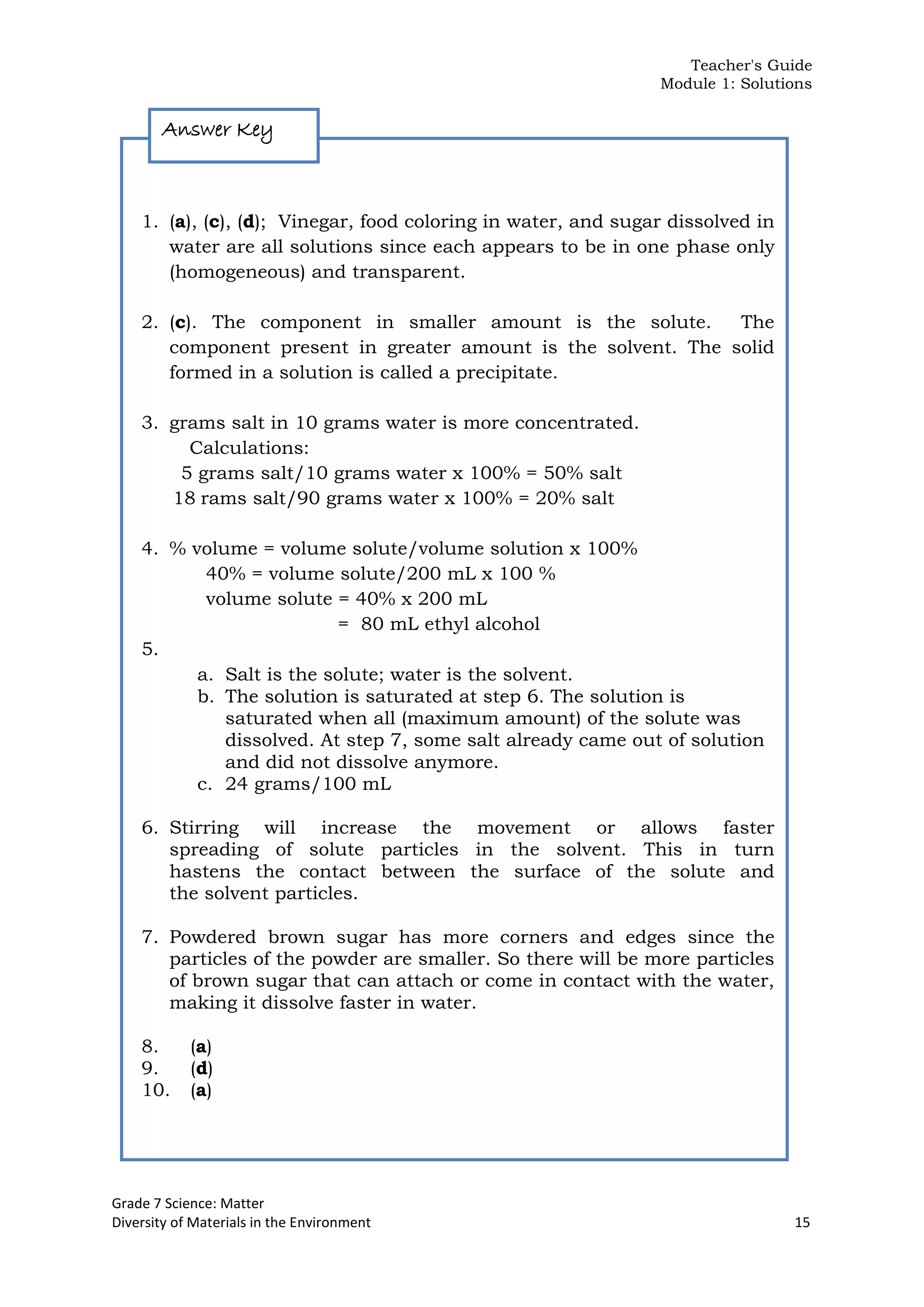
       Answer Key


    1. (a), (c), (d); Vinegar, food coloring in water, and sugar dissolved in
       water are all solutions since each appears to be in one phase only
       (homogeneous) and transparent.

    2. (c). The component in smaller amount is the solute.      The
       component present in greater amount is the solvent. The solid
       formed in a solution is called a precipitate.

    3. grams salt in 10 grams water is more concentrated.
         Calculations:
        5 grams salt/10 grams water x 100% = 50% salt
       18 rams salt/90 grams water x 100% = 20% salt

    4. % volume = volume solute/volume solution x 100%
           40% = volume solute/200 mL x 100 %
           volume solute = 40% x 200 mL
                          = 80 mL ethyl alcohol
    5.
          a. Salt is the solute; water is the solvent.
          b. The solution is saturated at step 6. The solution is
             saturated when all (maximum amount) of the solute was
             dissolved. At step 7, some salt already came out of solution
             and did not dissolve anymore.
          c. 24 grams/100 mL

    6. Stirring will increase the movement or allows faster
       spreading of solute particles in the solvent. This in turn
       hastens the contact between the surface of the solute and
       the solvent particles.

    7. Powdered brown sugar has more corners and edges since the
       particles of the powder are smaller. So there will be more particles
       of brown sugar that can attach or come in contact with the water,
       making it dissolve faster in water.

    8.      (a)
    9.      (d)
    10.     (a)


Grade 7 Science: Matter
Diversity of Materials in the Environment                                       15
Teacher's Guide
                                                             Module 1: Solutions


References

Brady, J. E. & Senese, F. (2004). Chemistry: Matter and its changes, 4th
    edition. River Street Hoboken, NJ: John Wiley & Sons, Inc.

Bucat, R. B. (Ed.) (1984). Elements of chemistry: Earth, air, fire & water.
    Volume 2. Canberra City, A.C.T., Australia.

California Grade 7 Science. (2009) Cluster 2: Particle theory of matter,
     Grades 5 to 8: A foundation for implementation. Retrieved January 17,
     2012 from
     http://www.edu.gov.mb.ca/k12/cur/science/found/5to8/7c2.pdf.

Elvins, C., Jones, D., Lukins, N., Miskin, J., Ross, Bo., & Sanders, R. (1990)
     Chemistry one: Materials, chemistry in everyday life. Port Melbourne,
     Australia: Heinemann Educational Australia.

Hill, J. W. & Kolb, D. K. (1998). Chemistry for changing times, 8th edition.
      Upper Saddle River, NJ: Prentice Hall.

Kurtus, Ron (13 January 2006). Mixtures. Retrieved Jan 9, 2012 from
    http://www.school-for-champions.com/chemistry/mixtures.htm.

Philippines. Department of Education (2004). Chemistry: Science and
     technology textbook for 3rd year. (Revised ed.) Quezon City: Author.

University of California at Berkeley. CEPUP Lawrence Hall of Science.
    (1990). Chemistry survey & solutions and pollution. Menlo Park,
    California: Addision-Wesley Publishing Company.


Grade 7 Science: Matter
Diversity of Materials in the Environment                                    16
Teacher's Guide
                                                        Module 2: Substances & Mixtures

MODULE 2: SUBSTANCES AND MIXTURES

       In this module, students will broaden their knowledge about the
different samples of matter. They will find out that mixture is just one of the
two major classes of matter. The other of which is the substance. Based on
differences in behavior under certain conditions, they should be able to
distinguish one from the other.

Key questions for this module

                   How are mixtures different from substances?
                             How are they similar?


A series of activities will gear the students in answering the questions above.
With the hope that students will find connection between the topics they have
learned in the lower grade levels to the ones they are about to learn, the first
activity will bring them to their past lesson on separating mixtures. Moreover,
the products obtained from this activity will be the ones used for the
proceeding activity which will focus on differentiating substances from
mixtures. In this manner, the students will be more convinced that mixtures
may be composed of substances. A culminating activity will check if they have
learned the distinguishable behaviors between these classes of matter vis-à-
vis their ability to design an investigation.

Skills enhanced in this module
                   Science Inquiry Skills                       Manipulative Skills

                                                 through
   making qualitative and quantitative observations        observing proper behavior in
                                                             the laboratory to prevent
   drawing inferences from observations                     accidents and errors
   organizing and tabulating data                          using the correct technique in
                                                             smelling, feeling, and tasting
   comparing and contrasting behaviors of
                                                             samples
    substances and mixtures
                                                            using the correct technique in
   classifying samples as mixtures and substances
                                                             making temperature readings
   plotting and interpreting line graphs
                                                            setting up equipment for
   stating a generalization based on observations or        boiling and melting samples
    data which are consistent in a number of trials
                                                            constructing an improvised
                                                             equipment


Grade 7 Science: Matter
Diversity of Materials in the Environment                                              17
Teacher's Guide
                                                      Module 2: Substances & Mixtures

   Activity

     1        Seawater! See water and salt!


      In grade 6, students have encountered several ways in separating
mixtures. Most of them are techniques to separate heterogeneous mixtures
such as scooping, filtration, and
                                              Characteristics of Mixtures
decantation. In this activity, they will
experience a way of separating the            may be solid, liquid or gas
components      of   a    homogeneous         may be homogeneous or
mixture. It is important that they are         heterogeneous
aware of the kind of sample they are          made up of two or more
working with — mixture. They may               components
review some characteristics of mixtures       components may be
such as those in the table on the right.       separated/recovered by
They may check the sample that they            physical means such as
are going to use in this activity if it        filtration, and distillation
does have the characteristics listed in       amount of components may
the table. The students should know            vary
that the seawater sample is made up of
components; however, they cannot be distinguished because the sample is
homogeneous. This activity will help them “see” the components of their
seawater sample which are salt and water. They will distill the water out from
the mixture and may refer to this product as distilled water. The remaining
sample will evaporate out the rest of the water leaving salt crystals.


        Important!
             Emphasize the ones written in the “Take Care!” boxes.

             Make sure to use glassware that were not previously used for
              harmful chemicals. The students will be asked to taste a portion of
              the distillate.


Grade 7 Science: Matter
Diversity of Materials in the Environment                                           18
Teacher's Guide
                                                      Module 2: Substances & Mixtures


      Teaching Tips


          Alternative materials
             Salt solution instead of seawater. To prepare a salt solution, add
               about 3.0g table salt and 10 mL water. Mix well and filter
               undissolved particles.
             Broken tiles or porous pot chips instead of boiling chips. The chips
               can be reused two times. After the activity, collect all the chips.
               Wash, dry and then keep them in a covered container.
             Ballpen casing and rubber hose instead of the delivery tube used
               for the distillation setup.
             Aluminum foil instead of evaporating dish. The foil may be
               shaped like a bowl and fitted around the mouth of a beaker. See
               Figure 2 in Student Module 2.

          Wire gauze without the asbestos. Simply scrape off the asbestos
           center of those old wire gauze, provided they are not yet worn out.
           Collect the asbestos and dispose of properly.

          Distillation techniques
            Do not remove the flame from the test tube while distillation is in
              progress. This may cause the cold liquid to be sucked back into
              the hot test tube. Remove the receiving test tube first before
              extinguishing the flame.
            Do not let the solution in the sample flask dry up. Remove the
              flame as soon as the liquid in the sample flask is only about 1 cm
              high from the bottom.
            Keep the receiver in the water bath while doing the distillation. It
              is better to add ice to the water bath.

          You may discuss the distillation techniques above and ask the
           students the possible reason for such techniques. Allow the
           students to think or give them prompt questions that may lead them
           to think of the reasons.

          Let the students be the ones to assemble the distillation setup,
           however make sure that they have done it correctly. You may
           include this as an assessment.


Grade 7 Science: Matter
Diversity of Materials in the Environment                                            19
Teacher's Guide
                                                       Module 2: Substances & Mixtures


        Answers to Activity Questions


  Q1. The liquid is tasteless like ordinary drinking water. No, seawater is
      salty while the distillate is not.

  Q2. There are some small, solid crystals left.

  Q3. The residue tastes salty. It tastes like salt.


  Activity

    2        Looks may be Deceiving

      In Activity 1, students have learned that mixtures, despite the
homogeneity, are made up of components. These components were referred
as substances. However, the word substance is being introduced in the
module for the first time. The students may not have any idea on what a
substance is. Hence, this activity will build in the students the concept of
substance from their previous knowledge on mixtures. They will find out that
the behavior of mixtures are much different than those of substances. Being
so, substance is another class of matter.

       This activity is divided into two parts: part A will differentiate
substances and mixtures through the way the temperature changes during
boiling; while in part B, these two are differentiated through how they
appear/behave while they are melting. Both parts will make use of samples
that appear to be identical. Part A will use the distilled water obtained in
Activity 1 and seawater; while Part B will use benzoic acid and a mixture of
benzoic acid and salt. They will first differentiate the samples based on
appearance. They will find it difficult to identify one from the other by simply
looking at them since they are homogeneous. As such, looks may be
deceiving. Only after the activity, they will realize a way these samples may be
differentiated. From here, the students will give their operational definition of
substances.

      It is highly encouraged to use the distilled water obtained in Activity 1
as the sample for Part A. In this manner, the students will be more convinced
that mixtures may be composed of substances. Salts that were recovered
from Activity 1 are still mixtures of different salts and minerals. In effect, it
may be said that mixtures may also be composed of mixtures.


Grade 7 Science: Matter
Diversity of Materials in the Environment                                            20
Teacher's Guide
                                                     Module 2: Substances & Mixtures
       Reminders


          In part A, make sure the students will boil the distilled water
           sample first. In this manner, the chances of contaminating the
           distilled water may be lessened. Also, make sure the seawater
           sample has the same odor as distilled water. Allow the seawater to
           dissipate its characteristic odor by leaving the container partly
           covered overnight.

          In part B, make sure the samples are placed in their assigned X
           marks of the improvised melting dish.

          The expected results and generalization are as follows. Allow the
           students to come about these generalizations by themselves as you
           facilitate in processing their results.
            During boiling, the temperature of a substance changes at first
              then it becomes the same, while the temperature of a mixture is
              different at different times.
            During melting, a substance melts completely/smoothly within
              a short time; while the mixtures have portions that seem to be
              not melting.

          Do the following after Activity 2 to emphasize that melting and
            boiling behavior of a substance are the same even the amount
            changes.
            Boil different volumes (1 mL, 3mL, 5mL) of distilled water. Ask
              the students to describe the boiling behavior of distilled water in
              different volumes. (The behavior is the same for the different
              volumes of distilled water, i.e., the temperature changes at first
              then it becomes the same.)
            Melt different amounts (1 scoop, 2 scoops, 3 scoops, 4 scoops) of
              benzoic acid. Ask the students to describe the melting behavior
              of benzoic acid in different amounts. (The behavior is the same
              for the different amounts of benzoic acid, i.e., the samples melt
              completely/smoothly within a short time.)
            Let them think of other properties that will not change with the
              amount of a substance (e.g., density).


Grade 7 Science: Matter
Diversity of Materials in the Environment                                           21
Teacher's Guide
                                                       Module 2: Substances & Mixtures

          Teaching Tips

             Emphasize that the samples that will be used in Part A are the
              products from Activity 1. Part B will not be using the ones collected
              from Activity 1. However, after the activity, students will infer the
              melting behavior of one of its products.

             The melting dish made by other classes or batches may be used.
              You may skip the construction of an improvised melting dish if it is
              already available.

             In case some materials for Part B are not available, a video may
              serve as an alternative. To get a copy of this video, please access
              curriculum.nismed.upd.edu.ph.

             Allow students to tinker with the samples so they may be able to
              give a rich description for each of them. Hand lens, if available, may
              be used.

             Let the students assemble the setup for boiling. This will give an
              opportunity for the students to enhance their lab/manipulative
              skills. This can also be included as an assessment.

             Review techniques in the proper use of a laboratory thermometer.
              Make sure temperature is read at the eye level. There is no need to
              shake the thermometer to bring the reading to zero.


Grade 7 Science: Matter
Diversity of Materials in the Environment                                            22
Teacher's Guide
                                                   Module 2: Substances & Mixtures


       Teaching Tips


          Check how your students construct their graphs. This part is an
           opportunity to reinforce what they have learned about
           investigations in Module 1. This can be a way to check if they
           understand the concepts of independent and dependent variables;
           and if they can plot using the appropiate graph to show their
           results.
            Let them identify the kind of graph (line) that best suits their
              data.
            Let them identify the independent (time) and the dependent
              (temperature reading in oC) variables.
            Let them plot the graph and see to it that it is correctly done.
              - The data for the x-axis must be the independent variable,
                 while the y-axis is for the dependent variable.
              - The scale is appropriate. They should have regular intervals
                 in their x-axis. Since reading is done every 30 sec, you can
                 suggest that they plot every reading they have obtained.
                 Hence, the x-axis will have 30 sec per unit.
              - The axes should be labelled with both quantity and units.
              - There is a descriptive title for their graph.

          Compare the data obtained by the different groups. Discuss
           similarities and differences among these data. Make a
           generalization based on the data obtained. Emphasize that this
           generalization was based on data that is consistent in a number of
           trials.

          After doing Part B of Activity 2, ask the students to describe how
           sodium chloride melts. Tell them that it is a substance. After some
           students have shared their answers, show them a video on how
           sodium chloride melts.


Grade 7 Science: Matter
Diversity of Materials in the Environment                                        23
Teacher's Guide
                                                       Module 2: Substances & Mixtures

       Teaching Tips

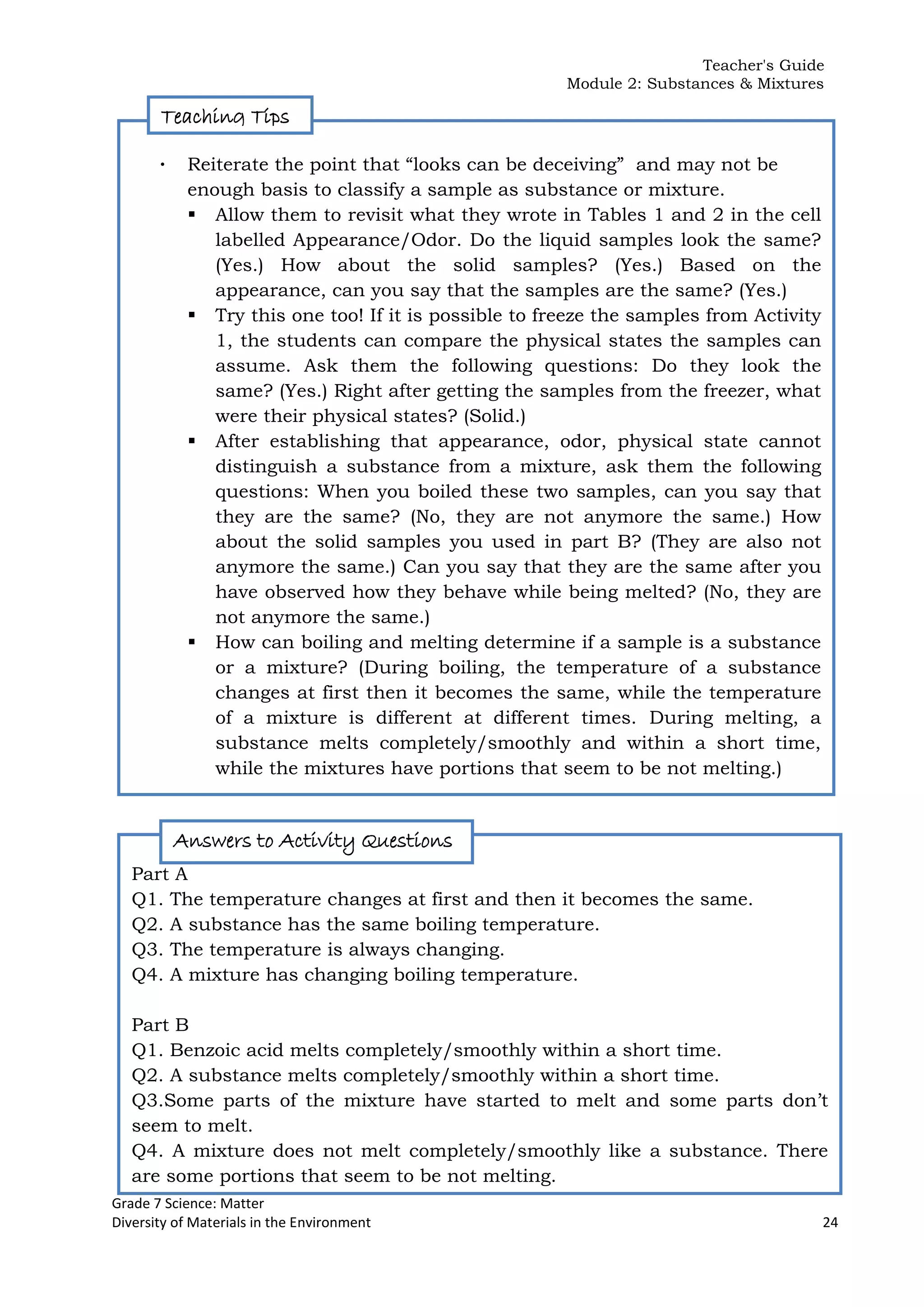
           Reiterate the point that “looks can be deceiving” and may not be
            enough basis to classify a sample as substance or mixture.
             Allow them to revisit what they wrote in Tables 1 and 2 in the cell
               labelled Appearance/Odor. Do the liquid samples look the same?
               (Yes.) How about the solid samples? (Yes.) Based on the
               appearance, can you say that the samples are the same? (Yes.)
             Try this one too! If it is possible to freeze the samples from Activity
               1, the students can compare the physical states the samples can
               assume. Ask them the following questions: Do they look the
               same? (Yes.) Right after getting the samples from the freezer, what
               were their physical states? (Solid.)
             After establishing that appearance, odor, physical state cannot
               distinguish a substance from a mixture, ask them the following
               questions: When you boiled these two samples, can you say that
               they are the same? (No, they are not anymore the same.) How
               about the solid samples you used in part B? (They are also not
               anymore the same.) Can you say that they are the same after you
               have observed how they behave while being melted? (No, they are
               not anymore the same.)
             How can boiling and melting determine if a sample is a substance
               or a mixture? (During boiling, the temperature of a substance
               changes at first then it becomes the same, while the temperature
               of a mixture is different at different times. During melting, a
               substance melts completely/smoothly and within a short time,
               while the mixtures have portions that seem to be not melting.)


           Answers to Activity Questions
   Part A
   Q1. The temperature changes at first and then it becomes the same.
   Q2. A substance has the same boiling temperature.
   Q3. The temperature is always changing.
   Q4. A mixture has changing boiling temperature.

   Part B
   Q1. Benzoic acid melts completely/smoothly within a short time.
   Q2. A substance melts completely/smoothly within a short time.
   Q3.Some parts of the mixture have started to melt and some parts don’t
   seem to melt.
   Q4. A mixture does not melt completely/smoothly like a substance. There
   are some portions that seem to be not melting.
Grade 7 Science: Matter
Diversity of Materials in the Environment                                               24
Teacher's Guide
                                                          Module 2: Substances & Mixtures


 Activity

   3         My Unknown Sample: Substance or Mixture?


       This activity may assess two things: 1) their understanding of the
distinguishable behaviors between substances and mixtures; and 2) their
ability to conduct an unstructured investigation. Each student is given one
unknown sample, either a solid or liquid. Refer to the table below for some
samples that may be used as unknowns. They will design a procedure that
will identify their unknown sample as substance or mixture. They will decide
which methodology is best fitted to test their sample. This procedure may be
critiqued by their fellow students but you will still be the one to give the final
check and “go signal” to do the activity.

Some unknown samples that may be used in the activity
                           Liquid                                 Solid

        Substance                     distilled water         benzoic acid

                                            vinegar        benzoic acid-salt*

                                                            benzoic acid-
            Mixture                   mineral water
                                                        monosodium glutamate*

                                            seawater    benzoic acid-white sugar*

*The ratio between the two components is 1:1.


      Answers to Activity Questions
Q1. Answers will depend on the student’s unknown.
    For solid unknown, determine its melting behavior to identify whether
   it is a substance or a mixture. A substance melts
   completely/smoothly, while a mixture takes longer time to completely
   melt.
    For liquid unknown, determine its boiling behavior to identify whether
   it is a substance or a mixture. A substance has a constant boiling
   temperature, while a mixture boils at a temperature range.

       Note that the method has to be repeated at least three times before
       the student can conclude if their unknown sample is a substance or a
       mixture.


Grade 7 Science: Matter
Diversity of Materials in the Environment                                               25
Teacher's Guide
                                                       Module 2: Substances & Mixtures


 Pre/Post Test


    1. You were tasked to check if the liquid sample you have is a substance
       or a mixture. Which among these tests is the BEST way to do so?

         I.         Color comparison                 III.   Boiling test
         II.        Taste comparison                 IV.    Melting test


        A.     I,   II, III and IV
        B.     I,   II and III only
        C.     I,   II and IV only
        D.     I    and III only


    2. A liquid has the following properties: one-phase, colorless, boils at
       varying temperature. Which of the following BEST describes the
       liquid?

        A.     Solution
        B.     Substance
        C.     Suspension
        D.     Coarse mixture


    3. Jill has an unopened box of a 2-meter foil labeled 100% made of
       aluminum. Aluminum is a substance. Jill takes just a thumb-size
       piece of the aluminum foil. Which of the following statements is
       TRUE about the piece of aluminum foil that Jill took compared with
       the rest that was left in the box?

        A.     Its mass and melting behavior are different.
        B.     Its mass and melting behavior are the same.
        C.     The mass is different but the melting behavior is the same.
        D.     The mass is the same but the melting behavior is different.


                                                               Answer Key
                                                               1. D
                                                               2. A
                                                               3. C


Grade 7 Science: Matter
Diversity of Materials in the Environment                                            26
Teacher's Guide
                                                  Module 3: Substances & Mixtures

Reference

    (no author). (no date). Atoms, elements, and compounds. Retrieved
        January 16, 2012, from http://www.kgg.org.uk/atoms.html

    (no author). (no date). Lesson 6: Pure substances. Retrieved January 30,
       2012, from
       http://www.saskschools.ca/curr_content/science9/chemistry/lesson
       6.html

    American Association for the Advancement of Science. (no date). AAAS
      science assessment. Retrieved March 30, 2012, from
      http://assessment.aaas.org/pages/home

    Burns, R.A. (1999). Fundamentals of chemistry. New Jersey: Prentice-
       Hall, Inc.

    College of Southern Idaho. (2003). Melting point tips and guidelines.
       Retrieved January 21, 2012, from
       http://www.csi.edu/ip/physci/faculty/rex/MPTips.htm

    Hill, J.W., & Kolb, D.K. (1998). Chemistry for changing times 8th edition.
       New Jersey: Prentice-Hall, Inc.

    Padolina, M.C.D., Simon-Antero, E., Alumaga, M.J.B., & Estanilla, L.C.
       (2004). Conceptual and functional chemistry. Quezon City: Vibal
       Publishing House, Inc.

    Philippines. Ministry of Education and Culture. (1980). Chemistry in our
       environment: High school science III (Teacher’s ed.). Quezon City:
       Author

    Philippines. Department of Education. (2009). Chemistry: Science and
       technology textbook for 3rd year. (Reprint ed.). Quezon City: Author

    Shugar. G., & Dean, J. (1990). The chemist’s ready reference handbook.
      USA: McGrawHill, Inc.


Grade 7 Science: Matter
Diversity of Materials in the Environment                                           27
Teacher's Guide
                                                 Module 3: Elements & Compounds


MODULE 3: ELEMENTS AND COMPOUNDS

       In this module, students will begin broadening and deepening their
knowledge about substances. They will find out that substances, like
mixtures, are of various kinds. Being so, like mixtures which may be
classified in many ways such as solution, suspension, and colloid;
substances may also be further classified into smaller groups, such as
elements and compounds.


Key questions for this module


                How are elements different from compounds?
                           How are they similar?


       A series of activities will gear the students in answering the questions
above. With the hope that students will find connection between the topics
they have learned in the lower grade levels to the ones they are about to
learn, the first activity will resurface some ideas from Module 2. It will begin
with compound, for the reason that it is more comparable with mixtures in
terms of the number of components they are made of. Moreover, the
products obtained from this activity will serve as the examples used to
introduce the next concept, which is element. In this manner, the students
will see better the connection between compounds and elements, that is,
compounds are made up of elements. The periodic table will also be
introduced to familiarize the students with the elements and the periodic
table per se. Two activities culminate this module which will let the
students realize that these elements and compounds are found just about
anywhere, even with the food they eat.


Grade 7 Science: Matter
Diversity of Materials in the Environment                                           28
Teacher's Guide
                                                 Module 3: Elements & Compounds

   Activity

     1        Water, “Wat-er “You Made Of?


       In Module 2, students have learned that substances and mixtures
share some similarities such as homogeneity. All substances are
homogeneous while only some mixtures are. Also, they learned that being
homogeneous does not automatically say that a sample is made up of only
one component. This holds true for one group of substances — the
compounds. Compounds are homogeneous which are also made up of
components. In this activity, the students will separate components of
widely used compound — water. They will learn that water is made up of the
elements hydrogen and oxygen. The properties of each of these substances
are different from one another.

      Components of water are separated through the passage of an electric
current, hence the process is termed as electrolysis. The students will use
an improvised electrolysis apparatus. You will find below how to construct
one from commonly available materials.


   Reminders
 Acquaint the students with the
  apparatus before doing the activity.
  Emphasize some parts (as shown in
  Figure 1) because they will be                                           electrolysis
  mentioned in the activity procedure.                           1    1
                                                                           syringe
                                                                 2    2
                                                                 3    3
                                                                 4    4
                                                                 5    5


                                              sample
                                                                 6    6


 Prepare ahead 5% NaOH. You may
                                                                 7    7
                                                                 8    8


                                              container
                                                                 9    9
                                                                 10   10


  either use NaOH pellets or Liquid Sosa.
                                                                 11   11


   NaOH pellets. Place 100 mL distilled                                     stainless
     water in a beaker. Dissolve carefully                                   screw
     5 g of NaOH pellets (corrosive).
     Store NaOH solution in PET bottle.
     Label with its name, concentration       Connect red
                                                                           Connect black
                                              wire to positive
                                                                           wire to negative
     and date of preparation. NaOH            (+) terminal of
                                                                           (-) terminal of
                                              the dry cell.
     absorbs CO2 from air. Its                                             the dry cell.

     concentration could change after        Figure 1. An improvised electrolysis
     some time.                              apparatus
   Liquid Sosa. Mix thoroughly 1mL
     liquid sosa and 20mL water.

Grade 7 Science: Matter
Diversity of Materials in the Environment                                                 29
Teacher's Guide
                                                   Module 3: Elements & Compounds


      Teaching Tips


         Run down the procedure before doing the activity. Together,
          visualize what is supposed to be done. Have one complete setup the
          students can look at while emphasizing some procedures. Ask some
          questions as you go through each step, for example:

             Procedure 1: What are the components of a 5% sodium
              hydroxide solution? (Sodium hydroxide and water.) How much
              in percentage is each of these components present in the said
              solution? (95% water and 5% sodium hydroxide.) What is the
              component that is of highest amount in the solution? (water.)
             Procedure 2: What is the basic solution referred to? (5% sodium
              hydroxide solution) Why is it referred as a basic solution?
              (Sodium hydroxide is a base.)
             Procedure 4: Here is the dry cell, where will you connect the red
              wire? (Positive terminal.) How about the black wire? (Negative
              terminal.)

         Assess your students’ capability in doing the activity. If you find
          that the students are not yet ready to be the ones to do this, you
          are free to make this as a demonstration activity instead.

         Emphasize the difference in behavior of the the two products. In the
          presence of a flame or spark, hydrogen gives off a “pop” sound while
          oxygen induces a brighter spark. You may also try doing the same
          thing with water. Collect some water vapor in a test tube and insert
          a glowing stick/flame. Nothing is supposed to happen. This will let
          the students observe that these three exhibit different behaviors,
          hence are different substances.


       Answers to Activity Questions


  Q1. A “pop” sound was heard.

  Q2. A brighter spark was observed.


Grade 7 Science: Matter
Diversity of Materials in the Environment                                             30
Teacher's Guide
                                                                    Module 3: Elements & Compounds


Construction of an Improvised Electrolysis Apparatus
Materials Needed

       glue
       ruler
       alcohol lamp
       stripping knife
       dry cells (1.5V)
       2 paper clips (bulldog type)
       3 disposable syringes (10 mL)
       2 stainless steel screws #6 (2 x 12)
       2 connecting wires (red and black)
       GI wire (about 6 cm, ordinary wire)
       plastic bottle (1 L, 8 cm in diameter or more), preferably thick and
        hard
       hard plastic straw or dextrose plastic tube (6 cm long)


Procedure       (Source: Practical Work in High School Chemistry)


    1. Get two disposable 10 mL syringes and
       remove the plungers. Attach the two syringes at
       the base. Using an alcohol lamp, heat the edge
       of the base to be attached. Refer to the figure on
       the right.


    2. Insert each tip of the syringe inside a
       plastic straw about 6 cm long. Bend the
       straw to close it and place a bulldog type
       paper clip on the bend to keep it in place.
       Refer to the figure on the right. These will
       serve as the “electrolysis syringes”.


Grade 7 Science: Matter
Diversity of Materials in the Environment                                                              31
Teacher's Guide
                                                  Module 3: Elements & Compounds


Construction of an Improvised Electrolysis Apparatus


    3. Divide the plastic bottle into three portions. Mark “cutting lines”
       around the bottle. Refer to the figure on the right.

        Distance between cutting-line marks:
            Bottom portion (3): about 5 cm from the
              bottom part of the bottle.          1
                                                      2                   6 cm
                Middle portion (2): about 6 cm
                 from the marked line of the
                 bottom portion (3)                    3                     5 cm


        Heat the stripping knife in an alcohol lamp. Use the hot stripping
        knife to cut around these line marks.


    4. Use the middle portion of the bottle to
       make a stand for the sample container.
       Make two small squares measuring about 2
       cm x 2 cm at opposite sides of the base.
       These will serve as passageway for the
       connecting wires.                        2 cm x x cm
                                                2cm 22cm


    5. Use the bottom portion of the bottle as the sample
       container. Measure the distance between
       the centers of the “electrolysis syringes”.
       Mark this length with a line on the
       bottom of the cup. Then using a hot GI
       wire (2 mm in diameter) bore a small hole
       at each end of the line. The stainless screws
       will pass through these holes.


Grade 7 Science: Matter
Diversity of Materials in the Environment                                            32
Teacher's Guide
                                                          Module 3: Elements & Compounds


  Construction of an Improvised Electrolysis Apparatus


     6. Insert the stainless screw through each hole by
        rotating it carefully until 1/4 of the nail is out at
        the bottom of the bottle. Refer to the figure on
        the right. To prevent leaks, apply glue around
        the stainless screws at the bottom part of the
        sample container.


         Note: The glue should only be applied on the outside
         surface of the sample container.


     7. Support the sample container on the stand
        prepared in #3. Refer to the figure on the right.


     8. Invert the “electrolysis syringes” over the
     stainless screws. Complete the setup as
     shown in the figure on the right. Insert the dry               1
                                                                    2
                                                                    3
                                                                    4
                                                                         1
                                                                         2
                                                                         3
                                                                         4


     cells between the connecting wires when you
                                                                    5    5
                                                                    6    6
                                                                    7    7
                                                                    8    8
                                                                    9    9
                                                                    10   10


     are ready to do the electrolysis.
                                                                    11   11


                                              Connect to positive             Connect to
                                              (+) terminal of the             negative (-)
                                              dry cell                        terminal of the dry
                                                                              cell


Note: This procedure is also available in
http://curriculum.nismed.upd.edu.ph/2012/04/how-to-make-an-
improvised-electrolysis-apparatus/

 Grade 7 Science: Matter
 Diversity of Materials in the Environment                                                          33
Teacher's Guide
                                                      Module 3: Elements & Compounds


  Activity

    2          The Periodic Table: It’s Element-ary!


       In Activity 1, they were able to generate two elements — hydrogen and
oxygen. In this activity, they will find out that these two elements are just a
fraction of the numerous elements currently existing. Also, that these are
the substances that are homogeneous which are made up of only one
component. Being so, they are said to be the “simplest form of matter”.

       All of the elements are systematically organized in the periodic table. It
was described to be “amazingly” done as varied information about all of the
elements are laid out in a single table. Patterns and trends are evident in the
arrangement. It serves as a handy reference and as such was labelled as a
chemist’s tool. This tool can then be a good starting material to learn about
the different elements. However, note that this is the first time for the
students to formally use this tool. Being so, this activity, as it walks them
through the periodic table, focuses only with the basic information — name
and symbol. Do not overwhelm them with the vast information the periodic
table can provide. Worse, if they are required to memorize its contents.
Gradually, let them realize these different information through varied
activities that require its use. In that manner, they may find the periodic
table not that complicated — it’s even quite simple that it’s “element-ary”.

      Reminders

            Periodic table is a tool in Chemistry that we can refer to every now
             and then. The more we use it, the more we get to be familiar with
             what it contains. Thus, there is no need to memorize such table.

            A periodic table is provided at the end page of Modules 3 and 5. The
             information placed there is limited to the scope of the module for
             this quarter. It is highly encouraged to begin with the names and
             symbols of the elements as they try to know what the elements are.
             Group number will be introduced at the latter part of the activity.
             Atomic numbers, at this point, will serve as a guide on how
             elements are sequenced in the table; it will not be defined as the
             number of protons of an element’s atom. The latter will be discussed
             in grade 8 when they have already learned about the particulate
             nature of matter.
Grade 7 Science: Matter
Diversity of Materials in the Environment                                                34
Teacher's Guide
                                                  Module 3: Elements & Compounds

   Teaching Tips

       Show students pictures of some elements. You may refer to some of
        the books and websites listed at the end page of this guide. They may
        give other descriptions of the elements such as physical state at
        standard conditions and color. If possible, use real samples .

       As an assignment, a student may choose one element and find more
        information about it. A poster or something similar may be done as if
        the student is trying to promote that element.


    Answers to Activity Questions

       Table 1. Name and symbol of some elements and the group
       number it belongs to.
                                             Group Number
         Q#         Name         Symbol
                                                  (Q9)

                  beryllium                 Be           2
                  phosphorus                 P          15
            1
                  germanium                 Ge          14
                  darmstatdtium             Ds          10
                  boron                     B           13
                  nitrogen                  N           15
            2
                  fluorine                   F          17
                  vanadium                  V            5
                  lithium                   Li           1
                  chlorine                  Cl          17
            3     argon                     Ar          18
                  calcium                   Ca           2
                  manganese                 Mn           7
                  iron                      Fe           8
                  silver                    Ag          11
            4
                  mercury                   Hg          12
                  lead                      Pb          14
                  silicon                   Si          14
            5     magnesium                 Mg           2
                  gold                      Au          11
                  aluminum                  Al          13
                  copper                    Cu          11
            6
                  tin                       Sn          14
                  carbon                    C           14
            7     potassium                 K            1
                  titanium                  Ti           4
            8
                  barium                    Ba           2
Grade 7 Science: Matter
Diversity of Materials in the Environment                                            35
Teacher's Guide
                                                    Module 3: Elements & Compounds


 Activity

   3         The “Matter” on Labels


      Food in itself is a sample of matter and thereby made up of either
elements, compounds or mixtures. By law, these matter must be written in
food labels. In this activity, the students will find these matter on food
labels. They will focus on the elements and compounds that make up the
food they eat. They will be more aware of the existence of elements and
compounds around them. They will find out that these elements are some of
the nutrients that a food provides. These nutrients are called minerals.
They can find them listed in the Nutrition Facts. Moreover, these minerals
are not added as the elements themselves. Most of the time, compounds of
that element are the ones added to manufacture the food. Being so, it is the
compound which is the one listed as the Ingredient.

       Aside from the knowledge the students may gain in this activity, it is
also hoped that the students acquire the habit of reading food labels. The
food they eat has a major implication to their health and well-being. It is
imperative then to be aware of what is taken in by the body. These are all
listed in a food label. Therefore, reading food labels “matter”.


            Teaching Tips

            Ask the students to bring more food labels. The ones used in the
             activity are hoped to be only supplemental.

            As an assignment, the students can find product labels other than
             food such as medicine, household cleaning products, cosmetics and
             tolietries. They can identify elements and compounds listed on those
             labels.


Grade 7 Science: Matter
Diversity of Materials in the Environment                                              36
Teacher's Guide
                                                      Module 3: Elements & Compounds


          Teaching Tips

           In the activity, the students will find out that the list of ingredients
            does not seem to contain those nutrients in the Nutrition Facts. The
            iron reported in chocolate candy is provided by the unsweetened
            chocolate/cocoa listed in the ingredient. This is an opportunity to
            emphasize that aside from knowing the name of the compound, it is
            an added advantage if they are familiar with the natural mineral
            content of the food. Some of them are listed in Table 2 of Module 3. It
            may also go the other way around. An ingredient is listed but does
            not have a counterpart in the Nutrition Fact. There may be two
            reasons for this. One is that the mineral is not that essential for
            health maintenance. The other is that the food product does not
            significantly provide that nutrient.


          Answers to Activity Questions


   Note: Answers below are based on those labels provided in the activity.
   However, it is highly encouraged that the students use additional labels
   for reference.

   Table 3. Compounds and their constituent elements written in the food
   labels
      Food Product                    Compound         Constituent Elements
                               iron pyrophosphate   iron, phosphorus, oxygen
    Cereal Drink
                               zinc sulfate         zinc, sulfur, oxygen
                                                    sodium, hydrogen, carbon,
                               sodium bicarbonate
    Chocolate candy                                 oxygen
                               calcium chloride     calcium, chlorine
                               monosodium           sodium, carbon, hydrogen,
    Soy sauce
                               glutamate            nitrogen, oxygen


Grade 7 Science: Matter
Diversity of Materials in the Environment                                                37
Teacher's Guide
                                                 Module 3: Elements & Compounds


     Activity

       4        The Iron-y of Food
       Most of the minerals added to the food are in the form of compounds,
for it is more easily absorbed by the body if it is in such form. Being so,
rarely that the element itself is added. However, there are food products
which are fortified with element iron.

       Iron in the blood is the one responsible in carrying oxygen from the
lungs to the rest of the body. For the body to function well, oxygen is
critically needed. Health officials had to find ways to ascertain that there is
enough iron in the food. Besides, there was a time when a lot of people were
stricken with anemia — sickness caused by a deficiency of iron. To address
this, most of the food products especially milk and cereal were required to
be fortified with iron. Some food are added with compounds of iron such as
ferrous sulfate, ferric pyrophosphate, and ferrous fumarate. However,
addition of some of these compounds affect the taste of the food. In effect,
consumers may not buy or patronize the food product. Food technologists
devised other ways to add iron to food products. One of which is to
manufacture a food grade iron. This is the elemental iron which was
subjected into a reduction process that makes it permissible to be added to
food. Being the element iron itself, properties of this substance are retained
such as its ability to be attracted by a magnet.

      In this activity, students will be able to recover the iron present in a
food product. Emphasize though that the iron in the food is safe to eat
compared to the iron that makes up the concrete nail and other products
that are not meant to be ingested. Also, the ones that will be recovered from
the activity should not be ingested.

       Most of the equipment needed for this activity may be available in
your TLE laboratory. A video* is provided in case the materials for this
activity are not easily accessible/available.
       *http://curriculum.nismed.upd.edu.ph/2012/04/the-iron-y-of-food/

      Answers to Activity Questions


  Q1. There are small, black pieces or bits that are attached to the magnet.
  Q2. With its attraction to the magnet, it is highly possible that the black
  bits recovered from the food are pieces of iron.


Grade 7 Science: Matter
Diversity of Materials in the Environment                                           38
Teacher's Guide
                                                      Module 3: Elements & Compounds


  Pre/Post Test


1. Which of the following statements is TRUE?

    A.   Ferrous sulfate cannot be broken down into simpler substances.
    B.   Compounds are made up of one kind of element.
    C.   Water is composed of more than two elements.
    D.   Compounds are more complex than elements.

2. Calcium chloride is a compound of the two elements calcium and
  chlorine. Which of the following statements is TRUE?

    A.   Calcium chloride is listed in the periodic table.
    B.   The symbol for calcium chloride includes Ca and Cl.
    C.   Chlorine may still be broken down into a simpler form.
    D.   Calcium and chlorine belong to the same group in the periodic table.

For questions 3 to 5. Refer to the information below. You may also refer to
the periodic table. Write the symbols only.

             Substance                 Substance   Substance
              Symbol                    melts at    boils at
          Ca                             850 oC     1490 oC
          Cu                            1083 oC     2600 oC
          Fe                            1540 oC     2900 oC
          He                            -270 oC     -269 oC
          Mg                             650 oC     1110 oC
          NCl3                           -37 oC      71 oC
          NO                            -163 oC     -152 oC
          Na2CO3                         858 oC      890 oC
          SiO2                          1610 oC     2230 oC

3. Which compound melts above 1000oC and boils above 2000oC?
4. Which element is gaseous at room temperature?
5. Which substance is liquid at 30oC?
                                                      Answer Key
                                                                 1.   D
                                                                 2.   B
                                                                 3.   SiO2
                                                                 4.   He
                                                                 5.   NCl3


Grade 7 Science: Matter
Diversity of Materials in the Environment                                                39
Teacher's Guide
                                                  Module 3: Elements & Compounds

Reference

 (no author). (no date). Melting and boiling points of compounds. Retrieved
   March 30, 2012, from http://www.gcsescience.com/imeltcomplz.htm

 (no author). (no date). Understanding food additives. Retrieved February 6,
   2012, from http://www.understandingfoodadditives.org/pages/Ch2p5-
   3.htm

 Burns, R.A. (1999). Fundamentals of chemistry. New Jersey: Prentice-Hall, Inc.

 Hill, J.W., & Kolb, D.K. (1998). Chemistry for changing times 8th edition.
   New Jersey: Prentice-Hall, Inc.

 Nutritionist-Dietitians’ Association of the Philippines. (2006). Iron
   fortification of rice: The Philippine experience. Retrieved February 18,
   2012, from http://www.ndap.org.ph/iron-fortification-rice-philippine-
   experience

 Padolina, M.C.D., Simon-Antero, E., Alumaga, M.J.B., & Estanilla, L.C.
   (2004). Conceptual and functional chemistry. Quezon City: Vibal
   Publishing House, Inc.

 Philippines. National Institute for Science and Mathematics Education
   Development. (2001). Practical work in high school chemistry: Sourcebook
   for teachers. Quezon City: Author

 Philippines. Department of Education. (2009). Chemistry: Science and
   technology textbook for 3rd year. (Reprint ed.). Quezon City: Author

 Rose, A. (2012). Iron rich foods: Foods high in iron for health. Retrieved
   February 18, 2012, from http://www.ironrichfood.org/

 USA. Department of Energy. (1991). Iron compounds and magnetism.
   Retrieved February 20, 2012, from
   http://www.newton.dep.anl.gov/askasci/chem03/chem03870.htm

 World Health Organization. (2004). Recommended nutrient intakes —
  minerals . Retrieved March 9, 2012, from
  http://whqlibdoc.who.int/publications/2004/9241546123_annexes.pdf


Grade 7 Science: Matter
Diversity of Materials in the Environment                                            40
Teacher's Guide
                                                             Module 2: Acids and Bases


MODULE 4: ACIDS AND BASES

       In this module, students will get acquainted with the properties of a
group of compounds—acids and bases. They will prepare plant indicators to
help them determine the acidity or basicity of common household items.
Upon completion of this module, students will be able to answer the
following key questions that will allow them recognize the characteristic
properties of acids and bases.

Key questions for this module


                  How acidic or basic are common household materials?
                  Does water from different sources have the same acidity?
                           What is the effect of acid on metals?


       Similar to Module 1, the activities have been developed in such a way
that concepts are developed gradually from the first to the last activity. It
starts with the students distinguishing between acidic and basic mixtures
through the use of a plant indicator, which they will prepare. Using the
plant indicator, they will determine the acidity or basicity of common
household items as well as that of water from different sources. In Activity 2,
students are guided to determine the pH of the solutions in Activity 1. In
Activity 3, students will investigate the effect of an acid on a metal like iron.
They will find out what happens after the metal has been in contact with the
acidic mixture for some time.


       Activity

         1            How can You Tell if a Mixture is Acidic or Basic?


      This is a colorful activity that the students will enjoy. Instead of using
litmus paper, which can only indicate if a sample is acidic or basic, the use
of plant indicators has an advantage since these can specify a range of pH
values.

     This activity is divided into three parts. Part A allows the students to
prepare the plant indicator and use it in Part B to determine the acidity or

Grade 7 Science: Matter
Diversity of Materials in the Environment                                          41
Teacher's Guide
                                                       Module 2: Acids and Bases

basicity of common household items. Similar to Part B, Part C gives the
students the opportunity to test different water samples from various
sources for acidity or basicity.

      If you want the class to always have indicator paper available for use,
then it is good to ask selected students to work on the following with the
guidance of the teacher outside of their class time in Science.

Preparing an eggplant/camote acid-base indicator paper


Note: You may do this if you need to use an indicator to test samples in
      other science activities.

1. Pour the indicator solution prepared in Part A into a shallow plastic or
   ceramic container. (Do not use a metal container.)

2. Cover the entire filter or bond paper with the indicator solution by
   dipping the paper into the solution.

3. Air dry for about five minutes. (There is no need to air dry the paper
   completely at this point.)

4. Repeat procedure numbers 1 and 2 three times or until the color of the
   paper becomes dark.

5. Continue drying the indicator paper. When the paper is completely dry,
   cut the paper into small square pieces. This is your indicator paper. Keep
   it in a covered bottle.

6. Label the bottle properly (with name of material and date of preparation).


Background Information on Indicators

      The red, purple, and blue colors of most flowers and some vegetables
contain compounds called anthocyanins. A typical anthocyanin is red in
acid, purple in neutral, and blue in basic solution. The eggplant extract
shows yellow in a strong base since it contains anthoxanthins (colorless in
acid, yellow in base) in addition to anthocyanins. Note that anthocyanins
and anthoxanthins are usually present in many plants. The green color is a
mixture of blue and yellow. Colors of anthocyanins in neutral to basic


Grade 7 Science: Matter
Diversity of Materials in the Environment                                    42
Teacher's Guide
                                                         Module 2: Acids and Bases

condition are very unstable. The purple, blue, and green colors will fade
and eventually turn to yellow upon exposure to air.


      Teaching Tips

  Part A

          Only one of the suggested plants will be prepared by all groups in
           the class.

          If the other plants are available, you may assign some groups to use
           the other suggested plants that can be used as indicators.

          Emphasize the caution written in the “Take Care!” box.

  Part C

          Instruct the students to use a wide-mouthed plastic container,
           about ½ liter capacity to collect water. The container for collecting
           water should be dipped or immersed about 6 inches or about 15 cm
           from the surface of the source of water.


Grade 7 Science: Matter
Diversity of Materials in the Environment                                      43
Teacher's Guide
                                                                     Module 2: Acids and Bases


       Answers to Activity 1

  Table 1. Acidic or basic nature of household materials

                Sample                      Color of indicator     Nature of sample
      calamansi                                                  strongly acidic
      tap water (water from                                      weakly acidic
      the faucet)
      distilled water                                            neutral
      vinegar                                                    strongly acidic
      sugar in water                                             weakly acidic or
                                                                 neutral (depending on
                                                                 the type of water
                                                                 used)
      baking soda                                                basic
      baking powder                                              basic
      soft drink (colorless)                                     strongly acidic
      coconut water (from                                        weakly acidic
      buko)
      toothpaste                                                 basic
      shampoo                                                    basic
      soap                                                       basic


      Reminders

         It is recommended that preparation for Activity 3 be started the
          day before Activity 2 is done. This will ensure that students have
          three days to observe the changes in each setup of Activity 3.

         Refer to the Teaching Tips for Activity 3 regarding instructions on
          the setups.


Grade 7 Science: Matter
Diversity of Materials in the Environment                                                  44
Teacher's Guide
                                                              Module 2: Acids and Bases


  Activity

    2          Color Range, pH Range !

       This activity introduces students to another method that can be used
to distinguish acids from bases. It is through the use of the pH scale, which
extends from 0 to 14. Students simply need to use color range given for
eggplant indicator in the student module.


      Teaching Tips

            If a universal indicator paper is available, it would be good to use
             it also and compare the pH observed with that of the plant
             indicator.

            The excess plant indicator can be stored in a bottle and kept in a
             cool dark place or inside a refrigerator.

            The pH indicated in the answers for Table 3 may not be exactly
             the same as the pH observed using the plant indicator prepared
             by the students. This is acceptable as long as the nature of the
             sample (acidic or basic) is the same as expected. This means that
             a sample of calamansi may not have exactly pH 2, but it should
             still be in the strongly acidic range.


Grade 7 Science: Matter
Diversity of Materials in the Environment                                           45
Teacher's Guide
                                                                   Module 2: Acids and Bases


        Answers to Activity 2


   Table 3. pH of samples from Activity 1

                                           pH based on
                 Sample                  eggplant/camote      Acidic or Basic
                                             indicator
       calamansi                        pH 2               strongly acidic
       tap water (water                 pH 5 to 6          weakly acidic
       from the faucet)
       Distilled water                  around pH 7        neutral
       vinegar                          pH 2 to 3          strongly acidic
       sugar in water                   pH 6-7             weakly acidic to
                                                           neutral
       baking soda                      pH 8 to 9          basic
       baking powder                    around pH 8        basic
       soft drink (colorless)           pH 2 to 3          strongly acidic
       coconut water (from              pH 5               weakly acidic
       buko)
       toothpaste                       pH 8 to 9          basic
       shampoo                          pH 8 to 9          basic
       soap                             pH 8 to 9          basic


   Answers to Part C will depend on the sources of water, so pH will
   depend on the specific water sample tested by the student.


Grade 7 Science: Matter
Diversity of Materials in the Environment                                                46
Teacher's Guide
                                                         Module 2: Acids and Bases
    Activity

      3        What Happens to Metals When Exposed to an Acidic
               Mixture?

      Teaching Tips

     The setup for this activity has to be prepared ahead of time. You can
      instruct the students to set up the iron nails.

      If 100-mL beakers are available in your school, beakers can be used.

     Follow step numbers 1 to 5 in the procedure for preparing the setup.

     Students should be observing and recording for 3 days.


      Answers to Activity Questions


Q1. There are three different bottles for each sample of iron nail to make
     sure that replicate data are gathered for the setups.
Q2. At the end of 3 days, the iron nail has rust all over its sides, head,
    and tip.
Q3. When iron rusts, it produces a characteristic flaky red-brown solid,
     commonly called iron rust.


      Further Explanation on Rusting of Iron

      Rust is hydrated iron or iron (III) hydroxide, Fe(OH)3, sometimes
written as Fe2O3∙3H2O. This layer does not securely stick to the surface
of the iron. It flakes off, weakening the metal and leaving it exposed to
further rusting and structural decay.

       Iron forms rust upon prolonged exposure to oxygen and moisture
in the air and in the presence of acid. Recall that the acid used in
Activity 3 is vinegar, which is about 4.5 to 5% acetic acid.

     Note that you do not need to let the students memorize the
chemical formula of iron rust. It is sufficient for Grade 7 students to
know that rust is hydrated iron or iron hydroxide.


Grade 7 Science: Matter
Diversity of Materials in the Environment                                      47
Teacher's Guide
                                                          Module 2: Acids and Bases


 Pre/Post Test


1. Arrange the following household items: toothpaste, bath soap, tap water,
   vinegar from the most acidic to most basic?

              a.   tap water, milk, toothpaste, vinegar
              b.   milk, tap water, vinegar, toothpaste
              c.   toothpaste, milk, tap water, vinegar
              d.   vinegar, tap water, milk, toothpaste

2. Arrange the household items in question number (1) from the item with
    the highest pH to the one with the lowest pH.

3. Give a reason why farmers need to know how acidic or basic the soil is
    before they plant their crop.

4. Give at least two (2) safe ways you should practice when you handle an
    acid, like muriatic acid.

5. Why does “rust” form on some metallic materials?


Grade 7 Science: Matter
Diversity of Materials in the Environment                                       48
Teacher's Guide
                                                           Module 2: Acids and Bases


     Answer Key


  1. (D) vinegar, tap water, milk, toothpast

  2. toothpaste, milk, tap water, vinegar

  3. Any one of the answers below is considered correct.

       (a) Some plants grow well in acidic soil while others prefer basic soil.
           Farmers need to know the pH of their soil since plants will only
           grow in a specific pH range.
       (b) The pH also affects how much nutrients from the soil become
            available to plants.

  4. Any two of the following answers is considered correct.

       (a)   Do not take internally (Do not taste nor drink).
       (b)   Avoid contact with eyes, nose and mouth.
       (c)   Use only in well ventilated areas.
       (d)   Always keep the container tightly sealed.
       (e)   Do not store in a warm place.
       (f)   Keep out of reach of children.

  5. A metal like iron forms rust when exposed for a long time to oxygen
       and moisture in the air and in the presence of an acid.


Grade 7 Science: Matter
Diversity of Materials in the Environment                                         49
Teacher's Guide
                                                       Module 2: Acids and Bases

References

Brady, J.E. & Senese, F. (2004). Chemistry: Matter and its changes, 4th
   edition. River Street Hoboken, NJ: John Wiley & Sons, Inc

Bucat, R.B. (Ed.) (1984). Elements of chemistry: Earth, air, fire & water,
   Volume 2. Canberra City, A.C.T., Australia: Australian Academy of
   Science.

Bucat, R. B. (Ed.) (1983). Elements of chemistry: Earth, air, fire & water,
   Volume 1. Canberra City, A.C.T., Australia: Australian Academy of
   Science.

Burns, R. A. (1999). Fundamentals of chemistry, 3rd edition. Upper Saddle
   River, N.J. Prentice-Hall, Inc.

Elvins, C., Jones, D., Lukins, N., Miskin, J., Ross, B., & Sanders, R. (1990).
    Chemistry one: Materials, chemistry in everyday life. Port Melbourne,
    Australia: Heinemann Educational Australia.

Gallagher, R. & Ingram, P. (1989). Co-ordinated science: Chemistry. Oxford,
    England: Oxford University Press.

Heffner, K. & Dorean, E. (n.d.) Must it rust? The reaction between iron and
    oxygen. Retrieved Feb 16, 2012 from
     http://www.haverford.edu/educ/knight-booklet/mustitrust.htm

Heyworth, R. M. (2000). Explore your world with science discovery 1. First
    Lok Yang Road, Singapore. Pearson Education South Asia Pte Ltd.

Hill, J.W. & Kolb, D.K. (1998). Chemistry for changing times, 8th edition.
     Upper Saddle River, NJ: Prentice Hall.

Philippines. Department of Education. (2004).Chemistry: Science and
     technology textbook for 3rd year. (Revised ed.). Quezon City: Author.


Grade 7 Science: Matter
Diversity of Materials in the Environment                                     50
Teacher's Guide
                                                   Module 5: Metals and Nonmetals


MODULE 5: METALS AND NONMETALS

       Students are already familiar with metals. They have encountered a
lot of this during their early grade levels. In fact, they use metals as one of
the segregation scheme when they were starting the habit of 5Rs — reduce,
reuse, recycle, recover and repair. Appearance was their primary basis when
they identify metals. In this module, students will broaden their knowledge
on the properties of metals. They will learn additional characteristics of
metals. They will find out that these are also elements. Moreover, they will
find out that not all elements exhibit such properties. Most of them have
highly contrasting properties with that of metals. As such, they were
referred as nonmetals.


Key questions for this module

                   How are metals different from nonmetals?
                            How are they similar?


A series of activities will gear the students in answering the questions above.
With the hope that students will find connection between the topics they
have learned in the lower grade levels to the ones they are about to learn, a
simple activity on identifying the metals around them will be done. It is
expected that they will be basing it on the appearance of the material. Other
simple activities are interspersed within the student module to learn more
properties exhibited by different metals. They will verify if such properties
are truly exhibited by metals. For instance, they will bring close a magnet to
different samples of metals. They will find out that not all of these properties
are exhibited by metals. The main activity highlights the property that is
common to all metals — electrical conductivity. It will be followed by
another activity that will likewise differentiate a metal and a nonmetal.


Grade 7 Science: Matter
Diversity of Materials in the Environment                                            51
Teacher's Guide
                                                           Module 5: Metals and Nonmetals

       Activity

          1       Which can Conduct Electricity, Metals or
                  Nonmetals?

          Prior to this activity, the students must have learned that metals
    share a number of common properties. However, not all of the metals exhibit
    these properties. For instance, only some metals are magnetic. The common
    ones are iron, nickel and cobalt.

          In this activity, students will learn that there is a property that all
    metals possess — electrical conductivity. This is the ability of a material to
    allow electricity to pass through it. They will use an improvised electrical
    conductivity tester to check for such property. You will find below how to
    construct one from commonly available materials.


            Reminder

           The sound (and light) indicates that
            a material is electrically conductive.
            The stem of the tester is electrically
            conductive. Please see figure on the
            right. Make sure that the tips of the
                                                                    These are made from copper.
            conductivity tester are not touching                    Make sure they are not
            each other especially when testing                      touching each other.

            the sample material.




              Teaching Tips

                 Acquaint the students with the electrical conductivity tester before
                  starting the activity. Allow them to try having the tips of the tester
                  touch each other. Ask them about what they observe. This will help
                  emphasize the reminder stated above.

                  may give other descriptions of the elements such as physical state
                  at standard conditions and color. Use real samples if possible.


    Grade 7 Science: Matter
    Diversity of Materials in the Environment                                                     52
Teacher's Guide
                                                       Module 5: Metals and Nonmetals

           Teaching Tips

           After processing the activity, you may go back to the reminder set
            for this activity. Ask the students again why they were asked not to
            let the tips of the electrical conductivity tester touch each other.
            What could be the material of the stem of the conductivity tester?
            (Metal.)

           The students can find other objects around them to test using the
            improvised electrical conductivity tester; and identify these objects if
            these are made up of metals or nonmetals.

           Students have to understand the concept of conductivity, that is, a
            material is conductive if it allows something to pass through it. In
            the case of electrical conductivity, it is electricity that is allowed to
            pass. A material may also allow heat to pass through it. In this case,
            the material is said to be thermally conductive. However, the
            concept of being thermal has not been formally introduced to the
            students. Being so, describe the elements that are thermally
            conductive as heat conductors. The term thermal conductivity is the
            one used for many references, so for familiarity purposes, the term
            is mentioned. Moreover, when they have to find the values from
            different references, these are referred as thermal conductivity
            values. During the 3rd quarter (physics), the student will learn more
            about conductivity.

           Show students pictures of some metals and nonmetals. You may
            refer to some of the books and websites listed at the end page of this
            guide. They may give other descriptions of the elements such as
            physical state at standard conditions and color. If possible, use real
            samples.


       Answers to Activity Questions


  Q1. Aluminum, copper and iron look like metals; while iodine and sulfur
      look like nonmetals.

  Q2. Aluminum, copper and iron are electrical conductors; while iodine
      and sulfur are nonconductors of electricity.


Grade 7 Science: Matter
Diversity of Materials in the Environment                                                53
Teacher's Guide
                                                     Module 5: Metals and Nonmetals


Construction of an Improvised Electrical Conductivity tester


   Materials Needed

             alcohol lamp
             stripping knife
             pliers (long nose)
             musical greeting card
             insulated copper wire, 2 pcs (2.0 mm in diameter, 24 cm long);
             2 pcs wood/chopstick (1 cm x 1 cm)
             thick iron nail, 7 cm long, 3 mm thick


   Procedure

         1.     Using pliers and a stripping knife, remove about 6 cm of the
              insulation of the copper wire on one end. At the other end of
              the wire, remove about 15 cm of the insulation.


                                            Fig. 1

         2. Measure four 1.5 cm length on the 6 cm stripped portion of the
            copper wire. Mark these lengths as L1, L2, L3, and L4.


                                            Fig. 2

         3. Using a pair of pliers, completely turn L1
            180o angle until its end touches the L2 side
            of the wire. Turn L3 opposite to L1. Lastly,
            bend L4 in the opposite direction so that
            four zigzag bends are formed. See Figure 3.
            Do this for both wires.
                                                                 Fig. 3


Grade 7 Science: Matter
Diversity of Materials in the Environment                                              54
Teacher's Guide
                                                      Module 5: Metals and Nonmetals


    Construction of an Improvised Electrical Conductivity tester


        4. Open the musical greeting card and
           carefully remove the integrated circuit
           by cutting out the paper on which the
           IC is attached.
                                                               Fig. 4


        5. Lift the long metal sheet of the switch
           part of the IC. Fold it to expose the
           negative (-) terminal of the switch.
           Retain the dry cell. See Figure 5.

                                                               Fig. 5


        6. Clip the metal electrodes on the IC, one
           on the positive (+) terminal and the
           other on the negative (-) terminal.
           Place a block of wood or plastic or any
           insulator between the two electrodes
           and fix it by taping. See Figure 6.
                                                                     Fig. 6


Grade 7 Science: Matter
Diversity of Materials in the Environment                                               55
Teacher's Guide
                                                   Module 5: Metals and Nonmetals


  Activity

    2        Acidity of the Oxides of Metals and Nonmetals


      This activity reinforces the idea learned from Module 3, that is,
compounds may be formed when elements combine. Hence, metals and
nonmetals, being elements, may form compounds. Combining with oxygen,
a metal or a nonmetal may form an oxide. However, the acidity differs
depending on the nature of this oxide. This, again, is a defining
characteristic of a metal and a nonmetal. A metal oxide is generally basic;
while a nonmetal oxide is acidic.

       Moreover, the activity will allow the students to apply their learning in
Module 4. They will test the acidity of their samples. It is very important that
they know how to interpret the color changes of the acid/base indicator. The
litmus paper is suggested to be used in this activity. However, you may use
other acid/base indicators that are more available in your school. You may
refer to Module 4 for some of these indicators.


    Answers to Activity Questions


 Q1. Magnesium is a metal.

 Q2. The red litmus paper changed its color to blue.

 Q3. The oxide of magnesium is basic.

 Q4. Sulfur is a nonmetal.

 Q5. The blue litmus paper changed its color to red.

 Q6. The oxide of sulfur is acidic.


Grade 7 Science: Matter
Diversity of Materials in the Environment                                            56
Teacher's Guide
                                                          Module 5: Metals and Nonmetals


  Pre/Post Test


1. Which of the following elements is most likely ductile at room
   temperature?

    A. Sulfur                                         C. Nitrogen
    B. Mercury                                        D. Aluminum

2. An element was subjected into flame and the acidity of the oxide formed
   was tested. Solution of this oxide turned red litmus paper to blue. Which
   is most likely that element?

    A. Chlorine                                       C. Phosphorus
    B. Nickel                                         D. Silicon

For questions 3 to 5. Refer to the information below. Write the symbols only.

                 Element               MP       BP       Electrical
                 Symbol                (oC)    (oC)     conductivity
                    Al                 660    2450         Good
                    Br                  -7      58          Poor
                    Ca                 850    1490         Good
                    Cl                -101     -35          Poor
                    Cu                1083    2600         Good
                    He                -270    -269          Poor
                    Fe                1540    2900         Good
                    Pb                 327    1750         Good
                    Mg                 650    1110         Good
                    Hg                 -39     357         Good
                    N                 -210    -196          Poor
                    O                 -219    -183          Poor
                     P                  44     280          Poor
                    K                   64     760         Good
                    Na                  98     890         Good
                     S                 119     445          Poor
                    Zn                 419     906         Good

3. Which metal is liquid at room temperature?                           Answer Key
4. Which nonmetal is liquid at room temperature?                        1.   D
5. List the nonmetals in order of increasing boiling point.             2.   B
                                                                        3.   Hg
                                                                        4.   Br
                                                                        5.He, N, O, Cl,
                                                                        Br, P, S
Grade 7 Science: Matter
Diversity of Materials in the Environment                                                   57
Teacher's Guide
                                                    Module 5: Metals and Nonmetals


Reference

    Barbalace, K. (1995). Periodic table of elements sorted by thermal
       conductivity. Retrieved March 14, 2012, from
       http://EnvironmentalChemistry.com/yogi/periodic/thermal.html

    Breck, W.G., Brown, R.J.C., & McCowan, J.D. (1988). Chemistry for
       science and engineering 2nd edition. Canada: McGraw-Hill Ryerson
       Limited

    Burns, R.A. (1999). Fundamentals of chemistry. New Jersey: Prentice-
       Hall, Inc.

    Fine, L.W., Beall, H., & Stuehr, J. (2000). Chemistry for scientists and
       engineers. USA: Harcourt, Inc.

    Gallagher, R., & Ingram, P. (1989) Co-ordinated science: Chemistry. New
        York: Oxford University Press

    Hill, J.W., & Kolb, D.K. (1998). Chemistry for changing times 8th edition.
       New Jersey: Prentice-Hall, Inc.

    Padolina, M.C.D., Simon-Antero, E., Alumaga, M.J.B., & Estanilla, L.C.
      (2004). Conceptual and functional chemistry. Quezon City: Vibal
      Publishing House, Inc.

    Philippines. Department of Education. (2009). Chemistry: Science and
       technology textbook for 3rd year. (Reprint ed.). Quezon City: Author

    Philippines. National Institute for Science and Mathematics Education
        Development. (2001). Practical work in high school chemistry:
        Sourcebook for teachers. Quezon City: Author


Grade 7 Science: Matter
Diversity of Materials in the Environment                                             58
For Teachers


                      Grade 7 Science

                        QUARTER 2

       Living Things and Their
            Environment


                      Department of Education


                       University of the Philippines
National Institute for Science and Mathematics Education Development
Copyright page


Quarter 2
Teacher’s Guide
Grade 7 Science
Living Things and Their Environment


      Maria Helen D.H. Catalan, Michael Anthony B. Mantala,Risa L. Reyes,
      Ma. Dulcelina O. Sebastian, Rodolfo S. Treyes, Writers. Merle C. Tan, Reviewer.
      Rosita R. Cruz, Wilhelmina L. Dela Paz, Cecile N. Sales, Encoders.
      Rizaldo Ramoncito S. Saliva, Artist. Cover design by Alvin J. Encarnacion.


May 2012
CONTENTS
  Living Things and Their Environment: Overview

  Module 1. From Cell to Organism . . . . . . . . . . . . . . . . . . . . . . . . . . . . .                  64

      Activity 1: What makes up and organism?. . . . . . . . . . . . . . . . . . . . .                       67
      Activity 2: Levels of organization in an organism . . . . . . . . . . . . . . .                        71
      Pre/Post Test . . . . . . . . . . . . . . . . . . . . . . . . . . . . . . . . . . . . . . . . . . .    72

  Module 2. Plant and Animal Cells . . . . . . . . . . . . . . . . . . . . . . . . . . . . .                 75

      Activity 1: Comparing plant and animal cells . . . . . . . . . . . . . . . . . .                       76
      Activity 2: Investigating plant cells . . . . . . . . . . . . . . . . . . . . . . . . . .              79
      Pre/Post Test . . . . . . . . . . . . . . . . . . . . . . . . . . . . . . . . . . . . . . . . . .      81
      How to Use the Light Microscope . . . . . . . . . . . . . . . . . . . . . . . . . . .                  85
      Pre/Post Test . . . . . . . . . . . . . . . . . . . . . . . . . . . . . . . . . . . . . . . . . . .    89

  Module 3. Living Things Other Than Plants & Animals . . . . . . . . . . . . .                              93

      Activity 1: Are these also plants? . . . . . . . . . . . . . . . . . . . . . . . . . . . 94
      Activity 2: What other living things are found in the school grounds? 98
      Pre/Post Test . . . . . . . . . . . . . . . . . . . . . . . . . . . . . . . . . . . . . . . . . . . 103
      Activity 3: What do these living things look like under the
                  microscope? . . . . . . . . . . . . . . . . . . . . . . . . . . . . . . . . . . . 104

  Module 4. Reproduction: The Continuity of Life . . . . . . . . . . . . . . . . . . 107

      Activity 1: Can you grow new plants from “eyes”? . . . . . . . . . . . . . .                          107
      Activity 2: Can one become two? . . . . . . . . . . . . . . . . . . . .. . . . . . . .                108
      Activity 3: Structure of a Gumamela flower . . . . . . . . . . . . . . . . . . . .                    110
      Pre/Post Test . . . . . . . . . . . . . . . . . . . . . . . . . . . . . . . . . . . . . . . . . . .   112

  Module 5. Interactions . . . . . . . . . . . . . . . . . . . . . . . . . . . . . . . . . . . . . . 114

      Activity 1: What does it mean to be alive?. . . . . . . . . . . . . . . . . . . . .                   115
      Activity 2: Housemates? Ecomates! . . . . . . . . . . . . . . . . . . . . . . . .                     117
      Activity 3: Which eats what? . . . . . . . . . . . . . . . . . . . . . . . . . . . . . . .            122
      Activity 4: What to do with food wastes ?. . . . . . . . . . . . . . . . . . . . . .                  126
      Pre/Post Test . . . . . . . . . . . . . . . . . . . . . . . . . . . . . . . . . . . . . . . . . . .   129
LIVING THINGS AND THEIR ENVIRONMENT


OVERVIEW
      Science is about asking questions and looking for answers.

        Each of the five modules on Living Things and Their Environment for
Grade 7 starts with questions that will guide students in their journey of
constructing the big ideas through activities that are interspersed in the
modules. The students are provided with opportunities to develop the inquiry
skills as well as their critical thinking, problem solving, and communication
skills.

      There are five modules on Life Science:

      Module   1:   From Cell to Organism
      Module   2:   Plant and Animals Cells
      Module   3:   Living Things Other than Plants and Animals
      Module   4:   Reproduction: The Continuity of Life
      Module   5:   Interactions

       These modules deal with the levels of organization and diversity of living
components of the environment both at the organism and ecosystem levels; the
relationships among living things, and between living things and their
environment; and how living things reproduce to continue their own kind.

      Most of the activities may be performed as groupwork while some may be
performed individually or with a partner. It is strongly urged that students
read the activities before performing them. It is also important that the
students take note of the safety measures.

       There is also a pre/post test that should be administered before and after
all the activities in each module have been completed. The pretest results will
reveal students’ prior knowledge and alternative conceptions (if any). The
posttest results will show the extent of students’ comprehension of the
concepts and their capacity to demonstrate needed skills. The posttest can also
uncover students’ misconceptions that need to be addressed in succeeding
modules.

       The K to 12 curriculum spirals and increases in difficulty at each grade
level so as to provide challenges appropriate to the students’ age. The tools
and habits of inquiry that students will acquire will help them develop into
scientifically literate and productive citizens.
TEACHING GUIDE


  MODULE                 FROM CELL TO

        1                ORGANISM

Overview

      In the First Quarter, the students learned that there are different
materials in the environment. For this quarter, they will be introduced to
the diverse kinds of living things and the processes and interactions they go
through. This module deals with different kinds of living things and what
they are made up of.

      In the lower grades, the students have learned that the human body is
made up of organ systems that work together. In turn, these organ systems
are made up of organs whose functions are related with each other. For
example, the heart and the blood vessels are organs that facilitate the
circulation of blood and nutrients to the different parts of the body;
similarly, the esophagus, stomach, and intestines work together to carry out
digestion of food. The organs are made up of even smaller structures: the
tissues and cells.

       In this module, the students will be introduced to the concept of levels
of organization in an organism. They will learn in the activity titled, “What
makes up an organism?” that whatever happens to the smaller structures
will affect the bigger structures and, eventually, the whole organism. Draw
out from the students the idea that these structures work together to carry
out specific functions to make the organism meet its basic needs and
survive.

        Towards the end of the module, the students will recognize that all
organisms are made up of cells – the basic unit of structure and function in
all living things. They will discover more about cells in Module 2.

Key questions for this module


               What are organisms? What makes them up?


Grade 7 Science                                                             64
Living Things and Their Environment
Motivation
                 Ballpen disassembly


       Below are parts of 4 different kinds of ballpens. Ask the students to
identify which part belongs to which ballpen.


                            Photo: Courtesy of Michael Anthony B. Mantala


      A ballpen has parts like those shown in the picture below. Ask them
to identify the function of each part of the ballpen.


                                                       Other Parts


                                          Ink Tube                    Cap


                           Barrel Shell              Ballpoint

                            Photo: Courtesy of Michael Anthony B. Mantala


     Have them take a closer look at the top picture on the next page. Ask
them to identify the part of the ballpen that is missing and its function. Ask
them to imagine how the ballpen will work compared to the ballpen with
complete parts.


Grade 7 Science                                                             65
Living Things and Their Environment
Photo: Courtesy of Michael Anthony B. Mantala


      Below is a picture of a ballpen that was assembled with a part that
belongs to another ballpen. Ask the students to identify the part of the
ballpen that was replaced and its function. Ask them to imagine how the
ballpen will work compared to the original ballpen.


                             Photo: Courtesy of Michael Anthony B. Mantala


      In this motivation part of the lesson, you used ballpens to represent
structure and function in organisms. The ballpen is made up of different
parts that have specific functions; they work together to make the ballpen
perform its function. Similarly, organisms are made up of parts that work
together: organ systems, organs, tissues, and cells.

      Of course, you can use other representations. Bear in mind though,
that the use of representations has its limitations. It can help, to some
extent, concretize abstract concepts like structural organization in
organisms as it can also give, to some extent, misconceptions like using the
ballpen as a representation for concepts the apply to living things.

      That said, have them discover through a discussion that like the
ballpen that is made up of different parts that work together, organ systems
are made up of organs that also work together to carry out the organ
system‟s task. Anything that happens to the small parts will certainly affect
the bigger parts and, eventually, the organism.

Grade 7 Science                                                              66
Living Things and Their Environment
Activity

     1        What makes up an organism?

      In this activity, you will ask the students to read the selection and
answer the questions that follow. The activity seeks to answer the questions:
„What are organisms?‟ and, „What are they made up of?‟

       If you have a model or a poster of a human torso, you can show it to
the class and ask the students to check the parts closely. If not, you can
direct the class to check Figure 2 of Module 1.

Q1. What parts of the human body do you see?

          They will see that the human body is made up of different parts.

Q2. To which organ systems do these parts belong?

       To answer this question, have them recall the different organ systems
of the body that they have learned in the lower grades. Then, have them look
at Figure 3.

       Figure 3 shows some organ systems of the human body. Have them
identify the parts that make up each of the organ systems. Ask them to
describe how the different parts work together in an organ system. Have
them imagine what happens to the organism if any of the organ systems is
injured or diseased.

Q3. Can you identify these organ systems?

      The organ systems shown in Figure 3 include the skeletal, muscular,
circulatory, and nervous systems

Q4. How do these organ systems work together?

       To answer this question, they will have to identify the functions of
each of the organ systems and describe how the function of one organ
system relates to the functions of the others. For example, the skeletal
system, along with the muscular system, functions for movement. The
bones move according to the alternating contraction and relaxation of the
muscles. These movements of the skeletal and muscular systems are
coordinated by the nervous system. All these happen because of energy that
comes from the nutrients transported by the circulatory system to the
different parts of the body.

     Organ systems are made up of functionally related organs. Figure 4
shows a model of a human heart.

Q4. Refer to Figure 4. What parts of the human heart do you see?

Grade 7 Science                                                              67
Living Things and Their Environment
The human heart is made up of muscles and blood vessels: the veins
and arteries. If they had advanced readings, they would probably mention
auricles, ventricles, and valves in addition to what is shown in the figure.
They will have more on these and other parts of the heart in higher Biology.

Q6. What do you think will happen to the heart if any of these parts were
    injured or diseased?

     An injury to any of the parts of the heart is an injury of the heart. This
means, the heart will suffer in the same way that its parts suffer.

Q7. If these parts of the heart were injured or diseased, what do you think
    will happen to the organism?

       As you ask this question, you can also ask them if they know of
relatives or acquaintances who have been diagnosed with heart ailment.
They would probably mention that the person is weak and experiences chest
pains or difficulty in breathing. An injury to any of the parts of the heart
affects the organism – the person.

      Another organ – the kidney – belongs to another organ system, the
excretory system. Like the processing you did for the heart, ask the students
to check out the picture of a model of a human kidney.

Q8. Refer to Figure 5. What parts of the human kidney do you see?

     Like the heart, the kidneys are made up of muscles and blood vessels.
Those who had advanced readings may probably mention renal cortex,
medulla, and pelvis in addition to what is shown in the figure. They will
have more on these and other parts of the heart in higher Biology.
Q9. What do you think will happen to the kidneys if any of these parts were
    injured or diseased?

       An injury to any of the parts of the kidneys is an injury of the entire
organ. This means, the kidneys will suffer in the same way that its parts
suffer.

Q10. If these parts of the kidneys were injured or diseased what do you
    think will happen to the organism?

      Before you ask this question, you can ask them if they know of people
who have been diagnosed with kidney problems. You can also ask how these
people are coping with the disease. They will probably mention that these
people are weak and have difficulty urinating or may have poor appetite. An
injury to any of the parts of the kidneys affects the organism – the person.

       Organs themselves are made up of even smaller parts: the tissues and
cells. Guide the students through Figure 6 that shows a picture of a muscle

Grade 7 Science                                                             68
Living Things and Their Environment
tissue. You should be able to draw the idea that these tissues play specific
tasks to keep the organs, organ systems, and the whole organism healthy.

Q11. What procedure can a medical doctor do to correct an injury the these
     organs?

       They will answer this question using what they have learned from the
interviews they made of the articles they have read.

Q12. What do you think will happen to the organs if these tissues were
     injured or diseased?

       The organ will suffer from an injury to the tissues.

Q13. If these tissues were injured or diseased, what do you think will
     happen to the organ systems?

       The organ systems will suffer, too.

Q14. If these tissues were injured or diseased, what do you think will
     happen to the organism?

       The organism will suffer, too. For example, a cut on the tissues of the
skin is felt by the whole organism. Anything that happens to the tissues will
affect the bigger structures they make up.

       Plants are also made up of organ systems: the root and shoot systems.
The roots absorb water and nutrients; the shoot system moves them to the
different parts of the plant.

Q15. In what ways are the functions of the organ systems of plants similar
     to those of animals?

      Like the organ systems of animals, those of plants have parts that
work together. For example, the shoot system of plants is composed of the
stem, leaves, and flowers. The stem has tissues that allow for the transport
of water and nutrients from the roots to the leaves. The leaves on the other
hand serve as structures for photosynthesis through which, they
manufacture their food. The flowers are the reproductive organs of plants.

Q16. In what ways are they different?

      Plants have only two organ systems: the root and shoot systems;
whereas, animals have complex organ systems that work directly with the
other organ systems. For example, plants do not have a nervous system that
coordinates the functions of the other organ systems of animals. Plants also
do not have circulatory and respiratory systems that move oxygen and
nutrients to the different parts of the body.


Grade 7 Science                                                            69
Living Things and Their Environment
Figure 8 shows a picture of a flower. Flowers are the reproductive
organs of plants. Together with the leaves and the stems, they make up the
shoot system.

Q17. How are flowers similar to the reproductive organs of animals?

      Like the reproductive organs of animals, complete flowers have male
and female parts. These parts work together to bear seeds from which new
plants germinate.

Q18. How are they different?

      Plants can dispense with their flowers – their reproductive organs – to
generate their kind for they can also reproduce asexually. Animals that
reproduce sexually make use of only their reproductive organs to do so.

Q19. How do the flowers, leaves, and stems help plants meet their basic
     needs?

       They have learned in the lower grades that plants are able to
manufacture their food through photosynthesis. They use their leaves to
carry out this process. The stem provides support to the leaves, flowers, and
fruits. They also serve as channels for the transport of water and nutrients
from the roots to the different parts of the plant. The flowers serve as their
reproductive organs.

Q20. What do you think will happen to the plant if any of the parts that
     make up the shoot system were injured or diseased?

       Anything that happens to any of the parts that make up the shoot
system of pants will certainly affect the plant as well. You can ask them to
cite examples to highlight this connection.

      The root system is another organ system of plants. In some plants, it
is made up of the primary root, the secondary roots, and the root hairs.
Figure 9 shows a picture of a root tip of an orchid.

Q21. Aside from absorbing water and nutrients, what other functions do
     the roots serve?

       Roots also provide anchorage to the plant.

       Plants have tissues, too. You can peel off the skin of onion bulbs to
show your students what tissues look like. Tissues of onion bulbs would
look like a transparent plastic. Roots are also made up of tissues. Figure 10
shows a model of a section of a root tip.


Grade 7 Science                                                            70
Living Things and Their Environment
Tissues are made up of cells – the basic units of structure and
function in organisms. All organisms are made up of cells; they are the
smallest level of organization at which the properties of life can be carried
out.

Q22. What do you think will happen to the roots if the tissues that make
     them up were injured or diseased?

Q23. If the roots were injured or diseased, what do you think will happen to
     the plant?

         Serious damage to the root will kill the plant.

Q24. What do you think will happen to the tissues, organs, and organ
     systems if these cells were injured or diseased?

      When cells or tissues are injured or diseased, the higher levels of
organization that they make up are affected as well.

Q25. What do you think will happen to the organism?

      The different parts that make up an organism each perform a specific
function. Anything that happens to the smallest of parts that make up an
organism will most likely affect the whole organism.


   Activity

     2        Levels of organization in an organism

       For Activity 2, Levels of organization in an organism, ask the students
to complete the table on page 8 of Module 1 using the information they
gathered from their interviews with relatives or neighbors who have diseases
affecting certain organs or who know of people who have the disease. They
may also use the information from the articles that they have read in
Activity 1. Have the students read the procedure for completing the table.

      The activity will help the students synthesize what they have learned
about what makes up an organism; it also serves as an enrichment activity.
In each of the boxes that correspond to the levels of organization, have them
describe how the disease affects the parts that make up each level. Opposite
each level of organization, have them cut and paste pictures (they may use
the pictures that come with the articles) that show how the disease affects
the parts that make up the different levels. Another option is to have them
show it through drawing. After completing the table, have them present their
work to class.


Grade 7 Science                                                            71
Living Things and Their Environment
In the last part of Activity 2, ask the students to reflect on the
question, Are there levels of organization that are bigger than the organism?

       At the end of Module 1, the students should have learned the
following big ideas:

        o Organisms are made up of parts: organ systems, organs, tissues,
          and cells.

        o Whatever happens to any of these parts will affect the other parts
          and the whole organism.

        o We need to keep our cells and tissues healthy to make our organs,
          organ systems, and the whole body healthy.

        o To stay healthy, we need to eat nutritious foods; they include the
          plants in our backyard and the animals in our farm.

        o Like us, these plants and animals are also organisms. They have
          basic needs that include proper care for them.


PRE/POST TEST


1. The heart pumps blood that carries oxygen and nutrients to the different
   parts of the body. To which organ system does the heart belong?

   A.   Circulatory
   B.   Digestive
   C.   Excretory
   D.   Reproductive

2. Cancer starts from cells that start to grow uncontrollably fast. They
   destroy tissues and organs. What does this say about the effects of
   diseased cells on the higher levels of organization in an organism?

   A. Cancer involves only certain kinds of cells and does not affect any
      other kind of cell.

   B. Diseased cells affect only the next higher levels of organization that
      they make up – the tissues.

   C. Diseased cells damage the higher levels of organization they make up:
      tissues, organs, organ systems, and eventually, the whole organism.

   D. Diseased cells do not affect the other parts of an organism.


Grade 7 Science                                                           72
Living Things and Their Environment
3. Each part of an organ system plays a specific function. Which of the
   following structures does not match its function?

   A.   Eyes : Sight
   B.   Kidneys : Respiration
   C.   Heart : Circulation
   D.   Stomach : Digestion

4. Flowers are the reproductive organs of plants. How are flowers different
   from the reproductive organs of animals?

   A. Flowers have male and female parts; animals have either male or
      female parts.

   B. Flowers need pollinators like bees to reproduce; animals do not.

   C. Flowers are shed from time to time; nothing is shed from animals.

   D. There is no difference between flowers and the reproductive organs of
      animals.

5. The organ systems of plants consist of the root and shoot systems. Why
   is it important for these organ systems to work together?

   A.   To   grow and survive
   B.   To   avoid pests and other animals
   C.   To   survive floods and strong winds
   D.   To   survive droughts and earthquakes

6. Which of the following differentiates organs from tissues?

   A.   Organs make up tissues; tissues make up organs
   B.   Tissues make up organs; cells make up tissues
   C.   Organs and tissues are made up of cells.
   D.   Organs and tissues make up an organ system.

7. At which smallest level of organization in an organism can the
   characteristics of life be carried out?

   A. Organ system                       C. Tissue
   B. Organ                              D. Cell

8. Which is the correct sequence – from biggest to smallest – of the levels of
   organization in an organism?

   A.   Cell   Organ        Organ System    Tissue
   B.   Organ    Organ      System   Tissue    Cell
   C.   Tissue   Cell       Organ   Organ System
   D.   Organ System         Organ   Tissue    Cell


Grade 7 Science                                                             73
Living Things and Their Environment
Answer Key


      1. A
      2. C

  Note: When cancer cells metastasize, they spread to the cells of other
        tissues and organs. But even in the early stages, they start affecting
        nearby cells and tissues and making them cancerous.

      3. B
      4. B

  Note: Some animals are hermaphroditic like the earthworms. They have
        both male and female parts; hence A is not the answer. Egg and
        sperm cells are shed from the reproductive organs of animals from
        time to time; hence, C is not the answer. Option B shows a
        difference between flowers and the reproductive organs of animals;
        D is not the answer.

      5.   A
      6.   B
      7.   D
      8.   D


References


Bright Hub Education. (2009). Science Lesson Plan: Biological Organization.
      Middle School Science Lessons. Retrieved January 16 2012 from
      http://www.brighthubeducation.com/

Education. (2003). The Pyramid of Life (Levels of Biological Organization).
     Biology Demystified: A Self-Teaching Guide. Retrieved January 16,
     2012 from http://www.education.com/

Scitable by Nature Education. (2008). Biological Complexity and Integrative
      Levels of Organization. Scitable Topicpage. Retrieved February 7, 2012
      from http://www.nature.com/scitable


Grade 7 Science                                                            74
Living Things and Their Environment
TEACHING GUIDE


  MODULE                 PLANT AND ANIMAL

        2                CELLS

Overview

      The module presents to the students discoveries about the cell based
on what have been observed by scientists through the microscope. It
discusses concepts that all organisms are made up of cells and that an
organism can be just single-celled (unicellular) or many-celled
(multicellular). Through the module they will be introduced to the cell, its
parts and their functions, and similarities and differences between two
kinds of cells.

Key questions for this module


               Are all cells the same?
               If not, in what ways are they different?


       Activity 1 shows how plant and animal cells look like through the
illustrations presented. Students will study and analyse these illustrations.
Through these they will also be able to observe the differences in shapes of
the two cells as shown by the figures presented. In the activity students will
construct a Venn diagram to illustrate how it can be used to differentiate
plant from animal cells.

     Activity 2 is an alternate activity that students can do IF YOUR
SCHOOL HAS MICROSCOPES. It will give them an opportunity to have a
hands-on experience of studying plant cells using this tool. It will also
demonstrate how a stain can help in making plant cells more visible under
the microscope. In the activity students will also draw plant cells as seen
under the light microscope.


Grade 7 Science                                                            75
Living Things and Their Environment
Cell Parts

      Start by saying that in the earlier module, you learned that organisms
have organ systems composed of organs. These organs are made up of even
smaller parts namely, tissues and the smallest of which are the cells. Make
them recall what they have learned in Module 1 by showing them the
muscle tissues, plant root tissues and the cell models they saw in the
previous module. Let them identify which are the tissues or the cells. Or
show and ask them whether an onion bulb, a stem, or a leaf or a leaf midrib
is an organ, tissue or cell. Watch out for wrong answers like, some may still
mistake tissues for cells. Make sure that they will be able to differentiate one
from the other at this point. Then, continue by asking them the essential
questions.

    Activity

      1        Comparing plant and animal cells

      You may wish to use enlarged illustrations of Figures 1 and 2 during
the discussion part of the activity. Add the information that these diagrams
are results of cell studies done using the more powerful electron microscope.
Researchers and scientists put together all the cell parts they have seen
under this type of microscope in the diagrams presented.

      Give time for students to study and analyse the figures. Let them
examine first the plant cell then, the animal cell. Have them describe the
plant cell and its parts by asking them how each part looks like or where
they are located or the number of a part present in a cell. Then, let students
answer the questions.

Q1. Compare the shape of a plant cell with that of an animal cell as shown
    in Figures 1 and 2. Answers may be: Plant cells are rectangular or
    angular or rigid in shape, while animal cells are rounded and somewhat
    irregular or spherical or cylindrical. Mention that there are many other
    shapes of animal cells according to their functions that they will study
    later in the next grade levels.

Q2. Which cell parts are found in both cells? The nucleus, plasma
    membrane, cytoplasm, the mitochondrion, rough and smooth
    endoplasmic reticulum, Golgi body, vacuole/vesicle, ribosome/s and
    lysosome are common to both plant and animal cells.

Q3. Which cell parts are present only in animal cells? The centrioles are
    present in animal cells only.

Q4. Which cell parts are present only in plant cells? The cell wall and
    chloroplast are present in plant cells only.

Grade 7 Science                                                              76
Living Things and Their Environment
After students have read what a Venn diagram is, call one or two to
explain if they have understood what it is. A correct explanation would be: A
Venn Diagram shows relationships between and among sets or groups of
objects that have something in common. It uses two circles that overlap with
one another. The common things are found in the overlapping area, while
the differences are in the non-overlapping areas. You can either have
students make their Venn Diagram individually or by groups.

       The Venn diagram that students made may look like the one below:


       Come up with a system of correcting students’ work. An example
would be for a completely correct output like the figure above, score it 16.
For any wrongly placed part or heading subtract 1 point. Take note that cell
parts present only in plant or animal cells may be written either on the left
or right side of the overlapping area.

Q5. Based on your observations and study of plant and animal cells, cite
    differences and similarities between them.

       Differences between plant and animal cells:

          Plant and animal cells differ in shape and in some parts. Plant cells
           are rectangular or angular or rigid in shape, while animal cells are
           rounded and somewhat irregular.

          Plant cells have cell walls and chloroplasts which animal cells do
           not have. Animal cells have centrioles which plant cells do not
           have.

       Similarity between plant and animal cells:

          Both plant and animal cells have common parts namely: the
           nucleus, plasma membrane, cytoplasm, the mitochondrion, rough
           and smooth endoplasmic reticulum, Golgi body, vacuole/vesicle,
           ribosomes and lysosome.

Grade 7 Science                                                              77
Living Things and Their Environment
End the discussion for the activity by asking students if plant and
animal cells are the only types of cells. Watch out for students who have the
misconception and might think that there are only two types of cells. Clarify
that cells can be of different kinds, plant or animal cells, bacteria, amoeba
cells, etc. Inform them that these will be dealt with in later topics or grade
levels.

      Proceed with the discussion about the nucleus, plasma membrane
and cytoplasm, the basic parts of the cell. The nucleus serves as the control
center of the cell. The plasma membrane is also called the cell membrane. It
is semipermeable because it permits some substances but prevents others
to pass through it.

Q6. What do you think will happen to the cell if the plasma membrane does
    not function properly? Without the plasma membrane, any substance
    can go in and out the cell. The cell may be affected by the exit of needed
    substances or entrance of unneeded or poisonous substances that may
    lead to death of the cell.

      Point out the cell wall and the chloroplasts, the plant cell parts which
distinguishes it from the animal cell. Mention that cell walls form the outer
boundary of plant cells and are made of cellulose a tough material. Thus,
cell walls serve as protective barrier. Add that fungi, algae, and bacteria also
have cell walls.

Q7. What is the purpose of the cell wall in plants? The cell wall being made
    of tough or rigid material gives shape and protection to plant cells.

Q8. Look at Fig. 1 again. Why are there several chloroplasts in the plant
    cell? The chloroplast in cells of plants is where food is made. The greater
    the number of chloroplast in them makes them efficient in making more
    food for the plant.

      Some students may have read in other books that vacuoles/large or
central vacuoles are only found in plant cells. Clarify that vacuoles are easily
seen in plant cells because of their size. Since water also collects in the
vacuoles, it pushes out into the cell wall producing turgor pressure. This
turgor pressure maintains crispness of fresh vegetables.

       In animals vacuoles are smaller and are called by some biologists as
vesicles. Some books and other reading materials say that plant and animal
cells contain vesicles that store and transport a variety of substances. In
Grade 7, it is enough that students know that plant and animal cells have
parts that store and transport different substances, some call them
vacuoles, others vesicles.

     Add too that lysosomes although rare are also found in plant cells. If
animal cells have these parts to digest or breakdown unneeded or trash

Grade 7 Science                                                              78
Living Things and Their Environment
materials, then plant cells must have a part that can do this for them. Some
biologists refer to them as plant lysosomes or the small vacuoles in plant
cells.

      Regarding Q9, if students cannot relate what they have learned about
contents of some plant vacuoles to the harm they cause to the animals that
eat them, let them recall that part of the discussion in the student material.

Q9. How would vacuoles in plants serve as defense against animals that eat
    them? Vacuoles in some plants may contain poison or toxic substances.
    These substances can harm these animals, once eaten. So, this serve to
    protect them.

      The centrioles which can be found in animal cells only, are located
near the nucleus. They help organize structures during cell division.

      As stated in the student module, functions of the other cell parts will
be dealt with in detail in the higher grades. The following information can be
for your consumption or if needed can be mentioned in class:

              Mitochondrion- converts energy in food to a form usable to the cell;
               will be taken up again in Grade 9
              Golgi body/apparatus – sort, modify, package and distribute cell
               products to where they are needed;
              Endoplasmic reticulum(ER) – carry proteins to different parts of
               the cell;
              Rough ER – with attached ribosomes that manufacture proteins
              Smooth ER – contains no ribosomes; makes lipids(fats)
              Ribosomes – produced in the nucleus, occurs in large numbers
               and can be free floating in the cytoplasm, involved in the
               manufacture of protein, can be attached to the ER, thus there is a
               rough ER; will be taken up in detail in Grade 10
              Nucleolus – the prominent round structure in the nucleus that
               produces ribosomes; will be dealt with in Module 4 and in Grades
               11 and 12

    Activity

      2         Investigating plant cells


      If your school has microscopes/s let students perform Activity 2 for
them to be able to observe actual plant cells, the onion cells. It is a must
that they do first the activities in the section on “HOW TO USE THE
MICROSCOPE” for them to be able to do this activity.

Grade 7 Science                                                                 79
Living Things and Their Environment
In Step 2, check if students placed the piece of transparent onion skin
on the slide with its non-waxy side facing up.

     Check students’ record of magnification of their onion cell drawings.
Some may need to go back to part “D” on “The Magnifying Power of the
Microscope”.

Q10. How much are these onion cells magnified?

      The answer may vary depending on the magnifying powers of the
eyepiece and objective used.

Q11. In this case, why is it not good to tilt the microscope? It is not good to
     tilt the microscope while viewing a wet mount. It might cause water to
     spill and flow into its mechanical parts. This will cause its parts to rust.

Q12. Describe the onion cells. The shape of onion cells are quite angular to
     almost rectangular. The cytoplasm appears translucent. The nucleus is
     easily seen as a dark spot, more or less rounded in shape and
     brownish or dark brown in color.

Q13. Did you observe any change in the image of onion cell before and after
     staining? Yes.

Q14. How did the iodine solution affect the image of the onion cell? There is
     a change in the clarity of the image of onion cells and its parts. The cells
     became more visible and the parts distinct. The nucleus is more
     prominent or darker and brownish in color. The cell wall is clearly seen.

Q15. What parts of the onion cell can you identify? Answers may vary.
     Usually, onion cell parts easily seen using the light microscope and
     iodine stain are the cell wall, cytoplasm, nucleus and sometimes
     plasma membrane and vacuole. Some very observant students may ask
     about the prominent and still darker, inner circle inside the nucleus.
     This is the nucleolus.

       Some other students may ask which are the chloroplasts or why they
cannot see or identify the chloroplasts. Some might think and have that
misconception that all plant cells contain chloroplasts. Make them recall in
what part of the plant is food made. Lead them to the idea (by posing
questions) that chloroplasts are not found in onion cells because onion
bulbs are growing under the soil. Onion bulbs are specialized leaves that
store food, so they are not photosynthesing or better are not involved in the
food making process. They should be able to say that not all plant cells have
chloroplasts. Only cells that produce food for the plant contain chloroplasts.


Grade 7 Science                                                               80
Living Things and Their Environment
You can ask students what is the purpose of adding iodine solution to
their onion cell preparation. Explain that iodine solution is used to stain
cells. Have them recall their observation and answer to Q14 to confirm this.

      A drawing of four onion cells must be made. Labels should include the
nucleus, cytoplasm, cell wall, and the plasma membrane and nucleolus if
observed. Encourage them to be honest in what they have actually seen.
Drawings should be realistic, that is they must only draw what was actually
observed.

Q16. Of what importance is the contribution of the microscope in the study
     of cells? The microscope makes one see objects that are not seen by just
     using the eyes. It enables one to see enlarged images of specimens
     such as cells for a thorough study of their structure and thus, infer their
     function.

      To summarize the lesson, ask some students what they have learned
from it. Check if they are able to answer the essential questions found at the
beginning of the module.


PRE/POST TEST


1. Which of the following parts allow different activities of the cell to
   happen?

   A.   vacuoles
   B.   lysosome
   C.   cytoplasm
   D.   vesicle

2. If the chloroplasts of a plant cell are damaged, which will it be unable to
   do?

   A.   protect the cell
   B.   make food for the cell
   C.   excrete waste materials
   D.   give instruction for cell to reproduce

   Questions 3 and 4 refer to the figure next page. Use numbers in your
   answers.


Grade 7 Science                                                              81
Living Things and Their Environment
3. Which part allows or prevents substances to go into and out of this cell?

4. What part of this cell store water and maintain its rigidity?

         The table below enumerates the parts that are present or absent in
   two kinds of cells.


                    Structure         Cell A   Cell B
                      cell wall
                                        ×       
                     plasma
                    membrane
                                               
                   Chloroplast
                                        ×       
                      Vesicle
                                                ×
                      nucleus
                                               


5. Which is a plant cell? Explain your answer.

6. Which is an animal cell? Explain your answer.


Grade 7 Science                                                           82
Living Things and Their Environment
Use the following options to answer the next question.

     I.      absence of centrioles
     II.     irregular shape
     III.    presence of cell wall
     IV.     angular and rigid shape
     V.      absence of chloroplast

7. You are asked to identify an unknown slide. Which could help you
   identify it to be an animal cell?

     A.     I and III
     B.     II and V
     C.     I and IV
     D.     III and IV


     Questions 8 to 10 are about the figure next page. Use numbers in your
     answers.


8.     Which part of this cell function in the excretion of waste materials?

9.     Which is the control center of this cell?

10. It is the part of this cell which play a role during cell division.


Grade 7 Science                                                                83
Living Things and Their Environment
The following questions can be given if Activity 2 was performed:

     I. Adding iodine solution to the onion cell preparation makes the
        cells______.

         A.    big.
         B.    small.
         C.    less visible.
         D.    more visible.

     II. Which of the following plant cell parts is not found in onion cells?

         A.    chloroplast
         B.    cell wall
         C.    vacuole
         D.    mitochondrion


       Key to Self-Test

       1. C
       2. B
       3. 2
       4. 11
       5. 2 pts. – B is a plant cell because it has a cell wall and chloroplast.
         1 pt. – B is a plant cell but no explanation
          0 pt. – Wrong answer or no answer at all
       6. 2 pts. – A is an animal cell because it has no cell wall and no
                   chloroplast.
          1 pt. – A is an animal cell but no explanation.
          0 pt. – Wrong answer or no answer at all
       7. B
       8. 1
       9. 8
       10.7


       Answers to Optional Questions:

       I. D
       II. A


Grade 7 Science                                                                 84
Living Things and Their Environment
How To Use The Light Microscope

      Humans are unable to see the cell, the tiniest part that make up all
organisms. The microscope has made possible observation of the cell, other
tiny objects and organisms.

       This section will provide students with information about features and
capabilities of the light microscope. Activities on the parts as well as the
function of these parts will familiarize students with this important tool in
learning science. The module will teach and help students develop the skill
in manipulating it. This will aid them in doing a successful study of cells
and other investigations in later topics and grade levels. In this section,
students will also calculate how much objects are magnified under the
microscope. Tips given on the proper use and care of the microscope will
help schools maintain the equipment for efficient and longer use. Ultimately,
the students will be able to recognize the role of microscopes in their study
of objects and organisms and enable them to understand life itself.

      If your school has microscopes you can give demonstrations or let
your students do the activities with your supervision. Start by showing
students the light microscope. You can show the figure below to give idea to
the students the difference between the early microscopes and the current
one being used.


                                                     lens


                                                            mounting pin


                                                            focusing screw


                   Microscope constructed by Anton van Leeuwenhoek (1632-1723)
    (Philippines. Department of Education. (2009). Science and Technology II textbook. (Rev. ed.).
                    Pasig City: Instructional Materials Development Corporation)


Grade 7 Science                                                                                      85
Living Things and Their Environment
A. Introduce students to the microscope by discussing its features and
   capabilities. Have students locate the different parts of the microscope
   using Figure 1 in the student material. Let them point out the parts as
   they go along with the first part of the activity. Give emphasis too on the
   reminders or cautions regarding the use of the microscope.

Q1. What are the functions of the base and the arm of the microscope? The
    base provides support to the microscope. The arm on the other hand
    supports the body tube and it is where the microscope is held.

Q2. What have you observed about the objectives? Answers can be: they are
    of different lengths, they are marked with numbers followed by x, some
    may say: there are three or four objectives attached to the revolving
    nosepiece.

Q3. What is accomplished by turning the coarse adjustment upwards?
    Downwards? Turning the coarse adjustment upwards and downwards
    raises and lowers the body tube with the objectives respectively. It also
    focuses or brings out the object to be observed.

      Mention that in some new microscopes however, this movement raises
or lowers the stage.


Q4. What is the other function of the revolving nosepiece? It facilitates the
    changing of objectives.

Q5. Which connects the eyepiece to the revolving nosepiece with the
    objectives? Body tube.

      Students should be able to notice that the eyepiece also may have 5x,
10x or 15x marks. Take note that the light microscope has two sets of lenses
to magnify the object that is why it is also called a compound microscope.
Lenses should only be cleaned with lens paper. A lens cleaning kit is also a
good investment to maintain usefulness of the microscope. It can be bought
in photo shops.

       For Step 10, if the mirror was stored properly with the concave side
facing the user the answer is No. If its position was changed, there may be a
circle of light that can be seen.

Q6. What are the two functions of the eyepiece? It is where you look through
    in the microscope. It also magnifies the image of the object that has been
    magnified by the objective.

Q7. Describe the function of the mirror. It reflects light up to the diaphragm,
    object to be observed and lenses.


Grade 7 Science                                                             86
Living Things and Their Environment
Q8. What do you notice as you change the diaphragm openings? The size of
    the openings differ. The amount of light reflected also changes in that the
    bigger the opening, the greater is the amount of light reflected.

Q9. What can you infer as to the function of the diaphragm? The diaphragm
    regulates the amount of light reflected to the object to be viewed.

Q10. What parts of the microscope are being connected by the inclination
     joint? The arm and the base of the microscope.

Q11. What does this movement do? It allows one to tilt the microscope so
     viewing is possible while seated.

      Emphasize to students that even if tilting of the microscope can be
done, it can cause water or liquids in wet mounts to spill and flow into the
metal parts. This can cause rusting. The microscope can be tilted when
observing dry specimens and while seated so that observing specimens will
not to be tiresome.

B. Making a Wet Mount

      A wet mount is a slide preparation in which the specimen is placed in
a drop of water or liquid and held between a slide and a cover slip. Water
improves the clarity of the image formed. Wet mounts however, cannot be
stored for a long time so it is also called a temporary mount. It is important
for students to learn the proper way of preparing wet mounts as they will
use this in doing other investigations later. Care must be taken that
bubbles will not interfere in their observation of objects or organisms.

Q12. What makes letter “e” suitable for observation under the microscope?
     It is small and thin. Specimens must be thin and small enough to allow
     light to pass through for them to be viewed under the microscope.

Q13. Describe the position of the letter as seen under the microscope. The
     letter is inverted.

Q14. Compare the image of the letter as seen under the microscope. The
     image is larger or is enlarged as compared to the one using the eyes
     only. With the microscope, the letter also appears grainy and not in
     straight lines.

Q15. To which direction does the image move? It moves toward the opposite
     direction.

      Have the students also move the slide forward (away from them) or
backward (toward them) and ask what they have observed. They should
notice that the slide also moves to the opposite direction.


Grade 7 Science                                                             87
Living Things and Their Environment
Q16. Why do you have to watch from the side when changing objectives?
     Objectives are of different lengths. This is done to prevent accidental
     crashing of the objectives into the slide and breakage of objective lens,
     slide or cover slip.

Q17. Why should the fine adjustment be used only with the HPO? The HPO
     is longer and can easily crash into the cover slip and slide.

        Explain that the fine adjustment other than that it is longer compared
to the scanner and LPO, moves slower or shorter in terms of distance as in
steps of stairs which are closer to each other. The coarse adjustment in
contrast moves fast and have greater distance as in steps of stairs which are
little far away from each other.

Q18. In which objective/s can you see the whole letter ”e”? It can be seen
     whole under the scanner.

       Have students also describe letter “e” under the LPO and HPO. Take
note that only a part of the letter can be seen under the LPO. Under the
HPO only a small portion can be seen. They may even need to move the slide
to see that small portion of the letter.

Q19. What are the advantages of using the HPO? the disadvantages? The
     advantages of using the HPO are: the image is greatly magnified,
     details of the letter or cell structure can be observed. Disadvantages
     include: reduced field of view and the whole letter or structure cannot
     be observed.

Q20. In which objective is the light darker? brighter? It is darker in the HPO
     than in the LPO and scanner.

      Ask students what they think of the field of view of the three
objectives. They should have observed that as the magnifying power of the
objectives increase the field of view decreases.

Q21. How much is the letter “e” you are now viewing under the scanner
     magnified? under the LPO? Under the HPO? Answer depends on what
     eyepiece and objective are currently used. If the eyepiece is 10x and
     scanner is 5x, then it is magnified 50x or 50 times. If the eyepiece is
     10x and the LPO used is 10x, then it is magnified 100x. If the eyepiece
     is 10x and the HPO is 40x, then it is magnified 400x.

Q22. If a cell being observed has been magnified 200x under a 40x HPO,
     what is the magnifying power of the eyepiece used? The eyepiece used
     is 5x.


Grade 7 Science                                                            88
Living Things and Their Environment
Q23. In what ways would the microscope contribute to the study of
     different objects and organisms? The microscope gives an enlarged
     view of objects and organisms. Detailed studies of their complex
     structure and consequently their functions is possible using this
     equipment. It also enables one to see and observe organisms that are
     not visible using the unaided eye.

      Silica gel is a dessicant which absorbs water or moisture. It prevents
fungal growth in microscope lenses. If you are not familiar with it, ask the
Chemistry teachers in your school about it. Silica gel packs are found in
newly bought appliances or in medicine and food bottles or containers.

      The steps given in preparing for storage and practices on care and
maintenance of the microscope would develop in students responsibility in
the use and giving value to this expensive yet important science tool.


PRE/POST TEST

1. Which two parts of the light microscope magnify the image of an object?

   A.   eyepiece and mirror
   B.   eyepiece and objectives
   C.   objectives and mirror
   D.   objectives and diaphragm

    Use the letters in the figure next page to answer questions 2 to 4.


2. It moves the body tube and objectives up and down.

3. Which part makes possible the changing of the objectives?

4. Which part will you adjust if the onion cell you are observing under the
   HPO is not clear?

Grade 7 Science                                                           89
Living Things and Their Environment
5. A plant cell is viewed using a 10X eyepiece and a 43x HPO. How much
   will the cell be magnified?

6. Which should be used to observe bacteria?

   A.   43x   objective   and a 10x eyepiece
   B.   60x   objective   with immersion oil and 10x eyepiece
   C.   60x   objective   and 15x eyepiece
   D.   97x   objective   with immersion oil and 5x objective

7. What is the correct way of carrying a microscope?

8. An animal cell being observed is seen at the topmost part of the field of
   view under the LPO. If you want to center the specimen, which direction
   should you move the slide?

9. Which of the following can be observed using the light microscope?

   A.   acacia bark
   B.   five peso coin
   C.   piece of stone
   D.   tip of gumamela leaf

   Refer to the pictures below:


                                      A.                        B.

10. Which of the two above shows letter “e” seen under the microscope?


Grade 7 Science                                                          90
Living Things and Their Environment
Answer Key

  1.  B
  2.  B
  3.  I
  4.  C
  5.  430x or 430 times
  6.  D
  7.  Hold the arm by grasping it with one hand(right/left) and support the
      base with the other hand(left/right)hand.
  8. Forward or away from me or the user
  9. D
  10. A


References

Miller, K. R. & Levine, J. (2000). Biology (5th Annotated teacher’s ed.). Upper
     Saddle River, NJ: Prentice Hall.

Miller, K. R., & Levine, L. (2006). Prentice Hall biology. Upper Saddle River,
     NJ:Pearson.

Morgan,J.G., & Carter, M. E. B. (1993). Investigating biology. (Annotated
    Instructor’s Edition. A laboratory manual for biology. Redwood City, CA:
    The Benjamin/Cumming

My pals are here! Science 6A: Teacher’s guide (International ed.). (2010).
   Singapore: Marshall Cavendish

Oram, R.F. (1994). Biology: Living systems. Teacher wraparound ed. New
   York: Glencoe.

Philippines. Department of Education. (2009). Science and Technology II
     Textbook. (Rev. ed.). Pasig City: Instructional Materials Development
     Corporation

Reyes, V.F., & Alfonso, L. G. (1979). The microscope: Part 1. Manila: Alemar-
    Phoenix Publishing House

Science and Mathematics Education Manpower Development (1998).
    Sourcebook on practical work for teachers: High school biology (vol. 1).
    Quezon City: Author.


Grade 7 Science                                                             91
Living Things and Their Environment
Strauss, E., & Lisowski, M. (1998). Biology: The web of life (Teacher’s ed.).
    Reading, MA: Scott Foresman-Addison Wesley.

University of the Philippines. Institute for Science and Mathematics
    Education Development (2000). Sourcebook on practical work for
    teacher trainers: High school biology (vol. 2). Quezon City: Science and
    Mathematics Education Manpower Project (SMEMDP).

Winchester, A. M. (1988). Bilogy laboratory Manual (7th ed.). Dubuque,
    IA:Wm.C.Brown

http://www.biologycorner.com/worksheets/comparing_plant_animal.html

http://www.cellsalive.com/cells/cell_model.htm

http://www.eurekascience.com/ICanDoThat/plant_cells_pt.htm

http://www.teach-nology.com.worksheets/science/cell/

www.microscope-microscope.org/activities/.../microscope-use.htm

www.biologycorner.com/bio1/microscope.html


Grade 7 Science                                                           92
Living Things and Their Environment
TEACHING GUIDE


  MODULE                 LIVING THINGS OTHER

        3                THAN PLANTS & ANIMALS

Overview

       This module contains activities that will introduce learners to living
things other than the animals and plants they studied in Grades 3-6, or, if
they have some knowledge about them already, bring such knowledge to the
classroom to be shared, further added to, and organized in a useful way.
They will also use a magnifying lens in their study, or even a microscope, if
their school has one. Many representatives of the groups Fungi, Algae and
Bacteria are quite beneficial to humans and may cause disease and harm
too. The common members of these groups and most visible ones will be
studied first before proceeding to members that are very small in size,
needing the use of a microscope to become visible to us, hence the term
microorganisms to refer to them.

      Through the activities, learners will develop their inquiry skills of
observing, communicating, inferring, comparing, classifying, and gathering,
recording, and organizing data in a table.

      More than that, they will be getting to know their immediate
environment more closely so that it may be protected, conserved, and made
safe and useful for their own and the community‟s benefit.


Advance preparation

1. Collect one kind of mushroom and lichen. You may usually find the latter
   on trunks of trees.
2. Buy from the market ar-arusep or lato (Caulerpa) or whatever seaweed is
   available locally. If you are in a mountainous or landlocked area, you
   may collect green algae or lumot from rocks, ponds, or even your
   aquarium in school.
3. Allow molds to grow on some fruit peelings (banana) or a piece of
   moistened bread.
4. Grow a bacterial colony on a slice of potato or kamote which you have
   dropped in boiling water for 3 minutes. Do this by getting a clean cotton
   bud (Q tip) wiped against your tongue or the inside of your cheek. Then
   streak it across the potato surface as a big letter Z. Keep this slice inside
   a clean, see-through plastic bag and seal with tape inside a dark cabinet
   for 2-3 days.

Grade 7 Science                                                              93
Living Things and Their Environment
DAY 1
 Activity

   1        Are these also plants?

1. Recall that during the elementary grades, they learned about animals
   and plants---the different kinds, their characteristics and needs. Say:
   “Today we will examine some living things which may also be found in
   our environment. Ask yourself the question: „Are they also plants?‟”

2. Distribute Activity 1 and tell them to answer Q1 to Q11 initially. Show
   them live specimens of mushrooms and ar-arusep (Caulerpa) or other
   edible algae found in the local market, if possible. In the absence of
   edible seaweed, show lumot, or the green scum that forms in shallow
   ponds or places that are always wet. Give them a few minutes to observe
   the specimens and write down their answers.

3. When they are done, show them a specimen of a lichen (#4 in the
   Student Activity). This can be collected from trunks of trees. Tell them to
   answer Q12 to Q14. Following are some photos of lichens from internet
   sources. Tell them they can use their magnifying lenses.


                          http://www.ppdl.purdue.edu/ppdl/weeklypics/1-
                          12-04.html downloaded 9 March 2012


Grade 7 Science                                                            94
Living Things and Their Environment
http://visual.merriam-webster.comimagesplants-
                                 gardeningplantslichenexamples-lichens.jpg


     You may take photos of your own and project these. The ones shown
here may or may not be the same kinds found in your locality. Look at
trunks of trees that are in shady and moist places.

5. Then, show them the bacterial colony in the form of the letter Z on
   potato, the fungus on rotting banana peel or the mold on old bread, and
   green algae or lumot. Tell them to answer Q15 to Q17. Ask if they know
   what each is. Encourage them to use their magnifying lenses. They will
   see something similar to the following:

   Q15. (a)


                                  Photo by A. Encarnacion 2012


Grade 7 Science                                                                 95
Living Things and Their Environment
Q16. (b) Fungus on rotting banana peeling


        Rotting banana peeling as seen                    Rotting banana peeling as seen
            through the naked eye                           through a magnifying lens
                                                               (photos by R.L. Reyes)
Or, (c)


           Old bread with mold seen                   Old bread seen with a magnifying lens
            through the naked eye                             (photos by R.L. Reyes)


and, (d)


                          Green algae or lumot in a freshwater aquarium
                   http://www.guitarfish.org/algae downloaded 12 March 2012


Grade 7 Science                                                                               96
Living Things and Their Environment
6. Conduct a discussion of the answers they wrote. Do not give them the
   answers, though you can confirm at the end, after eliciting answers from
   all, those who mentioned the correct answers.
   Expected answers

   Q1.     Yes, it is a plant.
   Q2.     Mushrooms (Correct!)
   Q3.     Answers will vary. Example: They have “stems” and a “crown” like
           miniature trees.
   Q4.     Yes, it is a plant.
   Q5.     Answers will vary. They may answer “seaweed” or the local name.
           (Correct!)
   Q6.     Because it‟s green.
   Q7.     One is green, the other is white, brown, or grey.
   Q8.     Both have root-like, stem-like or fruit-like parts.
   Q9.     Answers will vary. If they have, they may describe light brown
           slices of button mushrooms or pieces of black taingang daga. If it‟s
           seaweed, they may describe other seaweeds like guso on the cover
           of this module.

   Q10. They may have eaten dishes with mushrooms or salads with
        seaweeds.

   Q11. Answers will vary; common names are different in the different
        dialects.
   Q12. Answers may vary; many will probably answer “plant.”
   Q13. Yes.
   Q14. Because its color is greenish; it has leaf-like parts.
   Q15. (a) The letter Z in a different color from the potato. It‟s white.
   Q16. (b) Cottony, thread-like growth (on banana peel). Some may
            mention amag (correct).
   Or, if you showed them the moldy bread,
           (c) There are tiny black dots and growth like cotton. (This is also
               amag.)
   Q17. Dark green, slimy stuff.
   Q18-19. Answers will vary depending on what the students already know
           or have experienced. Elicit all the different answers then affirm
           the correct ones. It is not expected that any student would
           guess that the Z is a bacterial colony (Q18). Students may
           correctly guess Q19 (b) or (c) as amag which both are.


Grade 7 Science                                                              97
Living Things and Their Environment
Q20. (d) May be correctly identified as lumot. In English the word “moss”
             is used but mosses are very small plants that have thin stems
             and grow on land. Lumot are actually green algae, not plants.
             They float in water or cling to wet rocks. They have no roots,
             stems or leaves.
Advance preparation for Day 2

      Survey the school grounds beforehand so you know where to take
them to find mushrooms, puddles or rocks with algae (lumot), tree trunks
with lichens and whatever there is to find that is not recognizably or
doubtfully a plant for Activity 2.

DAY 2
  Activity

    2        What other living things are found in the school grounds?

1. Distribute Activity 2. Tell them to wear their        gloves; bring tweezers,
   tongs, or forceps; plastic bags or glass jars. Give   them a maximum of 10
   minutes outside. Each student need only collect       one living thing similar
   to the ones you showed them yesterday or which        they are not sure about
   being a plant.

In the grounds:

2. Bring them to shady, moist areas with decaying plant matter. Point out
   cottony, powdery material on decaying logs and leaves as well as green
   stuff on wet surfaces. Fruiting bodies of mushrooms are easy to spot and
   would be the obvious choice of students to collect.
3. Prompt them to get a sample of green algae (lumot), lichens, fuzzy or
   hairy patches.


Back in the classroom:
4. Allow them to describe the specimens they collected and to show their
   drawings (Q1) to the class. Discuss their answers to Q2, and Q3.

    Expected answers:

    Q1. Drawings will vary, depending on what they collected.
    Q2. Answers will depend on the exact place of collection.
    Q3. Answers will depend on the conditions of the place of collection, e.g.,
        if it was collected in a moist, shady place, the specimen must need
        moisture to live. It may be inferred that it will not thrive under
        intense sunlight and dry conditions. They should also give air as a
        need.

Grade 7 Science                                                               98
Living Things and Their Environment
5. When they have heard and seen what others have collected, tell them to
   answer Q4 and Q5.
   Q4. Answers will vary, but they are expected to collect something they
       had seen the previous day in the classroom because you pointed out
       the places where they were to go and suggested what to collect. They
       may collect the same kind of living thing but of a different species or
       form.
6. At this point (as you discuss answers to Q4), give the names of all the
   organisms they observed in Activities 1 and 2: mushrooms, molds, algae,
   and lichens. Tell them that the Z in the potato is actually a bacterial
   colony from human saliva. The lichen is a combination of fungus and
   alga.
        Allow students to group the living things they have seen so far. Ask
   them for their reasons for grouping together the living things. See if they
   see the similarities between different kinds of mushrooms and molds and
   the different kinds of algae (seaweeds) if they are by the sea, and lumot.
   Q5.     Their answers may include the following: Mushrooms and molds
           are different from plants because they are not green; they are
           white, grey, brown, black. They only have stem-like, fruit-like, and
           leaf-like parts just as plants do but their bodies are very much
           softer and smaller. Seaweeds may be green but they only have
           stem-like, fruit-like, leaf-like parts not the real parts.
7. For their homework, tell them to find reference books or search the
   internet for the big groups these organisms belong to based on the names
   you gave them. The names of the big groups are Fungi, Protists or just
   Algae or Seaweeds, and Monerans or just Bacteria. Lichens are
   combinations of a fungus and an alga. Tell them to find out the
   characteristics of these groups, their uses to humans and the
   environment, and negative effects, if any. Tell them they can give other
   examples they find out about in the course of their readings.

         Tell that what they did (collecting specimens in the school grounds)
   is already part of an investigation.

8. Discuss information they gathered that may not be in agreement. Review
   their sources. Give them the opportunity to evaluate and judge their
   sources. Explain to them that through this process, their critical thinking
   skills will be honed. There should not just be one source of information.
   Encourage them to refer to several sources.

   Expected answers to questions after the activity:

   Q.    What are the similarities among these groups? They are close to the
         ground (small, e.g., the fungi and lumot). They need moisture to live.
         They grow on living things or once-living things and in fact, cause
         decay and decomposition, in the case of fungi.


Grade 7 Science                                                             99
Living Things and Their Environment
Q.    How are they different from each other? The algae are green, they
         make their own food, while mushrooms are white, cream, grey and
         get food from decaying living things. Lichens are often found on
         trunks of trees and are greyish green.

   Q.    How are these big groups different from the plants studied in Grades
         3-6? These big groups are mostly smaller than plants. They have no
         true leaves, true roots, true stems, true flowers.


DAY 3
      On a table like the one below, allow the students to enter the
information they gathered as homework the previous day.

Expected information:

       Name of          Big group/    Characteristics      Uses/          Harmful
     living thing         Other                           Benefits        Effects
     or organism        Examples
     Mushroom         Fungi /         Not green;        Food;            Some
                      yeast, mold     cannot make its   decomposes       species can
                                      own food          living matter    cause
                                                                         disease, e.g.
                                                                         athlete‟s
                                                                         foot,
                                                                         ringworm;
                                                                         some are
                                                                         poisonous
                                                                         when eaten
     Green algae,     Protist         Has green, and    Food for         Some
     e.g.             (Algae)/        other colors;     humans;          considered
     Caulerpa or      Red algae,      can make their    food for fish    pests in
     ar-arusep,       e.g.,           own food; some    in ponds         aquariums
                      Kappaphycus     are one-celled,                    and
                      or Eucheuma     some are                           recreation
                                      multicellular                      beaches
     Lichen           Partly fungus   Algal part can    Algal part
                      and partly      photosynthesize   provides
                      alga            ; fungal part     food for the
                                      cannot            fungal part;
                                                        fungal part
                                                        provides a
                                                        home for the
                                                        alga ; acts as
                                                        indicator of
                                                        air pollution;
                                                        lichens act
                                                        as seed bed
                                                        or spore bed


Grade 7 Science                                                                     100
Living Things and Their Environment
Molds                 Fungi           Has root-like,      Break down     Responsible
                                      stem-like, fruit-   once living    for spoiled
                                      like parts; has     matter into    food
                                      spores              its simplest
                                                          components
Bacteria              Bacteria or     Can be seen         Making         May cause
                      Monera          only when in        fermented      disease like
                                      colonies or big     products:      TB,
                                      numbers             also           diarrhea,
                                                          decomposes     pneumonia,
                                                          once-living    some
                                                          matter         sexually
                                                                         transmitted
                                                                         diseases,
                                                                         urinary
                                                                         tract
                                                                         infection or
                                                                         UTI,
                                                                         leprosy,
                                                                         typhoid,
                                                                         rheumatic
                                                                         fever


2. Teach them how to list down their references. Enabling them to seek and
   gather information on their own is a valuable skill students need to learn.
   They should also be engaged in evaluating credibility of various sources
   and determining acceptable information. These skills are part of critical
   thinking.

3. Discuss disease-carrying and beneficial members of these big groups.
   Settle differences by evaluating their sources.

4. End the lesson by saying they have just classified certain living things
   under three big groups apart from the groups of Animals and Plants they
   have learned about in the elementary grades. Say that other members of
   these   groups,     especially   the   microscopic   and   single-celled
   representatives, will be studied in the higher grades.

5. Administer the posttest.


Grade 7 Science                                                                    101
Living Things and Their Environment
References

Calumpong, H.P. and Meñez, E.G. (1997). Field Guide to the Common
     Mangroves, Seagrasses and Algae of the Philippines. Makati:
     Bookmark Inc.

Carale, L., Galvez, E. & Reyes, R. (1990). Science and Technology for a Better
      Life 2. Biology Workbook. Makati: Basic Media Systems.

Pundasyon sa Pagpapaunlad ng Kaalaman sa Pagtuturo ng Agham, Ink.
     1996. Plants of the Philippines. 2nd Ed. Quezon City: Pundasyon sa
     Pagpapaunlad ng Kaalaman sa Pagtuturo ng Agham, Ink.

Trono, G.C. Jr. (2009). Tropical Marine Macrobenthic Algae: A Lecture Series.
      Bicutan, Taguig, Metro Manila: Department of Science and
      Technology, Philippine Council for Aquatic and Marine Research and
      Development.

University of the Philippines Institute for Science and Mathematics
     Education Development (1993). Microorganisms in Biotechnology.
     Quezon City: UP ISMED.

University of the Philippines Institute for Science and Mathematics
     Education Development (1992). Fungi. Quezon City: UP ISMED.

University of the Philippines Institute for Science and Mathematics
     Education Development. (1989). Microbes: Friend or Foe?. Quezon
     City: UP ISMED.


Grade 7 Science                                                           102
Living Things and Their Environment
PRE/POST TEST


1. The green alga, Caulerpa, and mushrooms both have some
   characteristics similar to plants. What are these characteristics common
   to both that are also found in plants?

        I     Green color for foodmaking
        II    Stem-like parts
        III   Spores
        IV    Fruit-like parts

   A. I and II                         C. I and III
   B. II and III                       D. II and IV*
2. Just like many living things, fungi have certain needs to survive. What
   are these needs?

        I     Food
        II    Air and water
        III   Sunlight and soil
        IV    Water

   A. I and II*                        C. I and III
   B. II and III                       D. II and IV

3. Fungi cannot make their own food. What is the effect of their food getting
   activities?

   A.   Decomposition of living things*
   B.   Production of starch
   C.   Trapping of solar energy
   D.   Release of oxygen

4. What characteristic differentiates fungi, algae and bacteria from the
   plants studied in Grades 3-6 aside from their small size?

   A. They do not have true roots, true leaves, true stems, fruits and
      flowers.*
   B. Most do not make their own food unlike plants.
   C. They are at the base of the food chain while animals are at the top.
   D. They cause diseases while plants and animals have many uses.


Grade 7 Science                                                              103
Living Things and Their Environment
Teaching Guide for Activity 3 (for schools with microscopes)

   Activity

     3        What do these living things look like
              under the microscope?

1. Distribute Activity 3. Supervise their preparation of slides. Each group
   should have slides of each of the specimens: banana peeling mold, bread
   mold, lumot, bacterial colony, and lichen.

2. Help them also in the manipulation of the microscope.

    For Q1, they may see something like this:


                  Growth on banana peeling under LPO
                              Photo by R Reyes


    For Q2, they may see something like this:


                 Growth on banana peeling under HPO
                              Photo by R Reyes

Q3. Sample answer:

       Under the LPO, I see threadlike structures and two roundish,
       yellowish forms.

       Under the HPO, this yellowish, roundish form has smaller round things
       inside and a stalk or stem-like part

Grade 7 Science                                                         104
Living Things and Their Environment
Q4. Show this to students and ask them to label their drawings:


         Fungal hyphae (plural of hypha) – fine branching, colorless threads;
                together they form a tangled web called a mycelium
     (http://www.countrysideinfo.co.uk/fungi/struct.htm downloaded 21 March 2012)


The stolon is a kind of hypha connecting fruiting bodies. The stemlike part is
    called a sporangiophore. The roundish yellowish shapes are sporangia
    (plural for sporangium) the structures which bear the small round spores.
    Each spore that lands in a warm, dark, moist place “germinates” and form
    hyphae all over again.

Source: http://www.backyardnature.net/f/bredmold.htm downloaded 21 March 2012


Grade 7 Science                                                                     105
Living Things and Their Environment
7. The mold on bread is similar to the mold on the old banana peeling.

LPO                                   HPO


Example of Lumot


http://www.microscopyuk.org.uk/mag/indexmag.html?http://www.microscopy-uk3


Grade 7 Science                                                              106
Living Things and Their Environment
TEACHING GUIDE


  MODULE                 REPRODUCTION: THE

         4               CONTINUITY OF LIFE

Overview

      This module discusses the different modes of reproduction in
representative plants, animals, and microorganisms. Investigations in this
module will help students understand the different ways that organisms
reproduce. At the end of this module, students should be able to describe
asexual and sexual reproduction and differentiate the offspring resulting
from each mode of reproduction.

Key questions for this module


             What are the different modes of reproduction?
             How can we use this knowledge to grow plants?


  Activity

     1       Can you grow new plants from “eyes”?

      In this activity, the potato is used as an example of a plant that can
reproduce asexually through vegetative reproduction.     The potato tuber, a
specialized underground stem, is cut into pieces 2-3 days before planting to
allow for the growth of the hard and waxy layer on the cut surface to prevent
rapid decomposition.

      If potatoes are not readily available, you may use ginger or sweet
potato for this activity.

         Possible answers to the developmental questions in Activity 1:

         Q1. The cut pieces are planted with the eye pieces pointing upward to
             enable the shoots to grow faster.
         Q2. Answers may vary.
         Q3. One potato “eye” will yield one new shoot.

Grade 7 Science                                                           107
Living Things and Their Environment
Q4. Vegetative propagation is a faster way of propagating plants. A
              larger number of offspring may also result in vegetative
              propagation. In Activity 1, several new plants were grown from
              one potato plant.

      Ask the students if they know of other plants that can be propagated
vegetatively. Students may give some of these possible answers: Some
plants that can be propagated vegetatively are kamote (sweet potato),
cassava, ginger, pineapple, and some ornamental plants.


   Activity

     2        Can one become two?

       Before discussing fission, show the class how to prepare a wet mount
of Protococcus. The scrapings of Protococcus must be soaked in water three
days before the cells are studied. In this way, it will be easier to separate
the cells from the other algae and debris in the scrapings. To separate
Protococcus, tease the scrapings using two dissecting needles.           The
Protococcus is a green alga that may form clusters or colonies.

          Answer to the developmental questions in Activity 2:

          Q5. Dividing Protococcus cells may look like these:


      Q6.   Paramecium and amoeba are two examples of unicellular
organisms that reproduce through fission.

       You may show students prepared slides of Paramecium undergoing
fission.

       Introduce budding as another type of asexual reproduction. You may
show the class a slide of yeast cells. Have them describe what they see. In
some cases, they may see actual budding of the yeast cells. The smaller cell
is called a bud which detaches itself from the mother cell and grows into a
mature cell. Ask the students if they know of other organisms that
reproduce by budding. Possible responses: hydra and sponges.

Grade 7 Science                                                          108
Living Things and Their Environment
Prepare ahead of time a bread mold culture before the discussion on
spore formation as a means of asexual reproduction. Expose a piece of
bread for a few days until you can observe mold growing on the bread.
Spore formation is common among the molds. Using the bread mold
culture, show the class where the spores are located.

      If you have a microscope, you may prepare the bread mold for
examination under the microscope. With a dissecting needle, get a few
filaments from the culture and place them on a clean slide with a drop of
water. Put a cover slip. Under the microscope, the bread mold looks like
this:


                                                             spore case


                                                             stalk


                              Mold with spore case


       Call the attention of the students to the round structures at the tip of
the stalk. These are the spore cases containing the spores. You may crush
one and show the spores under the microscope to give the students an idea
of the size and number of spores. Ask students how important spores are.
The acceptable response is: the spores, when carried by the wind to bread
or fruit, can grow into a new mold.

      Emphasize that proper temperature, amount of moisture, and food
source are necessary for the spores to germinate. Ask the class if they know
of other organisms that can reproduce by spore formation.            Possible
responses: kabute (mushrooms), shelf or bracket fungi, pako (fern).

       Proceed to the discussion on asexual reproduction among animals.
Reproduction through regeneration or replacement of missing parts is also
possible among lower forms of animals. The bodies of sponges, hydra, and
planaria can be cut into several pieces and each part can become new
individuals. Point out the difference between regeneration and reproduction.
Through regeneration lizards, crabs, and lobsters can replace missing parts
like tails or legs but their tails or legs cannot regenerate the missing heads.


Grade 7 Science                                                            109
Living Things and Their Environment
In general, increased specialization in animals corresponds to a decrease in
capacity for regeneration.

       After providing students with a wide range of common examples of
organisms that reproduce asexually, ask them to describe the offspring
resulting from asexual reproduction. Answer: Asexual reproduction gives
rise to offspring that are identical to the parents.

      After the kinds of asexual reproduction have been taken up, introduce
the second mode of reproduction, sexual reproduction. Emphasize that
sexual reproduction involves sex cells or gametes. The female gamete is
called egg cell or ovum; and the male gamete is called sperm cell. A form of
sexual reproduction is called conjugation. This is exhibited by Spirogyra,
Paramecium, and bread mold. If you have a prepared slide of conjugating
Paramecium and Spirogyra, you may focus them under the microscope for
students to study. Use drawings if there are no prepared slides.

Sexual Reproduction in Flowering Plants

       The flower is the reproductive structure in plants. Some plants have
the male and the female reproductive structures in one flower. Others have
separate flowers containing the male and female reproductive structures. In
Activity 3, the gumamela flower will be studied.

     Activity

       3        Structure of a Gumamela flower

      At the end of this activity, the students should be able to: (1)
distinguish the male and the female reproductive structures; and (2)
describe the function of each structure in reproduction.

      Ask each student to bring the following: gumamela flowers (1 fresh, 1
withered, and 1 gumamela bud), scalpel or razor blade. Remind the
students not to play with the scalpel or razor blade.

     To motivate the students, ask them what they think about flowers.
What is the importance of flowers? Encourage discussion of responses.
Then bring around the discussion to the biological importance of flowers.
You may bring up the topic of pollination and the role of attractive flowers.

         Proceed with the activity.


Grade 7 Science                                                          110
Living Things and Their Environment
Answers to the developmental questions in Activity 3:

       Q6.  The flower is attached to the stem by a short stalk-like
            structure.
       Q7. The sepals provide protection to the unopened flower.
       Q8. The stigma of the fresh flower feels sticky.
       Q9. The stigma is sticky so the pollen grains that fall on it can better
            adhere on it.
       Q10. The answers may vary.
       Q11. Pollen grains may reach the pistil through agents of pollination
            like insects, wind, water, and humans.

        Use illustrations or drawings in describing the formation of a pollen
tube so that the students will understand the process better. Talk about
fertilization which occurs after pollination. Fertilization is the fusion of the
nuclear contents of the egg and the sperm. From this union, a zygote
results. In plants, the zygote or embryo is within the seed.

Sexual Reproduction in Humans and Animals

       Sexual reproduction needs two parents, a male and a female and this
involves specialized cells or gametes. The more complex species have
gonads for the production of the male and female gametes. Gametes differ
in form and structure. Use diagrams of the egg and sperm cells to facilitate
the discussion on gametes. Emphasize that gametes are microscopic cells.
The method by which the sperm comes in contact with the egg cell may be
external or internal.     External fertilization usually occurs in aquatic
animals. In internal fertilization, specialized structures transport the sperm
into the egg within the body of the female. Fertilization or the union of these
gametes starts the development of the new individual.

      Sexual reproduction gives rise to offspring that are a combination of
the traits from its parents. Thus, the offspring differ genetically from their
parents and their siblings. These genetic differences help to ensure the
survival of the species in changing environmental conditions.


Grade 7 Science                                                             111
Living Things and Their Environment
PRE/POST TEST


1. Which of the following structures are NOT involved in asexual
   reproduction?
   A. Gametes                   C. Stem
   B. Tuber                     B. Root

2. A farmer grew only one type of onion. All of the onion plants died from
   the same disease. What can be said of this onion plant population?
   A. Only a few plants were resistant to the disease.
   B. All of the onion plants were resistant to the disease.
   C. The onion plants were genetically identical.
   D. The onion plants were genetically different from each other.

3. A farmer wants to propagate a good variety of a crop in a way which
   maintained all its desirable traits. Which of the following methods
   should be used?
   A. Self-pollination
   B. Vegetative propagation
   C. Growing seeds produced from this variety
   D. Cross-pollinating this crop with another good variety and growing the
      seeds resulting from the cross

4. A sperm cell unites with an egg cell to form a zygote. Which process is
   taking place?
   A. Pollination                  C. Asexual reproduction
   B. Fertilization                D. Vegetative propagation

5. In sexual reproduction, what is the source of the genetic material in a
   zygote?
   A. An egg cell only             C. A pollen and a sperm cell
   B. A sperm cell only            D. An egg cell and a sperm cell

6.   Which species can produce offspring that are genetically different from
     their parents?
     A. A species that has few variations
     B. A species that reproduces asexually
     C. A species that reproduces sexually
     D. A species that competes with a similar species


Grade 7 Science                                                          112
Living Things and Their Environment
7. What is NOT a characteristic of sexual reproduction?
   A. Gametes from two parents unite to form a zygote.
   B. Offspring are genetically identical with the parent.
   C. Offspring are different from their parents and sibling.
   D. Genetic variability of offspring help to ensure survival in changing
      environmental conditions.


       Answer Key

  1.   A
  2.   C
  3.   B
  4.   B
  5.   D
  6.   C
  7.   B


References


Hwa, K. S., Sao-Ee, G., & Luan, K. S. (2010). My pals are here! 6A science.
     (International Ed.). Singapore: Marshall Cavendish.

Philippines. Department of Education. (2009). Science and Technology II
      textbook. (Rev. ed.). Pasig City: Instructional Materials Development
      Corporation.


Grade 7 Science                                                        113
Living Things and Their Environment
TEACHING GUIDE


  MODULE
                         INTERACTIONS
        5
Overview

      In the lower grades, learners were introduced to the living and
nonliving things that make up the environment. They have also been
introduced to the different interactions that take place among organisms
and between organisms and their environment; they prey on other
organisms for food, they have structures that help them look for food and
meet their basic needs, and they live in places where they can be safe from
bigger animals.

      Some interactions are beneficial; others are harmful. There are also
interactions in which populations of organisms are neither benefitted nor
harmed. All these interactions take place in ecosystems.

      All these interactions involve energy and its transformation through
trophic levels. Producers like plants convert radiant energy into chemical
energy through photosynthesis. This energy is transformed to other forms in
the environment as one organism feeds on another organism.

      In this module, the students will discover that there are levels of
organization that are beyond the level of the organism.

Key questions for this module


      How do organisms interact with each other and with their
      environment?

      How is energy transferred from one organism to the other?


Grade 7 Science                                                        114
Living Things and Their Environment
Activity

     1        What does it mean to be alive?


      In this activity, you will ask the students to identify the components of
the environment, compare the living and nonliving things, and describe how
organisms interact with each other and with their environment.

      Visit your school garden or a pond near your school. On a separate
sheet of paper, ask the students to describe or draw the place.

Q1. What are the things that you see in your school garden or the pond?

     Depending on the nature of your school garden or the pond, the
students will probably see rocks, soil, water, insects, and plants.

Q2. Which of these things are living? Which of these things are nonliving?

      In the sample answer to Q1, the living things include the insects and
plants; the nonliving things include the rocks, soil, and water.

Q3. Observe the things that you identified as living. What do they have in
    common?

      They will probably observe that the insects move and that both the
insects and plants respond to stimuli.

Q4. Observe the things that you identified as nonliving. What do they have
    in common?

      They will probably observe that, except for the water that is fluid, the
rocks and soil are stationary; but nonliving things do not respond to stimuli

Q5. What interactions do you observe happening among the living and
    nonliving things?

     They will probably observe small plants inhabiting the rocks; or ants
making anthills.

Q6. What makes living things different from nonliving things?

     Accept as many answers for this question as possible. Their answers
may include properties they mentioned in answering Q3 and Q4.


Grade 7 Science                                                            115
Living Things and Their Environment
Have the students observe the rocks found in the school garden or the
pond. Ask them if they look like the rock shown in Figure 1 of Module 5. If
so, have them use a magnifying lens to see the details of the small plants.

Q7. What do these small plants need that is provided for by the rock?

      These small plants need water and nutrients. Rocks are porous and
hold enough water to sustain the small plants’ growth; they also contain
some nutrients and minerals that the small plants need.

Q8. Where do you find these rocks that are inhabited by small plants?

       Most of these rocks are found in moist places.

Q9. What other things in the environment are inhabited by these small
    plants? Where do you find these things?

      Some of these small plants grow on concrete walls like those shown in
Figure 2; others grow on the stem of trees.

Q10. Why do you find them in these places?

       These places hold enough moisture and may contain some nutrients
that support the growth of the small plants; they also get just enough
filtered light. Direct sunlight may dry up the place and cause the small
plants to wither.

Q11. Do you also see small plants growing on the fences of your school?

       If yes, the reason may be similar to those mentioned in the answer for

Q12. What other living and nonliving things did you see in the school
     garden or the pond? Do you see them in other parts of the school?
     Explain your answer.

       They probably will not see rocks that are inhabited by small plants in
parts of the school that are dry. These small plants need enough moisture to
live and grow. Accept as many answers as possible to this question.

     Figure 3 shows a picture of a community of plants. Different
populations of organisms that interact with each other in a given place
make up a community.

Q13. Do you know of a similar place near your school where you see
     communities of organisms?


Grade 7 Science                                                           116
Living Things and Their Environment
The answer to this question varies depending on the other places in
the school that were visited by the students.

Q14. Are the things you find in your school garden or the pond the same
     things that you find in the backyard of your house? Explain your
     answer.

       If the physical conditions of the school garden i.e., moist and with
filtered light, are the same as the physical conditions of the backyard of the
house, then more likely, they will observe similar communities of organisms.

Q15. How do living things interact with each other and with their
     environment?

      Living things have basic needs to meet in order to survive. These basic
needs: water, nutrients, sunlight (for plants), and shelter, are provided to
them by their physical environment. Living things meet their basic needs
through their interaction with their physical environment.


   Activity

     2        Housemates? Ecomates!

      In this activity, the students will describe interdependence among the
components of the environment, explain how organisms interact with their
environment to survive, and infer what happens to organisms if their
environment is not able to provide them with their basic needs.

      Guide the students through the
                                             Preparation for Bromthymol Blue (BTB)
procedure. They will set up 8 different
aquaria; the contents of which are
                                                1. Add 0.1g Bromthymol Blue into
provided in the chart. Should you opt to
                                                   16ml of 0.01N NaOH
use Bromthymol Blue as an indicator for
                                                2. Mix in a small container
the presence of carbon dioxide, you may         3. Dilute to 250mL with distilled
use the boxed procedure on the right.              water
                                                4. Add 5 drops in 10mL of test
      On a separate sheet of paper, have           sample
the students copy Table 1. They will
record their observations of changes, if     *Adapted from
any, in the things that were placed in       http://www.thelabrat.com
each of the aquaria.


Grade 7 Science                                                                 117
Living Things and Their Environment
Q16. Where did the snails and fish stay most of the time in each of the
     containers each day for three days? Explain your answer.

      The snails and the fish in the containers that did not have plants
stayed near the top of the water column most of the time. Snails and fish
need oxygen to live. Without plants, their only source of oxygen is the air
just above the water.

Q17. What happened to the organisms in each of the containers after three
     days?

      It’s very likely that the snails and fish in the containers that did not
have plants would have already died or are very weak.

Q18. In which container/s were the organisms still alive? Which organisms
     are these?

       It’s very likely that the organisms in the containers that have plants
are still alive. These organisms are the snails, fish, and even the plants.

Q19. What do you think will happen to the organisms in each of the jars
     when left closed for a longer period of time? Why do you think so?

      After a longer period of time, the organisms that were placed in the
dark would have already died. The snails, fish, and plants that were placed
together in the container that was placed in strong light would have
survived.

Questions 20-22 are additional questions if you used BTB.

Q20. In which container/s did you observe change in color on each day for
     three days?

       Containers B1 and B2

Q21. Bromthymol blue changes color to yellow in the presence of carbon
     dioxide. Which jar/s contained carbon dioxide?

       Containers B1 and B2

Q22. What explains the presence of carbon dioxide in this/these container/s?

       These containers had snails and fish that give off carbon dioxide.

Q23. How do plants and animals depend on each other?


Grade 7 Science                                                             118
Living Things and Their Environment
The plants give off oxygen in the presence of light. The fishes and
snails need oxygen to survive. Plants need carbon dioxide given off by the
fishes and snails to survive.

      What the students have observed in this activity are interactions that
take place in an aquarium. There are other kinds of interactions and
interdependence among organisms and their environment in bigger
ecosystems.


Ecological Relationships


Objective

      The purpose of this section is to study the how organisms interact
with other organisms in a given environment.


Teaching Tips

      At a start of the lesson, explain to the students that in our
environment, there plants, animals, and microorganisms (bacteria, fungi).

       There are other microorganisms such as protozoa – they are single-
celled organisms that have a true nucleus enclosed by a membrane. Some
protozoa have animal-like behavior such as, movement (e.g., amoeba and
paramecium). Some protozoa have plant-like behavior, they are able to
photosynthesize, and these include the algae.

      Explain to the students that a population is a group of organisms or
individuals of the same kind (species) living in a given place and in a given
time. Have students study figure 4 and then ask:

Q24. In figure 4 below, what populations of organisms can you observe?

       Answer:

       Populations of:

          Cotton stainer insect
          Dragon fly
          Fly
          Butterfly
          Praying mantis
          Different fungi
          Different plants


Grade 7 Science                                                          119
Living Things and Their Environment
Fungus


                                                                            Fungus


                                                                            Fungus


              Butterfly   Cotton stainer   Fly   Dragon fly   Fungus   Praying mantis


Each picture of an organism represents of the population of that organism,
e.g., cotton stainer represents the population of the cotton stainer in the
given area. A butterfly represents the population of butterflies in the area.

       Explain to the students this set of populations that inhabit a certain
area form a community. Therefore, what was shown in figure 24 in the
student text is an example of a community of different populations and in
turn each population is composed of one kind of organisms. You may
introduce other sample of a community as shown in figure below. Different
populations of organisms such as: Ducks, a representative of herons (white
bird), insects, tall grasses, coconut plants, and different types of fish in
water.


Grade 7 Science                                                                         120
Living Things and Their Environment
These populations of organisms interact among themselves. For
example, ducks stay in water for food. They eat small animals living in
water. This is an interaction between ducks and small animals. Biological
interactions are the effects organisms in a community have on one another.
In the environment no organism exists in absolute isolation, and thus every
organism must interact with other organisms and the environment.

      In the student text, Figure 25 shows fern plants growing on a trunk of
a Narra tree. What kind of relationship do you think these two organisms
have? Figure 25 shows an epiphytic fern attached itself on a trunk of a
Narra tree without harming the tree. The Narra tree is a host that provides
a place for the fern. When it rains, the ferns get nutrients from rotting
leaves and other organic materials that collect at the root base of the fern
plant. This relationship is called commensalism -- one organism benefits
from the host organism, while the host organism is neither positively nor
negatively affected.

Q25. What other examples can you give similar to this relationship?


Barnacles and other seashells


        Photos: Courtesy of Rodolfo S. Treyes

        Barnacles on the shells of tahong       Barnacles on the shells of talaba

Barnacles adhering to the shell of oyster or mussels (talaba or tahong): they
are crustaceans whose adults are sedentary. The motile larvae find a
suitable surface and then undergo a metamorphosis to the sedentary form.
The barnacle benefits by finding a habitat where nutrients are available. In
the case of lodging on the shell of other organisms living organism, barnacle
populations does not hamper or enhance the survival of the animals
carrying them. However, some species of barnacles are parasitic.


Grade 7 Science                                                                     121
Living Things and Their Environment
Orchid plants and trees

Orchid plant is an epiphytic plant species that
grows on certain woody plants (trees).     Orchid
draws its nutrients from the atmosphere, not from
the host tree. Thus the orchid has no harmful
effect to the woody plant.

      Another type of relationship is parasitism
– one organism lives in or on another organism
(the host) and consequently harms the host
while it benefits.

Q26. What other example of parasitism do you
     know?

               Hookworms consuming blood from
                inside an animal's intestine.
               Tick that feed on the blood of dog
                                                            Photo: Courtesy of Rodolfo S. Treyes
   Activity

     3          Which Eats What?

          Let the students fill in the appropriate box to each of the organism.


                                  Q27.               Q28.                      Q29.
                             What              What is the              What part of the
              Organisms      organisms are     eater?                   body does the
                             involved?         What is eaten?           eater use to get
                                                                        its food?

                             Frog and insect   The frog is the         The frog stretches
                                               eater.                  its tongue to
                                               An insect is            catch an insect.
                                               eaten by the
                                               frog.


                              Cat and mouse    The cat is the          Cat uses its sharp
                                               eater.                  claws to catch the
                                               The mouse is            mouse and bitten
                                               eaten.                  using its sharp
                                                                       canine teeth.


Grade 7 Science                                                                                    122
Living Things and Their Environment
Spider and      The spider is the   The spider uses
                                 insect        eater.              its web to catch
                                                Insect is eaten.   the insect.


                                 Mantis        Praying mantis      By grabbing the
                            Student may        Small crawling      prey with its front
                            search in the      animals e.g.,       claw like legs and
                            internet what      ants                eating it alive.
                            the praying
                            mantis eating.
                            (Praying
                            mantises eat
                            insects and
                            other
                            invertebrates
                            such as,
                            beetles,
                            butterflies,
                            spiders,
                            crickets,
                            grasshoppers,
                            and even
                            spiders.)

                            Bird and           The bird is the     The bird uses its
                            earthworm          eater.              beak to get the
                                               The earthworm       earthworm.
                                               is eaten.


      Students may visit a school ground or garden to make more
observations. Facilitates the students in identifying the organisms they are
observing. They can search some information in the internet.

                              Q30                   Q31                   Q32
      Organisms         What organisms       What is the eater?     How does the
                        are involved?        What is eaten?         eater gets its
                                                                    food?


Grade 7 Science                                                                        123
Living Things and Their Environment
Explain to the students, what they have observed in this activity is
predation -- an interaction in which one organism captures another and
feeds on the captured organism. An animal that kills and eat other animal
is called predator. An animal that is killed and eaten by its predator is
called a prey. Prey animals are usually smaller and less powerful than the
predator that eats it.


Energy Transfer in the Ecosystems

      Plants, animals, and microorganisms eat food to get energy that
enable them to move, grow, repair damaged body parts, and reproduce.

Q33. Why plants are considered producers?

       Answer: Plants are capable of converting energy from the Sun into
       chemical energy in the form of glucose (food). The process is called
       photosynthesis, which uses water, carbon dioxide and sunlight.

Q34. Are plants the only organisms in an ecosystems that can produce
     their own food?

       Answer: There are also microorganisms that can photosynthesize;
       examples of which are shown in Figure 8.


Grade 7 Science                                                        124
Living Things and Their Environment
Q35. How do animals and humans obtain energy to keep them alive?

       Answer: Humans and other animals are not capable of making their
       own food. They are must eat other organisms in order to obtain their
       energy as well as nutrients.

Q36. In the figure 9, what are organisms being eaten?

       Answer: Plants and plant parts are eaten by animals.

Q37. What are the eaters?

       Answer: Goats, cows, caterpillar, and mouse are the eaters.

Q38. What other organisms do you know in your area that eats only plants?

       Answer: snails, grasshoppers, horses, sheep, beetles,

Q39. In figure 10, what organisms could provide energy to the snake and
     chicken?

       Answer: The snake gets its energy by eating the mouse. The Chicken
       gets its energy by eating the caterpillar.

Q40. Refer to figure 11 above. How does energy from the Sun reach the 3rd
     order consumers? Trace the flow of energy among organisms by filling
     up the boxes below? The arrow (     ) pointing to the next box means
     ―eaten by‖.

       Answer:


Grade 7 Science                                                        125
Living Things and Their Environment
Q41. List down the organisms found in your community.              Classify the
     organisms according to the following categories:

          Organism       Producer     First Order   Second Order   Third Order
                                      Consumer       Consumer       Consumer


         Answers to this question will depend on students’ data.

Q42. Construct a food chain using the organisms listed on the table above.

         Answers to this question will depend on students’ data.


   Activity

     4        What to do with food wastes?


      Before the activity review the students about the food chain. A food
chain only follows just one path as animals find food.


                                      Food Chain


Grade 7 Science                                                            126
Living Things and Their Environment
Then introduce a food web — shows the many different paths plants
and animals are connected. A food web is several food chains connected
together.

      The food web below includes a third group of organisms. Besides the
producers and the consumers, the food web depicts the decomposers
consisting of bacteria and fungi. Decomposers act on dead organisms and
change these to simple nutrients which plants can use again.


                                         A Food Web


    Answer Key to Qs in the activity

 1. Do not water the jar of food wastes without soil. Observe the food
    wastes and living organisms that you find in the jar daily. Record your
    observations on a table like the one below:

         Day/Date        Observations about food wastes and living organisms


         Note: Write your answers in your notebook. Add rows as needed.


       Answers to this question will depend on students’ observation.

Grade 7 Science                                                                127
Living Things and Their Environment
Q43. What organisms did you find in the compost jar or pot from Day 1?
     List them down in the order of appearance. You may draw those you
     cannot identify. (Write your answers in your notebook.)

       Answer: Answers to this question will depend on students’ observation.

       Expect varied answers from the students. Organisms may be present
       are: houseflies, molds, ants, fruit flies

Q44. Draw the microscopic organisms you observe and try to identify them
     with the help of reference books.

       Answer: (The drawing should be similar to this photo. Student may
       focus only to the molds, they appear cottony and filamentous.)


         Rotting banana peel seen through a magnifying lens (photo by R.L.Reyes)

Q45. Construct at least one food chain and one food web based on your
     observations.


Grade 7 Science                                                                    128
Living Things and Their Environment
Q46. What is the benefit of composting food wastes?

        Answer: Composting makes the soil fertile for the plants.
        Microorganisms (bacteria and fungi) break down proteins, starches, and
        other complex organic substances that were once part of the living
        things. During the process of decomposition, decomposers release
        nutrients from the organic material back into the soil, making the soil
        available to living plants and other producers.

Q47. What would you recommend to dispose of food wastes?

        Answer: Bury the food wastes in the soil.


PRE/POST TEST

1. A plant needs water, radiant energy, minerals, oxygen, and carbon
   dioxide to live. This statement shows that an organism depends on which
   of the following?

   A.   Abiotic components
   B.   Biotic components
   C.   Climate
   D.   Minerals

2. Which of the following represents an abiotic component of the
   environment?

   A.   Sprouting mongo seeds
   B.   Dugong nursing its young
   C.   Grass on mountain slopes
   D.   Flowing lava

3. Setting up an aquarium that represents a mini ecosystem has to have
   which of the following requirements?

   A.   Fish and water only
   B.   Water, sand, soil, and light only
   C.   Populations of fish, snails, and plants only
   D.   Communities of different species of organisms, water, sand, soil, and
        sunlight

4. Frogs feed on insects. Which type of consumer is the frog?

   A.   Producer
   B.   First order Consumer
   C.   Second order consumer
   D.   Third order consumer


Grade 7 Science                                                            129
Living Things and Their Environment
5. Which of the following is the correct food chain?

   A.   Grass    →grasshopper→ maya bird→hawk
   B.   Grass    →grasshopper→snake→frog→ hawk
   C.   Grass    → mouse →snake→ hawk
   D.   Grass    →mouse→ crocodile

6. Which of the following describes parasitism?

   A.   Barnacle sticking on the shell of an oyster
   B.   Fern plant growing on a trunk of a tree
   C.   An orchid living on a truck of a mahogany tree
   D.   An insect larva staying on the leaves of a plant

7. In a given environment, which of the following refers to a population?

   A. Any organisms that live together and eat in one place.
   B. Several numbers of organisms living in the same place.
   C. Different organisms live together in the same place and in the same
      time.
   D. Group of organisms of the same kind living in the same place and at
      the same time.

8. Why are plants considered as producers?

   A.   Plants produce fruits that can be eaten by animals
   B.   Plants produce root crops that supply carbohydrates to animals.
   C.   Plants provide vegetable for animals and human consumption.
   D.   Plants convert energy from the Sun into chemical energy in the form
        of glucose (food).


        Answer Key

        1.   A
        2.   D
        3.   D
        4.   C
        5.   C
        6.   D
        7.   D
        8.   D


Grade 7 Science                                                             130
Living Things and Their Environment
References


About Our Earth, Panda. (2008). Ecological Interactions. Teacher Resources,
     Web Fieldtrips. Retrieved February 7, 2012 from
     http://wwf.panda.org/

Global Change, University of Michigan. (2008). Ecological Communities:
     Networks of Interacting Species. Global Change Lectures. Retrieved
     January 16, 2012 from http://www.globalchange.umich.edu/

Nature, International Weekly Journal of Science. (2010). Ecological
     Interactions. Nature Journal. Retrieved January 16, 2012 from
     http://www.nature.com/nature/index.html


Grade 7 Science                                                        131
Living Things and Their Environment

Science tg-g7

  • 1.
    SCIENCE Grade 7 Teacher’s Guide (Unit 1 and Unit 2)
  • 2.
    For Teachers Grade 7 Science: Matter QUARTER 1 DIVERSITY OF MATERIALS IN THE ENVIRONMENT Department of Education University of the Philippines National Institute for Science and Mathematics Education Development
  • 3.
    Copyright page Quarter 1 Teacher’sGuide Grade 7 Science: Matter Diversity of Materials in the Environment Marlene B. Ferido, Jacqueline Rose M. Gutierrez, Writers. Ma. Cristina D. Padolina, Merle C. Tan, Reviewers. Rosita R. Cruz, Wilhelmina L. Dela Paz, Cecile N. Sales, Encoders. Alvin J. Encarnacion, Rizaldo Ramoncito S. Saliva, Artists. Cover Design by Alvin J. Encarnacion. May 2012
  • 4.
    CONTENTS Diversityof Materials in the Environment: Overview . . . . . . . . . . . . . . . i Module 1. Solutions ....................................... 1 Activity 1: What Solutions Do You Find in Your Home? . . . . . . . . . . 2 Activity 2: What are the Properties of Solution? . . . . . . . . . . . . . . . . 3 Activity 3: What is the Evidence that a Solution is Saturated? . . . . . 4 Activity 4: Size Matters! . . . . . . . . . . . . . . . . . . . . . . . . . . . . . . . . . . . 7 Activity 5: How Fast does Coffee Dissolve in Hot Water? In Cold Water?. . . . . . . . . . . . . . . . . . . . . . . . . . . . . . . . . . 9 Activity 6: Which Dissolves Faster in Hot and in Cold Water: Sugar or Salt . . . . . . . . . . . . . . . . . . . . . . . . . . . . . . . . . . . 10 Pre/Post Test . . . . . . . . . . . . . . . . . . . . . . . . . . . . . . . . . . . . . . . . . . . 13 Module 2. Substances and Mixtures . . . . . . . . . . . . . . . . . . . . . . . . . . . 17 Activity 1: Seawater! See Water and Salts! . . . . . . . . . . . . . . . . . . . . 18 Activity 2: Looks may be Deceiving . . . . . . . . . . . . . . . . . . . . . . . . . 20 Activity 3: My Unknown Sample: Substance or Mixture? . . . . . . . . . 25 Pre/Post Test . . . . . . . . . . . . . . . . . . . . . . . . . . . . . . . . . . . . . . . . . . . 26 Module 3. Elements and Compounds . . . . . . . . . . . . . . . . . . . . . . . . . . 28 Activity 1: Water, “Wat-er You Made Of?. . . . . . . . . . . . . . . . . . . . . . 29 Activity 2: The Periodic Table: It’s Element-ary! . . . . . . . . . . . . . . . . 34 Activity 3: The “Matter” on Labels . . . . . . . . . . . . . . . . . . . . . . . . . . . 36 Activity 4: The Iron-y of Food. . . . . . . . . . . . . . . . . . . . . . . . . . . . . . . 38 Pre/Post Test . . . . . . . . . . . . . . . . . . . . . . . . . . . . . . . . . . . . . . . . . . . 39 Module 4. Acids and Bases . . . . . . . . . . . . . . . . . . . . . . . . . . . . . . . . . . 41 Activity 1: How can You Tell if the Mixture is Acidic or Basic?. . . . . . 41 Activity 2: Color Range, pH Scale! . . . . . . . . . . . . . . . . . . . . . . . . . . 45 Activity 3: What Happens to a Metal when Exposed to an Acidic Mixture? . . . . . . . . . . . . . . . . . . . . . . . . . . . . . . 47 Pre/Post Test . . . . . . . . . . . . . . . . . . . . . . . . . . . . . . . . . . . . . . . . . . . 48 Module 5. Metals and Nonmetals . . . . . . . . . . . . . . . . . . . . . . . . . . . . . . 51 Activity 1: Which can Conduct Electricity, Metals or Nonmetals? . . . 52 Activity 2: Acidity of the Oxides of Metals and Nonmetals . . . . . . . . 56 Pre/Post Test . . . . . . . . . . . . . . . . . . . . . . . . . . . . . . . . . . . . . . . . . . . 57
  • 5.
    DIVERSITY OF MATERIALSIN THE ENVIRONMENT OVERVIEW This set of five modules on the Diversity of Materials in the Environment provides many opportunities for students to increase their understanding of solutions, substances and mixtures, elements and compounds, acids and bases, and metals and nonmetals, through engaging them in scientific inquiry. There is a wide range and variety of materials on Earth. These include natural materials, those that have been made from other materials (processed or manufactured), and those which make up living things. In Grade 7, the development of ideas about materials begins with awareness of solutions, which students often encounter everyday as liquid mixtures. Further awareness of materials in terms of the components they are made of— substances, elements, compounds are taken up in Modules 2, 3, and 5. Students will also study the properties of a special group of compounds—acids and bases in Module 4. These concepts will be encountered by the students in the contexts and life situations that they are most familiar with. It is important to recognize that the teaching of the concepts covered in this set of modules focuses more on the „macro‟ view (the tangible and visible). Science education research recommends that concepts be taught, initially, at the macro level only. Explanations at the „submicroscopic‟ level (atomic or molecular level) could be shared in appropriate doses enough to be processed by the students. The use of chemical symbols and equations are reserved for higher grade levels much later. The experiences gained through different activities in each module will allow students to transform the information they obtain into a form that is usable to them in their own personal and community context. The development of the modules veers away from teaching science that is textbook-centered to that which incorporates interactive and inquiry-based learning experiences. Inquiry is essential in learning science. When students are engaged in inquiry, they describe objects and phenomena, “identify questions that can be answered through scientific investigations; design and conduct a scientific investigation; use appropriate tools and techniques to
  • 6.
    gather, analyze, andinterpret data; develop descriptions, explanations, predictions, and models using evidence; think critically and logically to make the relationships between evidence and explanations; recognize and analyze alternative explanations and predictions; communicate scientific procedures and explanations; and use mathematics in all aspects of scientific inquiry” (The National Science Education Standards, U.S. National Research Council, 2000. p.19). Research has shown that the use of inquiry and investigative skills develop with age. In this set of modules, the students will apply the inquiry skills they learned in earlier grades. They will plan and carry out simple science investigations. Each student will be able to participate first-hand in looking for evidence to answer questions they have posed at the beginning. They will have opportunities to gather and interpret data as well as draw conclusions based on evidence they have gathered. They will perform fair tests by identifying variables to be changed, measured and controlled, and do repeat trials. The teacher needs to guide and intervene throughout the process of investigation to improve the students‟ understanding of the concepts involved. Gradually, the students will gain more independence in looking for evidence to answer questions as they move from guided inquiry to full investigations. It is hoped that through the use of inquiry, teachers will be able to facilitate learning of science and assess each student‟s developing understandings and abilities. Some activities, by themselves, can be considered as embedded assessment. There is also a pre/post test that should be administered before and after all the activities in each module have been completed. The teacher needs to analyze the results of these tests. The pretest results will indicate students‟ prior knowledge and alternative conceptions (if any). The posttest results will show the extent of students‟ comprehension of the concepts and their capacity to demonstrate needed skills. The posttest can also reveal students‟ misconceptions that need to be addressed in succeeding modules. Grade 7 Science: Matter Diversity of Materials in the Environment ii
  • 7.
    Teacher's Guide Module 1: Solutions MODULE 1: SOLUTIONS Overview In this module on Solutions, the activities have been sequenced in such a way that the concepts are developed gradually from the first to the last activity. It starts with the students being acquainted with solutions found in their home. The second activity allows them to study the common characteristics of solutions—appearance, number of phases observed, ability to be dissolved in water, and ability to be filtered. In Activity 3, students begin to distinguish a saturated from an unsaturated solution through a guided investigation where they learn that there is a maximum amount of solute that can dissolve in a given amount of solvent at a certain temperature. Key question for this module What common properties do solutions have? Are solutions always liquid? Will all solids dissolve in water? How fast do solids dissolve in water? The development of inquiry skills is also gradual. In Activity 1, the students will simply write observations and present their observations in table form. In the second activity, students will predict, find some patterns and draw conclusions based on the collected data in order to give the common characteristics of solutions. Students will have the opportunity to observe, measure, analyze data and consequently give generalizations when they distinguish between a saturated and an unsaturated solution in Activity 3. Activities 4 to 6 deal with factors affecting how fast a solid solute dissolves in water. Students will perform a guided investigation where they will (1) formulate specific question(s) to a testable form; (2) formulate a hypothesis that identifies a cause and effect relationship between the dependent and independent variables; (3) select and justify a procedure to be used in answering the specific question(s); (4) identify the dependent and independent variables in the investigation; (5) carry out the procedure that Grade 7 Science: Matter Diversity of Materials in the Environment 1
  • 8.
    Teacher's Guide Module 1: Solutions includes a fair test, including controlling variables and doing repeated trials to increase accuracy and reliability; (6) make observations that are relevant to the specific question(s); (7) make measurements using appropriate devices; (8) record and report all observations and data; (9) interpret patterns from the data gathered; (10) infer and explain relationships from the data; and (11) draw a conclusion from the results obtained, including a statement to support or reject the hypothesis. Activity 1 What Solutions Do You Find in Your Home?! For the TEACHER 1. Assign your students to go to a store or grocery and list the products being sold. Ask them to identify which among the products are solutions. 2. Let the students describe the products in terms of color and appearance, odor, feel, and taste (for food products). 3. They may also search their kitchen shelves and storage areas at home to identify the solutions they use at home. Let the students bring the product itself or the label of the used product. 4. Bring to class other solutions which students may not recognize as solutions. Some examples are bronze medal, brass, stainless steel utensils, sterling silver jewelry, coins, and other solutions. Grade 7 Science: Matter Diversity of Materials in the Environment 2
  • 9.
    Teacher's Guide Module 1: Solutions Activity 2 What are the Properties of Solutions? Table 1. Data table for Activity 2 (1) (2) (3) (4) (5) (6) Sample Will Appearance Number Can be Solution solid or dissolve in of phases separated or not? liquid one cup by water filtration (yes or no) (yes or no) Sugar completely uniform one NO solution Salt completely uniform two NO solution Mongo not at all not uniform two YES not a seeds solution Powdered completely not uniform two NO or juice or some colloid partially powder left on (not a filter solution) paper Cooking oil not at all not uniform Two NO not a layers solution Vinegar completely uniform one NO solution Note: In column 3, students may describe the mixture in other ways such as homogeneous or heterogeneous. They may also describe the color of the mixture. Based on the results of this activity, there are common properties that solutions have as stated in the Student Module at the end of Activity 2. Grade 7 Science: Matter Diversity of Materials in the Environment 3
  • 10.
    Teacher's Guide Module 1: Solutions Activity 3 What is the Evidence that a Solution is Saturated? Answers to Questions Q1. The solution appears uniform throughout. It is homogeneous. Q2. Five and ½ teaspoons of sugar were added when there was excess undissolved sugar observed remaining in the container. Q3. Five teaspoons of sugar is the maximum amount that can dissolve in 20 mL of water. Note: WHAT ARE THE PROPERTIES OF SOLUTIONS? Activity 3 is done at room temperature only. The effect of temperature on solubility is not yet discussed in Grade 7. Activities 4 to 6 will deal only with the factors affecting how fast a solid solute dissolves in water. While in general, solubility of solute increases as temperature is increased, it should be noted that the relationship between temperature and solubility is not simple. Faster dissolving does not necessarily mean more extensive dissolving. It is important to distinguish the effect of temperature on how fast the process of dissolving takes place from its effect on the final amount of solute that will completely dissolve. The solubility of some solutes decreases as temperature increases. On the other hand, there are solutes that increase their solubility at higher temperatures. For some other solutes, their solubility is not affected by an increase in temperature. Since the effect of temperature on different solutes is more accurately explained using solubility curves, Grade 7 students are not expected to use these solubility curves, which will be taken up in Grade 9. The effect of temperature on the solubility of gases in liquids will also be taken up also in Grade 9. Teacher Demonstration: Concentration of Solutions Materials food color (blue, yellow, or green) 4 clear, transparent bottles medicine droppers stirrer water Grade 7 Science: Matter Diversity of Materials in the Environment 4
  • 11.
    Teacher's Guide Module 1: Solutions Procedure (Part 1) 1. Label the clear, transparent bottles with numbers 1 to 4. 2. Place one drop of food color in bottle #1. 3. Add 50 mL water to the food color in bottle #1 and stir the solution. 4. Place 10 drops of food color in bottle #2. 5. Add 50 mL water to the food color in bottle #2 and stir the solution. 6. Show the class bottles #1 and #2 and ask them to differentiate the two bottles. Procedure (Part 2) 1. Place one drop of food color in bottle #3. 2. Add 20 mL water in bottle #3 and stir the solution. 3. Place one drop of food color in bottle #4. 4. Add 100 mL water to the food color in bottle #4 and stir the solution. 5. Show the class bottles #3 and #4 and ask them to differentiate the two bottles. After the demonstration, student should be aware that concentrated solutions can be prepared either by adding more solute and keeping the amount of solvent the same or keeping the amount of solute the same and reducing the amount of solvent. Activities 4 to 6 focus on some factors affecting how fast a solid solute dissolves in water. These activities will allow students to perform simple investigations where they have to do the following: 1. formulate a specific question or problem to a testable form 2. formulate a hypothesis (the statement that gives a tentative answer or solution to the question; a possible explanation that will be proven or disproven) 3. select and justify a procedure to be used in answering the specific question 4. identify the dependent and independent variables in the investigation The dependent variable is the factor or condition that is  measured or responding in an experiment  the change or result that occurs due to the independent variable  the “what will happen” in an experiment Grade 7 Science: Matter Diversity of Materials in the Environment 5
  • 12.
    Teacher's Guide Module 1: Solutions The independent variable is the factor or condition that is  changed in an experiment directly caused by the experimenter  manipulated in the experiment  the “what you do” in the experiment 5. carry out the procedure that includes a fair test, which includes identifying the control variables (factors that are kept the same) and doing repeated trials to increase accuracy and reliability. A fair test is making sure that in an experiment, one factor or condition (the independent variable) affects another (the dependent variable) by keeping all other conditions constant or the same. 6. make observations that are relevant to the specific question 7. make measurements using appropriate devices and units 8. record and report all observations and data 9. interpret patterns from the data gathered 10. infer and explain relationships from the data; and 11. draw a conclusion from the results obtained, including a statement to support or reject the hypothesis. The teacher will demonstrate the effect of stirring, as one factor affecting how fast solids dissolve in liquids. For the other factors affecting how fast solids dissolve in water, the class can be divided into groups of 6-8 students, where different groups can address any one of the following: a) the effect of particle size b) the effect of temperature c) the nature of the solute The discussion for Grade 7 will be limited only on the factors that affecting how fast a solid solute dissolves in water based on the results of the students’ investigations in this module. Teacher Demonstration: The Effect of Stirring 1. Put one (1) teaspoon of chocolate powder in each of two different transparent drinking cups, labeled cup A and cup B, respectively. 2. Add ½ cup of water in each of the cups. Let the students observe closely. 3. Stir the mixture in cup A 10 times using a stirrer or teaspoon. Do not stir the mixture in cup B. Grade 7 Science: Matter Diversity of Materials in the Environment 6
  • 13.
    Teacher's Guide Module 1: Solutions 4. Let the students observe what happens in each cup. 5. Ask the students: what differences do you observe between cup A and cup B? 6. Let the students give the reason(s) for the results they observed. Emphasize that stirring the solution will let the solvent particles come in contact faster with the corners and edges of solute particles. Therefore, the solute dissolves faster. Keep in mind that stirring does not affect the amount (how much) of solute that dissolves in solution. You will recall in Activity 3 that a solute remains undissolved no matter how much you stir if it is already a saturated solution. Activity 4 Size Matters! 1. Let different groups of students design and conduct an investigation to find out whether the particle size of a solid affects how fast it dissolves in water. 2. Ask students to come up with a hypothesis in a testable form. Example: The crushed salt dissolves faster than the uncrushed (salt which has bigger size of particles). 3. Ask students to think about how they could investigate this question using table salt. Introduce them to the idea that crushing salt will make the particle size smaller. WHAT ARE THE 4. PROPERTIES Provide measuring cups OF teaspoons, water, table salt (big crystals) and SOLUTIONS? Let them use a big cup or glass bottle to roll over table and crushed salt. salt in order to crush it. 5. Let the students list the materials they need. Check whether the list is complete. Make sure that the following materials are listed (though the groups may ask for different amounts): 2 clear plastic cups 2 stirrers Measuring cups: ½ cup, 1 cup 2 tablespoons of rock salt water Grade 7 Science: Matter Diversity of Materials in the Environment 7
  • 14.
    Teacher's Guide Module 1: Solutions 6. Check the procedure of the students. The dependent and independent variables should be identified. The control variable should also be specified and considered in the procedure to be done. 7. Let the students perform at least two trials (replicates), but it is much better if three trials or replicates are done. Effect of Particle Size In the discussion, ask students if their observations from the investigation support this idea that smaller pieces can dissolve faster than larger ones. They can infer that when water and salt are mixed, the particles are constantly moving within the container. The teacher should let the students imagine that in a solution, the particles of the solute (table salt) and the solvent (water) are constantly moving. Water particles collide everywhere along the surface of the particles of table salt. When the water particles come close to the salt particles, the collision happens more often at the corners and edges of the solid salt. At the corners and edges of the solid, the particles are more easily removed than those which are within the solid. The container with crushed salt has much smaller particles in the solution than the container with bigger crystals of salt. So water particles could more easily surround the smaller particles of crushed salt than the surface of the big salt crystal. Therefore, the crushed salt dissolves faster. Thus, the smaller particles of salt, the easier they mix with the water. These explanations refer to the surface area of the solute particles. The surface area is the area of the solute particles exposed to the solvent (water in this case). Since the crushed table salt has a bigger the surface area, then it dissolves faster. Therefore, crushed table salt dissolves faster than the bigger granules of salt. Note: The term “surface area” is not used in explaining the effect of particle size to Grade 7 students since it may still be difficult for them to visualize what it means. However, showing a big whole cube and another cube of the same dimension but cut into smaller pieces of cubes may help students visualize that the cube cut into smaller pieces has a larger surface area. Grade 7 Science: Matter Diversity of Materials in the Environment 8
  • 15.
    Teacher's Guide Module 1: Solutions Activity 5 How Fast does Coffee Dissolve in Hot Water? In Cold Water? This activity will let students conduct an investigation to see how fast coffee dissolves in cold and in hot water. 1. Ask students how they make hot coffee. Ask them if they could make “cold coffee” by adding cold water or milk to the hot coffee. 2. In groups, ask them to write a hypothesis in testable form to compare how fast coffee dissolves in cold and in hot water. An example of a hypothesis is: Coffee powder dissolves faster in hot water than in cold water. WHAT ARE THE PROPERTIES OF SOLUTIONS? 3. Give time for the students to determine which variables should be controlled. They should come up with the following variables: amount of water in each cup; amount of coffee in each cup; method of stirring; time when the solid is added to water, and how long each solution is stirred. Students should know that what differs in each cup is the temperature of the water. Note: You may either have each group conduct its own investigation according to the group’s plans, or have a class discussion to decide on a procedure that everyone will use. 4. Let them list the materials they need as well as the amounts needed. Their list should include the following: 2 cups hot water 2 stirrers 2 cups cold water Measuring cups: ½ cup, 1 cup instant coffee powder Measuring spoons: ½ tsp, 1 tsp 2 clear plastic cups 5. The following procedure is one method students can use. Different ratios of coffee and water can be used since different groups are assigned to investigate the effect of temperature. Grade 7 Science: Matter Diversity of Materials in the Environment 9
  • 16.
    Teacher's Guide Module 1: Solutions Procedure 1. Place ½ cup of cold water in a cup. 2. Place ½ cup of hot water in another cup. 3. At the same time, add ½ teaspoon of coffee to each cup. 4. Stir each solid for 10 seconds and observe. 5. Stir for another 10 seconds and observe again. Expected results: The coffee in hot water will make the color of water dark brown or black. The coffee powder will dissolve faster in hot water. In cold water, there will be some coffee particles remaining that did not dissolve. With more stirring, the coffee in the cold water may also completely dissolve in the water after some time. Note: Coffee is used in this activity because making hot coffee is common to students and such will show how heating a liquid can affect how fast a solid dissolves. Let the students draw diagrams or illustrations showing the stages of a solid dissolving. Ask students questions like the following: • Does coffee dissolve faster in hot water? • What is the best way to make “cold coffee”? The Effect of Temperature Most solids, like coffee powder, dissolve faster in hot water than in cold water. At higher temperature, the water particles in move faster and come in contact more frequently with the solute particles (the coffee powder). Which Dissolves Faster in Hot and in Cold Water: Activity The6 Sugar or Salt? nature of solute Questions to investigate: Does salt dissolve faster in hot water than in cold water? Does sugar dissolve faster in hot water than in cold water? 1. Ask students to investigate how temperature affects how fast sugar and salt dissolve in water. Grade 7 Science: Matter Diversity of Materials in the Environment 10 WHAT ARE THE PROPERTIES OF SOLUTIONS?
  • 17.
    Teacher's Guide Module 1: Solutions In their earlier investigations, students learned that the temperature of water affected how fast coffee dissolves in water. Ask students how they could test whether the temperature of water affects how fast salt dissolves in water. Similarly, ask them how they can test whether temperature of water affects how fast sugar dissolves in water. 2. Let the students formulate a hypothesis in testable form. For example, they can predict that both sugar and salt dissolve better in hot water than in cold water. 3. Ask the students to identify the dependent and the independent variables. 4. Give time for the students to determine which variables should be controlled. They should come up with the following variables: amount of water in each cup; amount of salt and sugar in each cup; method of stirring; time when the solid is added to water, and how long each solution is stirred. Students should recognize that what differs in each cup is the temperature of the water. You may ask students these questions to guide them in controlling variables: • Do you need to use the same amount of sugar in each sample? • Do you need to use the same amount of water in dissolving both sugar and salt? • Should the water be at the same or at different temperatures? 5. Let them list the materials they need as well as the amounts needed. Their list should include the following: 2 cups of water 4 plastic cups 2 cups cold water 2 stirrers 2 tablespoon sugar Measuring cups: ½ cup, 1 cup 2 tablespoon salt Measuring spoons: ½ tsp, 1 tsp 6. The following procedure is one method students can use. Different amounts of salt, sugar and water can be used depending on the planned procedure of the students. Hint: It is better to use a small volume of water, for example, 20 mL of water to make the time for investigation shorter. Sugar in hot and cold water a. Place 20 mL of hot water in a cup. b. Place 20 mL of cold water in another cup. c. At the same time, add 2 teaspoons of sugar to each cup. Grade 7 Science: Matter Diversity of Materials in the Environment 11
  • 18.
    Teacher's Guide Module 1: Solutions d. Stir the sugar in each cup for 10 seconds and observe. What happened to the sugar? e. Record your observations. f. Stir for another 10 seconds and observe again. g. Set aside both containers. h. After 5 minutes, observe closely the bottom of the container. Salt in cold and hot water Repeat Steps 1 to 7 with salt. 7. Discuss the results of the investigation. Ask the following questions: • Does temperature affect how fast sugar dissolves in water? Give the evidence based on your observations. • Does temperature affect how fast salt that dissolves in water? Give the evidence based on your observations. • Which dissolves easier in hot water: sugar or salt? Expected results: For sugar: Sugar dissolves faster in hot water than in cold water. Two teaspoons of sugar can completely dissolve at room temperature in three minutes. But, two teaspoons of sugar can completely dissolve at 75oC in one minute and 13 seconds. For salt: There is about the same amount of salt remaining at the bottom of both the hot and cold containers. Only a little more salt can dissolve in very hot water than in cold. Students can conclude that temperature affects how fast sugar dissolves in water more than it affects how fast salt dissolves in water. This conclusion is based on the difference in the time needed to dissolve sugar in cold and in hot water. However, there is only a slight difference in the time needed to completely dissolve the salt in hot water than in cold water. 8. Let students use their observations to make statements about the effect of temperature on how fast salt dissolves in water as well as how fast sugar dissolves in water. 9. When all groups have completed their investigation, compare the results. Grade 7 Science: Matter Diversity of Materials in the Environment 12
  • 19.
    Teacher's Guide Module 1: Solutions Pre/Post Test 1. Which of the following is an example of a solution? (Choose more than one.) a. Vinegar b. Mud in water c. Food coloring in water d. Sugar dissolved in water e. Ice cream Give the reason why you think these are solutions. 2. Which statement describes the solute? a. It is the solid formed in solution. b. It is the liquid part of the solution. c. It is the component of a solution in smaller amount. d. It is the component of a solution in bigger amount. 3. Which is more concentrated, a solution containing 5 grams of salt in 10 grams of water or a solution containing 18 grams of salt in 90 grams of water? Show your calculations. 4. The label of the 200-mL rubbing alcohol that Mrs. Herrera bought shows that it contains 40% ethyl alcohol. What is the volume of ethyl alcohol does the rubbing alcohol contain? Show your calculations. 5. Joel and Ben wanted to find out how much salt is needed to make a saturated solution in 100 mL of water. Use the following data to answer the questions below the table. Step Amount of Number salt added Observations 1 6 grams After stirring, salt completely dissolved. 2 6 grams After stirring, salt completely dissolved. 3 6 grams After stirring, salt completely dissolved. 4 6 grams After stirring, salt completely dissolved. 5 6 grams After stirring, salt completely dissolved. 6 6 grams After stirring, salt completely dissolved. 7 6 grams After stirring, some salt is seen at the bottom of the container. a. Which is the solute of the solution? Which is the solvent? b. In which step is the solution described as saturated solution? Explain your answer. c. What the concentration of the solution in step 4? Grade 7 Science: Matter Diversity of Materials in the Environment 13
  • 20.
    Teacher's Guide Module 1: Solutions 6. Give one reason why people stir coffee or juice in water after they have added sugar. 7. Why do you think that it is easier to dissolve powdered brown sugar than a big whole piece or chunk of brown sugar (the size of a small ice cream cup) in water? For items 8-10: A group of students was asked to investigate how fast sugar dissolves in cold and in hot water? 8. If this is going to be a fair test, what variables should they control? a. Amount of water and sugar in each cup, method of stirring, time when the solid is added to water, how long each solution is stirred. b. Amount of water and sugar in each cup, method of stirring, how long each solution is stirred. c. Amount of sugar in each cup; method of stirring, time when the solid is added to water, how long each solution is stirred. d. Amount of water in each cup, method of stirring, time when the solid is added to water; how long each solution is stirred. 9. What is the dependent variable (what is being measured)? I. The temperature of water. II. The amount of sugar. III. The length of time that sugar completely dissolves in hot water. IV. The length of time that sugar completely dissolves in cold water. a. I only c. II and III b. II only d. III and IV 10. What is the independent variable in the investigation? a. I only c. I, II and III b. II and III d. II, III and IV Grade 7 Science: Matter Diversity of Materials in the Environment 14
  • 21.
    Teacher's Guide Module 1: Solutions Answer Key 1. (a), (c), (d); Vinegar, food coloring in water, and sugar dissolved in water are all solutions since each appears to be in one phase only (homogeneous) and transparent. 2. (c). The component in smaller amount is the solute. The component present in greater amount is the solvent. The solid formed in a solution is called a precipitate. 3. grams salt in 10 grams water is more concentrated. Calculations: 5 grams salt/10 grams water x 100% = 50% salt 18 rams salt/90 grams water x 100% = 20% salt 4. % volume = volume solute/volume solution x 100% 40% = volume solute/200 mL x 100 % volume solute = 40% x 200 mL = 80 mL ethyl alcohol 5. a. Salt is the solute; water is the solvent. b. The solution is saturated at step 6. The solution is saturated when all (maximum amount) of the solute was dissolved. At step 7, some salt already came out of solution and did not dissolve anymore. c. 24 grams/100 mL 6. Stirring will increase the movement or allows faster spreading of solute particles in the solvent. This in turn hastens the contact between the surface of the solute and the solvent particles. 7. Powdered brown sugar has more corners and edges since the particles of the powder are smaller. So there will be more particles of brown sugar that can attach or come in contact with the water, making it dissolve faster in water. 8. (a) 9. (d) 10. (a) Grade 7 Science: Matter Diversity of Materials in the Environment 15
  • 22.
    Teacher's Guide Module 1: Solutions References Brady, J. E. & Senese, F. (2004). Chemistry: Matter and its changes, 4th edition. River Street Hoboken, NJ: John Wiley & Sons, Inc. Bucat, R. B. (Ed.) (1984). Elements of chemistry: Earth, air, fire & water. Volume 2. Canberra City, A.C.T., Australia. California Grade 7 Science. (2009) Cluster 2: Particle theory of matter, Grades 5 to 8: A foundation for implementation. Retrieved January 17, 2012 from http://www.edu.gov.mb.ca/k12/cur/science/found/5to8/7c2.pdf. Elvins, C., Jones, D., Lukins, N., Miskin, J., Ross, Bo., & Sanders, R. (1990) Chemistry one: Materials, chemistry in everyday life. Port Melbourne, Australia: Heinemann Educational Australia. Hill, J. W. & Kolb, D. K. (1998). Chemistry for changing times, 8th edition. Upper Saddle River, NJ: Prentice Hall. Kurtus, Ron (13 January 2006). Mixtures. Retrieved Jan 9, 2012 from http://www.school-for-champions.com/chemistry/mixtures.htm. Philippines. Department of Education (2004). Chemistry: Science and technology textbook for 3rd year. (Revised ed.) Quezon City: Author. University of California at Berkeley. CEPUP Lawrence Hall of Science. (1990). Chemistry survey & solutions and pollution. Menlo Park, California: Addision-Wesley Publishing Company. Grade 7 Science: Matter Diversity of Materials in the Environment 16
  • 23.
    Teacher's Guide Module 2: Substances & Mixtures MODULE 2: SUBSTANCES AND MIXTURES In this module, students will broaden their knowledge about the different samples of matter. They will find out that mixture is just one of the two major classes of matter. The other of which is the substance. Based on differences in behavior under certain conditions, they should be able to distinguish one from the other. Key questions for this module How are mixtures different from substances? How are they similar? A series of activities will gear the students in answering the questions above. With the hope that students will find connection between the topics they have learned in the lower grade levels to the ones they are about to learn, the first activity will bring them to their past lesson on separating mixtures. Moreover, the products obtained from this activity will be the ones used for the proceeding activity which will focus on differentiating substances from mixtures. In this manner, the students will be more convinced that mixtures may be composed of substances. A culminating activity will check if they have learned the distinguishable behaviors between these classes of matter vis-à- vis their ability to design an investigation. Skills enhanced in this module Science Inquiry Skills Manipulative Skills through  making qualitative and quantitative observations  observing proper behavior in the laboratory to prevent  drawing inferences from observations accidents and errors  organizing and tabulating data  using the correct technique in smelling, feeling, and tasting  comparing and contrasting behaviors of samples substances and mixtures  using the correct technique in  classifying samples as mixtures and substances making temperature readings  plotting and interpreting line graphs  setting up equipment for  stating a generalization based on observations or boiling and melting samples data which are consistent in a number of trials  constructing an improvised equipment Grade 7 Science: Matter Diversity of Materials in the Environment 17
  • 24.
    Teacher's Guide Module 2: Substances & Mixtures Activity 1 Seawater! See water and salt! In grade 6, students have encountered several ways in separating mixtures. Most of them are techniques to separate heterogeneous mixtures such as scooping, filtration, and Characteristics of Mixtures decantation. In this activity, they will experience a way of separating the  may be solid, liquid or gas components of a homogeneous  may be homogeneous or mixture. It is important that they are heterogeneous aware of the kind of sample they are  made up of two or more working with — mixture. They may components review some characteristics of mixtures  components may be such as those in the table on the right. separated/recovered by They may check the sample that they physical means such as are going to use in this activity if it filtration, and distillation does have the characteristics listed in  amount of components may the table. The students should know vary that the seawater sample is made up of components; however, they cannot be distinguished because the sample is homogeneous. This activity will help them “see” the components of their seawater sample which are salt and water. They will distill the water out from the mixture and may refer to this product as distilled water. The remaining sample will evaporate out the rest of the water leaving salt crystals. Important!  Emphasize the ones written in the “Take Care!” boxes.  Make sure to use glassware that were not previously used for harmful chemicals. The students will be asked to taste a portion of the distillate. Grade 7 Science: Matter Diversity of Materials in the Environment 18
  • 25.
    Teacher's Guide Module 2: Substances & Mixtures Teaching Tips  Alternative materials  Salt solution instead of seawater. To prepare a salt solution, add about 3.0g table salt and 10 mL water. Mix well and filter undissolved particles.  Broken tiles or porous pot chips instead of boiling chips. The chips can be reused two times. After the activity, collect all the chips. Wash, dry and then keep them in a covered container.  Ballpen casing and rubber hose instead of the delivery tube used for the distillation setup.  Aluminum foil instead of evaporating dish. The foil may be shaped like a bowl and fitted around the mouth of a beaker. See Figure 2 in Student Module 2.  Wire gauze without the asbestos. Simply scrape off the asbestos center of those old wire gauze, provided they are not yet worn out. Collect the asbestos and dispose of properly.  Distillation techniques  Do not remove the flame from the test tube while distillation is in progress. This may cause the cold liquid to be sucked back into the hot test tube. Remove the receiving test tube first before extinguishing the flame.  Do not let the solution in the sample flask dry up. Remove the flame as soon as the liquid in the sample flask is only about 1 cm high from the bottom.  Keep the receiver in the water bath while doing the distillation. It is better to add ice to the water bath.  You may discuss the distillation techniques above and ask the students the possible reason for such techniques. Allow the students to think or give them prompt questions that may lead them to think of the reasons.  Let the students be the ones to assemble the distillation setup, however make sure that they have done it correctly. You may include this as an assessment. Grade 7 Science: Matter Diversity of Materials in the Environment 19
  • 26.
    Teacher's Guide Module 2: Substances & Mixtures Answers to Activity Questions Q1. The liquid is tasteless like ordinary drinking water. No, seawater is salty while the distillate is not. Q2. There are some small, solid crystals left. Q3. The residue tastes salty. It tastes like salt. Activity 2 Looks may be Deceiving In Activity 1, students have learned that mixtures, despite the homogeneity, are made up of components. These components were referred as substances. However, the word substance is being introduced in the module for the first time. The students may not have any idea on what a substance is. Hence, this activity will build in the students the concept of substance from their previous knowledge on mixtures. They will find out that the behavior of mixtures are much different than those of substances. Being so, substance is another class of matter. This activity is divided into two parts: part A will differentiate substances and mixtures through the way the temperature changes during boiling; while in part B, these two are differentiated through how they appear/behave while they are melting. Both parts will make use of samples that appear to be identical. Part A will use the distilled water obtained in Activity 1 and seawater; while Part B will use benzoic acid and a mixture of benzoic acid and salt. They will first differentiate the samples based on appearance. They will find it difficult to identify one from the other by simply looking at them since they are homogeneous. As such, looks may be deceiving. Only after the activity, they will realize a way these samples may be differentiated. From here, the students will give their operational definition of substances. It is highly encouraged to use the distilled water obtained in Activity 1 as the sample for Part A. In this manner, the students will be more convinced that mixtures may be composed of substances. Salts that were recovered from Activity 1 are still mixtures of different salts and minerals. In effect, it may be said that mixtures may also be composed of mixtures. Grade 7 Science: Matter Diversity of Materials in the Environment 20
  • 27.
    Teacher's Guide Module 2: Substances & Mixtures Reminders  In part A, make sure the students will boil the distilled water sample first. In this manner, the chances of contaminating the distilled water may be lessened. Also, make sure the seawater sample has the same odor as distilled water. Allow the seawater to dissipate its characteristic odor by leaving the container partly covered overnight.  In part B, make sure the samples are placed in their assigned X marks of the improvised melting dish.  The expected results and generalization are as follows. Allow the students to come about these generalizations by themselves as you facilitate in processing their results.  During boiling, the temperature of a substance changes at first then it becomes the same, while the temperature of a mixture is different at different times.  During melting, a substance melts completely/smoothly within a short time; while the mixtures have portions that seem to be not melting.  Do the following after Activity 2 to emphasize that melting and boiling behavior of a substance are the same even the amount changes.  Boil different volumes (1 mL, 3mL, 5mL) of distilled water. Ask the students to describe the boiling behavior of distilled water in different volumes. (The behavior is the same for the different volumes of distilled water, i.e., the temperature changes at first then it becomes the same.)  Melt different amounts (1 scoop, 2 scoops, 3 scoops, 4 scoops) of benzoic acid. Ask the students to describe the melting behavior of benzoic acid in different amounts. (The behavior is the same for the different amounts of benzoic acid, i.e., the samples melt completely/smoothly within a short time.)  Let them think of other properties that will not change with the amount of a substance (e.g., density). Grade 7 Science: Matter Diversity of Materials in the Environment 21
  • 28.
    Teacher's Guide Module 2: Substances & Mixtures Teaching Tips  Emphasize that the samples that will be used in Part A are the products from Activity 1. Part B will not be using the ones collected from Activity 1. However, after the activity, students will infer the melting behavior of one of its products.  The melting dish made by other classes or batches may be used. You may skip the construction of an improvised melting dish if it is already available.  In case some materials for Part B are not available, a video may serve as an alternative. To get a copy of this video, please access curriculum.nismed.upd.edu.ph.  Allow students to tinker with the samples so they may be able to give a rich description for each of them. Hand lens, if available, may be used.  Let the students assemble the setup for boiling. This will give an opportunity for the students to enhance their lab/manipulative skills. This can also be included as an assessment.  Review techniques in the proper use of a laboratory thermometer. Make sure temperature is read at the eye level. There is no need to shake the thermometer to bring the reading to zero. Grade 7 Science: Matter Diversity of Materials in the Environment 22
  • 29.
    Teacher's Guide Module 2: Substances & Mixtures Teaching Tips  Check how your students construct their graphs. This part is an opportunity to reinforce what they have learned about investigations in Module 1. This can be a way to check if they understand the concepts of independent and dependent variables; and if they can plot using the appropiate graph to show their results.  Let them identify the kind of graph (line) that best suits their data.  Let them identify the independent (time) and the dependent (temperature reading in oC) variables.  Let them plot the graph and see to it that it is correctly done. - The data for the x-axis must be the independent variable, while the y-axis is for the dependent variable. - The scale is appropriate. They should have regular intervals in their x-axis. Since reading is done every 30 sec, you can suggest that they plot every reading they have obtained. Hence, the x-axis will have 30 sec per unit. - The axes should be labelled with both quantity and units. - There is a descriptive title for their graph.  Compare the data obtained by the different groups. Discuss similarities and differences among these data. Make a generalization based on the data obtained. Emphasize that this generalization was based on data that is consistent in a number of trials.  After doing Part B of Activity 2, ask the students to describe how sodium chloride melts. Tell them that it is a substance. After some students have shared their answers, show them a video on how sodium chloride melts. Grade 7 Science: Matter Diversity of Materials in the Environment 23
  • 30.
    Teacher's Guide Module 2: Substances & Mixtures Teaching Tips  Reiterate the point that “looks can be deceiving” and may not be enough basis to classify a sample as substance or mixture.  Allow them to revisit what they wrote in Tables 1 and 2 in the cell labelled Appearance/Odor. Do the liquid samples look the same? (Yes.) How about the solid samples? (Yes.) Based on the appearance, can you say that the samples are the same? (Yes.)  Try this one too! If it is possible to freeze the samples from Activity 1, the students can compare the physical states the samples can assume. Ask them the following questions: Do they look the same? (Yes.) Right after getting the samples from the freezer, what were their physical states? (Solid.)  After establishing that appearance, odor, physical state cannot distinguish a substance from a mixture, ask them the following questions: When you boiled these two samples, can you say that they are the same? (No, they are not anymore the same.) How about the solid samples you used in part B? (They are also not anymore the same.) Can you say that they are the same after you have observed how they behave while being melted? (No, they are not anymore the same.)  How can boiling and melting determine if a sample is a substance or a mixture? (During boiling, the temperature of a substance changes at first then it becomes the same, while the temperature of a mixture is different at different times. During melting, a substance melts completely/smoothly and within a short time, while the mixtures have portions that seem to be not melting.) Answers to Activity Questions Part A Q1. The temperature changes at first and then it becomes the same. Q2. A substance has the same boiling temperature. Q3. The temperature is always changing. Q4. A mixture has changing boiling temperature. Part B Q1. Benzoic acid melts completely/smoothly within a short time. Q2. A substance melts completely/smoothly within a short time. Q3.Some parts of the mixture have started to melt and some parts don’t seem to melt. Q4. A mixture does not melt completely/smoothly like a substance. There are some portions that seem to be not melting. Grade 7 Science: Matter Diversity of Materials in the Environment 24
  • 31.
    Teacher's Guide Module 2: Substances & Mixtures Activity 3 My Unknown Sample: Substance or Mixture? This activity may assess two things: 1) their understanding of the distinguishable behaviors between substances and mixtures; and 2) their ability to conduct an unstructured investigation. Each student is given one unknown sample, either a solid or liquid. Refer to the table below for some samples that may be used as unknowns. They will design a procedure that will identify their unknown sample as substance or mixture. They will decide which methodology is best fitted to test their sample. This procedure may be critiqued by their fellow students but you will still be the one to give the final check and “go signal” to do the activity. Some unknown samples that may be used in the activity Liquid Solid Substance distilled water benzoic acid vinegar benzoic acid-salt* benzoic acid- Mixture mineral water monosodium glutamate* seawater benzoic acid-white sugar* *The ratio between the two components is 1:1. Answers to Activity Questions Q1. Answers will depend on the student’s unknown. For solid unknown, determine its melting behavior to identify whether it is a substance or a mixture. A substance melts completely/smoothly, while a mixture takes longer time to completely melt. For liquid unknown, determine its boiling behavior to identify whether it is a substance or a mixture. A substance has a constant boiling temperature, while a mixture boils at a temperature range. Note that the method has to be repeated at least three times before the student can conclude if their unknown sample is a substance or a mixture. Grade 7 Science: Matter Diversity of Materials in the Environment 25
  • 32.
    Teacher's Guide Module 2: Substances & Mixtures Pre/Post Test 1. You were tasked to check if the liquid sample you have is a substance or a mixture. Which among these tests is the BEST way to do so? I. Color comparison III. Boiling test II. Taste comparison IV. Melting test A. I, II, III and IV B. I, II and III only C. I, II and IV only D. I and III only 2. A liquid has the following properties: one-phase, colorless, boils at varying temperature. Which of the following BEST describes the liquid? A. Solution B. Substance C. Suspension D. Coarse mixture 3. Jill has an unopened box of a 2-meter foil labeled 100% made of aluminum. Aluminum is a substance. Jill takes just a thumb-size piece of the aluminum foil. Which of the following statements is TRUE about the piece of aluminum foil that Jill took compared with the rest that was left in the box? A. Its mass and melting behavior are different. B. Its mass and melting behavior are the same. C. The mass is different but the melting behavior is the same. D. The mass is the same but the melting behavior is different. Answer Key 1. D 2. A 3. C Grade 7 Science: Matter Diversity of Materials in the Environment 26
  • 33.
    Teacher's Guide Module 3: Substances & Mixtures Reference (no author). (no date). Atoms, elements, and compounds. Retrieved January 16, 2012, from http://www.kgg.org.uk/atoms.html (no author). (no date). Lesson 6: Pure substances. Retrieved January 30, 2012, from http://www.saskschools.ca/curr_content/science9/chemistry/lesson 6.html American Association for the Advancement of Science. (no date). AAAS science assessment. Retrieved March 30, 2012, from http://assessment.aaas.org/pages/home Burns, R.A. (1999). Fundamentals of chemistry. New Jersey: Prentice- Hall, Inc. College of Southern Idaho. (2003). Melting point tips and guidelines. Retrieved January 21, 2012, from http://www.csi.edu/ip/physci/faculty/rex/MPTips.htm Hill, J.W., & Kolb, D.K. (1998). Chemistry for changing times 8th edition. New Jersey: Prentice-Hall, Inc. Padolina, M.C.D., Simon-Antero, E., Alumaga, M.J.B., & Estanilla, L.C. (2004). Conceptual and functional chemistry. Quezon City: Vibal Publishing House, Inc. Philippines. Ministry of Education and Culture. (1980). Chemistry in our environment: High school science III (Teacher’s ed.). Quezon City: Author Philippines. Department of Education. (2009). Chemistry: Science and technology textbook for 3rd year. (Reprint ed.). Quezon City: Author Shugar. G., & Dean, J. (1990). The chemist’s ready reference handbook. USA: McGrawHill, Inc. Grade 7 Science: Matter Diversity of Materials in the Environment 27
  • 34.
    Teacher's Guide Module 3: Elements & Compounds MODULE 3: ELEMENTS AND COMPOUNDS In this module, students will begin broadening and deepening their knowledge about substances. They will find out that substances, like mixtures, are of various kinds. Being so, like mixtures which may be classified in many ways such as solution, suspension, and colloid; substances may also be further classified into smaller groups, such as elements and compounds. Key questions for this module How are elements different from compounds? How are they similar? A series of activities will gear the students in answering the questions above. With the hope that students will find connection between the topics they have learned in the lower grade levels to the ones they are about to learn, the first activity will resurface some ideas from Module 2. It will begin with compound, for the reason that it is more comparable with mixtures in terms of the number of components they are made of. Moreover, the products obtained from this activity will serve as the examples used to introduce the next concept, which is element. In this manner, the students will see better the connection between compounds and elements, that is, compounds are made up of elements. The periodic table will also be introduced to familiarize the students with the elements and the periodic table per se. Two activities culminate this module which will let the students realize that these elements and compounds are found just about anywhere, even with the food they eat. Grade 7 Science: Matter Diversity of Materials in the Environment 28
  • 35.
    Teacher's Guide Module 3: Elements & Compounds Activity 1 Water, “Wat-er “You Made Of? In Module 2, students have learned that substances and mixtures share some similarities such as homogeneity. All substances are homogeneous while only some mixtures are. Also, they learned that being homogeneous does not automatically say that a sample is made up of only one component. This holds true for one group of substances — the compounds. Compounds are homogeneous which are also made up of components. In this activity, the students will separate components of widely used compound — water. They will learn that water is made up of the elements hydrogen and oxygen. The properties of each of these substances are different from one another. Components of water are separated through the passage of an electric current, hence the process is termed as electrolysis. The students will use an improvised electrolysis apparatus. You will find below how to construct one from commonly available materials. Reminders  Acquaint the students with the apparatus before doing the activity. Emphasize some parts (as shown in Figure 1) because they will be electrolysis mentioned in the activity procedure. 1 1 syringe 2 2 3 3 4 4 5 5 sample 6 6  Prepare ahead 5% NaOH. You may 7 7 8 8 container 9 9 10 10 either use NaOH pellets or Liquid Sosa. 11 11  NaOH pellets. Place 100 mL distilled stainless water in a beaker. Dissolve carefully screw 5 g of NaOH pellets (corrosive). Store NaOH solution in PET bottle. Label with its name, concentration Connect red Connect black wire to positive wire to negative and date of preparation. NaOH (+) terminal of (-) terminal of the dry cell. absorbs CO2 from air. Its the dry cell. concentration could change after Figure 1. An improvised electrolysis some time. apparatus  Liquid Sosa. Mix thoroughly 1mL liquid sosa and 20mL water. Grade 7 Science: Matter Diversity of Materials in the Environment 29
  • 36.
    Teacher's Guide Module 3: Elements & Compounds Teaching Tips  Run down the procedure before doing the activity. Together, visualize what is supposed to be done. Have one complete setup the students can look at while emphasizing some procedures. Ask some questions as you go through each step, for example:  Procedure 1: What are the components of a 5% sodium hydroxide solution? (Sodium hydroxide and water.) How much in percentage is each of these components present in the said solution? (95% water and 5% sodium hydroxide.) What is the component that is of highest amount in the solution? (water.)  Procedure 2: What is the basic solution referred to? (5% sodium hydroxide solution) Why is it referred as a basic solution? (Sodium hydroxide is a base.)  Procedure 4: Here is the dry cell, where will you connect the red wire? (Positive terminal.) How about the black wire? (Negative terminal.)  Assess your students’ capability in doing the activity. If you find that the students are not yet ready to be the ones to do this, you are free to make this as a demonstration activity instead.  Emphasize the difference in behavior of the the two products. In the presence of a flame or spark, hydrogen gives off a “pop” sound while oxygen induces a brighter spark. You may also try doing the same thing with water. Collect some water vapor in a test tube and insert a glowing stick/flame. Nothing is supposed to happen. This will let the students observe that these three exhibit different behaviors, hence are different substances. Answers to Activity Questions Q1. A “pop” sound was heard. Q2. A brighter spark was observed. Grade 7 Science: Matter Diversity of Materials in the Environment 30
  • 37.
    Teacher's Guide Module 3: Elements & Compounds Construction of an Improvised Electrolysis Apparatus Materials Needed  glue  ruler  alcohol lamp  stripping knife  dry cells (1.5V)  2 paper clips (bulldog type)  3 disposable syringes (10 mL)  2 stainless steel screws #6 (2 x 12)  2 connecting wires (red and black)  GI wire (about 6 cm, ordinary wire)  plastic bottle (1 L, 8 cm in diameter or more), preferably thick and hard  hard plastic straw or dextrose plastic tube (6 cm long) Procedure (Source: Practical Work in High School Chemistry) 1. Get two disposable 10 mL syringes and remove the plungers. Attach the two syringes at the base. Using an alcohol lamp, heat the edge of the base to be attached. Refer to the figure on the right. 2. Insert each tip of the syringe inside a plastic straw about 6 cm long. Bend the straw to close it and place a bulldog type paper clip on the bend to keep it in place. Refer to the figure on the right. These will serve as the “electrolysis syringes”. Grade 7 Science: Matter Diversity of Materials in the Environment 31
  • 38.
    Teacher's Guide Module 3: Elements & Compounds Construction of an Improvised Electrolysis Apparatus 3. Divide the plastic bottle into three portions. Mark “cutting lines” around the bottle. Refer to the figure on the right. Distance between cutting-line marks:  Bottom portion (3): about 5 cm from the bottom part of the bottle. 1 2 6 cm  Middle portion (2): about 6 cm from the marked line of the bottom portion (3) 3 5 cm Heat the stripping knife in an alcohol lamp. Use the hot stripping knife to cut around these line marks. 4. Use the middle portion of the bottle to make a stand for the sample container. Make two small squares measuring about 2 cm x 2 cm at opposite sides of the base. These will serve as passageway for the connecting wires. 2 cm x x cm 2cm 22cm 5. Use the bottom portion of the bottle as the sample container. Measure the distance between the centers of the “electrolysis syringes”. Mark this length with a line on the bottom of the cup. Then using a hot GI wire (2 mm in diameter) bore a small hole at each end of the line. The stainless screws will pass through these holes. Grade 7 Science: Matter Diversity of Materials in the Environment 32
  • 39.
    Teacher's Guide Module 3: Elements & Compounds Construction of an Improvised Electrolysis Apparatus 6. Insert the stainless screw through each hole by rotating it carefully until 1/4 of the nail is out at the bottom of the bottle. Refer to the figure on the right. To prevent leaks, apply glue around the stainless screws at the bottom part of the sample container. Note: The glue should only be applied on the outside surface of the sample container. 7. Support the sample container on the stand prepared in #3. Refer to the figure on the right. 8. Invert the “electrolysis syringes” over the stainless screws. Complete the setup as shown in the figure on the right. Insert the dry 1 2 3 4 1 2 3 4 cells between the connecting wires when you 5 5 6 6 7 7 8 8 9 9 10 10 are ready to do the electrolysis. 11 11 Connect to positive Connect to (+) terminal of the negative (-) dry cell terminal of the dry cell Note: This procedure is also available in http://curriculum.nismed.upd.edu.ph/2012/04/how-to-make-an- improvised-electrolysis-apparatus/ Grade 7 Science: Matter Diversity of Materials in the Environment 33
  • 40.
    Teacher's Guide Module 3: Elements & Compounds Activity 2 The Periodic Table: It’s Element-ary! In Activity 1, they were able to generate two elements — hydrogen and oxygen. In this activity, they will find out that these two elements are just a fraction of the numerous elements currently existing. Also, that these are the substances that are homogeneous which are made up of only one component. Being so, they are said to be the “simplest form of matter”. All of the elements are systematically organized in the periodic table. It was described to be “amazingly” done as varied information about all of the elements are laid out in a single table. Patterns and trends are evident in the arrangement. It serves as a handy reference and as such was labelled as a chemist’s tool. This tool can then be a good starting material to learn about the different elements. However, note that this is the first time for the students to formally use this tool. Being so, this activity, as it walks them through the periodic table, focuses only with the basic information — name and symbol. Do not overwhelm them with the vast information the periodic table can provide. Worse, if they are required to memorize its contents. Gradually, let them realize these different information through varied activities that require its use. In that manner, they may find the periodic table not that complicated — it’s even quite simple that it’s “element-ary”. Reminders  Periodic table is a tool in Chemistry that we can refer to every now and then. The more we use it, the more we get to be familiar with what it contains. Thus, there is no need to memorize such table.  A periodic table is provided at the end page of Modules 3 and 5. The information placed there is limited to the scope of the module for this quarter. It is highly encouraged to begin with the names and symbols of the elements as they try to know what the elements are. Group number will be introduced at the latter part of the activity. Atomic numbers, at this point, will serve as a guide on how elements are sequenced in the table; it will not be defined as the number of protons of an element’s atom. The latter will be discussed in grade 8 when they have already learned about the particulate nature of matter. Grade 7 Science: Matter Diversity of Materials in the Environment 34
  • 41.
    Teacher's Guide Module 3: Elements & Compounds Teaching Tips  Show students pictures of some elements. You may refer to some of the books and websites listed at the end page of this guide. They may give other descriptions of the elements such as physical state at standard conditions and color. If possible, use real samples .  As an assignment, a student may choose one element and find more information about it. A poster or something similar may be done as if the student is trying to promote that element. Answers to Activity Questions Table 1. Name and symbol of some elements and the group number it belongs to. Group Number Q# Name Symbol (Q9) beryllium Be 2 phosphorus P 15 1 germanium Ge 14 darmstatdtium Ds 10 boron B 13 nitrogen N 15 2 fluorine F 17 vanadium V 5 lithium Li 1 chlorine Cl 17 3 argon Ar 18 calcium Ca 2 manganese Mn 7 iron Fe 8 silver Ag 11 4 mercury Hg 12 lead Pb 14 silicon Si 14 5 magnesium Mg 2 gold Au 11 aluminum Al 13 copper Cu 11 6 tin Sn 14 carbon C 14 7 potassium K 1 titanium Ti 4 8 barium Ba 2 Grade 7 Science: Matter Diversity of Materials in the Environment 35
  • 42.
    Teacher's Guide Module 3: Elements & Compounds Activity 3 The “Matter” on Labels Food in itself is a sample of matter and thereby made up of either elements, compounds or mixtures. By law, these matter must be written in food labels. In this activity, the students will find these matter on food labels. They will focus on the elements and compounds that make up the food they eat. They will be more aware of the existence of elements and compounds around them. They will find out that these elements are some of the nutrients that a food provides. These nutrients are called minerals. They can find them listed in the Nutrition Facts. Moreover, these minerals are not added as the elements themselves. Most of the time, compounds of that element are the ones added to manufacture the food. Being so, it is the compound which is the one listed as the Ingredient. Aside from the knowledge the students may gain in this activity, it is also hoped that the students acquire the habit of reading food labels. The food they eat has a major implication to their health and well-being. It is imperative then to be aware of what is taken in by the body. These are all listed in a food label. Therefore, reading food labels “matter”. Teaching Tips  Ask the students to bring more food labels. The ones used in the activity are hoped to be only supplemental.  As an assignment, the students can find product labels other than food such as medicine, household cleaning products, cosmetics and tolietries. They can identify elements and compounds listed on those labels. Grade 7 Science: Matter Diversity of Materials in the Environment 36
  • 43.
    Teacher's Guide Module 3: Elements & Compounds Teaching Tips  In the activity, the students will find out that the list of ingredients does not seem to contain those nutrients in the Nutrition Facts. The iron reported in chocolate candy is provided by the unsweetened chocolate/cocoa listed in the ingredient. This is an opportunity to emphasize that aside from knowing the name of the compound, it is an added advantage if they are familiar with the natural mineral content of the food. Some of them are listed in Table 2 of Module 3. It may also go the other way around. An ingredient is listed but does not have a counterpart in the Nutrition Fact. There may be two reasons for this. One is that the mineral is not that essential for health maintenance. The other is that the food product does not significantly provide that nutrient. Answers to Activity Questions Note: Answers below are based on those labels provided in the activity. However, it is highly encouraged that the students use additional labels for reference. Table 3. Compounds and their constituent elements written in the food labels Food Product Compound Constituent Elements iron pyrophosphate iron, phosphorus, oxygen Cereal Drink zinc sulfate zinc, sulfur, oxygen sodium, hydrogen, carbon, sodium bicarbonate Chocolate candy oxygen calcium chloride calcium, chlorine monosodium sodium, carbon, hydrogen, Soy sauce glutamate nitrogen, oxygen Grade 7 Science: Matter Diversity of Materials in the Environment 37
  • 44.
    Teacher's Guide Module 3: Elements & Compounds Activity 4 The Iron-y of Food Most of the minerals added to the food are in the form of compounds, for it is more easily absorbed by the body if it is in such form. Being so, rarely that the element itself is added. However, there are food products which are fortified with element iron. Iron in the blood is the one responsible in carrying oxygen from the lungs to the rest of the body. For the body to function well, oxygen is critically needed. Health officials had to find ways to ascertain that there is enough iron in the food. Besides, there was a time when a lot of people were stricken with anemia — sickness caused by a deficiency of iron. To address this, most of the food products especially milk and cereal were required to be fortified with iron. Some food are added with compounds of iron such as ferrous sulfate, ferric pyrophosphate, and ferrous fumarate. However, addition of some of these compounds affect the taste of the food. In effect, consumers may not buy or patronize the food product. Food technologists devised other ways to add iron to food products. One of which is to manufacture a food grade iron. This is the elemental iron which was subjected into a reduction process that makes it permissible to be added to food. Being the element iron itself, properties of this substance are retained such as its ability to be attracted by a magnet. In this activity, students will be able to recover the iron present in a food product. Emphasize though that the iron in the food is safe to eat compared to the iron that makes up the concrete nail and other products that are not meant to be ingested. Also, the ones that will be recovered from the activity should not be ingested. Most of the equipment needed for this activity may be available in your TLE laboratory. A video* is provided in case the materials for this activity are not easily accessible/available. *http://curriculum.nismed.upd.edu.ph/2012/04/the-iron-y-of-food/ Answers to Activity Questions Q1. There are small, black pieces or bits that are attached to the magnet. Q2. With its attraction to the magnet, it is highly possible that the black bits recovered from the food are pieces of iron. Grade 7 Science: Matter Diversity of Materials in the Environment 38
  • 45.
    Teacher's Guide Module 3: Elements & Compounds Pre/Post Test 1. Which of the following statements is TRUE? A. Ferrous sulfate cannot be broken down into simpler substances. B. Compounds are made up of one kind of element. C. Water is composed of more than two elements. D. Compounds are more complex than elements. 2. Calcium chloride is a compound of the two elements calcium and chlorine. Which of the following statements is TRUE? A. Calcium chloride is listed in the periodic table. B. The symbol for calcium chloride includes Ca and Cl. C. Chlorine may still be broken down into a simpler form. D. Calcium and chlorine belong to the same group in the periodic table. For questions 3 to 5. Refer to the information below. You may also refer to the periodic table. Write the symbols only. Substance Substance Substance Symbol melts at boils at Ca 850 oC 1490 oC Cu 1083 oC 2600 oC Fe 1540 oC 2900 oC He -270 oC -269 oC Mg 650 oC 1110 oC NCl3 -37 oC 71 oC NO -163 oC -152 oC Na2CO3 858 oC 890 oC SiO2 1610 oC 2230 oC 3. Which compound melts above 1000oC and boils above 2000oC? 4. Which element is gaseous at room temperature? 5. Which substance is liquid at 30oC? Answer Key 1. D 2. B 3. SiO2 4. He 5. NCl3 Grade 7 Science: Matter Diversity of Materials in the Environment 39
  • 46.
    Teacher's Guide Module 3: Elements & Compounds Reference (no author). (no date). Melting and boiling points of compounds. Retrieved March 30, 2012, from http://www.gcsescience.com/imeltcomplz.htm (no author). (no date). Understanding food additives. Retrieved February 6, 2012, from http://www.understandingfoodadditives.org/pages/Ch2p5- 3.htm Burns, R.A. (1999). Fundamentals of chemistry. New Jersey: Prentice-Hall, Inc. Hill, J.W., & Kolb, D.K. (1998). Chemistry for changing times 8th edition. New Jersey: Prentice-Hall, Inc. Nutritionist-Dietitians’ Association of the Philippines. (2006). Iron fortification of rice: The Philippine experience. Retrieved February 18, 2012, from http://www.ndap.org.ph/iron-fortification-rice-philippine- experience Padolina, M.C.D., Simon-Antero, E., Alumaga, M.J.B., & Estanilla, L.C. (2004). Conceptual and functional chemistry. Quezon City: Vibal Publishing House, Inc. Philippines. National Institute for Science and Mathematics Education Development. (2001). Practical work in high school chemistry: Sourcebook for teachers. Quezon City: Author Philippines. Department of Education. (2009). Chemistry: Science and technology textbook for 3rd year. (Reprint ed.). Quezon City: Author Rose, A. (2012). Iron rich foods: Foods high in iron for health. Retrieved February 18, 2012, from http://www.ironrichfood.org/ USA. Department of Energy. (1991). Iron compounds and magnetism. Retrieved February 20, 2012, from http://www.newton.dep.anl.gov/askasci/chem03/chem03870.htm World Health Organization. (2004). Recommended nutrient intakes — minerals . Retrieved March 9, 2012, from http://whqlibdoc.who.int/publications/2004/9241546123_annexes.pdf Grade 7 Science: Matter Diversity of Materials in the Environment 40
  • 47.
    Teacher's Guide Module 2: Acids and Bases MODULE 4: ACIDS AND BASES In this module, students will get acquainted with the properties of a group of compounds—acids and bases. They will prepare plant indicators to help them determine the acidity or basicity of common household items. Upon completion of this module, students will be able to answer the following key questions that will allow them recognize the characteristic properties of acids and bases. Key questions for this module How acidic or basic are common household materials? Does water from different sources have the same acidity? What is the effect of acid on metals? Similar to Module 1, the activities have been developed in such a way that concepts are developed gradually from the first to the last activity. It starts with the students distinguishing between acidic and basic mixtures through the use of a plant indicator, which they will prepare. Using the plant indicator, they will determine the acidity or basicity of common household items as well as that of water from different sources. In Activity 2, students are guided to determine the pH of the solutions in Activity 1. In Activity 3, students will investigate the effect of an acid on a metal like iron. They will find out what happens after the metal has been in contact with the acidic mixture for some time. Activity 1 How can You Tell if a Mixture is Acidic or Basic? This is a colorful activity that the students will enjoy. Instead of using litmus paper, which can only indicate if a sample is acidic or basic, the use of plant indicators has an advantage since these can specify a range of pH values. This activity is divided into three parts. Part A allows the students to prepare the plant indicator and use it in Part B to determine the acidity or Grade 7 Science: Matter Diversity of Materials in the Environment 41
  • 48.
    Teacher's Guide Module 2: Acids and Bases basicity of common household items. Similar to Part B, Part C gives the students the opportunity to test different water samples from various sources for acidity or basicity. If you want the class to always have indicator paper available for use, then it is good to ask selected students to work on the following with the guidance of the teacher outside of their class time in Science. Preparing an eggplant/camote acid-base indicator paper Note: You may do this if you need to use an indicator to test samples in other science activities. 1. Pour the indicator solution prepared in Part A into a shallow plastic or ceramic container. (Do not use a metal container.) 2. Cover the entire filter or bond paper with the indicator solution by dipping the paper into the solution. 3. Air dry for about five minutes. (There is no need to air dry the paper completely at this point.) 4. Repeat procedure numbers 1 and 2 three times or until the color of the paper becomes dark. 5. Continue drying the indicator paper. When the paper is completely dry, cut the paper into small square pieces. This is your indicator paper. Keep it in a covered bottle. 6. Label the bottle properly (with name of material and date of preparation). Background Information on Indicators The red, purple, and blue colors of most flowers and some vegetables contain compounds called anthocyanins. A typical anthocyanin is red in acid, purple in neutral, and blue in basic solution. The eggplant extract shows yellow in a strong base since it contains anthoxanthins (colorless in acid, yellow in base) in addition to anthocyanins. Note that anthocyanins and anthoxanthins are usually present in many plants. The green color is a mixture of blue and yellow. Colors of anthocyanins in neutral to basic Grade 7 Science: Matter Diversity of Materials in the Environment 42
  • 49.
    Teacher's Guide Module 2: Acids and Bases condition are very unstable. The purple, blue, and green colors will fade and eventually turn to yellow upon exposure to air. Teaching Tips Part A  Only one of the suggested plants will be prepared by all groups in the class.  If the other plants are available, you may assign some groups to use the other suggested plants that can be used as indicators.  Emphasize the caution written in the “Take Care!” box. Part C  Instruct the students to use a wide-mouthed plastic container, about ½ liter capacity to collect water. The container for collecting water should be dipped or immersed about 6 inches or about 15 cm from the surface of the source of water. Grade 7 Science: Matter Diversity of Materials in the Environment 43
  • 50.
    Teacher's Guide Module 2: Acids and Bases Answers to Activity 1 Table 1. Acidic or basic nature of household materials Sample Color of indicator Nature of sample calamansi strongly acidic tap water (water from weakly acidic the faucet) distilled water neutral vinegar strongly acidic sugar in water weakly acidic or neutral (depending on the type of water used) baking soda basic baking powder basic soft drink (colorless) strongly acidic coconut water (from weakly acidic buko) toothpaste basic shampoo basic soap basic Reminders  It is recommended that preparation for Activity 3 be started the day before Activity 2 is done. This will ensure that students have three days to observe the changes in each setup of Activity 3.  Refer to the Teaching Tips for Activity 3 regarding instructions on the setups. Grade 7 Science: Matter Diversity of Materials in the Environment 44
  • 51.
    Teacher's Guide Module 2: Acids and Bases Activity 2 Color Range, pH Range ! This activity introduces students to another method that can be used to distinguish acids from bases. It is through the use of the pH scale, which extends from 0 to 14. Students simply need to use color range given for eggplant indicator in the student module. Teaching Tips  If a universal indicator paper is available, it would be good to use it also and compare the pH observed with that of the plant indicator.  The excess plant indicator can be stored in a bottle and kept in a cool dark place or inside a refrigerator.  The pH indicated in the answers for Table 3 may not be exactly the same as the pH observed using the plant indicator prepared by the students. This is acceptable as long as the nature of the sample (acidic or basic) is the same as expected. This means that a sample of calamansi may not have exactly pH 2, but it should still be in the strongly acidic range. Grade 7 Science: Matter Diversity of Materials in the Environment 45
  • 52.
    Teacher's Guide Module 2: Acids and Bases Answers to Activity 2 Table 3. pH of samples from Activity 1 pH based on Sample eggplant/camote Acidic or Basic indicator calamansi pH 2 strongly acidic tap water (water pH 5 to 6 weakly acidic from the faucet) Distilled water around pH 7 neutral vinegar pH 2 to 3 strongly acidic sugar in water pH 6-7 weakly acidic to neutral baking soda pH 8 to 9 basic baking powder around pH 8 basic soft drink (colorless) pH 2 to 3 strongly acidic coconut water (from pH 5 weakly acidic buko) toothpaste pH 8 to 9 basic shampoo pH 8 to 9 basic soap pH 8 to 9 basic Answers to Part C will depend on the sources of water, so pH will depend on the specific water sample tested by the student. Grade 7 Science: Matter Diversity of Materials in the Environment 46
  • 53.
    Teacher's Guide Module 2: Acids and Bases Activity 3 What Happens to Metals When Exposed to an Acidic Mixture? Teaching Tips  The setup for this activity has to be prepared ahead of time. You can instruct the students to set up the iron nails.  If 100-mL beakers are available in your school, beakers can be used.  Follow step numbers 1 to 5 in the procedure for preparing the setup.  Students should be observing and recording for 3 days. Answers to Activity Questions Q1. There are three different bottles for each sample of iron nail to make sure that replicate data are gathered for the setups. Q2. At the end of 3 days, the iron nail has rust all over its sides, head, and tip. Q3. When iron rusts, it produces a characteristic flaky red-brown solid, commonly called iron rust. Further Explanation on Rusting of Iron Rust is hydrated iron or iron (III) hydroxide, Fe(OH)3, sometimes written as Fe2O3∙3H2O. This layer does not securely stick to the surface of the iron. It flakes off, weakening the metal and leaving it exposed to further rusting and structural decay. Iron forms rust upon prolonged exposure to oxygen and moisture in the air and in the presence of acid. Recall that the acid used in Activity 3 is vinegar, which is about 4.5 to 5% acetic acid. Note that you do not need to let the students memorize the chemical formula of iron rust. It is sufficient for Grade 7 students to know that rust is hydrated iron or iron hydroxide. Grade 7 Science: Matter Diversity of Materials in the Environment 47
  • 54.
    Teacher's Guide Module 2: Acids and Bases Pre/Post Test 1. Arrange the following household items: toothpaste, bath soap, tap water, vinegar from the most acidic to most basic? a. tap water, milk, toothpaste, vinegar b. milk, tap water, vinegar, toothpaste c. toothpaste, milk, tap water, vinegar d. vinegar, tap water, milk, toothpaste 2. Arrange the household items in question number (1) from the item with the highest pH to the one with the lowest pH. 3. Give a reason why farmers need to know how acidic or basic the soil is before they plant their crop. 4. Give at least two (2) safe ways you should practice when you handle an acid, like muriatic acid. 5. Why does “rust” form on some metallic materials? Grade 7 Science: Matter Diversity of Materials in the Environment 48
  • 55.
    Teacher's Guide Module 2: Acids and Bases Answer Key 1. (D) vinegar, tap water, milk, toothpast 2. toothpaste, milk, tap water, vinegar 3. Any one of the answers below is considered correct. (a) Some plants grow well in acidic soil while others prefer basic soil. Farmers need to know the pH of their soil since plants will only grow in a specific pH range. (b) The pH also affects how much nutrients from the soil become available to plants. 4. Any two of the following answers is considered correct. (a) Do not take internally (Do not taste nor drink). (b) Avoid contact with eyes, nose and mouth. (c) Use only in well ventilated areas. (d) Always keep the container tightly sealed. (e) Do not store in a warm place. (f) Keep out of reach of children. 5. A metal like iron forms rust when exposed for a long time to oxygen and moisture in the air and in the presence of an acid. Grade 7 Science: Matter Diversity of Materials in the Environment 49
  • 56.
    Teacher's Guide Module 2: Acids and Bases References Brady, J.E. & Senese, F. (2004). Chemistry: Matter and its changes, 4th edition. River Street Hoboken, NJ: John Wiley & Sons, Inc Bucat, R.B. (Ed.) (1984). Elements of chemistry: Earth, air, fire & water, Volume 2. Canberra City, A.C.T., Australia: Australian Academy of Science. Bucat, R. B. (Ed.) (1983). Elements of chemistry: Earth, air, fire & water, Volume 1. Canberra City, A.C.T., Australia: Australian Academy of Science. Burns, R. A. (1999). Fundamentals of chemistry, 3rd edition. Upper Saddle River, N.J. Prentice-Hall, Inc. Elvins, C., Jones, D., Lukins, N., Miskin, J., Ross, B., & Sanders, R. (1990). Chemistry one: Materials, chemistry in everyday life. Port Melbourne, Australia: Heinemann Educational Australia. Gallagher, R. & Ingram, P. (1989). Co-ordinated science: Chemistry. Oxford, England: Oxford University Press. Heffner, K. & Dorean, E. (n.d.) Must it rust? The reaction between iron and oxygen. Retrieved Feb 16, 2012 from http://www.haverford.edu/educ/knight-booklet/mustitrust.htm Heyworth, R. M. (2000). Explore your world with science discovery 1. First Lok Yang Road, Singapore. Pearson Education South Asia Pte Ltd. Hill, J.W. & Kolb, D.K. (1998). Chemistry for changing times, 8th edition. Upper Saddle River, NJ: Prentice Hall. Philippines. Department of Education. (2004).Chemistry: Science and technology textbook for 3rd year. (Revised ed.). Quezon City: Author. Grade 7 Science: Matter Diversity of Materials in the Environment 50
  • 57.
    Teacher's Guide Module 5: Metals and Nonmetals MODULE 5: METALS AND NONMETALS Students are already familiar with metals. They have encountered a lot of this during their early grade levels. In fact, they use metals as one of the segregation scheme when they were starting the habit of 5Rs — reduce, reuse, recycle, recover and repair. Appearance was their primary basis when they identify metals. In this module, students will broaden their knowledge on the properties of metals. They will learn additional characteristics of metals. They will find out that these are also elements. Moreover, they will find out that not all elements exhibit such properties. Most of them have highly contrasting properties with that of metals. As such, they were referred as nonmetals. Key questions for this module How are metals different from nonmetals? How are they similar? A series of activities will gear the students in answering the questions above. With the hope that students will find connection between the topics they have learned in the lower grade levels to the ones they are about to learn, a simple activity on identifying the metals around them will be done. It is expected that they will be basing it on the appearance of the material. Other simple activities are interspersed within the student module to learn more properties exhibited by different metals. They will verify if such properties are truly exhibited by metals. For instance, they will bring close a magnet to different samples of metals. They will find out that not all of these properties are exhibited by metals. The main activity highlights the property that is common to all metals — electrical conductivity. It will be followed by another activity that will likewise differentiate a metal and a nonmetal. Grade 7 Science: Matter Diversity of Materials in the Environment 51
  • 58.
    Teacher's Guide Module 5: Metals and Nonmetals Activity 1 Which can Conduct Electricity, Metals or Nonmetals? Prior to this activity, the students must have learned that metals share a number of common properties. However, not all of the metals exhibit these properties. For instance, only some metals are magnetic. The common ones are iron, nickel and cobalt. In this activity, students will learn that there is a property that all metals possess — electrical conductivity. This is the ability of a material to allow electricity to pass through it. They will use an improvised electrical conductivity tester to check for such property. You will find below how to construct one from commonly available materials. Reminder  The sound (and light) indicates that a material is electrically conductive. The stem of the tester is electrically conductive. Please see figure on the right. Make sure that the tips of the These are made from copper. conductivity tester are not touching Make sure they are not each other especially when testing touching each other. the sample material.  Teaching Tips  Acquaint the students with the electrical conductivity tester before starting the activity. Allow them to try having the tips of the tester touch each other. Ask them about what they observe. This will help emphasize the reminder stated above. may give other descriptions of the elements such as physical state at standard conditions and color. Use real samples if possible. Grade 7 Science: Matter Diversity of Materials in the Environment 52
  • 59.
    Teacher's Guide Module 5: Metals and Nonmetals Teaching Tips  After processing the activity, you may go back to the reminder set for this activity. Ask the students again why they were asked not to let the tips of the electrical conductivity tester touch each other. What could be the material of the stem of the conductivity tester? (Metal.)  The students can find other objects around them to test using the improvised electrical conductivity tester; and identify these objects if these are made up of metals or nonmetals.  Students have to understand the concept of conductivity, that is, a material is conductive if it allows something to pass through it. In the case of electrical conductivity, it is electricity that is allowed to pass. A material may also allow heat to pass through it. In this case, the material is said to be thermally conductive. However, the concept of being thermal has not been formally introduced to the students. Being so, describe the elements that are thermally conductive as heat conductors. The term thermal conductivity is the one used for many references, so for familiarity purposes, the term is mentioned. Moreover, when they have to find the values from different references, these are referred as thermal conductivity values. During the 3rd quarter (physics), the student will learn more about conductivity.  Show students pictures of some metals and nonmetals. You may refer to some of the books and websites listed at the end page of this guide. They may give other descriptions of the elements such as physical state at standard conditions and color. If possible, use real samples. Answers to Activity Questions Q1. Aluminum, copper and iron look like metals; while iodine and sulfur look like nonmetals. Q2. Aluminum, copper and iron are electrical conductors; while iodine and sulfur are nonconductors of electricity. Grade 7 Science: Matter Diversity of Materials in the Environment 53
  • 60.
    Teacher's Guide Module 5: Metals and Nonmetals Construction of an Improvised Electrical Conductivity tester Materials Needed  alcohol lamp  stripping knife  pliers (long nose)  musical greeting card  insulated copper wire, 2 pcs (2.0 mm in diameter, 24 cm long);  2 pcs wood/chopstick (1 cm x 1 cm)  thick iron nail, 7 cm long, 3 mm thick Procedure 1. Using pliers and a stripping knife, remove about 6 cm of the insulation of the copper wire on one end. At the other end of the wire, remove about 15 cm of the insulation. Fig. 1 2. Measure four 1.5 cm length on the 6 cm stripped portion of the copper wire. Mark these lengths as L1, L2, L3, and L4. Fig. 2 3. Using a pair of pliers, completely turn L1 180o angle until its end touches the L2 side of the wire. Turn L3 opposite to L1. Lastly, bend L4 in the opposite direction so that four zigzag bends are formed. See Figure 3. Do this for both wires. Fig. 3 Grade 7 Science: Matter Diversity of Materials in the Environment 54
  • 61.
    Teacher's Guide Module 5: Metals and Nonmetals Construction of an Improvised Electrical Conductivity tester 4. Open the musical greeting card and carefully remove the integrated circuit by cutting out the paper on which the IC is attached. Fig. 4 5. Lift the long metal sheet of the switch part of the IC. Fold it to expose the negative (-) terminal of the switch. Retain the dry cell. See Figure 5. Fig. 5 6. Clip the metal electrodes on the IC, one on the positive (+) terminal and the other on the negative (-) terminal. Place a block of wood or plastic or any insulator between the two electrodes and fix it by taping. See Figure 6. Fig. 6 Grade 7 Science: Matter Diversity of Materials in the Environment 55
  • 62.
    Teacher's Guide Module 5: Metals and Nonmetals Activity 2 Acidity of the Oxides of Metals and Nonmetals This activity reinforces the idea learned from Module 3, that is, compounds may be formed when elements combine. Hence, metals and nonmetals, being elements, may form compounds. Combining with oxygen, a metal or a nonmetal may form an oxide. However, the acidity differs depending on the nature of this oxide. This, again, is a defining characteristic of a metal and a nonmetal. A metal oxide is generally basic; while a nonmetal oxide is acidic. Moreover, the activity will allow the students to apply their learning in Module 4. They will test the acidity of their samples. It is very important that they know how to interpret the color changes of the acid/base indicator. The litmus paper is suggested to be used in this activity. However, you may use other acid/base indicators that are more available in your school. You may refer to Module 4 for some of these indicators. Answers to Activity Questions Q1. Magnesium is a metal. Q2. The red litmus paper changed its color to blue. Q3. The oxide of magnesium is basic. Q4. Sulfur is a nonmetal. Q5. The blue litmus paper changed its color to red. Q6. The oxide of sulfur is acidic. Grade 7 Science: Matter Diversity of Materials in the Environment 56
  • 63.
    Teacher's Guide Module 5: Metals and Nonmetals Pre/Post Test 1. Which of the following elements is most likely ductile at room temperature? A. Sulfur C. Nitrogen B. Mercury D. Aluminum 2. An element was subjected into flame and the acidity of the oxide formed was tested. Solution of this oxide turned red litmus paper to blue. Which is most likely that element? A. Chlorine C. Phosphorus B. Nickel D. Silicon For questions 3 to 5. Refer to the information below. Write the symbols only. Element MP BP Electrical Symbol (oC) (oC) conductivity Al 660 2450 Good Br -7 58 Poor Ca 850 1490 Good Cl -101 -35 Poor Cu 1083 2600 Good He -270 -269 Poor Fe 1540 2900 Good Pb 327 1750 Good Mg 650 1110 Good Hg -39 357 Good N -210 -196 Poor O -219 -183 Poor P 44 280 Poor K 64 760 Good Na 98 890 Good S 119 445 Poor Zn 419 906 Good 3. Which metal is liquid at room temperature? Answer Key 4. Which nonmetal is liquid at room temperature? 1. D 5. List the nonmetals in order of increasing boiling point. 2. B 3. Hg 4. Br 5.He, N, O, Cl, Br, P, S Grade 7 Science: Matter Diversity of Materials in the Environment 57
  • 64.
    Teacher's Guide Module 5: Metals and Nonmetals Reference Barbalace, K. (1995). Periodic table of elements sorted by thermal conductivity. Retrieved March 14, 2012, from http://EnvironmentalChemistry.com/yogi/periodic/thermal.html Breck, W.G., Brown, R.J.C., & McCowan, J.D. (1988). Chemistry for science and engineering 2nd edition. Canada: McGraw-Hill Ryerson Limited Burns, R.A. (1999). Fundamentals of chemistry. New Jersey: Prentice- Hall, Inc. Fine, L.W., Beall, H., & Stuehr, J. (2000). Chemistry for scientists and engineers. USA: Harcourt, Inc. Gallagher, R., & Ingram, P. (1989) Co-ordinated science: Chemistry. New York: Oxford University Press Hill, J.W., & Kolb, D.K. (1998). Chemistry for changing times 8th edition. New Jersey: Prentice-Hall, Inc. Padolina, M.C.D., Simon-Antero, E., Alumaga, M.J.B., & Estanilla, L.C. (2004). Conceptual and functional chemistry. Quezon City: Vibal Publishing House, Inc. Philippines. Department of Education. (2009). Chemistry: Science and technology textbook for 3rd year. (Reprint ed.). Quezon City: Author Philippines. National Institute for Science and Mathematics Education Development. (2001). Practical work in high school chemistry: Sourcebook for teachers. Quezon City: Author Grade 7 Science: Matter Diversity of Materials in the Environment 58
  • 65.
    For Teachers Grade 7 Science QUARTER 2 Living Things and Their Environment Department of Education University of the Philippines National Institute for Science and Mathematics Education Development
  • 66.
    Copyright page Quarter 2 Teacher’sGuide Grade 7 Science Living Things and Their Environment Maria Helen D.H. Catalan, Michael Anthony B. Mantala,Risa L. Reyes, Ma. Dulcelina O. Sebastian, Rodolfo S. Treyes, Writers. Merle C. Tan, Reviewer. Rosita R. Cruz, Wilhelmina L. Dela Paz, Cecile N. Sales, Encoders. Rizaldo Ramoncito S. Saliva, Artist. Cover design by Alvin J. Encarnacion. May 2012
  • 67.
    CONTENTS LivingThings and Their Environment: Overview Module 1. From Cell to Organism . . . . . . . . . . . . . . . . . . . . . . . . . . . . . 64 Activity 1: What makes up and organism?. . . . . . . . . . . . . . . . . . . . . 67 Activity 2: Levels of organization in an organism . . . . . . . . . . . . . . . 71 Pre/Post Test . . . . . . . . . . . . . . . . . . . . . . . . . . . . . . . . . . . . . . . . . . . 72 Module 2. Plant and Animal Cells . . . . . . . . . . . . . . . . . . . . . . . . . . . . . 75 Activity 1: Comparing plant and animal cells . . . . . . . . . . . . . . . . . . 76 Activity 2: Investigating plant cells . . . . . . . . . . . . . . . . . . . . . . . . . . 79 Pre/Post Test . . . . . . . . . . . . . . . . . . . . . . . . . . . . . . . . . . . . . . . . . . 81 How to Use the Light Microscope . . . . . . . . . . . . . . . . . . . . . . . . . . . 85 Pre/Post Test . . . . . . . . . . . . . . . . . . . . . . . . . . . . . . . . . . . . . . . . . . . 89 Module 3. Living Things Other Than Plants & Animals . . . . . . . . . . . . . 93 Activity 1: Are these also plants? . . . . . . . . . . . . . . . . . . . . . . . . . . . 94 Activity 2: What other living things are found in the school grounds? 98 Pre/Post Test . . . . . . . . . . . . . . . . . . . . . . . . . . . . . . . . . . . . . . . . . . . 103 Activity 3: What do these living things look like under the microscope? . . . . . . . . . . . . . . . . . . . . . . . . . . . . . . . . . . . 104 Module 4. Reproduction: The Continuity of Life . . . . . . . . . . . . . . . . . . 107 Activity 1: Can you grow new plants from “eyes”? . . . . . . . . . . . . . . 107 Activity 2: Can one become two? . . . . . . . . . . . . . . . . . . . .. . . . . . . . 108 Activity 3: Structure of a Gumamela flower . . . . . . . . . . . . . . . . . . . . 110 Pre/Post Test . . . . . . . . . . . . . . . . . . . . . . . . . . . . . . . . . . . . . . . . . . . 112 Module 5. Interactions . . . . . . . . . . . . . . . . . . . . . . . . . . . . . . . . . . . . . . 114 Activity 1: What does it mean to be alive?. . . . . . . . . . . . . . . . . . . . . 115 Activity 2: Housemates? Ecomates! . . . . . . . . . . . . . . . . . . . . . . . . 117 Activity 3: Which eats what? . . . . . . . . . . . . . . . . . . . . . . . . . . . . . . . 122 Activity 4: What to do with food wastes ?. . . . . . . . . . . . . . . . . . . . . . 126 Pre/Post Test . . . . . . . . . . . . . . . . . . . . . . . . . . . . . . . . . . . . . . . . . . . 129
  • 68.
    LIVING THINGS ANDTHEIR ENVIRONMENT OVERVIEW Science is about asking questions and looking for answers. Each of the five modules on Living Things and Their Environment for Grade 7 starts with questions that will guide students in their journey of constructing the big ideas through activities that are interspersed in the modules. The students are provided with opportunities to develop the inquiry skills as well as their critical thinking, problem solving, and communication skills. There are five modules on Life Science: Module 1: From Cell to Organism Module 2: Plant and Animals Cells Module 3: Living Things Other than Plants and Animals Module 4: Reproduction: The Continuity of Life Module 5: Interactions These modules deal with the levels of organization and diversity of living components of the environment both at the organism and ecosystem levels; the relationships among living things, and between living things and their environment; and how living things reproduce to continue their own kind. Most of the activities may be performed as groupwork while some may be performed individually or with a partner. It is strongly urged that students read the activities before performing them. It is also important that the students take note of the safety measures. There is also a pre/post test that should be administered before and after all the activities in each module have been completed. The pretest results will reveal students’ prior knowledge and alternative conceptions (if any). The posttest results will show the extent of students’ comprehension of the concepts and their capacity to demonstrate needed skills. The posttest can also uncover students’ misconceptions that need to be addressed in succeeding modules. The K to 12 curriculum spirals and increases in difficulty at each grade level so as to provide challenges appropriate to the students’ age. The tools and habits of inquiry that students will acquire will help them develop into scientifically literate and productive citizens.
  • 69.
    TEACHING GUIDE MODULE FROM CELL TO 1 ORGANISM Overview In the First Quarter, the students learned that there are different materials in the environment. For this quarter, they will be introduced to the diverse kinds of living things and the processes and interactions they go through. This module deals with different kinds of living things and what they are made up of. In the lower grades, the students have learned that the human body is made up of organ systems that work together. In turn, these organ systems are made up of organs whose functions are related with each other. For example, the heart and the blood vessels are organs that facilitate the circulation of blood and nutrients to the different parts of the body; similarly, the esophagus, stomach, and intestines work together to carry out digestion of food. The organs are made up of even smaller structures: the tissues and cells. In this module, the students will be introduced to the concept of levels of organization in an organism. They will learn in the activity titled, “What makes up an organism?” that whatever happens to the smaller structures will affect the bigger structures and, eventually, the whole organism. Draw out from the students the idea that these structures work together to carry out specific functions to make the organism meet its basic needs and survive. Towards the end of the module, the students will recognize that all organisms are made up of cells – the basic unit of structure and function in all living things. They will discover more about cells in Module 2. Key questions for this module What are organisms? What makes them up? Grade 7 Science 64 Living Things and Their Environment
  • 70.
    Motivation Ballpen disassembly Below are parts of 4 different kinds of ballpens. Ask the students to identify which part belongs to which ballpen. Photo: Courtesy of Michael Anthony B. Mantala A ballpen has parts like those shown in the picture below. Ask them to identify the function of each part of the ballpen. Other Parts Ink Tube Cap Barrel Shell Ballpoint Photo: Courtesy of Michael Anthony B. Mantala Have them take a closer look at the top picture on the next page. Ask them to identify the part of the ballpen that is missing and its function. Ask them to imagine how the ballpen will work compared to the ballpen with complete parts. Grade 7 Science 65 Living Things and Their Environment
  • 71.
    Photo: Courtesy ofMichael Anthony B. Mantala Below is a picture of a ballpen that was assembled with a part that belongs to another ballpen. Ask the students to identify the part of the ballpen that was replaced and its function. Ask them to imagine how the ballpen will work compared to the original ballpen. Photo: Courtesy of Michael Anthony B. Mantala In this motivation part of the lesson, you used ballpens to represent structure and function in organisms. The ballpen is made up of different parts that have specific functions; they work together to make the ballpen perform its function. Similarly, organisms are made up of parts that work together: organ systems, organs, tissues, and cells. Of course, you can use other representations. Bear in mind though, that the use of representations has its limitations. It can help, to some extent, concretize abstract concepts like structural organization in organisms as it can also give, to some extent, misconceptions like using the ballpen as a representation for concepts the apply to living things. That said, have them discover through a discussion that like the ballpen that is made up of different parts that work together, organ systems are made up of organs that also work together to carry out the organ system‟s task. Anything that happens to the small parts will certainly affect the bigger parts and, eventually, the organism. Grade 7 Science 66 Living Things and Their Environment
  • 72.
    Activity 1 What makes up an organism? In this activity, you will ask the students to read the selection and answer the questions that follow. The activity seeks to answer the questions: „What are organisms?‟ and, „What are they made up of?‟ If you have a model or a poster of a human torso, you can show it to the class and ask the students to check the parts closely. If not, you can direct the class to check Figure 2 of Module 1. Q1. What parts of the human body do you see? They will see that the human body is made up of different parts. Q2. To which organ systems do these parts belong? To answer this question, have them recall the different organ systems of the body that they have learned in the lower grades. Then, have them look at Figure 3. Figure 3 shows some organ systems of the human body. Have them identify the parts that make up each of the organ systems. Ask them to describe how the different parts work together in an organ system. Have them imagine what happens to the organism if any of the organ systems is injured or diseased. Q3. Can you identify these organ systems? The organ systems shown in Figure 3 include the skeletal, muscular, circulatory, and nervous systems Q4. How do these organ systems work together? To answer this question, they will have to identify the functions of each of the organ systems and describe how the function of one organ system relates to the functions of the others. For example, the skeletal system, along with the muscular system, functions for movement. The bones move according to the alternating contraction and relaxation of the muscles. These movements of the skeletal and muscular systems are coordinated by the nervous system. All these happen because of energy that comes from the nutrients transported by the circulatory system to the different parts of the body. Organ systems are made up of functionally related organs. Figure 4 shows a model of a human heart. Q4. Refer to Figure 4. What parts of the human heart do you see? Grade 7 Science 67 Living Things and Their Environment
  • 73.
    The human heartis made up of muscles and blood vessels: the veins and arteries. If they had advanced readings, they would probably mention auricles, ventricles, and valves in addition to what is shown in the figure. They will have more on these and other parts of the heart in higher Biology. Q6. What do you think will happen to the heart if any of these parts were injured or diseased? An injury to any of the parts of the heart is an injury of the heart. This means, the heart will suffer in the same way that its parts suffer. Q7. If these parts of the heart were injured or diseased, what do you think will happen to the organism? As you ask this question, you can also ask them if they know of relatives or acquaintances who have been diagnosed with heart ailment. They would probably mention that the person is weak and experiences chest pains or difficulty in breathing. An injury to any of the parts of the heart affects the organism – the person. Another organ – the kidney – belongs to another organ system, the excretory system. Like the processing you did for the heart, ask the students to check out the picture of a model of a human kidney. Q8. Refer to Figure 5. What parts of the human kidney do you see? Like the heart, the kidneys are made up of muscles and blood vessels. Those who had advanced readings may probably mention renal cortex, medulla, and pelvis in addition to what is shown in the figure. They will have more on these and other parts of the heart in higher Biology. Q9. What do you think will happen to the kidneys if any of these parts were injured or diseased? An injury to any of the parts of the kidneys is an injury of the entire organ. This means, the kidneys will suffer in the same way that its parts suffer. Q10. If these parts of the kidneys were injured or diseased what do you think will happen to the organism? Before you ask this question, you can ask them if they know of people who have been diagnosed with kidney problems. You can also ask how these people are coping with the disease. They will probably mention that these people are weak and have difficulty urinating or may have poor appetite. An injury to any of the parts of the kidneys affects the organism – the person. Organs themselves are made up of even smaller parts: the tissues and cells. Guide the students through Figure 6 that shows a picture of a muscle Grade 7 Science 68 Living Things and Their Environment
  • 74.
    tissue. You shouldbe able to draw the idea that these tissues play specific tasks to keep the organs, organ systems, and the whole organism healthy. Q11. What procedure can a medical doctor do to correct an injury the these organs? They will answer this question using what they have learned from the interviews they made of the articles they have read. Q12. What do you think will happen to the organs if these tissues were injured or diseased? The organ will suffer from an injury to the tissues. Q13. If these tissues were injured or diseased, what do you think will happen to the organ systems? The organ systems will suffer, too. Q14. If these tissues were injured or diseased, what do you think will happen to the organism? The organism will suffer, too. For example, a cut on the tissues of the skin is felt by the whole organism. Anything that happens to the tissues will affect the bigger structures they make up. Plants are also made up of organ systems: the root and shoot systems. The roots absorb water and nutrients; the shoot system moves them to the different parts of the plant. Q15. In what ways are the functions of the organ systems of plants similar to those of animals? Like the organ systems of animals, those of plants have parts that work together. For example, the shoot system of plants is composed of the stem, leaves, and flowers. The stem has tissues that allow for the transport of water and nutrients from the roots to the leaves. The leaves on the other hand serve as structures for photosynthesis through which, they manufacture their food. The flowers are the reproductive organs of plants. Q16. In what ways are they different? Plants have only two organ systems: the root and shoot systems; whereas, animals have complex organ systems that work directly with the other organ systems. For example, plants do not have a nervous system that coordinates the functions of the other organ systems of animals. Plants also do not have circulatory and respiratory systems that move oxygen and nutrients to the different parts of the body. Grade 7 Science 69 Living Things and Their Environment
  • 75.
    Figure 8 showsa picture of a flower. Flowers are the reproductive organs of plants. Together with the leaves and the stems, they make up the shoot system. Q17. How are flowers similar to the reproductive organs of animals? Like the reproductive organs of animals, complete flowers have male and female parts. These parts work together to bear seeds from which new plants germinate. Q18. How are they different? Plants can dispense with their flowers – their reproductive organs – to generate their kind for they can also reproduce asexually. Animals that reproduce sexually make use of only their reproductive organs to do so. Q19. How do the flowers, leaves, and stems help plants meet their basic needs? They have learned in the lower grades that plants are able to manufacture their food through photosynthesis. They use their leaves to carry out this process. The stem provides support to the leaves, flowers, and fruits. They also serve as channels for the transport of water and nutrients from the roots to the different parts of the plant. The flowers serve as their reproductive organs. Q20. What do you think will happen to the plant if any of the parts that make up the shoot system were injured or diseased? Anything that happens to any of the parts that make up the shoot system of pants will certainly affect the plant as well. You can ask them to cite examples to highlight this connection. The root system is another organ system of plants. In some plants, it is made up of the primary root, the secondary roots, and the root hairs. Figure 9 shows a picture of a root tip of an orchid. Q21. Aside from absorbing water and nutrients, what other functions do the roots serve? Roots also provide anchorage to the plant. Plants have tissues, too. You can peel off the skin of onion bulbs to show your students what tissues look like. Tissues of onion bulbs would look like a transparent plastic. Roots are also made up of tissues. Figure 10 shows a model of a section of a root tip. Grade 7 Science 70 Living Things and Their Environment
  • 76.
    Tissues are madeup of cells – the basic units of structure and function in organisms. All organisms are made up of cells; they are the smallest level of organization at which the properties of life can be carried out. Q22. What do you think will happen to the roots if the tissues that make them up were injured or diseased? Q23. If the roots were injured or diseased, what do you think will happen to the plant? Serious damage to the root will kill the plant. Q24. What do you think will happen to the tissues, organs, and organ systems if these cells were injured or diseased? When cells or tissues are injured or diseased, the higher levels of organization that they make up are affected as well. Q25. What do you think will happen to the organism? The different parts that make up an organism each perform a specific function. Anything that happens to the smallest of parts that make up an organism will most likely affect the whole organism. Activity 2 Levels of organization in an organism For Activity 2, Levels of organization in an organism, ask the students to complete the table on page 8 of Module 1 using the information they gathered from their interviews with relatives or neighbors who have diseases affecting certain organs or who know of people who have the disease. They may also use the information from the articles that they have read in Activity 1. Have the students read the procedure for completing the table. The activity will help the students synthesize what they have learned about what makes up an organism; it also serves as an enrichment activity. In each of the boxes that correspond to the levels of organization, have them describe how the disease affects the parts that make up each level. Opposite each level of organization, have them cut and paste pictures (they may use the pictures that come with the articles) that show how the disease affects the parts that make up the different levels. Another option is to have them show it through drawing. After completing the table, have them present their work to class. Grade 7 Science 71 Living Things and Their Environment
  • 77.
    In the lastpart of Activity 2, ask the students to reflect on the question, Are there levels of organization that are bigger than the organism? At the end of Module 1, the students should have learned the following big ideas: o Organisms are made up of parts: organ systems, organs, tissues, and cells. o Whatever happens to any of these parts will affect the other parts and the whole organism. o We need to keep our cells and tissues healthy to make our organs, organ systems, and the whole body healthy. o To stay healthy, we need to eat nutritious foods; they include the plants in our backyard and the animals in our farm. o Like us, these plants and animals are also organisms. They have basic needs that include proper care for them. PRE/POST TEST 1. The heart pumps blood that carries oxygen and nutrients to the different parts of the body. To which organ system does the heart belong? A. Circulatory B. Digestive C. Excretory D. Reproductive 2. Cancer starts from cells that start to grow uncontrollably fast. They destroy tissues and organs. What does this say about the effects of diseased cells on the higher levels of organization in an organism? A. Cancer involves only certain kinds of cells and does not affect any other kind of cell. B. Diseased cells affect only the next higher levels of organization that they make up – the tissues. C. Diseased cells damage the higher levels of organization they make up: tissues, organs, organ systems, and eventually, the whole organism. D. Diseased cells do not affect the other parts of an organism. Grade 7 Science 72 Living Things and Their Environment
  • 78.
    3. Each partof an organ system plays a specific function. Which of the following structures does not match its function? A. Eyes : Sight B. Kidneys : Respiration C. Heart : Circulation D. Stomach : Digestion 4. Flowers are the reproductive organs of plants. How are flowers different from the reproductive organs of animals? A. Flowers have male and female parts; animals have either male or female parts. B. Flowers need pollinators like bees to reproduce; animals do not. C. Flowers are shed from time to time; nothing is shed from animals. D. There is no difference between flowers and the reproductive organs of animals. 5. The organ systems of plants consist of the root and shoot systems. Why is it important for these organ systems to work together? A. To grow and survive B. To avoid pests and other animals C. To survive floods and strong winds D. To survive droughts and earthquakes 6. Which of the following differentiates organs from tissues? A. Organs make up tissues; tissues make up organs B. Tissues make up organs; cells make up tissues C. Organs and tissues are made up of cells. D. Organs and tissues make up an organ system. 7. At which smallest level of organization in an organism can the characteristics of life be carried out? A. Organ system C. Tissue B. Organ D. Cell 8. Which is the correct sequence – from biggest to smallest – of the levels of organization in an organism? A. Cell Organ Organ System Tissue B. Organ Organ System Tissue Cell C. Tissue Cell Organ Organ System D. Organ System Organ Tissue Cell Grade 7 Science 73 Living Things and Their Environment
  • 79.
    Answer Key 1. A 2. C Note: When cancer cells metastasize, they spread to the cells of other tissues and organs. But even in the early stages, they start affecting nearby cells and tissues and making them cancerous. 3. B 4. B Note: Some animals are hermaphroditic like the earthworms. They have both male and female parts; hence A is not the answer. Egg and sperm cells are shed from the reproductive organs of animals from time to time; hence, C is not the answer. Option B shows a difference between flowers and the reproductive organs of animals; D is not the answer. 5. A 6. B 7. D 8. D References Bright Hub Education. (2009). Science Lesson Plan: Biological Organization. Middle School Science Lessons. Retrieved January 16 2012 from http://www.brighthubeducation.com/ Education. (2003). The Pyramid of Life (Levels of Biological Organization). Biology Demystified: A Self-Teaching Guide. Retrieved January 16, 2012 from http://www.education.com/ Scitable by Nature Education. (2008). Biological Complexity and Integrative Levels of Organization. Scitable Topicpage. Retrieved February 7, 2012 from http://www.nature.com/scitable Grade 7 Science 74 Living Things and Their Environment
  • 80.
    TEACHING GUIDE MODULE PLANT AND ANIMAL 2 CELLS Overview The module presents to the students discoveries about the cell based on what have been observed by scientists through the microscope. It discusses concepts that all organisms are made up of cells and that an organism can be just single-celled (unicellular) or many-celled (multicellular). Through the module they will be introduced to the cell, its parts and their functions, and similarities and differences between two kinds of cells. Key questions for this module Are all cells the same? If not, in what ways are they different? Activity 1 shows how plant and animal cells look like through the illustrations presented. Students will study and analyse these illustrations. Through these they will also be able to observe the differences in shapes of the two cells as shown by the figures presented. In the activity students will construct a Venn diagram to illustrate how it can be used to differentiate plant from animal cells. Activity 2 is an alternate activity that students can do IF YOUR SCHOOL HAS MICROSCOPES. It will give them an opportunity to have a hands-on experience of studying plant cells using this tool. It will also demonstrate how a stain can help in making plant cells more visible under the microscope. In the activity students will also draw plant cells as seen under the light microscope. Grade 7 Science 75 Living Things and Their Environment
  • 81.
    Cell Parts Start by saying that in the earlier module, you learned that organisms have organ systems composed of organs. These organs are made up of even smaller parts namely, tissues and the smallest of which are the cells. Make them recall what they have learned in Module 1 by showing them the muscle tissues, plant root tissues and the cell models they saw in the previous module. Let them identify which are the tissues or the cells. Or show and ask them whether an onion bulb, a stem, or a leaf or a leaf midrib is an organ, tissue or cell. Watch out for wrong answers like, some may still mistake tissues for cells. Make sure that they will be able to differentiate one from the other at this point. Then, continue by asking them the essential questions. Activity 1 Comparing plant and animal cells You may wish to use enlarged illustrations of Figures 1 and 2 during the discussion part of the activity. Add the information that these diagrams are results of cell studies done using the more powerful electron microscope. Researchers and scientists put together all the cell parts they have seen under this type of microscope in the diagrams presented. Give time for students to study and analyse the figures. Let them examine first the plant cell then, the animal cell. Have them describe the plant cell and its parts by asking them how each part looks like or where they are located or the number of a part present in a cell. Then, let students answer the questions. Q1. Compare the shape of a plant cell with that of an animal cell as shown in Figures 1 and 2. Answers may be: Plant cells are rectangular or angular or rigid in shape, while animal cells are rounded and somewhat irregular or spherical or cylindrical. Mention that there are many other shapes of animal cells according to their functions that they will study later in the next grade levels. Q2. Which cell parts are found in both cells? The nucleus, plasma membrane, cytoplasm, the mitochondrion, rough and smooth endoplasmic reticulum, Golgi body, vacuole/vesicle, ribosome/s and lysosome are common to both plant and animal cells. Q3. Which cell parts are present only in animal cells? The centrioles are present in animal cells only. Q4. Which cell parts are present only in plant cells? The cell wall and chloroplast are present in plant cells only. Grade 7 Science 76 Living Things and Their Environment
  • 82.
    After students haveread what a Venn diagram is, call one or two to explain if they have understood what it is. A correct explanation would be: A Venn Diagram shows relationships between and among sets or groups of objects that have something in common. It uses two circles that overlap with one another. The common things are found in the overlapping area, while the differences are in the non-overlapping areas. You can either have students make their Venn Diagram individually or by groups. The Venn diagram that students made may look like the one below: Come up with a system of correcting students’ work. An example would be for a completely correct output like the figure above, score it 16. For any wrongly placed part or heading subtract 1 point. Take note that cell parts present only in plant or animal cells may be written either on the left or right side of the overlapping area. Q5. Based on your observations and study of plant and animal cells, cite differences and similarities between them. Differences between plant and animal cells:  Plant and animal cells differ in shape and in some parts. Plant cells are rectangular or angular or rigid in shape, while animal cells are rounded and somewhat irregular.  Plant cells have cell walls and chloroplasts which animal cells do not have. Animal cells have centrioles which plant cells do not have. Similarity between plant and animal cells:  Both plant and animal cells have common parts namely: the nucleus, plasma membrane, cytoplasm, the mitochondrion, rough and smooth endoplasmic reticulum, Golgi body, vacuole/vesicle, ribosomes and lysosome. Grade 7 Science 77 Living Things and Their Environment
  • 83.
    End the discussionfor the activity by asking students if plant and animal cells are the only types of cells. Watch out for students who have the misconception and might think that there are only two types of cells. Clarify that cells can be of different kinds, plant or animal cells, bacteria, amoeba cells, etc. Inform them that these will be dealt with in later topics or grade levels. Proceed with the discussion about the nucleus, plasma membrane and cytoplasm, the basic parts of the cell. The nucleus serves as the control center of the cell. The plasma membrane is also called the cell membrane. It is semipermeable because it permits some substances but prevents others to pass through it. Q6. What do you think will happen to the cell if the plasma membrane does not function properly? Without the plasma membrane, any substance can go in and out the cell. The cell may be affected by the exit of needed substances or entrance of unneeded or poisonous substances that may lead to death of the cell. Point out the cell wall and the chloroplasts, the plant cell parts which distinguishes it from the animal cell. Mention that cell walls form the outer boundary of plant cells and are made of cellulose a tough material. Thus, cell walls serve as protective barrier. Add that fungi, algae, and bacteria also have cell walls. Q7. What is the purpose of the cell wall in plants? The cell wall being made of tough or rigid material gives shape and protection to plant cells. Q8. Look at Fig. 1 again. Why are there several chloroplasts in the plant cell? The chloroplast in cells of plants is where food is made. The greater the number of chloroplast in them makes them efficient in making more food for the plant. Some students may have read in other books that vacuoles/large or central vacuoles are only found in plant cells. Clarify that vacuoles are easily seen in plant cells because of their size. Since water also collects in the vacuoles, it pushes out into the cell wall producing turgor pressure. This turgor pressure maintains crispness of fresh vegetables. In animals vacuoles are smaller and are called by some biologists as vesicles. Some books and other reading materials say that plant and animal cells contain vesicles that store and transport a variety of substances. In Grade 7, it is enough that students know that plant and animal cells have parts that store and transport different substances, some call them vacuoles, others vesicles. Add too that lysosomes although rare are also found in plant cells. If animal cells have these parts to digest or breakdown unneeded or trash Grade 7 Science 78 Living Things and Their Environment
  • 84.
    materials, then plantcells must have a part that can do this for them. Some biologists refer to them as plant lysosomes or the small vacuoles in plant cells. Regarding Q9, if students cannot relate what they have learned about contents of some plant vacuoles to the harm they cause to the animals that eat them, let them recall that part of the discussion in the student material. Q9. How would vacuoles in plants serve as defense against animals that eat them? Vacuoles in some plants may contain poison or toxic substances. These substances can harm these animals, once eaten. So, this serve to protect them. The centrioles which can be found in animal cells only, are located near the nucleus. They help organize structures during cell division. As stated in the student module, functions of the other cell parts will be dealt with in detail in the higher grades. The following information can be for your consumption or if needed can be mentioned in class:  Mitochondrion- converts energy in food to a form usable to the cell; will be taken up again in Grade 9  Golgi body/apparatus – sort, modify, package and distribute cell products to where they are needed;  Endoplasmic reticulum(ER) – carry proteins to different parts of the cell;  Rough ER – with attached ribosomes that manufacture proteins  Smooth ER – contains no ribosomes; makes lipids(fats)  Ribosomes – produced in the nucleus, occurs in large numbers and can be free floating in the cytoplasm, involved in the manufacture of protein, can be attached to the ER, thus there is a rough ER; will be taken up in detail in Grade 10  Nucleolus – the prominent round structure in the nucleus that produces ribosomes; will be dealt with in Module 4 and in Grades 11 and 12 Activity 2 Investigating plant cells If your school has microscopes/s let students perform Activity 2 for them to be able to observe actual plant cells, the onion cells. It is a must that they do first the activities in the section on “HOW TO USE THE MICROSCOPE” for them to be able to do this activity. Grade 7 Science 79 Living Things and Their Environment
  • 85.
    In Step 2,check if students placed the piece of transparent onion skin on the slide with its non-waxy side facing up. Check students’ record of magnification of their onion cell drawings. Some may need to go back to part “D” on “The Magnifying Power of the Microscope”. Q10. How much are these onion cells magnified? The answer may vary depending on the magnifying powers of the eyepiece and objective used. Q11. In this case, why is it not good to tilt the microscope? It is not good to tilt the microscope while viewing a wet mount. It might cause water to spill and flow into its mechanical parts. This will cause its parts to rust. Q12. Describe the onion cells. The shape of onion cells are quite angular to almost rectangular. The cytoplasm appears translucent. The nucleus is easily seen as a dark spot, more or less rounded in shape and brownish or dark brown in color. Q13. Did you observe any change in the image of onion cell before and after staining? Yes. Q14. How did the iodine solution affect the image of the onion cell? There is a change in the clarity of the image of onion cells and its parts. The cells became more visible and the parts distinct. The nucleus is more prominent or darker and brownish in color. The cell wall is clearly seen. Q15. What parts of the onion cell can you identify? Answers may vary. Usually, onion cell parts easily seen using the light microscope and iodine stain are the cell wall, cytoplasm, nucleus and sometimes plasma membrane and vacuole. Some very observant students may ask about the prominent and still darker, inner circle inside the nucleus. This is the nucleolus. Some other students may ask which are the chloroplasts or why they cannot see or identify the chloroplasts. Some might think and have that misconception that all plant cells contain chloroplasts. Make them recall in what part of the plant is food made. Lead them to the idea (by posing questions) that chloroplasts are not found in onion cells because onion bulbs are growing under the soil. Onion bulbs are specialized leaves that store food, so they are not photosynthesing or better are not involved in the food making process. They should be able to say that not all plant cells have chloroplasts. Only cells that produce food for the plant contain chloroplasts. Grade 7 Science 80 Living Things and Their Environment
  • 86.
    You can askstudents what is the purpose of adding iodine solution to their onion cell preparation. Explain that iodine solution is used to stain cells. Have them recall their observation and answer to Q14 to confirm this. A drawing of four onion cells must be made. Labels should include the nucleus, cytoplasm, cell wall, and the plasma membrane and nucleolus if observed. Encourage them to be honest in what they have actually seen. Drawings should be realistic, that is they must only draw what was actually observed. Q16. Of what importance is the contribution of the microscope in the study of cells? The microscope makes one see objects that are not seen by just using the eyes. It enables one to see enlarged images of specimens such as cells for a thorough study of their structure and thus, infer their function. To summarize the lesson, ask some students what they have learned from it. Check if they are able to answer the essential questions found at the beginning of the module. PRE/POST TEST 1. Which of the following parts allow different activities of the cell to happen? A. vacuoles B. lysosome C. cytoplasm D. vesicle 2. If the chloroplasts of a plant cell are damaged, which will it be unable to do? A. protect the cell B. make food for the cell C. excrete waste materials D. give instruction for cell to reproduce Questions 3 and 4 refer to the figure next page. Use numbers in your answers. Grade 7 Science 81 Living Things and Their Environment
  • 87.
    3. Which partallows or prevents substances to go into and out of this cell? 4. What part of this cell store water and maintain its rigidity? The table below enumerates the parts that are present or absent in two kinds of cells. Structure Cell A Cell B cell wall ×  plasma membrane   Chloroplast ×  Vesicle  × nucleus   5. Which is a plant cell? Explain your answer. 6. Which is an animal cell? Explain your answer. Grade 7 Science 82 Living Things and Their Environment
  • 88.
    Use the followingoptions to answer the next question. I. absence of centrioles II. irregular shape III. presence of cell wall IV. angular and rigid shape V. absence of chloroplast 7. You are asked to identify an unknown slide. Which could help you identify it to be an animal cell? A. I and III B. II and V C. I and IV D. III and IV Questions 8 to 10 are about the figure next page. Use numbers in your answers. 8. Which part of this cell function in the excretion of waste materials? 9. Which is the control center of this cell? 10. It is the part of this cell which play a role during cell division. Grade 7 Science 83 Living Things and Their Environment
  • 89.
    The following questionscan be given if Activity 2 was performed: I. Adding iodine solution to the onion cell preparation makes the cells______. A. big. B. small. C. less visible. D. more visible. II. Which of the following plant cell parts is not found in onion cells? A. chloroplast B. cell wall C. vacuole D. mitochondrion Key to Self-Test 1. C 2. B 3. 2 4. 11 5. 2 pts. – B is a plant cell because it has a cell wall and chloroplast. 1 pt. – B is a plant cell but no explanation 0 pt. – Wrong answer or no answer at all 6. 2 pts. – A is an animal cell because it has no cell wall and no chloroplast. 1 pt. – A is an animal cell but no explanation. 0 pt. – Wrong answer or no answer at all 7. B 8. 1 9. 8 10.7 Answers to Optional Questions: I. D II. A Grade 7 Science 84 Living Things and Their Environment
  • 90.
    How To UseThe Light Microscope Humans are unable to see the cell, the tiniest part that make up all organisms. The microscope has made possible observation of the cell, other tiny objects and organisms. This section will provide students with information about features and capabilities of the light microscope. Activities on the parts as well as the function of these parts will familiarize students with this important tool in learning science. The module will teach and help students develop the skill in manipulating it. This will aid them in doing a successful study of cells and other investigations in later topics and grade levels. In this section, students will also calculate how much objects are magnified under the microscope. Tips given on the proper use and care of the microscope will help schools maintain the equipment for efficient and longer use. Ultimately, the students will be able to recognize the role of microscopes in their study of objects and organisms and enable them to understand life itself. If your school has microscopes you can give demonstrations or let your students do the activities with your supervision. Start by showing students the light microscope. You can show the figure below to give idea to the students the difference between the early microscopes and the current one being used. lens mounting pin focusing screw Microscope constructed by Anton van Leeuwenhoek (1632-1723) (Philippines. Department of Education. (2009). Science and Technology II textbook. (Rev. ed.). Pasig City: Instructional Materials Development Corporation) Grade 7 Science 85 Living Things and Their Environment
  • 91.
    A. Introduce studentsto the microscope by discussing its features and capabilities. Have students locate the different parts of the microscope using Figure 1 in the student material. Let them point out the parts as they go along with the first part of the activity. Give emphasis too on the reminders or cautions regarding the use of the microscope. Q1. What are the functions of the base and the arm of the microscope? The base provides support to the microscope. The arm on the other hand supports the body tube and it is where the microscope is held. Q2. What have you observed about the objectives? Answers can be: they are of different lengths, they are marked with numbers followed by x, some may say: there are three or four objectives attached to the revolving nosepiece. Q3. What is accomplished by turning the coarse adjustment upwards? Downwards? Turning the coarse adjustment upwards and downwards raises and lowers the body tube with the objectives respectively. It also focuses or brings out the object to be observed. Mention that in some new microscopes however, this movement raises or lowers the stage. Q4. What is the other function of the revolving nosepiece? It facilitates the changing of objectives. Q5. Which connects the eyepiece to the revolving nosepiece with the objectives? Body tube. Students should be able to notice that the eyepiece also may have 5x, 10x or 15x marks. Take note that the light microscope has two sets of lenses to magnify the object that is why it is also called a compound microscope. Lenses should only be cleaned with lens paper. A lens cleaning kit is also a good investment to maintain usefulness of the microscope. It can be bought in photo shops. For Step 10, if the mirror was stored properly with the concave side facing the user the answer is No. If its position was changed, there may be a circle of light that can be seen. Q6. What are the two functions of the eyepiece? It is where you look through in the microscope. It also magnifies the image of the object that has been magnified by the objective. Q7. Describe the function of the mirror. It reflects light up to the diaphragm, object to be observed and lenses. Grade 7 Science 86 Living Things and Their Environment
  • 92.
    Q8. What doyou notice as you change the diaphragm openings? The size of the openings differ. The amount of light reflected also changes in that the bigger the opening, the greater is the amount of light reflected. Q9. What can you infer as to the function of the diaphragm? The diaphragm regulates the amount of light reflected to the object to be viewed. Q10. What parts of the microscope are being connected by the inclination joint? The arm and the base of the microscope. Q11. What does this movement do? It allows one to tilt the microscope so viewing is possible while seated. Emphasize to students that even if tilting of the microscope can be done, it can cause water or liquids in wet mounts to spill and flow into the metal parts. This can cause rusting. The microscope can be tilted when observing dry specimens and while seated so that observing specimens will not to be tiresome. B. Making a Wet Mount A wet mount is a slide preparation in which the specimen is placed in a drop of water or liquid and held between a slide and a cover slip. Water improves the clarity of the image formed. Wet mounts however, cannot be stored for a long time so it is also called a temporary mount. It is important for students to learn the proper way of preparing wet mounts as they will use this in doing other investigations later. Care must be taken that bubbles will not interfere in their observation of objects or organisms. Q12. What makes letter “e” suitable for observation under the microscope? It is small and thin. Specimens must be thin and small enough to allow light to pass through for them to be viewed under the microscope. Q13. Describe the position of the letter as seen under the microscope. The letter is inverted. Q14. Compare the image of the letter as seen under the microscope. The image is larger or is enlarged as compared to the one using the eyes only. With the microscope, the letter also appears grainy and not in straight lines. Q15. To which direction does the image move? It moves toward the opposite direction. Have the students also move the slide forward (away from them) or backward (toward them) and ask what they have observed. They should notice that the slide also moves to the opposite direction. Grade 7 Science 87 Living Things and Their Environment
  • 93.
    Q16. Why doyou have to watch from the side when changing objectives? Objectives are of different lengths. This is done to prevent accidental crashing of the objectives into the slide and breakage of objective lens, slide or cover slip. Q17. Why should the fine adjustment be used only with the HPO? The HPO is longer and can easily crash into the cover slip and slide. Explain that the fine adjustment other than that it is longer compared to the scanner and LPO, moves slower or shorter in terms of distance as in steps of stairs which are closer to each other. The coarse adjustment in contrast moves fast and have greater distance as in steps of stairs which are little far away from each other. Q18. In which objective/s can you see the whole letter ”e”? It can be seen whole under the scanner. Have students also describe letter “e” under the LPO and HPO. Take note that only a part of the letter can be seen under the LPO. Under the HPO only a small portion can be seen. They may even need to move the slide to see that small portion of the letter. Q19. What are the advantages of using the HPO? the disadvantages? The advantages of using the HPO are: the image is greatly magnified, details of the letter or cell structure can be observed. Disadvantages include: reduced field of view and the whole letter or structure cannot be observed. Q20. In which objective is the light darker? brighter? It is darker in the HPO than in the LPO and scanner. Ask students what they think of the field of view of the three objectives. They should have observed that as the magnifying power of the objectives increase the field of view decreases. Q21. How much is the letter “e” you are now viewing under the scanner magnified? under the LPO? Under the HPO? Answer depends on what eyepiece and objective are currently used. If the eyepiece is 10x and scanner is 5x, then it is magnified 50x or 50 times. If the eyepiece is 10x and the LPO used is 10x, then it is magnified 100x. If the eyepiece is 10x and the HPO is 40x, then it is magnified 400x. Q22. If a cell being observed has been magnified 200x under a 40x HPO, what is the magnifying power of the eyepiece used? The eyepiece used is 5x. Grade 7 Science 88 Living Things and Their Environment
  • 94.
    Q23. In whatways would the microscope contribute to the study of different objects and organisms? The microscope gives an enlarged view of objects and organisms. Detailed studies of their complex structure and consequently their functions is possible using this equipment. It also enables one to see and observe organisms that are not visible using the unaided eye. Silica gel is a dessicant which absorbs water or moisture. It prevents fungal growth in microscope lenses. If you are not familiar with it, ask the Chemistry teachers in your school about it. Silica gel packs are found in newly bought appliances or in medicine and food bottles or containers. The steps given in preparing for storage and practices on care and maintenance of the microscope would develop in students responsibility in the use and giving value to this expensive yet important science tool. PRE/POST TEST 1. Which two parts of the light microscope magnify the image of an object? A. eyepiece and mirror B. eyepiece and objectives C. objectives and mirror D. objectives and diaphragm Use the letters in the figure next page to answer questions 2 to 4. 2. It moves the body tube and objectives up and down. 3. Which part makes possible the changing of the objectives? 4. Which part will you adjust if the onion cell you are observing under the HPO is not clear? Grade 7 Science 89 Living Things and Their Environment
  • 95.
    5. A plantcell is viewed using a 10X eyepiece and a 43x HPO. How much will the cell be magnified? 6. Which should be used to observe bacteria? A. 43x objective and a 10x eyepiece B. 60x objective with immersion oil and 10x eyepiece C. 60x objective and 15x eyepiece D. 97x objective with immersion oil and 5x objective 7. What is the correct way of carrying a microscope? 8. An animal cell being observed is seen at the topmost part of the field of view under the LPO. If you want to center the specimen, which direction should you move the slide? 9. Which of the following can be observed using the light microscope? A. acacia bark B. five peso coin C. piece of stone D. tip of gumamela leaf Refer to the pictures below: A. B. 10. Which of the two above shows letter “e” seen under the microscope? Grade 7 Science 90 Living Things and Their Environment
  • 96.
    Answer Key 1. B 2. B 3. I 4. C 5. 430x or 430 times 6. D 7. Hold the arm by grasping it with one hand(right/left) and support the base with the other hand(left/right)hand. 8. Forward or away from me or the user 9. D 10. A References Miller, K. R. & Levine, J. (2000). Biology (5th Annotated teacher’s ed.). Upper Saddle River, NJ: Prentice Hall. Miller, K. R., & Levine, L. (2006). Prentice Hall biology. Upper Saddle River, NJ:Pearson. Morgan,J.G., & Carter, M. E. B. (1993). Investigating biology. (Annotated Instructor’s Edition. A laboratory manual for biology. Redwood City, CA: The Benjamin/Cumming My pals are here! Science 6A: Teacher’s guide (International ed.). (2010). Singapore: Marshall Cavendish Oram, R.F. (1994). Biology: Living systems. Teacher wraparound ed. New York: Glencoe. Philippines. Department of Education. (2009). Science and Technology II Textbook. (Rev. ed.). Pasig City: Instructional Materials Development Corporation Reyes, V.F., & Alfonso, L. G. (1979). The microscope: Part 1. Manila: Alemar- Phoenix Publishing House Science and Mathematics Education Manpower Development (1998). Sourcebook on practical work for teachers: High school biology (vol. 1). Quezon City: Author. Grade 7 Science 91 Living Things and Their Environment
  • 97.
    Strauss, E., &Lisowski, M. (1998). Biology: The web of life (Teacher’s ed.). Reading, MA: Scott Foresman-Addison Wesley. University of the Philippines. Institute for Science and Mathematics Education Development (2000). Sourcebook on practical work for teacher trainers: High school biology (vol. 2). Quezon City: Science and Mathematics Education Manpower Project (SMEMDP). Winchester, A. M. (1988). Bilogy laboratory Manual (7th ed.). Dubuque, IA:Wm.C.Brown http://www.biologycorner.com/worksheets/comparing_plant_animal.html http://www.cellsalive.com/cells/cell_model.htm http://www.eurekascience.com/ICanDoThat/plant_cells_pt.htm http://www.teach-nology.com.worksheets/science/cell/ www.microscope-microscope.org/activities/.../microscope-use.htm www.biologycorner.com/bio1/microscope.html Grade 7 Science 92 Living Things and Their Environment
  • 98.
    TEACHING GUIDE MODULE LIVING THINGS OTHER 3 THAN PLANTS & ANIMALS Overview This module contains activities that will introduce learners to living things other than the animals and plants they studied in Grades 3-6, or, if they have some knowledge about them already, bring such knowledge to the classroom to be shared, further added to, and organized in a useful way. They will also use a magnifying lens in their study, or even a microscope, if their school has one. Many representatives of the groups Fungi, Algae and Bacteria are quite beneficial to humans and may cause disease and harm too. The common members of these groups and most visible ones will be studied first before proceeding to members that are very small in size, needing the use of a microscope to become visible to us, hence the term microorganisms to refer to them. Through the activities, learners will develop their inquiry skills of observing, communicating, inferring, comparing, classifying, and gathering, recording, and organizing data in a table. More than that, they will be getting to know their immediate environment more closely so that it may be protected, conserved, and made safe and useful for their own and the community‟s benefit. Advance preparation 1. Collect one kind of mushroom and lichen. You may usually find the latter on trunks of trees. 2. Buy from the market ar-arusep or lato (Caulerpa) or whatever seaweed is available locally. If you are in a mountainous or landlocked area, you may collect green algae or lumot from rocks, ponds, or even your aquarium in school. 3. Allow molds to grow on some fruit peelings (banana) or a piece of moistened bread. 4. Grow a bacterial colony on a slice of potato or kamote which you have dropped in boiling water for 3 minutes. Do this by getting a clean cotton bud (Q tip) wiped against your tongue or the inside of your cheek. Then streak it across the potato surface as a big letter Z. Keep this slice inside a clean, see-through plastic bag and seal with tape inside a dark cabinet for 2-3 days. Grade 7 Science 93 Living Things and Their Environment
  • 99.
    DAY 1 Activity 1 Are these also plants? 1. Recall that during the elementary grades, they learned about animals and plants---the different kinds, their characteristics and needs. Say: “Today we will examine some living things which may also be found in our environment. Ask yourself the question: „Are they also plants?‟” 2. Distribute Activity 1 and tell them to answer Q1 to Q11 initially. Show them live specimens of mushrooms and ar-arusep (Caulerpa) or other edible algae found in the local market, if possible. In the absence of edible seaweed, show lumot, or the green scum that forms in shallow ponds or places that are always wet. Give them a few minutes to observe the specimens and write down their answers. 3. When they are done, show them a specimen of a lichen (#4 in the Student Activity). This can be collected from trunks of trees. Tell them to answer Q12 to Q14. Following are some photos of lichens from internet sources. Tell them they can use their magnifying lenses. http://www.ppdl.purdue.edu/ppdl/weeklypics/1- 12-04.html downloaded 9 March 2012 Grade 7 Science 94 Living Things and Their Environment
  • 100.
    http://visual.merriam-webster.comimagesplants- gardeningplantslichenexamples-lichens.jpg You may take photos of your own and project these. The ones shown here may or may not be the same kinds found in your locality. Look at trunks of trees that are in shady and moist places. 5. Then, show them the bacterial colony in the form of the letter Z on potato, the fungus on rotting banana peel or the mold on old bread, and green algae or lumot. Tell them to answer Q15 to Q17. Ask if they know what each is. Encourage them to use their magnifying lenses. They will see something similar to the following: Q15. (a) Photo by A. Encarnacion 2012 Grade 7 Science 95 Living Things and Their Environment
  • 101.
    Q16. (b) Funguson rotting banana peeling Rotting banana peeling as seen Rotting banana peeling as seen through the naked eye through a magnifying lens (photos by R.L. Reyes) Or, (c) Old bread with mold seen Old bread seen with a magnifying lens through the naked eye (photos by R.L. Reyes) and, (d) Green algae or lumot in a freshwater aquarium http://www.guitarfish.org/algae downloaded 12 March 2012 Grade 7 Science 96 Living Things and Their Environment
  • 102.
    6. Conduct adiscussion of the answers they wrote. Do not give them the answers, though you can confirm at the end, after eliciting answers from all, those who mentioned the correct answers. Expected answers Q1. Yes, it is a plant. Q2. Mushrooms (Correct!) Q3. Answers will vary. Example: They have “stems” and a “crown” like miniature trees. Q4. Yes, it is a plant. Q5. Answers will vary. They may answer “seaweed” or the local name. (Correct!) Q6. Because it‟s green. Q7. One is green, the other is white, brown, or grey. Q8. Both have root-like, stem-like or fruit-like parts. Q9. Answers will vary. If they have, they may describe light brown slices of button mushrooms or pieces of black taingang daga. If it‟s seaweed, they may describe other seaweeds like guso on the cover of this module. Q10. They may have eaten dishes with mushrooms or salads with seaweeds. Q11. Answers will vary; common names are different in the different dialects. Q12. Answers may vary; many will probably answer “plant.” Q13. Yes. Q14. Because its color is greenish; it has leaf-like parts. Q15. (a) The letter Z in a different color from the potato. It‟s white. Q16. (b) Cottony, thread-like growth (on banana peel). Some may mention amag (correct). Or, if you showed them the moldy bread, (c) There are tiny black dots and growth like cotton. (This is also amag.) Q17. Dark green, slimy stuff. Q18-19. Answers will vary depending on what the students already know or have experienced. Elicit all the different answers then affirm the correct ones. It is not expected that any student would guess that the Z is a bacterial colony (Q18). Students may correctly guess Q19 (b) or (c) as amag which both are. Grade 7 Science 97 Living Things and Their Environment
  • 103.
    Q20. (d) Maybe correctly identified as lumot. In English the word “moss” is used but mosses are very small plants that have thin stems and grow on land. Lumot are actually green algae, not plants. They float in water or cling to wet rocks. They have no roots, stems or leaves. Advance preparation for Day 2 Survey the school grounds beforehand so you know where to take them to find mushrooms, puddles or rocks with algae (lumot), tree trunks with lichens and whatever there is to find that is not recognizably or doubtfully a plant for Activity 2. DAY 2 Activity 2 What other living things are found in the school grounds? 1. Distribute Activity 2. Tell them to wear their gloves; bring tweezers, tongs, or forceps; plastic bags or glass jars. Give them a maximum of 10 minutes outside. Each student need only collect one living thing similar to the ones you showed them yesterday or which they are not sure about being a plant. In the grounds: 2. Bring them to shady, moist areas with decaying plant matter. Point out cottony, powdery material on decaying logs and leaves as well as green stuff on wet surfaces. Fruiting bodies of mushrooms are easy to spot and would be the obvious choice of students to collect. 3. Prompt them to get a sample of green algae (lumot), lichens, fuzzy or hairy patches. Back in the classroom: 4. Allow them to describe the specimens they collected and to show their drawings (Q1) to the class. Discuss their answers to Q2, and Q3. Expected answers: Q1. Drawings will vary, depending on what they collected. Q2. Answers will depend on the exact place of collection. Q3. Answers will depend on the conditions of the place of collection, e.g., if it was collected in a moist, shady place, the specimen must need moisture to live. It may be inferred that it will not thrive under intense sunlight and dry conditions. They should also give air as a need. Grade 7 Science 98 Living Things and Their Environment
  • 104.
    5. When theyhave heard and seen what others have collected, tell them to answer Q4 and Q5. Q4. Answers will vary, but they are expected to collect something they had seen the previous day in the classroom because you pointed out the places where they were to go and suggested what to collect. They may collect the same kind of living thing but of a different species or form. 6. At this point (as you discuss answers to Q4), give the names of all the organisms they observed in Activities 1 and 2: mushrooms, molds, algae, and lichens. Tell them that the Z in the potato is actually a bacterial colony from human saliva. The lichen is a combination of fungus and alga. Allow students to group the living things they have seen so far. Ask them for their reasons for grouping together the living things. See if they see the similarities between different kinds of mushrooms and molds and the different kinds of algae (seaweeds) if they are by the sea, and lumot. Q5. Their answers may include the following: Mushrooms and molds are different from plants because they are not green; they are white, grey, brown, black. They only have stem-like, fruit-like, and leaf-like parts just as plants do but their bodies are very much softer and smaller. Seaweeds may be green but they only have stem-like, fruit-like, leaf-like parts not the real parts. 7. For their homework, tell them to find reference books or search the internet for the big groups these organisms belong to based on the names you gave them. The names of the big groups are Fungi, Protists or just Algae or Seaweeds, and Monerans or just Bacteria. Lichens are combinations of a fungus and an alga. Tell them to find out the characteristics of these groups, their uses to humans and the environment, and negative effects, if any. Tell them they can give other examples they find out about in the course of their readings. Tell that what they did (collecting specimens in the school grounds) is already part of an investigation. 8. Discuss information they gathered that may not be in agreement. Review their sources. Give them the opportunity to evaluate and judge their sources. Explain to them that through this process, their critical thinking skills will be honed. There should not just be one source of information. Encourage them to refer to several sources. Expected answers to questions after the activity: Q. What are the similarities among these groups? They are close to the ground (small, e.g., the fungi and lumot). They need moisture to live. They grow on living things or once-living things and in fact, cause decay and decomposition, in the case of fungi. Grade 7 Science 99 Living Things and Their Environment
  • 105.
    Q. How are they different from each other? The algae are green, they make their own food, while mushrooms are white, cream, grey and get food from decaying living things. Lichens are often found on trunks of trees and are greyish green. Q. How are these big groups different from the plants studied in Grades 3-6? These big groups are mostly smaller than plants. They have no true leaves, true roots, true stems, true flowers. DAY 3 On a table like the one below, allow the students to enter the information they gathered as homework the previous day. Expected information: Name of Big group/ Characteristics Uses/ Harmful living thing Other Benefits Effects or organism Examples Mushroom Fungi / Not green; Food; Some yeast, mold cannot make its decomposes species can own food living matter cause disease, e.g. athlete‟s foot, ringworm; some are poisonous when eaten Green algae, Protist Has green, and Food for Some e.g. (Algae)/ other colors; humans; considered Caulerpa or Red algae, can make their food for fish pests in ar-arusep, e.g., own food; some in ponds aquariums Kappaphycus are one-celled, and or Eucheuma some are recreation multicellular beaches Lichen Partly fungus Algal part can Algal part and partly photosynthesize provides alga ; fungal part food for the cannot fungal part; fungal part provides a home for the alga ; acts as indicator of air pollution; lichens act as seed bed or spore bed Grade 7 Science 100 Living Things and Their Environment
  • 106.
    Molds Fungi Has root-like, Break down Responsible stem-like, fruit- once living for spoiled like parts; has matter into food spores its simplest components Bacteria Bacteria or Can be seen Making May cause Monera only when in fermented disease like colonies or big products: TB, numbers also diarrhea, decomposes pneumonia, once-living some matter sexually transmitted diseases, urinary tract infection or UTI, leprosy, typhoid, rheumatic fever 2. Teach them how to list down their references. Enabling them to seek and gather information on their own is a valuable skill students need to learn. They should also be engaged in evaluating credibility of various sources and determining acceptable information. These skills are part of critical thinking. 3. Discuss disease-carrying and beneficial members of these big groups. Settle differences by evaluating their sources. 4. End the lesson by saying they have just classified certain living things under three big groups apart from the groups of Animals and Plants they have learned about in the elementary grades. Say that other members of these groups, especially the microscopic and single-celled representatives, will be studied in the higher grades. 5. Administer the posttest. Grade 7 Science 101 Living Things and Their Environment
  • 107.
    References Calumpong, H.P. andMeñez, E.G. (1997). Field Guide to the Common Mangroves, Seagrasses and Algae of the Philippines. Makati: Bookmark Inc. Carale, L., Galvez, E. & Reyes, R. (1990). Science and Technology for a Better Life 2. Biology Workbook. Makati: Basic Media Systems. Pundasyon sa Pagpapaunlad ng Kaalaman sa Pagtuturo ng Agham, Ink. 1996. Plants of the Philippines. 2nd Ed. Quezon City: Pundasyon sa Pagpapaunlad ng Kaalaman sa Pagtuturo ng Agham, Ink. Trono, G.C. Jr. (2009). Tropical Marine Macrobenthic Algae: A Lecture Series. Bicutan, Taguig, Metro Manila: Department of Science and Technology, Philippine Council for Aquatic and Marine Research and Development. University of the Philippines Institute for Science and Mathematics Education Development (1993). Microorganisms in Biotechnology. Quezon City: UP ISMED. University of the Philippines Institute for Science and Mathematics Education Development (1992). Fungi. Quezon City: UP ISMED. University of the Philippines Institute for Science and Mathematics Education Development. (1989). Microbes: Friend or Foe?. Quezon City: UP ISMED. Grade 7 Science 102 Living Things and Their Environment
  • 108.
    PRE/POST TEST 1. Thegreen alga, Caulerpa, and mushrooms both have some characteristics similar to plants. What are these characteristics common to both that are also found in plants? I Green color for foodmaking II Stem-like parts III Spores IV Fruit-like parts A. I and II C. I and III B. II and III D. II and IV* 2. Just like many living things, fungi have certain needs to survive. What are these needs? I Food II Air and water III Sunlight and soil IV Water A. I and II* C. I and III B. II and III D. II and IV 3. Fungi cannot make their own food. What is the effect of their food getting activities? A. Decomposition of living things* B. Production of starch C. Trapping of solar energy D. Release of oxygen 4. What characteristic differentiates fungi, algae and bacteria from the plants studied in Grades 3-6 aside from their small size? A. They do not have true roots, true leaves, true stems, fruits and flowers.* B. Most do not make their own food unlike plants. C. They are at the base of the food chain while animals are at the top. D. They cause diseases while plants and animals have many uses. Grade 7 Science 103 Living Things and Their Environment
  • 109.
    Teaching Guide forActivity 3 (for schools with microscopes) Activity 3 What do these living things look like under the microscope? 1. Distribute Activity 3. Supervise their preparation of slides. Each group should have slides of each of the specimens: banana peeling mold, bread mold, lumot, bacterial colony, and lichen. 2. Help them also in the manipulation of the microscope. For Q1, they may see something like this: Growth on banana peeling under LPO Photo by R Reyes For Q2, they may see something like this: Growth on banana peeling under HPO Photo by R Reyes Q3. Sample answer: Under the LPO, I see threadlike structures and two roundish, yellowish forms. Under the HPO, this yellowish, roundish form has smaller round things inside and a stalk or stem-like part Grade 7 Science 104 Living Things and Their Environment
  • 110.
    Q4. Show thisto students and ask them to label their drawings: Fungal hyphae (plural of hypha) – fine branching, colorless threads; together they form a tangled web called a mycelium (http://www.countrysideinfo.co.uk/fungi/struct.htm downloaded 21 March 2012) The stolon is a kind of hypha connecting fruiting bodies. The stemlike part is called a sporangiophore. The roundish yellowish shapes are sporangia (plural for sporangium) the structures which bear the small round spores. Each spore that lands in a warm, dark, moist place “germinates” and form hyphae all over again. Source: http://www.backyardnature.net/f/bredmold.htm downloaded 21 March 2012 Grade 7 Science 105 Living Things and Their Environment
  • 111.
    7. The moldon bread is similar to the mold on the old banana peeling. LPO HPO Example of Lumot http://www.microscopyuk.org.uk/mag/indexmag.html?http://www.microscopy-uk3 Grade 7 Science 106 Living Things and Their Environment
  • 112.
    TEACHING GUIDE MODULE REPRODUCTION: THE 4 CONTINUITY OF LIFE Overview This module discusses the different modes of reproduction in representative plants, animals, and microorganisms. Investigations in this module will help students understand the different ways that organisms reproduce. At the end of this module, students should be able to describe asexual and sexual reproduction and differentiate the offspring resulting from each mode of reproduction. Key questions for this module What are the different modes of reproduction? How can we use this knowledge to grow plants? Activity 1 Can you grow new plants from “eyes”? In this activity, the potato is used as an example of a plant that can reproduce asexually through vegetative reproduction. The potato tuber, a specialized underground stem, is cut into pieces 2-3 days before planting to allow for the growth of the hard and waxy layer on the cut surface to prevent rapid decomposition. If potatoes are not readily available, you may use ginger or sweet potato for this activity. Possible answers to the developmental questions in Activity 1: Q1. The cut pieces are planted with the eye pieces pointing upward to enable the shoots to grow faster. Q2. Answers may vary. Q3. One potato “eye” will yield one new shoot. Grade 7 Science 107 Living Things and Their Environment
  • 113.
    Q4. Vegetative propagationis a faster way of propagating plants. A larger number of offspring may also result in vegetative propagation. In Activity 1, several new plants were grown from one potato plant. Ask the students if they know of other plants that can be propagated vegetatively. Students may give some of these possible answers: Some plants that can be propagated vegetatively are kamote (sweet potato), cassava, ginger, pineapple, and some ornamental plants. Activity 2 Can one become two? Before discussing fission, show the class how to prepare a wet mount of Protococcus. The scrapings of Protococcus must be soaked in water three days before the cells are studied. In this way, it will be easier to separate the cells from the other algae and debris in the scrapings. To separate Protococcus, tease the scrapings using two dissecting needles. The Protococcus is a green alga that may form clusters or colonies. Answer to the developmental questions in Activity 2: Q5. Dividing Protococcus cells may look like these: Q6. Paramecium and amoeba are two examples of unicellular organisms that reproduce through fission. You may show students prepared slides of Paramecium undergoing fission. Introduce budding as another type of asexual reproduction. You may show the class a slide of yeast cells. Have them describe what they see. In some cases, they may see actual budding of the yeast cells. The smaller cell is called a bud which detaches itself from the mother cell and grows into a mature cell. Ask the students if they know of other organisms that reproduce by budding. Possible responses: hydra and sponges. Grade 7 Science 108 Living Things and Their Environment
  • 114.
    Prepare ahead oftime a bread mold culture before the discussion on spore formation as a means of asexual reproduction. Expose a piece of bread for a few days until you can observe mold growing on the bread. Spore formation is common among the molds. Using the bread mold culture, show the class where the spores are located. If you have a microscope, you may prepare the bread mold for examination under the microscope. With a dissecting needle, get a few filaments from the culture and place them on a clean slide with a drop of water. Put a cover slip. Under the microscope, the bread mold looks like this: spore case stalk Mold with spore case Call the attention of the students to the round structures at the tip of the stalk. These are the spore cases containing the spores. You may crush one and show the spores under the microscope to give the students an idea of the size and number of spores. Ask students how important spores are. The acceptable response is: the spores, when carried by the wind to bread or fruit, can grow into a new mold. Emphasize that proper temperature, amount of moisture, and food source are necessary for the spores to germinate. Ask the class if they know of other organisms that can reproduce by spore formation. Possible responses: kabute (mushrooms), shelf or bracket fungi, pako (fern). Proceed to the discussion on asexual reproduction among animals. Reproduction through regeneration or replacement of missing parts is also possible among lower forms of animals. The bodies of sponges, hydra, and planaria can be cut into several pieces and each part can become new individuals. Point out the difference between regeneration and reproduction. Through regeneration lizards, crabs, and lobsters can replace missing parts like tails or legs but their tails or legs cannot regenerate the missing heads. Grade 7 Science 109 Living Things and Their Environment
  • 115.
    In general, increasedspecialization in animals corresponds to a decrease in capacity for regeneration. After providing students with a wide range of common examples of organisms that reproduce asexually, ask them to describe the offspring resulting from asexual reproduction. Answer: Asexual reproduction gives rise to offspring that are identical to the parents. After the kinds of asexual reproduction have been taken up, introduce the second mode of reproduction, sexual reproduction. Emphasize that sexual reproduction involves sex cells or gametes. The female gamete is called egg cell or ovum; and the male gamete is called sperm cell. A form of sexual reproduction is called conjugation. This is exhibited by Spirogyra, Paramecium, and bread mold. If you have a prepared slide of conjugating Paramecium and Spirogyra, you may focus them under the microscope for students to study. Use drawings if there are no prepared slides. Sexual Reproduction in Flowering Plants The flower is the reproductive structure in plants. Some plants have the male and the female reproductive structures in one flower. Others have separate flowers containing the male and female reproductive structures. In Activity 3, the gumamela flower will be studied. Activity 3 Structure of a Gumamela flower At the end of this activity, the students should be able to: (1) distinguish the male and the female reproductive structures; and (2) describe the function of each structure in reproduction. Ask each student to bring the following: gumamela flowers (1 fresh, 1 withered, and 1 gumamela bud), scalpel or razor blade. Remind the students not to play with the scalpel or razor blade. To motivate the students, ask them what they think about flowers. What is the importance of flowers? Encourage discussion of responses. Then bring around the discussion to the biological importance of flowers. You may bring up the topic of pollination and the role of attractive flowers. Proceed with the activity. Grade 7 Science 110 Living Things and Their Environment
  • 116.
    Answers to thedevelopmental questions in Activity 3: Q6. The flower is attached to the stem by a short stalk-like structure. Q7. The sepals provide protection to the unopened flower. Q8. The stigma of the fresh flower feels sticky. Q9. The stigma is sticky so the pollen grains that fall on it can better adhere on it. Q10. The answers may vary. Q11. Pollen grains may reach the pistil through agents of pollination like insects, wind, water, and humans. Use illustrations or drawings in describing the formation of a pollen tube so that the students will understand the process better. Talk about fertilization which occurs after pollination. Fertilization is the fusion of the nuclear contents of the egg and the sperm. From this union, a zygote results. In plants, the zygote or embryo is within the seed. Sexual Reproduction in Humans and Animals Sexual reproduction needs two parents, a male and a female and this involves specialized cells or gametes. The more complex species have gonads for the production of the male and female gametes. Gametes differ in form and structure. Use diagrams of the egg and sperm cells to facilitate the discussion on gametes. Emphasize that gametes are microscopic cells. The method by which the sperm comes in contact with the egg cell may be external or internal. External fertilization usually occurs in aquatic animals. In internal fertilization, specialized structures transport the sperm into the egg within the body of the female. Fertilization or the union of these gametes starts the development of the new individual. Sexual reproduction gives rise to offspring that are a combination of the traits from its parents. Thus, the offspring differ genetically from their parents and their siblings. These genetic differences help to ensure the survival of the species in changing environmental conditions. Grade 7 Science 111 Living Things and Their Environment
  • 117.
    PRE/POST TEST 1. Whichof the following structures are NOT involved in asexual reproduction? A. Gametes C. Stem B. Tuber B. Root 2. A farmer grew only one type of onion. All of the onion plants died from the same disease. What can be said of this onion plant population? A. Only a few plants were resistant to the disease. B. All of the onion plants were resistant to the disease. C. The onion plants were genetically identical. D. The onion plants were genetically different from each other. 3. A farmer wants to propagate a good variety of a crop in a way which maintained all its desirable traits. Which of the following methods should be used? A. Self-pollination B. Vegetative propagation C. Growing seeds produced from this variety D. Cross-pollinating this crop with another good variety and growing the seeds resulting from the cross 4. A sperm cell unites with an egg cell to form a zygote. Which process is taking place? A. Pollination C. Asexual reproduction B. Fertilization D. Vegetative propagation 5. In sexual reproduction, what is the source of the genetic material in a zygote? A. An egg cell only C. A pollen and a sperm cell B. A sperm cell only D. An egg cell and a sperm cell 6. Which species can produce offspring that are genetically different from their parents? A. A species that has few variations B. A species that reproduces asexually C. A species that reproduces sexually D. A species that competes with a similar species Grade 7 Science 112 Living Things and Their Environment
  • 118.
    7. What isNOT a characteristic of sexual reproduction? A. Gametes from two parents unite to form a zygote. B. Offspring are genetically identical with the parent. C. Offspring are different from their parents and sibling. D. Genetic variability of offspring help to ensure survival in changing environmental conditions. Answer Key 1. A 2. C 3. B 4. B 5. D 6. C 7. B References Hwa, K. S., Sao-Ee, G., & Luan, K. S. (2010). My pals are here! 6A science. (International Ed.). Singapore: Marshall Cavendish. Philippines. Department of Education. (2009). Science and Technology II textbook. (Rev. ed.). Pasig City: Instructional Materials Development Corporation. Grade 7 Science 113 Living Things and Their Environment
  • 119.
    TEACHING GUIDE MODULE INTERACTIONS 5 Overview In the lower grades, learners were introduced to the living and nonliving things that make up the environment. They have also been introduced to the different interactions that take place among organisms and between organisms and their environment; they prey on other organisms for food, they have structures that help them look for food and meet their basic needs, and they live in places where they can be safe from bigger animals. Some interactions are beneficial; others are harmful. There are also interactions in which populations of organisms are neither benefitted nor harmed. All these interactions take place in ecosystems. All these interactions involve energy and its transformation through trophic levels. Producers like plants convert radiant energy into chemical energy through photosynthesis. This energy is transformed to other forms in the environment as one organism feeds on another organism. In this module, the students will discover that there are levels of organization that are beyond the level of the organism. Key questions for this module How do organisms interact with each other and with their environment? How is energy transferred from one organism to the other? Grade 7 Science 114 Living Things and Their Environment
  • 120.
    Activity 1 What does it mean to be alive? In this activity, you will ask the students to identify the components of the environment, compare the living and nonliving things, and describe how organisms interact with each other and with their environment. Visit your school garden or a pond near your school. On a separate sheet of paper, ask the students to describe or draw the place. Q1. What are the things that you see in your school garden or the pond? Depending on the nature of your school garden or the pond, the students will probably see rocks, soil, water, insects, and plants. Q2. Which of these things are living? Which of these things are nonliving? In the sample answer to Q1, the living things include the insects and plants; the nonliving things include the rocks, soil, and water. Q3. Observe the things that you identified as living. What do they have in common? They will probably observe that the insects move and that both the insects and plants respond to stimuli. Q4. Observe the things that you identified as nonliving. What do they have in common? They will probably observe that, except for the water that is fluid, the rocks and soil are stationary; but nonliving things do not respond to stimuli Q5. What interactions do you observe happening among the living and nonliving things? They will probably observe small plants inhabiting the rocks; or ants making anthills. Q6. What makes living things different from nonliving things? Accept as many answers for this question as possible. Their answers may include properties they mentioned in answering Q3 and Q4. Grade 7 Science 115 Living Things and Their Environment
  • 121.
    Have the studentsobserve the rocks found in the school garden or the pond. Ask them if they look like the rock shown in Figure 1 of Module 5. If so, have them use a magnifying lens to see the details of the small plants. Q7. What do these small plants need that is provided for by the rock? These small plants need water and nutrients. Rocks are porous and hold enough water to sustain the small plants’ growth; they also contain some nutrients and minerals that the small plants need. Q8. Where do you find these rocks that are inhabited by small plants? Most of these rocks are found in moist places. Q9. What other things in the environment are inhabited by these small plants? Where do you find these things? Some of these small plants grow on concrete walls like those shown in Figure 2; others grow on the stem of trees. Q10. Why do you find them in these places? These places hold enough moisture and may contain some nutrients that support the growth of the small plants; they also get just enough filtered light. Direct sunlight may dry up the place and cause the small plants to wither. Q11. Do you also see small plants growing on the fences of your school? If yes, the reason may be similar to those mentioned in the answer for Q12. What other living and nonliving things did you see in the school garden or the pond? Do you see them in other parts of the school? Explain your answer. They probably will not see rocks that are inhabited by small plants in parts of the school that are dry. These small plants need enough moisture to live and grow. Accept as many answers as possible to this question. Figure 3 shows a picture of a community of plants. Different populations of organisms that interact with each other in a given place make up a community. Q13. Do you know of a similar place near your school where you see communities of organisms? Grade 7 Science 116 Living Things and Their Environment
  • 122.
    The answer tothis question varies depending on the other places in the school that were visited by the students. Q14. Are the things you find in your school garden or the pond the same things that you find in the backyard of your house? Explain your answer. If the physical conditions of the school garden i.e., moist and with filtered light, are the same as the physical conditions of the backyard of the house, then more likely, they will observe similar communities of organisms. Q15. How do living things interact with each other and with their environment? Living things have basic needs to meet in order to survive. These basic needs: water, nutrients, sunlight (for plants), and shelter, are provided to them by their physical environment. Living things meet their basic needs through their interaction with their physical environment. Activity 2 Housemates? Ecomates! In this activity, the students will describe interdependence among the components of the environment, explain how organisms interact with their environment to survive, and infer what happens to organisms if their environment is not able to provide them with their basic needs. Guide the students through the Preparation for Bromthymol Blue (BTB) procedure. They will set up 8 different aquaria; the contents of which are 1. Add 0.1g Bromthymol Blue into provided in the chart. Should you opt to 16ml of 0.01N NaOH use Bromthymol Blue as an indicator for 2. Mix in a small container the presence of carbon dioxide, you may 3. Dilute to 250mL with distilled use the boxed procedure on the right. water 4. Add 5 drops in 10mL of test On a separate sheet of paper, have sample the students copy Table 1. They will record their observations of changes, if *Adapted from any, in the things that were placed in http://www.thelabrat.com each of the aquaria. Grade 7 Science 117 Living Things and Their Environment
  • 123.
    Q16. Where didthe snails and fish stay most of the time in each of the containers each day for three days? Explain your answer. The snails and the fish in the containers that did not have plants stayed near the top of the water column most of the time. Snails and fish need oxygen to live. Without plants, their only source of oxygen is the air just above the water. Q17. What happened to the organisms in each of the containers after three days? It’s very likely that the snails and fish in the containers that did not have plants would have already died or are very weak. Q18. In which container/s were the organisms still alive? Which organisms are these? It’s very likely that the organisms in the containers that have plants are still alive. These organisms are the snails, fish, and even the plants. Q19. What do you think will happen to the organisms in each of the jars when left closed for a longer period of time? Why do you think so? After a longer period of time, the organisms that were placed in the dark would have already died. The snails, fish, and plants that were placed together in the container that was placed in strong light would have survived. Questions 20-22 are additional questions if you used BTB. Q20. In which container/s did you observe change in color on each day for three days? Containers B1 and B2 Q21. Bromthymol blue changes color to yellow in the presence of carbon dioxide. Which jar/s contained carbon dioxide? Containers B1 and B2 Q22. What explains the presence of carbon dioxide in this/these container/s? These containers had snails and fish that give off carbon dioxide. Q23. How do plants and animals depend on each other? Grade 7 Science 118 Living Things and Their Environment
  • 124.
    The plants giveoff oxygen in the presence of light. The fishes and snails need oxygen to survive. Plants need carbon dioxide given off by the fishes and snails to survive. What the students have observed in this activity are interactions that take place in an aquarium. There are other kinds of interactions and interdependence among organisms and their environment in bigger ecosystems. Ecological Relationships Objective The purpose of this section is to study the how organisms interact with other organisms in a given environment. Teaching Tips At a start of the lesson, explain to the students that in our environment, there plants, animals, and microorganisms (bacteria, fungi). There are other microorganisms such as protozoa – they are single- celled organisms that have a true nucleus enclosed by a membrane. Some protozoa have animal-like behavior such as, movement (e.g., amoeba and paramecium). Some protozoa have plant-like behavior, they are able to photosynthesize, and these include the algae. Explain to the students that a population is a group of organisms or individuals of the same kind (species) living in a given place and in a given time. Have students study figure 4 and then ask: Q24. In figure 4 below, what populations of organisms can you observe? Answer: Populations of:  Cotton stainer insect  Dragon fly  Fly  Butterfly  Praying mantis  Different fungi  Different plants Grade 7 Science 119 Living Things and Their Environment
  • 125.
    Fungus Fungus Fungus Butterfly Cotton stainer Fly Dragon fly Fungus Praying mantis Each picture of an organism represents of the population of that organism, e.g., cotton stainer represents the population of the cotton stainer in the given area. A butterfly represents the population of butterflies in the area. Explain to the students this set of populations that inhabit a certain area form a community. Therefore, what was shown in figure 24 in the student text is an example of a community of different populations and in turn each population is composed of one kind of organisms. You may introduce other sample of a community as shown in figure below. Different populations of organisms such as: Ducks, a representative of herons (white bird), insects, tall grasses, coconut plants, and different types of fish in water. Grade 7 Science 120 Living Things and Their Environment
  • 126.
    These populations oforganisms interact among themselves. For example, ducks stay in water for food. They eat small animals living in water. This is an interaction between ducks and small animals. Biological interactions are the effects organisms in a community have on one another. In the environment no organism exists in absolute isolation, and thus every organism must interact with other organisms and the environment. In the student text, Figure 25 shows fern plants growing on a trunk of a Narra tree. What kind of relationship do you think these two organisms have? Figure 25 shows an epiphytic fern attached itself on a trunk of a Narra tree without harming the tree. The Narra tree is a host that provides a place for the fern. When it rains, the ferns get nutrients from rotting leaves and other organic materials that collect at the root base of the fern plant. This relationship is called commensalism -- one organism benefits from the host organism, while the host organism is neither positively nor negatively affected. Q25. What other examples can you give similar to this relationship? Barnacles and other seashells Photos: Courtesy of Rodolfo S. Treyes Barnacles on the shells of tahong Barnacles on the shells of talaba Barnacles adhering to the shell of oyster or mussels (talaba or tahong): they are crustaceans whose adults are sedentary. The motile larvae find a suitable surface and then undergo a metamorphosis to the sedentary form. The barnacle benefits by finding a habitat where nutrients are available. In the case of lodging on the shell of other organisms living organism, barnacle populations does not hamper or enhance the survival of the animals carrying them. However, some species of barnacles are parasitic. Grade 7 Science 121 Living Things and Their Environment
  • 127.
    Orchid plants andtrees Orchid plant is an epiphytic plant species that grows on certain woody plants (trees). Orchid draws its nutrients from the atmosphere, not from the host tree. Thus the orchid has no harmful effect to the woody plant. Another type of relationship is parasitism – one organism lives in or on another organism (the host) and consequently harms the host while it benefits. Q26. What other example of parasitism do you know?  Hookworms consuming blood from inside an animal's intestine.  Tick that feed on the blood of dog Photo: Courtesy of Rodolfo S. Treyes Activity 3 Which Eats What? Let the students fill in the appropriate box to each of the organism. Q27. Q28. Q29. What What is the What part of the Organisms organisms are eater? body does the involved? What is eaten? eater use to get its food? Frog and insect The frog is the The frog stretches eater. its tongue to An insect is catch an insect. eaten by the frog. Cat and mouse The cat is the Cat uses its sharp eater. claws to catch the The mouse is mouse and bitten eaten. using its sharp canine teeth. Grade 7 Science 122 Living Things and Their Environment
  • 128.
    Spider and The spider is the The spider uses insect eater. its web to catch Insect is eaten. the insect. Mantis Praying mantis By grabbing the Student may Small crawling prey with its front search in the animals e.g., claw like legs and internet what ants eating it alive. the praying mantis eating. (Praying mantises eat insects and other invertebrates such as, beetles, butterflies, spiders, crickets, grasshoppers, and even spiders.) Bird and The bird is the The bird uses its earthworm eater. beak to get the The earthworm earthworm. is eaten. Students may visit a school ground or garden to make more observations. Facilitates the students in identifying the organisms they are observing. They can search some information in the internet. Q30 Q31 Q32 Organisms What organisms What is the eater? How does the are involved? What is eaten? eater gets its food? Grade 7 Science 123 Living Things and Their Environment
  • 129.
    Explain to thestudents, what they have observed in this activity is predation -- an interaction in which one organism captures another and feeds on the captured organism. An animal that kills and eat other animal is called predator. An animal that is killed and eaten by its predator is called a prey. Prey animals are usually smaller and less powerful than the predator that eats it. Energy Transfer in the Ecosystems Plants, animals, and microorganisms eat food to get energy that enable them to move, grow, repair damaged body parts, and reproduce. Q33. Why plants are considered producers? Answer: Plants are capable of converting energy from the Sun into chemical energy in the form of glucose (food). The process is called photosynthesis, which uses water, carbon dioxide and sunlight. Q34. Are plants the only organisms in an ecosystems that can produce their own food? Answer: There are also microorganisms that can photosynthesize; examples of which are shown in Figure 8. Grade 7 Science 124 Living Things and Their Environment
  • 130.
    Q35. How doanimals and humans obtain energy to keep them alive? Answer: Humans and other animals are not capable of making their own food. They are must eat other organisms in order to obtain their energy as well as nutrients. Q36. In the figure 9, what are organisms being eaten? Answer: Plants and plant parts are eaten by animals. Q37. What are the eaters? Answer: Goats, cows, caterpillar, and mouse are the eaters. Q38. What other organisms do you know in your area that eats only plants? Answer: snails, grasshoppers, horses, sheep, beetles, Q39. In figure 10, what organisms could provide energy to the snake and chicken? Answer: The snake gets its energy by eating the mouse. The Chicken gets its energy by eating the caterpillar. Q40. Refer to figure 11 above. How does energy from the Sun reach the 3rd order consumers? Trace the flow of energy among organisms by filling up the boxes below? The arrow ( ) pointing to the next box means ―eaten by‖. Answer: Grade 7 Science 125 Living Things and Their Environment
  • 131.
    Q41. List downthe organisms found in your community. Classify the organisms according to the following categories: Organism Producer First Order Second Order Third Order Consumer Consumer Consumer Answers to this question will depend on students’ data. Q42. Construct a food chain using the organisms listed on the table above. Answers to this question will depend on students’ data. Activity 4 What to do with food wastes? Before the activity review the students about the food chain. A food chain only follows just one path as animals find food. Food Chain Grade 7 Science 126 Living Things and Their Environment
  • 132.
    Then introduce afood web — shows the many different paths plants and animals are connected. A food web is several food chains connected together. The food web below includes a third group of organisms. Besides the producers and the consumers, the food web depicts the decomposers consisting of bacteria and fungi. Decomposers act on dead organisms and change these to simple nutrients which plants can use again. A Food Web Answer Key to Qs in the activity 1. Do not water the jar of food wastes without soil. Observe the food wastes and living organisms that you find in the jar daily. Record your observations on a table like the one below: Day/Date Observations about food wastes and living organisms Note: Write your answers in your notebook. Add rows as needed. Answers to this question will depend on students’ observation. Grade 7 Science 127 Living Things and Their Environment
  • 133.
    Q43. What organismsdid you find in the compost jar or pot from Day 1? List them down in the order of appearance. You may draw those you cannot identify. (Write your answers in your notebook.) Answer: Answers to this question will depend on students’ observation. Expect varied answers from the students. Organisms may be present are: houseflies, molds, ants, fruit flies Q44. Draw the microscopic organisms you observe and try to identify them with the help of reference books. Answer: (The drawing should be similar to this photo. Student may focus only to the molds, they appear cottony and filamentous.) Rotting banana peel seen through a magnifying lens (photo by R.L.Reyes) Q45. Construct at least one food chain and one food web based on your observations. Grade 7 Science 128 Living Things and Their Environment
  • 134.
    Q46. What isthe benefit of composting food wastes? Answer: Composting makes the soil fertile for the plants. Microorganisms (bacteria and fungi) break down proteins, starches, and other complex organic substances that were once part of the living things. During the process of decomposition, decomposers release nutrients from the organic material back into the soil, making the soil available to living plants and other producers. Q47. What would you recommend to dispose of food wastes? Answer: Bury the food wastes in the soil. PRE/POST TEST 1. A plant needs water, radiant energy, minerals, oxygen, and carbon dioxide to live. This statement shows that an organism depends on which of the following? A. Abiotic components B. Biotic components C. Climate D. Minerals 2. Which of the following represents an abiotic component of the environment? A. Sprouting mongo seeds B. Dugong nursing its young C. Grass on mountain slopes D. Flowing lava 3. Setting up an aquarium that represents a mini ecosystem has to have which of the following requirements? A. Fish and water only B. Water, sand, soil, and light only C. Populations of fish, snails, and plants only D. Communities of different species of organisms, water, sand, soil, and sunlight 4. Frogs feed on insects. Which type of consumer is the frog? A. Producer B. First order Consumer C. Second order consumer D. Third order consumer Grade 7 Science 129 Living Things and Their Environment
  • 135.
    5. Which ofthe following is the correct food chain? A. Grass →grasshopper→ maya bird→hawk B. Grass →grasshopper→snake→frog→ hawk C. Grass → mouse →snake→ hawk D. Grass →mouse→ crocodile 6. Which of the following describes parasitism? A. Barnacle sticking on the shell of an oyster B. Fern plant growing on a trunk of a tree C. An orchid living on a truck of a mahogany tree D. An insect larva staying on the leaves of a plant 7. In a given environment, which of the following refers to a population? A. Any organisms that live together and eat in one place. B. Several numbers of organisms living in the same place. C. Different organisms live together in the same place and in the same time. D. Group of organisms of the same kind living in the same place and at the same time. 8. Why are plants considered as producers? A. Plants produce fruits that can be eaten by animals B. Plants produce root crops that supply carbohydrates to animals. C. Plants provide vegetable for animals and human consumption. D. Plants convert energy from the Sun into chemical energy in the form of glucose (food). Answer Key 1. A 2. D 3. D 4. C 5. C 6. D 7. D 8. D Grade 7 Science 130 Living Things and Their Environment
  • 136.
    References About Our Earth,Panda. (2008). Ecological Interactions. Teacher Resources, Web Fieldtrips. Retrieved February 7, 2012 from http://wwf.panda.org/ Global Change, University of Michigan. (2008). Ecological Communities: Networks of Interacting Species. Global Change Lectures. Retrieved January 16, 2012 from http://www.globalchange.umich.edu/ Nature, International Weekly Journal of Science. (2010). Ecological Interactions. Nature Journal. Retrieved January 16, 2012 from http://www.nature.com/nature/index.html Grade 7 Science 131 Living Things and Their Environment