B.PHARM.VII-SEMESTER
BP702T.
INDUSTRIALPHARMACY-II(Theory)
QUALITYMANAGEMENTSYSTEMS
Dr. Ajay K. , Maharishi Arvind College of Pharmacy, Jaipur
TREY
research
LEARNINGOBJECTIVES
After completing this presentation, you will be able to understand:
Total quality management
Quality by design
3
TREY
research
4
TQM
TREY
research
5
TQM
 Pharmaceutical industry is key part of the health care system.
 Regulation of this industry is very important,
 because one mistake in production or design can cause more severe
condition in relation to health care system.
 So, the Maintenance of the quality of the drugs is so important in
pharmaceutical industries,
 because the poor quality of drugs can cause health hazards and economical
burden for both the government and patients.
TREY
research
6
TQM
Total quality management is improvised in the industries
to maintain the quality and safety of the drugs and prevention of the defects
rather than the detection.
The pharmaceutical quality system is described under ICH guideline Q10.
The concepts, key points of quality improvement of TQM were proposed by
several eminents like
Edward Deming, Joseph Juran, Philip Crosby, Genichi Taguchi, etc.
TREY
research
“A management approach of an organization
centered on quality,
based on participation of all its members and
aiming at long term benefits to all members of
the organization and society”.
[International Organization of Standard (ISO)]
7
TQM
TREY
research
8
TQM: Focus
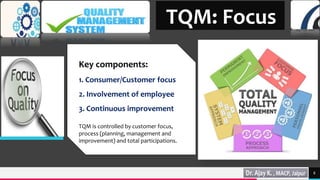
Key components:
1. Consumer/Customer focus
2. Involvement of employee
3. Continuous improvement
TQM is controlled by customer focus,
process (planning, management and
improvement) and total participations.
TREY
research
9
TQM: Focus
The key ingredients of TQM are:
1. Strategic commitment by the management
2. Employee involvement
3. Materials used in the organizations
4. Precise techniques used by the organizations and
5. Improved methods
(Mazumder et al, 2011)
TREY
research
10
TQM: Statistical Quality
Control
To achieve accuracy, statistics play an important role in
quality management systems.
Seven major tools used for statistical process control are:
1. Histogram
2. Pareto chart
3. Cause and effect diagram (Fish bone diagram)
4. Defect concentration diagram.
5. Control chart
6. Scatter diagram
7. Check sheet
TREY
research
11
TQM: Statistical Quality
Control
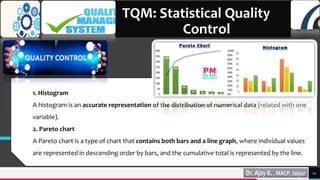
1. Histogram
A histogram is an accurate representation of the distribution of numerical data (related with one
variable).
2. Pareto chart
A Pareto chart is a type of chart that contains both bars and a line graph, where individual values
are represented in descending order by bars, and the cumulative total is represented by the line.
TREY
research
12
TQM: Statistical Quality
Control
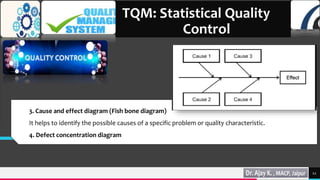
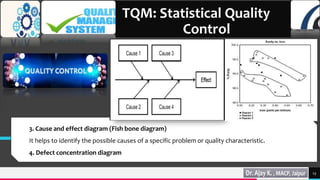
3. Cause and effect diagram (Fish bone diagram)
It helps to identify the possible causes of a specific problem or quality characteristic.
4. Defect concentration diagram
TREY
research
13
TQM: Statistical Quality
Control
3. Cause and effect diagram (Fish bone diagram)
It helps to identify the possible causes of a specific problem or quality characteristic.
4. Defect concentration diagram
TREY
research
14
TQM: Statistical Quality
Control
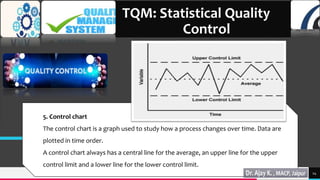
5. Control chart
The control chart is a graph used to study how a process changes over time. Data are
plotted in time order.
A control chart always has a central line for the average, an upper line for the upper
control limit and a lower line for the lower control limit.
TREY
research
15
TQM: Statistical Quality
Control
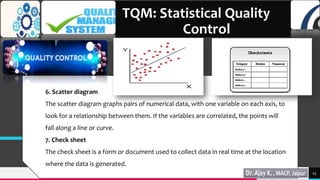
6. Scatter diagram
The scatter diagram graphs pairs of numerical data, with one variable on each axis, to
look for a relationship between them. If the variables are correlated, the points will
fall along a line or curve.
7. Check sheet
The check sheet is a form or document used to collect data in real time at the location
where the data is generated.
TREY
research
16
TQM
Advantages
1. Improve in quality and safety of the drugs.
2. Improvement of customer satisfaction.
3. Improvement of reputation of industry.
4. Total involvement of employee with higher
moral and responsibilities.
5. Lower economic burden.
TREY
research
17
QbD
TREY
research
18
QbD
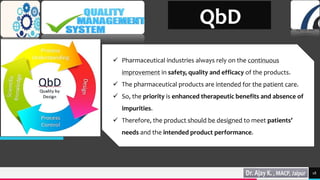
 Pharmaceutical industries always rely on the continuous
improvement in safety, quality and efficacy of the products.
 The pharmaceutical products are intended for the patient care.
 So, the priority is enhanced therapeutic benefits and absence of
impurities.
 Therefore, the product should be designed to meet patients’
needs and the intended product performance.
TREY
research
19
QbD
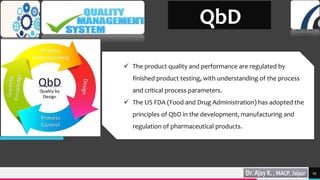
 The product quality and performance are regulated by
finished product testing, with understanding of the process
and critical process parameters.
 The US FDA (Food and Drug Administration) has adopted the
principles of QbD in the development, manufacturing and
regulation of pharmaceutical products.
TREY
research
20
QbD
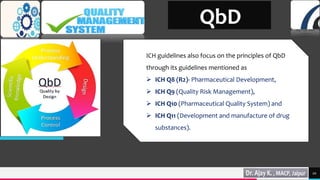
ICH guidelines also focus on the principles of QbD
through its guidelines mentioned as
 ICH Q8 (R2)- Pharmaceutical Development,
 ICH Q9 (Quality Risk Management),
 ICH Q10 (Pharmaceutical Quality System) and
 ICH Q11 (Development and manufacture of drug
substances).
TREY
research
21
QbD
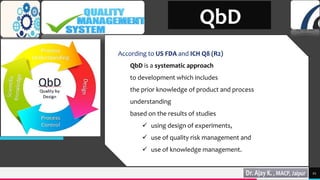
According to US FDA and ICH Q8 (R2)
QbD is a systematic approach
to development which includes
the prior knowledge of product and process
understanding
based on the results of studies
 using design of experiments,
 use of quality risk management and
 use of knowledge management.
TREY
research
22
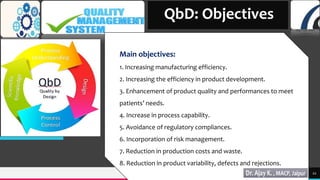
QbD: Objectives
Main objectives:
1. Increasing manufacturing efficiency.
2. Increasing the efficiency in product development.
3. Enhancement of product quality and performances to meet
patients’ needs.
4. Increase in process capability.
5. Avoidance of regulatory compliances.
6. Incorporation of risk management.
7. Reduction in production costs and waste.
8. Reduction in product variability, defects and rejections.
TREY
research
23
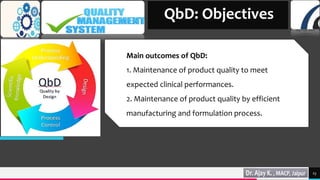
QbD: Objectives
Main outcomes of QbD:
1. Maintenance of product quality to meet
expected clinical performances.
2. Maintenance of product quality by efficient
manufacturing and formulation process.
TREY
research
24
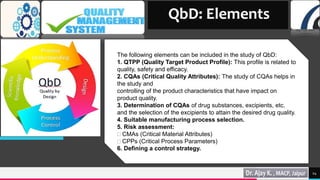
QbD: Elements
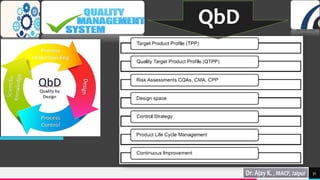
The following elements can be included in the study of QbD:
1. QTPP (Quality Target Product Profile): This profile is related to
quality, safety and efficacy.
2. CQAs (Critical Quality Attributes): The study of CQAs helps in
the study and
controlling of the product characteristics that have impact on
product quality.
3. Determination of CQAs of drug substances, excipients, etc.
and the selection of the excipients to attain the desired drug quality.
4. Suitable manufacturing process selection.
5. Risk assessment:
CMAs (Critical Material Attributes)
CPPs (Critical Process Parameters)
6. Defining a control strategy.
TREY
research
25
QbD
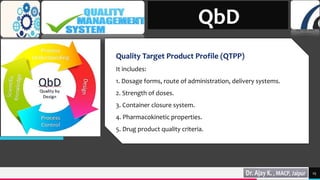
Quality Target Product Profile (QTPP)
It includes:
1. Dosage forms, route of administration, delivery systems.
2. Strength of doses.
3. Container closure system.
4. Pharmacokinetic properties.
5. Drug product quality criteria.
TREY
research
26
QbD
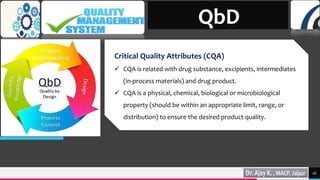
Critical Quality Attributes (CQA)
 CQA is related with drug substance, excipients, intermediates
(in-process materials) and drug product.
 CQA is a physical, chemical, biological or microbiological
property (should be within an appropriate limit, range, or
distribution) to ensure the desired product quality.
TREY
research
27
QbD
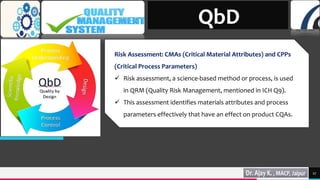
Risk Assessment: CMAs (Critical Material Attributes) and CPPs
(Critical Process Parameters)
 Risk assessment, a science-based method or process, is used
in QRM (Quality Risk Management, mentioned in ICH Q9).
 This assessment identifies materials attributes and process
parameters effectively that have an effect on product CQAs.
TREY
research
28
QbD
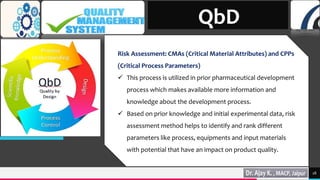
Risk Assessment: CMAs (Critical Material Attributes) and CPPs
(Critical Process Parameters)
 This process is utilized in prior pharmaceutical development
process which makes available more information and
knowledge about the development process.
 Based on prior knowledge and initial experimental data, risk
assessment method helps to identify and rank different
parameters like process, equipments and input materials
with potential that have an impact on product quality.
TREY
research
29
QbD
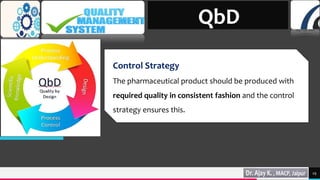
Control Strategy
The pharmaceutical product should be produced with
required quality in consistent fashion and the control
strategy ensures this.
TREY
research
30
QbD
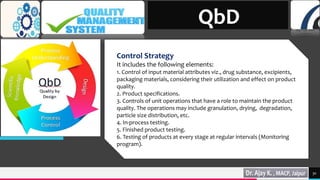
Control Strategy
It includes the following elements:
1. Control of input material attributes viz., drug substance, excipients,
packaging materials, considering their utilization and effect on product
quality.
2. Product specifications.
3. Controls of unit operations that have a role to maintain the product
quality. The operations may include granulation, drying, degradation,
particle size distribution, etc.
4. In-process testing.
5. Finished product testing.
6. Testing of products at every stage at regular intervals (Monitoring
program).
TREY
research
31
QbD
B.PHARM. VII-SEMESTER BP 702 T. INDUSTRIAL PHARMACY-II (Theory)
DR. AJAY K. TIWARI, ASSOCIATE PROFESSOR
MAHARISHI ARVIND COLLEGE OF PHARMACY, JAIPUR (RAJ.)
AJAY81AJAY@GMAIL.COM WHATSAPP: 9782226444
Tobecontinued...

quality management systems: Total quality management & Quality by design

  • 1.
  • 2.
    QUALITYMANAGEMENTSYSTEMS Dr. Ajay K., Maharishi Arvind College of Pharmacy, Jaipur
  • 3.
    TREY research LEARNINGOBJECTIVES After completing thispresentation, you will be able to understand: Total quality management Quality by design 3
  • 4.
  • 5.
    TREY research 5 TQM  Pharmaceutical industryis key part of the health care system.  Regulation of this industry is very important,  because one mistake in production or design can cause more severe condition in relation to health care system.  So, the Maintenance of the quality of the drugs is so important in pharmaceutical industries,  because the poor quality of drugs can cause health hazards and economical burden for both the government and patients.
  • 6.
    TREY research 6 TQM Total quality managementis improvised in the industries to maintain the quality and safety of the drugs and prevention of the defects rather than the detection. The pharmaceutical quality system is described under ICH guideline Q10. The concepts, key points of quality improvement of TQM were proposed by several eminents like Edward Deming, Joseph Juran, Philip Crosby, Genichi Taguchi, etc.
  • 7.
    TREY research “A management approachof an organization centered on quality, based on participation of all its members and aiming at long term benefits to all members of the organization and society”. [International Organization of Standard (ISO)] 7 TQM
  • 8.
    TREY research 8 TQM: Focus Key components: 1.Consumer/Customer focus 2. Involvement of employee 3. Continuous improvement TQM is controlled by customer focus, process (planning, management and improvement) and total participations.
  • 9.
    TREY research 9 TQM: Focus The keyingredients of TQM are: 1. Strategic commitment by the management 2. Employee involvement 3. Materials used in the organizations 4. Precise techniques used by the organizations and 5. Improved methods (Mazumder et al, 2011)
  • 10.
    TREY research 10 TQM: Statistical Quality Control Toachieve accuracy, statistics play an important role in quality management systems. Seven major tools used for statistical process control are: 1. Histogram 2. Pareto chart 3. Cause and effect diagram (Fish bone diagram) 4. Defect concentration diagram. 5. Control chart 6. Scatter diagram 7. Check sheet
  • 11.
    TREY research 11 TQM: Statistical Quality Control 1.Histogram A histogram is an accurate representation of the distribution of numerical data (related with one variable). 2. Pareto chart A Pareto chart is a type of chart that contains both bars and a line graph, where individual values are represented in descending order by bars, and the cumulative total is represented by the line.
  • 12.
    TREY research 12 TQM: Statistical Quality Control 3.Cause and effect diagram (Fish bone diagram) It helps to identify the possible causes of a specific problem or quality characteristic. 4. Defect concentration diagram
  • 13.
    TREY research 13 TQM: Statistical Quality Control 3.Cause and effect diagram (Fish bone diagram) It helps to identify the possible causes of a specific problem or quality characteristic. 4. Defect concentration diagram
  • 14.
    TREY research 14 TQM: Statistical Quality Control 5.Control chart The control chart is a graph used to study how a process changes over time. Data are plotted in time order. A control chart always has a central line for the average, an upper line for the upper control limit and a lower line for the lower control limit.
  • 15.
    TREY research 15 TQM: Statistical Quality Control 6.Scatter diagram The scatter diagram graphs pairs of numerical data, with one variable on each axis, to look for a relationship between them. If the variables are correlated, the points will fall along a line or curve. 7. Check sheet The check sheet is a form or document used to collect data in real time at the location where the data is generated.
  • 16.
    TREY research 16 TQM Advantages 1. Improve inquality and safety of the drugs. 2. Improvement of customer satisfaction. 3. Improvement of reputation of industry. 4. Total involvement of employee with higher moral and responsibilities. 5. Lower economic burden.
  • 17.
  • 18.
    TREY research 18 QbD  Pharmaceutical industriesalways rely on the continuous improvement in safety, quality and efficacy of the products.  The pharmaceutical products are intended for the patient care.  So, the priority is enhanced therapeutic benefits and absence of impurities.  Therefore, the product should be designed to meet patients’ needs and the intended product performance.
  • 19.
    TREY research 19 QbD  The productquality and performance are regulated by finished product testing, with understanding of the process and critical process parameters.  The US FDA (Food and Drug Administration) has adopted the principles of QbD in the development, manufacturing and regulation of pharmaceutical products.
  • 20.
    TREY research 20 QbD ICH guidelines alsofocus on the principles of QbD through its guidelines mentioned as  ICH Q8 (R2)- Pharmaceutical Development,  ICH Q9 (Quality Risk Management),  ICH Q10 (Pharmaceutical Quality System) and  ICH Q11 (Development and manufacture of drug substances).
  • 21.
    TREY research 21 QbD According to USFDA and ICH Q8 (R2) QbD is a systematic approach to development which includes the prior knowledge of product and process understanding based on the results of studies  using design of experiments,  use of quality risk management and  use of knowledge management.
  • 22.
    TREY research 22 QbD: Objectives Main objectives: 1.Increasing manufacturing efficiency. 2. Increasing the efficiency in product development. 3. Enhancement of product quality and performances to meet patients’ needs. 4. Increase in process capability. 5. Avoidance of regulatory compliances. 6. Incorporation of risk management. 7. Reduction in production costs and waste. 8. Reduction in product variability, defects and rejections.
  • 23.
    TREY research 23 QbD: Objectives Main outcomesof QbD: 1. Maintenance of product quality to meet expected clinical performances. 2. Maintenance of product quality by efficient manufacturing and formulation process.
  • 24.
    TREY research 24 QbD: Elements The followingelements can be included in the study of QbD: 1. QTPP (Quality Target Product Profile): This profile is related to quality, safety and efficacy. 2. CQAs (Critical Quality Attributes): The study of CQAs helps in the study and controlling of the product characteristics that have impact on product quality. 3. Determination of CQAs of drug substances, excipients, etc. and the selection of the excipients to attain the desired drug quality. 4. Suitable manufacturing process selection. 5. Risk assessment: CMAs (Critical Material Attributes) CPPs (Critical Process Parameters) 6. Defining a control strategy.
  • 25.
    TREY research 25 QbD Quality Target ProductProfile (QTPP) It includes: 1. Dosage forms, route of administration, delivery systems. 2. Strength of doses. 3. Container closure system. 4. Pharmacokinetic properties. 5. Drug product quality criteria.
  • 26.
    TREY research 26 QbD Critical Quality Attributes(CQA)  CQA is related with drug substance, excipients, intermediates (in-process materials) and drug product.  CQA is a physical, chemical, biological or microbiological property (should be within an appropriate limit, range, or distribution) to ensure the desired product quality.
  • 27.
    TREY research 27 QbD Risk Assessment: CMAs(Critical Material Attributes) and CPPs (Critical Process Parameters)  Risk assessment, a science-based method or process, is used in QRM (Quality Risk Management, mentioned in ICH Q9).  This assessment identifies materials attributes and process parameters effectively that have an effect on product CQAs.
  • 28.
    TREY research 28 QbD Risk Assessment: CMAs(Critical Material Attributes) and CPPs (Critical Process Parameters)  This process is utilized in prior pharmaceutical development process which makes available more information and knowledge about the development process.  Based on prior knowledge and initial experimental data, risk assessment method helps to identify and rank different parameters like process, equipments and input materials with potential that have an impact on product quality.
  • 29.
    TREY research 29 QbD Control Strategy The pharmaceuticalproduct should be produced with required quality in consistent fashion and the control strategy ensures this.
  • 30.
    TREY research 30 QbD Control Strategy It includesthe following elements: 1. Control of input material attributes viz., drug substance, excipients, packaging materials, considering their utilization and effect on product quality. 2. Product specifications. 3. Controls of unit operations that have a role to maintain the product quality. The operations may include granulation, drying, degradation, particle size distribution, etc. 4. In-process testing. 5. Finished product testing. 6. Testing of products at every stage at regular intervals (Monitoring program).
  • 31.
  • 32.
    B.PHARM. VII-SEMESTER BP702 T. INDUSTRIAL PHARMACY-II (Theory) DR. AJAY K. TIWARI, ASSOCIATE PROFESSOR MAHARISHI ARVIND COLLEGE OF PHARMACY, JAIPUR (RAJ.) AJAY81AJAY@GMAIL.COM WHATSAPP: 9782226444 Tobecontinued...