QUALITY RISK MANAGEMENT
ICH GUIDELINE - Q9
Presented By
Praveen Dubey
M.Pharm
Drug Regulatory Affairs
TABLE OF CONTENT
 Introduction
 Scope
 Principles
 General Quality Risk Management Process
 Risk Management Methodology
Annex I: Risk Management Methods and
Tools
 Integration of QRM into Industry and Regulatory
Operations
Annex II: Potential Application for Quality
Risk Management
INTRODUCTION
 Risk is defined as the combination of the
probability of occurrence of harm and the severity
of that harm.
 Management functions include: Planning,
organizing, staffing, leading or directing, and
controlling an organization (a group of one or
more people or entities) or effort for the purpose
of accomplishing a goal.
 Quality risk management is a systematic
process for the assessment, control,
communication and review of risks to
INTRODUCTION
Process consisting of well-defined steps which,
when taken in sequence, support better
Decision Making by contributing to a greater
insight into risks and their impacts.
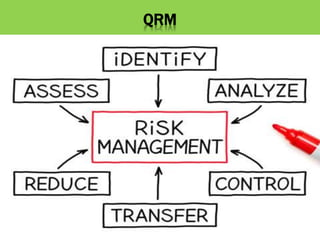
It includes elements such as risk identification,
assessment, mitigation, elimination and
communication.
Risk= probability and severity
INTRODUCTION
Quality
“The degree of excellence of something”
International conference on harmonisation
(ICH) describe the following guidelines for
the maintaining products Quality, Safety &
Efficacy.
1. Quality (Q1-Q12)
2. Safety (S1-S11)
3. Efficacy (E1-E18)
4. Multidisciplinary (M1-M10)
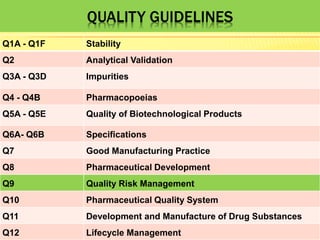
QUALITY GUIDELINES
Q1A - Q1F Stability
Q2 Analytical Validation
Q3A - Q3D Impurities
Q4 - Q4B Pharmacopoeias
Q5A - Q5E Quality of Biotechnological Products
Q6A- Q6B Specifications
Q7 Good Manufacturing Practice
Q8 Pharmaceutical Development
Q9 Quality Risk Management
Q10 Pharmaceutical Quality System
Q11 Development and Manufacture of Drug Substances
Q12 Lifecycle Management
QUALITY
RISK
QRM
RISK
BACKGROUND
 July 2003, Brussels: Initial meeting to discuss topic
and merits of moving ahead.
 November 2003, Osaka: Developed concept paper
and received approval.
 March 2004, London: Drafted outline and agreed on
general approach.
 June 2004, Washington: Developed the first draft of
the guideline.
 June 2004, Draft sent out to the Q9 EWG for review
by constituents.
 September 2004, Consolidate comments.
 November 2004, Step II document preparation.
SCOPE
 This guidelines provides principles and example of
tools for QRM that can be applied to different
aspects of pharmaceutical quality.
 Drug Substances, Drug (Medicinal) products,
Biological and biotechnological products.
Including the selection and use of:
 Raw Material
 Solvents
 Excipients
 Packaging and labelling materials
 Components
PRINCIPLES
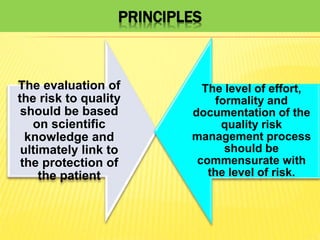
The evaluation of
the risk to quality
should be based
on scientific
knowledge and
ultimately link to
the protection of
the patient
The level of effort,
formality and
documentation of the
quality risk
management process
should be
commensurate with
the level of risk.
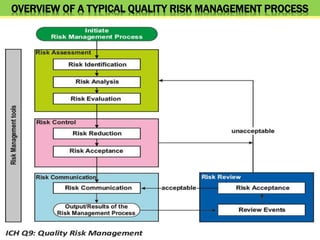
OVERVIEW OF A TYPICAL QUALITY RISK MANAGEMENT PROCESS
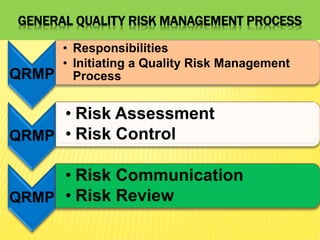
GENERAL QUALITY RISK MANAGEMENT PROCESS
QRMP
• Responsibilities
• Initiating a Quality Risk Management
Process
QRMP
• Risk Assessment
• Risk Control
QRMP
• Risk Communication
• Risk Review
QRMP
Responsibilities:
 Take responsibility for coordinating quality
risk management across various functions
and departments of their organization.
 Assure that a quality risk management
process is defined, deployed and
reviewed and that adequate resources
are available.
QRMP
 Initiating a Quality Risk Management
Process:
 Define the problem and/or risk question, including
pertinent assumptions identifying the potential for
risk;
 Assemble background information and/ or data on
the potential hazard, harm or human health impact
relevant to the risk assessment;
 Identify a leader and necessary resources;
 Specify a timeline, deliverables and appropriate level
QRMP
 Risk Assessment :
 Risk identification , Risk Analysis and Risk Evaluation & the
risk(s) for risk assessment purposes, three fundamental
questions are often helpful:
 1. What might go wrong?
 2. What is the likelihood (probability) it will go wrong?
 3. What are the consequences (severity)?
Risk Control:
Risk control might focus on the following questions:
 Is the risk above an acceptable level?
 What can be done to reduce or eliminate risks?
 What is the appropriate balance among benefits, risks and
resources?
 Are new risks introduced as a result of the identified risks
being controlled?
QRMP
Risk control might focus on the following
questions:
 Is the risk above an acceptable level?
 What can be done to reduce or eliminate
risks?
 What is the appropriate balance among
benefits, risks and resources?
 Are new risks introduced as a result of the
identified risks being controlled?
QRMP
 Risk Communication:
 Risk communication is the sharing of
information about risk and risk management
between the decision makers and others.
 Risk Review:
 Risk management should be an ongoing part of
the quality management process. A mechanism
to review or monitor events should be
implemented.
RISK MANAGEMENT METHODOLOGY
(ANNEX: I)
 Basic risk management facilitation methods
(flowcharts, check sheets etc.);
 Failure Mode Effects Analysis (FMEA);
 Failure Mode, Effects and Criticality Analysis
(FMECA);
 Fault Tree Analysis (FTA);
 Hazard Analysis and Critical Control Points
(HACCP);
 Hazard Operability Analysis (HAZOP);
 Preliminary Hazard Analysis (PHA);
 Risk ranking and filtering;
RISK MANAGEMENT METHODS AND TOOLS
The purpose of this annex is to provide a general
overview of and references for some of the
primary tools that might be used in quality risk
management by industry and regulators.
 Basic Risk Management Facilitation Methods
Some of the simple techniques that are
commonly used to structure risk management by
organizing data and facilitating decision-making
are:
 Flowcharts.
 Check Sheets.
 Process Mapping.
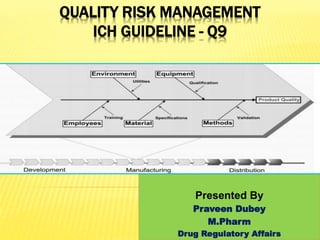
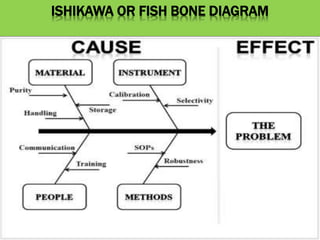
 Cause and Effect Diagrams (also called an
Ishikawa diagram or fish bone diagram).
ISHIKAWA OR FISH BONE DIAGRAM
RISK MANAGEMENT METHODS AND TOOLS
 Failure Mode Effects Analysis (FMEA)
 FMEA can be used to prioritize risks and monitor the
effectiveness of risk control activities.
 FMEA can be applied to equipment and facilities and
might be used to analyze a manufacturing operation and
its effect on product or process.
 Failure Mode, Effects and Criticality Analysis
(FMECA)
 FMECA application in the pharmaceutical industry
should mostly be utilized for failures and risks
associated with manufacturing processes; however, it is
not limited to this application. The output of an FMECA is
a relative risk “score” for each failure mode, which is
used to rank the modes on a relative risk basis.
RISK MANAGEMENT METHODS AND TOOLS
 Hazard Analysis and Critical Control Points
(HACCP)
(1)conduct a hazard analysis and identify preventive
measures for each step of the process;
(2) determine the critical control points;
(3) establish critical limits;
(4) establish a system to monitor the critical control
points;
(5)establish the corrective action to be taken when
monitoring indicates that the critical control points are
not in a state of control;
(6) establish system to verify that the HACCP system is
working effectively;
(7) establish a record-keeping system.
 HACCP might be used to identify and manage risks
RISK MANAGEMENT METHODS AND TOOLS
 Hazard Operability Analysis (HAZOP)
 HAZOP can be applied to manufacturing processes,
including outsourced production and formulation as
well as the upstream suppliers, equipment and
facilities for drug substances and drug (medicinal)
products.
 Preliminary Hazard Analysis (PHA)
 PHA might be useful when analyzing existing
systems or prioritizing hazards where circumstances
prevent a more extensive technique from being used.
 Fault Tree Analysis (FTA)
 FTA can be used to establish the pathway to the root
cause of the failure.
RISK MANAGEMENT METHODS AND TOOLS
 Risk Ranking and Filtering
 Risk ranking and filtering can be used to prioritize
manufacturing sites for inspection/audit by regulators or
industry.
 Supporting Statistical Tools
 Control Charts, for example:
-Acceptance Control Charts
-Control Charts with Arithmetic Average and Warning
Limits
- Cumulative Sum Charts
- Shewhart Control Charts
- Weighted Moving Average.
 Design of Experiments (DOE);
 Histograms;
 Pareto Charts;
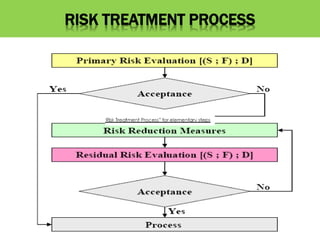
RISK TREATMENT PROCESS
POTENTIAL APPLICATIONS FOR QUALITY RISK MANAGEMENT:
ANNEX II
 Quality Risk Management as Part of Integrated Quality
Management Documentation.
 Quality Risk Management as Part of Regulatory
Operations Inspection and assessment activities.
 Quality Risk Management as Part of development
 Quality Risk Management for Facilities, Equipment and
Utilities Design of facility / equipment.
 Quality Risk Management as Part of Materials
Management
 Quality Risk Management as Part of Production.
 Quality Risk Management as Part of Laboratory Control
and Stability Studies.
 Quality Risk Management as Part of Packaging and
Labelling.
POTENTIAL APPLICATIONS FOR QUALITY RISK MANAGEMENT:
ANNEX II
 Quality Risk Management as Part of Integrated Quality
Management Documentation:
Focus on Documentation , Training and education,
Quality defects, Auditing/Inspection, Periodic review,
Change management/change control and Continual
improvement.
 Quality Risk Management as Part of Regulatory
Operations:
Inspection and assessment activities, Assist with resource
allocation, Evaluate the significance, determine the
appropriateness and type of post-inspection , evaluate
information submitted by industry including PD
information, evaluate impact of proposed variation or
changes and Indentify risk which should be communicated
ANNEX: II
 Quality Risk Management as Part of development
:
 Reduce product and material defects;
 Reduce manufacturing defects.
 Quality Risk Management for Facilities,
Equipment and Utilities :
Design of facility / equipment , Hygiene aspects in
facilities, Qualification of facility/equipment/utilities,
Cleaning of equipment and environmental control,
Calibration/preventive maintenance, Computer
systems and computer controlled equipment
ANNEX: II
 Quality Risk Management as Part of
Materials Management :
Assessment and evaluation of suppliers and
contract manufacturers, Storage, logistics and
distribution conditions, Use of materials.
 Quality Risk Management as Part of
Production:
Include Validation, In-process sampling &
testing and Production planning.
ANNEX: II
 Quality Risk Management as Part of
Laboratory Control and Stability Studies:
Out of specification results, Retest period /
expiration date.
 Quality Risk Management as Part of
Packaging and Labelling:
Design of packages, Selection of container
closure system and label control etc.
REFERENCES
 ICH Q9
 WHO
 FDA: Guidance for industry on Quality Risk
Managements
 Google search
Quality risk management

Quality risk management

  • 1.
    QUALITY RISK MANAGEMENT ICHGUIDELINE - Q9 Presented By Praveen Dubey M.Pharm Drug Regulatory Affairs
  • 2.
    TABLE OF CONTENT Introduction  Scope  Principles  General Quality Risk Management Process  Risk Management Methodology Annex I: Risk Management Methods and Tools  Integration of QRM into Industry and Regulatory Operations Annex II: Potential Application for Quality Risk Management
  • 3.
    INTRODUCTION  Risk isdefined as the combination of the probability of occurrence of harm and the severity of that harm.  Management functions include: Planning, organizing, staffing, leading or directing, and controlling an organization (a group of one or more people or entities) or effort for the purpose of accomplishing a goal.  Quality risk management is a systematic process for the assessment, control, communication and review of risks to
  • 4.
    INTRODUCTION Process consisting ofwell-defined steps which, when taken in sequence, support better Decision Making by contributing to a greater insight into risks and their impacts. It includes elements such as risk identification, assessment, mitigation, elimination and communication. Risk= probability and severity
  • 5.
    INTRODUCTION Quality “The degree ofexcellence of something” International conference on harmonisation (ICH) describe the following guidelines for the maintaining products Quality, Safety & Efficacy. 1. Quality (Q1-Q12) 2. Safety (S1-S11) 3. Efficacy (E1-E18) 4. Multidisciplinary (M1-M10)
  • 6.
    QUALITY GUIDELINES Q1A -Q1F Stability Q2 Analytical Validation Q3A - Q3D Impurities Q4 - Q4B Pharmacopoeias Q5A - Q5E Quality of Biotechnological Products Q6A- Q6B Specifications Q7 Good Manufacturing Practice Q8 Pharmaceutical Development Q9 Quality Risk Management Q10 Pharmaceutical Quality System Q11 Development and Manufacture of Drug Substances Q12 Lifecycle Management
  • 7.
  • 8.
  • 9.
  • 10.
  • 11.
    BACKGROUND  July 2003,Brussels: Initial meeting to discuss topic and merits of moving ahead.  November 2003, Osaka: Developed concept paper and received approval.  March 2004, London: Drafted outline and agreed on general approach.  June 2004, Washington: Developed the first draft of the guideline.  June 2004, Draft sent out to the Q9 EWG for review by constituents.  September 2004, Consolidate comments.  November 2004, Step II document preparation.
  • 12.
    SCOPE  This guidelinesprovides principles and example of tools for QRM that can be applied to different aspects of pharmaceutical quality.  Drug Substances, Drug (Medicinal) products, Biological and biotechnological products. Including the selection and use of:  Raw Material  Solvents  Excipients  Packaging and labelling materials  Components
  • 13.
    PRINCIPLES The evaluation of therisk to quality should be based on scientific knowledge and ultimately link to the protection of the patient The level of effort, formality and documentation of the quality risk management process should be commensurate with the level of risk.
  • 14.
    OVERVIEW OF ATYPICAL QUALITY RISK MANAGEMENT PROCESS
  • 15.
    GENERAL QUALITY RISKMANAGEMENT PROCESS QRMP • Responsibilities • Initiating a Quality Risk Management Process QRMP • Risk Assessment • Risk Control QRMP • Risk Communication • Risk Review
  • 16.
    QRMP Responsibilities:  Take responsibilityfor coordinating quality risk management across various functions and departments of their organization.  Assure that a quality risk management process is defined, deployed and reviewed and that adequate resources are available.
  • 17.
    QRMP  Initiating aQuality Risk Management Process:  Define the problem and/or risk question, including pertinent assumptions identifying the potential for risk;  Assemble background information and/ or data on the potential hazard, harm or human health impact relevant to the risk assessment;  Identify a leader and necessary resources;  Specify a timeline, deliverables and appropriate level
  • 18.
    QRMP  Risk Assessment:  Risk identification , Risk Analysis and Risk Evaluation & the risk(s) for risk assessment purposes, three fundamental questions are often helpful:  1. What might go wrong?  2. What is the likelihood (probability) it will go wrong?  3. What are the consequences (severity)? Risk Control: Risk control might focus on the following questions:  Is the risk above an acceptable level?  What can be done to reduce or eliminate risks?  What is the appropriate balance among benefits, risks and resources?  Are new risks introduced as a result of the identified risks being controlled?
  • 19.
    QRMP Risk control mightfocus on the following questions:  Is the risk above an acceptable level?  What can be done to reduce or eliminate risks?  What is the appropriate balance among benefits, risks and resources?  Are new risks introduced as a result of the identified risks being controlled?
  • 20.
    QRMP  Risk Communication: Risk communication is the sharing of information about risk and risk management between the decision makers and others.  Risk Review:  Risk management should be an ongoing part of the quality management process. A mechanism to review or monitor events should be implemented.
  • 21.
    RISK MANAGEMENT METHODOLOGY (ANNEX:I)  Basic risk management facilitation methods (flowcharts, check sheets etc.);  Failure Mode Effects Analysis (FMEA);  Failure Mode, Effects and Criticality Analysis (FMECA);  Fault Tree Analysis (FTA);  Hazard Analysis and Critical Control Points (HACCP);  Hazard Operability Analysis (HAZOP);  Preliminary Hazard Analysis (PHA);  Risk ranking and filtering;
  • 22.
    RISK MANAGEMENT METHODSAND TOOLS The purpose of this annex is to provide a general overview of and references for some of the primary tools that might be used in quality risk management by industry and regulators.  Basic Risk Management Facilitation Methods Some of the simple techniques that are commonly used to structure risk management by organizing data and facilitating decision-making are:  Flowcharts.  Check Sheets.  Process Mapping.  Cause and Effect Diagrams (also called an Ishikawa diagram or fish bone diagram).
  • 23.
    ISHIKAWA OR FISHBONE DIAGRAM
  • 24.
    RISK MANAGEMENT METHODSAND TOOLS  Failure Mode Effects Analysis (FMEA)  FMEA can be used to prioritize risks and monitor the effectiveness of risk control activities.  FMEA can be applied to equipment and facilities and might be used to analyze a manufacturing operation and its effect on product or process.  Failure Mode, Effects and Criticality Analysis (FMECA)  FMECA application in the pharmaceutical industry should mostly be utilized for failures and risks associated with manufacturing processes; however, it is not limited to this application. The output of an FMECA is a relative risk “score” for each failure mode, which is used to rank the modes on a relative risk basis.
  • 25.
    RISK MANAGEMENT METHODSAND TOOLS  Hazard Analysis and Critical Control Points (HACCP) (1)conduct a hazard analysis and identify preventive measures for each step of the process; (2) determine the critical control points; (3) establish critical limits; (4) establish a system to monitor the critical control points; (5)establish the corrective action to be taken when monitoring indicates that the critical control points are not in a state of control; (6) establish system to verify that the HACCP system is working effectively; (7) establish a record-keeping system.  HACCP might be used to identify and manage risks
  • 26.
    RISK MANAGEMENT METHODSAND TOOLS  Hazard Operability Analysis (HAZOP)  HAZOP can be applied to manufacturing processes, including outsourced production and formulation as well as the upstream suppliers, equipment and facilities for drug substances and drug (medicinal) products.  Preliminary Hazard Analysis (PHA)  PHA might be useful when analyzing existing systems or prioritizing hazards where circumstances prevent a more extensive technique from being used.  Fault Tree Analysis (FTA)  FTA can be used to establish the pathway to the root cause of the failure.
  • 27.
    RISK MANAGEMENT METHODSAND TOOLS  Risk Ranking and Filtering  Risk ranking and filtering can be used to prioritize manufacturing sites for inspection/audit by regulators or industry.  Supporting Statistical Tools  Control Charts, for example: -Acceptance Control Charts -Control Charts with Arithmetic Average and Warning Limits - Cumulative Sum Charts - Shewhart Control Charts - Weighted Moving Average.  Design of Experiments (DOE);  Histograms;  Pareto Charts;
  • 28.
  • 29.
    POTENTIAL APPLICATIONS FORQUALITY RISK MANAGEMENT: ANNEX II  Quality Risk Management as Part of Integrated Quality Management Documentation.  Quality Risk Management as Part of Regulatory Operations Inspection and assessment activities.  Quality Risk Management as Part of development  Quality Risk Management for Facilities, Equipment and Utilities Design of facility / equipment.  Quality Risk Management as Part of Materials Management  Quality Risk Management as Part of Production.  Quality Risk Management as Part of Laboratory Control and Stability Studies.  Quality Risk Management as Part of Packaging and Labelling.
  • 30.
    POTENTIAL APPLICATIONS FORQUALITY RISK MANAGEMENT: ANNEX II  Quality Risk Management as Part of Integrated Quality Management Documentation: Focus on Documentation , Training and education, Quality defects, Auditing/Inspection, Periodic review, Change management/change control and Continual improvement.  Quality Risk Management as Part of Regulatory Operations: Inspection and assessment activities, Assist with resource allocation, Evaluate the significance, determine the appropriateness and type of post-inspection , evaluate information submitted by industry including PD information, evaluate impact of proposed variation or changes and Indentify risk which should be communicated
  • 31.
    ANNEX: II  QualityRisk Management as Part of development :  Reduce product and material defects;  Reduce manufacturing defects.  Quality Risk Management for Facilities, Equipment and Utilities : Design of facility / equipment , Hygiene aspects in facilities, Qualification of facility/equipment/utilities, Cleaning of equipment and environmental control, Calibration/preventive maintenance, Computer systems and computer controlled equipment
  • 32.
    ANNEX: II  QualityRisk Management as Part of Materials Management : Assessment and evaluation of suppliers and contract manufacturers, Storage, logistics and distribution conditions, Use of materials.  Quality Risk Management as Part of Production: Include Validation, In-process sampling & testing and Production planning.
  • 33.
    ANNEX: II  QualityRisk Management as Part of Laboratory Control and Stability Studies: Out of specification results, Retest period / expiration date.  Quality Risk Management as Part of Packaging and Labelling: Design of packages, Selection of container closure system and label control etc.
  • 34.
    REFERENCES  ICH Q9 WHO  FDA: Guidance for industry on Quality Risk Managements  Google search