Department of Pharmaceutics, KCP, CBE-32 1Monday, July 23, 2019
CONTENTS
INTRODUCTION
ICH GUIDELINE Q8
REGULATORY AND INDUSTRY VIEW
ON QBD
2Department of Pharmaceutics, KCP, CBE-32Monday, July 23, 2019
QbD
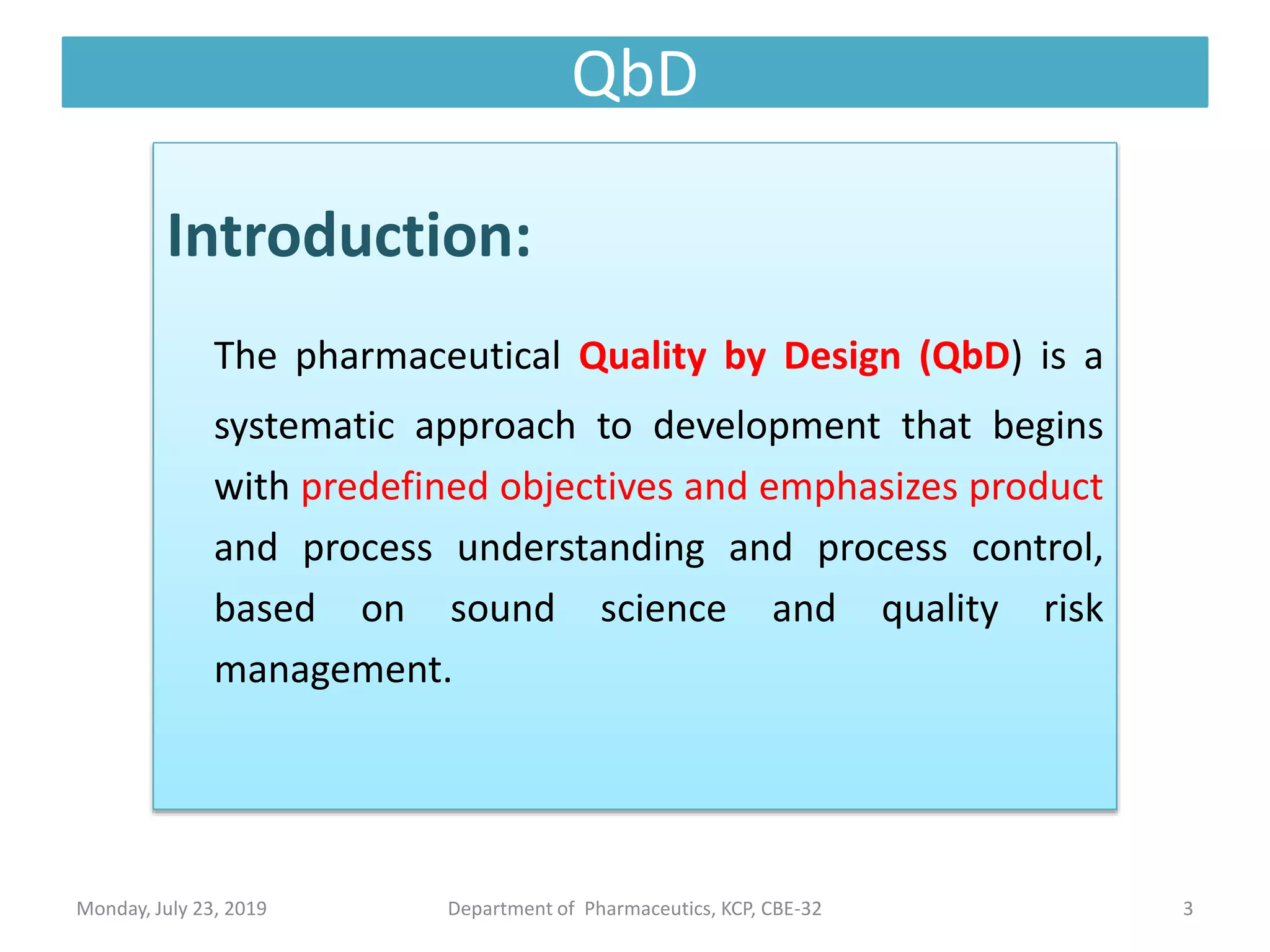
Introduction:
The pharmaceutical Quality by Design (QbD) is a
systematic approach to development that begins
with predefined objectives and emphasizes product
and process understanding and process control,
based on sound science and quality risk
management.
3Department of Pharmaceutics, KCP, CBE-32Monday, July 23, 2019
QbD Will Enhance
4Department of Pharmaceutics, KCP, CBE-32
SAFE
EFFECTIVE
Mfg QUALITY
Monday, July 23, 2019
QbD
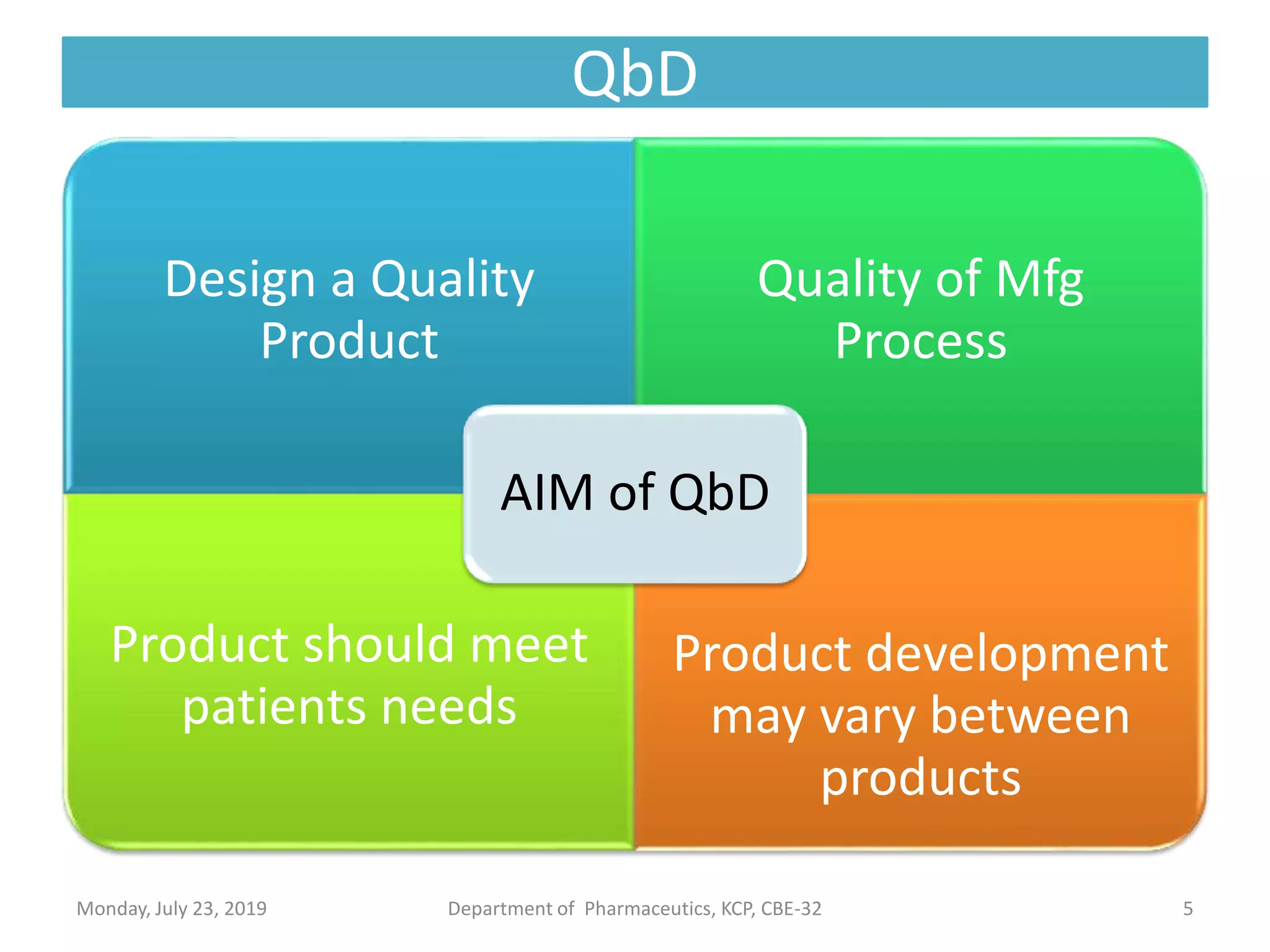
5Department of Pharmaceutics, KCP, CBE-32
Design a Quality
Product
Quality of Mfg
Process
Product should meet
patients needs
Product development
may vary between
products
AIM of QbD
Monday, July 23, 2019
QbD
6Department of Pharmaceutics, KCP, CBE-32
APPROCHES
Empirical
method
Systematic
method
Combination
of Both
Monday, July 23, 2019
QbD
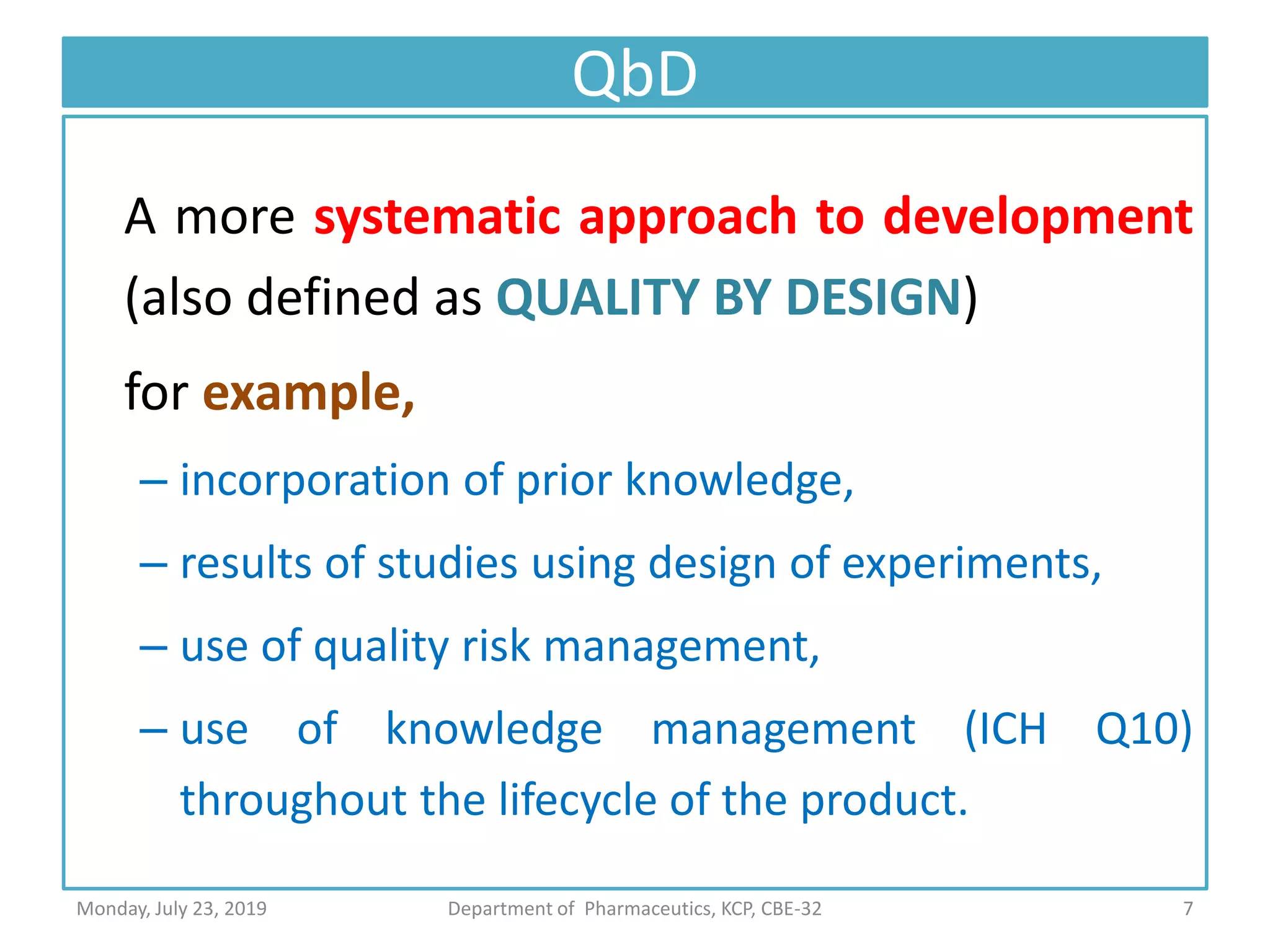
A more systematic approach to development
(also defined as QUALITY BY DESIGN)
for example,
– incorporation of prior knowledge,
– results of studies using design of experiments,
– use of quality risk management,
– use of knowledge management (ICH Q10)
throughout the lifecycle of the product.
7Department of Pharmaceutics, KCP, CBE-32Monday, July 23, 2019
QbD
8Department of Pharmaceutics, KCP, CBE-32Monday, July 23, 2019
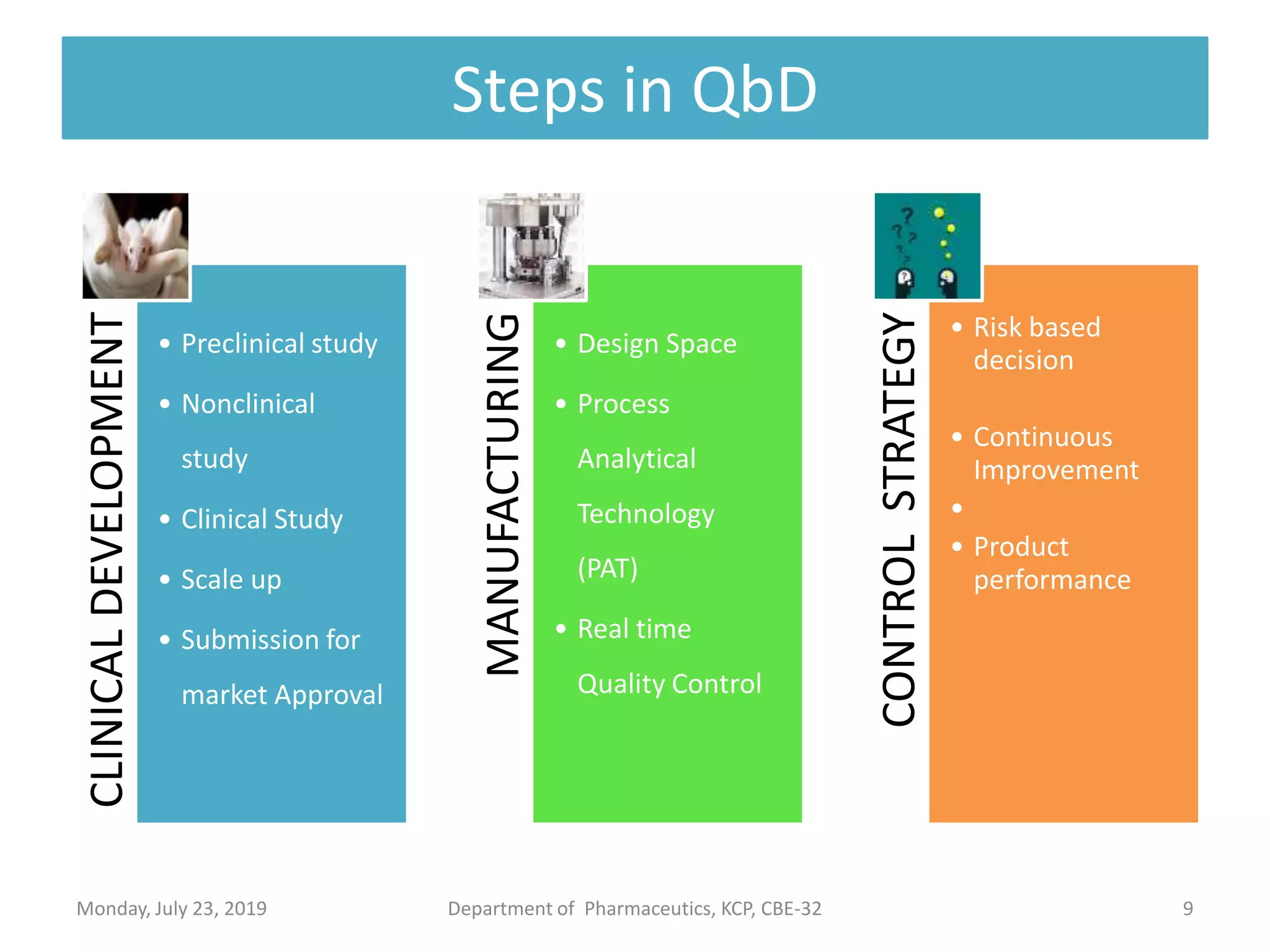
Steps in QbD
9Department of Pharmaceutics, KCP, CBE-32
CLINICALDEVELOPMENT
• Preclinical study
• Nonclinical
study
• Clinical Study
• Scale up
• Submission for
market Approval
MANUFACTURING
• Design Space
• Process
Analytical
Technology
(PAT)
• Real time
Quality Control
CONTROLSTRATEGY
• Risk based
decision
• Continuous
Improvement
•
• Product
performance
Monday, July 23, 2019
Elements For Pharmaceutical Development
ELEMENTS OF PHARMACEUTICAL DEVELOPMENT
The section that follows elaborates on possible approaches to
gaining a more systematic, enhanced understanding of the product
and process under development.
 Quality Target Product Profile (QTPP)
 Critical Quality Attributes (CQA)
 Risk Assessment
 Design Space
• Selection of Variables
• Describing a Design Space in a Submission
• Unit Operation Design Space(s)
• Relationship of Design Space to Scale and Equipment
• Design Space Versus Proven Acceptable Ranges
• Design Space and Edge of Failure
 Control Strategy
 Product Lifecycle Management and Continual Improvement
10Department of Pharmaceutics, KCP, CBE-32Monday, July 23, 2019
Elements For Pharmaceutical Development
Quality Target Product Profile (QTPP)
The quality target product profile forms the basis of design for the
development of the product. (it mainly focus on the safety and
efficacy. )
Considerations for the quality target product profile could include
 Intended use in clinical setting, route of administration, dosage
form, delivery systems.
 Dosage strength(s)
 Container closure system
 Therapeutic moiety release or delivery and attributes affecting
pharmacokinetic characteristics (e.g., dissolution, aerodynamic
performance)
 Drug product quality criteria (e.g., sterility, purity, stability and drug
release) appropriate for the intended marketed product.
11Department of Pharmaceutics, KCP, CBE-32Monday, July 23, 2019
Elements For Pharmaceutical Development
Benefits in the Quality Target Product Profile
 Identifies risks and best approaches to manage.
 Uses tools/enablers in an optimized fashion (such as
integration of QbD and biopharmaceutics)
 Generates and enables knowledge sharing.
 An iterative, learning, life-cycle process for optimizing decision
making and the therapeutic outcomes for the patient benefit.
 A drug product designed, developed and manufactured
according to Quality Target Product Profile with specification
(such as dissolution/release acceptance criteria) consistent
with the desired in vivo performance of the product.
12Department of Pharmaceutics, KCP, CBE-32Monday, July 23, 2019
Elements For Pharmaceutical Development
Critical Quality Attributes (CQA)
A CQA is a physical, chemical, biological, or
microbiological property that should be within an
appropriate limit, range, or distribution to ensure the
desired product quality.
CQAs are generally associated with the drug
substance, excipients, intermediates (in-process
materials) and drug product.
13Department of Pharmaceutics, KCP, CBE-32Monday, July 23, 2019
Elements For Pharmaceutical Development
CQAs of solid oral dosage forms are typically those
aspects affecting
• product purity, strength,
• drug release and stability.
CQAs for other delivery systems can additionally include
more product specific aspects,
• such as aerodynamic properties for inhaled products,
• sterility for parenterals,
• adhesion properties for transdermal patches.
CQAs For drug substances, raw materials and
intermediates,
• It include the particle size distribution, bulk density
14Department of Pharmaceutics, KCP, CBE-32Monday, July 23, 2019
Elements For Pharmaceutical Development
Risk assessment
Risk assessment is a valuable science-based process
used in quality risk management that can aid in
identifying which material attributes and process
parameters potentially have an effect on product
CQAs.
Risk assessment is typically performed early in the
pharmaceutical development process and is
repeated as more information becomes available and
greater knowledge is obtained.
15Department of Pharmaceutics, KCP, CBE-32Monday, July 23, 2019
Cont..,
They can overcome by Once the significant
parameters are identified, they can be further
studied (e.g., through a combination of design of
experiments, mathematical models, or studies that
lead to mechanistic understanding) to achieve a
higher level of process understanding.
16Department of Pharmaceutics, KCP, CBE-32Monday, July 23, 2019
Elements For Pharmaceutical Development
Examples
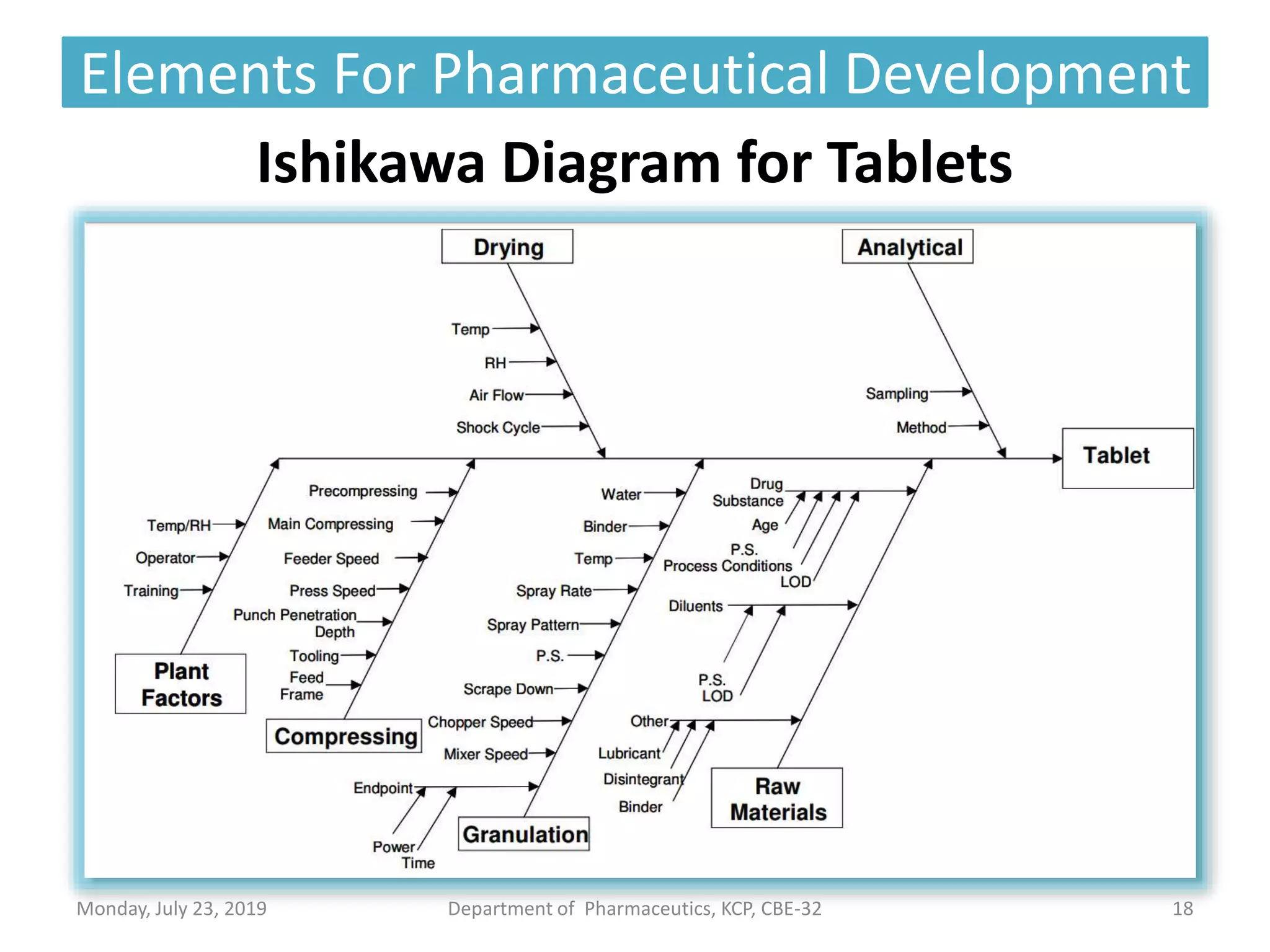
Use of a risk assessment tool.
For example, a cross-functional team of experts
could work together to develop an Ishikawa
(fishbone) diagram that identifies potential
variables which can have an impact on the desired
quality attribute.
17Department of Pharmaceutics, KCP, CBE-32Monday, July 23, 2019
Elements For Pharmaceutical Development
18Department of Pharmaceutics, KCP, CBE-32
Ishikawa Diagram for Tablets
Monday, July 23, 2019
Elements For Pharmaceutical Development
The relationship between the
1. (Material attributes and process
parameters)
&
2.
Can Be Described In The Design Space
19Department of Pharmaceutics, KCP, CBE-32Monday, July 23, 2019
Elements For Pharmaceutical Development
SELECTION OF VARIABLES
The risk assessment and process development
experiments can lead to an understanding of the
linkage and effect of process parameters and
material attributes on product CQAs, and also help
identify the variables and their ranges within which
consistent quality can be achieved.
20Department of Pharmaceutics, KCP, CBE-32Monday, July 23, 2019
Elements For Pharmaceutical Development
Example
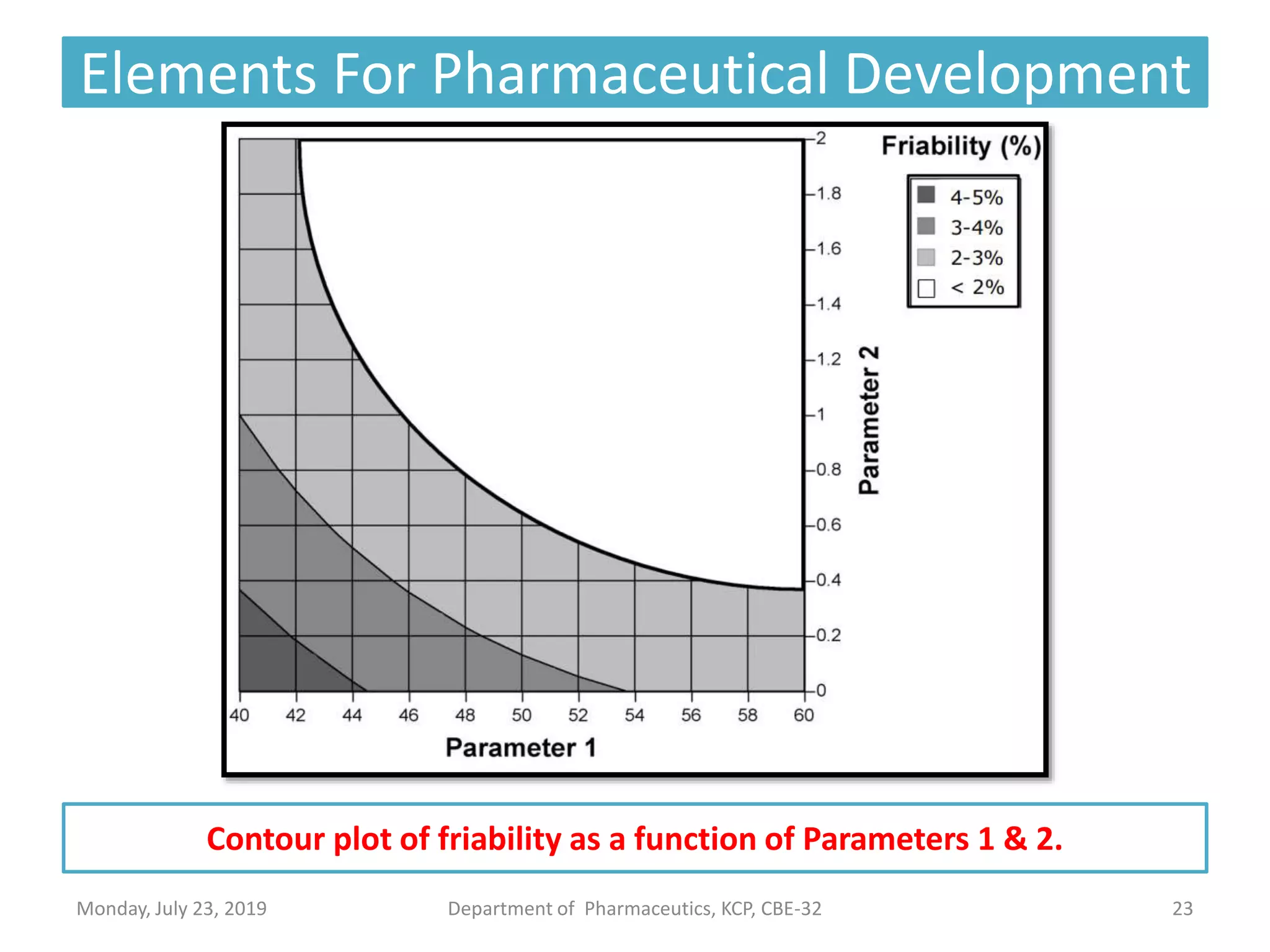
Design space determined from the common region
of successful operating ranges for multiple CQAs.
The relations of two CQAs, i.e., tablet friability and
dissolution, to two process parameters of a
granulation operation.
21Department of Pharmaceutics, KCP, CBE-32Monday, July 23, 2019
Elements For Pharmaceutical Development
22Department of Pharmaceutics, KCP, CBE-32
Contour plot of dissolution as a function of Parameters 1 & 2.
Monday, July 23, 2019
Elements For Pharmaceutical Development
23Department of Pharmaceutics, KCP, CBE-32
Contour plot of friability as a function of Parameters 1 & 2.
Monday, July 23, 2019
Elements For Pharmaceutical Development
24Department of Pharmaceutics, KCP, CBE-32
Proposed design space, comprised of the overlap region of ranges for friability and or
dissolution.
Monday, July 23, 2019
Elements For Pharmaceutical Development
CONTROL STRATEGY
A control strategy can include,
 Control of input material attributes (e.g., drug substance,
excipients, primary packaging materials) based on an understanding
of their impact on processability or product quality;
 Product specification(s)
 Controls for unit operations that have an impact on downstream
processing or product quality (e.g., the impact of drying on
degradation, particle size distribution of the granulate on
dissolution);
 In-process or real-time release testing in lieu of end-product testing
(e.g. measurement and control of CQAs during processing);
 A monitoring program (e.g., full product testing at regular intervals)
for verifying multivariate prediction models.
25Department of Pharmaceutics, KCP, CBE-32Monday, July 23, 2019
REGULATORY VIEWS ON QBD
As defined by an FDA official (Woodcock, 2004),
“The QbD concept represents product and process
performance characteristics scientifically designed to
meet specific objectives, not merely empirically derived
from performance of test batches.”
“Another FDA representative (Shah, 2009) states that
introduction of the QbD concept can lead to cost savings
and efficiency improvements for both industry and
regulators.”
26Department of Pharmaceutics, KCP, CBE-32Monday, July 23, 2019
REGULATORY VIEWS ON QBD
QBD facilitate
27Department of Pharmaceutics, KCP, CBE-32
• enhance opportunities for first cycle approval,
• streamline post approval changes and regulatory processes,
• enable more focused inspections,
• provide opportunities for continual improvement (Shah, 2009).
• innovation,
• increase manufacturing efficiency,
• reduce cost/product rejects,
• minimize/eliminate potential compliance actions,
Monday, July 23, 2019
REGULATORY VIEWS ON QBD
EMA representatives (Korakianiti, 2009) point out that it
is preferable for a design space to be complemented by
an appropriate control strategy.
The review of variations regulations and the revised
Variations Classifications Guideline (2008) has taken into
account QbD submissions, to enable easier updates of
the registration dossier.
EMA templates and guidance documents used for the
assessment of any new drug application in the
centralized procedure include the possibility of design
space appointment (e.g. Day 80 Quality AR Template).
28Department of Pharmaceutics, KCP, CBE-32Monday, July 23, 2019
REGULATORY VIEWS ON QBD
EMA, FDA, and ICH working groups have appointed
the ICH quality implementation working group
(Q-IWG), which prepared various templates,
workshop training materials, questions and answers,
as well as a points- to-consider document (issued in
2011) that covers ICH Q8(R2), ICH Q9, and ICH Q10
guidelines.
This document provides an interesting overview on
the use of different modeling techniques in QbD.
29Department of Pharmaceutics, KCP, CBE-32Monday, July 23, 2019
REGULATORY VIEWS ON QBD
 There were several EMA marketing authorization applications
(MAA) with QbD and PAT elements
 for the following products: Avamys®, Torisel® , Tyverb® , Norvir® ,
Exjade® , Revolade® , Votrient® , etc.).
 Up to 2011, there was a total of 26 QbD submissions to EMA (for
the new chemical entities)
 18 of them were initial MAAs (4 including the realtime release),
 6 of them were concerning post- authorization, and 2 were
scientific advice requests.
 An additional two MAAs were submitted for biological products,
but none of the submissions were related to the generics industry
 Up to 2011, there were approximately 50 QbD related applications
to the FDA (Miksinski, 2011). FDA authorities state that QbD is to be
fully implemented by January 2013 (Miksinski, 2011).
30Department of Pharmaceutics, KCP, CBE-32Monday, July 23, 2019
INDUSTRY VIEWS ON QBD
 Pfizer was one of the first companies to implement
QbD and PAT concepts.
 Through these concepts, the company gained
enhanced process understanding, higher process
capability, better product quality, and increased
flexibility to implement continuous improvement
change.
31Department of Pharmaceutics, KCP, CBE-32Monday, July 23, 2019
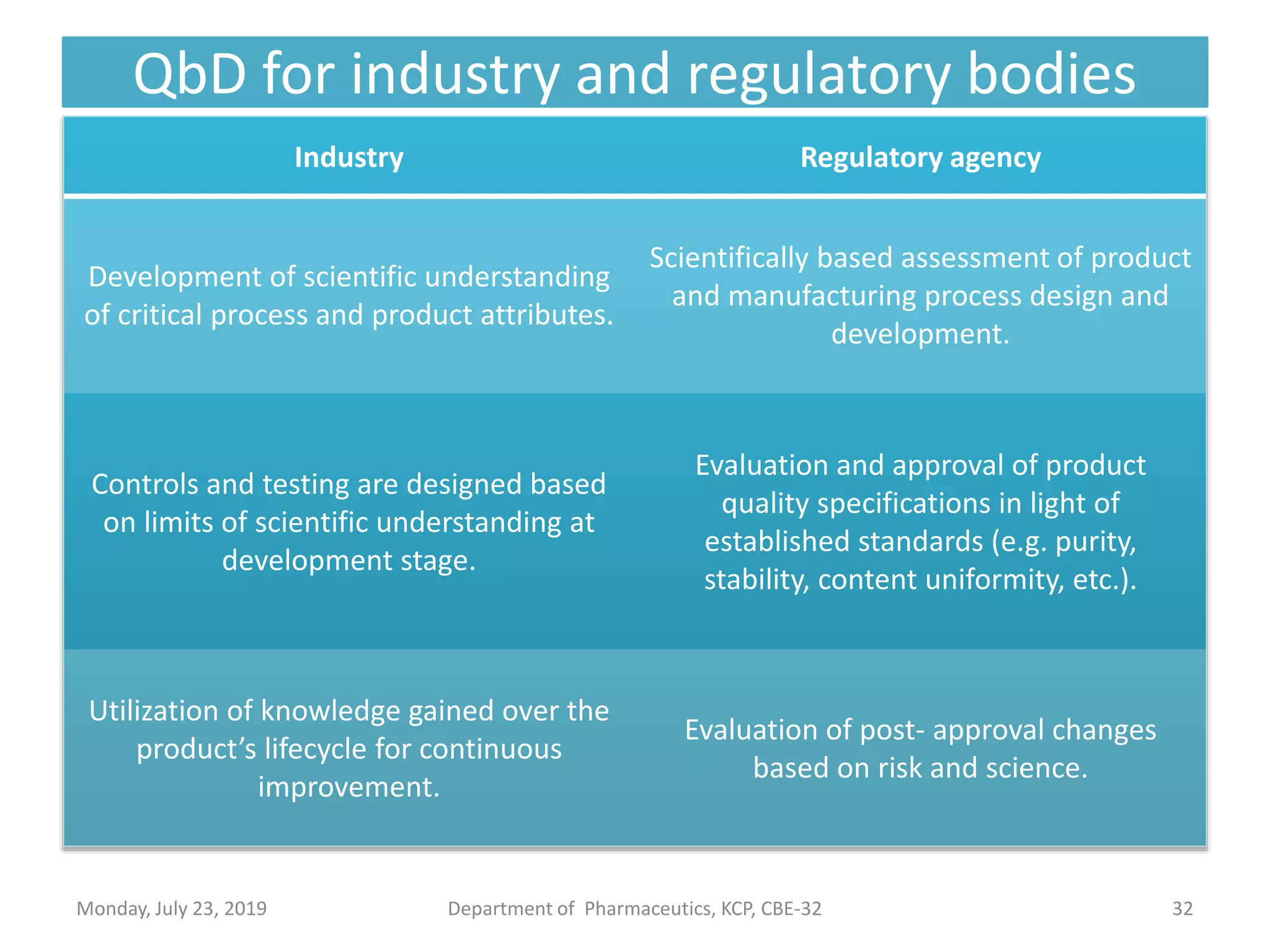
QbD for industry and regulatory bodies
Industry Regulatory agency
Development of scientific understanding
of critical process and product attributes.
Scientifically based assessment of product
and manufacturing process design and
development.
Controls and testing are designed based
on limits of scientific understanding at
development stage.
Evaluation and approval of product
quality specifications in light of
established standards (e.g. purity,
stability, content uniformity, etc.).
Utilization of knowledge gained over the
product’s lifecycle for continuous
improvement.
Evaluation of post- approval changes
based on risk and science.
32Department of Pharmaceutics, KCP, CBE-32Monday, July 23, 2019
References
 Jelena Djuris Computer-aided applications in
pharmaceutical technology 2013 (1 to 7)
 PHARMACEUTICAL DEVELOPMENT – ANNEX. ICH
Harmonised Tripartite Guideline. 2013 (9 to 14)
 Nishendu P. Nadpara, Rakshit V. Thumar, Vidhi N.
Kalola, Parula B. Patel. Quality By Design (Qbd) : A
Complete Review, International Journal of
Pharmaceutical Sciences Review and Research. ISSN
0976 – 044X. 2012 (20 to 28).
33Department of Pharmaceutics, KCP, CBE-32Monday, July 23, 2019
Thank You
34Department of Pharmaceutics, KCP, CBE-32Monday, July 23, 2019

Quality by Design ( QbD )

  • 1.
    Department of Pharmaceutics,KCP, CBE-32 1Monday, July 23, 2019
  • 2.
    CONTENTS INTRODUCTION ICH GUIDELINE Q8 REGULATORYAND INDUSTRY VIEW ON QBD 2Department of Pharmaceutics, KCP, CBE-32Monday, July 23, 2019
  • 3.
    QbD Introduction: The pharmaceutical Qualityby Design (QbD) is a systematic approach to development that begins with predefined objectives and emphasizes product and process understanding and process control, based on sound science and quality risk management. 3Department of Pharmaceutics, KCP, CBE-32Monday, July 23, 2019
  • 4.
    QbD Will Enhance 4Departmentof Pharmaceutics, KCP, CBE-32 SAFE EFFECTIVE Mfg QUALITY Monday, July 23, 2019
  • 5.
    QbD 5Department of Pharmaceutics,KCP, CBE-32 Design a Quality Product Quality of Mfg Process Product should meet patients needs Product development may vary between products AIM of QbD Monday, July 23, 2019
  • 6.
    QbD 6Department of Pharmaceutics,KCP, CBE-32 APPROCHES Empirical method Systematic method Combination of Both Monday, July 23, 2019
  • 7.
    QbD A more systematicapproach to development (also defined as QUALITY BY DESIGN) for example, – incorporation of prior knowledge, – results of studies using design of experiments, – use of quality risk management, – use of knowledge management (ICH Q10) throughout the lifecycle of the product. 7Department of Pharmaceutics, KCP, CBE-32Monday, July 23, 2019
  • 8.
    QbD 8Department of Pharmaceutics,KCP, CBE-32Monday, July 23, 2019
  • 9.
    Steps in QbD 9Departmentof Pharmaceutics, KCP, CBE-32 CLINICALDEVELOPMENT • Preclinical study • Nonclinical study • Clinical Study • Scale up • Submission for market Approval MANUFACTURING • Design Space • Process Analytical Technology (PAT) • Real time Quality Control CONTROLSTRATEGY • Risk based decision • Continuous Improvement • • Product performance Monday, July 23, 2019
  • 10.
    Elements For PharmaceuticalDevelopment ELEMENTS OF PHARMACEUTICAL DEVELOPMENT The section that follows elaborates on possible approaches to gaining a more systematic, enhanced understanding of the product and process under development.  Quality Target Product Profile (QTPP)  Critical Quality Attributes (CQA)  Risk Assessment  Design Space • Selection of Variables • Describing a Design Space in a Submission • Unit Operation Design Space(s) • Relationship of Design Space to Scale and Equipment • Design Space Versus Proven Acceptable Ranges • Design Space and Edge of Failure  Control Strategy  Product Lifecycle Management and Continual Improvement 10Department of Pharmaceutics, KCP, CBE-32Monday, July 23, 2019
  • 11.
    Elements For PharmaceuticalDevelopment Quality Target Product Profile (QTPP) The quality target product profile forms the basis of design for the development of the product. (it mainly focus on the safety and efficacy. ) Considerations for the quality target product profile could include  Intended use in clinical setting, route of administration, dosage form, delivery systems.  Dosage strength(s)  Container closure system  Therapeutic moiety release or delivery and attributes affecting pharmacokinetic characteristics (e.g., dissolution, aerodynamic performance)  Drug product quality criteria (e.g., sterility, purity, stability and drug release) appropriate for the intended marketed product. 11Department of Pharmaceutics, KCP, CBE-32Monday, July 23, 2019
  • 12.
    Elements For PharmaceuticalDevelopment Benefits in the Quality Target Product Profile  Identifies risks and best approaches to manage.  Uses tools/enablers in an optimized fashion (such as integration of QbD and biopharmaceutics)  Generates and enables knowledge sharing.  An iterative, learning, life-cycle process for optimizing decision making and the therapeutic outcomes for the patient benefit.  A drug product designed, developed and manufactured according to Quality Target Product Profile with specification (such as dissolution/release acceptance criteria) consistent with the desired in vivo performance of the product. 12Department of Pharmaceutics, KCP, CBE-32Monday, July 23, 2019
  • 13.
    Elements For PharmaceuticalDevelopment Critical Quality Attributes (CQA) A CQA is a physical, chemical, biological, or microbiological property that should be within an appropriate limit, range, or distribution to ensure the desired product quality. CQAs are generally associated with the drug substance, excipients, intermediates (in-process materials) and drug product. 13Department of Pharmaceutics, KCP, CBE-32Monday, July 23, 2019
  • 14.
    Elements For PharmaceuticalDevelopment CQAs of solid oral dosage forms are typically those aspects affecting • product purity, strength, • drug release and stability. CQAs for other delivery systems can additionally include more product specific aspects, • such as aerodynamic properties for inhaled products, • sterility for parenterals, • adhesion properties for transdermal patches. CQAs For drug substances, raw materials and intermediates, • It include the particle size distribution, bulk density 14Department of Pharmaceutics, KCP, CBE-32Monday, July 23, 2019
  • 15.
    Elements For PharmaceuticalDevelopment Risk assessment Risk assessment is a valuable science-based process used in quality risk management that can aid in identifying which material attributes and process parameters potentially have an effect on product CQAs. Risk assessment is typically performed early in the pharmaceutical development process and is repeated as more information becomes available and greater knowledge is obtained. 15Department of Pharmaceutics, KCP, CBE-32Monday, July 23, 2019
  • 16.
    Cont.., They can overcomeby Once the significant parameters are identified, they can be further studied (e.g., through a combination of design of experiments, mathematical models, or studies that lead to mechanistic understanding) to achieve a higher level of process understanding. 16Department of Pharmaceutics, KCP, CBE-32Monday, July 23, 2019
  • 17.
    Elements For PharmaceuticalDevelopment Examples Use of a risk assessment tool. For example, a cross-functional team of experts could work together to develop an Ishikawa (fishbone) diagram that identifies potential variables which can have an impact on the desired quality attribute. 17Department of Pharmaceutics, KCP, CBE-32Monday, July 23, 2019
  • 18.
    Elements For PharmaceuticalDevelopment 18Department of Pharmaceutics, KCP, CBE-32 Ishikawa Diagram for Tablets Monday, July 23, 2019
  • 19.
    Elements For PharmaceuticalDevelopment The relationship between the 1. (Material attributes and process parameters) & 2. Can Be Described In The Design Space 19Department of Pharmaceutics, KCP, CBE-32Monday, July 23, 2019
  • 20.
    Elements For PharmaceuticalDevelopment SELECTION OF VARIABLES The risk assessment and process development experiments can lead to an understanding of the linkage and effect of process parameters and material attributes on product CQAs, and also help identify the variables and their ranges within which consistent quality can be achieved. 20Department of Pharmaceutics, KCP, CBE-32Monday, July 23, 2019
  • 21.
    Elements For PharmaceuticalDevelopment Example Design space determined from the common region of successful operating ranges for multiple CQAs. The relations of two CQAs, i.e., tablet friability and dissolution, to two process parameters of a granulation operation. 21Department of Pharmaceutics, KCP, CBE-32Monday, July 23, 2019
  • 22.
    Elements For PharmaceuticalDevelopment 22Department of Pharmaceutics, KCP, CBE-32 Contour plot of dissolution as a function of Parameters 1 & 2. Monday, July 23, 2019
  • 23.
    Elements For PharmaceuticalDevelopment 23Department of Pharmaceutics, KCP, CBE-32 Contour plot of friability as a function of Parameters 1 & 2. Monday, July 23, 2019
  • 24.
    Elements For PharmaceuticalDevelopment 24Department of Pharmaceutics, KCP, CBE-32 Proposed design space, comprised of the overlap region of ranges for friability and or dissolution. Monday, July 23, 2019
  • 25.
    Elements For PharmaceuticalDevelopment CONTROL STRATEGY A control strategy can include,  Control of input material attributes (e.g., drug substance, excipients, primary packaging materials) based on an understanding of their impact on processability or product quality;  Product specification(s)  Controls for unit operations that have an impact on downstream processing or product quality (e.g., the impact of drying on degradation, particle size distribution of the granulate on dissolution);  In-process or real-time release testing in lieu of end-product testing (e.g. measurement and control of CQAs during processing);  A monitoring program (e.g., full product testing at regular intervals) for verifying multivariate prediction models. 25Department of Pharmaceutics, KCP, CBE-32Monday, July 23, 2019
  • 26.
    REGULATORY VIEWS ONQBD As defined by an FDA official (Woodcock, 2004), “The QbD concept represents product and process performance characteristics scientifically designed to meet specific objectives, not merely empirically derived from performance of test batches.” “Another FDA representative (Shah, 2009) states that introduction of the QbD concept can lead to cost savings and efficiency improvements for both industry and regulators.” 26Department of Pharmaceutics, KCP, CBE-32Monday, July 23, 2019
  • 27.
    REGULATORY VIEWS ONQBD QBD facilitate 27Department of Pharmaceutics, KCP, CBE-32 • enhance opportunities for first cycle approval, • streamline post approval changes and regulatory processes, • enable more focused inspections, • provide opportunities for continual improvement (Shah, 2009). • innovation, • increase manufacturing efficiency, • reduce cost/product rejects, • minimize/eliminate potential compliance actions, Monday, July 23, 2019
  • 28.
    REGULATORY VIEWS ONQBD EMA representatives (Korakianiti, 2009) point out that it is preferable for a design space to be complemented by an appropriate control strategy. The review of variations regulations and the revised Variations Classifications Guideline (2008) has taken into account QbD submissions, to enable easier updates of the registration dossier. EMA templates and guidance documents used for the assessment of any new drug application in the centralized procedure include the possibility of design space appointment (e.g. Day 80 Quality AR Template). 28Department of Pharmaceutics, KCP, CBE-32Monday, July 23, 2019
  • 29.
    REGULATORY VIEWS ONQBD EMA, FDA, and ICH working groups have appointed the ICH quality implementation working group (Q-IWG), which prepared various templates, workshop training materials, questions and answers, as well as a points- to-consider document (issued in 2011) that covers ICH Q8(R2), ICH Q9, and ICH Q10 guidelines. This document provides an interesting overview on the use of different modeling techniques in QbD. 29Department of Pharmaceutics, KCP, CBE-32Monday, July 23, 2019
  • 30.
    REGULATORY VIEWS ONQBD  There were several EMA marketing authorization applications (MAA) with QbD and PAT elements  for the following products: Avamys®, Torisel® , Tyverb® , Norvir® , Exjade® , Revolade® , Votrient® , etc.).  Up to 2011, there was a total of 26 QbD submissions to EMA (for the new chemical entities)  18 of them were initial MAAs (4 including the realtime release),  6 of them were concerning post- authorization, and 2 were scientific advice requests.  An additional two MAAs were submitted for biological products, but none of the submissions were related to the generics industry  Up to 2011, there were approximately 50 QbD related applications to the FDA (Miksinski, 2011). FDA authorities state that QbD is to be fully implemented by January 2013 (Miksinski, 2011). 30Department of Pharmaceutics, KCP, CBE-32Monday, July 23, 2019
  • 31.
    INDUSTRY VIEWS ONQBD  Pfizer was one of the first companies to implement QbD and PAT concepts.  Through these concepts, the company gained enhanced process understanding, higher process capability, better product quality, and increased flexibility to implement continuous improvement change. 31Department of Pharmaceutics, KCP, CBE-32Monday, July 23, 2019
  • 32.
    QbD for industryand regulatory bodies Industry Regulatory agency Development of scientific understanding of critical process and product attributes. Scientifically based assessment of product and manufacturing process design and development. Controls and testing are designed based on limits of scientific understanding at development stage. Evaluation and approval of product quality specifications in light of established standards (e.g. purity, stability, content uniformity, etc.). Utilization of knowledge gained over the product’s lifecycle for continuous improvement. Evaluation of post- approval changes based on risk and science. 32Department of Pharmaceutics, KCP, CBE-32Monday, July 23, 2019
  • 33.
    References  Jelena DjurisComputer-aided applications in pharmaceutical technology 2013 (1 to 7)  PHARMACEUTICAL DEVELOPMENT – ANNEX. ICH Harmonised Tripartite Guideline. 2013 (9 to 14)  Nishendu P. Nadpara, Rakshit V. Thumar, Vidhi N. Kalola, Parula B. Patel. Quality By Design (Qbd) : A Complete Review, International Journal of Pharmaceutical Sciences Review and Research. ISSN 0976 – 044X. 2012 (20 to 28). 33Department of Pharmaceutics, KCP, CBE-32Monday, July 23, 2019
  • 34.
    Thank You 34Department ofPharmaceutics, KCP, CBE-32Monday, July 23, 2019