B.PHARM.VII-SEMESTER
BP702T.
INDUSTRIALPHARMACY-II(Theory)
QUALITYMANAGEMENTSYSTEMS
Dr. Ajay K. , Maharishi Arvind College of Pharmacy, Jaipur
G L P
TREY
research
CHA
NGE
CO
NTR
OL
LEARNINGOBJECTIVES
After completing this presentation, you will be able to understand:
1. Introduction to GLP
2. Definition of GLP
3. Fundamentals of GLP
4. GLP Principles
5. Aim of GLP
3
GOOD LABORATORY PRACTICE
TREY
research
4
TREY
research
 GLP was introduced for the non-clinical safety studies in 1976.
 In late 90’s, this practice along with OECD (Organization for
Economic Co-operation and Development) was accepted as
industry standards.
5
GLP
1. Introduction to GLP
TREY
research
 GLP has been introduced due to
 poor and dishonest practice in laboratory in the early 70’s.
 The poor lab practices include wrong calibration of
equipments, inaccurate test systems and accounts.
6
GLP
1. Introduction to GLP
TREY
research
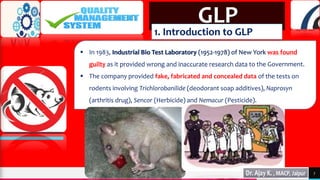
 In 1983, Industrial Bio Test Laboratory (1952-1978) of New York was found
guilty as it provided wrong and inaccurate research data to the Government.
 The company provided fake, fabricated and concealed data of the tests on
rodents involving Trichlorobanilide (deodorant soap additives), Naprosyn
(arthritis drug), Sencor (Herbicide) and Nemacur (Pesticide).
7
GLP
1. Introduction to GLP
TREY
research
According to Valcarcel M.,
GLP is a set of rules,
operating procedures and practices
established by an organization
to ensure the quality and accurate results
in a laboratory practice.
In this practice, the given organization sets
the principles and the laboratory works are
planned, operated, overlooked and
reported.
8
GLP
2. Definition of GLP
TREY
research
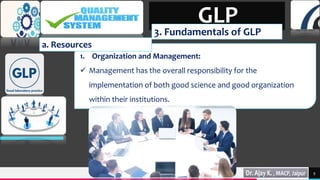
1. Organization and Management:
 Management has the overall responsibility for the
implementation of both good science and good organization
within their institutions.
9
GLP
3. Fundamentals of GLP
a. Resources
TREY
research
1. Organization and Management:
 Good science includes proper definition of experimental design, knowledge
of scientific principles, documentation of experimental and environmental
variables, complete evaluation of the results and reporting of results.
 Whereas, good organization should provide proper planning of studies,
qualified skilled personnel, adequate facilities, infrastructures, proper
conduction of studies and verification process for the study results.
10
GLP
3. Fundamentals of GLP
a. Resources
TREY
research
2. Personnel:
 The detailed records should be maintained for every individual
staff of the institution.
 The records include the detail curriculum vitae, training records
and their job descriptions.
 These records should meet the GLP requirements and these are
maintained to establish that every staff has the competence,
education, experience and training to perform the tests.
11
GLP
3. Fundamentals of GLP
a. Resources
TREY
research
3. Availability of Facilities:
 Adequate facilities with state-of-the-art infrastructure should be
provided by the institution and management to ensure the
validation of the studies.
 The cleaning, maintenance and documents of the site plan
should satisfy the guidelines.
12
GLP
3. Fundamentals of GLP
a. Resources
TREY
research
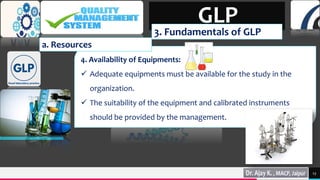
4. Availability of Equipments:
 Adequate equipments must be available for the study in the
organization.
 The suitability of the equipment and calibrated instruments
should be provided by the management.
13
GLP
3. Fundamentals of GLP
a. Resources
TREY
research
1. Test Items:
 It may be an active ingredient for a medicine, a pesticide, a
food additive, a vaccine, an industrially used chemical, a
biomass or an extraction from plants.
 These items are characterized by analytical profile like
chemical identification test, solubility, stability etc.
 The test items should be stored properly to avoid the
contamination.
14
GLP
3. Fundamentals of GLP
b. Characterization
TREY
research
2. Test Systems:
 The test systems could be the animals, bacteria, cells, organs
and plants.
 Sometimes they may be analytical equipments also.
 The test systems should be handled in such a way that it
must comply with the GLP guidelines and with the national
animal welfare law.
15
GLP
3. Fundamentals of GLP
b. Characterization
TREY
research
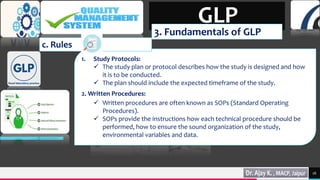
1. Study Protocols:
 The study plan or protocol describes how the study is designed and how
it is to be conducted.
 The plan should include the expected timeframe of the study.
2. Written Procedures:
 Written procedures are often known as SOPs (Standard Operating
Procedures).
 SOPs provide the instructions how each technical procedure should be
performed, how to ensure the sound organization of the study,
environmental variables and data.
16
GLP
3. Fundamentals of GLP
c. Rules
TREY
research
It includes raw data, final reports and data archiving.
1. Raw Data:
 The original record and the data needed for the reconstruction
should be recorded.
 The raw data should include ‘what’ was done, ‘how’ it was done,
‘when’ the work was done and ‘who’ performed the work.
 The recorded data should clarify the process by which it is
generated and should confirm the process has been performed
as per the guidelines and SOPs.
17
GLP
3. Fundamentals of GLP
d. Results
TREY
research
2. Final Results:
 Final results are the responsibility of the study director.
 These results should describe the study accurately and the scientific
interpretation.
 The results should reflect accurately the raw data.
 The review and audit of these reports should be done.
 All accepted changes in the results approved by the reviewer should be
incorporated before the finalization of the results.
18
GLP
3. Fundamentals of GLP
d. Results
TREY
research
3. Archives:
 Archiving is a safe depositing of all information.
 It is considered to be a center for the compilation and
distribution of summary documents.
 The archiving of document helps the reconstruction of studies
performed earlier.
19
GLP
3. Fundamentals of GLP
d. Results
TREY
research
 The requirement of the quality assurance is to validate the experimental
results.
 Quality assurance unit (QAU) or simply QA must review all phases of
preclinical research, organization framework, staff documents, study
procedures and SOPs.
 The internal audits and inspections should be performed by the QA officers.
 The QA performs the study-based audit, facility and systems-based
inspection and process-based inspections.
20
GLP
3. Fundamentals of GLP
e. Quality Assurance
TREY
research
 GLP principles are set of organizational requirements.
 GLP is a regulation covering the quality management of non-
clinical safety studies.
 The aim of the regulation is to encourage scientists to organize
and perform their studies in a way which promotes the quality
and validity of the test data.
21
GLP
4. GLP Principles
TREY
research
GLP deals with issues like:
 The facility provided by the organization.
 Efficient and trained personnel.
 Quality of validated equipment and reagents.
 Predetermined study design.
 SOPs, process validation and test procedures.
 Correctness of the results.
 Quality assurance laboratory (QAL) and Quality assurance
program (QAP).
 Recorded and documented results and their storage.
22
GLP
4. GLP Principles
TREY
research
1. Helps to reduce number of false negatives arising from studies.
False negative result for a toxicity study falsely intimated that the test
item is not toxic, but in real the item is toxic.
2. Helps to reduce the chance of false positives.
In the case of a non-clinical safety study, the results wrongly predict that
the test item is toxic, when really it is not.
3. Promotes international recognition of study data.
When studies are performed according to OECD GLP principles, then the
acceptability and reliability of the data are recognized in the
international level by the OECD member states.
23
GLP
5. Aim of GLP
TREY
research
24
TREY
research
25
1. American Society for Quality (ASQ) Certified Quality Engineer
(CQE) http://prdweb.asq.org/certification/control/quality-engineer/index
2.^ "Homepage | ISPE | International Society for Pharmaceutical Engineering". ispe.org. Retrieved 2020-07-31.
3.^ http://www.access.gpo.gov/nara/cfr/waisidx_05/21cfr820_05.html
4.^ http://www.access.gpo.gov/nara/cfr/waisidx_05/21cfr820_05.html
5.^ Poksinska, Bozena; Dahlgaard, Jens Jörn; Antoni, Marc (2002). "The state of ISO 9000 certification: A study of
Swedish organizations". The TQM Magazine. 14 (5): 297. doi:10.1108/09544780210439734.
6.^ Anton, Doug; Carole Anton (2006). ISO 9001 Survival Guide, Third Edition. AEM Consulting Group, Inc.
p. 100. ISBN 978-0-9672170-8-6.
7.^ Tricker, Ray; Bruce Sherring-Lucas (2005). ISO 9001:2008 In Brief, Second Edition. Butterworth-Heinemann.
p. 192. ISBN 978-0-7506-6616-9.
8.^ Tricker, Ray (2005). ISO 9001:2000 Audit Procedures, Second Edition. Butterworth-Heinemann.
p. 320. ISBN 978-0-7506-6615-2.
9.^ Tricker, Ray (2005). ISO 9001: 2000 For Small Businesses. Butterworth-Heinemann. p. 480. ISBN 978-0-7506-
6617-6.
10.^ Hoyle, David (2005). ISO 9000 Quality Systems Handbook, Fifth Edition. Butterworth-Heinemann.
p. 686. ISBN 978-0-7506-6785-2.
11.^ Dobb, Fred (2004). ISO 9001:2000 Quality Registration Step-by-Step, Third Edition. Butterworth-Heinemann.
p. 292. ISBN 978-0-7506-4949-0.
General references
•ICH1 Guidance E6: Good Clinical Practice: Consolidated guideline (and see Clinical Quality Management
System)
•Pyzdek, T, "Quality Engineering Handbook", 2003, ISBN 0-8247-4614-7
•Juran, Joseph M. and De Feo, Joseph A., "Juran's Quality Handbook", 6th Edition, 1999, ISBN 978-0-07-162973-
7
https://en.wikipedia.org/wiki/Quality_management_system
B.PHARM. VII-SEMESTER BP 702 T. INDUSTRIAL PHARMACY-II (Theory)
DR. AJAY K., ASSOCIATE PROFESSOR
MAHARISHI ARVIND COLLEGE OF PHARMACY, JAIPUR (RAJ.)
AJAY81AJAY@GMAIL.COM WHATSAPP: 9782226444

Quality management systems: Good Laboratory Practice (QMS GLP)

  • 1.
  • 2.
    QUALITYMANAGEMENTSYSTEMS Dr. Ajay K., Maharishi Arvind College of Pharmacy, Jaipur G L P
  • 3.
    TREY research CHA NGE CO NTR OL LEARNINGOBJECTIVES After completing thispresentation, you will be able to understand: 1. Introduction to GLP 2. Definition of GLP 3. Fundamentals of GLP 4. GLP Principles 5. Aim of GLP 3 GOOD LABORATORY PRACTICE
  • 4.
  • 5.
    TREY research  GLP wasintroduced for the non-clinical safety studies in 1976.  In late 90’s, this practice along with OECD (Organization for Economic Co-operation and Development) was accepted as industry standards. 5 GLP 1. Introduction to GLP
  • 6.
    TREY research  GLP hasbeen introduced due to  poor and dishonest practice in laboratory in the early 70’s.  The poor lab practices include wrong calibration of equipments, inaccurate test systems and accounts. 6 GLP 1. Introduction to GLP
  • 7.
    TREY research  In 1983,Industrial Bio Test Laboratory (1952-1978) of New York was found guilty as it provided wrong and inaccurate research data to the Government.  The company provided fake, fabricated and concealed data of the tests on rodents involving Trichlorobanilide (deodorant soap additives), Naprosyn (arthritis drug), Sencor (Herbicide) and Nemacur (Pesticide). 7 GLP 1. Introduction to GLP
  • 8.
    TREY research According to ValcarcelM., GLP is a set of rules, operating procedures and practices established by an organization to ensure the quality and accurate results in a laboratory practice. In this practice, the given organization sets the principles and the laboratory works are planned, operated, overlooked and reported. 8 GLP 2. Definition of GLP
  • 9.
    TREY research 1. Organization andManagement:  Management has the overall responsibility for the implementation of both good science and good organization within their institutions. 9 GLP 3. Fundamentals of GLP a. Resources
  • 10.
    TREY research 1. Organization andManagement:  Good science includes proper definition of experimental design, knowledge of scientific principles, documentation of experimental and environmental variables, complete evaluation of the results and reporting of results.  Whereas, good organization should provide proper planning of studies, qualified skilled personnel, adequate facilities, infrastructures, proper conduction of studies and verification process for the study results. 10 GLP 3. Fundamentals of GLP a. Resources
  • 11.
    TREY research 2. Personnel:  Thedetailed records should be maintained for every individual staff of the institution.  The records include the detail curriculum vitae, training records and their job descriptions.  These records should meet the GLP requirements and these are maintained to establish that every staff has the competence, education, experience and training to perform the tests. 11 GLP 3. Fundamentals of GLP a. Resources
  • 12.
    TREY research 3. Availability ofFacilities:  Adequate facilities with state-of-the-art infrastructure should be provided by the institution and management to ensure the validation of the studies.  The cleaning, maintenance and documents of the site plan should satisfy the guidelines. 12 GLP 3. Fundamentals of GLP a. Resources
  • 13.
    TREY research 4. Availability ofEquipments:  Adequate equipments must be available for the study in the organization.  The suitability of the equipment and calibrated instruments should be provided by the management. 13 GLP 3. Fundamentals of GLP a. Resources
  • 14.
    TREY research 1. Test Items: It may be an active ingredient for a medicine, a pesticide, a food additive, a vaccine, an industrially used chemical, a biomass or an extraction from plants.  These items are characterized by analytical profile like chemical identification test, solubility, stability etc.  The test items should be stored properly to avoid the contamination. 14 GLP 3. Fundamentals of GLP b. Characterization
  • 15.
    TREY research 2. Test Systems: The test systems could be the animals, bacteria, cells, organs and plants.  Sometimes they may be analytical equipments also.  The test systems should be handled in such a way that it must comply with the GLP guidelines and with the national animal welfare law. 15 GLP 3. Fundamentals of GLP b. Characterization
  • 16.
    TREY research 1. Study Protocols: The study plan or protocol describes how the study is designed and how it is to be conducted.  The plan should include the expected timeframe of the study. 2. Written Procedures:  Written procedures are often known as SOPs (Standard Operating Procedures).  SOPs provide the instructions how each technical procedure should be performed, how to ensure the sound organization of the study, environmental variables and data. 16 GLP 3. Fundamentals of GLP c. Rules
  • 17.
    TREY research It includes rawdata, final reports and data archiving. 1. Raw Data:  The original record and the data needed for the reconstruction should be recorded.  The raw data should include ‘what’ was done, ‘how’ it was done, ‘when’ the work was done and ‘who’ performed the work.  The recorded data should clarify the process by which it is generated and should confirm the process has been performed as per the guidelines and SOPs. 17 GLP 3. Fundamentals of GLP d. Results
  • 18.
    TREY research 2. Final Results: Final results are the responsibility of the study director.  These results should describe the study accurately and the scientific interpretation.  The results should reflect accurately the raw data.  The review and audit of these reports should be done.  All accepted changes in the results approved by the reviewer should be incorporated before the finalization of the results. 18 GLP 3. Fundamentals of GLP d. Results
  • 19.
    TREY research 3. Archives:  Archivingis a safe depositing of all information.  It is considered to be a center for the compilation and distribution of summary documents.  The archiving of document helps the reconstruction of studies performed earlier. 19 GLP 3. Fundamentals of GLP d. Results
  • 20.
    TREY research  The requirementof the quality assurance is to validate the experimental results.  Quality assurance unit (QAU) or simply QA must review all phases of preclinical research, organization framework, staff documents, study procedures and SOPs.  The internal audits and inspections should be performed by the QA officers.  The QA performs the study-based audit, facility and systems-based inspection and process-based inspections. 20 GLP 3. Fundamentals of GLP e. Quality Assurance
  • 21.
    TREY research  GLP principlesare set of organizational requirements.  GLP is a regulation covering the quality management of non- clinical safety studies.  The aim of the regulation is to encourage scientists to organize and perform their studies in a way which promotes the quality and validity of the test data. 21 GLP 4. GLP Principles
  • 22.
    TREY research GLP deals withissues like:  The facility provided by the organization.  Efficient and trained personnel.  Quality of validated equipment and reagents.  Predetermined study design.  SOPs, process validation and test procedures.  Correctness of the results.  Quality assurance laboratory (QAL) and Quality assurance program (QAP).  Recorded and documented results and their storage. 22 GLP 4. GLP Principles
  • 23.
    TREY research 1. Helps toreduce number of false negatives arising from studies. False negative result for a toxicity study falsely intimated that the test item is not toxic, but in real the item is toxic. 2. Helps to reduce the chance of false positives. In the case of a non-clinical safety study, the results wrongly predict that the test item is toxic, when really it is not. 3. Promotes international recognition of study data. When studies are performed according to OECD GLP principles, then the acceptability and reliability of the data are recognized in the international level by the OECD member states. 23 GLP 5. Aim of GLP
  • 24.
  • 25.
    TREY research 25 1. American Societyfor Quality (ASQ) Certified Quality Engineer (CQE) http://prdweb.asq.org/certification/control/quality-engineer/index 2.^ "Homepage | ISPE | International Society for Pharmaceutical Engineering". ispe.org. Retrieved 2020-07-31. 3.^ http://www.access.gpo.gov/nara/cfr/waisidx_05/21cfr820_05.html 4.^ http://www.access.gpo.gov/nara/cfr/waisidx_05/21cfr820_05.html 5.^ Poksinska, Bozena; Dahlgaard, Jens Jörn; Antoni, Marc (2002). "The state of ISO 9000 certification: A study of Swedish organizations". The TQM Magazine. 14 (5): 297. doi:10.1108/09544780210439734. 6.^ Anton, Doug; Carole Anton (2006). ISO 9001 Survival Guide, Third Edition. AEM Consulting Group, Inc. p. 100. ISBN 978-0-9672170-8-6. 7.^ Tricker, Ray; Bruce Sherring-Lucas (2005). ISO 9001:2008 In Brief, Second Edition. Butterworth-Heinemann. p. 192. ISBN 978-0-7506-6616-9. 8.^ Tricker, Ray (2005). ISO 9001:2000 Audit Procedures, Second Edition. Butterworth-Heinemann. p. 320. ISBN 978-0-7506-6615-2. 9.^ Tricker, Ray (2005). ISO 9001: 2000 For Small Businesses. Butterworth-Heinemann. p. 480. ISBN 978-0-7506- 6617-6. 10.^ Hoyle, David (2005). ISO 9000 Quality Systems Handbook, Fifth Edition. Butterworth-Heinemann. p. 686. ISBN 978-0-7506-6785-2. 11.^ Dobb, Fred (2004). ISO 9001:2000 Quality Registration Step-by-Step, Third Edition. Butterworth-Heinemann. p. 292. ISBN 978-0-7506-4949-0. General references •ICH1 Guidance E6: Good Clinical Practice: Consolidated guideline (and see Clinical Quality Management System) •Pyzdek, T, "Quality Engineering Handbook", 2003, ISBN 0-8247-4614-7 •Juran, Joseph M. and De Feo, Joseph A., "Juran's Quality Handbook", 6th Edition, 1999, ISBN 978-0-07-162973- 7 https://en.wikipedia.org/wiki/Quality_management_system
  • 26.
    B.PHARM. VII-SEMESTER BP702 T. INDUSTRIAL PHARMACY-II (Theory) DR. AJAY K., ASSOCIATE PROFESSOR MAHARISHI ARVIND COLLEGE OF PHARMACY, JAIPUR (RAJ.) AJAY81AJAY@GMAIL.COM WHATSAPP: 9782226444