Quality by Design (QbD) in
Product Development
1
2
ICH’s released current ‘Q8(R2) pharmaceutical development’ 2009,
‘Q9 quality risk management’ 2005and
‘Q10 pharmaceutical quality system guidelines’ 2008
ICH Q8 defines design space from the concept that
quality cannot be tested into product but has to be built in by design
7
This guideline is an annex to ICH Q8 Pharmaceutical Development and provides
further clarification of key concepts outlined in the core guideline. In addition,
this annex describes the principles of quality by design (QbD). The annex is not
intended to establish new standards or to introduce new regulatory
requirements; however, it shows how concepts and tools (e.g., design space)
outlined in the parent Q8 document could be put into practice by the applicant
for all dosage forms.
The Pharmaceutical Development section provides an opportunity to
present the knowledge gained through the application of scientific approaches
and quality risk management to the development of a product and its
manufacturing process.
ICH Q8
4
COMPONENTS OF DRUG PRODUCT GIVEN
BY ICH Q8
• DRUG SUBSTANCES
“The physicochemical and biological properties of the drug substance that can
influence the performance of the drug product and its manufacturability.”
Examples of physicochemical and biological properties that
might need to be examined include
•Solubility,
•Water content,
•Particle size,
•Crystal properties,
•Biological activity,
•Permeability.
5
• EXCIPIENTS
The excipients chosen, their concentration, and the characteristics that can
influence the drug product performance or manufacturability should be
discussed relative to the respective function of each excipients.
The compatibility of the drug substance with excipients should be evaluated.
For products that contain more than one drug substance, the compatibility of
the drug substances with each other should also be evaluated.
6• FORMULATION DEVELOPMENT
A summary should be provided describing the development of the formulation,
including identification of those attributes that are critical to the quality of the drug
product and also highlight the evolution of the formulation design from initial
concept up to the final design.
Information from comparative in vitro studies (e.g., dissolution) or comparative in
vivo studies (e.g., BE) that links clinical formulations to the proposed commercial
formulation.
A successful correlation can assist in the selection of appropriate dissolution
acceptance criteria, and can potentially reduce the need for further bioequivalence
studies following changes to the product or its manufacturing process.
7• CONTAINER AND CLOSURE SYSTEM
The choice for selection of the container closure system for the
commercial product should be discussed.
The choice of materials for primary packaging and secondary
packaging should be justified.
A possible interaction between product and container or label should
be considered.
8
• MICROBIOLOGICAL ATTRIBUTES
The selection and effectiveness of preservative systems in products
containing antimicrobial preservative or the antimicrobial effectiveness of
products that are inherently antimicrobial.
 For sterile products, the integrity of the container closure system as it
relates to preventing microbial contamination.
The lowest specified concentration of antimicrobial preservative should
be justified in terms of efficacy and safety, such that the minimum
concentration of preservative that gives the required level of efficacy
throughout the intended shelf life of the product is used.
2
Quality has been given abundant significance by all regulatory
bodies for manufacturing of pharmaceutical products and drug
delivery systems.
Quality means customer satisfaction in terms of service, product,
and process. Customer demands the perfection in quality,
reliability, low cost and timely performance of the drug product.
But merely analyzing the final product does indicate the quality;
however it should be designed in the product
3
Thus the quality has to be built in the product through proper planning, so that
the impending failure can be circumvented.
Initially, quality by test (QbT) was the solitary approach to assure the quality of
drug products which was based on methods without clear understanding of the
processes.
But after the launching of guidelines for current good manufacturing practice
(cGMP) by FDA
this problem was solved as FDA developed generalized quality by design (QbD) in
the field of pharmacy
11
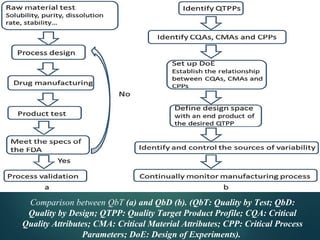
Comparison between QbT (a) and QbD (b). (QbT: Quality by Test; QbD:
Quality by Design; QTPP: Quality Target Product Profile; CQA: Critical
Quality Attributes; CMA: Critical Material Attributes; CPP: Critical Process
Parameters; DoE: Design of Experiments).
12
QbD is based on the thorough understanding of how
materials and process parameters affect the profile of final
products.
ICH defines QbD as “a systematic approach to
pharmaceutical development that begins with predefined
objectives and emphasizes product and process
understanding and process control, based on sound
science and quality risk management”
QbD essentially means building quality in, not testing it.
13
• Compared with traditional quality by the testing (QbT) approach, QbD has
immense prospects
• build a well-organized and flexible system with increased manufacturing
efficiency
• reduced costs, project rejections and waste.
• With scientific knowledge and risk management, QbD guarantees consistent
information and incorporated risk management.
• QbD fetches cost-efficiency and simplicity of manufacturing process into
reality
14
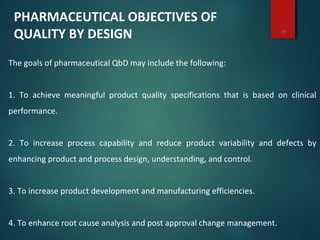
The goals of pharmaceutical QbD may include the following:
1. To achieve meaningful product quality specifications that is based on clinical
performance.
2. To increase process capability and reduce product variability and defects by
enhancing product and process design, understanding, and control.
3. To increase product development and manufacturing efficiencies.
4. To enhance root cause analysis and post approval change management.
PHARMACEUTICAL OBJECTIVES OF
QUALITY BY DESIGN
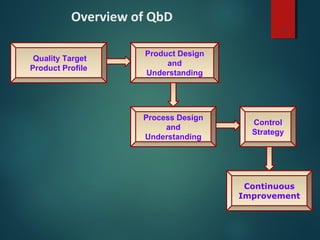
Overview of QbD
Quality Target
Product Profile
Product Design
and
Understanding
Process Design
and
Understanding
Control
Strategy
Continuous
Improvement
16
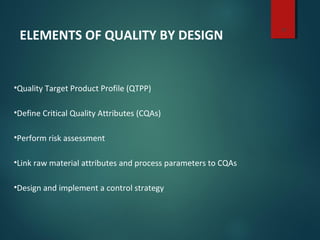
•Quality Target Product Profile (QTPP)
•Define Critical Quality Attributes (CQAs)
•Perform risk assessment
•Link raw material attributes and process parameters to CQAs
•Design and implement a control strategy
ELEMENTS OF QUALITY BY DESIGN
17
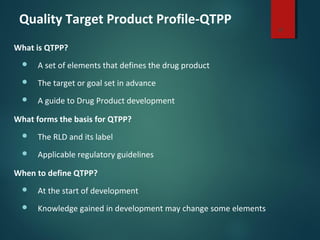
Quality Target Product Profile-QTPP
What is QTPP?
 A set of elements that defines the drug product
 The target or goal set in advance
 A guide to Drug Product development
What forms the basis for QTPP?
 The RLD and its label
 Applicable regulatory guidelines
When to define QTPP?
 At the start of development
 Knowledge gained in development may change some elements
18
Components of QTPP
Components related to safety, efficacy, identity, purity and potency
Critical and non-critical components, e.g.
 Critical: Assay, content uniformity
 Non-critical: Appearance
Fixed and variable components
 Fixed elements must be present
e.g. Dosage form, strength
 Variable elements may have a range of acceptable values
e.g. Tablet weight, assay
19
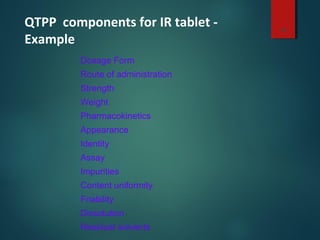
QTPP components for IR tablet -
Example
Dosage Form
Route of administration
Strength
Weight
Pharmacokinetics
Appearance
Identity
Assay
Impurities
Content uniformity
Friability
Dissolution
Residual solvents
20
Specific requirements in QTPP
 Orally Disintegrating tablets
 Hardness
 Disintegration time
 Extended Release products
 Alcohol induced dose dumping
21
Critical Quality Attributes – CQAs
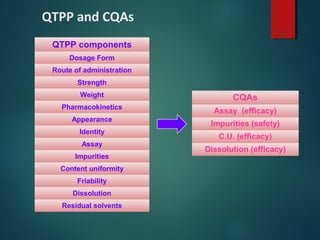
 CQAs are a subset of the QTPP
 Include critical parameters that are likely to change based upon
variations in raw materials and processes
-Identity test for dosage form – Not a CQA
-Assay, Content uniformity – CQAs
 CQAs are monitored throughout the DP development.
 CQAs ensure that DP remains within safe and effective levels.
22
QTPP and CQAs
QTPP components
Dosage Form
Route of administration
Strength
Weight
Pharmacokinetics
Appearance
Identity
Assay
Impurities
Content uniformity
Friability
Dissolution
Residual solvents
CQAs
Assay (efficacy)
Impurities (safety)
C.U. (efficacy)
Dissolution (efficacy)
23
23
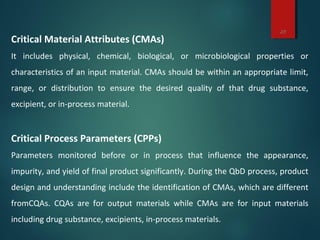
Critical Material Attributes (CMAs)
It includes physical, chemical, biological, or microbiological properties or
characteristics of an input material. CMAs should be within an appropriate limit,
range, or distribution to ensure the desired quality of that drug substance,
excipient, or in-process material.
Critical Process Parameters (CPPs)
Parameters monitored before or in process that influence the appearance,
impurity, and yield of final product significantly. During the QbD process, product
design and understanding include the identification of CMAs, which are different
fromCQAs. CQAs are for output materials while CMAs are for input materials
including drug substance, excipients, in-process materials.
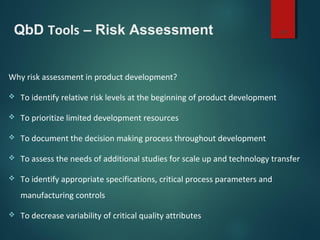
QbD Tools – Risk Assessment
Why risk assessment in product development?
 To identify relative risk levels at the beginning of product development
 To prioritize limited development resources
 To document the decision making process throughout development
 To assess the needs of additional studies for scale up and technology transfer
 To identify appropriate specifications, critical process parameters and
manufacturing controls
 To decrease variability of critical quality attributes
25
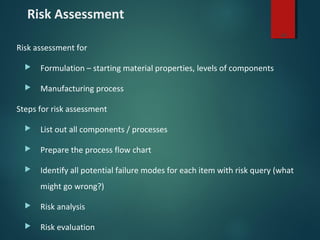
Risk Assessment
Risk assessment for
 Formulation – starting material properties, levels of components
 Manufacturing process
Steps for risk assessment
 List out all components / processes
 Prepare the process flow chart
 Identify all potential failure modes for each item with risk query (what
might go wrong?)
 Risk analysis
 Risk evaluation
26
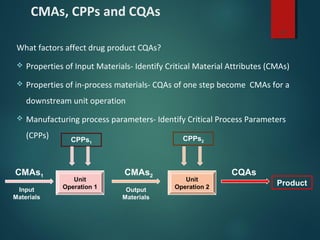
CMAs, CPPs and CQAs
What factors affect drug product CQAs?
 Properties of Input Materials- Identify Critical Material Attributes (CMAs)
 Properties of in-process materials- CQAs of one step become CMAs for a
downstream unit operation
 Manufacturing process parameters- Identify Critical Process Parameters
(CPPs)
Input
Materials
CMAs1
Output
Materials
Product
CQAs
CPPs1
Unit
Operation 1
Unit
Operation 2
CMAs2
CPPs2
27
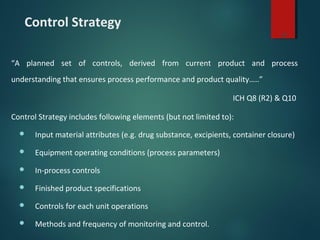
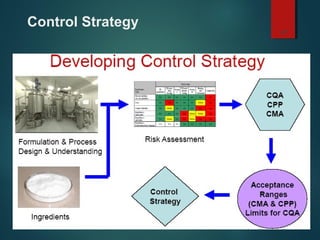
Control Strategy
“A planned set of controls, derived from current product and process
understanding that ensures process performance and product quality…..”
ICH Q8 (R2) & Q10
Control Strategy includes following elements (but not limited to):
 Input material attributes (e.g. drug substance, excipients, container closure)
 Equipment operating conditions (process parameters)
 In-process controls
 Finished product specifications
 Controls for each unit operations
 Methods and frequency of monitoring and control.
28
Control Strategy
29
References for QbD
1. Guidance for Industry: Q8(R2) Pharmaceutical Development
2. Guidance for Industry: Q9 Quality Risk Management
3. Guidance for Industry: Q10 Pharmaceutical Quality System
4. Guidance for Industry PAT: A Framework for Innovative Pharmaceutical
Development, Manufacturing, and Quality Assurance
5. Quality by Design for ANDAs: An Example for Modified Release Dosage Forms
6. Quality by Design for ANDAs: An Example for Immediate Release Dosage Forms
7. GPhA presentations
8. Draft QbD updated
30
THANKS….
PRESENTED BY - JATIN SINGLA
M.PHARM
1ST
YEAR
PH’CEUTICS

Qbd

  • 1.
    Quality by Design(QbD) in Product Development 1
  • 2.
    2 ICH’s released current‘Q8(R2) pharmaceutical development’ 2009, ‘Q9 quality risk management’ 2005and ‘Q10 pharmaceutical quality system guidelines’ 2008 ICH Q8 defines design space from the concept that quality cannot be tested into product but has to be built in by design
  • 3.
    7 This guideline isan annex to ICH Q8 Pharmaceutical Development and provides further clarification of key concepts outlined in the core guideline. In addition, this annex describes the principles of quality by design (QbD). The annex is not intended to establish new standards or to introduce new regulatory requirements; however, it shows how concepts and tools (e.g., design space) outlined in the parent Q8 document could be put into practice by the applicant for all dosage forms. The Pharmaceutical Development section provides an opportunity to present the knowledge gained through the application of scientific approaches and quality risk management to the development of a product and its manufacturing process. ICH Q8
  • 4.
    4 COMPONENTS OF DRUGPRODUCT GIVEN BY ICH Q8 • DRUG SUBSTANCES “The physicochemical and biological properties of the drug substance that can influence the performance of the drug product and its manufacturability.” Examples of physicochemical and biological properties that might need to be examined include •Solubility, •Water content, •Particle size, •Crystal properties, •Biological activity, •Permeability.
  • 5.
    5 • EXCIPIENTS The excipientschosen, their concentration, and the characteristics that can influence the drug product performance or manufacturability should be discussed relative to the respective function of each excipients. The compatibility of the drug substance with excipients should be evaluated. For products that contain more than one drug substance, the compatibility of the drug substances with each other should also be evaluated.
  • 6.
    6• FORMULATION DEVELOPMENT Asummary should be provided describing the development of the formulation, including identification of those attributes that are critical to the quality of the drug product and also highlight the evolution of the formulation design from initial concept up to the final design. Information from comparative in vitro studies (e.g., dissolution) or comparative in vivo studies (e.g., BE) that links clinical formulations to the proposed commercial formulation. A successful correlation can assist in the selection of appropriate dissolution acceptance criteria, and can potentially reduce the need for further bioequivalence studies following changes to the product or its manufacturing process.
  • 7.
    7• CONTAINER ANDCLOSURE SYSTEM The choice for selection of the container closure system for the commercial product should be discussed. The choice of materials for primary packaging and secondary packaging should be justified. A possible interaction between product and container or label should be considered.
  • 8.
    8 • MICROBIOLOGICAL ATTRIBUTES Theselection and effectiveness of preservative systems in products containing antimicrobial preservative or the antimicrobial effectiveness of products that are inherently antimicrobial.  For sterile products, the integrity of the container closure system as it relates to preventing microbial contamination. The lowest specified concentration of antimicrobial preservative should be justified in terms of efficacy and safety, such that the minimum concentration of preservative that gives the required level of efficacy throughout the intended shelf life of the product is used.
  • 9.
    2 Quality has beengiven abundant significance by all regulatory bodies for manufacturing of pharmaceutical products and drug delivery systems. Quality means customer satisfaction in terms of service, product, and process. Customer demands the perfection in quality, reliability, low cost and timely performance of the drug product. But merely analyzing the final product does indicate the quality; however it should be designed in the product
  • 10.
    3 Thus the qualityhas to be built in the product through proper planning, so that the impending failure can be circumvented. Initially, quality by test (QbT) was the solitary approach to assure the quality of drug products which was based on methods without clear understanding of the processes. But after the launching of guidelines for current good manufacturing practice (cGMP) by FDA this problem was solved as FDA developed generalized quality by design (QbD) in the field of pharmacy
  • 11.
    11 Comparison between QbT(a) and QbD (b). (QbT: Quality by Test; QbD: Quality by Design; QTPP: Quality Target Product Profile; CQA: Critical Quality Attributes; CMA: Critical Material Attributes; CPP: Critical Process Parameters; DoE: Design of Experiments).
  • 12.
    12 QbD is basedon the thorough understanding of how materials and process parameters affect the profile of final products. ICH defines QbD as “a systematic approach to pharmaceutical development that begins with predefined objectives and emphasizes product and process understanding and process control, based on sound science and quality risk management” QbD essentially means building quality in, not testing it.
  • 13.
    13 • Compared withtraditional quality by the testing (QbT) approach, QbD has immense prospects • build a well-organized and flexible system with increased manufacturing efficiency • reduced costs, project rejections and waste. • With scientific knowledge and risk management, QbD guarantees consistent information and incorporated risk management. • QbD fetches cost-efficiency and simplicity of manufacturing process into reality
  • 14.
    14 The goals ofpharmaceutical QbD may include the following: 1. To achieve meaningful product quality specifications that is based on clinical performance. 2. To increase process capability and reduce product variability and defects by enhancing product and process design, understanding, and control. 3. To increase product development and manufacturing efficiencies. 4. To enhance root cause analysis and post approval change management. PHARMACEUTICAL OBJECTIVES OF QUALITY BY DESIGN
  • 15.
    Overview of QbD QualityTarget Product Profile Product Design and Understanding Process Design and Understanding Control Strategy Continuous Improvement 16
  • 16.
    •Quality Target ProductProfile (QTPP) •Define Critical Quality Attributes (CQAs) •Perform risk assessment •Link raw material attributes and process parameters to CQAs •Design and implement a control strategy ELEMENTS OF QUALITY BY DESIGN 17
  • 17.
    Quality Target ProductProfile-QTPP What is QTPP?  A set of elements that defines the drug product  The target or goal set in advance  A guide to Drug Product development What forms the basis for QTPP?  The RLD and its label  Applicable regulatory guidelines When to define QTPP?  At the start of development  Knowledge gained in development may change some elements 18
  • 18.
    Components of QTPP Componentsrelated to safety, efficacy, identity, purity and potency Critical and non-critical components, e.g.  Critical: Assay, content uniformity  Non-critical: Appearance Fixed and variable components  Fixed elements must be present e.g. Dosage form, strength  Variable elements may have a range of acceptable values e.g. Tablet weight, assay 19
  • 19.
    QTPP components forIR tablet - Example Dosage Form Route of administration Strength Weight Pharmacokinetics Appearance Identity Assay Impurities Content uniformity Friability Dissolution Residual solvents 20
  • 20.
    Specific requirements inQTPP  Orally Disintegrating tablets  Hardness  Disintegration time  Extended Release products  Alcohol induced dose dumping 21
  • 21.
    Critical Quality Attributes– CQAs  CQAs are a subset of the QTPP  Include critical parameters that are likely to change based upon variations in raw materials and processes -Identity test for dosage form – Not a CQA -Assay, Content uniformity – CQAs  CQAs are monitored throughout the DP development.  CQAs ensure that DP remains within safe and effective levels. 22
  • 22.
    QTPP and CQAs QTPPcomponents Dosage Form Route of administration Strength Weight Pharmacokinetics Appearance Identity Assay Impurities Content uniformity Friability Dissolution Residual solvents CQAs Assay (efficacy) Impurities (safety) C.U. (efficacy) Dissolution (efficacy) 23
  • 23.
    23 Critical Material Attributes(CMAs) It includes physical, chemical, biological, or microbiological properties or characteristics of an input material. CMAs should be within an appropriate limit, range, or distribution to ensure the desired quality of that drug substance, excipient, or in-process material. Critical Process Parameters (CPPs) Parameters monitored before or in process that influence the appearance, impurity, and yield of final product significantly. During the QbD process, product design and understanding include the identification of CMAs, which are different fromCQAs. CQAs are for output materials while CMAs are for input materials including drug substance, excipients, in-process materials.
  • 24.
    QbD Tools –Risk Assessment Why risk assessment in product development?  To identify relative risk levels at the beginning of product development  To prioritize limited development resources  To document the decision making process throughout development  To assess the needs of additional studies for scale up and technology transfer  To identify appropriate specifications, critical process parameters and manufacturing controls  To decrease variability of critical quality attributes 25
  • 25.
    Risk Assessment Risk assessmentfor  Formulation – starting material properties, levels of components  Manufacturing process Steps for risk assessment  List out all components / processes  Prepare the process flow chart  Identify all potential failure modes for each item with risk query (what might go wrong?)  Risk analysis  Risk evaluation 26
  • 26.
    CMAs, CPPs andCQAs What factors affect drug product CQAs?  Properties of Input Materials- Identify Critical Material Attributes (CMAs)  Properties of in-process materials- CQAs of one step become CMAs for a downstream unit operation  Manufacturing process parameters- Identify Critical Process Parameters (CPPs) Input Materials CMAs1 Output Materials Product CQAs CPPs1 Unit Operation 1 Unit Operation 2 CMAs2 CPPs2 27
  • 27.
    Control Strategy “A plannedset of controls, derived from current product and process understanding that ensures process performance and product quality…..” ICH Q8 (R2) & Q10 Control Strategy includes following elements (but not limited to):  Input material attributes (e.g. drug substance, excipients, container closure)  Equipment operating conditions (process parameters)  In-process controls  Finished product specifications  Controls for each unit operations  Methods and frequency of monitoring and control. 28
  • 28.
  • 29.
    References for QbD 1.Guidance for Industry: Q8(R2) Pharmaceutical Development 2. Guidance for Industry: Q9 Quality Risk Management 3. Guidance for Industry: Q10 Pharmaceutical Quality System 4. Guidance for Industry PAT: A Framework for Innovative Pharmaceutical Development, Manufacturing, and Quality Assurance 5. Quality by Design for ANDAs: An Example for Modified Release Dosage Forms 6. Quality by Design for ANDAs: An Example for Immediate Release Dosage Forms 7. GPhA presentations 8. Draft QbD updated 30
  • 30.
    THANKS…. PRESENTED BY -JATIN SINGLA M.PHARM 1ST YEAR PH’CEUTICS