NAME : BHUMIN N. JAIN
M. PHARM FIRST YEAR
DEPARTMENT OF PHARMACEUTICS
GUIDED BY – DR. H. S. MAHAJAN SIR
1
 CONTENTS :
1. Introduction
2. Definition
3. Objectives
4. Advantages
5. ICH guidelines
6. Elements of QbD
7. QbD Tools
8. Applications
9. Conclusion
2
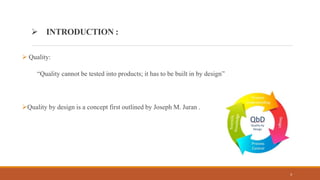
 INTRODUCTION :
 Quality:
“Quality cannot be tested into products; it has to be built in by design”
Quality by design is a concept first outlined by Joseph M. Juran .
3
 Definition:
The Pharmaceutical Quality by Design is a systematic approach to development that begins
with predefined objectives and emphasizes product and process understanding and process
control based on sound science and quality risk management.
4
QbD is emerging
to enhance
Assurance of safe
Effective drug
supply to consumer
Offers promise to
significant
improvement
5
 OBJECTIVES OF PHARMACEUTICALQbD:
1. To achieve meaningful product quality specifications that are based on clinical performances.
2. To increase process capability and reduce product variability.
3. To increase product development and manufacturing efficiencies.
4. To enhance root cause analysis and post approval change management.
5. To prevent regulatory compliance issues.
6. Increase the efficiency of production, lower costs, avoid waste.
6
 ADVANTAGES OF QBD:
 Benefits for Industry:
◦ Better understanding of the process
◦ Less batch failure
◦ More efficient and effective control of change
◦ Return on investment or cost savings
7
 ADVANTAGES OF QBD:
 Additional opportunities:
◦ Reduction of post-approval submissions
◦ More efficient technology transfer to manufacturing
◦ Risk-based approach and identification
◦ Innovative process validation approaches
8
 ICH Guidelines :
Q8: Pharmaceutical
Development
Q9: Quality Risk
Management
Q10: Pharmaceutical
Quality System
9
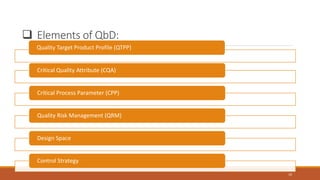
 Elements of QbD:
Quality Target Product Profile (QTPP)
Critical Quality Attribute (CQA)
Critical Process Parameter (CPP)
Quality Risk Management (QRM)
Design Space
Control Strategy
10
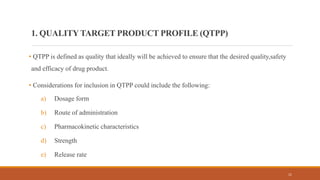
1. QUALITY TARGET PRODUCT PROFILE (QTPP)
• QTPP is defined as quality that ideally will be achieved to ensure that the desired quality,safety
and efficacy of drug product.
• Considerations for inclusion in QTPP could include the following:
a) Dosage form
b) Route of administration
c) Pharmacokinetic characteristics
d) Strength
e) Release rate
11
2. CRITICALQUALITYATTRIBUTE (CQA)
• CQA is defined as a physical,chemical,biological or microbiological property that should be with
in an appropriate limit or range to ensure the desired product quality.
• CQAs are generally-
a) Drug substance
b) Excipients
c) Intermediates
d) Drug product
12
3.CRITICALPROCESS PARAMETER (CPP)
• A process parameter whose variability has an impact on CQA and therefore should be monitor or
controlled to ensure process produces the desired quality.
• CPPs have a direct impact on CQAs.
• Process parameter can be measured and controlled.
• Examples of CPP- temperature, cooling rate, rotation speed, pH.
13
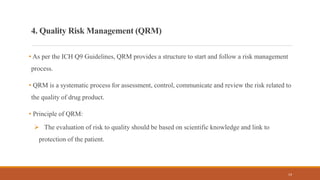
4. Quality Risk Management (QRM)
• As per the ICH Q9 Guidelines, QRM provides a structure to start and follow a risk management
process.
• QRM is a systematic process for assessment, control, communicate and review the risk related to
the quality of drug product.
• Principle of QRM:
 The evaluation of risk to quality should be based on scientific knowledge and link to
protection of the patient.
14
5. DESIGN SPACE
• As per ICH Q8 Guidelines, aim of pharmaceutical development is to design a quality product and
its manufacturing process to consistently deliver the intended performance of product.
•It is a multidimensional combination and interaction of input variables and process parameter
established to provide quality assurance.
•Design space is proposed by applicant and is subjected to regulatory assessment and approval.
15
6. CONTROLSTRATEGY
• As per ICH Q10 Guidelines, it is a management system to direct and control a pharmaceutical
company with regard to quality.
• A control strategy is designed to ensure that a product of required quality will be produced
consistently.
• The elements of control which contribute to final product quality include
a) In process controls
b) Control of input materials eg. Excipient and drug substance
c) Container closure system
16
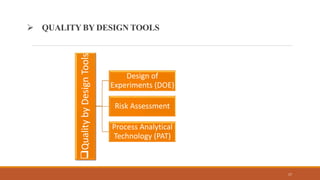
 QUALITY BY DESIGN TOOLS
Quality
by
Design
Tools
Design of
Experiments (DOE)
Risk Assessment
Process Analytical
Technology (PAT)
17
1. DESIGN OF EXPERIMENTS (DOE)
• DOE is structured ,organized method for determining relationship between factors affecting a process
and the response of that process.
• DOE is effective in design of different dosage forms and unit operations.
• Guarantee high research efficiency and improved product quality.
• The DOE also reveals between input factors and output responses.
18
 DOE METHODOLOGY
Choose
experimental
design
Conduct
randomized
experiments
Analyze data
Create
multidimension
al surface
model
19
A series of structured tests are designed
in which planned changes are made to the input variables of a process or system
The effect of these changes on a predefined output are then assessed.
 DOE is important as a formal way of maximizing information gained and minimizing resources
required.
20
2.RISKASSESSMENT
 Risk:
Risk is defined as the combination of the probability of occurrence of form and severity of
that form.
 Risk assessment :
A systematic process of organizing information to support a risk decision to be
made with in risk management process.
It consists of identification of hazards analysis and evaluation of risk associated with
those hazards.
21
3. PROCESSANALYTICALTECHNOLOGY (PAT)
A system for designing, analysing, and controlling manufacturing through timely measurements
of critical quality and performance attributes of raw and in process materials and process with
goal of ensuring final product quality.
22
 APPLICATIONS OF QUALITY BY DESIGN (QBD)
In pharmaceutical development.
To design a quality product and a manufacturing process to consistently deliver the intended
performance of product.
In life cycle management.
23
 CONCLUSION-
QbD is increasingly becoming an important and widely used technique in pharmaceutical
product development.
Implementing QbD concept in product development provide quality medicines to patients, and
production improvements to manufacturers with reduced batch failures and drug regulatory
bodies will have greater confidence in robust quality of product.
As such QbD is becoming a promising scientific tool in quality assurance in pharmaceutical
industry.
24
 References-
1. Woodcock J. The Concept of Pharmaceutical Quality. 7th ed. American Pharmaceutical
Review; 2004. (6), 1010-1015.
2. Nadpara NP, Thumar RV, Kalola VN, Patel PB. Quality by design (QBD): A complete review.
Int J Pharm Sci Rev Res. 2012;17(2):20-8.
3. Juran JM, Godfrey AB. Juran's Quality Handbook. 5th ed. McGraw Hill; 1998, 29.1
4. Zhang L, Mao S. Application of quality by design in the current drug development. Asian
journal of pharmaceutical sciences. 2017 Jan 1;12(1):1-8.
5. Kadam VR, Patil MP, Pawar VV, Kshirsagar S. A review on: Quality by design (QbD). Asian J.
Res. Pharm. Sci. 2017 Dec 24;7(4):197-204.
25
26

Quality by Design.pptx

  • 1.
    NAME : BHUMINN. JAIN M. PHARM FIRST YEAR DEPARTMENT OF PHARMACEUTICS GUIDED BY – DR. H. S. MAHAJAN SIR 1
  • 2.
     CONTENTS : 1.Introduction 2. Definition 3. Objectives 4. Advantages 5. ICH guidelines 6. Elements of QbD 7. QbD Tools 8. Applications 9. Conclusion 2
  • 3.
     INTRODUCTION : Quality: “Quality cannot be tested into products; it has to be built in by design” Quality by design is a concept first outlined by Joseph M. Juran . 3
  • 4.
     Definition: The PharmaceuticalQuality by Design is a systematic approach to development that begins with predefined objectives and emphasizes product and process understanding and process control based on sound science and quality risk management. 4
  • 5.
    QbD is emerging toenhance Assurance of safe Effective drug supply to consumer Offers promise to significant improvement 5
  • 6.
     OBJECTIVES OFPHARMACEUTICALQbD: 1. To achieve meaningful product quality specifications that are based on clinical performances. 2. To increase process capability and reduce product variability. 3. To increase product development and manufacturing efficiencies. 4. To enhance root cause analysis and post approval change management. 5. To prevent regulatory compliance issues. 6. Increase the efficiency of production, lower costs, avoid waste. 6
  • 7.
     ADVANTAGES OFQBD:  Benefits for Industry: ◦ Better understanding of the process ◦ Less batch failure ◦ More efficient and effective control of change ◦ Return on investment or cost savings 7
  • 8.
     ADVANTAGES OFQBD:  Additional opportunities: ◦ Reduction of post-approval submissions ◦ More efficient technology transfer to manufacturing ◦ Risk-based approach and identification ◦ Innovative process validation approaches 8
  • 9.
     ICH Guidelines: Q8: Pharmaceutical Development Q9: Quality Risk Management Q10: Pharmaceutical Quality System 9
  • 10.
     Elements ofQbD: Quality Target Product Profile (QTPP) Critical Quality Attribute (CQA) Critical Process Parameter (CPP) Quality Risk Management (QRM) Design Space Control Strategy 10
  • 11.
    1. QUALITY TARGETPRODUCT PROFILE (QTPP) • QTPP is defined as quality that ideally will be achieved to ensure that the desired quality,safety and efficacy of drug product. • Considerations for inclusion in QTPP could include the following: a) Dosage form b) Route of administration c) Pharmacokinetic characteristics d) Strength e) Release rate 11
  • 12.
    2. CRITICALQUALITYATTRIBUTE (CQA) •CQA is defined as a physical,chemical,biological or microbiological property that should be with in an appropriate limit or range to ensure the desired product quality. • CQAs are generally- a) Drug substance b) Excipients c) Intermediates d) Drug product 12
  • 13.
    3.CRITICALPROCESS PARAMETER (CPP) •A process parameter whose variability has an impact on CQA and therefore should be monitor or controlled to ensure process produces the desired quality. • CPPs have a direct impact on CQAs. • Process parameter can be measured and controlled. • Examples of CPP- temperature, cooling rate, rotation speed, pH. 13
  • 14.
    4. Quality RiskManagement (QRM) • As per the ICH Q9 Guidelines, QRM provides a structure to start and follow a risk management process. • QRM is a systematic process for assessment, control, communicate and review the risk related to the quality of drug product. • Principle of QRM:  The evaluation of risk to quality should be based on scientific knowledge and link to protection of the patient. 14
  • 15.
    5. DESIGN SPACE •As per ICH Q8 Guidelines, aim of pharmaceutical development is to design a quality product and its manufacturing process to consistently deliver the intended performance of product. •It is a multidimensional combination and interaction of input variables and process parameter established to provide quality assurance. •Design space is proposed by applicant and is subjected to regulatory assessment and approval. 15
  • 16.
    6. CONTROLSTRATEGY • Asper ICH Q10 Guidelines, it is a management system to direct and control a pharmaceutical company with regard to quality. • A control strategy is designed to ensure that a product of required quality will be produced consistently. • The elements of control which contribute to final product quality include a) In process controls b) Control of input materials eg. Excipient and drug substance c) Container closure system 16
  • 17.
     QUALITY BYDESIGN TOOLS Quality by Design Tools Design of Experiments (DOE) Risk Assessment Process Analytical Technology (PAT) 17
  • 18.
    1. DESIGN OFEXPERIMENTS (DOE) • DOE is structured ,organized method for determining relationship between factors affecting a process and the response of that process. • DOE is effective in design of different dosage forms and unit operations. • Guarantee high research efficiency and improved product quality. • The DOE also reveals between input factors and output responses. 18
  • 19.
  • 20.
    A series ofstructured tests are designed in which planned changes are made to the input variables of a process or system The effect of these changes on a predefined output are then assessed.  DOE is important as a formal way of maximizing information gained and minimizing resources required. 20
  • 21.
    2.RISKASSESSMENT  Risk: Risk isdefined as the combination of the probability of occurrence of form and severity of that form.  Risk assessment : A systematic process of organizing information to support a risk decision to be made with in risk management process. It consists of identification of hazards analysis and evaluation of risk associated with those hazards. 21
  • 22.
    3. PROCESSANALYTICALTECHNOLOGY (PAT) Asystem for designing, analysing, and controlling manufacturing through timely measurements of critical quality and performance attributes of raw and in process materials and process with goal of ensuring final product quality. 22
  • 23.
     APPLICATIONS OFQUALITY BY DESIGN (QBD) In pharmaceutical development. To design a quality product and a manufacturing process to consistently deliver the intended performance of product. In life cycle management. 23
  • 24.
     CONCLUSION- QbD isincreasingly becoming an important and widely used technique in pharmaceutical product development. Implementing QbD concept in product development provide quality medicines to patients, and production improvements to manufacturers with reduced batch failures and drug regulatory bodies will have greater confidence in robust quality of product. As such QbD is becoming a promising scientific tool in quality assurance in pharmaceutical industry. 24
  • 25.
     References- 1. WoodcockJ. The Concept of Pharmaceutical Quality. 7th ed. American Pharmaceutical Review; 2004. (6), 1010-1015. 2. Nadpara NP, Thumar RV, Kalola VN, Patel PB. Quality by design (QBD): A complete review. Int J Pharm Sci Rev Res. 2012;17(2):20-8. 3. Juran JM, Godfrey AB. Juran's Quality Handbook. 5th ed. McGraw Hill; 1998, 29.1 4. Zhang L, Mao S. Application of quality by design in the current drug development. Asian journal of pharmaceutical sciences. 2017 Jan 1;12(1):1-8. 5. Kadam VR, Patil MP, Pawar VV, Kshirsagar S. A review on: Quality by design (QbD). Asian J. Res. Pharm. Sci. 2017 Dec 24;7(4):197-204. 25
  • 26.