CS3352 & Foundations of Data Science
Basic Statistical Descriptions of Data.
Dr.M.Swarna Sudha
Associate Professor/CSE
Ramco Institute of Technology
Rajapalayam
Statistics
• Statistics studies the collection, analysis,
interpretation or explanation, and
presentation of data.
• Data mining has an inherent connection
with statistics.
• A statistical model is a set of
mathematical functions that describe the
behavior of the objects in a target class in
terms of random variables and their
associated probability distributions.
• Statistics is useful for mining various patterns
from data as well as for understanding the
underlying mechanisms generating and affecting
the patterns.
• Inferential statistics (or predictive statistics)
models data in a way that accounts for
randomness and uncertainty in the observations
and is used to draw inferences about the process
or population under investigation
Dataset
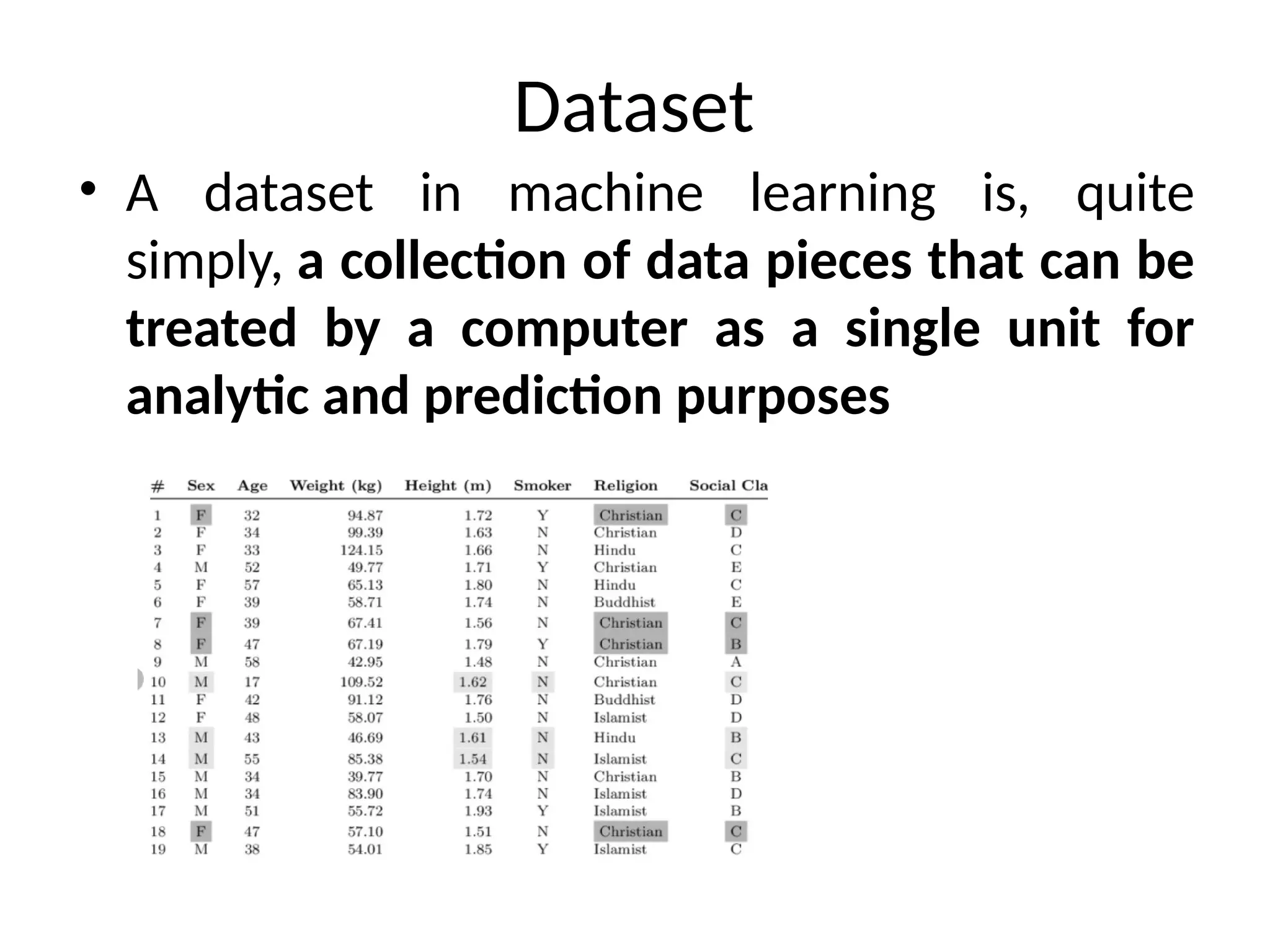
• A dataset in machine learning is, quite
simply, a collection of data pieces that can be
treated by a computer as a single unit for
analytic and prediction purposes
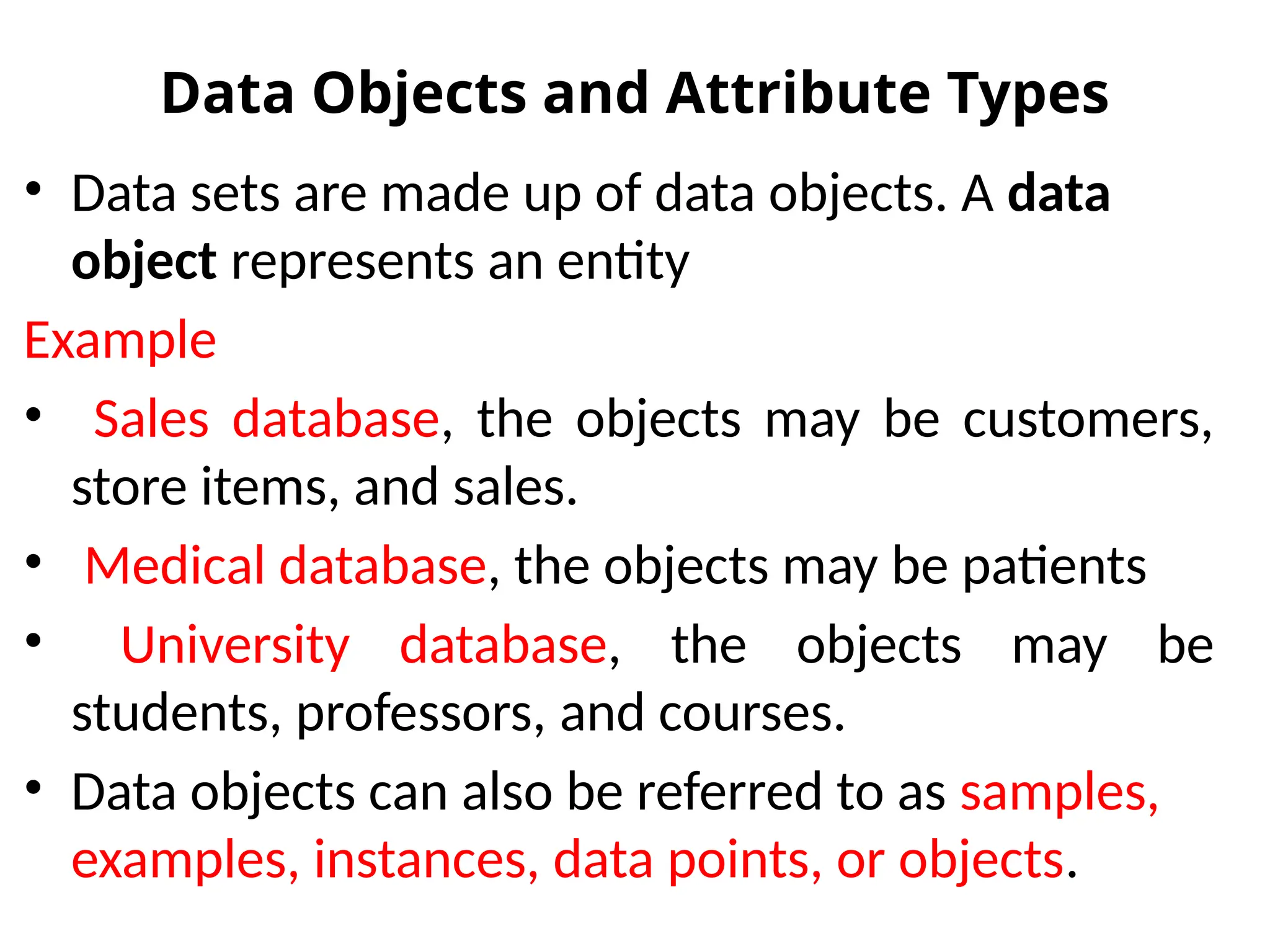
Data Objects and Attribute Types
• Data sets are made up of data objects. A data
object represents an entity
Example
• Sales database, the objects may be customers,
store items, and sales.
• Medical database, the objects may be patients
• University database, the objects may be
students, professors, and courses.
• Data objects can also be referred to as samples,
examples, instances, data points, or objects.
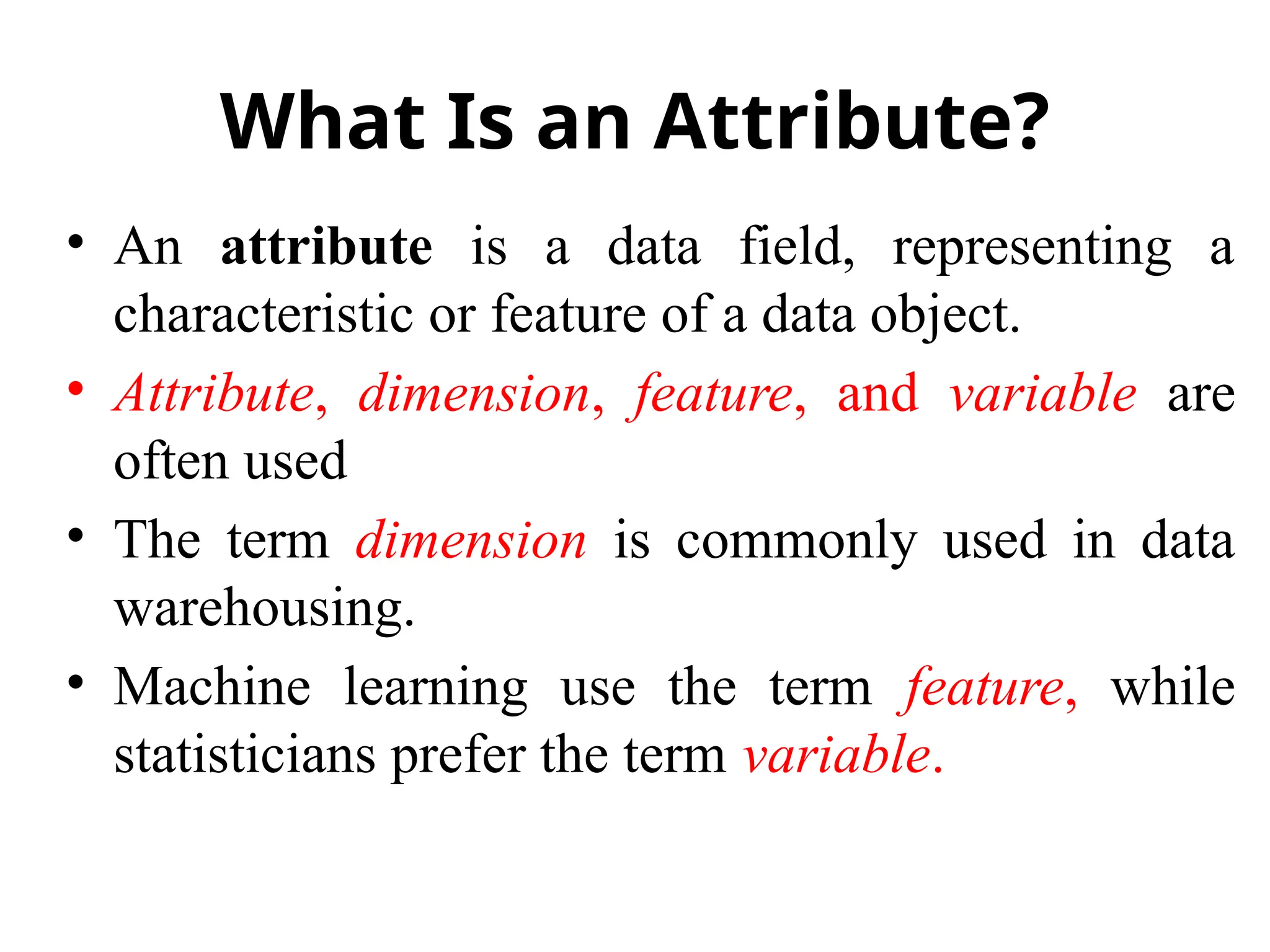
What Is an Attribute?
• An attribute is a data field, representing a
characteristic or feature of a data object.
• Attribute, dimension, feature, and variable are
often used
• The term dimension is commonly used in data
warehousing.
• Machine learning use the term feature, while
statisticians prefer the term variable.
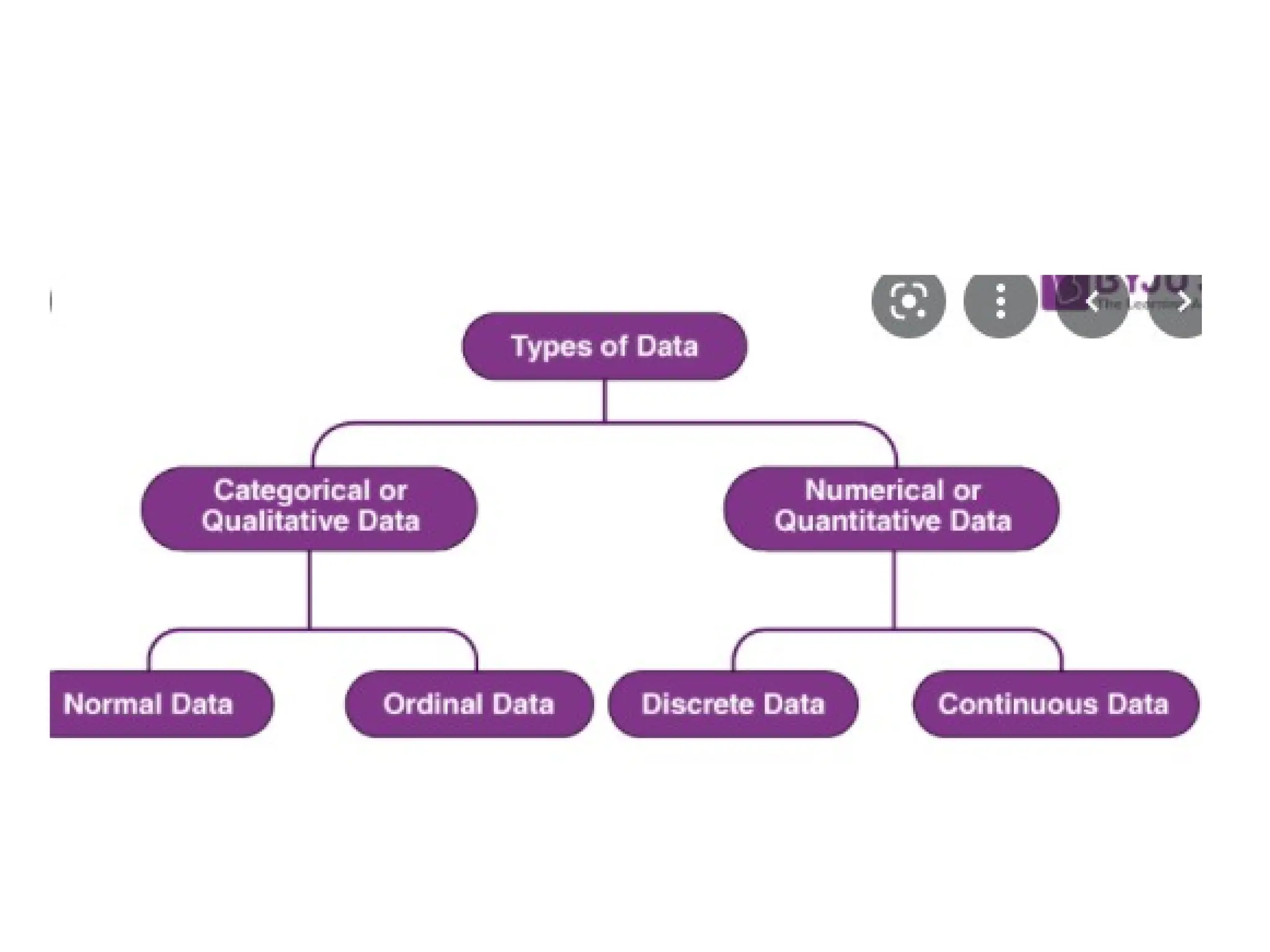
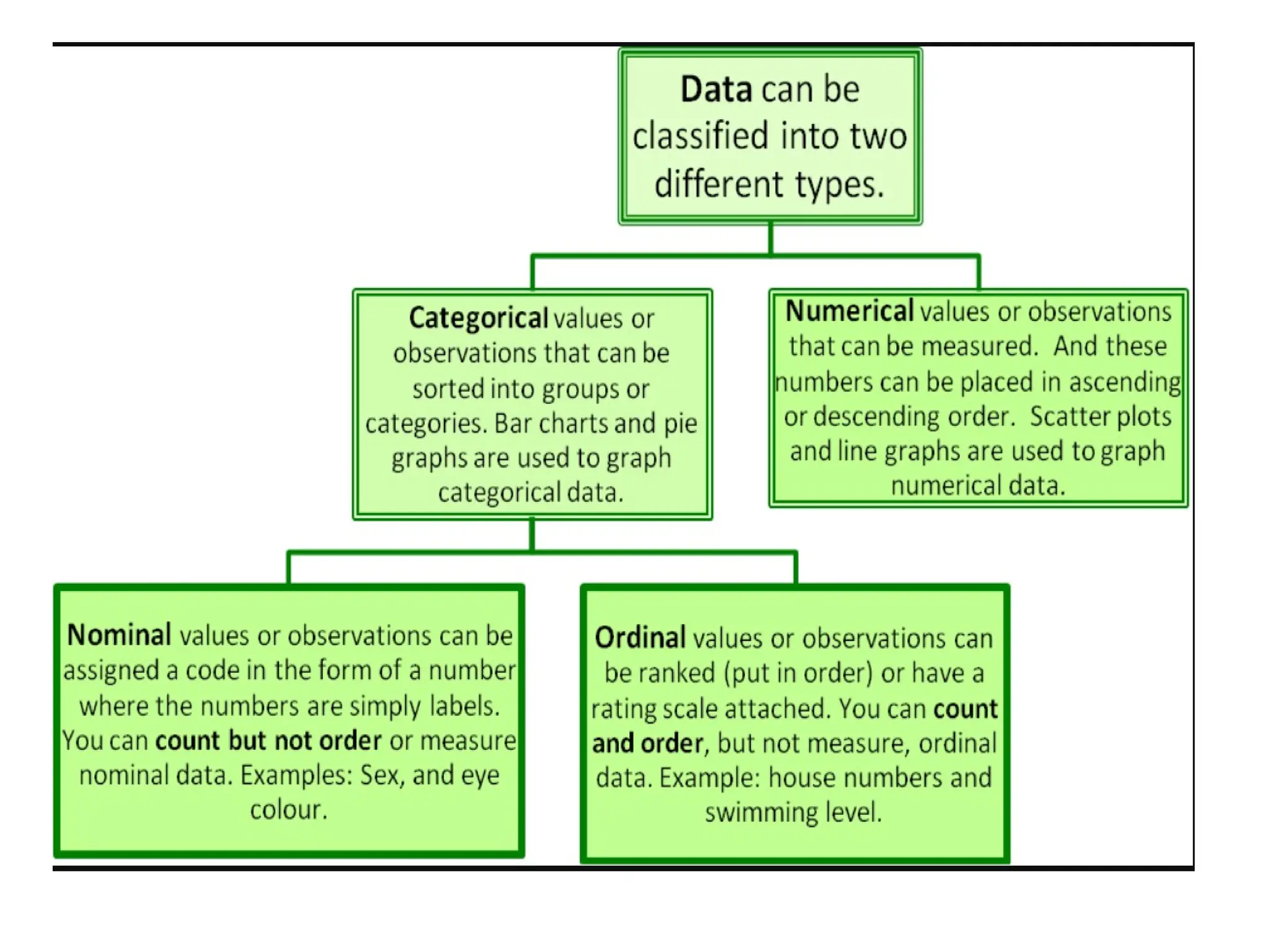
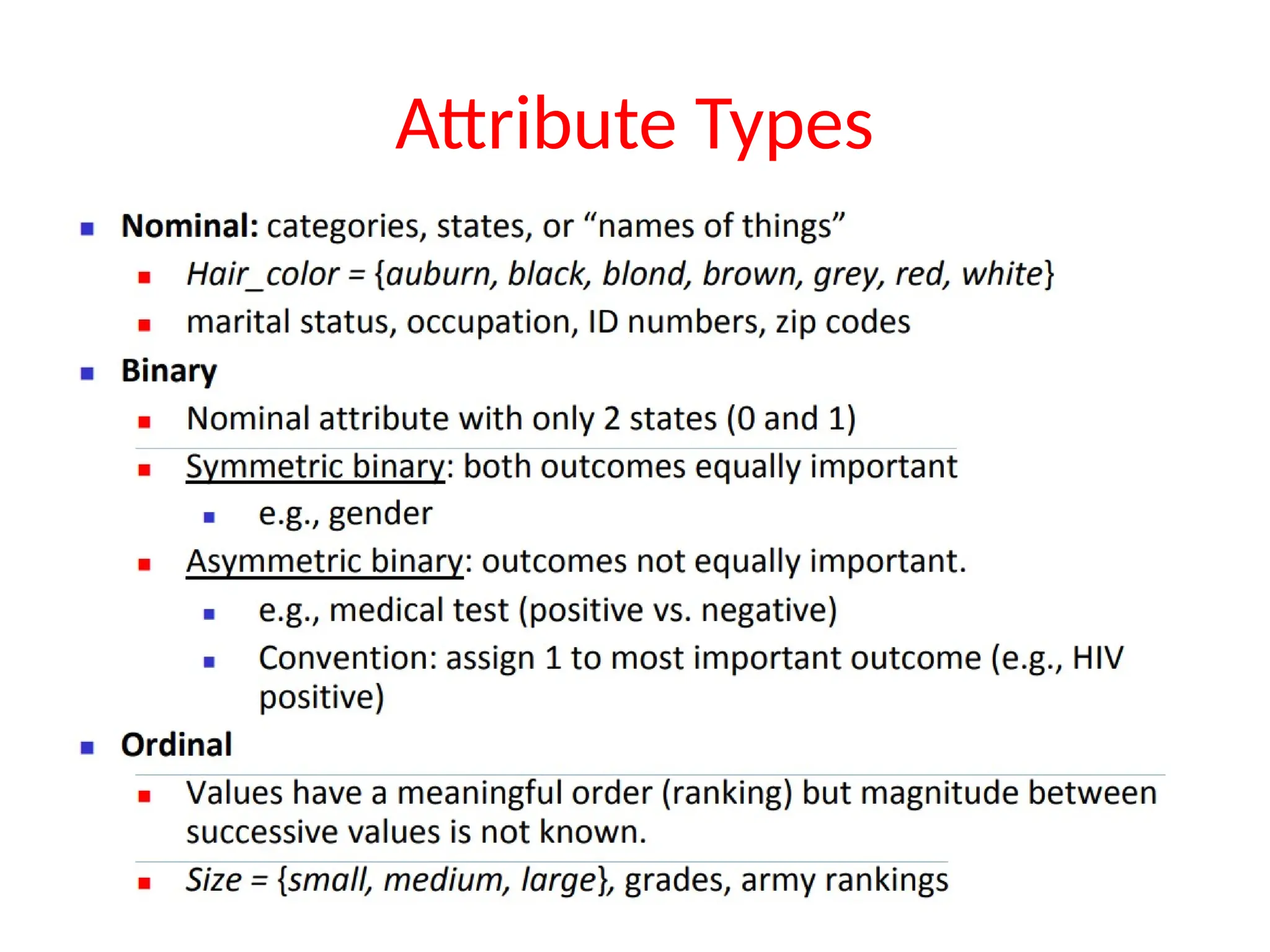
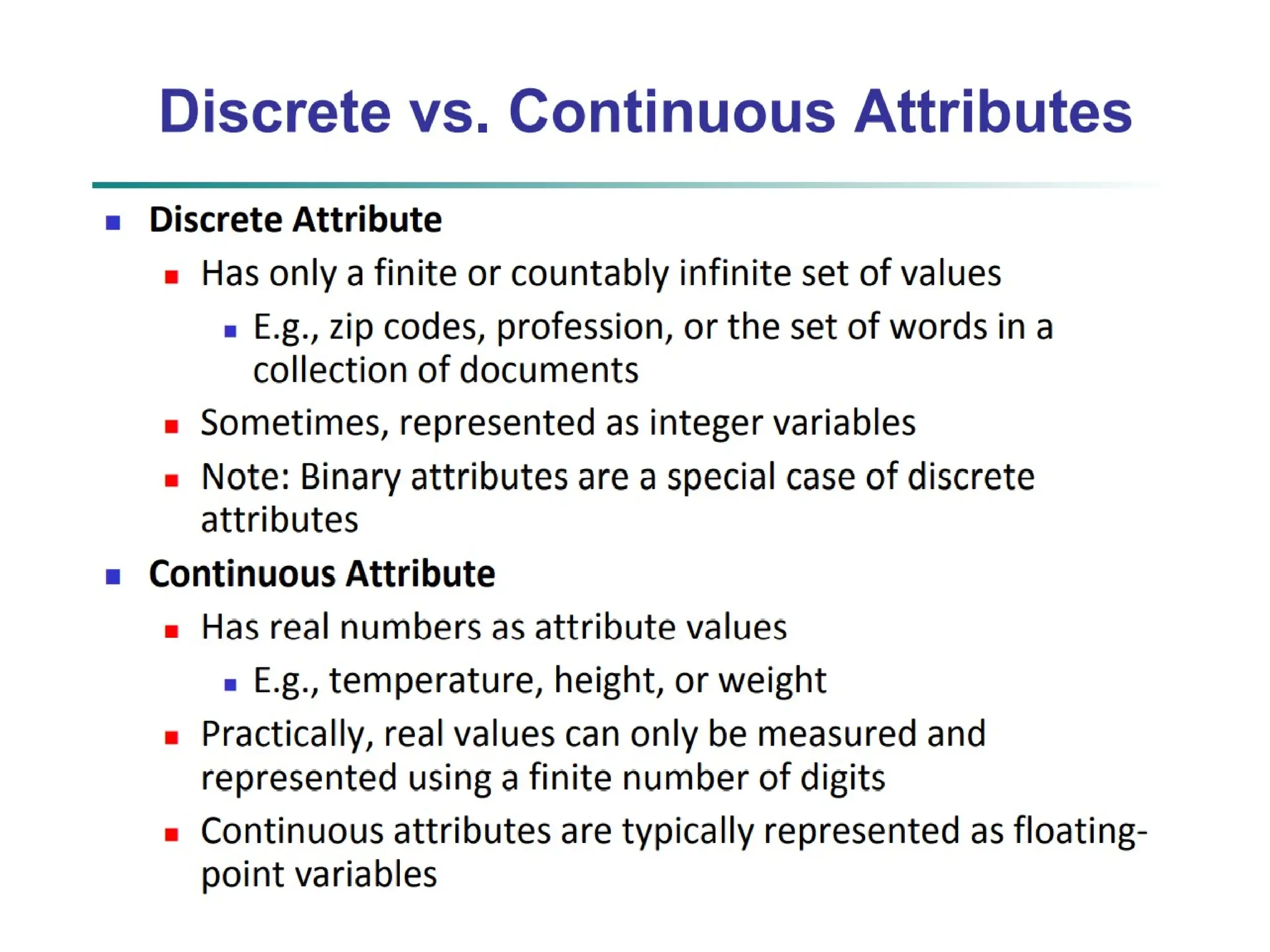
Attribute Types
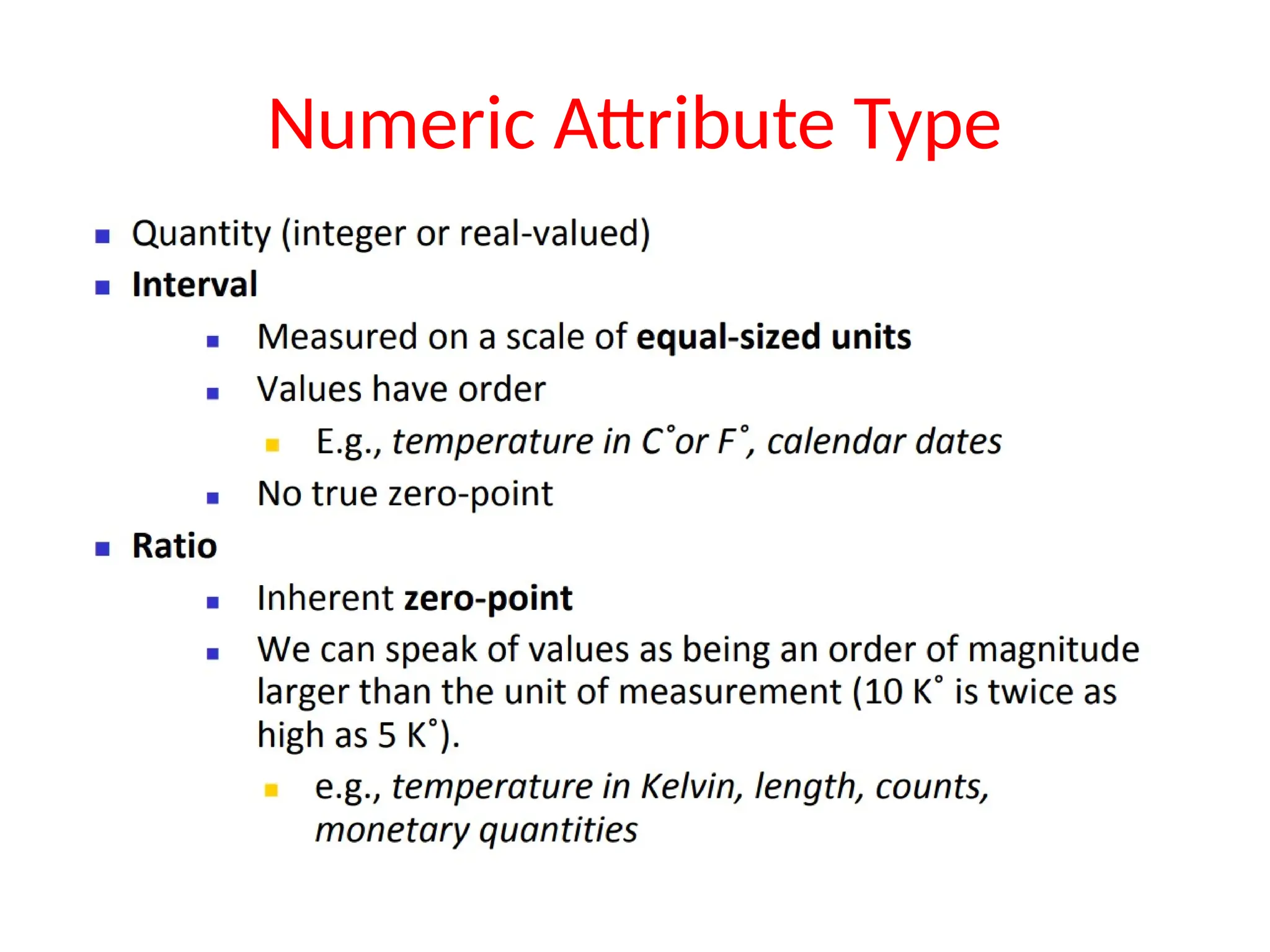
Numeric Attribute Type
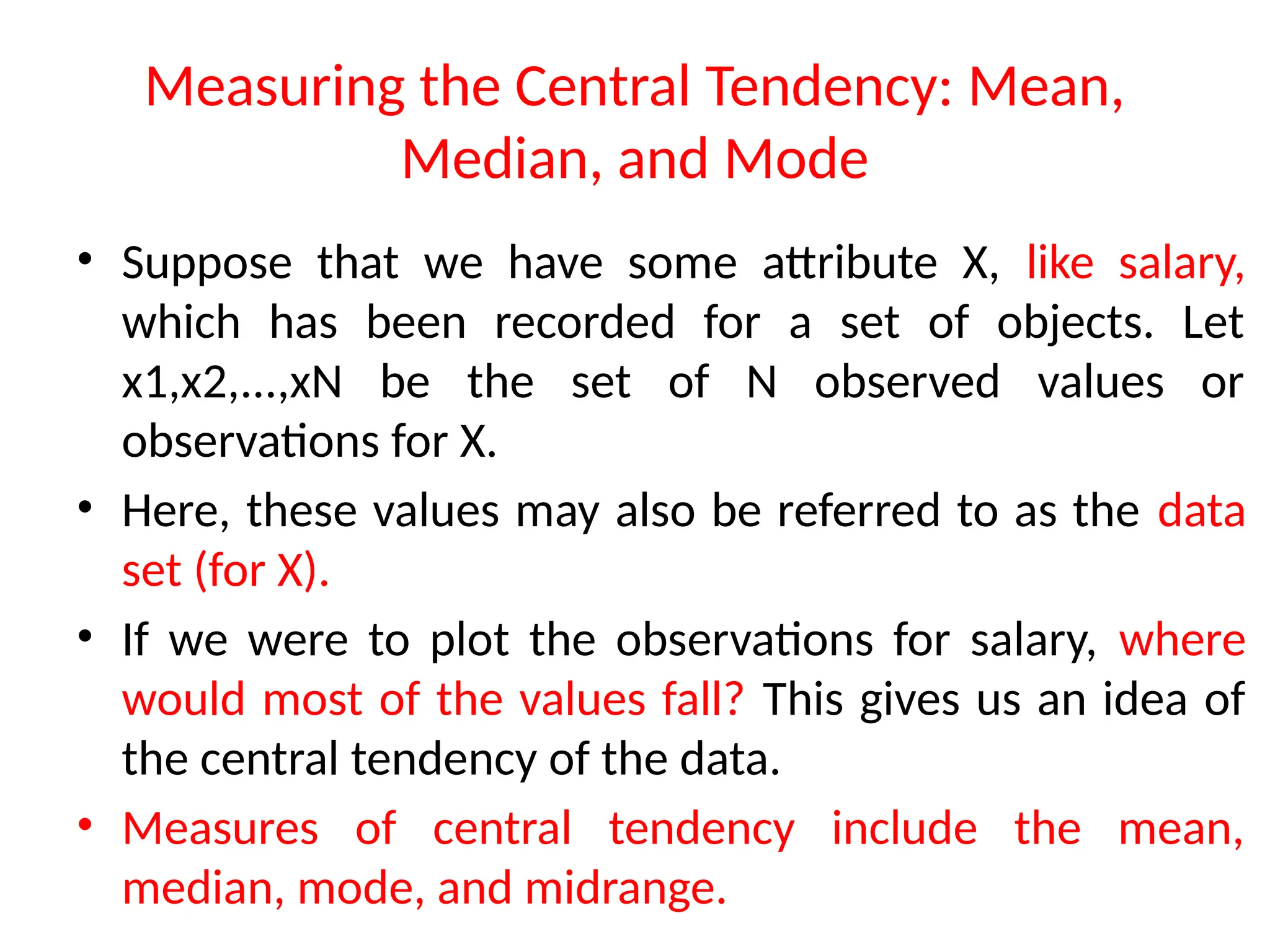
Measuring the Central Tendency: Mean,
Median, and Mode
• Suppose that we have some attribute X, like salary,
which has been recorded for a set of objects. Let
x1,x2,...,xN be the set of N observed values or
observations for X.
• Here, these values may also be referred to as the data
set (for X).
• If we were to plot the observations for salary, where
would most of the values fall? This gives us an idea of
the central tendency of the data.
• Measures of central tendency include the mean,
median, mode, and midrange.
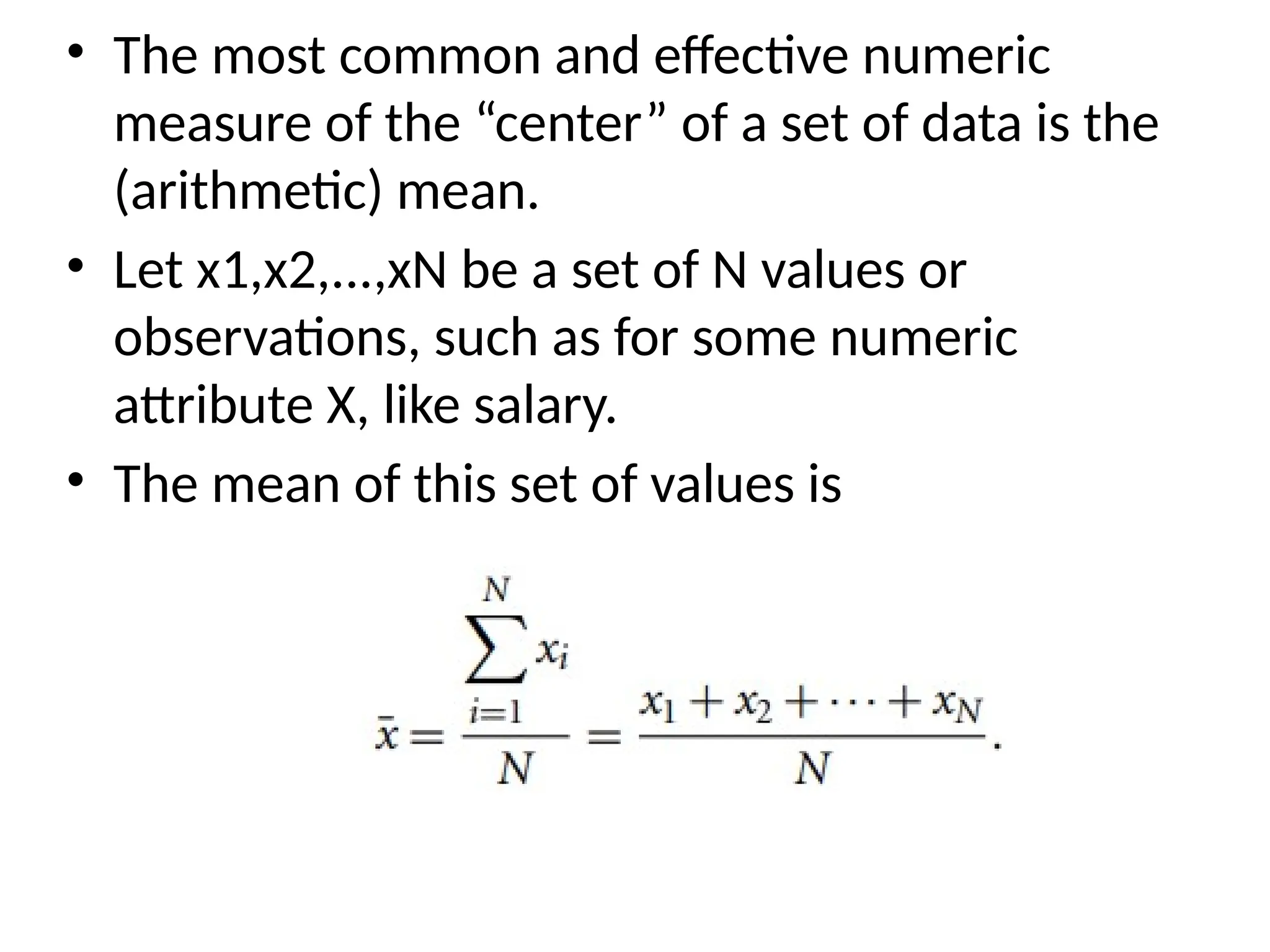
• The most common and effective numeric
measure of the “center” of a set of data is the
(arithmetic) mean.
• Let x1,x2,...,xN be a set of N values or
observations, such as for some numeric
attribute X, like salary.
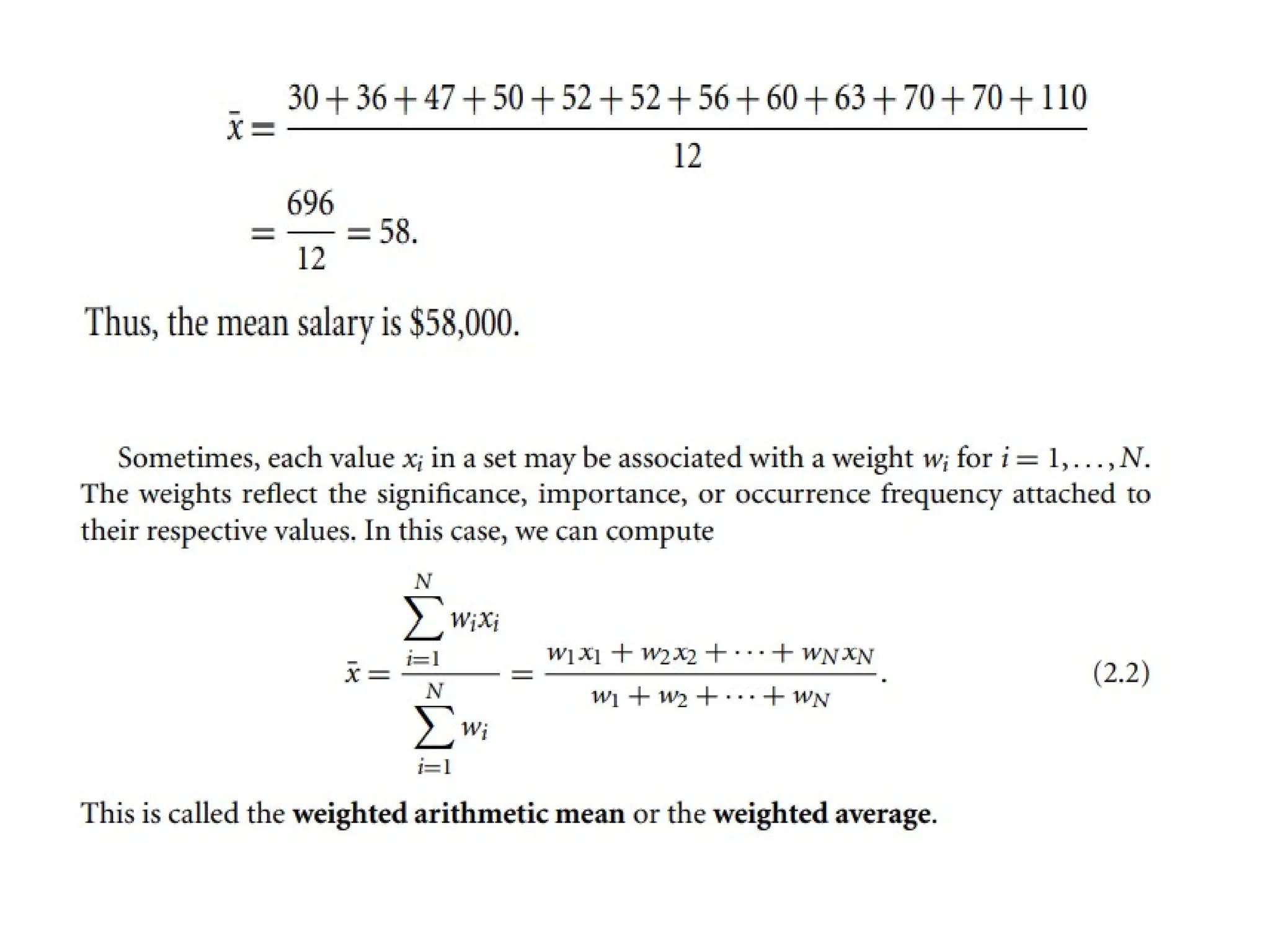
• The mean of this set of values is
Examples
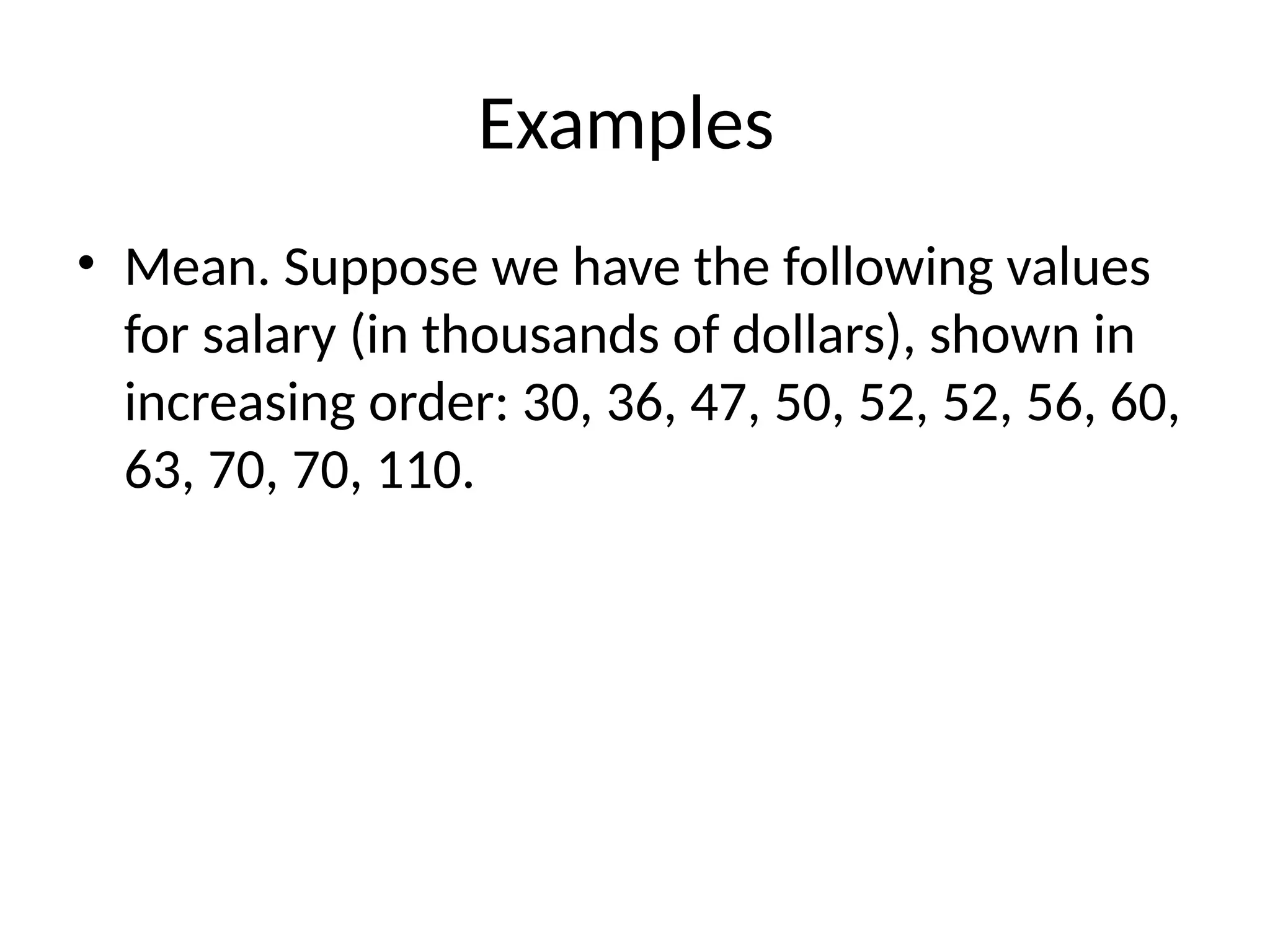
• Mean. Suppose we have the following values
for salary (in thousands of dollars), shown in
increasing order: 30, 36, 47, 50, 52, 52, 56, 60,
63, 70, 70, 110.
•
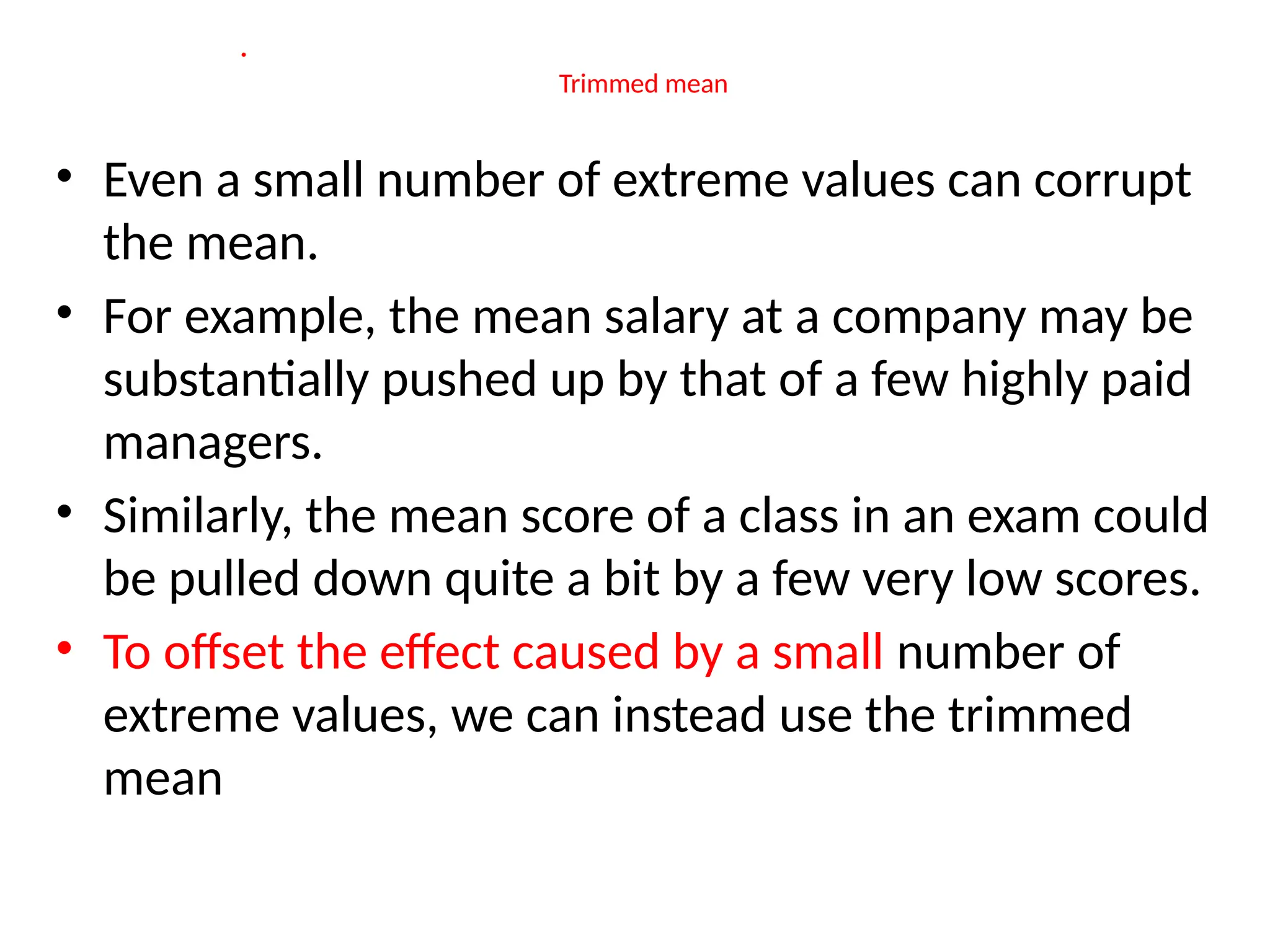
Trimmed mean
• Even a small number of extreme values can corrupt
the mean.
• For example, the mean salary at a company may be
substantially pushed up by that of a few highly paid
managers.
• Similarly, the mean score of a class in an exam could
be pulled down quite a bit by a few very low scores.
• To offset the effect caused by a small number of
extreme values, we can instead use the trimmed
mean
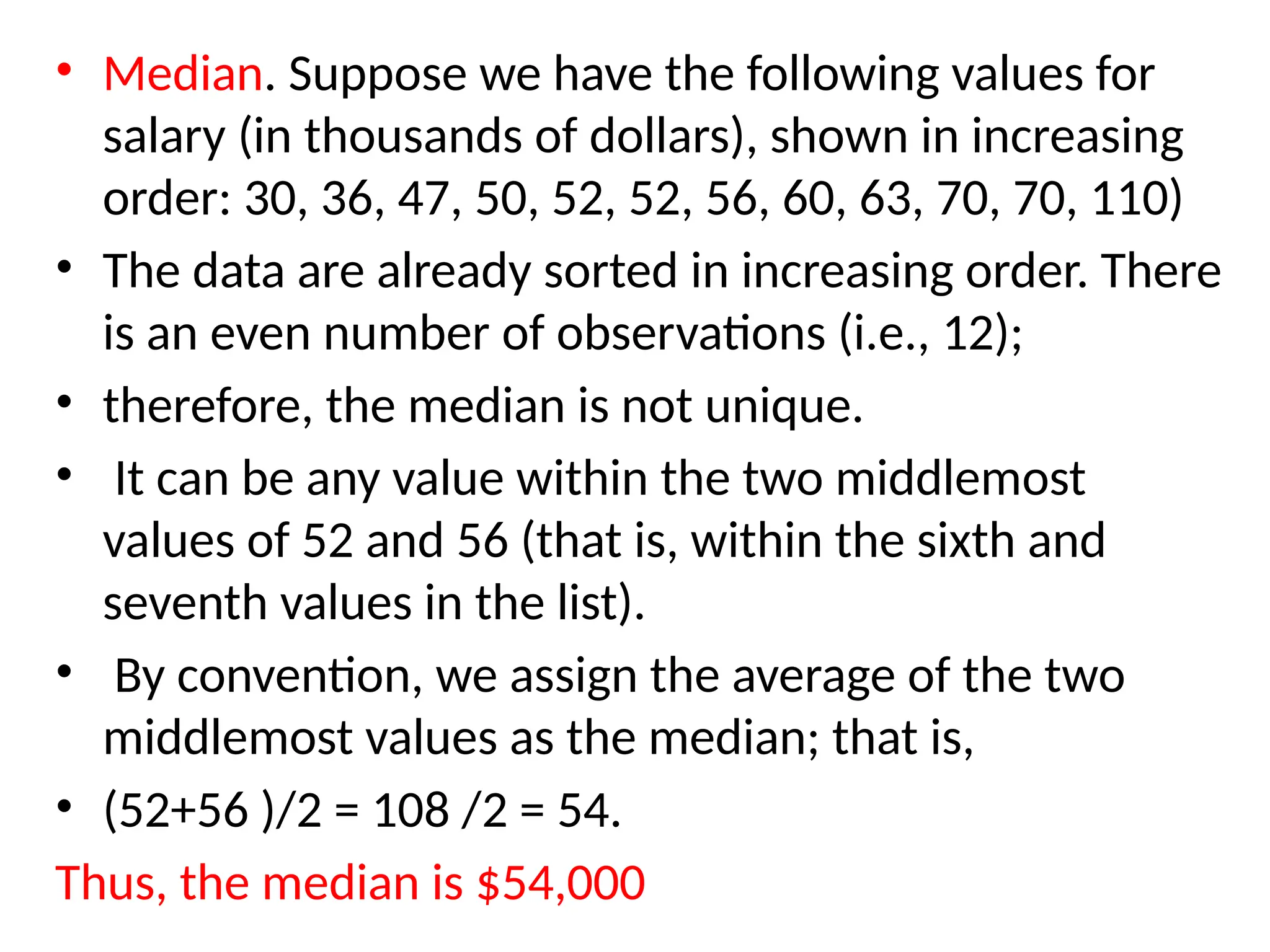
• Median. Suppose we have the following values for
salary (in thousands of dollars), shown in increasing
order: 30, 36, 47, 50, 52, 52, 56, 60, 63, 70, 70, 110)
• The data are already sorted in increasing order. There
is an even number of observations (i.e., 12);
• therefore, the median is not unique.
• It can be any value within the two middlemost
values of 52 and 56 (that is, within the sixth and
seventh values in the list).
• By convention, we assign the average of the two
middlemost values as the median; that is,
• (52+56 )/2 = 108 /2 = 54.
Thus, the median is $54,000
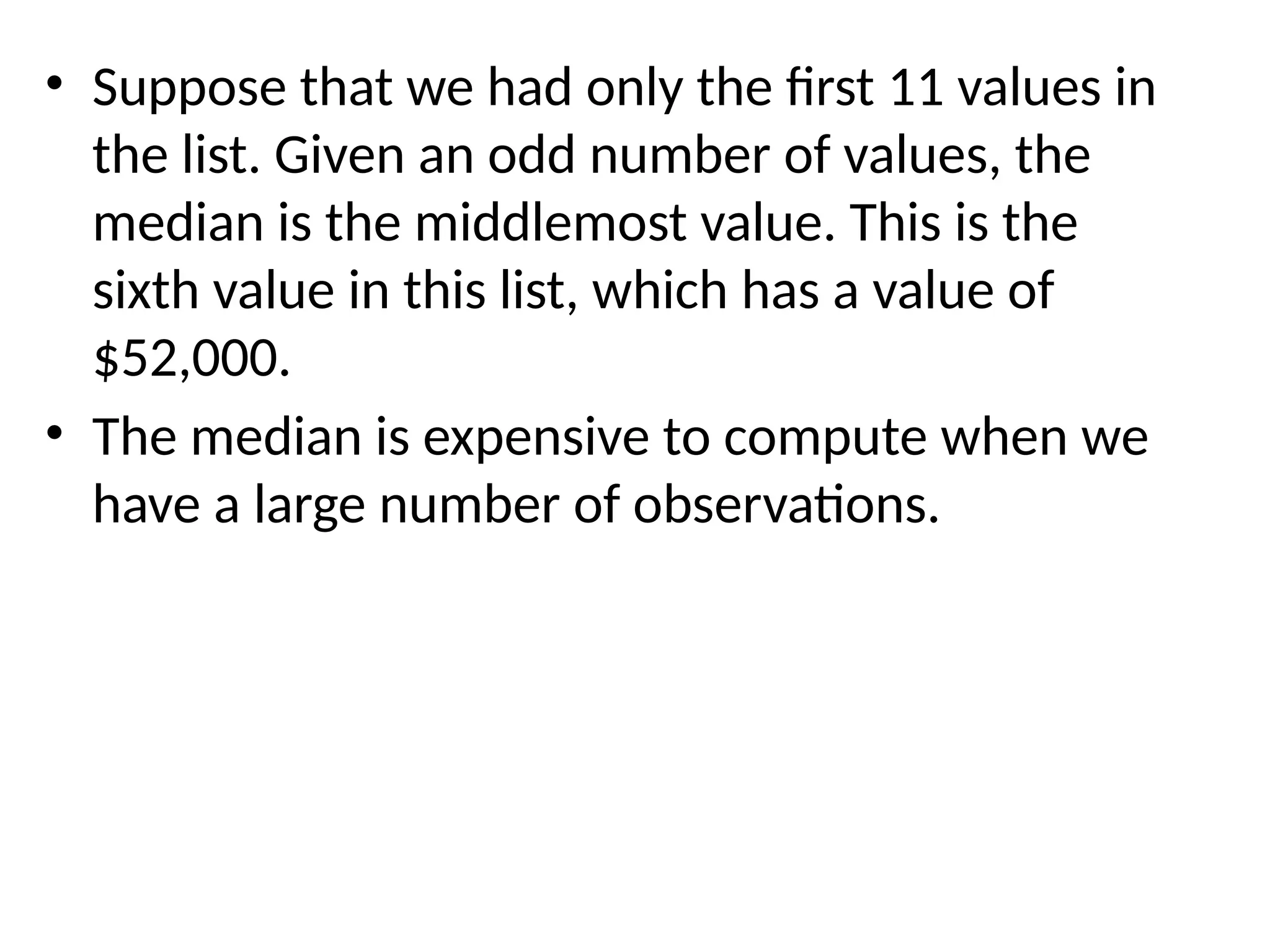
• Suppose that we had only the first 11 values in
the list. Given an odd number of values, the
median is the middlemost value. This is the
sixth value in this list, which has a value of
$52,000.
• The median is expensive to compute when we
have a large number of observations.
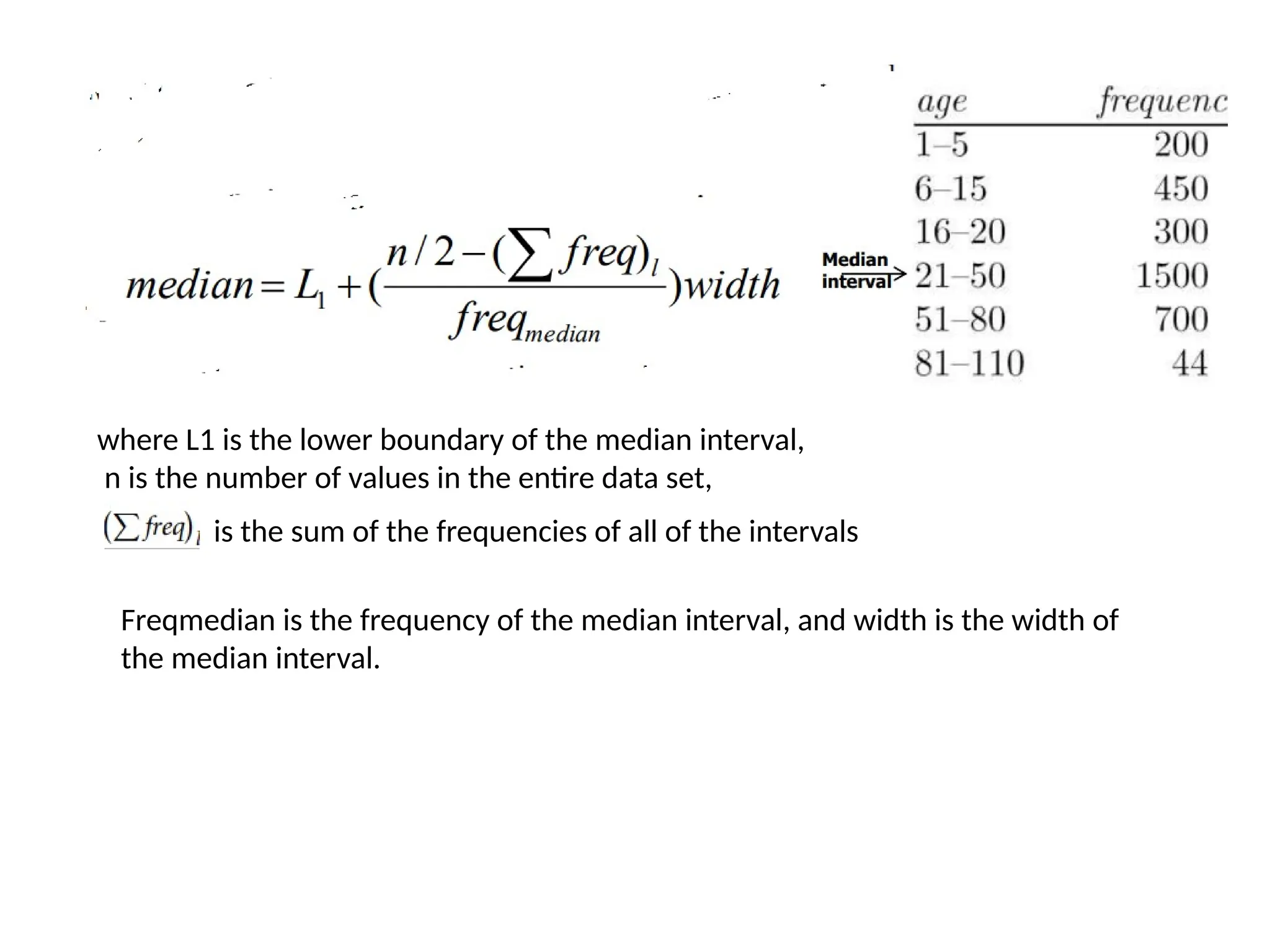
where L1 is the lower boundary of the median interval,
n is the number of values in the entire data set,
Freqmedian is the frequency of the median interval, and width is the width of
the median interval.
is the sum of the frequencies of all of the intervals
• Mode : Suppose we have the following values for
salary (in thousands of dollars), shown in increasing
order: 30, 36, 47, 50, 52, 52, 56, 60, 63, 70, 70, 110)
• The two modes are $52,000 and $70,000.
• The mode for a set of data is the value that occurs
most frequently in the set.
• Therefore, it can be determined for qualitative
and quantitative attributes
• Data sets with one, two, or three modes are
respectively called unimodal, bimodal, and
trimodal. In general, a data set with two or more
modes is multimodal.
• For unimodal numeric data that are moderately
skewed (asymmetrical),
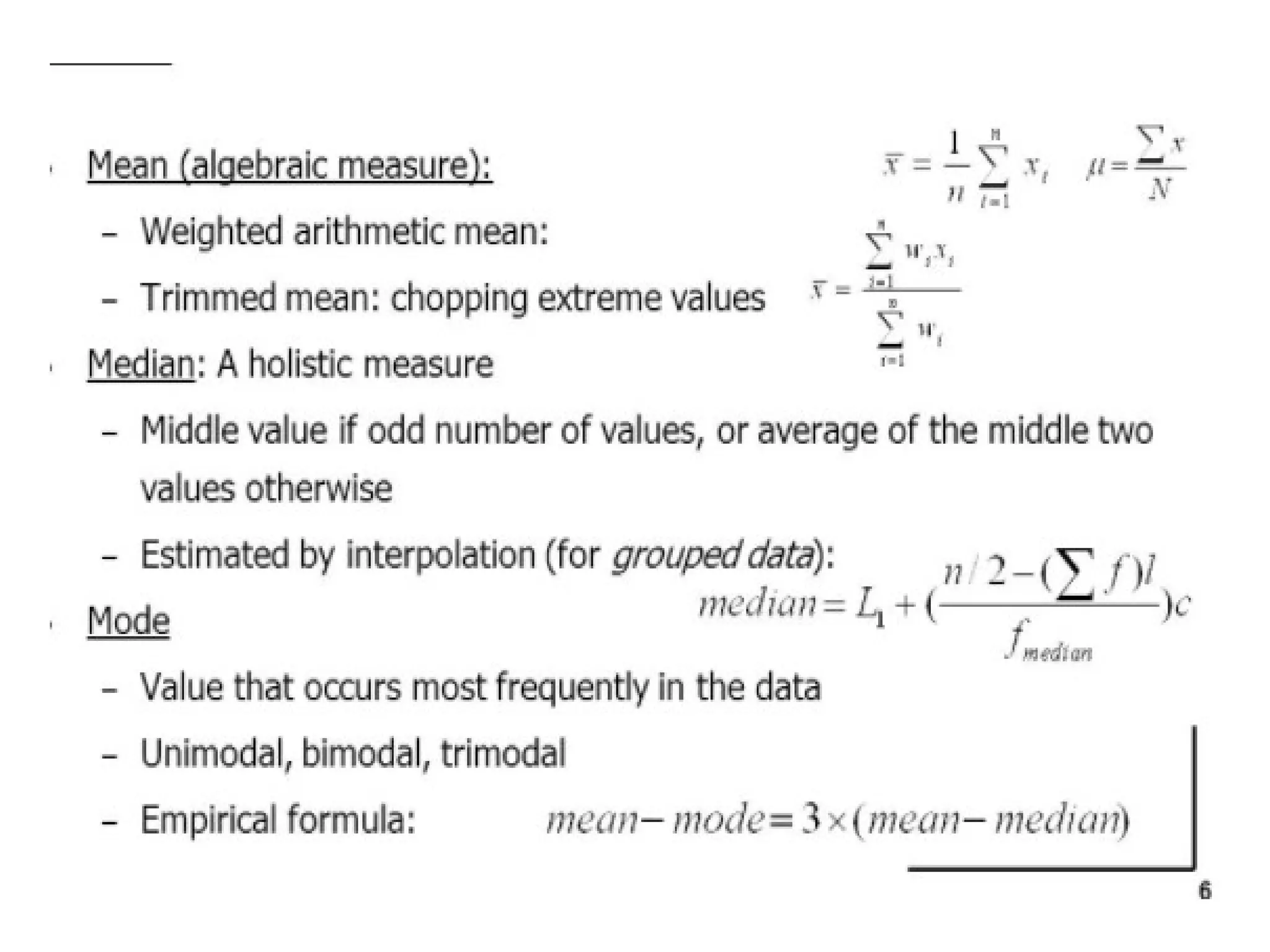
• we have the following empirical relation: mean −
mode ≈ 3 × (mean − median).
• This implies that the mode for unimodal frequency
curves that are moderately skewed can easily be
approximated if the mean and median values are
known.
• The midrange can also be used to assess the central
tendency of a numeric data set.
• It is the average of the largest and smallest values in
the set
• Suppose we have the following values for salary (in
thousands of dollars), shown in increasing order: 30, 36, 47,
50, 52, 52, 56, 60, 63, 70, 70, 110)
• Midrange. The midrange of the data of Example 2.6 is
30,000+110,000 2 = $70,000.
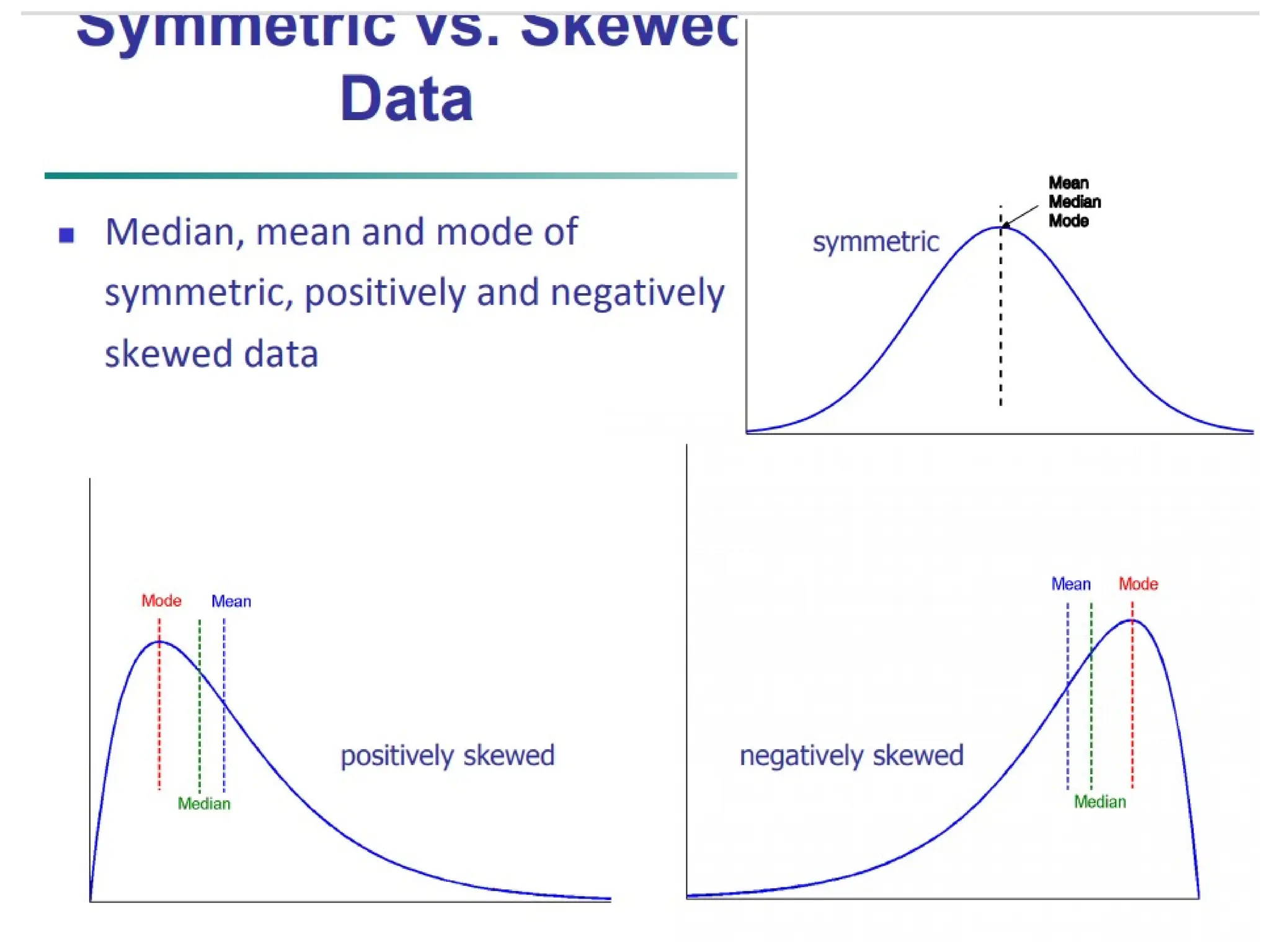
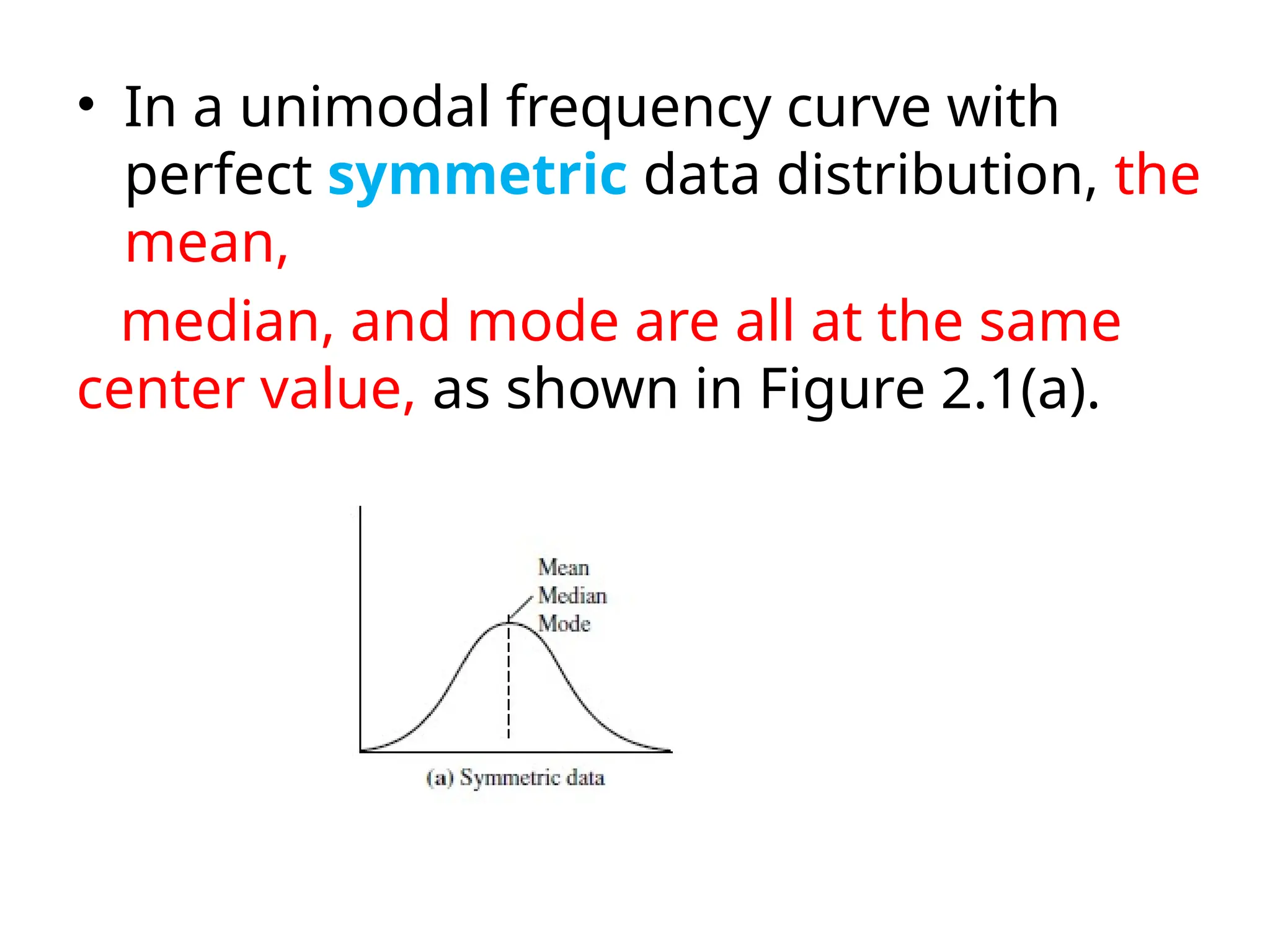
• In a unimodal frequency curve with perfect symmetric
data distribution, the mean, median, and mode are all at
the same center value, as shown in Figure 2.1(a).
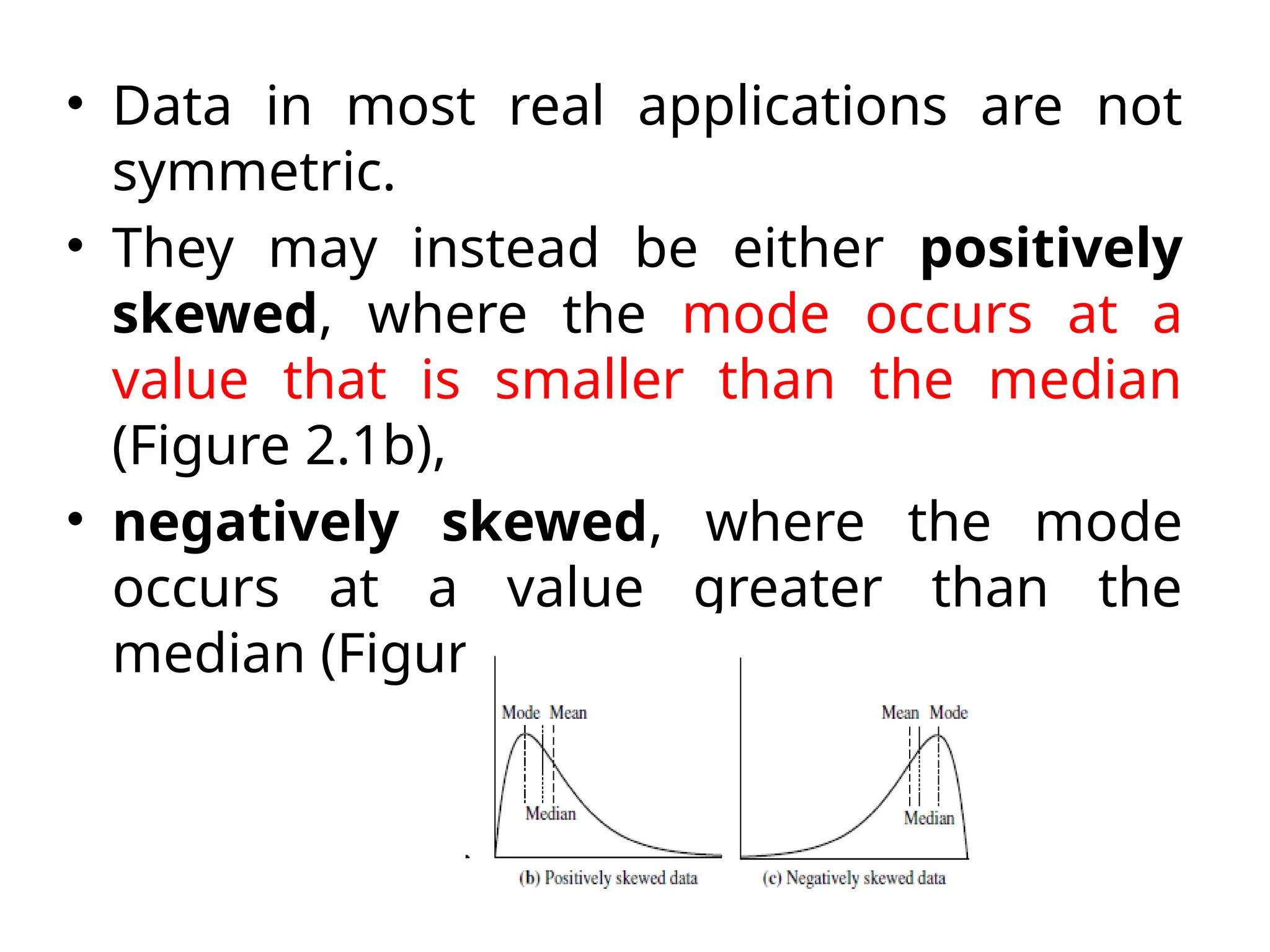
• Data in most real applications are not symmetric. They
may instead be either positively skewed, where the mode
occurs at a value that is smaller than the median (Figure
2.1b),
• or negatively skewed, where the mode occurs at a value
greater than the median (Figure 2.1c).
Skewness
• Skewness is used to measure symmetry of data
along with the mean value. Symmetry means equal
distribution of observation above or below the mean.
• skewness = 0: if data is symmetric along with mean
• skewness = Negative: if data is not symmetric and
right side tail is longer than left side tail of density
plot.
• skewness = Positive: if data is not symmetric and
left side tail is longer than right side tail in density
plot.
• We can find skewness of given variable by below
given formula.
• data[‘A’].skew()
• In a unimodal frequency curve with
perfect symmetric data distribution, the
mean,
median, and mode are all at the same
center value, as shown in Figure 2.1(a).
• Data in most real applications are not
symmetric.
• They may instead be either positively
skewed, where the mode occurs at a
value that is smaller than the median
(Figure 2.1b),
• negatively skewed, where the mode
occurs at a value greater than the
median (Figure 2.1c).
Range, Quartiles, and
Interquartile Range
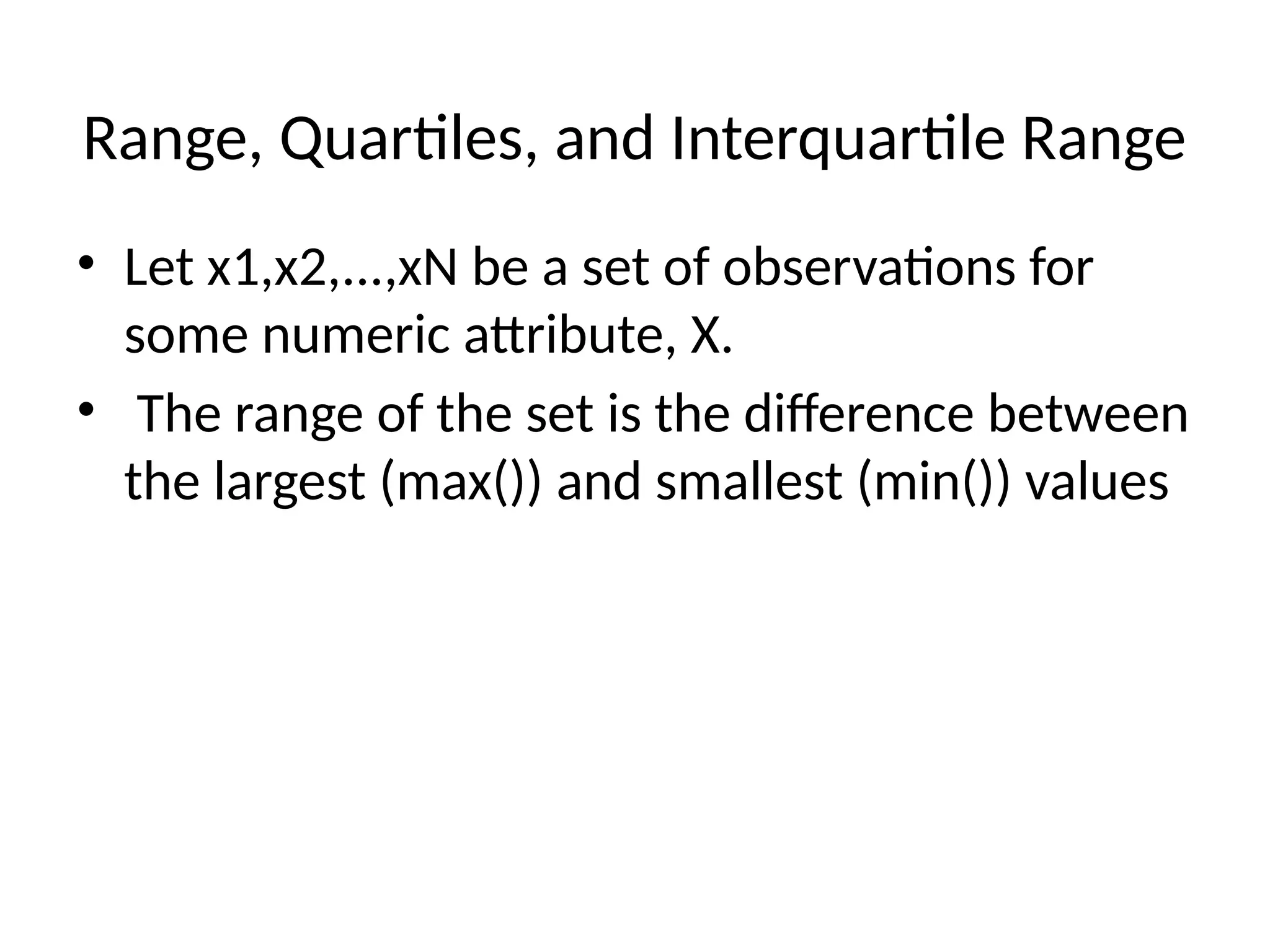
Range, Quartiles, and Interquartile Range
• Let x1,x2,...,xN be a set of observations for
some numeric attribute, X.
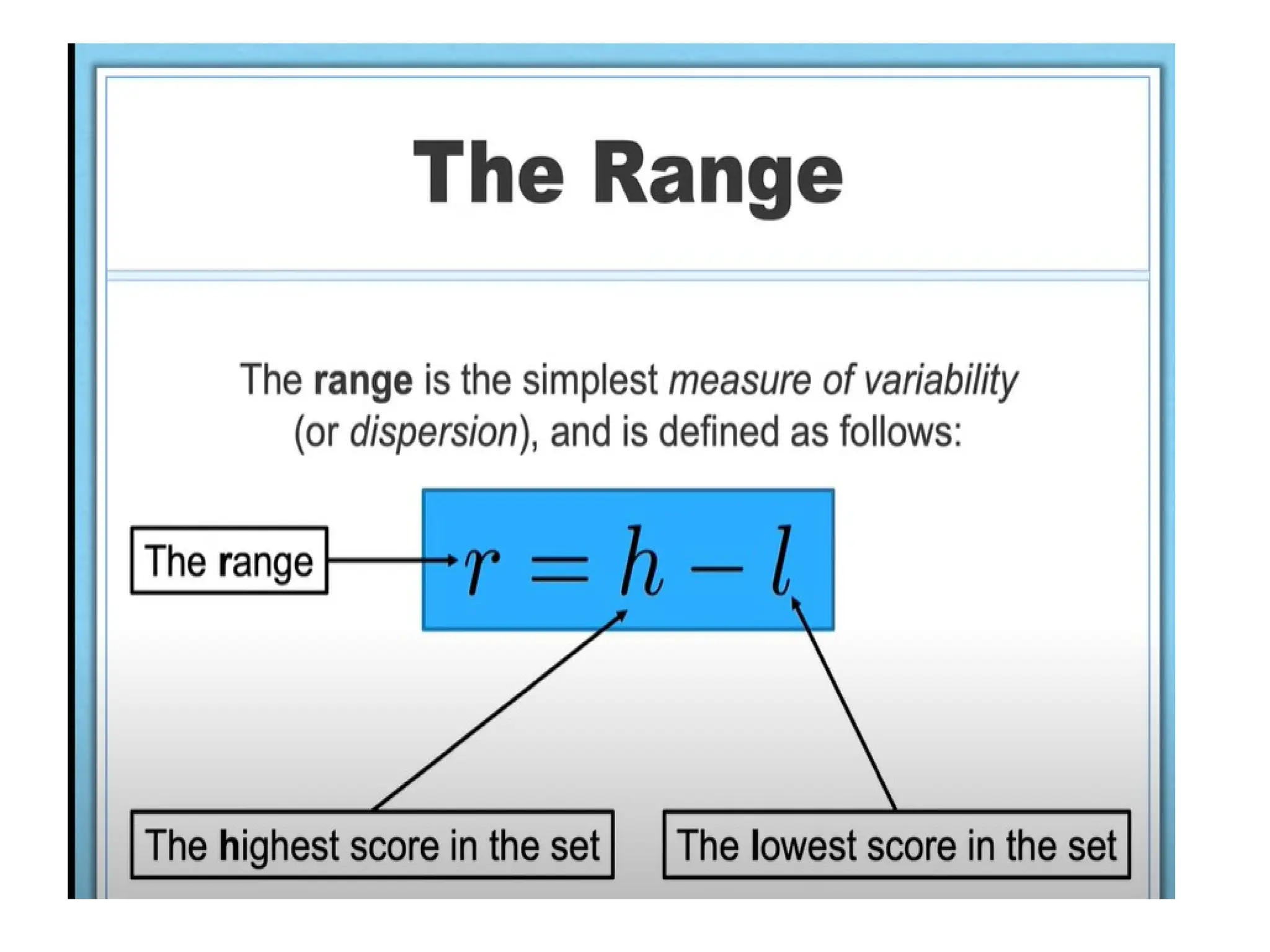
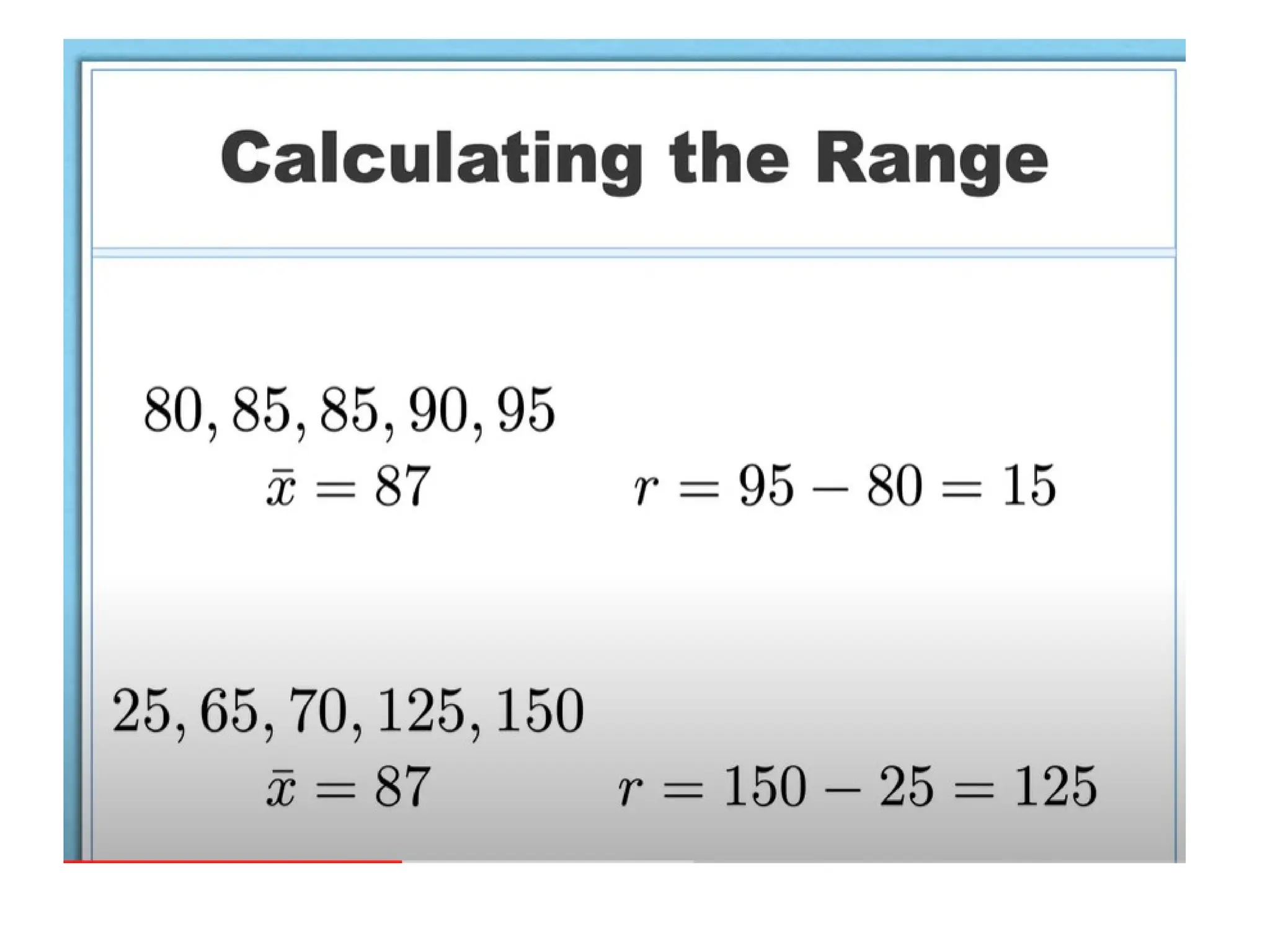
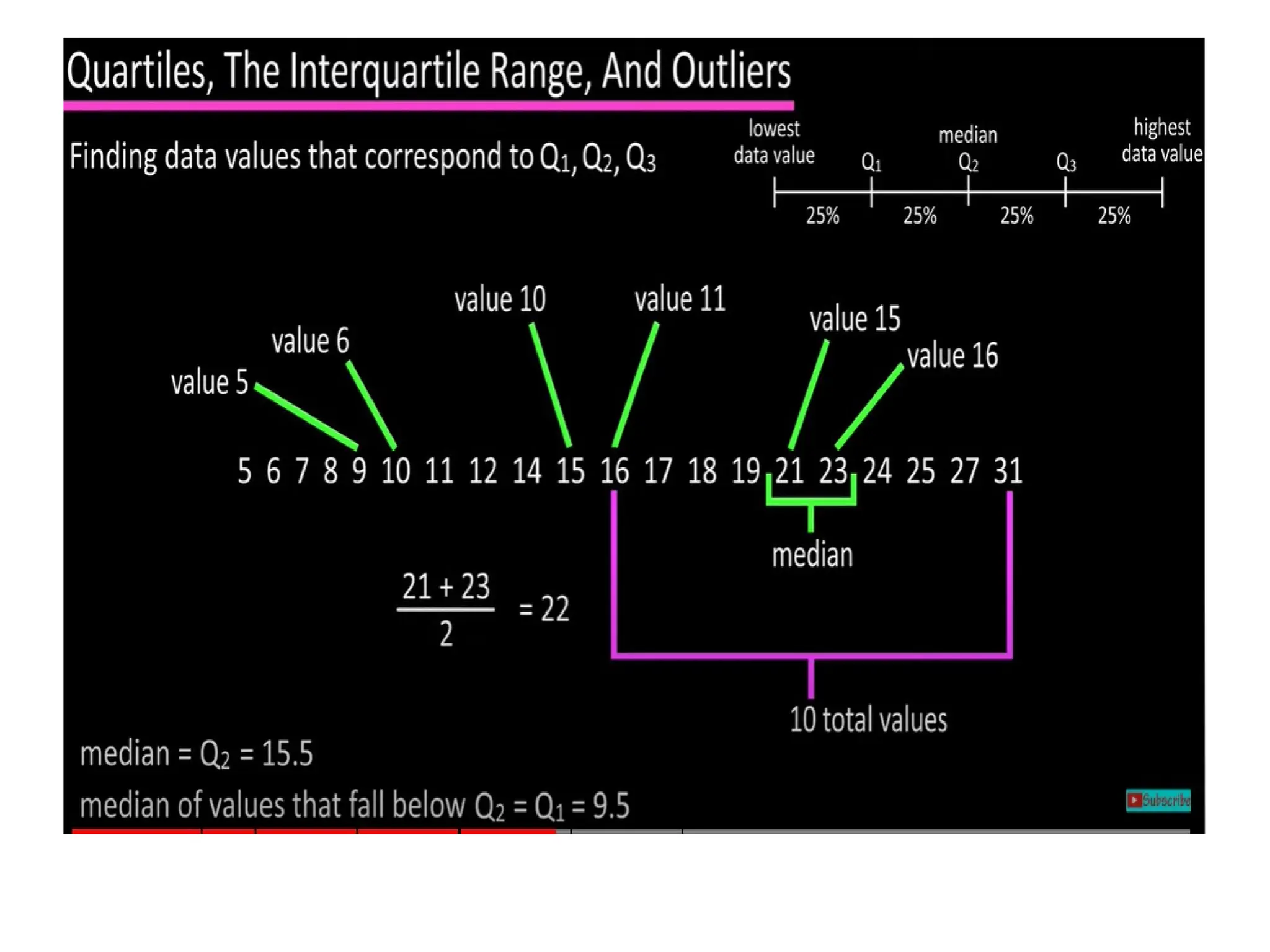
• The range of the set is the difference between
the largest (max()) and smallest (min()) values
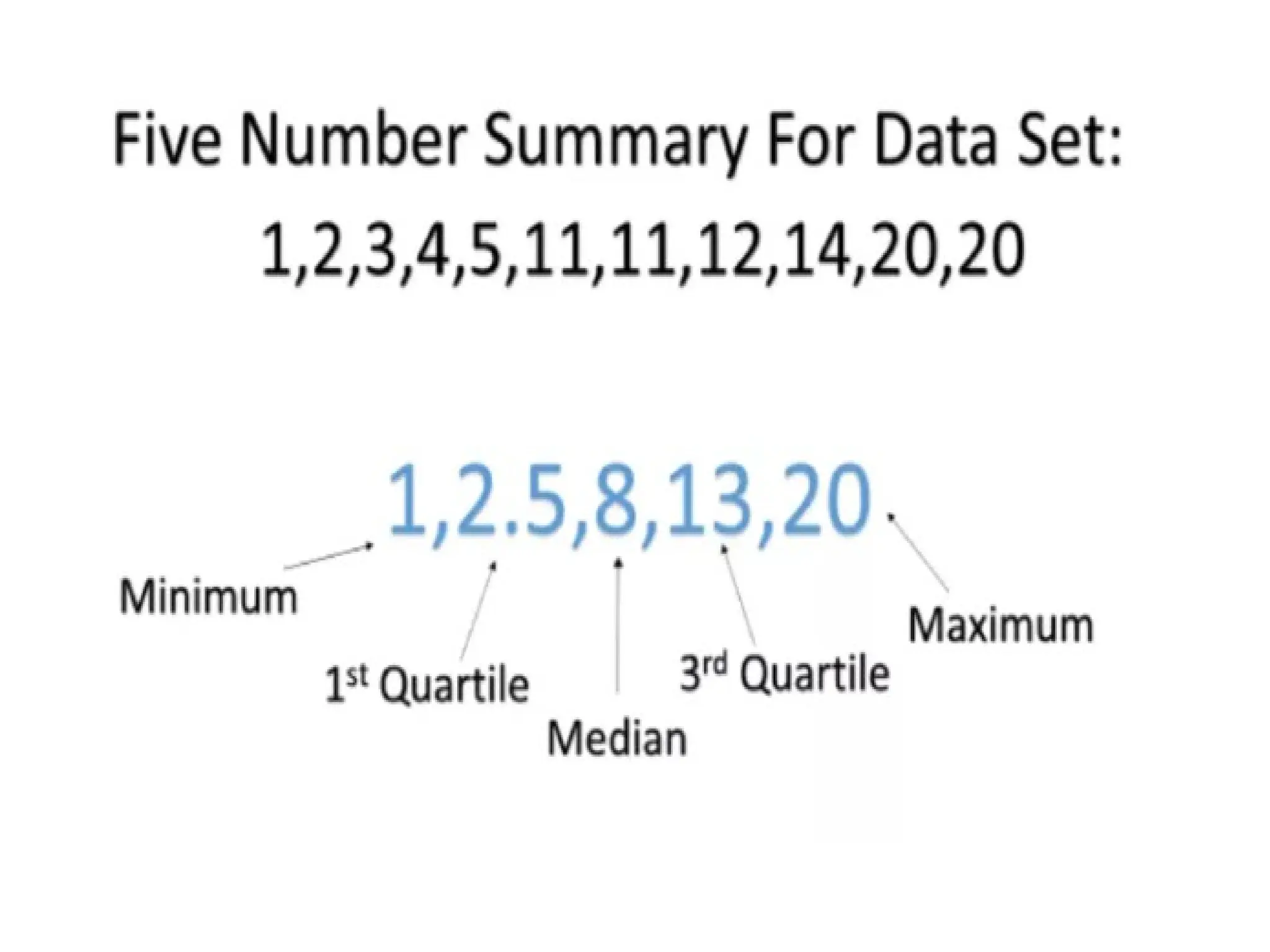
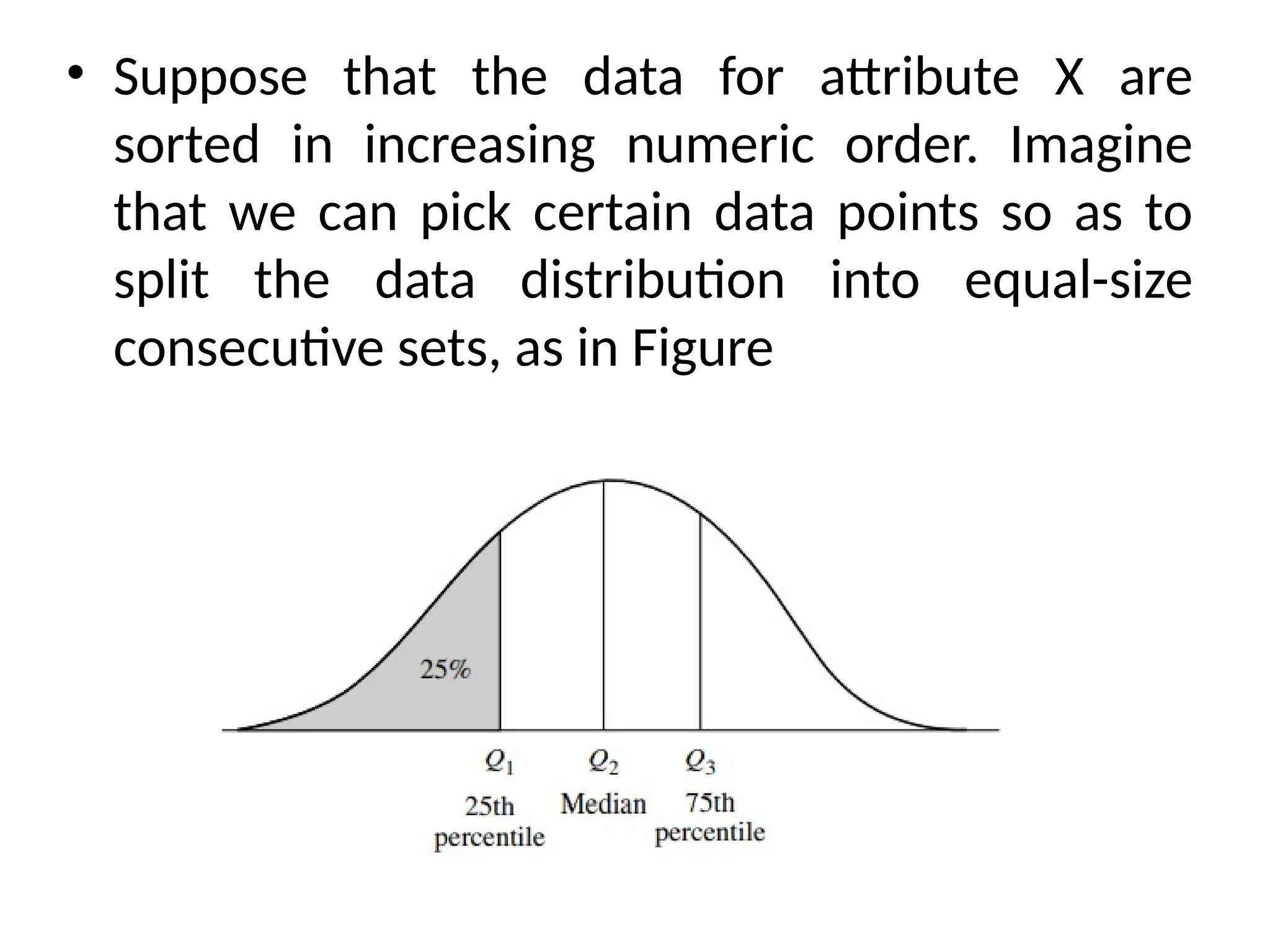
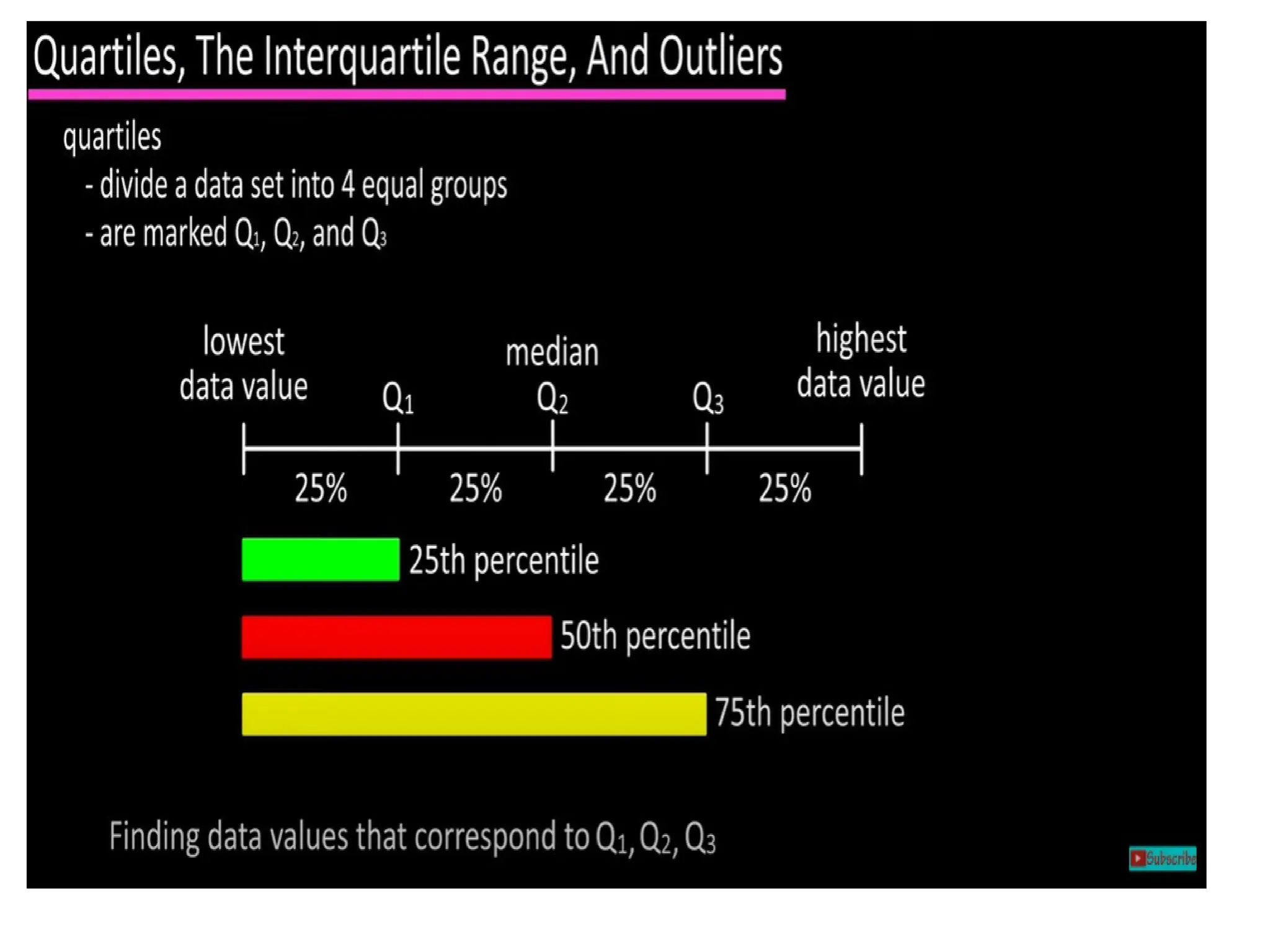
• Suppose that the data for attribute X are
sorted in increasing numeric order. Imagine
that we can pick certain data points so as to
split the data distribution into equal-size
consecutive sets, as in Figure
Examples
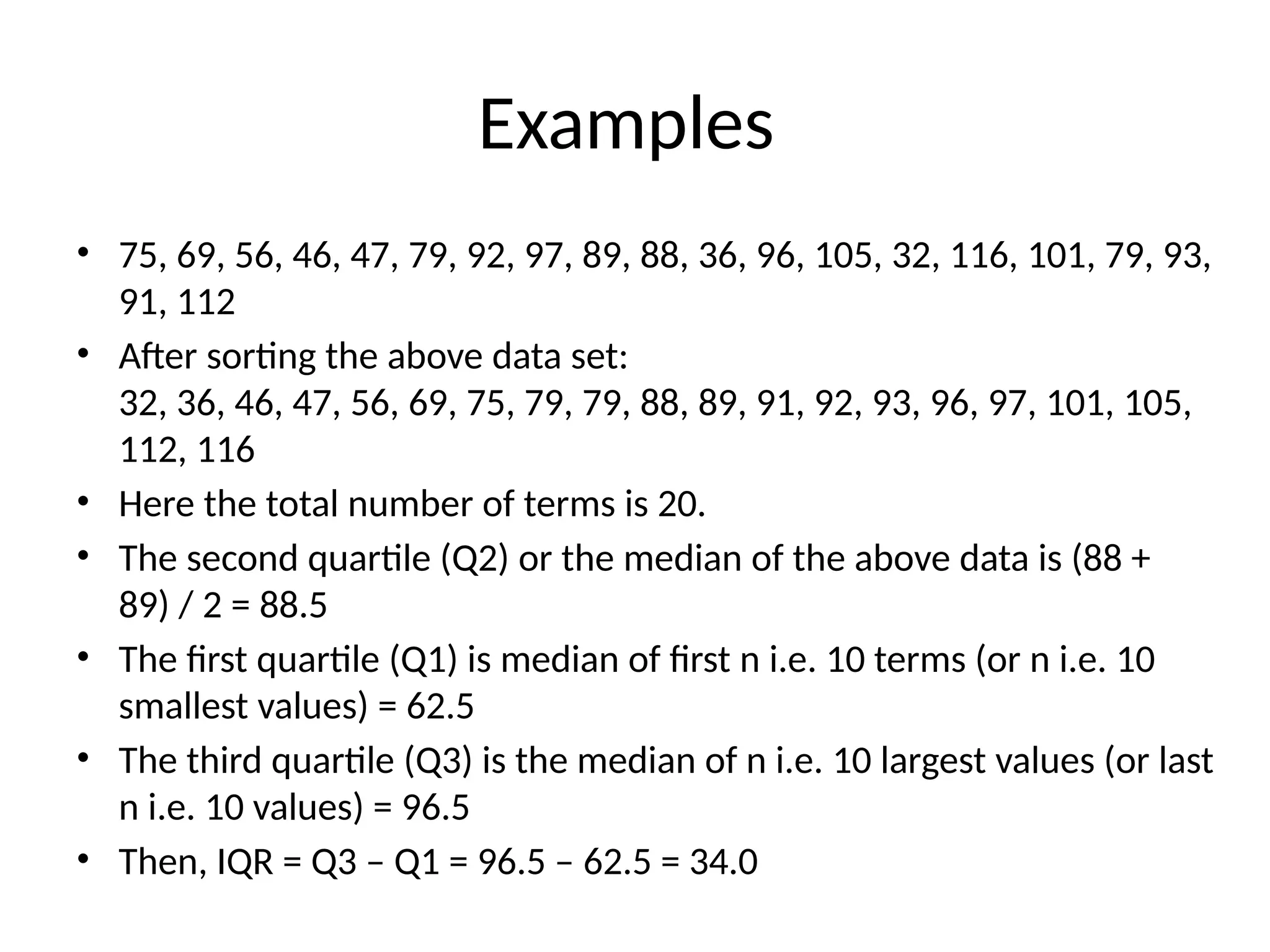
• 75, 69, 56, 46, 47, 79, 92, 97, 89, 88, 36, 96, 105, 32, 116, 101, 79, 93,
91, 112
• After sorting the above data set:
32, 36, 46, 47, 56, 69, 75, 79, 79, 88, 89, 91, 92, 93, 96, 97, 101, 105,
112, 116
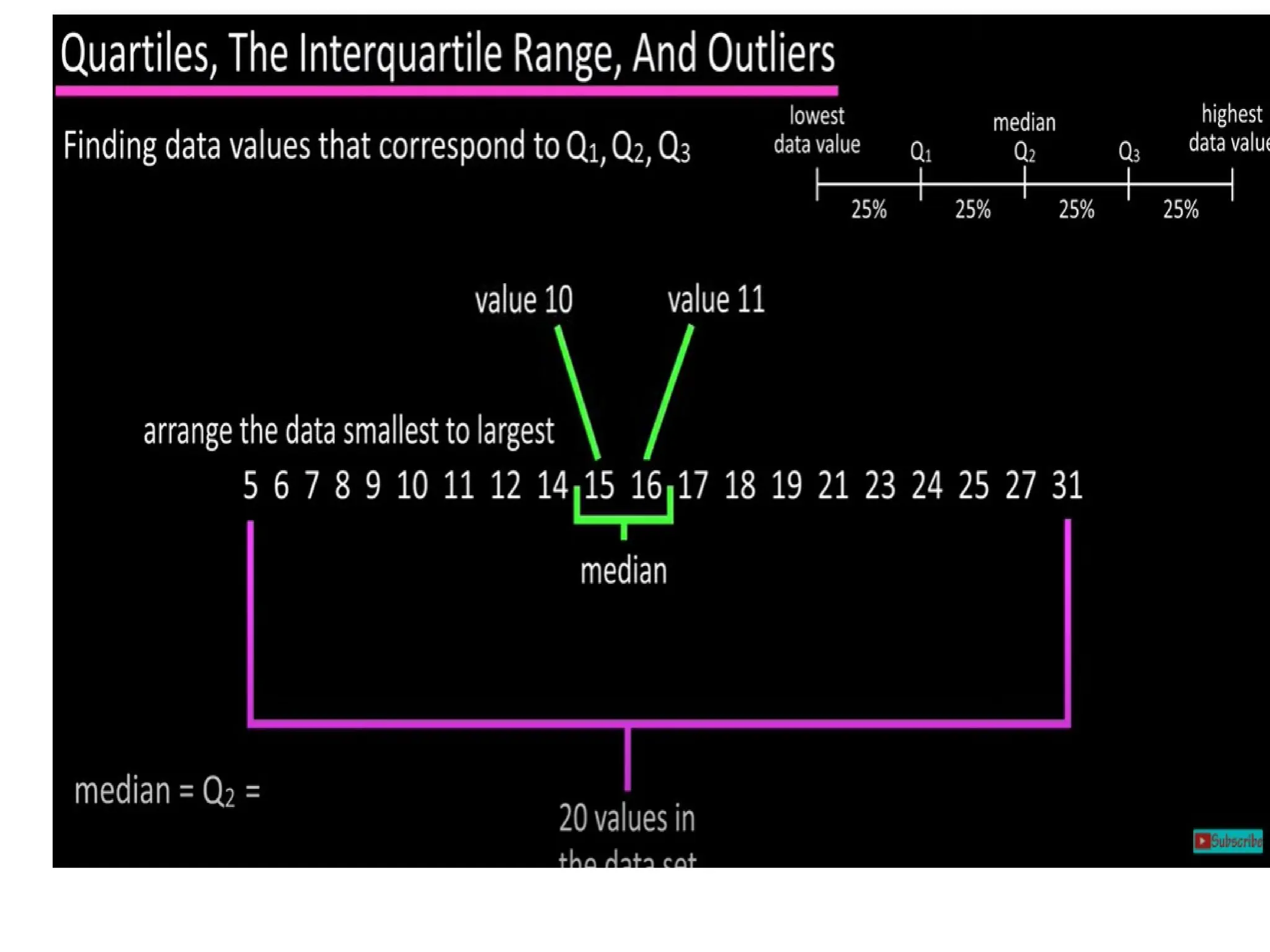
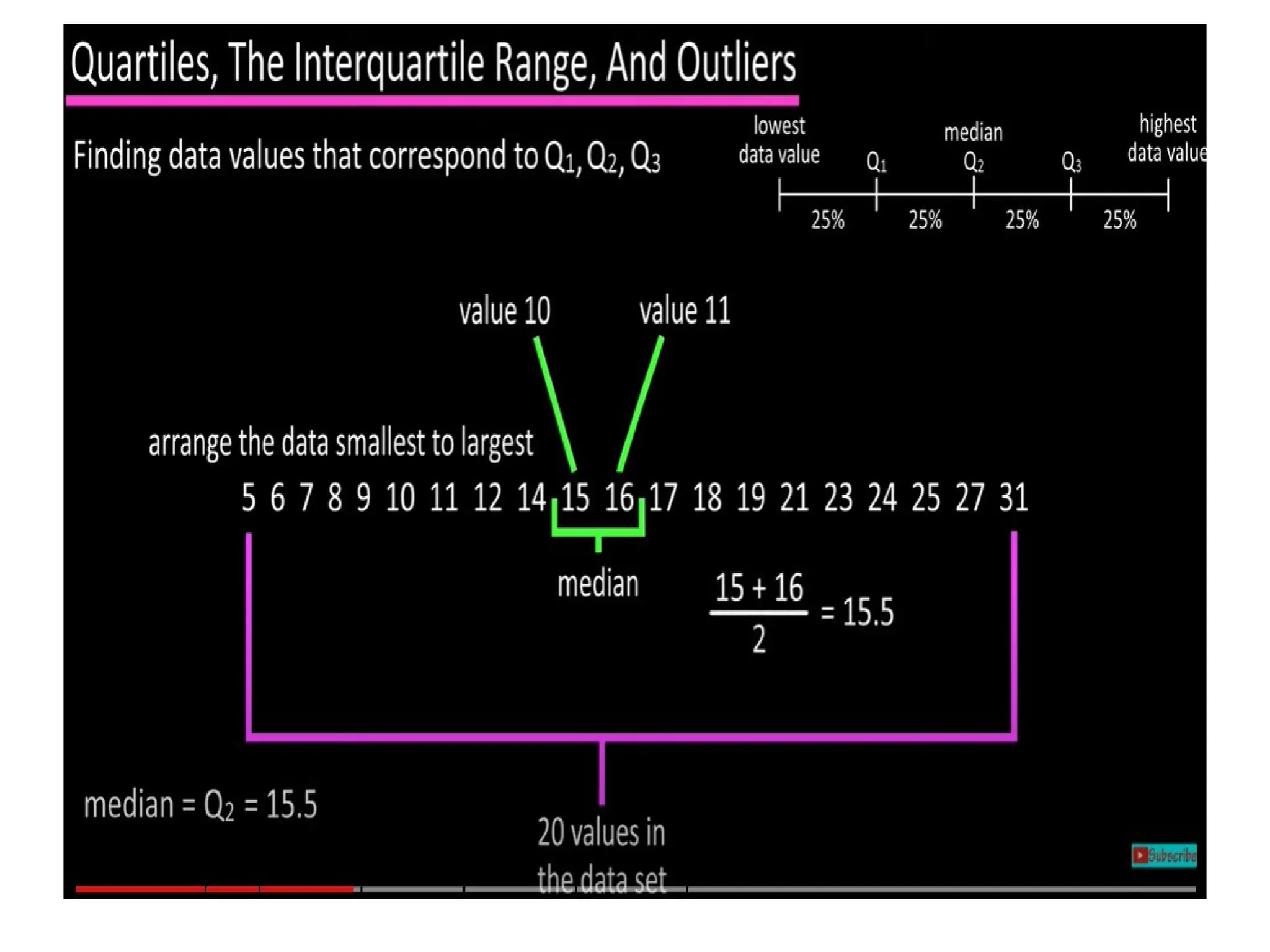
• Here the total number of terms is 20.
• The second quartile (Q2) or the median of the above data is (88 +
89) / 2 = 88.5
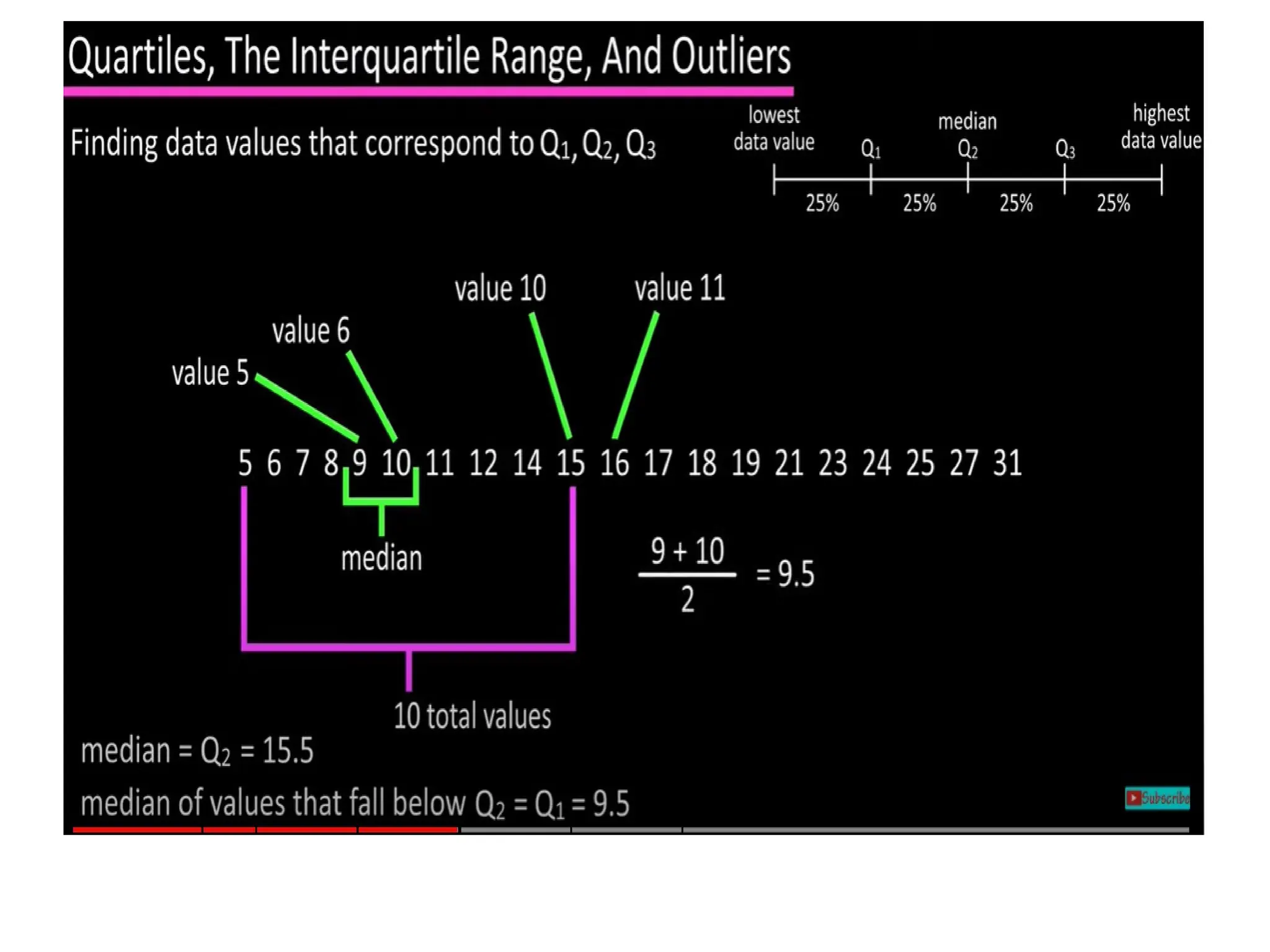
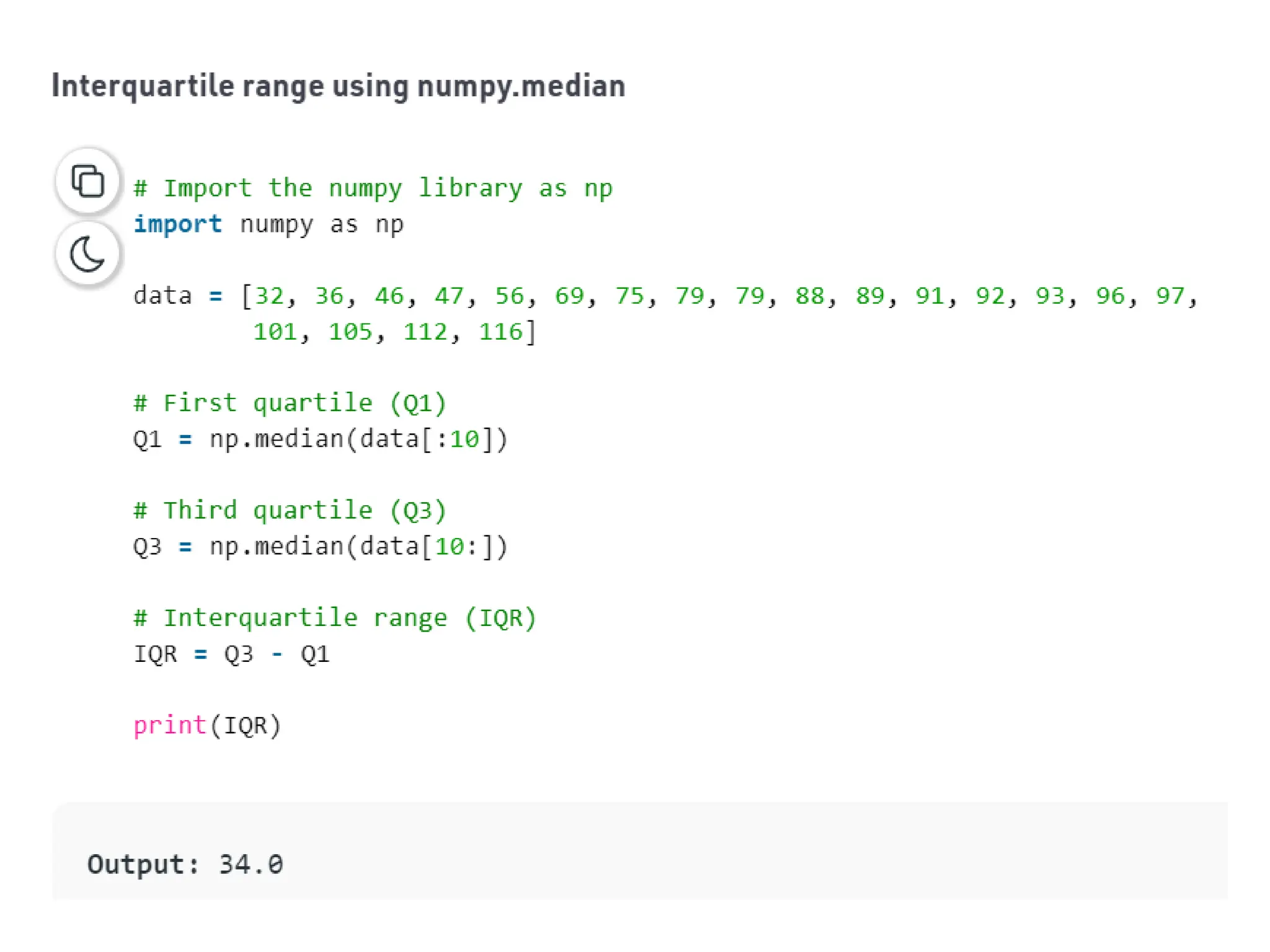
• The first quartile (Q1) is median of first n i.e. 10 terms (or n i.e. 10
smallest values) = 62.5
• The third quartile (Q3) is the median of n i.e. 10 largest values (or last
n i.e. 10 values) = 96.5
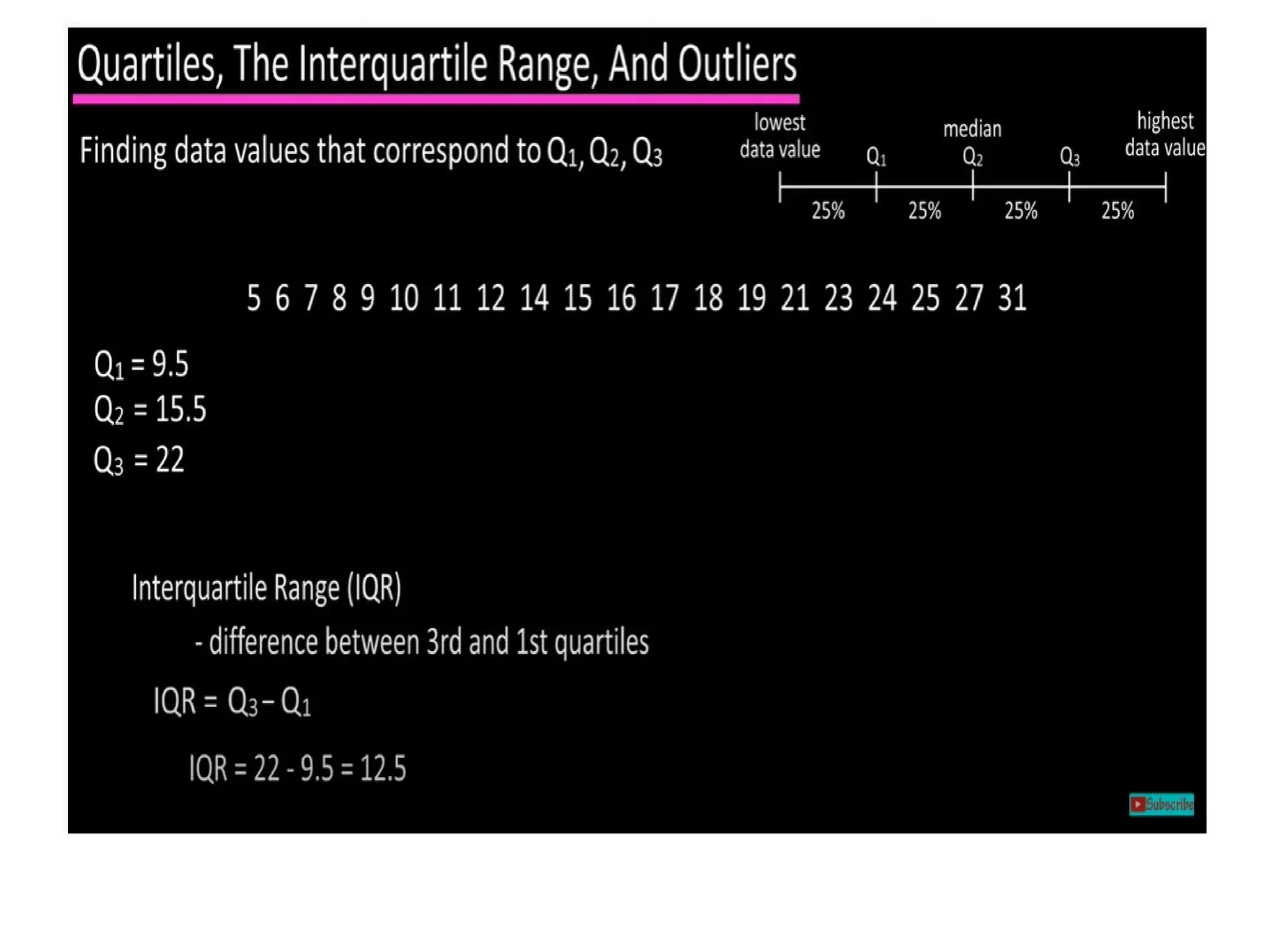
• Then, IQR = Q3 – Q1 = 96.5 – 62.5 = 34.0
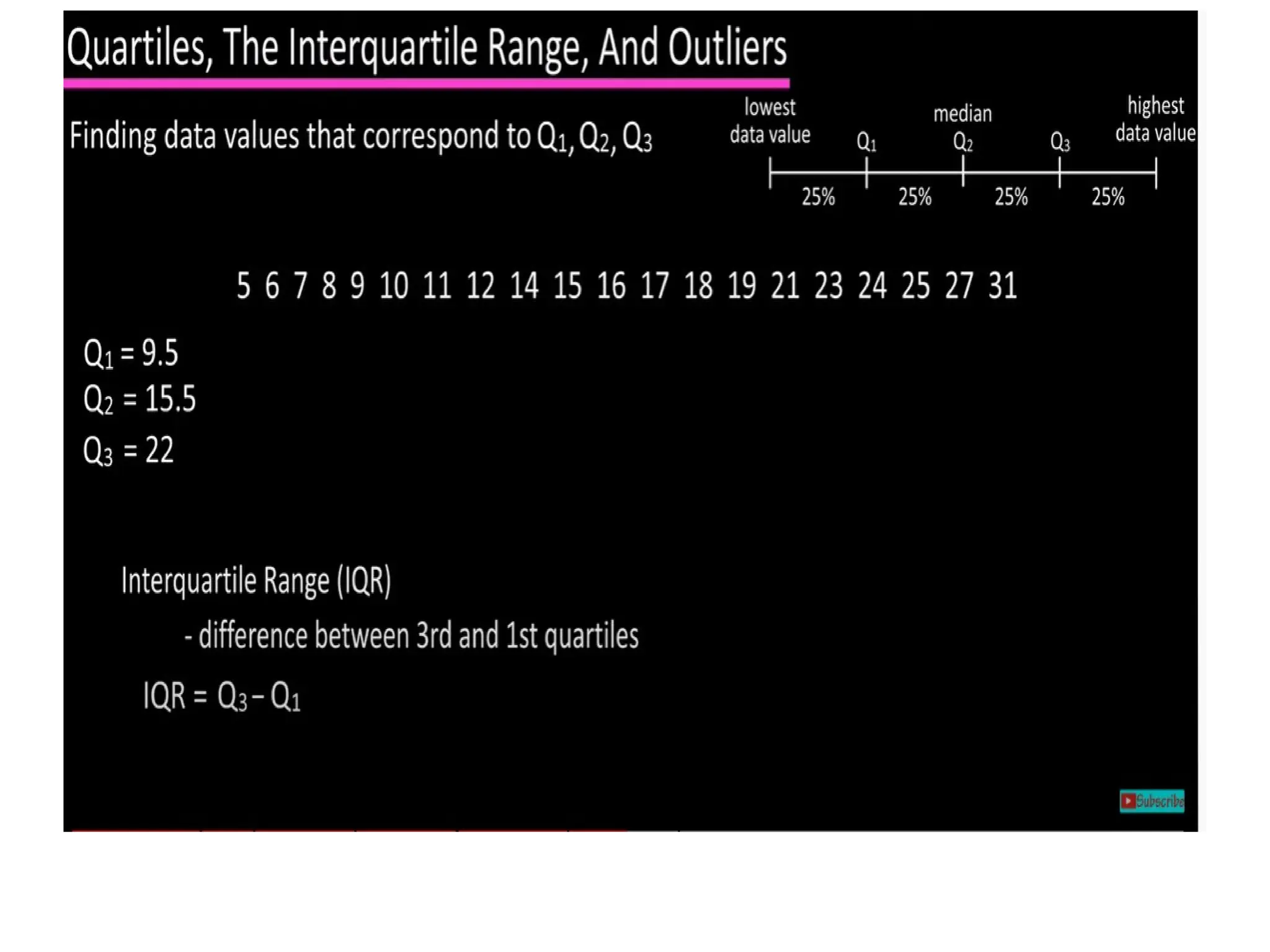
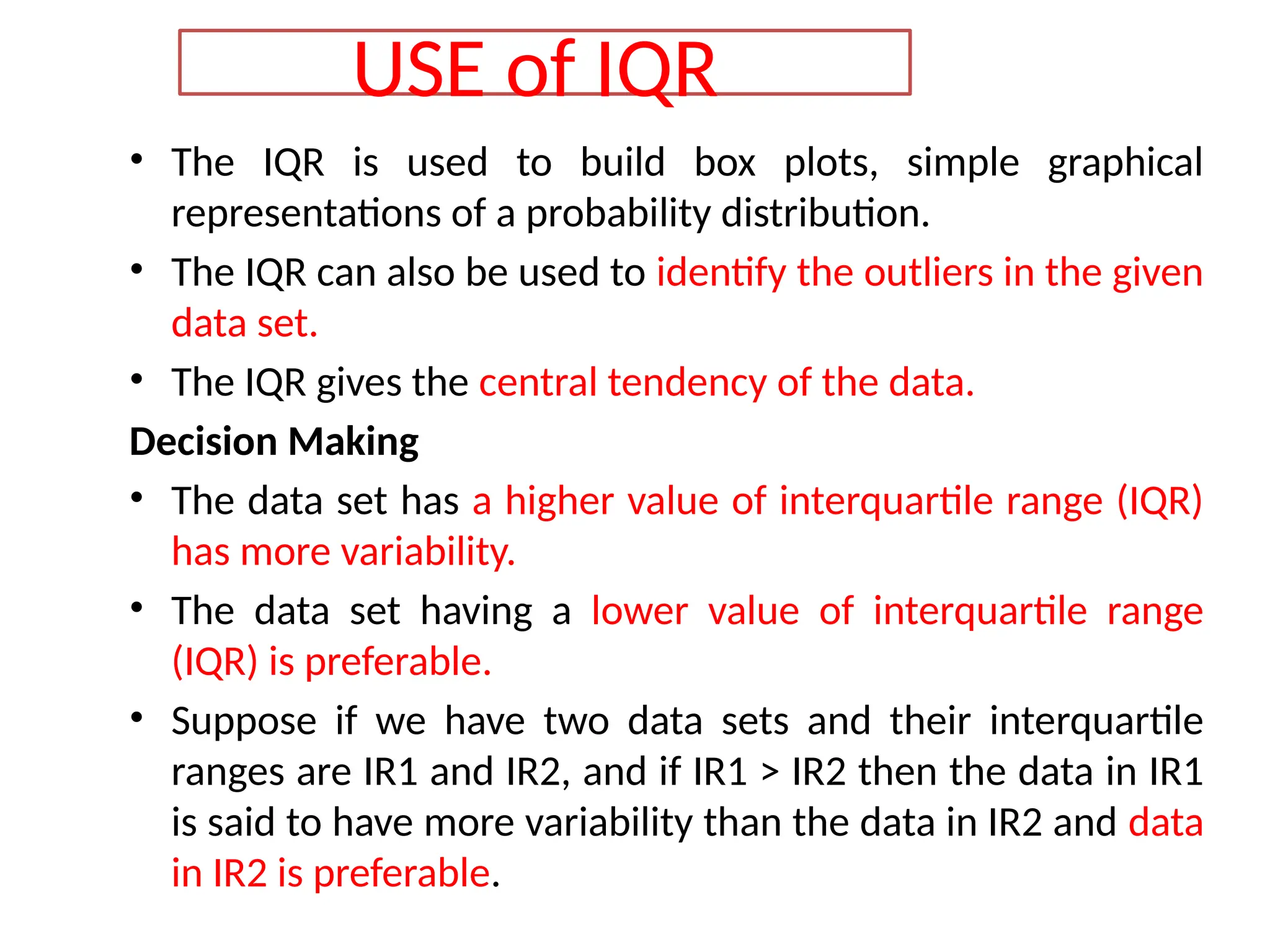
• The IQR is used to build box plots, simple graphical
representations of a probability distribution.
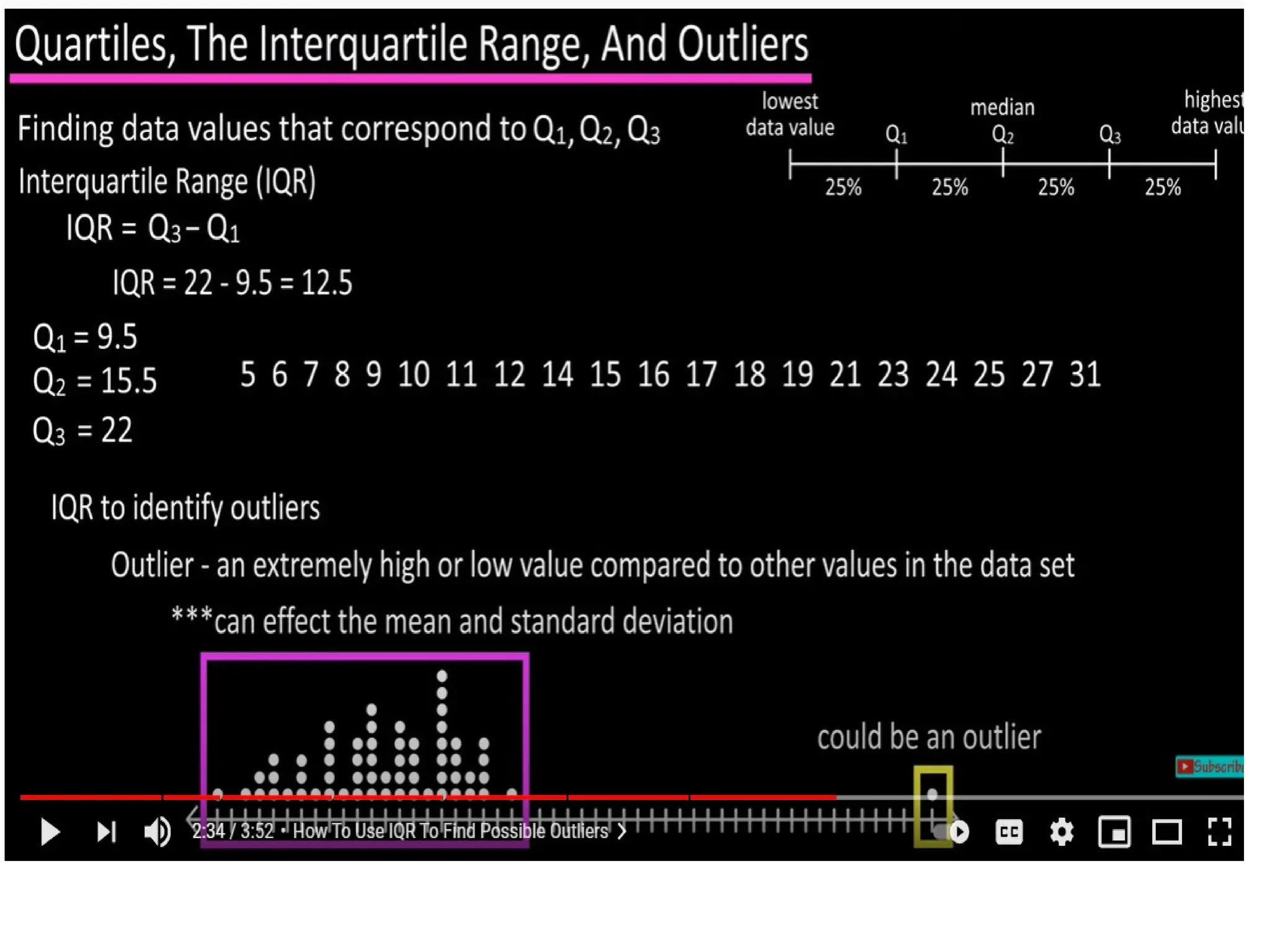
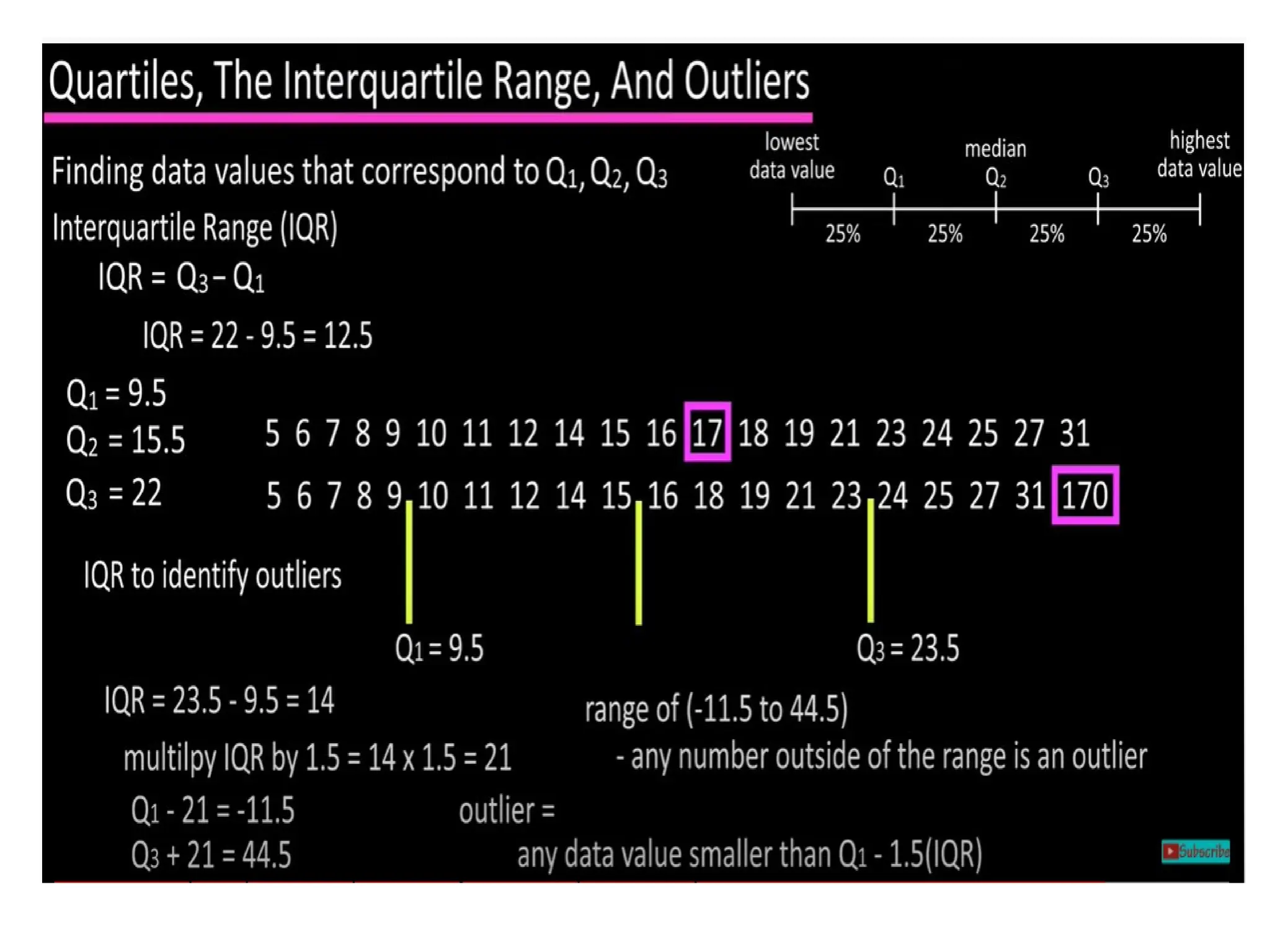
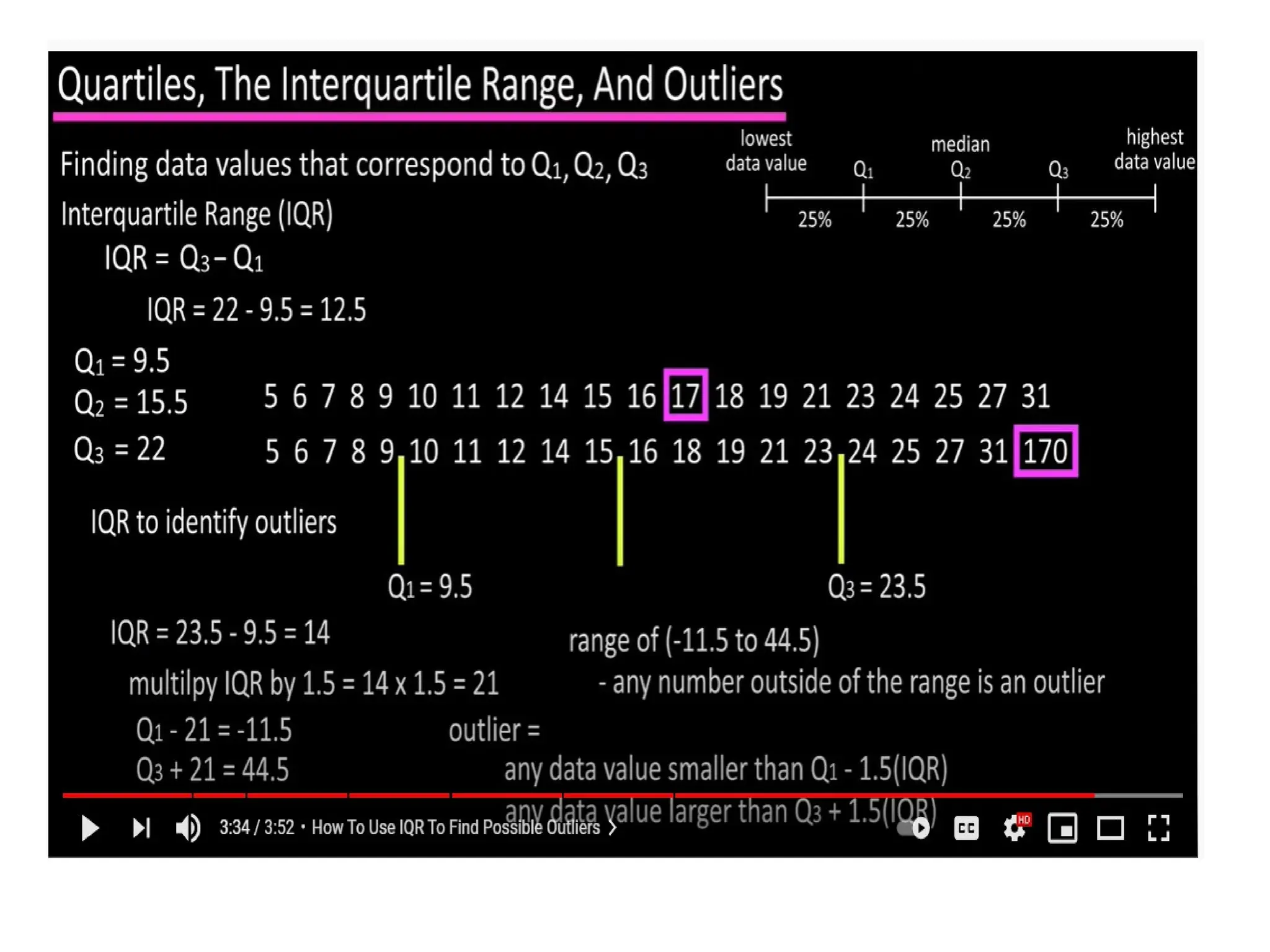
• The IQR can also be used to identify the outliers in the given
data set.
• The IQR gives the central tendency of the data.
Decision Making
• The data set has a higher value of interquartile range (IQR)
has more variability.
• The data set having a lower value of interquartile range
(IQR) is preferable.
• Suppose if we have two data sets and their interquartile
ranges are IR1 and IR2, and if IR1 > IR2 then the data in IR1
is said to have more variability than the data in IR2 and data
in IR2 is preferable.
USE of IQR
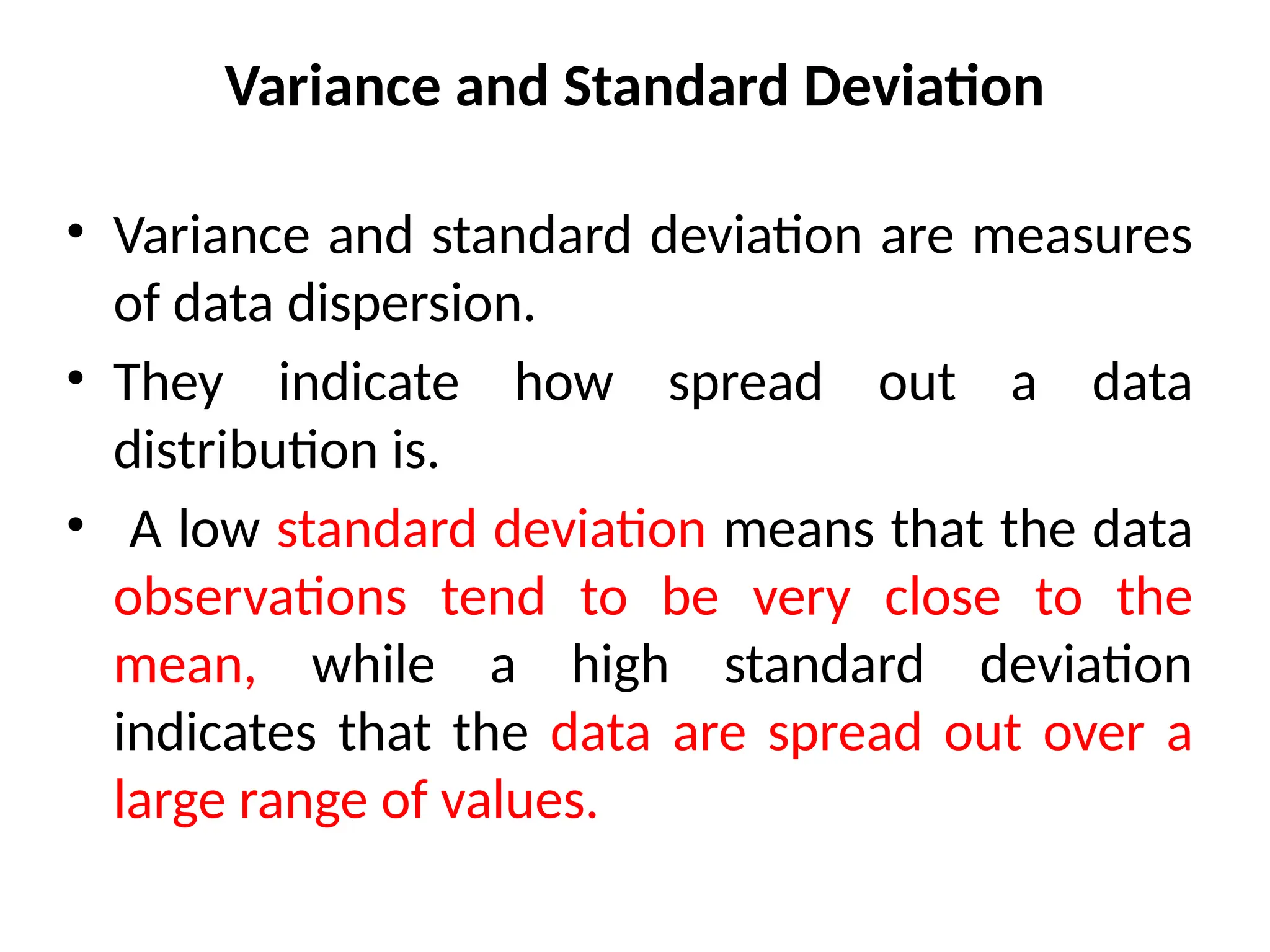
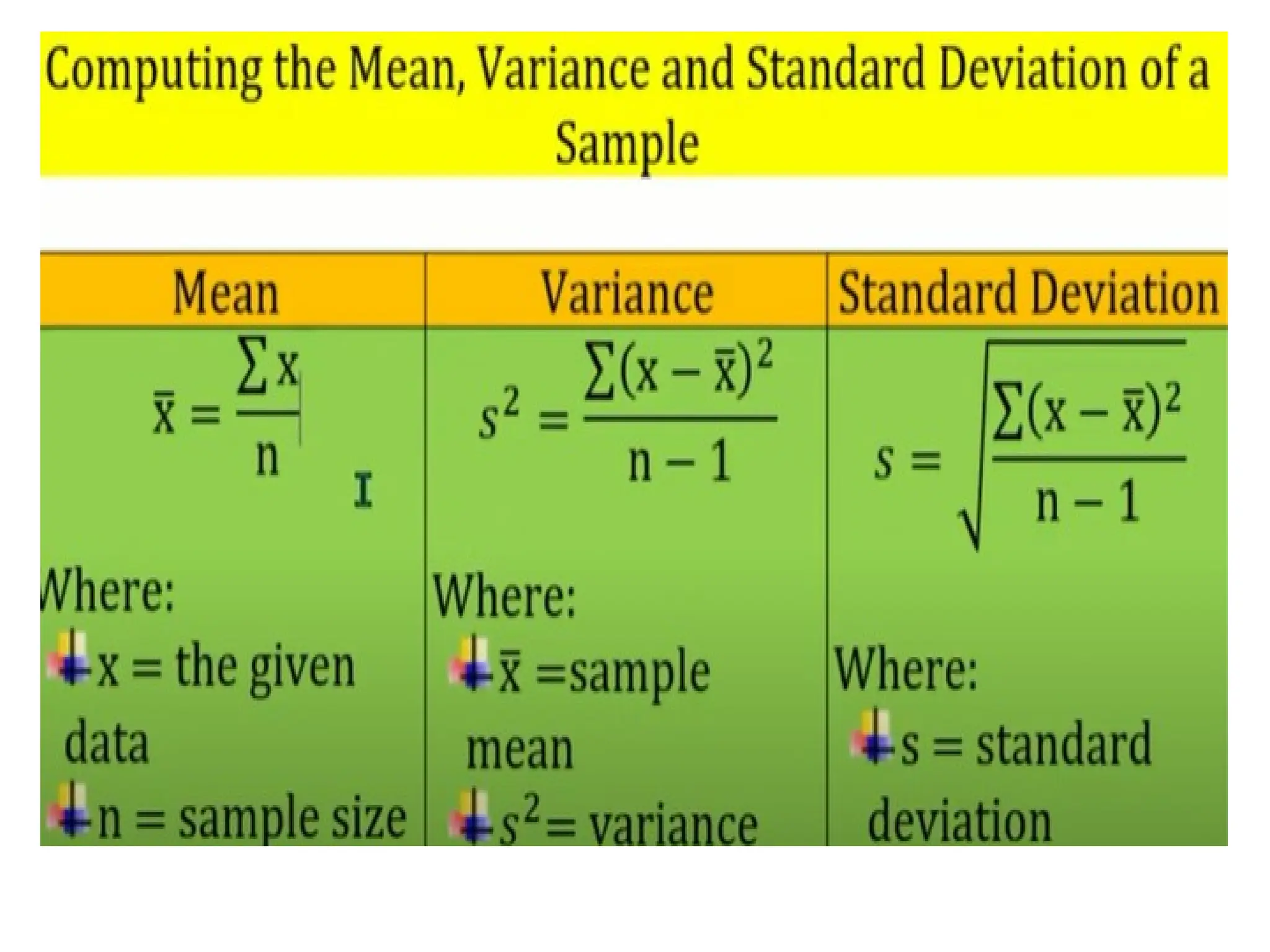
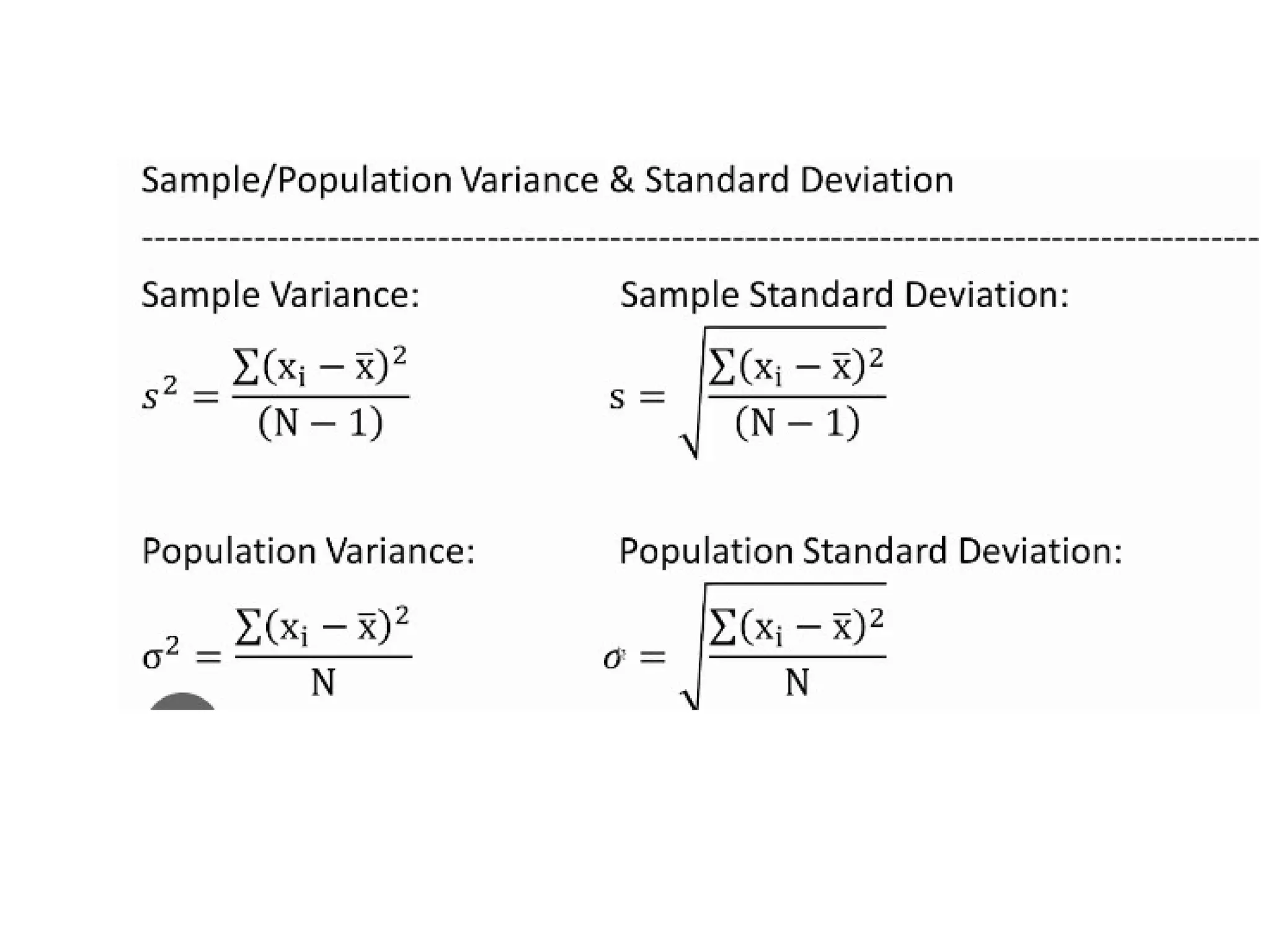
Variance and Standard Deviation
• Variance and standard deviation are measures
of data dispersion.
• They indicate how spread out a data
distribution is.
• A low standard deviation means that the data
observations tend to be very close to the
mean, while a high standard deviation
indicates that the data are spread out over a
large range of values.
Basic Statistical descriptions of Data.pptx

Basic Statistical descriptions of Data.pptx

  • 1.
    CS3352 & Foundationsof Data Science Basic Statistical Descriptions of Data. Dr.M.Swarna Sudha Associate Professor/CSE Ramco Institute of Technology Rajapalayam
  • 2.
    Statistics • Statistics studiesthe collection, analysis, interpretation or explanation, and presentation of data. • Data mining has an inherent connection with statistics. • A statistical model is a set of mathematical functions that describe the behavior of the objects in a target class in terms of random variables and their associated probability distributions.
  • 3.
    • Statistics isuseful for mining various patterns from data as well as for understanding the underlying mechanisms generating and affecting the patterns. • Inferential statistics (or predictive statistics) models data in a way that accounts for randomness and uncertainty in the observations and is used to draw inferences about the process or population under investigation
  • 4.
    Dataset • A datasetin machine learning is, quite simply, a collection of data pieces that can be treated by a computer as a single unit for analytic and prediction purposes
  • 8.
    Data Objects andAttribute Types • Data sets are made up of data objects. A data object represents an entity Example • Sales database, the objects may be customers, store items, and sales. • Medical database, the objects may be patients • University database, the objects may be students, professors, and courses. • Data objects can also be referred to as samples, examples, instances, data points, or objects.
  • 9.
    What Is anAttribute? • An attribute is a data field, representing a characteristic or feature of a data object. • Attribute, dimension, feature, and variable are often used • The term dimension is commonly used in data warehousing. • Machine learning use the term feature, while statisticians prefer the term variable.
  • 12.
  • 13.
  • 16.
    Measuring the CentralTendency: Mean, Median, and Mode • Suppose that we have some attribute X, like salary, which has been recorded for a set of objects. Let x1,x2,...,xN be the set of N observed values or observations for X. • Here, these values may also be referred to as the data set (for X). • If we were to plot the observations for salary, where would most of the values fall? This gives us an idea of the central tendency of the data. • Measures of central tendency include the mean, median, mode, and midrange.
  • 17.
    • The mostcommon and effective numeric measure of the “center” of a set of data is the (arithmetic) mean. • Let x1,x2,...,xN be a set of N values or observations, such as for some numeric attribute X, like salary. • The mean of this set of values is
  • 18.
    Examples • Mean. Supposewe have the following values for salary (in thousands of dollars), shown in increasing order: 30, 36, 47, 50, 52, 52, 56, 60, 63, 70, 70, 110.
  • 20.
    • Trimmed mean • Evena small number of extreme values can corrupt the mean. • For example, the mean salary at a company may be substantially pushed up by that of a few highly paid managers. • Similarly, the mean score of a class in an exam could be pulled down quite a bit by a few very low scores. • To offset the effect caused by a small number of extreme values, we can instead use the trimmed mean
  • 21.
    • Median. Supposewe have the following values for salary (in thousands of dollars), shown in increasing order: 30, 36, 47, 50, 52, 52, 56, 60, 63, 70, 70, 110) • The data are already sorted in increasing order. There is an even number of observations (i.e., 12); • therefore, the median is not unique. • It can be any value within the two middlemost values of 52 and 56 (that is, within the sixth and seventh values in the list). • By convention, we assign the average of the two middlemost values as the median; that is, • (52+56 )/2 = 108 /2 = 54. Thus, the median is $54,000
  • 22.
    • Suppose thatwe had only the first 11 values in the list. Given an odd number of values, the median is the middlemost value. This is the sixth value in this list, which has a value of $52,000. • The median is expensive to compute when we have a large number of observations.
  • 23.
    where L1 isthe lower boundary of the median interval, n is the number of values in the entire data set, Freqmedian is the frequency of the median interval, and width is the width of the median interval. is the sum of the frequencies of all of the intervals
  • 24.
    • Mode :Suppose we have the following values for salary (in thousands of dollars), shown in increasing order: 30, 36, 47, 50, 52, 52, 56, 60, 63, 70, 70, 110) • The two modes are $52,000 and $70,000. • The mode for a set of data is the value that occurs most frequently in the set. • Therefore, it can be determined for qualitative and quantitative attributes • Data sets with one, two, or three modes are respectively called unimodal, bimodal, and trimodal. In general, a data set with two or more modes is multimodal.
  • 25.
    • For unimodalnumeric data that are moderately skewed (asymmetrical), • we have the following empirical relation: mean − mode ≈ 3 × (mean − median). • This implies that the mode for unimodal frequency curves that are moderately skewed can easily be approximated if the mean and median values are known. • The midrange can also be used to assess the central tendency of a numeric data set. • It is the average of the largest and smallest values in the set
  • 26.
    • Suppose wehave the following values for salary (in thousands of dollars), shown in increasing order: 30, 36, 47, 50, 52, 52, 56, 60, 63, 70, 70, 110) • Midrange. The midrange of the data of Example 2.6 is 30,000+110,000 2 = $70,000. • In a unimodal frequency curve with perfect symmetric data distribution, the mean, median, and mode are all at the same center value, as shown in Figure 2.1(a). • Data in most real applications are not symmetric. They may instead be either positively skewed, where the mode occurs at a value that is smaller than the median (Figure 2.1b), • or negatively skewed, where the mode occurs at a value greater than the median (Figure 2.1c).
  • 29.
    Skewness • Skewness isused to measure symmetry of data along with the mean value. Symmetry means equal distribution of observation above or below the mean. • skewness = 0: if data is symmetric along with mean • skewness = Negative: if data is not symmetric and right side tail is longer than left side tail of density plot. • skewness = Positive: if data is not symmetric and left side tail is longer than right side tail in density plot. • We can find skewness of given variable by below given formula. • data[‘A’].skew()
  • 30.
    • In aunimodal frequency curve with perfect symmetric data distribution, the mean, median, and mode are all at the same center value, as shown in Figure 2.1(a).
  • 31.
    • Data inmost real applications are not symmetric. • They may instead be either positively skewed, where the mode occurs at a value that is smaller than the median (Figure 2.1b), • negatively skewed, where the mode occurs at a value greater than the median (Figure 2.1c).
  • 32.
  • 34.
    Range, Quartiles, andInterquartile Range • Let x1,x2,...,xN be a set of observations for some numeric attribute, X. • The range of the set is the difference between the largest (max()) and smallest (min()) values
  • 37.
    • Suppose thatthe data for attribute X are sorted in increasing numeric order. Imagine that we can pick certain data points so as to split the data distribution into equal-size consecutive sets, as in Figure
  • 48.
    Examples • 75, 69,56, 46, 47, 79, 92, 97, 89, 88, 36, 96, 105, 32, 116, 101, 79, 93, 91, 112 • After sorting the above data set: 32, 36, 46, 47, 56, 69, 75, 79, 79, 88, 89, 91, 92, 93, 96, 97, 101, 105, 112, 116 • Here the total number of terms is 20. • The second quartile (Q2) or the median of the above data is (88 + 89) / 2 = 88.5 • The first quartile (Q1) is median of first n i.e. 10 terms (or n i.e. 10 smallest values) = 62.5 • The third quartile (Q3) is the median of n i.e. 10 largest values (or last n i.e. 10 values) = 96.5 • Then, IQR = Q3 – Q1 = 96.5 – 62.5 = 34.0
  • 50.
    • The IQRis used to build box plots, simple graphical representations of a probability distribution. • The IQR can also be used to identify the outliers in the given data set. • The IQR gives the central tendency of the data. Decision Making • The data set has a higher value of interquartile range (IQR) has more variability. • The data set having a lower value of interquartile range (IQR) is preferable. • Suppose if we have two data sets and their interquartile ranges are IR1 and IR2, and if IR1 > IR2 then the data in IR1 is said to have more variability than the data in IR2 and data in IR2 is preferable. USE of IQR
  • 51.
    Variance and StandardDeviation • Variance and standard deviation are measures of data dispersion. • They indicate how spread out a data distribution is. • A low standard deviation means that the data observations tend to be very close to the mean, while a high standard deviation indicates that the data are spread out over a large range of values.