MACHINE LEARNING
INTRODUCTION
Machine Learning (ML)
 ML is a branch of artificial intelligence:
 Uses computing based systems to make sense out of data
 Extracting patterns, fitting data to functions, classifying data, etc
 ML systems can learn and improve
 With historical data, time and experience
 Bridges theoretical computer science and real noise data.
 Role of Statistics: Inference from a sample
 Role of Computer science: Efficient algorithms to
 Solve the optimization problem
 Representing and evaluating the model for inference
Growth of Machine Learning
 Machine learning is preferred approach to
 Speech recognition, Natural language processing
 Computer vision
 Medical outcomes analysis
 Robot control
 Computational biology
 This trend is accelerating
 Improved machine learning algorithms
 Improved data capture, networking, faster computers
 Software too complex to write by hand
 New sensors / IO devices
 Demand for self-customization to user, environment
 It turns out to be difficult to extract knowledge from human
expertsfailure of expert systems in the 1980’s.
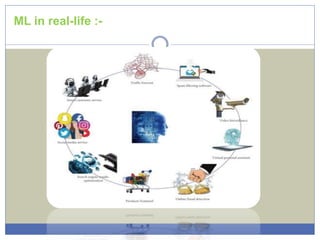
ML in real-life :-
Applications-:
 Supervised Learning
Classification
Regression/Prediction
 Unsupervised Learning
 Reinforcement Learning
Supervised Learning
 Supervised Learning
 For every example in the data there is always a
predefined outcome
 Models the relations between a set of descriptive
features and a target (Fits data to a function)
 2 groups of problems:
Classification
Regression
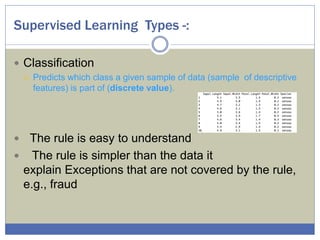
Supervised Learning Types -:
 Classification
 Predicts which class a given sample of data (sample of descriptive
features) is part of (discrete value).
 : The rule is easy to understand
 CThe rule is simpler than the data it
explain:Exceptions that are not covered by the rule,
e.g., fraud
Regression
 Example: Price of a used car
 x : car attributes
y : price
y = g (x | θ )
g ( ) model,
θ parameters
Unsupervised Learning
 Learning “what normally happens”
 No output
 Clustering: Grouping similar instances
 Other applications: Summarization, Association
Analysis
 Example applications
 Customer segmentation in CRM
 Image compression: Color quantization
 Bioinformatics: Learning motifs
Reinforcement Learning
 Policies: what actions should an agent take in a particular
situation
 Utility estimation: how good is a state (used by policy)
 No supervised output but delayed reward
 Credit assignment problem (what was responsible
for the outcome)
 Applications:
 Game playing
 Robot in a maze
ANN -:
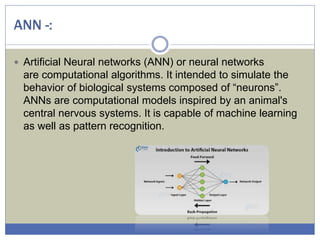
 Artificial Neural networks (ANN) or neural networks
are computational algorithms. It intended to simulate the
behavior of biological systems composed of “neurons”.
ANNs are computational models inspired by an animal's
central nervous systems. It is capable of machine learning
as well as pattern recognition.
DECISION TREE
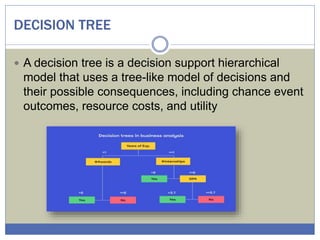
 A decision tree is a decision support hierarchical
model that uses a tree-like model of decisions and
their possible consequences, including chance event
outcomes, resource costs, and utility
SUPPORT VECTOR MACHINE
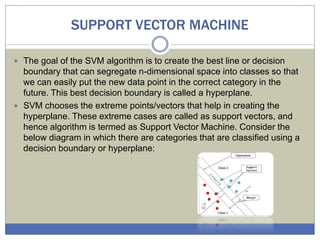
 The goal of the SVM algorithm is to create the best line or decision
boundary that can segregate n-dimensional space into classes so that
we can easily put the new data point in the correct category in the
future. This best decision boundary is called a hyperplane.
 SVM chooses the extreme points/vectors that help in creating the
hyperplane. These extreme cases are called as support vectors, and
hence algorithm is termed as Support Vector Machine. Consider the
below diagram in which there are categories that are classified using a
decision boundary or hyperplane:
NAÏVE BAYES
 Naïve Bayes algorithm is a supervised learning algorithm,
which is based on Bayes theorem and used for solving
classification problems.
 It is mainly used in text classification that includes a high-
dimensional training dataset.
 Naïve Bayes Classifier is one of the simple and most
effective Classification algorithms which helps in building
the fast machine learning models that can make quick
predictions.
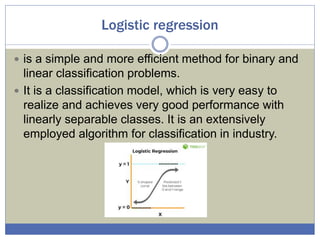
Logistic regression
 is a simple and more efficient method for binary and
linear classification problems.
 It is a classification model, which is very easy to
realize and achieves very good performance with
linearly separable classes. It is an extensively
employed algorithm for classification in industry.
THANKS FOR WATCHING

INTRODUCTIONTOML2024 for graphic era.pptx

  • 1.
  • 2.
    Machine Learning (ML) ML is a branch of artificial intelligence:  Uses computing based systems to make sense out of data  Extracting patterns, fitting data to functions, classifying data, etc  ML systems can learn and improve  With historical data, time and experience  Bridges theoretical computer science and real noise data.  Role of Statistics: Inference from a sample  Role of Computer science: Efficient algorithms to  Solve the optimization problem  Representing and evaluating the model for inference
  • 3.
    Growth of MachineLearning  Machine learning is preferred approach to  Speech recognition, Natural language processing  Computer vision  Medical outcomes analysis  Robot control  Computational biology  This trend is accelerating  Improved machine learning algorithms  Improved data capture, networking, faster computers  Software too complex to write by hand  New sensors / IO devices  Demand for self-customization to user, environment  It turns out to be difficult to extract knowledge from human expertsfailure of expert systems in the 1980’s.
  • 4.
  • 5.
  • 6.
    Supervised Learning  SupervisedLearning  For every example in the data there is always a predefined outcome  Models the relations between a set of descriptive features and a target (Fits data to a function)  2 groups of problems: Classification Regression
  • 7.
    Supervised Learning Types-:  Classification  Predicts which class a given sample of data (sample of descriptive features) is part of (discrete value).  : The rule is easy to understand  CThe rule is simpler than the data it explain:Exceptions that are not covered by the rule, e.g., fraud
  • 8.
    Regression  Example: Priceof a used car  x : car attributes y : price y = g (x | θ ) g ( ) model, θ parameters
  • 9.
    Unsupervised Learning  Learning“what normally happens”  No output  Clustering: Grouping similar instances  Other applications: Summarization, Association Analysis  Example applications  Customer segmentation in CRM  Image compression: Color quantization  Bioinformatics: Learning motifs
  • 10.
    Reinforcement Learning  Policies:what actions should an agent take in a particular situation  Utility estimation: how good is a state (used by policy)  No supervised output but delayed reward  Credit assignment problem (what was responsible for the outcome)  Applications:  Game playing  Robot in a maze
  • 11.
    ANN -:  ArtificialNeural networks (ANN) or neural networks are computational algorithms. It intended to simulate the behavior of biological systems composed of “neurons”. ANNs are computational models inspired by an animal's central nervous systems. It is capable of machine learning as well as pattern recognition.
  • 12.
    DECISION TREE  Adecision tree is a decision support hierarchical model that uses a tree-like model of decisions and their possible consequences, including chance event outcomes, resource costs, and utility
  • 13.
    SUPPORT VECTOR MACHINE The goal of the SVM algorithm is to create the best line or decision boundary that can segregate n-dimensional space into classes so that we can easily put the new data point in the correct category in the future. This best decision boundary is called a hyperplane.  SVM chooses the extreme points/vectors that help in creating the hyperplane. These extreme cases are called as support vectors, and hence algorithm is termed as Support Vector Machine. Consider the below diagram in which there are categories that are classified using a decision boundary or hyperplane:
  • 14.
    NAÏVE BAYES  NaïveBayes algorithm is a supervised learning algorithm, which is based on Bayes theorem and used for solving classification problems.  It is mainly used in text classification that includes a high- dimensional training dataset.  Naïve Bayes Classifier is one of the simple and most effective Classification algorithms which helps in building the fast machine learning models that can make quick predictions.
  • 15.
    Logistic regression  isa simple and more efficient method for binary and linear classification problems.  It is a classification model, which is very easy to realize and achieves very good performance with linearly separable classes. It is an extensively employed algorithm for classification in industry.
  • 16.