


Ahmet Selman Bozkır
   Introduction to conditional, total probability & Bayesian
    theorem
   Historical background of probabilistic information retrieval
   Why probabilities in IR?
   Document ranking problem
   Binary Independence Model
   Given some event B with nonzero probability P(B) > 0
   We can define conditional prob. as an event A, given B, by
                                    P( A B)
                          P( A B)
                                      P( B)
    The Probabilty P(A|B) simply reflects the fact that the probability of an
    event A may depend on a second event B. So if A and B are mutually
    exclusive, A B =
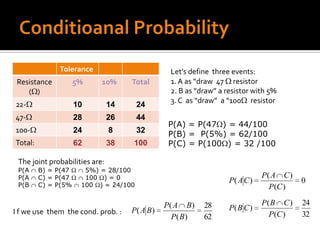
Tolerance                         Let’s define three events:
 Resistance          5%     10%      Total      1. A as “draw 47 resistor
    ( )                                         2. B as “draw” a resistor with 5%
22-                                             3. C as “draw” a “100 resistor
                     10         14     24
47-                  28         26     44
                                               P(A) = P(47 ) = 44/100
100-                 24         8      32      P(B) = P(5%) = 62/100
Total:               62         38   100       P(C) = P(100 ) = 32 /100

 The joint probabilities are:
 P(A     B) = P(47     5%) = 28/100
 P(A     C) = P(47     100 ) = 0                                             P( A C )
                                                                  P( A C )              0
 P(B     C) = P(5%    100 ) = 24/100                                           P(C )

                                               P( A B)    28                 P( B C )   24
I f we use them the cond. prob. :    P( A B)                      P( B C )
                                                 P( B)    62                   P(C )    32
   The probability of P(A) of any event A defined on a sample space S can be
    expressed in terms of cond. probabilities. Suppose we are given N
    mutually exclusive events Bn ,n = 1,2…. N whose union equals S as
    ilustrated in figure
                                                  A Bn
      B1        B2
                         A                                 N        N
                                            A   S A       B
                                                          n 1
                                                                n   (A  B )
                                                                    n 1
                                                                            n


       B3                         Bn
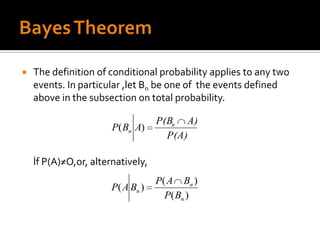
   The definition of conditional probability applies to any two
    events. In particular ,let Bn be one of the events defined
    above in the subsection on total probability.

                                   P(Bn A)
                       P( Bn A)
                                     P(A)

    İf P(A)≠O,or, alternatively,
                                   P( A Bn )
                       P( A Bn )
                                     P( Bn )
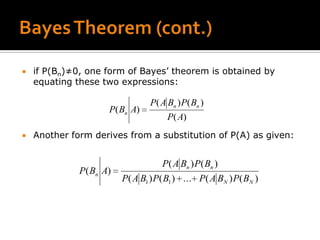
   if P(Bn)≠0, one form of Bayes’ theorem is obtained by
    equating these two expressions:

                                 P( A Bn ) P( Bn )
                     P( Bn A)
                                      P( A)
   Another form derives from a substitution of P(A) as given:


                                    P( A Bn ) P( Bn )
              P( Bn A)
                         P( A B1 ) P( B1 ) ... P( A BN ) P( BN )
   The first attempts to develop a probabilistic theory of retrieval were made over
    30 years ago [Maron and Kuhns 1960; Miller 1971], and since then there has been
    a steady development of the approach. There are already several operational IR
    systems based upon probabilistic or semiprobabilistic models.
   One major obstacle in probabilistic or semiprobabilistic IR models is finding
    methods for estimating the probabilities used to evaluate the probability of
    relevance that are both theoretically sound and computationally efficient.
   The first models to be based upon such assumptions were the “binary
    independence indexing model” and the “binary independence retrieval model
   One area of recent research investigates the use of an explicit network
    representation of dependencies. The networks are processed by means of
    Bayesian inference or belief theory, using evidential reasoning techniques such as
    those described by Pearl 1988. This approach is an extension of the earliest
    probabilistic models, taking into account the conditional dependencies present in
    a real environment.
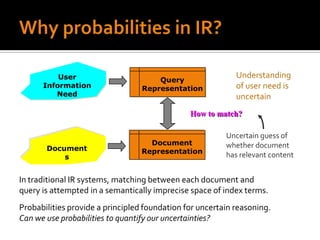
User                                              Understanding
                                      Query
      Information                 Representation            of user need is
         Need                                               uncertain
                                               How to match?

                                                         Uncertain guess of
                                    Document             whether document
       Document                   Representation
           s                                             has relevant content


In traditional IR systems, matching between each document and
query is attempted in a semantically imprecise space of index terms.
Probabilities provide a principled foundation for uncertain reasoning.
Can we use probabilities to quantify our uncertainties?
   Classical probabilistic retrieval model
     Probability ranking principle, etc.
   (Naïve) Bayesian Text Categorization
   Bayesian networks for text retrieval

   Probabilistic methods are one of the oldest but also one of the
    currently hottest topics in IR.
     Traditionally: neat ideas, but they’ve never won on
      performance. It may be different now.
   In probabilistic information retrieval, the goal is the estimation of the
    probability of relevance P(R l qk, dm) that a document dm will be judged
    relevant by a user with request qk. In order to estimate this probability, a
    large number of probabilistic models have been developed.

   Typically, such a model is based on representations of queries and
    documents (e.g., as sets of terms); in addition to this, probabilistic
    assumptions about the distribution of elements of these representations
    within relevant and nonrelevant documents are required.

    By collecting relevance feedback data from a few documents, the model
    then can be applied in order to estimate the probability of relevance for
    the remaining documents in the collection.
   We have a collection of documents
   User issues a query
   A list of documents needs to be returned
   Ranking method is core of an IR system:
     In what order do we present documents to the
      user?
     We want the “best” document to be first, second best
      second, etc….

   Idea: Rank by probability of relevance of the
    document w.r.t. information need
     P(relevant|documenti, query)
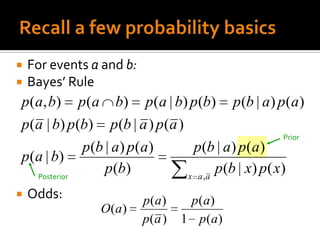
   For events a and b:
   Bayes’ Rule
p(a, b) p(a b) p(a | b) p (b) p (b | a) p (a )
p(a | b) p(b) p (b | a ) p (a )
                                                      Prior
              p(b | a) p(a)      p(b | a) p(a)
p ( a | b)
    Posterior
                  p (b)         x a ,a
                                       p (b | x) p( x)
   Odds:                 p(a)     p(a)
                O(a )
                          p(a )   1 p(a)
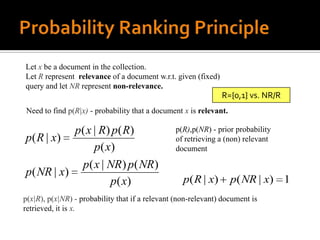
Let x be a document in the collection.
Let R represent relevance of a document w.r.t. given (fixed)
query and let NR represent non-relevance.
                                                                R={0,1} vs. NR/R
Need to find p(R|x) - probability that a document x is relevant.

           p( x | R) p( R)                      p(R),p(NR) - prior probability
p( R | x)                                       of retrieving a (non) relevant
                p( x)                           document

            p( x | NR) p( NR)
p( NR | x)
                    p ( x)                         p ( R | x)      p( NR | x) 1
p(x|R), p(x|NR) - probability that if a relevant (non-relevant) document is
retrieved, it is x.
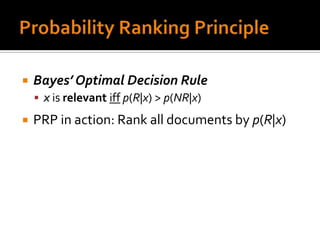
   Bayes’ Optimal Decision Rule
     x is relevant iff p(R|x) > p(NR|x)

   PRP in action: Rank all documents by p(R|x)
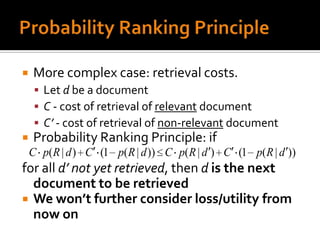
   More complex case: retrieval costs.
      Let d be a document
      C - cost of retrieval of relevant document
      C’ - cost of retrieval of non-relevant document
   Probability Ranking Principle: if
    C p( R | d ) C (1 p( R | d )) C p( R | d ) C (1 p( R | d ))
for all d’ not yet retrieved, then d is the next
  document to be retrieved
 We won’t further consider loss/utility from
  now on
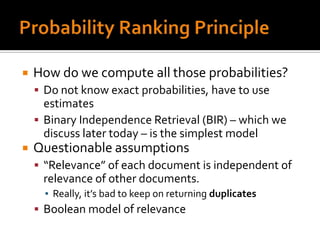
   How do we compute all those probabilities?
     Do not know exact probabilities, have to use
      estimates
     Binary Independence Retrieval (BIR) – which we
      discuss later today – is the simplest model
   Questionable assumptions
     “Relevance” of each document is independent of
     relevance of other documents.
      ▪ Really, it’s bad to keep on returning duplicates
     Boolean model of relevance
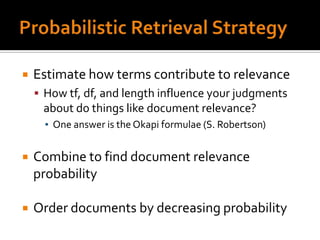
   Estimate how terms contribute to relevance
     How tf, df, and length influence your judgments
     about do things like document relevance?
      ▪ One answer is the Okapi formulae (S. Robertson)


   Combine to find document relevance
    probability

   Order documents by decreasing probability
   Basic concept:
   "For a given query, if we know some documents
    that are relevant, terms that occur in those
    documents should be given greater weighting in
    searching for other relevant documents.
   By making assumptions about the distribution of
    terms and applying Bayes Theorem, it is possible
    to derive weights theoretically."
                                       Van Rijsbergen
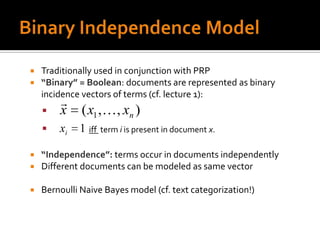
   Traditionally used in conjunction with PRP
   “Binary” = Boolean: documents are represented as binary
    incidence vectors of terms (cf. lecture 1):
        
       x     ( x1 , , xn )
       xi   1 iff term i is present in document x.

   “Independence”: terms occur in documents independently
   Different documents can be modeled as same vector

   Bernoulli Naive Bayes model (cf. text categorization!)
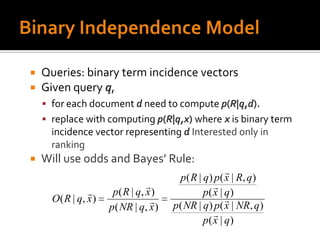
   Queries: binary term incidence vectors
   Given query q,
     for each document d need to compute p(R|q,d).
     replace with computing p(R|q,x) where x is binary term
      incidence vector representing d Interested only in
      ranking
   Will use odds and Bayes’ Rule:
                                                          
                                          p ( R | q ) p ( x | R, q )
                                                     
                       p ( R | q, x )            p( x | q)
      O ( R | q, x )                                     
                       p( NR | q, x )    p( NR | q) p( x | NR, q)
                                                      
                                                  p( x | q)
                        
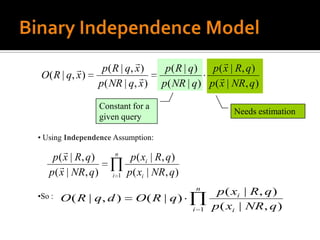
                     p ( R | q, x )      p ( R | q ) p ( x | R, q )
 O ( R | q, x )                                        
                     p( NR | q, x )      p( NR | q) p( x | NR, q)

                     Constant for a
                                                             Needs estimation
                     given query

• Using Independence Assumption:
                         n
    p ( x | R, q )              p ( xi | R, q )
       
   p ( x | NR, q )       i 1   p ( xi | NR, q )
                                                  n
•So :                                                    p ( xi | R, q )
        O ( R | q, d )           O( R | q)
                                                  i 1   p ( xi | NR , q )
n
                                                p ( xi | R, q )
O ( R | q, d )         O( R | q)
                                         i 1   p ( xi | NR, q )
• Since xi is either 0 or 1:
                                       p( xi 1 | R, q)           p( xi 0 | R, q)
O( R | q, d ) O( R | q)
                               xi 1   p( xi 1 | NR, q)   xi 0   p( xi 0 | NR, q)
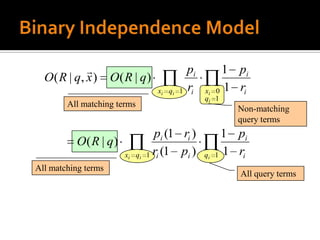
 • Let   pi    p( xi    1 | R, q); ri          p( xi   1 | NR, q);

 • Assume, for all terms not occurring in the query (qi=0)           pi   ri
                                                                 This can be
                                                                 changed (e.g., in
                                      Then...                    relevance feedback)
                              pi         1 pi
  O ( R | q, x )     O( R | q)
                                  xi qi 1   ri   xi   0 1 ri
                                                 qi 1
        All matching terms
                                                          Non-matching
                                                          query terms
                                  pi (1 ri )           1 pi
          O( R | q)
                        xi qi   1 ri (1 pi )     qi   1 1 ri
All matching terms
                                                          All query terms
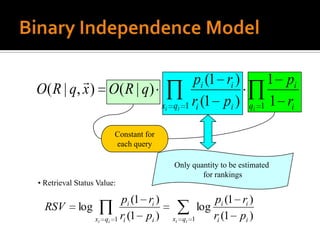
                                        pi (1 ri )           1 pi
O ( R | q, x ) O ( R | q )
                                         xi q i   1 ri (1 pi )     qi   1 1 ri


                          Constant for
                          each query

                                             Only quantity to be estimated
                                                     for rankings
• Retrieval Status Value:

                            pi (1 ri )                    pi (1 ri )
  RSV       log                                       log
                  xi qi   1 ri (1 pi )      xi qi   1     ri (1 pi )
• Estimating RSV coefficients.
• For each term i look at this table of document counts:

     Documens Relevant                Non-Relevant Total

     Xi=1                   s               n-s             n
     Xi=0                  S-s            N-n-S+s          N-n
     Total                 S                 N-S           N
                           s            (n s)
 • Estimates:      pi            ri
                           S           (N S)                     For now,
                                     s (S s)                     assume no
ci    K ( N , n, S , s )    log                                  zero terms.
                                (n s) ( N n S              s)
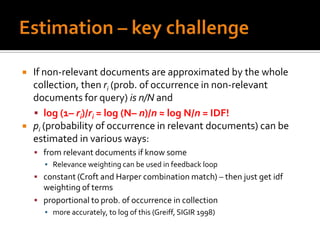
   If non-relevant documents are approximated by the whole
    collection, then ri (prob. of occurrence in non-relevant
    documents for query) is n/N and
     log (1– ri)/ri = log (N– n)/n ≈ log N/n = IDF!
   pi (probability of occurrence in relevant documents) can be
    estimated in various ways:
     from relevant documents if know some
      ▪ Relevance weighting can be used in feedback loop
     constant (Croft and Harper combination match) – then just get idf
      weighting of terms
     proportional to prob. of occurrence in collection
       ▪ more accurately, to log of this (Greiff, SIGIR 1998)
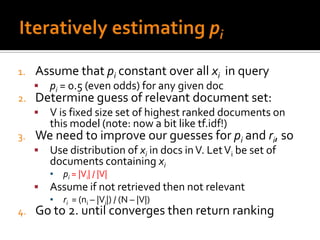
1.   Assume that pi constant over all xi in query
        pi = 0.5 (even odds) for any given doc
2.   Determine guess of relevant document set:
        V is fixed size set of highest ranked documents on
         this model (note: now a bit like tf.idf!)
3.   We need to improve our guesses for pi and ri, so
        Use distribution of xi in docs in V. Let Vi be set of
         documents containing xi
         ▪   pi = |Vi| / |V|
        Assume if not retrieved then not relevant
         ▪   ri = (ni – |Vi|) / (N – |V|)
4.   Go to 2. until converges then return ranking
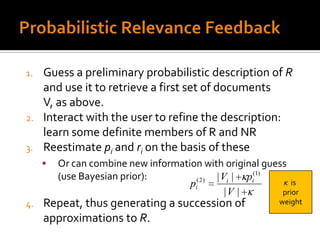
1. Guess a preliminary probabilistic description of R
   and use it to retrieve a first set of documents
   V, as above.
2. Interact with the user to refine the description:
   learn some definite members of R and NR
3. Reestimate pi and ri on the basis of these
        Or can combine new information with original guess
         (use Bayesian prior):               | Vi | pi(1)
                                     pi( 2 )              κ is
                                                |V |      prior
4.   Repeat, thus generating a succession of              weight

     approximations to R.
   Getting reasonable approximations of
    probabilities is possible.
   Requires restrictive assumptions:
     term independence
     terms not in query don’t affect the outcome
     boolean representation of documents/queries/relevance
     document relevance values are independent
   Some of these assumptions can be removed
   Problem: either require partial relevance information or
    only can derive somewhat inferior term weights
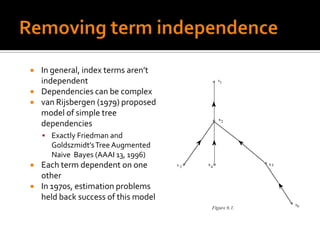
   In general, index terms aren’t
    independent
   Dependencies can be complex
   van Rijsbergen (1979) proposed
    model of simple tree
    dependencies
     Exactly Friedman and
      Goldszmidt’s Tree Augmented
      Naive Bayes (AAAI 13, 1996)
   Each term dependent on one
    other
   In 1970s, estimation problems
    held back success of this model
   What is a Bayesian network?
     A directed acyclic graph
     Nodes
      ▪ Events or Variables
        ▪ Assume values.
        ▪ For our purposes, all Boolean
     Links
      ▪ model direct dependencies between nodes
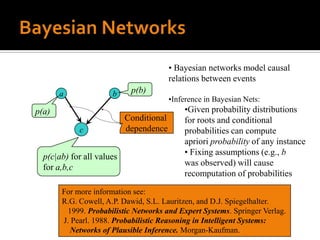
• Bayesian networks model causal
                                         relations between events
       a              b     p(b)
                                         •Inference in Bayesian Nets:
p(a)                                         •Given probability distributions
                           Conditional       for roots and conditional
            c              dependence        probabilities can compute
                                             apriori probability of any instance
                                             • Fixing assumptions (e.g., b
  p(c|ab) for all values
                                             was observed) will cause
  for a,b,c
                                             recomputation of probabilities

       For more information see:
       R.G. Cowell, A.P. Dawid, S.L. Lauritzen, and D.J. Spiegelhalter.
        1999. Probabilistic Networks and Expert Systems. Springer Verlag.
       J. Pearl. 1988. Probabilistic Reasoning in Intelligent Systems:
         Networks of Plausible Inference. Morgan-Kaufman.
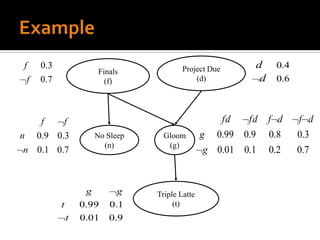
f    0 .3                                   Project Due      d     0.4
                         Finals
 f   0 .7                  (f)                  (d)           d    0.6


     f      f                                          fd   fd    f d    f d
n 0.9 0.3                No Sleep     Gloom        g 0.99 0.9     0.8    0.3
                           (n)         (g)
 n 0.1 0.7                                          g 0.01 0.1    0.2    0.7


                     g         g    Triple Latte
            t       0.99    0.1          (t)
                t   0.01    0.9
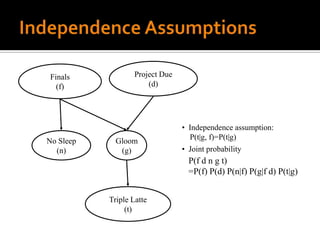
Finals             Project Due
  (f)                  (d)


                                 • Independence assumption:
No Sleep     Gloom                 P(t|g, f)=P(t|g)
  (n)         (g)                • Joint probability
                                  P(f d n g t)
                                  =P(f) P(d) P(n|f) P(g|f d) P(t|g)


           Triple Latte
                (t)
   Goal
     Given a user’s information need (evidence), find
     probability a doc satisfies need
   Retrieval model
     Model docs in a document network
     Model information need in a query network
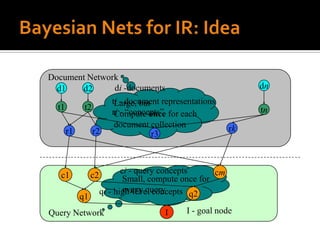
Document Network
  d1    d2     di -documents                                dn
              ti - document representations
               Large, but
  t1    t2                                                  tn
              ri - “concepts” for each
               Compute once
               document collection                     rk
     r1    r2             r3


                         ci - query concepts      cm
   c1        c2           Small, compute once for
                          every query
                  qi - high-level concepts q2
        q1
Query Network                      I     I - goal node
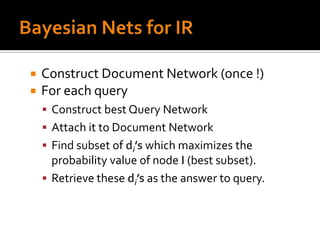
   Construct Document Network (once !)
   For each query
     Construct best Query Network
     Attach it to Document Network
     Find subset of di’s which maximizes the
      probability value of node I (best subset).
     Retrieve these di’s as the answer to query.
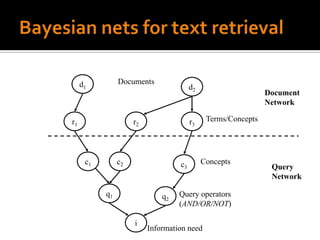
d1         Documents
                                        d2
                                                               Document
                                                               Network

r1                   r2                 r3    Terms/Concepts


      c1        c2                 c3        Concepts
                                                                Query
                                                                Network

           q1                 q2   Query operators
                                   (AND/OR/NOT)

                     i
                          Information need
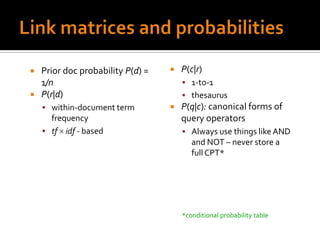
 Prior doc probability P(d) =      P(c|r)
  1/n                                 1-to-1
 P(r|d)                              thesaurus
     within-document term          P(q|c): canonical forms of
      frequency                      query operators
     tf idf - based                  Always use things like AND
                                        and NOT – never store a
                                        full CPT*


                                     *conditional probability table
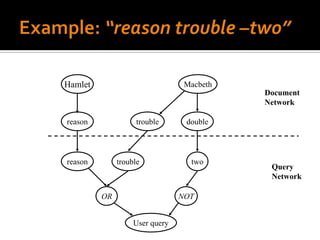
Hamlet                           Macbeth
                                           Document
                                           Network

reason              trouble      double


reason        trouble             two
                                            Query
                                            Network

         OR                     NOT


                   User query
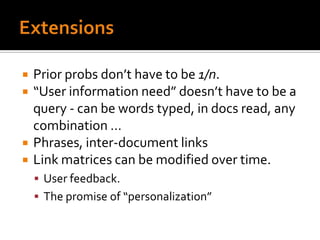
   Prior probs don’t have to be 1/n.
   “User information need” doesn’t have to be a
    query - can be words typed, in docs read, any
    combination …
   Phrases, inter-document links
   Link matrices can be modified over time.
     User feedback.
     The promise of “personalization”
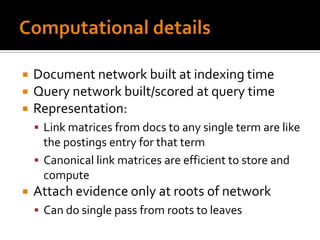
   Document network built at indexing time
   Query network built/scored at query time
   Representation:
     Link matrices from docs to any single term are like
      the postings entry for that term
     Canonical link matrices are efficient to store and
      compute
   Attach evidence only at roots of network
     Can do single pass from roots to leaves
All sources served by Google!

Probabilistic information retrieval models & systems

  • 1.
  • 2.
    Introduction to conditional, total probability & Bayesian theorem  Historical background of probabilistic information retrieval  Why probabilities in IR?  Document ranking problem  Binary Independence Model
  • 3.
    Given some event B with nonzero probability P(B) > 0  We can define conditional prob. as an event A, given B, by P( A B) P( A B) P( B) The Probabilty P(A|B) simply reflects the fact that the probability of an event A may depend on a second event B. So if A and B are mutually exclusive, A B =
  • 4.
    Tolerance Let’s define three events: Resistance 5% 10% Total 1. A as “draw 47 resistor ( ) 2. B as “draw” a resistor with 5% 22- 3. C as “draw” a “100 resistor 10 14 24 47- 28 26 44 P(A) = P(47 ) = 44/100 100- 24 8 32 P(B) = P(5%) = 62/100 Total: 62 38 100 P(C) = P(100 ) = 32 /100 The joint probabilities are: P(A B) = P(47 5%) = 28/100 P(A C) = P(47 100 ) = 0 P( A C ) P( A C ) 0 P(B C) = P(5% 100 ) = 24/100 P(C ) P( A B) 28 P( B C ) 24 I f we use them the cond. prob. : P( A B) P( B C ) P( B) 62 P(C ) 32
  • 5.
    The probability of P(A) of any event A defined on a sample space S can be expressed in terms of cond. probabilities. Suppose we are given N mutually exclusive events Bn ,n = 1,2…. N whose union equals S as ilustrated in figure A Bn B1 B2 A N N A S A B n 1 n (A  B ) n 1 n B3 Bn
  • 6.
    The definition of conditional probability applies to any two events. In particular ,let Bn be one of the events defined above in the subsection on total probability. P(Bn A) P( Bn A) P(A) İf P(A)≠O,or, alternatively, P( A Bn ) P( A Bn ) P( Bn )
  • 7.
    if P(Bn)≠0, one form of Bayes’ theorem is obtained by equating these two expressions: P( A Bn ) P( Bn ) P( Bn A) P( A)  Another form derives from a substitution of P(A) as given: P( A Bn ) P( Bn ) P( Bn A) P( A B1 ) P( B1 ) ... P( A BN ) P( BN )
  • 8.
    The first attempts to develop a probabilistic theory of retrieval were made over 30 years ago [Maron and Kuhns 1960; Miller 1971], and since then there has been a steady development of the approach. There are already several operational IR systems based upon probabilistic or semiprobabilistic models.  One major obstacle in probabilistic or semiprobabilistic IR models is finding methods for estimating the probabilities used to evaluate the probability of relevance that are both theoretically sound and computationally efficient.  The first models to be based upon such assumptions were the “binary independence indexing model” and the “binary independence retrieval model  One area of recent research investigates the use of an explicit network representation of dependencies. The networks are processed by means of Bayesian inference or belief theory, using evidential reasoning techniques such as those described by Pearl 1988. This approach is an extension of the earliest probabilistic models, taking into account the conditional dependencies present in a real environment.
  • 9.
    User Understanding Query Information Representation of user need is Need uncertain How to match? Uncertain guess of Document whether document Document Representation s has relevant content In traditional IR systems, matching between each document and query is attempted in a semantically imprecise space of index terms. Probabilities provide a principled foundation for uncertain reasoning. Can we use probabilities to quantify our uncertainties?
  • 10.
    Classical probabilistic retrieval model  Probability ranking principle, etc.  (Naïve) Bayesian Text Categorization  Bayesian networks for text retrieval  Probabilistic methods are one of the oldest but also one of the currently hottest topics in IR.  Traditionally: neat ideas, but they’ve never won on performance. It may be different now.
  • 11.
    In probabilistic information retrieval, the goal is the estimation of the probability of relevance P(R l qk, dm) that a document dm will be judged relevant by a user with request qk. In order to estimate this probability, a large number of probabilistic models have been developed.  Typically, such a model is based on representations of queries and documents (e.g., as sets of terms); in addition to this, probabilistic assumptions about the distribution of elements of these representations within relevant and nonrelevant documents are required.  By collecting relevance feedback data from a few documents, the model then can be applied in order to estimate the probability of relevance for the remaining documents in the collection.
  • 12.
    We have a collection of documents  User issues a query  A list of documents needs to be returned  Ranking method is core of an IR system:  In what order do we present documents to the user?  We want the “best” document to be first, second best second, etc….  Idea: Rank by probability of relevance of the document w.r.t. information need  P(relevant|documenti, query)
  • 13.
    For events a and b:  Bayes’ Rule p(a, b) p(a b) p(a | b) p (b) p (b | a) p (a ) p(a | b) p(b) p (b | a ) p (a ) Prior p(b | a) p(a) p(b | a) p(a) p ( a | b) Posterior p (b) x a ,a p (b | x) p( x)  Odds: p(a) p(a) O(a ) p(a ) 1 p(a)
  • 14.
    Let x bea document in the collection. Let R represent relevance of a document w.r.t. given (fixed) query and let NR represent non-relevance. R={0,1} vs. NR/R Need to find p(R|x) - probability that a document x is relevant. p( x | R) p( R) p(R),p(NR) - prior probability p( R | x) of retrieving a (non) relevant p( x) document p( x | NR) p( NR) p( NR | x) p ( x) p ( R | x) p( NR | x) 1 p(x|R), p(x|NR) - probability that if a relevant (non-relevant) document is retrieved, it is x.
  • 15.
    Bayes’ Optimal Decision Rule  x is relevant iff p(R|x) > p(NR|x)  PRP in action: Rank all documents by p(R|x)
  • 16.
    More complex case: retrieval costs.  Let d be a document  C - cost of retrieval of relevant document  C’ - cost of retrieval of non-relevant document  Probability Ranking Principle: if C p( R | d ) C (1 p( R | d )) C p( R | d ) C (1 p( R | d )) for all d’ not yet retrieved, then d is the next document to be retrieved  We won’t further consider loss/utility from now on
  • 17.
    How do we compute all those probabilities?  Do not know exact probabilities, have to use estimates  Binary Independence Retrieval (BIR) – which we discuss later today – is the simplest model  Questionable assumptions  “Relevance” of each document is independent of relevance of other documents. ▪ Really, it’s bad to keep on returning duplicates  Boolean model of relevance
  • 18.
    Estimate how terms contribute to relevance  How tf, df, and length influence your judgments about do things like document relevance? ▪ One answer is the Okapi formulae (S. Robertson)  Combine to find document relevance probability  Order documents by decreasing probability
  • 19.
    Basic concept:  "For a given query, if we know some documents that are relevant, terms that occur in those documents should be given greater weighting in searching for other relevant documents.  By making assumptions about the distribution of terms and applying Bayes Theorem, it is possible to derive weights theoretically."  Van Rijsbergen
  • 20.
    Traditionally used in conjunction with PRP  “Binary” = Boolean: documents are represented as binary incidence vectors of terms (cf. lecture 1):   x ( x1 , , xn )  xi 1 iff term i is present in document x.  “Independence”: terms occur in documents independently  Different documents can be modeled as same vector  Bernoulli Naive Bayes model (cf. text categorization!)
  • 21.
    Queries: binary term incidence vectors  Given query q,  for each document d need to compute p(R|q,d).  replace with computing p(R|q,x) where x is binary term incidence vector representing d Interested only in ranking  Will use odds and Bayes’ Rule:  p ( R | q ) p ( x | R, q )    p ( R | q, x ) p( x | q) O ( R | q, x )   p( NR | q, x ) p( NR | q) p( x | NR, q)  p( x | q)
  • 22.
      p ( R | q, x ) p ( R | q ) p ( x | R, q ) O ( R | q, x )   p( NR | q, x ) p( NR | q) p( x | NR, q) Constant for a Needs estimation given query • Using Independence Assumption:  n p ( x | R, q ) p ( xi | R, q )  p ( x | NR, q ) i 1 p ( xi | NR, q ) n •So : p ( xi | R, q ) O ( R | q, d ) O( R | q) i 1 p ( xi | NR , q )
  • 23.
    n p ( xi | R, q ) O ( R | q, d ) O( R | q) i 1 p ( xi | NR, q ) • Since xi is either 0 or 1: p( xi 1 | R, q) p( xi 0 | R, q) O( R | q, d ) O( R | q) xi 1 p( xi 1 | NR, q) xi 0 p( xi 0 | NR, q) • Let pi p( xi 1 | R, q); ri p( xi 1 | NR, q); • Assume, for all terms not occurring in the query (qi=0) pi ri This can be changed (e.g., in Then... relevance feedback)
  • 24.
    pi 1 pi O ( R | q, x ) O( R | q) xi qi 1 ri xi 0 1 ri qi 1 All matching terms Non-matching query terms pi (1 ri ) 1 pi O( R | q) xi qi 1 ri (1 pi ) qi 1 1 ri All matching terms All query terms
  • 25.
    pi (1 ri ) 1 pi O ( R | q, x ) O ( R | q ) xi q i 1 ri (1 pi ) qi 1 1 ri Constant for each query Only quantity to be estimated for rankings • Retrieval Status Value: pi (1 ri ) pi (1 ri ) RSV log log xi qi 1 ri (1 pi ) xi qi 1 ri (1 pi )
  • 26.
    • Estimating RSVcoefficients. • For each term i look at this table of document counts: Documens Relevant Non-Relevant Total Xi=1 s n-s n Xi=0 S-s N-n-S+s N-n Total S N-S N s (n s) • Estimates: pi ri S (N S) For now, s (S s) assume no ci K ( N , n, S , s ) log zero terms. (n s) ( N n S s)
  • 27.
    If non-relevant documents are approximated by the whole collection, then ri (prob. of occurrence in non-relevant documents for query) is n/N and  log (1– ri)/ri = log (N– n)/n ≈ log N/n = IDF!  pi (probability of occurrence in relevant documents) can be estimated in various ways:  from relevant documents if know some ▪ Relevance weighting can be used in feedback loop  constant (Croft and Harper combination match) – then just get idf weighting of terms  proportional to prob. of occurrence in collection ▪ more accurately, to log of this (Greiff, SIGIR 1998)
  • 28.
    1. Assume that pi constant over all xi in query  pi = 0.5 (even odds) for any given doc 2. Determine guess of relevant document set:  V is fixed size set of highest ranked documents on this model (note: now a bit like tf.idf!) 3. We need to improve our guesses for pi and ri, so  Use distribution of xi in docs in V. Let Vi be set of documents containing xi ▪ pi = |Vi| / |V|  Assume if not retrieved then not relevant ▪ ri = (ni – |Vi|) / (N – |V|) 4. Go to 2. until converges then return ranking
  • 29.
    1. Guess apreliminary probabilistic description of R and use it to retrieve a first set of documents V, as above. 2. Interact with the user to refine the description: learn some definite members of R and NR 3. Reestimate pi and ri on the basis of these  Or can combine new information with original guess (use Bayesian prior): | Vi | pi(1) pi( 2 ) κ is |V | prior 4. Repeat, thus generating a succession of weight approximations to R.
  • 30.
    Getting reasonable approximations of probabilities is possible.  Requires restrictive assumptions:  term independence  terms not in query don’t affect the outcome  boolean representation of documents/queries/relevance  document relevance values are independent  Some of these assumptions can be removed  Problem: either require partial relevance information or only can derive somewhat inferior term weights
  • 31.
    In general, index terms aren’t independent  Dependencies can be complex  van Rijsbergen (1979) proposed model of simple tree dependencies  Exactly Friedman and Goldszmidt’s Tree Augmented Naive Bayes (AAAI 13, 1996)  Each term dependent on one other  In 1970s, estimation problems held back success of this model
  • 32.
    What is a Bayesian network?  A directed acyclic graph  Nodes ▪ Events or Variables ▪ Assume values. ▪ For our purposes, all Boolean  Links ▪ model direct dependencies between nodes
  • 33.
    • Bayesian networksmodel causal relations between events a b p(b) •Inference in Bayesian Nets: p(a) •Given probability distributions Conditional for roots and conditional c dependence probabilities can compute apriori probability of any instance • Fixing assumptions (e.g., b p(c|ab) for all values was observed) will cause for a,b,c recomputation of probabilities For more information see: R.G. Cowell, A.P. Dawid, S.L. Lauritzen, and D.J. Spiegelhalter. 1999. Probabilistic Networks and Expert Systems. Springer Verlag. J. Pearl. 1988. Probabilistic Reasoning in Intelligent Systems: Networks of Plausible Inference. Morgan-Kaufman.
  • 34.
    f 0 .3 Project Due d 0.4 Finals f 0 .7 (f) (d) d 0.6 f f fd fd f d f d n 0.9 0.3 No Sleep Gloom g 0.99 0.9 0.8 0.3 (n) (g) n 0.1 0.7 g 0.01 0.1 0.2 0.7 g g Triple Latte t 0.99 0.1 (t) t 0.01 0.9
  • 35.
    Finals Project Due (f) (d) • Independence assumption: No Sleep Gloom P(t|g, f)=P(t|g) (n) (g) • Joint probability P(f d n g t) =P(f) P(d) P(n|f) P(g|f d) P(t|g) Triple Latte (t)
  • 36.
    Goal  Given a user’s information need (evidence), find probability a doc satisfies need  Retrieval model  Model docs in a document network  Model information need in a query network
  • 37.
    Document Network d1 d2 di -documents dn ti - document representations Large, but t1 t2 tn ri - “concepts” for each Compute once document collection rk r1 r2 r3 ci - query concepts cm c1 c2 Small, compute once for every query qi - high-level concepts q2 q1 Query Network I I - goal node
  • 38.
    Construct Document Network (once !)  For each query  Construct best Query Network  Attach it to Document Network  Find subset of di’s which maximizes the probability value of node I (best subset).  Retrieve these di’s as the answer to query.
  • 39.
    d1 Documents d2 Document Network r1 r2 r3 Terms/Concepts c1 c2 c3 Concepts Query Network q1 q2 Query operators (AND/OR/NOT) i Information need
  • 40.
     Prior docprobability P(d) =  P(c|r) 1/n  1-to-1  P(r|d)  thesaurus  within-document term  P(q|c): canonical forms of frequency query operators  tf idf - based  Always use things like AND and NOT – never store a full CPT* *conditional probability table
  • 41.
    Hamlet Macbeth Document Network reason trouble double reason trouble two Query Network OR NOT User query
  • 42.
    Prior probs don’t have to be 1/n.  “User information need” doesn’t have to be a query - can be words typed, in docs read, any combination …  Phrases, inter-document links  Link matrices can be modified over time.  User feedback.  The promise of “personalization”
  • 43.
    Document network built at indexing time  Query network built/scored at query time  Representation:  Link matrices from docs to any single term are like the postings entry for that term  Canonical link matrices are efficient to store and compute  Attach evidence only at roots of network  Can do single pass from roots to leaves
  • 44.