Seminar 2
Kernels
and
Support Vector Machines
Edgar Marca
Supervisor: DSc. André M.S. Barreto
Petrópolis, Rio de Janeiro - Brazil
September 2nd, 2015
1 / 28
Kernels
Kernels
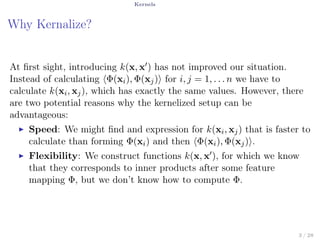
Why Kernalize?
At first sight, introducing k(x, x′) has not improved our situation.
Instead of calculating ⟨Φ(xi), Φ(xj)⟩ for i, j = 1, . . . n we have to
calculate k(xi, xj), which has exactly the same values. However, there
are two potential reasons why the kernelized setup can be
advantageous:
▶ Speed: We might find and expression for k(xi, xj) that is faster to
calculate than forming Φ(xi) and then ⟨Φ(xi), Φ(xj)⟩.
▶ Flexibility: We construct functions k(x, x′), for which we know
that they corresponds to inner products after some feature
mapping Φ, but we don’t know how to compute Φ.
3 / 28
Kernels
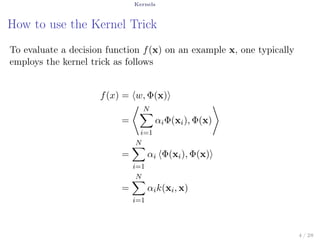
How to use the Kernel Trick
To evaluate a decision function f(x) on an example x, one typically
employs the kernel trick as follows
f(x) = ⟨w, Φ(x)⟩
=
⟨ N∑
i=1
αiΦ(xi), Φ(x)
⟩
=
N∑
i=1
αi ⟨Φ(xi), Φ(x)⟩
=
N∑
i=1
αik(xi, x)
4 / 28
How to proof that a function
is a kernel?
Kernels
Some Definitions
Definition 1.1 (Positive Definite Kernel)
Let X be a nonempty set. A function k : X × X → C is called a
positive definite if and only if
n∑
i=1
n∑
j=1
cicjk(xi, xj) ≥ 0 (1)
for all n ∈ N, {x1, . . . , xn} ⊆ X and {c1, . . . , cn}.
Unfortunately, there is no common use of the preceding definition in
the literature. Indeed, some authors call positive definite function
positive semi-definite, ans strictly positive definite functions are
sometimes called positive definite.
Note:
For fixed x1, x2, . . . , xn ∈ X, then n × n matrix K := [k(xi, xj)]1≤i,j≤n
is often called the Gram Matrix.
6 / 28
Kernels
Mercer Condition
Theorem 1.2
Let X = [a, b] be compact interval and let k : [a, b] × [a, b] → C be
continuous. Then φ is positive definite if and only if
∫ b
a
∫ b
a
c(x)c(y)k(x, y)dxdy ≥ 0 (2)
for each continuous function c : X → C.
7 / 28
Kernels
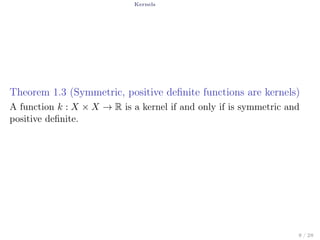
Theorem 1.3 (Symmetric, positive definite functions are kernels)
A function k : X × X → R is a kernel if and only if is symmetric and
positive definite.
8 / 28
Kernels
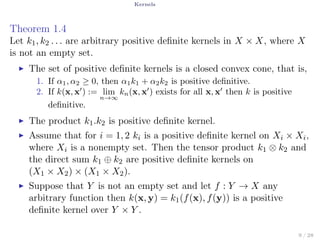
Theorem 1.4
Let k1, k2 . . . are arbitrary positive definite kernels in X × X, where X
is not an empty set.
▶ The set of positive definite kernels is a closed convex cone, that is,
1. If α1, α2 ≥ 0, then α1k1 + α2k2 is positive definitive.
2. If k(x, x′
) := lim
n→∞
kn(x, x′
) exists for all x, x′
then k is positive
definitive.
▶ The product k1.k2 is positive definite kernel.
▶ Assume that for i = 1, 2 ki is a positive definite kernel on Xi × Xi,
where Xi is a nonempty set. Then the tensor product k1 ⊗ k2 and
the direct sum k1 ⊕ k2 are positive definite kernels on
(X1 × X2) × (X1 × X2).
▶ Suppose that Y is not an empty set and let f : Y → X any
arbitrary function then k(x, y) = k1(f(x), f(y)) is a positive
definite kernel over Y × Y .
9 / 28
Kernel Families
Kernels Kernel Families
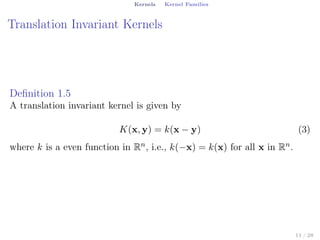
Translation Invariant Kernels
Definition 1.5
A translation invariant kernel is given by
K(x, y) = k(x − y) (3)
where k is a even function in Rn, i.e., k(−x) = k(x) for all x in Rn.
11 / 28
Kernels Kernel Families
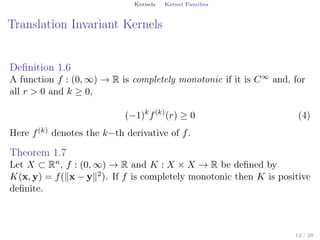
Translation Invariant Kernels
Definition 1.6
A function f : (0, ∞) → R is completely monotonic if it is C∞ and, for
all r > 0 and k ≥ 0,
(−1)k
f(k)
(r) ≥ 0 (4)
Here f(k) denotes the k−th derivative of f.
Theorem 1.7
Let X ⊂ Rn, f : (0, ∞) → R and K : X × X → R be defined by
K(x, y) = f(∥x − y∥2). If f is completely monotonic then K is positive
definite.
12 / 28
Kernels Kernel Families
Translation Invariant Kernels
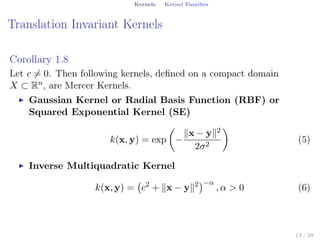
Corollary 1.8
Let c ̸= 0. Then following kernels, defined on a compact domain
X ⊂ Rn, are Mercer Kernels.
▶ Gaussian Kernel or Radial Basis Function (RBF) or
Squared Exponential Kernel (SE)
k(x, y) = exp
(
−
∥x − y∥2
2σ2
)
(5)
▶ Inverse Multiquadratic Kernel
k(x, y) =
(
c2
+ ∥x − y∥2
)−α
, α > 0 (6)
13 / 28
Kernels Kernel Families
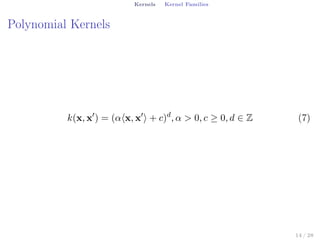
Polynomial Kernels
k(x, x′
) = (α⟨x, x′
⟩ + c)d
, α > 0, c ≥ 0, d ∈ Z (7)
14 / 28
Kernels Kernel Families
Non Mercer Kernels
Example 1.9
Let k : X × X → R defined as
k(x, x′
) =
{
1 , ∥x − x′∥ ≥ 1
0 , in other case
(8)
Suppose that k is a Mercer Kernel and set x1 = 1, x2 = 2 and x3 = 3
then the matrix Kij = k(xi, xj) for 1 ≤ i, j ≤ 3 is
K =


1 1 0
1 1 1
0 1 1

 (9)
then the eigenvalues of K are λ1 = (
√
2 − 1)−1 > 0 and
λ2 = (1 −
√
2) < 0. This is a contradiction because all the eigenvalues
of K are positive then we can conclude that k is not a Mercer Kernel.
15 / 28
Kernels Kernel Families
References for Kernels
[3] C. Berg, J. Reus, and P. Ressel. Harmonic Analysis on
Semigroups: Theory of Positive Definite and Related Functions.
Springer Science+Business Media, LLV, 1984.
[9] Felipe Cucker and Ding Xuan Zhou. Learning Theory.
Cambridge University Press, 2007.
[47] Ingo Steinwart and Christmannm Andreas. Support Vector
Machines. 2008.
16 / 28
Support Vector Machines
Applications SVM
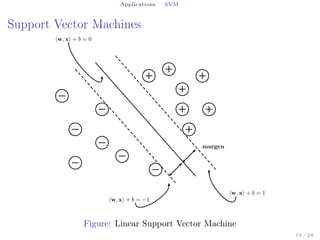
Support Vector Machines
w, x + b = 1
w, x + b = −1
w, x + b = 0
margen
Figure: Linear Support Vector Machine
18 / 28
Applications SVM
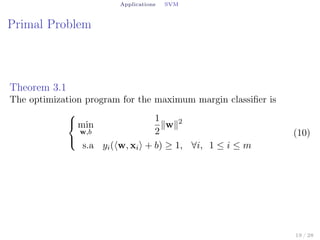
Primal Problem
Theorem 3.1
The optimization program for the maximum margin classifier is



min
w,b
1
2
∥w∥2
s.a yi(⟨w, xi⟩ + b) ≥ 1, ∀i, 1 ≤ i ≤ m
(10)
19 / 28
Applications SVM
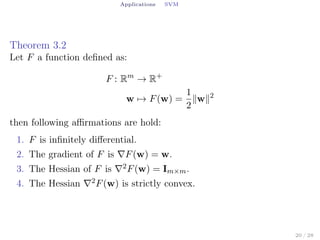
Theorem 3.2
Let F a function defined as:
F : Rm
→ R+
w → F(w) =
1
2
∥w∥2
then following affirmations are hold:
1. F is infinitely differential.
2. The gradient of F is ∇F(w) = w.
3. The Hessian of F is ∇2F(w) = Im×m.
4. The Hessian ∇2F(w) is strictly convex.
20 / 28
Applications SVM
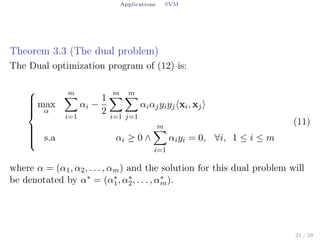
Theorem 3.3 (The dual problem)
The Dual optimization program of (12) is:



max
α
m∑
i=1
αi −
1
2
m∑
i=1
m∑
j=1
αiαjyiyj⟨xi, xj⟩
s.a αi ≥ 0 ∧
m∑
i=1
αiyi = 0, ∀i, 1 ≤ i ≤ m
(11)
where α = (α1, α2, . . . , αm) and the solution for this dual problem will
be denotated by α∗ = (α∗
1, α∗
2, . . . , α∗
m).
21 / 28
Applications SVM
Proof.
The Lagrangianx of the function F is
L(x, b, α) =
1
2
∥w∥2
−
m∑
i=1
αi[yi(⟨w, xi⟩ + b) − 1] (12)
Because of the KKT conditions are hold (F is continuous and
differentiable and the restrictions are also continuous and differentiable)
then we can add the complementary conditions
Stationarity:
∇wL = w −
m∑
i=1
αiyixi = 0 ⇒ w =
m∑
i=1
αiyixi (13)
∇bL = −
m∑
i=1
αiyi = 0 ⇒
m∑
i=1
αiyi = 0 (14)
22 / 28
Applications SVM
Primal feasibility:
yi(⟨w, xi⟩ + b) ≥ 1, ∀i ∈ [1, m] (15)
Dual feasibility:
αi ≥ 0, ∀i ∈ [1, m] (16)
Complementary slackness:
αi[yi(⟨w, xi⟩+b)−1] = 0 ⇒ αi = 0∨yi(⟨w, xi⟩+b) = 1, ∀i ∈ [1, m] (17)
L(w, b, α) =
1
2
m∑
i=1
αiyixi
2
−
m∑
i=1
m∑
j=1
αiαjyiyj⟨xi, xj⟩
=− 1
2
∑m
i=1
∑m
j=1 αiαjyiyj⟨xi,xj⟩
−
m∑
i=1
αiyib
=0
+
m∑
i=1
αi
(18)
then
L(w, b, α) =
m∑
i=1
αi −
1
2
m∑
i=1
m∑
j=1
αiαjyiyj⟨xi, xj⟩ (19)
23 / 28
Applications SVM
Theorem 3.4
Let G a function defined as:
G: Rm
→ R
α → G(α) = αt
Im×m −
1
2
αt
Aα
where α = (α1, α2, . . . , αm) y A = [yiyj⟨xi, xj⟩]1≤i,j≤m in Rm×m then
the following affirmations are hold:
1. The A is symmetric.
2. The function G is differentiable and
∂G(α)
∂α
= Im×m − Aα.
3. The function G is twice differentiable and
∂2G(α)
∂α2
= −A.
4. The function G is a concave function.
24 / 28
Applications SVM
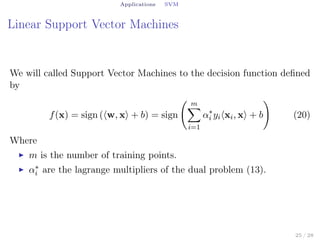
Linear Support Vector Machines
We will called Support Vector Machines to the decision function defined
by
f(x) = sign (⟨w, x⟩ + b) = sign
( m∑
i=1
α∗
i yi⟨xi, x⟩ + b
)
(20)
Where
▶ m is the number of training points.
▶ α∗
i are the lagrange multipliers of the dual problem (13).
25 / 28
Applications Non Linear SVM
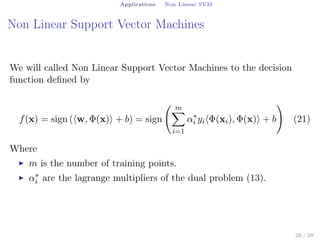
Non Linear Support Vector Machines
We will called Non Linear Support Vector Machines to the decision
function defined by
f(x) = sign (⟨w, Φ(x)⟩ + b) = sign
( m∑
i=1
α∗
i yi⟨Φ(xi), Φ(x)⟩ + b
)
(21)
Where
▶ m is the number of training points.
▶ α∗
i are the lagrange multipliers of the dual problem (13).
26 / 28
Applications Non Linear SVM
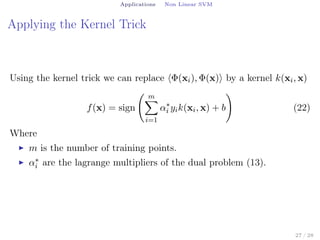
Applying the Kernel Trick
Using the kernel trick we can replace ⟨Φ(xi), Φ(x)⟩ by a kernel k(xi, x)
f(x) = sign
( m∑
i=1
α∗
i yik(xi, x) + b
)
(22)
Where
▶ m is the number of training points.
▶ α∗
i are the lagrange multipliers of the dual problem (13).
27 / 28
Applications Non Linear SVM
References for Support Vector Machines
[31] Mehryar Mohri, Afshin Rostamizadeh, and Ameet Talwalkar.
Foundations of Machine Learning. The MIT Press, 2012.
28 / 28

Kernels and Support Vector Machines

  • 1.
    Seminar 2 Kernels and Support VectorMachines Edgar Marca Supervisor: DSc. André M.S. Barreto Petrópolis, Rio de Janeiro - Brazil September 2nd, 2015 1 / 28
  • 2.
  • 3.
    Kernels Why Kernalize? At firstsight, introducing k(x, x′) has not improved our situation. Instead of calculating ⟨Φ(xi), Φ(xj)⟩ for i, j = 1, . . . n we have to calculate k(xi, xj), which has exactly the same values. However, there are two potential reasons why the kernelized setup can be advantageous: ▶ Speed: We might find and expression for k(xi, xj) that is faster to calculate than forming Φ(xi) and then ⟨Φ(xi), Φ(xj)⟩. ▶ Flexibility: We construct functions k(x, x′), for which we know that they corresponds to inner products after some feature mapping Φ, but we don’t know how to compute Φ. 3 / 28
  • 4.
    Kernels How to usethe Kernel Trick To evaluate a decision function f(x) on an example x, one typically employs the kernel trick as follows f(x) = ⟨w, Φ(x)⟩ = ⟨ N∑ i=1 αiΦ(xi), Φ(x) ⟩ = N∑ i=1 αi ⟨Φ(xi), Φ(x)⟩ = N∑ i=1 αik(xi, x) 4 / 28
  • 5.
    How to proofthat a function is a kernel?
  • 6.
    Kernels Some Definitions Definition 1.1(Positive Definite Kernel) Let X be a nonempty set. A function k : X × X → C is called a positive definite if and only if n∑ i=1 n∑ j=1 cicjk(xi, xj) ≥ 0 (1) for all n ∈ N, {x1, . . . , xn} ⊆ X and {c1, . . . , cn}. Unfortunately, there is no common use of the preceding definition in the literature. Indeed, some authors call positive definite function positive semi-definite, ans strictly positive definite functions are sometimes called positive definite. Note: For fixed x1, x2, . . . , xn ∈ X, then n × n matrix K := [k(xi, xj)]1≤i,j≤n is often called the Gram Matrix. 6 / 28
  • 7.
    Kernels Mercer Condition Theorem 1.2 LetX = [a, b] be compact interval and let k : [a, b] × [a, b] → C be continuous. Then φ is positive definite if and only if ∫ b a ∫ b a c(x)c(y)k(x, y)dxdy ≥ 0 (2) for each continuous function c : X → C. 7 / 28
  • 8.
    Kernels Theorem 1.3 (Symmetric,positive definite functions are kernels) A function k : X × X → R is a kernel if and only if is symmetric and positive definite. 8 / 28
  • 9.
    Kernels Theorem 1.4 Let k1,k2 . . . are arbitrary positive definite kernels in X × X, where X is not an empty set. ▶ The set of positive definite kernels is a closed convex cone, that is, 1. If α1, α2 ≥ 0, then α1k1 + α2k2 is positive definitive. 2. If k(x, x′ ) := lim n→∞ kn(x, x′ ) exists for all x, x′ then k is positive definitive. ▶ The product k1.k2 is positive definite kernel. ▶ Assume that for i = 1, 2 ki is a positive definite kernel on Xi × Xi, where Xi is a nonempty set. Then the tensor product k1 ⊗ k2 and the direct sum k1 ⊕ k2 are positive definite kernels on (X1 × X2) × (X1 × X2). ▶ Suppose that Y is not an empty set and let f : Y → X any arbitrary function then k(x, y) = k1(f(x), f(y)) is a positive definite kernel over Y × Y . 9 / 28
  • 10.
  • 11.
    Kernels Kernel Families TranslationInvariant Kernels Definition 1.5 A translation invariant kernel is given by K(x, y) = k(x − y) (3) where k is a even function in Rn, i.e., k(−x) = k(x) for all x in Rn. 11 / 28
  • 12.
    Kernels Kernel Families TranslationInvariant Kernels Definition 1.6 A function f : (0, ∞) → R is completely monotonic if it is C∞ and, for all r > 0 and k ≥ 0, (−1)k f(k) (r) ≥ 0 (4) Here f(k) denotes the k−th derivative of f. Theorem 1.7 Let X ⊂ Rn, f : (0, ∞) → R and K : X × X → R be defined by K(x, y) = f(∥x − y∥2). If f is completely monotonic then K is positive definite. 12 / 28
  • 13.
    Kernels Kernel Families TranslationInvariant Kernels Corollary 1.8 Let c ̸= 0. Then following kernels, defined on a compact domain X ⊂ Rn, are Mercer Kernels. ▶ Gaussian Kernel or Radial Basis Function (RBF) or Squared Exponential Kernel (SE) k(x, y) = exp ( − ∥x − y∥2 2σ2 ) (5) ▶ Inverse Multiquadratic Kernel k(x, y) = ( c2 + ∥x − y∥2 )−α , α > 0 (6) 13 / 28
  • 14.
    Kernels Kernel Families PolynomialKernels k(x, x′ ) = (α⟨x, x′ ⟩ + c)d , α > 0, c ≥ 0, d ∈ Z (7) 14 / 28
  • 15.
    Kernels Kernel Families NonMercer Kernels Example 1.9 Let k : X × X → R defined as k(x, x′ ) = { 1 , ∥x − x′∥ ≥ 1 0 , in other case (8) Suppose that k is a Mercer Kernel and set x1 = 1, x2 = 2 and x3 = 3 then the matrix Kij = k(xi, xj) for 1 ≤ i, j ≤ 3 is K =   1 1 0 1 1 1 0 1 1   (9) then the eigenvalues of K are λ1 = ( √ 2 − 1)−1 > 0 and λ2 = (1 − √ 2) < 0. This is a contradiction because all the eigenvalues of K are positive then we can conclude that k is not a Mercer Kernel. 15 / 28
  • 16.
    Kernels Kernel Families Referencesfor Kernels [3] C. Berg, J. Reus, and P. Ressel. Harmonic Analysis on Semigroups: Theory of Positive Definite and Related Functions. Springer Science+Business Media, LLV, 1984. [9] Felipe Cucker and Ding Xuan Zhou. Learning Theory. Cambridge University Press, 2007. [47] Ingo Steinwart and Christmannm Andreas. Support Vector Machines. 2008. 16 / 28
  • 17.
  • 18.
    Applications SVM Support VectorMachines w, x + b = 1 w, x + b = −1 w, x + b = 0 margen Figure: Linear Support Vector Machine 18 / 28
  • 19.
    Applications SVM Primal Problem Theorem3.1 The optimization program for the maximum margin classifier is    min w,b 1 2 ∥w∥2 s.a yi(⟨w, xi⟩ + b) ≥ 1, ∀i, 1 ≤ i ≤ m (10) 19 / 28
  • 20.
    Applications SVM Theorem 3.2 LetF a function defined as: F : Rm → R+ w → F(w) = 1 2 ∥w∥2 then following affirmations are hold: 1. F is infinitely differential. 2. The gradient of F is ∇F(w) = w. 3. The Hessian of F is ∇2F(w) = Im×m. 4. The Hessian ∇2F(w) is strictly convex. 20 / 28
  • 21.
    Applications SVM Theorem 3.3(The dual problem) The Dual optimization program of (12) is:    max α m∑ i=1 αi − 1 2 m∑ i=1 m∑ j=1 αiαjyiyj⟨xi, xj⟩ s.a αi ≥ 0 ∧ m∑ i=1 αiyi = 0, ∀i, 1 ≤ i ≤ m (11) where α = (α1, α2, . . . , αm) and the solution for this dual problem will be denotated by α∗ = (α∗ 1, α∗ 2, . . . , α∗ m). 21 / 28
  • 22.
    Applications SVM Proof. The Lagrangianxof the function F is L(x, b, α) = 1 2 ∥w∥2 − m∑ i=1 αi[yi(⟨w, xi⟩ + b) − 1] (12) Because of the KKT conditions are hold (F is continuous and differentiable and the restrictions are also continuous and differentiable) then we can add the complementary conditions Stationarity: ∇wL = w − m∑ i=1 αiyixi = 0 ⇒ w = m∑ i=1 αiyixi (13) ∇bL = − m∑ i=1 αiyi = 0 ⇒ m∑ i=1 αiyi = 0 (14) 22 / 28
  • 23.
    Applications SVM Primal feasibility: yi(⟨w,xi⟩ + b) ≥ 1, ∀i ∈ [1, m] (15) Dual feasibility: αi ≥ 0, ∀i ∈ [1, m] (16) Complementary slackness: αi[yi(⟨w, xi⟩+b)−1] = 0 ⇒ αi = 0∨yi(⟨w, xi⟩+b) = 1, ∀i ∈ [1, m] (17) L(w, b, α) = 1 2 m∑ i=1 αiyixi 2 − m∑ i=1 m∑ j=1 αiαjyiyj⟨xi, xj⟩ =− 1 2 ∑m i=1 ∑m j=1 αiαjyiyj⟨xi,xj⟩ − m∑ i=1 αiyib =0 + m∑ i=1 αi (18) then L(w, b, α) = m∑ i=1 αi − 1 2 m∑ i=1 m∑ j=1 αiαjyiyj⟨xi, xj⟩ (19) 23 / 28
  • 24.
    Applications SVM Theorem 3.4 LetG a function defined as: G: Rm → R α → G(α) = αt Im×m − 1 2 αt Aα where α = (α1, α2, . . . , αm) y A = [yiyj⟨xi, xj⟩]1≤i,j≤m in Rm×m then the following affirmations are hold: 1. The A is symmetric. 2. The function G is differentiable and ∂G(α) ∂α = Im×m − Aα. 3. The function G is twice differentiable and ∂2G(α) ∂α2 = −A. 4. The function G is a concave function. 24 / 28
  • 25.
    Applications SVM Linear SupportVector Machines We will called Support Vector Machines to the decision function defined by f(x) = sign (⟨w, x⟩ + b) = sign ( m∑ i=1 α∗ i yi⟨xi, x⟩ + b ) (20) Where ▶ m is the number of training points. ▶ α∗ i are the lagrange multipliers of the dual problem (13). 25 / 28
  • 26.
    Applications Non LinearSVM Non Linear Support Vector Machines We will called Non Linear Support Vector Machines to the decision function defined by f(x) = sign (⟨w, Φ(x)⟩ + b) = sign ( m∑ i=1 α∗ i yi⟨Φ(xi), Φ(x)⟩ + b ) (21) Where ▶ m is the number of training points. ▶ α∗ i are the lagrange multipliers of the dual problem (13). 26 / 28
  • 27.
    Applications Non LinearSVM Applying the Kernel Trick Using the kernel trick we can replace ⟨Φ(xi), Φ(x)⟩ by a kernel k(xi, x) f(x) = sign ( m∑ i=1 α∗ i yik(xi, x) + b ) (22) Where ▶ m is the number of training points. ▶ α∗ i are the lagrange multipliers of the dual problem (13). 27 / 28
  • 28.
    Applications Non LinearSVM References for Support Vector Machines [31] Mehryar Mohri, Afshin Rostamizadeh, and Ameet Talwalkar. Foundations of Machine Learning. The MIT Press, 2012. 28 / 28