RANDOM
FOREST
Agenda
• What Is Random Forest And History
• What is Supervised Learning
• What Is Decision Tree
• Decision Tree Important Terms
• How Does Decision Tree Works
• Ensemble Learning
• Dataset Preparation
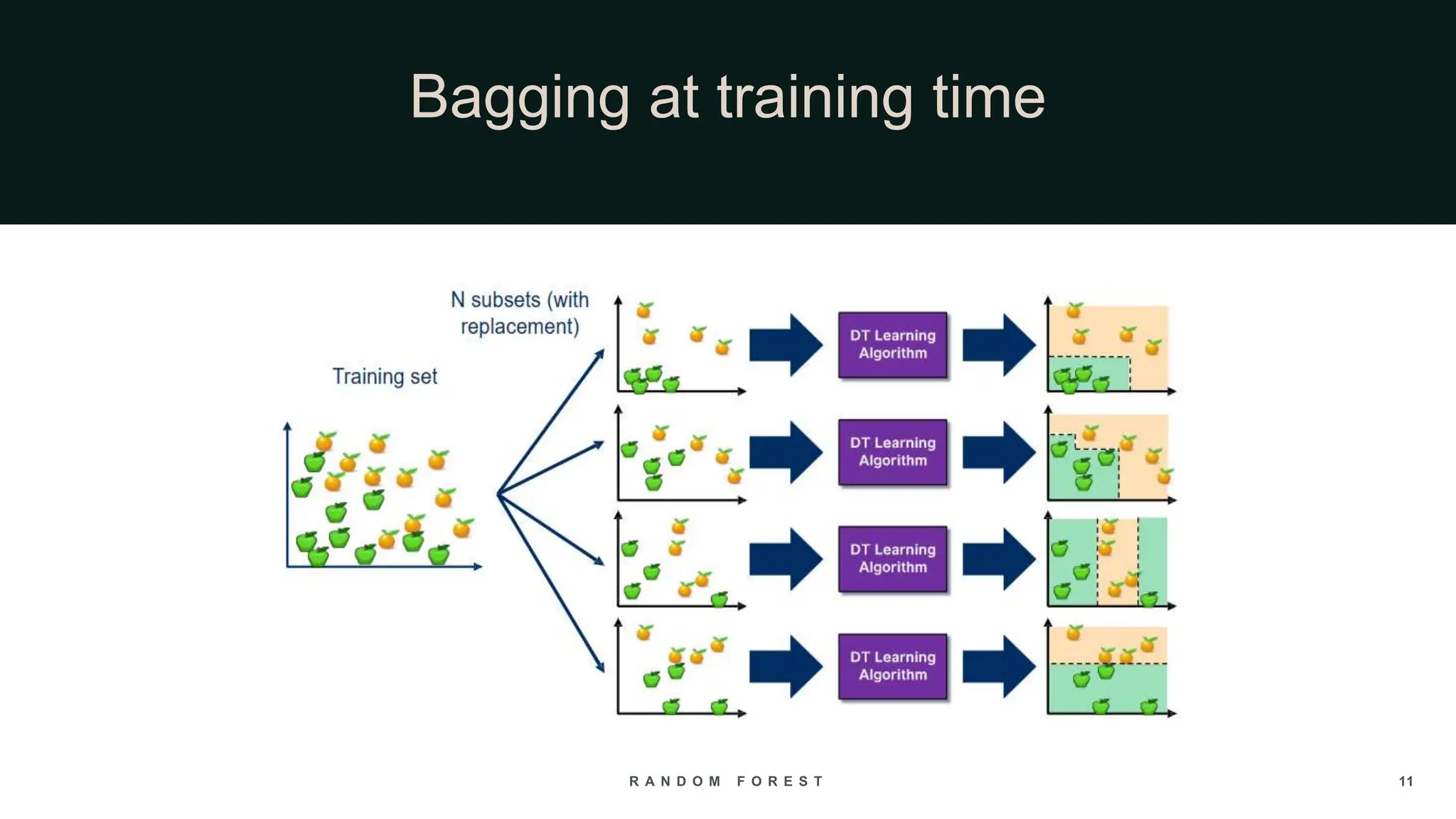
• Bagging At Training Time
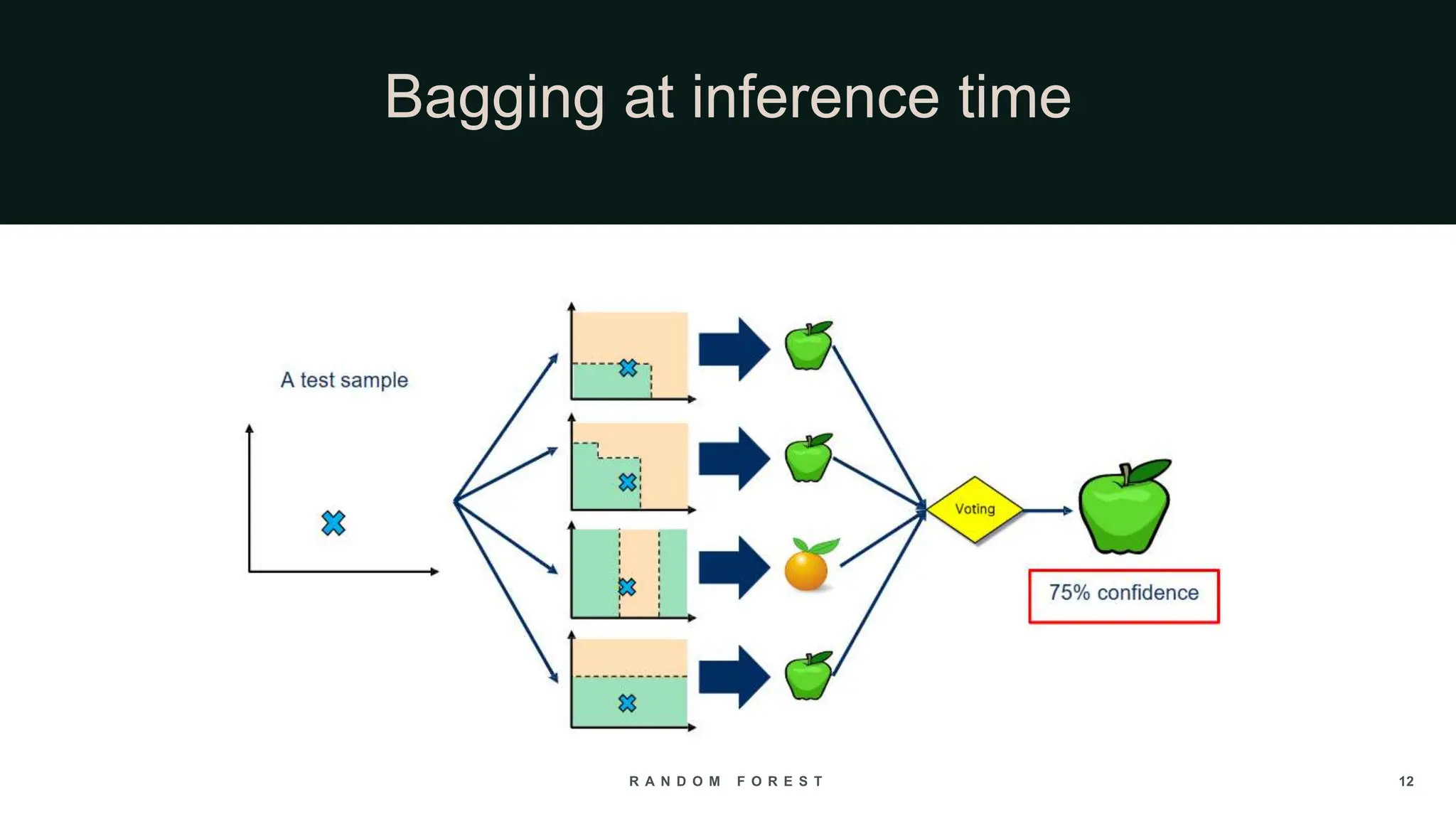
• Bagging At Inference Time
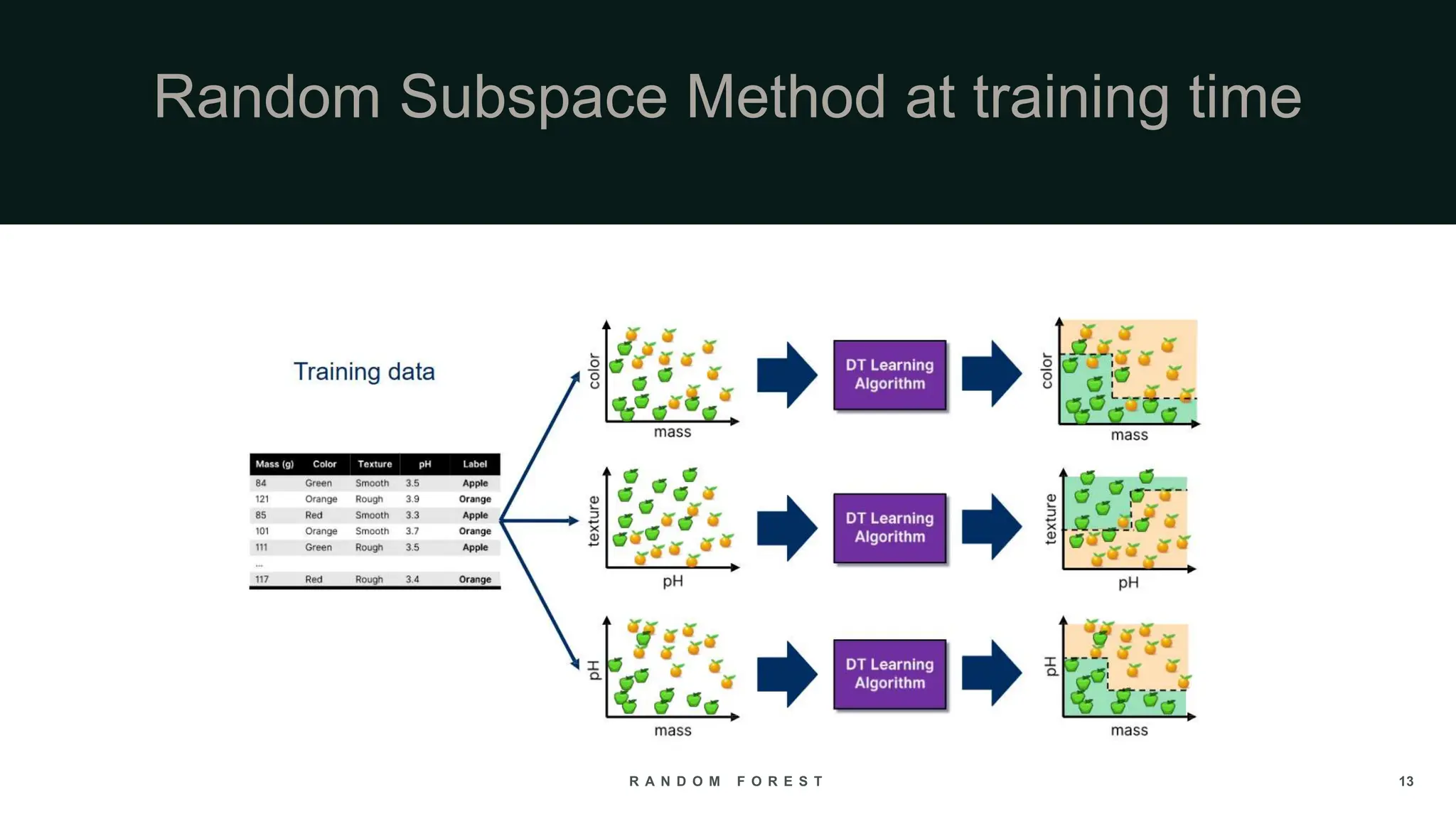
• Random Subspace Method At Training Time
• Random Subspace Method At Inference Time
• Definition
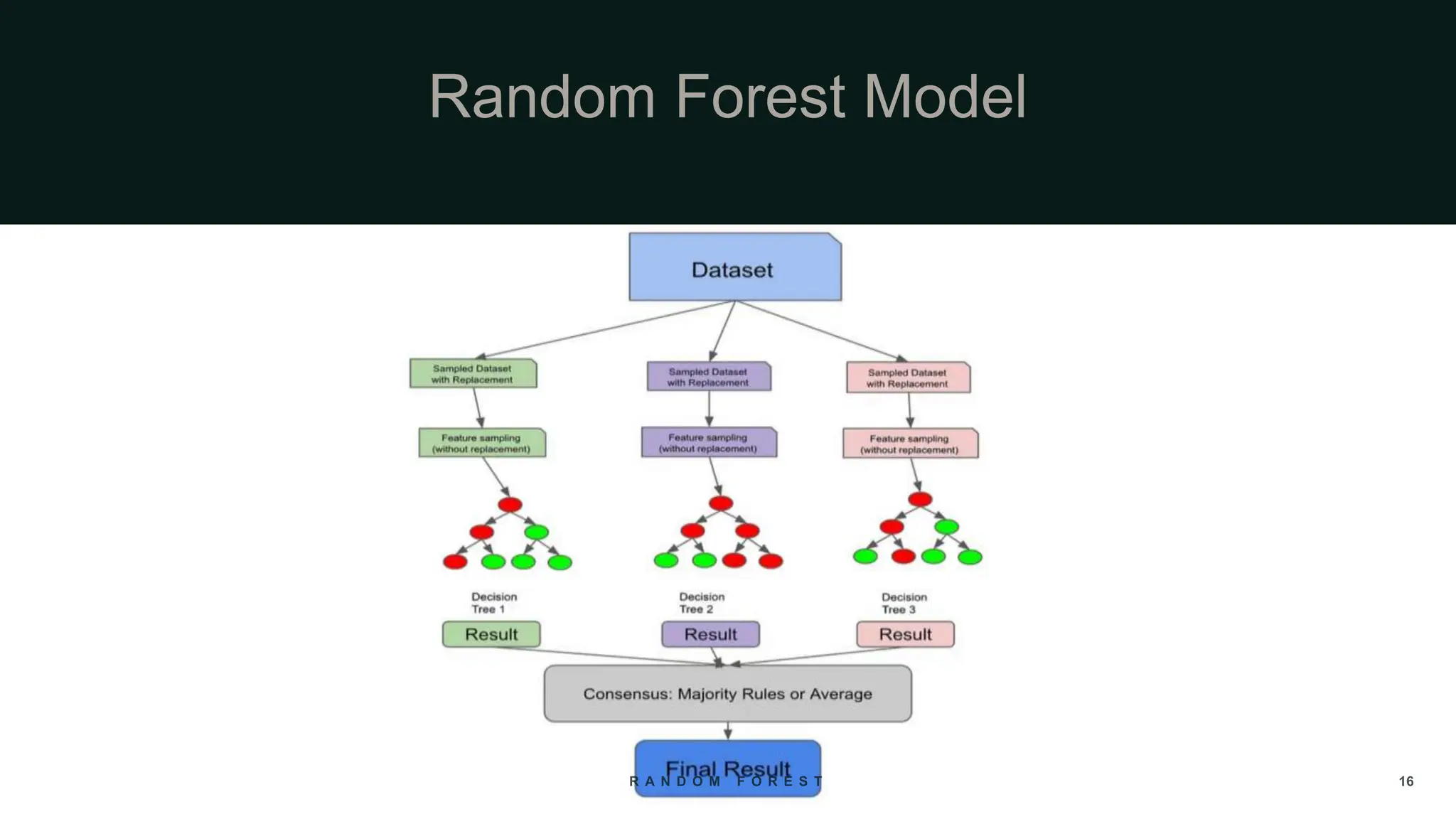
• Random Forest Model
• Why Use Random Forest Model
• Advantages & Disadvantages
• Random Forest Application
R A N D O M F O R E S T 2
Introduction
• A random Forest Algorithm is a supervised machine learning Algorithm consisting
decision trees.
• The general method of random decision forests was first proposed by Ho in 1995.
After that, It was developed by Leo Breiman in 2001.
What Is Supervised Learning:
1. Supervised learning is the type of machine learning in which machines are trained using
labeled training data.
2. On the basis of that data, machines predict the output.
3. The labeled data means some input data is already tagged with the correct output.
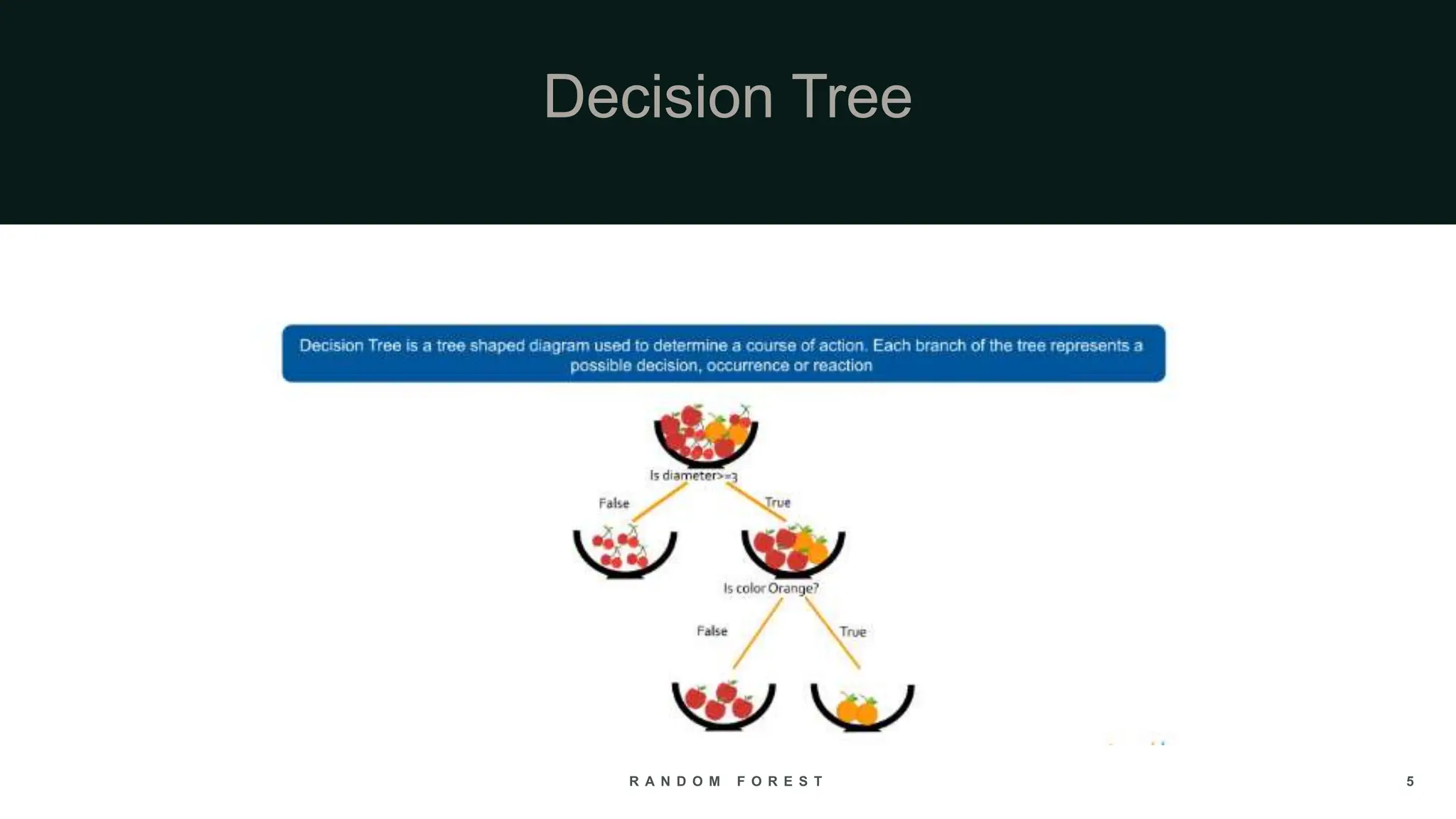
How Decision Tree Works
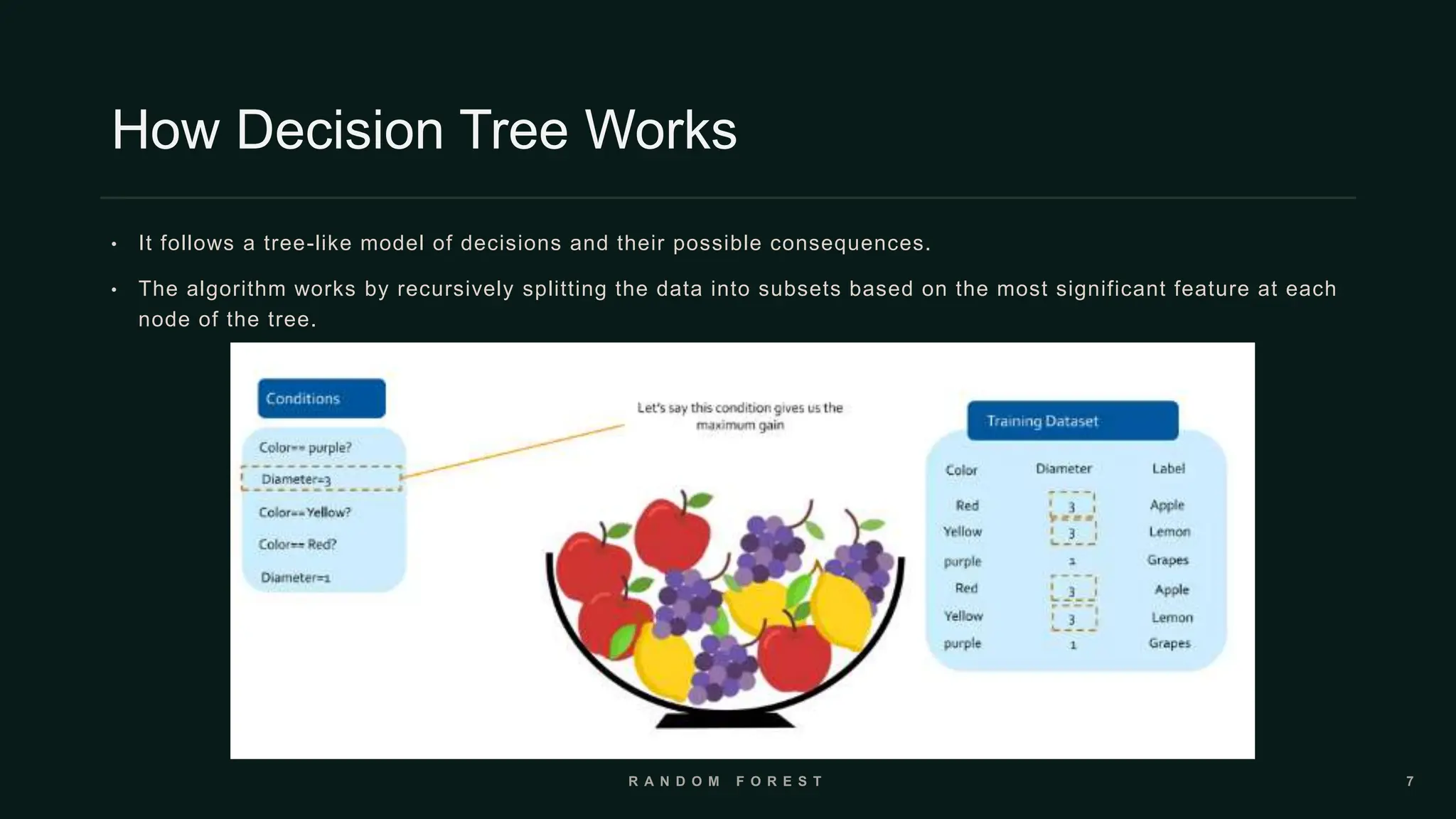
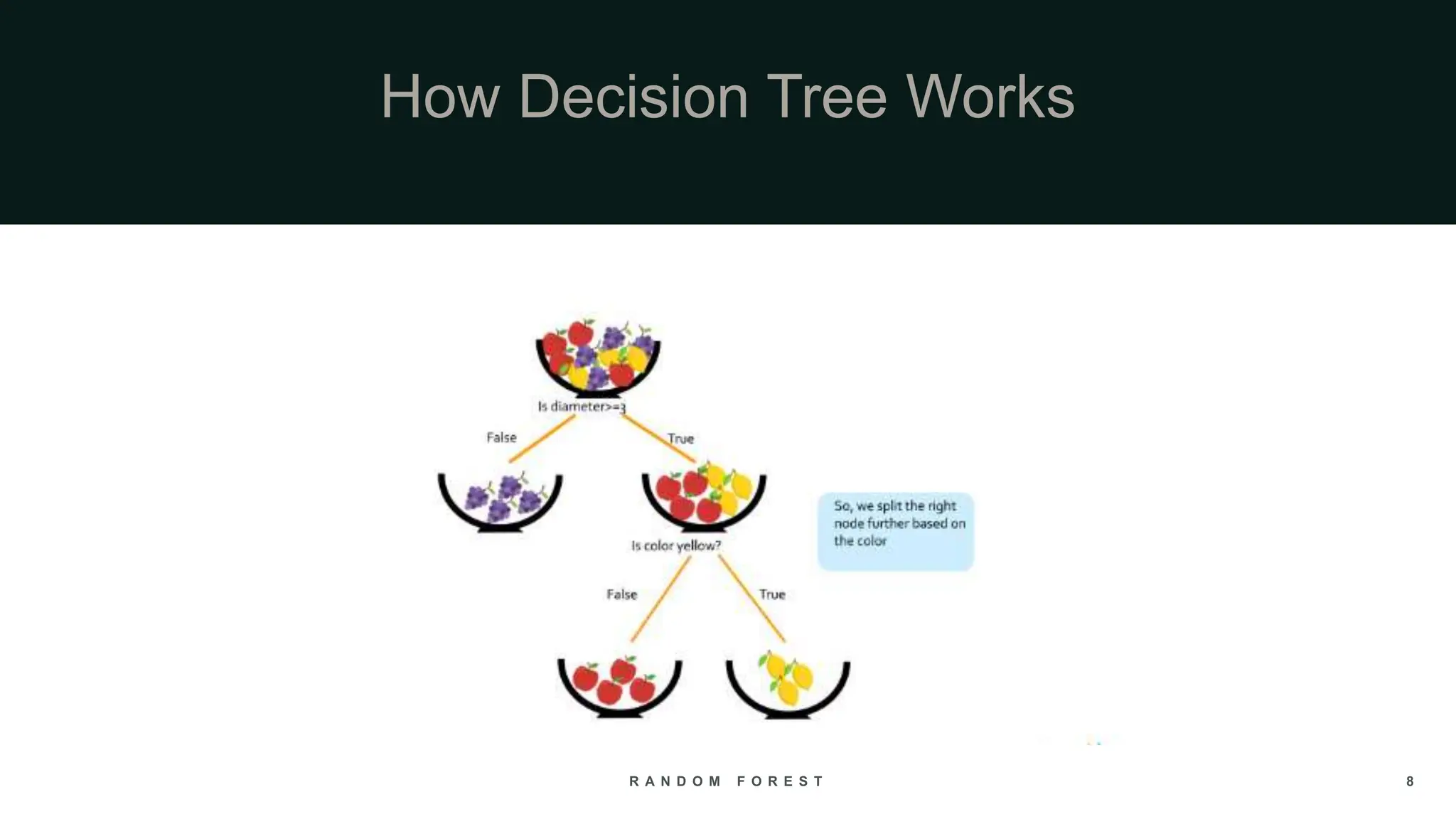
• It follows a tree-like model of decisions and their possible consequences.
• The algorithm works by recursively splitting the data into subsets based on the most significant feature at each
node of the tree.
Ensemble Learning
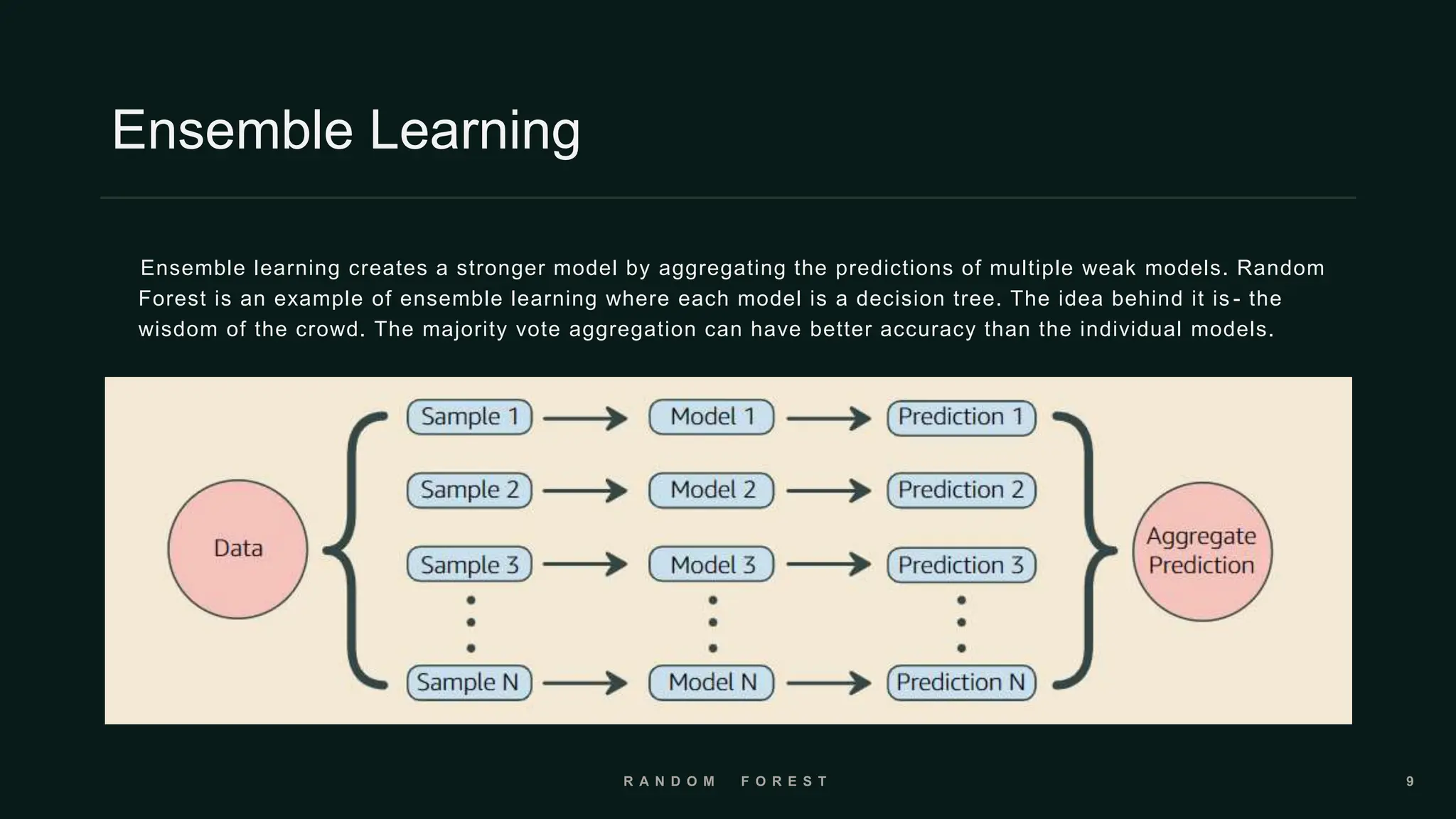
Ensemble learning creates a stronger model by aggregating the predictions of multiple weak models. Random
Forest is an example of ensemble learning where each model is a decision tree. The idea behind it is - the
wisdom of the crowd. The majority vote aggregation can have better accuracy than the individual models.
Dataset
Preparation
Bootstrap Aggregating (Bagging)
Out Of Bag (OOB)
Random Subspace Method(Feature Bagging)
Bagging at training time​
Bagging at inference time
Definition
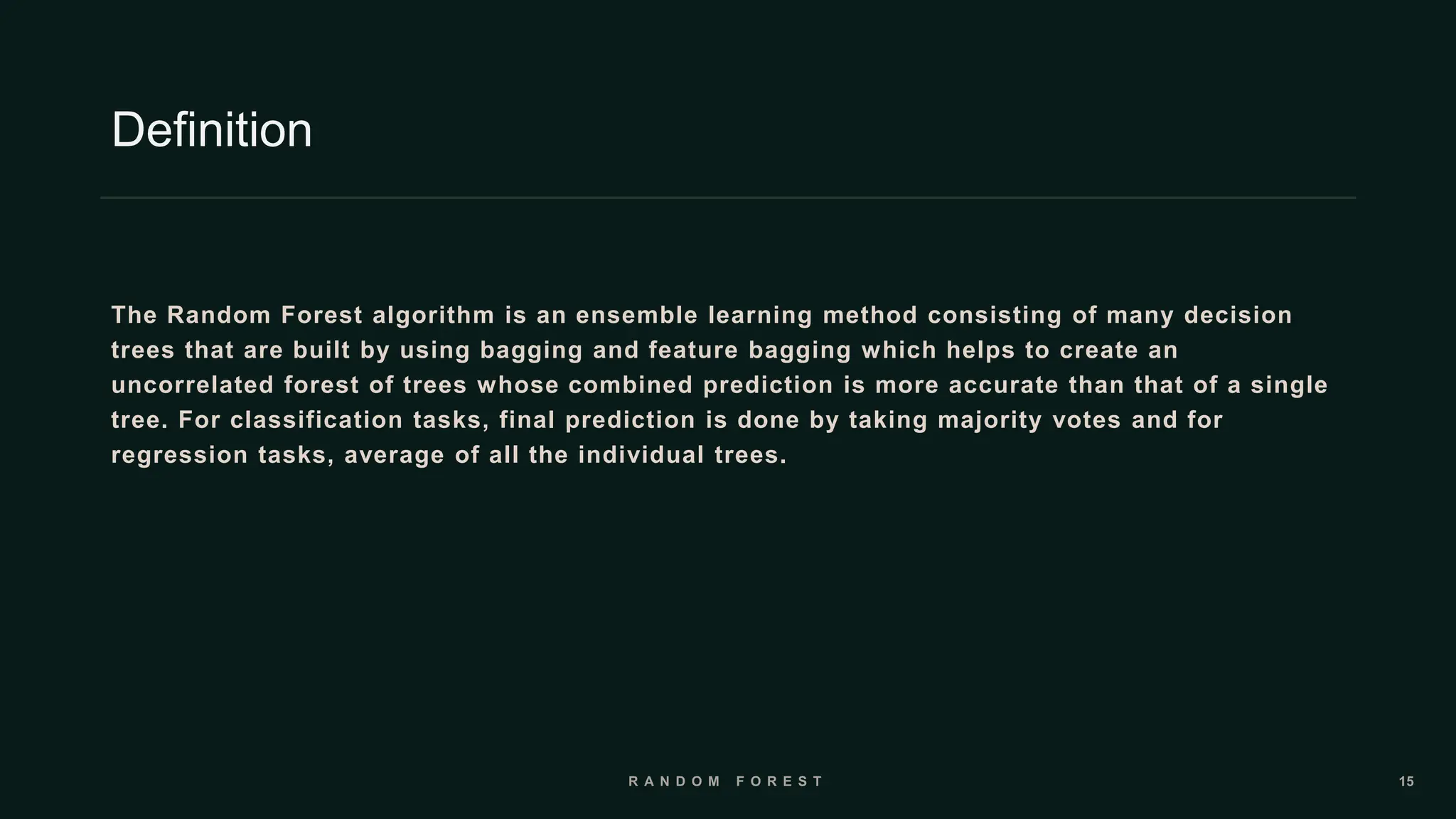
The Random Forest algorithm is an ensemble learning method consisting of many decision
trees that are built by using bagging and feature bagging which helps to create an
uncorrelated forest of trees whose combined prediction is more accurate than that of a single
tree. For classification tasks, final prediction is done by taking majority votes and for
regression tasks, average of all the individual trees.
Why Use Random Forest
 Random forests are an effective tool in prediction.
 Forests give results competitive with boosting and adaptive bagging, yet do not
progressively change the training set.
 Random inputs and random features produce good results in classification- less so in
regression.
 For larger data sets, we can gain accuracy by combining random features with boosting.
Advantages
 Versatile uses
 Easy-to-understand hyperparameters
 Classifier doesn't overfit with enough
trees
Disadvantages
 Increased accuracy requires more trees
 More trees slow down model
 Can’t describe relationships within data
Advantages and Disadvantages
Random Forest Applications
 Detects reliable debtors and potential fraudsters in finance
 Verifies medicine components and patient data in healthcare
 Gauges whether customers will like products in e-commerce
• https://www.simplilearn.com/tutorials/machine-learning-tutorial/random-forest-algorithm#GoTop
• https://en.wikipedia.org/wiki/Bootstrap_aggregating
• https://en.wikipedia.org/wiki/Random_subspace_method
• https://en.wikipedia.org/wiki/Random_forest
• https://mlu-explain.github.io/random-forest/
• https://docs.google.com/presentation/d/1Yu479Jz31rKr-I9dRI6YO_8xcd6bRvKpU_B9sg9ozvY/edit#slide=id.p16
• https://developers.google.com/machine-learning/decision-forests/random-forests
• https://towardsdatascience.com/demystifying-the-random-forest-8a46f4fd416f
• https://www.ibm.com/topics/random-forest
• https://www.analyticsvidhya.com/blog/2021/06/understanding-random-forest/

Random Forest

  • 1.
  • 2.
    Agenda • What IsRandom Forest And History • What is Supervised Learning • What Is Decision Tree • Decision Tree Important Terms • How Does Decision Tree Works • Ensemble Learning • Dataset Preparation • Bagging At Training Time • Bagging At Inference Time • Random Subspace Method At Training Time • Random Subspace Method At Inference Time • Definition • Random Forest Model • Why Use Random Forest Model • Advantages & Disadvantages • Random Forest Application R A N D O M F O R E S T 2
  • 3.
    Introduction • A randomForest Algorithm is a supervised machine learning Algorithm consisting decision trees. • The general method of random decision forests was first proposed by Ho in 1995. After that, It was developed by Leo Breiman in 2001.
  • 4.
    What Is SupervisedLearning: 1. Supervised learning is the type of machine learning in which machines are trained using labeled training data. 2. On the basis of that data, machines predict the output. 3. The labeled data means some input data is already tagged with the correct output.
  • 7.
    How Decision TreeWorks • It follows a tree-like model of decisions and their possible consequences. • The algorithm works by recursively splitting the data into subsets based on the most significant feature at each node of the tree.
  • 9.
    Ensemble Learning Ensemble learningcreates a stronger model by aggregating the predictions of multiple weak models. Random Forest is an example of ensemble learning where each model is a decision tree. The idea behind it is - the wisdom of the crowd. The majority vote aggregation can have better accuracy than the individual models.
  • 10.
    Dataset Preparation Bootstrap Aggregating (Bagging) OutOf Bag (OOB) Random Subspace Method(Feature Bagging)
  • 11.
  • 12.
  • 15.
    Definition The Random Forestalgorithm is an ensemble learning method consisting of many decision trees that are built by using bagging and feature bagging which helps to create an uncorrelated forest of trees whose combined prediction is more accurate than that of a single tree. For classification tasks, final prediction is done by taking majority votes and for regression tasks, average of all the individual trees.
  • 17.
    Why Use RandomForest  Random forests are an effective tool in prediction.  Forests give results competitive with boosting and adaptive bagging, yet do not progressively change the training set.  Random inputs and random features produce good results in classification- less so in regression.  For larger data sets, we can gain accuracy by combining random features with boosting.
  • 18.
    Advantages  Versatile uses Easy-to-understand hyperparameters  Classifier doesn't overfit with enough trees Disadvantages  Increased accuracy requires more trees  More trees slow down model  Can’t describe relationships within data Advantages and Disadvantages
  • 19.
    Random Forest Applications Detects reliable debtors and potential fraudsters in finance  Verifies medicine components and patient data in healthcare  Gauges whether customers will like products in e-commerce
  • 21.
    • https://www.simplilearn.com/tutorials/machine-learning-tutorial/random-forest-algorithm#GoTop • https://en.wikipedia.org/wiki/Bootstrap_aggregating •https://en.wikipedia.org/wiki/Random_subspace_method • https://en.wikipedia.org/wiki/Random_forest • https://mlu-explain.github.io/random-forest/ • https://docs.google.com/presentation/d/1Yu479Jz31rKr-I9dRI6YO_8xcd6bRvKpU_B9sg9ozvY/edit#slide=id.p16 • https://developers.google.com/machine-learning/decision-forests/random-forests • https://towardsdatascience.com/demystifying-the-random-forest-8a46f4fd416f • https://www.ibm.com/topics/random-forest • https://www.analyticsvidhya.com/blog/2021/06/understanding-random-forest/