

Groap 2
Outline
• Definition.
• Causes.
• Types.
• Pulpitis - Histopathology.
• References.
Definition
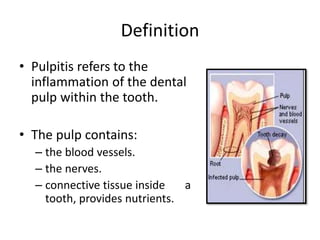
• Pulpitis refers to the
inflammation of the dental
pulp within the tooth.
• The pulp contains:
– the blood vessels.
– the nerves.
– connective tissue inside a
tooth, provides nutrients.
Causes
Inflammation of the dental pulp, usually due
to:
 Bacterial infection in dental caries.
 Tooth fracture.
 Chemical irritants.
 Thermal factors.
 Traumatic exposure.
Any condition that cause exposure of the
tooth pulp.
Types
Once the pulp has become inflamed the tooth
can be diagnostically divided into two
categories:
1. Reversible pulpitis.
2. Irreversible pulpitis.
A. Pulp Necrosis.
B. Acute Pulpitis.
C. Chronic inflammation
Reversible Pulpitis (pulp hyperemia).
• A common condition affecting a tooth
accompanied by short-lived pain following
application of heat or cold; the pulp usually
recovers.
• It does not have to be treated as it will heal on
its own over time.
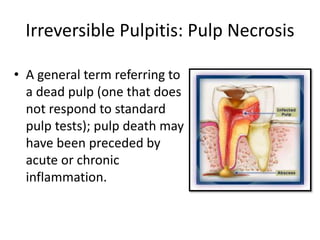
Irreversible Pulpitis: Pulp Necrosis
• A general term referring to
a dead pulp (one that does
not respond to standard
pulp tests); pulp death may
have been preceded by
acute or chronic
inflammation.
Irreversible Pulpitis: Acute Pulpitis
• A common condition affecting a tooth
accompanied by severe, relentless pain; the
acute inflammation associated with it
invariably causes pulp death requiring pulp
extirpation or extraction.
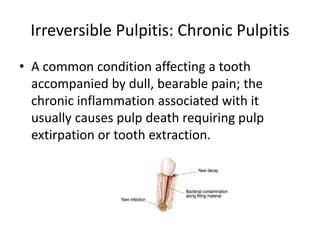
Irreversible Pulpitis: Chronic Pulpitis
• A common condition affecting a tooth
accompanied by dull, bearable pain; the
chronic inflammation associated with it
usually causes pulp death requiring pulp
extirpation or tooth extraction.
Symptoms and Signs
Acute pulpitis is usually associated
with:
 severe tooth pain.
The tooth becomes sensitive to hot or
cold foots and pressure, such as might
occur with chewing.
Acute reversible: sensitive to cold.
Acute irreversible: sensitive to hot &
cold.
Swelling.
Pulpitis - Histopathology
Poor correlation between microscopic changes & clinical
symptoms.
Inflammatory process may be modified by several factors :
1 : Nature, severity and duration of insult.
2 : Efficiency of host defenses.
3 : Efficiency of pulpo-dentinal complex defenses.
4 : Special anatomy of pulp: surrounded by hard tissue and
cannot tolerate edema.
Pulpitis - Histopathology
• Immune reactions in inflamed tissue may
contribute to tissue damage.
• Rate of progression of pulpitis is variable, but
end result of untreated pulpitis is total
necrosis except in the case of pulp polyp
formation.
Closed pulpitis:
whether acute or chronic, may
progress to necrosis due to limited
ability of pulp to withstand
inflammatory edema since it is
surrounded by hard tissues.
Closed pulpitis (general feature) :
• First type  Acute closed pulpitis :
- Initiation of hyperaemia.
- Infiltration by inflammatory cells & destruction of adjacent
odonoblast.
- Formation of a little abscess.
- Pulp is obliterated by dilated BV & acute inflammatory cells.
• Second type  Chronic closed pulpitis :
- main feature are a predominantly mononuclear cells.
- More vigorous connective tissue reaction.
- Small necrosis area + pus formation (granulation tissue)
- little abscess may form.
Open pulpitis or chronic hyperplastic
pulpitis (pulp polyp):
• Pulp is survive but large carious cavities.
• Young molar teeth with wide apices and good
blood supply.
• Usually devoid of sensation on gentle probing.
• Polyp consists of chronically inflamed
hyperplastic granulation tissue protruding from
pulp cavity.
Open pulpitis or chronic hyperplastic
pulpitis (pulp polyp):
• May become epithelialized by spontaneous
grafting of desquamated oral epithelial cells
from saliva.
• Histologically, odontoblasts survive & the pulp
is replaced by granulation tissue.
Treatment
 1-Drilling and filling for reversible pulpitis
 2-Root canal and crown for irreversible pulpitis
 3-or extraction
Causes of endodontic treatment failure:
 Presence of infected and necrotic pulp tissue in root
canal. (main cause)
 Over or incompletely filled teeth
 Excessive hemorrhage
 Chemical irritants (Hypersensitivity to the materials
used)
References
• Burket's Oral Medicine:
Diagnosis and Treatment.
• www.medicinenet.com
• www.ada.org
• Regazi , Oral Pathology.
• Mosby, Dental drug reference.
Pulpitis OD

Pulpitis OD

  • 1.
  • 2.
    Outline • Definition. • Causes. •Types. • Pulpitis - Histopathology. • References.
  • 3.
    Definition • Pulpitis refersto the inflammation of the dental pulp within the tooth. • The pulp contains: – the blood vessels. – the nerves. – connective tissue inside a tooth, provides nutrients.
  • 4.
    Causes Inflammation of thedental pulp, usually due to:  Bacterial infection in dental caries.  Tooth fracture.  Chemical irritants.  Thermal factors.  Traumatic exposure. Any condition that cause exposure of the tooth pulp.
  • 5.
    Types Once the pulphas become inflamed the tooth can be diagnostically divided into two categories: 1. Reversible pulpitis. 2. Irreversible pulpitis. A. Pulp Necrosis. B. Acute Pulpitis. C. Chronic inflammation
  • 6.
    Reversible Pulpitis (pulphyperemia). • A common condition affecting a tooth accompanied by short-lived pain following application of heat or cold; the pulp usually recovers. • It does not have to be treated as it will heal on its own over time.
  • 7.
    Irreversible Pulpitis: PulpNecrosis • A general term referring to a dead pulp (one that does not respond to standard pulp tests); pulp death may have been preceded by acute or chronic inflammation.
  • 8.
    Irreversible Pulpitis: AcutePulpitis • A common condition affecting a tooth accompanied by severe, relentless pain; the acute inflammation associated with it invariably causes pulp death requiring pulp extirpation or extraction.
  • 9.
    Irreversible Pulpitis: ChronicPulpitis • A common condition affecting a tooth accompanied by dull, bearable pain; the chronic inflammation associated with it usually causes pulp death requiring pulp extirpation or tooth extraction.
  • 10.
    Symptoms and Signs Acutepulpitis is usually associated with:  severe tooth pain. The tooth becomes sensitive to hot or cold foots and pressure, such as might occur with chewing. Acute reversible: sensitive to cold. Acute irreversible: sensitive to hot & cold. Swelling.
  • 11.
    Pulpitis - Histopathology Poorcorrelation between microscopic changes & clinical symptoms. Inflammatory process may be modified by several factors : 1 : Nature, severity and duration of insult. 2 : Efficiency of host defenses. 3 : Efficiency of pulpo-dentinal complex defenses. 4 : Special anatomy of pulp: surrounded by hard tissue and cannot tolerate edema.
  • 12.
    Pulpitis - Histopathology •Immune reactions in inflamed tissue may contribute to tissue damage. • Rate of progression of pulpitis is variable, but end result of untreated pulpitis is total necrosis except in the case of pulp polyp formation.
  • 13.
    Closed pulpitis: whether acuteor chronic, may progress to necrosis due to limited ability of pulp to withstand inflammatory edema since it is surrounded by hard tissues.
  • 14.
    Closed pulpitis (generalfeature) : • First type Acute closed pulpitis : - Initiation of hyperaemia. - Infiltration by inflammatory cells & destruction of adjacent odonoblast. - Formation of a little abscess. - Pulp is obliterated by dilated BV & acute inflammatory cells. • Second type Chronic closed pulpitis : - main feature are a predominantly mononuclear cells. - More vigorous connective tissue reaction. - Small necrosis area + pus formation (granulation tissue) - little abscess may form.
  • 15.
    Open pulpitis orchronic hyperplastic pulpitis (pulp polyp): • Pulp is survive but large carious cavities. • Young molar teeth with wide apices and good blood supply. • Usually devoid of sensation on gentle probing. • Polyp consists of chronically inflamed hyperplastic granulation tissue protruding from pulp cavity.
  • 16.
    Open pulpitis orchronic hyperplastic pulpitis (pulp polyp): • May become epithelialized by spontaneous grafting of desquamated oral epithelial cells from saliva. • Histologically, odontoblasts survive & the pulp is replaced by granulation tissue.
  • 17.
    Treatment  1-Drilling andfilling for reversible pulpitis  2-Root canal and crown for irreversible pulpitis  3-or extraction Causes of endodontic treatment failure:  Presence of infected and necrotic pulp tissue in root canal. (main cause)  Over or incompletely filled teeth  Excessive hemorrhage  Chemical irritants (Hypersensitivity to the materials used)
  • 19.
    References • Burket's OralMedicine: Diagnosis and Treatment. • www.medicinenet.com • www.ada.org • Regazi , Oral Pathology. • Mosby, Dental drug reference.