
Disease of Pulp
Saowanee Maipanich
57090201
Etiology
External stimuli
Mechanical
damage
Thermal
stimuli
Chemical
irritation
Bacterial
effect
Vasodilation Increase
blood flow
Vascular
leakage
Noxious levelNoxious levelNoxious level
Removed cause
Return to
normal pulp Irreversible
Pulpitis
Pulp
necrosis
Persistent
noxious stimuli
External stimuli
• Mechanical damage
– Trauma from accident
– Iatrogenic
– Tooth brushed, abrasive agent
• Thermal stimuli
– Heat, cold
• Chemical irritation
– Sweet, sour food
– Acid agent in dental used
• Bacterial effect
– Bacterial cause dental caries and periodontal disease
Classification of pulp disease
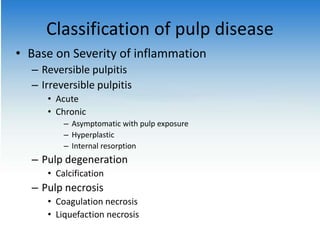
• Base on Severity of inflammation
– Reversible pulpitis
– Irreversible pulpitis
• Acute
• Chronic
– Asymptomatic with pulp exposure
– Hyperplastic
– Internal resorption
– Pulp degeneration
• Calcification
– Pulp necrosis
• Coagulation necrosis
• Liquefaction necrosis
Classification of pulp disease
• According to involvement
– Focal or Subtotal or Partial pulpitis
– Total or Generalized pulpitis
• According to severity
– Acute
– Chronic
• According to presence or absence of direct
communication between dental pulp and oral
environment
– Pulpitis Aperts (Open pulpitis)
– Pulpitis Clausa (Closed pulpitis)
Classification of pulp disease
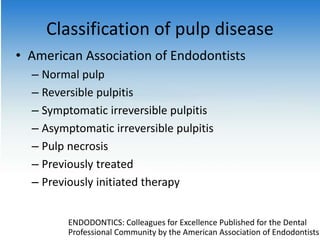
• American Association of Endodontists
– Normal pulp
– Reversible pulpitis
– Symptomatic irreversible pulpitis
– Asymptomatic irreversible pulpitis
– Pulp necrosis
– Previously treated
– Previously initiated therapy
ENDODONTICS: Colleagues for Excellence Published for the Dental
Professional Community by the American Association of Endodontists
Normal Pulp
Reversible pulpitis
Reversible pulpitis
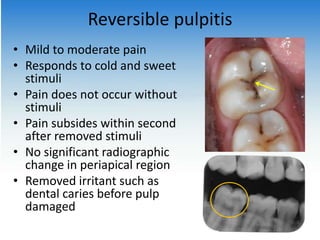
• Mild to moderate pain
• Responds to cold and sweet
stimuli
• Pain does not occur without
stimuli
• Pain subsides within second
after removed stimuli
• No significant radiographic
change in periapical region
• Removed irritant such as
dental caries before pulp
damaged
Reversible pulpitis
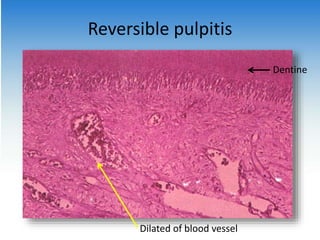
Dentine
Dilated of blood vessel
Irreversible pulpitis
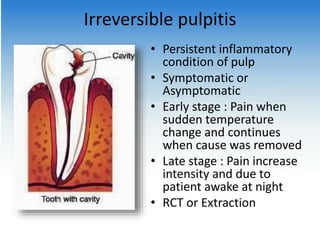
• Persistent inflammatory
condition of pulp
• Symptomatic or
Asymptomatic
• Early stage : Pain when
sudden temperature
change and continues
when cause was removed
• Late stage : Pain increase
intensity and due to
patient awake at night
• RCT or Extraction
Symptomatic
irreversible pulpitis
Asymptomatic
irreversible pulpitis
Extensive
restoration
Tooth fracture exposed
pulp
Has clinical symptoms No clinical symptoms
Deep caries may be exposed
pulp or exposed pulp
Subjective finding
Sensitive to thermal
change
Persistent response
to Hot & cold stimuli
Severe lancinating
or throbbing pain if
intrapulpal abscess
formation
Increase
sensitivity to pulp
vitality test
Not tender to
percussion unless
inflammation
spread to
periapical region
Objective finding
Mild intermittent pain
Response to thermal stimuli
Reduced response to pulp
vitality test
Irreversible pulpitis
Intrapulpal
abscess
Irreversible pulpitis
Black arrow : Acute inflammatory infiltrate
of polymorphonuclear leukocytes
Dentine
Irreversible pulpitis Dentine
FibrosisChronic inflammatory
cell infiltration
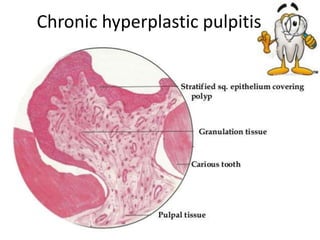
Chronic hyperplastic pulpitis
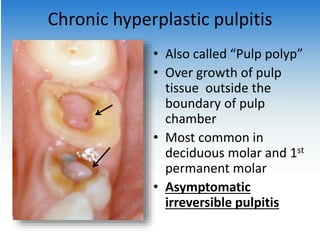
• Also called “Pulp polyp”
• Over growth of pulp
tissue outside the
boundary of pulp
chamber
• Most common in
deciduous molar and 1st
permanent molar
• Asymptomatic
irreversible pulpitis
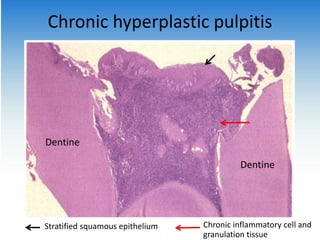
Chronic hyperplastic pulpitis
Dentine
Dentine
Stratified squamous epithelium Chronic inflammatory cell and
granulation tissue
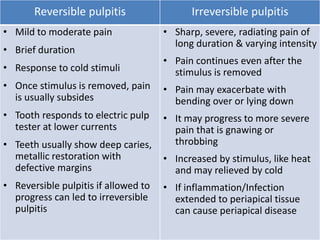
Reversible pulpitis Irreversible pulpitis
• Mild to moderate pain
• Brief duration
• Response to cold stimuli
• Once stimulus is removed, pain
is usually subsides
• Tooth responds to electric pulp
tester at lower currents
• Teeth usually show deep caries,
metallic restoration with
defective margins
• Reversible pulpitis if allowed to
progress can led to irreversible
pulpitis
• Sharp, severe, radiating pain of
long duration & varying intensity
• Pain continues even after the
stimulus is removed
• Pain may exacerbate with
bending over or lying down
• It may progress to more severe
pain that is gnawing or
throbbing
• Increased by stimulus, like heat
and may relieved by cold
• If inflammation/Infection
extended to periapical tissue
can cause periapical disease
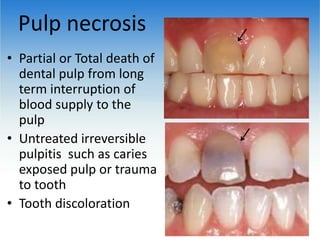
Pulp necrosis
Pulp necrosis
• Partial or Total death of
dental pulp from long
term interruption of
blood supply to the
pulp
• Untreated irreversible
pulpitis such as caries
exposed pulp or trauma
to tooth
• Tooth discoloration
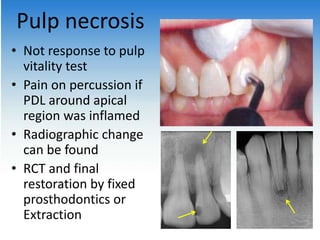
Pulp necrosis
• Not response to pulp
vitality test
• Pain on percussion if
PDL around apical
region was inflamed
• Radiographic change
can be found
• RCT and final
restoration by fixed
prosthodontics or
Extraction
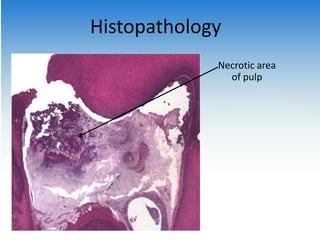
Necrotic area
of pulp
Histopathology
Previously treated
and
Previously initiated therapy
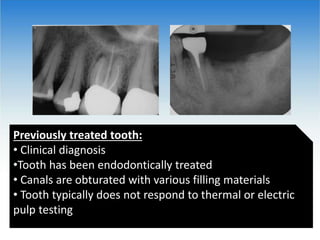
Previously treated tooth:
• Clinical diagnosis
•Tooth has been endodontically treated
• Canals are obturated with various filling materials
• Tooth typically does not respond to thermal or electric
pulp testing
Previously Initiated Therapy
• Clinical diagnostic
• Tooth has been previously treated by partial endodontic
therapy such as pulpotomy or pulpectomy
• Degree of response to pulp testing depending on the level
of therapy, the tooth may or may not respond
• History taking is the most important for diagnosis
Reference
• ENDODONTICS: Colleagues for Excellence
Published for the Dental Professional Community
by the American Association of Endodontists
• Neville BW, Damm DD, Allen CM, and Bouquot
JE., Oral and Maxillofacial Pathology, 3rd edition.
Saunders: Philadelphia, 2009
• Sapp JP et al. (2004) Contemporary oral and
maxillofacial pathology, 2nd edition
• R.A Cawson, Cawson’s Essentials of Oral
Pathology and Oral Medicine,8th Edition, Page 60

Pulp diseases

  • 1.
    Disease of Pulp SaowaneeMaipanich 57090201
  • 2.
  • 3.
    External stimuli Mechanical damage Thermal stimuli Chemical irritation Bacterial effect Vasodilation Increase bloodflow Vascular leakage Noxious levelNoxious levelNoxious level Removed cause Return to normal pulp Irreversible Pulpitis Pulp necrosis Persistent noxious stimuli
  • 4.
    External stimuli • Mechanicaldamage – Trauma from accident – Iatrogenic – Tooth brushed, abrasive agent • Thermal stimuli – Heat, cold • Chemical irritation – Sweet, sour food – Acid agent in dental used • Bacterial effect – Bacterial cause dental caries and periodontal disease
  • 5.
  • 6.
    Classification of pulpdisease • Base on Severity of inflammation – Reversible pulpitis – Irreversible pulpitis • Acute • Chronic – Asymptomatic with pulp exposure – Hyperplastic – Internal resorption – Pulp degeneration • Calcification – Pulp necrosis • Coagulation necrosis • Liquefaction necrosis
  • 7.
    Classification of pulpdisease • According to involvement – Focal or Subtotal or Partial pulpitis – Total or Generalized pulpitis • According to severity – Acute – Chronic • According to presence or absence of direct communication between dental pulp and oral environment – Pulpitis Aperts (Open pulpitis) – Pulpitis Clausa (Closed pulpitis)
  • 8.
    Classification of pulpdisease • American Association of Endodontists – Normal pulp – Reversible pulpitis – Symptomatic irreversible pulpitis – Asymptomatic irreversible pulpitis – Pulp necrosis – Previously treated – Previously initiated therapy ENDODONTICS: Colleagues for Excellence Published for the Dental Professional Community by the American Association of Endodontists
  • 9.
  • 10.
  • 11.
    Reversible pulpitis • Mildto moderate pain • Responds to cold and sweet stimuli • Pain does not occur without stimuli • Pain subsides within second after removed stimuli • No significant radiographic change in periapical region • Removed irritant such as dental caries before pulp damaged
  • 12.
  • 13.
  • 14.
    Irreversible pulpitis • Persistentinflammatory condition of pulp • Symptomatic or Asymptomatic • Early stage : Pain when sudden temperature change and continues when cause was removed • Late stage : Pain increase intensity and due to patient awake at night • RCT or Extraction
  • 15.
    Symptomatic irreversible pulpitis Asymptomatic irreversible pulpitis Extensive restoration Toothfracture exposed pulp Has clinical symptoms No clinical symptoms Deep caries may be exposed pulp or exposed pulp Subjective finding Sensitive to thermal change Persistent response to Hot & cold stimuli Severe lancinating or throbbing pain if intrapulpal abscess formation Increase sensitivity to pulp vitality test Not tender to percussion unless inflammation spread to periapical region Objective finding Mild intermittent pain Response to thermal stimuli Reduced response to pulp vitality test
  • 16.
  • 17.
    Irreversible pulpitis Black arrow: Acute inflammatory infiltrate of polymorphonuclear leukocytes Dentine
  • 18.
    Irreversible pulpitis Dentine FibrosisChronicinflammatory cell infiltration
  • 19.
    Chronic hyperplastic pulpitis •Also called “Pulp polyp” • Over growth of pulp tissue outside the boundary of pulp chamber • Most common in deciduous molar and 1st permanent molar • Asymptomatic irreversible pulpitis
  • 20.
  • 21.
    Chronic hyperplastic pulpitis Dentine Dentine Stratifiedsquamous epithelium Chronic inflammatory cell and granulation tissue
  • 22.
    Reversible pulpitis Irreversiblepulpitis • Mild to moderate pain • Brief duration • Response to cold stimuli • Once stimulus is removed, pain is usually subsides • Tooth responds to electric pulp tester at lower currents • Teeth usually show deep caries, metallic restoration with defective margins • Reversible pulpitis if allowed to progress can led to irreversible pulpitis • Sharp, severe, radiating pain of long duration & varying intensity • Pain continues even after the stimulus is removed • Pain may exacerbate with bending over or lying down • It may progress to more severe pain that is gnawing or throbbing • Increased by stimulus, like heat and may relieved by cold • If inflammation/Infection extended to periapical tissue can cause periapical disease
  • 23.
  • 24.
    Pulp necrosis • Partialor Total death of dental pulp from long term interruption of blood supply to the pulp • Untreated irreversible pulpitis such as caries exposed pulp or trauma to tooth • Tooth discoloration
  • 25.
    Pulp necrosis • Notresponse to pulp vitality test • Pain on percussion if PDL around apical region was inflamed • Radiographic change can be found • RCT and final restoration by fixed prosthodontics or Extraction
  • 26.
  • 27.
  • 28.
    Previously treated tooth: •Clinical diagnosis •Tooth has been endodontically treated • Canals are obturated with various filling materials • Tooth typically does not respond to thermal or electric pulp testing
  • 29.
    Previously Initiated Therapy •Clinical diagnostic • Tooth has been previously treated by partial endodontic therapy such as pulpotomy or pulpectomy • Degree of response to pulp testing depending on the level of therapy, the tooth may or may not respond • History taking is the most important for diagnosis
  • 30.
    Reference • ENDODONTICS: Colleaguesfor Excellence Published for the Dental Professional Community by the American Association of Endodontists • Neville BW, Damm DD, Allen CM, and Bouquot JE., Oral and Maxillofacial Pathology, 3rd edition. Saunders: Philadelphia, 2009 • Sapp JP et al. (2004) Contemporary oral and maxillofacial pathology, 2nd edition • R.A Cawson, Cawson’s Essentials of Oral Pathology and Oral Medicine,8th Edition, Page 60

Editor's Notes

  • #4 เมื่อมีสิ่งกระตุ้นที่รุนแรงหรือกระตุ้นซ้ำๆเป็นเวลานานแล้วทำให้โพรงประสาทฟันเกิดการบาดเจ็บ โดยสิ่งกระตุ้นนั้นแบ่งเป็นสี่ประเภทใหญ่ๆคือ Mechanical damage เช่น Traumatic accident, Iatrogenic, Mechanical force irritation ( Attrition, Abrasion ) Thermal injury เช่น ความร้อนจากการกรอฟัน, วัสดุอุดฟันที่เป็นโลหะใหญ่ๆ Chemical irritation เช่น ของเปรี้ยว, ของหวาน, กรดที่ใช้ในทางทันตกรรม Bacterial effect เช่น toxin ของ bacteria เหล่านี้ทำให้เกิดการตอบสนองของโพรงประสาทฟันต่อสิ่งกระตุ้น คือ มีการกระตุ้น mast cell ให้หลั่ง cytokine เช่น histamine, bradykinin ทำให้เกิดการตอบสนองคือเกิด vasodilation, increase blood flow, มี vascular leakage ทำให้เกิด edema หากกำจัดสาเหตุออก ร่างกายจะมีการตอบสนองโดยการหายทำให้เนื้อเยื่อโพรงประสาทฟันกลับสู่ภาวะปกติได้ แต่หากสิ่งกระตุ้นยังคงกระตุ้นต่อไปจะทำให้เกิด injury และนำไปสู่การตายของ pulp Increase fluid pressure Increase interstitial pressure บริเวณที่มีการอักเสบทำให้เกิด Increase flow of fluid back into capillary and increase drainage
  • #12 Reversible Pulpitis is based upon subjective and objective findings indicating that the inflammation should resolve and the pulp return to normal following appropriate management of the etiology. Discomfort is experienced when a stimulus such as cold or sweet is applied and goes away within a couple of seconds following the removal of the stimulus. Typical etiologies may include exposed dentin (dentinal sensitivity), caries or deep restorations. There are no significant radiographic changes in the periapical region of the suspect tooth and the pain experienced is not spontaneous. Following the management of the etiology (e.g. caries removal plus restoration; covering the exposed dentin), the tooth requires further evaluation to determine whether the “reversible pulpitis” has returned to a normal status. Although dentinal sensitivity per se is not an inflammatory process, all of the symptoms of this entity mimic those of a reversible pulpitis
  • #13 Dental pulp exhibiting hyperemia and edema. The adjacent dentin was cut recently during placement of dental restoration
  • #16 Symptomatic Irreversible Pulpitis is based on subjective and objective findings that the vital inflamed pulp is incapable of healing and that root canal treatment is indicated. Characteristics may include sharp pain upon thermal stimulus, lingering pain (often 30 seconds or longer after stimulus removal), spontaneity (unprovoked pain) and referred pain. Sometimes the pain may be accentuated by postural changes such as lying down or bending over and over-the-counter analgesics are typically ineffective. Common etiologies may include deep caries, extensive restorations, or fractures exposing the pulpal tissues. Teeth with symptomatic irreversible pulpitis may be difficult to diagnose because the inflammation has not yet reached the periapical tissues, thus resulting in no pain or discomfort to percussion. In such cases, dental history and thermal testing are the primary tools for assessing pulpal status. Asymptomatic Irreversible Pulpitis is a clinical diagnosis based on subjective and objective findings indicating that the vital inflamed pulp is incapable of healing and that root canal treatment is indicated. These cases have no clinical symptoms and usually respond normally to thermal testing but may have had trauma or deep caries that would likely result in exposure following removal.
  • #17 Dental pulp exhibiting acute inflammatory infiltrate consisting predominantly of polymorphonuclear leukocyte
  • #18 Dental pulp exhibiting acute inflammatory infiltrate consisting predominantly of polymorphonuclear leukocyte
  • #19 Dental pulp exhibiting an area of fibrosis and chronic inflammation peripheral to zone of abscess formation
  • #22 Chronic inflammation that produces hyperplastic granulation tissue that extrudes from chamber
  • #25 Pulp Necrosis is a clinical diagnostic category indicating death of the dental pulp, necessitating root canal treatment. The pulp is non-responsive to pulp testing and is asymptomatic. Pulp necrosis by itself does not cause apical periodontitis (pain to percussion or radiographic evidence of osseous breakdown) unless the canal is infected. Some teeth may be nonresponsive to pulp testing because of calcification, recent history of trauma, or simply the tooth is just not responding. As stated previously, this is why all testing must be of a comparative nature (e.g. patient may not respond to thermal testing on any teeth)
  • #29 Previously Treated is a clinical diagnostic category indicating that the tooth has been endodontically treated and the canals are obturated with various filling materials other than intracanal medicaments. The tooth typically does not respond to thermal or electric pulp testing.
  • #30 Previously Initiated Therapy is a clinical diagnostic category indicating that the tooth has been previously treated by partial endodontic therapy such as pulpotomy or pulpectomy. Depending on the level of therapy, the tooth may or may not respond to pulp testing modalities.