

SRI AUROBINDO COLLEGE
OF DENTISTRY
DEPARTMENT OF PEDODONTICS
AND PREVENTIVE DENTISTRY
PEDODONTIC TREATMENT
TRIANGLE
• GUIDED BY : SUBMITTED BY : POOJA PATEL
• DR. BHARATH BHUSHAN SIR BATCH – 2017-18
• DR. KHUSHBOO BARJATYA MA’AM ROLL NO. - 47
• DR. BINTI CHAND MA’AM
• DR. ABHILASHA M. TRIPATHI MA’AM
• DR. PREENE JUNEJA MA’AM
• DR. HARIOM MEENA SIR
CONTENTS
• Introduction
• Objective
• Definition
• Modification
• Variations of pedodontics treatment triangle
• Parental influences on child’s behaviour
• References
INTRODUCTION
• Pediatric triangle is described by DR. GZ Wright in 1975.
• It shows the relationship between child , parent and dentist.
• The first dental visit of a child is always full of anxiety for both the
parents and the child.
• As the pediatric dentist usually relies on the cooperation of the child
for rendering effective treatment.
• The first appointment is very important for establishing rapport and
gaining the trust of the child.
• Behaviour management is an integral part of the pediatric dental
practice.
OBJECTIVES
• To effectively and efficiently perform treatment for the child.
• To instil a positive attitude.
DEFINITION
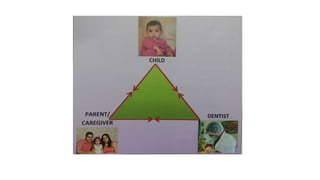
• Child is placed at the apex of triangle.
• Parents and dentist are at the base of triangle.
• Child is at the apex as he/she is the focus of the attention for both the
dentist as well as the parents.
• All these three are interrelated; arrows denote that the communication
is reciprocal.
• It is defined as the triangle which shows the relationship between
dentist ,patient and parent.
MODIFICATIONS
• Modification was given by McDonald in 2004.
• SOCIETY has been added to this treatment triangle as it also has a
strong influence on overall development of the child.
• It came into central of triangle indicating that manage methods
acceptable to society and litigiousness of society are important
factors influencing treatment modalities.
Variations of Pedodontics
Treatment Triangle
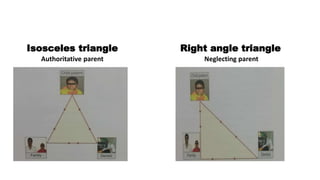
• Isosceles triangle – An authoritative or overindulgent parent always
tries to interfere in the conversation between the dentist and the
child by answering on behalf of the child.
• As a consequences , there is more interaction between parent and
the dentist hence the equilateral triangle is replaced by isosceles
triangle.
• Right angle triangle- on the contrary ,if the parent is negligent , then
the conversation between the parent and the dentist may not be
reciprocal effectively; hence, right angle triangle replaces the normal
equilateral triangle.
Isosceles triangle
Authoritative parent
Right angle triangle
Neglecting parent
PARENTAL INFLUENCES ON CHILD’S
BEHAVIOUR
• Maternal influences is more important because mother - child
relationship is more intimate.
1. Effects of parental attitudes:
(a) Overprotection
(b) Overindulgence
(c) Under affection
(d) Rejection
(e) Authoritarianism
(f) Identification
2. Effects of parental anxiety :
- Children respond with tension and fear primarily because of the
way dental experiences have been described to them.
- The behaviour of child is found to be directly proportional to the
level of maternal anxiety.
- Children of mothers with high anxiety levels exhibit more negative
and uncooperative behaviour.
3. Effects of parent’s presence in operatory
- If the child is uncooperative , parent’s presence may support his/
her behaviour and limit the range of behaviour control techniques
of the dentistry.
-In some cases ,parent’s presence may be desirable i.e.
i) Children of 1-3 years of age.
ii) Children during their first dental visit.
iii) Handicapped children.
REFERENCES
• Shobha Tandon
• S.G. Damle
• Nikhil Marwah
Pedodontic treatment triangle

Pedodontic treatment triangle

  • 1.
    SRI AUROBINDO COLLEGE OFDENTISTRY DEPARTMENT OF PEDODONTICS AND PREVENTIVE DENTISTRY
  • 2.
    PEDODONTIC TREATMENT TRIANGLE • GUIDEDBY : SUBMITTED BY : POOJA PATEL • DR. BHARATH BHUSHAN SIR BATCH – 2017-18 • DR. KHUSHBOO BARJATYA MA’AM ROLL NO. - 47 • DR. BINTI CHAND MA’AM • DR. ABHILASHA M. TRIPATHI MA’AM • DR. PREENE JUNEJA MA’AM • DR. HARIOM MEENA SIR
  • 3.
    CONTENTS • Introduction • Objective •Definition • Modification • Variations of pedodontics treatment triangle • Parental influences on child’s behaviour • References
  • 4.
    INTRODUCTION • Pediatric triangleis described by DR. GZ Wright in 1975. • It shows the relationship between child , parent and dentist. • The first dental visit of a child is always full of anxiety for both the parents and the child. • As the pediatric dentist usually relies on the cooperation of the child for rendering effective treatment. • The first appointment is very important for establishing rapport and gaining the trust of the child. • Behaviour management is an integral part of the pediatric dental practice.
  • 5.
    OBJECTIVES • To effectivelyand efficiently perform treatment for the child. • To instil a positive attitude.
  • 6.
    DEFINITION • Child isplaced at the apex of triangle. • Parents and dentist are at the base of triangle. • Child is at the apex as he/she is the focus of the attention for both the dentist as well as the parents. • All these three are interrelated; arrows denote that the communication is reciprocal. • It is defined as the triangle which shows the relationship between dentist ,patient and parent.
  • 8.
    MODIFICATIONS • Modification wasgiven by McDonald in 2004. • SOCIETY has been added to this treatment triangle as it also has a strong influence on overall development of the child. • It came into central of triangle indicating that manage methods acceptable to society and litigiousness of society are important factors influencing treatment modalities.
  • 10.
    Variations of Pedodontics TreatmentTriangle • Isosceles triangle – An authoritative or overindulgent parent always tries to interfere in the conversation between the dentist and the child by answering on behalf of the child. • As a consequences , there is more interaction between parent and the dentist hence the equilateral triangle is replaced by isosceles triangle. • Right angle triangle- on the contrary ,if the parent is negligent , then the conversation between the parent and the dentist may not be reciprocal effectively; hence, right angle triangle replaces the normal equilateral triangle.
  • 11.
    Isosceles triangle Authoritative parent Rightangle triangle Neglecting parent
  • 12.
    PARENTAL INFLUENCES ONCHILD’S BEHAVIOUR • Maternal influences is more important because mother - child relationship is more intimate. 1. Effects of parental attitudes: (a) Overprotection (b) Overindulgence (c) Under affection (d) Rejection (e) Authoritarianism (f) Identification
  • 13.
    2. Effects ofparental anxiety : - Children respond with tension and fear primarily because of the way dental experiences have been described to them. - The behaviour of child is found to be directly proportional to the level of maternal anxiety. - Children of mothers with high anxiety levels exhibit more negative and uncooperative behaviour.
  • 14.
    3. Effects ofparent’s presence in operatory - If the child is uncooperative , parent’s presence may support his/ her behaviour and limit the range of behaviour control techniques of the dentistry. -In some cases ,parent’s presence may be desirable i.e. i) Children of 1-3 years of age. ii) Children during their first dental visit. iii) Handicapped children.
  • 15.
    REFERENCES • Shobha Tandon •S.G. Damle • Nikhil Marwah