PULPITIS
Dr. Syed Sarosh Hussain
House officer HUDH
Content
■ Introduction
■ Etiology
■ Classification
■ Diagnosis
■ Treatment
Introduction
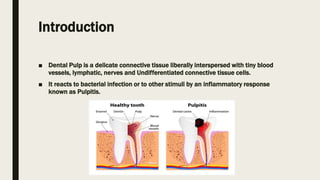
■ Dental Pulp is a delicate connective tissue liberally interspersed with tiny blood
vessels, lymphatic, nerves and Undifferentiated connective tissue cells.
■ It reacts to bacterial infection or to other stimuli by an inflammatory response
known as Pulpitis.
Etiology
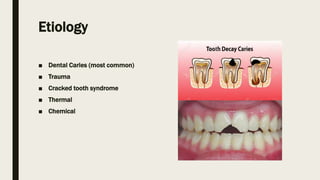
■ Dental Caries (most common)
■ Trauma
■ Cracked tooth syndrome
■ Thermal
■ Chemical
Classification
■ On the basis of severity of inflammation:-
1. Reversible Pulpitis
2. Irreversible Pulpitis
3. Pulp Necrosis
1. Reversible Pulpitis
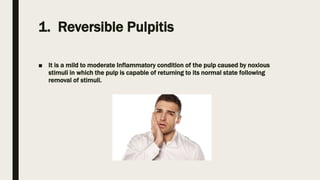
■ It is a mild to moderate Inflammatory condition of the pulp caused by noxious
stimuli in which the pulp is capable of returning to its normal state following
removal of stimuli.
Clinical features
■ Short sharp pain lasting for a moment.
■ Does not occur spontaneously and does not continue when the cause has been
removed.
■ Sensitivity to cold, hot or maybe air.
■ Symptoms resolve quickly after stimulus is removed.
■ Pain response to cold is immediate.
■ Pain response to hot initially delayed.
■ No radiographic changes evident.
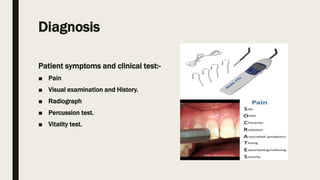
Diagnosis
Patient symptoms and clinical test:-
■ Pain
■ Visual examination and History.
■ Radiograph
■ Percussion test.
■ Vitality test.
Treatment
■ The best treatment for Reversible Pulpitis is prevention.
■ Periodic care to prevent the development of caries, early insertion of a filling if a
cavity has developed.
■ Desentization of necks of teeth where gingival recession is marked.
■ Use of cavity varnish or cement base before insertion of filling and care in cavity
preparation and polishing are recommended to prevent pulpitis.
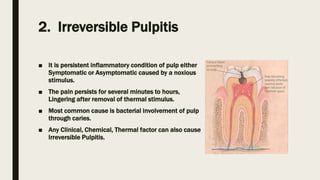
2. Irreversible Pulpitis
■ It is persistent inflammatory condition of pulp either
Symptomatic or Asymptomatic caused by a noxious
stimulus.
■ The pain persists for several minutes to hours,
Lingering after removal of thermal stimulus.
■ Most common cause is bacterial involvement of pulp
through caries.
■ Any Clinical, Chemical, Thermal factor can also cause
Irreversible Pulpitis.
Clinical features
■ Intermittent or continuous or spontaneous pain.
■ Pain last several minutes to hour even after removal
of stimulus.
■ Localization of pain is difficult, may radiate.
■ Inflammation in PDL causes percussion sensitivity.
■ Radiograph may show slightly widened PDL.
■ Occasionally erosion of Lamina Dura.
■ Subdivided as Symptomatic and Asymptomatic
Pulpitis.
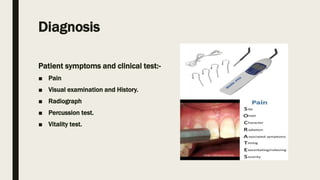
Diagnosis
Patient symptoms and clinical test:-
■ Pain
■ Visual examination and History.
■ Radiograph
■ Percussion test.
■ Vitality test.
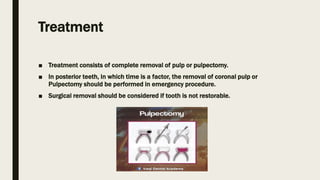
Treatment
■ Treatment consists of complete removal of pulp or pulpectomy.
■ In posterior teeth, in which time is a factor, the removal of coronal pulp or
Pulpectomy should be performed in emergency procedure.
■ Surgical removal should be considered if tooth is not restorable.
3. Pulp Necrosis
■ Death of the pulp.
■ Maybe partial or total depending on part or the entire pulp is involved.
Clinical features
■ Symptoms often similar to irreversible pulpitis.
■ Patient’s previous pain history.
■ Maybe spontaneous pain or complete absence
of pain.
■ May have little radiographic changes.
■ May have obvious radiographic pathology.
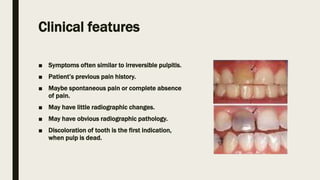
■ Discoloration of tooth is the first indication,
when pulp is dead.
Treatment
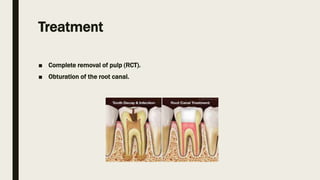
■ Complete removal of pulp (RCT).
■ Obturation of the root canal.
Pulpitis

Pulpitis

  • 2.
    PULPITIS Dr. Syed SaroshHussain House officer HUDH
  • 3.
    Content ■ Introduction ■ Etiology ■Classification ■ Diagnosis ■ Treatment
  • 4.
    Introduction ■ Dental Pulpis a delicate connective tissue liberally interspersed with tiny blood vessels, lymphatic, nerves and Undifferentiated connective tissue cells. ■ It reacts to bacterial infection or to other stimuli by an inflammatory response known as Pulpitis.
  • 5.
    Etiology ■ Dental Caries(most common) ■ Trauma ■ Cracked tooth syndrome ■ Thermal ■ Chemical
  • 6.
    Classification ■ On thebasis of severity of inflammation:- 1. Reversible Pulpitis 2. Irreversible Pulpitis 3. Pulp Necrosis
  • 7.
    1. Reversible Pulpitis ■It is a mild to moderate Inflammatory condition of the pulp caused by noxious stimuli in which the pulp is capable of returning to its normal state following removal of stimuli.
  • 8.
    Clinical features ■ Shortsharp pain lasting for a moment. ■ Does not occur spontaneously and does not continue when the cause has been removed. ■ Sensitivity to cold, hot or maybe air. ■ Symptoms resolve quickly after stimulus is removed. ■ Pain response to cold is immediate. ■ Pain response to hot initially delayed. ■ No radiographic changes evident.
  • 9.
    Diagnosis Patient symptoms andclinical test:- ■ Pain ■ Visual examination and History. ■ Radiograph ■ Percussion test. ■ Vitality test.
  • 10.
    Treatment ■ The besttreatment for Reversible Pulpitis is prevention. ■ Periodic care to prevent the development of caries, early insertion of a filling if a cavity has developed. ■ Desentization of necks of teeth where gingival recession is marked. ■ Use of cavity varnish or cement base before insertion of filling and care in cavity preparation and polishing are recommended to prevent pulpitis.
  • 11.
    2. Irreversible Pulpitis ■It is persistent inflammatory condition of pulp either Symptomatic or Asymptomatic caused by a noxious stimulus. ■ The pain persists for several minutes to hours, Lingering after removal of thermal stimulus. ■ Most common cause is bacterial involvement of pulp through caries. ■ Any Clinical, Chemical, Thermal factor can also cause Irreversible Pulpitis.
  • 12.
    Clinical features ■ Intermittentor continuous or spontaneous pain. ■ Pain last several minutes to hour even after removal of stimulus. ■ Localization of pain is difficult, may radiate. ■ Inflammation in PDL causes percussion sensitivity. ■ Radiograph may show slightly widened PDL. ■ Occasionally erosion of Lamina Dura. ■ Subdivided as Symptomatic and Asymptomatic Pulpitis.
  • 13.
    Diagnosis Patient symptoms andclinical test:- ■ Pain ■ Visual examination and History. ■ Radiograph ■ Percussion test. ■ Vitality test.
  • 14.
    Treatment ■ Treatment consistsof complete removal of pulp or pulpectomy. ■ In posterior teeth, in which time is a factor, the removal of coronal pulp or Pulpectomy should be performed in emergency procedure. ■ Surgical removal should be considered if tooth is not restorable.
  • 15.
    3. Pulp Necrosis ■Death of the pulp. ■ Maybe partial or total depending on part or the entire pulp is involved.
  • 16.
    Clinical features ■ Symptomsoften similar to irreversible pulpitis. ■ Patient’s previous pain history. ■ Maybe spontaneous pain or complete absence of pain. ■ May have little radiographic changes. ■ May have obvious radiographic pathology. ■ Discoloration of tooth is the first indication, when pulp is dead.
  • 17.
    Treatment ■ Complete removalof pulp (RCT). ■ Obturation of the root canal.