
DEPARTMENT OF PUBLIC
HEALTH DENTISTRY
T O P I C O F P R E S E N T A T I O N :
CPITN INDEX
(Community Periodontal Index of Treatment Needs)
PRESENTED BY:
JEBAN JYOTI SAHU
ROLL NO.: 1879032
CONTENTS
• INTRODUCTION
• SCOPE AND PURPOSE
• PROCEDURE
• SEXTANT
• INDEX TEETH
• INSTRUMENTS USED
• CPITN PROBE
• PROBING PROCEDURE
• EXAMINATION PROCEDURE
• CALCULATION OF CPITN
• COMMUNITY PERIODONTAL INDEX (CPI)
• SUMMARY
INTRODUCTION • CPITN was introduced by JUKKA AINAMO , DAVID BARMES ,
GORGE BEAGRIE , TERRY CUTRESS , JEAN MARTIN and
JENNIFER SARDO-INFIRRI for Joint working committee of the
WHO and FDI in 1982 .
• Developed primarily to survey and evaluate periodontal
treatment needs rather than determining past and present
periodontal status i.e. recession of the gingival margin and
alveolar bone .
• Treatment needs imply that CPITN assesses only those
conditions potentially responsive to treatment , but not
nontreatable or irreversible conditions .
SCOPE
AND
PURPOSE
• The CPITN procedure is recommended for epidemiological
surveys of periodontal health.
• It provides guidance on planning and monitoring of the
effectiveness of periodontal care programme and dental
personnel required.
• The CPITN records the common treatable conditions namely,
- periodontal pockets
- gingival inflammation
- dental calculus
- other plaque retentive factors
• It doesn’t record irreversible changes such as recession or
other deviations from periodontal health such as tooth
mobility or loss of periodontal attachment.
ADVANTAGES:
Major Advantages of CPITN are :
• Simplicity
• Speed
• International Uniformity
LIMITATIONS:
• Does not record the position of gingival margin.
• Does not provide assessment of past periodontal breakdown.
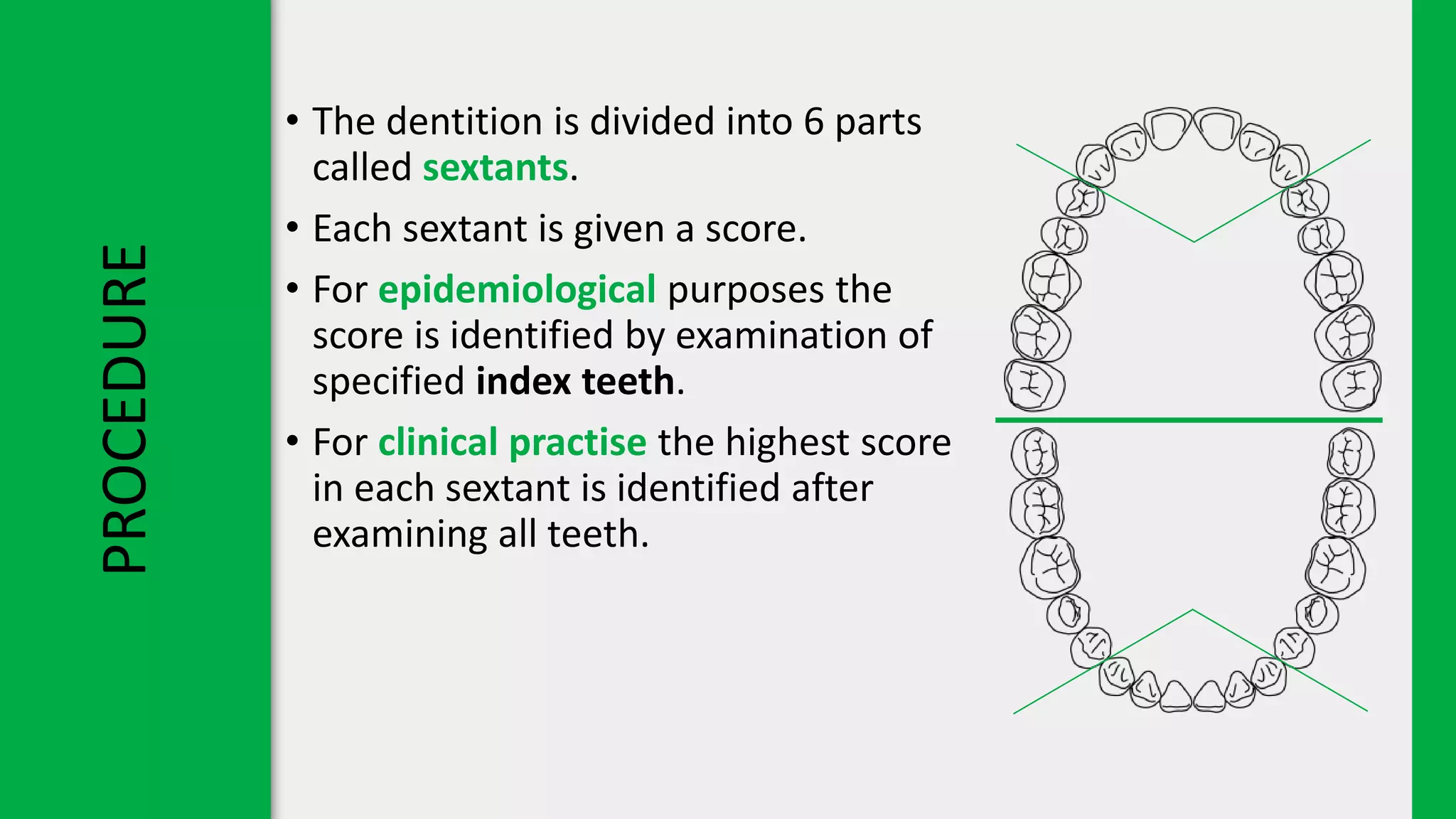
PROCEDURE • The dentition is divided into 6 parts
called sextants.
• Each sextant is given a score.
• For epidemiological purposes the
score is identified by examination of
specified index teeth.
• For clinical practise the highest score
in each sextant is identified after
examining all teeth.
SEXTANT
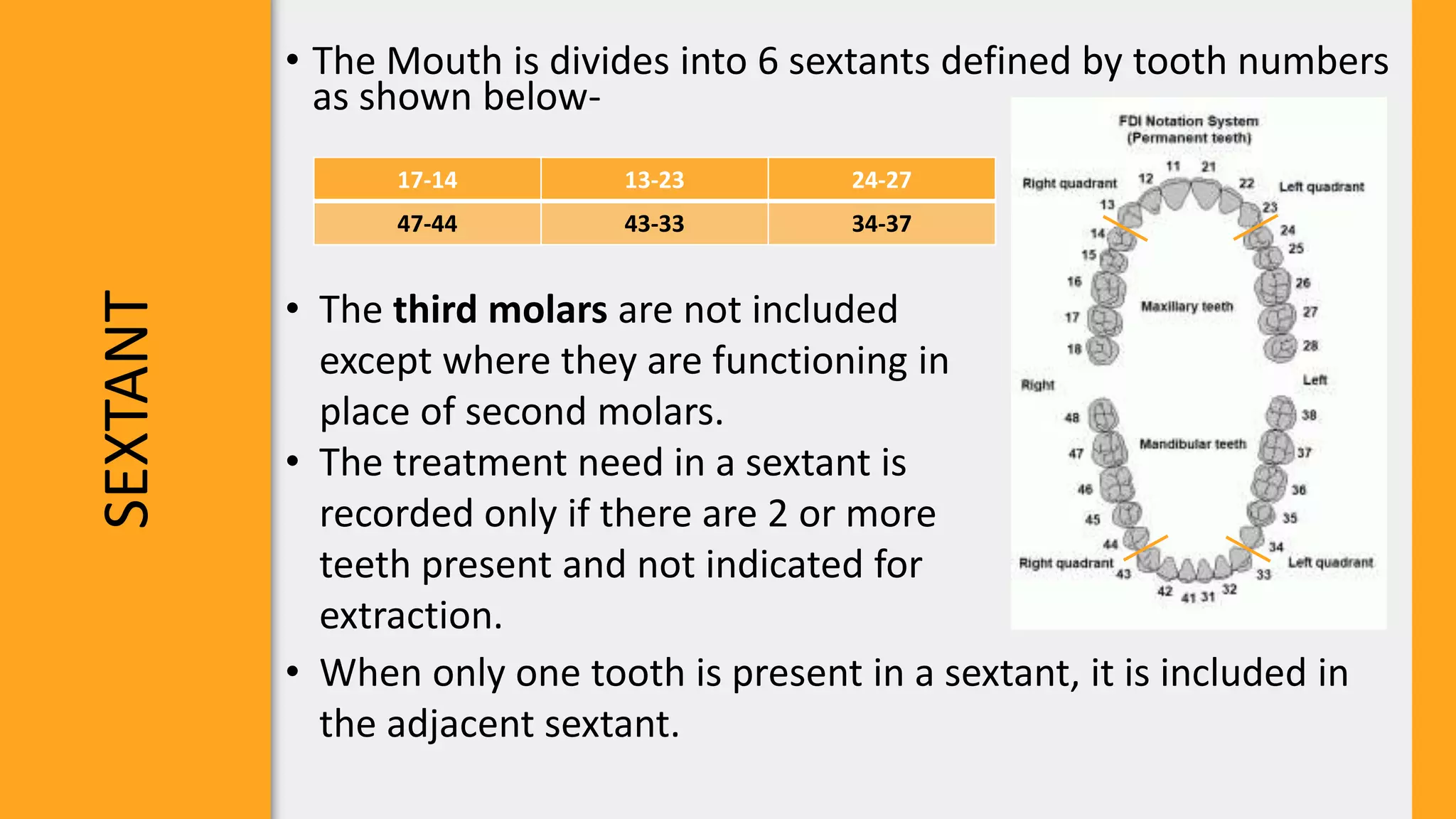
• The Mouth is divides into 6 sextants defined by tooth numbers
as shown below-
17-14 13-23 24-27
47-44 43-33 34-37
• The third molars are not included
except where they are functioning in
place of second molars.
• The treatment need in a sextant is
recorded only if there are 2 or more
teeth present and not indicated for
extraction.
• When only one tooth is present in a sextant, it is included in
the adjacent sextant.
INDEX
TEETH
• In Epidemiological surveys for adults, aged 20 years or more,
only 10 teeth, known as the Index Teeth are examined.
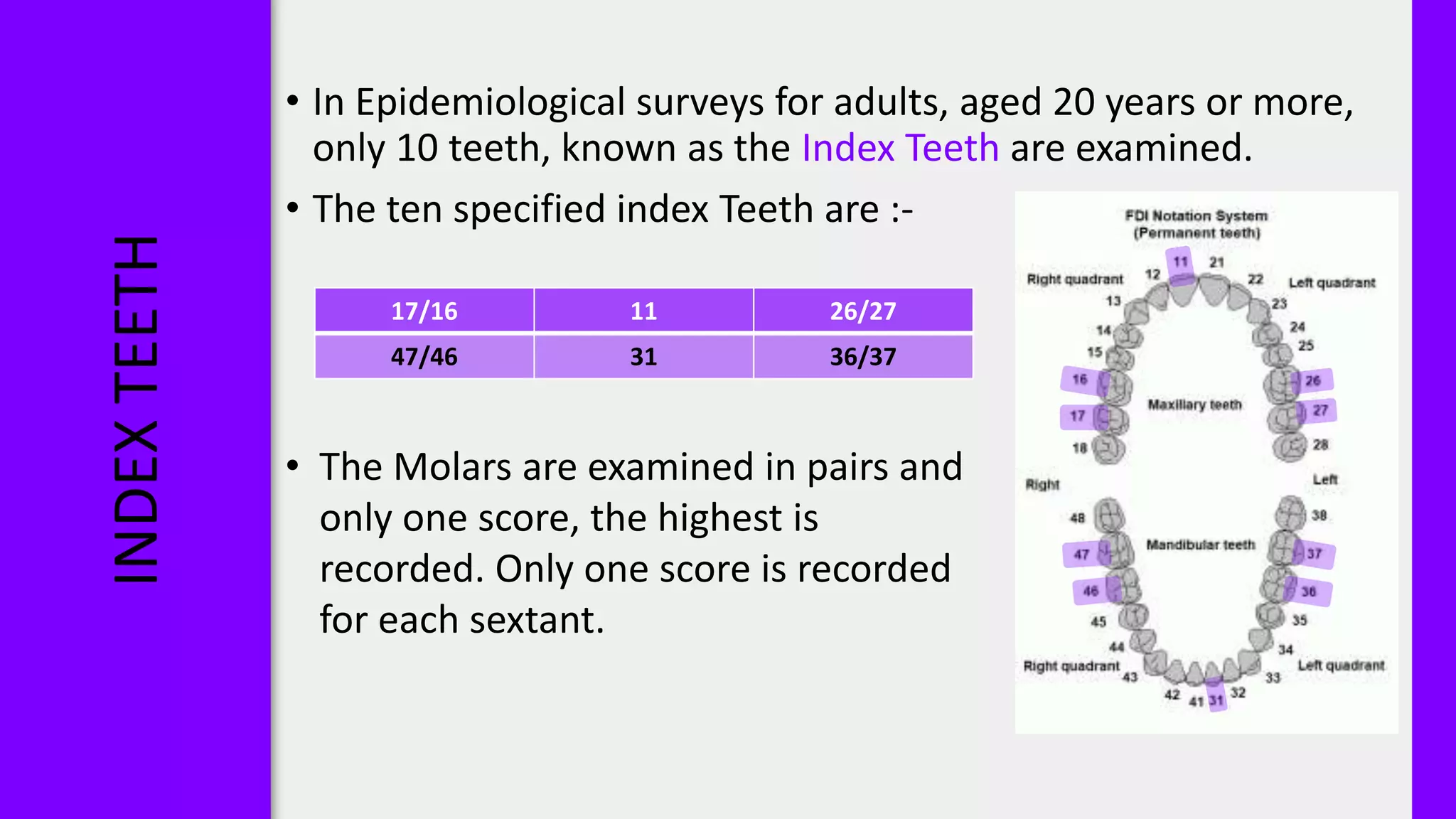
• The ten specified index Teeth are :-
• The Molars are examined in pairs and
only one score, the highest is
recorded. Only one score is recorded
for each sextant.
17/16 11 26/27
47/46 31 36/37
• For young people upto 19 years, only 6 Index teeth are examined. The
second molars are excluded as Index Teeth at these ages because of
the high frequency of false pockets.(non-inflammatory, associated with tooth eruption)
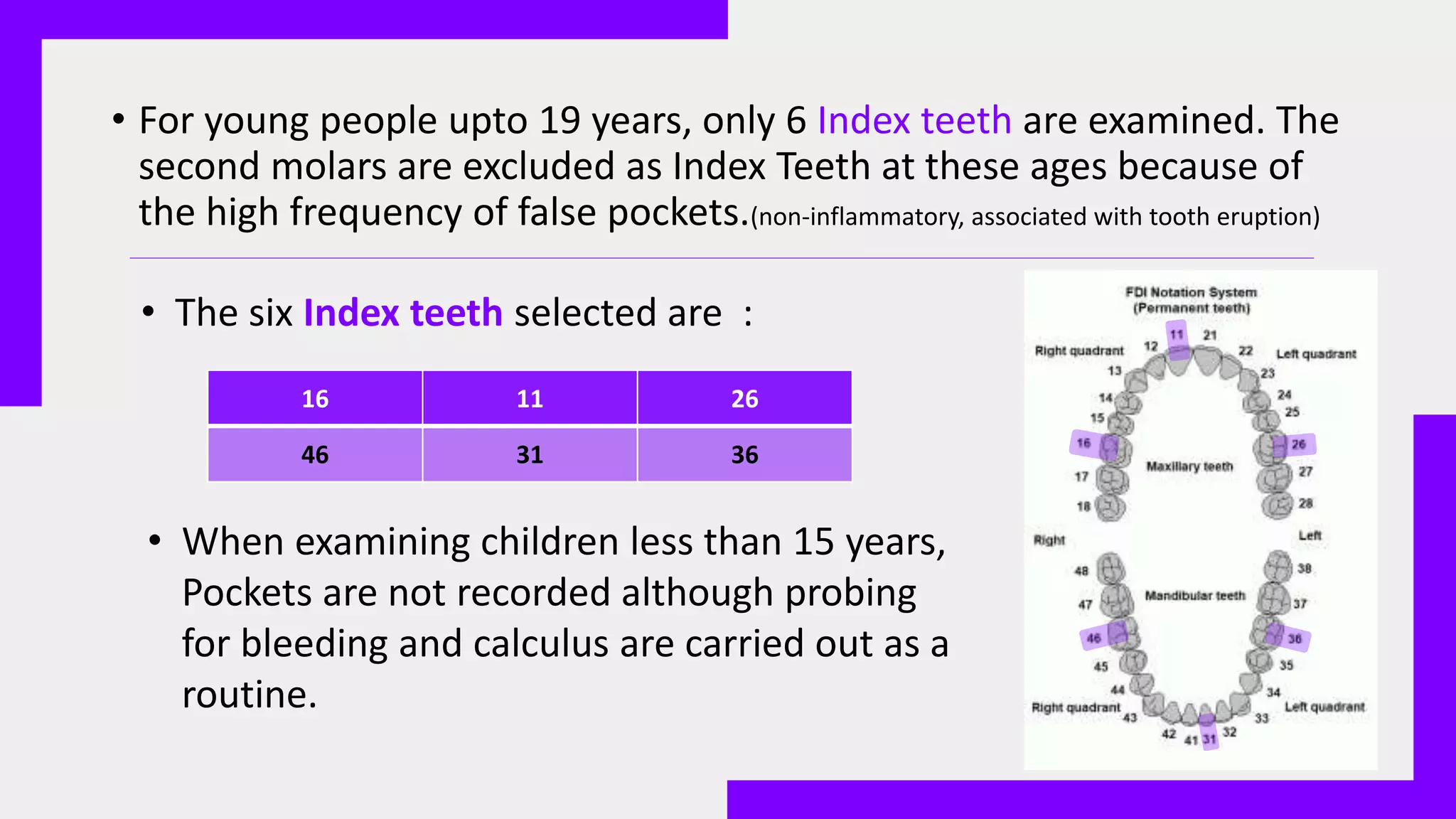
16 11 26
46 31 36
• The six Index teeth selected are :
• When examining children less than 15 years,
Pockets are not recorded although probing
for bleeding and calculus are carried out as a
routine.
INSTRUMENTS
USED
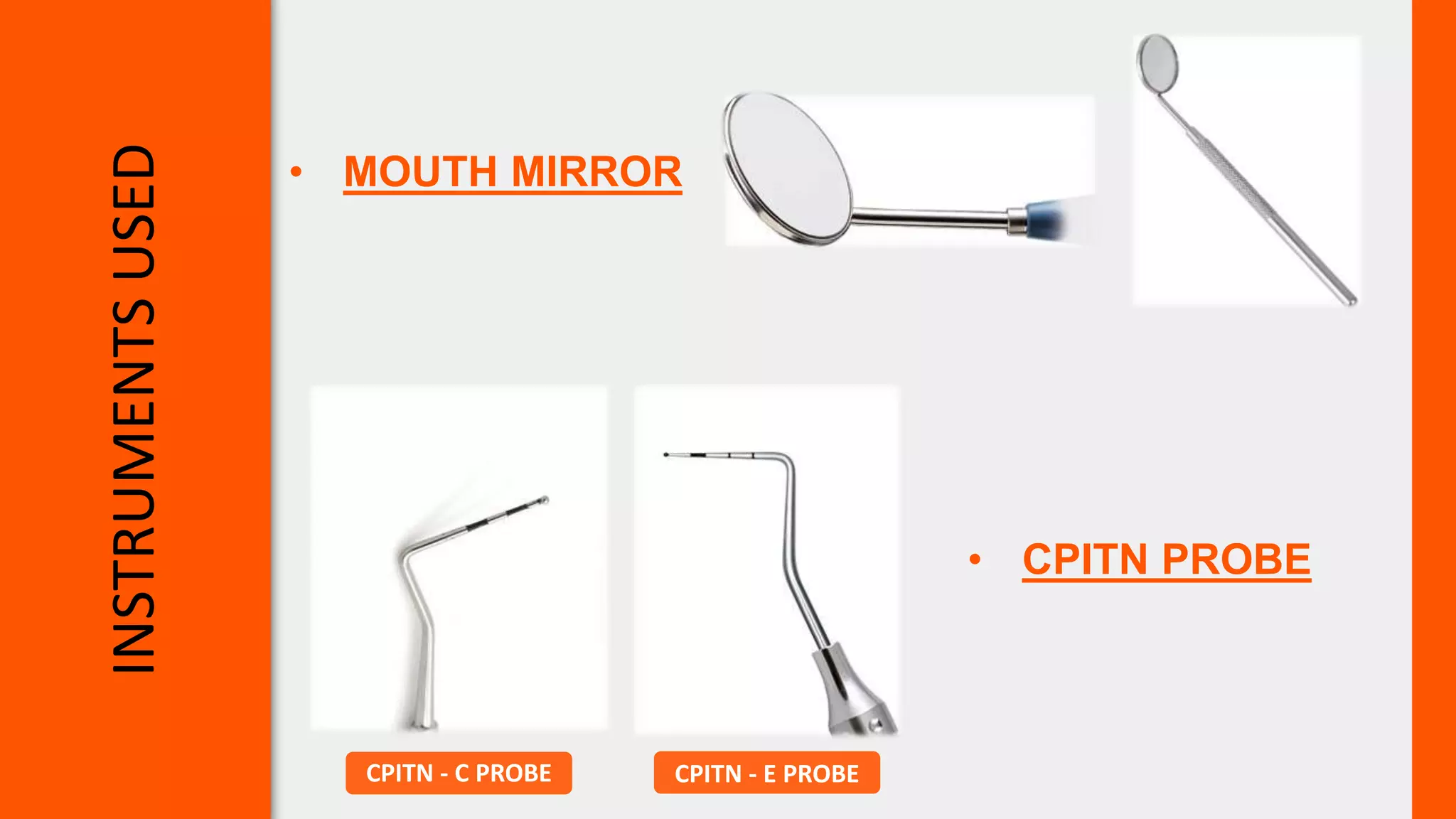
CPITN - C PROBE CPITN - E PROBE
• CPITN PROBE
• MOUTH MIRROR
CPITN
PROBE
CPITN-E PROBE CPITN-C
PROBE
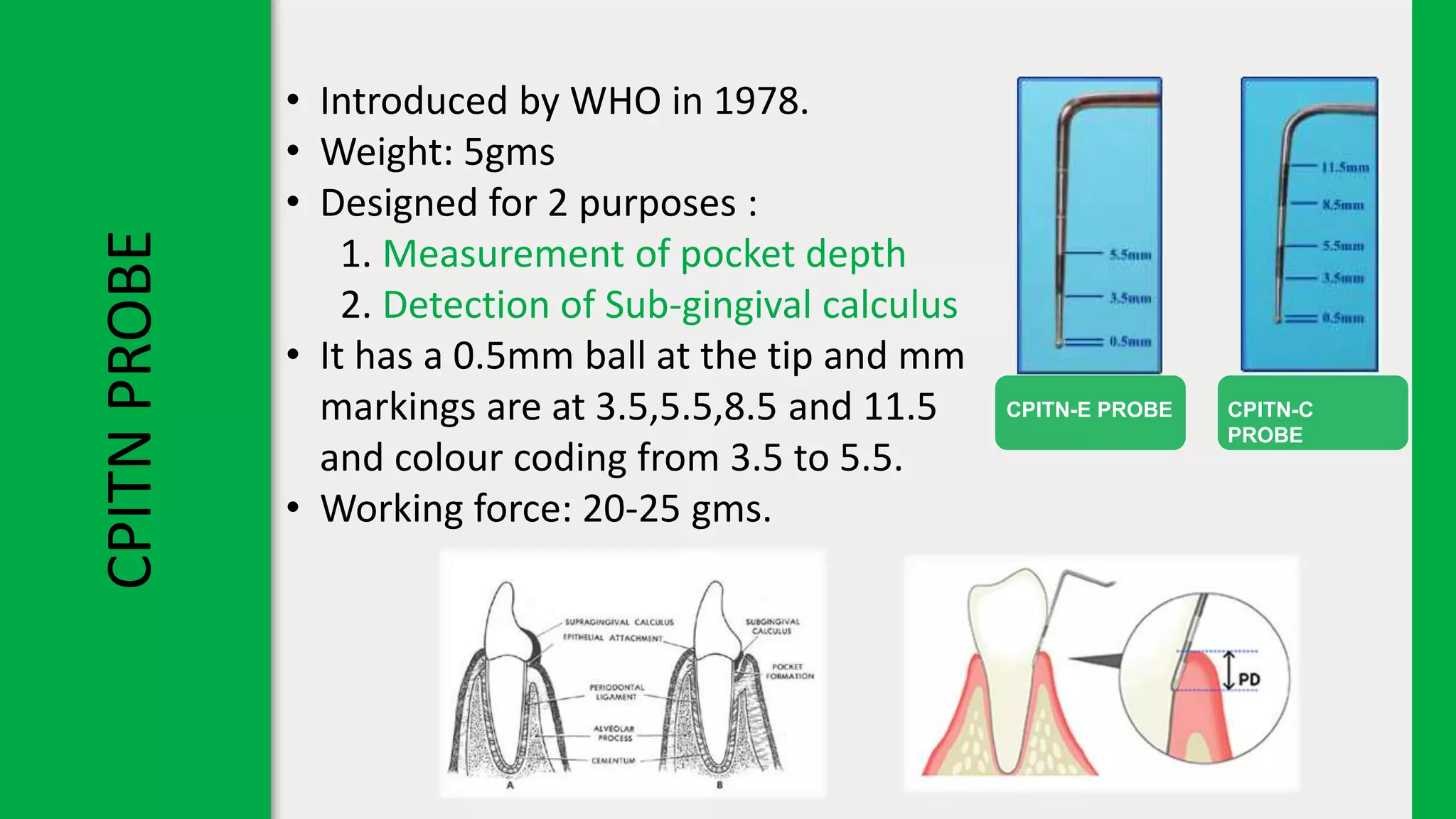
• Introduced by WHO in 1978.
• Weight: 5gms
• Designed for 2 purposes :
1. Measurement of pocket depth
2. Detection of Sub-gingival calculus
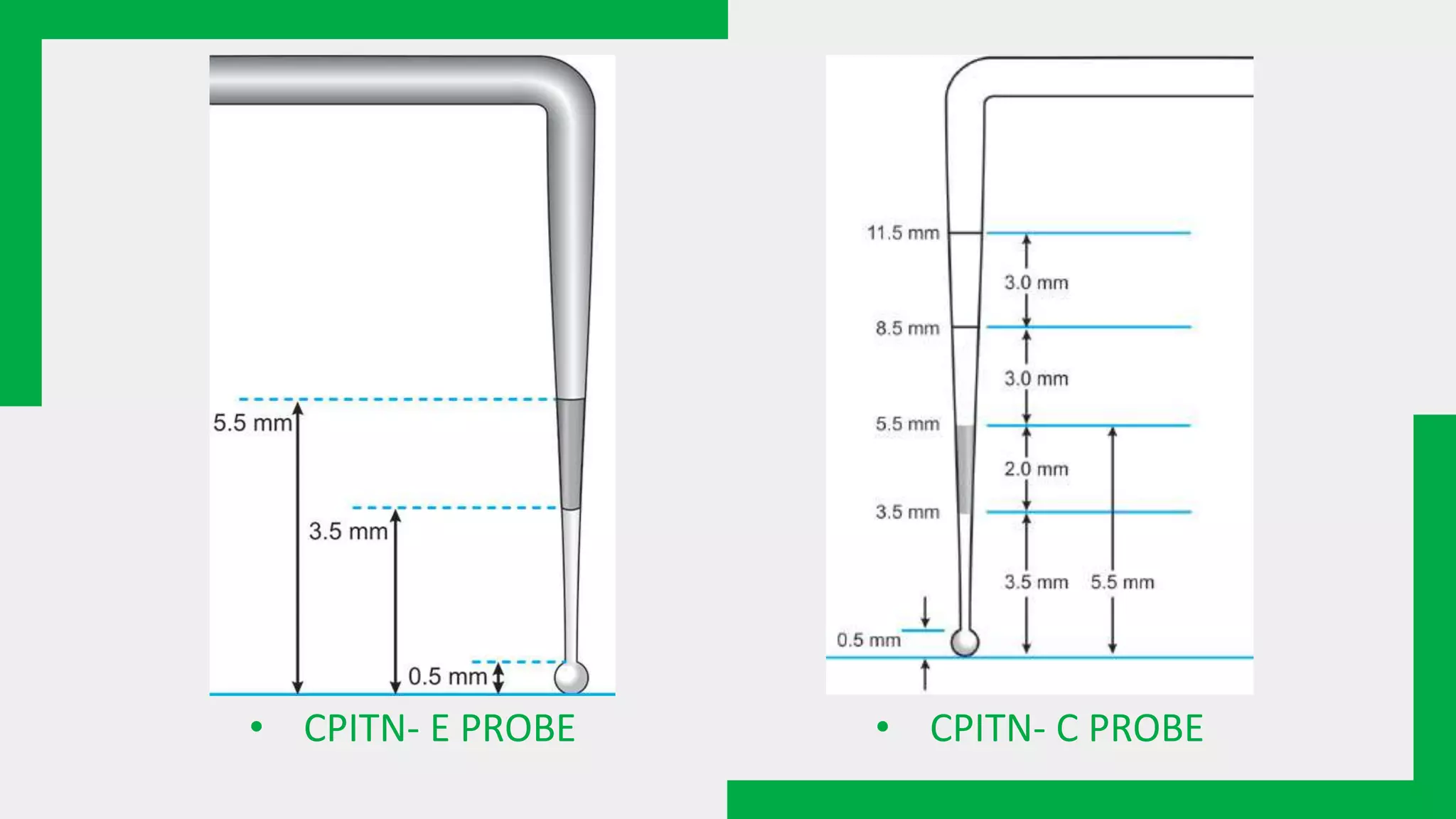
• It has a 0.5mm ball at the tip and mm
markings are at 3.5,5.5,8.5 and 11.5
and colour coding from 3.5 to 5.5.
• Working force: 20-25 gms.
• CPITN- C PROBE
• CPITN- E PROBE
PROBING
PROCEDURE
• A tooth is probed to determine pocket depth and to detect
subgingival calculus and bleeding response.
PROBING FORCE
WORKING COMPONENT
SENSING COMPONENT
To determine POCKET DEPTH
To detect SUBGINGIVAL CALCULUS
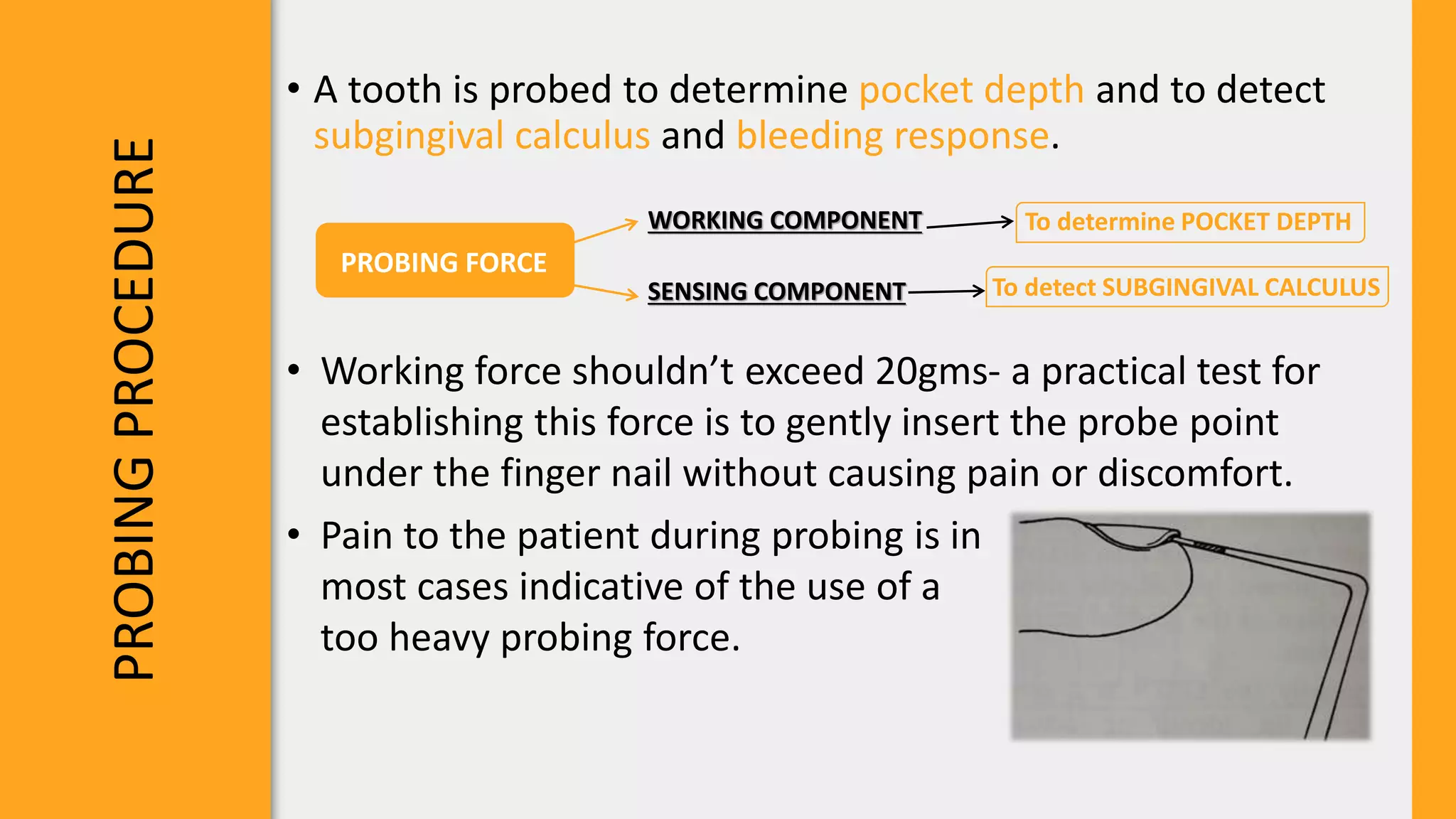
• Working force shouldn’t exceed 20gms- a practical test for
establishing this force is to gently insert the probe point
under the finger nail without causing pain or discomfort.
• Pain to the patient during probing is in
most cases indicative of the use of a
too heavy probing force.
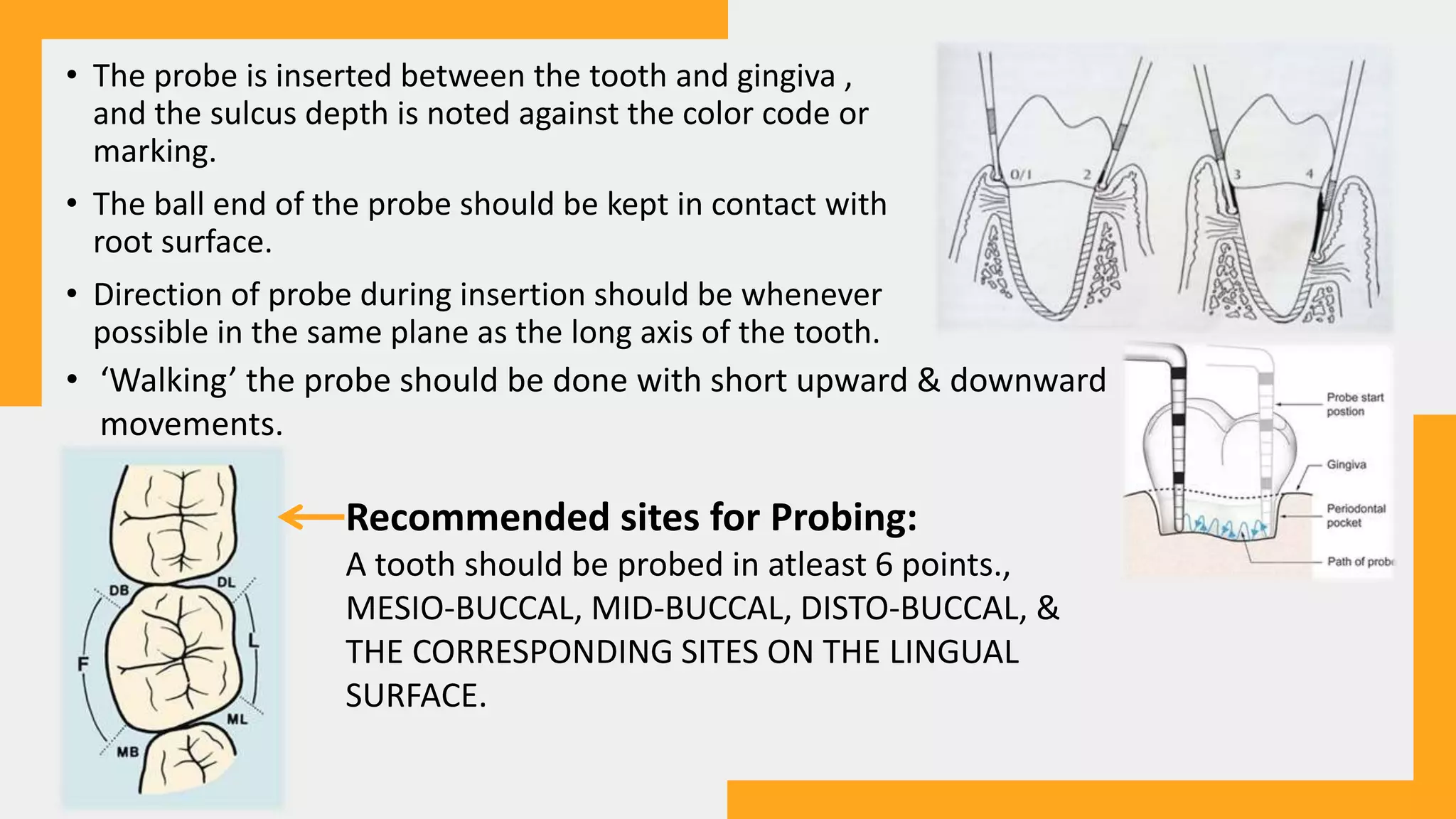
• The probe is inserted between the tooth and gingiva ,
and the sulcus depth is noted against the color code or
marking.
• The ball end of the probe should be kept in contact with
root surface.
• Direction of probe during insertion should be whenever
possible in the same plane as the long axis of the tooth.
• ‘Walking’ the probe should be done with short upward & downward
movements.
Recommended sites for Probing:
A tooth should be probed in atleast 6 points.,
MESIO-BUCCAL, MID-BUCCAL, DISTO-BUCCAL, &
THE CORRESPONDING SITES ON THE LINGUAL
SURFACE.
EXAMINATION
PROCEDURE
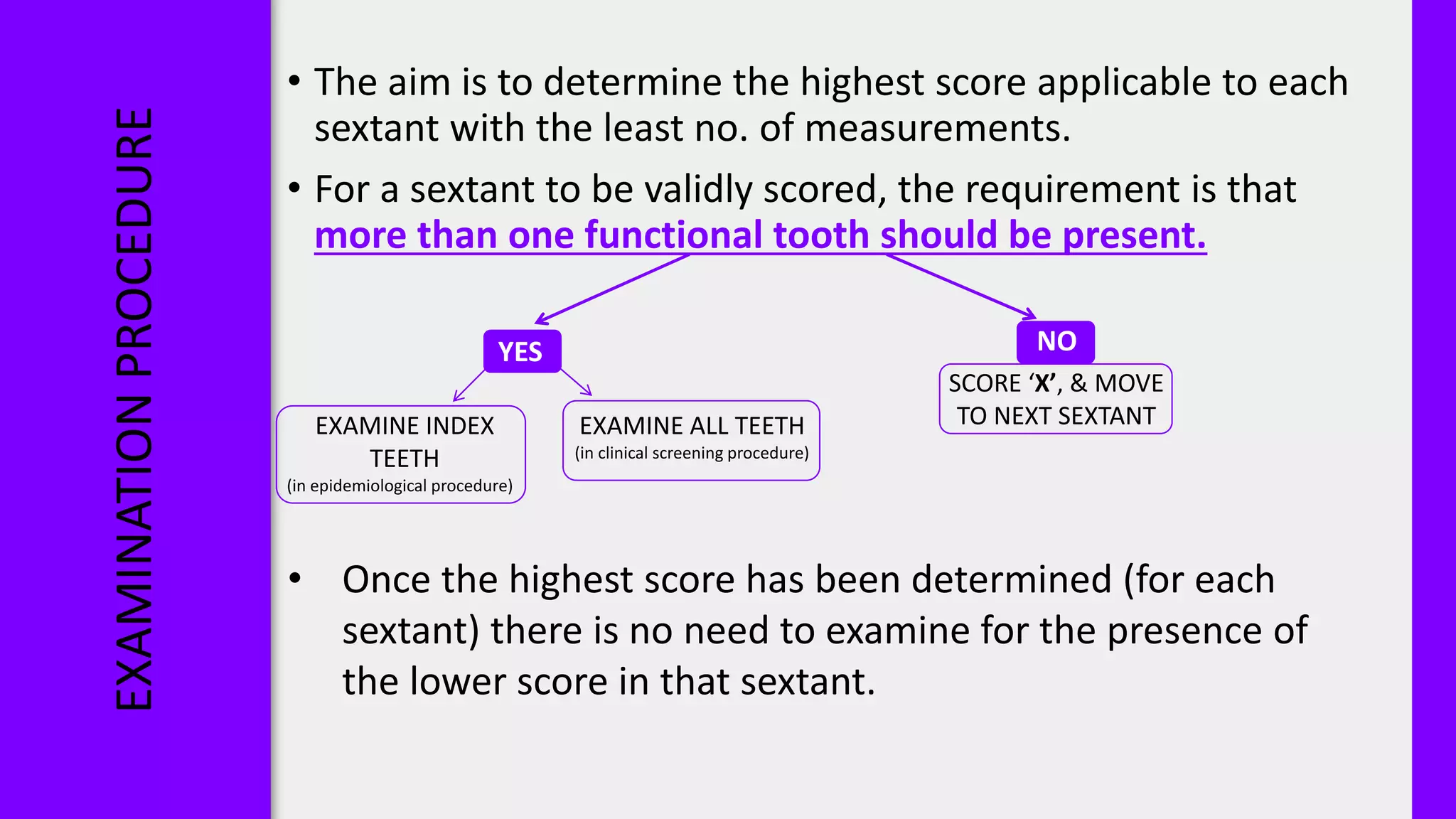
• The aim is to determine the highest score applicable to each
sextant with the least no. of measurements.
• For a sextant to be validly scored, the requirement is that
more than one functional tooth should be present.
NO
YES
SCORE ‘X’, & MOVE
TO NEXT SEXTANT
EXAMINE INDEX
TEETH
(in epidemiological procedure)
EXAMINE ALL TEETH
(in clinical screening procedure)
• Once the highest score has been determined (for each
sextant) there is no need to examine for the presence of
the lower score in that sextant.
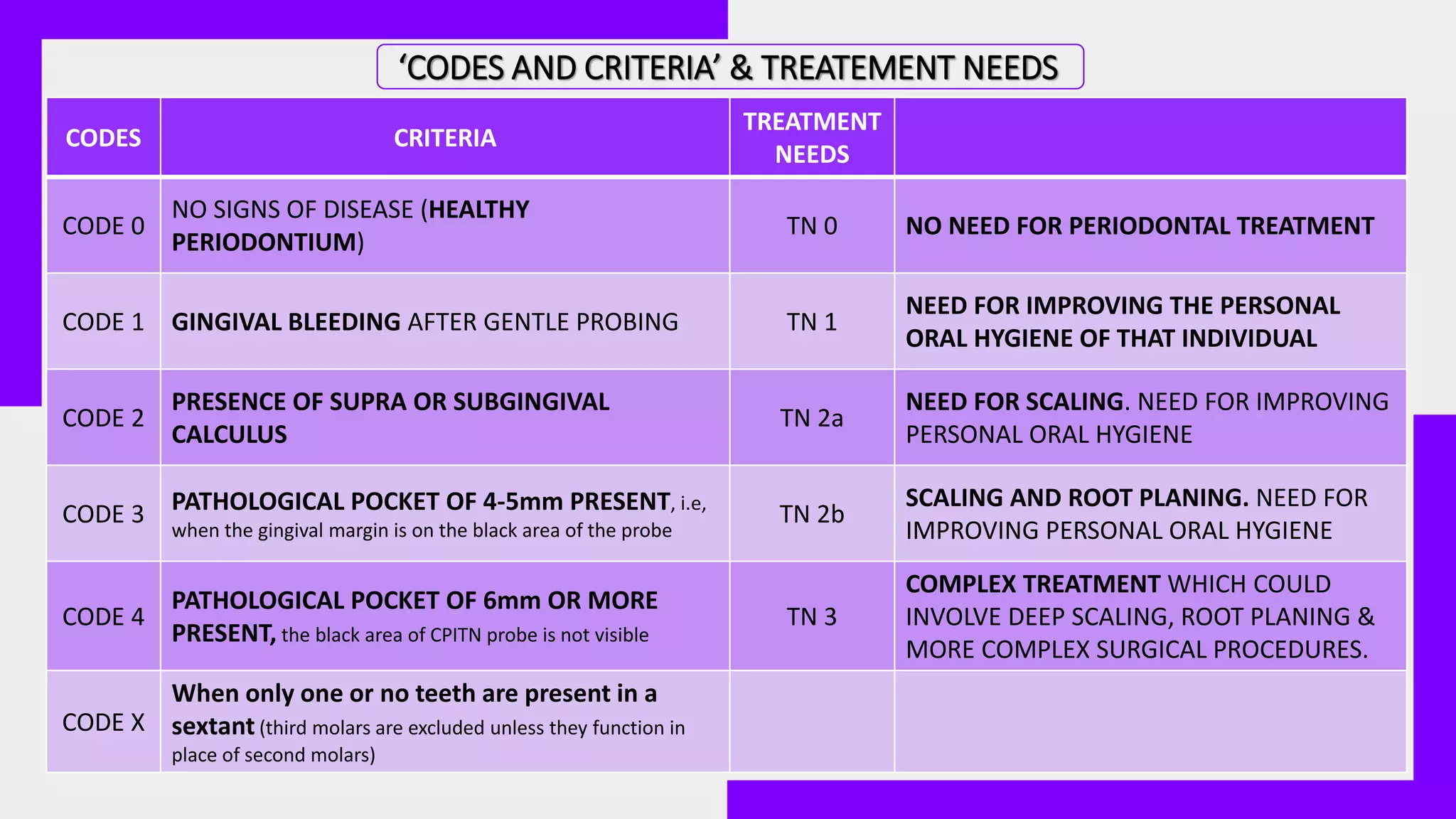
‘CODES AND CRITERIA’ & TREATEMENT NEEDS
CODES CRITERIA
TREATMENT
NEEDS
CODE 0
NO SIGNS OF DISEASE (HEALTHY
PERIODONTIUM)
TN 0 NO NEED FOR PERIODONTAL TREATMENT
CODE 1 GINGIVAL BLEEDING AFTER GENTLE PROBING TN 1
NEED FOR IMPROVING THE PERSONAL
ORAL HYGIENE OF THAT INDIVIDUAL
CODE 2
PRESENCE OF SUPRA OR SUBGINGIVAL
CALCULUS
TN 2a
NEED FOR SCALING. NEED FOR IMPROVING
PERSONAL ORAL HYGIENE
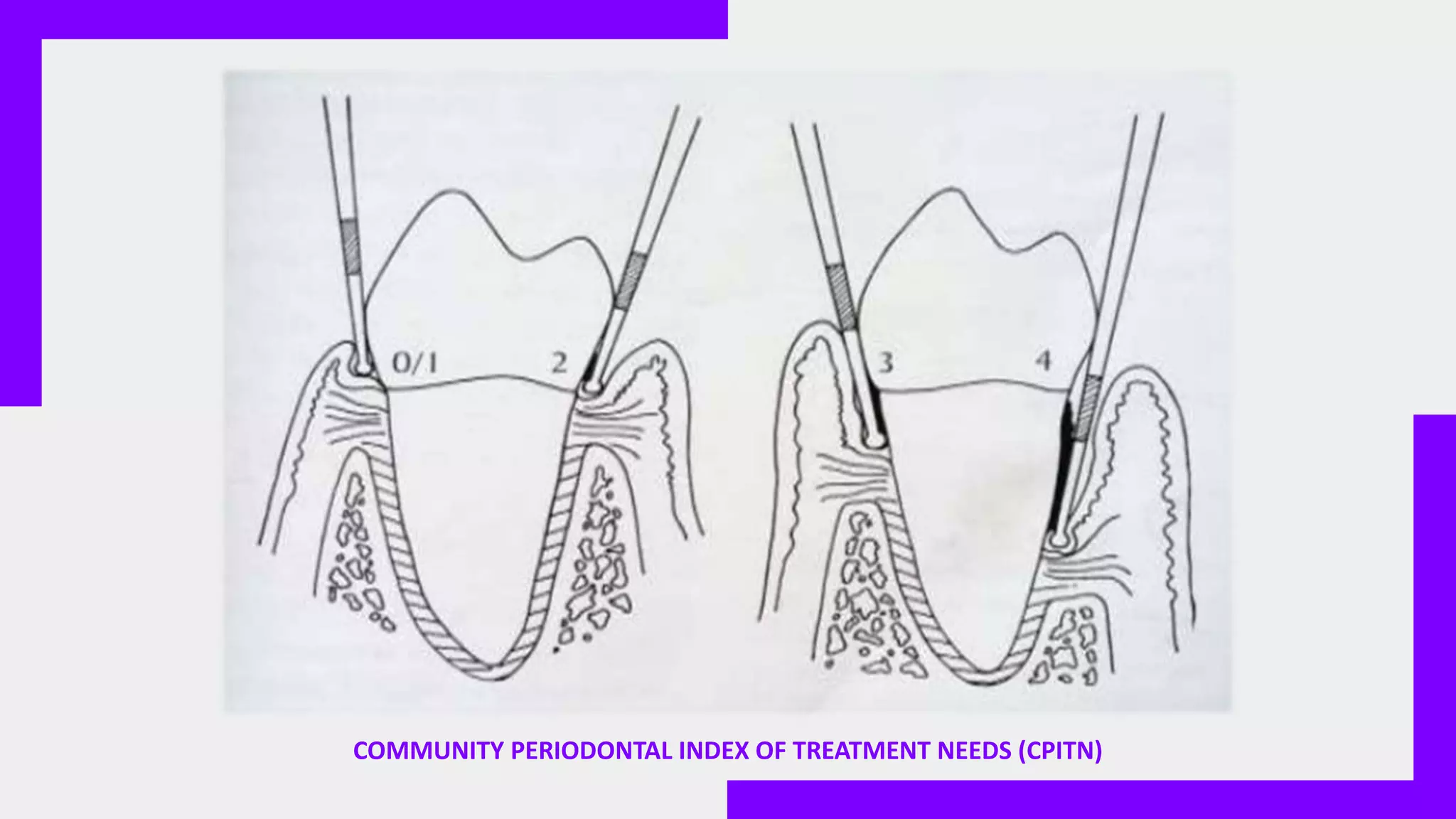
CODE 3 PATHOLOGICAL POCKET OF 4-5mm PRESENT, i.e,
when the gingival margin is on the black area of the probe
TN 2b
SCALING AND ROOT PLANING. NEED FOR
IMPROVING PERSONAL ORAL HYGIENE
CODE 4
PATHOLOGICAL POCKET OF 6mm OR MORE
PRESENT, the black area of CPITN probe is not visible
TN 3
COMPLEX TREATMENT WHICH COULD
INVOLVE DEEP SCALING, ROOT PLANING &
MORE COMPLEX SURGICAL PROCEDURES.
CODE X
When only one or no teeth are present in a
sextant (third molars are excluded unless they function in
place of second molars)
COMMUNITY PERIODONTAL INDEX OF TREATMENT NEEDS (CPITN)
CALCULATION
OF
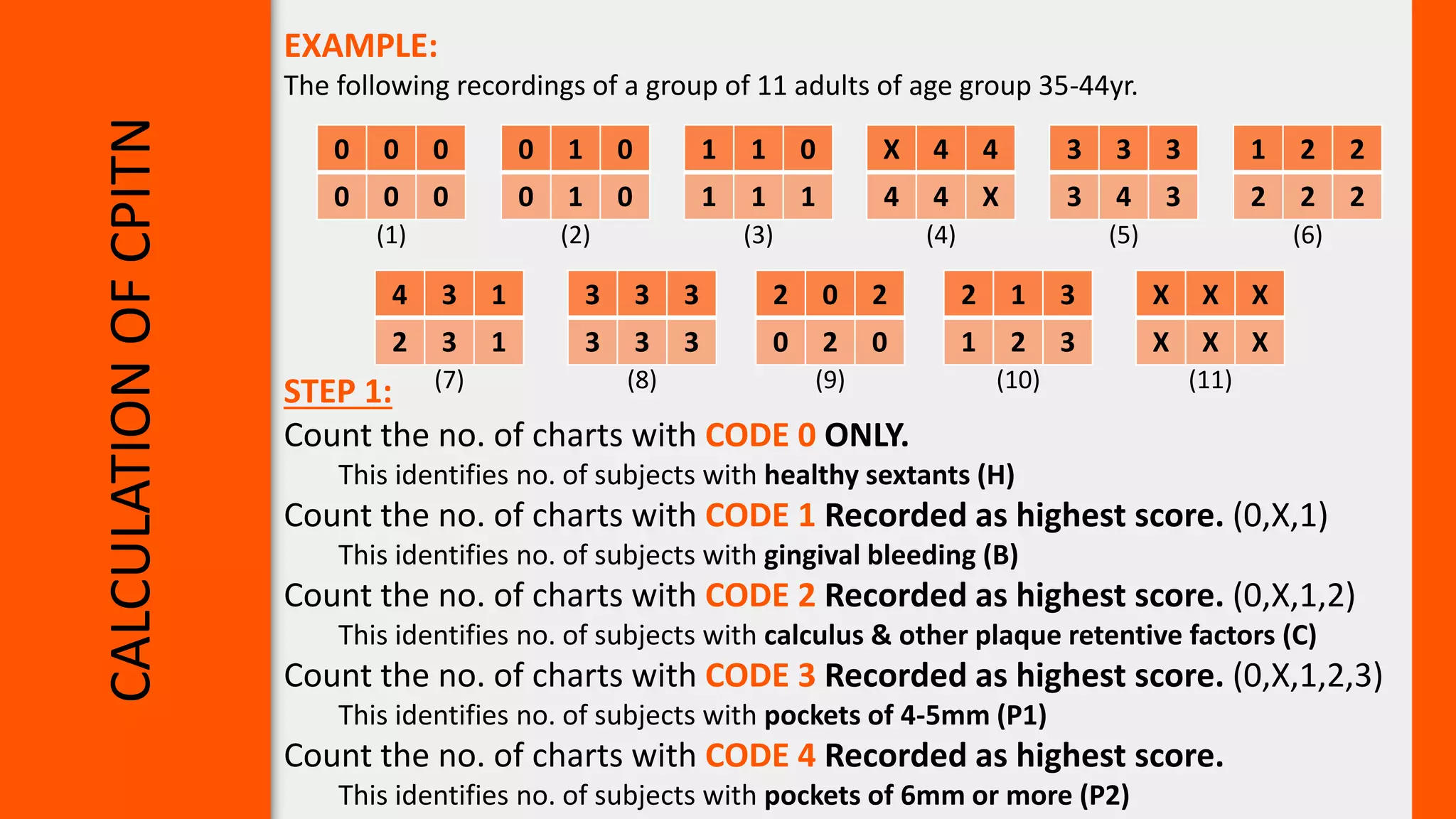
CPITN 0 0 0
0 0 0
3 3 3
3 4 3
1 1 0
1 1 1
X 4 4
4 4 X
4 3 1
2 3 1
0 1 0
0 1 0
3 3 3
3 3 3
2 0 2
0 2 0
2 1 3
1 2 3
X X X
X X X
1 2 2
2 2 2
(1) (2) (3) (4) (5) (6)
(7) (8) (9) (10) (11)
EXAMPLE:
The following recordings of a group of 11 adults of age group 35-44yr.
STEP 1:
Count the no. of charts with CODE 0 ONLY.
This identifies no. of subjects with healthy sextants (H)
Count the no. of charts with CODE 1 Recorded as highest score. (0,X,1)
This identifies no. of subjects with gingival bleeding (B)
Count the no. of charts with CODE 2 Recorded as highest score. (0,X,1,2)
This identifies no. of subjects with calculus & other plaque retentive factors (C)
Count the no. of charts with CODE 3 Recorded as highest score. (0,X,1,2,3)
This identifies no. of subjects with pockets of 4-5mm (P1)
Count the no. of charts with CODE 4 Recorded as highest score.
This identifies no. of subjects with pockets of 6mm or more (P2)
CALCULATIONS:
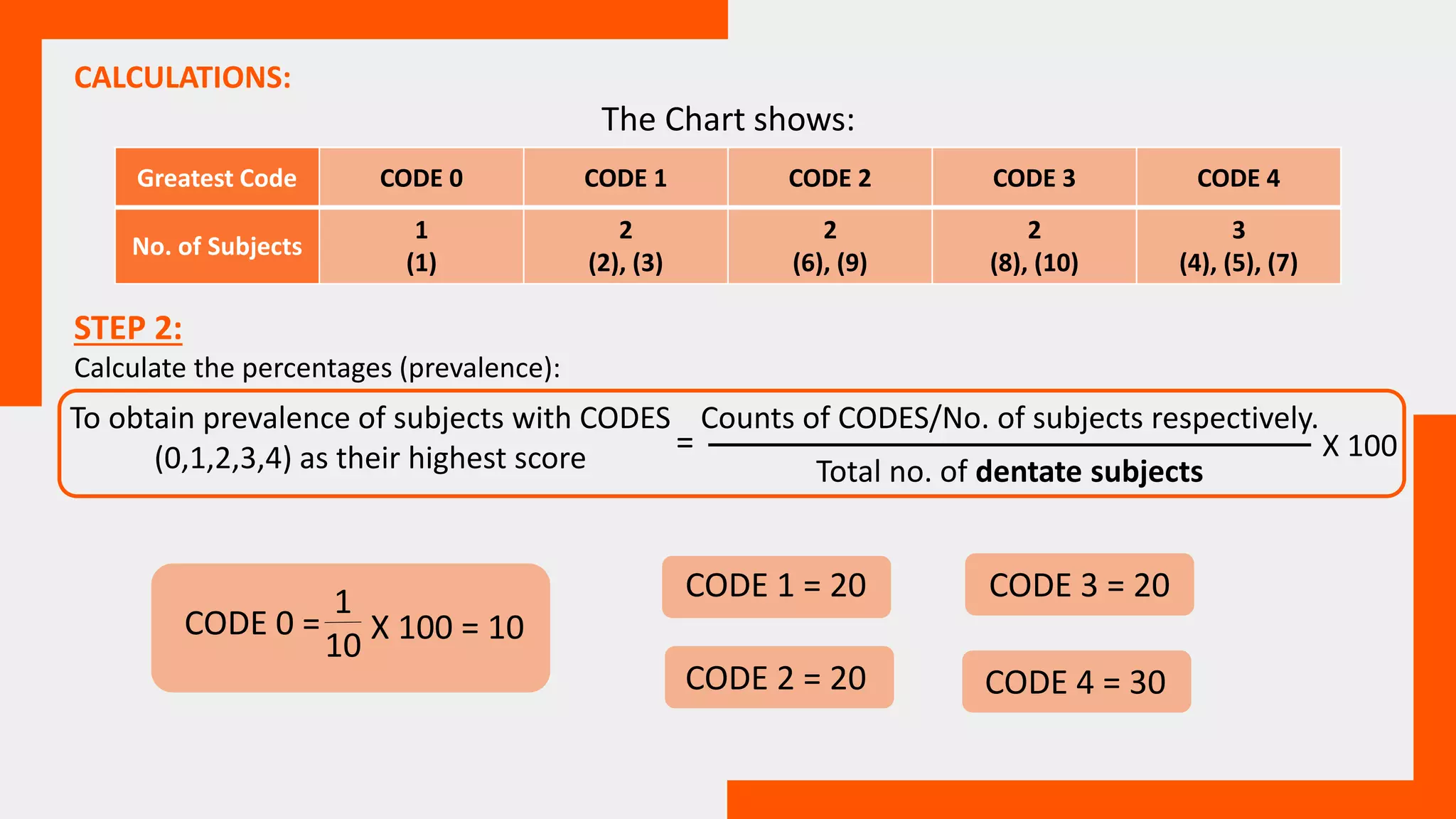
The Chart shows:
Greatest Code CODE 0 CODE 1 CODE 2 CODE 3 CODE 4
No. of Subjects
1
(1)
2
(2), (3)
2
(6), (9)
2
(8), (10)
3
(4), (5), (7)
STEP 2:
Calculate the percentages (prevalence):
To obtain prevalence of subjects with CODES
(0,1,2,3,4) as their highest score =
Counts of CODES/No. of subjects respectively.
Total no. of dentate subjects
X 100
CODE 0 =
1
10 X 100 = 10
CODE 1 = 20
CODE 2 = 20
CODE 3 = 20
CODE 4 = 30
STEP 3:
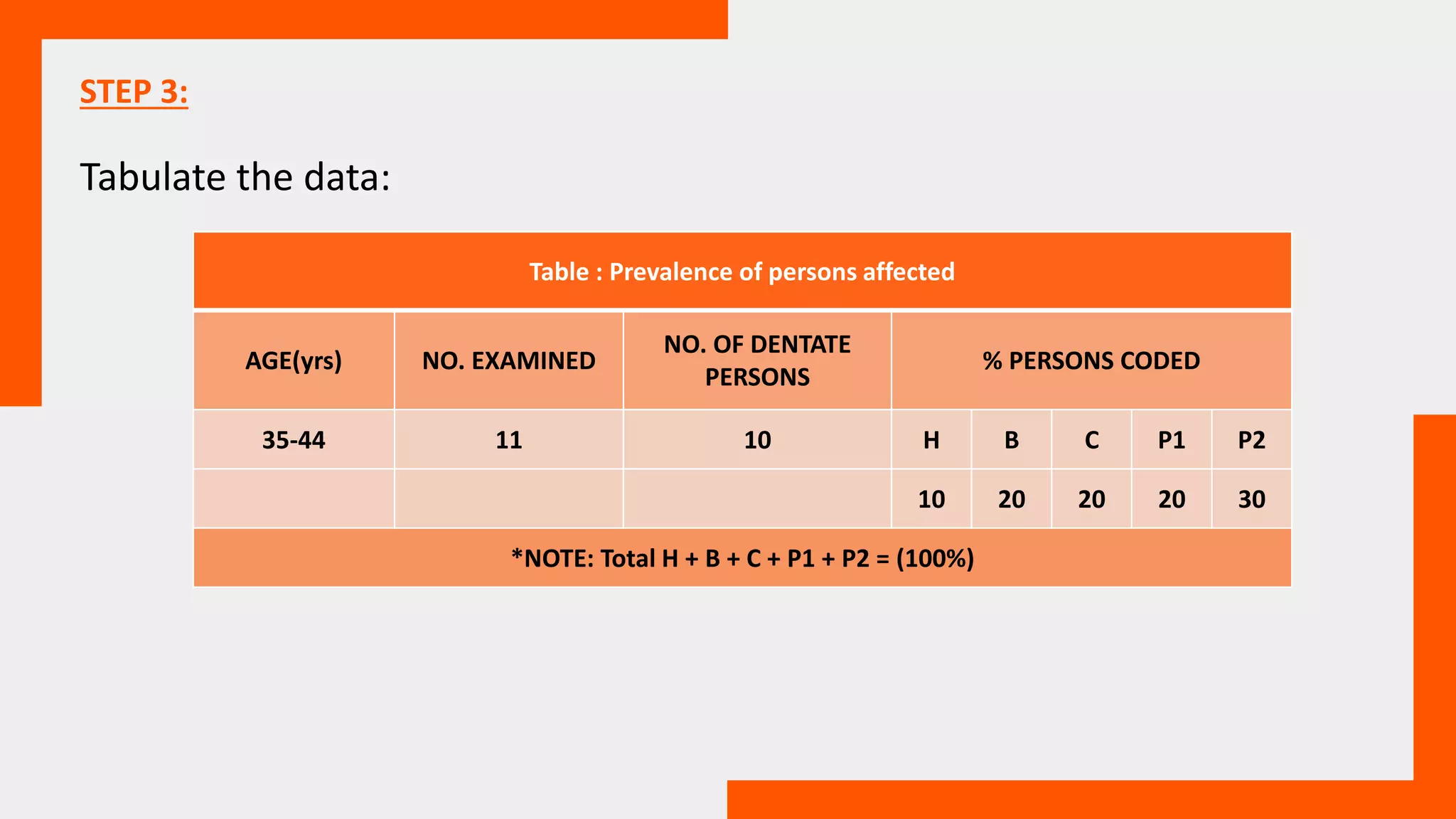
Tabulate the data:
Table : Prevalence of persons affected
AGE(yrs) NO. EXAMINED
NO. OF DENTATE
PERSONS
% PERSONS CODED
35-44 11 10 H B C P1 P2
10 20 20 20 30
*NOTE: Total H + B + C + P1 + P2 = (100%)
COMMUNITY
PERIODONTAL
INDEX
(CPI)
• This index is modification of CPITN.
• The modification is done by the inclusion of measurement of
‘Loss of Attachment’ and elimination of the ‘Treatment
Needs’ category.
INSTRUMENTS USED:
• MOUTH MIRROR
• The CPITN - C PROBE
PROCEDURE:
Same as that of CPITN.
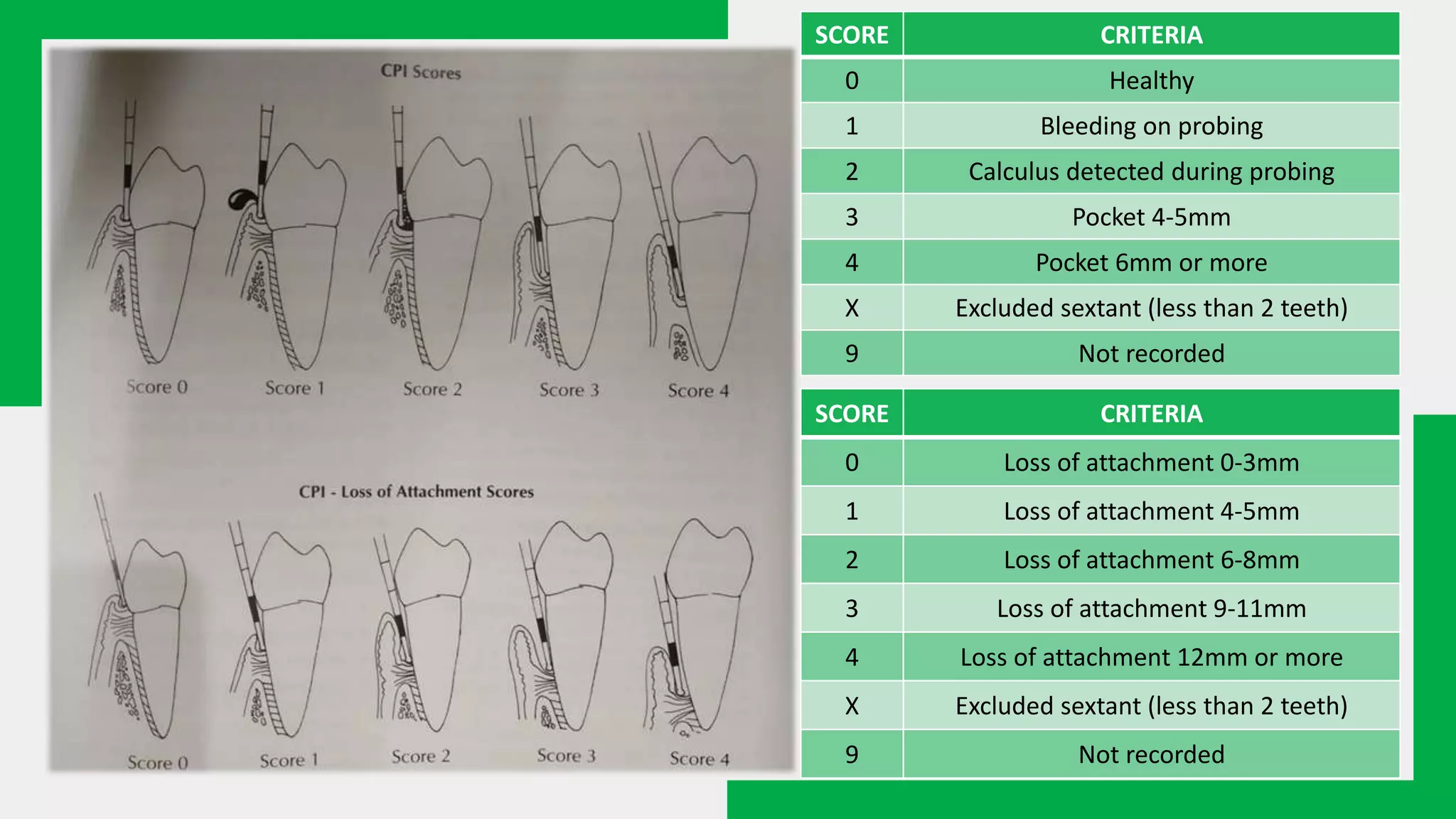
SCORE CRITERIA
0 Healthy
1 Bleeding on probing
2 Calculus detected during probing
3 Pocket 4-5mm
4 Pocket 6mm or more
X Excluded sextant (less than 2 teeth)
9 Not recorded
SCORE CRITERIA
0 Loss of attachment 0-3mm
1 Loss of attachment 4-5mm
2 Loss of attachment 6-8mm
3 Loss of attachment 9-11mm
4 Loss of attachment 12mm or more
X Excluded sextant (less than 2 teeth)
9 Not recorded
SUMMARY
• CPITN is a screening procedure for identifying actual and
potential problems posed by periodontal diseases both in the
community and in the individual, introduced in 1982.
• The CPITN records the common treatable conditions namely,
- periodontal pockets
- gingival inflammation
- dental calculus
- other plaque retentive factors
• CPITN PROBE (introduced by WHO in 1978) is used to
measure of pocket depth & detect sub-gingival calculus.
• COMMUNITY PERIODONTAL INDEX (CPI) is the modification of
CPITN which includes measurement of “loss of attachment”
STAY HOME. STAY SAFE
THANK YOU

CPITN INDEX (Community Periodontal Index of Treatment Needs)

  • 1.
    DEPARTMENT OF PUBLIC HEALTHDENTISTRY T O P I C O F P R E S E N T A T I O N : CPITN INDEX (Community Periodontal Index of Treatment Needs) PRESENTED BY: JEBAN JYOTI SAHU ROLL NO.: 1879032
  • 2.
    CONTENTS • INTRODUCTION • SCOPEAND PURPOSE • PROCEDURE • SEXTANT • INDEX TEETH • INSTRUMENTS USED • CPITN PROBE • PROBING PROCEDURE • EXAMINATION PROCEDURE • CALCULATION OF CPITN • COMMUNITY PERIODONTAL INDEX (CPI) • SUMMARY
  • 3.
    INTRODUCTION • CPITNwas introduced by JUKKA AINAMO , DAVID BARMES , GORGE BEAGRIE , TERRY CUTRESS , JEAN MARTIN and JENNIFER SARDO-INFIRRI for Joint working committee of the WHO and FDI in 1982 . • Developed primarily to survey and evaluate periodontal treatment needs rather than determining past and present periodontal status i.e. recession of the gingival margin and alveolar bone . • Treatment needs imply that CPITN assesses only those conditions potentially responsive to treatment , but not nontreatable or irreversible conditions .
  • 4.
    SCOPE AND PURPOSE • The CPITNprocedure is recommended for epidemiological surveys of periodontal health. • It provides guidance on planning and monitoring of the effectiveness of periodontal care programme and dental personnel required. • The CPITN records the common treatable conditions namely, - periodontal pockets - gingival inflammation - dental calculus - other plaque retentive factors • It doesn’t record irreversible changes such as recession or other deviations from periodontal health such as tooth mobility or loss of periodontal attachment.
  • 5.
    ADVANTAGES: Major Advantages ofCPITN are : • Simplicity • Speed • International Uniformity LIMITATIONS: • Does not record the position of gingival margin. • Does not provide assessment of past periodontal breakdown.
  • 6.
    PROCEDURE • Thedentition is divided into 6 parts called sextants. • Each sextant is given a score. • For epidemiological purposes the score is identified by examination of specified index teeth. • For clinical practise the highest score in each sextant is identified after examining all teeth.
  • 7.
    SEXTANT • The Mouthis divides into 6 sextants defined by tooth numbers as shown below- 17-14 13-23 24-27 47-44 43-33 34-37 • The third molars are not included except where they are functioning in place of second molars. • The treatment need in a sextant is recorded only if there are 2 or more teeth present and not indicated for extraction. • When only one tooth is present in a sextant, it is included in the adjacent sextant.
  • 8.
    INDEX TEETH • In Epidemiologicalsurveys for adults, aged 20 years or more, only 10 teeth, known as the Index Teeth are examined. • The ten specified index Teeth are :- • The Molars are examined in pairs and only one score, the highest is recorded. Only one score is recorded for each sextant. 17/16 11 26/27 47/46 31 36/37
  • 9.
    • For youngpeople upto 19 years, only 6 Index teeth are examined. The second molars are excluded as Index Teeth at these ages because of the high frequency of false pockets.(non-inflammatory, associated with tooth eruption) 16 11 26 46 31 36 • The six Index teeth selected are : • When examining children less than 15 years, Pockets are not recorded although probing for bleeding and calculus are carried out as a routine.
  • 10.
    INSTRUMENTS USED CPITN - CPROBE CPITN - E PROBE • CPITN PROBE • MOUTH MIRROR
  • 11.
    CPITN PROBE CPITN-E PROBE CPITN-C PROBE •Introduced by WHO in 1978. • Weight: 5gms • Designed for 2 purposes : 1. Measurement of pocket depth 2. Detection of Sub-gingival calculus • It has a 0.5mm ball at the tip and mm markings are at 3.5,5.5,8.5 and 11.5 and colour coding from 3.5 to 5.5. • Working force: 20-25 gms.
  • 12.
    • CPITN- CPROBE • CPITN- E PROBE
  • 13.
    PROBING PROCEDURE • A toothis probed to determine pocket depth and to detect subgingival calculus and bleeding response. PROBING FORCE WORKING COMPONENT SENSING COMPONENT To determine POCKET DEPTH To detect SUBGINGIVAL CALCULUS • Working force shouldn’t exceed 20gms- a practical test for establishing this force is to gently insert the probe point under the finger nail without causing pain or discomfort. • Pain to the patient during probing is in most cases indicative of the use of a too heavy probing force.
  • 14.
    • The probeis inserted between the tooth and gingiva , and the sulcus depth is noted against the color code or marking. • The ball end of the probe should be kept in contact with root surface. • Direction of probe during insertion should be whenever possible in the same plane as the long axis of the tooth. • ‘Walking’ the probe should be done with short upward & downward movements. Recommended sites for Probing: A tooth should be probed in atleast 6 points., MESIO-BUCCAL, MID-BUCCAL, DISTO-BUCCAL, & THE CORRESPONDING SITES ON THE LINGUAL SURFACE.
  • 15.
    EXAMINATION PROCEDURE • The aimis to determine the highest score applicable to each sextant with the least no. of measurements. • For a sextant to be validly scored, the requirement is that more than one functional tooth should be present. NO YES SCORE ‘X’, & MOVE TO NEXT SEXTANT EXAMINE INDEX TEETH (in epidemiological procedure) EXAMINE ALL TEETH (in clinical screening procedure) • Once the highest score has been determined (for each sextant) there is no need to examine for the presence of the lower score in that sextant.
  • 16.
    ‘CODES AND CRITERIA’& TREATEMENT NEEDS CODES CRITERIA TREATMENT NEEDS CODE 0 NO SIGNS OF DISEASE (HEALTHY PERIODONTIUM) TN 0 NO NEED FOR PERIODONTAL TREATMENT CODE 1 GINGIVAL BLEEDING AFTER GENTLE PROBING TN 1 NEED FOR IMPROVING THE PERSONAL ORAL HYGIENE OF THAT INDIVIDUAL CODE 2 PRESENCE OF SUPRA OR SUBGINGIVAL CALCULUS TN 2a NEED FOR SCALING. NEED FOR IMPROVING PERSONAL ORAL HYGIENE CODE 3 PATHOLOGICAL POCKET OF 4-5mm PRESENT, i.e, when the gingival margin is on the black area of the probe TN 2b SCALING AND ROOT PLANING. NEED FOR IMPROVING PERSONAL ORAL HYGIENE CODE 4 PATHOLOGICAL POCKET OF 6mm OR MORE PRESENT, the black area of CPITN probe is not visible TN 3 COMPLEX TREATMENT WHICH COULD INVOLVE DEEP SCALING, ROOT PLANING & MORE COMPLEX SURGICAL PROCEDURES. CODE X When only one or no teeth are present in a sextant (third molars are excluded unless they function in place of second molars)
  • 17.
    COMMUNITY PERIODONTAL INDEXOF TREATMENT NEEDS (CPITN)
  • 18.
    CALCULATION OF CPITN 0 00 0 0 0 3 3 3 3 4 3 1 1 0 1 1 1 X 4 4 4 4 X 4 3 1 2 3 1 0 1 0 0 1 0 3 3 3 3 3 3 2 0 2 0 2 0 2 1 3 1 2 3 X X X X X X 1 2 2 2 2 2 (1) (2) (3) (4) (5) (6) (7) (8) (9) (10) (11) EXAMPLE: The following recordings of a group of 11 adults of age group 35-44yr. STEP 1: Count the no. of charts with CODE 0 ONLY. This identifies no. of subjects with healthy sextants (H) Count the no. of charts with CODE 1 Recorded as highest score. (0,X,1) This identifies no. of subjects with gingival bleeding (B) Count the no. of charts with CODE 2 Recorded as highest score. (0,X,1,2) This identifies no. of subjects with calculus & other plaque retentive factors (C) Count the no. of charts with CODE 3 Recorded as highest score. (0,X,1,2,3) This identifies no. of subjects with pockets of 4-5mm (P1) Count the no. of charts with CODE 4 Recorded as highest score. This identifies no. of subjects with pockets of 6mm or more (P2)
  • 19.
    CALCULATIONS: The Chart shows: GreatestCode CODE 0 CODE 1 CODE 2 CODE 3 CODE 4 No. of Subjects 1 (1) 2 (2), (3) 2 (6), (9) 2 (8), (10) 3 (4), (5), (7) STEP 2: Calculate the percentages (prevalence): To obtain prevalence of subjects with CODES (0,1,2,3,4) as their highest score = Counts of CODES/No. of subjects respectively. Total no. of dentate subjects X 100 CODE 0 = 1 10 X 100 = 10 CODE 1 = 20 CODE 2 = 20 CODE 3 = 20 CODE 4 = 30
  • 20.
    STEP 3: Tabulate thedata: Table : Prevalence of persons affected AGE(yrs) NO. EXAMINED NO. OF DENTATE PERSONS % PERSONS CODED 35-44 11 10 H B C P1 P2 10 20 20 20 30 *NOTE: Total H + B + C + P1 + P2 = (100%)
  • 21.
    COMMUNITY PERIODONTAL INDEX (CPI) • This indexis modification of CPITN. • The modification is done by the inclusion of measurement of ‘Loss of Attachment’ and elimination of the ‘Treatment Needs’ category. INSTRUMENTS USED: • MOUTH MIRROR • The CPITN - C PROBE PROCEDURE: Same as that of CPITN.
  • 22.
    SCORE CRITERIA 0 Healthy 1Bleeding on probing 2 Calculus detected during probing 3 Pocket 4-5mm 4 Pocket 6mm or more X Excluded sextant (less than 2 teeth) 9 Not recorded SCORE CRITERIA 0 Loss of attachment 0-3mm 1 Loss of attachment 4-5mm 2 Loss of attachment 6-8mm 3 Loss of attachment 9-11mm 4 Loss of attachment 12mm or more X Excluded sextant (less than 2 teeth) 9 Not recorded
  • 23.
    SUMMARY • CPITN isa screening procedure for identifying actual and potential problems posed by periodontal diseases both in the community and in the individual, introduced in 1982. • The CPITN records the common treatable conditions namely, - periodontal pockets - gingival inflammation - dental calculus - other plaque retentive factors • CPITN PROBE (introduced by WHO in 1978) is used to measure of pocket depth & detect sub-gingival calculus. • COMMUNITY PERIODONTAL INDEX (CPI) is the modification of CPITN which includes measurement of “loss of attachment”
  • 24.
    STAY HOME. STAYSAFE THANK YOU