DISEASES OF
 THE PULP


     Prepared by:
          Dr. Rea Corpuz
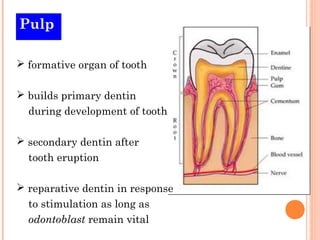
Pulp

 formative organ of tooth

 builds primary dentin
  during development of tooth

 secondary dentin after
  tooth eruption

 reparative dentin in response
  to stimulation as long as
  odontoblast remain vital
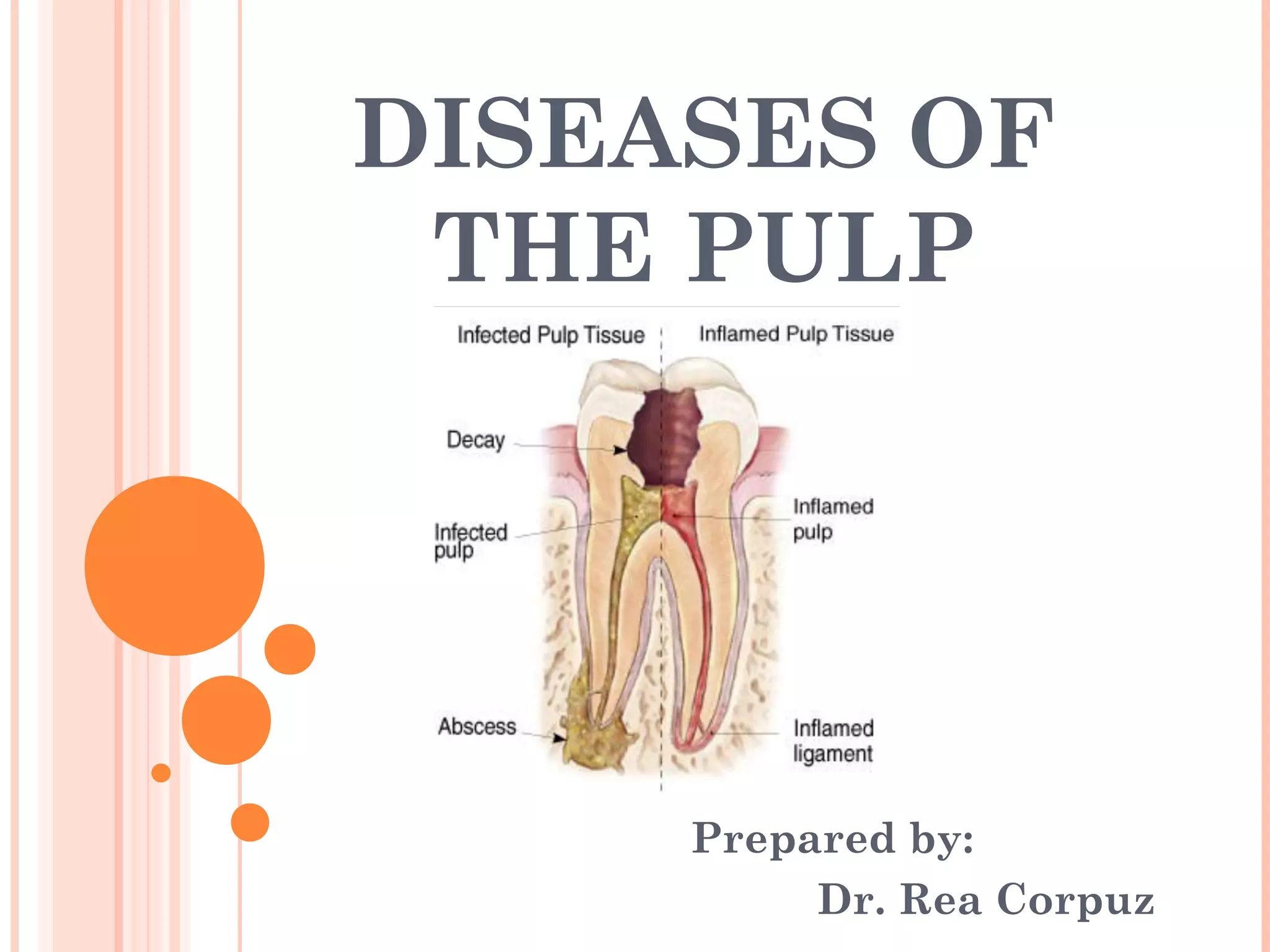
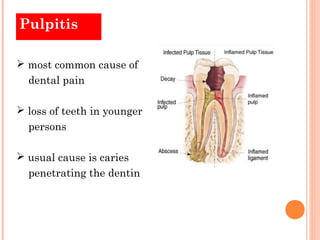
Pulpitis

 most common cause of
  dental pain

 loss of teeth in younger
  persons

 usual cause is caries
  penetrating the dentin
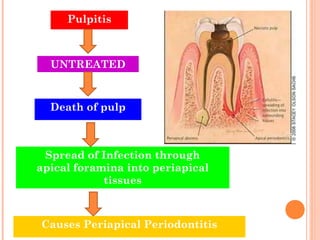
Pulpitis


  UNTREATED


  Death of pulp


 Spread of Infection through
apical foramina into periapical
            tissues


Causes Periapical Periodontitis
Causes of Pulpal
Inflammation
 (1) Mechanical Cause

 (2) Thermal Cause

 (3) Chemical Cause

 (4) Bacterial Cause
Causes of Pulpal
Inflammation
 (1) Mechanical Cause

    traumatic accident

    iatrogenic damage for
     dental procedure

    atrrition

    abrasion
Causes of Pulpal
Inflammation
 (2) Thermal Cause

   uninsulated metallic
     restoration

   during cavity preparation

   polishing
Causes of Pulpal
Inflammation
 (3) Chemical Cause

   arise from erosion

   or inappropriate use
     of acidic dental material
Causes of Pulpal
Inflammation
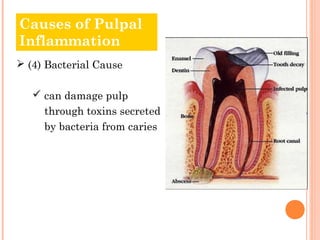
 (4) Bacterial Cause

    can damage pulp
     through toxins secreted
     by bacteria from caries
Classification

 (1) Based on Severity of
     Inflammation

 (2) According to Involvement
(1) Based on Severity
    of Inflammation

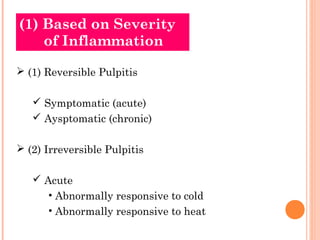
 (1) Reversible Pulpitis

 (2) Irreversible Pulpitis

 (3) Pulp Degeneration

 (4) Pulp Necrosis
(1) Based on Severity
    of Inflammation

 (1) Reversible Pulpitis

    Symptomatic (acute)
    Aysptomatic (chronic)

 (2) Irreversible Pulpitis

    Acute
      • Abnormally responsive to cold
      • Abnormally responsive to heat
(1) Based on Severity
    of Inflammation

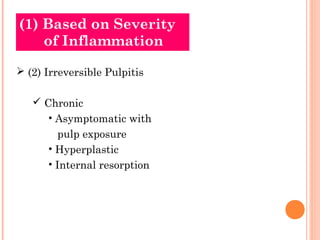
 (2) Irreversible Pulpitis

    Chronic
      • Asymptomatic with
         pulp exposure
      • Hyperplastic
      • Internal resorption
(1) Based on Severity
    of Inflammation
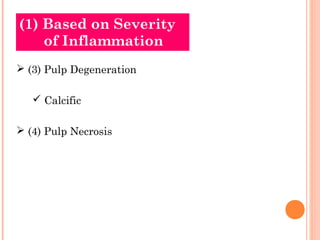
 (3) Pulp Degeneration

    Calcific

 (4) Pulp Necrosis
(2) According to
    Involvement
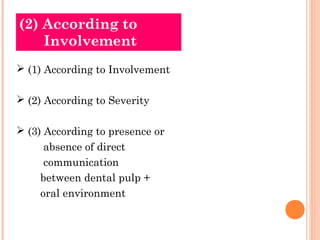
 (1) According to Involvement

 (2) According to Severity

 (3) According to presence or
     absence of direct
     communication
    between dental pulp +
    oral environment
(2) According to
    Involvement
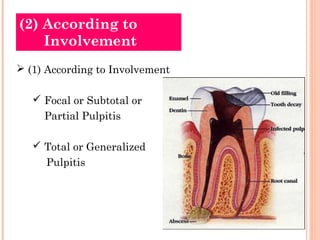
 (1) According to Involvement

    Focal or Subtotal or
     Partial Pulpitis

    Total or Generalized
     Pulpitis
(2) According to
    Involvement

 (2) According to Severity

    Acute
    Chronic
(2) According to
    Involvement

 (3) According to presence or
     absence of direct
     communication
    between dental pulp +
    oral environment

    Pulpitis Aperts (open pulpitis)

    Pulpitis Clausa (closed pulpitis)
Reversible Pulpitis


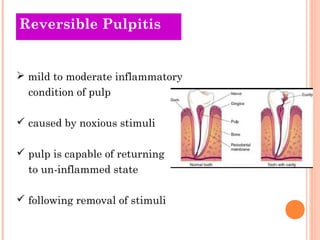
 mild to moderate inflammatory
  condition of pulp

 caused by noxious stimuli

 pulp is capable of returning
  to un-inflammed state

 following removal of stimuli
Reversible Pulpitis

 Causes

   agent capable of
    injuring pulp like:

     • trauma
     • disturbed occlusal
        relationship
     • thermal shock
Reversible Pulpitis

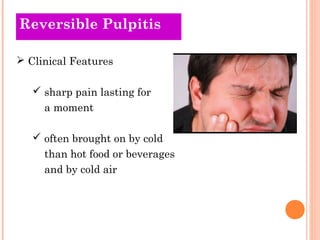
 Clinical Features

    sharp pain lasting for
     a moment

    often brought on by cold
     than hot food or beverages
     and by cold air
Reversible Pulpitis

 Clinical Features

    does not continue
     when the cause has been
     removed

    tooth responds to electric
     pulp testing at lower
     current
Reversible Pulpitis

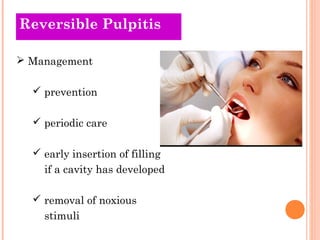
 Management

   prevention

   periodic care

   early insertion of filling
    if a cavity has developed

   removal of noxious
    stimuli
Focal Reversible
Pulpitis
earliest form

 also known as pulp hyperemia

 excessive accumulation of
  blood within pulp tissue

 leads to vascular congestion
Focal Reversible
Pulpitis
 Clinical Features

    sensitive to thermal
     changes

    particularly to cold

    application of ice or cold
    fluids to tooth result in pain
Focal Reversible
Pulpitis
 Clinical Features

    disappears upon removal
     of thermal irritant or
     restoration of normal
     temperature

    responds to electrical test
     stimulant at lower level
     of current
Focal Reversible
Pulpitis
 Clinical Features

    indicates lower pain
     threshold than that of
     adjacent normal
     teeth
Focal Reversible
Pulpitis
 Clinical Features

    teeth show:

      • deep carious lesion

      • large metallic restoration

      • restoration with defective
        margins
Focal Reversible
Pulpitis
 Management

   removal of irritants
    before the pulp is
    severely damaged
Irreversible Pulpitis


 persistent inflammatory
  condition of pulp

 may be symptomatic or
  asymptomatic

 caused by noxious stimulus
Irreversible Pulpitis


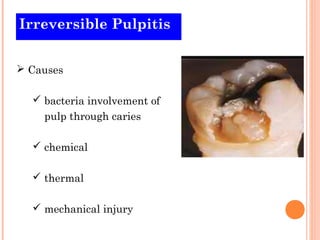
 Causes

   bacteria involvement of
    pulp through caries

   chemical

   thermal

   mechanical injury
Irreversible Pulpitis


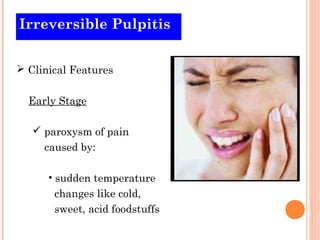
 Clinical Features


  Early Stage

    paroxysm of pain
     caused by:

      • sudden temperature
       changes like cold,
       sweet, acid foodstuffs
Irreversible Pulpitis


 Clinical Features


  Early Stage

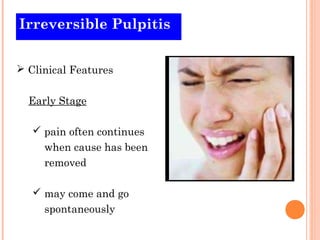
    pain often continues
     when cause has been
     removed

    may come and go
     spontaneously
Irreversible Pulpitis


 Clinical Features


  Early Stage

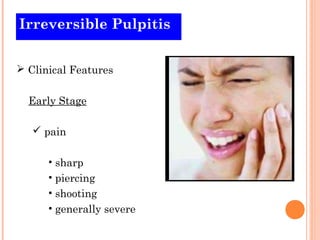
    pain

      • sharp
      • piercing
      • shooting
      • generally severe
Irreversible Pulpitis


 Clinical Features


  Early Stage

    pain

      • bending over         exacerbates pain which
      • lying down           is due to change in
      • change of position   intrapulpal pressure
Irreversible Pulpitis


 Clinical Features


  Late Stage

    pain

      • more severe   as if tooth is under
      • throbbing     constant pressure
Irreversible Pulpitis
 Clinical Features


  Late Stage

    pain

      • patient is often awake
        at night due to pain

      • increased by heat and
       sometimes relieved by cold,
       although continued application
       of cold may intensify pain
Irreversible Pulpitis
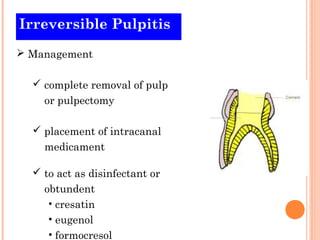
 Management

   complete removal of pulp
    or pulpectomy

   placement of intracanal
    medicament

   to act as disinfectant or
    obtundent
     • cresatin
     • eugenol
     • formocresol
Clinical Difference

  Reversible Pulpitis             Irreversible Pulpitis
   pain is generally traceable    more severe
    to a stimulus                  lasts longer
   cold water                     pain may come
   air                           without
                                    any apparent stimulus
Acute Pulpitis

 extensive acute inflammation
  of pulp

 frequent sequel of focal
  reversible pulpitis
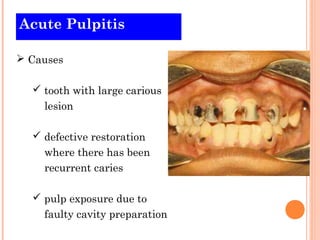
Acute Pulpitis

 Causes

   tooth with large carious
    lesion

   defective restoration
    where there has been
    recurrent caries

   pulp exposure due to
    faulty cavity preparation
Acute Pulpitis

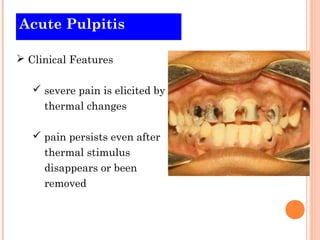
 Clinical Features

    severe pain is elicited by
     thermal changes

    pain persists even after
     thermal stimulus
     disappears or been
     removed
Acute Pulpitis

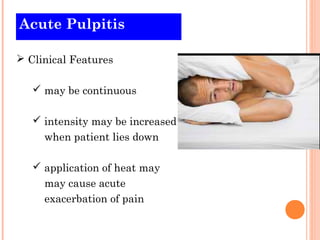
 Clinical Features

    may be continuous

    intensity may be increased
     when patient lies down

    application of heat may
     may cause acute
     exacerbation of pain
Acute Pulpitis

 Clinical Features

    tooth reacts to electric
     pulp vitality tester at a
     lower level of current
     than adjacent normal
     teeth
Acute Pulpitis

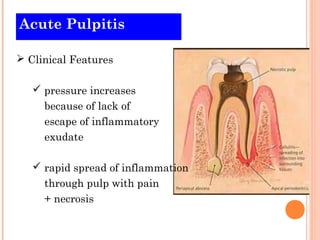
 Clinical Features

    pressure increases
     because of lack of
     escape of inflammatory
     exudate

    rapid spread of inflammation
     through pulp with pain
     + necrosis
Acute Pulpitis

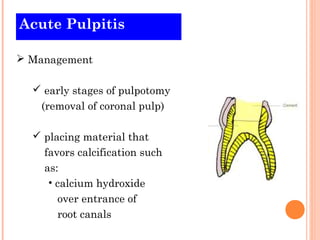
 Management

   early stages of pulpotomy
   (removal of coronal pulp)

   placing material that
    favors calcification such
    as:
     • calcium hydroxide
       over entrance of
       root canals
Acute Pulpitis

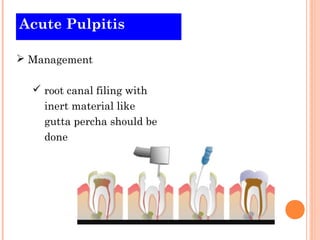
 Management

   root canal filing with
    inert material like
    gutta percha should be
    done
Chronic Pulpitis

 may develop with or
  without episodes of
  acute pulpitis

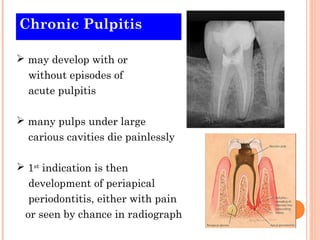
 many pulps under large
  carious cavities die painlessly

 1st indication is then
  development of periapical
  periodontitis, either with pain
 or seen by chance in radiograph
Chronic Pulpitis

 Clinical Features

    dull aching type

    more often intermittent
     than continuous
Chronic Pulpitis

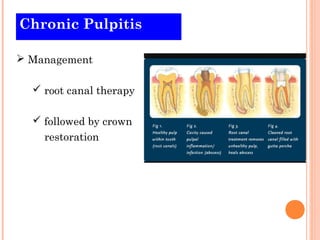
 Management

   root canal therapy

   followed by crown
    restoration
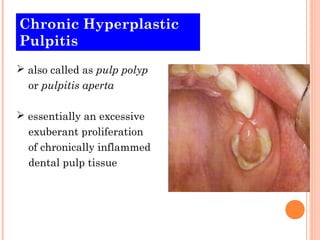
Chronic Hyperplastic
Pulpitis
 also called as pulp polyp
  or pulpitis aperta

 essentially an excessive
  exuberant proliferation
  of chronically inflammed
  dental pulp tissue
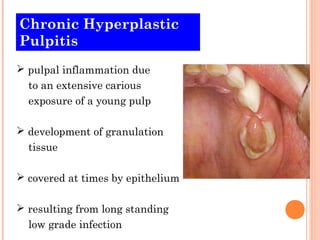
Chronic Hyperplastic
Pulpitis
 pulpal inflammation due
  to an extensive carious
  exposure of a young pulp

 development of granulation
  tissue

 covered at times by epithelium
 resulting from long standing
  low grade infection
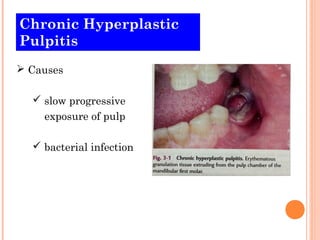
Chronic Hyperplastic
Pulpitis
 Causes

   slow progressive
    exposure of pulp

   bacterial infection
Chronic Hyperplastic
Pulpitis
 Clinical Features

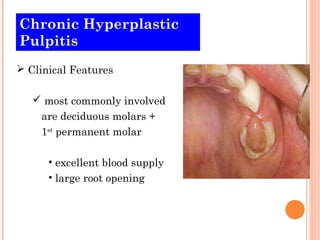
    most commonly involved
    are deciduous molars +
    1st permanent molar

      • excellent blood supply
      • large root opening
Chronic Hyperplastic
Pulpitis
 Clinical Features

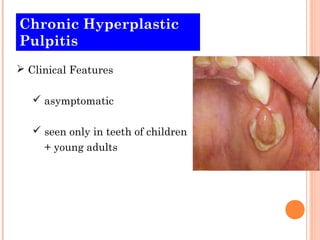
    asymptomatic

    seen only in teeth of children
     + young adults
Chronic Hyperplastic
Pulpitis
 Clinical Features

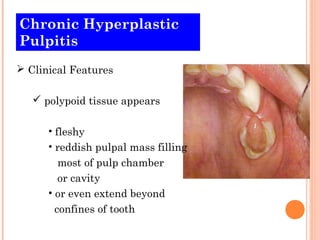
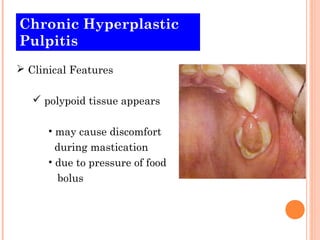
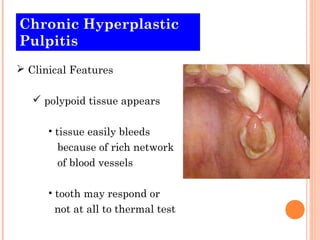
    polypoid tissue appears

      • fleshy
      • reddish pulpal mass filling
         most of pulp chamber
         or cavity
      • or even extend beyond
        confines of tooth
Chronic Hyperplastic
Pulpitis
 Clinical Features

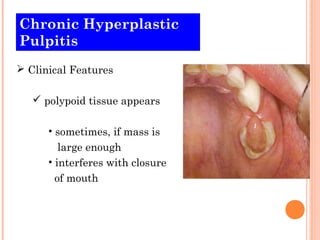
    polypoid tissue appears

      • sometimes, if mass is
         large enough
      • interferes with closure
        of mouth
Chronic Hyperplastic
Pulpitis
 Clinical Features

    polypoid tissue appears

      • may cause discomfort
        during mastication
      • due to pressure of food
        bolus
Chronic Hyperplastic
Pulpitis
 Clinical Features

    polypoid tissue appears

      • tissue easily bleeds
        because of rich network
        of blood vessels

      • tooth may respond or
       not at all to thermal test
Chronic Hyperplastic
Pulpitis
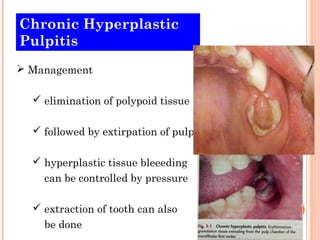
 Management

   elimination of polypoid tissue

   followed by extirpation of pulp

   hyperplastic tissue bleeeding
    can be controlled by pressure

   extraction of tooth can also
    be done
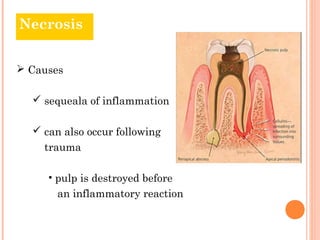
Necrosis


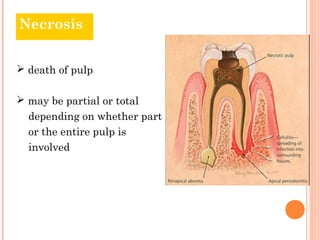
 death of pulp

 may be partial or total
  depending on whether part
  or the entire pulp is
  involved
Necrosis


 Causes

   sequeala of inflammation

   can also occur following
    trauma

     • pulp is destroyed before
       an inflammatory reaction
Necrosis


 Types

   (1) Coagulation Necrosis

   (2) Liquefaction Necrosis
Necrosis


 Types

   (1) Coagulation Necrosis

     • soluble portion of
       tissue is precipitated
     • or converted into a solid
       material
Necrosis


 Types

   (1) Coagulation Necrosis

     • tissue is converted into
          tissue mass consisting
          chiefly of coagulated

            proteins
            fats
            water
Necrosis


 Types

   (2) Liquefaction Necrosis

     • results when proteolytic
          enzymes convert the
          tissue into softened mass
          liquid or amorphous debris
Necrosis


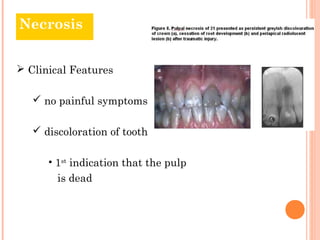
 Clinical Features

    no painful symptoms

    discoloration of tooth

      • 1st indication that the pulp
        is dead
Necrosis


 Clinical Features

    history of pain lasting from
     a few minutes to a few
     hours followed by
     complete + sudden
     cessation of pain
Necrosis


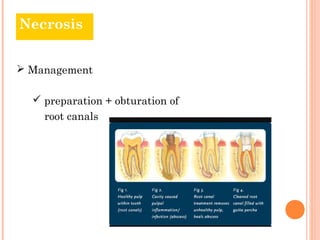
 Management

   preparation + obturation of
    root canals
References:
 Books
   Cawson, R.A: Cawson’s Essentials of Oral
       Oral Pathology and Oral Medicine,
       8th Edition
        • (page 60)
   Ghom, Ali & Mhaske, Shubhangi: Textbook of
       Oral Pathology
        • (pages 420-425)

Pulipitis

  • 1.
    DISEASES OF THEPULP Prepared by: Dr. Rea Corpuz
  • 2.
    Pulp  formative organof tooth  builds primary dentin during development of tooth  secondary dentin after tooth eruption  reparative dentin in response to stimulation as long as odontoblast remain vital
  • 3.
    Pulpitis  most commoncause of dental pain  loss of teeth in younger persons  usual cause is caries penetrating the dentin
  • 4.
    Pulpitis UNTREATED Death of pulp Spread of Infection through apical foramina into periapical tissues Causes Periapical Periodontitis
  • 5.
    Causes of Pulpal Inflammation (1) Mechanical Cause  (2) Thermal Cause  (3) Chemical Cause  (4) Bacterial Cause
  • 6.
    Causes of Pulpal Inflammation (1) Mechanical Cause  traumatic accident  iatrogenic damage for dental procedure  atrrition  abrasion
  • 7.
    Causes of Pulpal Inflammation (2) Thermal Cause  uninsulated metallic restoration  during cavity preparation  polishing
  • 8.
    Causes of Pulpal Inflammation (3) Chemical Cause  arise from erosion  or inappropriate use of acidic dental material
  • 9.
    Causes of Pulpal Inflammation (4) Bacterial Cause  can damage pulp through toxins secreted by bacteria from caries
  • 10.
    Classification  (1) Basedon Severity of Inflammation  (2) According to Involvement
  • 11.
    (1) Based onSeverity of Inflammation  (1) Reversible Pulpitis  (2) Irreversible Pulpitis  (3) Pulp Degeneration  (4) Pulp Necrosis
  • 12.
    (1) Based onSeverity of Inflammation  (1) Reversible Pulpitis  Symptomatic (acute)  Aysptomatic (chronic)  (2) Irreversible Pulpitis  Acute • Abnormally responsive to cold • Abnormally responsive to heat
  • 13.
    (1) Based onSeverity of Inflammation  (2) Irreversible Pulpitis  Chronic • Asymptomatic with pulp exposure • Hyperplastic • Internal resorption
  • 14.
    (1) Based onSeverity of Inflammation  (3) Pulp Degeneration  Calcific  (4) Pulp Necrosis
  • 15.
    (2) According to Involvement  (1) According to Involvement  (2) According to Severity  (3) According to presence or absence of direct communication between dental pulp + oral environment
  • 16.
    (2) According to Involvement  (1) According to Involvement  Focal or Subtotal or Partial Pulpitis  Total or Generalized Pulpitis
  • 17.
    (2) According to Involvement  (2) According to Severity  Acute  Chronic
  • 18.
    (2) According to Involvement  (3) According to presence or absence of direct communication between dental pulp + oral environment  Pulpitis Aperts (open pulpitis)  Pulpitis Clausa (closed pulpitis)
  • 19.
    Reversible Pulpitis  mildto moderate inflammatory condition of pulp  caused by noxious stimuli  pulp is capable of returning to un-inflammed state  following removal of stimuli
  • 20.
    Reversible Pulpitis  Causes  agent capable of injuring pulp like: • trauma • disturbed occlusal relationship • thermal shock
  • 21.
    Reversible Pulpitis  ClinicalFeatures  sharp pain lasting for a moment  often brought on by cold than hot food or beverages and by cold air
  • 22.
    Reversible Pulpitis  ClinicalFeatures  does not continue when the cause has been removed  tooth responds to electric pulp testing at lower current
  • 23.
    Reversible Pulpitis  Management  prevention  periodic care  early insertion of filling if a cavity has developed  removal of noxious stimuli
  • 24.
    Focal Reversible Pulpitis earliest form also known as pulp hyperemia  excessive accumulation of blood within pulp tissue  leads to vascular congestion
  • 25.
    Focal Reversible Pulpitis  ClinicalFeatures  sensitive to thermal changes  particularly to cold  application of ice or cold fluids to tooth result in pain
  • 26.
    Focal Reversible Pulpitis  ClinicalFeatures  disappears upon removal of thermal irritant or restoration of normal temperature  responds to electrical test stimulant at lower level of current
  • 27.
    Focal Reversible Pulpitis  ClinicalFeatures  indicates lower pain threshold than that of adjacent normal teeth
  • 28.
    Focal Reversible Pulpitis  ClinicalFeatures  teeth show: • deep carious lesion • large metallic restoration • restoration with defective margins
  • 29.
    Focal Reversible Pulpitis  Management  removal of irritants before the pulp is severely damaged
  • 30.
    Irreversible Pulpitis  persistentinflammatory condition of pulp  may be symptomatic or asymptomatic  caused by noxious stimulus
  • 31.
    Irreversible Pulpitis  Causes  bacteria involvement of pulp through caries  chemical  thermal  mechanical injury
  • 32.
    Irreversible Pulpitis  ClinicalFeatures Early Stage  paroxysm of pain caused by: • sudden temperature changes like cold, sweet, acid foodstuffs
  • 33.
    Irreversible Pulpitis  ClinicalFeatures Early Stage  pain often continues when cause has been removed  may come and go spontaneously
  • 34.
    Irreversible Pulpitis  ClinicalFeatures Early Stage  pain • sharp • piercing • shooting • generally severe
  • 35.
    Irreversible Pulpitis  ClinicalFeatures Early Stage  pain • bending over exacerbates pain which • lying down is due to change in • change of position intrapulpal pressure
  • 36.
    Irreversible Pulpitis  ClinicalFeatures Late Stage  pain • more severe as if tooth is under • throbbing constant pressure
  • 37.
    Irreversible Pulpitis  ClinicalFeatures Late Stage  pain • patient is often awake at night due to pain • increased by heat and sometimes relieved by cold, although continued application of cold may intensify pain
  • 38.
    Irreversible Pulpitis  Management  complete removal of pulp or pulpectomy  placement of intracanal medicament  to act as disinfectant or obtundent • cresatin • eugenol • formocresol
  • 39.
    Clinical Difference Reversible Pulpitis Irreversible Pulpitis  pain is generally traceable  more severe to a stimulus  lasts longer  cold water  pain may come  air without any apparent stimulus
  • 40.
    Acute Pulpitis  extensiveacute inflammation of pulp  frequent sequel of focal reversible pulpitis
  • 41.
    Acute Pulpitis  Causes  tooth with large carious lesion  defective restoration where there has been recurrent caries  pulp exposure due to faulty cavity preparation
  • 42.
    Acute Pulpitis  ClinicalFeatures  severe pain is elicited by thermal changes  pain persists even after thermal stimulus disappears or been removed
  • 43.
    Acute Pulpitis  ClinicalFeatures  may be continuous  intensity may be increased when patient lies down  application of heat may may cause acute exacerbation of pain
  • 44.
    Acute Pulpitis  ClinicalFeatures  tooth reacts to electric pulp vitality tester at a lower level of current than adjacent normal teeth
  • 45.
    Acute Pulpitis  ClinicalFeatures  pressure increases because of lack of escape of inflammatory exudate  rapid spread of inflammation through pulp with pain + necrosis
  • 46.
    Acute Pulpitis  Management  early stages of pulpotomy (removal of coronal pulp)  placing material that favors calcification such as: • calcium hydroxide over entrance of root canals
  • 47.
    Acute Pulpitis  Management  root canal filing with inert material like gutta percha should be done
  • 48.
    Chronic Pulpitis  maydevelop with or without episodes of acute pulpitis  many pulps under large carious cavities die painlessly  1st indication is then development of periapical periodontitis, either with pain or seen by chance in radiograph
  • 49.
    Chronic Pulpitis  ClinicalFeatures  dull aching type  more often intermittent than continuous
  • 50.
    Chronic Pulpitis  Management  root canal therapy  followed by crown restoration
  • 51.
    Chronic Hyperplastic Pulpitis  alsocalled as pulp polyp or pulpitis aperta  essentially an excessive exuberant proliferation of chronically inflammed dental pulp tissue
  • 52.
    Chronic Hyperplastic Pulpitis  pulpalinflammation due to an extensive carious exposure of a young pulp  development of granulation tissue  covered at times by epithelium  resulting from long standing low grade infection
  • 53.
    Chronic Hyperplastic Pulpitis  Causes  slow progressive exposure of pulp  bacterial infection
  • 54.
    Chronic Hyperplastic Pulpitis  ClinicalFeatures  most commonly involved are deciduous molars + 1st permanent molar • excellent blood supply • large root opening
  • 55.
    Chronic Hyperplastic Pulpitis  ClinicalFeatures  asymptomatic  seen only in teeth of children + young adults
  • 56.
    Chronic Hyperplastic Pulpitis  ClinicalFeatures  polypoid tissue appears • fleshy • reddish pulpal mass filling most of pulp chamber or cavity • or even extend beyond confines of tooth
  • 57.
    Chronic Hyperplastic Pulpitis  ClinicalFeatures  polypoid tissue appears • sometimes, if mass is large enough • interferes with closure of mouth
  • 58.
    Chronic Hyperplastic Pulpitis  ClinicalFeatures  polypoid tissue appears • may cause discomfort during mastication • due to pressure of food bolus
  • 59.
    Chronic Hyperplastic Pulpitis  ClinicalFeatures  polypoid tissue appears • tissue easily bleeds because of rich network of blood vessels • tooth may respond or not at all to thermal test
  • 60.
    Chronic Hyperplastic Pulpitis  Management  elimination of polypoid tissue  followed by extirpation of pulp  hyperplastic tissue bleeeding can be controlled by pressure  extraction of tooth can also be done
  • 61.
    Necrosis  death ofpulp  may be partial or total depending on whether part or the entire pulp is involved
  • 62.
    Necrosis  Causes  sequeala of inflammation  can also occur following trauma • pulp is destroyed before an inflammatory reaction
  • 63.
    Necrosis  Types  (1) Coagulation Necrosis  (2) Liquefaction Necrosis
  • 64.
    Necrosis  Types  (1) Coagulation Necrosis • soluble portion of tissue is precipitated • or converted into a solid material
  • 65.
    Necrosis  Types  (1) Coagulation Necrosis • tissue is converted into tissue mass consisting chiefly of coagulated  proteins  fats  water
  • 66.
    Necrosis  Types  (2) Liquefaction Necrosis • results when proteolytic enzymes convert the tissue into softened mass liquid or amorphous debris
  • 67.
    Necrosis  Clinical Features  no painful symptoms  discoloration of tooth • 1st indication that the pulp is dead
  • 68.
    Necrosis  Clinical Features  history of pain lasting from a few minutes to a few hours followed by complete + sudden cessation of pain
  • 69.
    Necrosis  Management  preparation + obturation of root canals
  • 70.
    References:  Books  Cawson, R.A: Cawson’s Essentials of Oral Oral Pathology and Oral Medicine, 8th Edition • (page 60)  Ghom, Ali & Mhaske, Shubhangi: Textbook of Oral Pathology • (pages 420-425)