PLAQUE DISCLOSING AGENTS
CONTENTS
I. DEFINITION OF PLAQUE
II. DENTAL PLAQUE: A HOST-ASSOCIATED BIOFILM
III. SIGNIFICANCE OF PLAQUE IN DEVELOPMENT OF PERIODONTAL DISEASE
IV. IDENTIFICATION OF DENTAL PLAQUE
V. DEFINITION OF DISCLOSING AGENT
VI. HISTORY
VII. UTILITY
VIII. IDEAL PROPERTIES
IX. COMPOSITION
X. MECHANISM OF ACTION
XI. DYES USED AS DISCLOSING AGENT
XII. METHOD OF APPLICATION
XIII. APPLIED ASPECTS
XIV. CONCLUSION
XV. REFERENCES 2
1. WHO (1978):
Dental plaque is defined as a specific but highly variable structural
resulting from sequential colonization and growth of micro
on the surfaces of teeth and restoration consisting of micro
of various strains and species are embedded in the extra cellular
composed of bacterial metabolic products and substance from
saliva and blood.
3
I. DEFINITION OF DENTAL PLAQUE
2. Bradshaw and Marsh (1999):
Dental plaque is a microbial biofilm, a diverse microbial community
found on the tooth surface embedded in a matrix of polymers of
bacterial and salivary origin.
4
Dumitrescu AL. Etiology and Pathogenesis of Periodontal disease: Springer – Verlag Berlin
Heidelberg, 2010.
II. DENTAL PLAQUE: A HOST-ASSOCIATED BIOFILM
 Dental plaque is a host-associated biofilm. The significance
of the biofilm environment has been increasingly
recognized because the environment itself may alter
properties of microorganisms. The biofilm community is
initially formed through bacterial interactions with the
tooth and then through physical and physiologic
interactions among different species within the microbial
mass. Furthermore, the bacteria found in the plaque
biofilm are strongly influenced by external environmental
factors that may be host mediated.
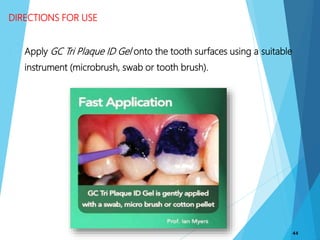
5Newman et al. Carranza’s Clinical Periodontology. ed.3. W.B. Saunders Co.2002.
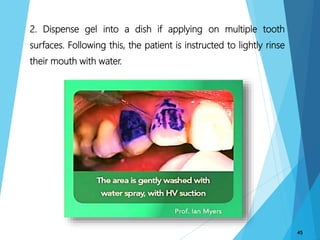
 Macroscopically,
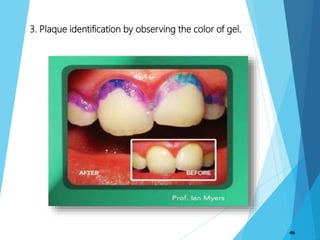
Classified as Supragingival & Subgingival plaque, based on its
position of the tooth surface.
Marginal plaque – The supragingival plaque in direct contact
with the gingival margin. Holds prime importance in the
development of gingivitis.
6Newman et al. Carranza’s Clinical Periodontology. ed.3. W.B. Saunders Co.2002.
III. SIGNIFICANCE OF PLAQUE IN DEVELOPMENT OF
PERIODONTAL DISEASE
• Once the biofilm has formed, the species composition at a site is
characterized by a degree of stability or balance among the component
species, despite regular minor environmental stresses following, for
example, periodic oral hygiene, food intake or diurnal changes in saliva
flow. Importantly, this stability (termed microbial homeostasis) is not due
to any biological indifference among the resident organisms, but is due
to a dynamic balance imposed by numerous microbial interactions.
7Newman et al. Carranza’s Clinical Periodontology. ed.3. W.B. Saunders Co.2002.
8
• Bacteria respond to environmental change, and, microbial
homeostasis can break down if a key parameter exceeds the
threshold that is compatible with community stability.
• A consequence of homeostasis breakdown is re-organization of
the structure and composition of the microbial community, with
previous species that were only minor components becoming
more competitive under the new conditions, and, as a result, more
dominant. Such a change in community composition and activity
can predispose a site to disease.
Newman et al. Carranza’s Clinical Periodontology. ed.3. W.B. Saunders Co.2002.
IV. IDENTIFICATION OF DENTAL PLAQUE
9
• Elimination of bacterial plaque from tooth surfaces is essential for
maintaining dental health (Loe et al 1965, 1971, Lovdal et al 1958, 1961,
Suomi et al 1969, 1971, Greene and Vermillion 1971).
• It is often difficult, however, to convince patients about the importance of
performing thorough oral hygiene.
• Patient motivation, therefore, represents an important aspect in improving
oral hygiene.
Lang et al 1972. A fluorescent plaque disclosing agent. J. Periodont.Res. 7: 59-67.
 The use of agents which stain and disclose bacterial plaque in situ is
generally thought to enhance motivation by enabling the patient to detect
deposits on the teeth and to control the efficacy of his oral hygiene
techniques.
 Home care aids: 1. Tooth brushing methods
2. Dentifrices(ShoPlaq , PlaqueHD)
may contain plaque disclosing agent that permits dental plaque
observation.
 Staining of bacterial plaque aids in efficient plaque removal teaches the
significance of plaque in periodontal disease.
Shefali Sharma 2010. Plaque Disclosing Agent – A Review. J Adv Dental Research.2[1]:1-3 10
Raybin (1943):
A disclosing agent is a solution which when applied on the tooth,
makes visible by staining roughness and foreign matter on the tooth.
World English Dictionary:
A disclosing agent is a dye in liquid or tablet form that colors
something, especially the teeth to show plaque.
V. DEFINITION OF DISCLOSING AGENT
11Shefali Sharma 2010. Plaque Disclosing Agent – A Review. J Adv Dental Research.2[1]:1-3
VI. HISTORY
1. Skinner in 1914: First disclosing solution (Skinner’s
iodine solution). Patients' teeth were disclosed with this
solution to demonstrate "soft accumulations" which
had to be removed by the patient at home.
2. Berwick in 1920: Combination of Brilliant green –
crystal violet.
3. Easlick in 1935: Bismark brown.
4. Raybin in 1943: Gentian violet (non-iodine dye)e
Cohen et al 1972. A Comparison of Bacterial Plaque Disclosants in Periodontal
Disease. J Periodonol.43[6]: 333-338. 12
VII. UTILITY OF DISCLOSING AGENT
a. Diagnosing the dental plaque.
b. Personalized patient instruction and motivation.
c. Self- evaluation by the patient.
d. To evaluate the effectiveness of oral hygiene maintenance.
e. Preparation of plaque indices.
13Shefali Sharma 2010. Plaque Disclosing Agent – A Review. J Adv Dental Research.2[1]:1-3
1. Taste:
i. Patient comfort.
ii. Flavored.
iii. Should encourage patient co-operation.
2. Intensity of color:
i. Evident contrast  to differentiate from surrounding environment.
3. Duration of Intensity: Retentive – The color should not rinse off with
ordinary rinsing methods for the period of time required to complete the
instructions or clinical examination.
4. Non-irritating to oral mucosa.
5. Non-allergic.
6. Antiseptic property.
VIII. IDEAL PROPERTIES
14Shefali Sharma 2010. Plaque Disclosing Agent – A Review. J Adv Dental Research.2[1]:1-3
7. The dye must be capable of adequately penetrating the plaque
deposit.
8. Selective staining efficacy.
9. Water-soluble.
15Skaggs et al.,1991. Plaque Disclosing Compositions. United States Patent: 1-7
IX. COMPOSITION
 Pertains to combinations of dyes-
I. FDC Red No. 3(Erythrosin) and FDC Blue No. 1;
II. FD&C Blue No. 2;
III. FD&C Green No.5;
IV. FD&C Blue No. 1 and D&C Yellow No. 5;
V. D. & C. Yellow No. 8 (Fluorescein);
VI. FD&C Red No. 3 and FD&C Green No. 3;
VII. FD&C Red No. 3 and Hercules Green Shade 3;
VIII. FD&C Red No. 40, or Allura Red (0.05%-10%);
IX. FD&C Red No. 22 (eocine)
16Skaggs et al.,1991. Plaque Disclosing Compositions. United States Patent: 1-7
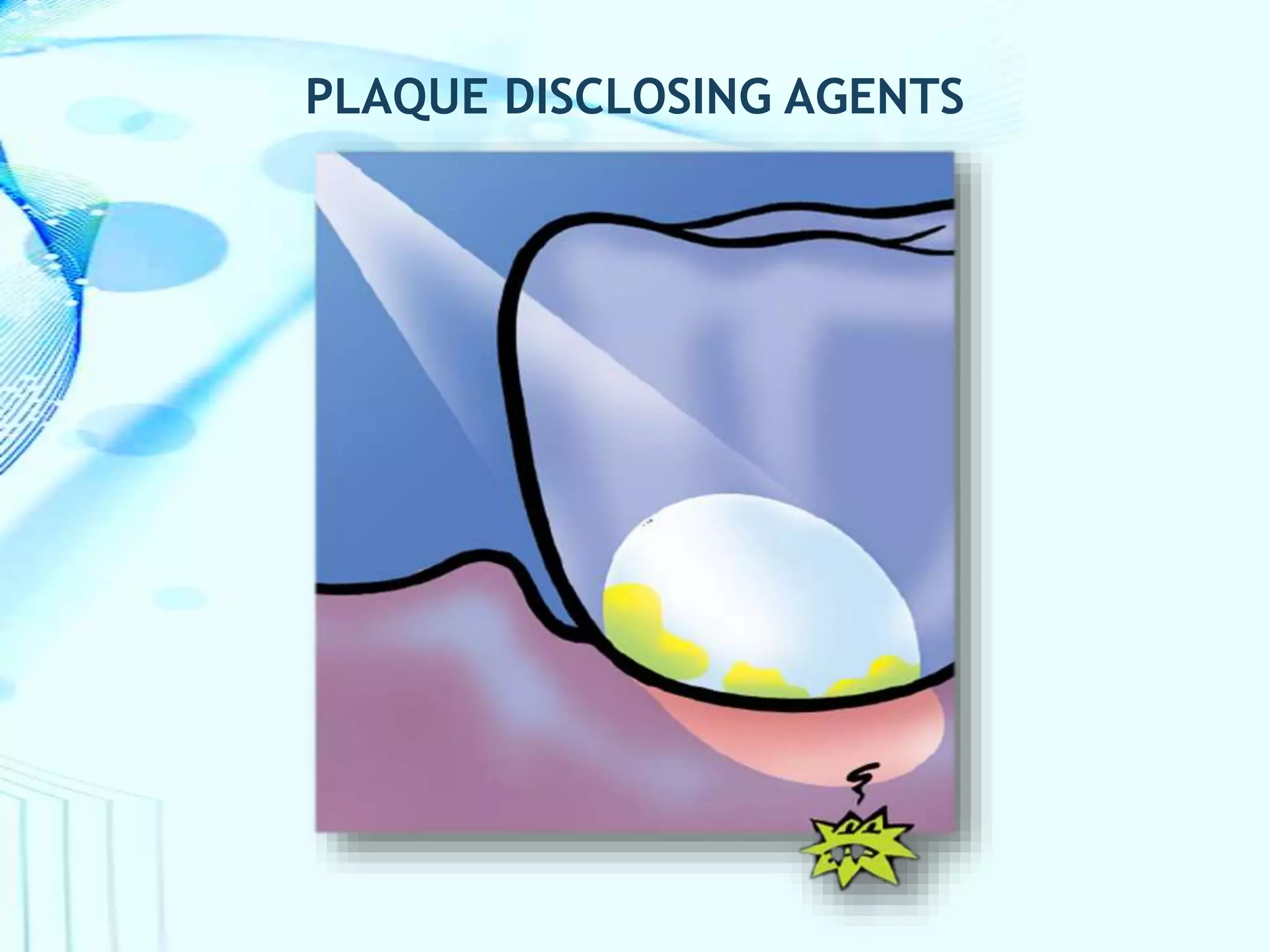
i. Disclosing agents work by changing the color of dental plaque so
that it contrasts with the white tooth surface.
ii. Dental plaque has the ability to retain a large number of dye
substances which can be used for disclosing purposes. This
property is related to interaction, because of the polarity difference
between the components of plaque and dyes(Gallagher et al, 1977).
The particles are bound to the surface by electrostatic
interaction(proteins) and hydrogen bonds(polysaccharides).
Chetrus and Ion 2013. Dental Plaque – classification, formation, and identification.
International Journal of Medical Dentistry.3[2]:139-143.
17
X. MECHANISM OF ACTION
2. Mercurochrome
preparations
3. Bismark brown
1. Iodine
preparations
5. Erythrosin
4. Merbromin
6. Fast green
8. Two tone
solution
9. Basic fuchsin
10. Three tone gel
7. Fluorescein
XI. DYES USED AS DISCLOSING AGENTS
18Shefali Sharma 2010. Plaque Disclosing Agent – A Review. J Adv Dental Research.2[1]:1-3
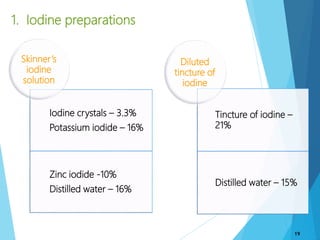
1. Iodine preparations
Iodine crystals – 3.3%
Potassium iodide – 16%
Zinc iodide -10%
Distilled water – 16%
Skinner’s
iodine
solution
Tincture of iodine –
21%
Distilled water – 15%
Diluted
tincture of
iodine
19
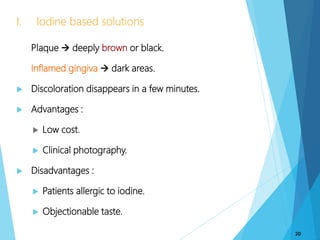
 Plaque  deeply brown or black.
 Inflamed gingiva  dark areas.
 Discoloration disappears in a few minutes.
 Advantages :
 Low cost.
 Clinical photography.
 Disadvantages :
 Patients allergic to iodine.
 Objectionable taste.
I. Iodine based solutions
20
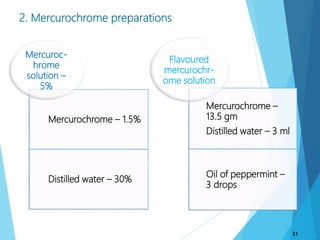
2. Mercurochrome preparations
Mercurochrome – 1.5%
Distilled water – 30%
Mercuroc-
hrome
solution –
5%
Mercurochrome –
13.5 gm
Distilled water – 3 ml
Oil of peppermint –
3 drops
Flavoured
mercurochr-
ome solution
21
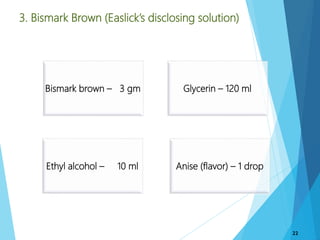
3. Bismark Brown (Easlick’s disclosing solution)
Bismark brown – 3 gm Glycerin – 120 ml
Ethyl alcohol – 10 ml Anise (flavor) – 1 drop
22
4. Merbromin
 Merbromin NF – 450 mg
 Oil of peppermint – 1 drop
 Distilled water – 100 ml
23
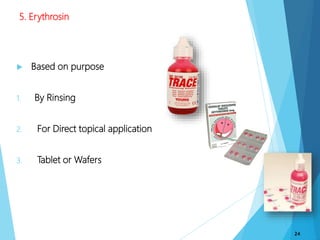
5. Erythrosin
 Based on purpose
1. By Rinsing
2. For Direct topical application
3. Tablet or Wafers
24
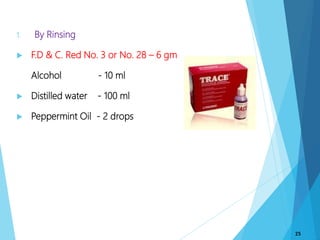
1. By Rinsing
 F.D & C. Red No. 3 or No. 28 – 6 gm
 Alcohol - 10 ml
 Distilled water - 100 ml
 Peppermint Oil - 2 drops
25
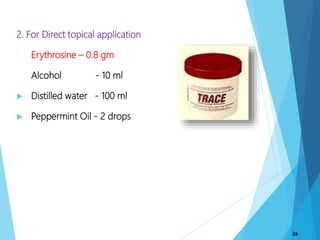
2. For Direct topical application
 Erythrosine – 0.8 gm
 Alcohol - 10 ml
 Distilled water - 100 ml
 Peppermint Oil - 2 drops
26
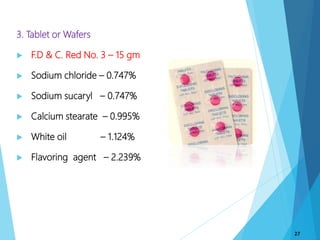
3. Tablet or Wafers
 F.D & C. Red No. 3 – 15 gm
 Sodium chloride – 0.747%
 Sodium sucaryl – 0.747%
 Calcium stearate – 0.995%
 White oil – 1.124%
 Flavoring agent – 2.239%
27
28
However, with regular use of the FDC Red No. 3 tablet, it became
abundantly clear that the “pleasing shade of red” adversely affected the
utility of wafer. The plaque interproximally and at the gingival margin,
especially in the posterior areas, could not easily be seen because of poor
contrast between the gingiva and the stained plaque. Accordingly, the use
of a red disclosing dye reveals that red is the wrong color since plaque that
has been stained red is extremely difficult to see due to poor contrast with
the oral tissues, especially in the back areas of the mouth and between the
teeth. It should be noted that it is these precise areas which are the most
prevalent sites of caries and periodontal disease.
Block et al 1973. Dental Plaque Disclosing Agent. United States Patent:1-6.
ADVANTAGES OF ERYTHROSIN RED
1. Fades in brief time.
2. Does not stain dental equipment or clothing permanently.
3. Does not stain composite type restoratives permanently.
4. Does not have any known possible effects that iodine or mercury
stains possess.
29
6. Fast Green
 F. D. & C. Green No. 3 – 5%
7. Fluoroscein
 F.D. & C. Yellow No. 8.
 Used with special ultraviolet light source to make the agents visible.
30
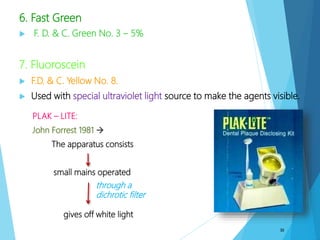
PLAK – LITE:
John Forrest 1981 
The apparatus consists of
a small mains operated lamp
gives off white light
through a
dichrotic filter
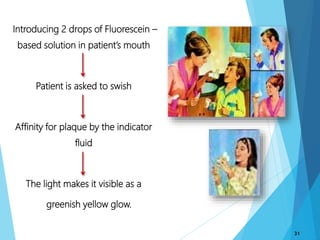
Introducing 2 drops of Fluorescein –
based solution in patient’s mouth
Patient is asked to swish
Affinity for plaque by the indicator
fluid
The light makes it visible as a
greenish yellow glow.
31
 Following application of the Plak-Lite® solution, the fluorescence
remained unchanged for 20 minutes following which it began to
fade, and after 2 hours, the fluorescence was completely absent.
 The Plak-Lite® system consists of a fluorescent disclosing agent
and a light source to make the agent visible. The solution has a light
absorbency which lies within the frequencies of 2000-5400 A. The
highest peak is at 4800 A and two lower peaks appear at 3250 A
and 2900 A (Fig. 1).
 The Plak-Lite® lamp transmits light in the frequency range 4200-
5600 A.
32Lang et al.,1972. A fluorescent plaque disclosing agent. J. periodont Res.7: 59-67.
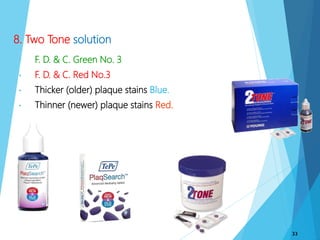
8. Two Tone solution
• F. D. & C. Green No. 3
• F. D. & C. Red No.3
• Thicker (older) plaque stains Blue.
• Thinner (newer) plaque stains Red.
33
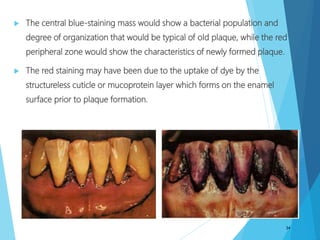
 The central blue-staining mass would show a bacterial population and
degree of organization that would be typical of old plaque, while the red
peripheral zone would show the characteristics of newly formed plaque.
 The red staining may have been due to the uptake of dye by the
structureless cuticle or mucoprotein layer which forms on the enamel
surface prior to plaque formation.
34
35
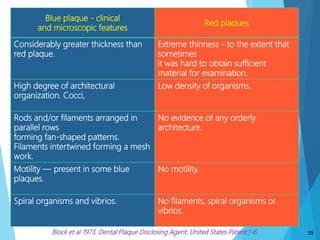
Blue plaque - clinical
and microscopic features
Red plaques
Considerably greater thickness than
red plaque.
Extreme thinness - to the extent that
sometimes
it was hard to obtain sufficient
material for examination.
High degree of architectural
organization. Cocci,
Low density of organisms.
Rods and/or filaments arranged in
parallel rows
forming fan-shaped patterns.
Filaments intertwined forming a mesh
work.
No evidence of any orderly
architecture.
Motility — present in some blue
plaques.
No motility.
Spiral organisms and vibrios. No filaments, spiral organisms or
vibrios.
Block et al 1973. Dental Plaque Disclosing Agent. United States Patent:1-6.
36
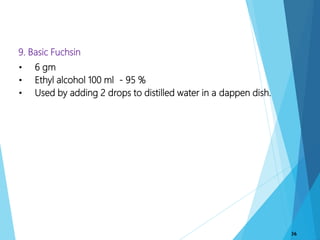
9. Basic Fuchsin
• 6 gm
• Ethyl alcohol 100 ml - 95 %
• Used by adding 2 drops to distilled water in a dappen dish.
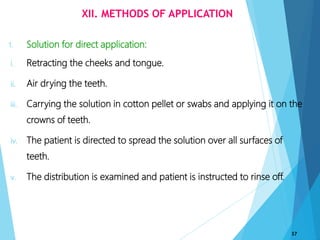
XII. METHODS OF APPLICATION
1. Solution for direct application:
i. Retracting the cheeks and tongue.
ii. Air drying the teeth.
iii. Carrying the solution in cotton pellet or swabs and applying it on the
crowns of teeth.
iv. The patient is directed to spread the solution over all surfaces of
teeth.
v. The distribution is examined and patient is instructed to rinse off.
37
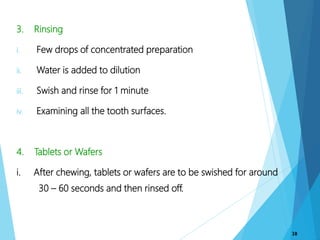
3. Rinsing
i. Few drops of concentrated preparation
ii. Water is added to dilution
iii. Swish and rinse for 1 minute
iv. Examining all the tooth surfaces.
4. Tablets or Wafers
i. After chewing, tablets or wafers are to be swished for around
30 – 60 seconds and then rinsed off.
38
EFFECT
Clean tooth surface do not absorb the colouring agent.
The pellicle and bacterial plaque, if present, absorbs the agent and are
thus, disclosed.
Pellicle stains  Relatively thin, clear covering.
Bacterial plaque  Darker, thicker and more opaque.
39
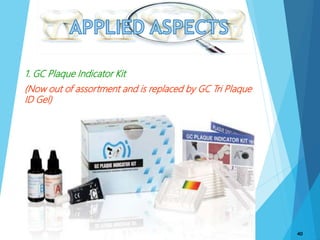
1. GC Plaque Indicator Kit
(Now out of assortment and is replaced by GC Tri Plaque
ID Gel)
40
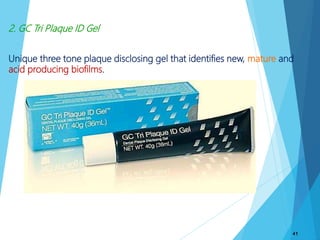
2. GC Tri Plaque ID Gel
Unique three tone plaque disclosing gel that identifies new, mature and
acid producing biofilms.
41
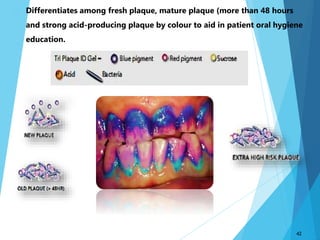
 Differentiates among fresh plaque, mature plaque (more than 48 hours
and strong acid-producing plaque by colour to aid in patient oral hygiene
education.
42
Ingredients:
1. Glycerol – 10 – 20%
2. Sucrose – 5 – 10%
3. Ethyl alcohol – 1 – 5%
4. Sodium carboxyl methyl cellulose – 1 – 5%
43
DIRECTIONS FOR USE
1. Apply GC Tri Plaque ID Gel onto the tooth surfaces using a suitable
instrument (microbrush, swab or tooth brush).
44
2. Dispense gel into a dish if applying on multiple tooth
surfaces. Following this, the patient is instructed to lightly rinse
their mouth with water.
45
3. Plaque identification by observing the color of gel.
46
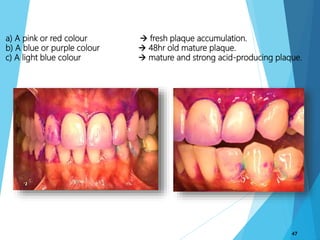
a) A pink or red colour  fresh plaque accumulation.
b) A blue or purple colour  48hr old mature plaque.
c) A light blue colour  mature and strong acid-producing plaque.
47
2. Patient is instructed about proper tooth cleaning and thereby
remove any remaining plaque and disclosing gel.
CONTRAINDICATION:
Patients sensitive or allergic to benzoate preservatives.
48
3. The use of a Disclosing Agent During Resective Periodontal
Surgery for Improved Removal of Biofilm
 Aim: To clinically evaluate the scaling effectiveness during osseous
resective surgery and the potential aid of a disclosing agent during
this procedure. The influence on the scaling results induced by the
operator awareness of a final supervision was also analyzed.
 The surgical treatments – Apically positioned flap with respective
osseous surgery – were performed.
49Montevecchi et al.2012. The Open Dentistry Journal(6):46-50.
50
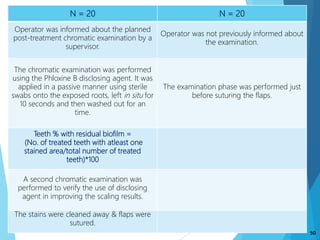
N = 20 N = 20
Operator was informed about the planned
post-treatment chromatic examination by a
supervisor.
Operator was not previously informed about
the examination.
The chromatic examination was performed
using the Phloxine B disclosing agent. It was
applied in a passive manner using sterile
swabs onto the exposed roots, left in situ for
10 seconds and then washed out for an
time.
The examination phase was performed just
before suturing the flaps.
Teeth % with residual biofilm =
(No. of treated teeth with atleast one
stained area/total number of treated
teeth)*100
A second chromatic examination was
performed to verify the use of disclosing
agent in improving the scaling results.
The stains were cleaned away & flaps were
sutured.
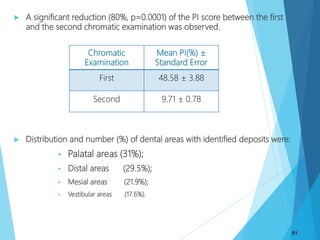
 A significant reduction (80%, p=0.0001) of the PI score between the first
and the second chromatic examination was observed.
 Distribution and number (%) of dental areas with identified deposits were:
 Palatal areas (31%);
 Distal areas (29.5%);
 Mesial areas (21.9%);
 Vestibular areas (17.6%).
51
Chromatic
Examination
Mean PI(%) ±
Standard Error
First 48.58 ± 3.88
Second 9.71 ± 0.78
 This finding, associated to the observation that at the first chromatic
examination, the distal and lingual areas remained more frequently
unclean than the vestibular areas – Suggestive of  Accessibility and
Visibility are important limiting factors in determining the quality of the
cleansing outcome.
 Interestingly, the use of a disclosing agent during periodontal resective
surgery seems to be instead effective in improving the scaling and root
planing results.
52
XIV. CONCLUSION
 This study shows that a total removal of root deposits during an
osseous resective surgery is never obtained with conventional
instrumentation.
 Clinical limitations and visual deficiency could be primarily
responsible of the present results. In order to overcome these
obstacles, the use of a plaque disclosing agent during resective
surgeries seems to be effective.
 Through this observation, the post-operative clinical parameters
remain to be assessed in order to evaluate the attainable
advantages that affect both recovery phases and long-term
periodontal health.
 Such observations would constitute an interesting starting point for
future experimental studies on this subject.
53
XV. REFERENCES
1. Newman et al. Carranza’s Clinical Periodontology. ed.3. W.B. Saunders Co.2002.
2. Dumitrescu AL. Etiology and Pathogenesis of Periodontal disease: Springer – Verlag
Berlin Heidelberg, 2010.
3. Lang et al 1972. A fluorescent plaque disclosing agent. J. Periodont.Res. 7: 59-67.
4. Shefali Sharma 2010. Plaque Disclosing Agent – A Review. J Adv Dental
Research.2[1]:1-3
5. Cohen et al 1972. A Comparison of Bacterial Plaque Disclosants in Periodontal
Disease. J Periodonol.43[6]: 333-338.
6. Skaggs et al.,1991. Plaque Disclosing Compositions. United States Patent: 1-7.
7. Chetrus and Ion 2013. Dental Plaque – classification, formation, and identification.
International Journal of Medical Dentistry.3[2]:139-143.
8. Block et al 1973. Dental Plaque Disclosing Agent. United States Patent:1-6.
9. Lang et al.,1972. A fluorescent plaque disclosing agent. J. periodont Res.7: 59-67.
10. Montevecchi et al.2012. The use of a Disclosing Agent During Resective Periodontal
Surgery for Improved Removal of Biofilm. The Open Dentistry Journal(6):46-50.
54
PLAQUE DISCLOSING AGENTS

PLAQUE DISCLOSING AGENTS

  • 1.
  • 2.
    CONTENTS I. DEFINITION OFPLAQUE II. DENTAL PLAQUE: A HOST-ASSOCIATED BIOFILM III. SIGNIFICANCE OF PLAQUE IN DEVELOPMENT OF PERIODONTAL DISEASE IV. IDENTIFICATION OF DENTAL PLAQUE V. DEFINITION OF DISCLOSING AGENT VI. HISTORY VII. UTILITY VIII. IDEAL PROPERTIES IX. COMPOSITION X. MECHANISM OF ACTION XI. DYES USED AS DISCLOSING AGENT XII. METHOD OF APPLICATION XIII. APPLIED ASPECTS XIV. CONCLUSION XV. REFERENCES 2
  • 3.
    1. WHO (1978): Dentalplaque is defined as a specific but highly variable structural resulting from sequential colonization and growth of micro on the surfaces of teeth and restoration consisting of micro of various strains and species are embedded in the extra cellular composed of bacterial metabolic products and substance from saliva and blood. 3 I. DEFINITION OF DENTAL PLAQUE
  • 4.
    2. Bradshaw andMarsh (1999): Dental plaque is a microbial biofilm, a diverse microbial community found on the tooth surface embedded in a matrix of polymers of bacterial and salivary origin. 4 Dumitrescu AL. Etiology and Pathogenesis of Periodontal disease: Springer – Verlag Berlin Heidelberg, 2010.
  • 5.
    II. DENTAL PLAQUE:A HOST-ASSOCIATED BIOFILM  Dental plaque is a host-associated biofilm. The significance of the biofilm environment has been increasingly recognized because the environment itself may alter properties of microorganisms. The biofilm community is initially formed through bacterial interactions with the tooth and then through physical and physiologic interactions among different species within the microbial mass. Furthermore, the bacteria found in the plaque biofilm are strongly influenced by external environmental factors that may be host mediated. 5Newman et al. Carranza’s Clinical Periodontology. ed.3. W.B. Saunders Co.2002.
  • 6.
     Macroscopically, Classified asSupragingival & Subgingival plaque, based on its position of the tooth surface. Marginal plaque – The supragingival plaque in direct contact with the gingival margin. Holds prime importance in the development of gingivitis. 6Newman et al. Carranza’s Clinical Periodontology. ed.3. W.B. Saunders Co.2002.
  • 7.
    III. SIGNIFICANCE OFPLAQUE IN DEVELOPMENT OF PERIODONTAL DISEASE • Once the biofilm has formed, the species composition at a site is characterized by a degree of stability or balance among the component species, despite regular minor environmental stresses following, for example, periodic oral hygiene, food intake or diurnal changes in saliva flow. Importantly, this stability (termed microbial homeostasis) is not due to any biological indifference among the resident organisms, but is due to a dynamic balance imposed by numerous microbial interactions. 7Newman et al. Carranza’s Clinical Periodontology. ed.3. W.B. Saunders Co.2002.
  • 8.
    8 • Bacteria respondto environmental change, and, microbial homeostasis can break down if a key parameter exceeds the threshold that is compatible with community stability. • A consequence of homeostasis breakdown is re-organization of the structure and composition of the microbial community, with previous species that were only minor components becoming more competitive under the new conditions, and, as a result, more dominant. Such a change in community composition and activity can predispose a site to disease. Newman et al. Carranza’s Clinical Periodontology. ed.3. W.B. Saunders Co.2002.
  • 9.
    IV. IDENTIFICATION OFDENTAL PLAQUE 9 • Elimination of bacterial plaque from tooth surfaces is essential for maintaining dental health (Loe et al 1965, 1971, Lovdal et al 1958, 1961, Suomi et al 1969, 1971, Greene and Vermillion 1971). • It is often difficult, however, to convince patients about the importance of performing thorough oral hygiene. • Patient motivation, therefore, represents an important aspect in improving oral hygiene. Lang et al 1972. A fluorescent plaque disclosing agent. J. Periodont.Res. 7: 59-67.
  • 10.
     The useof agents which stain and disclose bacterial plaque in situ is generally thought to enhance motivation by enabling the patient to detect deposits on the teeth and to control the efficacy of his oral hygiene techniques.  Home care aids: 1. Tooth brushing methods 2. Dentifrices(ShoPlaq , PlaqueHD) may contain plaque disclosing agent that permits dental plaque observation.  Staining of bacterial plaque aids in efficient plaque removal teaches the significance of plaque in periodontal disease. Shefali Sharma 2010. Plaque Disclosing Agent – A Review. J Adv Dental Research.2[1]:1-3 10
  • 11.
    Raybin (1943): A disclosingagent is a solution which when applied on the tooth, makes visible by staining roughness and foreign matter on the tooth. World English Dictionary: A disclosing agent is a dye in liquid or tablet form that colors something, especially the teeth to show plaque. V. DEFINITION OF DISCLOSING AGENT 11Shefali Sharma 2010. Plaque Disclosing Agent – A Review. J Adv Dental Research.2[1]:1-3
  • 12.
    VI. HISTORY 1. Skinnerin 1914: First disclosing solution (Skinner’s iodine solution). Patients' teeth were disclosed with this solution to demonstrate "soft accumulations" which had to be removed by the patient at home. 2. Berwick in 1920: Combination of Brilliant green – crystal violet. 3. Easlick in 1935: Bismark brown. 4. Raybin in 1943: Gentian violet (non-iodine dye)e Cohen et al 1972. A Comparison of Bacterial Plaque Disclosants in Periodontal Disease. J Periodonol.43[6]: 333-338. 12
  • 13.
    VII. UTILITY OFDISCLOSING AGENT a. Diagnosing the dental plaque. b. Personalized patient instruction and motivation. c. Self- evaluation by the patient. d. To evaluate the effectiveness of oral hygiene maintenance. e. Preparation of plaque indices. 13Shefali Sharma 2010. Plaque Disclosing Agent – A Review. J Adv Dental Research.2[1]:1-3
  • 14.
    1. Taste: i. Patientcomfort. ii. Flavored. iii. Should encourage patient co-operation. 2. Intensity of color: i. Evident contrast  to differentiate from surrounding environment. 3. Duration of Intensity: Retentive – The color should not rinse off with ordinary rinsing methods for the period of time required to complete the instructions or clinical examination. 4. Non-irritating to oral mucosa. 5. Non-allergic. 6. Antiseptic property. VIII. IDEAL PROPERTIES 14Shefali Sharma 2010. Plaque Disclosing Agent – A Review. J Adv Dental Research.2[1]:1-3
  • 15.
    7. The dyemust be capable of adequately penetrating the plaque deposit. 8. Selective staining efficacy. 9. Water-soluble. 15Skaggs et al.,1991. Plaque Disclosing Compositions. United States Patent: 1-7
  • 16.
    IX. COMPOSITION  Pertainsto combinations of dyes- I. FDC Red No. 3(Erythrosin) and FDC Blue No. 1; II. FD&C Blue No. 2; III. FD&C Green No.5; IV. FD&C Blue No. 1 and D&C Yellow No. 5; V. D. & C. Yellow No. 8 (Fluorescein); VI. FD&C Red No. 3 and FD&C Green No. 3; VII. FD&C Red No. 3 and Hercules Green Shade 3; VIII. FD&C Red No. 40, or Allura Red (0.05%-10%); IX. FD&C Red No. 22 (eocine) 16Skaggs et al.,1991. Plaque Disclosing Compositions. United States Patent: 1-7
  • 17.
    i. Disclosing agentswork by changing the color of dental plaque so that it contrasts with the white tooth surface. ii. Dental plaque has the ability to retain a large number of dye substances which can be used for disclosing purposes. This property is related to interaction, because of the polarity difference between the components of plaque and dyes(Gallagher et al, 1977). The particles are bound to the surface by electrostatic interaction(proteins) and hydrogen bonds(polysaccharides). Chetrus and Ion 2013. Dental Plaque – classification, formation, and identification. International Journal of Medical Dentistry.3[2]:139-143. 17 X. MECHANISM OF ACTION
  • 18.
    2. Mercurochrome preparations 3. Bismarkbrown 1. Iodine preparations 5. Erythrosin 4. Merbromin 6. Fast green 8. Two tone solution 9. Basic fuchsin 10. Three tone gel 7. Fluorescein XI. DYES USED AS DISCLOSING AGENTS 18Shefali Sharma 2010. Plaque Disclosing Agent – A Review. J Adv Dental Research.2[1]:1-3
  • 19.
    1. Iodine preparations Iodinecrystals – 3.3% Potassium iodide – 16% Zinc iodide -10% Distilled water – 16% Skinner’s iodine solution Tincture of iodine – 21% Distilled water – 15% Diluted tincture of iodine 19
  • 20.
     Plaque deeply brown or black.  Inflamed gingiva  dark areas.  Discoloration disappears in a few minutes.  Advantages :  Low cost.  Clinical photography.  Disadvantages :  Patients allergic to iodine.  Objectionable taste. I. Iodine based solutions 20
  • 21.
    2. Mercurochrome preparations Mercurochrome– 1.5% Distilled water – 30% Mercuroc- hrome solution – 5% Mercurochrome – 13.5 gm Distilled water – 3 ml Oil of peppermint – 3 drops Flavoured mercurochr- ome solution 21
  • 22.
    3. Bismark Brown(Easlick’s disclosing solution) Bismark brown – 3 gm Glycerin – 120 ml Ethyl alcohol – 10 ml Anise (flavor) – 1 drop 22
  • 23.
    4. Merbromin  MerbrominNF – 450 mg  Oil of peppermint – 1 drop  Distilled water – 100 ml 23
  • 24.
    5. Erythrosin  Basedon purpose 1. By Rinsing 2. For Direct topical application 3. Tablet or Wafers 24
  • 25.
    1. By Rinsing F.D & C. Red No. 3 or No. 28 – 6 gm  Alcohol - 10 ml  Distilled water - 100 ml  Peppermint Oil - 2 drops 25
  • 26.
    2. For Directtopical application  Erythrosine – 0.8 gm  Alcohol - 10 ml  Distilled water - 100 ml  Peppermint Oil - 2 drops 26
  • 27.
    3. Tablet orWafers  F.D & C. Red No. 3 – 15 gm  Sodium chloride – 0.747%  Sodium sucaryl – 0.747%  Calcium stearate – 0.995%  White oil – 1.124%  Flavoring agent – 2.239% 27
  • 28.
    28 However, with regularuse of the FDC Red No. 3 tablet, it became abundantly clear that the “pleasing shade of red” adversely affected the utility of wafer. The plaque interproximally and at the gingival margin, especially in the posterior areas, could not easily be seen because of poor contrast between the gingiva and the stained plaque. Accordingly, the use of a red disclosing dye reveals that red is the wrong color since plaque that has been stained red is extremely difficult to see due to poor contrast with the oral tissues, especially in the back areas of the mouth and between the teeth. It should be noted that it is these precise areas which are the most prevalent sites of caries and periodontal disease. Block et al 1973. Dental Plaque Disclosing Agent. United States Patent:1-6.
  • 29.
    ADVANTAGES OF ERYTHROSINRED 1. Fades in brief time. 2. Does not stain dental equipment or clothing permanently. 3. Does not stain composite type restoratives permanently. 4. Does not have any known possible effects that iodine or mercury stains possess. 29
  • 30.
    6. Fast Green F. D. & C. Green No. 3 – 5% 7. Fluoroscein  F.D. & C. Yellow No. 8.  Used with special ultraviolet light source to make the agents visible. 30 PLAK – LITE: John Forrest 1981  The apparatus consists of a small mains operated lamp gives off white light through a dichrotic filter
  • 31.
    Introducing 2 dropsof Fluorescein – based solution in patient’s mouth Patient is asked to swish Affinity for plaque by the indicator fluid The light makes it visible as a greenish yellow glow. 31
  • 32.
     Following applicationof the Plak-Lite® solution, the fluorescence remained unchanged for 20 minutes following which it began to fade, and after 2 hours, the fluorescence was completely absent.  The Plak-Lite® system consists of a fluorescent disclosing agent and a light source to make the agent visible. The solution has a light absorbency which lies within the frequencies of 2000-5400 A. The highest peak is at 4800 A and two lower peaks appear at 3250 A and 2900 A (Fig. 1).  The Plak-Lite® lamp transmits light in the frequency range 4200- 5600 A. 32Lang et al.,1972. A fluorescent plaque disclosing agent. J. periodont Res.7: 59-67.
  • 33.
    8. Two Tonesolution • F. D. & C. Green No. 3 • F. D. & C. Red No.3 • Thicker (older) plaque stains Blue. • Thinner (newer) plaque stains Red. 33
  • 34.
     The centralblue-staining mass would show a bacterial population and degree of organization that would be typical of old plaque, while the red peripheral zone would show the characteristics of newly formed plaque.  The red staining may have been due to the uptake of dye by the structureless cuticle or mucoprotein layer which forms on the enamel surface prior to plaque formation. 34
  • 35.
    35 Blue plaque -clinical and microscopic features Red plaques Considerably greater thickness than red plaque. Extreme thinness - to the extent that sometimes it was hard to obtain sufficient material for examination. High degree of architectural organization. Cocci, Low density of organisms. Rods and/or filaments arranged in parallel rows forming fan-shaped patterns. Filaments intertwined forming a mesh work. No evidence of any orderly architecture. Motility — present in some blue plaques. No motility. Spiral organisms and vibrios. No filaments, spiral organisms or vibrios. Block et al 1973. Dental Plaque Disclosing Agent. United States Patent:1-6.
  • 36.
    36 9. Basic Fuchsin •6 gm • Ethyl alcohol 100 ml - 95 % • Used by adding 2 drops to distilled water in a dappen dish.
  • 37.
    XII. METHODS OFAPPLICATION 1. Solution for direct application: i. Retracting the cheeks and tongue. ii. Air drying the teeth. iii. Carrying the solution in cotton pellet or swabs and applying it on the crowns of teeth. iv. The patient is directed to spread the solution over all surfaces of teeth. v. The distribution is examined and patient is instructed to rinse off. 37
  • 38.
    3. Rinsing i. Fewdrops of concentrated preparation ii. Water is added to dilution iii. Swish and rinse for 1 minute iv. Examining all the tooth surfaces. 4. Tablets or Wafers i. After chewing, tablets or wafers are to be swished for around 30 – 60 seconds and then rinsed off. 38
  • 39.
    EFFECT Clean tooth surfacedo not absorb the colouring agent. The pellicle and bacterial plaque, if present, absorbs the agent and are thus, disclosed. Pellicle stains  Relatively thin, clear covering. Bacterial plaque  Darker, thicker and more opaque. 39
  • 40.
    1. GC PlaqueIndicator Kit (Now out of assortment and is replaced by GC Tri Plaque ID Gel) 40
  • 41.
    2. GC TriPlaque ID Gel Unique three tone plaque disclosing gel that identifies new, mature and acid producing biofilms. 41
  • 42.
     Differentiates amongfresh plaque, mature plaque (more than 48 hours and strong acid-producing plaque by colour to aid in patient oral hygiene education. 42
  • 43.
    Ingredients: 1. Glycerol –10 – 20% 2. Sucrose – 5 – 10% 3. Ethyl alcohol – 1 – 5% 4. Sodium carboxyl methyl cellulose – 1 – 5% 43
  • 44.
    DIRECTIONS FOR USE 1.Apply GC Tri Plaque ID Gel onto the tooth surfaces using a suitable instrument (microbrush, swab or tooth brush). 44
  • 45.
    2. Dispense gelinto a dish if applying on multiple tooth surfaces. Following this, the patient is instructed to lightly rinse their mouth with water. 45
  • 46.
    3. Plaque identificationby observing the color of gel. 46
  • 47.
    a) A pinkor red colour  fresh plaque accumulation. b) A blue or purple colour  48hr old mature plaque. c) A light blue colour  mature and strong acid-producing plaque. 47
  • 48.
    2. Patient isinstructed about proper tooth cleaning and thereby remove any remaining plaque and disclosing gel. CONTRAINDICATION: Patients sensitive or allergic to benzoate preservatives. 48
  • 49.
    3. The useof a Disclosing Agent During Resective Periodontal Surgery for Improved Removal of Biofilm  Aim: To clinically evaluate the scaling effectiveness during osseous resective surgery and the potential aid of a disclosing agent during this procedure. The influence on the scaling results induced by the operator awareness of a final supervision was also analyzed.  The surgical treatments – Apically positioned flap with respective osseous surgery – were performed. 49Montevecchi et al.2012. The Open Dentistry Journal(6):46-50.
  • 50.
    50 N = 20N = 20 Operator was informed about the planned post-treatment chromatic examination by a supervisor. Operator was not previously informed about the examination. The chromatic examination was performed using the Phloxine B disclosing agent. It was applied in a passive manner using sterile swabs onto the exposed roots, left in situ for 10 seconds and then washed out for an time. The examination phase was performed just before suturing the flaps. Teeth % with residual biofilm = (No. of treated teeth with atleast one stained area/total number of treated teeth)*100 A second chromatic examination was performed to verify the use of disclosing agent in improving the scaling results. The stains were cleaned away & flaps were sutured.
  • 51.
     A significantreduction (80%, p=0.0001) of the PI score between the first and the second chromatic examination was observed.  Distribution and number (%) of dental areas with identified deposits were:  Palatal areas (31%);  Distal areas (29.5%);  Mesial areas (21.9%);  Vestibular areas (17.6%). 51 Chromatic Examination Mean PI(%) ± Standard Error First 48.58 ± 3.88 Second 9.71 ± 0.78
  • 52.
     This finding,associated to the observation that at the first chromatic examination, the distal and lingual areas remained more frequently unclean than the vestibular areas – Suggestive of  Accessibility and Visibility are important limiting factors in determining the quality of the cleansing outcome.  Interestingly, the use of a disclosing agent during periodontal resective surgery seems to be instead effective in improving the scaling and root planing results. 52
  • 53.
    XIV. CONCLUSION  Thisstudy shows that a total removal of root deposits during an osseous resective surgery is never obtained with conventional instrumentation.  Clinical limitations and visual deficiency could be primarily responsible of the present results. In order to overcome these obstacles, the use of a plaque disclosing agent during resective surgeries seems to be effective.  Through this observation, the post-operative clinical parameters remain to be assessed in order to evaluate the attainable advantages that affect both recovery phases and long-term periodontal health.  Such observations would constitute an interesting starting point for future experimental studies on this subject. 53
  • 54.
    XV. REFERENCES 1. Newmanet al. Carranza’s Clinical Periodontology. ed.3. W.B. Saunders Co.2002. 2. Dumitrescu AL. Etiology and Pathogenesis of Periodontal disease: Springer – Verlag Berlin Heidelberg, 2010. 3. Lang et al 1972. A fluorescent plaque disclosing agent. J. Periodont.Res. 7: 59-67. 4. Shefali Sharma 2010. Plaque Disclosing Agent – A Review. J Adv Dental Research.2[1]:1-3 5. Cohen et al 1972. A Comparison of Bacterial Plaque Disclosants in Periodontal Disease. J Periodonol.43[6]: 333-338. 6. Skaggs et al.,1991. Plaque Disclosing Compositions. United States Patent: 1-7. 7. Chetrus and Ion 2013. Dental Plaque – classification, formation, and identification. International Journal of Medical Dentistry.3[2]:139-143. 8. Block et al 1973. Dental Plaque Disclosing Agent. United States Patent:1-6. 9. Lang et al.,1972. A fluorescent plaque disclosing agent. J. periodont Res.7: 59-67. 10. Montevecchi et al.2012. The use of a Disclosing Agent During Resective Periodontal Surgery for Improved Removal of Biofilm. The Open Dentistry Journal(6):46-50. 54