Contents
Determination of primary structure
Determination of secondary and tertiary
protein structures
Determination of primary structure
Determination of aminoacid composition
Degradation of protein or polypeptide into smaller fragments.
Determination of the aminoacid sequence
Determination of amino acid composition in a
protein
1. acid or
2. alkali treatment
3. enzyme hydrolysis Pronase
Separation and estimation of amino acids: chromatography
Degradation of protein into smaller fragment
liberation of polypeptides
urea or
guanidine hydrochloride
performic acid
Which of the following is a denaturing substance
A Guanosine
B Guanidine
C Glutamate
D Glycine
Breakdown of polypeptides into fragments
trypsin, chymotrypsin, pepsin and elastaseEnzymatic cleavage:
Chemical cleavage: Cyanogen bromide
Number of polypeptides
dansyl chloride.
binds N-terminal aminoAcids form dansyl polypeptide
on hydrolysis yield N-terminal dansyl amino acid
Determination of amino acid sequence
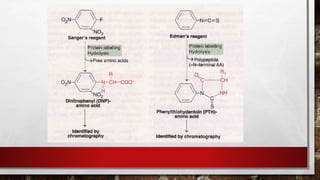
1-fluoro-2,4-dinitrobenzene (FDNB)
binds with N-terminal amino acids to form Dinitrophenyl (DNP)
derivative of peptide
• This is on hydrolysis yields DNP – amino acids ( N-terminal) and
free amino acids from the rest of the peptide chain.
• Used for identification of N terminal AA
• DNP-AA – identified by Chromatography
Sanger's reagent
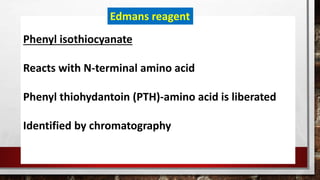
Phenyl isothiocyanate
Reacts with N-terminal amino acid
Phenyl thiohydantoin (PTH)-amino acid is liberated
Identified by chromatography
Edmans reagent
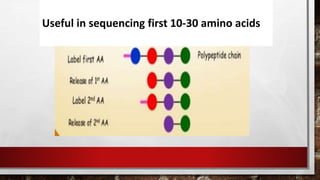
Useful in sequencing first 10-30 amino acids
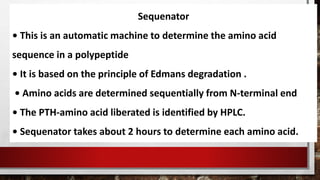
Sequenator
• This is an automatic machine to determine the amino acid
sequence in a polypeptide
• It is based on the principle of Edmans degradation .
• Amino acids are determined sequentially from N-terminal end
• The PTH-amino acid liberated is identified by HPLC.
• Sequenator takes about 2 hours to determine each amino acid.
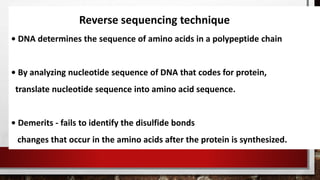
Reverse sequencing technique
• DNA determines the sequence of amino acids in a polypeptide chain
• By analyzing nucleotide sequence of DNA that codes for protein,
translate nucleotide sequence into amino acid sequence.
• Demerits - fails to identify the disulfide bonds
changes that occur in the amino acids after the protein is synthesized.
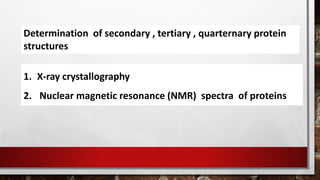
1. X-ray crystallography
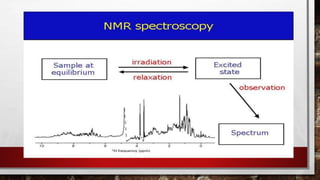
2. Nuclear magnetic resonance (NMR) spectra of proteins
Determination of secondary , tertiary , quarternary protein
structures
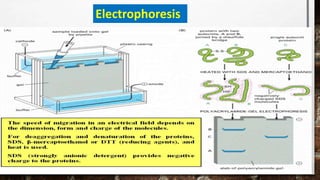
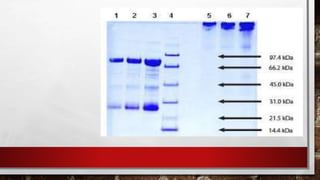
Electrophoresis
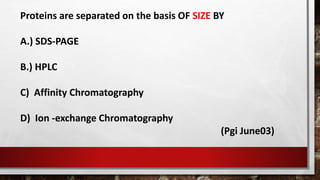
Proteins are separated on the basis OF SIZE BY
A.) SDS-PAGE
B.) HPLC
C) Affinity Chromatography
D) Ion -exchange Chromatography
(Pgi June03)
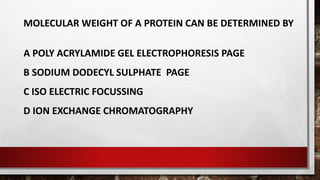
MOLECULAR WEIGHT OF A PROTEIN CAN BE DETERMINED BY
A POLY ACRYLAMIDE GEL ELECTROPHORESIS PAGE
B SODIUM DODECYL SULPHATE PAGE
C ISO ELECTRIC FOCUSSING
D ION EXCHANGE CHROMATOGRAPHY
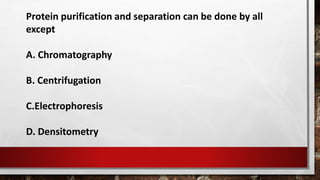
Protein purification and separation can be done by all
except
A. Chromatography
B. Centrifugation
C.Electrophoresis
D. Densitometry
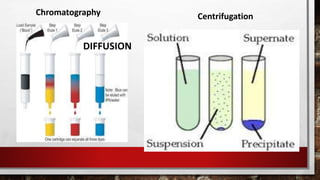
Chromatography Centrifugation
DIFFUSION
IN CHROMATOGRAPHY MASS MOVEMENTS OF THE SUBSTANCE
IS DUE TO
A DIFFUSION
B ELECTROPHORESIS
C PAPER CHROMATOGRPHY
D OSMOSIS
Haemoglobin electrophoresis
In the case of Sickle Cell hemoglobin ,
replacement of a negatively-charged Glu in the
standard HbA beta-globin by a
neutral Val in HbS
results in a protein with a slightly reduced negative charge.
Hemoglobin electrophoresis is based on
A molecular weight
B Charge..
C Solubility
D calorimetric properties
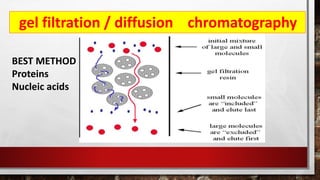
gel filtration / diffusion chromatography
BEST METHOD
Proteins
Nucleic acids
Cellulose resins have much greater permeability to
macromolecular polyelectrolytes
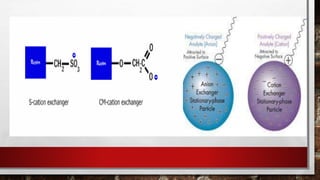
Carboxymethyl cellulose (CM-cellulose) – Cationic exchanger
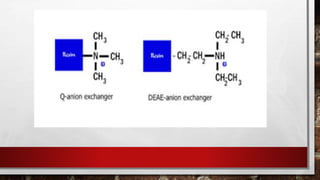
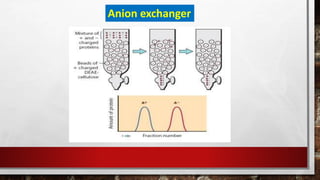
DEAE cellulose - Anionic exchanger
Cationic exchangers possess negatively charged group,
and these will attract positively charged cations.
“Acidic ion exchange materials”,
because their negative charges result from the ionization
of acidic group.
Anion exchanger
MOLECULAR SEPERATION OF TWO PROTEINS WITH
SAME CHARGE CAN BE DONE BY
A ION EXCHANGE CHROMATOGRAPHY
B DIALYSIS
C GEL DIFFUSION CHROMATOGRAPHY
D ELECTROPHORESIS
The following separation technique depends on molecular
size of the protein
A . Chromatography on carboxymethyl (CM) cellulose column
B. Iso-electric focussing
C. Gel filtration chromatography/ exclusion chromatography
D.Chromatography on di ethyI amino ethyl (DEAE) cellulose
column
Hydrophobic chromatography
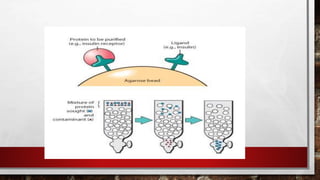
Affinity chromatography
Gel chromatography
Paper chromatography
In -which type of chromatography, proteins are Bound to
another substance
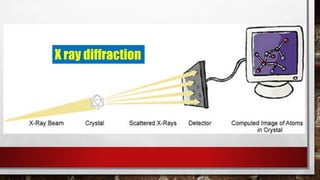
X ray diffraction
The tertiary structure of protein is detected by:
A. X- ray diffraction
B Spectrophotometry
C.Electrophoresis.
D.Chromatography
The substance present in the gall bladder stones or the kidney
A flurosence spectroscopy
B.Electron microscopy
C.Nuclear magnetic resonance
D.X ray diffraction
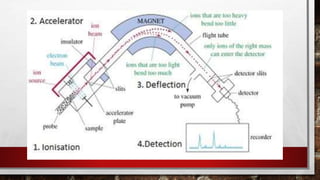
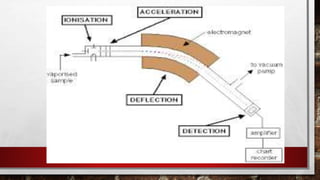
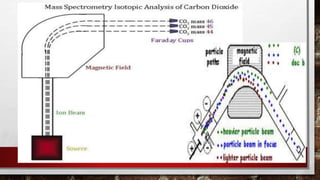
Mass spectroscopy
Molecular size is assessed by
A Sedimentation
B Absorption Mass spectroscopy
C.Liophilization
D.Salting out
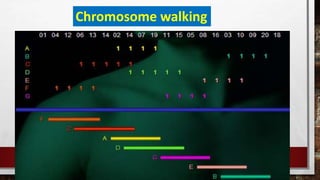
Chromosome walking
Sequence in a Iong Chain of protein is identified by-
A. restriction fragment length polymorphism
B Chromosome walking
C. Leucine Zipper
D. SSOP sequence specific oligonucleotide probes
Protein structure determination

Protein structure determination

  • 2.
    Contents Determination of primarystructure Determination of secondary and tertiary protein structures
  • 3.
    Determination of primarystructure Determination of aminoacid composition Degradation of protein or polypeptide into smaller fragments. Determination of the aminoacid sequence
  • 4.
    Determination of aminoacid composition in a protein 1. acid or 2. alkali treatment 3. enzyme hydrolysis Pronase Separation and estimation of amino acids: chromatography
  • 5.
    Degradation of proteininto smaller fragment liberation of polypeptides urea or guanidine hydrochloride performic acid
  • 6.
    Which of thefollowing is a denaturing substance A Guanosine B Guanidine C Glutamate D Glycine
  • 7.
    Breakdown of polypeptidesinto fragments trypsin, chymotrypsin, pepsin and elastaseEnzymatic cleavage: Chemical cleavage: Cyanogen bromide
  • 8.
    Number of polypeptides dansylchloride. binds N-terminal aminoAcids form dansyl polypeptide on hydrolysis yield N-terminal dansyl amino acid
  • 9.
  • 10.
    1-fluoro-2,4-dinitrobenzene (FDNB) binds withN-terminal amino acids to form Dinitrophenyl (DNP) derivative of peptide • This is on hydrolysis yields DNP – amino acids ( N-terminal) and free amino acids from the rest of the peptide chain. • Used for identification of N terminal AA • DNP-AA – identified by Chromatography Sanger's reagent
  • 11.
    Phenyl isothiocyanate Reacts withN-terminal amino acid Phenyl thiohydantoin (PTH)-amino acid is liberated Identified by chromatography Edmans reagent
  • 12.
    Useful in sequencingfirst 10-30 amino acids
  • 14.
    Sequenator • This isan automatic machine to determine the amino acid sequence in a polypeptide • It is based on the principle of Edmans degradation . • Amino acids are determined sequentially from N-terminal end • The PTH-amino acid liberated is identified by HPLC. • Sequenator takes about 2 hours to determine each amino acid.
  • 15.
    Reverse sequencing technique •DNA determines the sequence of amino acids in a polypeptide chain • By analyzing nucleotide sequence of DNA that codes for protein, translate nucleotide sequence into amino acid sequence. • Demerits - fails to identify the disulfide bonds changes that occur in the amino acids after the protein is synthesized.
  • 16.
    1. X-ray crystallography 2.Nuclear magnetic resonance (NMR) spectra of proteins Determination of secondary , tertiary , quarternary protein structures
  • 19.
  • 21.
    Proteins are separatedon the basis OF SIZE BY A.) SDS-PAGE B.) HPLC C) Affinity Chromatography D) Ion -exchange Chromatography (Pgi June03)
  • 22.
    MOLECULAR WEIGHT OFA PROTEIN CAN BE DETERMINED BY A POLY ACRYLAMIDE GEL ELECTROPHORESIS PAGE B SODIUM DODECYL SULPHATE PAGE C ISO ELECTRIC FOCUSSING D ION EXCHANGE CHROMATOGRAPHY
  • 23.
    Protein purification andseparation can be done by all except A. Chromatography B. Centrifugation C.Electrophoresis D. Densitometry
  • 24.
  • 25.
    IN CHROMATOGRAPHY MASSMOVEMENTS OF THE SUBSTANCE IS DUE TO A DIFFUSION B ELECTROPHORESIS C PAPER CHROMATOGRPHY D OSMOSIS
  • 26.
  • 27.
    In the caseof Sickle Cell hemoglobin , replacement of a negatively-charged Glu in the standard HbA beta-globin by a neutral Val in HbS results in a protein with a slightly reduced negative charge.
  • 28.
    Hemoglobin electrophoresis isbased on A molecular weight B Charge.. C Solubility D calorimetric properties
  • 29.
    gel filtration /diffusion chromatography BEST METHOD Proteins Nucleic acids
  • 30.
    Cellulose resins havemuch greater permeability to macromolecular polyelectrolytes Carboxymethyl cellulose (CM-cellulose) – Cationic exchanger DEAE cellulose - Anionic exchanger
  • 33.
    Cationic exchangers possessnegatively charged group, and these will attract positively charged cations. “Acidic ion exchange materials”, because their negative charges result from the ionization of acidic group.
  • 34.
  • 35.
    MOLECULAR SEPERATION OFTWO PROTEINS WITH SAME CHARGE CAN BE DONE BY A ION EXCHANGE CHROMATOGRAPHY B DIALYSIS C GEL DIFFUSION CHROMATOGRAPHY D ELECTROPHORESIS
  • 36.
    The following separationtechnique depends on molecular size of the protein A . Chromatography on carboxymethyl (CM) cellulose column B. Iso-electric focussing C. Gel filtration chromatography/ exclusion chromatography D.Chromatography on di ethyI amino ethyl (DEAE) cellulose column
  • 38.
    Hydrophobic chromatography Affinity chromatography Gelchromatography Paper chromatography In -which type of chromatography, proteins are Bound to another substance
  • 39.
  • 40.
    The tertiary structureof protein is detected by: A. X- ray diffraction B Spectrophotometry C.Electrophoresis. D.Chromatography
  • 41.
    The substance presentin the gall bladder stones or the kidney A flurosence spectroscopy B.Electron microscopy C.Nuclear magnetic resonance D.X ray diffraction
  • 42.
  • 46.
    Molecular size isassessed by A Sedimentation B Absorption Mass spectroscopy C.Liophilization D.Salting out
  • 47.
  • 48.
    Sequence in aIong Chain of protein is identified by- A. restriction fragment length polymorphism B Chromosome walking C. Leucine Zipper D. SSOP sequence specific oligonucleotide probes