Presentation on
Presented by
Abdullah Ibna Masud
Edman protein sequencing
What is protein
sequencing?
• Protein sequencing is the process of
determining the amino acid order in a protein
chain, revealing its primary structure.
• It is important as it provides key information
on protein-related biological processes and
diseases, playing significant roles in biological,
biomedical, clinical research, and applications.
• This may serve to identify the protein or
characterize its post transcriptional
modifications.
• Typically partial sequencing of a protein
provides sufficient information (one or more
sequence tags) to identify it with reference to
database of protein sequence derived from
the conceptual translation of genes.
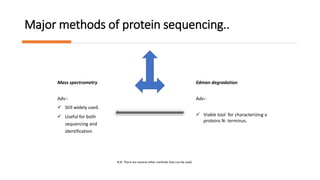
Major methods of protein sequencing..
Mass spectrometry
Adv:-
 Still widely used.
 Useful for both
sequencing and
identification.
Edman degradation
Adv:-
 Viable tool for characterizing a
proteins N- terminus.
N.B: There are several other methods that can be used.
Techniques to find out the sequence of amino acid in a protein..
1. N- terminal sequencing (Edman degradation)
2. C- terminal sequencing
3. Prediction from DNA sequence.
Why sequencing is so necessary in proteomics study?
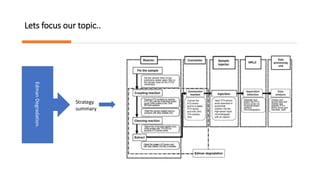
Lets focus our topic..
Edman
Degradation.
Strategy
summary
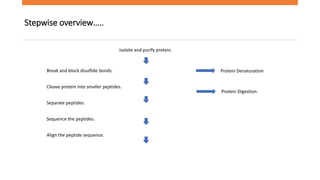
Stepwise overview…..
Break and block disulfide bonds.
Cleave protein into smaller peptides.
Separate peptides.
Sequence the peptides.
Align the peptide sequence.
Isolate and purify protein.
Protein Denaturation
Protein Digestion.
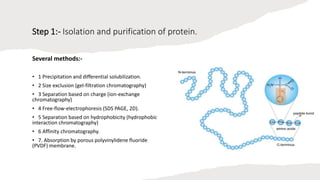
Step 1:- Isolation and purification of protein.
Several methods:-
• 1 Precipitation and differential solubilization.
• 2 Size exclusion (gel-filtration chromatography)
• 3 Separation based on charge (ion-exchange
chromatography)
• 4 Free-flow-electrophoresis (SDS PAGE, 2D).
• 5 Separation based on hydrophobicity (hydrophobic
interaction chromatography)
• 6 Affinity chromatography.
• 7. Absorption by porous polyvinylidene fluoride
(PVDF) membrane.
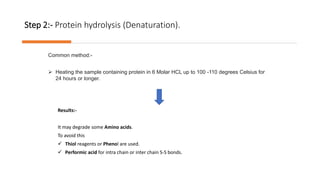
Step 2:- Protein hydrolysis (Denaturation).
Common method:-
 Heating the sample containing protein in 6 Molar HCL up to 100 -110 degrees Celsius for
24 hours or longer.
Results:-
It may degrade some Amino acids.
To avoid this
 Thiol reagents or Phenol are used.
 Performic acid for intra chain or inter chain S-S bonds.
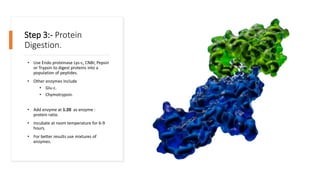
Step 3:- Protein
Digestion.
• Use Endo proteinase Lys-c, CNBr, Pepsin
or Trypsin to digest proteins into a
population of peptides.
• Other enzymes include
• Glu-c.
• Chymotrypsin.
• Add enzyme at 1:20 as enzyme :
protein ratio.
• Incubate at room temperature for 6-9
hours.
• For better results use mixtures of
enzymes.
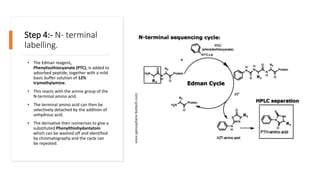
Step 4:- N- terminal
labelling.
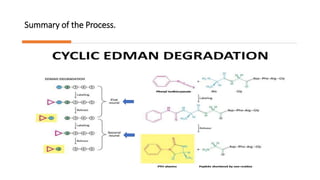
• The Edman reagent,
Phenylisothiocyanate (PTC), is added to
adsorbed peptide, together with a mild
basic buffer solution of 12%
trymethylamine.
• This reacts with the amine group of the
N-terminal amino acid.
• The terminal amino acid can then be
selectively detached by the addition of
anhydrous acid.
• The derivative then isomerises to give a
substituted Phenylthiohydantatoin
which can be washed off and identified
by chromatography and the cycle can
be repeated.
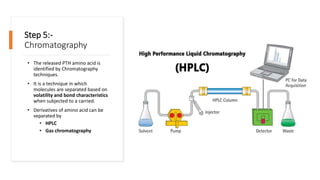
Step 5:-
Chromatography
• The released PTH amino acid is
identified by Chromatography
techniques.
• It is a technique in which
molecules are separated based on
volatility and bond characteristics
when subjected to a carried.
• Derivatives of amino acid can be
separated by
• HPLC
• Gas chromatography
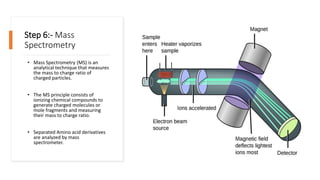
Step 6:- Mass
Spectrometry
• Mass Spectrometry (MS) is an
analytical technique that measures
the mass to charge ratio of
charged particles.
• The MS principle consists of
ionizing chemical compounds to
generate charged molecules or
mole fragments and measuring
their mass to charge ratio.
• Separated Amino acid derivatives
are analyzed by mass
spectrometer.
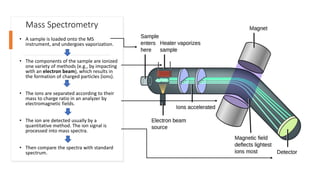
Mass Spectrometry
• A sample is loaded onto the MS
instrument, and undergoes vaporization.
• The components of the sample are ionized
one variety of methods (e.g., by impacting
with an electron beam), which results in
the formation of charged particles (ions).
• The ions are separated according to their
mass to charge ratio in an analyzer by
electromagnetic fields.
• The ion are detected usually by a
quantitative method. The ion signal is
processed into mass spectra.
• Then compare the spectra with standard
spectrum.
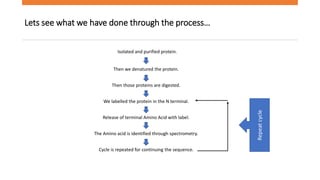
Lets see what we have done through the process…
Then we denatured the protein.
Then those proteins are digested.
We labelled the protein in the N terminal.
Release of terminal Amino Acid with label.
The Amino acid is identified through spectrometry.
Cycle is repeated for continuing the sequence.
Isolated and purified protein.
Repeat
cycle
Repeat
cycle
Summary of the Process.
.
protein sequencing -edman degradation.pptx

protein sequencing -edman degradation.pptx

  • 1.
    Presentation on Presented by AbdullahIbna Masud Edman protein sequencing
  • 2.
    What is protein sequencing? •Protein sequencing is the process of determining the amino acid order in a protein chain, revealing its primary structure. • It is important as it provides key information on protein-related biological processes and diseases, playing significant roles in biological, biomedical, clinical research, and applications. • This may serve to identify the protein or characterize its post transcriptional modifications. • Typically partial sequencing of a protein provides sufficient information (one or more sequence tags) to identify it with reference to database of protein sequence derived from the conceptual translation of genes.
  • 3.
    Major methods ofprotein sequencing.. Mass spectrometry Adv:-  Still widely used.  Useful for both sequencing and identification. Edman degradation Adv:-  Viable tool for characterizing a proteins N- terminus. N.B: There are several other methods that can be used.
  • 4.
    Techniques to findout the sequence of amino acid in a protein.. 1. N- terminal sequencing (Edman degradation) 2. C- terminal sequencing 3. Prediction from DNA sequence. Why sequencing is so necessary in proteomics study?
  • 5.
    Lets focus ourtopic.. Edman Degradation. Strategy summary
  • 6.
    Stepwise overview….. Break andblock disulfide bonds. Cleave protein into smaller peptides. Separate peptides. Sequence the peptides. Align the peptide sequence. Isolate and purify protein. Protein Denaturation Protein Digestion.
  • 7.
    Step 1:- Isolationand purification of protein. Several methods:- • 1 Precipitation and differential solubilization. • 2 Size exclusion (gel-filtration chromatography) • 3 Separation based on charge (ion-exchange chromatography) • 4 Free-flow-electrophoresis (SDS PAGE, 2D). • 5 Separation based on hydrophobicity (hydrophobic interaction chromatography) • 6 Affinity chromatography. • 7. Absorption by porous polyvinylidene fluoride (PVDF) membrane.
  • 8.
    Step 2:- Proteinhydrolysis (Denaturation). Common method:-  Heating the sample containing protein in 6 Molar HCL up to 100 -110 degrees Celsius for 24 hours or longer. Results:- It may degrade some Amino acids. To avoid this  Thiol reagents or Phenol are used.  Performic acid for intra chain or inter chain S-S bonds.
  • 9.
    Step 3:- Protein Digestion. •Use Endo proteinase Lys-c, CNBr, Pepsin or Trypsin to digest proteins into a population of peptides. • Other enzymes include • Glu-c. • Chymotrypsin. • Add enzyme at 1:20 as enzyme : protein ratio. • Incubate at room temperature for 6-9 hours. • For better results use mixtures of enzymes.
  • 10.
    Step 4:- N-terminal labelling. • The Edman reagent, Phenylisothiocyanate (PTC), is added to adsorbed peptide, together with a mild basic buffer solution of 12% trymethylamine. • This reacts with the amine group of the N-terminal amino acid. • The terminal amino acid can then be selectively detached by the addition of anhydrous acid. • The derivative then isomerises to give a substituted Phenylthiohydantatoin which can be washed off and identified by chromatography and the cycle can be repeated.
  • 11.
    Step 5:- Chromatography • Thereleased PTH amino acid is identified by Chromatography techniques. • It is a technique in which molecules are separated based on volatility and bond characteristics when subjected to a carried. • Derivatives of amino acid can be separated by • HPLC • Gas chromatography
  • 12.
    Step 6:- Mass Spectrometry •Mass Spectrometry (MS) is an analytical technique that measures the mass to charge ratio of charged particles. • The MS principle consists of ionizing chemical compounds to generate charged molecules or mole fragments and measuring their mass to charge ratio. • Separated Amino acid derivatives are analyzed by mass spectrometer.
  • 13.
    Mass Spectrometry • Asample is loaded onto the MS instrument, and undergoes vaporization. • The components of the sample are ionized one variety of methods (e.g., by impacting with an electron beam), which results in the formation of charged particles (ions). • The ions are separated according to their mass to charge ratio in an analyzer by electromagnetic fields. • The ion are detected usually by a quantitative method. The ion signal is processed into mass spectra. • Then compare the spectra with standard spectrum.
  • 14.
    Lets see whatwe have done through the process… Then we denatured the protein. Then those proteins are digested. We labelled the protein in the N terminal. Release of terminal Amino Acid with label. The Amino acid is identified through spectrometry. Cycle is repeated for continuing the sequence. Isolated and purified protein. Repeat cycle Repeat cycle
  • 15.
    Summary of theProcess. .