1
ASSIGNMENT-2
Analysis of Protiens
IN
PHARMACOGNOSY
Submitted by
K.GOWRI PRIYA
19AB1T0011
II PHARM D
UNDER THE GUIDANCE OF
M. SATHYAWATHI
Pharm D
ASSISTANT PROFESSOR
VIGNAN PHARMACY COLLEGE
Affiliated to JNTUK, KAKINADA, Approved by AICTE & PCI , New Delhi)
VADLAMUDI, GUNTUR DISTRICT, ANDHRA PRADESH, INDIA,
PIN:522213
2021
2
METHODS OF ANALYSIS OF PROTEINS
PROTEINS:
Protein is an important micronutrient essential for survival. They are constituent of
calls and hence are present in all living bodies. 10-35% of calories should come from protein.
Protein is found in meats, poultry, fish, meat substitutes, cheeses, milk etc.
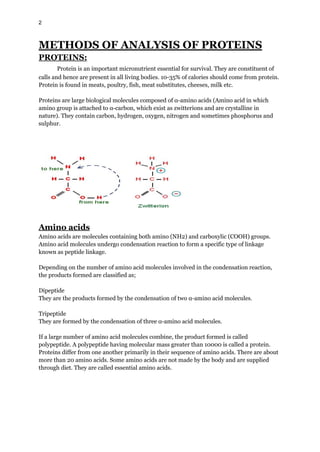
Proteins are large biological molecules composed of α-amino acids (Amino acid in which
amino group is attached to α-carbon, which exist as zwitterions and are crystalline in
nature). They contain carbon, hydrogen, oxygen, nitrogen and sometimes phosphorus and
sulphur.
Amino acids
Amino acids are molecules containing both amino (NH2) and carboxylic (COOH) groups.
Amino acid molecules undergo condensation reaction to form a specific type of linkage
known as peptide linkage.
Depending on the number of amino acid molecules involved in the condensation reaction,
the products formed are classified as;
Dipeptide
They are the products formed by the condensation of two α-amino acid molecules.
Tripeptide
They are formed by the condensation of three α-amino acid molecules.
If a large number of amino acid molecules combine, the product formed is called
polypeptide. A polypeptide having molecular mass greater than 10000 is called a protein.
Proteins differ from one another primarily in their sequence of amino acids. There are about
more than 20 amino acids. Some amino acids are not made by the body and are supplied
through diet. They are called essential amino acids.
3
METHODS FOR ANALYSIS OF PROTEINS:
Protein analysis is the bioinformatic study of protein structure and function using
database searches, sequence comparisons, structural and functional predictions.
QUALITATIVE ANALYSIS :
1. Sanger's reaction
2. Edmann's reaction
3. Reaction with Dansyl Chloride
4. Ninhydrin test
5. Reaction with Lithium borohydride
6. Biuret test
7. Millon's test
8. Sakaguchi test
9. Folin's test
10. Nitroprusside test
11. Aldehyde test for Tryptophan
1).REACTION WITH SANGER'S REAGENT:-
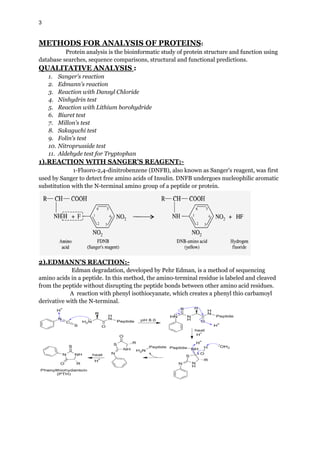
1-Fluoro-2,4-dinitrobenzene (DNFB), also known as Sanger's reagent, was first
used by Sanger to detect free amino acids of Insulin. DNFB undergoes nucleophilic aromatic
substitution with the N-terminal amino group of a peptide or protein.
2).EDMANN'S REACTION:-
Edman degradation, developed by Pehr Edman, is a method of sequencing
amino acids in a peptide. In this method, the amino-terminal residue is labeled and cleaved
from the peptide without disrupting the peptide bonds between other amino acid residues.
A reaction with phenyl isothiocyanate, which creates a phenyl thio carbamoyl
derivative with the N-terminal.
4
3). REACTION WITH DANSYL CHLORIDE:-
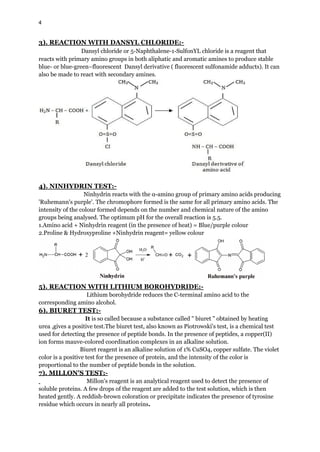
Dansyl chloride or 5-Naphthalene-1-SulfonYL chloride is a reagent that
reacts with primary amino groups in both aliphatic and aromatic amines to produce stable
blue- or blue-green–fluorescent Dansyl derivative ( fluorescent sulfonamide adducts). It can
also be made to react with secondary amines.
4). NINHYDRIN TEST:-
Ninhydrin reacts with the α-amino group of primary amino acids producing
'Ruhemann's purple'. The chromophore formed is the same for all primary amino acids. The
intensity of the colour formed depends on the number and chemical nature of the amino
groups being analysed. The optimum pH for the overall reaction is 5.5.
1.Amino acid + Ninhydrin reagent (in the presence of heat) = Blue/purple colour
2.Proline & Hydroxyproline +Ninhydrin reagent= yellow colour
5). REACTION WITH LITHIUM BOROHYDRIDE:-
Lithium borohydride reduces the C-terminal amino acid to the
corresponding amino alcohol.
6). BIURET TEST:-
It is so called because a substance called " biuret " obtained by heating
urea ,gives a positive test.The biuret test, also known as Piotrowski's test, is a chemical test
used for detecting the presence of peptide bonds. In the presence of peptides, a copper(II)
ion forms mauve-colored coordination complexes in an alkaline solution.
Biuret reagent is an alkaline solution of 1% CuSO4, copper sulfate. The violet
color is a positive test for the presence of protein, and the intensity of the color is
proportional to the number of peptide bonds in the solution.
7). MILLON'S TEST:-
Millon's reagent is an analytical reagent used to detect the presence of
soluble proteins. A few drops of the reagent are added to the test solution, which is then
heated gently. A reddish-brown coloration or precipitate indicates the presence of tyrosine
residue which occurs in nearly all proteins.
5
8). SAKAGUCHI TEST:-
The Sakaguchi test is a chemical test used for detecting the presence of
arginine in proteins. It is named after the Japanese Food Scientist and Organic Chemist,
Shoyo Sakaguchi (1900–1995) who described the test in 1925. The Sakaguchi reagent used in
the test consists of 1-Naphthol and a drop of sodium hypobromite.
9). FOLIN'S TEST:-
Amino acid give a red colour with sodium 1,2-naphthoquinone-4
Sulphate in alkaline solution.
10). NITROPRUSSIDE TEST:-
The nitroprusside reaction is a chemical test used to detect the presence
of thiol groups of cysteine in proteins. Proteins with the free thiol group give a red colour
when added to a solution of sodium nitroprusside in aqueous ammonia.
11). ALDEHYDE REACTION FOR TRYPTOPHAN:-
Indole derivatives give a purple colour with the p- dimethyl
aminobenzaldehyde in sulphuric acid (Ehlrick reagent).
PURIFICATION OF PROTEIN:
Proteins can be separated from a mixture by using some of their known
physical properties.Non Protein organic & inorganic solutes are easily removed by dialysis
using a semipermeable.
1. Molecular size
2. Solubility differences
3. Electric charges carried by Protein
(1).MOLECULAR SIZE:
Since Proteins have different molecular sizes.This can form a basis for
their separation.
a)Density gradient or Zonal centrifugation:-
A density gradient is essential for rate-zonal centrifugation to support the
zones of particles as they sediment. In addition, the sample can be loaded on to the top of the
gradient as a narrow zone and the increasing density from the top to the bottom of the
density gradient suppresses mechanical disturbances.
b)Gel filtration/molecular sieving:-
Gel filtration or molecular sieving in which molecules in solution are
separated by their size, and in some cases molecular weight. It is usually applied to large
molecules or macromolecular complexes such as proteins and industrial polymers.
(2) SOLUBILITY DIFFERENCES:
Solubility of Proteins varies with
● PH
● Ionic strength
● Nature of solvent
● Temperature
PH:- The solubility of most globular Proteins is lowest at its isoelectric Ph.
6
IONIC STRENGTH:-The ionic strength dependence of protein solubility depends on the
nature of the protein and on both the concentration and nature of the salt. Differential
solubility in ammonium sulfate solutions forms the basis of an effective protein purification
step.
NATURE OF SOLVENT:- solvents like alcohol and acetone decrease the solubilities of
most proteins in water and cause their precipitation.This may be an account of the lowering
of the dielectric constant of water due to presence of the solute.The proteins lose much of
their electric charges. The repulsive forces between Protein molecules decrease leading to
their coalescing and precipitation.
TEMPERATURE:-The solubilities of globular Proteins increases from 0-40°c. Above this
temperature,the molecules are denatured and precipitated but are separated from a mixture
in native state.
(3). ELECTRIC CHARGES CARRIED BY PROTEINS:-
These are based on the group that is present,i.e.,COOH is an acidic group &
that of NH3 is a basic group.
These are of 4 types:
a. Free Electrophoresis
b. Zone electrophoresis
c. PAGE
d. SDS
a).FREE ELECTROPHORESIS:-
In the free Electrophoresis process, a mixture of Proteins (serum/plasma)is
layered over the buffer solution. Electric current is passed,the PH of buffer is 8.6 (Proteins
having negative charges).move towards,anode at rates depending on the molecular size and
quantum of negative charge. After some time, Proteins migrated to different parts of the
buffer column and separated by optical devices. This is called Free Electrophoresis.
b).ZONE ELECTROPHORESIS:
In Zone Electrophoresis,a porous material like filter paper, cellulose acetate
strip or starch gel moistened with the buffer supports the protein mixture, when current is
passed , the proteins migrate on this supporting medium and will separate into distinct
bands on it. The band's can be cut and eluted using a suitable buffer or solvent to separate
the Proteins. Alternatively they can be stained using suitable dyes like bromophenol blue or
Amidoschwarz and can be estimated using a Densitometer.
More refined techniques like disc Electrophoresis and isoelectric focussing are
now in use.
c).POLYACRYLAMIDE GEL ELECTROPHORESIS (PAGE):
Buffered tubes or slabs of polyacrylamide gel (CH2=CH-CO-NH2) are
prepared by linking polyacrylamide with methylene bisacrylamide
[(CH2=CONH2)2CH2]. The solution containing the mixture of proteins is applied on top of
the tube or slab and a direct current is run for a specified time. The gel is then stained with
coomassie blue to visualize the separated Proteins. The procedure can be used for separation
of other substances also (eg:polynucleotides) using suitable dyes specific for those
substances.
7
d).SODIUM DODECYL SULPHATE(SDS):-
The Protein mixture is first boiled to denature the Proteins,or a denaturing
agent like sodium dodecyl sulphate(SDS) is added and the mixture is now subjected to
PAGE. The SDS is negatively charged molecules and coats the Proteins at the rate of two SDS
for each peptide bond. The negative charge on each denatured Protein will vary as the
number of peptide bonds in the Protein which in turn is proportional to the molecular weight
of the Protein. The rate of migration in Electrophoresis will therefore be an index of the
molecular weight of the protein .
HYDROLYSIS OF PROTEINS:
Protein hydrolysis is carried out by chemical and enzymatic methods. Proteolytic
enzymes hydrolyze proteins at the optimum temperature and pH and usually target specific
peptide cleavage bonds, resulting in digestion consisting of amino acids and peptides of
varying size.
Trypsin: peptide bonds involving-COOH of phenylalanine,tyrosine and Tryptophan.
Chymotrypsin:peptide bonds involving-COOH of phenylalanine, tyrosine and Tryptophan.
PEPSIN:peptide bonds involving-NH2/-COHfphenylalanine,tyrosine, glutamic acid,
cysteine, cystine.
PAPAIN: This is a proteolytic enzyme from papaya fruit and has an action similar to trypsin.
CARBOXYPEPTIDASE:peptide bond at the carboxyl end of polypeptide.
AMINOPEPTIDASE: peptide bond at the amino end of polypeptide.
Iv=N-terminus & C-terminus are determined.
● N-terminus is determined by Sanger's reaction, Edmann's reaction or by the Dansyl
Chloride method.
● C-terminus is determined by lithium hydrobromide method or by hydrazinolysis.
IV=The free amino acids are determined by ion exchange chromatography.
Several hydrolysis are performed with different enzymes to find the amino
acid sequence.
8
QUANTITATIVE ANALYSIS OF PROTEINS:
Quantitative analysis of Proteins is done using certain methods.These include:
(I).Kjeldahl method
(II). Modified Duma's method
(III). Spectroscopic analysis
● Biuret method
● Lowry method
(IV). Chromatographic method
(I).kJELDAHL METHOD:
Although many other physical and chemical methods are available to determine
nitrogen content, Kjeldahl method is extensively used the principle involved in this is
i) Digestion of organic material
ii) Distillation
iii) Titration
i). DIGESTION:
The organic sample is treated with conc.H2SO4 in the presence of K2SO4
catalysts like mercury , selenium, copper which converts nitrogen to ammonium sulfate.
● K2SO4 Increase B.P of H2SO4.
● Catalyst increases rate of reaction.
ii). DISTILLATION:-
Excess base is added to the digestion product to convert NH4 to NH3 as indicated
in the following equation. The NH3 is recovered by distilling the reaction product.
iii). TITRATION:-
The amount of ammonia present (hence the amount of nitrogen present in the
sample) is usually determined by titration. A known amount of acid solution is added to the
receiving flask. The excess acid is back-titrated using a base. Methyl orange is used as a pH
indicator. Boric acid may be used for the titration.
9
1000 ml of 1M NH3 Contains = 14gm of N/17gm of NH3
Vml of 1M NH3 Contains = ?
V = 14×V×M×1/1000
Percentage of N = 14×V×M×1/1000×100/m
(m = mass of organic sample)
By using certain conversion factors nitrogen amount is used to calculate the
Protein content.Different proteins have different conversion factor values but of all average
is 6.29.
Amount of proteins = percentage of Nitrogen×6.29
(II). MODIFIED DUMA'S METHOD:
The Dumas method of molecular weight determination was historically a
procedure used to determine the molecular weight of an unknown substance. The Dumas
method is appropriate to determine the molecular weights of volatile organic substances that
are liquids at room temperature.
This is performed by machines.Sample is heated with copper oxide in atmospheric
oxygen,CO2.The products of combustion are passed over heated copper.The by products
being CO2,H2O,N2 are collected over Conc.KOH solution & measured . KOH here will
absorb CO2 & H2O & only contains N2.This is carried out in a combustion tube
Organic sample +CuO -------------> product +Cu
C + CuO ----------->CO2+Cu
H+CuO ----------->H2O+Cu
N+Cuo -----------> N2 +Cu
(III). SPECTROSCOPICAL ANALYSIS:
● Colourless ----------->200 - 400nm -------> UV region
● Coloured samples ------------> 400-750 nm--------> Visible region
10
UV region
Proteins will absorb UV light at 280 mm .This is due to Tyrosine & Tryptophan
reduction in protein . Quantitative estimation is done by comparing the absorbance of the
test with the standard.
Visible Region
1.Biuret method
2.Lowry method
1).Biuret method:
Sample + cupric ions(CuSo4) + NaOH------>Pink/violet colour (Biuret Reagent)
● Intensity of colour & no.of peptide bonds
● The colour produced is compared with the intensity of colour of standard. (By
calorimetry)
● Absorbance at 540 mm
2).Lowry's method :
Sample + CuSo4 +NaOH---------->Pink/Purple colour
Pink / purple colour by Fc reagent ---------->Blue colour
This is based on reduction of Folin Phenol reagent (Phosphomolybdic acid &
phosphotungstic acid) by proteins ( Tyrosine & Tryptophan ).A blue colour is developed .The
intensity of colour produced is compared with that of colour produced by standard.
● Absorbance at 660 nm
(IV). CHROMATOGRAPHY TECHNIQUES:
Chromatography is the separation of mixture into individual components
using stationary phase & mobile phase.
● There are different types of chromatography techniques
They include :
1. Paper Chromatography
2. Thin layer Chromatography
3. Column Chromatography
4. Ion exchange Chromatography
5. Gas Chromatography
6. High performance liquid Chromatography
7. Chiral Chromatography
8. Adsorption Chromatography
9. Gel permeation Chromatography
Paper Chromatography :
Technique in which Proteins is estimated by flow of solvent on specially designed
filter paper.
The RF value is unique for the Proteins.It is the ratio of distance travelled by solute
to distance travelled by solvent front.
11
Thin layer Chromatography:
Thin Layer Chromatography is a technique used to isolate non-volatile mixtures.
The experiment is conducted on a sheet of aluminium foil, plastic, or glass which is coated
with a thin layer of adsorbent material. The material usually used is aluminium oxide,
cellulose, or silica gel.
Column Chromatography :
Column Chromatography is a preparative technique used to purify compounds
depending on their polarity or hydrophobicity. In column chromatography, a mixture of
molecules is separated based on their differentials partitioning between a mobile phase and a
stationary phase.
Ion exchange Chromatography:
Ion exchange is a water treatment method where one or more undesirable ionic
contaminants are removed from water by exchange with another non-objectionable, or less
objectionable ionic substance. ... A typical example of ion exchange is a process called “water
softening” aiming to reduce calcium and magnesium content.
Gas Chromatography:
Gas chromatography (GC) is an analytical technique used to separate the
chemical components of a sample mixture and then detect them to determine their presence
or absence and/or how much is present. These chemical components are usually organic
molecules or gases.
High performance liquid Chromatography:
High Performance Liquid Chromatography (HPLC) is a form of column
chromatography that pumps a sample mixture or analyte in a solvent (known as the mobile
phase) at high pressure through a column with chromatographic packing material
(stationary phase).
Chiral Chromatography:
Chiral chromatography refers to the separation of enantiomers using a chiral
HPLC column, an HPLC column that is packed with a chiral stationary phase (CSP).
Enantiomers are separated based on the number and type of each interaction that occurs
during their exposure to the chiral stationary phase.
Adsorption Chromatography:
Adsorption chromatography is a type of LC in which chemicals are retained
based on their adsorption and desorption at the surface of the support, which also acts as the
stationary phase.. This method is also sometimes referred to as liquid-solid chromatography.
Gel permation Chromatography:
Gel permeation chromatography is a type of size exclusion chromatography,
that separates analytes on the basis of size, typically in organic solvents. The technique is
often used for the analysis of polymers.

ANALYSIS OF PROTEINS.pdf

  • 1.
    1 ASSIGNMENT-2 Analysis of Protiens IN PHARMACOGNOSY Submittedby K.GOWRI PRIYA 19AB1T0011 II PHARM D UNDER THE GUIDANCE OF M. SATHYAWATHI Pharm D ASSISTANT PROFESSOR VIGNAN PHARMACY COLLEGE Affiliated to JNTUK, KAKINADA, Approved by AICTE & PCI , New Delhi) VADLAMUDI, GUNTUR DISTRICT, ANDHRA PRADESH, INDIA, PIN:522213 2021
  • 2.
    2 METHODS OF ANALYSISOF PROTEINS PROTEINS: Protein is an important micronutrient essential for survival. They are constituent of calls and hence are present in all living bodies. 10-35% of calories should come from protein. Protein is found in meats, poultry, fish, meat substitutes, cheeses, milk etc. Proteins are large biological molecules composed of α-amino acids (Amino acid in which amino group is attached to α-carbon, which exist as zwitterions and are crystalline in nature). They contain carbon, hydrogen, oxygen, nitrogen and sometimes phosphorus and sulphur. Amino acids Amino acids are molecules containing both amino (NH2) and carboxylic (COOH) groups. Amino acid molecules undergo condensation reaction to form a specific type of linkage known as peptide linkage. Depending on the number of amino acid molecules involved in the condensation reaction, the products formed are classified as; Dipeptide They are the products formed by the condensation of two α-amino acid molecules. Tripeptide They are formed by the condensation of three α-amino acid molecules. If a large number of amino acid molecules combine, the product formed is called polypeptide. A polypeptide having molecular mass greater than 10000 is called a protein. Proteins differ from one another primarily in their sequence of amino acids. There are about more than 20 amino acids. Some amino acids are not made by the body and are supplied through diet. They are called essential amino acids.
  • 3.
    3 METHODS FOR ANALYSISOF PROTEINS: Protein analysis is the bioinformatic study of protein structure and function using database searches, sequence comparisons, structural and functional predictions. QUALITATIVE ANALYSIS : 1. Sanger's reaction 2. Edmann's reaction 3. Reaction with Dansyl Chloride 4. Ninhydrin test 5. Reaction with Lithium borohydride 6. Biuret test 7. Millon's test 8. Sakaguchi test 9. Folin's test 10. Nitroprusside test 11. Aldehyde test for Tryptophan 1).REACTION WITH SANGER'S REAGENT:- 1-Fluoro-2,4-dinitrobenzene (DNFB), also known as Sanger's reagent, was first used by Sanger to detect free amino acids of Insulin. DNFB undergoes nucleophilic aromatic substitution with the N-terminal amino group of a peptide or protein. 2).EDMANN'S REACTION:- Edman degradation, developed by Pehr Edman, is a method of sequencing amino acids in a peptide. In this method, the amino-terminal residue is labeled and cleaved from the peptide without disrupting the peptide bonds between other amino acid residues. A reaction with phenyl isothiocyanate, which creates a phenyl thio carbamoyl derivative with the N-terminal.
  • 4.
    4 3). REACTION WITHDANSYL CHLORIDE:- Dansyl chloride or 5-Naphthalene-1-SulfonYL chloride is a reagent that reacts with primary amino groups in both aliphatic and aromatic amines to produce stable blue- or blue-green–fluorescent Dansyl derivative ( fluorescent sulfonamide adducts). It can also be made to react with secondary amines. 4). NINHYDRIN TEST:- Ninhydrin reacts with the α-amino group of primary amino acids producing 'Ruhemann's purple'. The chromophore formed is the same for all primary amino acids. The intensity of the colour formed depends on the number and chemical nature of the amino groups being analysed. The optimum pH for the overall reaction is 5.5. 1.Amino acid + Ninhydrin reagent (in the presence of heat) = Blue/purple colour 2.Proline & Hydroxyproline +Ninhydrin reagent= yellow colour 5). REACTION WITH LITHIUM BOROHYDRIDE:- Lithium borohydride reduces the C-terminal amino acid to the corresponding amino alcohol. 6). BIURET TEST:- It is so called because a substance called " biuret " obtained by heating urea ,gives a positive test.The biuret test, also known as Piotrowski's test, is a chemical test used for detecting the presence of peptide bonds. In the presence of peptides, a copper(II) ion forms mauve-colored coordination complexes in an alkaline solution. Biuret reagent is an alkaline solution of 1% CuSO4, copper sulfate. The violet color is a positive test for the presence of protein, and the intensity of the color is proportional to the number of peptide bonds in the solution. 7). MILLON'S TEST:- Millon's reagent is an analytical reagent used to detect the presence of soluble proteins. A few drops of the reagent are added to the test solution, which is then heated gently. A reddish-brown coloration or precipitate indicates the presence of tyrosine residue which occurs in nearly all proteins.
  • 5.
    5 8). SAKAGUCHI TEST:- TheSakaguchi test is a chemical test used for detecting the presence of arginine in proteins. It is named after the Japanese Food Scientist and Organic Chemist, Shoyo Sakaguchi (1900–1995) who described the test in 1925. The Sakaguchi reagent used in the test consists of 1-Naphthol and a drop of sodium hypobromite. 9). FOLIN'S TEST:- Amino acid give a red colour with sodium 1,2-naphthoquinone-4 Sulphate in alkaline solution. 10). NITROPRUSSIDE TEST:- The nitroprusside reaction is a chemical test used to detect the presence of thiol groups of cysteine in proteins. Proteins with the free thiol group give a red colour when added to a solution of sodium nitroprusside in aqueous ammonia. 11). ALDEHYDE REACTION FOR TRYPTOPHAN:- Indole derivatives give a purple colour with the p- dimethyl aminobenzaldehyde in sulphuric acid (Ehlrick reagent). PURIFICATION OF PROTEIN: Proteins can be separated from a mixture by using some of their known physical properties.Non Protein organic & inorganic solutes are easily removed by dialysis using a semipermeable. 1. Molecular size 2. Solubility differences 3. Electric charges carried by Protein (1).MOLECULAR SIZE: Since Proteins have different molecular sizes.This can form a basis for their separation. a)Density gradient or Zonal centrifugation:- A density gradient is essential for rate-zonal centrifugation to support the zones of particles as they sediment. In addition, the sample can be loaded on to the top of the gradient as a narrow zone and the increasing density from the top to the bottom of the density gradient suppresses mechanical disturbances. b)Gel filtration/molecular sieving:- Gel filtration or molecular sieving in which molecules in solution are separated by their size, and in some cases molecular weight. It is usually applied to large molecules or macromolecular complexes such as proteins and industrial polymers. (2) SOLUBILITY DIFFERENCES: Solubility of Proteins varies with ● PH ● Ionic strength ● Nature of solvent ● Temperature PH:- The solubility of most globular Proteins is lowest at its isoelectric Ph.
  • 6.
    6 IONIC STRENGTH:-The ionicstrength dependence of protein solubility depends on the nature of the protein and on both the concentration and nature of the salt. Differential solubility in ammonium sulfate solutions forms the basis of an effective protein purification step. NATURE OF SOLVENT:- solvents like alcohol and acetone decrease the solubilities of most proteins in water and cause their precipitation.This may be an account of the lowering of the dielectric constant of water due to presence of the solute.The proteins lose much of their electric charges. The repulsive forces between Protein molecules decrease leading to their coalescing and precipitation. TEMPERATURE:-The solubilities of globular Proteins increases from 0-40°c. Above this temperature,the molecules are denatured and precipitated but are separated from a mixture in native state. (3). ELECTRIC CHARGES CARRIED BY PROTEINS:- These are based on the group that is present,i.e.,COOH is an acidic group & that of NH3 is a basic group. These are of 4 types: a. Free Electrophoresis b. Zone electrophoresis c. PAGE d. SDS a).FREE ELECTROPHORESIS:- In the free Electrophoresis process, a mixture of Proteins (serum/plasma)is layered over the buffer solution. Electric current is passed,the PH of buffer is 8.6 (Proteins having negative charges).move towards,anode at rates depending on the molecular size and quantum of negative charge. After some time, Proteins migrated to different parts of the buffer column and separated by optical devices. This is called Free Electrophoresis. b).ZONE ELECTROPHORESIS: In Zone Electrophoresis,a porous material like filter paper, cellulose acetate strip or starch gel moistened with the buffer supports the protein mixture, when current is passed , the proteins migrate on this supporting medium and will separate into distinct bands on it. The band's can be cut and eluted using a suitable buffer or solvent to separate the Proteins. Alternatively they can be stained using suitable dyes like bromophenol blue or Amidoschwarz and can be estimated using a Densitometer. More refined techniques like disc Electrophoresis and isoelectric focussing are now in use. c).POLYACRYLAMIDE GEL ELECTROPHORESIS (PAGE): Buffered tubes or slabs of polyacrylamide gel (CH2=CH-CO-NH2) are prepared by linking polyacrylamide with methylene bisacrylamide [(CH2=CONH2)2CH2]. The solution containing the mixture of proteins is applied on top of the tube or slab and a direct current is run for a specified time. The gel is then stained with coomassie blue to visualize the separated Proteins. The procedure can be used for separation of other substances also (eg:polynucleotides) using suitable dyes specific for those substances.
  • 7.
    7 d).SODIUM DODECYL SULPHATE(SDS):- TheProtein mixture is first boiled to denature the Proteins,or a denaturing agent like sodium dodecyl sulphate(SDS) is added and the mixture is now subjected to PAGE. The SDS is negatively charged molecules and coats the Proteins at the rate of two SDS for each peptide bond. The negative charge on each denatured Protein will vary as the number of peptide bonds in the Protein which in turn is proportional to the molecular weight of the Protein. The rate of migration in Electrophoresis will therefore be an index of the molecular weight of the protein . HYDROLYSIS OF PROTEINS: Protein hydrolysis is carried out by chemical and enzymatic methods. Proteolytic enzymes hydrolyze proteins at the optimum temperature and pH and usually target specific peptide cleavage bonds, resulting in digestion consisting of amino acids and peptides of varying size. Trypsin: peptide bonds involving-COOH of phenylalanine,tyrosine and Tryptophan. Chymotrypsin:peptide bonds involving-COOH of phenylalanine, tyrosine and Tryptophan. PEPSIN:peptide bonds involving-NH2/-COHfphenylalanine,tyrosine, glutamic acid, cysteine, cystine. PAPAIN: This is a proteolytic enzyme from papaya fruit and has an action similar to trypsin. CARBOXYPEPTIDASE:peptide bond at the carboxyl end of polypeptide. AMINOPEPTIDASE: peptide bond at the amino end of polypeptide. Iv=N-terminus & C-terminus are determined. ● N-terminus is determined by Sanger's reaction, Edmann's reaction or by the Dansyl Chloride method. ● C-terminus is determined by lithium hydrobromide method or by hydrazinolysis. IV=The free amino acids are determined by ion exchange chromatography. Several hydrolysis are performed with different enzymes to find the amino acid sequence.
  • 8.
    8 QUANTITATIVE ANALYSIS OFPROTEINS: Quantitative analysis of Proteins is done using certain methods.These include: (I).Kjeldahl method (II). Modified Duma's method (III). Spectroscopic analysis ● Biuret method ● Lowry method (IV). Chromatographic method (I).kJELDAHL METHOD: Although many other physical and chemical methods are available to determine nitrogen content, Kjeldahl method is extensively used the principle involved in this is i) Digestion of organic material ii) Distillation iii) Titration i). DIGESTION: The organic sample is treated with conc.H2SO4 in the presence of K2SO4 catalysts like mercury , selenium, copper which converts nitrogen to ammonium sulfate. ● K2SO4 Increase B.P of H2SO4. ● Catalyst increases rate of reaction. ii). DISTILLATION:- Excess base is added to the digestion product to convert NH4 to NH3 as indicated in the following equation. The NH3 is recovered by distilling the reaction product. iii). TITRATION:- The amount of ammonia present (hence the amount of nitrogen present in the sample) is usually determined by titration. A known amount of acid solution is added to the receiving flask. The excess acid is back-titrated using a base. Methyl orange is used as a pH indicator. Boric acid may be used for the titration.
  • 9.
    9 1000 ml of1M NH3 Contains = 14gm of N/17gm of NH3 Vml of 1M NH3 Contains = ? V = 14×V×M×1/1000 Percentage of N = 14×V×M×1/1000×100/m (m = mass of organic sample) By using certain conversion factors nitrogen amount is used to calculate the Protein content.Different proteins have different conversion factor values but of all average is 6.29. Amount of proteins = percentage of Nitrogen×6.29 (II). MODIFIED DUMA'S METHOD: The Dumas method of molecular weight determination was historically a procedure used to determine the molecular weight of an unknown substance. The Dumas method is appropriate to determine the molecular weights of volatile organic substances that are liquids at room temperature. This is performed by machines.Sample is heated with copper oxide in atmospheric oxygen,CO2.The products of combustion are passed over heated copper.The by products being CO2,H2O,N2 are collected over Conc.KOH solution & measured . KOH here will absorb CO2 & H2O & only contains N2.This is carried out in a combustion tube Organic sample +CuO -------------> product +Cu C + CuO ----------->CO2+Cu H+CuO ----------->H2O+Cu N+Cuo -----------> N2 +Cu (III). SPECTROSCOPICAL ANALYSIS: ● Colourless ----------->200 - 400nm -------> UV region ● Coloured samples ------------> 400-750 nm--------> Visible region
  • 10.
    10 UV region Proteins willabsorb UV light at 280 mm .This is due to Tyrosine & Tryptophan reduction in protein . Quantitative estimation is done by comparing the absorbance of the test with the standard. Visible Region 1.Biuret method 2.Lowry method 1).Biuret method: Sample + cupric ions(CuSo4) + NaOH------>Pink/violet colour (Biuret Reagent) ● Intensity of colour & no.of peptide bonds ● The colour produced is compared with the intensity of colour of standard. (By calorimetry) ● Absorbance at 540 mm 2).Lowry's method : Sample + CuSo4 +NaOH---------->Pink/Purple colour Pink / purple colour by Fc reagent ---------->Blue colour This is based on reduction of Folin Phenol reagent (Phosphomolybdic acid & phosphotungstic acid) by proteins ( Tyrosine & Tryptophan ).A blue colour is developed .The intensity of colour produced is compared with that of colour produced by standard. ● Absorbance at 660 nm (IV). CHROMATOGRAPHY TECHNIQUES: Chromatography is the separation of mixture into individual components using stationary phase & mobile phase. ● There are different types of chromatography techniques They include : 1. Paper Chromatography 2. Thin layer Chromatography 3. Column Chromatography 4. Ion exchange Chromatography 5. Gas Chromatography 6. High performance liquid Chromatography 7. Chiral Chromatography 8. Adsorption Chromatography 9. Gel permeation Chromatography Paper Chromatography : Technique in which Proteins is estimated by flow of solvent on specially designed filter paper. The RF value is unique for the Proteins.It is the ratio of distance travelled by solute to distance travelled by solvent front.
  • 11.
    11 Thin layer Chromatography: ThinLayer Chromatography is a technique used to isolate non-volatile mixtures. The experiment is conducted on a sheet of aluminium foil, plastic, or glass which is coated with a thin layer of adsorbent material. The material usually used is aluminium oxide, cellulose, or silica gel. Column Chromatography : Column Chromatography is a preparative technique used to purify compounds depending on their polarity or hydrophobicity. In column chromatography, a mixture of molecules is separated based on their differentials partitioning between a mobile phase and a stationary phase. Ion exchange Chromatography: Ion exchange is a water treatment method where one or more undesirable ionic contaminants are removed from water by exchange with another non-objectionable, or less objectionable ionic substance. ... A typical example of ion exchange is a process called “water softening” aiming to reduce calcium and magnesium content. Gas Chromatography: Gas chromatography (GC) is an analytical technique used to separate the chemical components of a sample mixture and then detect them to determine their presence or absence and/or how much is present. These chemical components are usually organic molecules or gases. High performance liquid Chromatography: High Performance Liquid Chromatography (HPLC) is a form of column chromatography that pumps a sample mixture or analyte in a solvent (known as the mobile phase) at high pressure through a column with chromatographic packing material (stationary phase). Chiral Chromatography: Chiral chromatography refers to the separation of enantiomers using a chiral HPLC column, an HPLC column that is packed with a chiral stationary phase (CSP). Enantiomers are separated based on the number and type of each interaction that occurs during their exposure to the chiral stationary phase. Adsorption Chromatography: Adsorption chromatography is a type of LC in which chemicals are retained based on their adsorption and desorption at the surface of the support, which also acts as the stationary phase.. This method is also sometimes referred to as liquid-solid chromatography. Gel permation Chromatography: Gel permeation chromatography is a type of size exclusion chromatography, that separates analytes on the basis of size, typically in organic solvents. The technique is often used for the analysis of polymers.