Historical Background
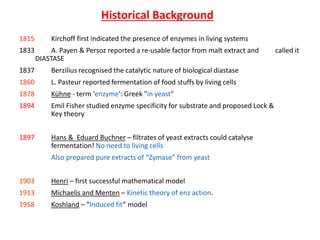
1815 Kirchoff first indicated the presence of enzymes in living systems
1833 A. Payen & Persoz reported a re-usable factor from malt extract and called it
DIASTASE
1837 Berzilius recognised the catalytic nature of biological diastase
1860 L. Pasteur reported fermentation of food stuffs by living cells
1878 Kühne - term 'enzyme': Greek "in yeast"
1894 Emil Fisher studied enzyme specificity for substrate and proposed Lock &
Key theory
1897 Hans & Eduard Buchner – filtrates of yeast extracts could catalyse
fermentation! No need to living cells
Also prepared pure extracts of “Zymase” from yeast
1903 Henri – first successful mathematical model
1913 Michaelis and Menten – Kinetic theory of enz action.
1958 Koshland – “Induced fit” model
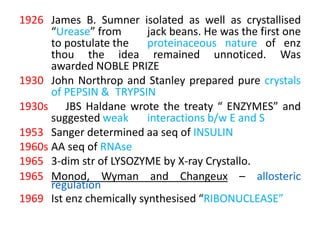
1926 James B. Sumner isolated as well as crystallised
“Urease” from jack beans. He was the first one
to postulate the proteinaceous nature of enz
thou the idea remained unnoticed. Was
awarded NOBLE PRIZE
1930 John Northrop and Stanley prepared pure crystals
of PEPSIN & TRYPSIN
1930s JBS Haldane wrote the treaty “ ENZYMES” and
suggested weak interactions b/w E and S
1953 Sanger determined aa seq of INSULIN
1960s AA seq of RNAse
1965 3-dim str of LYSOZYME by X-ray Crystallo.
1965 Monod, Wyman and Changeux – allosteric
regulation
1969 Ist enz chemically synthesised “RIBONUCLEASE”
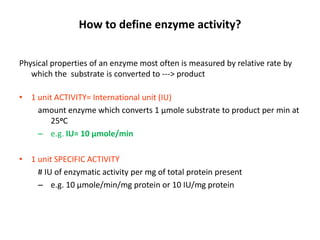
How to define enzyme activity?
Physical properties of an enzyme most often is measured by relative rate by
which the substrate is converted to ---> product
• 1 unit ACTIVITY= International unit (IU)
amount enzyme which converts 1 μmole substrate to product per min at
25oC
– e.g. IU= 10 μmole/min
• 1 unit SPECIFIC ACTIVITY
# IU of enzymatic activity per mg of total protein present
– e.g. 10 μmole/min/mg protein or 10 IU/mg protein
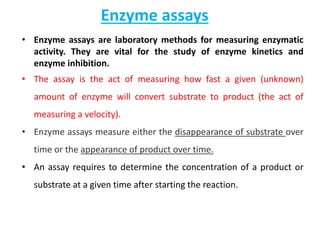
Enzyme assays
• Enzyme assays are laboratory methods for measuring enzymatic
activity. They are vital for the study of enzyme kinetics and
enzyme inhibition.
• The assay is the act of measuring how fast a given (unknown)
amount of enzyme will convert substrate to product (the act of
measuring a velocity).
• Enzyme assays measure either the disappearance of substrate over
time or the appearance of product over time.
• An assay requires to determine the concentration of a product or
substrate at a given time after starting the reaction.
Measuring enzyme activity
• Enzymes are usually present in very small quantities in
biological fluids
• Therefore, Enzymes are not directly measured
• They are commonly measured in terms of their catalytic activity
• We don’t measure the molecule …
• But we measure how much “work” it performs (catalytic
activity)
• That means the rate at which it catalyzes the conversion of
substrate to product
• The enzymatic activity is a reflection of its concentration
• Activity is proportional to concentration
Types of Enzyme assay
Enzyme assays can be split into two groups
according to their sampling method:
• Continuous assays, where the assay gives a
continuous reading of activity,
– multiple measurements, usually of absorbance change,
are made during the reaction,
– either at specific time intervals (usually every 30 or 60
seconds)
– or continuously by a continuous-recording
spectrophotometer.
– These assays are advantageous over fixed-time methods
because the linearity of the reaction may be more
adequately verified.
– the reaction proceeds for a designated time,
– the reaction is stopped (usually by inactivating the enzyme
with a weak acid),
– a measurement is made of the amount of reaction that has
occurred.
Discontinuous assays, where samples are taken, the
reaction stopped and then the concentration of
substrates/products determined.
Features of a good E.A.
• 1. Simple and Specific
• 2. Rapid ( one doesn’t need to wait for hrs or
weeks for the results to appear)
• 3. Sensitive ( v little sample)
• 4. Easy to use
• 5. Economical
Continuous assays
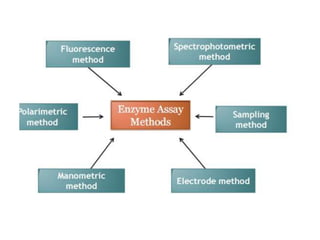
1. Spectrophotometric:
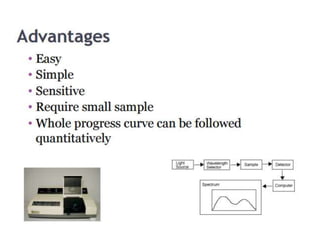
• The spectrophotometric assay is the most common method of
detection in enzyme assays.
• It uses a spectrophotometer, a machine used to measure the amount
of light a substance's absorbs, to combine kinetic measurements and
Beer's law by calculating the appearance of product or disappearance
of substrate concentrations
• If this light is in the visible region we can actually see a change in the
color of the assay, these are called colorimetric assays.
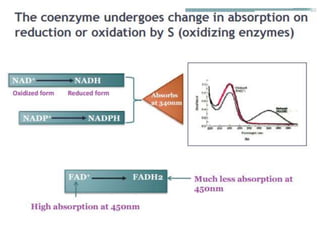
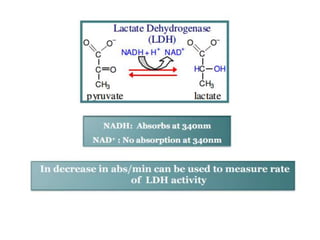
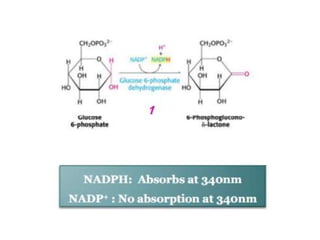
• UV light is often used, since the common coenzymes NADH and
NADPH absorb UV light in their reduced forms, but do not in their
oxidized forms.
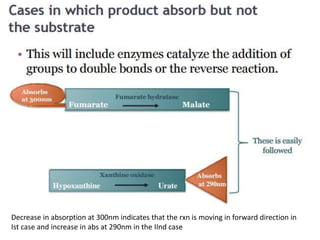
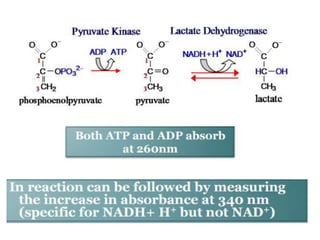
Decrease in absorption at 300nm indicates that the rxn is moving in forward direction in
Ist case and increase in abs at 290nm in the IInd case
COUPLED REACTIONS:
• In many reactions, changes in substrates or products are not
observable by spectrophotometric methods because they do
not absorb light.
• Even when such enzyme reaction does not result in a change in
the absorbance of light, it can still be possible to use a
spectrophotometric assay for the enzyme by using a coupled
assay.
• These reactions can be measured by coupling them to enzymes
that can be detected via a spectrophotometer.
• Here, the product of one reaction is used as the substrate of
another, easily-detectable reaction.
• This help to follow the first enzymatic reaction.
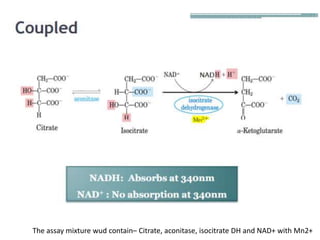
The assay mixture wud contain– Citrate, aconitase, isocitrate DH and NAD+ with Mn2+
2. Flurescence method/Fluorimetric:
 Fluorescence is when a molecule emits light of one
wavelength after absorbing light of a different wavelength.
 Uses a Fluorometer
 Fluorometric assays use a difference in the fluorescence of
substrate from product to measure the enzyme reaction.
 FLAVIN COMPOUNDS: fluorescence in reduced form and
loose their flouescence in oxidised form
 An example of these assays is again the use of the nucleotide coenzymes
NADH and NADPH.
 Here, the reduced forms are fluorescent and the oxidised forms non-
fluorescent.
 Oxidation reactions can therefore be followed by a decrease in fluorescence
and reduction reactions by an increase.
 More sensitive than spectrophotometric assays, but can suffer from
interference caused by impurities and the instability of many fluorescent
compounds when exposed to light.
 Detection in small quantities
 Non dangerous
3. Calorimetric: is the measurement of the
heat released or absorbed by chemical
reactions.
• These assays are very general, since many
reactions involve some change in heat and
with use of a micro-calorimeter, not much
enzyme or substrate is required.
• These assays can be used to measure
reactions that are impossible to assay in
any other way.
4. Chemiluminescent: is the emission of light
by a chemical reaction.
• Some enzyme reactions produce light and
this can be measured to detect product
formation.
• These types of assay can be extremely
sensitive, since the light produced can be
captured by photographic film over days or
weeks,
• but can be hard to quantify, because not all
the light released by a reaction will be
detected.
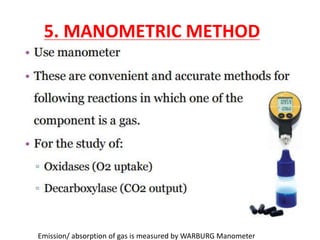
5. MANOMETRIC METHOD
Emission/ absorption of gas is measured by WARBURG Manometer
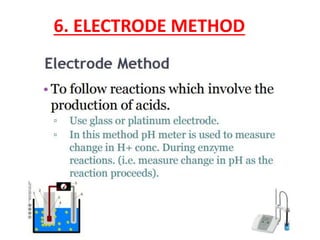
6. ELECTRODE METHOD
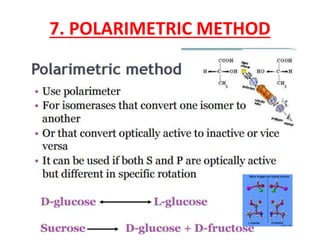
7. POLARIMETRIC METHOD
Discontinuous assays
Discontinuous assays are when samples are taken from an enzyme
reaction at intervals and the amount of product production or substrate
consumption is measured in these samples by different chemical
methods.
Radiometric: Radiometric assays measure the incorporation of
radioactivity into substrates or its release from substrates.
• The radioactive isotopes most frequently used in these assays are
14C, 32P, 35S and 125I.
• Since radioactive isotopes can allow the specific labelling of a single
atom of a substrate, these assays are both extremely sensitive and
specific.
• They are frequently used in biochemistry and are often the only way
of measuring a specific reaction in crude extracts (the complex
mixtures of enzymes produced when you lyse cells).
• Radioactivity is usually measured in these procedures using a
scintillation counter., which measures the ionizing radiation.
• V sensitive but hazardous
Chromatographic: Chromatographic assays measure
product formation by separating the reaction mixture
into its components by chromatography.
• This is usually done by high-performance liquid
chromatography (HPLC), but can also use the
simpler technique of thin layer chromatography.
• Although this approach can need a lot of material,
its sensitivity can be increased by labelling the
substrates/products with a radioactive or
fluorescent tag.
Enzymes assay ppt Best

Enzymes assay ppt Best

  • 1.
    Historical Background 1815 Kirchofffirst indicated the presence of enzymes in living systems 1833 A. Payen & Persoz reported a re-usable factor from malt extract and called it DIASTASE 1837 Berzilius recognised the catalytic nature of biological diastase 1860 L. Pasteur reported fermentation of food stuffs by living cells 1878 Kühne - term 'enzyme': Greek "in yeast" 1894 Emil Fisher studied enzyme specificity for substrate and proposed Lock & Key theory 1897 Hans & Eduard Buchner – filtrates of yeast extracts could catalyse fermentation! No need to living cells Also prepared pure extracts of “Zymase” from yeast 1903 Henri – first successful mathematical model 1913 Michaelis and Menten – Kinetic theory of enz action. 1958 Koshland – “Induced fit” model
  • 2.
    1926 James B.Sumner isolated as well as crystallised “Urease” from jack beans. He was the first one to postulate the proteinaceous nature of enz thou the idea remained unnoticed. Was awarded NOBLE PRIZE 1930 John Northrop and Stanley prepared pure crystals of PEPSIN & TRYPSIN 1930s JBS Haldane wrote the treaty “ ENZYMES” and suggested weak interactions b/w E and S 1953 Sanger determined aa seq of INSULIN 1960s AA seq of RNAse 1965 3-dim str of LYSOZYME by X-ray Crystallo. 1965 Monod, Wyman and Changeux – allosteric regulation 1969 Ist enz chemically synthesised “RIBONUCLEASE”
  • 3.
    How to defineenzyme activity? Physical properties of an enzyme most often is measured by relative rate by which the substrate is converted to ---> product • 1 unit ACTIVITY= International unit (IU) amount enzyme which converts 1 μmole substrate to product per min at 25oC – e.g. IU= 10 μmole/min • 1 unit SPECIFIC ACTIVITY # IU of enzymatic activity per mg of total protein present – e.g. 10 μmole/min/mg protein or 10 IU/mg protein
  • 4.
    Enzyme assays • Enzymeassays are laboratory methods for measuring enzymatic activity. They are vital for the study of enzyme kinetics and enzyme inhibition. • The assay is the act of measuring how fast a given (unknown) amount of enzyme will convert substrate to product (the act of measuring a velocity). • Enzyme assays measure either the disappearance of substrate over time or the appearance of product over time. • An assay requires to determine the concentration of a product or substrate at a given time after starting the reaction.
  • 5.
    Measuring enzyme activity •Enzymes are usually present in very small quantities in biological fluids • Therefore, Enzymes are not directly measured • They are commonly measured in terms of their catalytic activity • We don’t measure the molecule … • But we measure how much “work” it performs (catalytic activity) • That means the rate at which it catalyzes the conversion of substrate to product • The enzymatic activity is a reflection of its concentration • Activity is proportional to concentration
  • 6.
    Types of Enzymeassay Enzyme assays can be split into two groups according to their sampling method: • Continuous assays, where the assay gives a continuous reading of activity, – multiple measurements, usually of absorbance change, are made during the reaction, – either at specific time intervals (usually every 30 or 60 seconds) – or continuously by a continuous-recording spectrophotometer. – These assays are advantageous over fixed-time methods because the linearity of the reaction may be more adequately verified.
  • 7.
    – the reactionproceeds for a designated time, – the reaction is stopped (usually by inactivating the enzyme with a weak acid), – a measurement is made of the amount of reaction that has occurred. Discontinuous assays, where samples are taken, the reaction stopped and then the concentration of substrates/products determined.
  • 9.
    Features of agood E.A. • 1. Simple and Specific • 2. Rapid ( one doesn’t need to wait for hrs or weeks for the results to appear) • 3. Sensitive ( v little sample) • 4. Easy to use • 5. Economical
  • 10.
    Continuous assays 1. Spectrophotometric: •The spectrophotometric assay is the most common method of detection in enzyme assays. • It uses a spectrophotometer, a machine used to measure the amount of light a substance's absorbs, to combine kinetic measurements and Beer's law by calculating the appearance of product or disappearance of substrate concentrations • If this light is in the visible region we can actually see a change in the color of the assay, these are called colorimetric assays. • UV light is often used, since the common coenzymes NADH and NADPH absorb UV light in their reduced forms, but do not in their oxidized forms.
  • 13.
    Decrease in absorptionat 300nm indicates that the rxn is moving in forward direction in Ist case and increase in abs at 290nm in the IInd case
  • 17.
    COUPLED REACTIONS: • Inmany reactions, changes in substrates or products are not observable by spectrophotometric methods because they do not absorb light. • Even when such enzyme reaction does not result in a change in the absorbance of light, it can still be possible to use a spectrophotometric assay for the enzyme by using a coupled assay. • These reactions can be measured by coupling them to enzymes that can be detected via a spectrophotometer. • Here, the product of one reaction is used as the substrate of another, easily-detectable reaction. • This help to follow the first enzymatic reaction.
  • 18.
    The assay mixturewud contain– Citrate, aconitase, isocitrate DH and NAD+ with Mn2+
  • 20.
    2. Flurescence method/Fluorimetric: Fluorescence is when a molecule emits light of one wavelength after absorbing light of a different wavelength.  Uses a Fluorometer  Fluorometric assays use a difference in the fluorescence of substrate from product to measure the enzyme reaction.  FLAVIN COMPOUNDS: fluorescence in reduced form and loose their flouescence in oxidised form
  • 21.
     An exampleof these assays is again the use of the nucleotide coenzymes NADH and NADPH.  Here, the reduced forms are fluorescent and the oxidised forms non- fluorescent.  Oxidation reactions can therefore be followed by a decrease in fluorescence and reduction reactions by an increase.  More sensitive than spectrophotometric assays, but can suffer from interference caused by impurities and the instability of many fluorescent compounds when exposed to light.  Detection in small quantities  Non dangerous
  • 22.
    3. Calorimetric: isthe measurement of the heat released or absorbed by chemical reactions. • These assays are very general, since many reactions involve some change in heat and with use of a micro-calorimeter, not much enzyme or substrate is required. • These assays can be used to measure reactions that are impossible to assay in any other way.
  • 23.
    4. Chemiluminescent: isthe emission of light by a chemical reaction. • Some enzyme reactions produce light and this can be measured to detect product formation. • These types of assay can be extremely sensitive, since the light produced can be captured by photographic film over days or weeks, • but can be hard to quantify, because not all the light released by a reaction will be detected.
  • 24.
    5. MANOMETRIC METHOD Emission/absorption of gas is measured by WARBURG Manometer
  • 25.
  • 26.
  • 27.
    Discontinuous assays Discontinuous assaysare when samples are taken from an enzyme reaction at intervals and the amount of product production or substrate consumption is measured in these samples by different chemical methods. Radiometric: Radiometric assays measure the incorporation of radioactivity into substrates or its release from substrates. • The radioactive isotopes most frequently used in these assays are 14C, 32P, 35S and 125I. • Since radioactive isotopes can allow the specific labelling of a single atom of a substrate, these assays are both extremely sensitive and specific. • They are frequently used in biochemistry and are often the only way of measuring a specific reaction in crude extracts (the complex mixtures of enzymes produced when you lyse cells). • Radioactivity is usually measured in these procedures using a scintillation counter., which measures the ionizing radiation. • V sensitive but hazardous
  • 28.
    Chromatographic: Chromatographic assaysmeasure product formation by separating the reaction mixture into its components by chromatography. • This is usually done by high-performance liquid chromatography (HPLC), but can also use the simpler technique of thin layer chromatography. • Although this approach can need a lot of material, its sensitivity can be increased by labelling the substrates/products with a radioactive or fluorescent tag.