PROPTOSIS
PROPTOSIS
• Forward displacement of the eyeball beyond orbital
margins due to a mass/increased orbital contents .
• Proptosis >21 mm or asymmetry of >2 mm
between 2 eyes : abnormal.
• Exophthalmos: specifically describes proptosis
associated with thyroid eye disease (TED).
• Exorbitism: decrease in the volume of orbit
b/l.orbital contents to protrude forwards.
• Pseudoproptosis:apparent protrusion of eyeball
without increase in any orbital contents or mass.
• causes: Buphthalmos High myopia
: C/l ptosis C/l enophthalmos
EXOPHTHALMOS PROPTOSIS
ANATOMY OF ORBIT
• pear shaped, tapers posteriorly at optic canal.
• Volume of orbit :30 ml.
• 4 walls of 7 bones: ethmoid, frontal, lacrimal,
maxillary,palatine, sphenoid and zygomatic.
• Medial orbital walls are approximately parallel ,
separated by 25 mm.
• Lateral orbital walls angle about 90 degrees from
each other
• The widest dimension :1 cm behind the anterior
orbital rim.
• The thinnest bone is in the medial wall (lamina
papyracea) adjacent to the ethmoid air cells.
• Relationship of orbit & PNS :By its location & venous
drainage .
• orbital venous drainage :devoid of valves – two way
communication between orbit and sinuses.
• Roof :anterior cranial fossa & frontal sinus above.
• Medial wall : adjacent nasal cavity, ethmoid &
posterior sphenoid sinus.
• Floor :The maxillary antrum beneath .
• Lateral wall :adjacent to middle cranial ,temporal &
pterygopalatine fossa.
RELATIONS OF ORBITAL WALL
CLINICAL ASPECTS
• Ethmoidal sinusitis can breach lamina papyracea &
spread into the orbit.
• The floor is thin medially -> fragmentation in “blow
out” fractures.
• Lacrimal bone at the level of lacrimal fossa is very
thin-> easy penetration during endoscopic DCR. if
maxillary component is predominant ,difficult to
breach the bone in endoscopic DCR.
• Webers suture:Lying anterior to lacrimal fossa has
Infraorbital artery branches pass through it.
Bleeding during lacrimal sac sx.
• Traumatic Optic Neuropathy :indirect injury to optic
canal & direct injury by bony fragments in canal.
CLASSIFICATION OF PROPTOSIS
1. Unilateral proptosis
2. Bilateral proptosis
3. Acute proptosis
4. Intermittent proptosis
5. Pulsating proptosis
6. Axial proptosis
7. Non-axial proptosis.
U/L PROPTOSIS
1)congenital - dermoid
teratoma
2)Traumatic - orbital hemorrhage
emphysema
IOFB
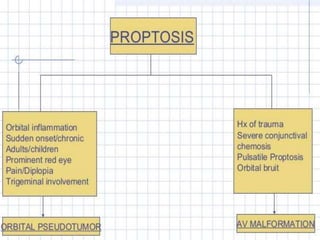
3)inflammation - orbital cellulitis/abscess
cavernous sinus thrombosis
pseudotumor
tuberculosis/gumma
sarcoidosis
4) vascular - orbital varix
5) Cysts - parasitic
6)Tumor - primary or secondary
7)mucocoele of paranasal sinuses
BILATERAL PROPTOSIS
1) Developmental abn/l - Oxycephaly
2)osteopathies - Rickets / Acromegaly
3)Tumors - Lymphoma / Leukemia
Ewings sarcoma
Neuroblastoma
4)Endocrinal - Thyroid eye disease
5)Inflammatory - Fungal granuloma
Mikulickz syndrome
6)Systemic - Histiocytosis
systemic amyloidosis
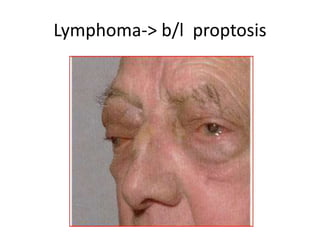
Lymphoma-> b/l proptosis
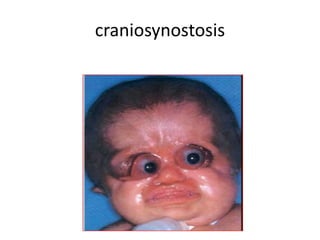
craniosynostosis
A/C PROPTOSIS
• orbital emphysema
• fracture of the medial orbital wall
• orbital haemorrhage
• rupture of ethmoidal mucocele.
INTERMITTENT PROPTOSIS
• orbital varix
• periodic orbital oedema
• recurrent orbital haemorrhage
• highly vascular tumours.
PULSATING PROPTOSIS
• Carotico cavernous fistula
• saccular aneurysm of ophthalmic artery.
• transmitted cerebral pulsations with deficient
orbital roof.
Congenital meningocele
Meningoencephalocele
Neurofibromatosis
Traumatic or operative hiatus.
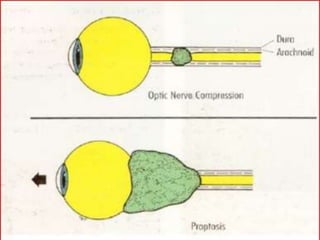
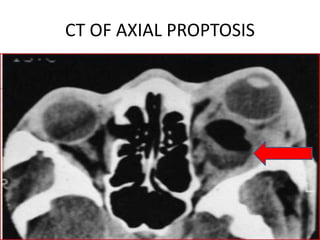
AXIAL PROPTOSIS
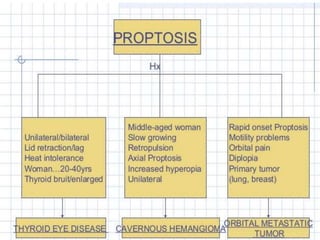
• Cavernous hemangioma
• Optic nerve glioma
• Thyroid eye disease
• Arteriovenous malformations, and
• Mass lesion within the muscle cone.
NON -AXIAL PROPTOSIS
• Lesions with prominent component outside muscle
cone .
Superior globe displacement:
• Neural/mesenchymal /vascular tumors in inferior orbit.
• Maxillary sinus tumors invading the orbital floor.
Inferomedial globe displacement
• Dermoid cysts in superolateral orbit.
• Lacrimal gland tumors.
Inferolateral globe displacement
• Frontoethmoidal mucoceles.
• Abscesses.
• Osteomas.
• Sinus carcinomas
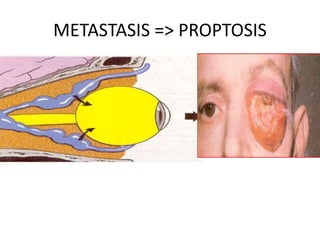
METASTASIS => PROPTOSIS
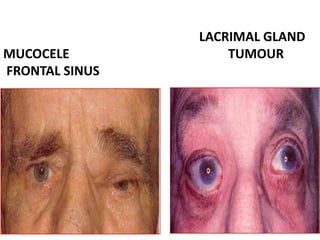
LACRIMAL GLAND
MUCOCELE TUMOUR
FRONTAL SINUS
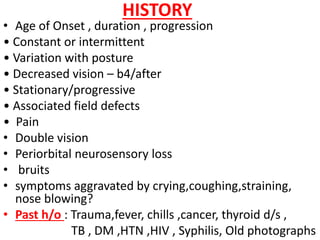
HISTORY
• Age of Onset , duration , progression
• Constant or intermittent
• Variation with posture
• Decreased vision – b4/after
• Stationary/progressive
• Associated field defects
• Pain
• Double vision
• Periorbital neurosensory loss
• bruits
• symptoms aggravated by crying,coughing,straining,
nose blowing?
• Past h/o : Trauma,fever, chills ,cancer, thyroid d/s ,
TB , DM ,HTN ,HIV , Syphilis, Old photographs
HEMORRHAGE INTO A LYMPHANGIOMA
• A sudden dramatic proptosis with conjunctival prolapse in a child with recent
URTI
GAZE-EVOKED AMAUROSIS
• may be associated with an orbital apex tumor.
MALIGNANT LESION (adenoid cystic carcinoma)
• Pain associated with a short history of a mass in the region of lacrimal gland.
• Periorbital neurosensory loss in the absence of trauma
BENIGN LESION (pleomorphic adenoma)
• a gradually progressive painless mass in the region of the lacrimal gland.
ARTERIOVENOUS SHUNT
• history of “tinnitus”
ORBITAL VARICES
• Proptosis provoked by straining may suggest.
AMYLOIDOSIS
• spontaneous unilateral periorbital bruising in an adult may suggest.
NEUROBLASTOMA
• bilateral bruising in a child
SCIRRHOUS ORBITAL METASTASIS.
• Acquired exophthalmos in a female patient with a past history of breast
carcinoma
GENERAL PHYSICAL EXAMINATION
• Skin and oropharynx
cutaneous /intraoral vascular lesions: lymphangioma
café au lait spots :neurofibromatosis.
• Cranial Nerve Examination:
periorbital and corneal sensation.
• Examination of Chest and Abdomen:
systemic malignancy: undiagnosed ca breast
• The regional/ distant/ generalized lymphadenopathy
lymphoproliferative disorder.
OCULAR EXAMINATION
• Visual acuity, Refraction, visual fields, colour vision.
• Facial asymmetry,Head posture,Lid retraction/ptosis
• ocular alignment,Extraocular movements
• Examination of the anterior segment including pupil.
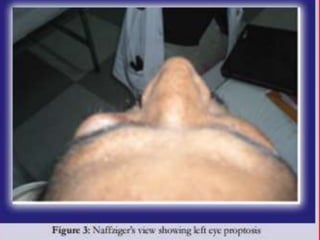
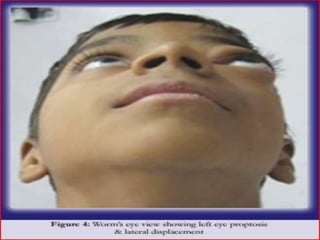
• INSPECTION:
• examiner looks from above standing behind patient/looks
up from below with the patient’s head tilted back
1]Type of proptosis (axial / non-axial),location of mass,
visible pulsation, skin changes.
2] Lagophthalmos,conjunctival congestion/discolouration.
3] Corneal exposure, change in size with valsalva.
4] examination of the globe and ocular adnexa
* Dilated episcleral vessels: arteriovenous shunt.
*A “salmon patch” lesion beneath the upper eyelid:
orbital lymphoma, amyloidosis, sarcoidosis, leukemia,
lymphoid hyperplasia, rhabdomyosarcoma.
*Eversion of the upper eyelid ->waxy yellow
infiltrate with tortuous vessels : amyloid lesion.
*S-shaped deformity of upper eyelid : plexiform NF.
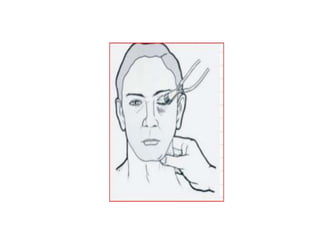
PALPATION :
1] Size, shape, surface, margins,consistency.
2] Signs of inflammation, tenderness, reducibility,motility.
3] Variation with valsalva, resistance to retropulsion,Thrill.
4] Corneal sensation, infraorbital / supraorbital anesthesia
5] Any swelling around the eyeball, regional lymph nodes
& orbital rim.
AUSCULTATION
abnormal vascular communications -> bruit
caroticocavernous fistula.
• Fundus examination : signs of venous engorgement
haemorrhage
papilloedema
optic atrophy
choroidal folds
• Intraocular pressure
EXOPHTHALMOMETRY
• Measurement is done from the lateral orbital rim to the anterior
corneal surface.
• A difference >2 mm between eyes ->proptosis.
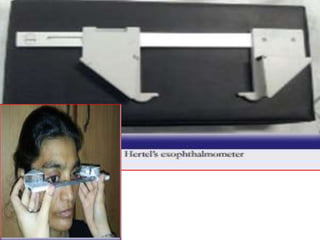
• Exophthalmometers
Hertel’s exophthalmometer
Luedde scale
Gormaz exophthalmometer.
• Three types
Absolute exophthalmometry - compared with n/l reading (>21mm)
Relative exophthalmometry - relative distance of the 2 corneas from
lateral orbital rim.
Comparative exophthalmometry -exophthalmos of at different times.
procedure
1) With closed eyes, locate the orbital notch on the
temporal side of the orbital rim near lateral canthus.
2) grooves placed in the orbital notch. The separation of
exophthalmometer noted
3)The patient told to open their eyes and look straight ahead.
4)Red lines should overlap to avoid the parallax.
5)corneal apex position on the scale noted.
6)From mirrors located at each end findings are recorded in mm.
Limitations
• Poor fixation, depressed /fractured lateral orbital
rim,convergence, parallax errors, head movements affect the
readings.
• separation of the grooved arcs is narrow, readings falsly low.
• separation of grooved arcs too wide :readings falsly high
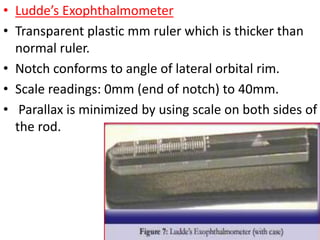
• Ludde’s Exophthalmometer
• Transparent plastic mm ruler which is thicker than
normal ruler.
• Notch conforms to angle of lateral orbital rim.
• Scale readings: 0mm (end of notch) to 40mm.
• Parallax is minimized by using scale on both sides of
the rod.
LABORATORY INVESTIGATIONS
• CXR :sarcoidosis
ca bronchus
Wegener’s granulomatosis
• TFT/thyroid ab :Graves’disease
• Angiotensin-converting enzyme:sarcoidosis
• c-ANCA & RFT :Wegener’s granulomatosis
• Immunology screen : SLE
ORBITAL IMAGING
• CECT - initial choice of investigation .
• MRI - orbital apex,CNS involvement,soft tissue
infiltration and RB.
• USG – 2 assess internal reflectivity of lesion &
calcification in RB.
• CT/MRI angiography for vascular lesions.
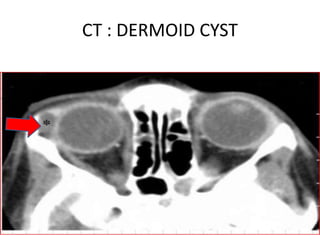
CT : DERMOID CYST
CT OF AXIAL PROPTOSIS
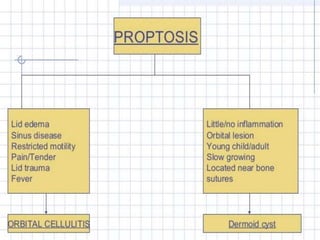
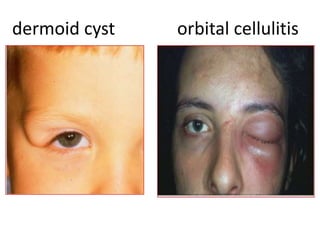
dermoid cyst orbital cellulitis
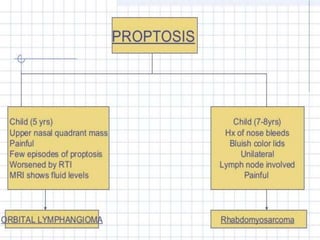
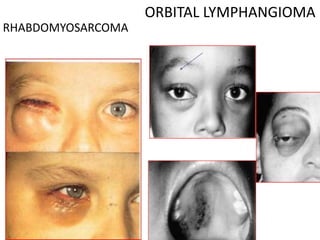
RHABDOMYOSARCOMA
ORBITAL LYMPHANGIOMA
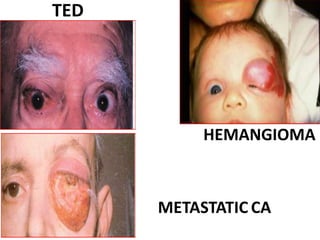
TED
HEMANGIOMA
METASTATIC CA
THANQ

Proptosis in ophthalmology

  • 1.
  • 2.
    PROPTOSIS • Forward displacementof the eyeball beyond orbital margins due to a mass/increased orbital contents . • Proptosis >21 mm or asymmetry of >2 mm between 2 eyes : abnormal. • Exophthalmos: specifically describes proptosis associated with thyroid eye disease (TED). • Exorbitism: decrease in the volume of orbit b/l.orbital contents to protrude forwards. • Pseudoproptosis:apparent protrusion of eyeball without increase in any orbital contents or mass. • causes: Buphthalmos High myopia : C/l ptosis C/l enophthalmos
  • 3.
  • 4.
    ANATOMY OF ORBIT •pear shaped, tapers posteriorly at optic canal. • Volume of orbit :30 ml. • 4 walls of 7 bones: ethmoid, frontal, lacrimal, maxillary,palatine, sphenoid and zygomatic. • Medial orbital walls are approximately parallel , separated by 25 mm. • Lateral orbital walls angle about 90 degrees from each other • The widest dimension :1 cm behind the anterior orbital rim. • The thinnest bone is in the medial wall (lamina papyracea) adjacent to the ethmoid air cells.
  • 5.
    • Relationship oforbit & PNS :By its location & venous drainage . • orbital venous drainage :devoid of valves – two way communication between orbit and sinuses. • Roof :anterior cranial fossa & frontal sinus above. • Medial wall : adjacent nasal cavity, ethmoid & posterior sphenoid sinus. • Floor :The maxillary antrum beneath . • Lateral wall :adjacent to middle cranial ,temporal & pterygopalatine fossa. RELATIONS OF ORBITAL WALL
  • 6.
    CLINICAL ASPECTS • Ethmoidalsinusitis can breach lamina papyracea & spread into the orbit. • The floor is thin medially -> fragmentation in “blow out” fractures. • Lacrimal bone at the level of lacrimal fossa is very thin-> easy penetration during endoscopic DCR. if maxillary component is predominant ,difficult to breach the bone in endoscopic DCR. • Webers suture:Lying anterior to lacrimal fossa has Infraorbital artery branches pass through it. Bleeding during lacrimal sac sx. • Traumatic Optic Neuropathy :indirect injury to optic canal & direct injury by bony fragments in canal.
  • 7.
    CLASSIFICATION OF PROPTOSIS 1.Unilateral proptosis 2. Bilateral proptosis 3. Acute proptosis 4. Intermittent proptosis 5. Pulsating proptosis 6. Axial proptosis 7. Non-axial proptosis.
  • 8.
    U/L PROPTOSIS 1)congenital -dermoid teratoma 2)Traumatic - orbital hemorrhage emphysema IOFB 3)inflammation - orbital cellulitis/abscess cavernous sinus thrombosis pseudotumor tuberculosis/gumma sarcoidosis 4) vascular - orbital varix 5) Cysts - parasitic 6)Tumor - primary or secondary 7)mucocoele of paranasal sinuses
  • 9.
    BILATERAL PROPTOSIS 1) Developmentalabn/l - Oxycephaly 2)osteopathies - Rickets / Acromegaly 3)Tumors - Lymphoma / Leukemia Ewings sarcoma Neuroblastoma 4)Endocrinal - Thyroid eye disease 5)Inflammatory - Fungal granuloma Mikulickz syndrome 6)Systemic - Histiocytosis systemic amyloidosis
  • 10.
  • 11.
  • 12.
    A/C PROPTOSIS • orbitalemphysema • fracture of the medial orbital wall • orbital haemorrhage • rupture of ethmoidal mucocele.
  • 13.
    INTERMITTENT PROPTOSIS • orbitalvarix • periodic orbital oedema • recurrent orbital haemorrhage • highly vascular tumours.
  • 14.
    PULSATING PROPTOSIS • Caroticocavernous fistula • saccular aneurysm of ophthalmic artery. • transmitted cerebral pulsations with deficient orbital roof. Congenital meningocele Meningoencephalocele Neurofibromatosis Traumatic or operative hiatus.
  • 15.
    AXIAL PROPTOSIS • Cavernoushemangioma • Optic nerve glioma • Thyroid eye disease • Arteriovenous malformations, and • Mass lesion within the muscle cone.
  • 17.
    NON -AXIAL PROPTOSIS •Lesions with prominent component outside muscle cone . Superior globe displacement: • Neural/mesenchymal /vascular tumors in inferior orbit. • Maxillary sinus tumors invading the orbital floor. Inferomedial globe displacement • Dermoid cysts in superolateral orbit. • Lacrimal gland tumors. Inferolateral globe displacement • Frontoethmoidal mucoceles. • Abscesses. • Osteomas. • Sinus carcinomas
  • 18.
  • 19.
  • 21.
    HISTORY • Age ofOnset , duration , progression • Constant or intermittent • Variation with posture • Decreased vision – b4/after • Stationary/progressive • Associated field defects • Pain • Double vision • Periorbital neurosensory loss • bruits • symptoms aggravated by crying,coughing,straining, nose blowing? • Past h/o : Trauma,fever, chills ,cancer, thyroid d/s , TB , DM ,HTN ,HIV , Syphilis, Old photographs
  • 22.
    HEMORRHAGE INTO ALYMPHANGIOMA • A sudden dramatic proptosis with conjunctival prolapse in a child with recent URTI GAZE-EVOKED AMAUROSIS • may be associated with an orbital apex tumor. MALIGNANT LESION (adenoid cystic carcinoma) • Pain associated with a short history of a mass in the region of lacrimal gland. • Periorbital neurosensory loss in the absence of trauma BENIGN LESION (pleomorphic adenoma) • a gradually progressive painless mass in the region of the lacrimal gland. ARTERIOVENOUS SHUNT • history of “tinnitus” ORBITAL VARICES • Proptosis provoked by straining may suggest. AMYLOIDOSIS • spontaneous unilateral periorbital bruising in an adult may suggest. NEUROBLASTOMA • bilateral bruising in a child SCIRRHOUS ORBITAL METASTASIS. • Acquired exophthalmos in a female patient with a past history of breast carcinoma
  • 23.
    GENERAL PHYSICAL EXAMINATION •Skin and oropharynx cutaneous /intraoral vascular lesions: lymphangioma café au lait spots :neurofibromatosis. • Cranial Nerve Examination: periorbital and corneal sensation. • Examination of Chest and Abdomen: systemic malignancy: undiagnosed ca breast • The regional/ distant/ generalized lymphadenopathy lymphoproliferative disorder.
  • 24.
    OCULAR EXAMINATION • Visualacuity, Refraction, visual fields, colour vision. • Facial asymmetry,Head posture,Lid retraction/ptosis • ocular alignment,Extraocular movements • Examination of the anterior segment including pupil. • INSPECTION: • examiner looks from above standing behind patient/looks up from below with the patient’s head tilted back 1]Type of proptosis (axial / non-axial),location of mass, visible pulsation, skin changes. 2] Lagophthalmos,conjunctival congestion/discolouration. 3] Corneal exposure, change in size with valsalva. 4] examination of the globe and ocular adnexa * Dilated episcleral vessels: arteriovenous shunt.
  • 25.
    *A “salmon patch”lesion beneath the upper eyelid: orbital lymphoma, amyloidosis, sarcoidosis, leukemia, lymphoid hyperplasia, rhabdomyosarcoma. *Eversion of the upper eyelid ->waxy yellow infiltrate with tortuous vessels : amyloid lesion. *S-shaped deformity of upper eyelid : plexiform NF. PALPATION : 1] Size, shape, surface, margins,consistency. 2] Signs of inflammation, tenderness, reducibility,motility. 3] Variation with valsalva, resistance to retropulsion,Thrill. 4] Corneal sensation, infraorbital / supraorbital anesthesia 5] Any swelling around the eyeball, regional lymph nodes & orbital rim. AUSCULTATION abnormal vascular communications -> bruit caroticocavernous fistula.
  • 28.
    • Fundus examination: signs of venous engorgement haemorrhage papilloedema optic atrophy choroidal folds • Intraocular pressure
  • 29.
    EXOPHTHALMOMETRY • Measurement isdone from the lateral orbital rim to the anterior corneal surface. • A difference >2 mm between eyes ->proptosis. • Exophthalmometers Hertel’s exophthalmometer Luedde scale Gormaz exophthalmometer. • Three types Absolute exophthalmometry - compared with n/l reading (>21mm) Relative exophthalmometry - relative distance of the 2 corneas from lateral orbital rim. Comparative exophthalmometry -exophthalmos of at different times.
  • 30.
    procedure 1) With closedeyes, locate the orbital notch on the temporal side of the orbital rim near lateral canthus. 2) grooves placed in the orbital notch. The separation of exophthalmometer noted 3)The patient told to open their eyes and look straight ahead. 4)Red lines should overlap to avoid the parallax. 5)corneal apex position on the scale noted. 6)From mirrors located at each end findings are recorded in mm. Limitations • Poor fixation, depressed /fractured lateral orbital rim,convergence, parallax errors, head movements affect the readings. • separation of the grooved arcs is narrow, readings falsly low. • separation of grooved arcs too wide :readings falsly high
  • 32.
    • Ludde’s Exophthalmometer •Transparent plastic mm ruler which is thicker than normal ruler. • Notch conforms to angle of lateral orbital rim. • Scale readings: 0mm (end of notch) to 40mm. • Parallax is minimized by using scale on both sides of the rod.
  • 33.
    LABORATORY INVESTIGATIONS • CXR:sarcoidosis ca bronchus Wegener’s granulomatosis • TFT/thyroid ab :Graves’disease • Angiotensin-converting enzyme:sarcoidosis • c-ANCA & RFT :Wegener’s granulomatosis • Immunology screen : SLE
  • 34.
    ORBITAL IMAGING • CECT- initial choice of investigation . • MRI - orbital apex,CNS involvement,soft tissue infiltration and RB. • USG – 2 assess internal reflectivity of lesion & calcification in RB. • CT/MRI angiography for vascular lesions.
  • 35.
  • 36.
    CT OF AXIALPROPTOSIS
  • 38.
  • 40.
  • 42.
  • 45.