By Peter C Roy
2009 batch
Forward displacement of eyeball beyond
the orbital margins.
Exophthalmos is synonymous, but is
usually used for the displacement
associated with thyroid disease.
Unilateral Proptosis
Bilateral Proptosis
Acute Proptosis
Intermittebt Proptosis
Pulsation Proptosis
 Congenital:
• Dermoid cyst
• Congenital cystic eyeball
• Orbital teratoma
 Traumatic:
• Orbital haemorrhage
• Retained intraorbital Foreign Body
• Traumatic aneurysm
• Emphysema of orbit
 Inflammatory Lesions
• Acute:
 Orbital cellulitis
 Abscess
 Panophthalmitis
 Thrombophlebitis
 Cavernous sinus thrombosis
• Chronic:
 Pseudotumours
 Tuberculoma
 Gumma
 Sarcoidosis
 Circulatory disturbances and vascular
lesions:
• Angioneurotic edema
• Orbital varix
• Aneurysms
 Cysts of orbit
• Hematic cyst
• Implantation cyst
• Parasitic cyst
 Tumors: primary, secondary, metastatic
 Mucoceles of frontal, ethmoidal, maxillary
sinuses
Orbitopalpebral cyst
Preseptal cellulitis
Pseudotumours of right orbit
 Developmental anomalies of skull
• Craniofacial dysostosis
eg. Oxycephaly (tower skull)
 Osteopathies
• Osteitis deformans
• Rickets
• Acromegaly.
 Inflammatory condition
• Mikulicz’s syndrome (enlarged lacrimal and parotid
glands caused by infiltration with lymphocytes)
• Late stage of cavernous sinus thrombosis.
 Endocrinal exophthalmos
• Thyrotoxic or thyrotropic.
 Tumours
• Symmetrical lymphoma or
• Lymphosarcoma
• Secondaries from Neuroblastoma
• Ewing’s sarcoma
• Leukemic infiltration.
 Systemic diseases
• Histiocytosis
• Systemic Amyloidosis
• Wegener’s Granulomatosis
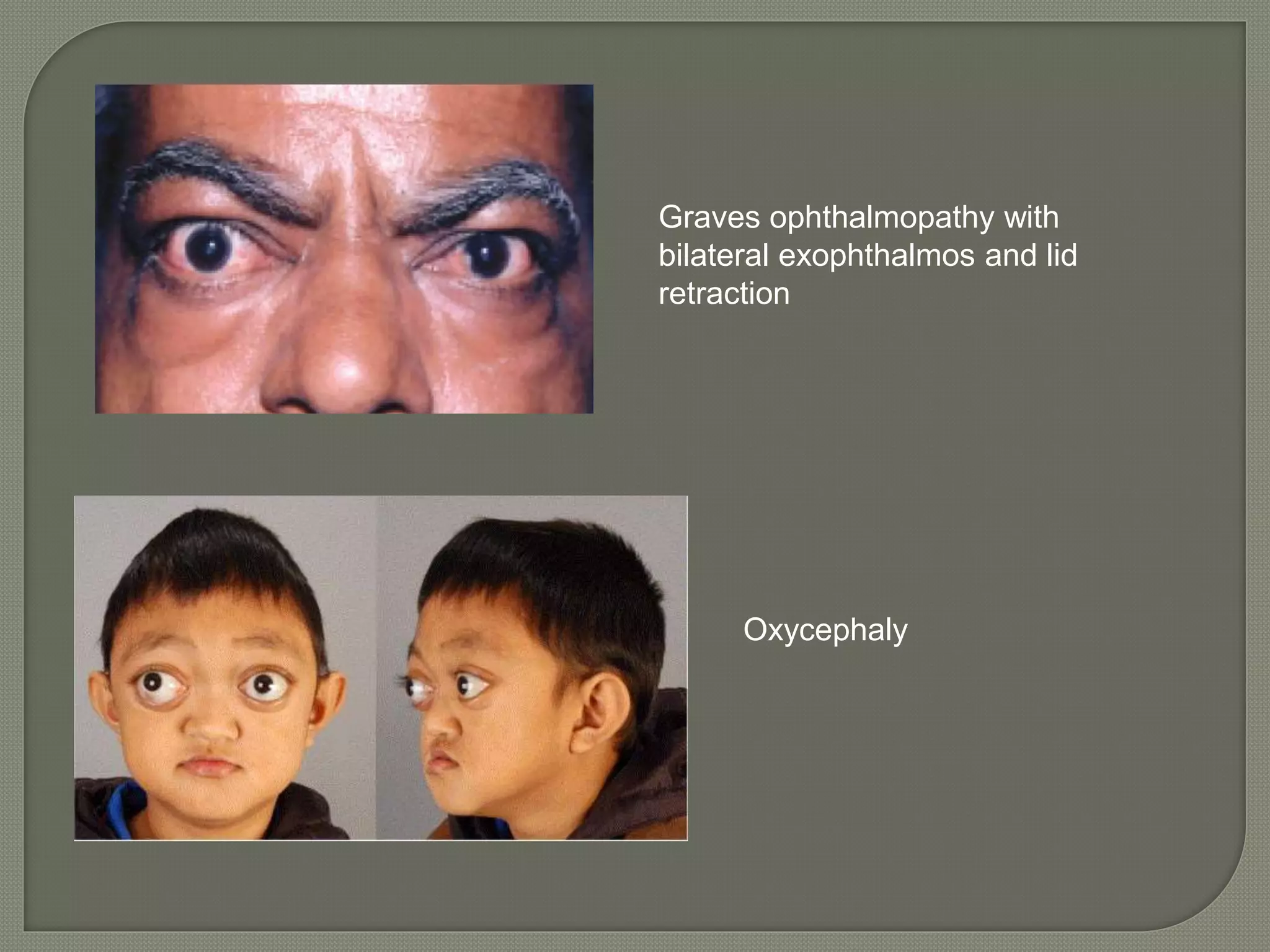
Graves ophthalmopathy with
bilateral exophthalmos and lid
retraction
Oxycephaly
Develops with extremely sudden onset
Common causes are
• Orbital emphysema
• Fracture of medial orbital wall
• Orbital hemorrhage
• Rupture of ethmoidal mucocele
 Appears and disappears on its own.
 Common causes are
• Periodic orbital oedema
• Orbital varix
• Reccurent orbital haemorrhage
• Highly vascular tumours
 Causes:
• Pulsating vascular lesions like Caroticocavernous
fistula and saccular aneurysms of ophthalmic
artery.
• Also by transmitted cerebral pulsations
associated with deficiency of orbital roof. These
include congenital meningocele or
meningoencephalocele, neurofibromatosis,
traumatic or operative hiatus
One eye may look to be larger than the
other eye
Causes
• Unilateral high axial myopia
• Unilateral buphthalmos
• Pseudocornea or anterior staphyloma
• Retraction of eyelid of one eye
• Enophthalmos of opposite eye
Pseudocornea RE
Myopia RE
Buphthalmos LE
Local Examination
Inspection - to diff proptosis and
pseudoproptosis, if proptosis is unilateral or
bilateral, to note the shape of the skull
Palpation – swellings, regional lymph nodes,
orbital rim
 Auscultation – to know abnormal vascular
communications like caroticocavernous fistula
 Transillumination
 Visual acuity – may decrease due to pressure
in the back of the eyeball, optic nerve
compression, exposure keratopathy
Pupil reactions
Fundoscopy – venous engorgement,
hemorrage, disc edema
Occular motility – decreased in thyroid
ophthalmopathy
Exophthalmometry –
• Measures the protrusion of the apex of the cornea
from the from outer orbital margin
• Normal – 10 to 21 mm, symmetrical in both eyes
• Difference of more than 2 mm is significant
Luedde’s Exophthalmometer
Hertel’s Exophthalmometer
(can measure both eyes
simultaneously)
Systemic Examination
Laboratory investigations
• thyroid function test
• haematological studies
• Casoni’s test
• Stool examination for ova and cysts
• Urine analysis for bence jones proteins
Imaging techniques
• Non-invasive – Plain X rays, Compted
tomography scanning, Ultrasonography, MRI
• Invasive – Not done
Histopathological studies
• Fine needle aspiration biopsy
• Incisional biopsy
• Excitional biopsy
Causes of proptosis

Causes of proptosis

  • 1.
    By Peter CRoy 2009 batch
  • 2.
    Forward displacement ofeyeball beyond the orbital margins. Exophthalmos is synonymous, but is usually used for the displacement associated with thyroid disease.
  • 3.
    Unilateral Proptosis Bilateral Proptosis AcuteProptosis Intermittebt Proptosis Pulsation Proptosis
  • 4.
     Congenital: • Dermoidcyst • Congenital cystic eyeball • Orbital teratoma  Traumatic: • Orbital haemorrhage • Retained intraorbital Foreign Body • Traumatic aneurysm • Emphysema of orbit
  • 5.
     Inflammatory Lesions •Acute:  Orbital cellulitis  Abscess  Panophthalmitis  Thrombophlebitis  Cavernous sinus thrombosis • Chronic:  Pseudotumours  Tuberculoma  Gumma  Sarcoidosis
  • 6.
     Circulatory disturbancesand vascular lesions: • Angioneurotic edema • Orbital varix • Aneurysms  Cysts of orbit • Hematic cyst • Implantation cyst • Parasitic cyst  Tumors: primary, secondary, metastatic  Mucoceles of frontal, ethmoidal, maxillary sinuses
  • 7.
  • 8.
     Developmental anomaliesof skull • Craniofacial dysostosis eg. Oxycephaly (tower skull)  Osteopathies • Osteitis deformans • Rickets • Acromegaly.  Inflammatory condition • Mikulicz’s syndrome (enlarged lacrimal and parotid glands caused by infiltration with lymphocytes) • Late stage of cavernous sinus thrombosis.
  • 9.
     Endocrinal exophthalmos •Thyrotoxic or thyrotropic.  Tumours • Symmetrical lymphoma or • Lymphosarcoma • Secondaries from Neuroblastoma • Ewing’s sarcoma • Leukemic infiltration.  Systemic diseases • Histiocytosis • Systemic Amyloidosis • Wegener’s Granulomatosis
  • 10.
    Graves ophthalmopathy with bilateralexophthalmos and lid retraction Oxycephaly
  • 11.
    Develops with extremelysudden onset Common causes are • Orbital emphysema • Fracture of medial orbital wall • Orbital hemorrhage • Rupture of ethmoidal mucocele
  • 12.
     Appears anddisappears on its own.  Common causes are • Periodic orbital oedema • Orbital varix • Reccurent orbital haemorrhage • Highly vascular tumours
  • 13.
     Causes: • Pulsatingvascular lesions like Caroticocavernous fistula and saccular aneurysms of ophthalmic artery. • Also by transmitted cerebral pulsations associated with deficiency of orbital roof. These include congenital meningocele or meningoencephalocele, neurofibromatosis, traumatic or operative hiatus
  • 14.
    One eye maylook to be larger than the other eye Causes • Unilateral high axial myopia • Unilateral buphthalmos • Pseudocornea or anterior staphyloma • Retraction of eyelid of one eye • Enophthalmos of opposite eye
  • 15.
  • 16.
    Local Examination Inspection -to diff proptosis and pseudoproptosis, if proptosis is unilateral or bilateral, to note the shape of the skull Palpation – swellings, regional lymph nodes, orbital rim  Auscultation – to know abnormal vascular communications like caroticocavernous fistula  Transillumination  Visual acuity – may decrease due to pressure in the back of the eyeball, optic nerve compression, exposure keratopathy
  • 17.
    Pupil reactions Fundoscopy –venous engorgement, hemorrage, disc edema Occular motility – decreased in thyroid ophthalmopathy Exophthalmometry – • Measures the protrusion of the apex of the cornea from the from outer orbital margin • Normal – 10 to 21 mm, symmetrical in both eyes • Difference of more than 2 mm is significant
  • 18.
  • 19.
    Systemic Examination Laboratory investigations •thyroid function test • haematological studies • Casoni’s test • Stool examination for ova and cysts • Urine analysis for bence jones proteins Imaging techniques • Non-invasive – Plain X rays, Compted tomography scanning, Ultrasonography, MRI • Invasive – Not done
  • 20.
    Histopathological studies • Fineneedle aspiration biopsy • Incisional biopsy • Excitional biopsy