proptosis
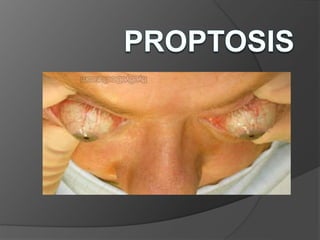
 It is defined as forward displacement of 
the eyeball beyond the orbital margins. 
 Though the word exophthalmos (out 
eye) is synonymous with it; but 
somehow it has become customary to 
use the term exophthalmos for the 
displacement associated with thyroid 
disease.
CLASSIFICATION 
Proptosis can be divided into following clinical 
groups: 
1. Unilateral proptosis 
2.Bilateral proptosis 
3. Acute proptosis 
4. Intermittent proptosis 
5. Pulsating proptosis
ETIOLOGY 
 Important causes of proptosis in each 
clinical group are listed here: 
 A. Causes of unilateral proptosis 
include: 
 1. Congenital conditions. These include: 
○ Dermoid cyst, 
○ congenital cystic eyeball, and orbital teratoma. 
 2. Traumatic lesions 
 3. Inflammatory lesions
 4. Circulatory disturbances and vascular 
lesions 
 5. Cysts of orbit 
 6. Tumours of the orbit 
 7. Mucoceles of paranasal sinuses
 B. Causes of bilateral proptosis 
include 
 1. Developmental anomalies of the skull: 
craniofacial dysostosis e.g., oxycephaly (tower 
skull). 
 2. Osteopathies 
 3. Inflammatory conditions: Mikulicz’s syndrome 
and late stage of cavernous sinus thrombosis. 
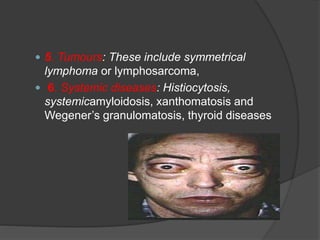
 4. Endocrinal exophthalmos (eg;thyrotoxicosis).
 5. Tumours: These include symmetrical 
lymphoma or lymphosarcoma, 
 6. Systemic diseases: Histiocytosis, 
systemicamyloidosis, xanthomatosis and 
Wegener’s granulomatosis, thyroid diseases
C. Causes of acute proptosis. 
It develops with extreme rapidity 
(sudden onset). Its common causes are 
: orbital emphysema, fracture of the 
medial orbital wall, orbital haemorrhage 
and rupture of ethmoidal mucocele.
D. Causes of intermittent 
proptosis: 
This type of proptosis appears and 
disappears of its own, Its common 
causes are: orbital varix, periodic orbital 
oedema, recurrent orbital haemorrhage 
and highly vascular tumours.
E. Causes of pulsating proptosis: 
 It is caused by pulsating vascular lesions 
such as caroticocavernous fistula and 
saccular aneurysm of ophthalmic artery. 
 Pulsating proptosis also occurs due to 
transmitted cerebral pulsations in 
conditions associated with deficient orbital 
roof. These include congenital 
meningocele or meningoencephalocele, 
neurofibromatosis and traumatic or 
operative hiatus.
Investigation of a case of 
proptosis 
 I. Clinical evaluation 
 (A) History. It should include: age of 
onset, nature of onset, duration, 
progression, chronology of orbital signs 
and symptoms. 
 (B) Local examination. It should be 
carried out as follows:
 1. Inspection. (i) To differentiate 
proptosis from pseudoproptosis which is 
seen in patients with buphthalmos, axial 
high myopia, retraction of upper lid and 
enophthalmos of the opposite eye. (ii) to 
ascertain whether the proptosis is 
unilateral or bilateral; (iii) to note the 
shape of the skull;and (iv) to observe 
whether proptosis is axial or eccentric.
 2. Palpation It should be carried out for 
retrodisplacement of globe to know 
compressibility of the tumour, for orbital 
thrill, for any swelling around the 
eyeball, regional lymph nodes and 
orbital rim. 
 3. Auscultation It is primarily of value in 
searching for abnormal vascular 
communications that generate a bruit, 
such as caroticocavernous fistula.
 4. Transillumination. It is helpful in 
evaluating anterior orbital lesions. 
 5. Visual acuity. Orbital lesions may 
reduce visual acuity by three 
mechanisms: refractive changes due to 
pressure on back of the eyeball, optic 
nerve compression and exposure 
keratopathy.
 6. Pupil reactions. The presence of 
Marcus Gunn pupil is suggestive of optic 
nerve compression. 
 7. Fundoscopy. It may reveal venous 
engorgement, haemorrhage, 
papilloedema and optic atrophy. 
 Choroidal folds and opticociliary shunts 
may be seen in patients with 
meningiomas.
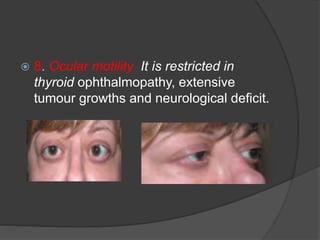
 8. Ocular motility It is restricted in 
thyroid ophthalmopathy, extensive 
tumour growths and neurological deficit.
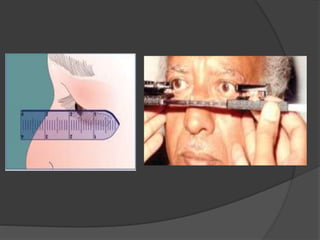
 9. Exophthalmometry It measures protrusion of the 
apex of cornea from the outer orbital margin (with the 
eyes looking straight ahead). 
 Normal values vary between 10 and 21 mm and 
are symmetrical in both eyes. 
 A difference of more than 2 mm between the two 
eyes is considered significant. 
The simplest instrument to measure proptosis is 
Luedde’s exophthalmometer . the Hertel’s 
exophthalmometer ( is the most commonly used 
instrument. 
Its advantage is that it measures the two eyes 
simultaneously.
 C) Systemic examination. A thorough 
examination should be conducted to rule 
out systemic causes of proptosis such as 
thyrotoxicosis, histiocytosis, and primary 
tumours elsewhere in the body 
(secondaries in orbits). 
Otorhinolaryngological examination is 
necessary when the paranasal sinus or a 
nasopharyngeal mass apears to be a 
possible etiological factor.
 II. Laboratory investigations 
These should include: Thyroid function tests, 
 Haematological studies (TLC, DLC, ESR, 
VDRL test), 
…. Casoni’s test (skin test to rule out hydatid 
cyst),. 
 Stool examination for cysts and ova, and 
 Urine analysis for Bence Jones proteins 
for 
multiple myeloma.
 III. Imaging Technique 
 (A) Non-invasive techniques 
 1. Plain X-rays. 
 2. Computed tomography scanning 
 3. Ultrasonography 
 4. Magnetic resonance imaging (MRI).
 (B) Invasive procedures 
 1. Orbital venography 
 2. Carotid angiography. 
 3. Radioisotope studies.
 IV. Histopathological studies ;The 
exact diagnosis of many orbital lesions 
cannot be made without the help of 
histopathological studies,which can be 
accomplished by following techniques. 
 1. Fine-needle aspiration biopsy 
(FNAB). 
 2. Incisional biopsy. 
 3. Excisional biopsy.
 MANAGEMENT OF PROPTOSIS 
REMOVE THE UNDERLYING 
CAUSES!!!!!!!!!!!!!!.
Proptosis

Proptosis

  • 1.
  • 3.
     It isdefined as forward displacement of the eyeball beyond the orbital margins.  Though the word exophthalmos (out eye) is synonymous with it; but somehow it has become customary to use the term exophthalmos for the displacement associated with thyroid disease.
  • 4.
    CLASSIFICATION Proptosis canbe divided into following clinical groups: 1. Unilateral proptosis 2.Bilateral proptosis 3. Acute proptosis 4. Intermittent proptosis 5. Pulsating proptosis
  • 5.
    ETIOLOGY  Importantcauses of proptosis in each clinical group are listed here:  A. Causes of unilateral proptosis include:  1. Congenital conditions. These include: ○ Dermoid cyst, ○ congenital cystic eyeball, and orbital teratoma.  2. Traumatic lesions  3. Inflammatory lesions
  • 6.
     4. Circulatorydisturbances and vascular lesions  5. Cysts of orbit  6. Tumours of the orbit  7. Mucoceles of paranasal sinuses
  • 7.
     B. Causesof bilateral proptosis include  1. Developmental anomalies of the skull: craniofacial dysostosis e.g., oxycephaly (tower skull).  2. Osteopathies  3. Inflammatory conditions: Mikulicz’s syndrome and late stage of cavernous sinus thrombosis.  4. Endocrinal exophthalmos (eg;thyrotoxicosis).
  • 8.
     5. Tumours:These include symmetrical lymphoma or lymphosarcoma,  6. Systemic diseases: Histiocytosis, systemicamyloidosis, xanthomatosis and Wegener’s granulomatosis, thyroid diseases
  • 9.
    C. Causes ofacute proptosis. It develops with extreme rapidity (sudden onset). Its common causes are : orbital emphysema, fracture of the medial orbital wall, orbital haemorrhage and rupture of ethmoidal mucocele.
  • 10.
    D. Causes ofintermittent proptosis: This type of proptosis appears and disappears of its own, Its common causes are: orbital varix, periodic orbital oedema, recurrent orbital haemorrhage and highly vascular tumours.
  • 11.
    E. Causes ofpulsating proptosis:  It is caused by pulsating vascular lesions such as caroticocavernous fistula and saccular aneurysm of ophthalmic artery.  Pulsating proptosis also occurs due to transmitted cerebral pulsations in conditions associated with deficient orbital roof. These include congenital meningocele or meningoencephalocele, neurofibromatosis and traumatic or operative hiatus.
  • 12.
    Investigation of acase of proptosis  I. Clinical evaluation  (A) History. It should include: age of onset, nature of onset, duration, progression, chronology of orbital signs and symptoms.  (B) Local examination. It should be carried out as follows:
  • 13.
     1. Inspection.(i) To differentiate proptosis from pseudoproptosis which is seen in patients with buphthalmos, axial high myopia, retraction of upper lid and enophthalmos of the opposite eye. (ii) to ascertain whether the proptosis is unilateral or bilateral; (iii) to note the shape of the skull;and (iv) to observe whether proptosis is axial or eccentric.
  • 14.
     2. PalpationIt should be carried out for retrodisplacement of globe to know compressibility of the tumour, for orbital thrill, for any swelling around the eyeball, regional lymph nodes and orbital rim.  3. Auscultation It is primarily of value in searching for abnormal vascular communications that generate a bruit, such as caroticocavernous fistula.
  • 15.
     4. Transillumination.It is helpful in evaluating anterior orbital lesions.  5. Visual acuity. Orbital lesions may reduce visual acuity by three mechanisms: refractive changes due to pressure on back of the eyeball, optic nerve compression and exposure keratopathy.
  • 16.
     6. Pupilreactions. The presence of Marcus Gunn pupil is suggestive of optic nerve compression.  7. Fundoscopy. It may reveal venous engorgement, haemorrhage, papilloedema and optic atrophy.  Choroidal folds and opticociliary shunts may be seen in patients with meningiomas.
  • 17.
     8. Ocularmotility It is restricted in thyroid ophthalmopathy, extensive tumour growths and neurological deficit.
  • 18.
     9. ExophthalmometryIt measures protrusion of the apex of cornea from the outer orbital margin (with the eyes looking straight ahead).  Normal values vary between 10 and 21 mm and are symmetrical in both eyes.  A difference of more than 2 mm between the two eyes is considered significant. The simplest instrument to measure proptosis is Luedde’s exophthalmometer . the Hertel’s exophthalmometer ( is the most commonly used instrument. Its advantage is that it measures the two eyes simultaneously.
  • 20.
     C) Systemicexamination. A thorough examination should be conducted to rule out systemic causes of proptosis such as thyrotoxicosis, histiocytosis, and primary tumours elsewhere in the body (secondaries in orbits). Otorhinolaryngological examination is necessary when the paranasal sinus or a nasopharyngeal mass apears to be a possible etiological factor.
  • 21.
     II. Laboratoryinvestigations These should include: Thyroid function tests,  Haematological studies (TLC, DLC, ESR, VDRL test), …. Casoni’s test (skin test to rule out hydatid cyst),.  Stool examination for cysts and ova, and  Urine analysis for Bence Jones proteins for multiple myeloma.
  • 22.
     III. ImagingTechnique  (A) Non-invasive techniques  1. Plain X-rays.  2. Computed tomography scanning  3. Ultrasonography  4. Magnetic resonance imaging (MRI).
  • 23.
     (B) Invasiveprocedures  1. Orbital venography  2. Carotid angiography.  3. Radioisotope studies.
  • 24.
     IV. Histopathologicalstudies ;The exact diagnosis of many orbital lesions cannot be made without the help of histopathological studies,which can be accomplished by following techniques.  1. Fine-needle aspiration biopsy (FNAB).  2. Incisional biopsy.  3. Excisional biopsy.
  • 25.
     MANAGEMENT OFPROPTOSIS REMOVE THE UNDERLYING CAUSES!!!!!!!!!!!!!!.