SUTURES AND
NEEDLES IN
OPHTHALMOLOG
Y
HISTORY
• Silk & cotton sutures : Susrutha
• Large ants : Aztec tribe.
INTRODUCTION
A suture is any material to hold a wound together in
good apposition until the natural healing process is
sufficiently well established to make the support.
IDEAL SUTURE MATERIAL
• Have good handling characteristics
• Not induce a significant tissue reaction
• Allow secure knots
• Have adequate tensile strength
• Not cut through tissue
• Be sterile, not support bacterial growth
• Be non-electrolytic
• Be non-allergenic/ carcinogenic
• Cheap
• Easy sterilization
TERMS TO DESCRIBE CHARACTERISTICS
OF SUTURE MATERIAL
• Absorbable - Progressive loss of mass and/or volume of
suture material.
• Nonabsorbable - suture material that is relatively
unaffected by the biologic activities of the body tissues.
permanent unless removed
• Breaking strength - Limit of tensile strength at which suture
failure occurs
• Capillarity - Extent to which absorbed fluid is transferred
along the suture
• Elasticity - Measure of the ability of the material to regain
its original form and length after deformation
• Fluid absorption - Ability to take up fluid after immersion
• Knot-pull tensile strength - Breaking strength of knotted
suture material (10-40% weaker)
• Knot strength - Amount of force necessary for the knot
to slip
• Memory - Inherent capability of suture to return or
maintain its original gross shape.
• Plasticity - Measure of the ability to deform without
breaking
• Pliability - Ease of handling of suture material; ability to
adjust knot tension and to secure knots
• Tensile strength - Measure of the ability of a material or
tissue to resist deformation and breakage
• Wound breaking strength - Limit of tensile strength of a
healing wound at which separation of the wound edges
occurs
• Straight-pull tensile strength - Linear breaking strength
of suture material.
TYPES OF SUTURES
• NATURAL
Absorbable materials :Catgut (Plain or chromic)
Non absorbable :Silk
Linen
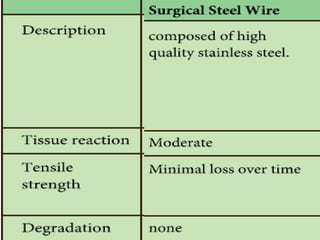
Stainless Steel Wire
• SYNTHETIC
absorbable materials : Polyglycolic Acid(Dexon)
Polyglactin (Vicryl)
Polydioxone (PDS)
Polyglyconate(Maxon)
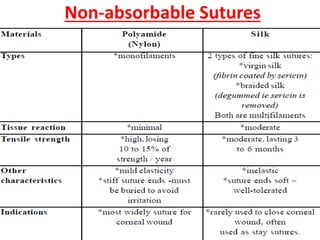
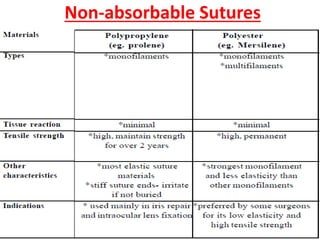
non-absorbable materials : Polyamide (Nylon)
Polyester (Dacron)
Polypropylene (Prolene).
Absorbable sutures are used for:
1.Repairing rapidly healing tissues that require minimal
support.
2. Ligating superficial blood vessels.
3. Conjunctival, subcutaneous tissue or mucosal closure
4. Muscles in strabismus and plastic surgery.
Nonabsorbable sutures are Used for:
• elicit a tissue reaction that results in encapsulation of
the suture material by fibroblasts
• Skin closure
• Corneo-scleral suturing
• Sling material for frontalis suspension
• Musculocutaneous flaps
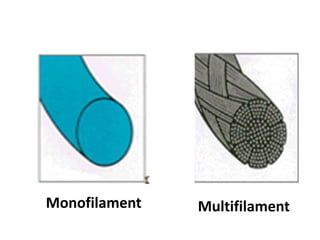
Monofilament
• Single strand
• Easy passage through tissues due to its low frictional
coefficient.
• Minimal tissue reactivity.
• Smooth surface will not support bacterial growth.
• Crushing can weaken the suture leading to
premature suture failure
• if handled inappropriately they can fracture.
• polypropylene
Multifilament
• Tightly braided filaments
• Less stiff but have a higher coefficient of friction
• Greater surface area.
• Easier to handle and knot well.
• Greater tensile strength and better pliability and
flexibility
• Have increased capillarity.
• polyglactin
MultifilamentMonofilament
DEGRADATION OF SUTURES
• Absorbable suture are broken down by:
proteolysis Catgut
hydrolysis Vicryl, Dexon.
CLASSES OF SUTURES
• Class I - Silk or synthetic fibers of monofilament,
twisted,braided construction
• Class II - Cotton or linen fibers or coated natural or
synthetic fibers in which the coating
contributes to suture thickness without adding
strength.
• Class III - Metal wire of monofilament or multifilament
construction.
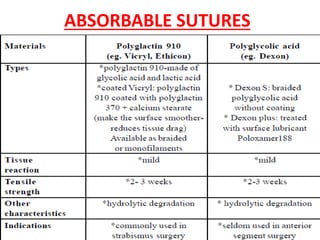
ABSORBABLE SUTURES
ABSORBABLE SUTURES
Non-absorbable Sutures
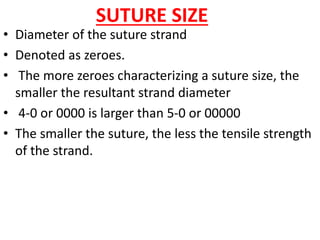
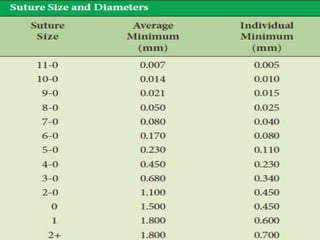
SUTURE SIZE
• Diameter of the suture strand
• Denoted as zeroes.
• The more zeroes characterizing a suture size, the
smaller the resultant strand diameter
• 4-0 or 0000 is larger than 5-0 or 00000
• The smaller the suture, the less the tensile strength
of the strand.
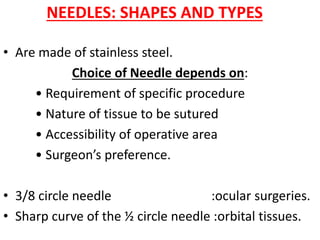
NEEDLES: SHAPES AND TYPES
• Are made of stainless steel.
Choice of Needle depends on:
• Requirement of specific procedure
• Nature of tissue to be sutured
• Accessibility of operative area
• Surgeon’s preference.
• 3/8 circle needle :ocular surgeries.
• Sharp curve of the ½ circle needle :orbital tissues.
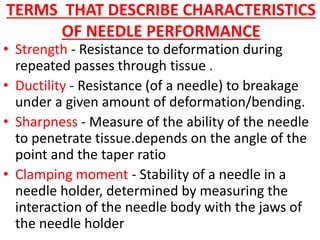
TERMS THAT DESCRIBE CHARACTERISTICS
OF NEEDLE PERFORMANCE
• Strength - Resistance to deformation during
repeated passes through tissue .
• Ductility - Resistance (of a needle) to breakage
under a given amount of deformation/bending.
• Sharpness - Measure of the ability of the needle
to penetrate tissue.depends on the angle of the
point and the taper ratio
• Clamping moment - Stability of a needle in a
needle holder, determined by measuring the
interaction of the needle body with the jaws of
the needle holder
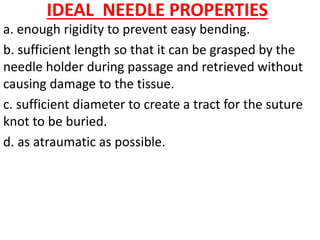
IDEAL NEEDLE PROPERTIES
a. enough rigidity to prevent easy bending.
b. sufficient length so that it can be grasped by the
needle holder during passage and retrieved without
causing damage to the tissue.
c. sufficient diameter to create a tract for the suture
knot to be buried.
d. as atraumatic as possible.
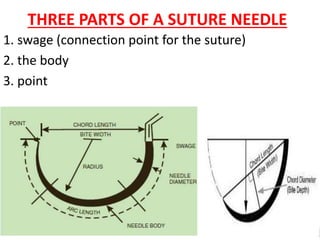
THREE PARTS OF A SUTURE NEEDLE
1. swage (connection point for the suture)
2. the body
3. point
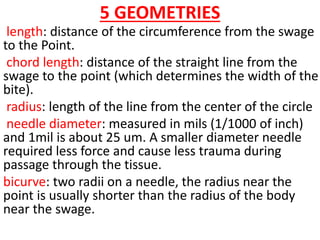
5 GEOMETRIES
length: distance of the circumference from the swage
to the Point.
chord length: distance of the straight line from the
swage to the point (which determines the width of the
bite).
radius: length of the line from the center of the circle
needle diameter: measured in mils (1/1000 of inch)
and 1mil is about 25 um. A smaller diameter needle
required less force and cause less trauma during
passage through the tissue.
bicurve: two radii on a needle, the radius near the
point is usually shorter than the radius of the body
near the swage.
DIAMETERS OF A NEEDLE BODY
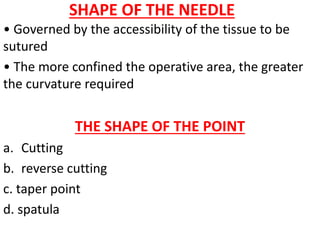
SHAPE OF THE NEEDLE
• Governed by the accessibility of the tissue to be
sutured
• The more confined the operative area, the greater
the curvature required
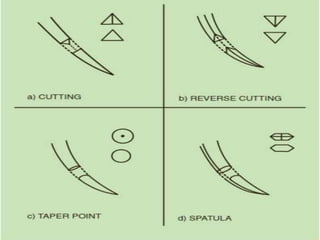
THE SHAPE OF THE POINT
a. Cutting
b. reverse cutting
c. taper point
d. spatula
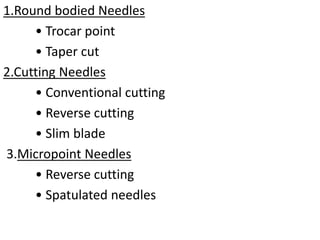
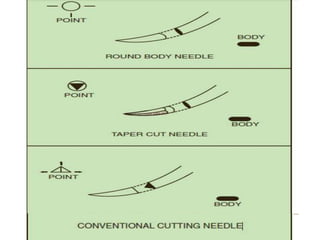
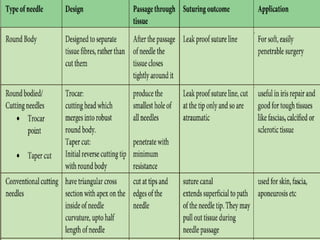
1.Round bodied Needles
• Trocar point
• Taper cut
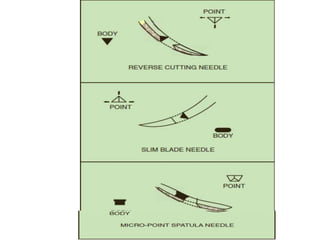
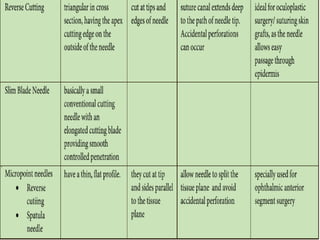
2.Cutting Needles
• Conventional cutting
• Reverse cutting
• Slim blade
3.Micropoint Needles
• Reverse cutting
• Spatulated needles
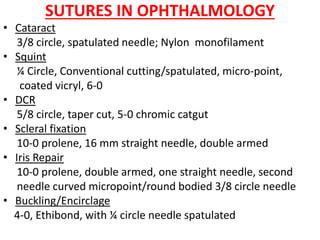
SUTURES IN OPHTHALMOLOGY
• Cataract
3/8 circle, spatulated needle; Nylon monofilament
• Squint
¼ Circle, Conventional cutting/spatulated, micro-point,
coated vicryl, 6-0
• DCR
5/8 circle, taper cut, 5-0 chromic catgut
• Scleral fixation
10-0 prolene, 16 mm straight needle, double armed
• Iris Repair
10-0 prolene, double armed, one straight needle, second
needle curved micropoint/round bodied 3/8 circle needle
• Buckling/Encirclage
4-0, Ethibond, with ¼ circle needle spatulated
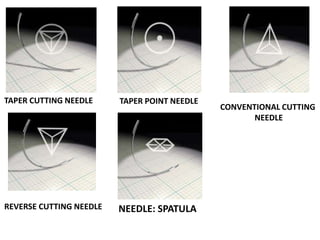
TAPER CUTTING NEEDLE TAPER POINT NEEDLE
CONVENTIONAL CUTTING
NEEDLE
REVERSE CUTTING NEEDLE NEEDLE: SPATULA
Sutures & needles in ophthalmology

Sutures & needles in ophthalmology

  • 1.
  • 2.
    HISTORY • Silk &cotton sutures : Susrutha • Large ants : Aztec tribe. INTRODUCTION A suture is any material to hold a wound together in good apposition until the natural healing process is sufficiently well established to make the support.
  • 3.
    IDEAL SUTURE MATERIAL •Have good handling characteristics • Not induce a significant tissue reaction • Allow secure knots • Have adequate tensile strength • Not cut through tissue • Be sterile, not support bacterial growth • Be non-electrolytic • Be non-allergenic/ carcinogenic • Cheap • Easy sterilization
  • 4.
    TERMS TO DESCRIBECHARACTERISTICS OF SUTURE MATERIAL • Absorbable - Progressive loss of mass and/or volume of suture material. • Nonabsorbable - suture material that is relatively unaffected by the biologic activities of the body tissues. permanent unless removed • Breaking strength - Limit of tensile strength at which suture failure occurs • Capillarity - Extent to which absorbed fluid is transferred along the suture • Elasticity - Measure of the ability of the material to regain its original form and length after deformation • Fluid absorption - Ability to take up fluid after immersion • Knot-pull tensile strength - Breaking strength of knotted suture material (10-40% weaker)
  • 5.
    • Knot strength- Amount of force necessary for the knot to slip • Memory - Inherent capability of suture to return or maintain its original gross shape. • Plasticity - Measure of the ability to deform without breaking • Pliability - Ease of handling of suture material; ability to adjust knot tension and to secure knots • Tensile strength - Measure of the ability of a material or tissue to resist deformation and breakage • Wound breaking strength - Limit of tensile strength of a healing wound at which separation of the wound edges occurs • Straight-pull tensile strength - Linear breaking strength of suture material.
  • 6.
    TYPES OF SUTURES •NATURAL Absorbable materials :Catgut (Plain or chromic) Non absorbable :Silk Linen Stainless Steel Wire • SYNTHETIC absorbable materials : Polyglycolic Acid(Dexon) Polyglactin (Vicryl) Polydioxone (PDS) Polyglyconate(Maxon) non-absorbable materials : Polyamide (Nylon) Polyester (Dacron) Polypropylene (Prolene).
  • 7.
    Absorbable sutures areused for: 1.Repairing rapidly healing tissues that require minimal support. 2. Ligating superficial blood vessels. 3. Conjunctival, subcutaneous tissue or mucosal closure 4. Muscles in strabismus and plastic surgery. Nonabsorbable sutures are Used for: • elicit a tissue reaction that results in encapsulation of the suture material by fibroblasts • Skin closure • Corneo-scleral suturing • Sling material for frontalis suspension • Musculocutaneous flaps
  • 8.
    Monofilament • Single strand •Easy passage through tissues due to its low frictional coefficient. • Minimal tissue reactivity. • Smooth surface will not support bacterial growth. • Crushing can weaken the suture leading to premature suture failure • if handled inappropriately they can fracture. • polypropylene
  • 9.
    Multifilament • Tightly braidedfilaments • Less stiff but have a higher coefficient of friction • Greater surface area. • Easier to handle and knot well. • Greater tensile strength and better pliability and flexibility • Have increased capillarity. • polyglactin
  • 10.
  • 11.
    DEGRADATION OF SUTURES •Absorbable suture are broken down by: proteolysis Catgut hydrolysis Vicryl, Dexon. CLASSES OF SUTURES • Class I - Silk or synthetic fibers of monofilament, twisted,braided construction • Class II - Cotton or linen fibers or coated natural or synthetic fibers in which the coating contributes to suture thickness without adding strength. • Class III - Metal wire of monofilament or multifilament construction.
  • 12.
  • 13.
  • 14.
  • 15.
  • 17.
    SUTURE SIZE • Diameterof the suture strand • Denoted as zeroes. • The more zeroes characterizing a suture size, the smaller the resultant strand diameter • 4-0 or 0000 is larger than 5-0 or 00000 • The smaller the suture, the less the tensile strength of the strand.
  • 19.
    NEEDLES: SHAPES ANDTYPES • Are made of stainless steel. Choice of Needle depends on: • Requirement of specific procedure • Nature of tissue to be sutured • Accessibility of operative area • Surgeon’s preference. • 3/8 circle needle :ocular surgeries. • Sharp curve of the ½ circle needle :orbital tissues.
  • 20.
    TERMS THAT DESCRIBECHARACTERISTICS OF NEEDLE PERFORMANCE • Strength - Resistance to deformation during repeated passes through tissue . • Ductility - Resistance (of a needle) to breakage under a given amount of deformation/bending. • Sharpness - Measure of the ability of the needle to penetrate tissue.depends on the angle of the point and the taper ratio • Clamping moment - Stability of a needle in a needle holder, determined by measuring the interaction of the needle body with the jaws of the needle holder
  • 21.
    IDEAL NEEDLE PROPERTIES a.enough rigidity to prevent easy bending. b. sufficient length so that it can be grasped by the needle holder during passage and retrieved without causing damage to the tissue. c. sufficient diameter to create a tract for the suture knot to be buried. d. as atraumatic as possible.
  • 22.
    THREE PARTS OFA SUTURE NEEDLE 1. swage (connection point for the suture) 2. the body 3. point
  • 23.
    5 GEOMETRIES length: distanceof the circumference from the swage to the Point. chord length: distance of the straight line from the swage to the point (which determines the width of the bite). radius: length of the line from the center of the circle needle diameter: measured in mils (1/1000 of inch) and 1mil is about 25 um. A smaller diameter needle required less force and cause less trauma during passage through the tissue. bicurve: two radii on a needle, the radius near the point is usually shorter than the radius of the body near the swage.
  • 24.
    DIAMETERS OF ANEEDLE BODY
  • 25.
    SHAPE OF THENEEDLE • Governed by the accessibility of the tissue to be sutured • The more confined the operative area, the greater the curvature required THE SHAPE OF THE POINT a. Cutting b. reverse cutting c. taper point d. spatula
  • 26.
    1.Round bodied Needles •Trocar point • Taper cut 2.Cutting Needles • Conventional cutting • Reverse cutting • Slim blade 3.Micropoint Needles • Reverse cutting • Spatulated needles
  • 32.
    SUTURES IN OPHTHALMOLOGY •Cataract 3/8 circle, spatulated needle; Nylon monofilament • Squint ¼ Circle, Conventional cutting/spatulated, micro-point, coated vicryl, 6-0 • DCR 5/8 circle, taper cut, 5-0 chromic catgut • Scleral fixation 10-0 prolene, 16 mm straight needle, double armed • Iris Repair 10-0 prolene, double armed, one straight needle, second needle curved micropoint/round bodied 3/8 circle needle • Buckling/Encirclage 4-0, Ethibond, with ¼ circle needle spatulated
  • 33.
    TAPER CUTTING NEEDLETAPER POINT NEEDLE CONVENTIONAL CUTTING NEEDLE REVERSE CUTTING NEEDLE NEEDLE: SPATULA