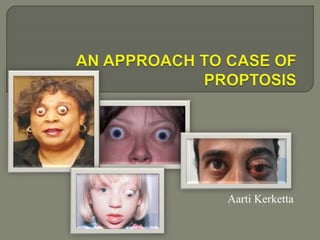
Aarti Kerketta
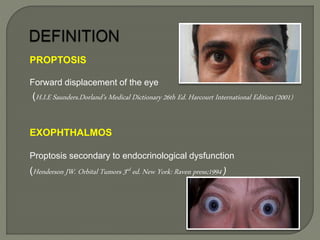
PROPTOSIS
Forward displacement of the eye
(H.I.E Saunders.Dorland’s Medical Dictionary 26th Ed. Harcourt International Edition (2001)
EXOPHTHALMOS
Proptosis secondary to endocrinological dysfunction
(Henderson JW. Orbital Tumors 3rd ed. New York: Raven press;1994 )
By Hertel’s
Exophthalmometer
Distance between lateral
orbital margin and corneal
apex greater than:
•13 to 15mm in Asians¹
•21 mm adult Caucasians²
•23 mm adult African-
American²
On CT scans³
•Globe protrusion > 21
mm anterior to the inter-
zygomatic line on mid
axial scans at the level of
the lens.
•Asymmetry between the
two sides >2mm
¹Sarinnapakoran V et al,Proptosis in normal Thai samples and thyroid patients.J Med Ass Thai 2007;90(4):679-83
²BeugerDG et al,Proptosis In: Ophthalmic secrets.Vander JF, GualtJA, Philadelpia,Pennsylvania,2002Chapter 36,p269
³Naik MN et al, Interpretation of computed tomography imaging of eye and orbit.A systemic approach.Indian J
Ophthalmology 2002;50(4):339-53
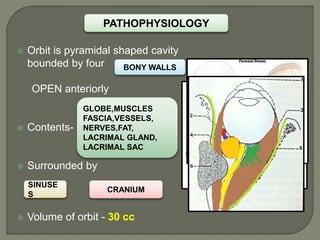
 Orbit is pyramidal shaped cavity
bounded by four
OPEN anteriorly
 Contents-
 Surrounded by
 Volume of orbit - 30 cc
PATHOPHYSIOLOGY
SINUSE
S
GLOBE,MUSCLES
FASCIA,VESSELS,
NERVES,FAT,
LACRIMAL GLAND,
LACRIMAL SAC
CRANIUM
BONY WALLS
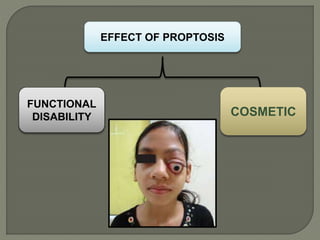
EFFECT OF PROPTOSIS
COSMETIC
FUNCTIONAL
DISABILITY
SYMPTOMS
 Forward protrusion or displacement of eye
 Visual disturbances- diminution of vision, diplopia
 Discomfort- grittiness, watering, pain
 Difficulty in closing eyes fully while sleeping or blinking
 Increase in visible white part of eye
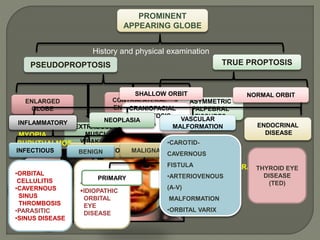
PROMINENT
APPEARING GLOBE
PSEUDOPROPTOSIS
ENLARGED
GLOBE
EXTRAOCULAR
MUSCLE
WEAKNESS
CONTRALATERAL
ENOPHTHALMOS
ASYMMETRIC
PALPEBRAL
FISSURES
•HIGH AXIAL
MYOPIA
•BUPHTHALMOS •IPSILATERAL
EYELID
RETRACTION
•CONTRALATERAL
PTOSIS
TRUE PROPTOSIS
History and physical examination
SHALLOW ORBIT NORMAL ORBIT
•CRANIOFACIAL
DYSOSTOSIS
•TRAUMA ENDOCRINAL
DISEASE
VASCULAR
MALFORMATION
INFLAMMATORY NEOPLASIA
INFECTIOUS
•ORBITAL
CELLULITIS
•CAVERNOUS
SINUS
THROMBOSIS
•PARASITIC
•SINUS DISEASE
NON INFECTIOUS
MYOSITIS
IDIOPATHIC
ORBITAL
EYE
DISEASE
SECONDARYPRIMARY
MALIGNANTBENIGN
•CAROTID-
CAVERNOUS
FISTULA
•ARTERIOVENOUS
(A-V)
MALFORMATION
•ORBITAL VARIX
THYROID EYE
DISEASE
(TED)
HISTORY
EXAMINATION
INVESTIGATION
• Age of patient at onset
• Progression
• Pain
• Visual disturbance
• Laterality(unilateral / bilateral)
• Nature- pulsatile/ intermittent /
variable
• redness, dry eye, discomfort
• Lid changes
• Headache, nausea, fever
• Systemic / extra-ocular disease
• Medications
• Previous trauma / surgery to orbit /
face
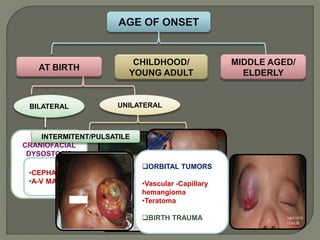
AGE OF ONSET
AT BIRTH
CHILDHOOD/
YOUNG ADULT
MIDDLE AGED/
ELDERLY
UNILATERALBILATERAL
CRANIOFACIAL
DYSOSTOSIS
•CROUZON’S
SYNDROME
•APERT’S
SYNDROME
INTERMITENT/PULSATILE NON PULSATILE
•CEPHALOCELE
•A-V MALFORMATIONS
ORBITAL TUMORS
•Vascular -Capillary
hemangioma
•Teratoma
BIRTH TRAUMA
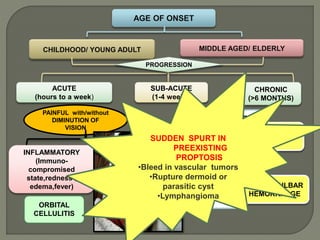
CHILDHOOD/ YOUNG ADULT MIDDLE AGED/ ELDERLY
AGE OF ONSET
PROGRESSION
ACUTE
(hours to a week)
SUB-ACUTE
(1-4 weeks)
CHRONIC
(>6 MONTHS)
PAINFUL with/without
DIMINUTION OF
VISION
INFLAMMATORY
(Immuno-
compromised
state,redness ,
edema,fever)
NON-
INFLAMMATORY
ORBITAL
CELLULITIS
PULSATILE
h/o Trauma,
surgery
(headache,tinnius,
diplopia)
NON
PULSATILE
(h/o trauma)
•A-V FISTULA
•RETROBULBAR
HEMORRHAGE
SUDDEN SPURT IN
PREEXISTING
PROPTOSIS
•Bleed in vascular tumors
•Rupture dermoid or
parasitic cyst
•Lymphangioma
CHILDHOOD/ YOUNG ADULT MIDDLE AGED/ ELDERLY
PROGRESSION
ACUTE
(hours to a week)
SUB-ACUTE
(1-4 weeks)
CHRONIC
(>6 MONTHS)
PAINFUL PAINLESS
(+/- DOV , diplopia, redness)
UNILATERAL BILATERAL
INFLAMMARTORY
NON-
INFLAMMATORY
ORBITAL
CELLULITIS
(fever)
(Diplopia)
MYOSITIS
TED
IOID (intermittent/
recurrent)
(Swelling,redness ,+/- DOV)
MALIGNANTM
ETASTASIC
TUMOR
CHILDHOOD/ YOUNG
ADULT
PRIMARY-
Rhabdomyosarcoma
SECONDARY –
Retinoblastoma, sinus
tumor
METASTATIC-Wilm’s
tumour,Neuroblastoma,
AML
MIDDLE AGED/
ELDERLY
•METASTATIC-lung,
breast, prostrate
•SECONDARY –
Intracranial tumor,
sinus tumor
INFLAMMARTORY
+
NON-
INFLAMMATORY
+/-
(Swelling,redness +/-DOV)
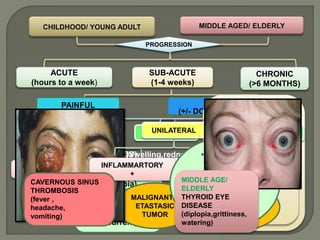
CAVERNOUS SINUS
THROMBOSIS
(fever ,
headache,
vomiting)
METASTATIC
TUMOR
•IDIOPATHIC
ORBITAL
INFLAMMATORY
DISEASE
•MALIGNANT
TUMOR
UNILATERAL BILATERAL
MIDDLE AGE/
ELDERLY
THYROID EYE
DISEASE
(diplopia,grittiness,
watering)
CHILDHOOD/ YOUNG ADULT MIDDLE AGED/ ELDERLY
PROGRESSION
ACUTE
(hours to a week)
SUB-ACUTE
(1-4 weeks)
CHRONIC
(>6 MONTHS)
PAINFUL PAINLESS
IDIOPATHIC
INFLAMMATORY
ORBITAL
DISEASE
(variable/recurrent)
TED(diplopia)
(Corneal dryness and exposure ,with DOV )
UNILATERAL BILATERAL
LARGE TUMOR/
CYST
WITH DOV WITHOUT DOV
PRECEEDING
PROPTOSIS
OPTIC NERVE
GLIOMA
(children)
FOLLOWING
PROPTOSIS
OPTIC NERVE
MENINGIOMA
BENIGN TUMOR
BENIGN TUMOR
CYST
•Parasitic
•Dermoid
(children,
young adult)
•Capillary
hemangioma
(children)
•Cavernous
hemangioma
(adults)
•Lymphangioma
(intermittent)
VASCULAR
TUMOR OTHER
•Neurofibroma
(pulsatile)
•Schwannoma
•Bone tumor
•Lacrima gland
tumor
•Lymphoma(bilateral)
History of systemic / extra-ocular disease
 Diabetes, immunocompromised status
 Sinus , dental and ENT diseases
 Prior nasal surgery
 Previous or current malignancy
 Thyroid dysfunction
 Trauma
INSPECTION
PALPATION
MEASUREMENT OF PROPTOSIS
OCULAR EXAMINATION
INSPECTION
 Compensatory head posture
 Facial scars, deformity
 Ocular symmetry and position of eye
 Adnexal structure
 Surface of eye
 Pulsations, valsalva maneuver
 Movements
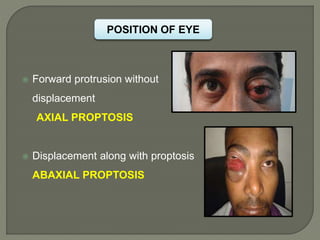
POSITION OF EYE
 Forward protrusion without
displacement
AXIAL PROPTOSIS
 Displacement along with proptosis
ABAXIAL PROPTOSIS
AXIAL PROPTOSIS
Lesions of intraconal space
Optic nerve glioma
Optic nerve sheath meningioma
Cvernous hemangioma, Orbital
varix
Schwannoma
Neurofibroma
Cystic lesion
Thyroid associated orbitopathy
 Idiopathic orbital inflammation
DOWN AND IN
Orbital mass of
superotemporal quadrant
•Lacrimal gland
tumor
•Dermoid
•Other benign or malignant
neoplasia
DOWN AND OUT
Orbital mass of
superonasal quadrant
•Frontoethmoidal
mucocele
•Fungal granulomas
• Benign or malignant
mass
LATERAL
DISPLACEMENT
•Tumor arising from
ethmoid sinus
•Lacrimal sac tumors
•Lethal midline granuloma
•Nasopharyngeal tumor
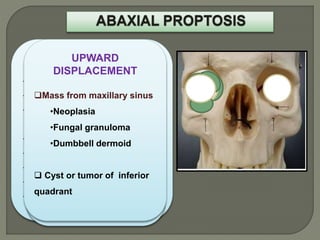
UPWARD
DISPLACEMENT
Mass from maxillary sinus
•Neoplasia
•Fungal granuloma
•Dumbbell dermoid
 Cyst or tumor of inferior
quadrant
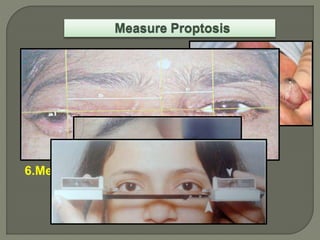
1.Nafziger’s Method
2.Clear plastic ruler
3. Luedde’s exophthalmometer
4. Hertel’s exophthalmometer
5.Naugle’s exophthalmometer
6.Measure dystopia (2 scale)
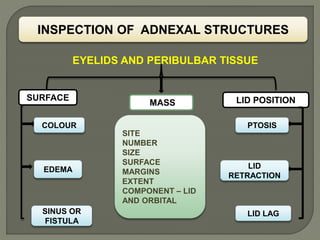
INSPECTION OF ADNEXAL STRUCTURES
SURFACE LID POSITIONMASS
EYELIDS AND PERIBULBAR TISSUE
COLOUR
EDEMA
SINUS OR
FISTULA
SITE
NUMBER
SIZE
SURFACE
MARGINS
EXTENT
COMPONENT – LID
AND ORBITAL
PTOSIS
LID
RETRACTION
LID LAG
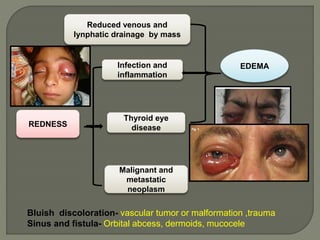
REDNESS
Infection and
inflammation
Thyroid eye
disease
Malignant and
metastatic
neoplasm
EDEMA
Reduced venous and
lynphatic drainage by mass
Bluish discoloration- vascular tumor or malformation ,trauma
Sinus and fistula- Orbital abcess, dermoids, mucocele
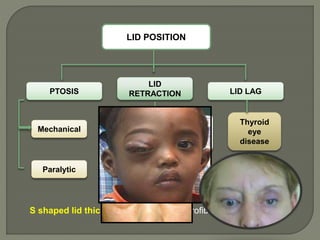
LID POSITION
PTOSIS
LID
RETRACTION LID LAG
Mechanical
Paralytic
Thyroid
eye
disease
Large
orbital
neoplasm
Thyroid
eye
disease
S shaped lid thickening - Plexiform neurofibroma
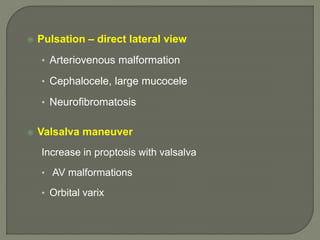
 Pulsation – direct lateral view
• Arteriovenous malformation
• Cephalocele, large mucocele
• Neurofibromatosis
 Valsalva maneuver
Increase in proptosis with valsalva
• AV malformations
• Orbital varix
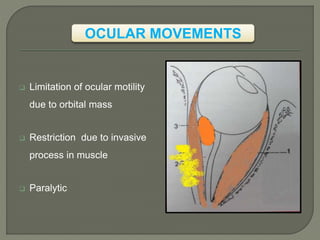
OCULAR MOVEMENTS
 Limitation of ocular motility
due to orbital mass
 Restriction due to invasive
process in muscle
 Paralytic
CONJUNCTIVA
Dilated vascular channel at the
canthus with chemosis-
dysthyroid disease
Epibulbar dark-red corkscrew
vessels – increased venous
pressure, AV malformation
Diffuse conjunctival congestion-
orbital inflammatory or infectious
disease
Sectoral congestion and
chemosis- Myositis
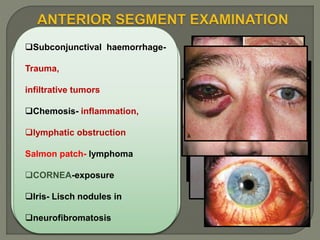
Subconjunctival haemorrhage-
Trauma,
infiltrative tumors
Chemosis- inflammation,
lymphatic obstruction
Salmon patch- lymphoma
CORNEA-exposure
Iris- Lisch nodules in
neurofibromatosis
EXAMINATION OF NASAL CAVITY
AND ORAL CAVITY IS MANDATORY
IN PRESENCE OF PARANASAL
SINUS INVOLVEMENT
• Local Temperature
• Tenderness
•Orbital tonometry, orbital margins
• If mass palpable note
•Position
•Size,surface, attachnents
•Consistency(hard , rubbery, spongy or soft)
•Compressibility/ Reducibility
Tenderness
 Orbital infection and inflammation
 Adenoid cystic carcinoma
 Trauma
Temperature
 Rise in temperature of overlying skin seen in orbital
infection and inflammation
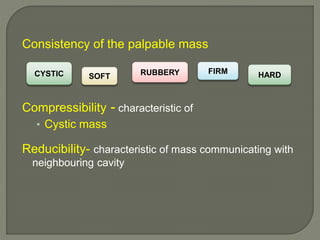
Consistency of the palpable mass
Compressibility - characteristic of
• Cystic mass
Reducibility- characteristic of mass communicating with
neighbouring cavity
CYSTIC SOFT
FIRMRUBBERY HARD
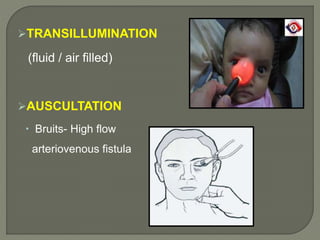
TRANSILLUMINATION
(fluid / air filled)
AUSCULTATION
 Bruits- High flow
arteriovenous fistula
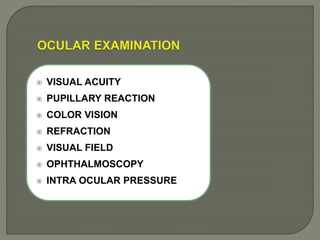
 VISUAL ACUITY
 PUPILLARY REACTION
 COLOR VISION
 REFRACTION
 VISUAL FIELD
 OPHTHALMOSCOPY
 INTRA OCULAR PRESSURE
Documentation of visual acuity is necessary
Diagnostic and aids in planning management
PUPILS
VISUAL ACUITY
Look carefully for RAPD suggestive
of optic nerve damage
COLOUR VISION
 In early compression of optic nerve patient may
not notice defective vision.
 In bilateral cases RAPD may not be elicited.
 Very early optic nerve compression can be
missed in fundus examination
IMPORTANCE
RAPD, COLOR VISION
ABNORMALITIES AND VISUAL FIELD
DEFECTS
CAN DETECT COMPROMISE OF THE
OPTIC NERVE EVEN WHEN THE
VISUAL ACUITY IS NORMAL
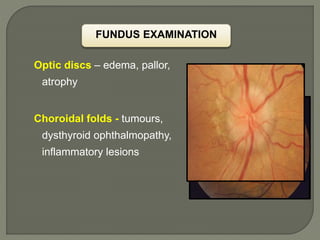
Optic discs – edema, pallor,
atrophy
Choroidal folds - tumours,
dysthyroid ophthalmopathy,
inflammatory lesions
FUNDUS EXAMINATION
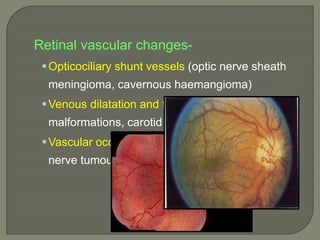
Retinal vascular changes-
Opticociliary shunt vessels (optic nerve sheath
meningioma, cavernous haemangioma)
Venous dilatation and tortousity (a-v
malformations, carotid cavernous fistula)
Vascular occlusions (orbital cellulitis and optic
nerve tumours
GENERAL EXAMINATION
 Look for evidence of malignancy
 Signs of thyroid dysfunction - thyromegaly,
tachycardia, tremors of the hand etc.
 Sites of entry for infection -sinus disease, nasal and
oral infection
 Lymphadenopathy
ON THE BASIS OF HISTORY
AND EXAMINATION
DIFFERENTIAL DIAGNOSIS
SHOULD BE MADE
IMAGING
SPECIAL INVESTIGATIONS
IMPORTANCE
To know exact location and
extent of lesion
Predict nature of lesion (tumor
or cyst,encapsulated/infiltrating,
Vascular/nonvascular,benign
/malignant/metastatic)
 Plan proper management
strategy
 Various imaging modalities in orbital disease
 X-Ray
 Non -contrast and contrast Computed Tomography
 Magnetic Resonance Imaging
 Ultrasound
CT and MRI have largely replaced radiography
Skull X-ray are now performed only in selective cases of
facial fracture
THE CHOICE OF IMAGING STUDY
SHOULD BE BASED ON CLINICAL
PRESENTATION AND THE SPECIFIC
PATHOLOGY BEING SUSPECTED
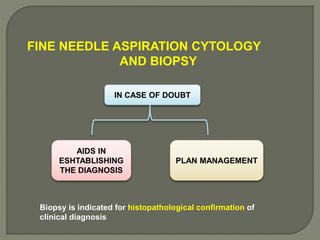
FINE NEEDLE ASPIRATION CYTOLOGY
AND BIOPSY
IN CASE OF DOUBT
AIDS IN
ESHTABLISHING
THE DIAGNOSIS
PLAN MANAGEMENT
Biopsy is indicated for histopathological confirmation of
clinical diagnosis
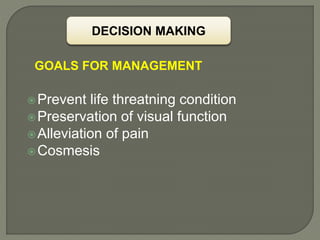
DECISION MAKING
GOALS FOR MANAGEMENT
Prevent life threatning condition
Preservation of visual function
Alleviation of pain
Cosmesis
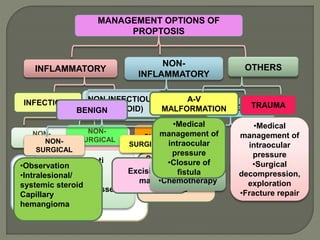
MANAGEMENT OPTIONS OF
PROPTOSIS
INFLAMMATORY
NON-
INFLAMMATORY
OTHERS
INFECTIOUS NON-INFECTIOUS
(TED, IOID)
NON-
SURGICAL SURGICAL
•Surgical
drainage of
abcess
•Enucleation/
Exentration
Systemic
•Antibiotics
•Antifungal
ANALGESIC
NON-
SURGICAL SURGICAL
•Non steroid anti
inflammatory
•Steroid
•Immunosuppressent
•Radiotherapy
•Surgical
decompression
•EOM surgery
•Lid surgery
BENIGN MALIGNANT
•Exentration
•Excision
NON-
SURGICAL
SURGICAL
•Observation
•Intralesional/
systemic steroid
Capillary
hemangioma
Excision of
mass
NON-
SURGICAL
SURGICAL
•Radiotherapy
•Chemotherapy
TRAUMA
A-V
MALFORMATION
•Medical
management of
intraocular
pressure
•Closure of
fistula
•Medical
management of
intraocular
pressure
•Surgical
decompression,
exploration
•Fracture repair
EVALUATION AND MANAGEMENT
OF PROPTOSIS REQUIRES A
MULTIDISCIPILINARY APPROACH
IF NEEDED ALWAYS TAKE OPINION OF
OTOLARYNGIOLOGIST, NEUROSURGEON,
ONCOLOGIST
 Large orbital tumor with pressure on eye
produce
 Irregular quadrantic contractions
 Meningioma- peripheral field affected earlier
than central
 Glioma- Scotoma dispropotionately greater than
proptosis

Final seminar on proptosis

  • 1.
  • 2.
    PROPTOSIS Forward displacement ofthe eye (H.I.E Saunders.Dorland’s Medical Dictionary 26th Ed. Harcourt International Edition (2001) EXOPHTHALMOS Proptosis secondary to endocrinological dysfunction (Henderson JW. Orbital Tumors 3rd ed. New York: Raven press;1994 )
  • 3.
    By Hertel’s Exophthalmometer Distance betweenlateral orbital margin and corneal apex greater than: •13 to 15mm in Asians¹ •21 mm adult Caucasians² •23 mm adult African- American² On CT scans³ •Globe protrusion > 21 mm anterior to the inter- zygomatic line on mid axial scans at the level of the lens. •Asymmetry between the two sides >2mm ¹Sarinnapakoran V et al,Proptosis in normal Thai samples and thyroid patients.J Med Ass Thai 2007;90(4):679-83 ²BeugerDG et al,Proptosis In: Ophthalmic secrets.Vander JF, GualtJA, Philadelpia,Pennsylvania,2002Chapter 36,p269 ³Naik MN et al, Interpretation of computed tomography imaging of eye and orbit.A systemic approach.Indian J Ophthalmology 2002;50(4):339-53
  • 4.
     Orbit ispyramidal shaped cavity bounded by four OPEN anteriorly  Contents-  Surrounded by  Volume of orbit - 30 cc PATHOPHYSIOLOGY SINUSE S GLOBE,MUSCLES FASCIA,VESSELS, NERVES,FAT, LACRIMAL GLAND, LACRIMAL SAC CRANIUM BONY WALLS
  • 5.
  • 6.
    SYMPTOMS  Forward protrusionor displacement of eye  Visual disturbances- diminution of vision, diplopia  Discomfort- grittiness, watering, pain  Difficulty in closing eyes fully while sleeping or blinking  Increase in visible white part of eye
  • 7.
    PROMINENT APPEARING GLOBE PSEUDOPROPTOSIS ENLARGED GLOBE EXTRAOCULAR MUSCLE WEAKNESS CONTRALATERAL ENOPHTHALMOS ASYMMETRIC PALPEBRAL FISSURES •HIGH AXIAL MYOPIA •BUPHTHALMOS•IPSILATERAL EYELID RETRACTION •CONTRALATERAL PTOSIS TRUE PROPTOSIS History and physical examination SHALLOW ORBIT NORMAL ORBIT •CRANIOFACIAL DYSOSTOSIS •TRAUMA ENDOCRINAL DISEASE VASCULAR MALFORMATION INFLAMMATORY NEOPLASIA INFECTIOUS •ORBITAL CELLULITIS •CAVERNOUS SINUS THROMBOSIS •PARASITIC •SINUS DISEASE NON INFECTIOUS MYOSITIS IDIOPATHIC ORBITAL EYE DISEASE SECONDARYPRIMARY MALIGNANTBENIGN •CAROTID- CAVERNOUS FISTULA •ARTERIOVENOUS (A-V) MALFORMATION •ORBITAL VARIX THYROID EYE DISEASE (TED)
  • 8.
  • 9.
    • Age ofpatient at onset • Progression • Pain • Visual disturbance • Laterality(unilateral / bilateral) • Nature- pulsatile/ intermittent / variable
  • 10.
    • redness, dryeye, discomfort • Lid changes • Headache, nausea, fever • Systemic / extra-ocular disease • Medications • Previous trauma / surgery to orbit / face
  • 11.
    AGE OF ONSET ATBIRTH CHILDHOOD/ YOUNG ADULT MIDDLE AGED/ ELDERLY UNILATERALBILATERAL CRANIOFACIAL DYSOSTOSIS •CROUZON’S SYNDROME •APERT’S SYNDROME INTERMITENT/PULSATILE NON PULSATILE •CEPHALOCELE •A-V MALFORMATIONS ORBITAL TUMORS •Vascular -Capillary hemangioma •Teratoma BIRTH TRAUMA
  • 12.
    CHILDHOOD/ YOUNG ADULTMIDDLE AGED/ ELDERLY AGE OF ONSET PROGRESSION ACUTE (hours to a week) SUB-ACUTE (1-4 weeks) CHRONIC (>6 MONTHS) PAINFUL with/without DIMINUTION OF VISION INFLAMMATORY (Immuno- compromised state,redness , edema,fever) NON- INFLAMMATORY ORBITAL CELLULITIS PULSATILE h/o Trauma, surgery (headache,tinnius, diplopia) NON PULSATILE (h/o trauma) •A-V FISTULA •RETROBULBAR HEMORRHAGE SUDDEN SPURT IN PREEXISTING PROPTOSIS •Bleed in vascular tumors •Rupture dermoid or parasitic cyst •Lymphangioma
  • 13.
    CHILDHOOD/ YOUNG ADULTMIDDLE AGED/ ELDERLY PROGRESSION ACUTE (hours to a week) SUB-ACUTE (1-4 weeks) CHRONIC (>6 MONTHS) PAINFUL PAINLESS (+/- DOV , diplopia, redness) UNILATERAL BILATERAL INFLAMMARTORY NON- INFLAMMATORY ORBITAL CELLULITIS (fever) (Diplopia) MYOSITIS TED IOID (intermittent/ recurrent) (Swelling,redness ,+/- DOV) MALIGNANTM ETASTASIC TUMOR CHILDHOOD/ YOUNG ADULT PRIMARY- Rhabdomyosarcoma SECONDARY – Retinoblastoma, sinus tumor METASTATIC-Wilm’s tumour,Neuroblastoma, AML MIDDLE AGED/ ELDERLY •METASTATIC-lung, breast, prostrate •SECONDARY – Intracranial tumor, sinus tumor INFLAMMARTORY + NON- INFLAMMATORY +/- (Swelling,redness +/-DOV) CAVERNOUS SINUS THROMBOSIS (fever , headache, vomiting) METASTATIC TUMOR •IDIOPATHIC ORBITAL INFLAMMATORY DISEASE •MALIGNANT TUMOR UNILATERAL BILATERAL MIDDLE AGE/ ELDERLY THYROID EYE DISEASE (diplopia,grittiness, watering)
  • 14.
    CHILDHOOD/ YOUNG ADULTMIDDLE AGED/ ELDERLY PROGRESSION ACUTE (hours to a week) SUB-ACUTE (1-4 weeks) CHRONIC (>6 MONTHS) PAINFUL PAINLESS IDIOPATHIC INFLAMMATORY ORBITAL DISEASE (variable/recurrent) TED(diplopia) (Corneal dryness and exposure ,with DOV ) UNILATERAL BILATERAL LARGE TUMOR/ CYST WITH DOV WITHOUT DOV PRECEEDING PROPTOSIS OPTIC NERVE GLIOMA (children) FOLLOWING PROPTOSIS OPTIC NERVE MENINGIOMA BENIGN TUMOR BENIGN TUMOR CYST •Parasitic •Dermoid (children, young adult) •Capillary hemangioma (children) •Cavernous hemangioma (adults) •Lymphangioma (intermittent) VASCULAR TUMOR OTHER •Neurofibroma (pulsatile) •Schwannoma •Bone tumor •Lacrima gland tumor •Lymphoma(bilateral)
  • 15.
    History of systemic/ extra-ocular disease  Diabetes, immunocompromised status  Sinus , dental and ENT diseases  Prior nasal surgery  Previous or current malignancy  Thyroid dysfunction  Trauma
  • 16.
  • 17.
    INSPECTION  Compensatory headposture  Facial scars, deformity  Ocular symmetry and position of eye  Adnexal structure  Surface of eye  Pulsations, valsalva maneuver  Movements
  • 18.
    POSITION OF EYE Forward protrusion without displacement AXIAL PROPTOSIS  Displacement along with proptosis ABAXIAL PROPTOSIS
  • 19.
    AXIAL PROPTOSIS Lesions ofintraconal space Optic nerve glioma Optic nerve sheath meningioma Cvernous hemangioma, Orbital varix Schwannoma Neurofibroma Cystic lesion Thyroid associated orbitopathy  Idiopathic orbital inflammation DOWN AND IN Orbital mass of superotemporal quadrant •Lacrimal gland tumor •Dermoid •Other benign or malignant neoplasia DOWN AND OUT Orbital mass of superonasal quadrant •Frontoethmoidal mucocele •Fungal granulomas • Benign or malignant mass LATERAL DISPLACEMENT •Tumor arising from ethmoid sinus •Lacrimal sac tumors •Lethal midline granuloma •Nasopharyngeal tumor UPWARD DISPLACEMENT Mass from maxillary sinus •Neoplasia •Fungal granuloma •Dumbbell dermoid  Cyst or tumor of inferior quadrant
  • 20.
    1.Nafziger’s Method 2.Clear plasticruler 3. Luedde’s exophthalmometer 4. Hertel’s exophthalmometer 5.Naugle’s exophthalmometer 6.Measure dystopia (2 scale)
  • 21.
    INSPECTION OF ADNEXALSTRUCTURES SURFACE LID POSITIONMASS EYELIDS AND PERIBULBAR TISSUE COLOUR EDEMA SINUS OR FISTULA SITE NUMBER SIZE SURFACE MARGINS EXTENT COMPONENT – LID AND ORBITAL PTOSIS LID RETRACTION LID LAG
  • 22.
    REDNESS Infection and inflammation Thyroid eye disease Malignantand metastatic neoplasm EDEMA Reduced venous and lynphatic drainage by mass Bluish discoloration- vascular tumor or malformation ,trauma Sinus and fistula- Orbital abcess, dermoids, mucocele
  • 23.
    LID POSITION PTOSIS LID RETRACTION LIDLAG Mechanical Paralytic Thyroid eye disease Large orbital neoplasm Thyroid eye disease S shaped lid thickening - Plexiform neurofibroma
  • 24.
     Pulsation –direct lateral view • Arteriovenous malformation • Cephalocele, large mucocele • Neurofibromatosis  Valsalva maneuver Increase in proptosis with valsalva • AV malformations • Orbital varix
  • 25.
    OCULAR MOVEMENTS  Limitationof ocular motility due to orbital mass  Restriction due to invasive process in muscle  Paralytic
  • 26.
    CONJUNCTIVA Dilated vascular channelat the canthus with chemosis- dysthyroid disease Epibulbar dark-red corkscrew vessels – increased venous pressure, AV malformation Diffuse conjunctival congestion- orbital inflammatory or infectious disease Sectoral congestion and chemosis- Myositis Subconjunctival haemorrhage- Trauma, infiltrative tumors Chemosis- inflammation, lymphatic obstruction Salmon patch- lymphoma CORNEA-exposure Iris- Lisch nodules in neurofibromatosis
  • 27.
    EXAMINATION OF NASALCAVITY AND ORAL CAVITY IS MANDATORY IN PRESENCE OF PARANASAL SINUS INVOLVEMENT
  • 28.
    • Local Temperature •Tenderness •Orbital tonometry, orbital margins • If mass palpable note •Position •Size,surface, attachnents •Consistency(hard , rubbery, spongy or soft) •Compressibility/ Reducibility
  • 29.
    Tenderness  Orbital infectionand inflammation  Adenoid cystic carcinoma  Trauma Temperature  Rise in temperature of overlying skin seen in orbital infection and inflammation
  • 30.
    Consistency of thepalpable mass Compressibility - characteristic of • Cystic mass Reducibility- characteristic of mass communicating with neighbouring cavity CYSTIC SOFT FIRMRUBBERY HARD
  • 31.
    TRANSILLUMINATION (fluid / airfilled) AUSCULTATION  Bruits- High flow arteriovenous fistula
  • 32.
     VISUAL ACUITY PUPILLARY REACTION  COLOR VISION  REFRACTION  VISUAL FIELD  OPHTHALMOSCOPY  INTRA OCULAR PRESSURE
  • 33.
    Documentation of visualacuity is necessary Diagnostic and aids in planning management PUPILS VISUAL ACUITY Look carefully for RAPD suggestive of optic nerve damage
  • 34.
    COLOUR VISION  Inearly compression of optic nerve patient may not notice defective vision.  In bilateral cases RAPD may not be elicited.  Very early optic nerve compression can be missed in fundus examination IMPORTANCE
  • 35.
    RAPD, COLOR VISION ABNORMALITIESAND VISUAL FIELD DEFECTS CAN DETECT COMPROMISE OF THE OPTIC NERVE EVEN WHEN THE VISUAL ACUITY IS NORMAL
  • 36.
    Optic discs –edema, pallor, atrophy Choroidal folds - tumours, dysthyroid ophthalmopathy, inflammatory lesions FUNDUS EXAMINATION
  • 37.
    Retinal vascular changes- Opticociliaryshunt vessels (optic nerve sheath meningioma, cavernous haemangioma) Venous dilatation and tortousity (a-v malformations, carotid cavernous fistula) Vascular occlusions (orbital cellulitis and optic nerve tumours
  • 38.
    GENERAL EXAMINATION  Lookfor evidence of malignancy  Signs of thyroid dysfunction - thyromegaly, tachycardia, tremors of the hand etc.  Sites of entry for infection -sinus disease, nasal and oral infection  Lymphadenopathy
  • 39.
    ON THE BASISOF HISTORY AND EXAMINATION DIFFERENTIAL DIAGNOSIS SHOULD BE MADE
  • 40.
    IMAGING SPECIAL INVESTIGATIONS IMPORTANCE To knowexact location and extent of lesion Predict nature of lesion (tumor or cyst,encapsulated/infiltrating, Vascular/nonvascular,benign /malignant/metastatic)  Plan proper management strategy
  • 41.
     Various imagingmodalities in orbital disease  X-Ray  Non -contrast and contrast Computed Tomography  Magnetic Resonance Imaging  Ultrasound CT and MRI have largely replaced radiography Skull X-ray are now performed only in selective cases of facial fracture
  • 42.
    THE CHOICE OFIMAGING STUDY SHOULD BE BASED ON CLINICAL PRESENTATION AND THE SPECIFIC PATHOLOGY BEING SUSPECTED
  • 43.
    FINE NEEDLE ASPIRATIONCYTOLOGY AND BIOPSY IN CASE OF DOUBT AIDS IN ESHTABLISHING THE DIAGNOSIS PLAN MANAGEMENT Biopsy is indicated for histopathological confirmation of clinical diagnosis
  • 44.
    DECISION MAKING GOALS FORMANAGEMENT Prevent life threatning condition Preservation of visual function Alleviation of pain Cosmesis
  • 45.
    MANAGEMENT OPTIONS OF PROPTOSIS INFLAMMATORY NON- INFLAMMATORY OTHERS INFECTIOUSNON-INFECTIOUS (TED, IOID) NON- SURGICAL SURGICAL •Surgical drainage of abcess •Enucleation/ Exentration Systemic •Antibiotics •Antifungal ANALGESIC NON- SURGICAL SURGICAL •Non steroid anti inflammatory •Steroid •Immunosuppressent •Radiotherapy •Surgical decompression •EOM surgery •Lid surgery BENIGN MALIGNANT •Exentration •Excision NON- SURGICAL SURGICAL •Observation •Intralesional/ systemic steroid Capillary hemangioma Excision of mass NON- SURGICAL SURGICAL •Radiotherapy •Chemotherapy TRAUMA A-V MALFORMATION •Medical management of intraocular pressure •Closure of fistula •Medical management of intraocular pressure •Surgical decompression, exploration •Fracture repair
  • 46.
    EVALUATION AND MANAGEMENT OFPROPTOSIS REQUIRES A MULTIDISCIPILINARY APPROACH IF NEEDED ALWAYS TAKE OPINION OF OTOLARYNGIOLOGIST, NEUROSURGEON, ONCOLOGIST
  • 50.
     Large orbitaltumor with pressure on eye produce  Irregular quadrantic contractions  Meningioma- peripheral field affected earlier than central  Glioma- Scotoma dispropotionately greater than proptosis

Editor's Notes

  • #3 Protrusion of the globe secondary to non-endocrine causes (Henderson JW. Orbital Tumors. 3rd ed. New York: Raven Press(1994)
  • #4 Lateral orbital rim to the corneal apex measures14 to 21 mm in adults Protrusion greater than 21 mm or a 2mm difference is generally abnormal
  • #10 In light of the fact that there are numerous causes of proptosis, and due to the lack of direct visualisation of the pathology in orbital disease, a thorough history is extremely helpful in arriving at a differential diagnosis and in the determination of appropriate investigations of the patient. Specific points which should be addressed include:
  • #18 Attentive gaze (Kocher’s sign) Infrequent blinking (Stellwag’s sign)
  • #19 Axial-• lesion arises from within the muscle cone (intra-conal) Non-axial-lesion arises from without the muscle cone (extra-conal)
  • #21 Stands behind the patient looks over forehead Raise patient’s upper lids with index fingers from the sides Compare position of apex of cornea on each side Patient bends head forward and cornea should disappear at the same time
  • #26 Thyroid associated orbitopathy, Idiopathic orbital inflammation, myocysticercosis ,fungal granuloma Paralytic- Carotico cavernous fistula Limitation of motility following trauma- soft tissue edema , entrapment of muscle in orbital fracture or injury to muscle itself
  • #35 If colour vision is defective evaluate carefully- Pupil for RAPD Do detailed fundus examination for Presence of disc edema,pallor,optocilliary shunt,retinal detachment
  • #37 It is important to note that in some cases choroidal folds may precede the development of proptosis.
  • #44 suspected and in those with secondary neoplasms from contiguous structures. Incisional biopsy is sometimes necessary in the case of suspected pseudotumour (particularly after poor response to oral steroids) and also in cases of suspected lymphoproliferative tumours where it may be necessary to perform a biopsy of at least one gram of fat.