CONTACT LENS
INDICATIONS & C/I
• Artificial device whose front surface substitutes the
anterior surface of the cornea .
• Indications • Optical • Therapeutic • Preventive •
Diagnostic • Operative • Cosmetic • Occupational
• C/I: mentaly unsound,irresposible,unable to use
hands
:eye d/s
:occupational hazards
:Nerve palsy
:poor hygeine
TYPES OF CONTACT LENSES
Broadly : focons & filcons
Depending upon nature of material used
• Rigid non gas Permeable Lens :PMMA
• Rigid Gas Permeable Lens :CAB,silicone
• Hydrophilic Soft Lens :hydrogel lenses
RIGID NON GAS PERMEABLE CL
• PMMA/acrylic lenses.
• Advantage:optical quality,stability,light weight
:excellent moulding,easy manufacturing
:non toxic,non allergic.
• Disadv :o2 impermeable
:hard->corneal abrasions
:hydrophobic nature resists wetting
RGP CL/SEMISOFT LENSES
• Rigid as PMMA,but o2 permeable.
• Materials used :cellulose acetate butyrate
:silicone,silicone acrylate
:styrene
:fluoropolymers
Rigid CL –adv & disadv
• Better Quality of vision
• Durable
• Deposit resistant
• Low risk of infection
• Less cost & easy handling
• Correction of astigmatism
• Modified in office
• Less comfortable & adaptable
• Over wearing->pain
• Spectacle blur
• Difficult to achieve on eye stability.
• Glare,photophobia
SOFT CL
• Made of hydrogel[co-polymerisation products of
hydrophilic monomers with ethylene glycol
dimethyl acrylate].
• Hydrogel lens materials :HEMA
:HEMA VP
:MMA-PVD
:Glycidyl methacrylate
Soft CL –adv & disadv
• Easy adaptation & comfortable wear.
• Over wear reactions less
• No spectacle blur
• More on eye stability
• Varible vn :spoilage,dehydration,deposits.
• Less durable
• Correction of astigmatism not good
• Deposits high
• No office modification possible
• Not suitable in tear film abn/l p/ts
• Handling difficult
• High cost
MANUFACTURING,DESIGN PRESCRIPTION
& PARAMETERS OF CL
• CL blank :sheet /rod of diameter 12.7 & 15.9 mm
: thickness 3.00 & 6.5 mm.
• Semifinished blank : blank with p.curve
• Semifinished lens : both a&p curvature polished
• Finished CL : individually adjusted 4 cornea
: diameter,edge,peripheral &
intermediate areas of posterior
surface modified
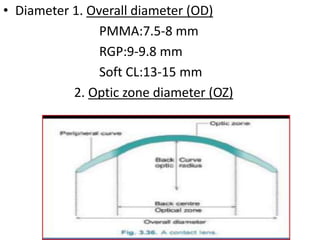
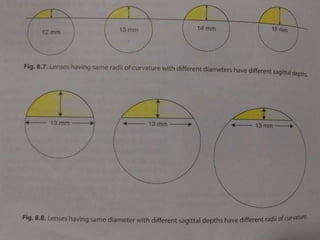
• Diameter 1. Overall diameter (OD)
PMMA:7.5-8 mm
RGP:9-9.8 mm
Soft CL:13-15 mm
2. Optic zone diameter (OZ)
CURVES
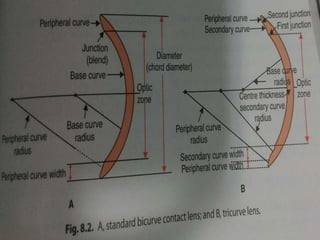
• Base curve (BC) or central posterior curve (CPC)
• Peripheral curves : 1. intermediate (IPC)
2. peripheral (PPC)
• Central anterior curve (CAC) or front curve (FC)
• Peripheral anterior curve (PAC)
• Intermediate anterior curve (IAC)
• Blend:smooth area of transition between radii of
curvatures
:light,medium,heavy
• Edge : Union of the Peri.Postr.C & Peri.Antr.C of lens
: edge lift-extend to which the most peripheral
curve differs from the base curve radius
• Power : Measured in terms of posterior vertex
power in diopters
• Thickness : Measured at the centre of the lens
: Varies depending upon the postr. vertex
power of the lens
• Tint :Color of the lens
OPTICS OF CL
• Contact lens placed insitu has a thin fluid film in
between it & cornea & thus it eliminates surface
irregularity of cornea & cornea is no more a ref.
surface.
• Power of corneal surface is tear-air interface.
• Corneal RI :1.37,tear film RI: 1.333
• Tear lens neutralises almost 9/10th power of a.
corneal surface , it from +48D + 5.2 D.
• CL has a fluid lens & glass lens.
Correction of ammetropia
• Afocal lenses:
• correction is by different curvatures of fluid lens
surfaces,mainly back vertex power of fluid lens in
air(back +front surface power).
• Disadv:too many base curves needed
:poor fitting technique
• Powered lenses:
• correction is by different curvatures of contact lens
surfaces.
• P. surface curvature is already known & a.surface
curvature is decided based on an emperical
relationship to the corneal curvature.
Power & magnification of CL
• CL is placed on the vertex plane.so in myopes power of CL
needed is less & hyperopes needs power than their specs
power.
• +8 D specs  125 mm
• CL  125-13 =112 mm=+8.93 D
• CL produces a magnification of 7% in aphakia.
Influence of tear lens
• RGP & tear lens :power varies with BC of CL
• BC of CL =k plano power tear lens
• BC of CL steeper than k = +ve tear lens
• BC of CL flatter than k = - ve tear lens
• For every .05mm diff in BC of CL & k,power of tear lens is
0.25 D.
• Final CL power =SAM & FAP
CL & accomodation
• CL accomodative & convergence requirement of
myopic eyes and decrease those of hyperopic eyes
propotionally to the amount of their refractive
errors.
Fitting procedure 4 rigid CL
• H/O :r/o medical C/I
Reason 4 CL wearing
General & emotional status of p/t.
• Ocular examination:
 s/l examination:conjunctival,limbal,corneal injection
 TBUT
 blink characteristics noted
 measure – corneal diameter,pupil diameter & palpebral width
4 deciding CL diameter.
Refraction :retinoscopy,subjective refraction,back vertex
distance.
Keratometry 4 measuring corneal curvature in 2 principle
meridia
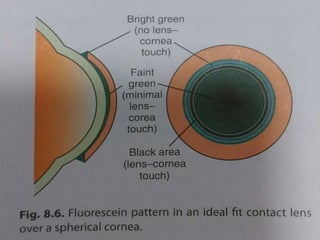
Trial lens fitting:with 2 diff diametre lenses of 0.25 D in BC.
• Diameter : 9mm in a p/t with avg corneal diameter &
palpebral aperture.
• BC  usually flatter k reading.
• Astigmatism: BC is steeper than flatter k.
• 0.5-1 D BC 0.25 D steeper than flatter k.
• 1.0-2.0 D BC 0.5 D steeper than flatter k.
• >2D 1/3RD toricity shud b added to k 4 BC.
K1=44 K2=47, BC= 44 + [ 47-44]
3
• Power of trial lens=spectacle power in minus cylinder form
corrected 4 zero vertex distance.
Specs power : -9.25/+0.50x90⁰
Minus power form : -8.75/-0.50x 180⁰
Vertex distance : 15 mm
CL power : -7.75/ -0.50X180⁰
• After adaptation period evaluate trial lens for
• Position of lens: High ride
• Low ride
• Horizontal decentering
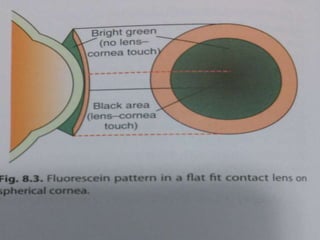
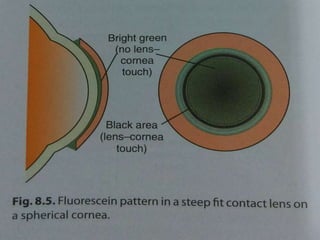
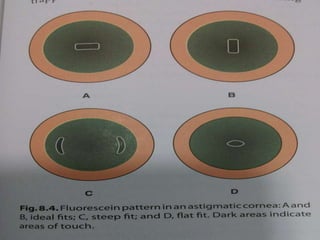
• BC determination :flat
:steep
:ideal
• Finalisation of diameter
• Finalisation of power
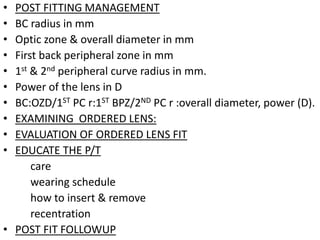
• POST FITTING MANAGEMENT
• BC radius in mm
• Optic zone & overall diameter in mm
• First back peripheral zone in mm
• 1st & 2nd peripheral curve radius in mm.
• Power of the lens in D
• BC:OZD/1ST PC r:1ST BPZ/2ND PC r :overall diameter, power (D).
• EXAMINING ORDERED LENS:
• EVALUATION OF ORDERED LENS FIT
• EDUCATE THE P/T
care
wearing schedule
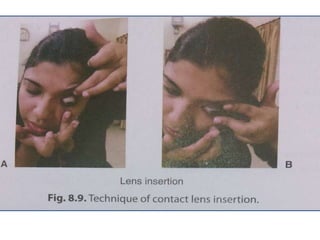
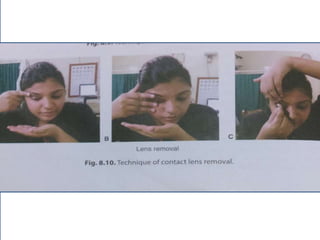
how to insert & remove
recentration
• POST FIT FOLLOWUP
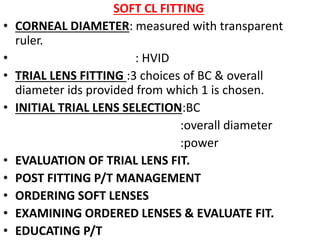
SOFT CL FITTING
• CORNEAL DIAMETER: measured with transparent
ruler.
• : HVID
• TRIAL LENS FITTING :3 choices of BC & overall
diameter ids provided from which 1 is chosen.
• INITIAL TRIAL LENS SELECTION:BC
:overall diameter
:power
• EVALUATION OF TRIAL LENS FIT.
• POST FITTING P/T MANAGEMENT
• ORDERING SOFT LENSES
• EXAMINING ORDERED LENSES & EVALUATE FIT.
• EDUCATING P/T
EXTENDED WEAR LENSES
• Worn day n night even for months
EXTENDED SOFT CL
• Elderly p/ts with handling problems
• Young p/ts to avoid frequent handling
• Low compliance to DWL
• Irregular work shifts
• habitual over wearers
• eg: low,high ,medium water content lenses
EXTENDED RGP CL
• Metabolic,allergic,visual problems with soft CL
• toric bifocal /high plus/minus power lenses
DISPOSABLE CL
• Lenses used on daily wear basis,disinfected with H2O2
overnight & disposed weekly/fortnight.
• Adv:lens deposits,preservative induced
keratitis,infectious keratitis are less
THERAPEUTIC CL
• Wound healing,mechanical support,maintain surface
hydration in dry eyes,reduce corneal surface
disorders,as a drug delivery system
COSMETIC soft CL
• tinted cl used to alter the appearance of n/l eyes
• Used in disfigured cornea,vision disturbing conditions
needing CL,occlusion therapy,to change eye colour
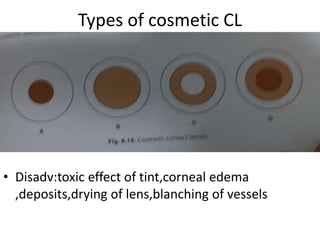
Types of cosmetic CL
• Disadv:toxic effect of tint,corneal edema
,deposits,drying of lens,blanching of vessels
SPECIAL CASES 4 CL USE
ASTIGMATISM
• RGP : spherical lenses
:with toric peripheral curve
:bitoric RGP
:Front surface with toric RGP
• Soft CL :Spherical soft CL
:toric soft CL
APHAKIA
• RGP :Single cut lenses
:large lenticular lenses
• Soft CL :EWCL
:Lathe cut lenticular design
Keratoconus
• RGP with 3 point touch technique
• Soper lenses
• Mc Guine CL
• Rose k lens
• Piggy back lens
• Hybrid lenses
• Scleral RGP lens
• Custom toric soft CL
Presbyopia
• Monovivsion CL
• Modified monovision CL
• Binocular bifocal CL
Complications of CL use
conjunctival complicaions
• Allergic conjunctivits
• Giant papillary conjunctivitis
• Superior limbic keratoconjunctivitis
Corneal complications
• Epithelial edema,microcysts
• Corneal abrasions
• 3 - 9 o clock staining
• Sterile corneal infiltrates
• Corneal neovascularisation
• Microbial keratitis
• corneal warpage
• Endothelial changes
CL related complications
• Physical damage to CL,CL discolouration,deposits
Contact lens

Contact lens

  • 1.
  • 2.
    INDICATIONS & C/I •Artificial device whose front surface substitutes the anterior surface of the cornea . • Indications • Optical • Therapeutic • Preventive • Diagnostic • Operative • Cosmetic • Occupational • C/I: mentaly unsound,irresposible,unable to use hands :eye d/s :occupational hazards :Nerve palsy :poor hygeine
  • 3.
    TYPES OF CONTACTLENSES Broadly : focons & filcons Depending upon nature of material used • Rigid non gas Permeable Lens :PMMA • Rigid Gas Permeable Lens :CAB,silicone • Hydrophilic Soft Lens :hydrogel lenses
  • 4.
    RIGID NON GASPERMEABLE CL • PMMA/acrylic lenses. • Advantage:optical quality,stability,light weight :excellent moulding,easy manufacturing :non toxic,non allergic. • Disadv :o2 impermeable :hard->corneal abrasions :hydrophobic nature resists wetting
  • 5.
    RGP CL/SEMISOFT LENSES •Rigid as PMMA,but o2 permeable. • Materials used :cellulose acetate butyrate :silicone,silicone acrylate :styrene :fluoropolymers
  • 6.
    Rigid CL –adv& disadv • Better Quality of vision • Durable • Deposit resistant • Low risk of infection • Less cost & easy handling • Correction of astigmatism • Modified in office • Less comfortable & adaptable • Over wearing->pain • Spectacle blur • Difficult to achieve on eye stability. • Glare,photophobia
  • 7.
    SOFT CL • Madeof hydrogel[co-polymerisation products of hydrophilic monomers with ethylene glycol dimethyl acrylate]. • Hydrogel lens materials :HEMA :HEMA VP :MMA-PVD :Glycidyl methacrylate
  • 8.
    Soft CL –adv& disadv • Easy adaptation & comfortable wear. • Over wear reactions less • No spectacle blur • More on eye stability • Varible vn :spoilage,dehydration,deposits. • Less durable • Correction of astigmatism not good • Deposits high • No office modification possible • Not suitable in tear film abn/l p/ts • Handling difficult • High cost
  • 9.
    MANUFACTURING,DESIGN PRESCRIPTION & PARAMETERSOF CL • CL blank :sheet /rod of diameter 12.7 & 15.9 mm : thickness 3.00 & 6.5 mm. • Semifinished blank : blank with p.curve • Semifinished lens : both a&p curvature polished • Finished CL : individually adjusted 4 cornea : diameter,edge,peripheral & intermediate areas of posterior surface modified
  • 10.
    • Diameter 1.Overall diameter (OD) PMMA:7.5-8 mm RGP:9-9.8 mm Soft CL:13-15 mm 2. Optic zone diameter (OZ)
  • 11.
    CURVES • Base curve(BC) or central posterior curve (CPC) • Peripheral curves : 1. intermediate (IPC) 2. peripheral (PPC) • Central anterior curve (CAC) or front curve (FC) • Peripheral anterior curve (PAC) • Intermediate anterior curve (IAC) • Blend:smooth area of transition between radii of curvatures :light,medium,heavy
  • 12.
    • Edge :Union of the Peri.Postr.C & Peri.Antr.C of lens : edge lift-extend to which the most peripheral curve differs from the base curve radius • Power : Measured in terms of posterior vertex power in diopters • Thickness : Measured at the centre of the lens : Varies depending upon the postr. vertex power of the lens • Tint :Color of the lens
  • 14.
    OPTICS OF CL •Contact lens placed insitu has a thin fluid film in between it & cornea & thus it eliminates surface irregularity of cornea & cornea is no more a ref. surface. • Power of corneal surface is tear-air interface. • Corneal RI :1.37,tear film RI: 1.333 • Tear lens neutralises almost 9/10th power of a. corneal surface , it from +48D + 5.2 D. • CL has a fluid lens & glass lens.
  • 15.
    Correction of ammetropia •Afocal lenses: • correction is by different curvatures of fluid lens surfaces,mainly back vertex power of fluid lens in air(back +front surface power). • Disadv:too many base curves needed :poor fitting technique • Powered lenses: • correction is by different curvatures of contact lens surfaces. • P. surface curvature is already known & a.surface curvature is decided based on an emperical relationship to the corneal curvature.
  • 16.
    Power & magnificationof CL • CL is placed on the vertex plane.so in myopes power of CL needed is less & hyperopes needs power than their specs power. • +8 D specs  125 mm • CL  125-13 =112 mm=+8.93 D • CL produces a magnification of 7% in aphakia. Influence of tear lens • RGP & tear lens :power varies with BC of CL • BC of CL =k plano power tear lens • BC of CL steeper than k = +ve tear lens • BC of CL flatter than k = - ve tear lens • For every .05mm diff in BC of CL & k,power of tear lens is 0.25 D. • Final CL power =SAM & FAP
  • 17.
    CL & accomodation •CL accomodative & convergence requirement of myopic eyes and decrease those of hyperopic eyes propotionally to the amount of their refractive errors.
  • 18.
    Fitting procedure 4rigid CL • H/O :r/o medical C/I Reason 4 CL wearing General & emotional status of p/t. • Ocular examination:  s/l examination:conjunctival,limbal,corneal injection  TBUT  blink characteristics noted  measure – corneal diameter,pupil diameter & palpebral width 4 deciding CL diameter. Refraction :retinoscopy,subjective refraction,back vertex distance. Keratometry 4 measuring corneal curvature in 2 principle meridia Trial lens fitting:with 2 diff diametre lenses of 0.25 D in BC.
  • 19.
    • Diameter :9mm in a p/t with avg corneal diameter & palpebral aperture. • BC  usually flatter k reading. • Astigmatism: BC is steeper than flatter k. • 0.5-1 D BC 0.25 D steeper than flatter k. • 1.0-2.0 D BC 0.5 D steeper than flatter k. • >2D 1/3RD toricity shud b added to k 4 BC. K1=44 K2=47, BC= 44 + [ 47-44] 3 • Power of trial lens=spectacle power in minus cylinder form corrected 4 zero vertex distance. Specs power : -9.25/+0.50x90⁰ Minus power form : -8.75/-0.50x 180⁰ Vertex distance : 15 mm CL power : -7.75/ -0.50X180⁰
  • 20.
    • After adaptationperiod evaluate trial lens for • Position of lens: High ride • Low ride • Horizontal decentering • BC determination :flat :steep :ideal • Finalisation of diameter • Finalisation of power
  • 26.
    • POST FITTINGMANAGEMENT • BC radius in mm • Optic zone & overall diameter in mm • First back peripheral zone in mm • 1st & 2nd peripheral curve radius in mm. • Power of the lens in D • BC:OZD/1ST PC r:1ST BPZ/2ND PC r :overall diameter, power (D). • EXAMINING ORDERED LENS: • EVALUATION OF ORDERED LENS FIT • EDUCATE THE P/T care wearing schedule how to insert & remove recentration • POST FIT FOLLOWUP
  • 29.
    SOFT CL FITTING •CORNEAL DIAMETER: measured with transparent ruler. • : HVID • TRIAL LENS FITTING :3 choices of BC & overall diameter ids provided from which 1 is chosen. • INITIAL TRIAL LENS SELECTION:BC :overall diameter :power • EVALUATION OF TRIAL LENS FIT. • POST FITTING P/T MANAGEMENT • ORDERING SOFT LENSES • EXAMINING ORDERED LENSES & EVALUATE FIT. • EDUCATING P/T
  • 30.
    EXTENDED WEAR LENSES •Worn day n night even for months EXTENDED SOFT CL • Elderly p/ts with handling problems • Young p/ts to avoid frequent handling • Low compliance to DWL • Irregular work shifts • habitual over wearers • eg: low,high ,medium water content lenses EXTENDED RGP CL • Metabolic,allergic,visual problems with soft CL • toric bifocal /high plus/minus power lenses
  • 31.
    DISPOSABLE CL • Lensesused on daily wear basis,disinfected with H2O2 overnight & disposed weekly/fortnight. • Adv:lens deposits,preservative induced keratitis,infectious keratitis are less THERAPEUTIC CL • Wound healing,mechanical support,maintain surface hydration in dry eyes,reduce corneal surface disorders,as a drug delivery system COSMETIC soft CL • tinted cl used to alter the appearance of n/l eyes • Used in disfigured cornea,vision disturbing conditions needing CL,occlusion therapy,to change eye colour
  • 32.
    Types of cosmeticCL • Disadv:toxic effect of tint,corneal edema ,deposits,drying of lens,blanching of vessels
  • 33.
    SPECIAL CASES 4CL USE ASTIGMATISM • RGP : spherical lenses :with toric peripheral curve :bitoric RGP :Front surface with toric RGP • Soft CL :Spherical soft CL :toric soft CL APHAKIA • RGP :Single cut lenses :large lenticular lenses • Soft CL :EWCL :Lathe cut lenticular design
  • 34.
    Keratoconus • RGP with3 point touch technique • Soper lenses • Mc Guine CL • Rose k lens • Piggy back lens • Hybrid lenses • Scleral RGP lens • Custom toric soft CL Presbyopia • Monovivsion CL • Modified monovision CL • Binocular bifocal CL
  • 35.
    Complications of CLuse conjunctival complicaions • Allergic conjunctivits • Giant papillary conjunctivitis • Superior limbic keratoconjunctivitis Corneal complications • Epithelial edema,microcysts • Corneal abrasions • 3 - 9 o clock staining • Sterile corneal infiltrates • Corneal neovascularisation • Microbial keratitis • corneal warpage • Endothelial changes CL related complications • Physical damage to CL,CL discolouration,deposits