AND
ATHETHOSI
S
PRESENTED BY ROLL NO -
04
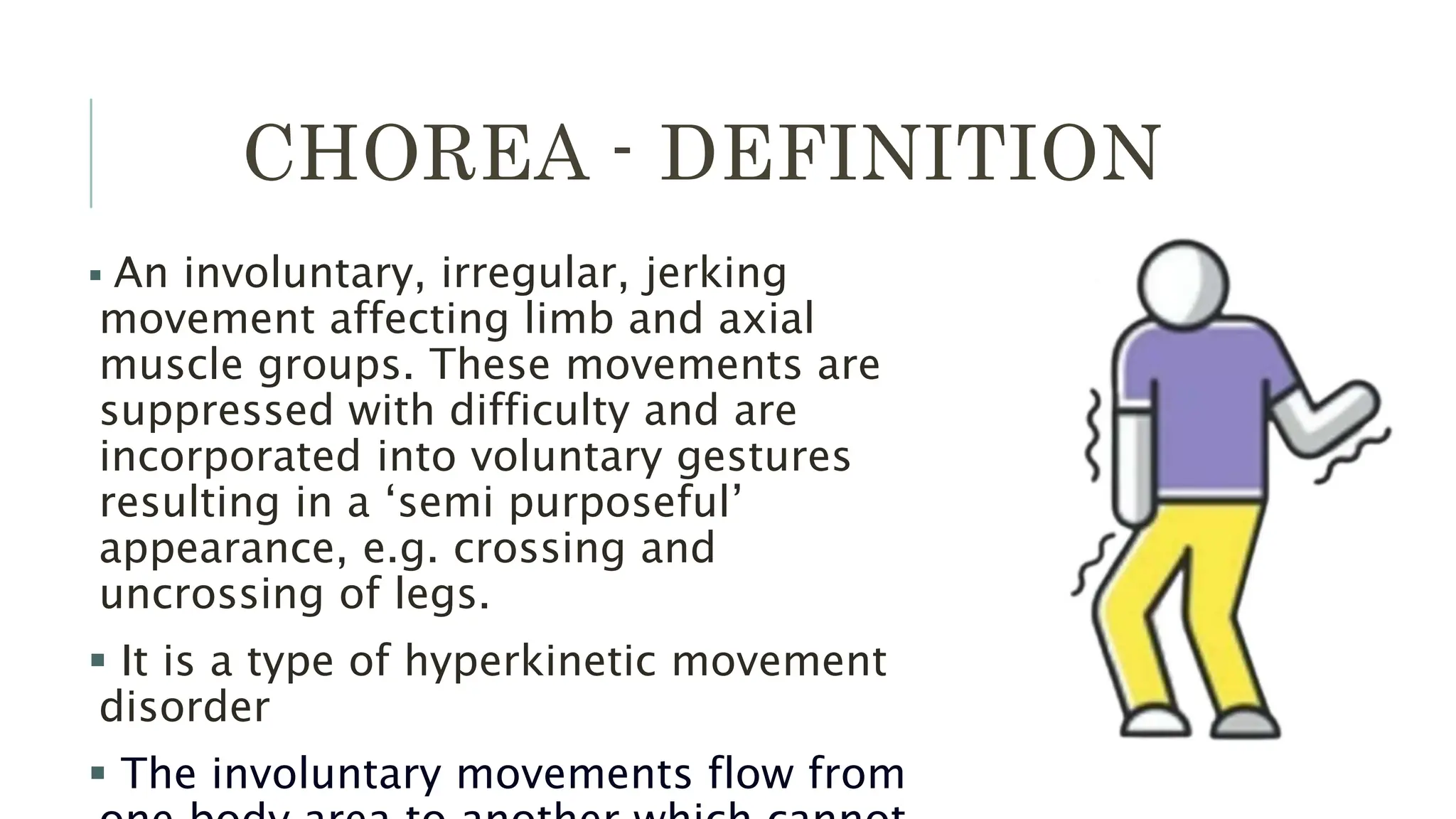
CHOREA - DEFINITION
 An involuntary, irregular, jerking
movement affecting limb and axial
muscle groups. These movements are
suppressed with difficulty and are
incorporated into voluntary gestures
resulting in a ‘semi purposeful’
appearance, e.g. crossing and
uncrossing of legs.
 It is a type of hyperkinetic movement
disorder
 The involuntary movements flow from
CAUSES
1)Hereditary – Huntington’s disease, Benign chorea
2)Metabolic – Hyperthyroidism, Hypocalcaemia
3)Drugs – Antiparkinsonian drugs, Oral contraceptives
4)Immunological – Systemic lupus erythematosus,
Polyarteritis nodosa
5)Toxins – alcohol, carbon monoxide poisoning
6)Miscellaneous – Chorea gravidarum, Polycythaemia
rubra vera
7)Infections – Sydenham’s chorea, Encephalitis
TYPES OF CHOREA
1) PRIMARY CHOREA (genetical causes)
Primary chorea develops as the result of a disease, of which it
is a primary symptom.
Eg: Hunington’s Syndrome
Primary will be symmetrical symptoms with insidious onset
2) SECONDARY CHOREA (acquired causes)
Drug induced Chorea, Immune mediated Chorea, Infectious
Chorea, Vascular Chorea, Hormonal Disorders
Secondary will be asymmetrical and most of time sudden onset
CLINICAL FEATURES
• Fidgeting involuntarily
• Asymmetrical irregular movements
• Inability to maintain an ongoing motor activity, such as maintaining a
constant grip or holding the tongue out
• Abrupt, interrupted speech
• Involuntary vocalization
• Loss of coordinated movements
• Gait disturbance – in the form of jerky movements
• Impaired balance
TREATMENT: MEDICAL MANAGEMENT
1. Dopamine-depleting agents: Tetrabenazine,
Deutetrabenazine, Valbenazine.
2. Dopamine D2 receptor-blocking agents: Haloperidol,
Clozapine, Olanzapine.
3. Anticonvulsants: Valproic acid, Carbamazepine,
Benzodiazepines, Levetiracetam.
4. Anti-glutamatergic agents: Amantadine, Riluzole.
5. Cannabinoids: Nabilone.
6. Deep Brain Stimulation
PHYSIOTHERAPY MANAGEMENT
• Gait re-education
• Balance retraining
• Fall prevention/management
• Aerobic capacity
• Muscle strengthening
• Wheelchair prescription and training
• Respiratory function
• Task-specific reach, grasp, and manipulation.
ATHETOSIS - DEFINITION
• It consists of irregular, repetitive, writhing
movements.
• Athetosis refers to the slow, involuntary, and
writhing movements of the limbs, face, neck,
tongue, and other muscle groups.
• These movements may be continuous, slow, and
rolling. They may also make maintaining a
symmetrical and stable posture difficult.
CAUSES
1) Jaundice
2) Birth difficulty – Asphyxia can lead to brain
damage
3) Cerebral Palsy
4) Stroke
5) Drug Toxicity
6) Head Trauma
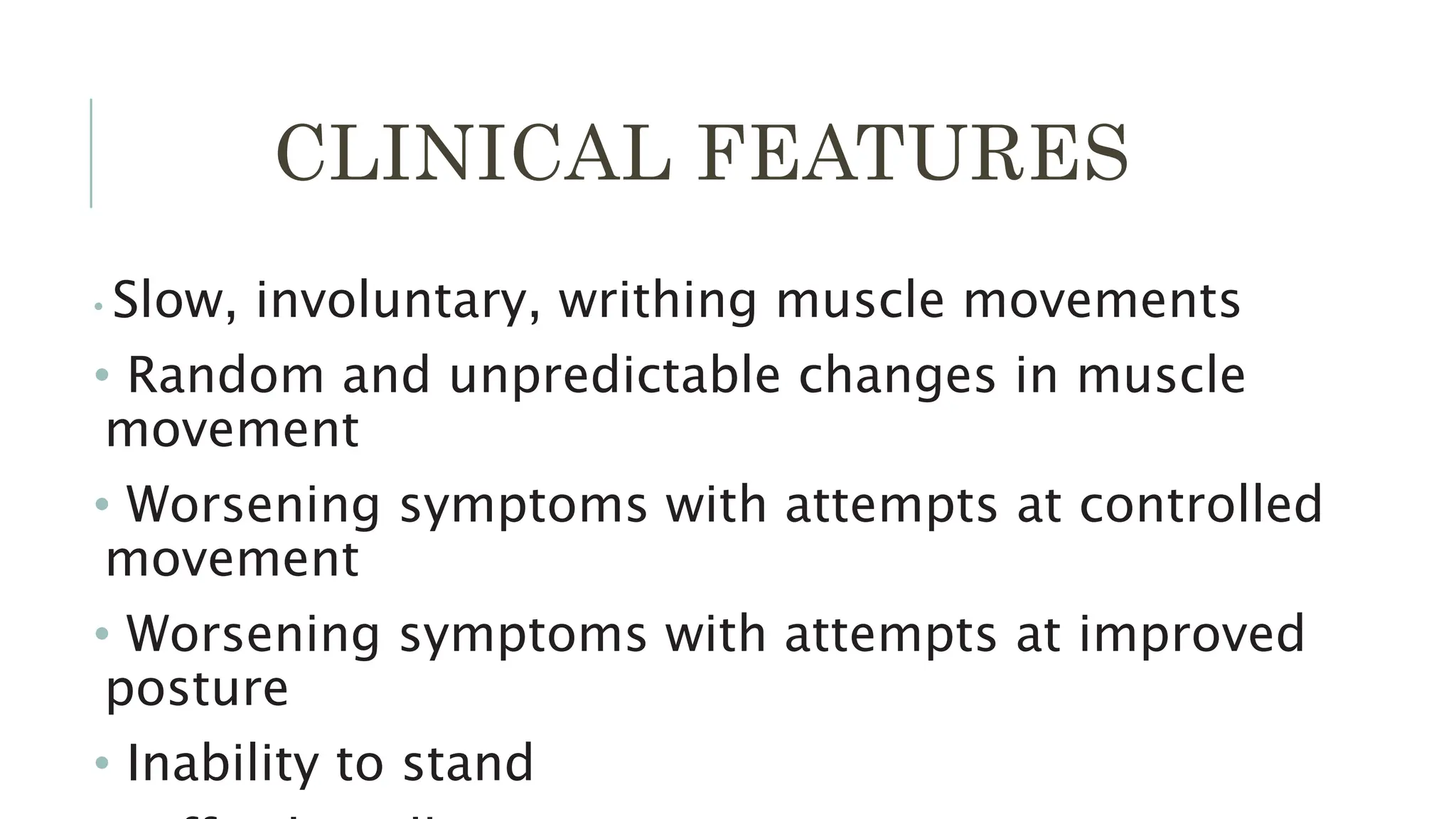
CLINICAL FEATURES
• Slow, involuntary, writhing muscle movements
• Random and unpredictable changes in muscle
movement
• Worsening symptoms with attempts at controlled
movement
• Worsening symptoms with attempts at improved
posture
• Inability to stand
TREATMENT- MEDICAL MANAGEMENT
• Anti-dopamine medicines: drugs that suppress the
hormone’s effect on the brain
• Botox injections: treatment that may temporarily
limit involuntary muscle actions
• Lifestyle Management- Changing your lifestyle,
eating healthier, and exercising regularly for muscle
strengthening can help improve the complications
• Occupational therapy: muscle training to regain
some control
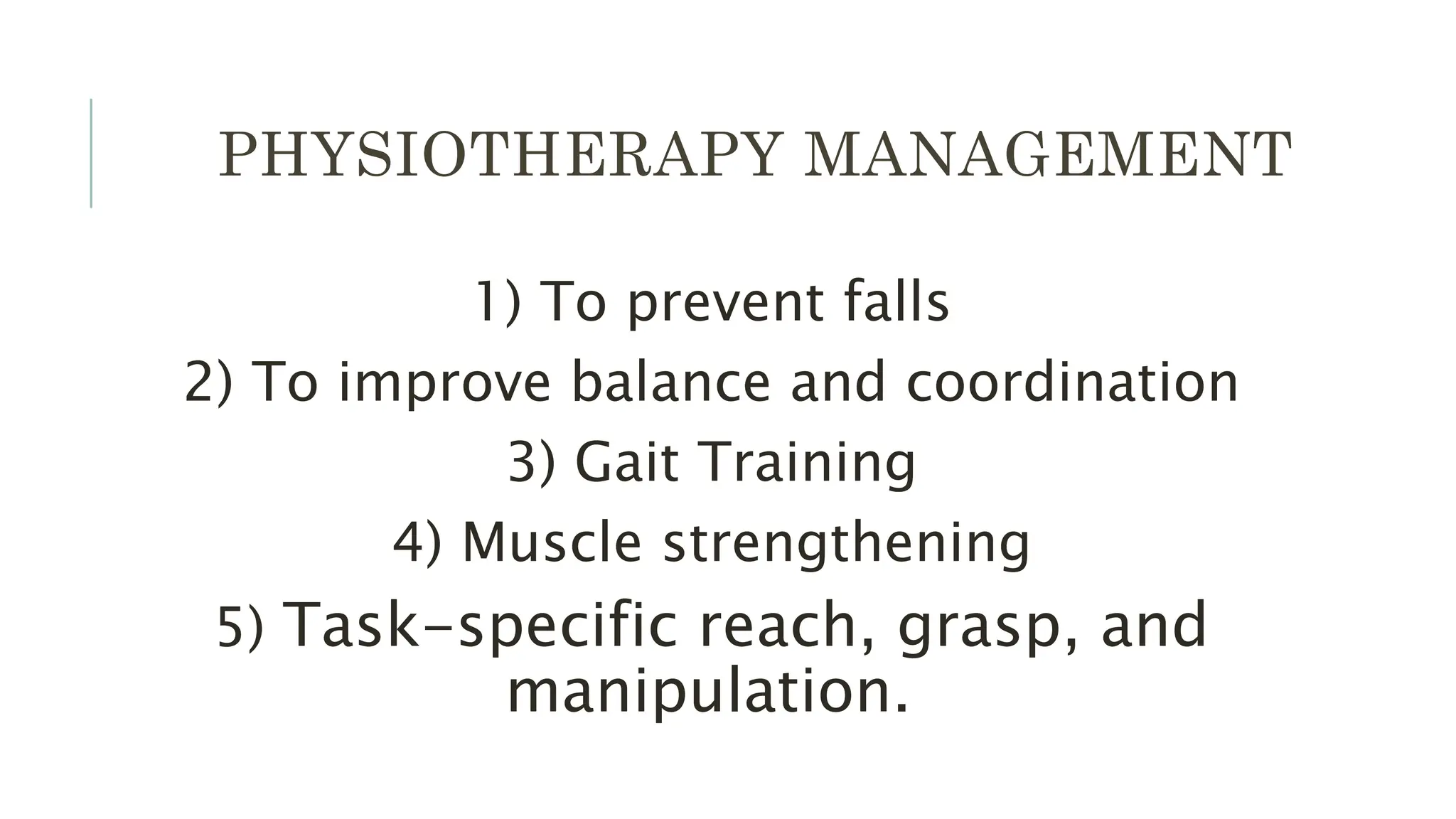
PHYSIOTHERAPY MANAGEMENT
1) To prevent falls
2) To improve balance and coordination
3) Gait Training
4) Muscle strengthening
5) Task-specific reach, grasp, and
manipulation.
T H A N K – Y O
U

Chorea and Athetosis - Presentation Neuro

  • 1.
  • 2.
    CHOREA - DEFINITION An involuntary, irregular, jerking movement affecting limb and axial muscle groups. These movements are suppressed with difficulty and are incorporated into voluntary gestures resulting in a ‘semi purposeful’ appearance, e.g. crossing and uncrossing of legs.  It is a type of hyperkinetic movement disorder  The involuntary movements flow from
  • 3.
    CAUSES 1)Hereditary – Huntington’sdisease, Benign chorea 2)Metabolic – Hyperthyroidism, Hypocalcaemia 3)Drugs – Antiparkinsonian drugs, Oral contraceptives 4)Immunological – Systemic lupus erythematosus, Polyarteritis nodosa 5)Toxins – alcohol, carbon monoxide poisoning 6)Miscellaneous – Chorea gravidarum, Polycythaemia rubra vera 7)Infections – Sydenham’s chorea, Encephalitis
  • 4.
    TYPES OF CHOREA 1)PRIMARY CHOREA (genetical causes) Primary chorea develops as the result of a disease, of which it is a primary symptom. Eg: Hunington’s Syndrome Primary will be symmetrical symptoms with insidious onset 2) SECONDARY CHOREA (acquired causes) Drug induced Chorea, Immune mediated Chorea, Infectious Chorea, Vascular Chorea, Hormonal Disorders Secondary will be asymmetrical and most of time sudden onset
  • 5.
    CLINICAL FEATURES • Fidgetinginvoluntarily • Asymmetrical irregular movements • Inability to maintain an ongoing motor activity, such as maintaining a constant grip or holding the tongue out • Abrupt, interrupted speech • Involuntary vocalization • Loss of coordinated movements • Gait disturbance – in the form of jerky movements • Impaired balance
  • 6.
    TREATMENT: MEDICAL MANAGEMENT 1.Dopamine-depleting agents: Tetrabenazine, Deutetrabenazine, Valbenazine. 2. Dopamine D2 receptor-blocking agents: Haloperidol, Clozapine, Olanzapine. 3. Anticonvulsants: Valproic acid, Carbamazepine, Benzodiazepines, Levetiracetam. 4. Anti-glutamatergic agents: Amantadine, Riluzole. 5. Cannabinoids: Nabilone. 6. Deep Brain Stimulation
  • 7.
    PHYSIOTHERAPY MANAGEMENT • Gaitre-education • Balance retraining • Fall prevention/management • Aerobic capacity • Muscle strengthening • Wheelchair prescription and training • Respiratory function • Task-specific reach, grasp, and manipulation.
  • 8.
    ATHETOSIS - DEFINITION •It consists of irregular, repetitive, writhing movements. • Athetosis refers to the slow, involuntary, and writhing movements of the limbs, face, neck, tongue, and other muscle groups. • These movements may be continuous, slow, and rolling. They may also make maintaining a symmetrical and stable posture difficult.
  • 9.
    CAUSES 1) Jaundice 2) Birthdifficulty – Asphyxia can lead to brain damage 3) Cerebral Palsy 4) Stroke 5) Drug Toxicity 6) Head Trauma
  • 10.
    CLINICAL FEATURES • Slow,involuntary, writhing muscle movements • Random and unpredictable changes in muscle movement • Worsening symptoms with attempts at controlled movement • Worsening symptoms with attempts at improved posture • Inability to stand
  • 11.
    TREATMENT- MEDICAL MANAGEMENT •Anti-dopamine medicines: drugs that suppress the hormone’s effect on the brain • Botox injections: treatment that may temporarily limit involuntary muscle actions • Lifestyle Management- Changing your lifestyle, eating healthier, and exercising regularly for muscle strengthening can help improve the complications • Occupational therapy: muscle training to regain some control
  • 12.
    PHYSIOTHERAPY MANAGEMENT 1) Toprevent falls 2) To improve balance and coordination 3) Gait Training 4) Muscle strengthening 5) Task-specific reach, grasp, and manipulation.
  • 13.
    T H AN K – Y O U