Somatic Motor Pathways in
 the Central Nervous System
ď‚› Impulses must be conducted from its motor areas to
  skeletal muscles by relays of neurons referred to as
  somatic motor pathways. Consist of motor neurons that
  conduct impulses from the central nervous system to
  somatic effectors such as skeletal muscles.
ď‚› There are two methods used to classify somatic motor
  pathways: one- divides them into pyramidal and
  extrapyramidal tracts. Two- classifies them as
  facilitatory and inhibitory.
ď‚› Pyramidal tracts are those whose fibers come together
  in the medulla to form the pyramids.
ď‚› Extrapyramidal tracts are much more complex, they
  consist of all motor tracts from the brain to the spinal
  cord anterior horn motor neurons except the
  corticospinal tracts. (1)
(9 ©)   (8 ©)
Structure of Spinal Nerves


ď‚› Each spinal nerve attaches to the spinal cord by
  means of two short roots, ventral and dorsal.
ď‚› The dorsal is easily recognized by a swelling called
  the dorsal root ganglion, or spinal ganglion. The
  roots and dorsal ganglia lie within the spinal
  cavity.
ď‚› Each spinal nerve splits into a distinct dorsal
  ramus and ventral ramus. (1)
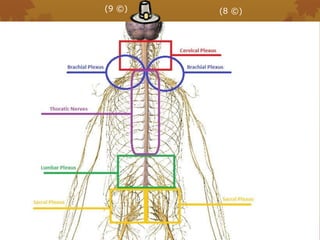
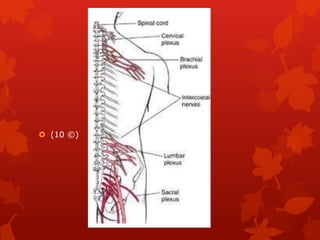
Nerve Plexuses
ď‚› The ventral rami of most spinal nerves subdivide to form
  complex networks called plexuses.
  Four Major Pairs:
    1. The Cervical Plexus – found deep within the neck;
    innervates muscles and skin of the neck, upper shoulder,
    and part of the head
    2. The Brachial Plexus – plexus located deep in the
    shoulder that innervates the lower part of the shoulder
    and the entire arm
     3. The Lumbar Plexus - spinal nerve plexus located in the
    lower back
    4. The Sacral Plexus – plexus formed by fibers from the
    fourth the fourth and fifth lumbar nerves and the first four
    sacral nerves
 (10 ©)
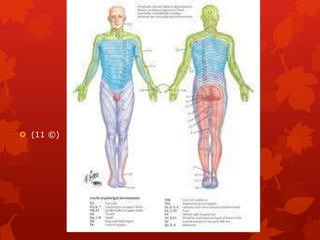
Dermatomes and Myotomes


ď‚› At first glance of the distribution of spinal nerves does
  not appear to follow an ordered arrangement, but
  detailed mapping of the skin surface has revealed a
  close relationship between the spinal origin of each
  spinal nerve and the region of the body it innervates.
 Dermatomes – skin surface areas supplied by a single
  spinal nerve
 Myotomes – skeletal muscle or group of muscles that
  receives motor axons from a given spinal nerve.
ď‚› There is some overlap among myotomes also, thus some
  skeletal muscle organs may be innervated by motor
  axons from more than one spinal nerve
 (11 ©)
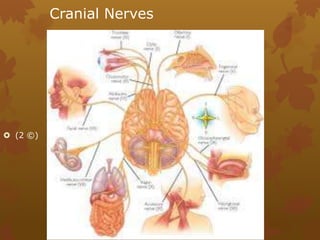
Cranial Nerves


 (2 ©)
Afferent and efferent


ď‚› Afferent division of the nervous system consists of all of
  the incoming sensory or afferent pathways.
ď‚› Efferent division of the nervous system consists of all
  the outgoing motor or efferent pathways.
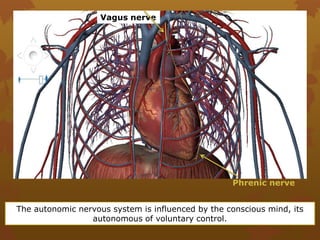
Vagus nerve


                                                   Phrenic nerve


The autonomic nervous system is influenced by the conscious mind, its
                 autonomous of voluntary control.
Sympathetic and
Parasympathetic


ď‚› Sympathetic division prepares the body to deal with
  immediate threats to the internal environment. It
  produces the “fight-or-flight” response.
 Parasympathetic division coordinates the body’s normal
  resting activities. Sometimes called the “rest-and-repair”
  division.

Nervous system artfact

  • 1.
    Somatic Motor Pathwaysin the Central Nervous System ď‚› Impulses must be conducted from its motor areas to skeletal muscles by relays of neurons referred to as somatic motor pathways. Consist of motor neurons that conduct impulses from the central nervous system to somatic effectors such as skeletal muscles. ď‚› There are two methods used to classify somatic motor pathways: one- divides them into pyramidal and extrapyramidal tracts. Two- classifies them as facilitatory and inhibitory. ď‚› Pyramidal tracts are those whose fibers come together in the medulla to form the pyramids. ď‚› Extrapyramidal tracts are much more complex, they consist of all motor tracts from the brain to the spinal cord anterior horn motor neurons except the corticospinal tracts. (1)
  • 2.
    (9 ©) (8 ©)
  • 3.
    Structure of SpinalNerves ď‚› Each spinal nerve attaches to the spinal cord by means of two short roots, ventral and dorsal. ď‚› The dorsal is easily recognized by a swelling called the dorsal root ganglion, or spinal ganglion. The roots and dorsal ganglia lie within the spinal cavity. ď‚› Each spinal nerve splits into a distinct dorsal ramus and ventral ramus. (1)
  • 4.
    Nerve Plexuses  Theventral rami of most spinal nerves subdivide to form complex networks called plexuses. Four Major Pairs:  1. The Cervical Plexus – found deep within the neck; innervates muscles and skin of the neck, upper shoulder, and part of the head  2. The Brachial Plexus – plexus located deep in the shoulder that innervates the lower part of the shoulder and the entire arm 3. The Lumbar Plexus - spinal nerve plexus located in the lower back  4. The Sacral Plexus – plexus formed by fibers from the fourth the fourth and fifth lumbar nerves and the first four sacral nerves
  • 5.
  • 6.
    Dermatomes and Myotomes At first glance of the distribution of spinal nerves does not appear to follow an ordered arrangement, but detailed mapping of the skin surface has revealed a close relationship between the spinal origin of each spinal nerve and the region of the body it innervates.  Dermatomes – skin surface areas supplied by a single spinal nerve  Myotomes – skeletal muscle or group of muscles that receives motor axons from a given spinal nerve.  There is some overlap among myotomes also, thus some skeletal muscle organs may be innervated by motor axons from more than one spinal nerve
  • 7.
  • 8.
  • 9.
    Afferent and efferent ď‚›Afferent division of the nervous system consists of all of the incoming sensory or afferent pathways. ď‚› Efferent division of the nervous system consists of all the outgoing motor or efferent pathways.
  • 10.
    Vagus nerve Phrenic nerve The autonomic nervous system is influenced by the conscious mind, its autonomous of voluntary control.
  • 11.
    Sympathetic and Parasympathetic  Sympatheticdivision prepares the body to deal with immediate threats to the internal environment. It produces the “fight-or-flight” response.  Parasympathetic division coordinates the body’s normal resting activities. Sometimes called the “rest-and-repair” division.