THE NEUROLOGICAL EXAMINATION
NEUROLOGICAL EXAM
• Mental status
• Cranial nerves
• Motor exam
– Strength
– Gait
– Cerebellar
• Reflexes
• Sensation
MENTAL STATUS
“FOGS”
 Family story of memory loss
 Orientation
 General Information
 Spelling &/or numbers
 Recognition of objects
Level of Consciousness
• Awake and alert
• Agitated
• Lethargic
– Arousable with
• Voice
• Gentle stimulation
• Painful/vigorous stimulation
• Comatose
LANGUAGE
• Fluency
• Naming
• Repetition
• Reading
• Writing
• Comprehension
Aphasia vs. dysarthria
MEMORY
• Immediate
– Really a measure of attention rather than memory
• Remote
• 3 objects at 0/3/5 minutes
• Historical events
• Personal events
Orientation
• Person
– Not who they are but who you are
• Place
• Time
OTHER COGNITIVE FUNCTIONS
• Calculation
• Abstraction
• Similarities/differences
• Judgement
• Personality/behavior
CRANIAL NERVE EXAM
• I - olfactory
– Don’t use a noxious stimulus
– Coffee, lemon extract
• Ii - optic
– Visual acuity
– Visual fields
– Fundoscopic exam
CRANIAL NERVE EXAM
• Iii/iv/vi oculomotor, trochlear, abducens
– Pupillary response
– Eye movements
• 9 cardinal positions
– Observe lids for ptosis
• V - trigeminal
– Motor - jaw strength
– Sensory - all 3 divisions
– A lesion that effects C5 will usually effect all three segments
(ophthalmic, maxillary, & mandibular) so the exam light
touch on both cheeks. By cotton.
CRANIAL NERVES
• Vii - facial
– Observe for facial asymmetry
– Forehead wrinkling, eyelid closure, whistle/pucker
– Bell’s Palsy- Where the nerve is injured between pons &
face there is total facial paralysis i.e., weakness of a
corner of the mouth + closing the eye + wrinkling the
brow.
• Viii - vestibular
– Acuity
– Rinne, weber
– Rubbing your fingers together next to the patients ear.
CRANIAL NERVES
• Ix/x - glossopharyngeal, vagus
– GAG reflex check
• Xi - spinal accessory
– Sternocleidomastoid m.
– Trapezius muscle
• Xii - hypoglossal
– Tongue strength
– Right xii thrusts tongue to left
– stick out your tongue
– The tongue will deviate to the side of weakness.
MOTOR EXAMINATION
STRENGTH
• Strength
– Graded 0 - 5
– 0 - no movement
– 1 - flicker
– 2 - movement with gravity removed
– 3 - movement against gravity
– 4 - movement against resistance
– 5 - normal strength
STRENGTH EXAM
• Upper and lower extremities
• Distal and proximal muscles
• Grip strength is a poor screening tool for strength
• Subtle weakness
– Toe walk, heel walk
– Out of chair
– Deep knee bend
Motor exam, cont
• Subtle signs of weakness on a cortical/subcortical
basis
– Pronator drift
– Orbiting
Gait evaluation
• Include walking and turning
• Examples of abnormal gait
– High steppage
– Waddling
– Hemiparetic
– Shuffling
– Turns en bloc
MUSCLE OBSERVATION
• ATROPHY
• FASCIULATIONS
ABNORMAL MOVEMENTS
• TREMOR
– REST
– WITH ARMS OUTSTRETCHED
– INTENTION
• CHOREA
• ATHETOSIS
• ABNORMAL POSTURES
CEREBELLAR FUNCTION
• RAPID ALTERNATING MOVEMENTS
• FINGER TO FINGER TO NOSE TESTING
• HEEL TO SHIN
• GAIT
– TANDEM
Romberg Test
• Key test:
• Be sure to check orthostatic (B/P) for changes first
• Balance is maintained by vision, vestibular sense &
proprioception. These feed into the cerebellum either
directly or indirectly. If a patient sways with eyes open or
close it is considered +.
Coordination
• Key Test:
• Finger to nose & heel to shin motions
• Alternating rapid movements of hand & foot.
Examples of tapping thumb & index fingers
together, or heel on floor & tap toes on floor.
• Balance test- Tandem gait or Romberg test.
REFLEXES
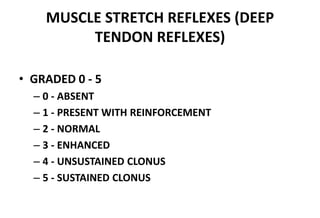
MUSCLE STRETCH REFLEXES (DEEP
TENDON REFLEXES)
• GRADED 0 - 5
– 0 - ABSENT
– 1 - PRESENT WITH REINFORCEMENT
– 2 - NORMAL
– 3 - ENHANCED
– 4 - UNSUSTAINED CLONUS
– 5 - SUSTAINED CLONUS
MSR / DTR
• BICEPS
• BRACHIORADIALIS
• TRICEPS
• KNEE
• ANKLE
Reflexes
• Key tests:
• Triceps, biceps, knee jerk, Achilles & Babinski are the major
reflexes.
• Asymmetry is usually a sign of major pathology.
• Babinski- This points to a upper motor neuron lesion. A
positive test is when the lateral aspect of the foot is
scratched & the big toe dorsiflexes & the other toes fan out
OTHER REFLEXES
• Upper motor neuron dysfunction
– BABINSKI
• present or absent
• toes downgoing/ flexor plantar response
– HOFMAN’S
– JAW JERK
• Frontal release signs
– GRASP
– SNOUT
– SUCK
– PALMOMENTAL
TONE
• INCREASED, DECREASED, NORMAL
• COGWHEELING
• CLASP KNIFE
SENSORY EXAM
SENSORY EXAM
• Vibration
– 128 hz tuning fork
• Joint position sense
• Pin prick
• Temperature
Start distally and move proximally
HIGHER CORTICAL SENSATIONS
• GRAPHESTHESIA
• STEREOGNOSIS
• DOUBLE SIMULTANEOUS STIMULATION
• BAROSTHESIA
• TEXTURES
Sensory Extremity Examination
• Key Test:
• Pain Sensation- Use simultaneous stimulation
(sharp, dull, etc.)
• Proprioception- Test big toe (position).
MS, neurosyphilis, & pernicious anemia may cause
loss of lower extremity proprioception.

mesfin NS ass't.ppt

  • 1.
  • 2.
    NEUROLOGICAL EXAM • Mentalstatus • Cranial nerves • Motor exam – Strength – Gait – Cerebellar • Reflexes • Sensation
  • 3.
    MENTAL STATUS “FOGS”  Familystory of memory loss  Orientation  General Information  Spelling &/or numbers  Recognition of objects
  • 4.
    Level of Consciousness •Awake and alert • Agitated • Lethargic – Arousable with • Voice • Gentle stimulation • Painful/vigorous stimulation • Comatose
  • 5.
    LANGUAGE • Fluency • Naming •Repetition • Reading • Writing • Comprehension Aphasia vs. dysarthria
  • 6.
    MEMORY • Immediate – Reallya measure of attention rather than memory • Remote • 3 objects at 0/3/5 minutes • Historical events • Personal events Orientation • Person – Not who they are but who you are • Place • Time
  • 7.
    OTHER COGNITIVE FUNCTIONS •Calculation • Abstraction • Similarities/differences • Judgement • Personality/behavior
  • 8.
    CRANIAL NERVE EXAM •I - olfactory – Don’t use a noxious stimulus – Coffee, lemon extract • Ii - optic – Visual acuity – Visual fields – Fundoscopic exam
  • 9.
    CRANIAL NERVE EXAM •Iii/iv/vi oculomotor, trochlear, abducens – Pupillary response – Eye movements • 9 cardinal positions – Observe lids for ptosis • V - trigeminal – Motor - jaw strength – Sensory - all 3 divisions – A lesion that effects C5 will usually effect all three segments (ophthalmic, maxillary, & mandibular) so the exam light touch on both cheeks. By cotton.
  • 10.
    CRANIAL NERVES • Vii- facial – Observe for facial asymmetry – Forehead wrinkling, eyelid closure, whistle/pucker – Bell’s Palsy- Where the nerve is injured between pons & face there is total facial paralysis i.e., weakness of a corner of the mouth + closing the eye + wrinkling the brow. • Viii - vestibular – Acuity – Rinne, weber – Rubbing your fingers together next to the patients ear.
  • 11.
    CRANIAL NERVES • Ix/x- glossopharyngeal, vagus – GAG reflex check • Xi - spinal accessory – Sternocleidomastoid m. – Trapezius muscle • Xii - hypoglossal – Tongue strength – Right xii thrusts tongue to left – stick out your tongue – The tongue will deviate to the side of weakness.
  • 12.
  • 13.
    STRENGTH • Strength – Graded0 - 5 – 0 - no movement – 1 - flicker – 2 - movement with gravity removed – 3 - movement against gravity – 4 - movement against resistance – 5 - normal strength
  • 14.
    STRENGTH EXAM • Upperand lower extremities • Distal and proximal muscles • Grip strength is a poor screening tool for strength • Subtle weakness – Toe walk, heel walk – Out of chair – Deep knee bend
  • 15.
    Motor exam, cont •Subtle signs of weakness on a cortical/subcortical basis – Pronator drift – Orbiting
  • 16.
    Gait evaluation • Includewalking and turning • Examples of abnormal gait – High steppage – Waddling – Hemiparetic – Shuffling – Turns en bloc
  • 17.
  • 18.
    ABNORMAL MOVEMENTS • TREMOR –REST – WITH ARMS OUTSTRETCHED – INTENTION • CHOREA • ATHETOSIS • ABNORMAL POSTURES
  • 19.
    CEREBELLAR FUNCTION • RAPIDALTERNATING MOVEMENTS • FINGER TO FINGER TO NOSE TESTING • HEEL TO SHIN • GAIT – TANDEM
  • 20.
    Romberg Test • Keytest: • Be sure to check orthostatic (B/P) for changes first • Balance is maintained by vision, vestibular sense & proprioception. These feed into the cerebellum either directly or indirectly. If a patient sways with eyes open or close it is considered +.
  • 21.
    Coordination • Key Test: •Finger to nose & heel to shin motions • Alternating rapid movements of hand & foot. Examples of tapping thumb & index fingers together, or heel on floor & tap toes on floor. • Balance test- Tandem gait or Romberg test.
  • 22.
  • 23.
    MUSCLE STRETCH REFLEXES(DEEP TENDON REFLEXES) • GRADED 0 - 5 – 0 - ABSENT – 1 - PRESENT WITH REINFORCEMENT – 2 - NORMAL – 3 - ENHANCED – 4 - UNSUSTAINED CLONUS – 5 - SUSTAINED CLONUS
  • 24.
    MSR / DTR •BICEPS • BRACHIORADIALIS • TRICEPS • KNEE • ANKLE
  • 25.
    Reflexes • Key tests: •Triceps, biceps, knee jerk, Achilles & Babinski are the major reflexes. • Asymmetry is usually a sign of major pathology. • Babinski- This points to a upper motor neuron lesion. A positive test is when the lateral aspect of the foot is scratched & the big toe dorsiflexes & the other toes fan out
  • 26.
    OTHER REFLEXES • Uppermotor neuron dysfunction – BABINSKI • present or absent • toes downgoing/ flexor plantar response – HOFMAN’S – JAW JERK • Frontal release signs – GRASP – SNOUT – SUCK – PALMOMENTAL
  • 27.
    TONE • INCREASED, DECREASED,NORMAL • COGWHEELING • CLASP KNIFE
  • 28.
  • 29.
    SENSORY EXAM • Vibration –128 hz tuning fork • Joint position sense • Pin prick • Temperature Start distally and move proximally
  • 30.
    HIGHER CORTICAL SENSATIONS •GRAPHESTHESIA • STEREOGNOSIS • DOUBLE SIMULTANEOUS STIMULATION • BAROSTHESIA • TEXTURES
  • 31.
    Sensory Extremity Examination •Key Test: • Pain Sensation- Use simultaneous stimulation (sharp, dull, etc.) • Proprioception- Test big toe (position). MS, neurosyphilis, & pernicious anemia may cause loss of lower extremity proprioception.