Projectile Motion
PART-1
1
What is Projectile motion?
 Projectile motion is the type of motion of
an object under the force of gravity
 Example: Throwing a ball in the air at any
angle the ball follows a projectile motion
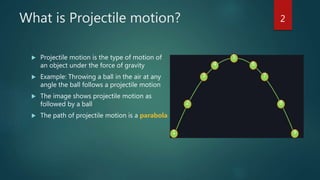
 The image shows projectile motion as
followed by a ball
 The path of projectile motion is a parabola
2
2 8
1 9
6
3
4
5
7
Breaking up projectile motion
 Important :
 Projectile motion is just a combination of motion in 2 directions at
the same time
 Motion in Horizontal direction (X-direction)
 Motion in Vertical direction (Y-direction)
 When the above two motions occur at the same time, it is called
PROJECTILE MOTION
 To understand and solve projectile motion problems, it is useful to
break it up into separate horizontal and vertical components
3
Motion in Horizontal direction (X-
direction)
 Motion in horizontal or x-direction is just straight line motion, hence we
do not need to consider any vertical component or vertical motion
 We do not have any horizontal acceleration, only velocity is present in
horizontal direction in case of projectile motion
 Formula to use:
 Velocity (in x-direction) = Distance/Time
4
Motion in Vertical direction (Y-direction)
 Motion in vertical or y-direction is also a straight line motion, hence we do not
need to consider any horizontal component or horizontal motion
 Acceleration due to gravity (g=9.8m/s2) is present in the vertical direction
directed downwards (towards the earth)
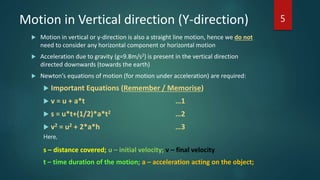
 Newton’s equations of motion (for motion under acceleration) are required:
 Important Equations (Remember / Memorise)
 v = u + a*t …1
 s = u*t+(1/2)*a*t2 …2
 v2 = u2 + 2*a*h …3
Here,
s – distance covered; u – initial velocity; v – final velocity
t – time duration of the motion; a – acceleration acting on the object;
5
Sign Convention and Directions
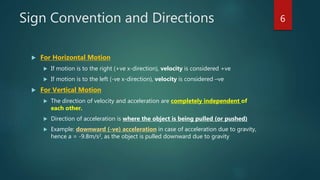
 For Horizontal Motion
 If motion is to the right (+ve x-direction), velocity is considered +ve
 If motion is to the left (-ve x-direction), velocity is considered –ve
 For Vertical Motion
 The direction of velocity and acceleration are completely independent of
each other.
 Direction of acceleration is where the object is being pulled (or pushed)
 Example: downward (-ve) acceleration in case of acceleration due to gravity,
hence a = -9.8m/s2, as the object is pulled downward due to gravity
6
End of Part-1
Coming up:
 Other useful results
 Numerical Examples.
7