

PROJECTILE
MOTION
PROJECTILE MOTION:-
 When a particle is thrown obliquely
near the earth’s surface it moves along
a curved path, such particle is called
projectile and it motion is said to be
projectile motion.
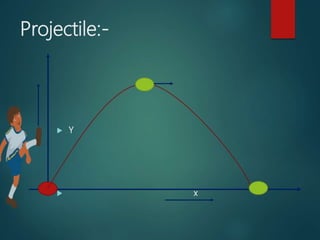
Projectile:-
 Y
 x
Terminology:-
Point of projection:- the point on the earth
from where particle is thrown .
Angle of projection (𝜽):- the angle made
by the velocity with x-axis is called as angle
of projection.
Trajectory:- the path followed by the
particle is called as the trajectory.
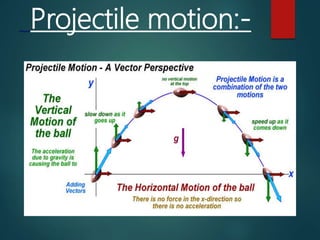
Projectile motion:-
Sign convention:-
 The vertically upward direction is
taken as the positive direction of
the y-axis.
 The vertically downward motion
is taken as the negative direction
of the y- axis.
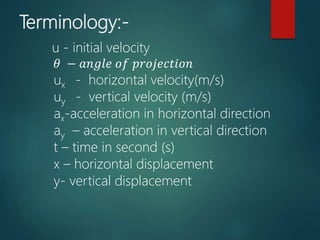
Terminology:-
u - initial velocity
𝜃 − 𝑎𝑛𝑔𝑙𝑒 𝑜𝑓 𝑝𝑟𝑜𝑗𝑒𝑐𝑡𝑖𝑜𝑛
ux - horizontal velocity(m/s)
uy - vertical velocity (m/s)
ax-acceleration in horizontal direction
ay – acceleration in vertical direction
t – time in second (s)
x – horizontal displacement
y- vertical displacement
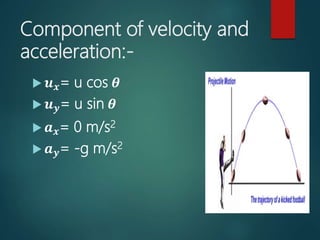
Component of velocity and
acceleration:-
 𝒖 𝒙= u cos 𝜽
 𝒖 𝒚= u sin 𝜽
 𝒂 𝒙= 0 m/s2
 𝒂 𝒚= -g m/s2
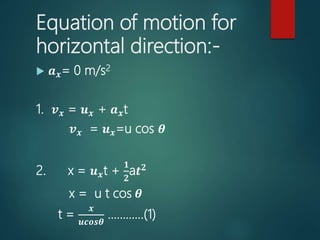
Equation of motion for
horizontal direction:-
 𝒂 𝒙= 0 m/s2
1. 𝒗 𝒙 = 𝒖 𝒙 + 𝒂 𝒙t
𝒗 𝒙 = 𝒖 𝒙=u cos 𝜽
2. x = 𝒖 𝒙t +
𝟏
𝟐
a𝒕 𝟐
x = u t cos 𝜽
t =
𝒙
𝒖𝒄𝒐𝒔𝜽
…………(1)
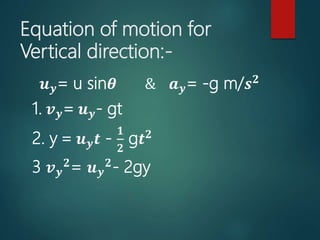
Equation of motion for
Vertical direction:-
𝒖 𝒚= u sin𝜽 & 𝒂 𝒚= -g m/𝒔 𝟐
1. 𝒗 𝒚= 𝒖 𝒚- gt
2. y = 𝒖 𝒚 𝒕 -
𝟏
𝟐
g𝒕 𝟐
3 𝒗 𝒚
𝟐
= 𝒖 𝒚
𝟐
- 2gy
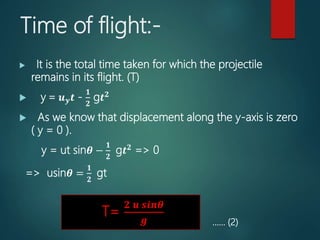
Time of flight:-
 It is the total time taken for which the projectile
remains in its flight. (T)
 y = 𝒖 𝒚 𝒕 -
𝟏
𝟐
g𝒕 𝟐
 As we know that displacement along the y-axis is zero
( y = 0 ).
y = ut sin𝜽 −
𝟏
𝟐
g𝒕 𝟐
=> 0
=> usin𝜽 =
𝟏
𝟐
gt
…… (2)
T=
𝟐 𝒖 𝒔𝒊𝒏𝜽
𝒈
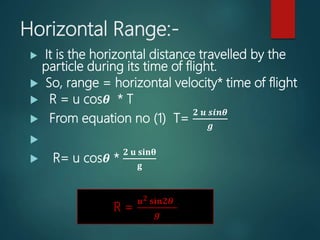
Horizontal Range:-
 It is the horizontal distance travelled by the
particle during its time of flight.
 So, range = horizontal velocity* time of flight
 R = u cos𝜽 * T
 From equation no (1) T=
𝟐 𝒖 𝒔𝒊𝒏𝜽
𝒈

 R= u cos𝜽 *
𝟐 𝐮 𝐬𝐢𝐧𝛉
𝐠
….(3)
R =
𝒖 𝟐 𝐬𝐢𝐧𝟐𝜽
𝒈
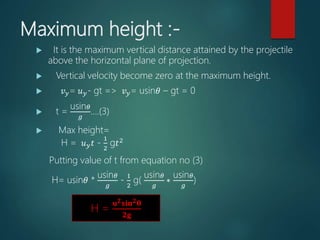
Maximum height :-
 It is the maximum vertical distance attained by the projectile
above the horizontal plane of projection.
 Vertical velocity become zero at the maximum height.
 𝑣 𝑦= 𝑢 𝑦- gt => 𝑣 𝑦= usin𝜃 – gt = 0
 t =
usin 𝜃
𝑔
….(3)
 Max height=
H = 𝑢 𝑦 𝑡 -
1
2
g𝑡2
Putting value of t from equation no (3)
H= usin𝜃 *
usin 𝜃
𝑔
-
1
2
g(
usin 𝜃
𝑔
∗
usin 𝜃
𝑔
)
….(4)
H =
𝐮 𝟐 𝐬𝐢𝐧 𝟐 𝛉
𝟐𝐠
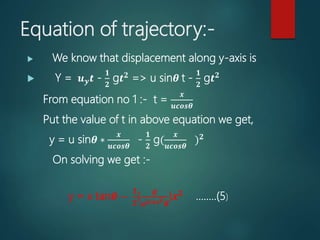
Equation of trajectory:-
 We know that displacement along y-axis is
 Y = 𝒖 𝒚 𝒕 -
𝟏
𝟐
g𝒕 𝟐
=> u sin𝜽 t -
𝟏
𝟐
g𝒕 𝟐
From equation no 1 :- t =
𝒙
𝒖𝒄𝒐𝒔𝜽
Put the value of t in above equation we get,
y = u sin𝜽 ∗
𝒙
𝒖𝒄𝒐𝒔𝜽
-
𝟏
𝟐
g(
𝒙
𝒖𝒄𝒐𝒔𝜽
) 𝟐
On solving we get :-
y = x tan𝜽 −
𝟏
𝟐
(
𝒈
𝒖 𝟐𝒄𝒐𝒔 𝟐
𝜽
)𝒙 𝟐 ……..(5)
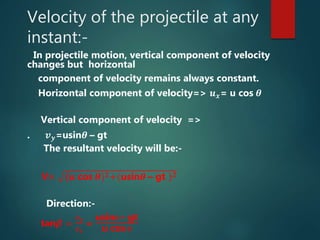
Velocity of the projectile at any
instant:-
In projectile motion, vertical component of velocity
changes but horizontal
component of velocity remains always constant.
Horizontal component of velocity=> 𝒖 𝒙= u cos 𝜽
Vertical component of velocity =>
. 𝒗 𝒚=usin𝜽 – gt
The resultant velocity will be:-
V= (u cos 𝜽) 𝟐+(usin𝜽 – gt ) 𝟐
Direction:-
tan𝜷 =
𝒗 𝒚
𝒗 𝒙
=
usin 𝜽 – gt
u cos 𝜽
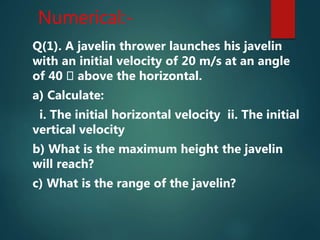
Numerical:-
Q(1). A javelin thrower launches his javelin
with an initial velocity of 20 m/s at an angle
of 40 above the horizontal.
a) Calculate:
i. The initial horizontal velocity ii. The initial
vertical velocity
b) What is the maximum height the javelin
will reach?
c) What is the range of the javelin?
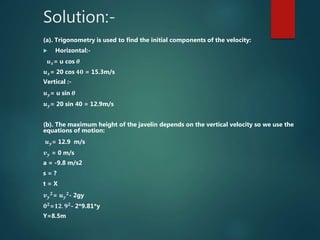
Solution:-
(a). Trigonometry is used to find the initial components of the velocity:
 Horizontal:-
𝒖 𝒙= u cos 𝜽
𝒖 𝒙= 20 cos 𝟒𝟎 = 15.3m/s
Vertical :-
𝒖 𝒚= u sin 𝜽
𝒖 𝒚= 20 sin 40 = 12.9m/s
(b). The maximum height of the javelin depends on the vertical velocity so we use the
equations of motion:
𝒖 𝒚= 12.9 m/s
𝒗 𝒚 = 0 m/s
a = -9.8 m/s2
s = ?
t = X
𝒗 𝒚
𝟐
= 𝒖 𝒚
𝟐
- 2gy
𝟎 𝟐
=𝟏𝟐. 𝟗 𝟐
- 2*9.81*y
Y=8.5m
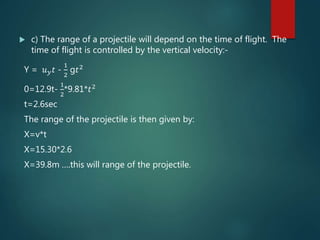
 c) The range of a projectile will depend on the time of flight. The
time of flight is controlled by the vertical velocity:-
Y = 𝑢 𝑦 𝑡 -
1
2
g𝑡2
0=12.9t-
1
2
*9.81*𝑡2
t=2.6sec
The range of the projectile is then given by:
X=v*t
X=15.30*2.6
X=39.8m ….this will range of the projectile.
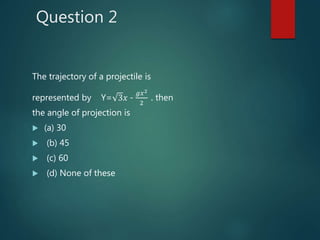
Question 2
The trajectory of a projectile is
represented by Y= 3𝑥 -
𝑔𝑥2
2
. then
the angle of projection is
 (a) 30
 (b) 45
 (c) 60
 (d) None of these
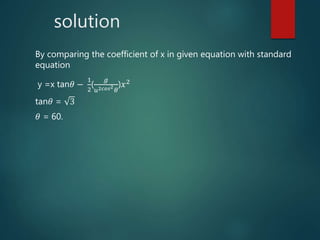
solution
By comparing the coefficient of x in given equation with standard
equation
y =x tan𝜃 −
1
2
(
𝑔
𝑢2𝑐𝑜𝑠2
𝜃
)𝑥2
tan𝜃 = 3
𝜃 = 60.
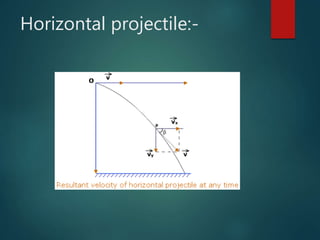
Projectile given in horizontal
direction:-
Horizontal projectile:-
Trajectory of the projectile:-
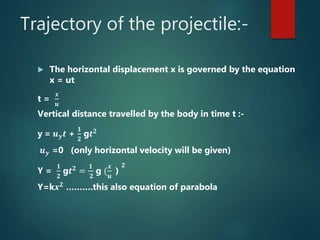
 The horizontal displacement x is governed by the equation
x = ut
t =
𝒙
𝒖
Vertical distance travelled by the body in time t :-
y = 𝒖 𝒚 𝒕 +
𝟏
𝟐
g𝒕 𝟐
𝒖 𝒚 =0 (only horizontal velocity will be given)
Y =
𝟏
𝟐
g𝒕 𝟐
=
𝟏
𝟐
g (
𝒙
𝒖
)
𝟐
Y=k𝒙 𝟐
……….this also equation of parabola
Time of flight:-
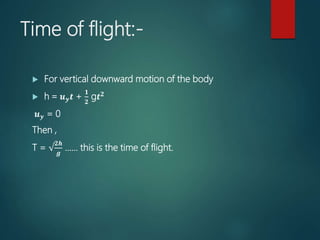
 For vertical downward motion of the body
 h = 𝒖 𝒚 𝒕 +
𝟏
𝟐
g𝒕 𝟐
𝒖 𝒚 = 0
Then ,
T = √
𝟐𝒉
𝒈
…… this is the time of flight.
Horizontal range:-
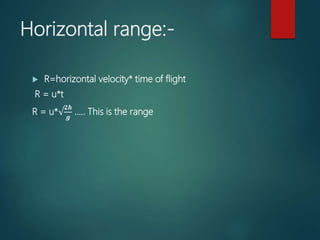
 R=horizontal velocity* time of flight
R = u*t
R = u*√
𝟐𝒉
𝒈
….. This is the range
Questions 3
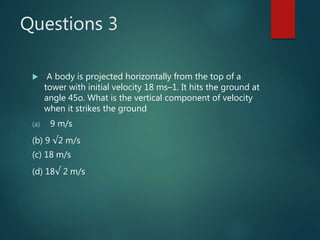
 A body is projected horizontally from the top of a
tower with initial velocity 18 ms–1. It hits the ground at
angle 45o. What is the vertical component of velocity
when it strikes the ground
(a) 9 m/s
(b) 9 √2 m/s
(c) 18 m/s
(d) 18√ 2 m/s
solution
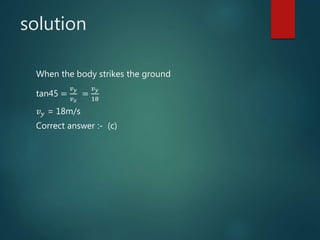
When the body strikes the ground
tan45 =
𝑣 𝑦
𝑣 𝑥
=
𝑣 𝑦
18
𝑣 𝑦 = 18m/s
Correct answer :- (c)
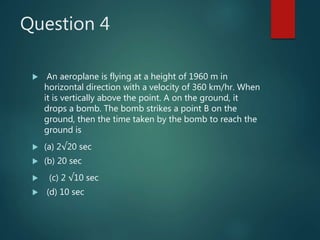
Question 4
 An aeroplane is flying at a height of 1960 m in
horizontal direction with a velocity of 360 km/hr. When
it is vertically above the point. A on the ground, it
drops a bomb. The bomb strikes a point B on the
ground, then the time taken by the bomb to reach the
ground is
 (a) 2√20 sec
 (b) 20 sec
 (c) 2 √10 sec
 (d) 10 sec
solution
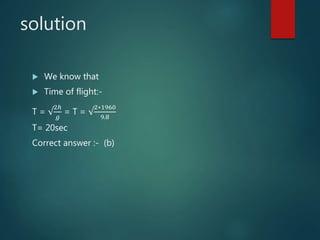
 We know that
 Time of flight:-
T = √
2ℎ
𝑔
= T = √
2∗1960
9.8
T= 20sec
Correct answer :- (b)
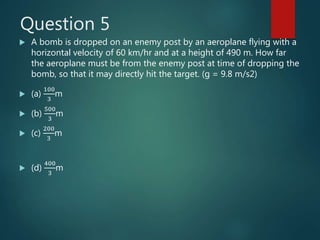
Question 5
 A bomb is dropped on an enemy post by an aeroplane flying with a
horizontal velocity of 60 km/hr and at a height of 490 m. How far
the aeroplane must be from the enemy post at time of dropping the
bomb, so that it may directly hit the target. (g = 9.8 m/s2)
 (a)
100
3
m
 (b)
500
3
m
 (c)
200
3
m
 (d)
400
3
m
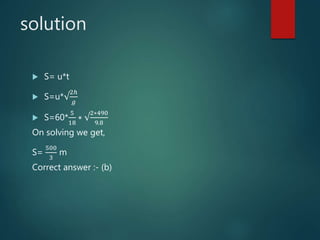
solution
 S= u*t
 S=u*√
2ℎ
𝑔
 S=60*
5
18
∗ √
2∗490
9.8
On solving we get,
S=
500
3
m
Correct answer :- (b)

Projecctile motion by sanjeev

  • 1.
  • 2.
    PROJECTILE MOTION:-  Whena particle is thrown obliquely near the earth’s surface it moves along a curved path, such particle is called projectile and it motion is said to be projectile motion.
  • 3.
  • 4.
    Terminology:- Point of projection:-the point on the earth from where particle is thrown . Angle of projection (𝜽):- the angle made by the velocity with x-axis is called as angle of projection. Trajectory:- the path followed by the particle is called as the trajectory.
  • 5.
  • 6.
    Sign convention:-  Thevertically upward direction is taken as the positive direction of the y-axis.  The vertically downward motion is taken as the negative direction of the y- axis.
  • 7.
    Terminology:- u - initialvelocity 𝜃 − 𝑎𝑛𝑔𝑙𝑒 𝑜𝑓 𝑝𝑟𝑜𝑗𝑒𝑐𝑡𝑖𝑜𝑛 ux - horizontal velocity(m/s) uy - vertical velocity (m/s) ax-acceleration in horizontal direction ay – acceleration in vertical direction t – time in second (s) x – horizontal displacement y- vertical displacement
  • 8.
    Component of velocityand acceleration:-  𝒖 𝒙= u cos 𝜽  𝒖 𝒚= u sin 𝜽  𝒂 𝒙= 0 m/s2  𝒂 𝒚= -g m/s2
  • 9.
    Equation of motionfor horizontal direction:-  𝒂 𝒙= 0 m/s2 1. 𝒗 𝒙 = 𝒖 𝒙 + 𝒂 𝒙t 𝒗 𝒙 = 𝒖 𝒙=u cos 𝜽 2. x = 𝒖 𝒙t + 𝟏 𝟐 a𝒕 𝟐 x = u t cos 𝜽 t = 𝒙 𝒖𝒄𝒐𝒔𝜽 …………(1)
  • 10.
    Equation of motionfor Vertical direction:- 𝒖 𝒚= u sin𝜽 & 𝒂 𝒚= -g m/𝒔 𝟐 1. 𝒗 𝒚= 𝒖 𝒚- gt 2. y = 𝒖 𝒚 𝒕 - 𝟏 𝟐 g𝒕 𝟐 3 𝒗 𝒚 𝟐 = 𝒖 𝒚 𝟐 - 2gy
  • 11.
    Time of flight:- It is the total time taken for which the projectile remains in its flight. (T)  y = 𝒖 𝒚 𝒕 - 𝟏 𝟐 g𝒕 𝟐  As we know that displacement along the y-axis is zero ( y = 0 ). y = ut sin𝜽 − 𝟏 𝟐 g𝒕 𝟐 => 0 => usin𝜽 = 𝟏 𝟐 gt …… (2) T= 𝟐 𝒖 𝒔𝒊𝒏𝜽 𝒈
  • 12.
    Horizontal Range:-  Itis the horizontal distance travelled by the particle during its time of flight.  So, range = horizontal velocity* time of flight  R = u cos𝜽 * T  From equation no (1) T= 𝟐 𝒖 𝒔𝒊𝒏𝜽 𝒈   R= u cos𝜽 * 𝟐 𝐮 𝐬𝐢𝐧𝛉 𝐠 ….(3) R = 𝒖 𝟐 𝐬𝐢𝐧𝟐𝜽 𝒈
  • 13.
    Maximum height :- It is the maximum vertical distance attained by the projectile above the horizontal plane of projection.  Vertical velocity become zero at the maximum height.  𝑣 𝑦= 𝑢 𝑦- gt => 𝑣 𝑦= usin𝜃 – gt = 0  t = usin 𝜃 𝑔 ….(3)  Max height= H = 𝑢 𝑦 𝑡 - 1 2 g𝑡2 Putting value of t from equation no (3) H= usin𝜃 * usin 𝜃 𝑔 - 1 2 g( usin 𝜃 𝑔 ∗ usin 𝜃 𝑔 ) ….(4) H = 𝐮 𝟐 𝐬𝐢𝐧 𝟐 𝛉 𝟐𝐠
  • 14.
    Equation of trajectory:- We know that displacement along y-axis is  Y = 𝒖 𝒚 𝒕 - 𝟏 𝟐 g𝒕 𝟐 => u sin𝜽 t - 𝟏 𝟐 g𝒕 𝟐 From equation no 1 :- t = 𝒙 𝒖𝒄𝒐𝒔𝜽 Put the value of t in above equation we get, y = u sin𝜽 ∗ 𝒙 𝒖𝒄𝒐𝒔𝜽 - 𝟏 𝟐 g( 𝒙 𝒖𝒄𝒐𝒔𝜽 ) 𝟐 On solving we get :- y = x tan𝜽 − 𝟏 𝟐 ( 𝒈 𝒖 𝟐𝒄𝒐𝒔 𝟐 𝜽 )𝒙 𝟐 ……..(5)
  • 15.
    Velocity of theprojectile at any instant:- In projectile motion, vertical component of velocity changes but horizontal component of velocity remains always constant. Horizontal component of velocity=> 𝒖 𝒙= u cos 𝜽 Vertical component of velocity => . 𝒗 𝒚=usin𝜽 – gt The resultant velocity will be:- V= (u cos 𝜽) 𝟐+(usin𝜽 – gt ) 𝟐 Direction:- tan𝜷 = 𝒗 𝒚 𝒗 𝒙 = usin 𝜽 – gt u cos 𝜽
  • 16.
    Numerical:- Q(1). A javelinthrower launches his javelin with an initial velocity of 20 m/s at an angle of 40 above the horizontal. a) Calculate: i. The initial horizontal velocity ii. The initial vertical velocity b) What is the maximum height the javelin will reach? c) What is the range of the javelin?
  • 17.
    Solution:- (a). Trigonometry isused to find the initial components of the velocity:  Horizontal:- 𝒖 𝒙= u cos 𝜽 𝒖 𝒙= 20 cos 𝟒𝟎 = 15.3m/s Vertical :- 𝒖 𝒚= u sin 𝜽 𝒖 𝒚= 20 sin 40 = 12.9m/s (b). The maximum height of the javelin depends on the vertical velocity so we use the equations of motion: 𝒖 𝒚= 12.9 m/s 𝒗 𝒚 = 0 m/s a = -9.8 m/s2 s = ? t = X 𝒗 𝒚 𝟐 = 𝒖 𝒚 𝟐 - 2gy 𝟎 𝟐 =𝟏𝟐. 𝟗 𝟐 - 2*9.81*y Y=8.5m
  • 18.
     c) Therange of a projectile will depend on the time of flight. The time of flight is controlled by the vertical velocity:- Y = 𝑢 𝑦 𝑡 - 1 2 g𝑡2 0=12.9t- 1 2 *9.81*𝑡2 t=2.6sec The range of the projectile is then given by: X=v*t X=15.30*2.6 X=39.8m ….this will range of the projectile.
  • 19.
    Question 2 The trajectoryof a projectile is represented by Y= 3𝑥 - 𝑔𝑥2 2 . then the angle of projection is  (a) 30  (b) 45  (c) 60  (d) None of these
  • 20.
    solution By comparing thecoefficient of x in given equation with standard equation y =x tan𝜃 − 1 2 ( 𝑔 𝑢2𝑐𝑜𝑠2 𝜃 )𝑥2 tan𝜃 = 3 𝜃 = 60.
  • 21.
    Projectile given inhorizontal direction:-
  • 22.
  • 23.
    Trajectory of theprojectile:-  The horizontal displacement x is governed by the equation x = ut t = 𝒙 𝒖 Vertical distance travelled by the body in time t :- y = 𝒖 𝒚 𝒕 + 𝟏 𝟐 g𝒕 𝟐 𝒖 𝒚 =0 (only horizontal velocity will be given) Y = 𝟏 𝟐 g𝒕 𝟐 = 𝟏 𝟐 g ( 𝒙 𝒖 ) 𝟐 Y=k𝒙 𝟐 ……….this also equation of parabola
  • 24.
    Time of flight:- For vertical downward motion of the body  h = 𝒖 𝒚 𝒕 + 𝟏 𝟐 g𝒕 𝟐 𝒖 𝒚 = 0 Then , T = √ 𝟐𝒉 𝒈 …… this is the time of flight.
  • 25.
    Horizontal range:-  R=horizontalvelocity* time of flight R = u*t R = u*√ 𝟐𝒉 𝒈 ….. This is the range
  • 26.
    Questions 3  Abody is projected horizontally from the top of a tower with initial velocity 18 ms–1. It hits the ground at angle 45o. What is the vertical component of velocity when it strikes the ground (a) 9 m/s (b) 9 √2 m/s (c) 18 m/s (d) 18√ 2 m/s
  • 27.
    solution When the bodystrikes the ground tan45 = 𝑣 𝑦 𝑣 𝑥 = 𝑣 𝑦 18 𝑣 𝑦 = 18m/s Correct answer :- (c)
  • 28.
    Question 4  Anaeroplane is flying at a height of 1960 m in horizontal direction with a velocity of 360 km/hr. When it is vertically above the point. A on the ground, it drops a bomb. The bomb strikes a point B on the ground, then the time taken by the bomb to reach the ground is  (a) 2√20 sec  (b) 20 sec  (c) 2 √10 sec  (d) 10 sec
  • 29.
    solution  We knowthat  Time of flight:- T = √ 2ℎ 𝑔 = T = √ 2∗1960 9.8 T= 20sec Correct answer :- (b)
  • 30.
    Question 5  Abomb is dropped on an enemy post by an aeroplane flying with a horizontal velocity of 60 km/hr and at a height of 490 m. How far the aeroplane must be from the enemy post at time of dropping the bomb, so that it may directly hit the target. (g = 9.8 m/s2)  (a) 100 3 m  (b) 500 3 m  (c) 200 3 m  (d) 400 3 m
  • 31.
    solution  S= u*t S=u*√ 2ℎ 𝑔  S=60* 5 18 ∗ √ 2∗490 9.8 On solving we get, S= 500 3 m Correct answer :- (b)