Vector Objectives
1. Add and subtract displacement vectors to describe
changes in position.
2. Calculate the x and y components of a displacement,
velocity, and force vector.
3. Write a velocity vector in polar and x-y coordinates.
4. Calculate the range of a projectile given the initial velocity
vector.
5. Use force vectors to solve two-dimensional equilibrium
problems with up to three forces.
6. Calculate the acceleration on an inclined plane when
given the angle of incline.
Chapter 7 Vocabulary Terms
 vector
 scalar
 magnitude
 x-component
 y-component
 cosine
 parabola
 Pythagorean
theorem
 displacement
 resultant
 position
 resolution
 right triangle
 sine
 dynamics
 tangent
 normal force
 projectile
 trajectory
 Cartesian
coordinates
 range
 velocity vector
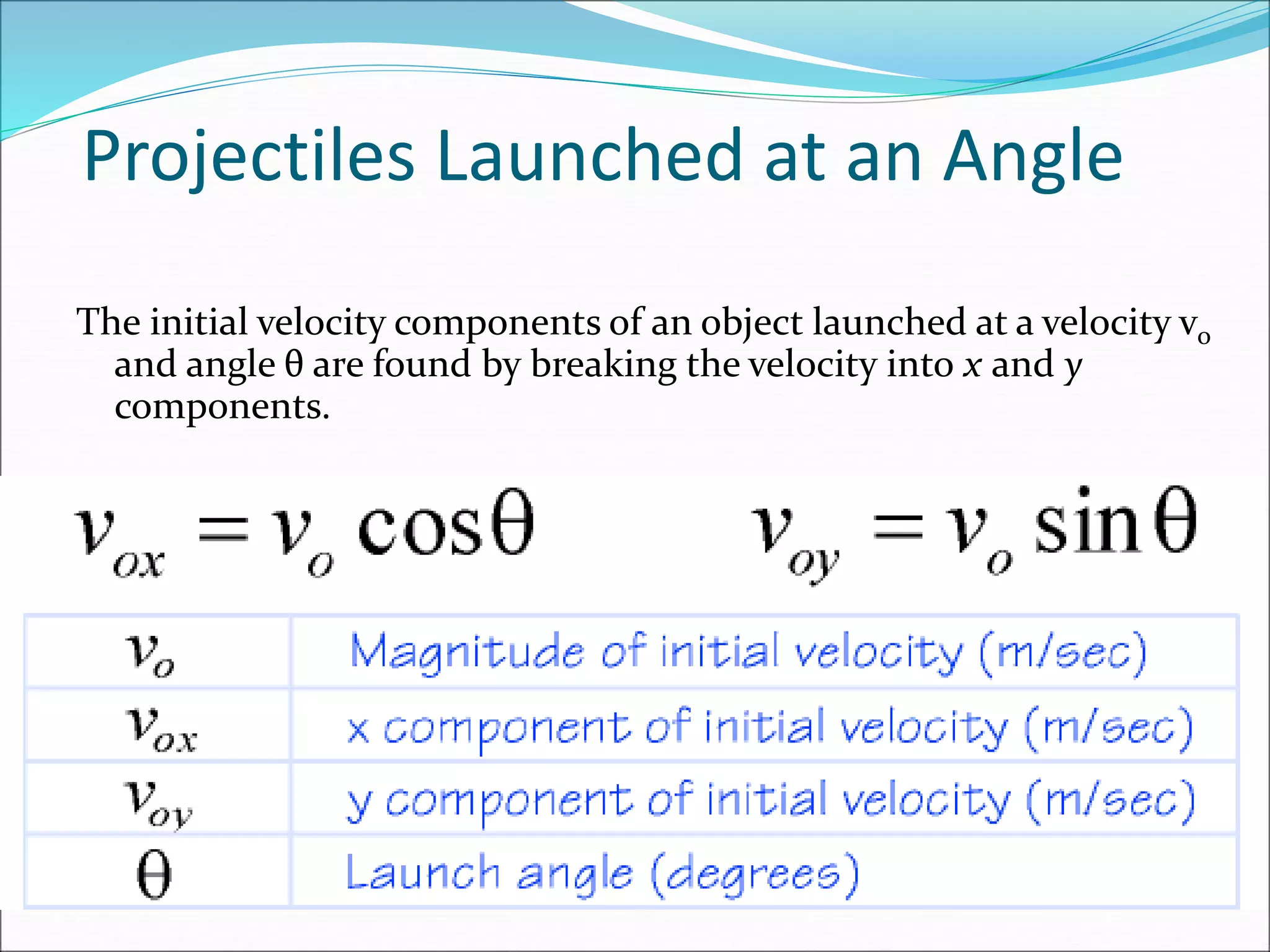
 equilibrium
 inclined plane
 polar coordinates
 scale component
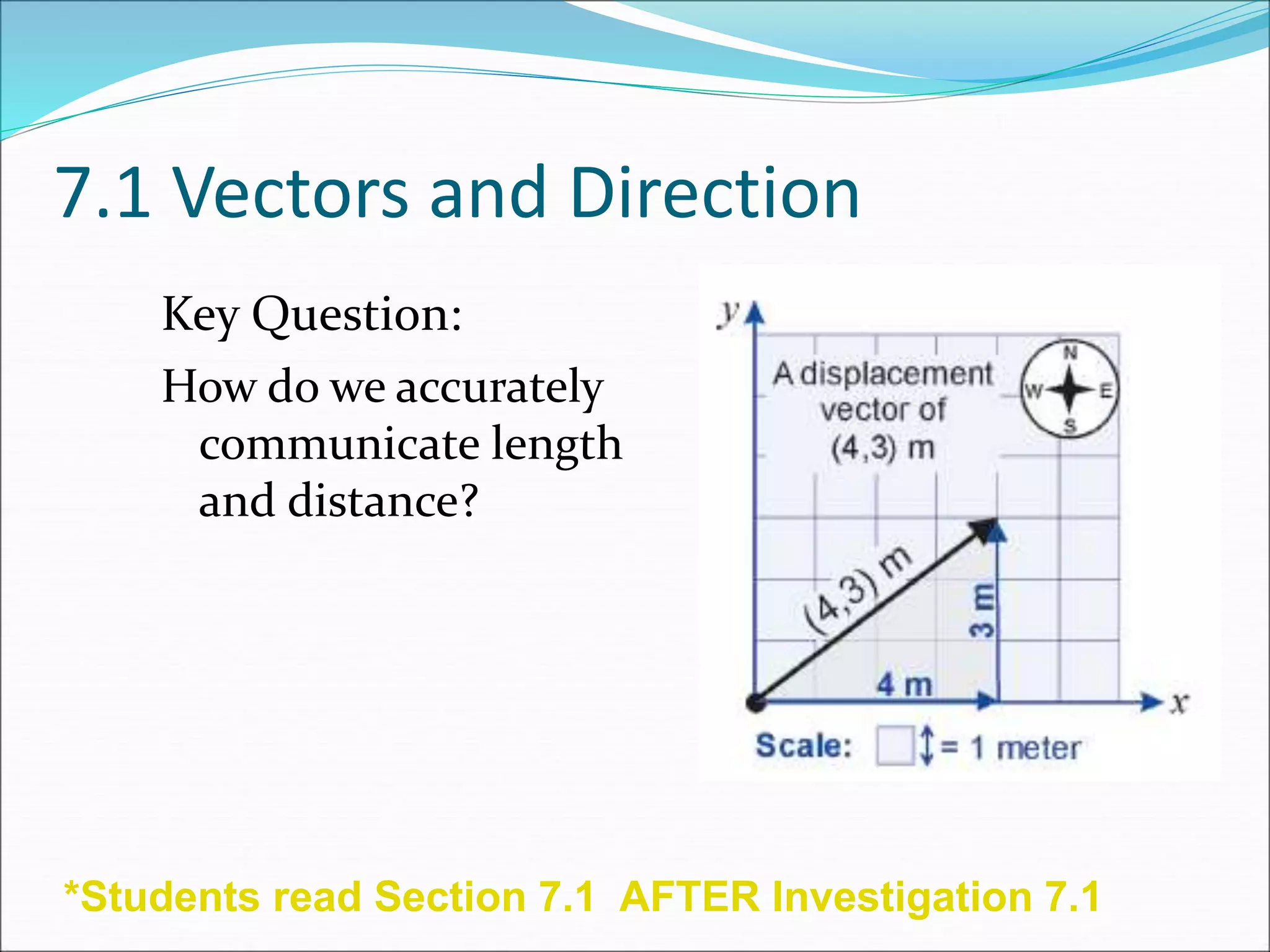
7.1 Vectors and Direction
Key Question:
How do we accurately
communicate length
and distance?
*Students read Section 7.1 AFTER Investigation 7.1
Vectors and Direction
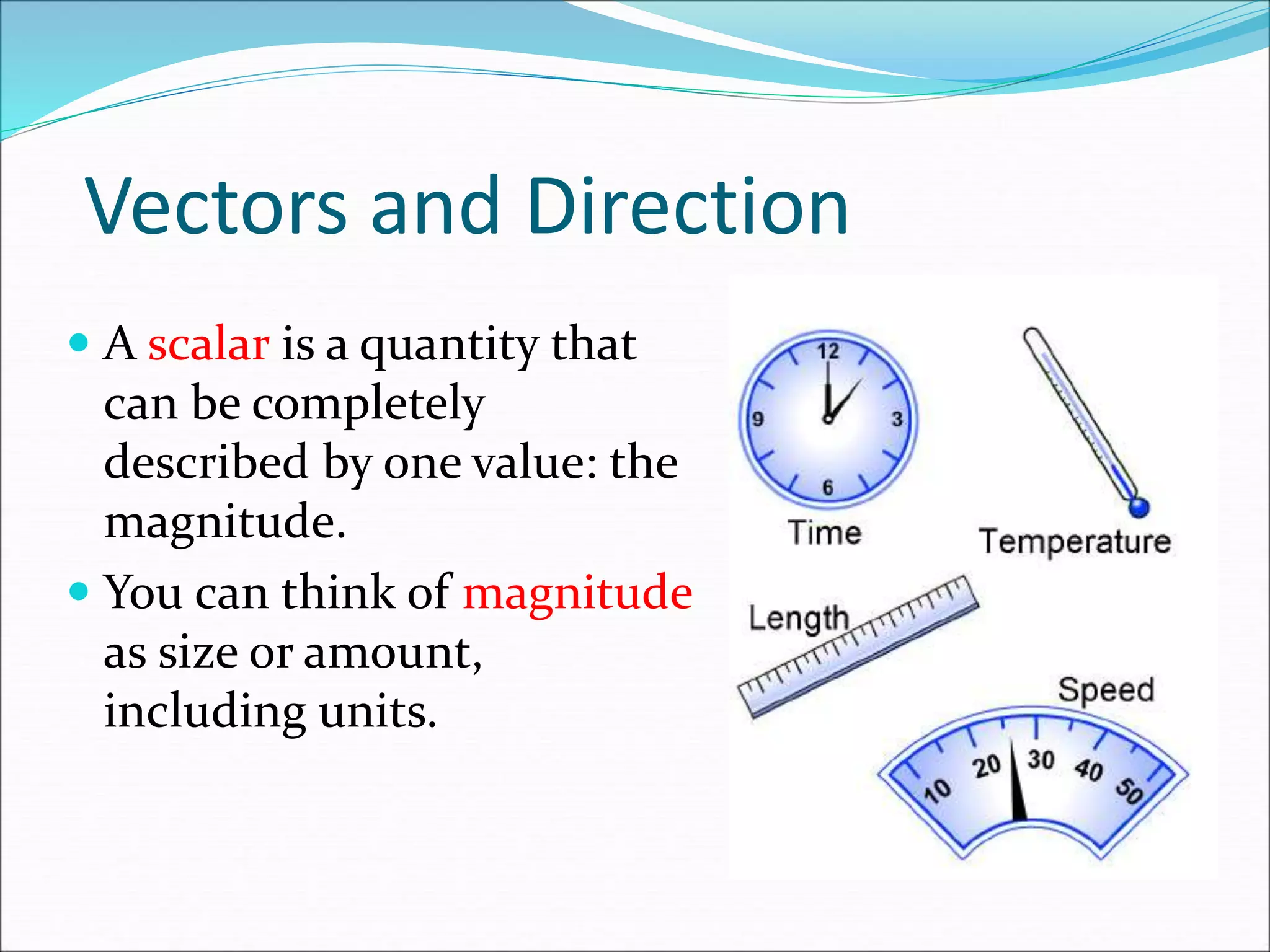
 A scalar is a quantity that
can be completely
described by one value: the
magnitude.
 You can think of magnitude
as size or amount,
including units.
Vectors and Direction
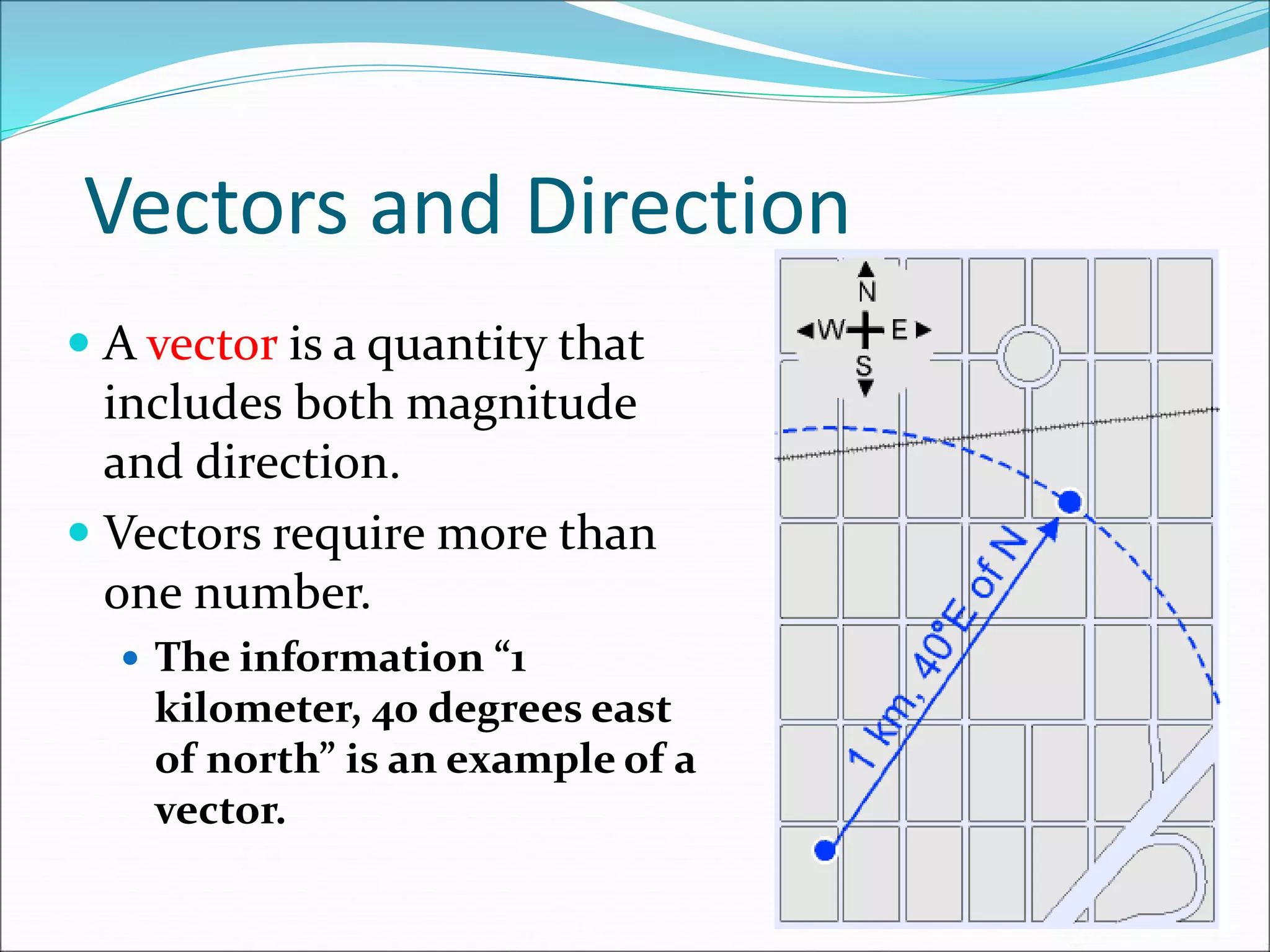
 A vector is a quantity that
includes both magnitude
and direction.
 Vectors require more than
one number.
 The information “1
kilometer, 40 degrees east
of north” is an example of a
vector.
Vectors and Direction
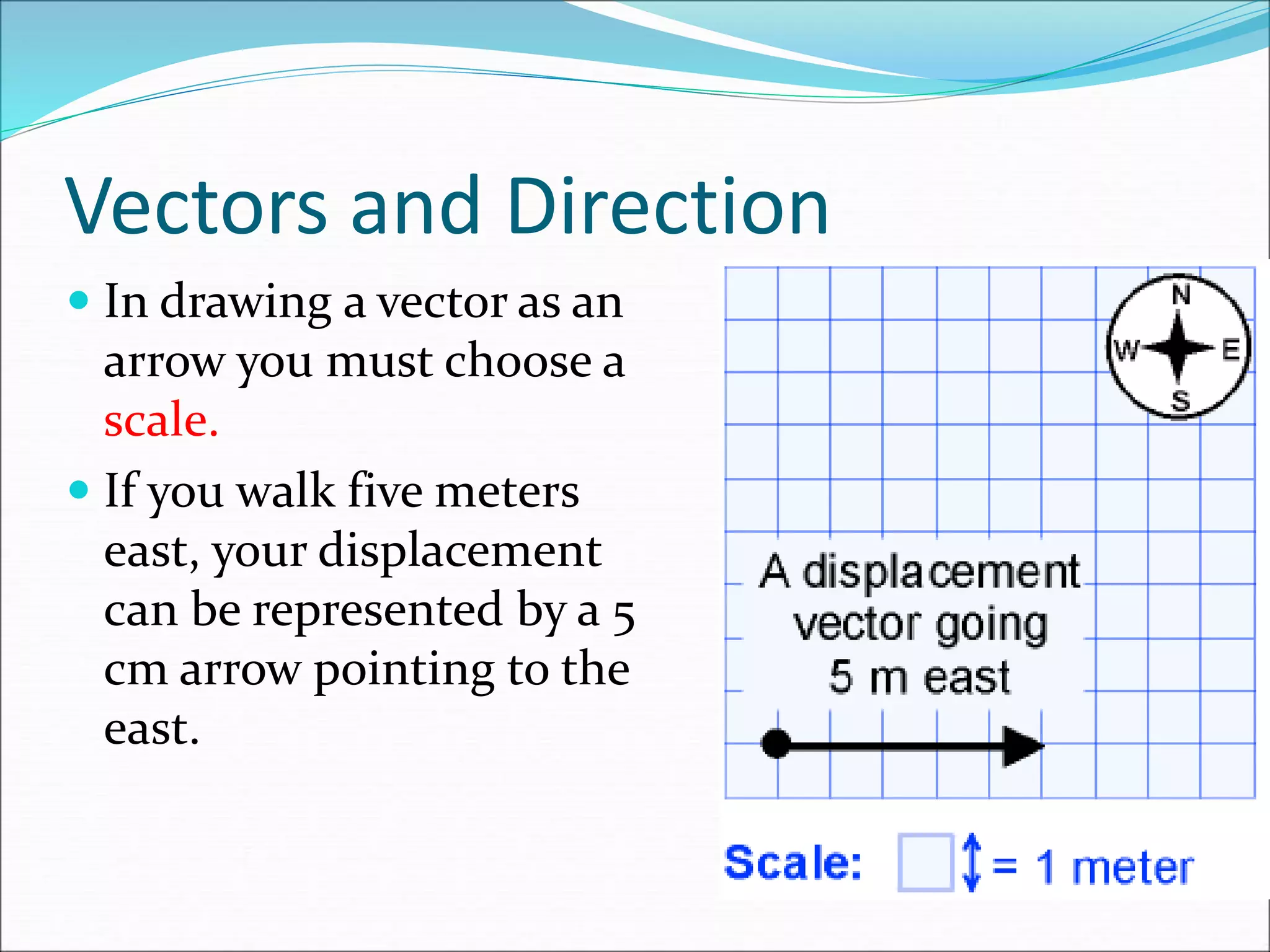
 In drawing a vector as an
arrow you must choose a
scale.
 If you walk five meters
east, your displacement
can be represented by a 5
cm arrow pointing to the
east.
Vectors and Direction
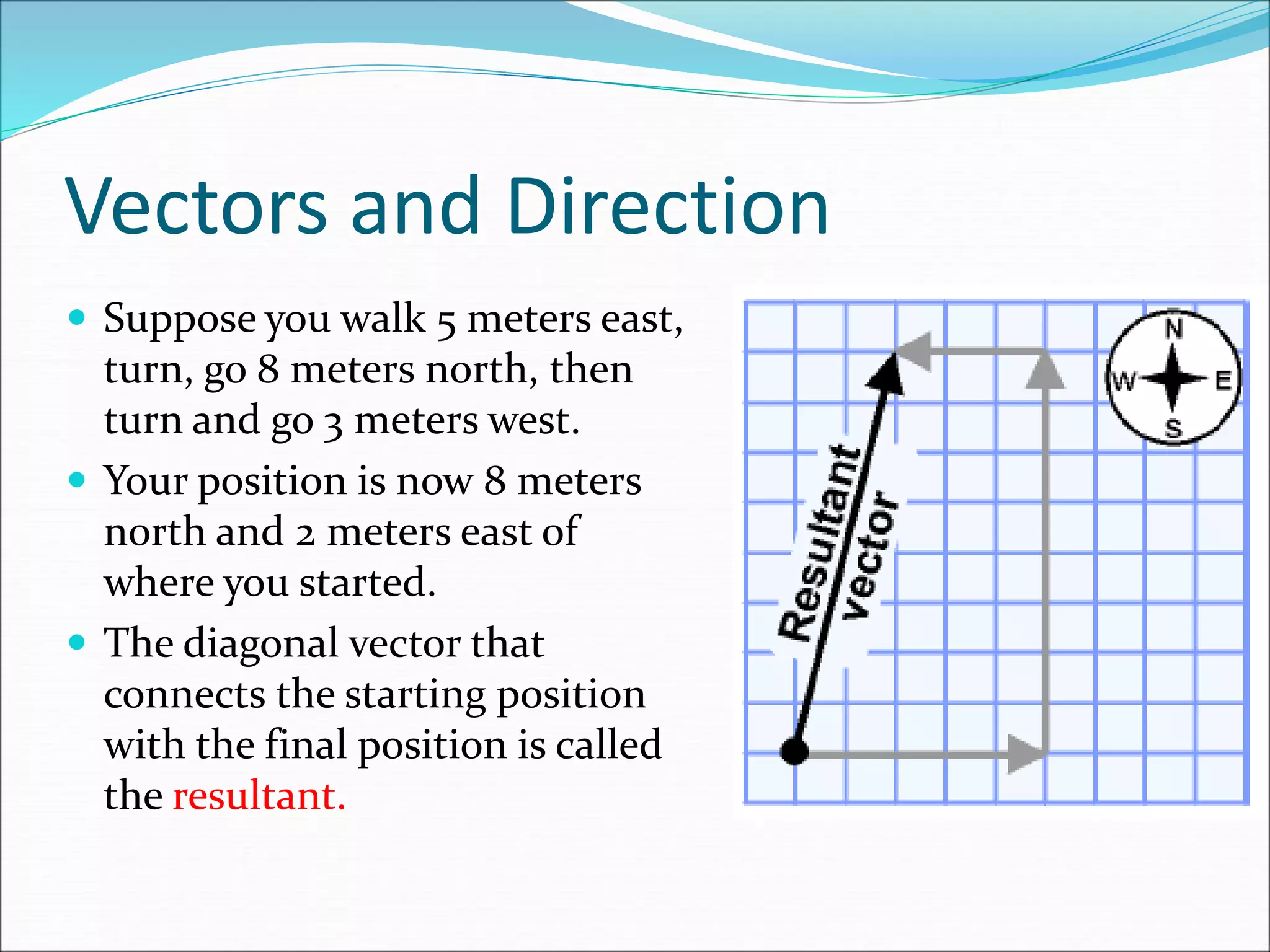
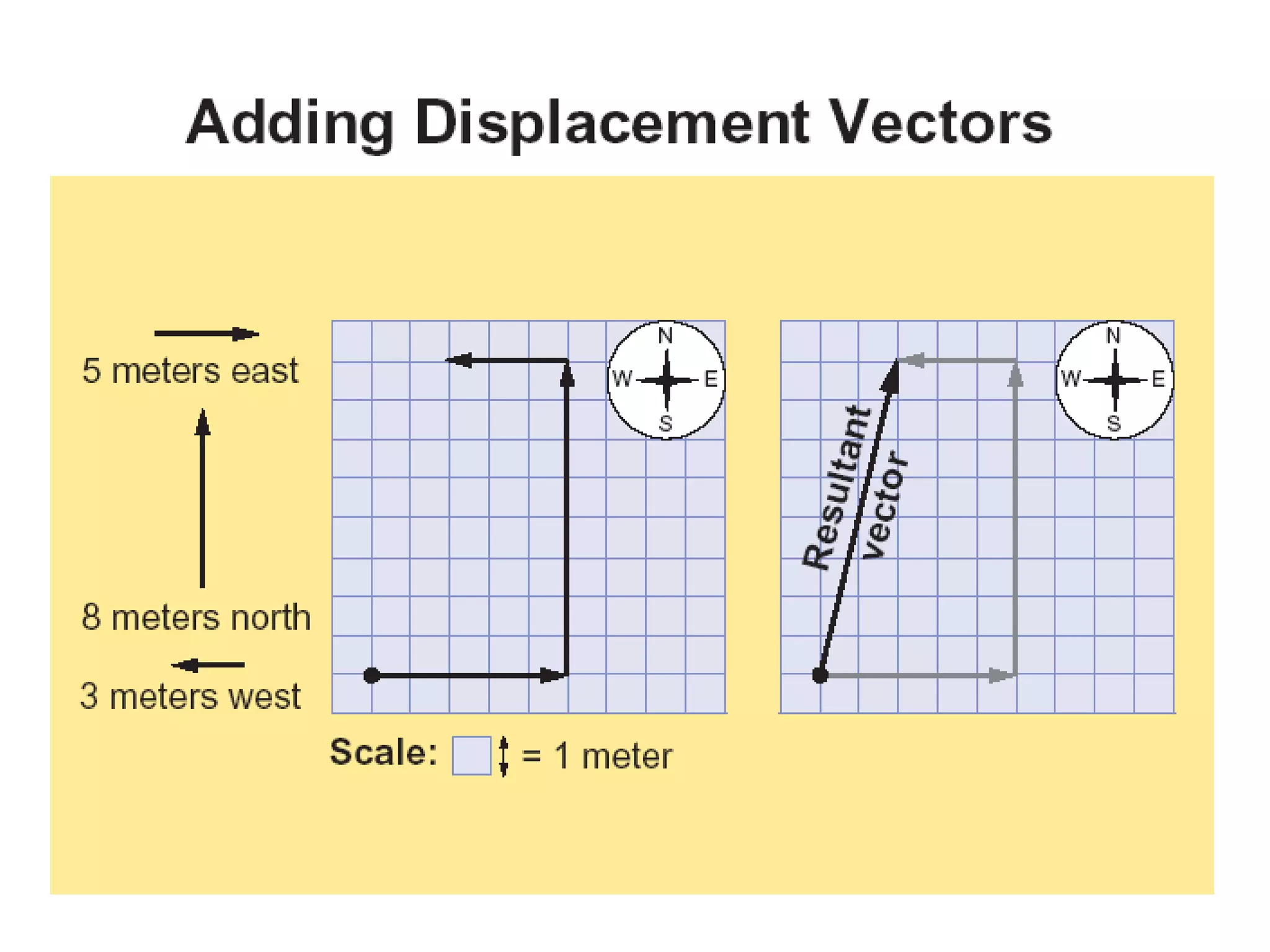
 Suppose you walk 5 meters east,
turn, go 8 meters north, then
turn and go 3 meters west.
 Your position is now 8 meters
north and 2 meters east of
where you started.
 The diagonal vector that
connects the starting position
with the final position is called
the resultant.
Vectors and Direction
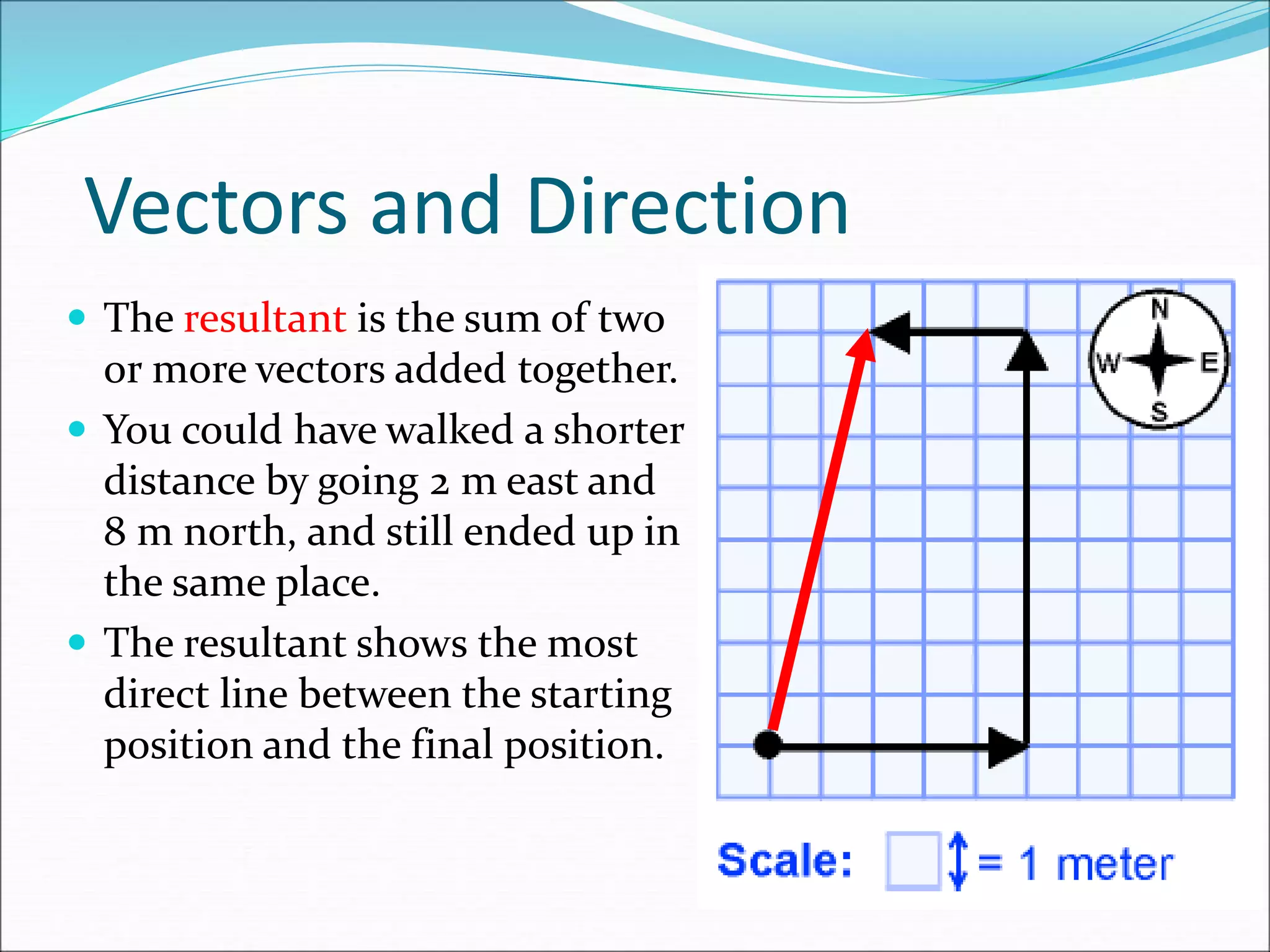
 The resultant is the sum of two
or more vectors added together.
 You could have walked a shorter
distance by going 2 m east and
8 m north, and still ended up in
the same place.
 The resultant shows the most
direct line between the starting
position and the final position.
Calculate a resultant vector
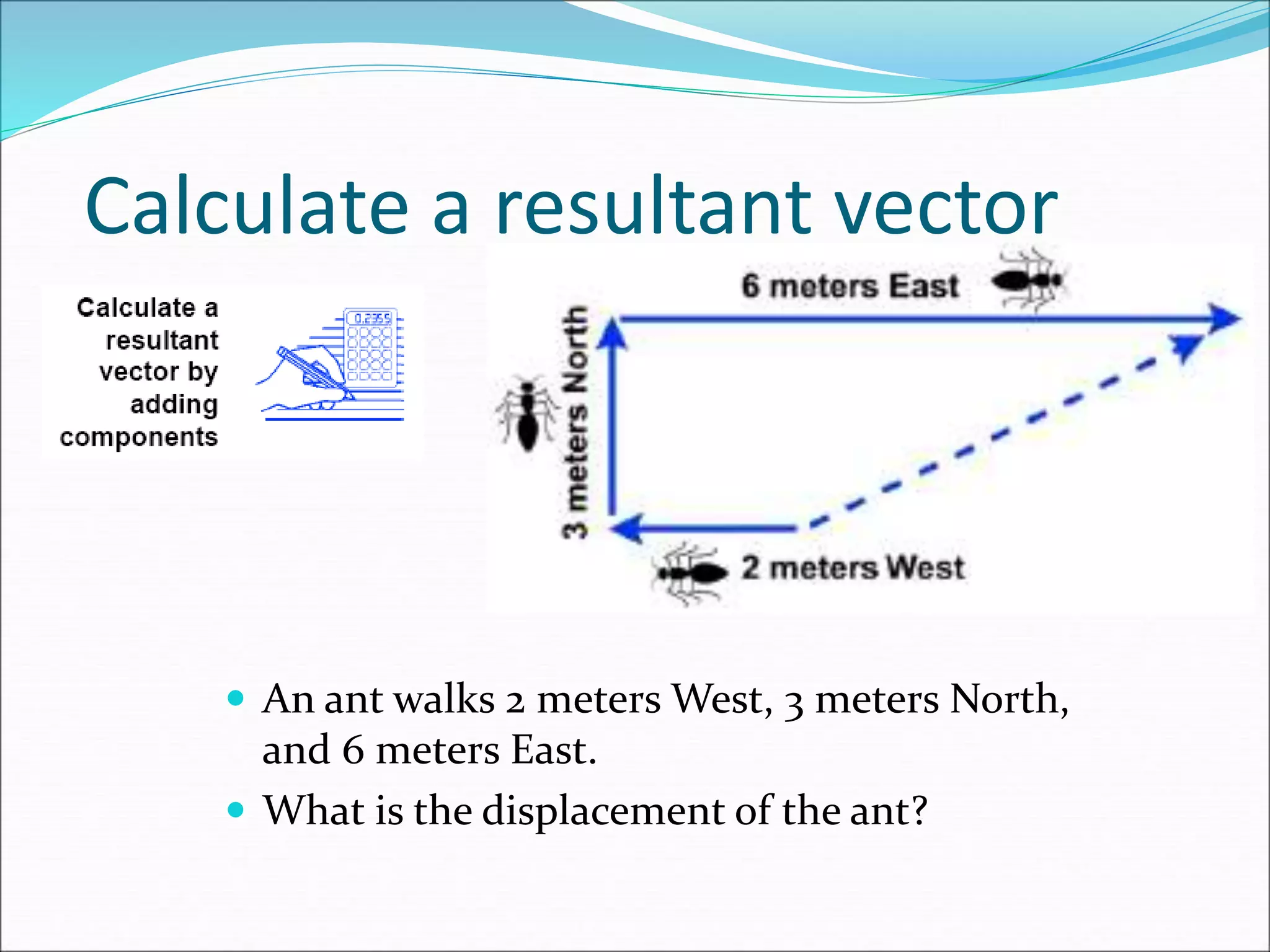
 An ant walks 2 meters West, 3 meters North,
and 6 meters East.
 What is the displacement of the ant?
Finding Vector Components
Graphically
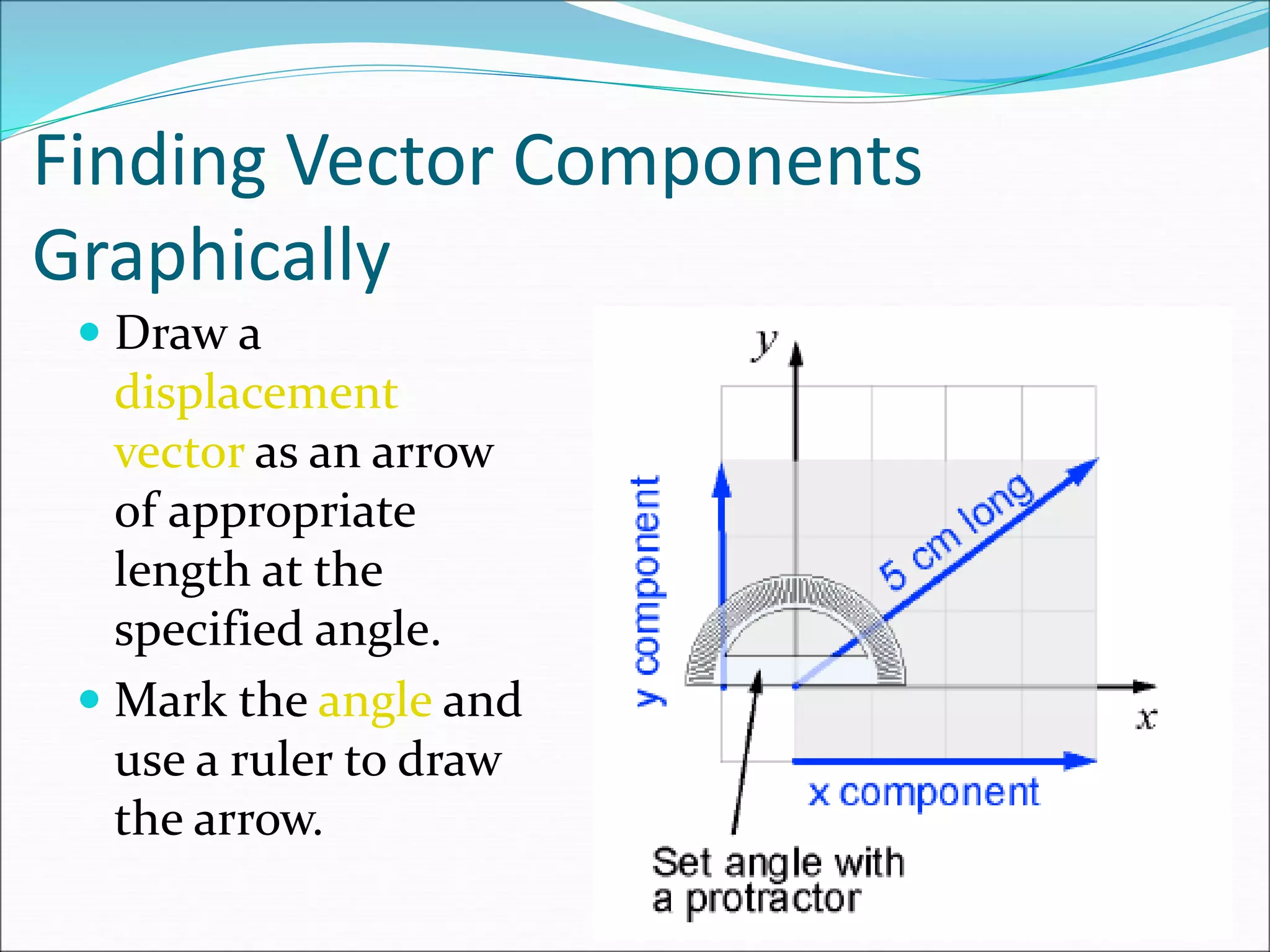
 Draw a
displacement
vector as an arrow
of appropriate
length at the
specified angle.
 Mark the angle and
use a ruler to draw
the arrow.
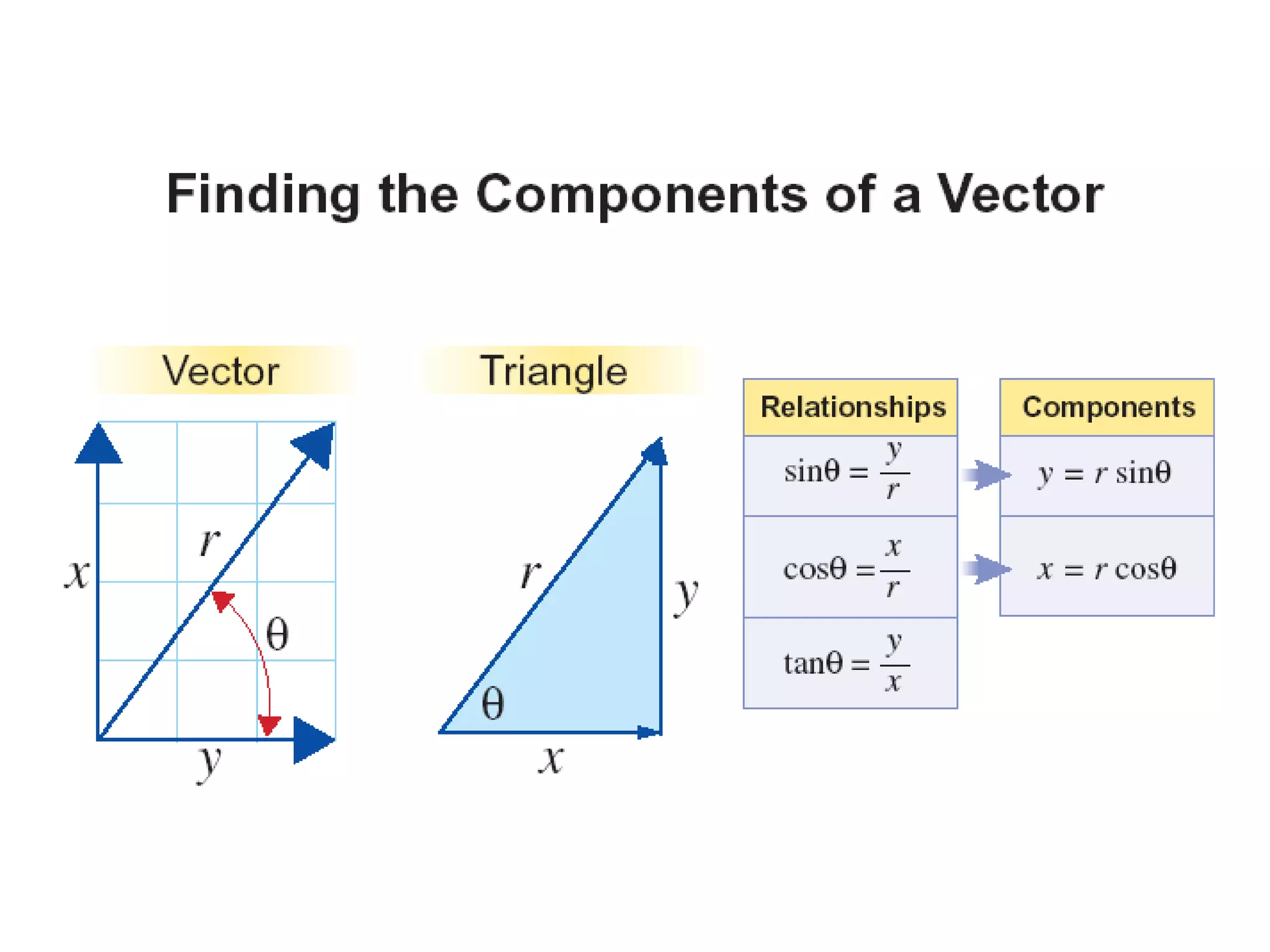
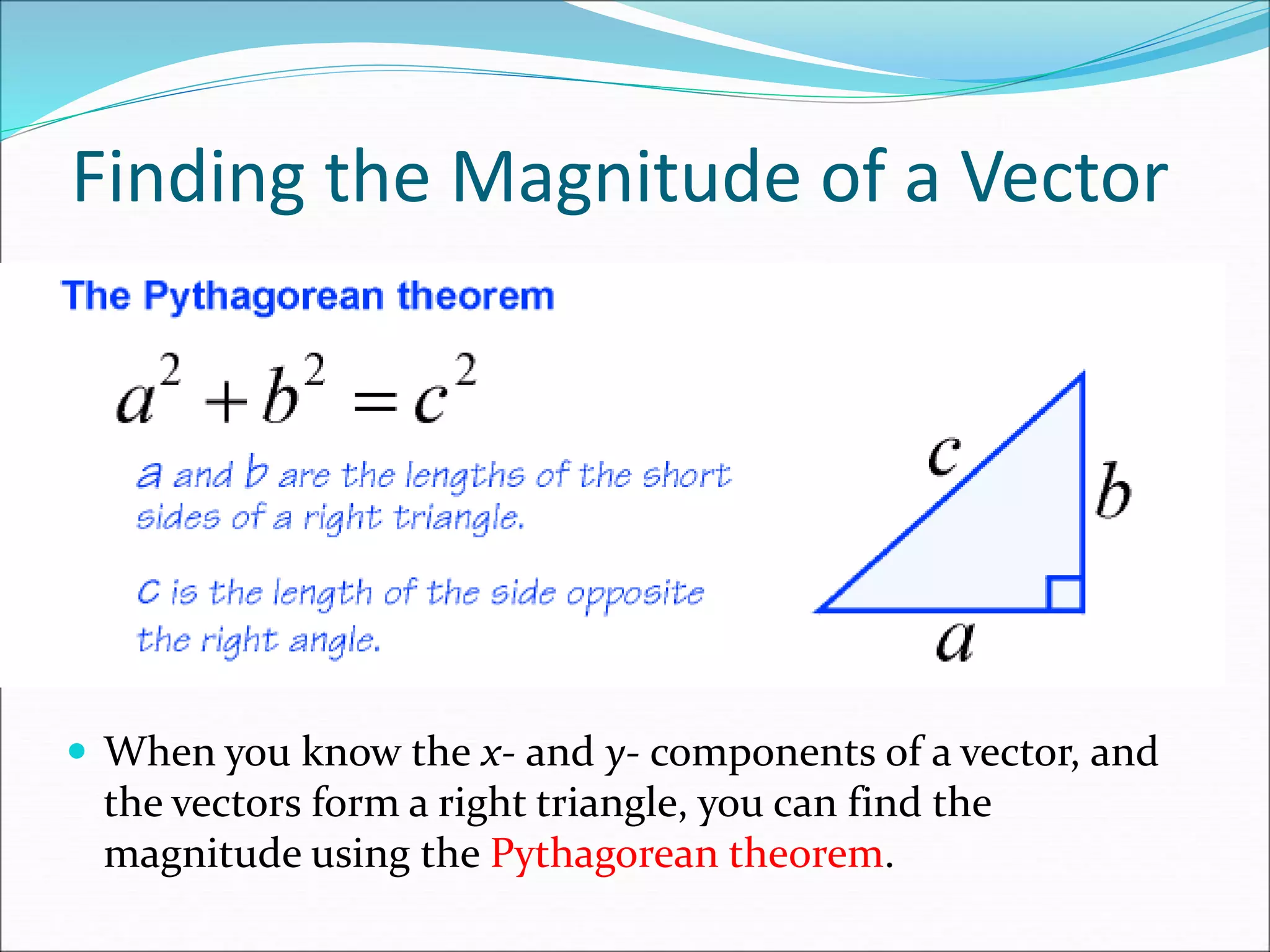
Finding the Magnitude of a Vector
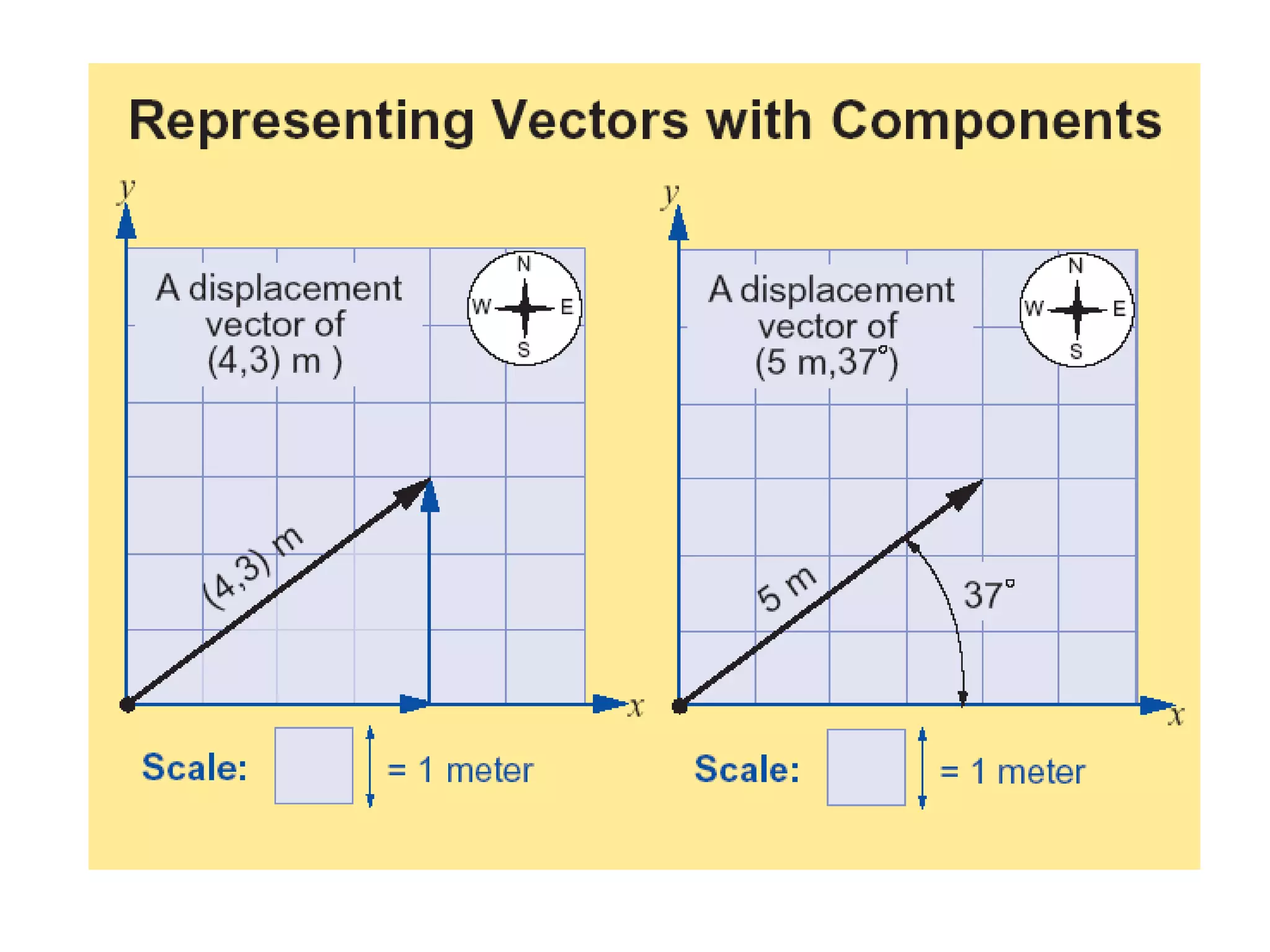
 When you know the x- and y- components of a vector, and
the vectors form a right triangle, you can find the
magnitude using the Pythagorean theorem.
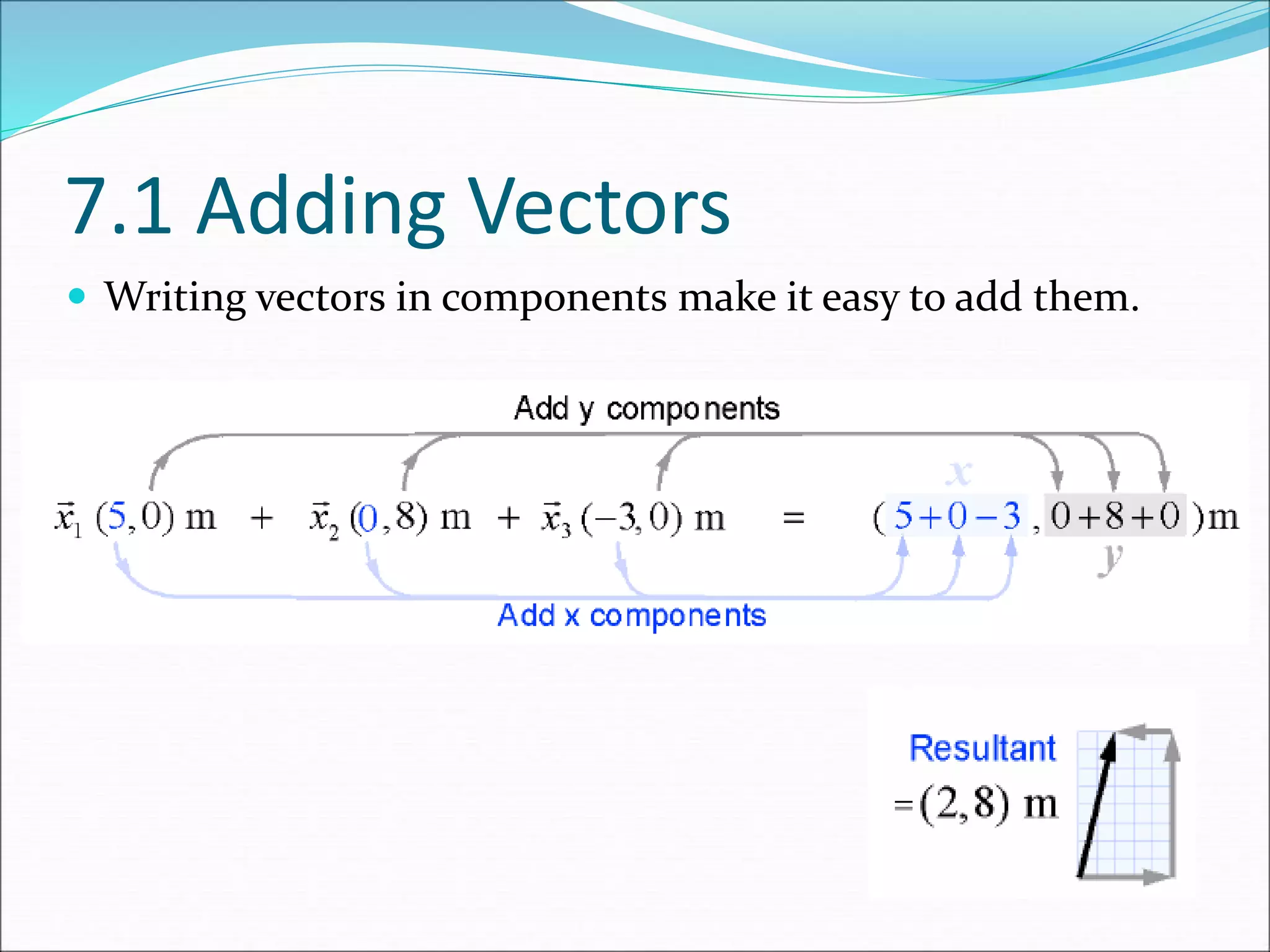
7.1 Adding Vectors
 Writing vectors in components make it easy to add them.
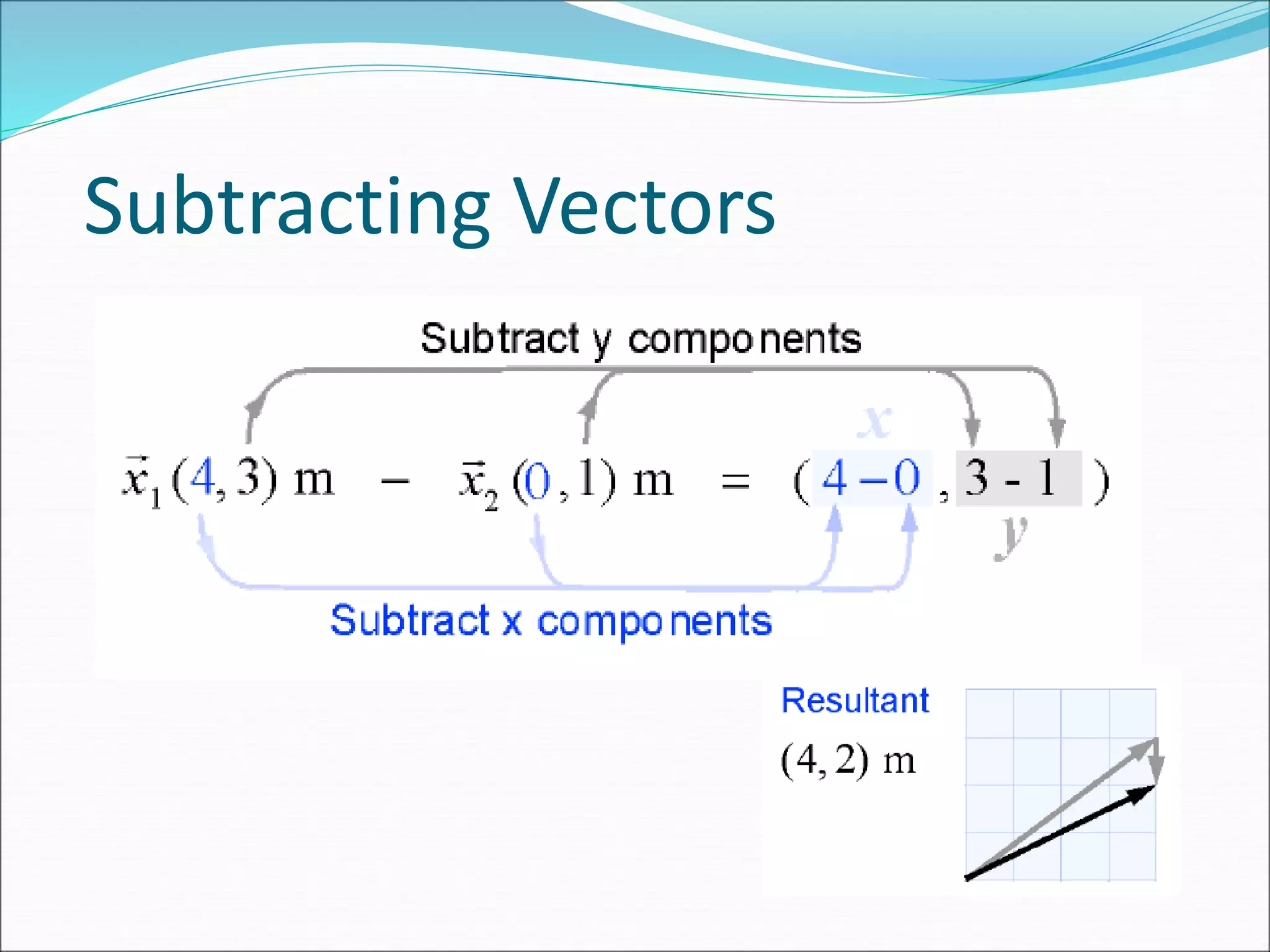
Subtracting Vectors
Calculate vector magnitude
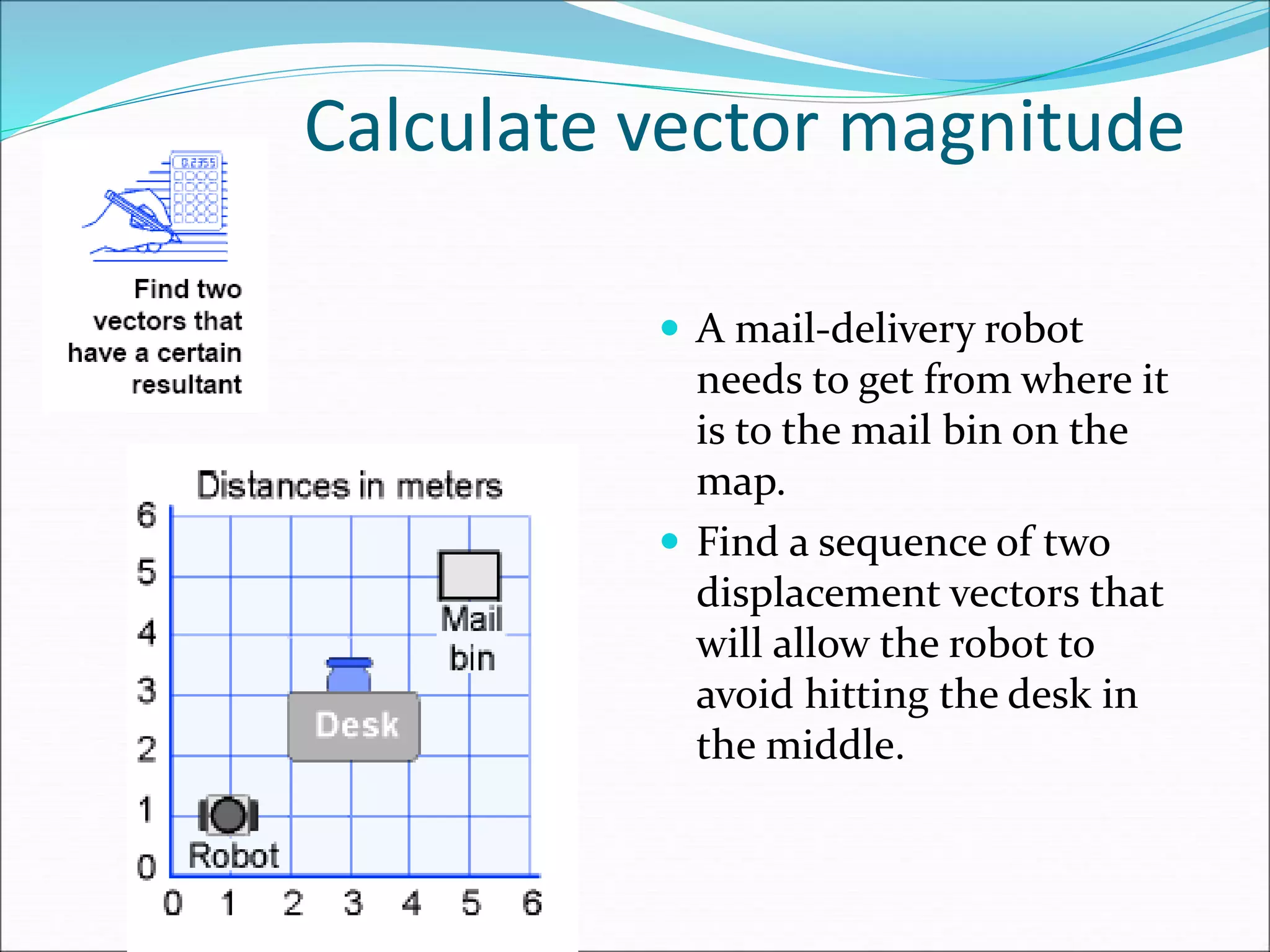
 A mail-delivery robot
needs to get from where it
is to the mail bin on the
map.
 Find a sequence of two
displacement vectors that
will allow the robot to
avoid hitting the desk in
the middle.
Projectile Motion and the Velocity
Vector
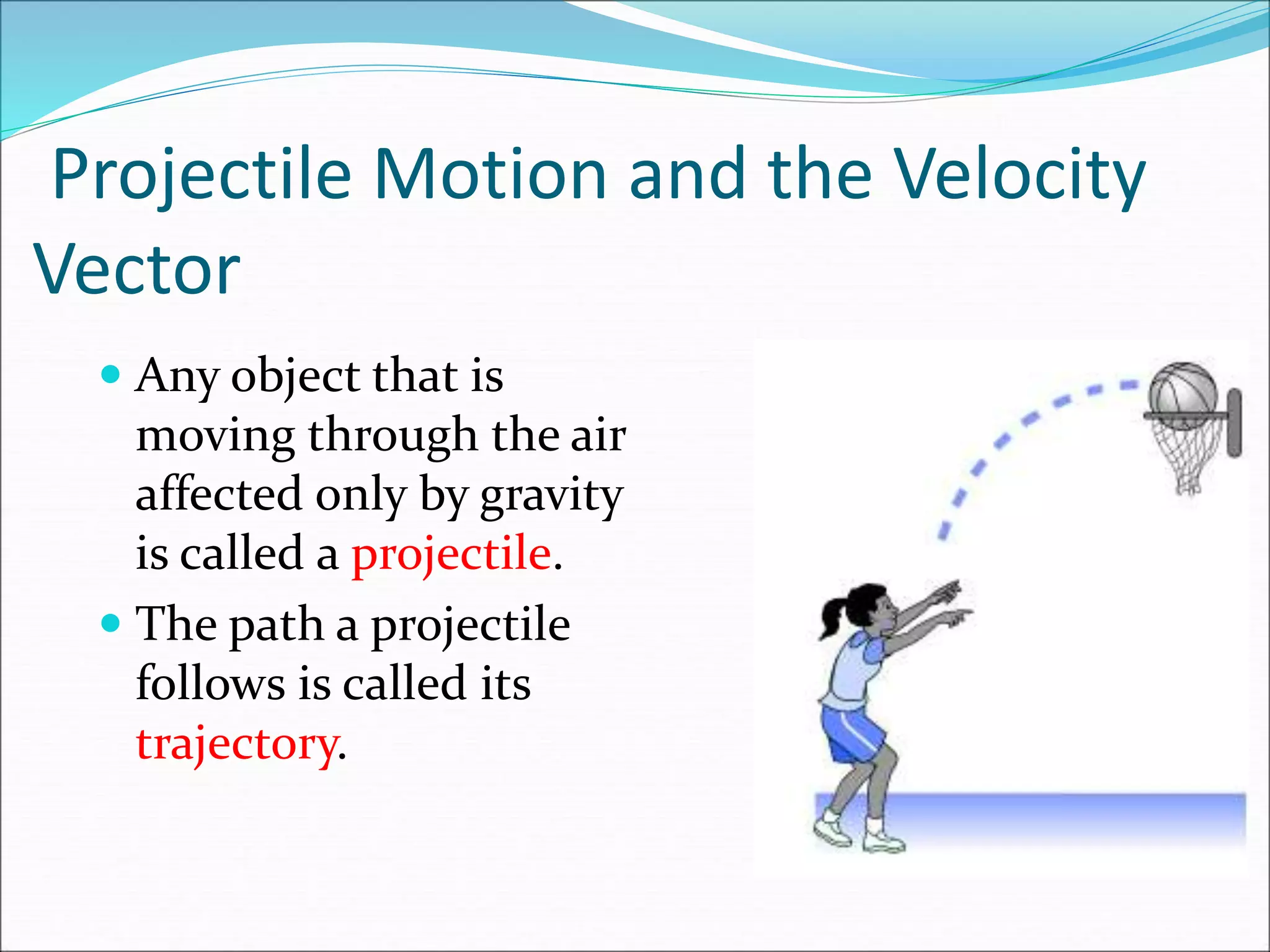
 Any object that is
moving through the air
affected only by gravity
is called a projectile.
 The path a projectile
follows is called its
trajectory.
Projectile Motion and the Velocity
Vector
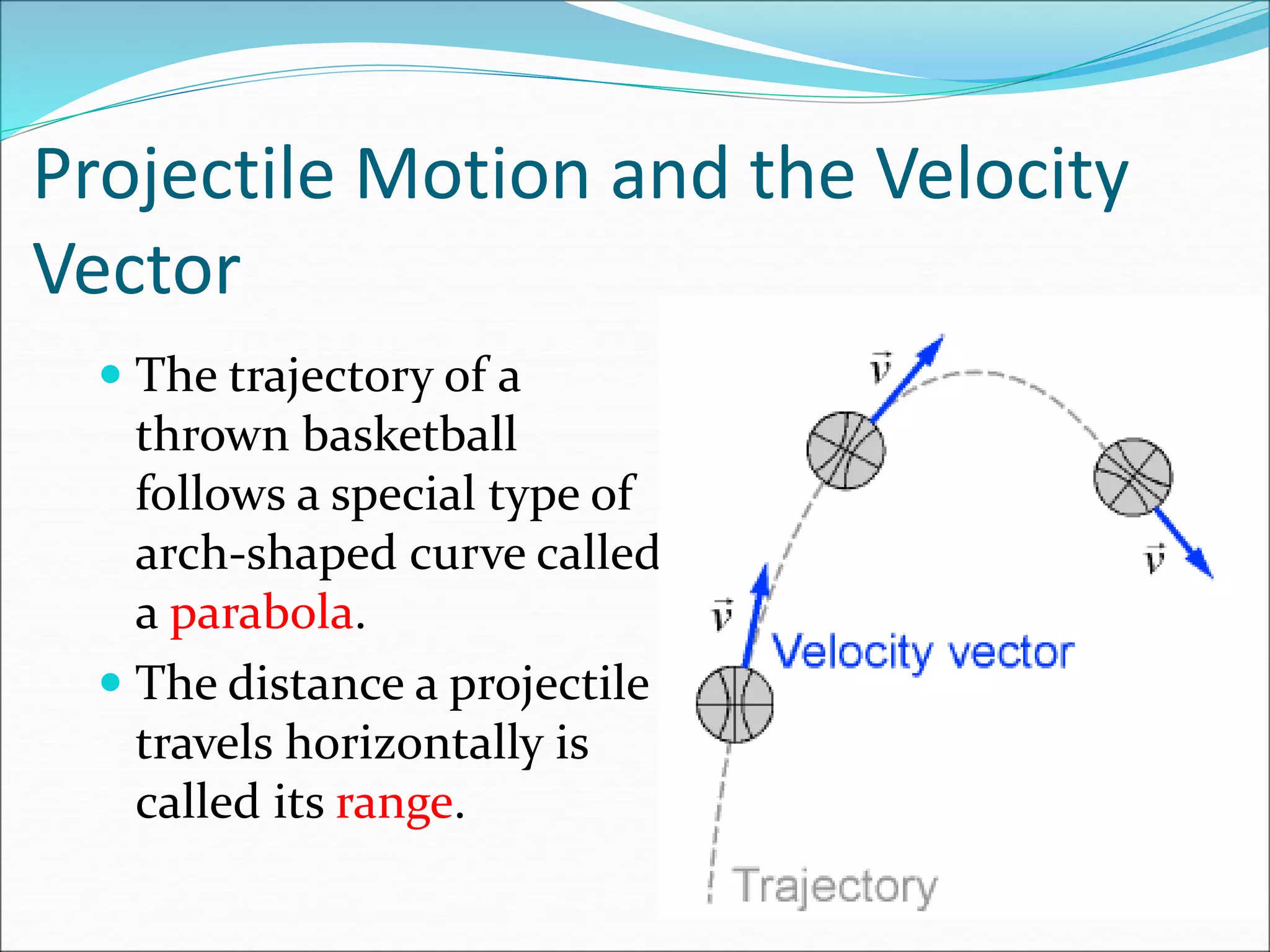
 The trajectory of a
thrown basketball
follows a special type of
arch-shaped curve called
a parabola.
 The distance a projectile
travels horizontally is
called its range.
Projectile Motion and the Velocity
Vector
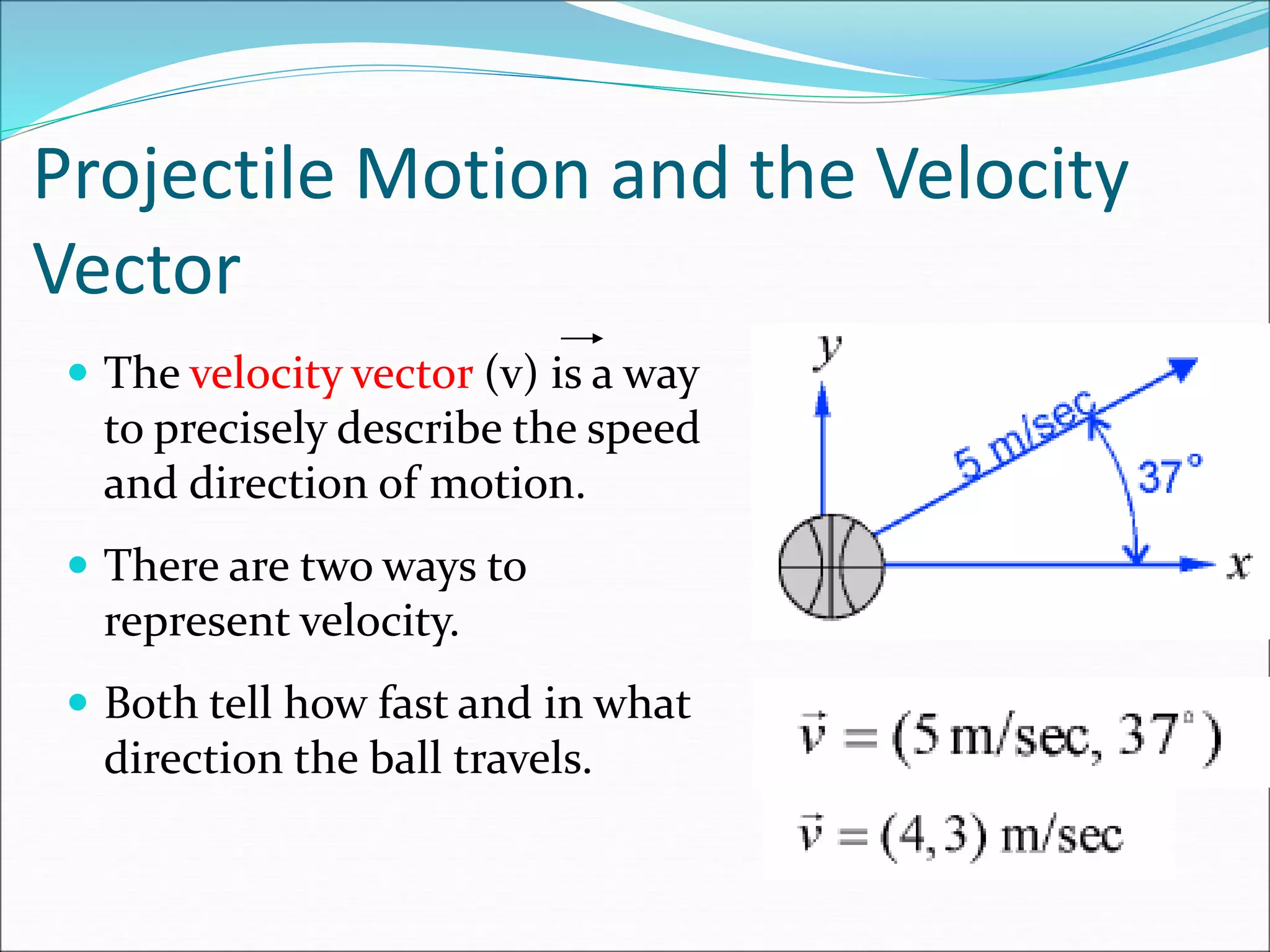
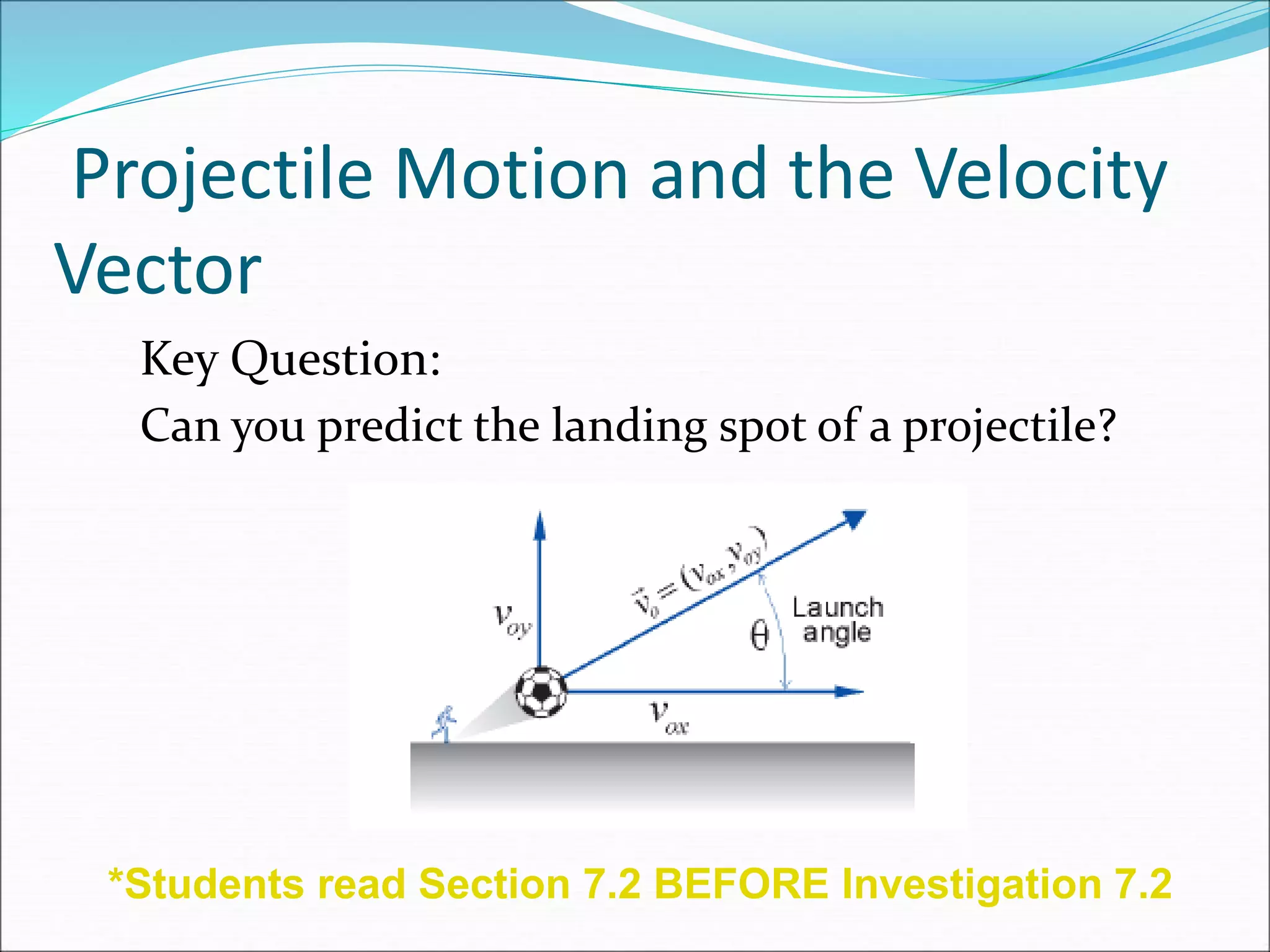
 The velocity vector (v) is a way
to precisely describe the speed
and direction of motion.
 There are two ways to
represent velocity.
 Both tell how fast and in what
direction the ball travels.
Calculate magnitude
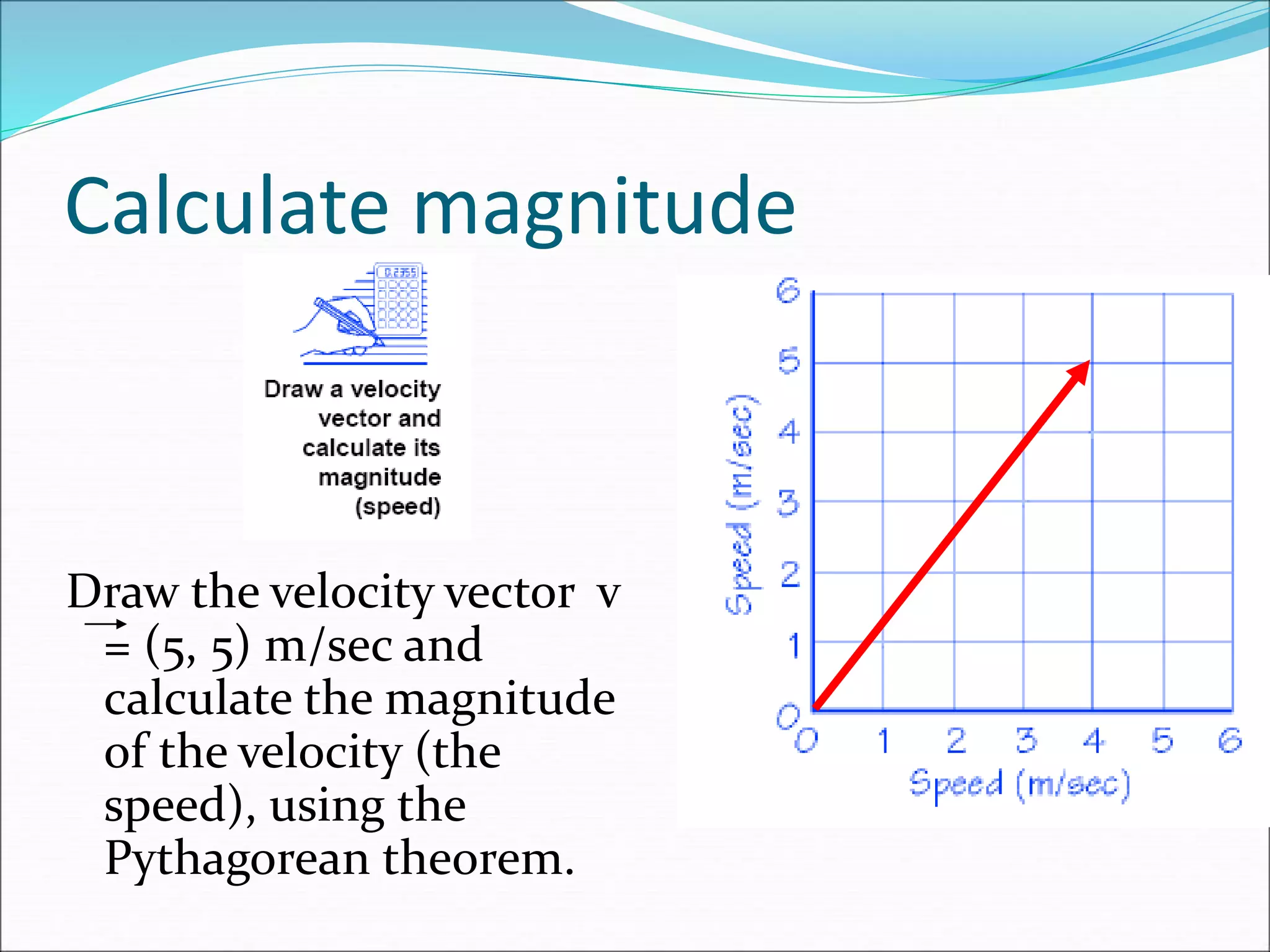
Draw the velocity vector v
= (5, 5) m/sec and
calculate the magnitude
of the velocity (the
speed), using the
Pythagorean theorem.
Components of the Velocity Vector
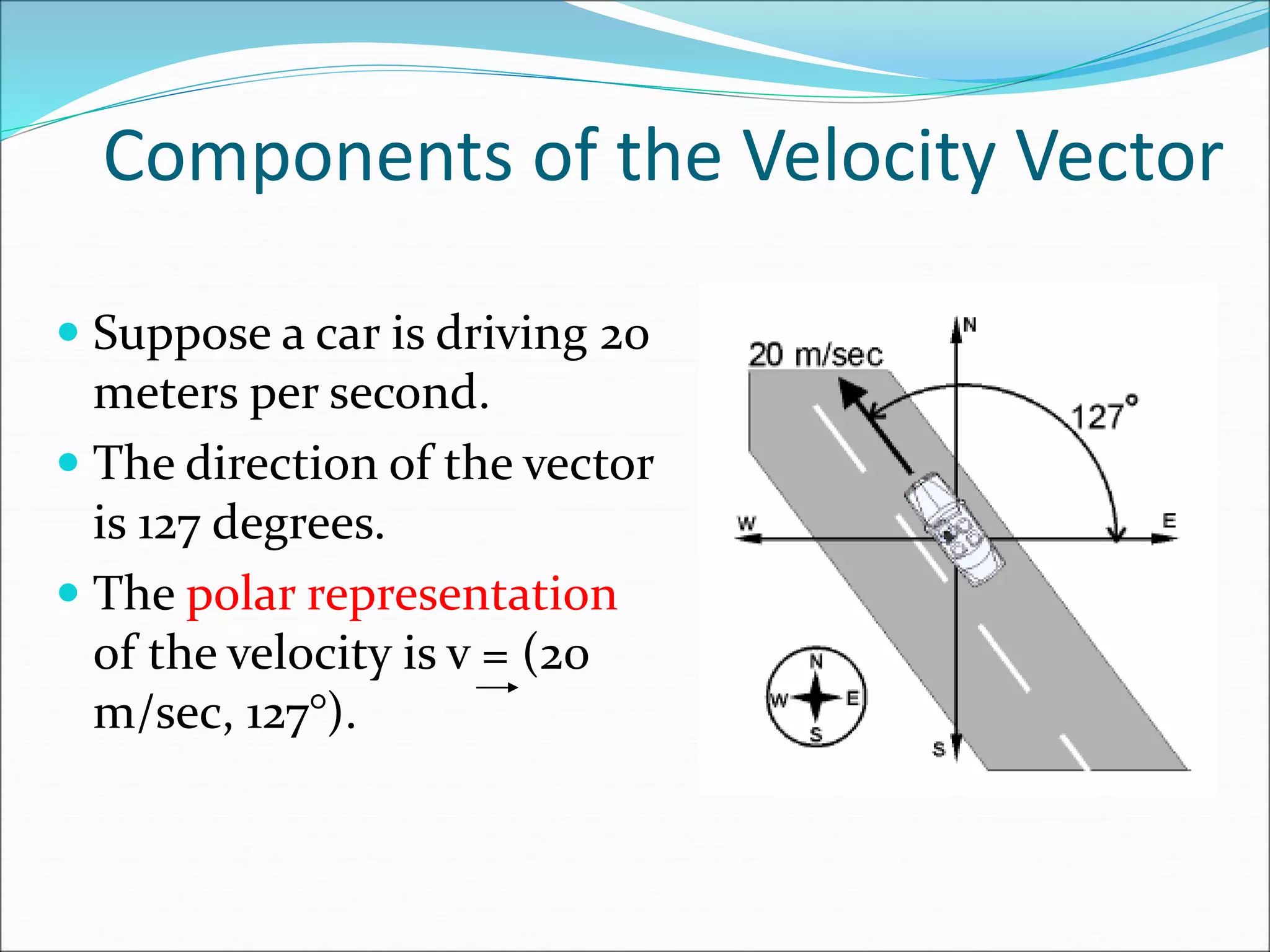
 Suppose a car is driving 20
meters per second.
 The direction of the vector
is 127 degrees.
 The polar representation
of the velocity is v = (20
m/sec, 127°).
Calculate velocity
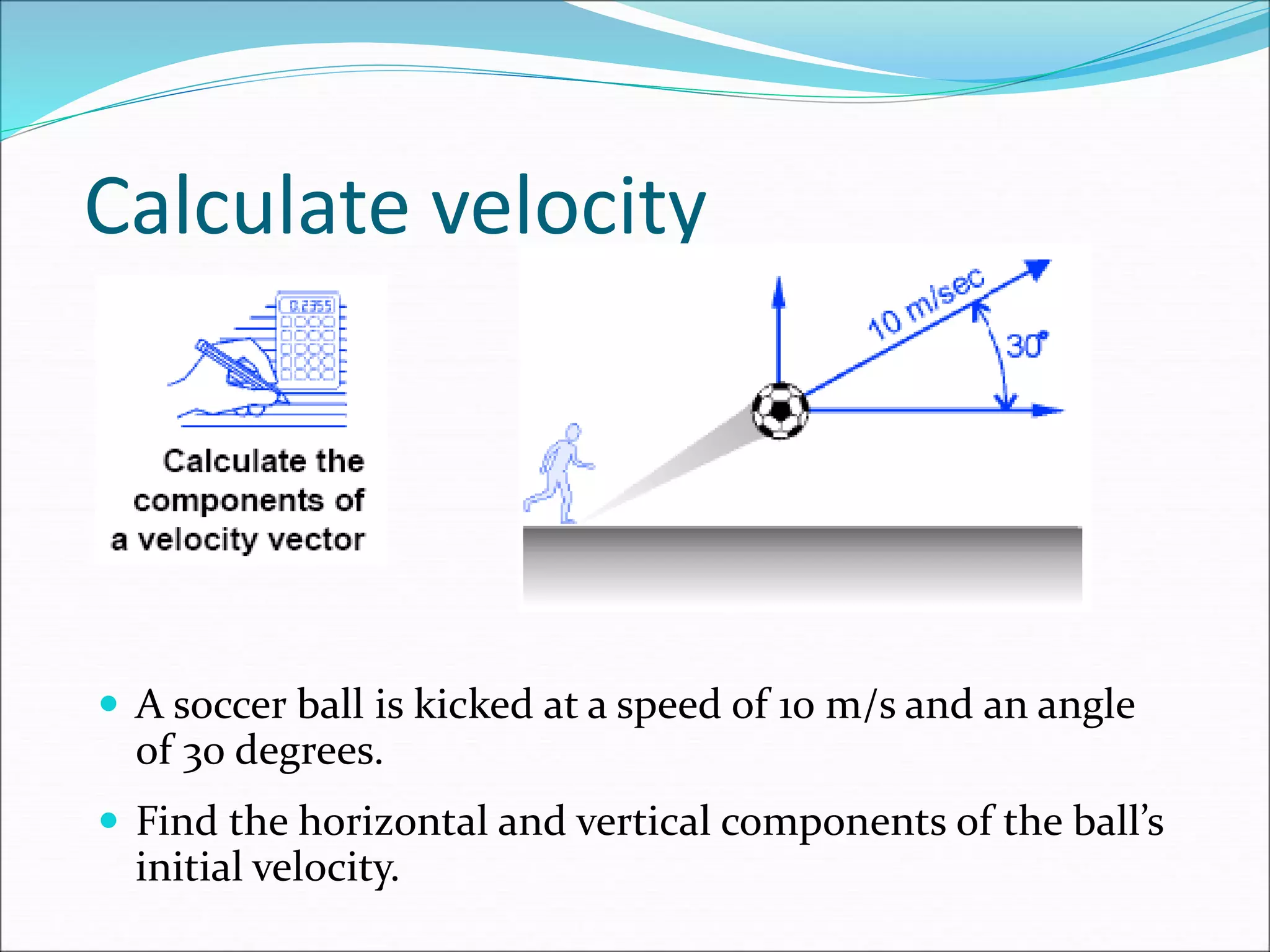
 A soccer ball is kicked at a speed of 10 m/s and an angle
of 30 degrees.
 Find the horizontal and vertical components of the ball’s
initial velocity.
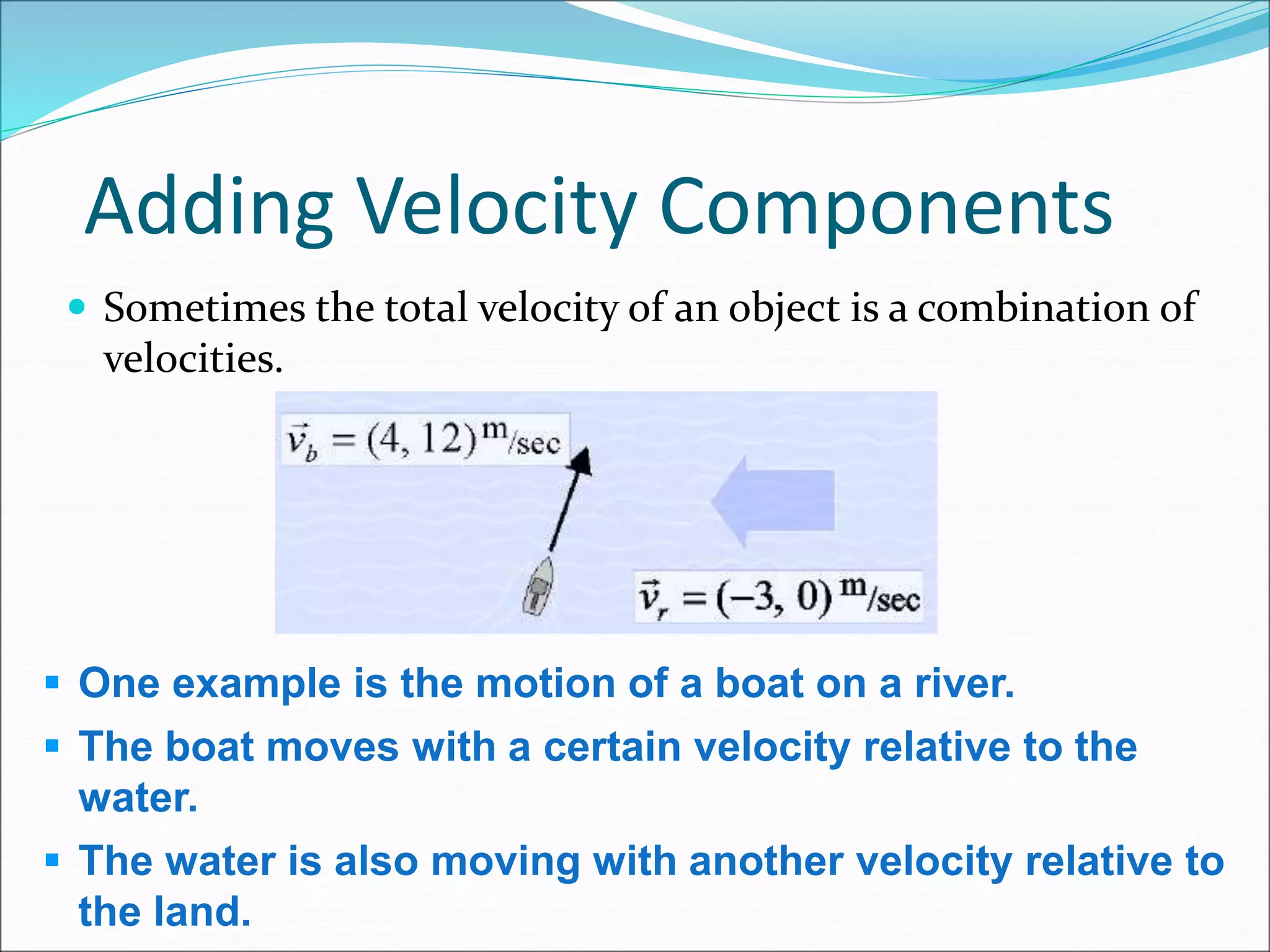
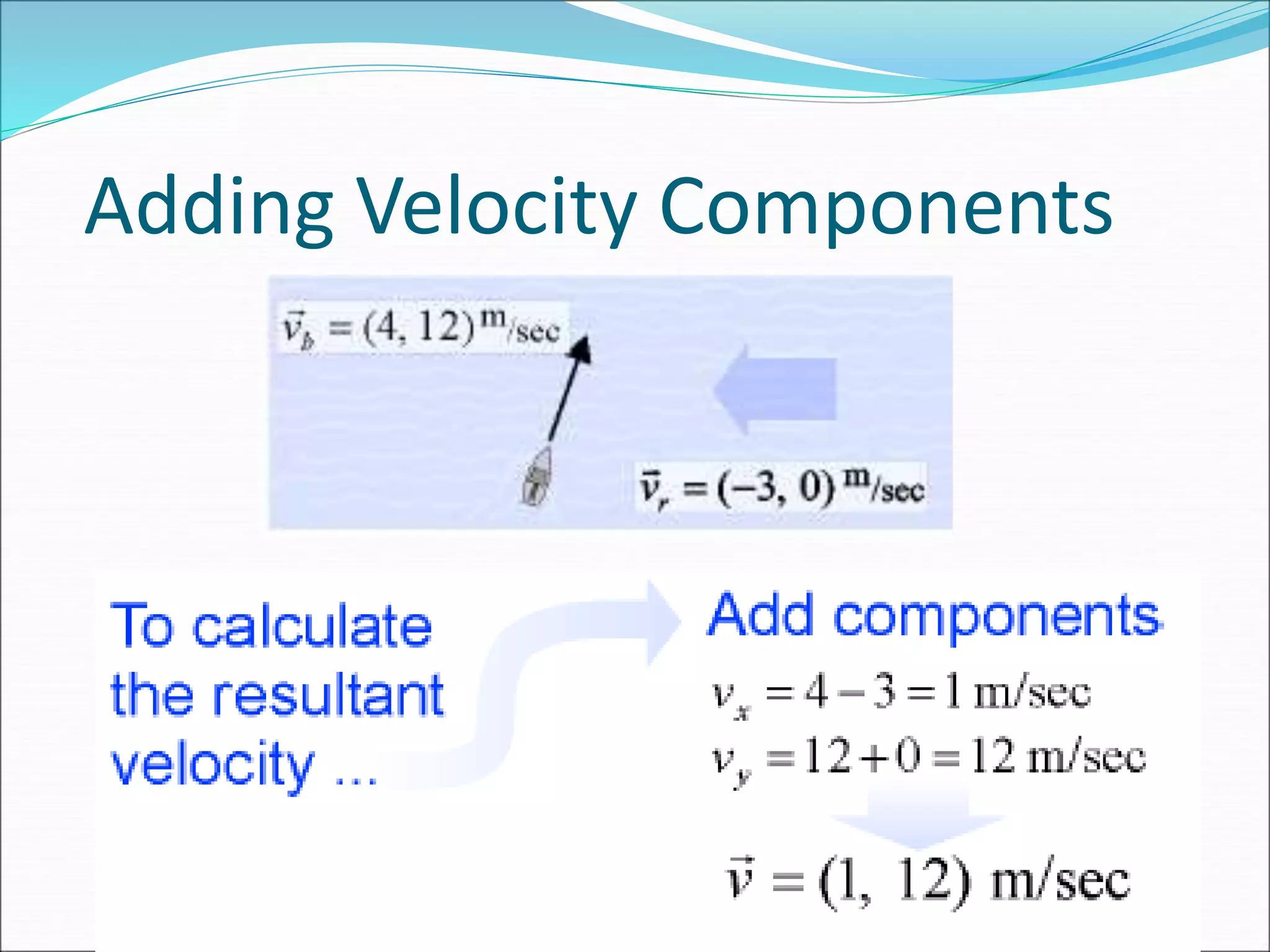
Adding Velocity Components
 Sometimes the total velocity of an object is a combination of
velocities.
 One example is the motion of a boat on a river.
 The boat moves with a certain velocity relative to the
water.
 The water is also moving with another velocity relative to
the land.
Adding Velocity Components
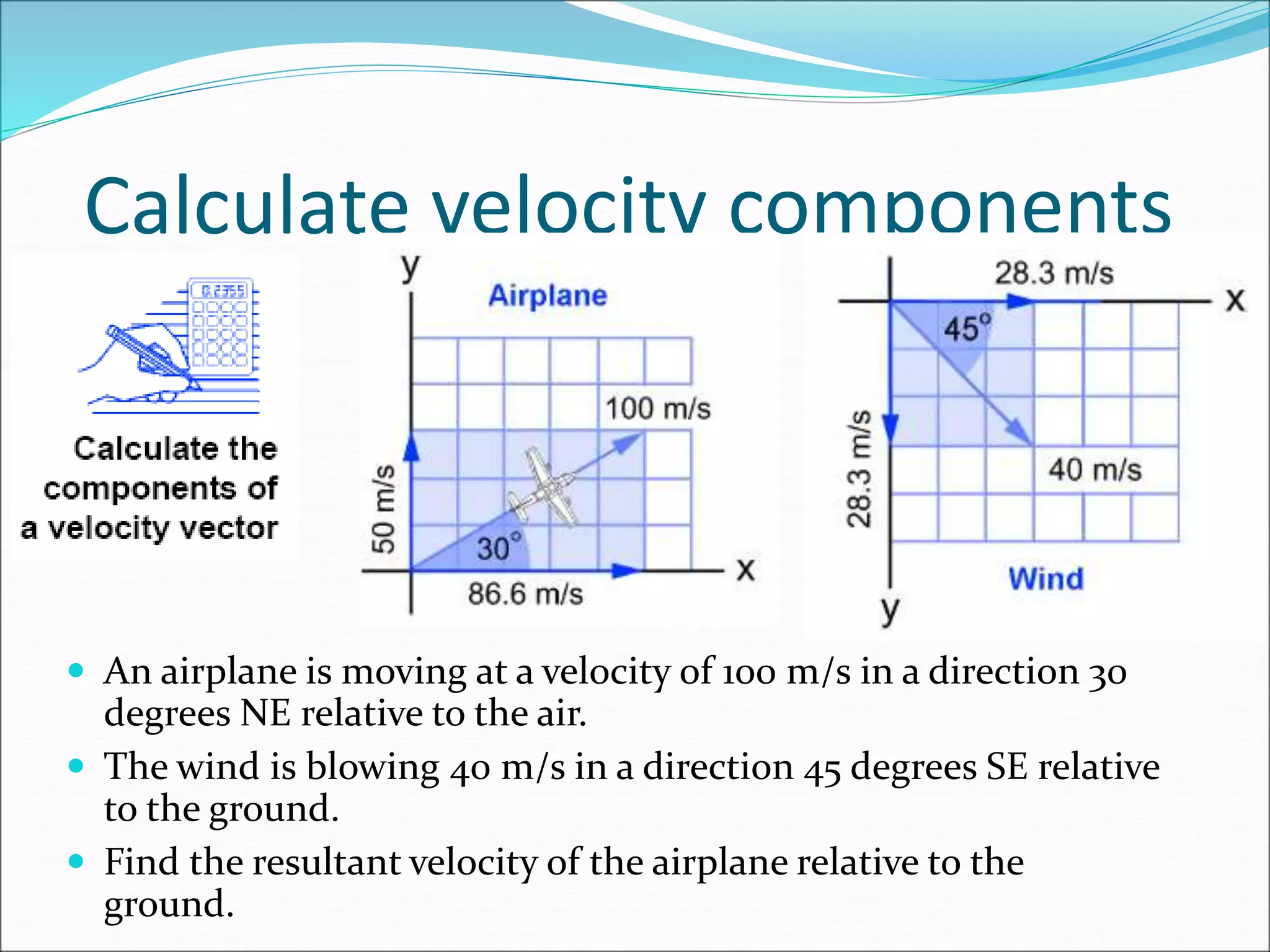
Calculate velocity components
 An airplane is moving at a velocity of 100 m/s in a direction 30
degrees NE relative to the air.
 The wind is blowing 40 m/s in a direction 45 degrees SE relative
to the ground.
 Find the resultant velocity of the airplane relative to the
ground.
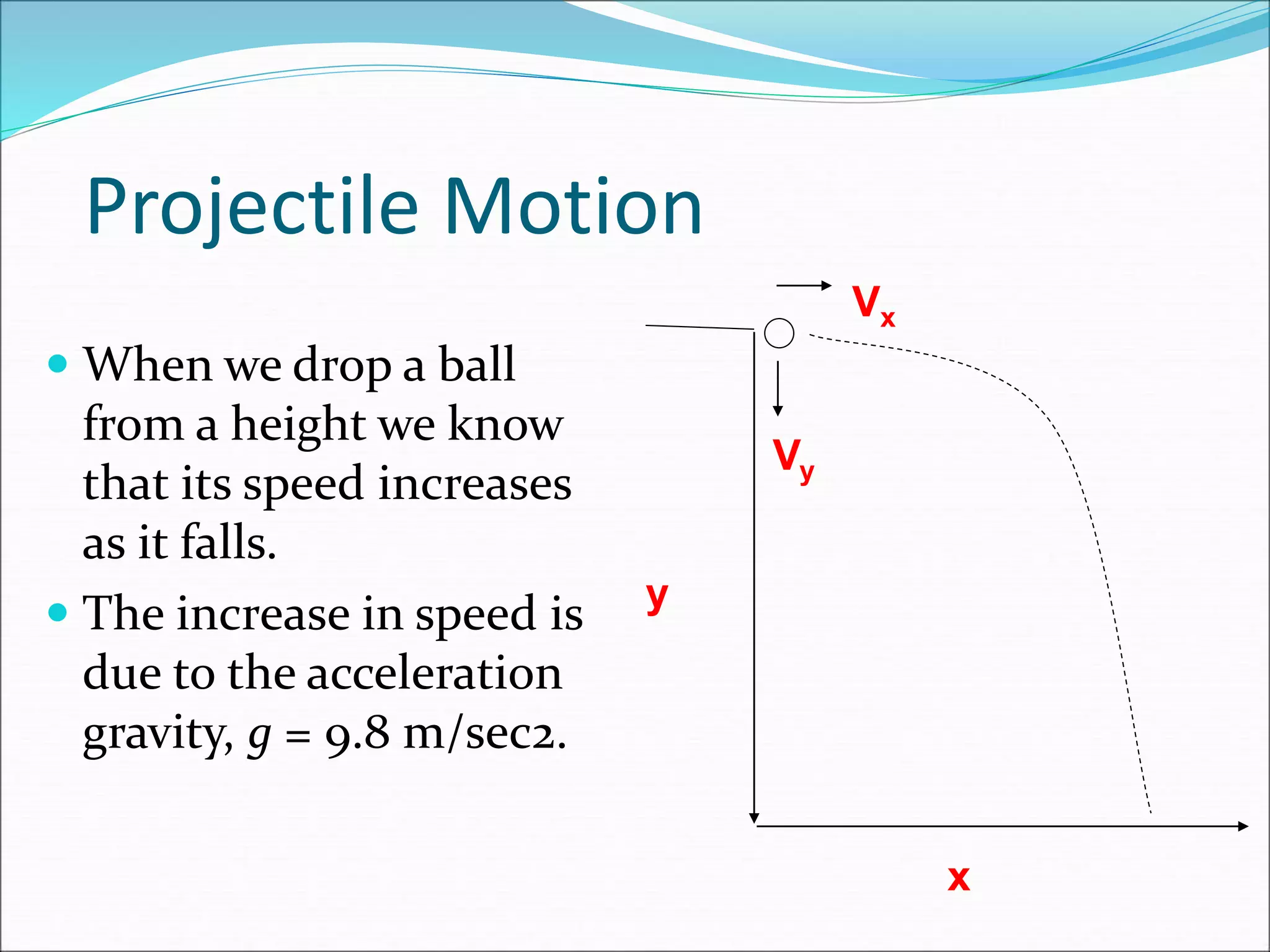
Projectile Motion
 When we drop a ball
from a height we know
that its speed increases
as it falls.
 The increase in speed is
due to the acceleration
gravity, g = 9.8 m/sec2.
Vx
Vy
x
y
Horizontal Speed
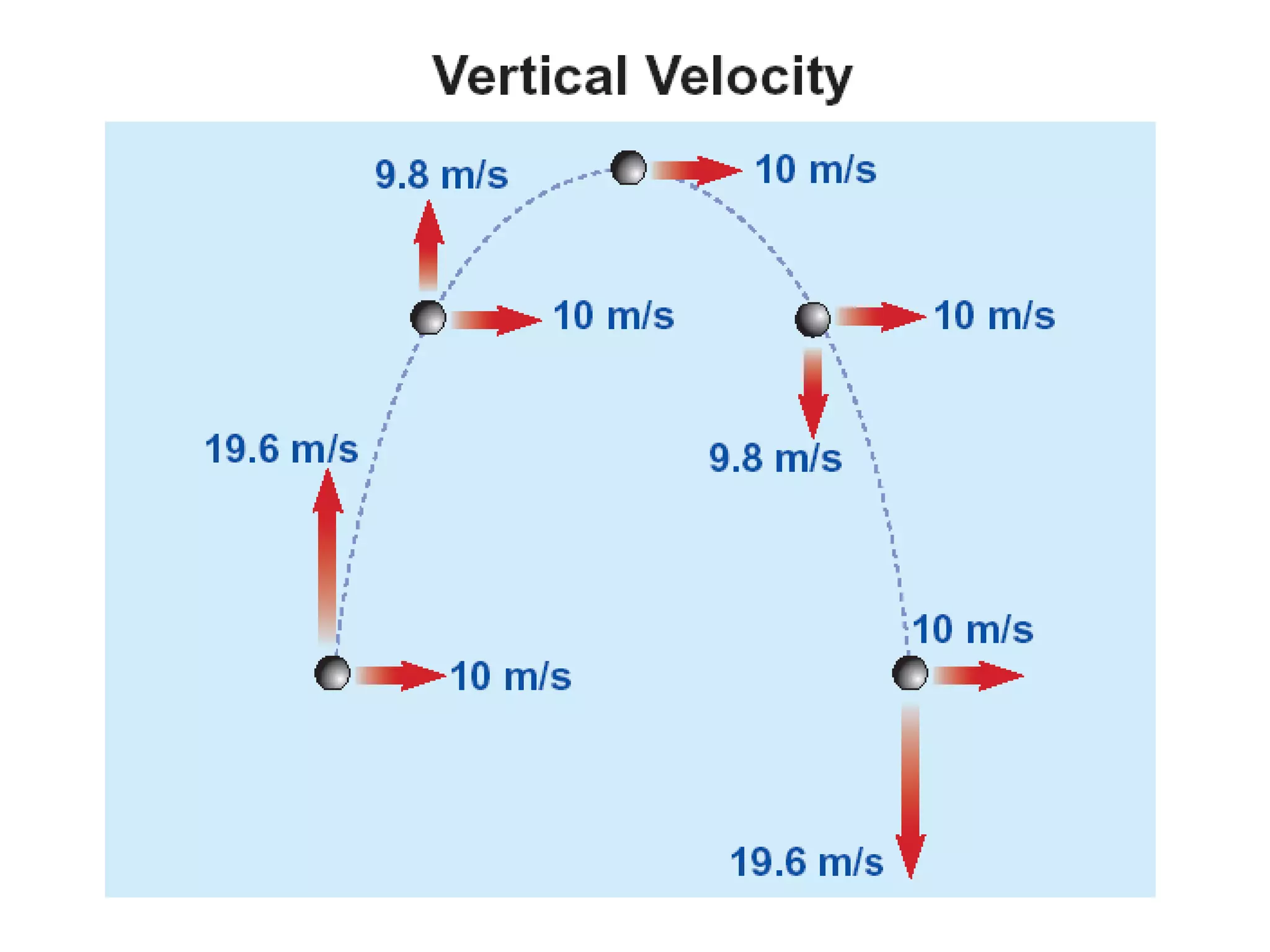
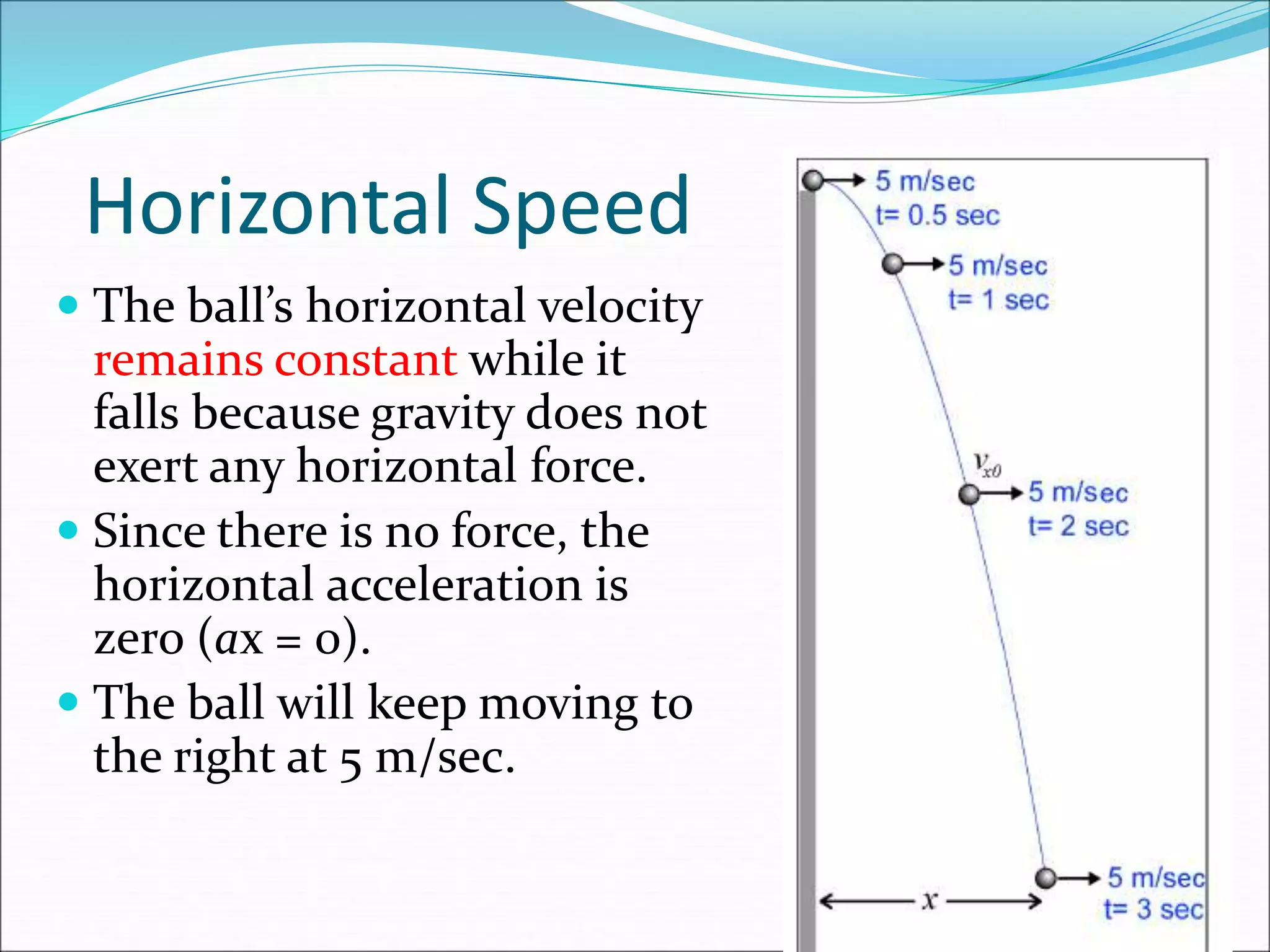
 The ball’s horizontal velocity
remains constant while it
falls because gravity does not
exert any horizontal force.
 Since there is no force, the
horizontal acceleration is
zero (ax = 0).
 The ball will keep moving to
the right at 5 m/sec.
Horizontal Speed
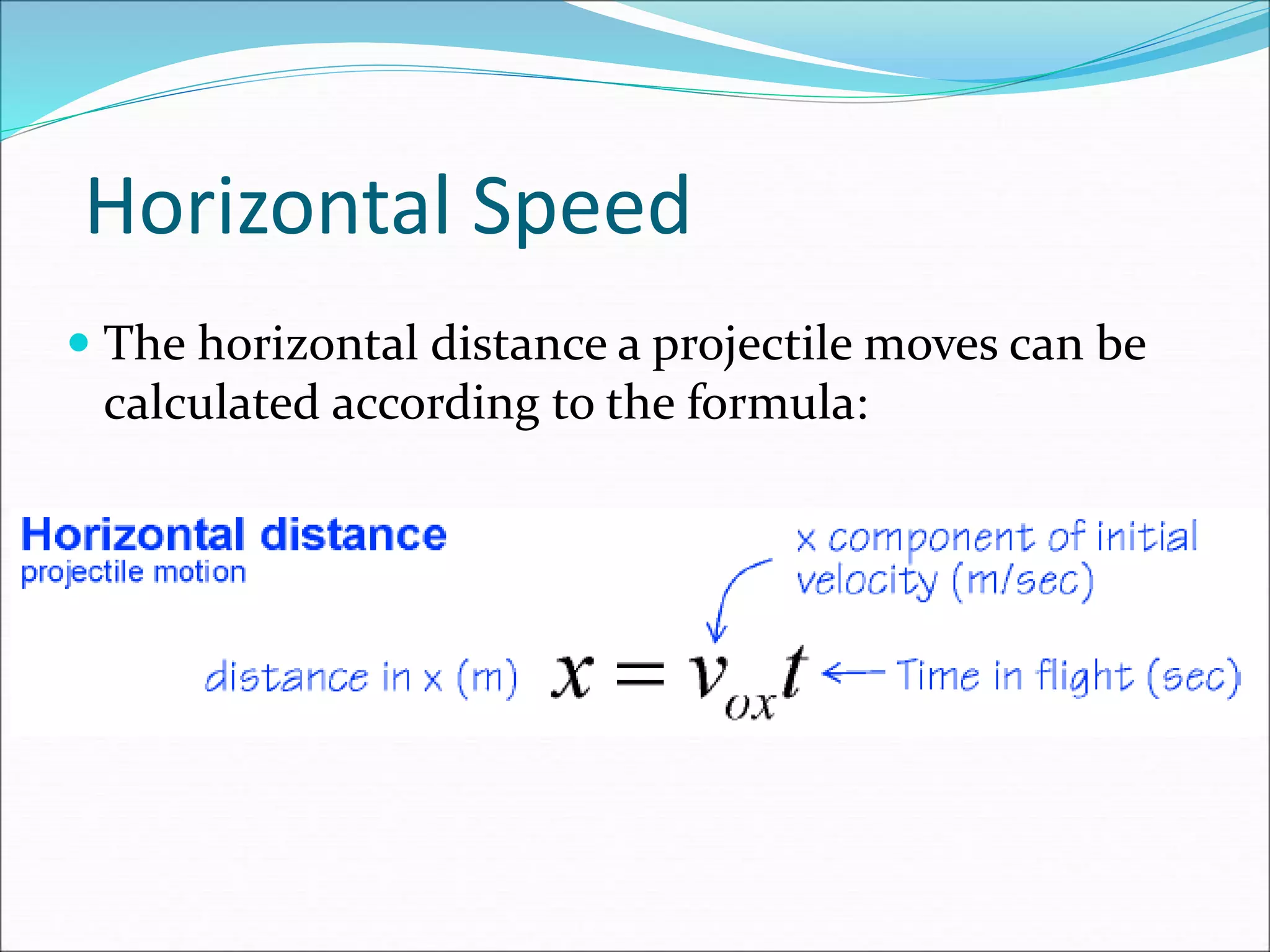
 The horizontal distance a projectile moves can be
calculated according to the formula:
Vertical Speed
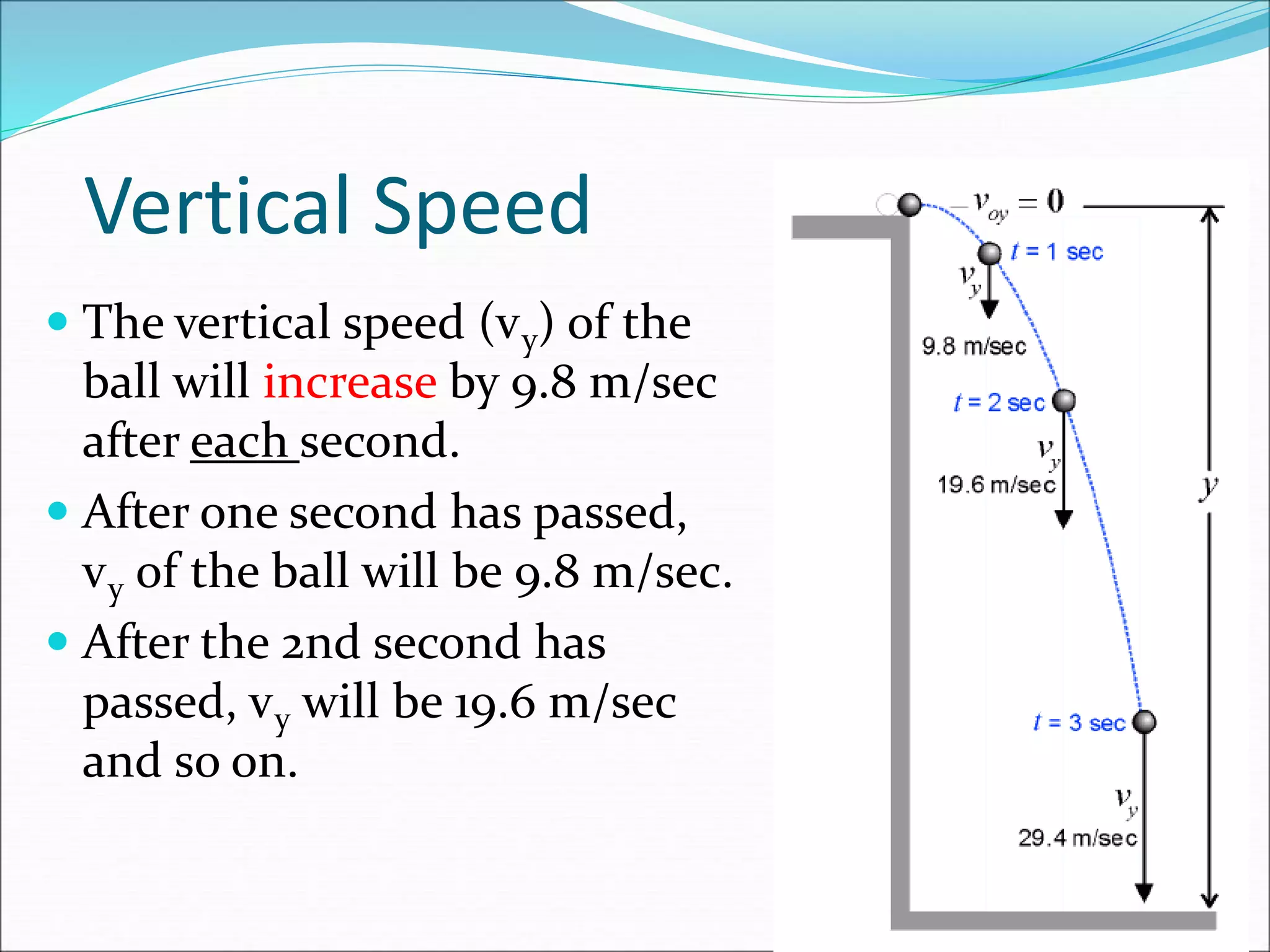
 The vertical speed (vy) of the
ball will increase by 9.8 m/sec
after each second.
 After one second has passed,
vy of the ball will be 9.8 m/sec.
 After the 2nd second has
passed, vy will be 19.6 m/sec
and so on.
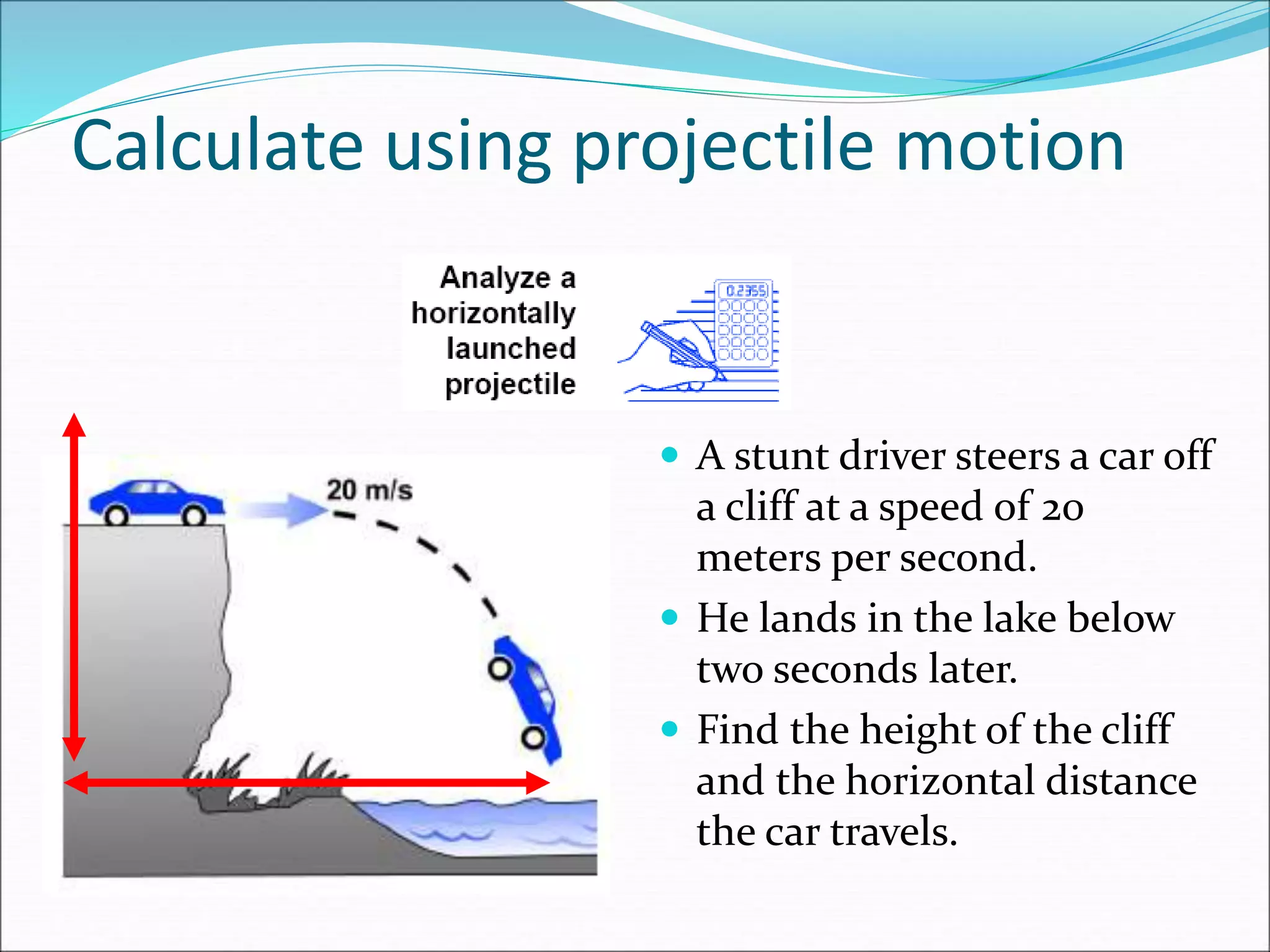
Calculate using projectile motion
 A stunt driver steers a car off
a cliff at a speed of 20
meters per second.
 He lands in the lake below
two seconds later.
 Find the height of the cliff
and the horizontal distance
the car travels.
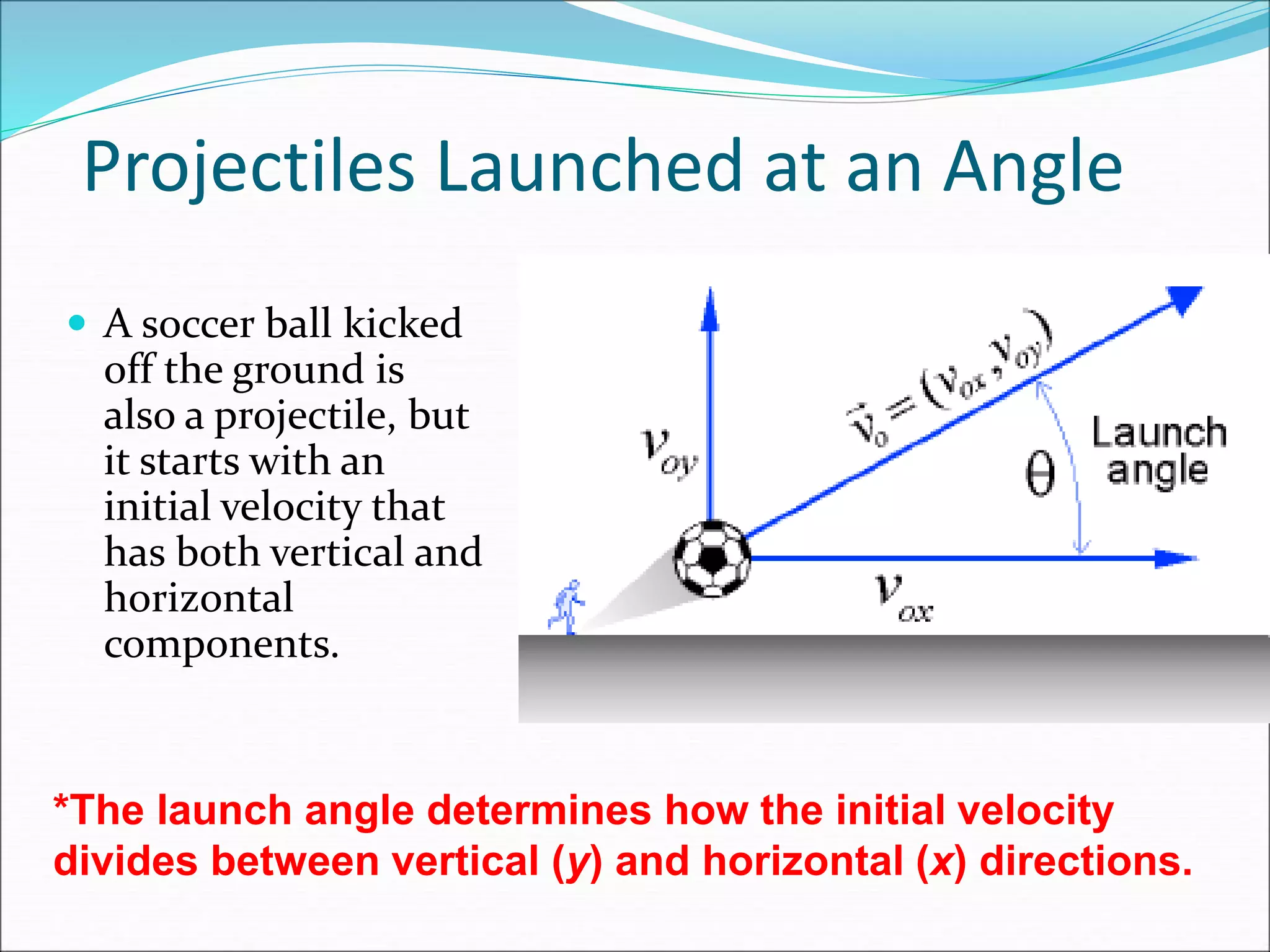
Projectiles Launched at an Angle
 A soccer ball kicked
off the ground is
also a projectile, but
it starts with an
initial velocity that
has both vertical and
horizontal
components.
*The launch angle determines how the initial velocity
divides between vertical (y) and horizontal (x) directions.
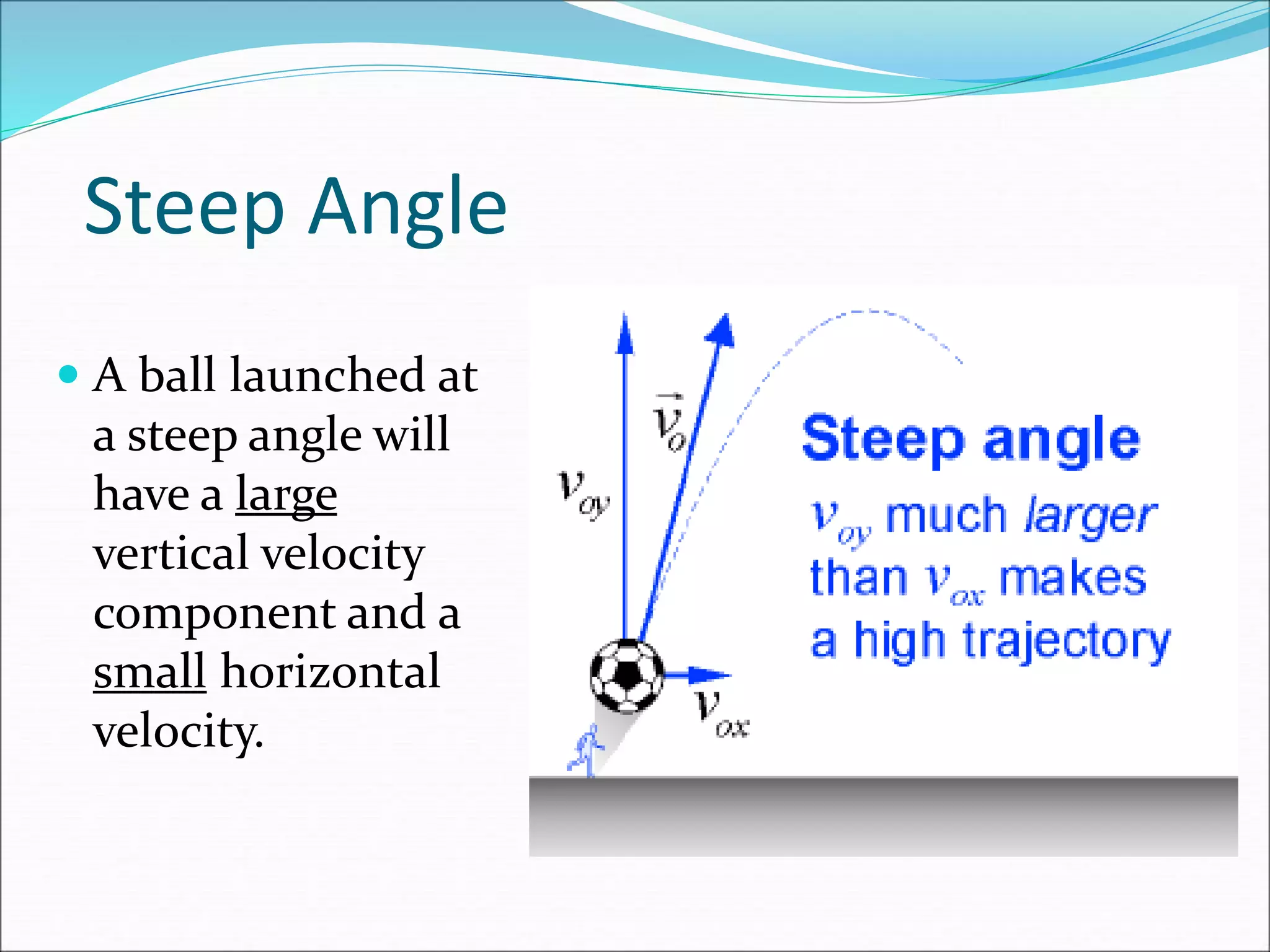
Steep Angle
 A ball launched at
a steep angle will
have a large
vertical velocity
component and a
small horizontal
velocity.
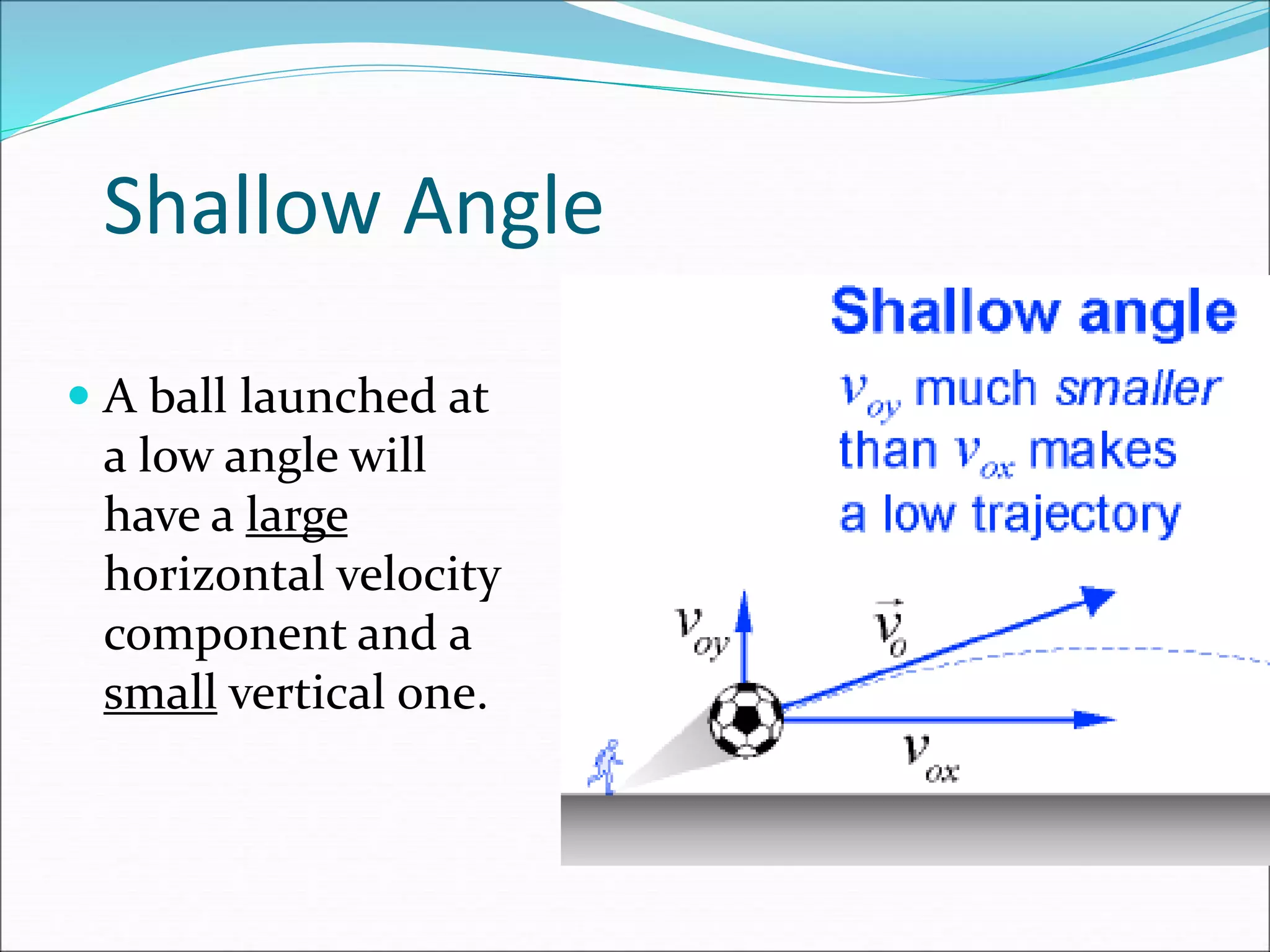
Shallow Angle
 A ball launched at
a low angle will
have a large
horizontal velocity
component and a
small vertical one.
Projectiles Launched at an Angle
The initial velocity components of an object launched at a velocity vo
and angle θ are found by breaking the velocity into x and y
components.
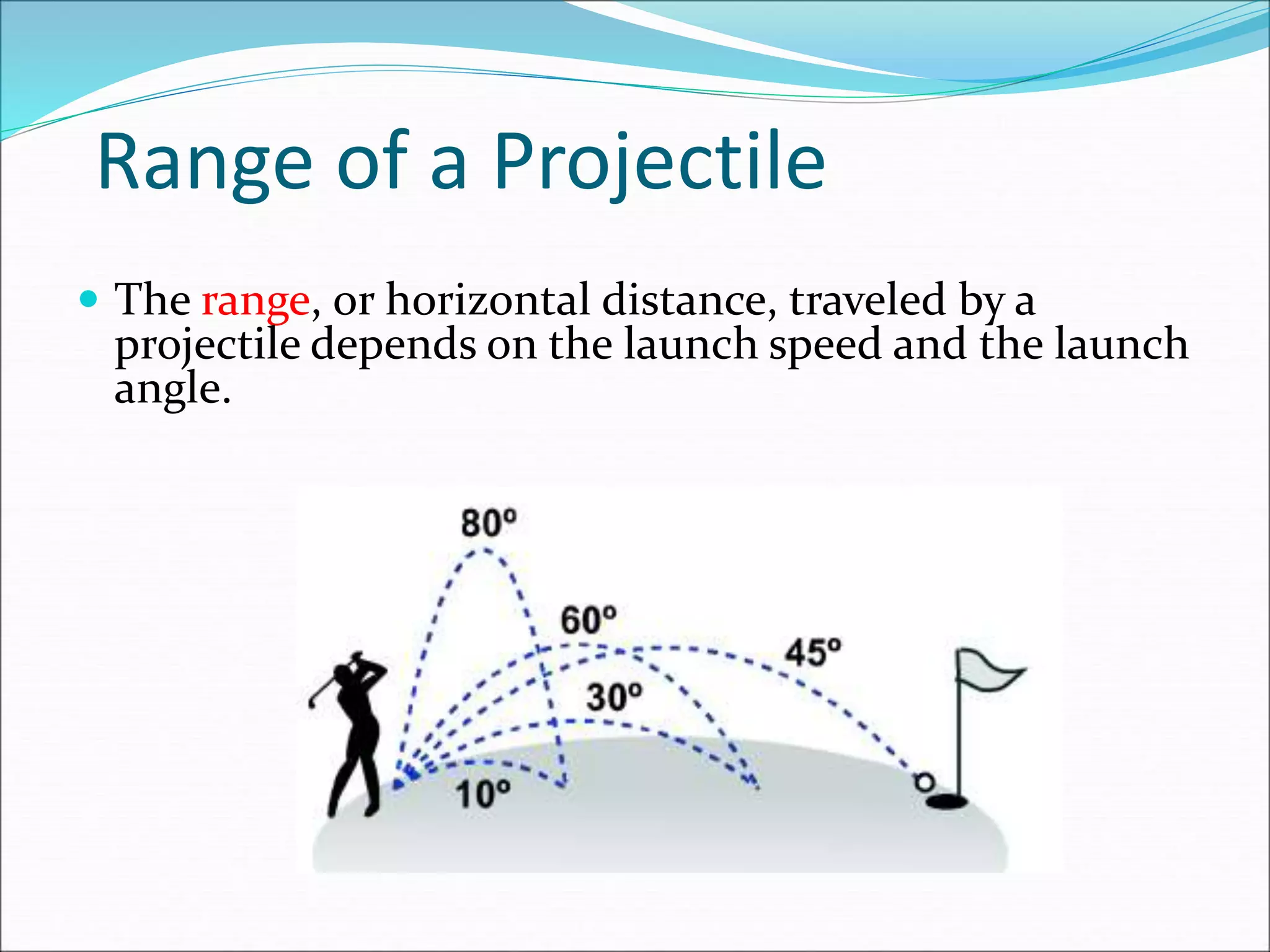
Range of a Projectile
 The range, or horizontal distance, traveled by a
projectile depends on the launch speed and the launch
angle.
Range of a Projectile
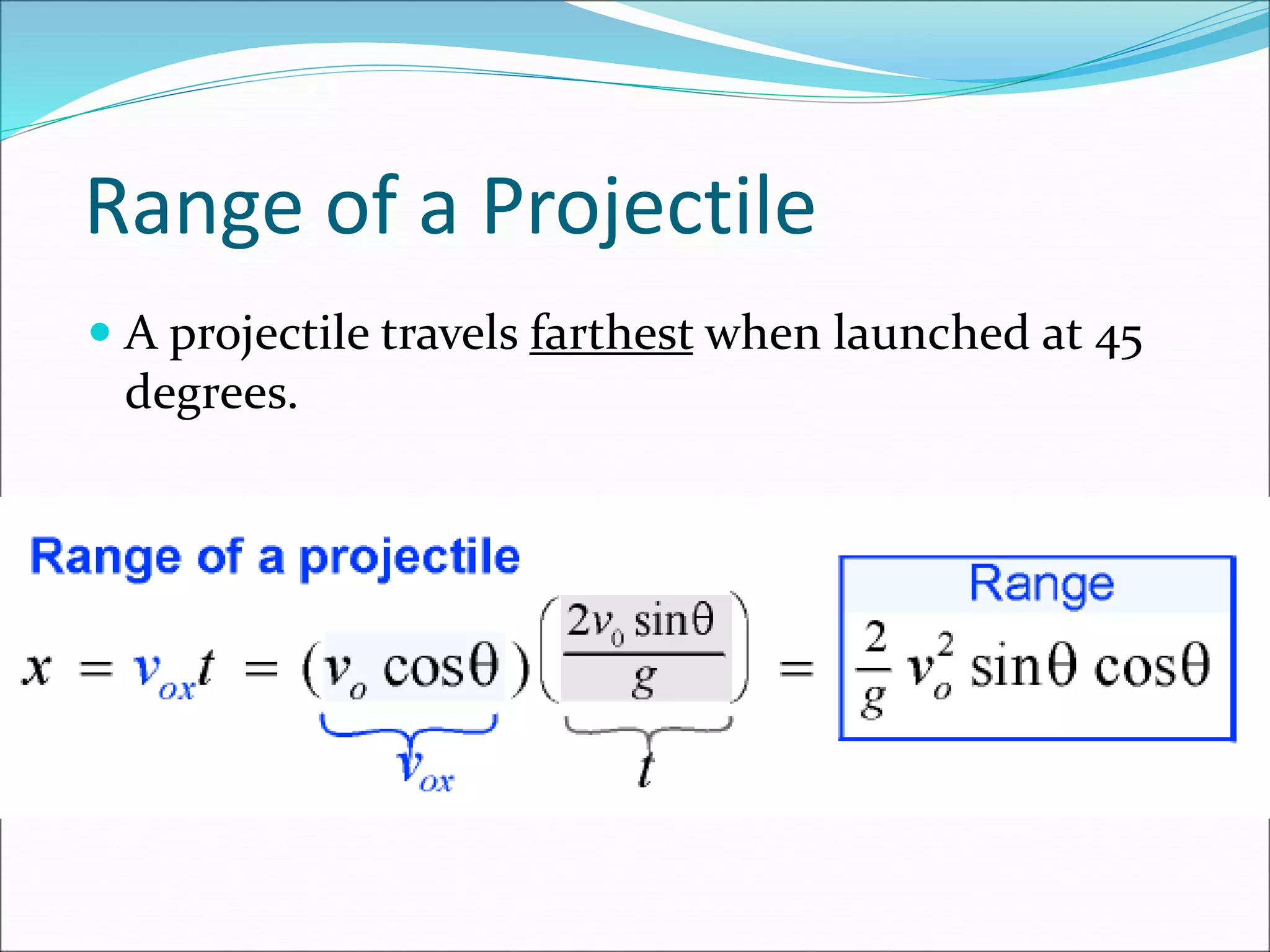
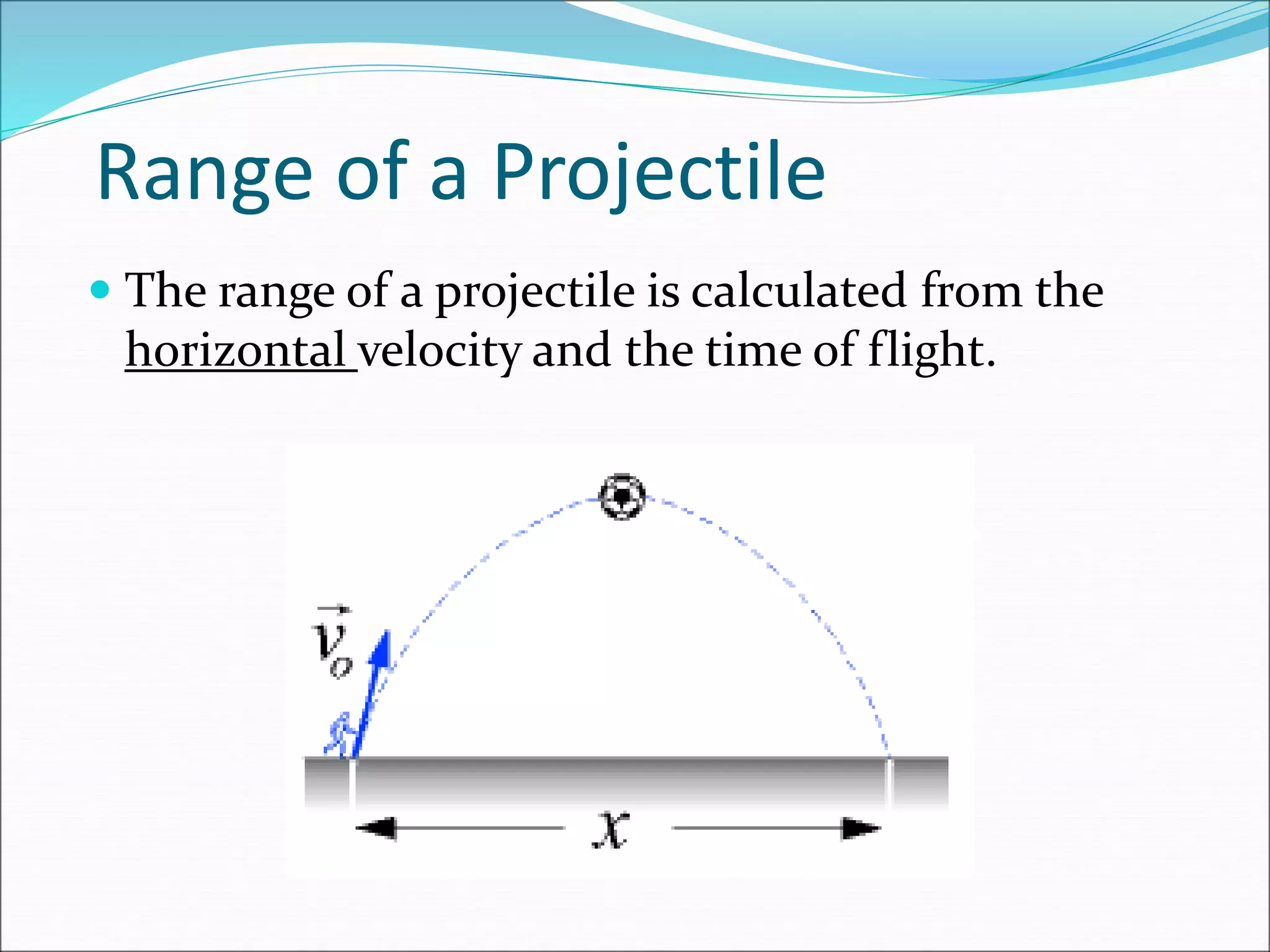
 The range of a projectile is calculated from the
horizontal velocity and the time of flight.
Range of a Projectile
 A projectile travels farthest when launched at 45
degrees.
Range of a Projectile
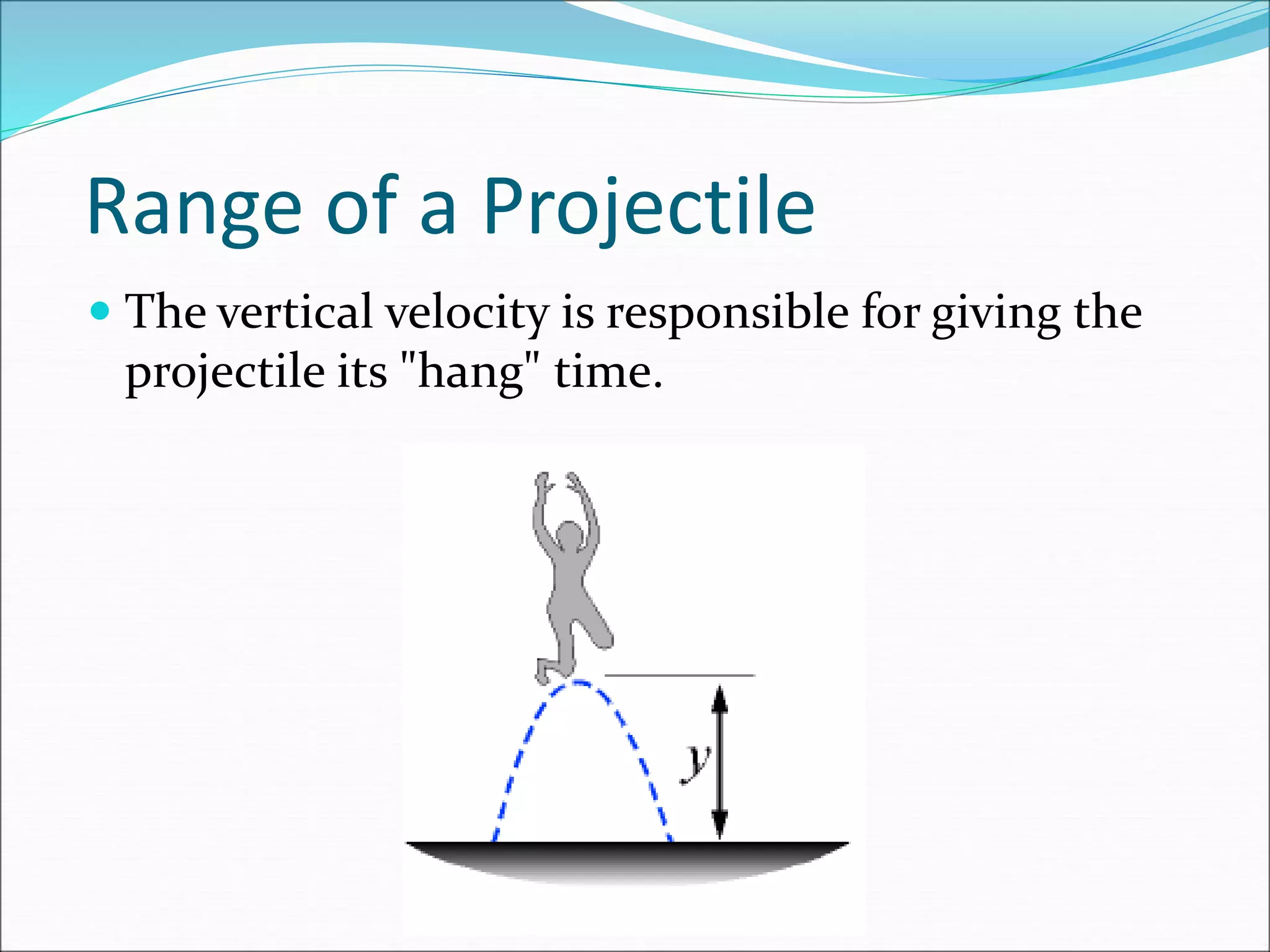
 The vertical velocity is responsible for giving the
projectile its "hang" time.
"Hang Time"
 You can easily calculate your own hang time.
 Run toward a doorway and jump as high as you can, touching the wall or door frame.
 Have someone watch to see exactly how high you reach.
 Measure this distance with a meter stick.
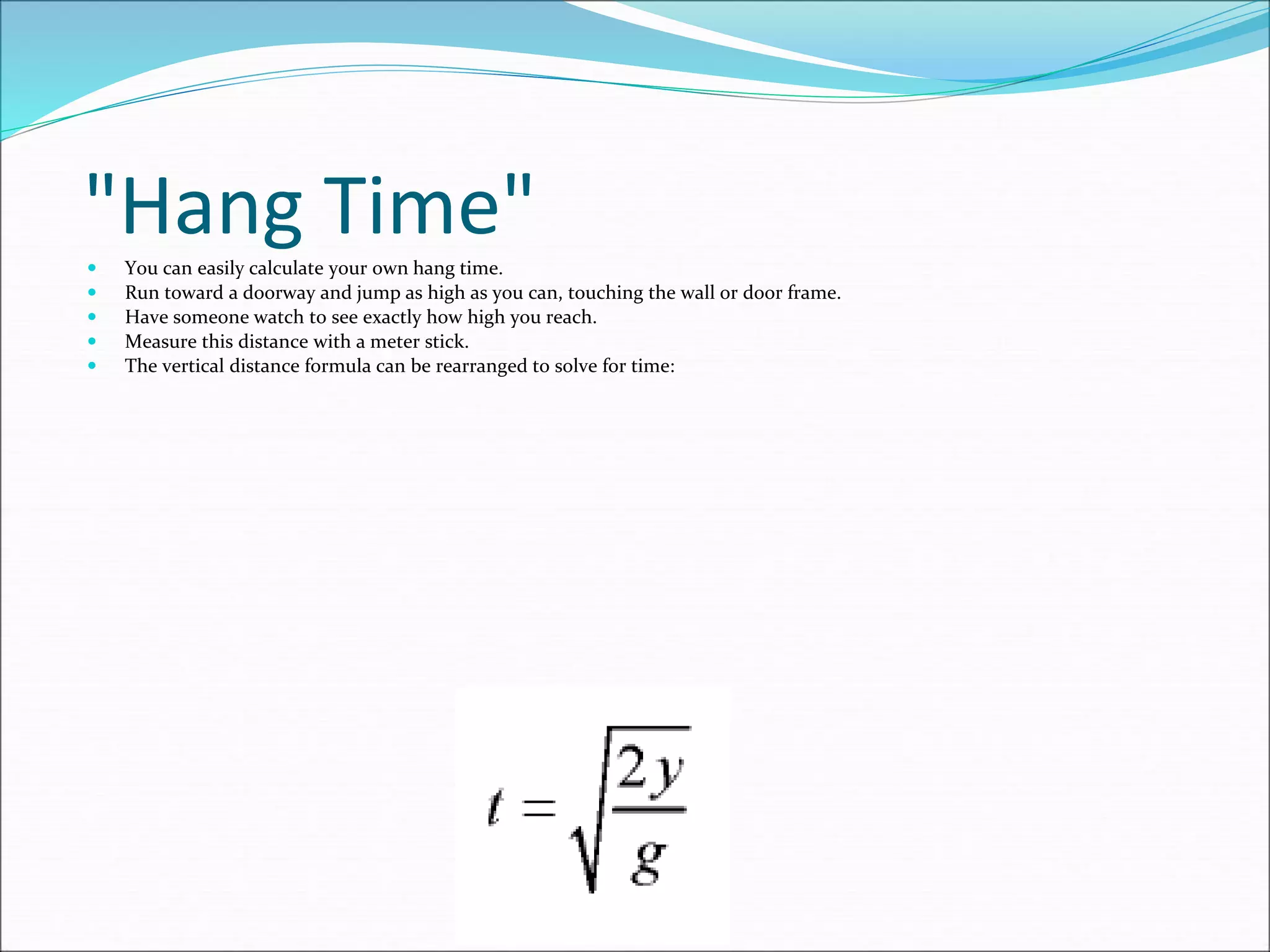
 The vertical distance formula can be rearranged to solve for time:
Projectile Motion and the Velocity
Vector
Key Question:
Can you predict the landing spot of a projectile?
*Students read Section 7.2 BEFORE Investigation 7.2
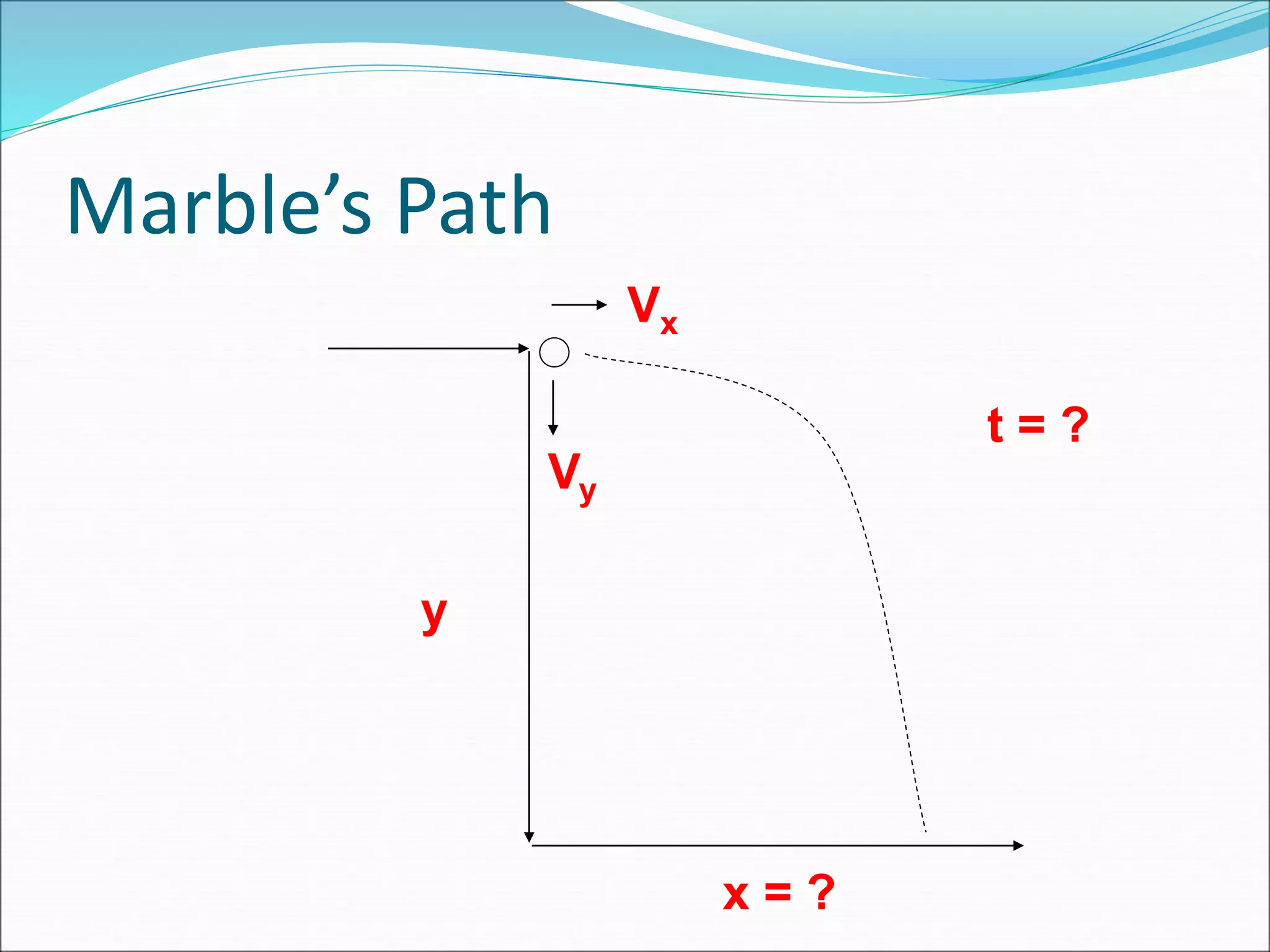
Marble’s Path
Vy
x = ?
y
Vx
t = ?
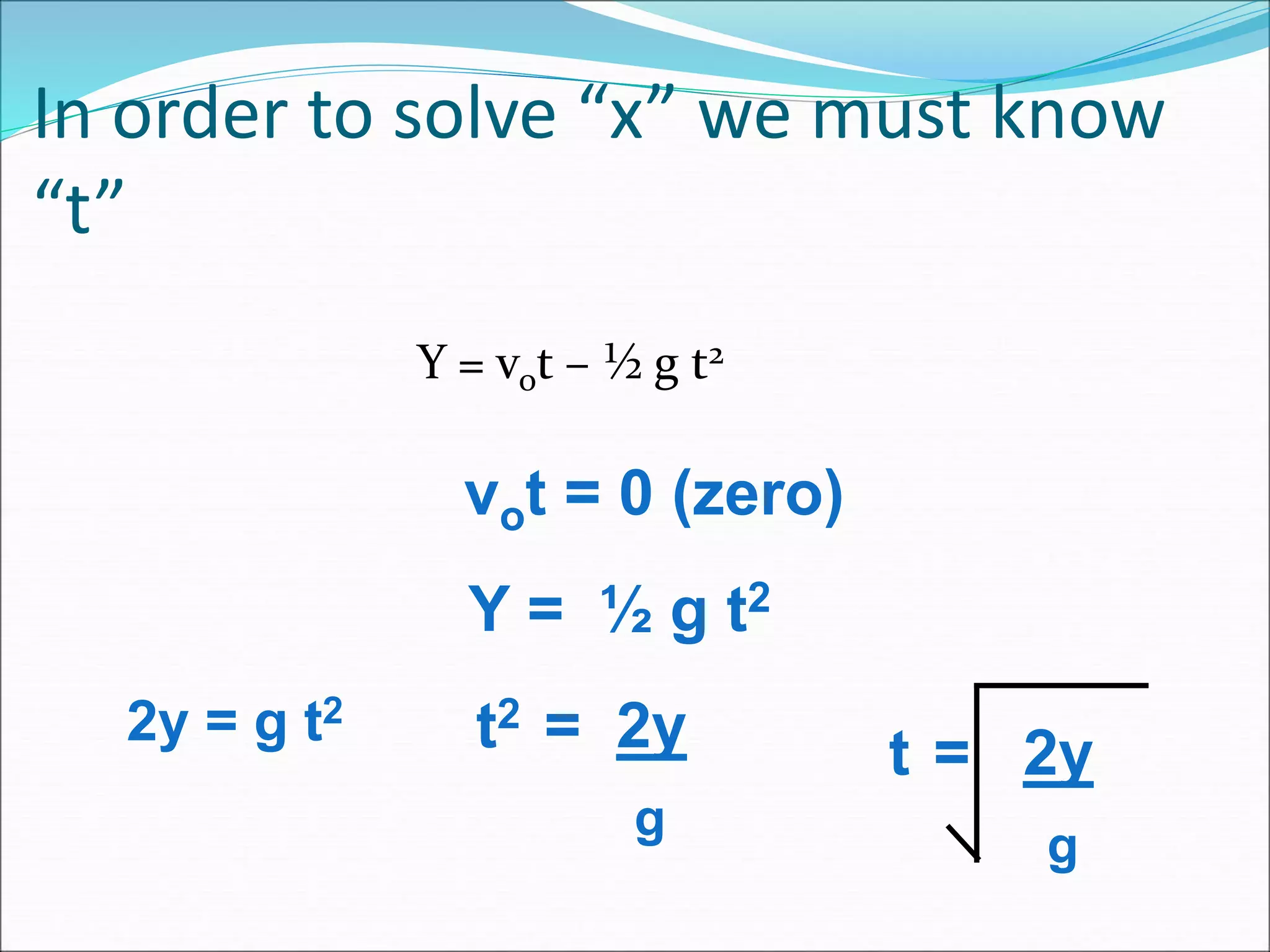
In order to solve “x” we must know
“t”
Y = vot – ½ g t2
2y = g t2
vot = 0 (zero)
Y = ½ g t2
t2 = 2y
g
t = 2y
g
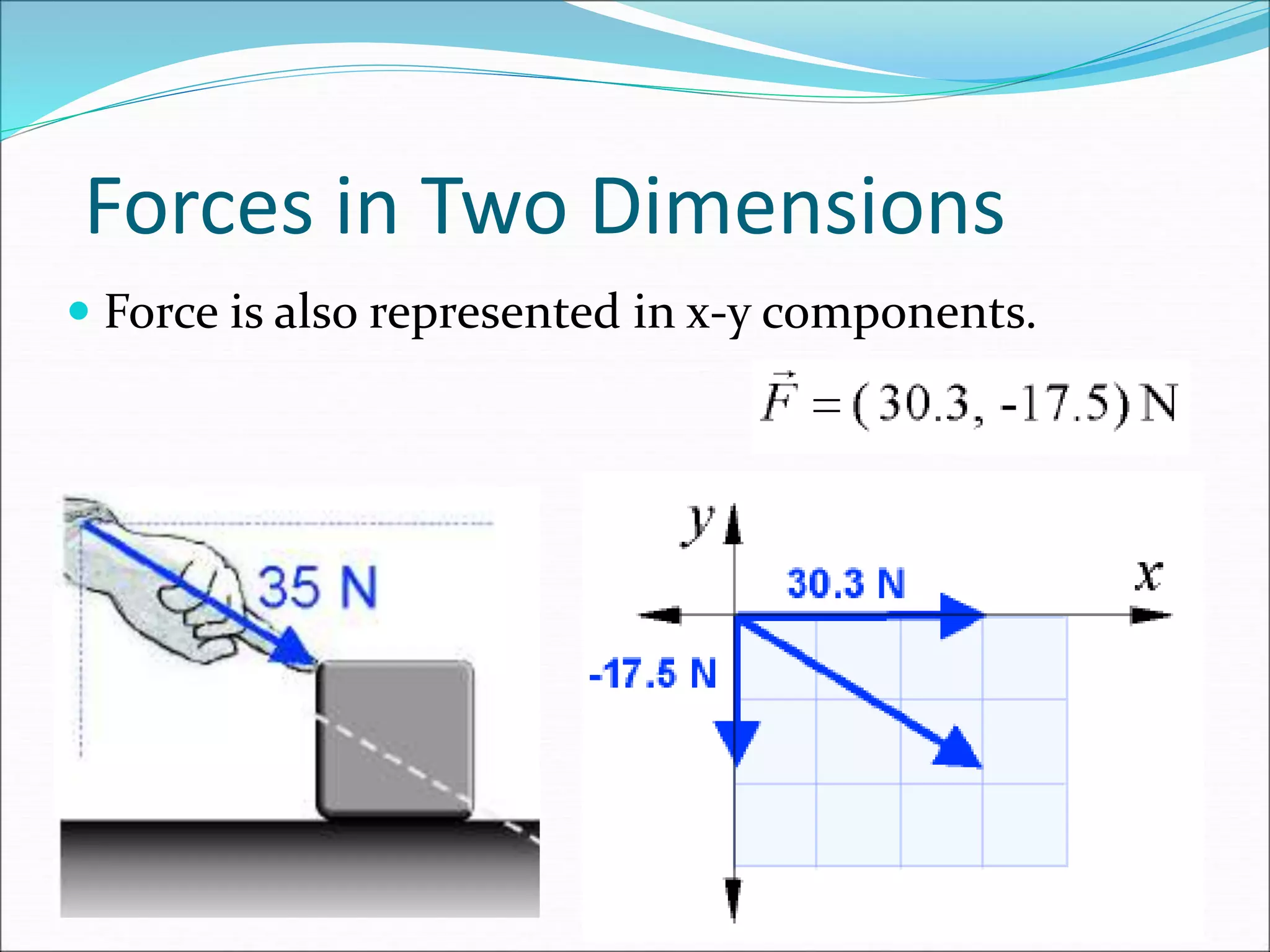
Forces in Two Dimensions
 Force is also represented in x-y components.
Force Vectors
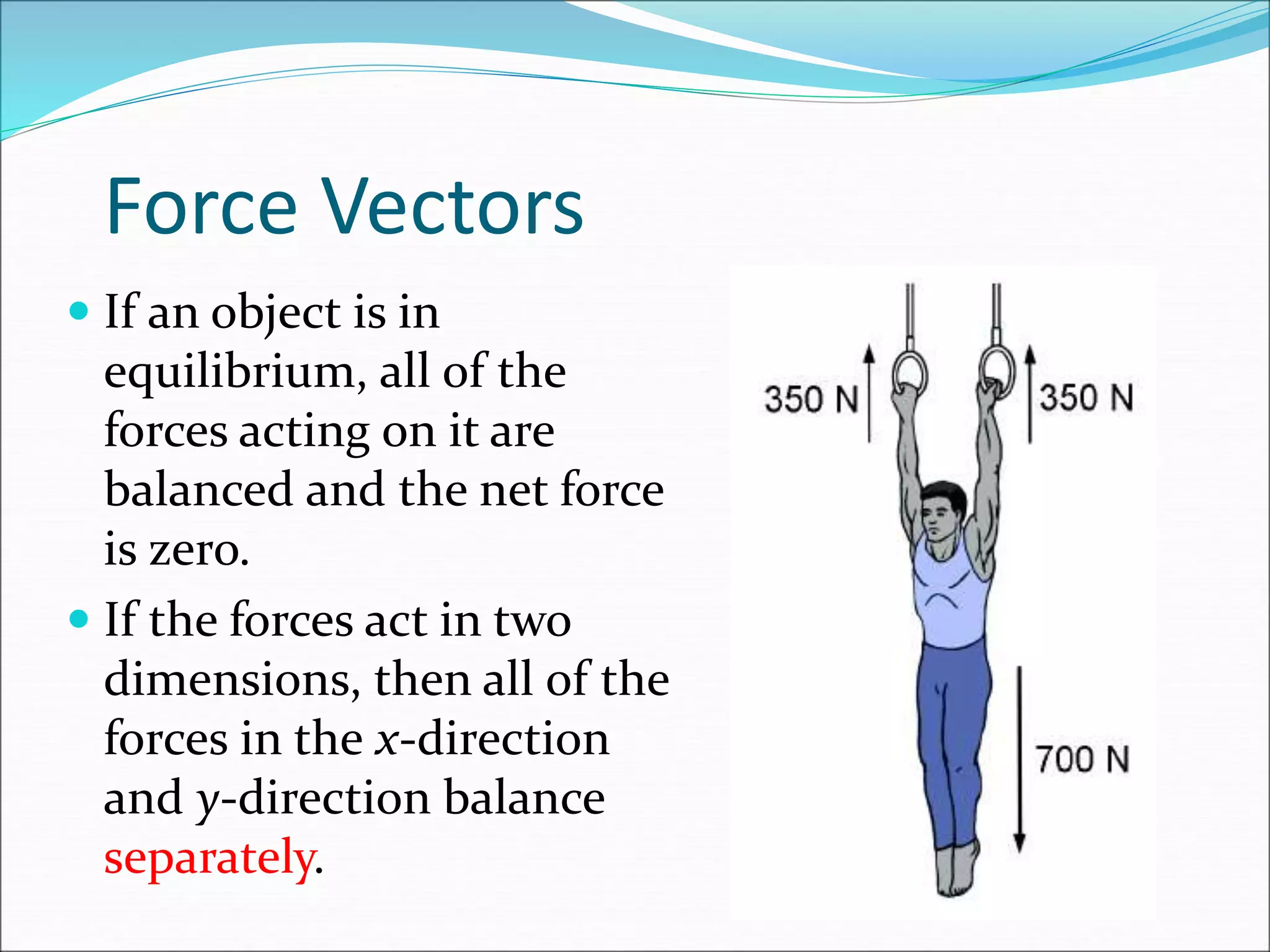
 If an object is in
equilibrium, all of the
forces acting on it are
balanced and the net force
is zero.
 If the forces act in two
dimensions, then all of the
forces in the x-direction
and y-direction balance
separately.
Equilibrium and Forces
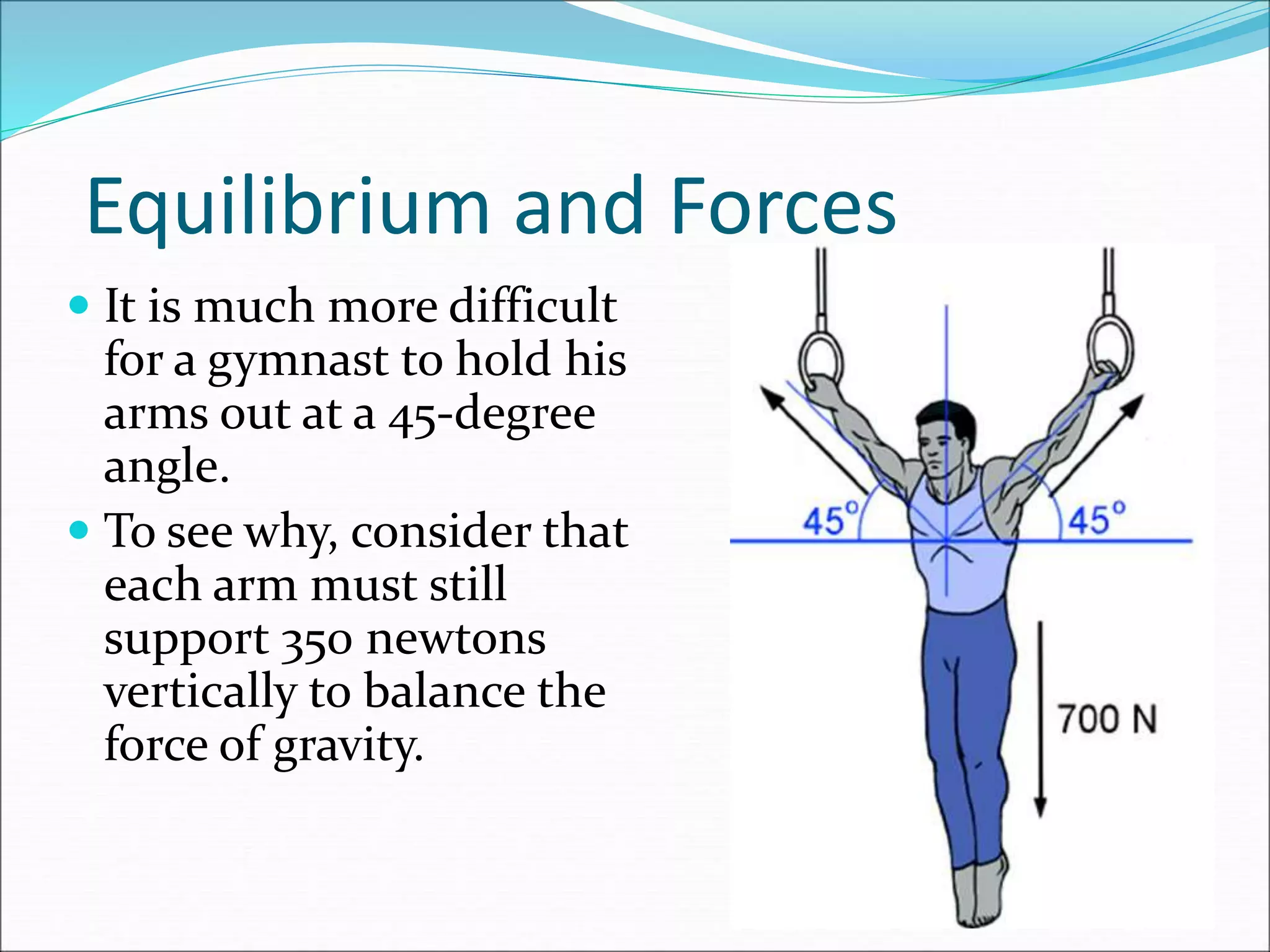
 It is much more difficult
for a gymnast to hold his
arms out at a 45-degree
angle.
 To see why, consider that
each arm must still
support 350 newtons
vertically to balance the
force of gravity.
Forces in Two Dimensions
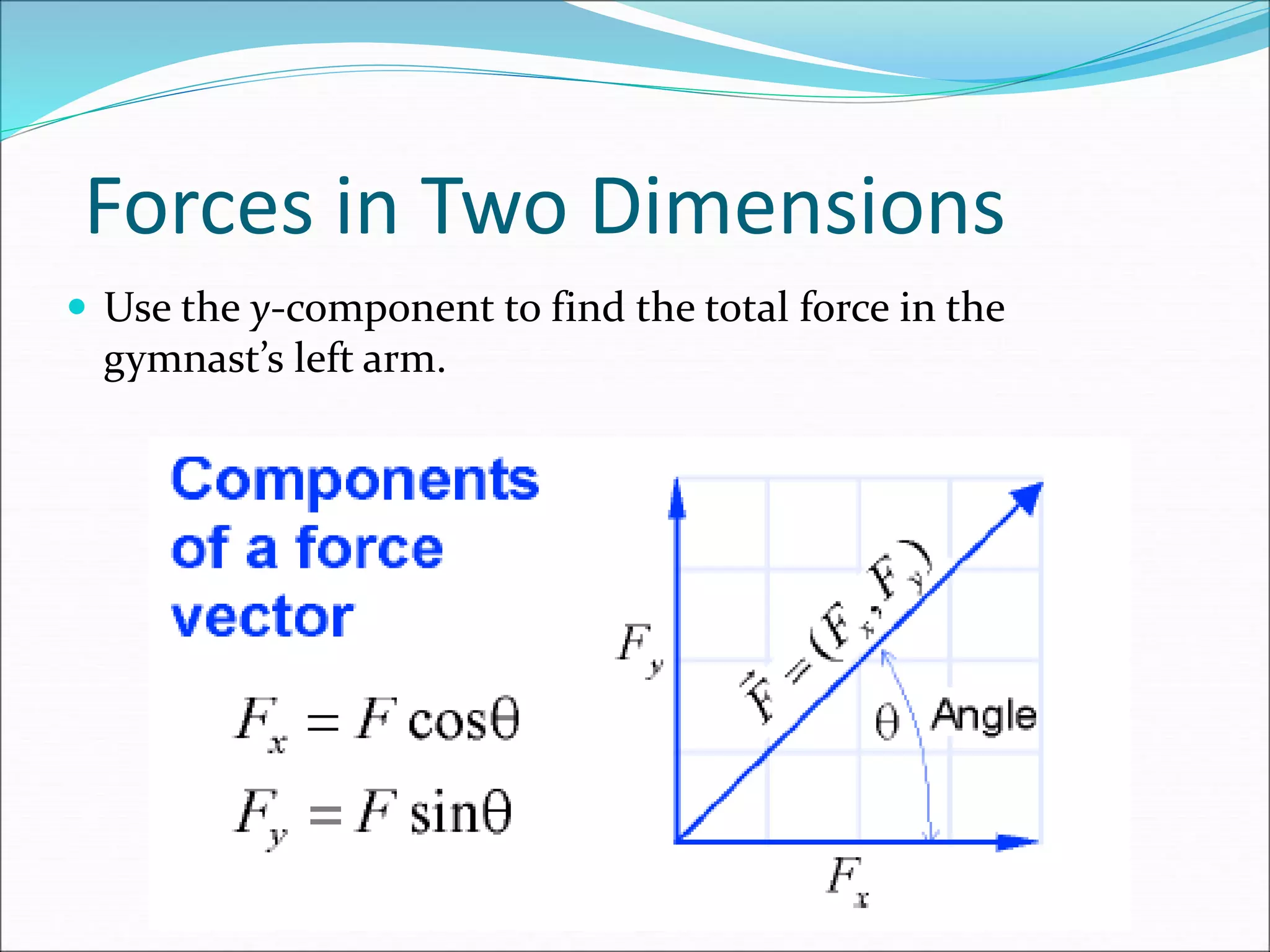
 Use the y-component to find the total force in the
gymnast’s left arm.
Forces in Two Dimensions
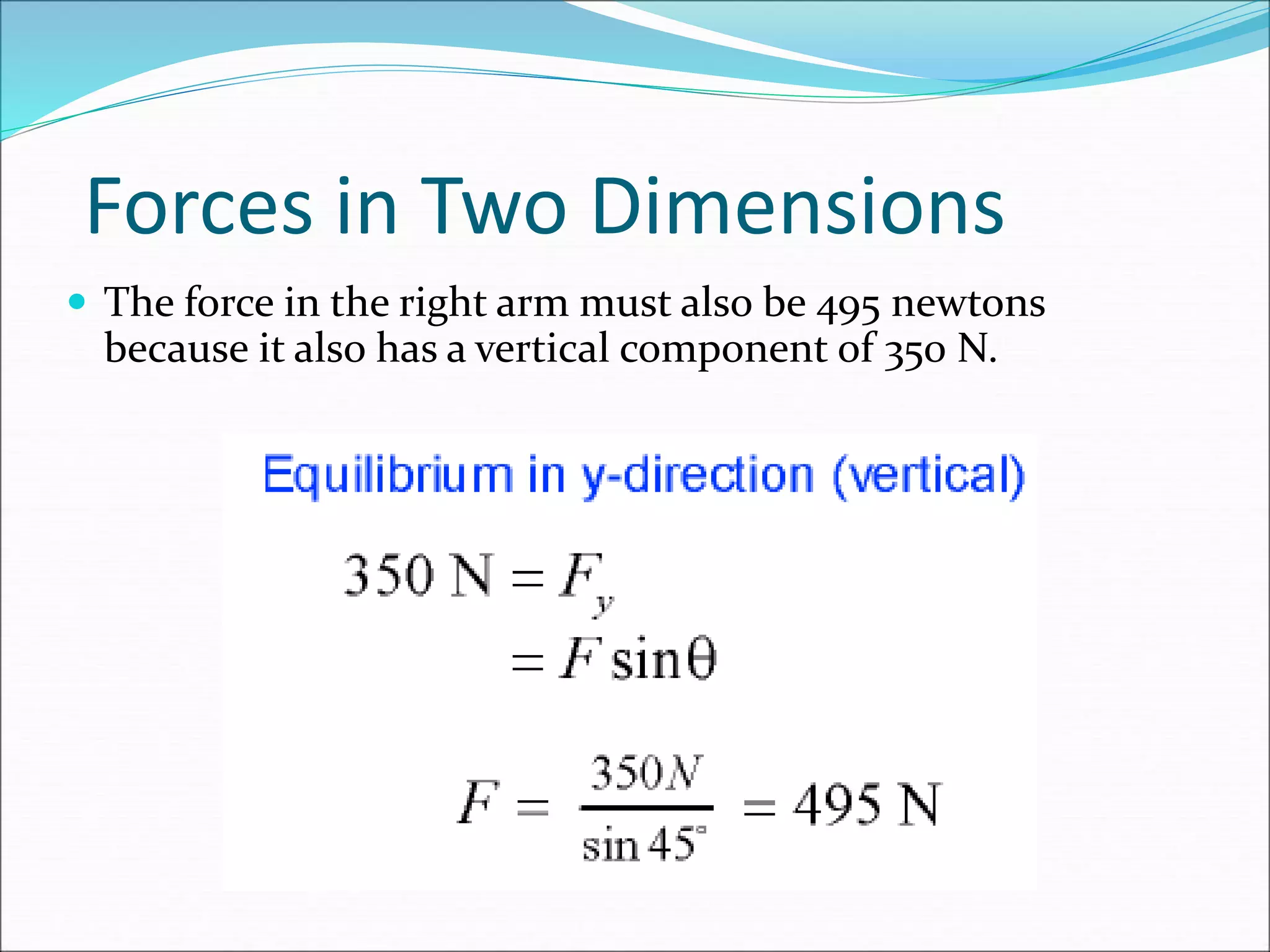
 The force in the right arm must also be 495 newtons
because it also has a vertical component of 350 N.
Forces in Two Dimensions
 When the gymnast’s arms
are at an angle, only part of
the force from each arm is
vertical.
 The total force must be
larger because the vertical
component of force in each
arm must still equal half his
weight.
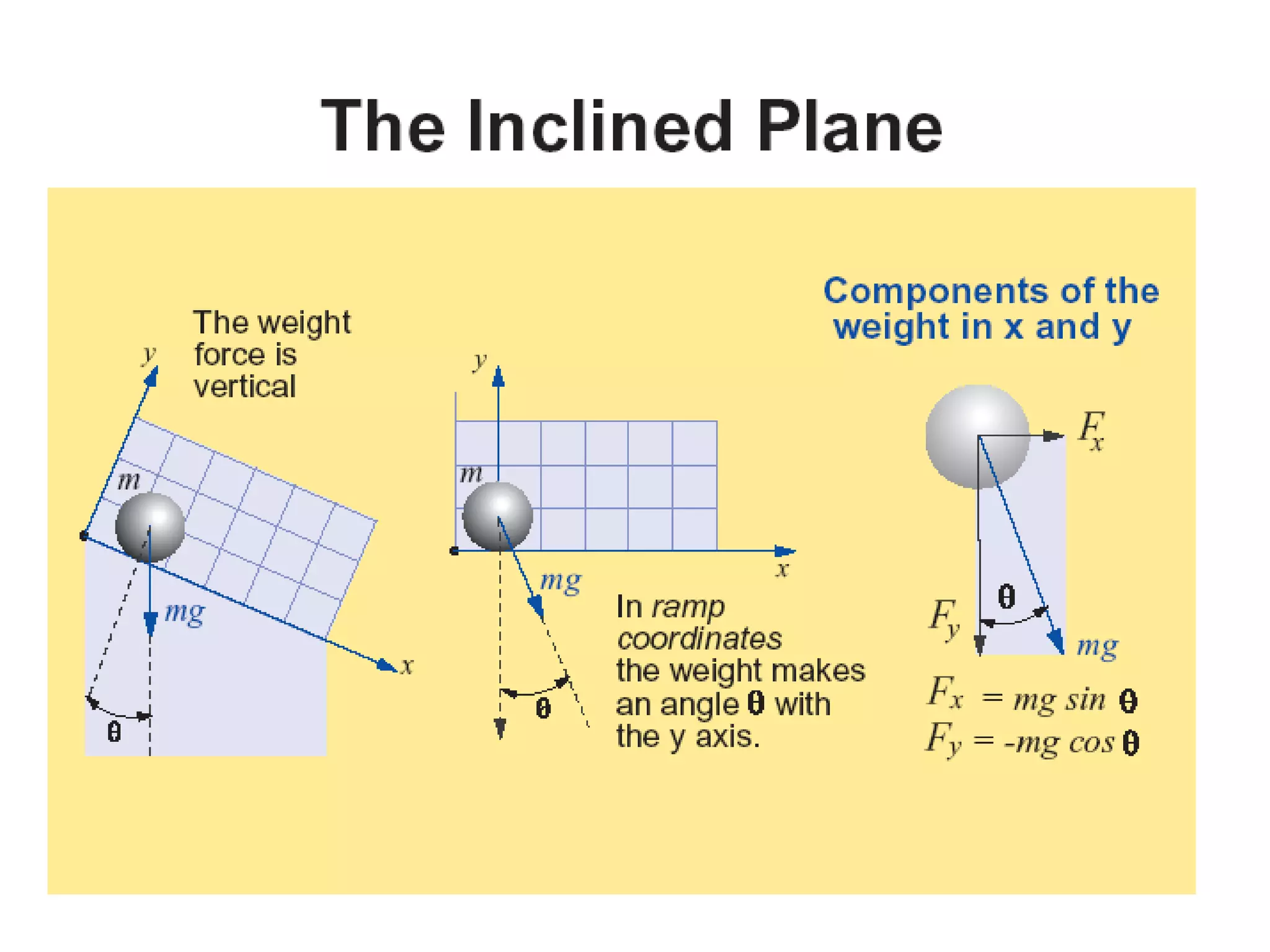
Forces and Inclined Planes
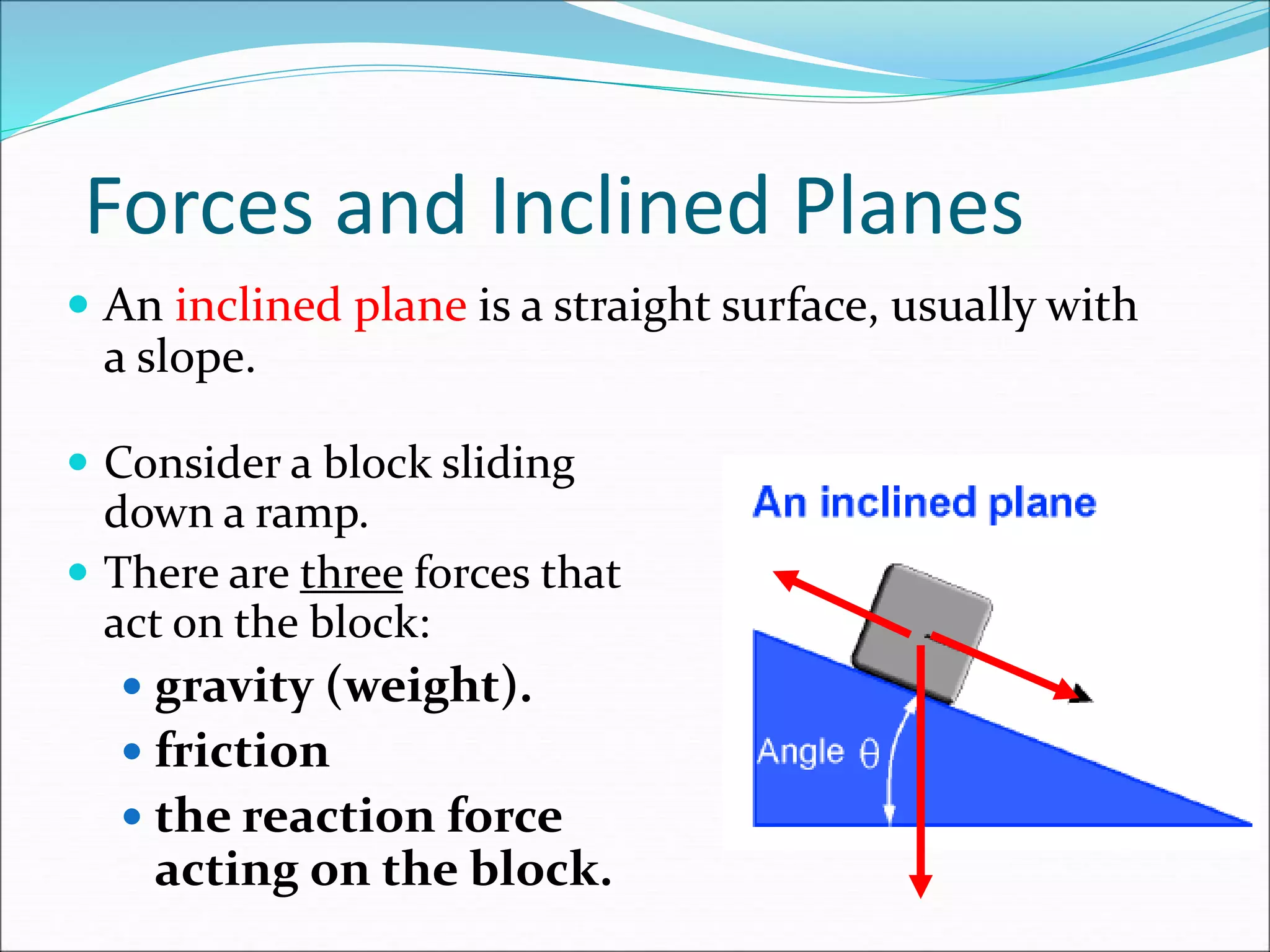
 An inclined plane is a straight surface, usually with
a slope.
 Consider a block sliding
down a ramp.
 There are three forces that
act on the block:
 gravity (weight).
 friction
 the reaction force
acting on the block.
Forces and Inclined Planes
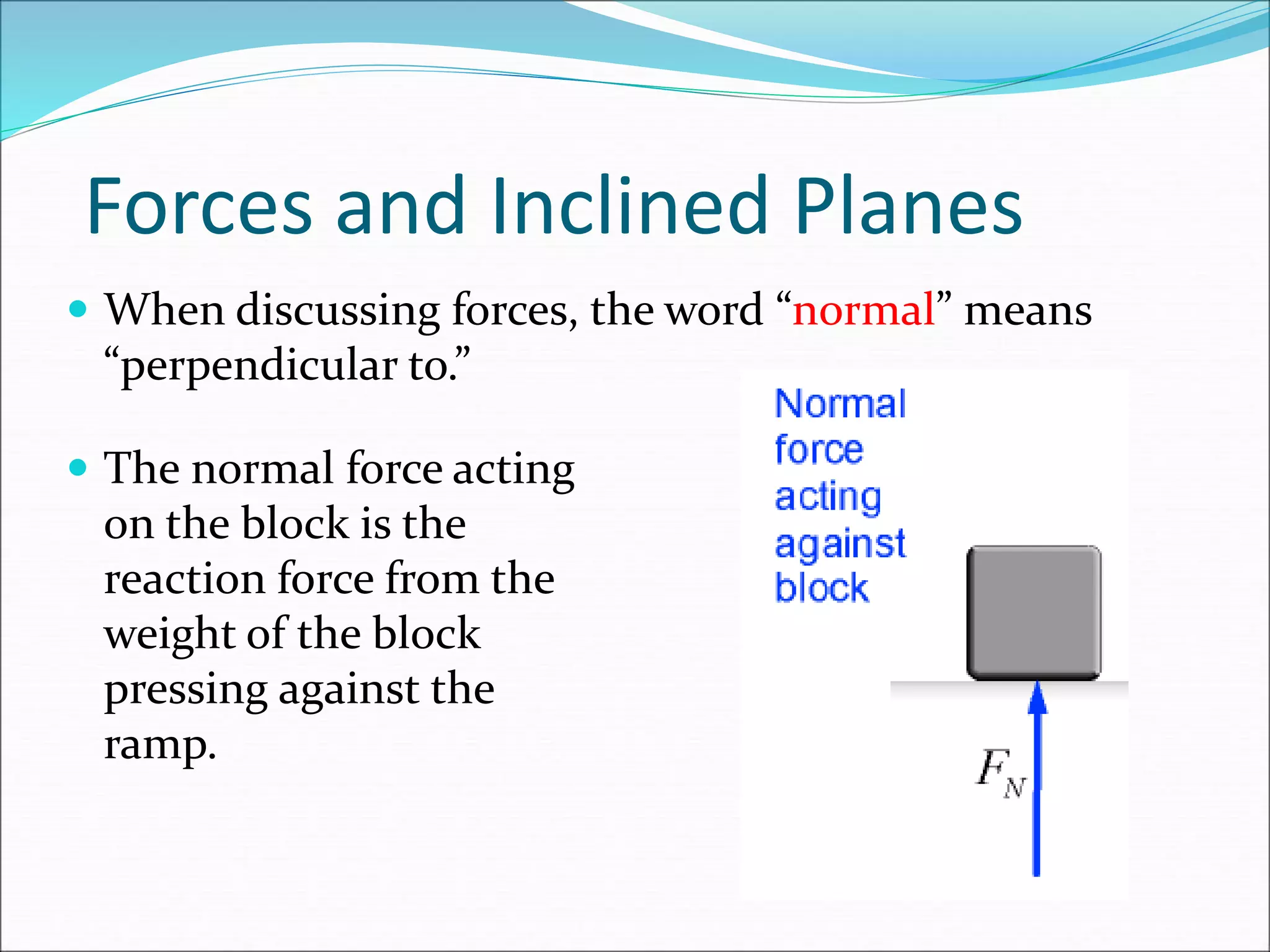
 When discussing forces, the word “normal” means
“perpendicular to.”
 The normal force acting
on the block is the
reaction force from the
weight of the block
pressing against the
ramp.
Forces and Inclined Planes
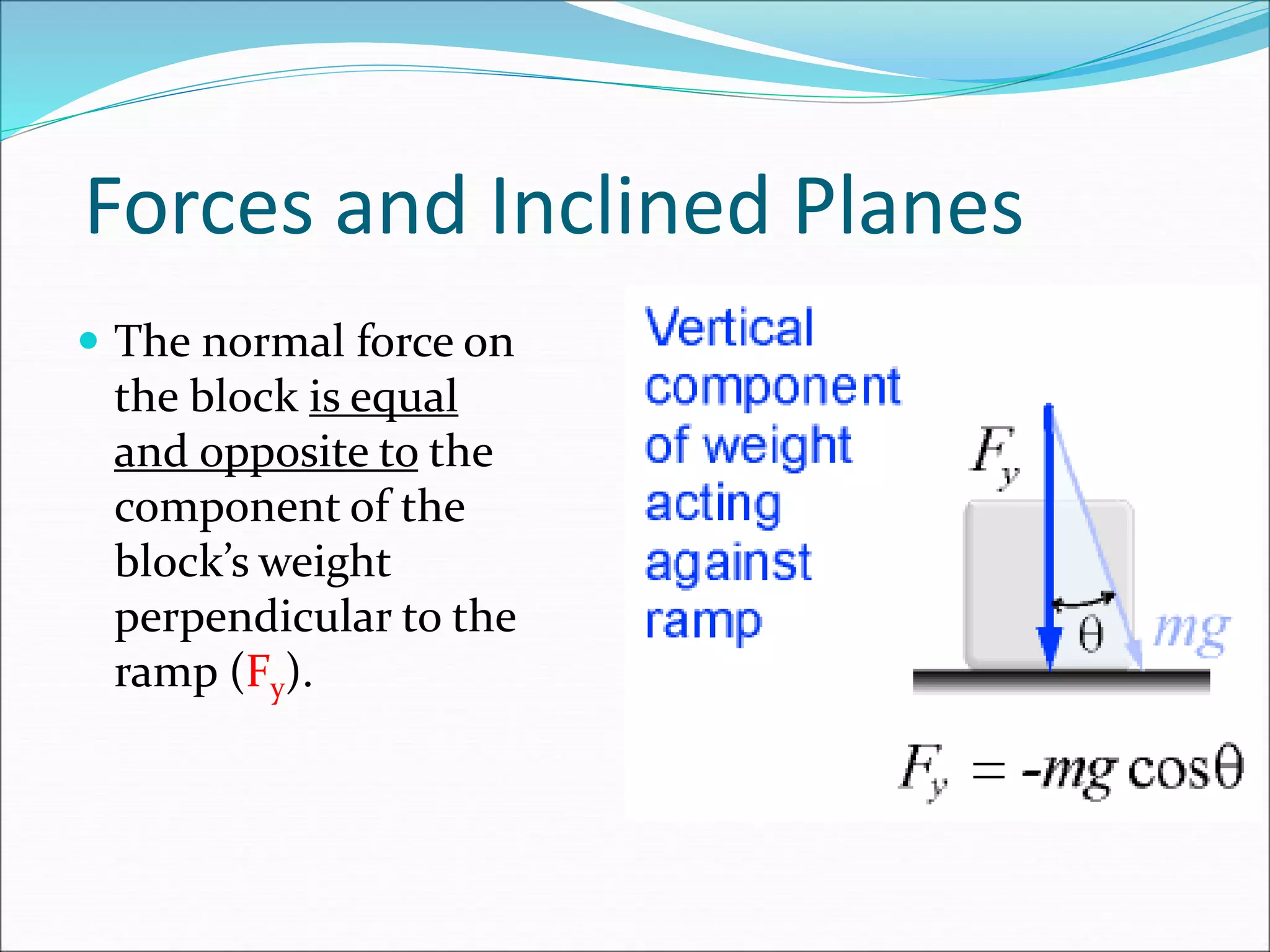
 The normal force on
the block is equal
and opposite to the
component of the
block’s weight
perpendicular to the
ramp (Fy).
Forces and Inclined Planes
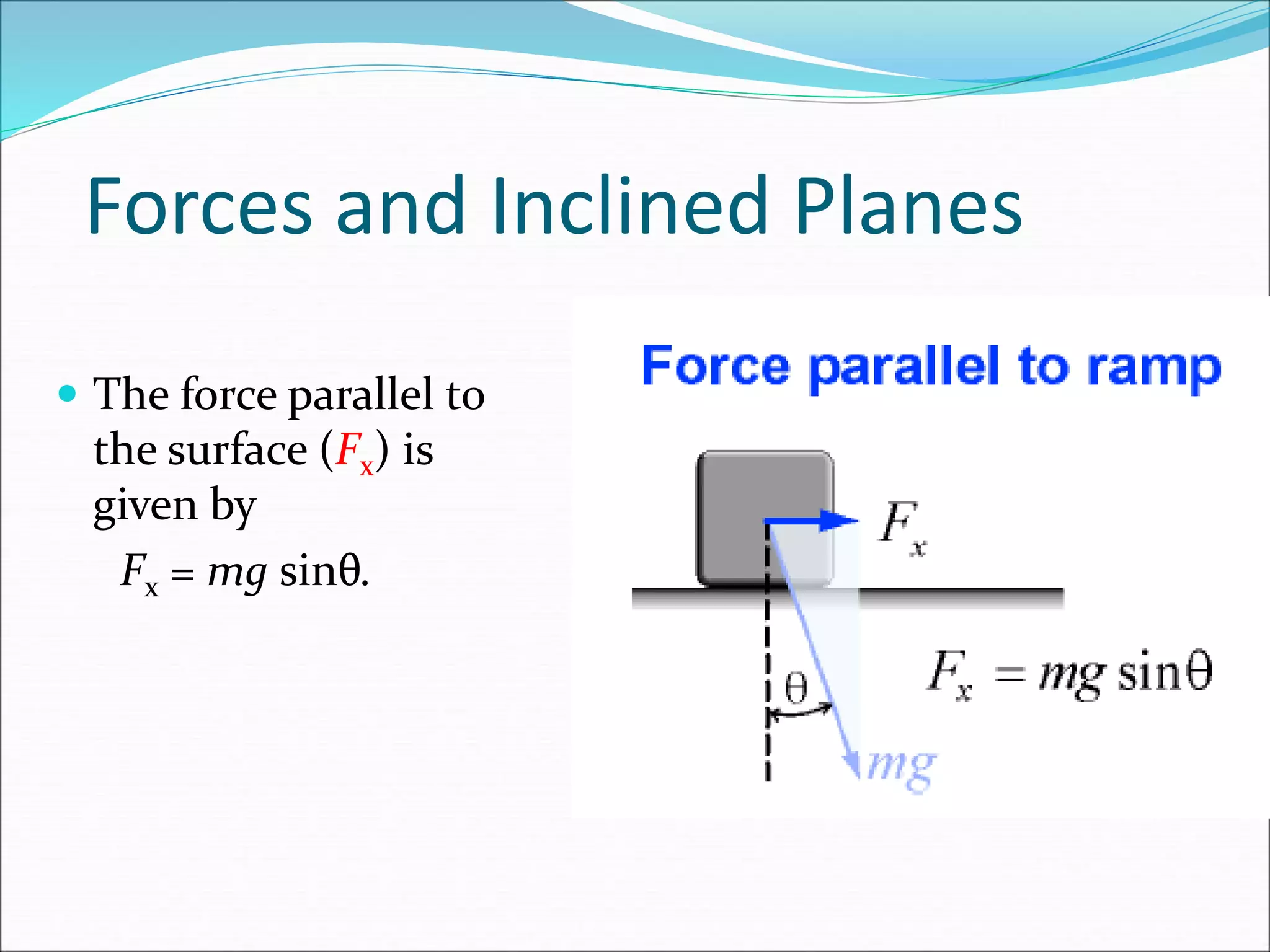
 The force parallel to
the surface (Fx) is
given by
Fx = mg sinθ.
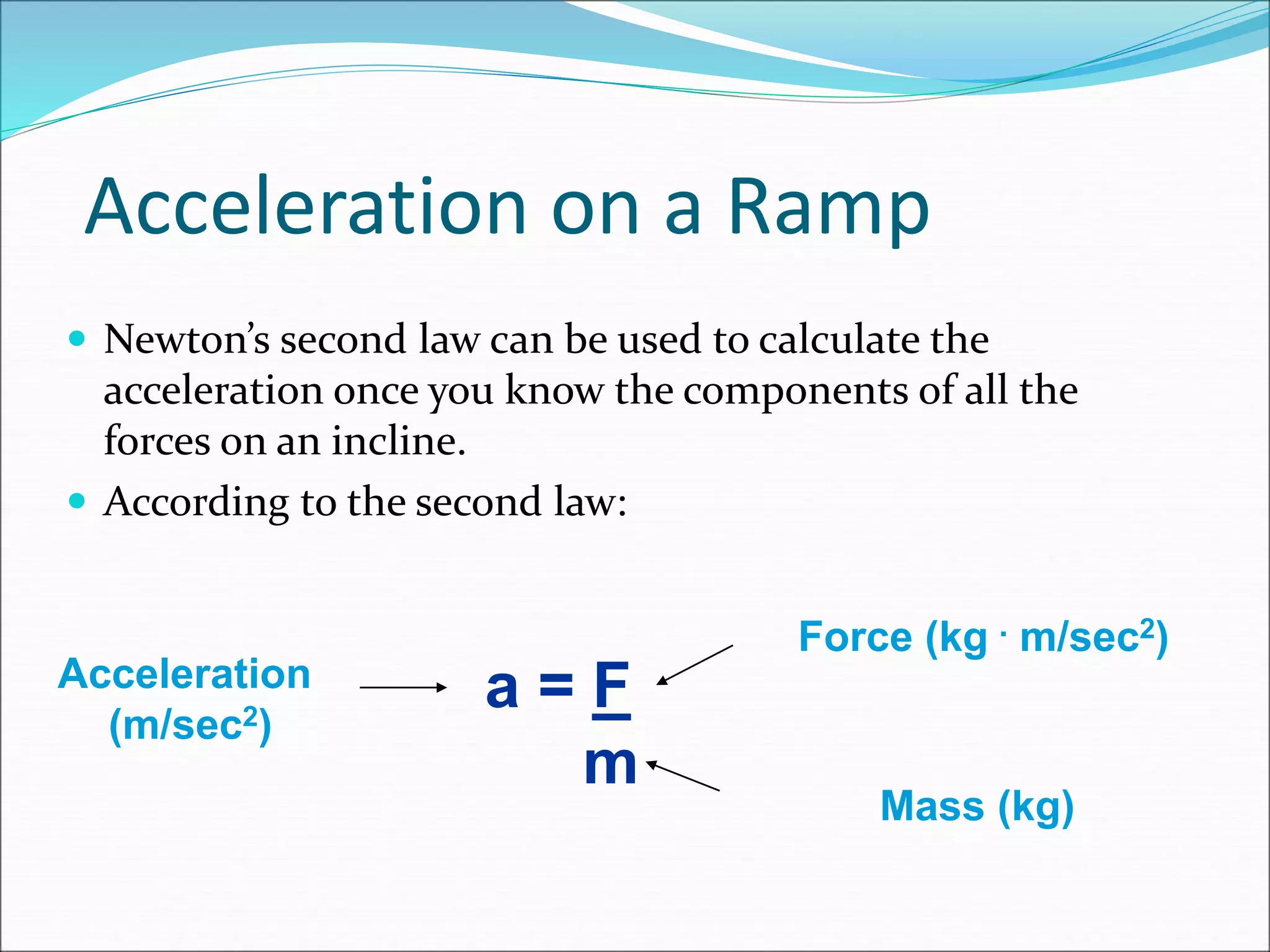
Acceleration on a Ramp
 Newton’s second law can be used to calculate the
acceleration once you know the components of all the
forces on an incline.
 According to the second law:
a = F
m
Force (kg . m/sec2)
Mass (kg)
Acceleration
(m/sec2)
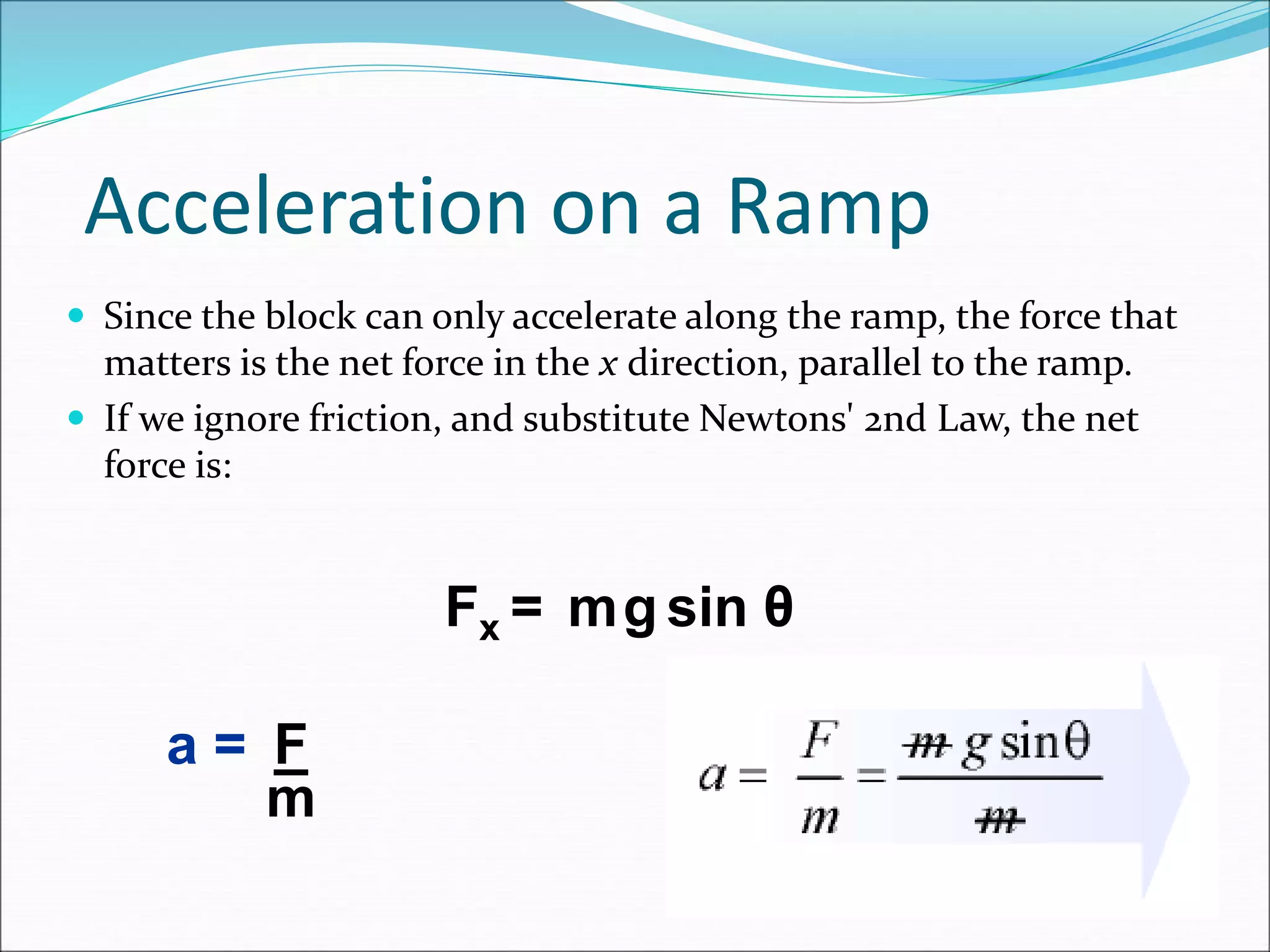
Acceleration on a Ramp
 Since the block can only accelerate along the ramp, the force that
matters is the net force in the x direction, parallel to the ramp.
 If we ignore friction, and substitute Newtons' 2nd Law, the net
force is:
Fx =
a =
m sin θ
g
F
m
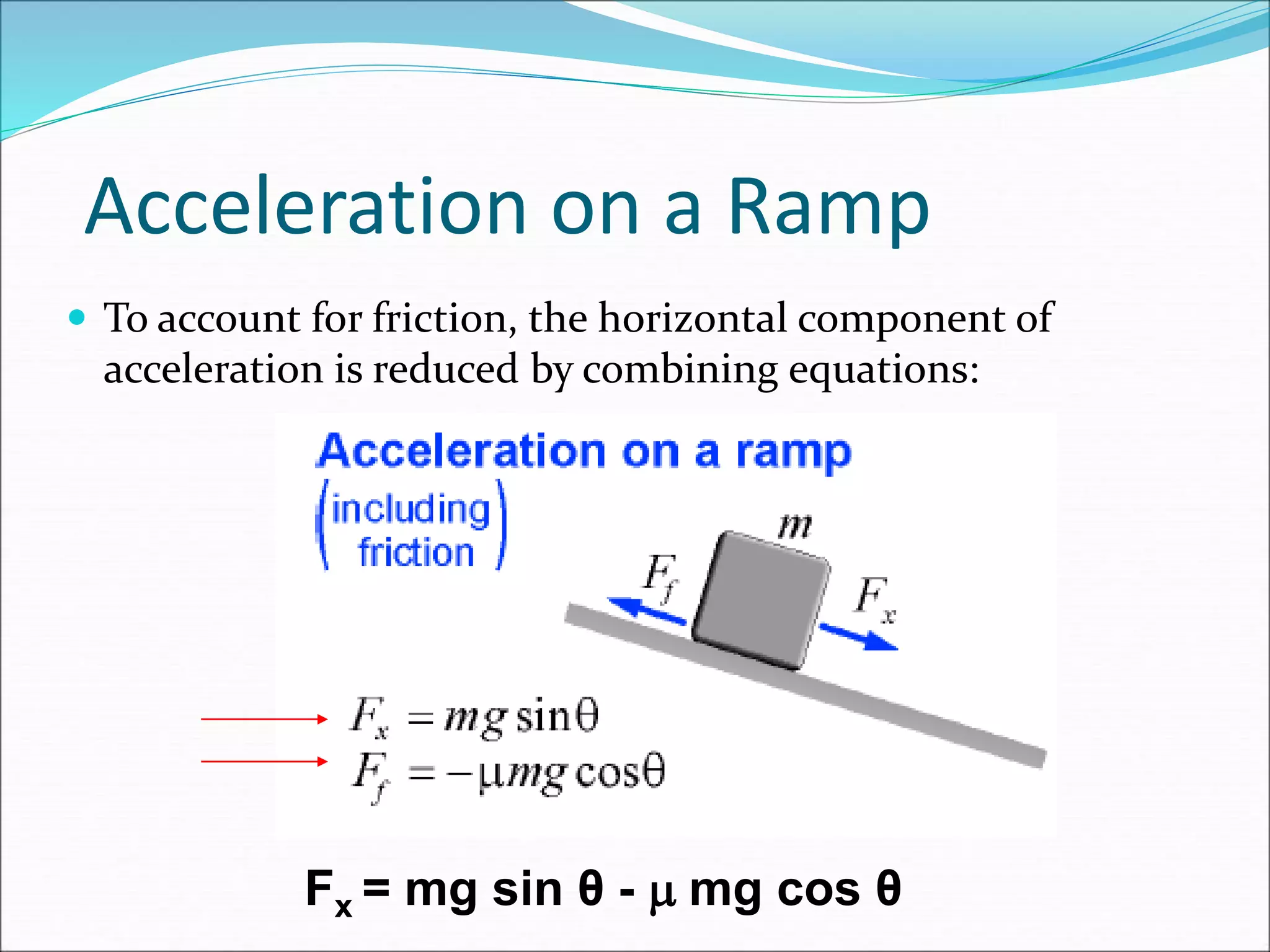
Acceleration on a Ramp
 To account for friction, the horizontal component of
acceleration is reduced by combining equations:
Fx = mg sin θ - m mg cos θ
Acceleration on a Ramp
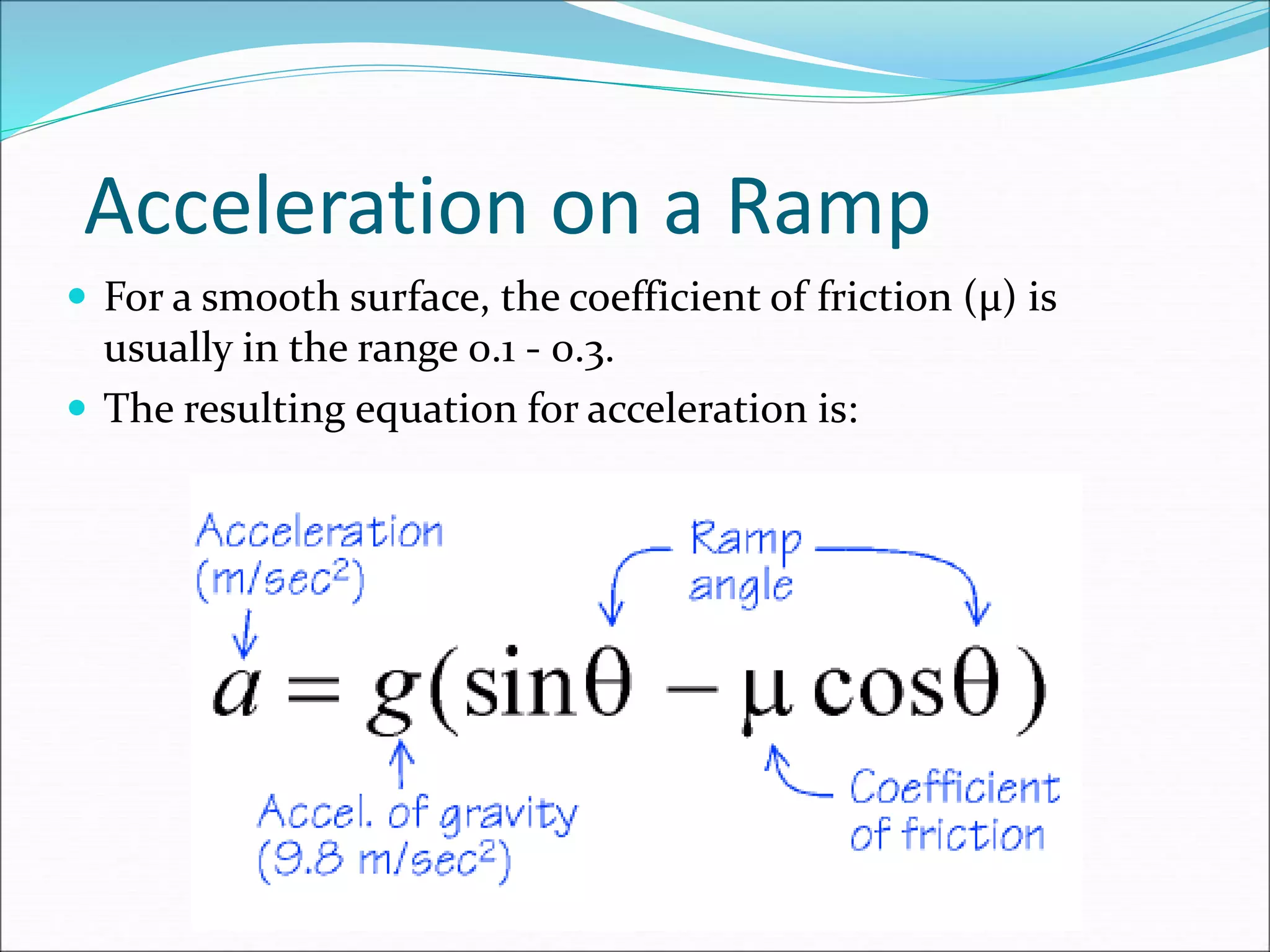
 For a smooth surface, the coefficient of friction (μ) is
usually in the range 0.1 - 0.3.
 The resulting equation for acceleration is:
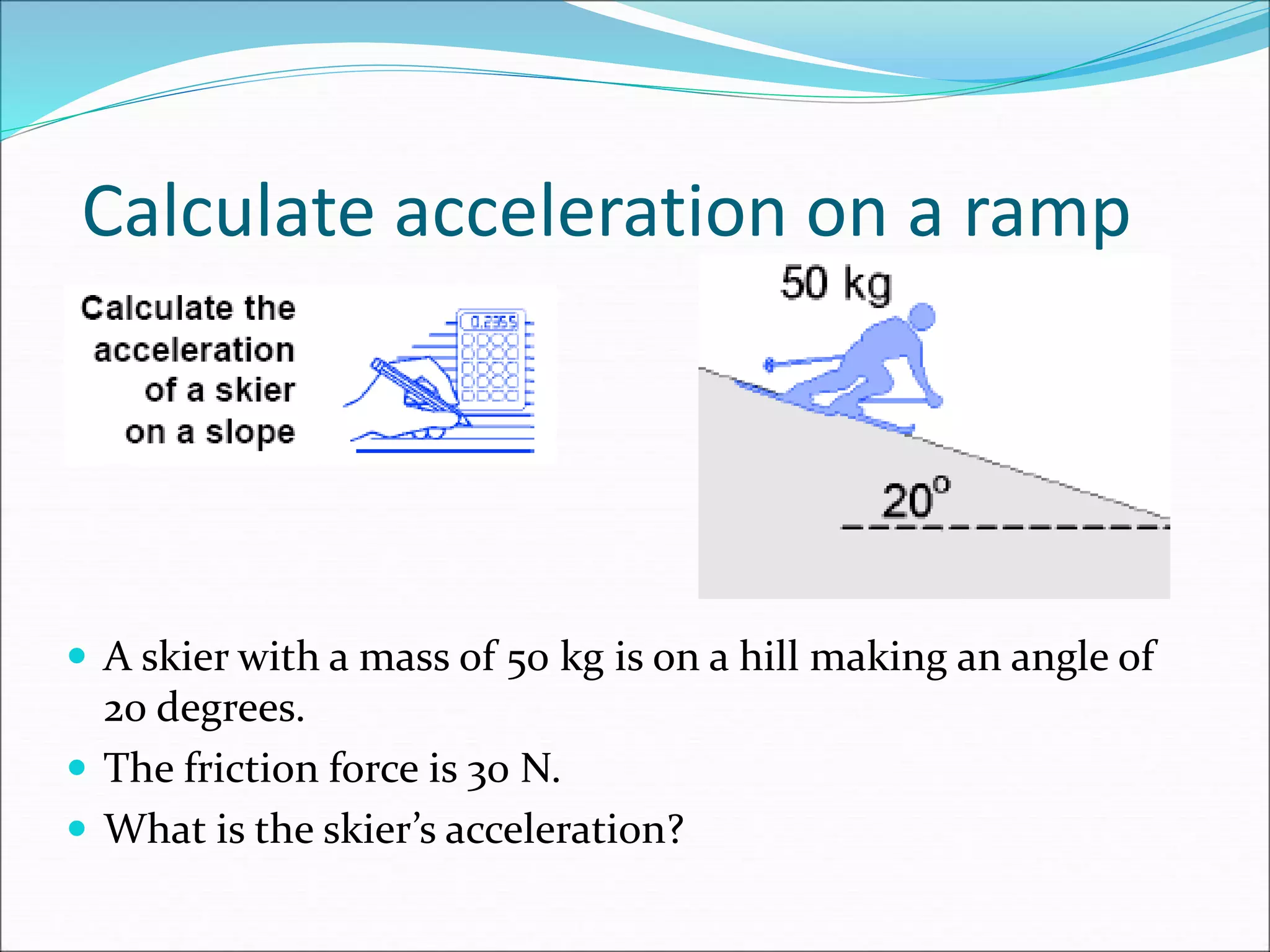
Calculate acceleration on a ramp
 A skier with a mass of 50 kg is on a hill making an angle of
20 degrees.
 The friction force is 30 N.
 What is the skier’s acceleration?
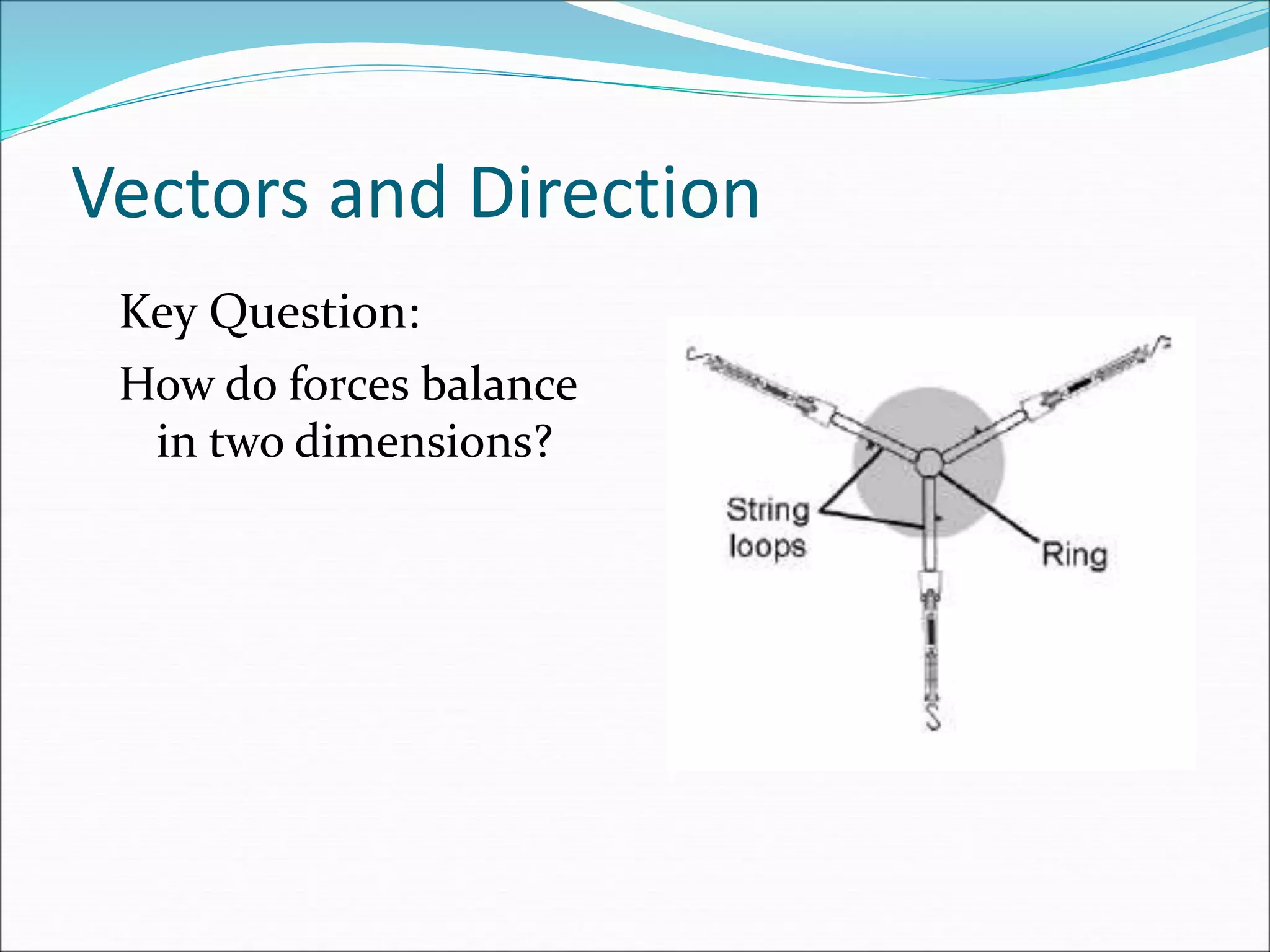
Vectors and Direction
Key Question:
How do forces balance
in two dimensions?

projectile-motion.ppt

  • 1.
    Vector Objectives 1. Addand subtract displacement vectors to describe changes in position. 2. Calculate the x and y components of a displacement, velocity, and force vector. 3. Write a velocity vector in polar and x-y coordinates. 4. Calculate the range of a projectile given the initial velocity vector. 5. Use force vectors to solve two-dimensional equilibrium problems with up to three forces. 6. Calculate the acceleration on an inclined plane when given the angle of incline.
  • 2.
    Chapter 7 VocabularyTerms  vector  scalar  magnitude  x-component  y-component  cosine  parabola  Pythagorean theorem  displacement  resultant  position  resolution  right triangle  sine  dynamics  tangent  normal force  projectile  trajectory  Cartesian coordinates  range  velocity vector  equilibrium  inclined plane  polar coordinates  scale component
  • 3.
    7.1 Vectors andDirection Key Question: How do we accurately communicate length and distance? *Students read Section 7.1 AFTER Investigation 7.1
  • 4.
    Vectors and Direction A scalar is a quantity that can be completely described by one value: the magnitude.  You can think of magnitude as size or amount, including units.
  • 5.
    Vectors and Direction A vector is a quantity that includes both magnitude and direction.  Vectors require more than one number.  The information “1 kilometer, 40 degrees east of north” is an example of a vector.
  • 6.
    Vectors and Direction In drawing a vector as an arrow you must choose a scale.  If you walk five meters east, your displacement can be represented by a 5 cm arrow pointing to the east.
  • 7.
    Vectors and Direction Suppose you walk 5 meters east, turn, go 8 meters north, then turn and go 3 meters west.  Your position is now 8 meters north and 2 meters east of where you started.  The diagonal vector that connects the starting position with the final position is called the resultant.
  • 8.
    Vectors and Direction The resultant is the sum of two or more vectors added together.  You could have walked a shorter distance by going 2 m east and 8 m north, and still ended up in the same place.  The resultant shows the most direct line between the starting position and the final position.
  • 11.
    Calculate a resultantvector  An ant walks 2 meters West, 3 meters North, and 6 meters East.  What is the displacement of the ant?
  • 12.
    Finding Vector Components Graphically Draw a displacement vector as an arrow of appropriate length at the specified angle.  Mark the angle and use a ruler to draw the arrow.
  • 14.
    Finding the Magnitudeof a Vector  When you know the x- and y- components of a vector, and the vectors form a right triangle, you can find the magnitude using the Pythagorean theorem.
  • 15.
    7.1 Adding Vectors Writing vectors in components make it easy to add them.
  • 16.
  • 17.
    Calculate vector magnitude A mail-delivery robot needs to get from where it is to the mail bin on the map.  Find a sequence of two displacement vectors that will allow the robot to avoid hitting the desk in the middle.
  • 18.
    Projectile Motion andthe Velocity Vector  Any object that is moving through the air affected only by gravity is called a projectile.  The path a projectile follows is called its trajectory.
  • 19.
    Projectile Motion andthe Velocity Vector  The trajectory of a thrown basketball follows a special type of arch-shaped curve called a parabola.  The distance a projectile travels horizontally is called its range.
  • 21.
    Projectile Motion andthe Velocity Vector  The velocity vector (v) is a way to precisely describe the speed and direction of motion.  There are two ways to represent velocity.  Both tell how fast and in what direction the ball travels.
  • 22.
    Calculate magnitude Draw thevelocity vector v = (5, 5) m/sec and calculate the magnitude of the velocity (the speed), using the Pythagorean theorem.
  • 23.
    Components of theVelocity Vector  Suppose a car is driving 20 meters per second.  The direction of the vector is 127 degrees.  The polar representation of the velocity is v = (20 m/sec, 127°).
  • 24.
    Calculate velocity  Asoccer ball is kicked at a speed of 10 m/s and an angle of 30 degrees.  Find the horizontal and vertical components of the ball’s initial velocity.
  • 25.
    Adding Velocity Components Sometimes the total velocity of an object is a combination of velocities.  One example is the motion of a boat on a river.  The boat moves with a certain velocity relative to the water.  The water is also moving with another velocity relative to the land.
  • 26.
  • 27.
    Calculate velocity components An airplane is moving at a velocity of 100 m/s in a direction 30 degrees NE relative to the air.  The wind is blowing 40 m/s in a direction 45 degrees SE relative to the ground.  Find the resultant velocity of the airplane relative to the ground.
  • 28.
    Projectile Motion  Whenwe drop a ball from a height we know that its speed increases as it falls.  The increase in speed is due to the acceleration gravity, g = 9.8 m/sec2. Vx Vy x y
  • 29.
    Horizontal Speed  Theball’s horizontal velocity remains constant while it falls because gravity does not exert any horizontal force.  Since there is no force, the horizontal acceleration is zero (ax = 0).  The ball will keep moving to the right at 5 m/sec.
  • 30.
    Horizontal Speed  Thehorizontal distance a projectile moves can be calculated according to the formula:
  • 31.
    Vertical Speed  Thevertical speed (vy) of the ball will increase by 9.8 m/sec after each second.  After one second has passed, vy of the ball will be 9.8 m/sec.  After the 2nd second has passed, vy will be 19.6 m/sec and so on.
  • 33.
    Calculate using projectilemotion  A stunt driver steers a car off a cliff at a speed of 20 meters per second.  He lands in the lake below two seconds later.  Find the height of the cliff and the horizontal distance the car travels.
  • 34.
    Projectiles Launched atan Angle  A soccer ball kicked off the ground is also a projectile, but it starts with an initial velocity that has both vertical and horizontal components. *The launch angle determines how the initial velocity divides between vertical (y) and horizontal (x) directions.
  • 35.
    Steep Angle  Aball launched at a steep angle will have a large vertical velocity component and a small horizontal velocity.
  • 36.
    Shallow Angle  Aball launched at a low angle will have a large horizontal velocity component and a small vertical one.
  • 37.
    Projectiles Launched atan Angle The initial velocity components of an object launched at a velocity vo and angle θ are found by breaking the velocity into x and y components.
  • 38.
    Range of aProjectile  The range, or horizontal distance, traveled by a projectile depends on the launch speed and the launch angle.
  • 39.
    Range of aProjectile  The range of a projectile is calculated from the horizontal velocity and the time of flight.
  • 40.
    Range of aProjectile  A projectile travels farthest when launched at 45 degrees.
  • 41.
    Range of aProjectile  The vertical velocity is responsible for giving the projectile its "hang" time.
  • 42.
    "Hang Time"  Youcan easily calculate your own hang time.  Run toward a doorway and jump as high as you can, touching the wall or door frame.  Have someone watch to see exactly how high you reach.  Measure this distance with a meter stick.  The vertical distance formula can be rearranged to solve for time:
  • 43.
    Projectile Motion andthe Velocity Vector Key Question: Can you predict the landing spot of a projectile? *Students read Section 7.2 BEFORE Investigation 7.2
  • 44.
  • 45.
    In order tosolve “x” we must know “t” Y = vot – ½ g t2 2y = g t2 vot = 0 (zero) Y = ½ g t2 t2 = 2y g t = 2y g
  • 46.
    Forces in TwoDimensions  Force is also represented in x-y components.
  • 47.
    Force Vectors  Ifan object is in equilibrium, all of the forces acting on it are balanced and the net force is zero.  If the forces act in two dimensions, then all of the forces in the x-direction and y-direction balance separately.
  • 48.
    Equilibrium and Forces It is much more difficult for a gymnast to hold his arms out at a 45-degree angle.  To see why, consider that each arm must still support 350 newtons vertically to balance the force of gravity.
  • 49.
    Forces in TwoDimensions  Use the y-component to find the total force in the gymnast’s left arm.
  • 50.
    Forces in TwoDimensions  The force in the right arm must also be 495 newtons because it also has a vertical component of 350 N.
  • 51.
    Forces in TwoDimensions  When the gymnast’s arms are at an angle, only part of the force from each arm is vertical.  The total force must be larger because the vertical component of force in each arm must still equal half his weight.
  • 52.
    Forces and InclinedPlanes  An inclined plane is a straight surface, usually with a slope.  Consider a block sliding down a ramp.  There are three forces that act on the block:  gravity (weight).  friction  the reaction force acting on the block.
  • 53.
    Forces and InclinedPlanes  When discussing forces, the word “normal” means “perpendicular to.”  The normal force acting on the block is the reaction force from the weight of the block pressing against the ramp.
  • 54.
    Forces and InclinedPlanes  The normal force on the block is equal and opposite to the component of the block’s weight perpendicular to the ramp (Fy).
  • 55.
    Forces and InclinedPlanes  The force parallel to the surface (Fx) is given by Fx = mg sinθ.
  • 57.
    Acceleration on aRamp  Newton’s second law can be used to calculate the acceleration once you know the components of all the forces on an incline.  According to the second law: a = F m Force (kg . m/sec2) Mass (kg) Acceleration (m/sec2)
  • 58.
    Acceleration on aRamp  Since the block can only accelerate along the ramp, the force that matters is the net force in the x direction, parallel to the ramp.  If we ignore friction, and substitute Newtons' 2nd Law, the net force is: Fx = a = m sin θ g F m
  • 59.
    Acceleration on aRamp  To account for friction, the horizontal component of acceleration is reduced by combining equations: Fx = mg sin θ - m mg cos θ
  • 60.
    Acceleration on aRamp  For a smooth surface, the coefficient of friction (μ) is usually in the range 0.1 - 0.3.  The resulting equation for acceleration is:
  • 61.
    Calculate acceleration ona ramp  A skier with a mass of 50 kg is on a hill making an angle of 20 degrees.  The friction force is 30 N.  What is the skier’s acceleration?
  • 62.
    Vectors and Direction KeyQuestion: How do forces balance in two dimensions?