Name - Shashank Tiwari
Class - 11th ‘A’
Subject – Physics
Roll no. - 31
Motion :- If the position of an object is
continuously changing w.r.t. its surrounding,
then it is said to be in the state of motion.
Motion is a change in position of an object with
time. It is common to everything in the
universe.
Example - We see that a train is moving on
rails , the walking man, the crawling insect,
water flowing down a dam, etc.
Types of motion –
1) Rectilinear Motion- The motion in which a
particle moves along a straight line is called
rectilinear motion.
Example- Motion of a sliding body on an inclined
plane.
2) Circular Motion- The motion in which a particle
moves in a circular path is called circular motion.
Example- A string whirled in a circular loop.
3) Oscillatory Motion- The motion in which a
particle moves to and fro about a given point is
known as oscillatory motion.
Example- Simple pendulum.
1) Position - It is defined as the point where an
object is situated. Position can be determined
by the coordinate axis that is, marked in units
of length and that has positive and negative
direction.
Example- If an object is situated at -1m then
minus sign indicates that the position has
negative direction but if the object at 0m
position then it will be said to be at rest.
2) Frame of Reference- The fixed point or place with
respect to which the position velocity and
acceleration of a body is measured is known as
frame of reference.
Frame of reference are of two types :-
1) Inertial frame of reference :- Any frame of
reference which is either at rest or moving with
uniform velocity is called Inertial frame of
reference.
Example :- A plane moving on a horizontal track
with constant is an inertial frame reference.
2) Non-Inertial Frame of reference :- A frame of
reference which is accelerated is called non-inertial
frame of reference.
Example :- Body falling down under the force of
gravity.
3) Path length and Distance :- The path covered
by a object in a given time interval, is called
Path length or Distance.
Example :- Suppose an object moves along x-
axis to a distance of 100m from the origin in
time ‘t’. Then the path length is 100m.
4) Displacement :- The shortest distance from the
initial position to the final position of the
particle is called displacement.
Displacement = x2 – x1
Velocity :- The rate of change in position or
displacement of an object with time is called the
velocity of that object.
Velocity = Displacement
Time
1)Uniform Velocity :- An object could have
uniform velocity if it covers equal displacement in
equal interval of time.
2) Non-Uniform Velocity :- A body said to be
move with non-uniform velocity if it covers
unequal displacement in equal interval of time.
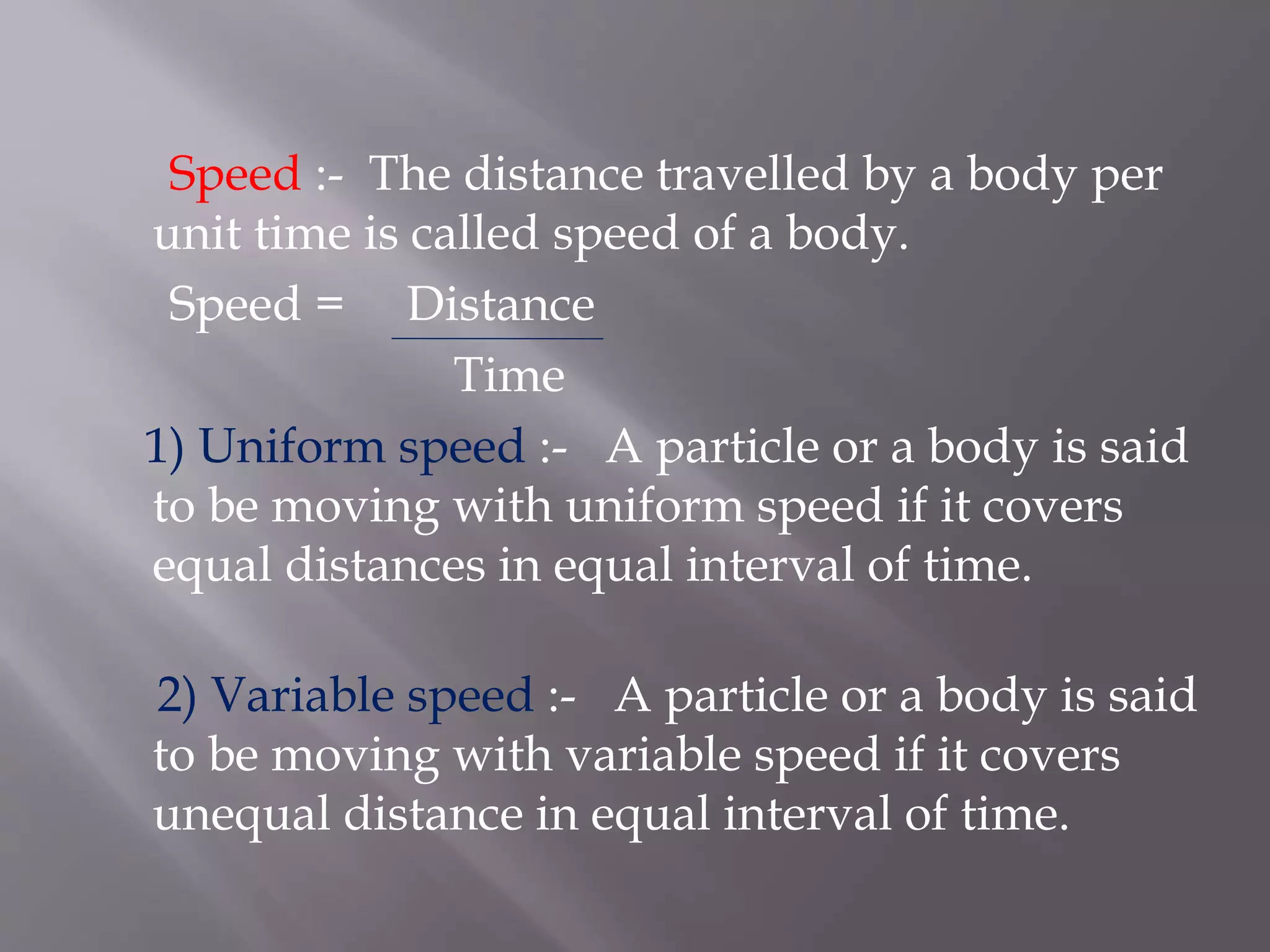
Speed :- The distance travelled by a body per
unit time is called speed of a body.
Speed = Distance
Time
1) Uniform speed :- A particle or a body is said
to be moving with uniform speed if it covers
equal distances in equal interval of time.
2) Variable speed :- A particle or a body is said
to be moving with variable speed if it covers
unequal distance in equal interval of time.
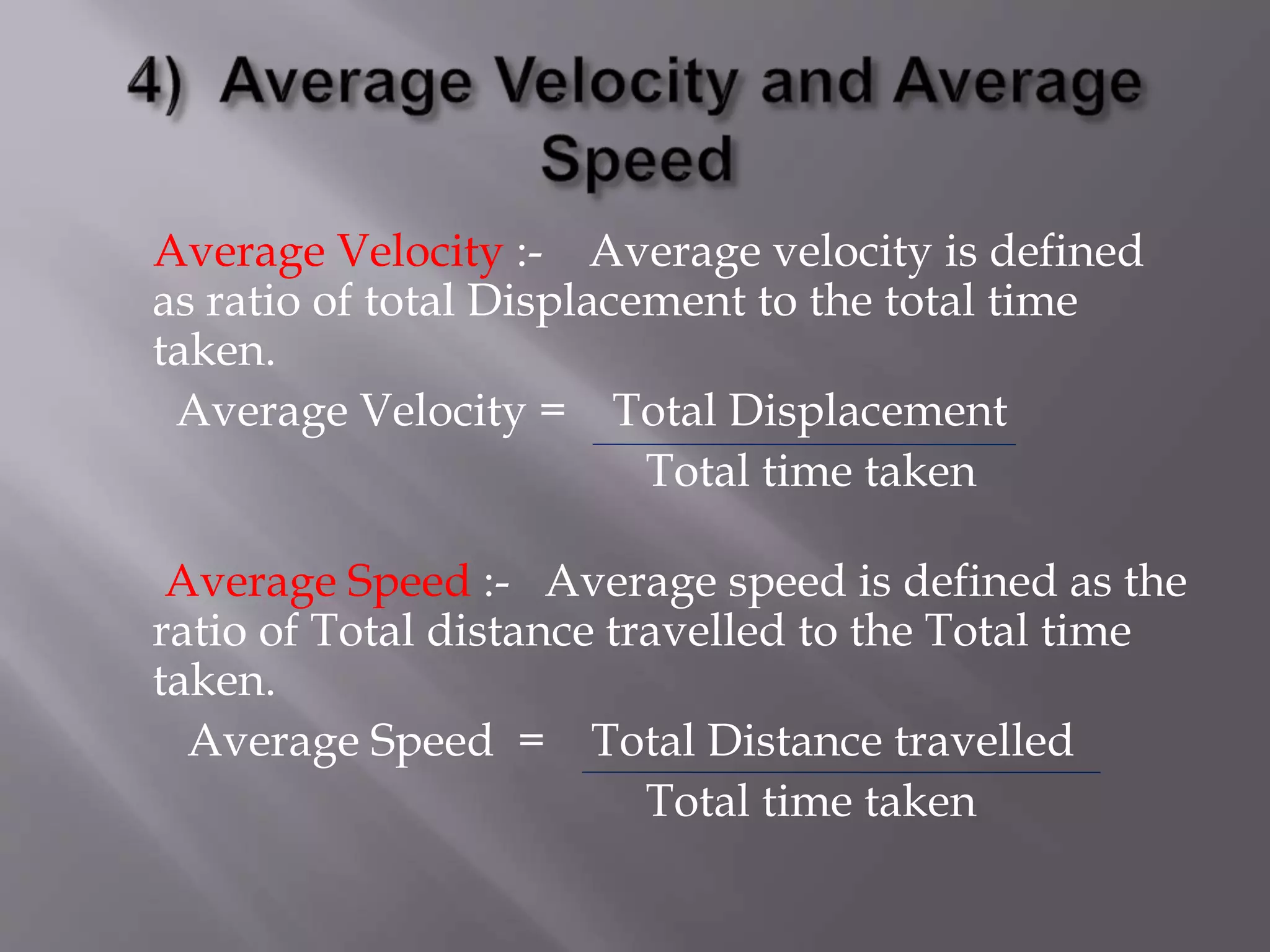
Average Velocity :- Average velocity is defined
as ratio of total Displacement to the total time
taken.
Average Velocity = Total Displacement
Total time taken
Average Speed :- Average speed is defined as the
ratio of Total distance travelled to the Total time
taken.
Average Speed = Total Distance travelled
Total time taken
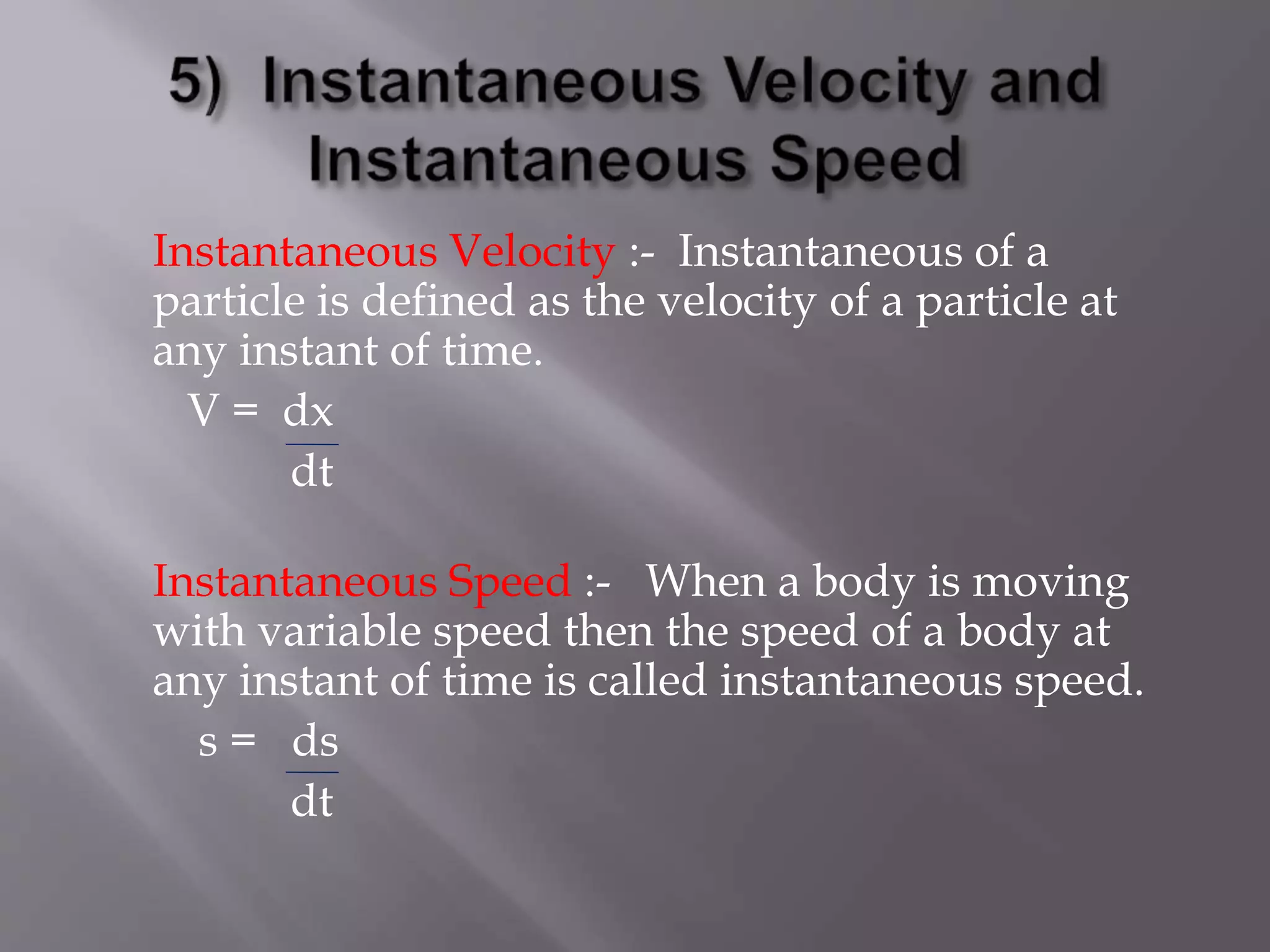
Instantaneous Velocity :- Instantaneous of a
particle is defined as the velocity of a particle at
any instant of time.
V = dx
dt
Instantaneous Speed :- When a body is moving
with variable speed then the speed of a body at
any instant of time is called instantaneous speed.
s = ds
dt
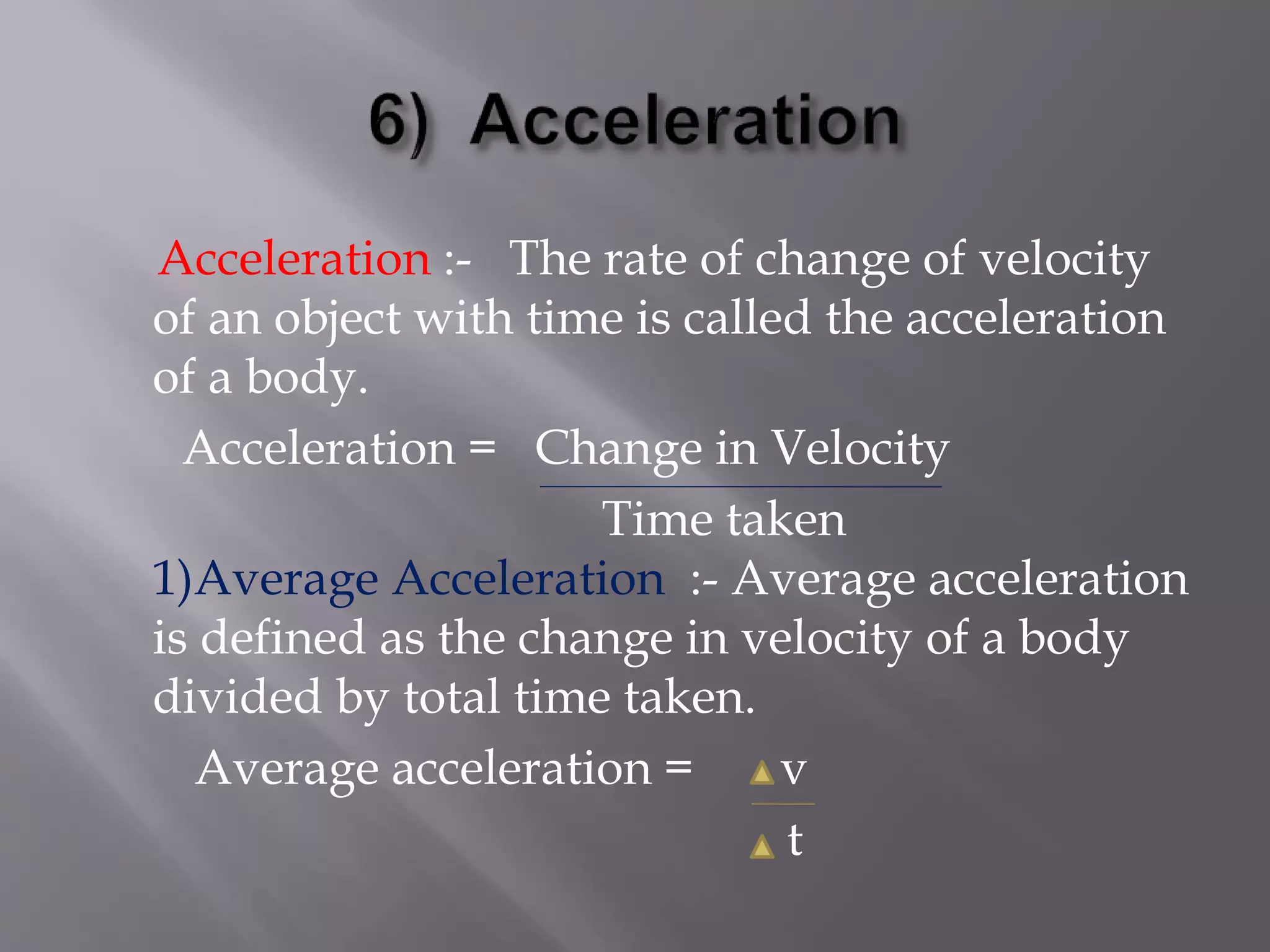
Acceleration :- The rate of change of velocity
of an object with time is called the acceleration
of a body.
Acceleration = Change in Velocity
Time taken
1)Average Acceleration :- Average acceleration
is defined as the change in velocity of a body
divided by total time taken.
Average acceleration = v
t
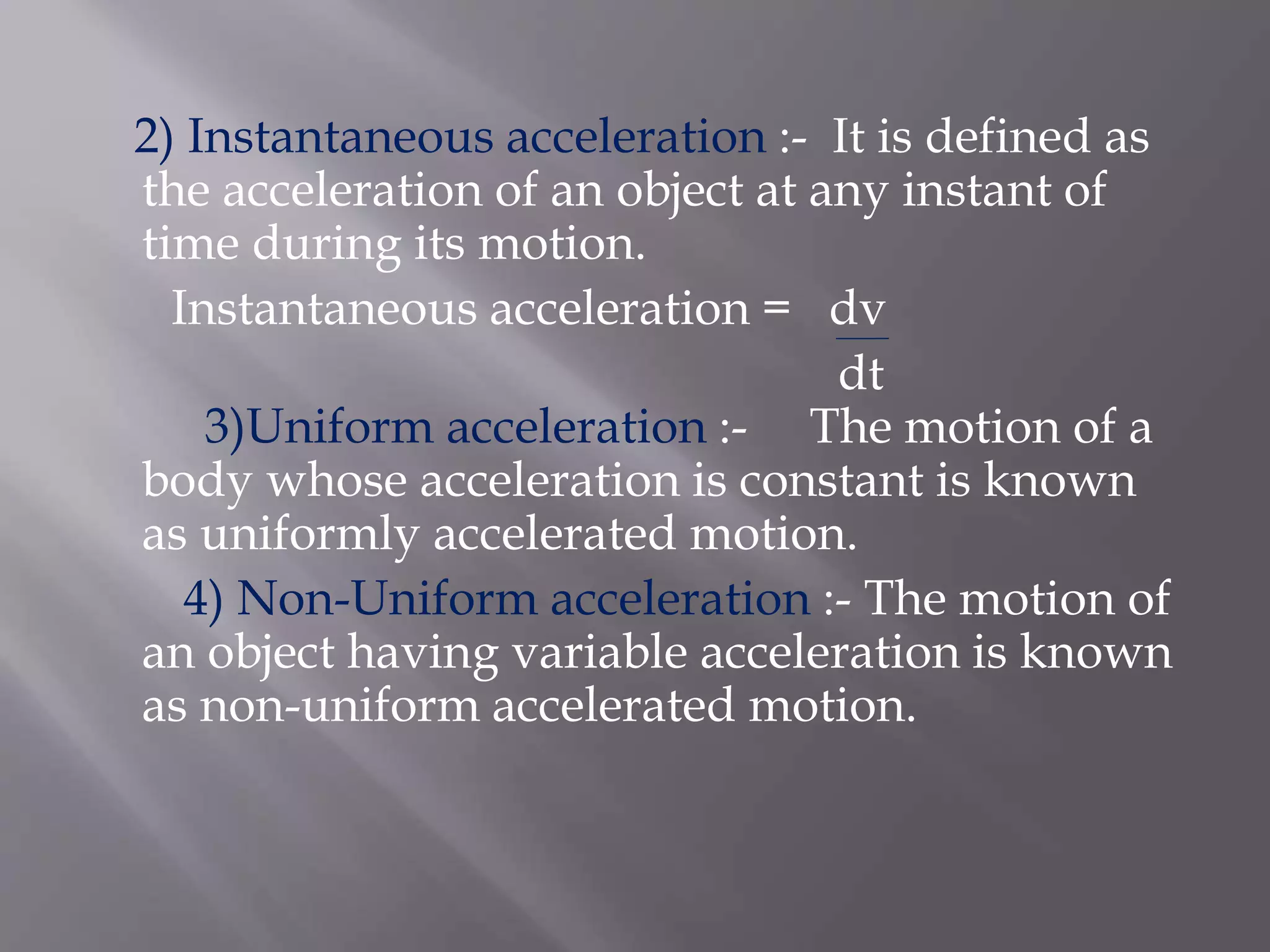
2) Instantaneous acceleration :- It is defined as
the acceleration of an object at any instant of
time during its motion.
Instantaneous acceleration = dv
dt
3)Uniform acceleration :- The motion of a
body whose acceleration is constant is known
as uniformly accelerated motion.
4) Non-Uniform acceleration :- The motion of
an object having variable acceleration is known
as non-uniform accelerated motion.
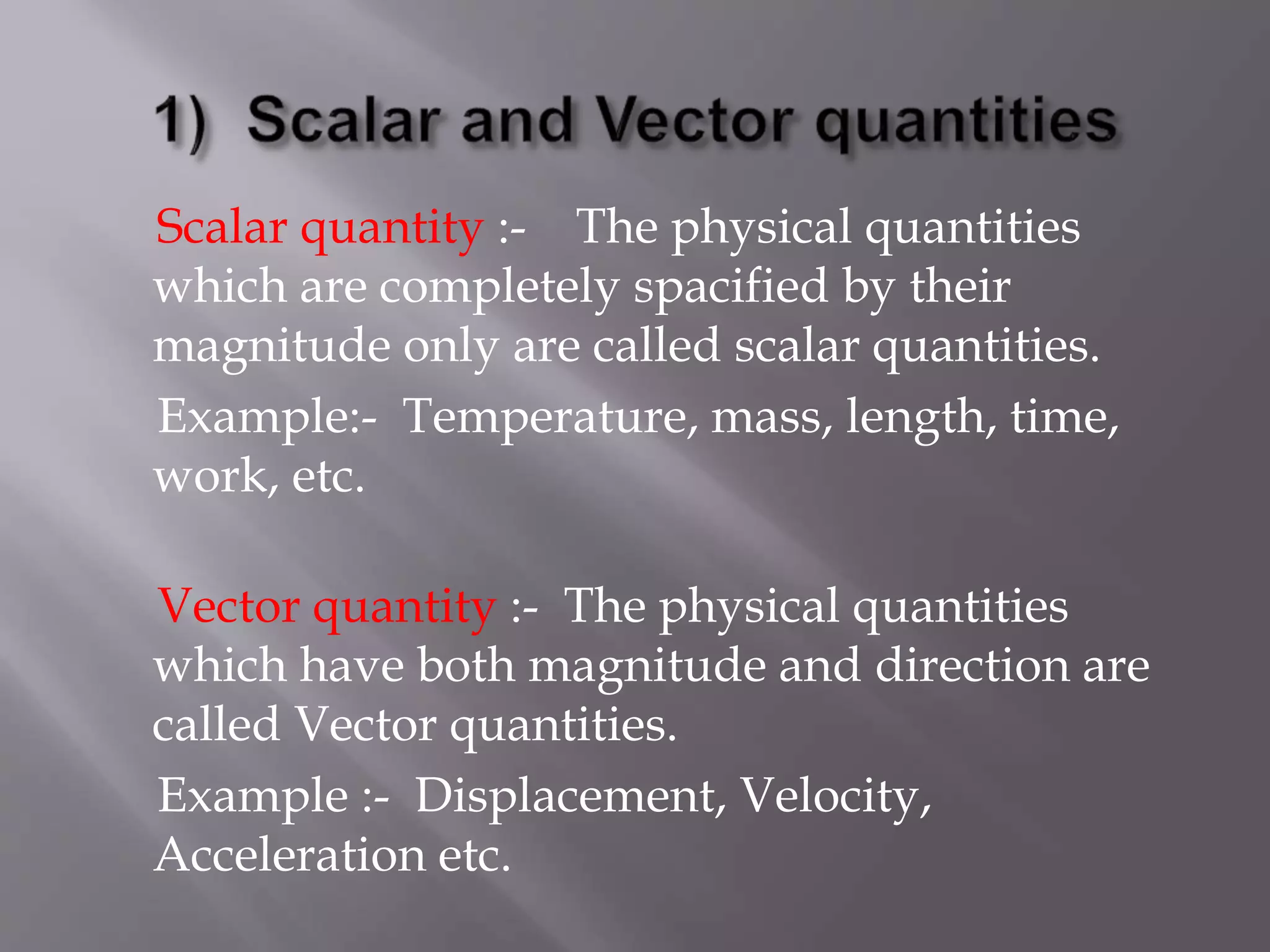
Scalar quantity :- The physical quantities
which are completely spacified by their
magnitude only are called scalar quantities.
Example:- Temperature, mass, length, time,
work, etc.
Vector quantity :- The physical quantities
which have both magnitude and direction are
called Vector quantities.
Example :- Displacement, Velocity,
Acceleration etc.
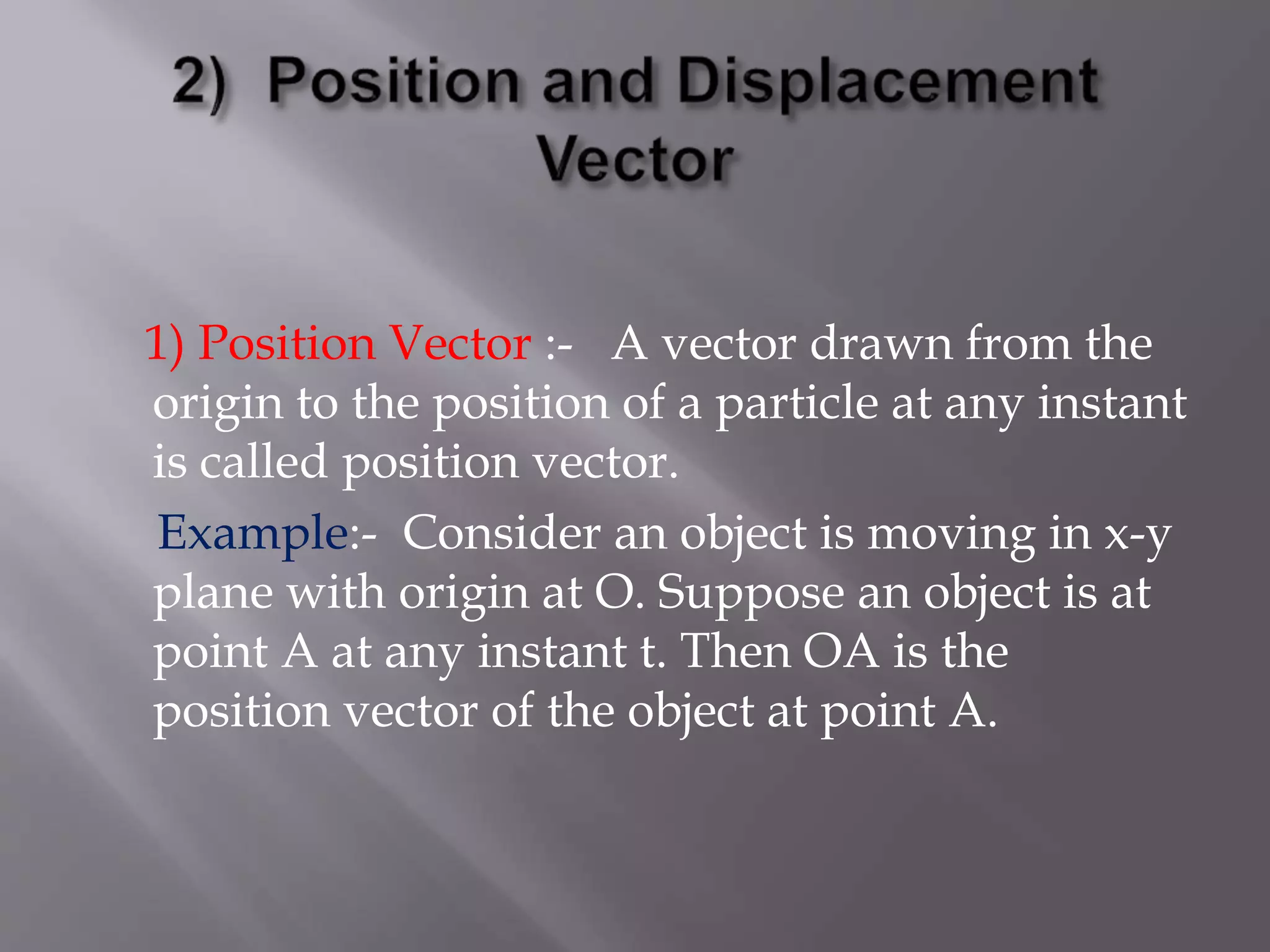
1) Position Vector :- A vector drawn from the
origin to the position of a particle at any instant
is called position vector.
Example:- Consider an object is moving in x-y
plane with origin at O. Suppose an object is at
point A at any instant t. Then OA is the
position vector of the object at point A.
2) Displacement Vector :- The displacement
vector of a moving particle in a given interval
of time is a direct line segment from the initial
to the final position of the particle.
Example:- Consider an object moving in the
x-y plane. Suppose it is at point A at any
instant t and at point B at any later instant t’.
Then vector AB is the displacement vector of
the object in time t to t’.
1) Modulus of a Vector :- The magnitude of a
vector is called modulus of vector. For a
vector A it is represented by |A|.
2) Unit vector :- A vector having magnitude
equal to unity but having a specific direction
is called a unit vector.
3) Null vector :- A vector with magnitude
zero and having an arbitrary direction is
called a null vector.
4) Equal Vectors :- Two vectors are said to be
equal if they have equal magnitude and same
direction.
5) Negative vectors :- Two vectors are said to be
negative of each other if their magnitudes are
equal but direction are opposite.
6) Collinear Vectors :- The two or more vectors
are said to be collinear, when they act along
the same lines or parallel lines.
When two vectors are pointing in two different
directions then they can be added using the
following laws :-
1) Triangle law of vector addition :- If two
vectors are represented both in magnitude and
direction by the two sides of a triangle taken in
the same order, then the resultant of these
vectors is represented both in magnitude and
direction by the third side of the triangle taken
in the opposite order.
2) Parallelogram law of vector addition :- If
two vector are represented both in magnitude
and direction by the adjacent sides of a
parallelogram drawn from a point then the
resultant vector is represented both in
magnitude and direction by the diagonal of
the parallelogram passing through the same
point.
1) Projectile :- An object with initial velocity
and which is then allowed to move under the
action of gravity along is called a projectile.
2) Maximum height attend by a projectile:- The
maximum vertical distance travelled by a
projectile during its journey is called the
maximum height attend by a projectile. It is
represented by ‘H’.
3) Time of Flight :- Total time taken by the
projectile from the point of projection till it hits
the horizontal plane having point of projection
is called time of flight.
4) Horizontal range of projectile :- The
maximum horizontal distance between the
point of projection and the point on the
horizontal plane where the projectile hits is
called horizontal range.
Motion in a Stright Line, Class 11th ,Chapter 1, Physics

Motion in a Stright Line, Class 11th ,Chapter 1, Physics

  • 1.
    Name - ShashankTiwari Class - 11th ‘A’ Subject – Physics Roll no. - 31
  • 3.
    Motion :- Ifthe position of an object is continuously changing w.r.t. its surrounding, then it is said to be in the state of motion. Motion is a change in position of an object with time. It is common to everything in the universe. Example - We see that a train is moving on rails , the walking man, the crawling insect, water flowing down a dam, etc.
  • 4.
    Types of motion– 1) Rectilinear Motion- The motion in which a particle moves along a straight line is called rectilinear motion. Example- Motion of a sliding body on an inclined plane. 2) Circular Motion- The motion in which a particle moves in a circular path is called circular motion. Example- A string whirled in a circular loop. 3) Oscillatory Motion- The motion in which a particle moves to and fro about a given point is known as oscillatory motion. Example- Simple pendulum.
  • 5.
    1) Position -It is defined as the point where an object is situated. Position can be determined by the coordinate axis that is, marked in units of length and that has positive and negative direction. Example- If an object is situated at -1m then minus sign indicates that the position has negative direction but if the object at 0m position then it will be said to be at rest.
  • 6.
    2) Frame ofReference- The fixed point or place with respect to which the position velocity and acceleration of a body is measured is known as frame of reference. Frame of reference are of two types :- 1) Inertial frame of reference :- Any frame of reference which is either at rest or moving with uniform velocity is called Inertial frame of reference. Example :- A plane moving on a horizontal track with constant is an inertial frame reference. 2) Non-Inertial Frame of reference :- A frame of reference which is accelerated is called non-inertial frame of reference. Example :- Body falling down under the force of gravity.
  • 7.
    3) Path lengthand Distance :- The path covered by a object in a given time interval, is called Path length or Distance. Example :- Suppose an object moves along x- axis to a distance of 100m from the origin in time ‘t’. Then the path length is 100m. 4) Displacement :- The shortest distance from the initial position to the final position of the particle is called displacement. Displacement = x2 – x1
  • 8.
    Velocity :- Therate of change in position or displacement of an object with time is called the velocity of that object. Velocity = Displacement Time 1)Uniform Velocity :- An object could have uniform velocity if it covers equal displacement in equal interval of time. 2) Non-Uniform Velocity :- A body said to be move with non-uniform velocity if it covers unequal displacement in equal interval of time.
  • 9.
    Speed :- Thedistance travelled by a body per unit time is called speed of a body. Speed = Distance Time 1) Uniform speed :- A particle or a body is said to be moving with uniform speed if it covers equal distances in equal interval of time. 2) Variable speed :- A particle or a body is said to be moving with variable speed if it covers unequal distance in equal interval of time.
  • 10.
    Average Velocity :-Average velocity is defined as ratio of total Displacement to the total time taken. Average Velocity = Total Displacement Total time taken Average Speed :- Average speed is defined as the ratio of Total distance travelled to the Total time taken. Average Speed = Total Distance travelled Total time taken
  • 11.
    Instantaneous Velocity :-Instantaneous of a particle is defined as the velocity of a particle at any instant of time. V = dx dt Instantaneous Speed :- When a body is moving with variable speed then the speed of a body at any instant of time is called instantaneous speed. s = ds dt
  • 12.
    Acceleration :- Therate of change of velocity of an object with time is called the acceleration of a body. Acceleration = Change in Velocity Time taken 1)Average Acceleration :- Average acceleration is defined as the change in velocity of a body divided by total time taken. Average acceleration = v t
  • 13.
    2) Instantaneous acceleration:- It is defined as the acceleration of an object at any instant of time during its motion. Instantaneous acceleration = dv dt 3)Uniform acceleration :- The motion of a body whose acceleration is constant is known as uniformly accelerated motion. 4) Non-Uniform acceleration :- The motion of an object having variable acceleration is known as non-uniform accelerated motion.
  • 15.
    Scalar quantity :-The physical quantities which are completely spacified by their magnitude only are called scalar quantities. Example:- Temperature, mass, length, time, work, etc. Vector quantity :- The physical quantities which have both magnitude and direction are called Vector quantities. Example :- Displacement, Velocity, Acceleration etc.
  • 16.
    1) Position Vector:- A vector drawn from the origin to the position of a particle at any instant is called position vector. Example:- Consider an object is moving in x-y plane with origin at O. Suppose an object is at point A at any instant t. Then OA is the position vector of the object at point A.
  • 17.
    2) Displacement Vector:- The displacement vector of a moving particle in a given interval of time is a direct line segment from the initial to the final position of the particle. Example:- Consider an object moving in the x-y plane. Suppose it is at point A at any instant t and at point B at any later instant t’. Then vector AB is the displacement vector of the object in time t to t’.
  • 18.
    1) Modulus ofa Vector :- The magnitude of a vector is called modulus of vector. For a vector A it is represented by |A|. 2) Unit vector :- A vector having magnitude equal to unity but having a specific direction is called a unit vector. 3) Null vector :- A vector with magnitude zero and having an arbitrary direction is called a null vector.
  • 19.
    4) Equal Vectors:- Two vectors are said to be equal if they have equal magnitude and same direction. 5) Negative vectors :- Two vectors are said to be negative of each other if their magnitudes are equal but direction are opposite. 6) Collinear Vectors :- The two or more vectors are said to be collinear, when they act along the same lines or parallel lines.
  • 20.
    When two vectorsare pointing in two different directions then they can be added using the following laws :- 1) Triangle law of vector addition :- If two vectors are represented both in magnitude and direction by the two sides of a triangle taken in the same order, then the resultant of these vectors is represented both in magnitude and direction by the third side of the triangle taken in the opposite order.
  • 21.
    2) Parallelogram lawof vector addition :- If two vector are represented both in magnitude and direction by the adjacent sides of a parallelogram drawn from a point then the resultant vector is represented both in magnitude and direction by the diagonal of the parallelogram passing through the same point.
  • 22.
    1) Projectile :-An object with initial velocity and which is then allowed to move under the action of gravity along is called a projectile. 2) Maximum height attend by a projectile:- The maximum vertical distance travelled by a projectile during its journey is called the maximum height attend by a projectile. It is represented by ‘H’.
  • 23.
    3) Time ofFlight :- Total time taken by the projectile from the point of projection till it hits the horizontal plane having point of projection is called time of flight. 4) Horizontal range of projectile :- The maximum horizontal distance between the point of projection and the point on the horizontal plane where the projectile hits is called horizontal range.