MOTION
IN TWO DIMENSIONS
(PROJECTILE MOTION)
Chapter04 from HRK.
Course code: 301
Course Title: Mechanics and properties of Matter
Course Incharge: SEHRISH INAM
Date: March08,2022
PROJECTILE MOTION
What is the path of a projectile as it moves
through the air?
 Parabolic?
 Straight up and down?
Yes, both are possible.
What forces act on projectiles?
 Only gravity, which acts only in the negative
y-direction.
 Air resistance is ignored in projectile motion.
MOTION IN TWO DIMENSIONS
Using + or – signs is not always sufficient
to fully describe motion in more than one
dimension
 Vectors can be used to more fully describe
motion
Still interested in displacement, velocity,
and acceleration
Will serve as the basis of multiple types of
motion in future chapters
GENERAL MOTION IDEAS
In two- or three-dimensional
kinematics, everything is the same as
as in one-dimensional motion except
that we must now use full vector
notation
 Positive and negative signs are no
longer sufficient to determine the
direction
PROJECTILE MOTION
An object may move in both the x and
y directions simultaneously
The form of two-dimensional motion
we will deal with is called projectile
motion
The object which is being moved in 2
dimension simultaneously is known
as projectile.
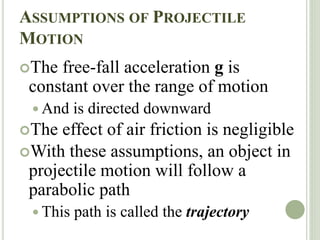
ASSUMPTIONS OF PROJECTILE
MOTION
The free-fall acceleration g is
constant over the range of motion
 And is directed downward
The effect of air friction is negligible
With these assumptions, an object in
projectile motion will follow a
parabolic path
 This path is called the trajectory
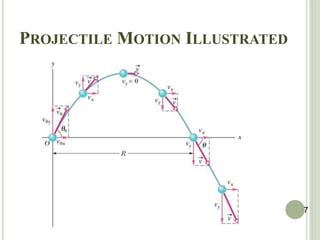
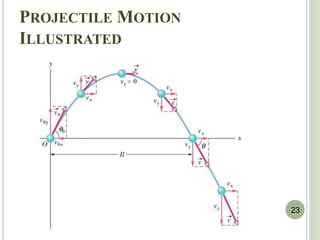
PROJECTILE MOTION ILLUSTRATED
7
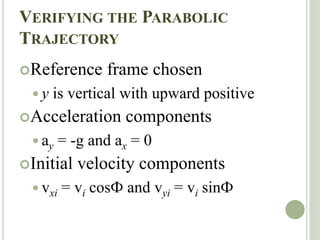
VERIFYING THE PARABOLIC
TRAJECTORY
Reference frame chosen
 y is vertical with upward positive
Acceleration components
 ay = -g and ax = 0
Initial velocity components
 vxi = vi cosФ and vyi = vi sinФ
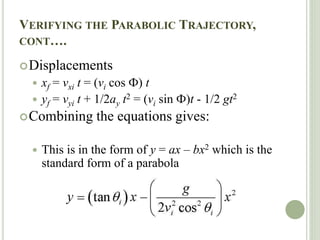
VERIFYING THE PARABOLIC TRAJECTORY,
CONT….
Displacements
 xf = vxi t = (vi cos Ф) t
 yf = vyi t + 1/2ay t2 = (vi sin Ф)t - 1/2 gt2
Combining the equations gives:
 This is in the form of y = ax – bx2 which is the
standard form of a parabola
ANALYZING PROJECTILE MOTION
Consider the motion as the superposition
of the motions in the x- and y-directions
The x-direction has constant velocity
 ax = 0
The y-direction is free fall
 ay = -g
The actual position at any time is given
by: rf = ri + vit + 1/2gt2
PROJECTILE MOTION VECTORS
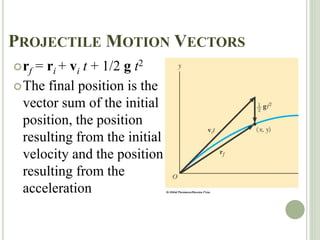
rf = ri + vi t + 1/2 g t2
The final position is the
vector sum of the initial
position, the position
resulting from the initial
velocity and the position
resulting from the
acceleration
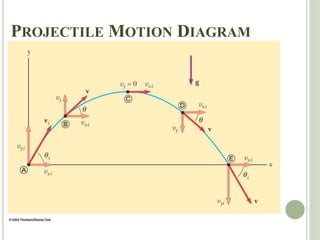
PROJECTILE MOTION DIAGRAM
PROJECTILE MOTION IMPLICATIONS
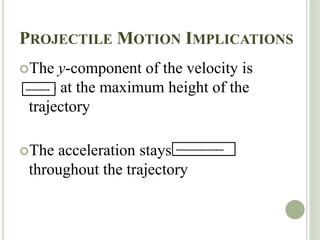
The y-component of the velocity is
zero at the maximum height of the
trajectory
The acceleration stays the same
throughout the trajectory
---------
------------------
RANGE &MAXIMUM HEIGHT OF A
PROJECTILE
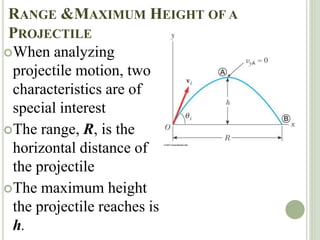
When analyzing
projectile motion, two
characteristics are of
special interest
The range, R, is the
horizontal distance of
the projectile
The maximum height
the projectile reaches is
h.
HEIGHT OF A PROJECTILE,
EQUATION
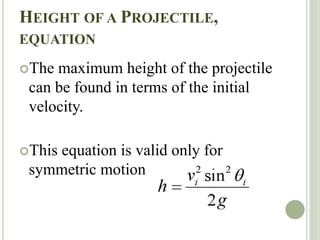
The maximum height of the projectile
can be found in terms of the initial
velocity.
This equation is valid only for
symmetric motion
RANGE OF A PROJECTILE, EQUATION
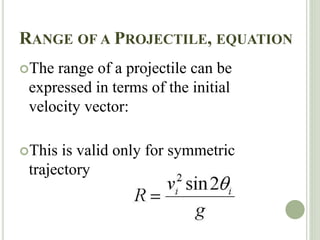
The range of a projectile can be
expressed in terms of the initial
velocity vector:
This is valid only for symmetric
trajectory
MORE ABOUT THE RANGE OF A
PROJECTILE
RANGE OF A PROJECTILE, FINAL
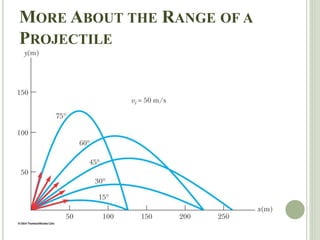
The maximum range occurs at Ф =
45o
Complementary angles will produce
the same range
 The maximum height will be different
for the two angles
 The times of the flight will be
different for the two angles.
PROJECTILE MOTION – PROBLEM
SOLVING HINTS
Select a coordinate system
Resolve the initial velocity into x and y
components
Analyze the horizontal motion using
constant velocity techniques
Analyze the vertical motion using constant
acceleration techniques
Remember that both directions share the
same time.
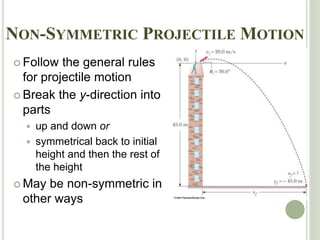
NON-SYMMETRIC PROJECTILE MOTION
 Follow the general rules
for projectile motion
 Break the y-direction into
parts
 up and down or
 symmetrical back to initial
height and then the rest of
the height
 May be non-symmetric in
other ways
ACCELERATION IN DIFFERENT
FRAMES OF REFERENCE
The derivative of the velocity equation will
give the acceleration equation
The acceleration of the particle measured
by an observer in one frame of reference is
the same as that measured by any other
observer moving at a constant velocity
relative to the first frame.
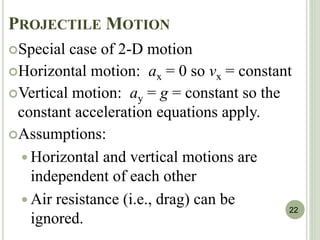
PROJECTILE MOTION
Special case of 2-D motion
Horizontal motion: ax = 0 so vx = constant
Vertical motion: ay = g = constant so the
constant acceleration equations apply.
Assumptions:
 Horizontal and vertical motions are
independent of each other
 Air resistance (i.e., drag) can be
ignored.
22
PROJECTILE MOTION
ILLUSTRATED
23
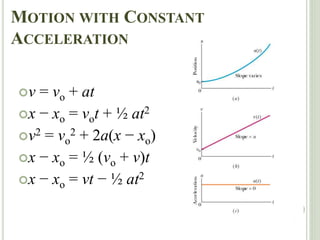
MOTION WITH CONSTANT
ACCELERATION
v = vo + at
x − xo = vot + ½ at2
v2 = vo
2 + 2a(x − xo)
x − xo = ½ (vo + v)t
x − xo = vt − ½ at2
24
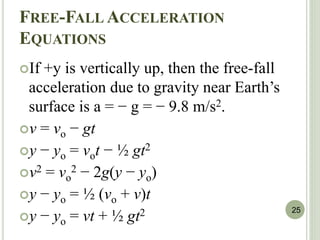
FREE-FALL ACCELERATION
EQUATIONS
If +y is vertically up, then the free-fall
acceleration due to gravity near Earth’s
surface is a = − g = − 9.8 m/s2.
v = vo − gt
y − yo = vot − ½ gt2
v2 = vo
2 − 2g(y − yo)
y − yo = ½ (vo + v)t
y − yo = vt + ½ gt2 25
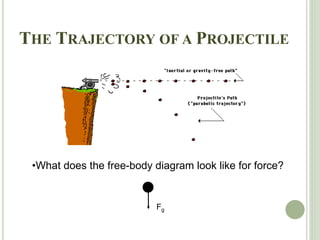
THE TRAJECTORY OF A PROJECTILE
•What does the free-body diagram look like for force?
Fg
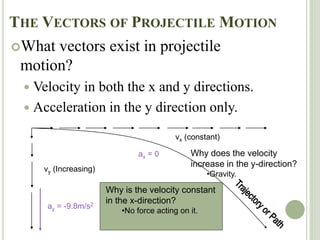
THE VECTORS OF PROJECTILE MOTION
What vectors exist in projectile
motion?
 Velocity in both the x and y directions.
 Acceleration in the y direction only.
vy (Increasing)
vx (constant)
ay = -9.8m/s2
ax = 0
Why is the velocity constant
in the x-direction?
•No force acting on it.
Why does the velocity
increase in the y-direction?
•Gravity.
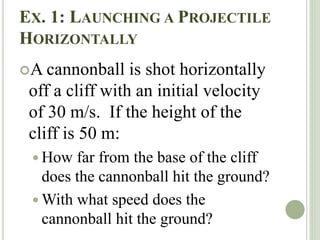
EX. 1: LAUNCHING A PROJECTILE
HORIZONTALLY
A cannonball is shot horizontally
off a cliff with an initial velocity
of 30 m/s. If the height of the
cliff is 50 m:
 How far from the base of the cliff
does the cannonball hit the ground?
 With what speed does the
cannonball hit the ground?
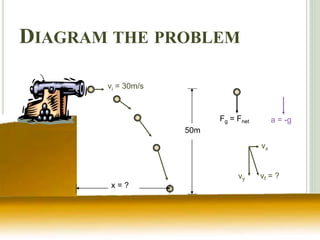
DIAGRAM THE PROBLEM
50m
Fg = Fnet a = -g
vi = 30m/s
vf = ?
vx
vy
x = ?
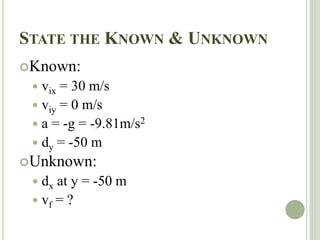
STATE THE KNOWN & UNKNOWN
Known:
 vix = 30 m/s
 viy = 0 m/s
 a = -g = -9.81m/s2
 dy = -50 m
Unknown:
 dx at y = -50 m
 vf = ?
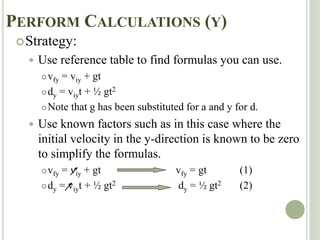
PERFORM CALCULATIONS (Y)
Strategy:
 Use reference table to find formulas you can use.
vfy = viy + gt
dy = viyt + ½ gt2
Note that g has been substituted for a and y for d.
 Use known factors such as in this case where the
initial velocity in the y-direction is known to be zero
to simplify the formulas.
vfy = viy + gt vfy = gt (1)
dy = viyt + ½ gt2 dy = ½ gt2 (2)
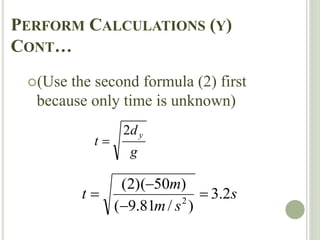
PERFORM CALCULATIONS (Y)
CONT…
(Use the second formula (2) first
because only time is unknown)
g
d
t
y
2

s
s
m
m
t 2
.
3
)
/
81
.
9
(
)
50
)(
2
(
2




PERFORM CALCULATIONS (Y)
CONT…..
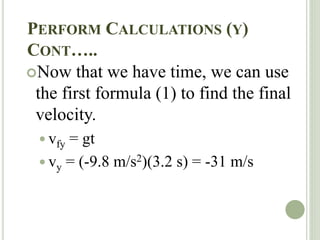
Now that we have time, we can use
the first formula (1) to find the final
velocity.
 vfy = gt
 vy = (-9.8 m/s2)(3.2 s) = -31 m/s
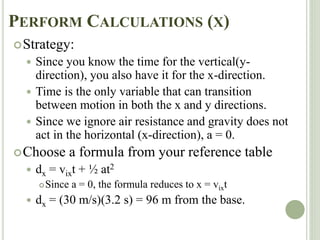
PERFORM CALCULATIONS (X)
Strategy:
 Since you know the time for the vertical(y-
direction), you also have it for the x-direction.
 Time is the only variable that can transition
between motion in both the x and y directions.
 Since we ignore air resistance and gravity does not
act in the horizontal (x-direction), a = 0.
Choose a formula from your reference table
 dx = vixt + ½ at2
Since a = 0, the formula reduces to x = vixt
 dx = (30 m/s)(3.2 s) = 96 m from the base.
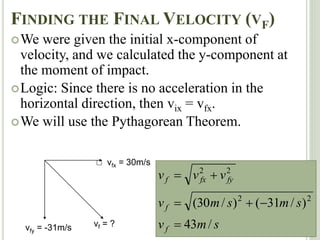
FINDING THE FINAL VELOCITY (VF)
We were given the initial x-component of
velocity, and we calculated the y-component at
the moment of impact.
Logic: Since there is no acceleration in the
horizontal direction, then vix = vfx.
We will use the Pythagorean Theorem.
vfx = 30m/s
vfy = -31m/s s
m
v
s
m
s
m
v
v
v
v
f
f
fy
fx
f
/
43
)
/
31
(
)
/
30
( 2
2
2
2






vf = ?
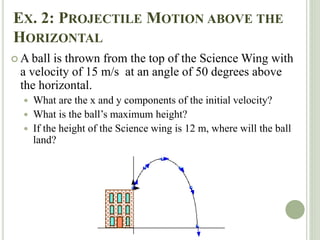
EX. 2: PROJECTILE MOTION ABOVE THE
HORIZONTAL
 A ball is thrown from the top of the Science Wing with
a velocity of 15 m/s at an angle of 50 degrees above
the horizontal.
 What are the x and y components of the initial velocity?
 What is the ball’s maximum height?
 If the height of the Science wing is 12 m, where will the ball
land?
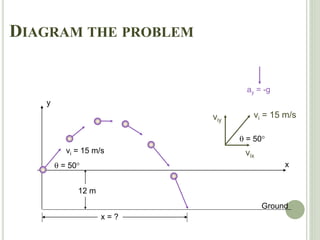
DIAGRAM THE PROBLEM
y
x
vi = 15 m/s
 = 50°
ay = -g
Ground
12 m
x = ?
vi = 15 m/s
vix
viy
 = 50°
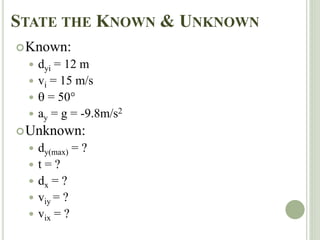
STATE THE KNOWN & UNKNOWN
Known:
 dyi = 12 m
 vi = 15 m/s
  = 50°
 ay = g = -9.8m/s2
Unknown:
 dy(max) = ?
 t = ?
 dx = ?
 viy = ?
 vix = ?
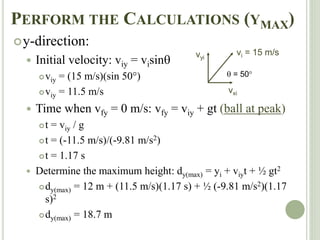
PERFORM THE CALCULATIONS (YMAX)
y-direction:
 Initial velocity: viy = visin
viy = (15 m/s)(sin 50°)
viy = 11.5 m/s
 Time when vfy = 0 m/s: vfy = viy + gt (ball at peak)
t = viy / g
t = (-11.5 m/s)/(-9.81 m/s2)
t = 1.17 s
 Determine the maximum height: dy(max) = yi + viyt + ½ gt2
dy(max) = 12 m + (11.5 m/s)(1.17 s) + ½ (-9.81 m/s2)(1.17
s)2
dy(max) = 18.7 m
vi = 15 m/s
vxi
vyi
 = 50°
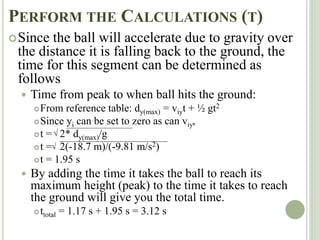
PERFORM THE CALCULATIONS (T)
Since the ball will accelerate due to gravity over
the distance it is falling back to the ground, the
time for this segment can be determined as
follows
 Time from peak to when ball hits the ground:
From reference table: dy(max) = viyt + ½ gt2
Since yi can be set to zero as can viy,
t = 2* dy(max)/g
t = 2(-18.7 m)/(-9.81 m/s2)
t = 1.95 s
 By adding the time it takes the ball to reach its
maximum height (peak) to the time it takes to reach
the ground will give you the total time.
ttotal = 1.17 s + 1.95 s = 3.12 s


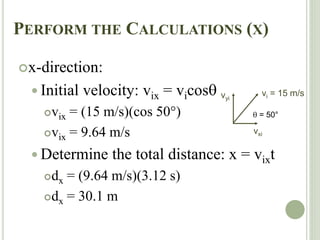
PERFORM THE CALCULATIONS (X)
x-direction:
 Initial velocity: vix = vicos
vix = (15 m/s)(cos 50°)
vix = 9.64 m/s
 Determine the total distance: x = vixt
dx = (9.64 m/s)(3.12 s)
dx = 30.1 m
vi = 15 m/s
vxi
vyi
 = 50°
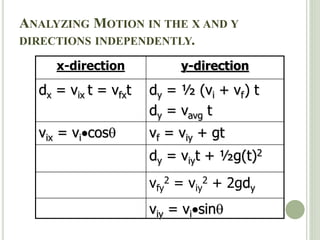
ANALYZING MOTION IN THE X AND Y
DIRECTIONS INDEPENDENTLY.
x-direction y-direction
dx = vix t = vfxt dy = ½ (vi + vf) t
dy = vavg t
vix = vicos vf = viy + gt
dy = viyt + ½g(t)2
vfy
2 = viy
2 + 2gdy
viy = visin

Ch#4 MOTION IN 2 DIMENSIONS

  • 1.
    MOTION IN TWO DIMENSIONS (PROJECTILEMOTION) Chapter04 from HRK. Course code: 301 Course Title: Mechanics and properties of Matter Course Incharge: SEHRISH INAM Date: March08,2022
  • 2.
    PROJECTILE MOTION What isthe path of a projectile as it moves through the air?  Parabolic?  Straight up and down? Yes, both are possible. What forces act on projectiles?  Only gravity, which acts only in the negative y-direction.  Air resistance is ignored in projectile motion.
  • 3.
    MOTION IN TWODIMENSIONS Using + or – signs is not always sufficient to fully describe motion in more than one dimension  Vectors can be used to more fully describe motion Still interested in displacement, velocity, and acceleration Will serve as the basis of multiple types of motion in future chapters
  • 4.
    GENERAL MOTION IDEAS Intwo- or three-dimensional kinematics, everything is the same as as in one-dimensional motion except that we must now use full vector notation  Positive and negative signs are no longer sufficient to determine the direction
  • 5.
    PROJECTILE MOTION An objectmay move in both the x and y directions simultaneously The form of two-dimensional motion we will deal with is called projectile motion The object which is being moved in 2 dimension simultaneously is known as projectile.
  • 6.
    ASSUMPTIONS OF PROJECTILE MOTION Thefree-fall acceleration g is constant over the range of motion  And is directed downward The effect of air friction is negligible With these assumptions, an object in projectile motion will follow a parabolic path  This path is called the trajectory
  • 7.
  • 8.
    VERIFYING THE PARABOLIC TRAJECTORY Referenceframe chosen  y is vertical with upward positive Acceleration components  ay = -g and ax = 0 Initial velocity components  vxi = vi cosФ and vyi = vi sinФ
  • 9.
    VERIFYING THE PARABOLICTRAJECTORY, CONT…. Displacements  xf = vxi t = (vi cos Ф) t  yf = vyi t + 1/2ay t2 = (vi sin Ф)t - 1/2 gt2 Combining the equations gives:  This is in the form of y = ax – bx2 which is the standard form of a parabola
  • 10.
    ANALYZING PROJECTILE MOTION Considerthe motion as the superposition of the motions in the x- and y-directions The x-direction has constant velocity  ax = 0 The y-direction is free fall  ay = -g The actual position at any time is given by: rf = ri + vit + 1/2gt2
  • 11.
    PROJECTILE MOTION VECTORS rf= ri + vi t + 1/2 g t2 The final position is the vector sum of the initial position, the position resulting from the initial velocity and the position resulting from the acceleration
  • 12.
  • 13.
    PROJECTILE MOTION IMPLICATIONS They-component of the velocity is zero at the maximum height of the trajectory The acceleration stays the same throughout the trajectory --------- ------------------
  • 14.
    RANGE &MAXIMUM HEIGHTOF A PROJECTILE When analyzing projectile motion, two characteristics are of special interest The range, R, is the horizontal distance of the projectile The maximum height the projectile reaches is h.
  • 15.
    HEIGHT OF APROJECTILE, EQUATION The maximum height of the projectile can be found in terms of the initial velocity. This equation is valid only for symmetric motion
  • 16.
    RANGE OF APROJECTILE, EQUATION The range of a projectile can be expressed in terms of the initial velocity vector: This is valid only for symmetric trajectory
  • 17.
    MORE ABOUT THERANGE OF A PROJECTILE
  • 18.
    RANGE OF APROJECTILE, FINAL The maximum range occurs at Ф = 45o Complementary angles will produce the same range  The maximum height will be different for the two angles  The times of the flight will be different for the two angles.
  • 19.
    PROJECTILE MOTION –PROBLEM SOLVING HINTS Select a coordinate system Resolve the initial velocity into x and y components Analyze the horizontal motion using constant velocity techniques Analyze the vertical motion using constant acceleration techniques Remember that both directions share the same time.
  • 20.
    NON-SYMMETRIC PROJECTILE MOTION Follow the general rules for projectile motion  Break the y-direction into parts  up and down or  symmetrical back to initial height and then the rest of the height  May be non-symmetric in other ways
  • 21.
    ACCELERATION IN DIFFERENT FRAMESOF REFERENCE The derivative of the velocity equation will give the acceleration equation The acceleration of the particle measured by an observer in one frame of reference is the same as that measured by any other observer moving at a constant velocity relative to the first frame.
  • 22.
    PROJECTILE MOTION Special caseof 2-D motion Horizontal motion: ax = 0 so vx = constant Vertical motion: ay = g = constant so the constant acceleration equations apply. Assumptions:  Horizontal and vertical motions are independent of each other  Air resistance (i.e., drag) can be ignored. 22
  • 23.
  • 24.
    MOTION WITH CONSTANT ACCELERATION v= vo + at x − xo = vot + ½ at2 v2 = vo 2 + 2a(x − xo) x − xo = ½ (vo + v)t x − xo = vt − ½ at2 24
  • 25.
    FREE-FALL ACCELERATION EQUATIONS If +yis vertically up, then the free-fall acceleration due to gravity near Earth’s surface is a = − g = − 9.8 m/s2. v = vo − gt y − yo = vot − ½ gt2 v2 = vo 2 − 2g(y − yo) y − yo = ½ (vo + v)t y − yo = vt + ½ gt2 25
  • 26.
    THE TRAJECTORY OFA PROJECTILE •What does the free-body diagram look like for force? Fg
  • 27.
    THE VECTORS OFPROJECTILE MOTION What vectors exist in projectile motion?  Velocity in both the x and y directions.  Acceleration in the y direction only. vy (Increasing) vx (constant) ay = -9.8m/s2 ax = 0 Why is the velocity constant in the x-direction? •No force acting on it. Why does the velocity increase in the y-direction? •Gravity.
  • 28.
    EX. 1: LAUNCHINGA PROJECTILE HORIZONTALLY A cannonball is shot horizontally off a cliff with an initial velocity of 30 m/s. If the height of the cliff is 50 m:  How far from the base of the cliff does the cannonball hit the ground?  With what speed does the cannonball hit the ground?
  • 29.
    DIAGRAM THE PROBLEM 50m Fg= Fnet a = -g vi = 30m/s vf = ? vx vy x = ?
  • 30.
    STATE THE KNOWN& UNKNOWN Known:  vix = 30 m/s  viy = 0 m/s  a = -g = -9.81m/s2  dy = -50 m Unknown:  dx at y = -50 m  vf = ?
  • 31.
    PERFORM CALCULATIONS (Y) Strategy: Use reference table to find formulas you can use. vfy = viy + gt dy = viyt + ½ gt2 Note that g has been substituted for a and y for d.  Use known factors such as in this case where the initial velocity in the y-direction is known to be zero to simplify the formulas. vfy = viy + gt vfy = gt (1) dy = viyt + ½ gt2 dy = ½ gt2 (2)
  • 32.
    PERFORM CALCULATIONS (Y) CONT… (Usethe second formula (2) first because only time is unknown) g d t y 2  s s m m t 2 . 3 ) / 81 . 9 ( ) 50 )( 2 ( 2    
  • 33.
    PERFORM CALCULATIONS (Y) CONT….. Nowthat we have time, we can use the first formula (1) to find the final velocity.  vfy = gt  vy = (-9.8 m/s2)(3.2 s) = -31 m/s
  • 34.
    PERFORM CALCULATIONS (X) Strategy: Since you know the time for the vertical(y- direction), you also have it for the x-direction.  Time is the only variable that can transition between motion in both the x and y directions.  Since we ignore air resistance and gravity does not act in the horizontal (x-direction), a = 0. Choose a formula from your reference table  dx = vixt + ½ at2 Since a = 0, the formula reduces to x = vixt  dx = (30 m/s)(3.2 s) = 96 m from the base.
  • 35.
    FINDING THE FINALVELOCITY (VF) We were given the initial x-component of velocity, and we calculated the y-component at the moment of impact. Logic: Since there is no acceleration in the horizontal direction, then vix = vfx. We will use the Pythagorean Theorem. vfx = 30m/s vfy = -31m/s s m v s m s m v v v v f f fy fx f / 43 ) / 31 ( ) / 30 ( 2 2 2 2       vf = ?
  • 36.
    EX. 2: PROJECTILEMOTION ABOVE THE HORIZONTAL  A ball is thrown from the top of the Science Wing with a velocity of 15 m/s at an angle of 50 degrees above the horizontal.  What are the x and y components of the initial velocity?  What is the ball’s maximum height?  If the height of the Science wing is 12 m, where will the ball land?
  • 37.
    DIAGRAM THE PROBLEM y x vi= 15 m/s  = 50° ay = -g Ground 12 m x = ? vi = 15 m/s vix viy  = 50°
  • 38.
    STATE THE KNOWN& UNKNOWN Known:  dyi = 12 m  vi = 15 m/s   = 50°  ay = g = -9.8m/s2 Unknown:  dy(max) = ?  t = ?  dx = ?  viy = ?  vix = ?
  • 39.
    PERFORM THE CALCULATIONS(YMAX) y-direction:  Initial velocity: viy = visin viy = (15 m/s)(sin 50°) viy = 11.5 m/s  Time when vfy = 0 m/s: vfy = viy + gt (ball at peak) t = viy / g t = (-11.5 m/s)/(-9.81 m/s2) t = 1.17 s  Determine the maximum height: dy(max) = yi + viyt + ½ gt2 dy(max) = 12 m + (11.5 m/s)(1.17 s) + ½ (-9.81 m/s2)(1.17 s)2 dy(max) = 18.7 m vi = 15 m/s vxi vyi  = 50°
  • 40.
    PERFORM THE CALCULATIONS(T) Since the ball will accelerate due to gravity over the distance it is falling back to the ground, the time for this segment can be determined as follows  Time from peak to when ball hits the ground: From reference table: dy(max) = viyt + ½ gt2 Since yi can be set to zero as can viy, t = 2* dy(max)/g t = 2(-18.7 m)/(-9.81 m/s2) t = 1.95 s  By adding the time it takes the ball to reach its maximum height (peak) to the time it takes to reach the ground will give you the total time. ttotal = 1.17 s + 1.95 s = 3.12 s  
  • 41.
    PERFORM THE CALCULATIONS(X) x-direction:  Initial velocity: vix = vicos vix = (15 m/s)(cos 50°) vix = 9.64 m/s  Determine the total distance: x = vixt dx = (9.64 m/s)(3.12 s) dx = 30.1 m vi = 15 m/s vxi vyi  = 50°
  • 42.
    ANALYZING MOTION INTHE X AND Y DIRECTIONS INDEPENDENTLY. x-direction y-direction dx = vix t = vfxt dy = ½ (vi + vf) t dy = vavg t vix = vicos vf = viy + gt dy = viyt + ½g(t)2 vfy 2 = viy 2 + 2gdy viy = visin