www.sanjivanimba.org.in
Presented By
Dr. Niraj Chaudahri
Assistant Professor,
Sanjivani College of Engineering ,
Dept.of MBA,
Kopargaon
1
Sanjivani College of Engineering, Kopargaon
Department of MBA
www.sanjivanimba.org.in
203- Operation Management
Production Control
www.sanjivanimba.org.in
Production control
• Production control is the task of predicting,
planning and scheduling work, taking into
account manpower, materials availability
and other capacity restrictions, and cost so
as to achieve proper quality and quantity at
the time it is needed and then following up
the schedule to see that the plan is carried
out, using whatever systems have proven
satisfactory for the purpose
www.sanjivanimba.org.in
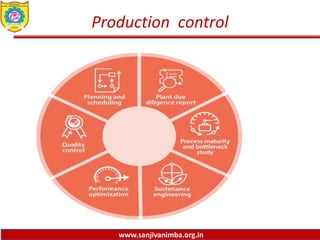
Production control
www.sanjivanimba.org.in
Production control
• Control implementing production plan
• Control involves utilization of data
• Control with corrective action plan
• Control to maintain time schedule
• Control to loading ,unloading ,material
handling in shop floor.
www.sanjivanimba.org.in
Scheduling
www.sanjivanimba.org.in
Scheduling
• Scheduling is the process of arranging,
controlling and optimizing work and
workloads in a production process or
manufacturing process.
• Scheduling is used to allocate plant and
machinery resources, plan human resources,
plan production processes and purchase
materials
www.sanjivanimba.org.in
Scheduling of Job Shops
www.sanjivanimba.org.in
Scheduling of Floor Shops
www.sanjivanimba.org.in
Loading
• A load means the quantity of work, and
allocating the quantity of work to the
processes necessary to manufacture each
item is called loading.
• It is performed in the CRP (Capacity
Requirements Planning) of the manufacturing
planning. In loading, each load is usually piled
up by time (hour), by which a setup time and
a real operating time are determined.
www.sanjivanimba.org.in
Objective of loading
• To keep the operator idle time minimum
• To keep machine idle time minimum
• To keep material waiting time minimum
• To maintain balancing plant and labor force
www.sanjivanimba.org.in
Gantt Chart
• A Gantt chart, commonly used in project management,
is one of the most popular and useful ways of showing
activities (tasks or events) displayed against time. On
the left of the chart is a list of the activities and along
the top is a suitable time scale. Each activity is
represented by a bar; the position and length of the bar
reflects the start date, duration and end date of the
activity.
• Gantt chart shows you what has to be done (the
activities) and when (the schedule)
www.sanjivanimba.org.in
Components of Gantt chart
• The various activity in project
• When activity stat and end.
• How long each activity scheduled
• Where activity overlaps with other activity
• Start and end date of whole project
www.sanjivanimba.org.in
Gantt Chart
www.sanjivanimba.org.in
Advantage Gantt Chart
• Simple and inexpensive method
• These chart clearly show the decided time
and work schedules for every job.
• Monitoring and controlling become easier.
• Can be changed and updated easily
• Lower cost
www.sanjivanimba.org.in
Disadvantage of Gantt Chart
• Not showing job interrelationships and
interdependence
• Cost implication cannot shown
• Not possible to mention alternatives for
project completion
• Shape and form of Gantt chart can differ
according to nature of activity.

Production Control

  • 1.
    www.sanjivanimba.org.in Presented By Dr. NirajChaudahri Assistant Professor, Sanjivani College of Engineering , Dept.of MBA, Kopargaon 1 Sanjivani College of Engineering, Kopargaon Department of MBA www.sanjivanimba.org.in 203- Operation Management Production Control
  • 2.
    www.sanjivanimba.org.in Production control • Productioncontrol is the task of predicting, planning and scheduling work, taking into account manpower, materials availability and other capacity restrictions, and cost so as to achieve proper quality and quantity at the time it is needed and then following up the schedule to see that the plan is carried out, using whatever systems have proven satisfactory for the purpose
  • 3.
  • 4.
    www.sanjivanimba.org.in Production control • Controlimplementing production plan • Control involves utilization of data • Control with corrective action plan • Control to maintain time schedule • Control to loading ,unloading ,material handling in shop floor.
  • 5.
  • 6.
    www.sanjivanimba.org.in Scheduling • Scheduling isthe process of arranging, controlling and optimizing work and workloads in a production process or manufacturing process. • Scheduling is used to allocate plant and machinery resources, plan human resources, plan production processes and purchase materials
  • 7.
  • 8.
  • 9.
    www.sanjivanimba.org.in Loading • A loadmeans the quantity of work, and allocating the quantity of work to the processes necessary to manufacture each item is called loading. • It is performed in the CRP (Capacity Requirements Planning) of the manufacturing planning. In loading, each load is usually piled up by time (hour), by which a setup time and a real operating time are determined.
  • 10.
    www.sanjivanimba.org.in Objective of loading •To keep the operator idle time minimum • To keep machine idle time minimum • To keep material waiting time minimum • To maintain balancing plant and labor force
  • 11.
    www.sanjivanimba.org.in Gantt Chart • AGantt chart, commonly used in project management, is one of the most popular and useful ways of showing activities (tasks or events) displayed against time. On the left of the chart is a list of the activities and along the top is a suitable time scale. Each activity is represented by a bar; the position and length of the bar reflects the start date, duration and end date of the activity. • Gantt chart shows you what has to be done (the activities) and when (the schedule)
  • 12.
    www.sanjivanimba.org.in Components of Ganttchart • The various activity in project • When activity stat and end. • How long each activity scheduled • Where activity overlaps with other activity • Start and end date of whole project
  • 13.
  • 14.
    www.sanjivanimba.org.in Advantage Gantt Chart •Simple and inexpensive method • These chart clearly show the decided time and work schedules for every job. • Monitoring and controlling become easier. • Can be changed and updated easily • Lower cost
  • 15.
    www.sanjivanimba.org.in Disadvantage of GanttChart • Not showing job interrelationships and interdependence • Cost implication cannot shown • Not possible to mention alternatives for project completion • Shape and form of Gantt chart can differ according to nature of activity.