www.sanjivanimba.org.in
Presented By
Dr. Niraj Chaudahri
Assistant Professor,
Sanjivani College of Engineering ,
Dept.of MBA,
Kopargaon
1
Sanjivani College of Engineering, Kopargaon
Department of MBA
www.sanjivanimba.org.in
203- Operation Management
Topic :- Inventory Control
www.sanjivanimba.org.in
Inventory control
• Inventory control is the process of keeping the right
number of parts and products in stock to avoid
shortages, overstocks, and other costly problems.
• By using inventory control, you are able to protect
against making rash decisions and you also avoid the
pain and expense that come from overstocking on
inventory
• inventory control helps you maintain control over
your inventory levels so that you make the best use
of your resources and avoid product spoilage and
obsolescence
www.sanjivanimba.org.in
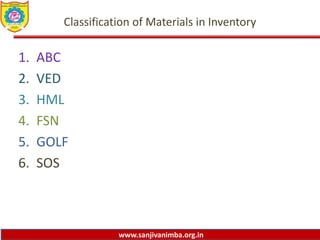
Classification of Materials in Inventory
1. ABC
2. VED
3. HML
4. FSN
5. GOLF
6. SOS
www.sanjivanimba.org.in
ABC Analysis
www.sanjivanimba.org.in
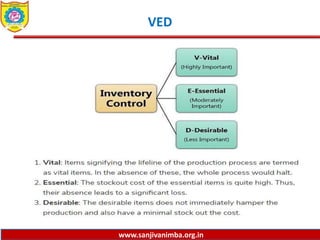
VED
www.sanjivanimba.org.in
HML
www.sanjivanimba.org.in
FSN
www.sanjivanimba.org.in
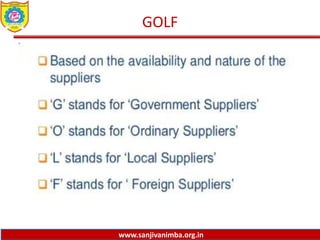
GOLF
www.sanjivanimba.org.in
SOS
www.sanjivanimba.org.in
Inventory turnover ratio
• Inventory turnover indicates the rate at which a
company sells and replaces its stock of goods during a
particular period. The inventory turnover ratio formula
is the cost of goods sold divided by the average
inventory for the same period.
• Inventory turnover is the rate at which a company
replaces inventory in a given period due to sales.
Calculating inventory turnover helps businesses make
better pricing, manufacturing, marketing, and
purchasing decisions
www.sanjivanimba.org.in
Fixed Order Quantity
• The Fixed Order Quantity is the inventory control
system, wherein the maximum and minimum
inventory levels are fixed, and maximum and fixed
amount of inventory can be replenished at a time
when the inventory level reaches the auto set
reorder point or the minimum stock level
• The Fixed Order Quantity system is followed by many
firms since it helps to reduce the reorder mistakes,
manage the storage capacity efficiently and prevent
the unnecessary blockage of funds
www.sanjivanimba.org.in
Periodic Review inventory
• The periodic inventory system uses an
occasional physical count to measure the level
of inventory and the cost of goods sold
(COGS).
• Periodic inventory accounting systems are
normally better suited to small businesses,
while businesses with high sales volume and
multiple retail outlets (like grocery stores or
pharmacies) need perpetual inventory
systems.
www.sanjivanimba.org.in
The reorder point (ROP)
• The reorder point (ROP) is the minimum
inventory or stock level for a specific
product that triggers the reordering of more
inventory when reached. When calculating
the reorder points for, the lead time it will
take to replenish inventory is factored in to
ensure inventory levels don't reach zero.

inventory control

  • 1.
    www.sanjivanimba.org.in Presented By Dr. NirajChaudahri Assistant Professor, Sanjivani College of Engineering , Dept.of MBA, Kopargaon 1 Sanjivani College of Engineering, Kopargaon Department of MBA www.sanjivanimba.org.in 203- Operation Management Topic :- Inventory Control
  • 2.
    www.sanjivanimba.org.in Inventory control • Inventorycontrol is the process of keeping the right number of parts and products in stock to avoid shortages, overstocks, and other costly problems. • By using inventory control, you are able to protect against making rash decisions and you also avoid the pain and expense that come from overstocking on inventory • inventory control helps you maintain control over your inventory levels so that you make the best use of your resources and avoid product spoilage and obsolescence
  • 3.
    www.sanjivanimba.org.in Classification of Materialsin Inventory 1. ABC 2. VED 3. HML 4. FSN 5. GOLF 6. SOS
  • 4.
  • 5.
  • 6.
  • 7.
  • 8.
  • 9.
  • 10.
    www.sanjivanimba.org.in Inventory turnover ratio •Inventory turnover indicates the rate at which a company sells and replaces its stock of goods during a particular period. The inventory turnover ratio formula is the cost of goods sold divided by the average inventory for the same period. • Inventory turnover is the rate at which a company replaces inventory in a given period due to sales. Calculating inventory turnover helps businesses make better pricing, manufacturing, marketing, and purchasing decisions
  • 11.
    www.sanjivanimba.org.in Fixed Order Quantity •The Fixed Order Quantity is the inventory control system, wherein the maximum and minimum inventory levels are fixed, and maximum and fixed amount of inventory can be replenished at a time when the inventory level reaches the auto set reorder point or the minimum stock level • The Fixed Order Quantity system is followed by many firms since it helps to reduce the reorder mistakes, manage the storage capacity efficiently and prevent the unnecessary blockage of funds
  • 12.
    www.sanjivanimba.org.in Periodic Review inventory •The periodic inventory system uses an occasional physical count to measure the level of inventory and the cost of goods sold (COGS). • Periodic inventory accounting systems are normally better suited to small businesses, while businesses with high sales volume and multiple retail outlets (like grocery stores or pharmacies) need perpetual inventory systems.
  • 13.
    www.sanjivanimba.org.in The reorder point(ROP) • The reorder point (ROP) is the minimum inventory or stock level for a specific product that triggers the reordering of more inventory when reached. When calculating the reorder points for, the lead time it will take to replenish inventory is factored in to ensure inventory levels don't reach zero.