Unit II – Project Planning and Scheduling
Introduction: Definition of Project Planning
1. “The process of choosing one method and order of work to be adopted for a project
from all the various ways and sequences in which it could be done” (Antill and
Woodhead1990, p.8; Callahan, Quackenbush and Rowings 1992, p.2)
2. The PMI define the planning process as “those process performed to establish the total
scope of the effort, define & refine of the objectives, and develop the course of action
required to attained those objectives” PMBOK (4th Edition, 2008)
3. Project planning serves as a foundation for several related functions such as cost
estimating, scheduling, project control, quality control, safety management and others.
Introduction: Project Planning
 Project Planning is the process of identifying all the activities necessary to successfully complete the
project.
 Determining the workable work scheme to achieve project objectives.
 Identify activities involve.
 Time consuming effort and often difficult. Requires knowledge of construction methods combined with
the abilities to visualize discrete work elements and to establish their mutual inter-dependencies.
 Experiences can also help.
 Effective planning – minimize the impact the unforeseen problem that could impede the progress of the
project.
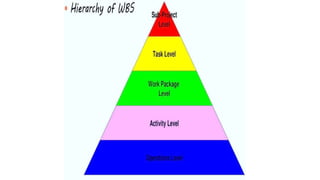
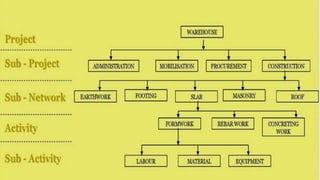
 Example of planning work: WBS
Project Scheduling
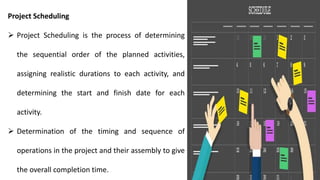
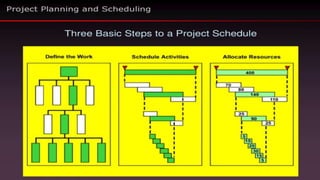
 Project Scheduling is the process of determining
the sequential order of the planned activities,
assigning realistic durations to each activity, and
determining the start and finish date for each
activity.
 Determination of the timing and sequence of
operations in the project and their assembly to give
the overall completion time.
 Planning is pre-requirement to project scheduling (no way to determine the
activities sequences and start/finish date of activities until they are
identified).
 After the activities identify, then the sequence of start, finish and linkage
between each activities can be determine.
 Project Scheduling help the managers in managing their project efficiently.
 Example of project scheduling: Gantt Chart, CPM and Network analysis
Concept of Planning and Scheduling
Adequate attention must be given to both planning & scheduling. Project planning is the
heart of good project management because it provides the central communications that
coordinates the works of all parties. Desired Results of Project Planning & Scheduling are:
 Finish the project on time.
 Continuous (uninterrupted) flow of work (no delays)
 Reduced amount of rework (least amount of changes)
 Minimized confusion on misunderstandings.
 Increase knowledge of status of project by everyone.
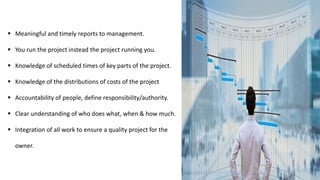
 Meaningful and timely reports to management.
 You run the project instead the project running you.
 Knowledge of scheduled times of key parts of the project.
 Knowledge of the distributions of costs of the project
 Accountability of people, define responsibility/authority.
 Clear understanding of who does what, when & how much.
 Integration of all work to ensure a quality project for the
owner.
The Key Principles For Planning And Scheduling
1. Begin planning before starting work, rather than after starting work.
2. Involve people who will actually do the work in the planning and scheduling process.
3. Includes all aspects of the project: scope, budget, schedule & quality.
4. Build flexibility into the plan, include allowance for changes and time for reviews and approvals.
5. Remember the schedule is the plan for doing the work, and it will never be precisely correct.
6. Keep the plan simple, eliminate irrelevant details that prevent the plans from being readable.
7. Communicating the plan to all parties; any plan is worthless unless it is known.
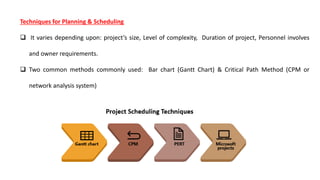
Techniques for Planning & Scheduling
 It varies depending upon: project’s size, Level of complexity, Duration of project, Personnel involves
and owner requirements.
 Two common methods commonly used: Bar chart (Gantt Chart) & Critical Path Method (CPM or
network analysis system)
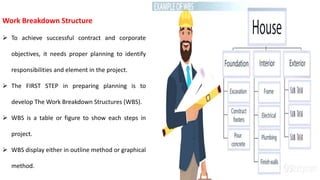
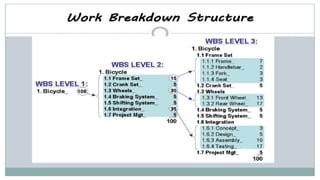
Work Breakdown Structure
 To achieve successful contract and corporate
objectives, it needs proper planning to identify
responsibilities and element in the project.
 The FIRST STEP in preparing planning is to
develop The Work Breakdown Structures (WBS).
 WBS is a table or figure to show each steps in
project.
 WBS display either in outline method or graphical
method.
 A WBS is a product-oriented family tree composed of hardware, services, and data which result from
project engineering efforts during the development and production of a project which completely
defines the project/program.
 The WBS defines the scope of the project and breaks the work down into components that can be
scheduled and estimated, as well as easily monitored and controlled.
Importance of WBS:
 Overall program can be explain in summary according to each sub-element divided.
 Planning could execute.
 Cost and budget could estimate more accurately.
 Time, Cost and Performance of each element could be monitor from time to time.
 Objective could be relate directly with the available resources in the company.
 Network diagram and control planning could be prepared in early stages.
 Responsibilities for each parties involve in every element could be identify and assign.
The process of converting a general or outline plan for a project into a time-based graphic
presentation using information on available resources and time constraints.
Scheduling
Scheduling is a management tool. It can be used to satisfy a number of objectives
 Coordination
 Analysis and forecasting
 Reporting against a baseline
Scheduling enables you to
 Integrate the activities of the various project participants
 Show interface responsibilities particularly with respect to timing
 Secure, record and communicate commitment to tasks by the various contributors to the
project effort
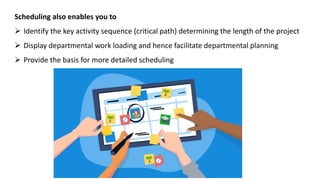
Scheduling also enables you to
 Identify the key activity sequence (critical path) determining the length of the project
 Display departmental work loading and hence facilitate departmental planning
 Provide the basis for more detailed scheduling
Scheduling enables analysis and forecasting
You can
• Show priorities for procuring equipment, material, labor and services
• Analyze complex work areas with many interrelated activities through network
analysis
• Facilitate long range planning and future resource allocation
• Measure progress
• Measure performance
• Maintain control over time and cost of the project
• Produce a cash flow forecast
There are two kinds of schedules: Project schedule and Task schedule.
Project managers and upper management use the project schedule (or project master schedule) to plan
and review the entire project. This schedule shows all the major project activities, but not much detail
about each.
A task schedule shows the specific activities necessary to complete a work package. It is
created for the people working on a specific task and enables lower level managers and supervisors to
focus on the task and not be distracted by other tasks with which they have no interaction. However, both
the project schedule and task schedule are prepared and displayed in many ways, including with Gantt
Charts.
There are many ways of presenting similar information, each with different
objectives
 Gantt Chart is another name for Bar Chart
 Milestone Chart
 Progress Chart
 Networks
 Earned Value or Trend lines
 Line of Balance
 And several others
Gantt charts
 The simplest and most commonly used technique is the Gantt chart (or Bar chart), named after the
management consultant Henry L. Gantt (1861-1919).
 He realized that time was a common denominator to most elements of a program plan, and that it
would be easy to assess progress by viewing each element’s status with respect to time.
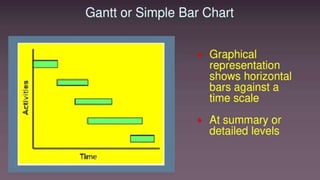
 The chart consists of a horizontal scale divided into time units – days, weeks, or months – and a vertical
scale showing project work elements – tasks, activities, or work packages.
 Preparation of the Gantt chart comes after a WBS analysis and identification of work packages or other
tasks. During WBS analysis, the functional manager, contractor, or others responsible for a work
package estimate its time and any prerequisites. The work elements are then listed in sequence of
time, taking into account which elements must be completed before others can be started.
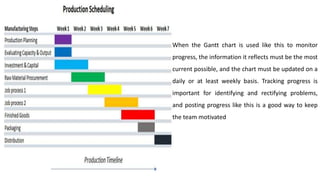
When the Gantt chart is used like this to monitor
progress, the information it reflects must be the most
current possible, and the chart must be updated on a
daily or at least weekly basis. Tracking progress is
important for identifying and rectifying problems,
and posting progress like this is a good way to keep
the team motivated
Disadvantages of the Gantt chart
• In all the projects, certain work elements depend upon others before they can begin; if
these are delayed then so will others and possibly, the entire project.
• A disadvantage of the Gantt chart is that it does not necessarily show the effects of one
work element falling behind schedule on other work elements. Also, Gantt charts alone
provide no way of distinguishing which elements can be delayed from those that
cannot.
Network based approaches
• Project scheduling involves much more than just displaying tasks on a Gantt chart. It is
an integral part of project planning, an often trail and error process of adjusting work
tasks to satisfy resource constraints while trying to meet project deadlines.
• Gantt charts are good for communicating project schedules, but they are limited as a
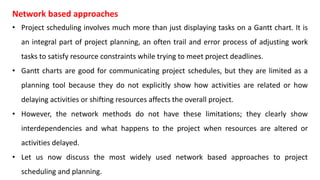
planning tool because they do not explicitly show how activities are related or how
delaying activities or shifting resources affects the overall project.
• However, the network methods do not have these limitations; they clearly show
interdependencies and what happens to the project when resources are altered or
activities delayed.
• Let us now discuss the most widely used network based approaches to project
scheduling and planning.
Network Diagrams
A network diagram shows a group of activities or tasks and their logical relationships, i.e. the precedence
relationships or dependencies among the tasks.
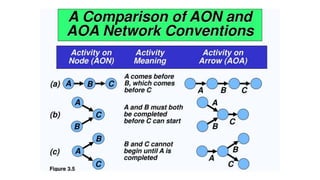
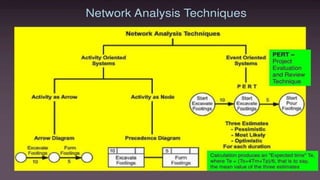
There are two methods for constructing the network diagrams: activity-on-node (AON), also called
precedence diagram method (PDM), and activity-on-arrow (AOA) or Arrow Diagramming Method (ADM).
Both were developed independently during the late 1950s. Let us first discuss the most commonly used AON
method.
AON Diagrams
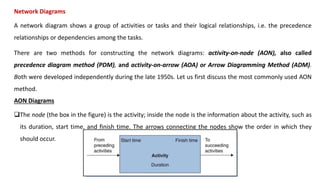
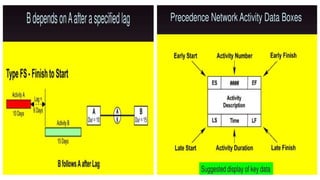
The node (the box in the figure) is the activity; inside the node is the information about the activity, such as
its duration, start time, and finish time. The arrows connecting the nodes show the order in which they
should occur.
To construct an AON network, start by drawing the first activity in the project. From
this activity, draw lines to the activities that happen next. Then the remaining activities
are added in sequence or parallel, until the last activity is included.
But before you can actually start a network, you must first know each activity’s
relationship to the other activities – for example:
• What activities are its predecessors?
• What activities are its successors?
• What activities are to be done at the same time as it?
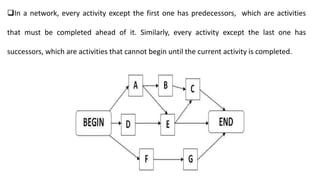
In a network, every activity except the first one has predecessors, which are activities
that must be completed ahead of it. Similarly, every activity except the last one has
successors, which are activities that cannot begin until the current activity is completed.
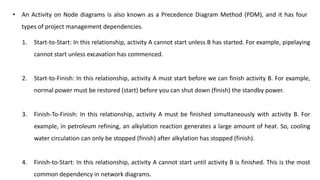
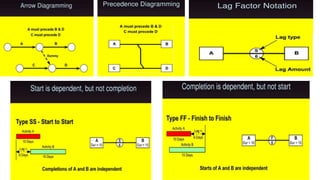
• An Activity on Node diagrams is also known as a Precedence Diagram Method (PDM), and it has four
types of project management dependencies.
1. Start-to-Start: In this relationship, activity A cannot start unless B has started. For example, pipelaying
cannot start unless excavation has commenced.
2. Start-to-Finish: In this relationship, activity A must start before we can finish activity B. For example,
normal power must be restored (start) before you can shut down (finish) the standby power.
3. Finish-To-Finish: In this relationship, activity A must be finished simultaneously with activity B. For
example, in petroleum refining, an alkylation reaction generates a large amount of heat. So, cooling
water circulation can only be stopped (finish) after alkylation has stopped (finish).
4. Finish-to-Start: In this relationship, activity A cannot start until activity B is finished. This is the most
common dependency in network diagrams.
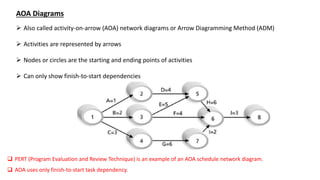
AOA Diagrams
 Also called activity-on-arrow (AOA) network diagrams or Arrow Diagramming Method (ADM)
 Activities are represented by arrows
 Nodes or circles are the starting and ending points of activities
 Can only show finish-to-start dependencies
 PERT (Program Evaluation and Review Technique) is an example of an AOA schedule network diagram.
 AOA uses only finish-to-start task dependency.
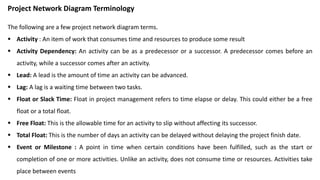
Project Network Diagram Terminology
The following are a few project network diagram terms.
 Activity : An item of work that consumes time and resources to produce some result
 Activity Dependency: An activity can be as a predecessor or a successor. A predecessor comes before an
activity, while a successor comes after an activity.
 Lead: A lead is the amount of time an activity can be advanced.
 Lag: A lag is a waiting time between two tasks.
 Float or Slack Time: Float in project management refers to time elapse or delay. This could either be a free
float or a total float.
 Free Float: This is the allowable time for an activity to slip without affecting its successor.
 Total Float: This is the number of days an activity can be delayed without delaying the project finish date.
 Event or Milestone : A point in time when certain conditions have been fulfilled, such as the start or
completion of one or more activities. Unlike an activity, does not consume time or resources. Activities take
place between events
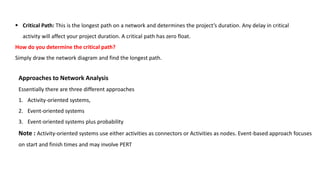
 Critical Path: This is the longest path on a network and determines the project’s duration. Any delay in critical
activity will affect your project duration. A critical path has zero float.
How do you determine the critical path?
Simply draw the network diagram and find the longest path.
Approaches to Network Analysis
Essentially there are three different approaches
1. Activity-oriented systems,
2. Event-oriented systems
3. Event-oriented systems plus probability
Note : Activity-oriented systems use either activities as connectors or Activities as nodes. Event-based approach focuses
on start and finish times and may involve PERT
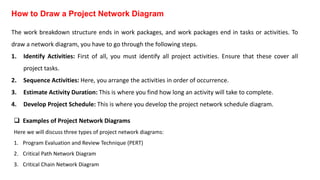
How to Draw a Project Network Diagram
The work breakdown structure ends in work packages, and work packages end in tasks or activities. To
draw a network diagram, you have to go through the following steps.
1. Identify Activities: First of all, you must identify all project activities. Ensure that these cover all
project tasks.
2. Sequence Activities: Here, you arrange the activities in order of occurrence.
3. Estimate Activity Duration: This is where you find how long an activity will take to complete.
4. Develop Project Schedule: This is where you develop the project network schedule diagram.
 Examples of Project Network Diagrams
Here we will discuss three types of project network diagrams:
1. Program Evaluation and Review Technique (PERT)
2. Critical Path Network Diagram
3. Critical Chain Network Diagram
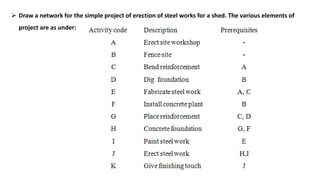
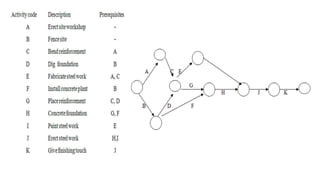
 Draw a network for the simple project of erection of steel works for a shed. The various elements of
project are as under:
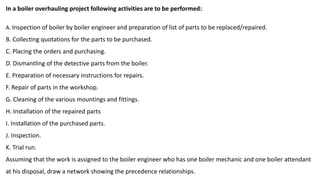
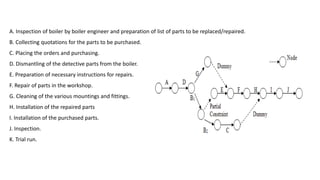
In a boiler overhauling project following activities are to be performed:
A. Inspection of boiler by boiler engineer and preparation of list of parts to be replaced/repaired.
B. Collecting quotations for the parts to be purchased.
C. Placing the orders and purchasing.
D. Dismantling of the detective parts from the boiler.
E. Preparation of necessary instructions for repairs.
F. Repair of parts in the workshop.
G. Cleaning of the various mountings and fittings.
H. Installation of the repaired parts
I. Installation of the purchased parts.
J. Inspection.
K. Trial run.
Assuming that the work is assigned to the boiler engineer who has one boiler mechanic and one boiler attendant
at his disposal, draw a network showing the precedence relationships.
A. Inspection of boiler by boiler engineer and preparation of list of parts to be replaced/repaired.
B. Collecting quotations for the parts to be purchased.
C. Placing the orders and purchasing.
D. Dismantling of the detective parts from the boiler.
E. Preparation of necessary instructions for repairs.
F. Repair of parts in the workshop.
G. Cleaning of the various mountings and fittings.
H. Installation of the repaired parts
I. Installation of the purchased parts.
J. Inspection.
K. Trial run.
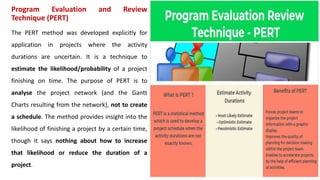
Program Evaluation and Review
Technique (PERT)
The PERT method was developed explicitly for
application in projects where the activity
durations are uncertain. It is a technique to
estimate the likelihood/probability of a project
finishing on time. The purpose of PERT is to
analyse the project network (and the Gantt
Charts resulting from the network), not to create
a schedule. The method provides insight into the
likelihood of finishing a project by a certain time,
though it says nothing about how to increase
that likelihood or reduce the duration of a
project.
Estimate Activity Durations in PERT Program Evaluation Review Technique
There are there estimate techniques in PERT Method to determine the duration of activities.
• Most Likely Estimate
• Optimistic Estimate
• Pessimistic Estimate
Most Likely Estimate (Tm)
The most likely estimate is an estimate of the most probable duration of a particular activity.
Optimistic Estimate (To)
The Optimistic estimate is an estimate of the shortest duration of activity that takes into consideration the
known parameters that can affect performance.
Pessimistic Estimate (Tp)
The Pessimistic estimate is an estimate of the longest duration of activity that takes into consideration all
unfavorable conditions that can affect performance.
The optimistic time is the minimum time for an activity, the situation where everything goes well
and there is little hope of finishing earlier. A normal level of effort is assumed, with no extra personnel.
The most likely time is the time that would occur most often if the activity were repeated. The pessimistic
time is the maximum time for an activity – the situation where bad luck is encountered at every step. The
pessimistic time includes likely problems in work, but not highly unlikely events such as natural disasters.
The formula to calculate the PERT is as follows:
PERT Estimate = (Tp + 4Tm + To) / 6
Here: Tm is the Most Likely Estimate. In this estimate, the chance of completing an activity
is highest. To is the Optimistic Estimate. This estimate considers the best-case scenario, so
the duration estimate is the shortest here. Tp is the Pessimistic Estimate.
The variance for the activity is given by σ 2 = [(tp – to) / 6]
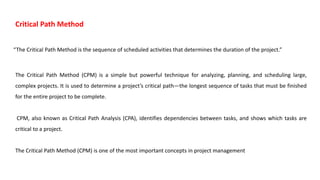
“The Critical Path Method is the sequence of scheduled activities that determines the duration of the project.”
Critical Path Method
The Critical Path Method (CPM) is a simple but powerful technique for analyzing, planning, and scheduling large,
complex projects. It is used to determine a project’s critical path—the longest sequence of tasks that must be finished
for the entire project to be complete.
CPM, also known as Critical Path Analysis (CPA), identifies dependencies between tasks, and shows which tasks are
critical to a project.
The Critical Path Method (CPM) is one of the most important concepts in project management
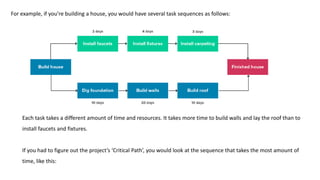
For example, if you’re building a house, you would have several task sequences as follows:
Each task takes a different amount of time and resources. It takes more time to build walls and lay the roof than to
install faucets and fixtures.
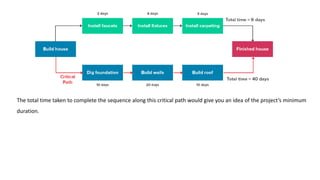
If you had to figure out the project’s ‘Critical Path’, you would look at the sequence that takes the most amount of
time, like this:
The total time taken to complete the sequence along this critical path would give you an idea of the project’s minimum
duration.
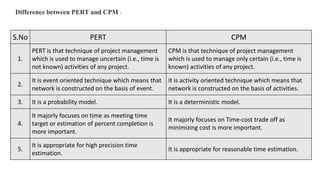
S.No PERT CPM
1.
PERT is that technique of project management
which is used to manage uncertain (i.e., time is
not known) activities of any project.
CPM is that technique of project management
which is used to manage only certain (i.e., time is
known) activities of any project.
2.
It is event oriented technique which means that
network is constructed on the basis of event.
It is activity oriented technique which means that
network is constructed on the basis of activities.
3. It is a probability model. It is a deterministic model.
4.
It majorly focuses on time as meeting time
target or estimation of percent completion is
more important.
It majorly focuses on Time-cost trade off as
minimizing cost is more important.
5.
It is appropriate for high precision time
estimation.
It is appropriate for reasonable time estimation.
Difference between PERT and CPM :
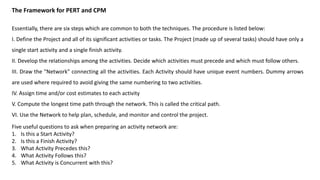
The Framework for PERT and CPM
Essentially, there are six steps which are common to both the techniques. The procedure is listed below:
I. Define the Project and all of its significant activities or tasks. The Project (made up of several tasks) should have only a
single start activity and a single finish activity.
II. Develop the relationships among the activities. Decide which activities must precede and which must follow others.
III. Draw the "Network" connecting all the activities. Each Activity should have unique event numbers. Dummy arrows
are used where required to avoid giving the same numbering to two activities.
IV. Assign time and/or cost estimates to each activity
V. Compute the longest time path through the network. This is called the critical path.
VI. Use the Network to help plan, schedule, and monitor and control the project.
Five useful questions to ask when preparing an activity network are:
1. Is this a Start Activity?
2. Is this a Finish Activity?
3. What Activity Precedes this?
4. What Activity Follows this?
5. What Activity is Concurrent with this?
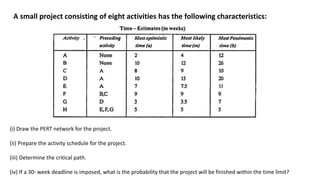
A small project consisting of eight activities has the following characteristics:
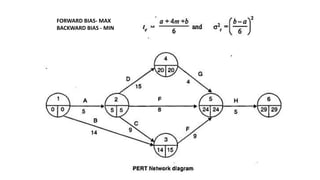
(i) Draw the PERT network for the project.
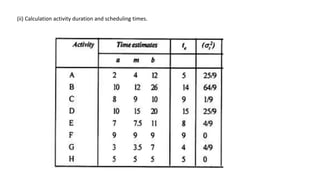
(ii) Prepare the activity schedule for the project.
(iii) Determine the critical path.
(iv) If a 30- week deadline is imposed, what is the probability that the project will be finished within the time limit?
FORWARD BIAS- MAX
BACKWARD BIAS - MIN
(ii) Calculation activity duration and scheduling times.
Time [Earliest & latest] are calculated as follows:
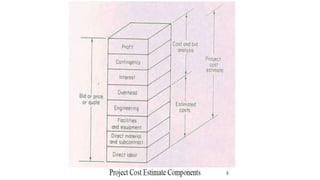
Cost Estimating and Budgeting
Cost estimates, budgets, WBSs, and schedules are interrelated. Ideally, cost estimates
are based upon elements of the WBS and are prepared at the work package level.
Cost estimating, budgeting, and control should be the concern of everyone involved in
the project, mainly those who are closest to the sources of cost, like engineers, scientists,
systems specialists, architects, or others, and should not be limited to only cost
specialists, planners and accountants.
The project manager, need not be a financial wizard, but should be able to skilfully
organize and use the cost figures. He oversees the cost estimating and budgeting process
with the assistance of a cost accountant or cost engineer.
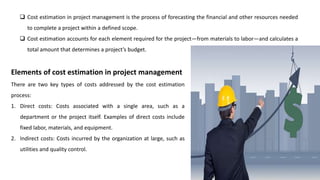
 Cost estimation in project management is the process of forecasting the financial and other resources needed
to complete a project within a defined scope.
 Cost estimation accounts for each element required for the project—from materials to labor—and calculates a
total amount that determines a project’s budget.
Elements of cost estimation in project management
There are two key types of costs addressed by the cost estimation
process:
1. Direct costs: Costs associated with a single area, such as a
department or the project itself. Examples of direct costs include
fixed labor, materials, and equipment.
2. Indirect costs: Costs incurred by the organization at large, such as
utilities and quality control.
Within these two categories, here are some typical elements that a cost estimation will take into account:
1. Labor: The cost of team members working on the project, both in terms of wages and time
2. Materials and equipment: The cost of resources required for the project, from physical tools to software to legal permits
3. Facilities: The cost of using any working spaces not owned by the organization.
4. Vendors: The cost of hiring third-party vendors or contractors.
5. Risk: The cost of any contingency plans implemented to reduce risk.
“Cost estimates are used to develop budgets, after the project begins, actual costs are compared to
estimated costs (indicated by the budget) as one measure of the project’s work performance. Without good
estimates, it is impossible to evaluate work efficiency or to determine in advance how much the project will
cost at completion”.
Cost Escalation
Accurate cost estimating can be difficult because it begins during project conception and before much is
known about the project. The less well defined the project, the greater the chances that estimated costs will
substantially differ from actual costs. As a rule, the estimate will be too low and the project will suffer a cost
overrun. The amount by which actual costs grow to exceed initial estimates is referred to as cost escalation.
Some escalation can be expected, and up to 20 percent is relatively common. Usually, the larger and more
complex the project, the greater is the potential for escalation. The costs of cutting edge technology and
research projects frequently escalate by upwards of several hundred percent. The Concorde supersonic
airliner exceeded the original estimate by a factor of five, nuclear power plants often exceed estimates by a
factor of two or three, and NASA spacecraft often exceed estimates by a factor of four to five. The history,
observed over several decades shows this fact that clearly, overruns have been, and remain, common.
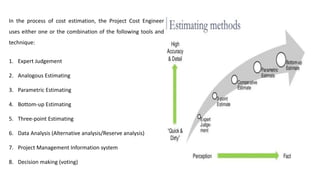
In the process of cost estimation, the Project Cost Engineer
uses either one or the combination of the following tools and
technique:
1. Expert Judgement
2. Analogous Estimating
3. Parametric Estimating
4. Bottom-up Estimating
5. Three-point Estimating
6. Data Analysis (Alternative analysis/Reserve analysis)
7. Project Management Information system
8. Decision making (voting)
1) Expert Judgement Method
 Expertise should be considered from individuals or groups with specialized knowledge or training in team and physical
resource planning and estimating.
 Expert judgment, guided by historical information, provides valuable insight about the environment and information
from prior similar projects.
 Expert judgment can also be used to determine whether to combine different methods of estimation and how to
reconcile differences between them.
2) Analogous Estimating Method
 Analogous cost estimating uses the values such as scope, cost, budget, and duration or measures of scale such as size,
weight, and complexity from a previous, similar project as the basis for estimating the same parameter or
measurement for a current project.
 When estimating costs, this technique relies on the actual cost of previous, similar projects as the basis for estimating
the cost of the current project.
 It is most reliable when the previous projects are similar in fact and not just in appearance, and the project team
members preparing the estimates have the needed expertise.
3) Parametric Estimating Method
Parametric estimating uses an algorithm or a statistical relationship between historical data and other variables (e.g.,
square footage in construction) to calculate resource quantities needed for an activity, based on historical data and
project parameters.
For example, if an activity needs 4,000 hours of coding and it needs to finish it in 1 year, it will require two people to
code (each doing 2,000 hours a year). This technique can produce higher levels of accuracy depending on the
sophistication and underlying data built into the model.
4) Bottom-up Estimating Method
 In the Bottom-up estimating method, team and physical resources are estimated at the activity level and then
aggregated to develop the estimates for work packages, control accounts, and summary project levels.
 Bottom-up estimating is a method of estimating a component of work. The cost of individual work packages or
activities is estimated to the greatest level of specified detail. The detailed cost is then summarized or rolled up to
higher levels for subsequent reporting and tracking purposes.
5) Three-Point Estimating Method
The accuracy of single-point activity cost estimates may be improved by considering estimation uncertainty and risk and
using three estimates to define an approximate range for an activity‘s cost:
• Most likely (M): The cost of the activity, based on realistic effort assessment for the required work and any predicted
expenses.
• Optimistic (O): The activity cost based on analysis of the best-case scenario for the activity.
• Pessimistic (P): The activity cost based on analysis of the worst-case scenario for the activity.
6) Data Analysis Method
 A data analysis technique used in this process includes but is not limited to alternatives analysis. Alternatives analysis
is used to evaluate identified options in order to select the options or approaches to use to execute and perform the
work of the project. Alternatives analysis assists in providing the best solution to perform the project activities, within
the defined constraints.
 Instead of overestimating each cost, money is budgeted for dealing with unplanned but statistically predictable cost
increases. Funds allocated for this purpose are called contingency reserves.
7) Project Management Information System Method
 Project management information systems can include resource management software that can help plan, organize,
and manage resource pools and develop resource estimates.
 Depending on the sophistication of the software, resource breakdown structures, resource availability, resource rates,
and various resource calendars can be designed to assist in optimizing resource utilization.
8) Decision-Making Method
Some decision techniques are unanimity, majority, plurality, points allocation, and dictatorship. For unanimity, everyone
must agree; there is a shared consensus. A majority or plurality is usually determined by a vote. For a majority, the
decision must be agreed to by more than half the participants.
Cost Estimating Process
Estimate versus Target or Goal
An estimate is a realistic assessment based upon known facts about the work, required resources,
constraints, and the environment, and is derived from estimating methods. Whereas, a target or goal is a
desired outcome or commitment. Other than by chance, the estimate will not be the same as the target or
goal. That said, once computed the estimate can be compared to a target value or goal, and the work tasks,
resources, schedules, etc., revised to bring the estimate closer to the target.
Accuracy versus Precision
Accuracy represents the closeness of an estimated value to the actual value: the accuracy of a 99,000/-
estimate for a project that actually cost 100,000 is very good. In contrast, precision is the number decimal
places in the estimate. An estimate of 75,321/- is more precise than one of 75,000/- (though neither is
accurate if the actual cost is 100,000/-). Accuracy matters more than precision: the aim is to derive the most
accurate estimate possible.
Classifying the Work Tasks and Costs
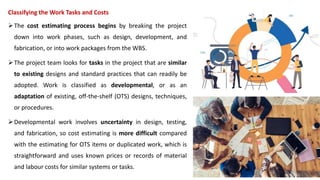
The cost estimating process begins by breaking the project
down into work phases, such as design, development, and
fabrication, or into work packages from the WBS.
The project team looks for tasks in the project that are similar
to existing designs and standard practices that can readily be
adopted. Work is classified as developmental, or as an
adaptation of existing, off-the-shelf (OTS) designs, techniques,
or procedures.
Developmental work involves uncertainty in design, testing,
and fabrication, so cost estimating is more difficult compared
with the estimating for OTS items or duplicated work, which is
straightforward and uses known prices or records of material
and labour costs for similar systems or tasks.
 In a pure project form of organization, the project manager delegates the responsibility for the
estimating effort, combines the estimated results, and presents the final figures to management.
 In a matrix organization, estimating is the joint responsibility of the project and functional managers;
the project manager coordinates the effort and accumulates results.
 Although this typifies the estimating process, the actual methods used will depend on the information
available and the required accuracy of the estimate. Most estimates are made using variants of four
methods: expert judgement, analogy, parametrizes, and cost engineering.
For large or small projects, the estimating procedure is roughly the same, as is presented below in detail.
 First, the manager of each work package breaks the work package down into more fundamental or basic
areas of work, such as engineering and fabrication.
 Supervisors in each basic area then estimate the hours and materials needed to do the work. The
engineering supervisor might further work into the tasks of structural analysis, computer analysis, layout
drawings, installation drawings, and manuals, then for each task develop an estimate of the duration and
the labor grade or skill level involved.
 In similar fashion, the fabrication supervisor might break the work down into materials (steel, piping,
wiring), hardware, machinery, equipment, insurance, and so on, then estimate how much (quantity, size,
length, weight, etc.) of each will be needed. The supervisors submit their estimates to the work package
manager, who checks, revises, and then forwards them to the project manager.
The project manager and the professional estimators on the project staff review the submitted time and
material estimates to be sure that no costs were overlooked or duplicated, everyone understood what they
were estimating, correct estimating methods were used, and allowances were made for risk and uncertainty.
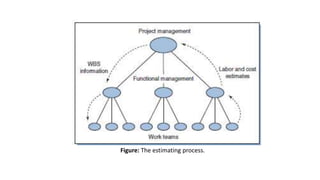
 The estimates are then aggregated as shown in the following figure. Finally, the project manager adds in
project-wide overhead (to cover project management and administrative costs) and company-wide overhead
(to cover general company expenses) to arrive at a cost estimate for the total project.
The accumulation of work package estimates (upward arrows in the figure) to derive the project estimate is
called the bottom-up approach.
The project manager submits the final cost estimate to company management along with forecasts showing
the effects of potential escalation factors, such as inflation and risks.
The estimate is compared against top management’s gross estimate, the goal or target set by the company or
customer. Management compares the final cost estimate to the gross estimate and either accepts it or
mandates a revision.
Figure: The estimating process.
If the gross estimate is larger, the project manager reviews the work package estimates for possible
oversights or over-optimism. If the final estimate is larger, the project manager reviews the work package
estimates for any incorrect assumptions and sources of excess cost.
Difference between Estimate and Budget
Budgets and cost estimates are the same in that both state the cost of doing something. The difference is
that the estimate comes first and is the basis for the budget. An estimate may have to be refined many
times, but once approved it becomes the budget. Organizations and work units are then committed to
performing work according to the budget. It is the agreed upon amount for what the work should cost, and
the baseline against which actual expenditures will be compared. Project budgets and fiscal operating
budgets are similar; the difference is that the former covers the life of a project, the latter only a year at a
time.

Unit II.pptx

  • 1.
    Unit II –Project Planning and Scheduling
  • 2.
    Introduction: Definition ofProject Planning 1. “The process of choosing one method and order of work to be adopted for a project from all the various ways and sequences in which it could be done” (Antill and Woodhead1990, p.8; Callahan, Quackenbush and Rowings 1992, p.2) 2. The PMI define the planning process as “those process performed to establish the total scope of the effort, define & refine of the objectives, and develop the course of action required to attained those objectives” PMBOK (4th Edition, 2008) 3. Project planning serves as a foundation for several related functions such as cost estimating, scheduling, project control, quality control, safety management and others.
  • 3.
    Introduction: Project Planning Project Planning is the process of identifying all the activities necessary to successfully complete the project.  Determining the workable work scheme to achieve project objectives.  Identify activities involve.  Time consuming effort and often difficult. Requires knowledge of construction methods combined with the abilities to visualize discrete work elements and to establish their mutual inter-dependencies.  Experiences can also help.  Effective planning – minimize the impact the unforeseen problem that could impede the progress of the project.  Example of planning work: WBS
  • 4.
    Project Scheduling  ProjectScheduling is the process of determining the sequential order of the planned activities, assigning realistic durations to each activity, and determining the start and finish date for each activity.  Determination of the timing and sequence of operations in the project and their assembly to give the overall completion time.
  • 5.
     Planning ispre-requirement to project scheduling (no way to determine the activities sequences and start/finish date of activities until they are identified).  After the activities identify, then the sequence of start, finish and linkage between each activities can be determine.  Project Scheduling help the managers in managing their project efficiently.  Example of project scheduling: Gantt Chart, CPM and Network analysis
  • 6.
    Concept of Planningand Scheduling Adequate attention must be given to both planning & scheduling. Project planning is the heart of good project management because it provides the central communications that coordinates the works of all parties. Desired Results of Project Planning & Scheduling are:  Finish the project on time.  Continuous (uninterrupted) flow of work (no delays)  Reduced amount of rework (least amount of changes)  Minimized confusion on misunderstandings.  Increase knowledge of status of project by everyone.
  • 7.
     Meaningful andtimely reports to management.  You run the project instead the project running you.  Knowledge of scheduled times of key parts of the project.  Knowledge of the distributions of costs of the project  Accountability of people, define responsibility/authority.  Clear understanding of who does what, when & how much.  Integration of all work to ensure a quality project for the owner.
  • 8.
    The Key PrinciplesFor Planning And Scheduling 1. Begin planning before starting work, rather than after starting work. 2. Involve people who will actually do the work in the planning and scheduling process. 3. Includes all aspects of the project: scope, budget, schedule & quality. 4. Build flexibility into the plan, include allowance for changes and time for reviews and approvals. 5. Remember the schedule is the plan for doing the work, and it will never be precisely correct. 6. Keep the plan simple, eliminate irrelevant details that prevent the plans from being readable. 7. Communicating the plan to all parties; any plan is worthless unless it is known.
  • 9.
    Techniques for Planning& Scheduling  It varies depending upon: project’s size, Level of complexity, Duration of project, Personnel involves and owner requirements.  Two common methods commonly used: Bar chart (Gantt Chart) & Critical Path Method (CPM or network analysis system)
  • 10.
    Work Breakdown Structure To achieve successful contract and corporate objectives, it needs proper planning to identify responsibilities and element in the project.  The FIRST STEP in preparing planning is to develop The Work Breakdown Structures (WBS).  WBS is a table or figure to show each steps in project.  WBS display either in outline method or graphical method.
  • 12.
     A WBSis a product-oriented family tree composed of hardware, services, and data which result from project engineering efforts during the development and production of a project which completely defines the project/program.  The WBS defines the scope of the project and breaks the work down into components that can be scheduled and estimated, as well as easily monitored and controlled. Importance of WBS:  Overall program can be explain in summary according to each sub-element divided.  Planning could execute.  Cost and budget could estimate more accurately.  Time, Cost and Performance of each element could be monitor from time to time.  Objective could be relate directly with the available resources in the company.  Network diagram and control planning could be prepared in early stages.  Responsibilities for each parties involve in every element could be identify and assign.
  • 15.
    The process ofconverting a general or outline plan for a project into a time-based graphic presentation using information on available resources and time constraints. Scheduling Scheduling is a management tool. It can be used to satisfy a number of objectives  Coordination  Analysis and forecasting  Reporting against a baseline Scheduling enables you to  Integrate the activities of the various project participants  Show interface responsibilities particularly with respect to timing  Secure, record and communicate commitment to tasks by the various contributors to the project effort
  • 16.
    Scheduling also enablesyou to  Identify the key activity sequence (critical path) determining the length of the project  Display departmental work loading and hence facilitate departmental planning  Provide the basis for more detailed scheduling
  • 17.
    Scheduling enables analysisand forecasting You can • Show priorities for procuring equipment, material, labor and services • Analyze complex work areas with many interrelated activities through network analysis • Facilitate long range planning and future resource allocation • Measure progress • Measure performance • Maintain control over time and cost of the project • Produce a cash flow forecast
  • 19.
    There are twokinds of schedules: Project schedule and Task schedule. Project managers and upper management use the project schedule (or project master schedule) to plan and review the entire project. This schedule shows all the major project activities, but not much detail about each. A task schedule shows the specific activities necessary to complete a work package. It is created for the people working on a specific task and enables lower level managers and supervisors to focus on the task and not be distracted by other tasks with which they have no interaction. However, both the project schedule and task schedule are prepared and displayed in many ways, including with Gantt Charts.
  • 20.
    There are manyways of presenting similar information, each with different objectives  Gantt Chart is another name for Bar Chart  Milestone Chart  Progress Chart  Networks  Earned Value or Trend lines  Line of Balance  And several others
  • 21.
    Gantt charts  Thesimplest and most commonly used technique is the Gantt chart (or Bar chart), named after the management consultant Henry L. Gantt (1861-1919).  He realized that time was a common denominator to most elements of a program plan, and that it would be easy to assess progress by viewing each element’s status with respect to time.  The chart consists of a horizontal scale divided into time units – days, weeks, or months – and a vertical scale showing project work elements – tasks, activities, or work packages.  Preparation of the Gantt chart comes after a WBS analysis and identification of work packages or other tasks. During WBS analysis, the functional manager, contractor, or others responsible for a work package estimate its time and any prerequisites. The work elements are then listed in sequence of time, taking into account which elements must be completed before others can be started.
  • 23.
    When the Ganttchart is used like this to monitor progress, the information it reflects must be the most current possible, and the chart must be updated on a daily or at least weekly basis. Tracking progress is important for identifying and rectifying problems, and posting progress like this is a good way to keep the team motivated
  • 24.
    Disadvantages of theGantt chart • In all the projects, certain work elements depend upon others before they can begin; if these are delayed then so will others and possibly, the entire project. • A disadvantage of the Gantt chart is that it does not necessarily show the effects of one work element falling behind schedule on other work elements. Also, Gantt charts alone provide no way of distinguishing which elements can be delayed from those that cannot.
  • 25.
    Network based approaches •Project scheduling involves much more than just displaying tasks on a Gantt chart. It is an integral part of project planning, an often trail and error process of adjusting work tasks to satisfy resource constraints while trying to meet project deadlines. • Gantt charts are good for communicating project schedules, but they are limited as a planning tool because they do not explicitly show how activities are related or how delaying activities or shifting resources affects the overall project. • However, the network methods do not have these limitations; they clearly show interdependencies and what happens to the project when resources are altered or activities delayed. • Let us now discuss the most widely used network based approaches to project scheduling and planning.
  • 26.
    Network Diagrams A networkdiagram shows a group of activities or tasks and their logical relationships, i.e. the precedence relationships or dependencies among the tasks. There are two methods for constructing the network diagrams: activity-on-node (AON), also called precedence diagram method (PDM), and activity-on-arrow (AOA) or Arrow Diagramming Method (ADM). Both were developed independently during the late 1950s. Let us first discuss the most commonly used AON method. AON Diagrams The node (the box in the figure) is the activity; inside the node is the information about the activity, such as its duration, start time, and finish time. The arrows connecting the nodes show the order in which they should occur.
  • 27.
    To construct anAON network, start by drawing the first activity in the project. From this activity, draw lines to the activities that happen next. Then the remaining activities are added in sequence or parallel, until the last activity is included. But before you can actually start a network, you must first know each activity’s relationship to the other activities – for example: • What activities are its predecessors? • What activities are its successors? • What activities are to be done at the same time as it?
  • 28.
    In a network,every activity except the first one has predecessors, which are activities that must be completed ahead of it. Similarly, every activity except the last one has successors, which are activities that cannot begin until the current activity is completed.
  • 29.
    • An Activityon Node diagrams is also known as a Precedence Diagram Method (PDM), and it has four types of project management dependencies. 1. Start-to-Start: In this relationship, activity A cannot start unless B has started. For example, pipelaying cannot start unless excavation has commenced. 2. Start-to-Finish: In this relationship, activity A must start before we can finish activity B. For example, normal power must be restored (start) before you can shut down (finish) the standby power. 3. Finish-To-Finish: In this relationship, activity A must be finished simultaneously with activity B. For example, in petroleum refining, an alkylation reaction generates a large amount of heat. So, cooling water circulation can only be stopped (finish) after alkylation has stopped (finish). 4. Finish-to-Start: In this relationship, activity A cannot start until activity B is finished. This is the most common dependency in network diagrams.
  • 30.
    AOA Diagrams  Alsocalled activity-on-arrow (AOA) network diagrams or Arrow Diagramming Method (ADM)  Activities are represented by arrows  Nodes or circles are the starting and ending points of activities  Can only show finish-to-start dependencies  PERT (Program Evaluation and Review Technique) is an example of an AOA schedule network diagram.  AOA uses only finish-to-start task dependency.
  • 32.
    Project Network DiagramTerminology The following are a few project network diagram terms.  Activity : An item of work that consumes time and resources to produce some result  Activity Dependency: An activity can be as a predecessor or a successor. A predecessor comes before an activity, while a successor comes after an activity.  Lead: A lead is the amount of time an activity can be advanced.  Lag: A lag is a waiting time between two tasks.  Float or Slack Time: Float in project management refers to time elapse or delay. This could either be a free float or a total float.  Free Float: This is the allowable time for an activity to slip without affecting its successor.  Total Float: This is the number of days an activity can be delayed without delaying the project finish date.  Event or Milestone : A point in time when certain conditions have been fulfilled, such as the start or completion of one or more activities. Unlike an activity, does not consume time or resources. Activities take place between events
  • 33.
     Critical Path:This is the longest path on a network and determines the project’s duration. Any delay in critical activity will affect your project duration. A critical path has zero float. How do you determine the critical path? Simply draw the network diagram and find the longest path. Approaches to Network Analysis Essentially there are three different approaches 1. Activity-oriented systems, 2. Event-oriented systems 3. Event-oriented systems plus probability Note : Activity-oriented systems use either activities as connectors or Activities as nodes. Event-based approach focuses on start and finish times and may involve PERT
  • 35.
    How to Drawa Project Network Diagram The work breakdown structure ends in work packages, and work packages end in tasks or activities. To draw a network diagram, you have to go through the following steps. 1. Identify Activities: First of all, you must identify all project activities. Ensure that these cover all project tasks. 2. Sequence Activities: Here, you arrange the activities in order of occurrence. 3. Estimate Activity Duration: This is where you find how long an activity will take to complete. 4. Develop Project Schedule: This is where you develop the project network schedule diagram.  Examples of Project Network Diagrams Here we will discuss three types of project network diagrams: 1. Program Evaluation and Review Technique (PERT) 2. Critical Path Network Diagram 3. Critical Chain Network Diagram
  • 38.
     Draw anetwork for the simple project of erection of steel works for a shed. The various elements of project are as under:
  • 40.
    In a boileroverhauling project following activities are to be performed: A. Inspection of boiler by boiler engineer and preparation of list of parts to be replaced/repaired. B. Collecting quotations for the parts to be purchased. C. Placing the orders and purchasing. D. Dismantling of the detective parts from the boiler. E. Preparation of necessary instructions for repairs. F. Repair of parts in the workshop. G. Cleaning of the various mountings and fittings. H. Installation of the repaired parts I. Installation of the purchased parts. J. Inspection. K. Trial run. Assuming that the work is assigned to the boiler engineer who has one boiler mechanic and one boiler attendant at his disposal, draw a network showing the precedence relationships.
  • 41.
    A. Inspection ofboiler by boiler engineer and preparation of list of parts to be replaced/repaired. B. Collecting quotations for the parts to be purchased. C. Placing the orders and purchasing. D. Dismantling of the detective parts from the boiler. E. Preparation of necessary instructions for repairs. F. Repair of parts in the workshop. G. Cleaning of the various mountings and fittings. H. Installation of the repaired parts I. Installation of the purchased parts. J. Inspection. K. Trial run.
  • 42.
    Program Evaluation andReview Technique (PERT) The PERT method was developed explicitly for application in projects where the activity durations are uncertain. It is a technique to estimate the likelihood/probability of a project finishing on time. The purpose of PERT is to analyse the project network (and the Gantt Charts resulting from the network), not to create a schedule. The method provides insight into the likelihood of finishing a project by a certain time, though it says nothing about how to increase that likelihood or reduce the duration of a project.
  • 43.
    Estimate Activity Durationsin PERT Program Evaluation Review Technique There are there estimate techniques in PERT Method to determine the duration of activities. • Most Likely Estimate • Optimistic Estimate • Pessimistic Estimate Most Likely Estimate (Tm) The most likely estimate is an estimate of the most probable duration of a particular activity. Optimistic Estimate (To) The Optimistic estimate is an estimate of the shortest duration of activity that takes into consideration the known parameters that can affect performance.
  • 44.
    Pessimistic Estimate (Tp) ThePessimistic estimate is an estimate of the longest duration of activity that takes into consideration all unfavorable conditions that can affect performance. The optimistic time is the minimum time for an activity, the situation where everything goes well and there is little hope of finishing earlier. A normal level of effort is assumed, with no extra personnel. The most likely time is the time that would occur most often if the activity were repeated. The pessimistic time is the maximum time for an activity – the situation where bad luck is encountered at every step. The pessimistic time includes likely problems in work, but not highly unlikely events such as natural disasters.
  • 45.
    The formula tocalculate the PERT is as follows: PERT Estimate = (Tp + 4Tm + To) / 6 Here: Tm is the Most Likely Estimate. In this estimate, the chance of completing an activity is highest. To is the Optimistic Estimate. This estimate considers the best-case scenario, so the duration estimate is the shortest here. Tp is the Pessimistic Estimate. The variance for the activity is given by σ 2 = [(tp – to) / 6]
  • 46.
    “The Critical PathMethod is the sequence of scheduled activities that determines the duration of the project.” Critical Path Method The Critical Path Method (CPM) is a simple but powerful technique for analyzing, planning, and scheduling large, complex projects. It is used to determine a project’s critical path—the longest sequence of tasks that must be finished for the entire project to be complete. CPM, also known as Critical Path Analysis (CPA), identifies dependencies between tasks, and shows which tasks are critical to a project. The Critical Path Method (CPM) is one of the most important concepts in project management
  • 47.
    For example, ifyou’re building a house, you would have several task sequences as follows: Each task takes a different amount of time and resources. It takes more time to build walls and lay the roof than to install faucets and fixtures. If you had to figure out the project’s ‘Critical Path’, you would look at the sequence that takes the most amount of time, like this:
  • 48.
    The total timetaken to complete the sequence along this critical path would give you an idea of the project’s minimum duration.
  • 49.
    S.No PERT CPM 1. PERTis that technique of project management which is used to manage uncertain (i.e., time is not known) activities of any project. CPM is that technique of project management which is used to manage only certain (i.e., time is known) activities of any project. 2. It is event oriented technique which means that network is constructed on the basis of event. It is activity oriented technique which means that network is constructed on the basis of activities. 3. It is a probability model. It is a deterministic model. 4. It majorly focuses on time as meeting time target or estimation of percent completion is more important. It majorly focuses on Time-cost trade off as minimizing cost is more important. 5. It is appropriate for high precision time estimation. It is appropriate for reasonable time estimation. Difference between PERT and CPM :
  • 50.
    The Framework forPERT and CPM Essentially, there are six steps which are common to both the techniques. The procedure is listed below: I. Define the Project and all of its significant activities or tasks. The Project (made up of several tasks) should have only a single start activity and a single finish activity. II. Develop the relationships among the activities. Decide which activities must precede and which must follow others. III. Draw the "Network" connecting all the activities. Each Activity should have unique event numbers. Dummy arrows are used where required to avoid giving the same numbering to two activities. IV. Assign time and/or cost estimates to each activity V. Compute the longest time path through the network. This is called the critical path. VI. Use the Network to help plan, schedule, and monitor and control the project. Five useful questions to ask when preparing an activity network are: 1. Is this a Start Activity? 2. Is this a Finish Activity? 3. What Activity Precedes this? 4. What Activity Follows this? 5. What Activity is Concurrent with this?
  • 51.
    A small projectconsisting of eight activities has the following characteristics: (i) Draw the PERT network for the project. (ii) Prepare the activity schedule for the project. (iii) Determine the critical path. (iv) If a 30- week deadline is imposed, what is the probability that the project will be finished within the time limit?
  • 52.
  • 53.
    (ii) Calculation activityduration and scheduling times.
  • 54.
    Time [Earliest &latest] are calculated as follows:
  • 55.
    Cost Estimating andBudgeting Cost estimates, budgets, WBSs, and schedules are interrelated. Ideally, cost estimates are based upon elements of the WBS and are prepared at the work package level. Cost estimating, budgeting, and control should be the concern of everyone involved in the project, mainly those who are closest to the sources of cost, like engineers, scientists, systems specialists, architects, or others, and should not be limited to only cost specialists, planners and accountants. The project manager, need not be a financial wizard, but should be able to skilfully organize and use the cost figures. He oversees the cost estimating and budgeting process with the assistance of a cost accountant or cost engineer.
  • 56.
     Cost estimationin project management is the process of forecasting the financial and other resources needed to complete a project within a defined scope.  Cost estimation accounts for each element required for the project—from materials to labor—and calculates a total amount that determines a project’s budget. Elements of cost estimation in project management There are two key types of costs addressed by the cost estimation process: 1. Direct costs: Costs associated with a single area, such as a department or the project itself. Examples of direct costs include fixed labor, materials, and equipment. 2. Indirect costs: Costs incurred by the organization at large, such as utilities and quality control.
  • 57.
    Within these twocategories, here are some typical elements that a cost estimation will take into account: 1. Labor: The cost of team members working on the project, both in terms of wages and time 2. Materials and equipment: The cost of resources required for the project, from physical tools to software to legal permits 3. Facilities: The cost of using any working spaces not owned by the organization. 4. Vendors: The cost of hiring third-party vendors or contractors. 5. Risk: The cost of any contingency plans implemented to reduce risk. “Cost estimates are used to develop budgets, after the project begins, actual costs are compared to estimated costs (indicated by the budget) as one measure of the project’s work performance. Without good estimates, it is impossible to evaluate work efficiency or to determine in advance how much the project will cost at completion”.
  • 58.
    Cost Escalation Accurate costestimating can be difficult because it begins during project conception and before much is known about the project. The less well defined the project, the greater the chances that estimated costs will substantially differ from actual costs. As a rule, the estimate will be too low and the project will suffer a cost overrun. The amount by which actual costs grow to exceed initial estimates is referred to as cost escalation. Some escalation can be expected, and up to 20 percent is relatively common. Usually, the larger and more complex the project, the greater is the potential for escalation. The costs of cutting edge technology and research projects frequently escalate by upwards of several hundred percent. The Concorde supersonic airliner exceeded the original estimate by a factor of five, nuclear power plants often exceed estimates by a factor of two or three, and NASA spacecraft often exceed estimates by a factor of four to five. The history, observed over several decades shows this fact that clearly, overruns have been, and remain, common.
  • 62.
    In the processof cost estimation, the Project Cost Engineer uses either one or the combination of the following tools and technique: 1. Expert Judgement 2. Analogous Estimating 3. Parametric Estimating 4. Bottom-up Estimating 5. Three-point Estimating 6. Data Analysis (Alternative analysis/Reserve analysis) 7. Project Management Information system 8. Decision making (voting)
  • 63.
    1) Expert JudgementMethod  Expertise should be considered from individuals or groups with specialized knowledge or training in team and physical resource planning and estimating.  Expert judgment, guided by historical information, provides valuable insight about the environment and information from prior similar projects.  Expert judgment can also be used to determine whether to combine different methods of estimation and how to reconcile differences between them. 2) Analogous Estimating Method  Analogous cost estimating uses the values such as scope, cost, budget, and duration or measures of scale such as size, weight, and complexity from a previous, similar project as the basis for estimating the same parameter or measurement for a current project.  When estimating costs, this technique relies on the actual cost of previous, similar projects as the basis for estimating the cost of the current project.  It is most reliable when the previous projects are similar in fact and not just in appearance, and the project team members preparing the estimates have the needed expertise.
  • 64.
    3) Parametric EstimatingMethod Parametric estimating uses an algorithm or a statistical relationship between historical data and other variables (e.g., square footage in construction) to calculate resource quantities needed for an activity, based on historical data and project parameters. For example, if an activity needs 4,000 hours of coding and it needs to finish it in 1 year, it will require two people to code (each doing 2,000 hours a year). This technique can produce higher levels of accuracy depending on the sophistication and underlying data built into the model. 4) Bottom-up Estimating Method  In the Bottom-up estimating method, team and physical resources are estimated at the activity level and then aggregated to develop the estimates for work packages, control accounts, and summary project levels.  Bottom-up estimating is a method of estimating a component of work. The cost of individual work packages or activities is estimated to the greatest level of specified detail. The detailed cost is then summarized or rolled up to higher levels for subsequent reporting and tracking purposes.
  • 65.
    5) Three-Point EstimatingMethod The accuracy of single-point activity cost estimates may be improved by considering estimation uncertainty and risk and using three estimates to define an approximate range for an activity‘s cost: • Most likely (M): The cost of the activity, based on realistic effort assessment for the required work and any predicted expenses. • Optimistic (O): The activity cost based on analysis of the best-case scenario for the activity. • Pessimistic (P): The activity cost based on analysis of the worst-case scenario for the activity. 6) Data Analysis Method  A data analysis technique used in this process includes but is not limited to alternatives analysis. Alternatives analysis is used to evaluate identified options in order to select the options or approaches to use to execute and perform the work of the project. Alternatives analysis assists in providing the best solution to perform the project activities, within the defined constraints.  Instead of overestimating each cost, money is budgeted for dealing with unplanned but statistically predictable cost increases. Funds allocated for this purpose are called contingency reserves.
  • 66.
    7) Project ManagementInformation System Method  Project management information systems can include resource management software that can help plan, organize, and manage resource pools and develop resource estimates.  Depending on the sophistication of the software, resource breakdown structures, resource availability, resource rates, and various resource calendars can be designed to assist in optimizing resource utilization. 8) Decision-Making Method Some decision techniques are unanimity, majority, plurality, points allocation, and dictatorship. For unanimity, everyone must agree; there is a shared consensus. A majority or plurality is usually determined by a vote. For a majority, the decision must be agreed to by more than half the participants.
  • 67.
    Cost Estimating Process Estimateversus Target or Goal An estimate is a realistic assessment based upon known facts about the work, required resources, constraints, and the environment, and is derived from estimating methods. Whereas, a target or goal is a desired outcome or commitment. Other than by chance, the estimate will not be the same as the target or goal. That said, once computed the estimate can be compared to a target value or goal, and the work tasks, resources, schedules, etc., revised to bring the estimate closer to the target. Accuracy versus Precision Accuracy represents the closeness of an estimated value to the actual value: the accuracy of a 99,000/- estimate for a project that actually cost 100,000 is very good. In contrast, precision is the number decimal places in the estimate. An estimate of 75,321/- is more precise than one of 75,000/- (though neither is accurate if the actual cost is 100,000/-). Accuracy matters more than precision: the aim is to derive the most accurate estimate possible.
  • 68.
    Classifying the WorkTasks and Costs The cost estimating process begins by breaking the project down into work phases, such as design, development, and fabrication, or into work packages from the WBS. The project team looks for tasks in the project that are similar to existing designs and standard practices that can readily be adopted. Work is classified as developmental, or as an adaptation of existing, off-the-shelf (OTS) designs, techniques, or procedures. Developmental work involves uncertainty in design, testing, and fabrication, so cost estimating is more difficult compared with the estimating for OTS items or duplicated work, which is straightforward and uses known prices or records of material and labour costs for similar systems or tasks.
  • 69.
     In apure project form of organization, the project manager delegates the responsibility for the estimating effort, combines the estimated results, and presents the final figures to management.  In a matrix organization, estimating is the joint responsibility of the project and functional managers; the project manager coordinates the effort and accumulates results.  Although this typifies the estimating process, the actual methods used will depend on the information available and the required accuracy of the estimate. Most estimates are made using variants of four methods: expert judgement, analogy, parametrizes, and cost engineering.
  • 70.
    For large orsmall projects, the estimating procedure is roughly the same, as is presented below in detail.  First, the manager of each work package breaks the work package down into more fundamental or basic areas of work, such as engineering and fabrication.  Supervisors in each basic area then estimate the hours and materials needed to do the work. The engineering supervisor might further work into the tasks of structural analysis, computer analysis, layout drawings, installation drawings, and manuals, then for each task develop an estimate of the duration and the labor grade or skill level involved.  In similar fashion, the fabrication supervisor might break the work down into materials (steel, piping, wiring), hardware, machinery, equipment, insurance, and so on, then estimate how much (quantity, size, length, weight, etc.) of each will be needed. The supervisors submit their estimates to the work package manager, who checks, revises, and then forwards them to the project manager.
  • 71.
    The project managerand the professional estimators on the project staff review the submitted time and material estimates to be sure that no costs were overlooked or duplicated, everyone understood what they were estimating, correct estimating methods were used, and allowances were made for risk and uncertainty.  The estimates are then aggregated as shown in the following figure. Finally, the project manager adds in project-wide overhead (to cover project management and administrative costs) and company-wide overhead (to cover general company expenses) to arrive at a cost estimate for the total project. The accumulation of work package estimates (upward arrows in the figure) to derive the project estimate is called the bottom-up approach. The project manager submits the final cost estimate to company management along with forecasts showing the effects of potential escalation factors, such as inflation and risks. The estimate is compared against top management’s gross estimate, the goal or target set by the company or customer. Management compares the final cost estimate to the gross estimate and either accepts it or mandates a revision.
  • 72.
  • 73.
    If the grossestimate is larger, the project manager reviews the work package estimates for possible oversights or over-optimism. If the final estimate is larger, the project manager reviews the work package estimates for any incorrect assumptions and sources of excess cost. Difference between Estimate and Budget Budgets and cost estimates are the same in that both state the cost of doing something. The difference is that the estimate comes first and is the basis for the budget. An estimate may have to be refined many times, but once approved it becomes the budget. Organizations and work units are then committed to performing work according to the budget. It is the agreed upon amount for what the work should cost, and the baseline against which actual expenditures will be compared. Project budgets and fiscal operating budgets are similar; the difference is that the former covers the life of a project, the latter only a year at a time.

Editor's Notes

  • #42 Looking at the list of activities, we note that activity A (inspection of boiler) is to be followed by dismantling of defective parts (D) and only after that it can be decided which parts can be repaired and which will have to be replaced. Now the repairing and purchasing can go side by side. But the instructions for repairs may be prepared after sending the letters for quotations. Note that it becomes a partial constraint, also started after activity D. Now we assume that repairing will take less time than purchasing. But the installation of repaired parts can be started only when the cleaning is completed. This results in the use of a dummy activity. After the installation of repaired parts, installation of purchased parts can be taken up. This will be followed by inspection and trial run.
  • #55 EFT (LFT-D) (EST+D)