The Production
Cycle
BHARTI KUMARI
Production Cycle Activities
 The production cycle is a recurring set
of business activities and related data
processing operations associated with
the manufacturing of products.
Production Cycle Activities
 What are the four basic activities in
the production cycle?
1 Product design
2 Planning and scheduling
3 Production operations
4 Cost accounting
Product Design (Activity 1)
 The first step in the production cycle is
product design.
 The objective of this activity is to
design a product that meets customer
requirements for quality, durability,
and functionality while simultaneously
minimizing production costs.
13-5
Product Design (Activity 1)
 Documents and procedures:
 The product design activity creates
two main documents:
1 Bill of materials
2 Operations list
Product Design (Activity 1)
 How can accountants be involved in product
design?
– by showing how various design trade-offs
affect production costs and thereby
profitability
– by ensuring that design is to collect and
provide information about the machine setup
and materials handling costs associated with
alternative product designs
– by providing data about repair and warranty
costs associated with existing products
Planning and Scheduling
(Activity 2)
 The second step in the production
cycle is planning and scheduling.
 The objective of this step is a
production plan efficient enough to
meet existing orders and anticipate
short-term demand without creating
excess finished goods inventories.
Planning and Scheduling
(Activity 2)
 What are two common methods of
production planning?
1 Manufacturing resource planning (MRP-II)
2 Just-in-time (JIT) manufacturing systems
• MRP-II is an extension of materials resource
planning that seeks to match existing
production capacity and raw materials needs
with forecasted sales demands.
• The goal of JIT is to minimize inventories of raw
materials, work in process, and finished goods.
Planning and Scheduling
(Activity 2)
 Documents and procedures:
 The master production schedule (MPS)
specifies how much of each product is to be
produced during the planning period and
when that production should occur.
 A production order authorizes
manufacturing.
 A materials requisition authorizes removal
of materials from the storeroom to the
factory.
Planning and Scheduling
(Activity 2)
 How can accountants be involved in
planning and scheduling?
– by ensuring that the reports costs in a
manner consistent with the production
planning techniques used by the
company
– by helping to choose whether MRP-II
or JIT is more appropriate
Production Operations
(Activity 3)
 The third step in the production cycle
is the actual manufacture of products.
 The manner in which this activity is
accomplished varies greatly across
companies.
 What is computer-integrated
manufacturing (CIM)?
It is the use of information technology
in the production process.
Production Operations
(Activity 3)
 Every firm needs to collect data
about the following four facets of its
production operations:
1. Raw materials used
2. Labor-hours expended
3. Machine operations performed
4. Other manufacturing overhead costs
incurred
Cost Accounting (Activity 4)
 The final step in the production cycle is
cost accounting.
 What are the three principal objectives of
the cost accounting system?
1. To provide information for planning,
controlling, and evaluating the performance
of production operations
2. To provide accurate cost data about
products for use in pricing and product mix
decisions
3. To collect and process the information used
to calculate the inventory and cost of goods
sold values
Cost Accounting (Activity 4)
 What are two types of cost accounting
systems?
1 Job-order costing
2 Process costing
 Job-order costing assigns costs to specific
production batches or to individual jobs.
 Process costing assigns costs to each
process, and then calculates the average
cost for all units produced.
Cost Accounting (Activity 4)
 The choice of job-order or process
costing affects only the method used
to assign costs to products, not the
method used for data collection.
 Raw Materials:
When production is initiated, the
issuance of a materials requisition
triggers the journal entry.
Cost Accounting (Activity 4)
 Assume that 1,05,000/- of raw
materials were issued.
 What is the journal entry?
 Work in Process 1,05,000
Raw Materials Inventory
1,05,000 To record issuance of
raw materials
 Assume that 10,000/- of raw materials
were returned to inventory.
Cost Accounting (Activity 4)
 What is the journal entry?
 Raw Materials Inventory 10,000
Work in Process 10,000
To record return of
raw materials to inventory
Cost Accounting (Activity 4)
 Direct Labor:
 A job-time ticket is a paper document used
to collect data about labor activity.
 This document records the amount of time a
worker spent on each specific job task.
 Workers can enter this data using online
terminals at each factory workstation.
Cost Accounting (Activity 4)
 Workers can use code identification
cards that run through a badge
reader or bar-code scanner when they
start and finish any task.
 Manufacturing Overhead:
 What is manufacturing overhead?
– all manufacturing costs that are not
economically feasible to trace directly
to specific jobs or processes
Cost Accounting (Activity 4)
 Accounting for Fixed Assets:
 It is also needed to collect and
process information about investment
in the property, plant, and equipment
used in the production cycle.
 Fixed assets should be bar-coded.
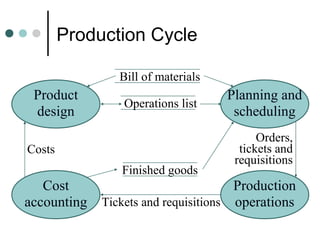
Production Cycle
Planning and
scheduling
Product
design
Production
operations
Cost
accounting
Finished goods
Bill of materials
Operations list
Costs
Tickets and requisitions
Orders,
tickets and
requisitions

Production cycle

  • 1.
  • 2.
    Production Cycle Activities The production cycle is a recurring set of business activities and related data processing operations associated with the manufacturing of products.
  • 3.
    Production Cycle Activities What are the four basic activities in the production cycle? 1 Product design 2 Planning and scheduling 3 Production operations 4 Cost accounting
  • 4.
    Product Design (Activity1)  The first step in the production cycle is product design.  The objective of this activity is to design a product that meets customer requirements for quality, durability, and functionality while simultaneously minimizing production costs.
  • 5.
    13-5 Product Design (Activity1)  Documents and procedures:  The product design activity creates two main documents: 1 Bill of materials 2 Operations list
  • 6.
    Product Design (Activity1)  How can accountants be involved in product design? – by showing how various design trade-offs affect production costs and thereby profitability – by ensuring that design is to collect and provide information about the machine setup and materials handling costs associated with alternative product designs – by providing data about repair and warranty costs associated with existing products
  • 7.
    Planning and Scheduling (Activity2)  The second step in the production cycle is planning and scheduling.  The objective of this step is a production plan efficient enough to meet existing orders and anticipate short-term demand without creating excess finished goods inventories.
  • 8.
    Planning and Scheduling (Activity2)  What are two common methods of production planning? 1 Manufacturing resource planning (MRP-II) 2 Just-in-time (JIT) manufacturing systems • MRP-II is an extension of materials resource planning that seeks to match existing production capacity and raw materials needs with forecasted sales demands. • The goal of JIT is to minimize inventories of raw materials, work in process, and finished goods.
  • 9.
    Planning and Scheduling (Activity2)  Documents and procedures:  The master production schedule (MPS) specifies how much of each product is to be produced during the planning period and when that production should occur.  A production order authorizes manufacturing.  A materials requisition authorizes removal of materials from the storeroom to the factory.
  • 10.
    Planning and Scheduling (Activity2)  How can accountants be involved in planning and scheduling? – by ensuring that the reports costs in a manner consistent with the production planning techniques used by the company – by helping to choose whether MRP-II or JIT is more appropriate
  • 11.
    Production Operations (Activity 3) The third step in the production cycle is the actual manufacture of products.  The manner in which this activity is accomplished varies greatly across companies.  What is computer-integrated manufacturing (CIM)? It is the use of information technology in the production process.
  • 12.
    Production Operations (Activity 3) Every firm needs to collect data about the following four facets of its production operations: 1. Raw materials used 2. Labor-hours expended 3. Machine operations performed 4. Other manufacturing overhead costs incurred
  • 13.
    Cost Accounting (Activity4)  The final step in the production cycle is cost accounting.  What are the three principal objectives of the cost accounting system? 1. To provide information for planning, controlling, and evaluating the performance of production operations 2. To provide accurate cost data about products for use in pricing and product mix decisions 3. To collect and process the information used to calculate the inventory and cost of goods sold values
  • 14.
    Cost Accounting (Activity4)  What are two types of cost accounting systems? 1 Job-order costing 2 Process costing  Job-order costing assigns costs to specific production batches or to individual jobs.  Process costing assigns costs to each process, and then calculates the average cost for all units produced.
  • 15.
    Cost Accounting (Activity4)  The choice of job-order or process costing affects only the method used to assign costs to products, not the method used for data collection.  Raw Materials: When production is initiated, the issuance of a materials requisition triggers the journal entry.
  • 16.
    Cost Accounting (Activity4)  Assume that 1,05,000/- of raw materials were issued.  What is the journal entry?  Work in Process 1,05,000 Raw Materials Inventory 1,05,000 To record issuance of raw materials  Assume that 10,000/- of raw materials were returned to inventory.
  • 17.
    Cost Accounting (Activity4)  What is the journal entry?  Raw Materials Inventory 10,000 Work in Process 10,000 To record return of raw materials to inventory
  • 18.
    Cost Accounting (Activity4)  Direct Labor:  A job-time ticket is a paper document used to collect data about labor activity.  This document records the amount of time a worker spent on each specific job task.  Workers can enter this data using online terminals at each factory workstation.
  • 19.
    Cost Accounting (Activity4)  Workers can use code identification cards that run through a badge reader or bar-code scanner when they start and finish any task.  Manufacturing Overhead:  What is manufacturing overhead? – all manufacturing costs that are not economically feasible to trace directly to specific jobs or processes
  • 20.
    Cost Accounting (Activity4)  Accounting for Fixed Assets:  It is also needed to collect and process information about investment in the property, plant, and equipment used in the production cycle.  Fixed assets should be bar-coded.
  • 21.
    Production Cycle Planning and scheduling Product design Production operations Cost accounting Finishedgoods Bill of materials Operations list Costs Tickets and requisitions Orders, tickets and requisitions