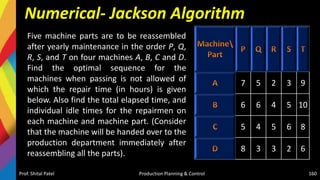
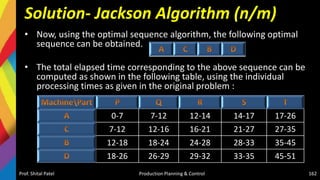
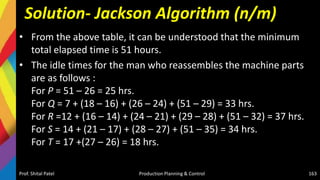
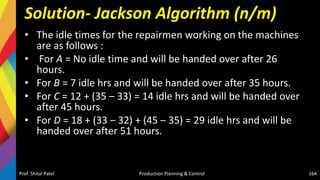
Module-5
Production Scheduling and
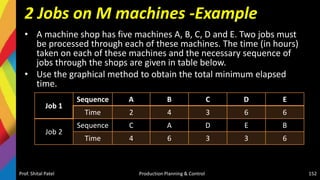
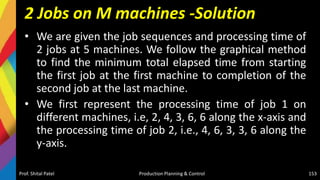
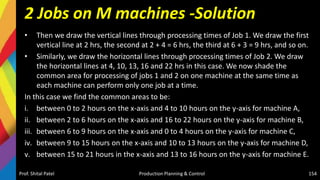
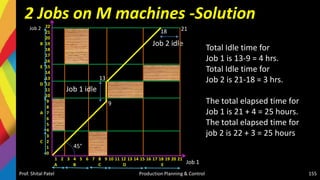
Sequencing
Content
• 5.1 Scheduling: Inputs for scheduling, loading and
scheduling devices, factors influencing scheduling,
scheduling techniques, use of Gantt Charts and basic
scheduling problems. Project scheduling by using elements
of network analysis –PERT & CPM, cost analysis & crashing,
resource leveling
• 5.2 Sequencing: Product sequencing, dispatching, progress
report & expediting and control. Johnson’s Rule for optimal
sequence of N jobs on 2 machine. Process n Jobs on 3
Machines (n/3 problem) and Jackson Algorithm. Processing
of 2 Jobs on m Machine (2/m) problem
Prof. Shital Patel 2
Production Planning & Control
Prof. Shital Patel Production Planning & Control 3
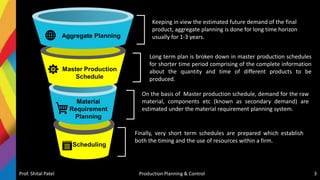
Aggregate Planning
Master Production
Schedule
Material
Requirement
Planning
Scheduling
Long term plan is broken down in master production schedules
for shorter time period comprising of the complete information
about the quantity and time of different products to be
produced.
On the basis of Master production schedule, demand for the raw
material, components etc (known as secondary demand) are
estimated under the material requirement planning system.
Finally, very short term schedules are prepared which establish
both the timing and the use of resources within a firm.
Keeping in view the estimated future demand of the final
product, aggregate planning is done for long time horizon
usually for 1-3 years.
Scheduling
• Inputs for scheduling
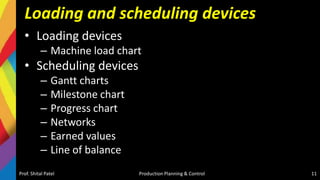
• Loading and scheduling devices
• Factors influencing scheduling
• Scheduling techniques
• Use of Gantt Charts
• Basic scheduling problems.
• Project scheduling by using elements of network analysis
– PERT & CPM
– Cost analysis & crashing
– Resource leveling
Prof. Shital Patel Production Planning & Control 4
Introduction - Scheduling
• Scheduling process involves the decision making regarding the allocation of available
capacity or resources. Thus, the process can be called as time-phased plans or schedule of
activities.
• Scheduling is concerned with preparation of machine loads and fixation of starting and
completion dates for each of the operations. Machines have to be loaded according to their
capability of performing the given task and according to their capacity. Thus the duties
include:
– Loading, the machines as per their capability and capacity.
– Determining the start and completion times for each operation.
– To coordinate with sales department regarding delivery schedules.
• Detailed scheduling determines start times, finish times and work assignments for all jobs at
each work centre. Calendar times are specified when job orders, employees, and materials
(inputs), as well as job completion (outputs), should occur at each work centre. By estimating
how long each job will take to complete and when it is due, schedulers can establish start and
finish dates and develop the detailed schedule.
Prof. Shital Patel Production Planning & Control 5
Introduction
• The production-schedules are developed by performing the
following functions:
– Loading
– Sequencing
– Scheduling
• A production schedule is the time table that specifies the times at
which the jobs in a production department will be processed on
various machines.
• The schedule gives the starting and ending times of each job on the
machines on which the job has to be processed.
• Last stage of planning before production occurs.
Prof. Shital Patel Production Planning & Control 6
Objectives of scheduling
• Meet customer due dates
• Minimize job lateness
• Minimize response time
• Minimize completion time
• Minimize time in the system
• Minimize overtime
• Maximize machine or labor utilization
• Minimize idle time
• Minimize work-in-process inventory
Prof. Shital Patel Production Planning & Control 7
Scheduling Operations
• Process Industry
– Linear programming
– EOQ with non-instantaneous replenishment
• Mass Production
– Assembly line balancing
• Project
– Project –scheduling techniques (PERT, CPM)
• Batch Production
– Aggregate planning
– Master scheduling
– Material requirements planning (MRP)
– Capacity requirements planning (CRP)
Prof. Shital Patel Production Planning & Control 8
Inputs for scheduling
1. Bill of Material (BOM) & Blue prints (Drawings) – shows kind of
item required and detailed work to be carried out.
2. Master Production Schedule (MPS) – shows priority and quantity
of finished products , due dates, quantity of raw materials
3. Route sheet – shows operations and machines to be scheduled
and processing times
4. Inventory Records – shows availability of materials & tools and
time required for procurement of items not in stock.
5. Machine-Load chart – shows the quantity of work already
scheduled on various machines and the amount of spare
(remaining) capacity available for use.
Prof. Shital Patel Production Planning & Control 9
Loading
• Machine loading is the process of converting operation
schedule into practices in conjunctions with routing.
• This process is assigning specific jobs to machines, men, or
work centers based on relative priorities and capacity
utilization.
• Loading ensures maximum possible utilization of
productive facilities and avoid bottleneck in production.
• It‘s important to either overloading or under loading the
facilities, work centers or machines to ensure maximum
utilization of resources.
Prof. Shital Patel Production Planning & Control 10
Loading and scheduling devices
• Loading devices
– Machine load chart
• Scheduling devices
– Gantt charts
– Milestone chart
– Progress chart
– Networks
– Earned values
– Line of balance
Prof. Shital Patel Production Planning & Control 11
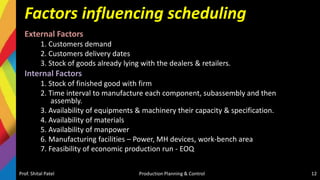
Factors influencing scheduling
External Factors
1. Customers demand
2. Customers delivery dates
3. Stock of goods already lying with the dealers & retailers.
Internal Factors
1. Stock of finished good with firm
2. Time interval to manufacture each component, subassembly and then
assembly.
3. Availability of equipments & machinery their capacity & specification.
4. Availability of materials
5. Availability of manpower
6. Manufacturing facilities – Power, MH devices, work-bench area
7. Feasibility of economic production run - EOQ
Prof. Shital Patel Production Planning & Control 12
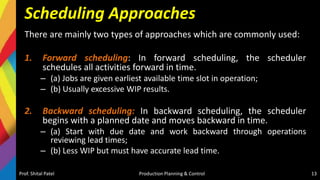
Scheduling Approaches
There are mainly two types of approaches which are commonly used:
1. Forward scheduling: In forward scheduling, the scheduler
schedules all activities forward in time.
– (a) Jobs are given earliest available time slot in operation;
– (b) Usually excessive WIP results.
2. Backward scheduling: In backward scheduling, the scheduler
begins with a planned date and moves backward in time.
– (a) Start with due date and work backward through operations
reviewing lead times;
– (b) Less WIP but must have accurate lead time.
Prof. Shital Patel Production Planning & Control 13
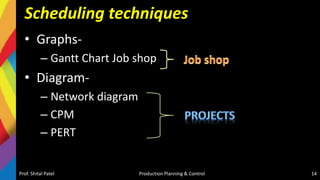
Scheduling techniques
• Graphs-
– Gantt Chart Job shop
• Diagram-
– Network diagram
– CPM
– PERT
Prof. Shital Patel Production Planning & Control 14
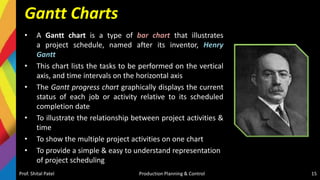
Gantt Charts
• A Gantt chart is a type of bar chart that illustrates
a project schedule, named after its inventor, Henry
Gantt
• This chart lists the tasks to be performed on the vertical
axis, and time intervals on the horizontal axis
• The Gantt progress chart graphically displays the current
status of each job or activity relative to its scheduled
completion date
• To illustrate the relationship between project activities &
time
• To show the multiple project activities on one chart
• To provide a simple & easy to understand representation
of project scheduling
Prof. Shital Patel Production Planning & Control 15
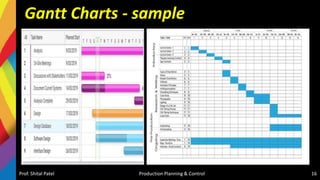
Gantt Charts - sample
Prof. Shital Patel Production Planning & Control 16
Steps to Creating a Gantt Chart
1. Determine Project start date and deadline
2. Gather all information surrounding the list of activities within a
project – the Work Breakdown Structure may be useful for this
3. Determine how long each activity will take
4. Evaluate what activities are dependant on others
5. Create Graph shell including the timeline and list of activities
6. Using either Forward Scheduling or Backward Scheduling Begin
to add bars ensuring to include dependencies and the full
duration for each activity
Prof. Shital Patel Production Planning & Control 17
Gantt Chart- Example
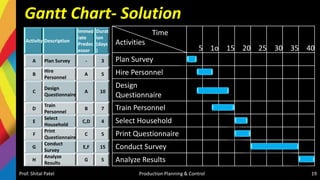
Consider a project on market survey of households. Do
the following for this project-
– a) Enumerate all the activities
– b) Write down the logical sequence of the activities (in
terms of immediate predecessors).
– c) Get the estimate for the time required by each activity.
– d) Draw Gantt chart.
Prof. Shital Patel Production Planning & Control 18
Gantt Chart- Solution
Activity Description
Immed
iate
Predec
essor
Durat
ion
(days
)
A Plan Survey - 3
B
Hire
Personnel
A 5
C
Design
Questionnaire
A 10
D
Train
Personnel
B 7
E
Select
Household
C,D 4
F
Print
Questionnaire
C 5
G
Conduct
Survey
E,F 15
H
Analyze
Results
G 5
Prof. Shital Patel Production Planning & Control 19
Time
Activities
5 1o 15 20 25 30 35 40
Plan Survey
Hire Personnel
Design
Questionnaire
Train Personnel
Select Household
Print Questionnaire
Conduct Survey
Analyze Results
Advantages of Gantt Chart
• A useful tool for displaying time-based information
within a project
• Very simple to create
• They provide a useful overview of project activities, a
good starting point for project planning
• The charts are widely used and understood
• There exists several PC software packages that allow
you to build Gantt Charts
Prof. Shital Patel Production Planning & Control 20
Limitations of Gantt Chart
• It does not help identifying the key activities which are important for project completion in
time.
• It does not permit identification of important stages in the completion of the project.
• The time (duration) estimates of the activities are made well in advance, and therefore, are
likely to involve considerable amount of uncertainty. But uncertainties cannot be taken into
account in scheduling activities using a Gantt chart.
• Utility of this chart becomes limited, especially in projects having a large number of activities.
• The Gantt Chart does not explain the reasoning behind the chosen duration of each activity
• The Gantt Chart is very difficult to update when changes to the project plan take place. This
makes it time consuming and results in long-term planning being very difficult
• Gantt Charts encourage a one-step approach to planning – this prevents flexibility in project
planning
• As Gantt Charts are difficult to update manually, they can often become obsolete
• The charts do not consider project costs or resources.
Prof. Shital Patel Production Planning & Control 21
Basic scheduling problems
• Bar Chart
• Network analysis consisting of three different
closely resembling methods.
namely :
– Precedence diagram method (PDM)
– Critical Path Method (CPM)
– Program evaluation and review technique (PERT)
• Line of Balance (LOB)
Prof. Shital Patel Production Planning & Control 22
Project
What is a project?
Project is an interrelated set of activities that has a definite starting
and ending point resulting in to an unique product. Few examples of
project are-
– Constructing a bridge, dam, highway or building
– Producing an aero plane, missile or rocket
– Introducing a new product
– Installation of a large computer system
– Construction of a ship
– Maintenance of major equipment/plant
– Commissioning of a power plant
– Conducting national election
Prof. Shital Patel Production Planning & Control 23
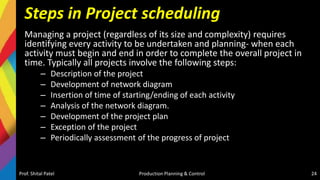
Steps in Project scheduling
Managing a project (regardless of its size and complexity) requires
identifying every activity to be undertaken and planning- when each
activity must begin and end in order to complete the overall project in
time. Typically all projects involve the following steps:
– Description of the project
– Development of network diagram
– Insertion of time of starting/ending of each activity
– Analysis of the network diagram.
– Development of the project plan
– Exception of the project
– Periodically assessment of the progress of project
Prof. Shital Patel Production Planning & Control 24
Project scheduling
• Network analysis
– CPM - Critical Path Method
– PERT – Program Evaluation & Review Technique
• Crashing
Prof. Shital Patel Production Planning & Control 25
Terminologies used in network diagram
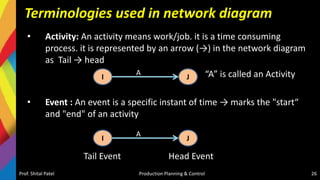
• Activity: An activity means work/job. it is a time consuming
process. it is represented by an arrow (→) in the network diagram
as Tail → head
“A” is called an Activity
• Event : An event is a specific instant of time → marks the "start“
and "end" of an activity
Tail Event Head Event
Prof. Shital Patel Production Planning & Control 26
I J
A
I J
A
• Duration (d) : Duration is the estimated or actual time
required to complete a task or an activity.
• Predecessor activity: Activities that must be completed
immediately prior to the start of another activity are called
predecessor activities.
• Successor activity : Activities that cannot be started until
one or more of other activities are completed but
immediately succeed them are called successor activities.
• Dummy activity: An activity which does not consume any
resource but merely depicts the dependence of one activity
on other is called dummy activity. It is introduced in a
network when two or more parallel activities have the
same start and finish nodes. Shown by dotted arrow line.
Prof. Shital Patel Production Planning & Control 27
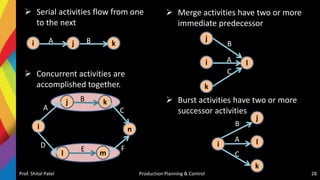
 Serial activities flow from one
to the next
 Concurrent activities are
accomplished together.
Prof. Shital Patel Production Planning & Control 28
 Merge activities have two or more
immediate predecessor
 Burst activities have two or more
successor activities
i j
A k
B
i
j
A
n
B
l
D E
k
C
m
F
l
j
B
k
C
i A
i
j
B
k
C
l
A
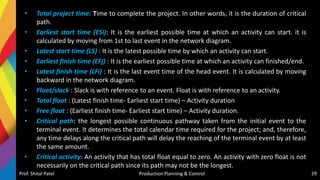
• Total project time: Time to complete the project. In other words, it is the duration of critical
path.
• Earliest start time (ESi): It is the earliest possible time at which an activity can start. it is
calculated by moving from 1st to last event in the network diagram.
• Latest start time (LS) : It is the latest possible time by which an activity can start.
• Earliest finish time (EFj) : It is the earliest possible time at which an activity can finished/end.
• Latest finish time (LFi) : It is the last event time of the head event. It is calculated by moving
backward in the network diagram.
• Float/slack : Slack is with reference to an event. Float is with reference to an activity.
• Total float : (Latest finish time- Earliest start time) – Activity duration
• Free float : (Earliest finish time- Earliest start time) – Activity duration.
• Critical path: the longest possible continuous pathway taken from the initial event to the
terminal event. It determines the total calendar time required for the project; and, therefore,
any time delays along the critical path will delay the reaching of the terminal event by at least
the same amount.
• Critical activity: An activity that has total float equal to zero. An activity with zero float is not
necessarily on the critical path since its path may not be the longest.
Prof. Shital Patel Production Planning & Control 29
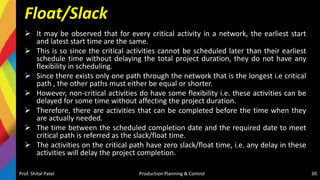
Float/Slack
 It may be observed that for every critical activity in a network, the earliest start
and latest start time are the same.
 This is so since the critical activities cannot be scheduled later than their earliest
schedule time without delaying the total project duration, they do not have any
flexibility in scheduling.
 Since there exists only one path through the network that is the longest i.e critical
path , the other paths must either be equal or shorter.
 However, non-critical activities do have some flexibility i.e. these activities can be
delayed for some time without affecting the project duration.
 Therefore, there are activities that can be completed before the time when they
are actually needed.
 The time between the scheduled completion date and the required date to meet
critical path is referred as the slack/float time.
 The activities on the critical path have zero slack/float time, i.e. any delay in these
activities will delay the project completion.
Prof. Shital Patel Production Planning & Control 30
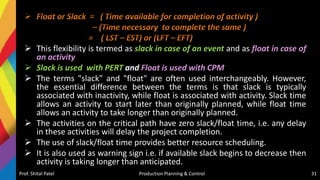
 This flexibility is termed as slack in case of an event and as float in case of
an activity
 Slack is used with PERT and Float is used with CPM
 The terms "slack" and "float" are often used interchangeably. However,
the essential difference between the terms is that slack is typically
associated with inactivity, while float is associated with activity. Slack time
allows an activity to start later than originally planned, while float time
allows an activity to take longer than originally planned.
 The activities on the critical path have zero slack/float time, i.e. any delay
in these activities will delay the project completion.
 The use of slack/float time provides better resource scheduling.
 It is also used as warning sign i.e. if available slack begins to decrease then
activity is taking longer than anticipated.
Prof. Shital Patel Production Planning & Control 31
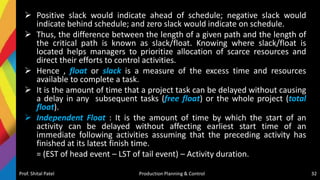
 Positive slack would indicate ahead of schedule; negative slack would
indicate behind schedule; and zero slack would indicate on schedule.
 Thus, the difference between the length of a given path and the length of
the critical path is known as slack/float. Knowing where slack/float is
located helps managers to prioritize allocation of scarce resources and
direct their efforts to control activities.
 Hence , float or slack is a measure of the excess time and resources
available to complete a task.
 It is the amount of time that a project task can be delayed without causing
a delay in any subsequent tasks (free float) or the whole project (total
float).
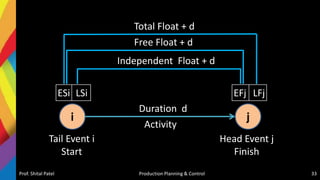
 Independent Float : It is the amount of time by which the start of an
activity can be delayed without affecting earliest start time of an
immediate following activities assuming that the preceding activity has
finished at its latest finish time.
= (EST of head event – LST of tail event) – Activity duration.
Prof. Shital Patel Production Planning & Control 32
Prof. Shital Patel Production Planning & Control 33
ESi LSi EFj LFj
Tail Event i
Start
Head Event j
Finish
i j
Duration d
Activity
Total Float + d
Free Float + d
Independent Float + d
AOA vs. AON
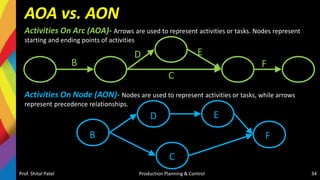
Activities On Arc (AOA)- Arrows are used to represent activities or tasks. Nodes represent
starting and ending points of activities
Prof. Shital Patel Production Planning & Control 34
E
C
D
B F
Activities On Node (AON)- Nodes are used to represent activities or tasks, while arrows
represent precedence relationships.
C
E
D
B F
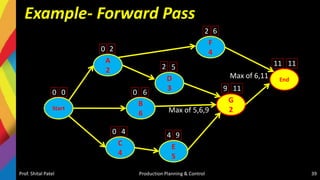
Forward Pass
 Forward pass determines the earliest times (ES- Early
Start) each activity can begin and the earliest it can be
completed (EF- Early Finish).
 There are three steps for applying the forward pass:
 Add all activity times along each path as we move through the network (ES + d
= EF)
 Carry the EF time to the activity nodes immediately succeeding the recently
completed node. That EF becomes the ES of the next node, unless the
succeeding node is a merge point
 At a merge point, the largest preceding EF becomes the ES for that node
(because the earliest the successor can begin is when all preceding activities
have been completed)
Prof. Shital Patel Production Planning & Control 35
Backward Pass
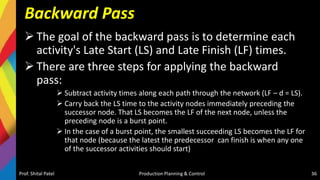
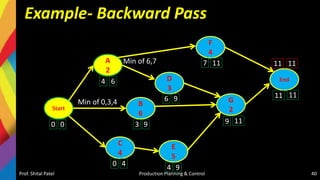
 The goal of the backward pass is to determine each
activity's Late Start (LS) and Late Finish (LF) times.
 There are three steps for applying the backward
pass:
 Subtract activity times along each path through the network (LF – d = LS).
 Carry back the LS time to the activity nodes immediately preceding the
successor node. That LS becomes the LF of the next node, unless the
preceding node is a burst point.
 In the case of a burst point, the smallest succeeding LS becomes the LF for
that node (because the latest the predecessor can finish is when any one
of the successor activities should start)
Prof. Shital Patel Production Planning & Control 36
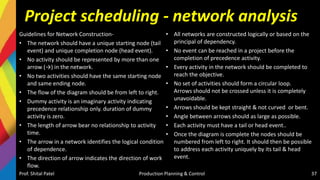
Project scheduling - network analysis
Guidelines for Network Construction-
• The network should have a unique starting node (tail
event) and unique completion node (head event).
• No activity should be represented by more than one
arrow (→) in the network.
• No two activities should have the same starting node
and same ending node.
• The flow of the diagram should be from left to right.
• Dummy activity is an imaginary activity indicating
precedence relationship only. duration of dummy
activity is zero.
• The length of arrow bear no relationship to activity
time.
• The arrow in a network identifies the logical condition
of dependence.
• The direction of arrow indicates the direction of work
flow.
Prof. Shital Patel Production Planning & Control 37
• All networks are constructed logically or based on the
principal of dependency.
• No event can be reached in a project before the
completion of precedence activity.
• Every activity in the network should be completed to
reach the objective.
• No set of activities should form a circular loop.
Arrows should not be crossed unless it is completely
unavoidable.
• Arrows should be kept straight & not curved or bent.
• Angle between arrows should as large as possible.
• Each activity must have a tail or head event..
• Once the diagram is complete the nodes should be
numbered from left to right. It should then be possible
to address each activity uniquely by its tail & head
event.
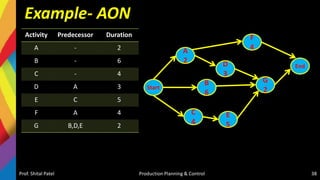
Example- AON
Activity Predecessor Duration
A - 2
B - 6
C - 4
D A 3
E C 5
F A 4
G B,D,E 2
Prof. Shital Patel Production Planning & Control 38
Start
A
2
C
4
End
F
4
G
2
D
3
B
6
E
5
Example- Forward Pass
Prof. Shital Patel Production Planning & Control 39
Start
A
2
C
4
End
F
4
G
2
D
3
B
6
E
5
11 11
9 11
4 9
6
0
4
0
0 2
0
0
2 6
2 5
Max of 5,6,9
Max of 6,11
Example- Backward Pass
Prof. Shital Patel Production Planning & Control 40
Start
A
2
C
4
End
F
4
G
2
D
3
B
6
E
5
7
4
4
0
0
0
6
3
6
4
9
9 11
11 11
9
9
11 11
11
Min of 6,7
Min of 0,3,4
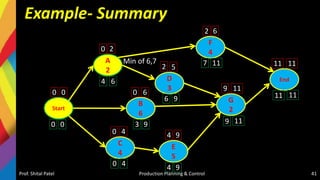
Example- Summary
Prof. Shital Patel Production Planning & Control 41
Start
A
2
C
4
End
F
4
G
2
D
3
B
6
E
5
7
4
4
0
0
0
6
3
6
4
9
9 11
11 11
9
9
11 11
9 11
11
4 9
6
0
4
0
0 2
0
0
2 6
2 5
Min of 6,7
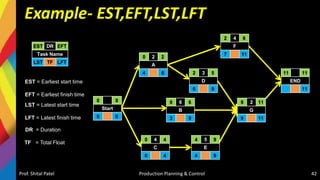
Example- EST,EFT,LST,LFT
Prof. Shital Patel Production Planning & Control 42
Start
0 0
0 0
A
0 2 2
4 6
F
2 4 6
7 11
D
2 3 5
6 9
B
0 6 6
3 9
C
0 4 4
0 4
E
4 5 9
4 9
G
9 2 11
9 11
END
11 11
11
Task Name
EST DR EFT
LST TF LFT
EST = Earliest start time
EFT = Earliest finish time
LST = Latest start time
LFT = Latest finish time
DR = Duration
TF = Total Float
CPM- Critical Path Method
Prof. Shital Patel Production Planning & Control 43
Start
0 0
0 0
A
0 2 2
4 6
F
2 4 6
7 11
D
2 3 5
6 9
B
0 6 6
3 9
C
0 4 4
0 4
E
4 5 9
4 9
G
9 2 11
9 11
End
11 11
11 11
Path 1-: Start-A-F-End = 6 days
Path 2-: Start-A-D-G-End = 7 days
Path 3-: Start-B-G-End = 8 days
Path 4-: Start-C-E-G-End = 11 days
[CRITICAL PATH]
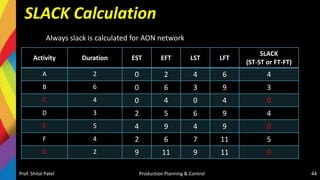
SLACK Calculation
Activity Duration EST EFT LST LFT
SLACK
(ST-ST or FT-FT)
A 2 0 2 4 6 4
B 6 0 6 3 9 3
C 4 0 4 0 4 0
D 3 2 5 6 9 4
E 5 4 9 4 9 0
F 4 2 6 7 11 5
G 2 9 11 9 11 0
Prof. Shital Patel Production Planning & Control 44
Always slack is calculated for AON network
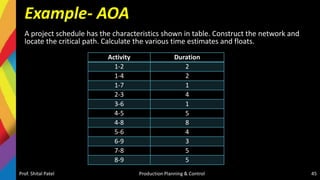
Example- AOA
A project schedule has the characteristics shown in table. Construct the network and
locate the critical path. Calculate the various time estimates and floats.
Prof. Shital Patel Production Planning & Control 45
Activity Duration
1-2 2
1-4 2
1-7 1
2-3 4
3-6 1
4-5 5
4-8 8
5-6 4
6-9 3
7-8 5
8-9 5
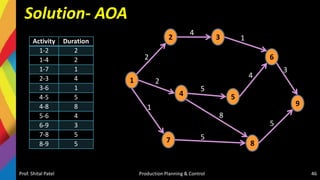
Solution- AOA
Prof. Shital Patel Production Planning & Control 46
Activity Duration
1-2 2
1-4 2
1-7 1
2-3 4
3-6 1
4-5 5
4-8 8
5-6 4
6-9 3
7-8 5
8-9 5
4
1
2 3
6
9
4 5
7 8
2
2
1
1
5
8
4
3
5
5
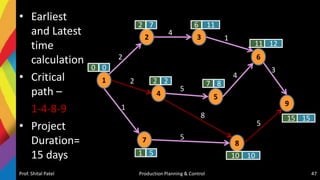
Prof. Shital Patel Production Planning & Control 47
• Earliest
and Latest
time
calculation
• Critical
path –
1-4-8-9
• Project
Duration=
15 days
4
1
2 3
6
9
4 5
7 8
2
2
1
1
5
8
4
3
5
5
0 0
2 7
2 2
1 5
6 11
7 8
11 12
10 10
15 15
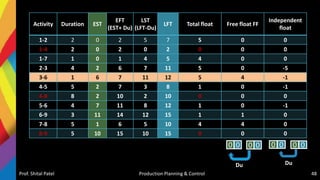
Activity Duration EST
EFT
(EST+ Du)
LST
(LFT-Du)
LFT Total float Free float FF
Independent
float
1-2 2 0 2 5 7 5 0 0
1-4 2 0 2 0 2 0 0 0
1-7 1 0 1 4 5 4 0 0
2-3 4 2 6 7 11 5 0 -5
3-6 1 6 7 11 12 5 4 -1
4-5 5 2 7 3 8 1 0 -1
4-8 8 2 10 2 10 0 0 0
5-6 4 7 11 8 12 1 0 -1
6-9 3 11 14 12 15 1 1 0
7-8 5 1 6 5 10 4 4 0
8-9 5 10 15 10 15 0 0 0
Prof. Shital Patel Production Planning & Control 48
0 0 0 0
Du
0 0 0 0
Du
Prof. Shital Patel Production Planning & Control 49
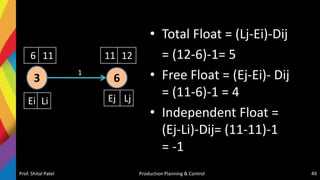
3 6
6 11 11 12
• Total Float = (Lj-Ei)-Dij
= (12-6)-1= 5
• Free Float = (Ej-Ei)- Dij
= (11-6)-1 = 4
• Independent Float =
(Ej-Li)-Dij= (11-11)-1
= -1
Ei Li Ej Lj
1
Advantages of CPM
• It shows the graphical view of the project.
• It discovers and makes dependencies visible.
• It helps in project planning, scheduling, and controlling.
• It helps in contingency planning.
• It shows the critical path, and identifies critical activities requiring special attention.
• It helps you assign the float to activities and flexibility to float activities.
• It shows you where you need to take action to bring project back on track.
• To shorten the planned critical path of a project by:
– Pruning (Trimming and cutting) critical path activities
– “Fast tracking" (To do more things in the same time in order to finish a job earlier
than normal or planned.)
– “Crashing the critical path" (Shortening the durations of critical path activities by
adding resources).
Prof. Shital Patel Production Planning & Control 50
Limitations of CPM
• Because the critical path method is an optimal planning tool, it
always assumes that all resources are available for the project at
all times.
• It does not consider resource dependencies.
• There are chances of misusing float or slack.
• Less attention on non-critical activities, though sometimes they
may also become critical activities.
• Projects based on the critical path often fail to be completed within
the approved time duration.
Prof. Shital Patel Production Planning & Control 51
PERT
PERT planning involves the following steps:
1. Identify the specific activities and milestones.
2. Determine the proper sequence of the
activities.
3. Construct a network diagram.
4. Estimate the time required for each activity.
5. Determine the critical path.
6. Update the PERT chart as the project
progresses.
Prof. Shital Patel Production Planning & Control 52
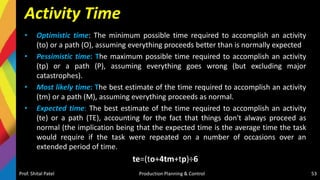
Activity Time
• Optimistic time: The minimum possible time required to accomplish an activity
(to) or a path (O), assuming everything proceeds better than is normally expected
• Pessimistic time: The maximum possible time required to accomplish an activity
(tp) or a path (P), assuming everything goes wrong (but excluding major
catastrophes).
• Most likely time: The best estimate of the time required to accomplish an activity
(tm) or a path (M), assuming everything proceeds as normal.
• Expected time: The best estimate of the time required to accomplish an activity
(te) or a path (TE), accounting for the fact that things don't always proceed as
normal (the implication being that the expected time is the average time the task
would require if the task were repeated on a number of occasions over an
extended period of time.
te=(to+4tm+tp)÷6
Prof. Shital Patel Production Planning & Control 53
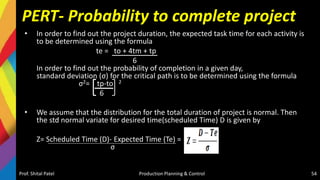
PERT- Probability to complete project
• In order to find out the project duration, the expected task time for each activity is
to be determined using the formula
te = to + 4tm + tp
6
In order to find out the probability of completion in a given day,
standard deviation (σ) for the critical path is to be determined using the formula
σ2= tp-to 2
6
• We assume that the distribution for the total duration of project is normal. Then
the std normal variate for desired time(scheduled Time) D is given by
Z= Scheduled Time (D)- Expected Time (Te) =
σ
Prof. Shital Patel Production Planning & Control 54
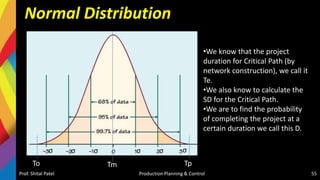
Normal Distribution
Prof. Shital Patel Production Planning & Control 55
σ σ σ σ σ σ
•We know that the project
duration for Critical Path (by
network construction), we call it
Te.
•We also know to calculate the
SD for the Critical Path.
•We are to find the probability
of completing the project at a
certain duration we call this D.
Tm
To Tp
Prof. Shital Patel Production Planning & Control 56
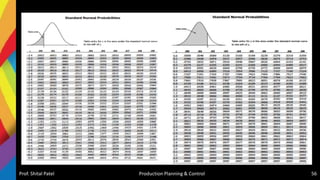
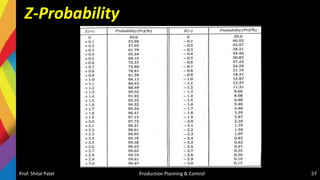
Z-Probability
Prof. Shital Patel Production Planning & Control 57
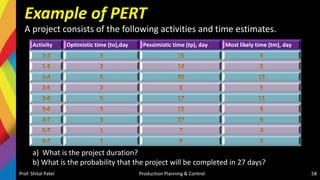
Example of PERT
A project consists of the following activities and time estimates.
Prof. Shital Patel Production Planning & Control 58
Activity Optimistic time (to),day Pessimistic time (tp), day Most likely time (tm), day
a) What is the project duration?
b) What is the probability that the project will be completed in 27 days?
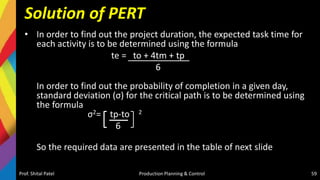
Solution of PERT
• In order to find out the project duration, the expected task time for
each activity is to be determined using the formula
te = to + 4tm + tp
6
In order to find out the probability of completion in a given day,
standard deviation (σ) for the critical path is to be determined using
the formula
σ2= tp-to 2
6
So the required data are presented in the table of next slide
Prof. Shital Patel Production Planning & Control 59
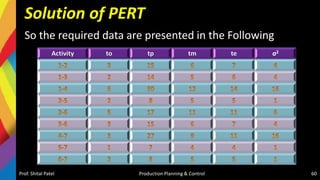
Solution of PERT
So the required data are presented in the Following
Prof. Shital Patel Production Planning & Control 60
Activity to tp tm te σ2
Solution of PERT
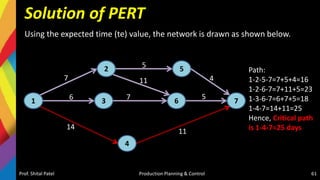
Using the expected time (te) value, the network is drawn as shown below.
Prof. Shital Patel Production Planning & Control 61
1
2
3
4
5
6 7
7
5
4
6 7
14
11
5
11
Path:
1-2-5-7=7+5+4=16
1-2-6-7=7+11+5=23
1-3-6-7=6+7+5=18
1-4-7=14+11=25
Hence, Critical path
is 1-4-7=25 days
Solution-PERT
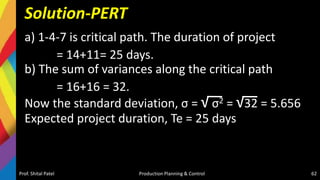
a) 1-4-7 is critical path. The duration of project
= 14+11= 25 days.
b) The sum of variances along the critical path
= 16+16 = 32.
Now the standard deviation, σ = √ σ2 = √32 = 5.656
Expected project duration, Te = 25 days
Prof. Shital Patel Production Planning & Control 62
Solution-PERT
• Given D = 27 day.
• With reference to Normal Distribution Curve
Prof. Shital Patel Production Planning & Control 63
-ve +ve
0
Solution-PERT
• From Normal Distribution Table, for Z = 0.35, the
fraction of (shadow) area = 0.637 i.e., 63.68%
• So probability of completion of project in 27 days is
63.68%
• [Note: If probability of completion of project will be
given and the due date (D) will be asked to find out,
then backward calculation can give the
result].
Prof. Shital Patel Production Planning & Control 64
Advantages of PERT
• PERT (Program Evaluation and Review Technique) compels managers to
plan, which helps them see how the pieces fit together.
• Each subordinate manger has to plan the events for which he or she
is responsible.
• It concentrates on critical elements that may need correction.
• It makes possible a kind of forward-looking control.
• The network system with its subsystems enables managers to aim
reports and pressure for action at the right spot and level in the
organization structure at the right time.
Prof. Shital Patel Production Planning & Control 65
Limitations of PERT
• Because of its emphasis on “activity-time” to its
operation, PERT is not useful when no reasonable
estimates of time schedule can be made.
• Another disadvantage has been its emphasis on
time only but not on costs.
Prof. Shital Patel Production Planning & Control 66
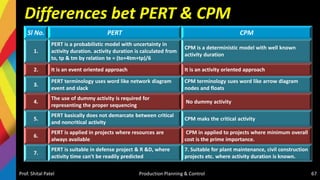
Differences bet PERT & CPM
Sl No. PERT CPM
1.
PERT is a probabilistic model with uncertainty in
activity duration. activity duration is calculated from
to, tp & tm by relation te = (to+4tm+tp)/6
CPM is a deterministic model with well known
activity duration
2. It is an event oriented approach It is an activity oriented approach
3.
PERT terminology uses word like network diagram
event and slack
CPM terminology sues word like arrow diagram
nodes and floats
4.
The use of dummy activity is required for
representing the proper sequencing
No dummy activity
5.
PERT basically does not demarcate between critical
and noncritical activity
CPM maks the critical activity
6.
PERT is applied in projects where resources are
always available
CPM in applied to projects where minimum overall
cost is the prime importance.
7.
PERT is suitable in defense project & R &D, where
activity time can't be readily predicted
7. Suitable for plant maintenance, civil construction
projects etc. where activity duration is known.
Prof. Shital Patel Production Planning & Control 67
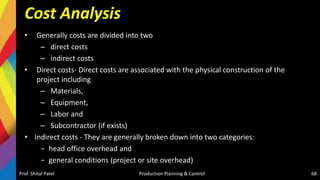
Cost Analysis
• Generally costs are divided into two
– direct costs
– indirect costs
• Direct costs- Direct costs are associated with the physical construction of the
project including
– Materials,
– Equipment,
– Labor and
– Subcontractor (if exists)
• Indirect costs - They are generally broken down into two categories:
− head office overhead and
− general conditions (project or site overhead)
Prof. Shital Patel Production Planning & Control 68
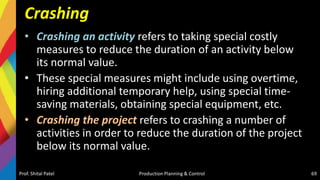
Crashing
• Crashing an activity refers to taking special costly
measures to reduce the duration of an activity below
its normal value.
• These special measures might include using overtime,
hiring additional temporary help, using special time-
saving materials, obtaining special equipment, etc.
• Crashing the project refers to crashing a number of
activities in order to reduce the duration of the project
below its normal value.
Prof. Shital Patel Production Planning & Control 69
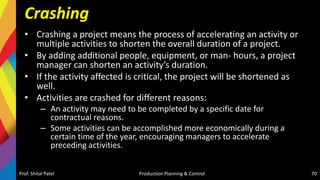
Crashing
• Crashing a project means the process of accelerating an activity or
multiple activities to shorten the overall duration of a project.
• By adding additional people, equipment, or man- hours, a project
manager can shorten an activity’s duration.
• If the activity affected is critical, the project will be shortened as
well.
• Activities are crashed for different reasons:
– An activity may need to be completed by a specific date for
contractual reasons.
– Some activities can be accomplished more economically during a
certain time of the year, encouraging managers to accelerate
preceding activities.
Prof. Shital Patel Production Planning & Control 70
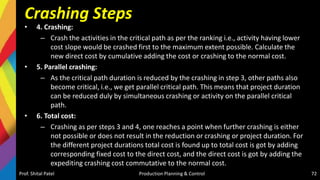
Crashing Steps
Crashing of a network can be done in following steps:
• 1. Critical path:
– Find the normal critical path and identify the critical activity.
• 2. Cost slope:
– Calculate the cost slope for the different activities by using the formula.
– Cost slope = [Crash cost-Normal cost]/[Normal time- Crash time]
– The cost slope indicates the extra cost required to expedite an activity per unit
time.
• 3. Ranking:
– Rank the activities in the ascending order of cost slope . The activity having
the minimum cost slope have to be crashed first, crash the selected activity to
its minimum duration.
Prof. Shital Patel Production Planning & Control 71
Crashing Steps
• 4. Crashing:
– Crash the activities in the critical path as per the ranking i.e., activity having lower
cost slope would be crashed first to the maximum extent possible. Calculate the
new direct cost by cumulative adding the cost or crashing to the normal cost.
• 5. Parallel crashing:
– As the critical path duration is reduced by the crashing in step 3, other paths also
become critical, i.e., we get parallel critical path. This means that project duration
can be reduced duly by simultaneous crashing or activity on the parallel critical
path.
• 6. Total cost:
– Crashing as per steps 3 and 4, one reaches a point when further crashing is either
not possible or does not result in the reduction or crashing or project duration. For
the different project durations total cost is found up to total cost is got by adding
corresponding fixed cost to the direct cost, and the direct cost is got by adding the
expediting crashing cost commutative to the normal cost.
Prof. Shital Patel Production Planning & Control 72
Cost Slop
Slop = Crash Cost-Normal Cost
Normal Time-Crash Time
Direct Cost =
Direct cost of previous Crashing
+
[Crashing Cost slop X Crashing
Time] of current crashing
Prof. Shital Patel Production Planning & Control 73
Activity
Cost
Time
Crash
Cost
Normal
Cost
Normal
Time
Crash
Time
Crashed Activity
Normal Activity
Actual Cost Curve
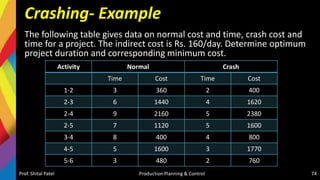
Crashing- Example
The following table gives data on normal cost and time, crash cost and
time for a project. The indirect cost is Rs. 160/day. Determine optimum
project duration and corresponding minimum cost.
Prof. Shital Patel Production Planning & Control 74
Activity Normal Crash
Time Cost Time Cost
1-2 3 360 2 400
2-3 6 1440 4 1620
2-4 9 2160 5 2380
2-5 7 1120 5 1600
3-4 8 400 4 800
4-5 5 1600 3 1770
5-6 3 480 2 760
Network Diagram
Prof. Shital Patel Production Planning & Control 75
1 2
3
4
5
6
0 0
3 3
9 9
17 17
22 22
25 25
3
6
9
8
7
5
3
Project Duration-25
Total Cost= Direct Cost +
[Indirect Cost X Duration]
= 7560 + [160 X 25]
= 11,560/-
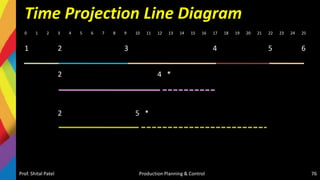
Time Projection Line Diagram
0 1 2 3 4 5 6 7 8 9 10 11 12 13 14 15 16 17 18 19 20 21 22 23 24 25
1 2 3 4 5 6
2 4 *
2 5 *
Prof. Shital Patel Production Planning & Control 76
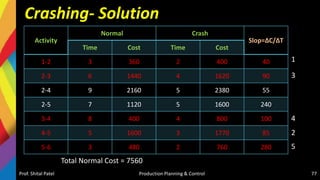
Crashing- Solution
Prof. Shital Patel Production Planning & Control 77
Activity
Normal Crash
Slop=∆C/∆T
Time Cost Time Cost
1-2 3 360 2 400 40
2-3 6 1440 4 1620 90
2-4 9 2160 5 2380 55
2-5 7 1120 5 1600 240
3-4 8 400 4 800 100
4-5 5 1600 3 1770 85
5-6 3 480 2 760 280
1
2
3
4
5
Total Normal Cost = 7560
Crashing- Solution
1. Crashing Activity 1-2: As min. slop is 40 for activity 1-2, we will Crash it first
Prof. Shital Patel Production Planning & Control 78
1 2
3
4
5
6
0 0
2 2
8 8
16 16
21 21
24 24
3
6
9
8
7
5
2
Project Duration-24
Total Cost = {Direct Cost + [Crash
Cost Slop X Crash Duration]} +
[Indirect Cost X Duration]
= {7560 + [40 X 1] } + [160 X 24]
= 7600 + 3840 = 11,440/-
Crashing- Solution
2. Crashing Activity 4-5: As next min. slop is 85 for activity 4-5, we will Crash it now
Prof. Shital Patel Production Planning & Control 79
1 2
3
4
5
6
0 0
2 2
8 8
16 16
19 19
22 22
2
6
9
8
7
5
3
Project Duration-22
Total Cost = [ Direct Cost of previous
crashing + [Crash Cost X Crash time]}
+ [Indirect Cost X Duration]
= {7600 + [85 X 2]} + [160 X 22]
= 7770 + 3520 = 11,290/-
3
Crashing- Solution
3. Crashing Activity 2-3: As next min. slop is 90 for activity 2-3, we will Crash it now
Prof. Shital Patel Production Planning & Control 80
1 2
3
4
5
6
0 0
2 2
6 6
14 14
17 17
20 20
2
6
9
8
7
3
3
4
Project Duration-20
Total Cost = [ Direct Cost of previous
crashing + [Crash Cost X Crash time]}
+ [Indirect Cost X Duration]
= {7770 + [90 X 2]} + [160 X 20]
= 7950 + 3200 = 11,150/-
Crashing- Solution
4. Crashing Activity 3-4: As next min. slop is 100 for activity 3-4, we will Crash it now. If we crash 3-4
fully by 4 days then CP will be changed. Therefore to maintain original CP containing 3-4, we will crash it
by 3 days only
Prof. Shital Patel Production Planning & Control 81
1 2
3
4
5
6
0 0
2 2
6 6
11 11
14 14
17 17
2
4
9
8
7
3
3
5
Project Duration-17
Total Cost = [ Direct Cost of previous
crashing + [Crash Cost X Crash time]}
+ [Indirect Cost X Duration]
= {7950 + [100 X 3]} + [160 X 17]
= 8250 + 2720 = 10,970/-
Crashing- Solution
5. Crashing Activity 2-4 & 3-4: If we crash 2-3 & 3-4 simultaneously by 1 day then total
cost (100+55=155) which is less than indirect cost 160. so we can crash both together
Prof. Shital Patel Production Planning & Control 82
1 2
3
4
5
6
0 0
2 2
6 6
10 10
13 13
16 16
2
4
9
5
7
3
3
4
8
Project Duration-16
Total Cost = [ Direct Cost of previous
crashing + [Crash Cost X Crash time]}
+ [Indirect Cost X Duration]
= {8250 + [155 X 1]} + [160 X 16]
= 8405 + 2560 = 10,965/-
Crashing- Solution
6. Crashing Activity 5-6: As next min. slop is 280 for activity 5-6, we will
Crash it now.
Prof. Shital Patel Production Planning & Control 83
1 2
3
4
5
6
0 0
2 2
6 6
10 10
13 13
15 15
2
4
8
4
7
3
3
2
Project Duration-15
Total Cost = [ Direct Cost of previous
crashing + [Crash Cost X Crash time]}
+ [Indirect Cost X Duration]
= {8405 + [280 X 1]} + [160 X 15]
= 8685 + 2400 = 11,085/-
Crashing- Solution
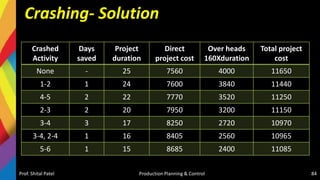
Crashed
Activity
Days
saved
Project
duration
Direct
project cost
Over heads
160Xduration
Total project
cost
None - 25 7560 4000 11650
1-2 1 24 7600 3840 11440
4-5 2 22 7770 3520 11250
2-3 2 20 7950 3200 11150
3-4 3 17 8250 2720 10970
3-4, 2-4 1 16 8405 2560 10965
5-6 1 15 8685 2400 11085
Prof. Shital Patel Production Planning & Control 84
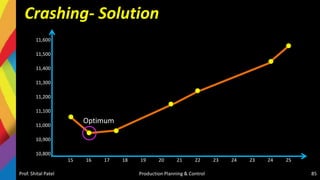
Crashing- Solution
11,600
11,500
11,400
11,300
11,200
11,100
11,000
10,900
10,800
15 16 17 18 19 20 21 22 23 24 23 24 25
Prof. Shital Patel Production Planning & Control 85
Optimum
Resource Leveling
• Resource leveling is a technique used to examine unbalanced use
of resources (usually people or equipment) over time, and for
resolving over-allocations or conflicts resulting from scheduling
certain tasks simultaneously. Such conflicts are:
– more resources such as machines or people are needed are available,
or
– a specific person is needed in both tasks, the tasks will have be
rescheduled concurrently or even sequentially to manage the
constraint.
• It is used to balance the workload of primary resources over course of the
project[s], usually at the expense of one of traditional triple constraints
(time, cost, scope)
Prof. Shital Patel Production Planning & Control 86
Resource Leveling
• Resource leveling helps an organization to make use of the
available resources to the maximum. The idea behind
resource leveling is to reduce wastage of resources i.e., to
stop over-allocation of resources. Resource leveling
techniques provide a means of distributing resource usage
over time to minimize the period-by-period variations in
manpower, equipment, or money expended.
• The essential idea of resource leveling centers about the
rescheduling of activities within the limits of available
float to achieve better distribution of resource usage.
Prof. Shital Patel Production Planning & Control 87
Resource Leveling -Example
A subcontractor needs to install flooring in two areas:
Area 1: This area has old vinyl tile that must be removed and replaced with new vinyl
tile.
Area 2: This area has a concrete slab that needs to be topped with ceramic tile. This
simple project is broken into the activities shown in the following table,
Prof. Shital Patel Production Planning & Control 88
Activity Description Predecessor Duration Worker
A Purchase and deliver material - 5 2
B Remove old vinyl tile - 7 4
C Install ceramic tile A 3 3
D Install new vinyl tile A,B 5 3
E Clean-up inspect C,D 2 2
Resource Leveling - Solution
1. Draw the precedence network and perform the
CPM calculations.
2. Allocate the required resources, then level them
so that the subcontractor does not use more
than six laborers at any time.
3. Find ways to improve the labor usage profile.
For the sake of simplicity, assume that any laborer
can perform any task.
Prof. Shital Patel Production Planning & Control 89
Resource Leveling - Solution
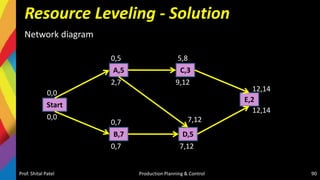
Network diagram
Prof. Shital Patel Production Planning & Control 90
0,7 7,12
Start
A,5
B,7
C,3
D,5
E,2
0,5
2,7
5,8
9,12
0,7 7,12
12,14
12,14
0,0
0,0
Prof. Shital Patel Production Planning & Control 91
Start
A,5
B,7
C,3
D,5
E,2
0,5
2,7
5,8
9,12
0,7
0,7
7,12
12,14
7,12
12,14
0,0
0,0
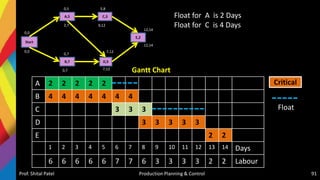
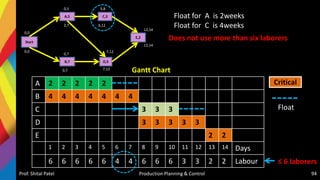
A 2 2 2 2 2
B 4 4 4 4 4 4 4
C 3 3 3
D 3 3 3 3 3
E 2 2
1 2 3 4 5 6 7 8 9 10 11 12 13 14 Days
6 6 6 6 6 7 7 6 3 3 3 3 2 2 Labour
Critical
Float
Float for A is 2 Days
Float for C is 4 Days
Gantt Chart
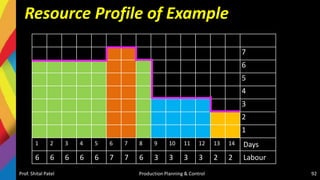
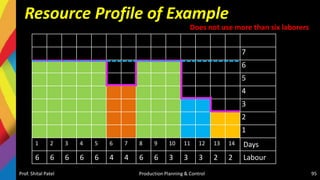
Resource Profile of Example
Prof. Shital Patel Production Planning & Control 92
7
6
5
4
3
2
1
1 2 3 4 5 6 7 8 9 10 11 12 13 14 Days
6 6 6 6 6 7 7 6 3 3 3 3 2 2 Labour
Resource Profile of Example
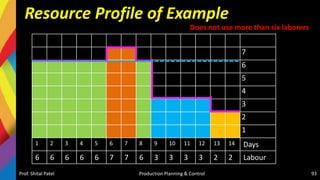
Prof. Shital Patel Production Planning & Control 93
7
6
5
4
3
2
1
1 2 3 4 5 6 7 8 9 10 11 12 13 14 Days
6 6 6 6 6 7 7 6 3 3 3 3 2 2 Labour
Does not use more than six laborers
Prof. Shital Patel Production Planning & Control 94
Start
A,5
B,7
C,3
D,5
E,2
0,5
2,7
5,8
9,12
0,7
0,7
7,12
12,14
7,12
12,14
0,0
0,0
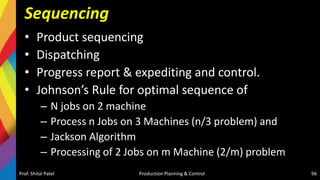
A 2 2 2 2 2
B 4 4 4 4 4 4 4
C 3 3 3
D 3 3 3 3 3
E 2 2
1 2 3 4 5 6 7 8 9 10 11 12 13 14 Days
6 6 6 6 6 4 4 6 6 6 3 3 2 2 Labour
Critical
Float
Float for A is 2weeks
Float for C is 4weeks
Gantt Chart
Does not use more than six laborers
≤ 6 laborers
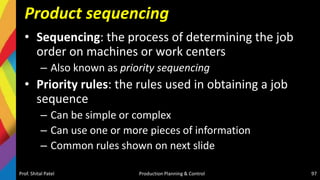
Resource Profile of Example
Prof. Shital Patel Production Planning & Control 95
7
6
5
4
3
2
1
1 2 3 4 5 6 7 8 9 10 11 12 13 14 Days
6 6 6 6 6 4 4 6 6 3 3 3 2 2 Labour
Does not use more than six laborers
Sequencing
• Product sequencing
• Dispatching
• Progress report & expediting and control.
• Johnson’s Rule for optimal sequence of
– N jobs on 2 machine
– Process n Jobs on 3 Machines (n/3 problem) and
– Jackson Algorithm
– Processing of 2 Jobs on m Machine (2/m) problem
Prof. Shital Patel Production Planning & Control 96
Product sequencing
• Sequencing: the process of determining the job
order on machines or work centers
– Also known as priority sequencing
• Priority rules: the rules used in obtaining a job
sequence
– Can be simple or complex
– Can use one or more pieces of information
– Common rules shown on next slide
Prof. Shital Patel Production Planning & Control 97
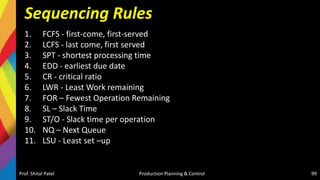
Priority Rules for Job Sequencing
• Prioritize jobs assigned to a resource
• If no order specified use first-come first-
served (FCFS)
• Many other sequencing rules exist
• Each attempts to achieve to an objective
Prof. Shital Patel Production Planning & Control 98
Sequencing Rules
1. FCFS - first-come, first-served
2. LCFS - last come, first served
3. SPT - shortest processing time
4. EDD - earliest due date
5. CR - critical ratio
6. LWR - Least Work remaining
7. FOR – Fewest Operation Remaining
8. SL – Slack Time
9. ST/O - Slack time per operation
10. NQ – Next Queue
11. LSU - Least set –up
Prof. Shital Patel Production Planning & Control 99
1. FCFS - first come, first served
Prof. Shital Patel Production Planning & Control 100
IN OUT
-Jobs are processed in the sequence in which they entered the shop
- The simplest and nature way of sequencing as in queuing of a bank
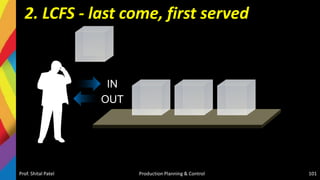
2. LCFS - last come, first served
Prof. Shital Patel Production Planning & Control 101
IN
OUT
Sequencing methods
3. SPT (shortest processing time)
– Jobs are sequenced in increasing order of their processing
time
– The job with shortest processing time is first, the one with
the next shortest processing time is second, and so on
4. EDD (earliest due date) - Jackson Algorithm
– Jobs are sequenced in increasing order of their due dates
– The job with earliest due date is first, the one with the
next earliest due date is second, and so on
Prof. Shital Patel Production Planning & Control 102
Sequencing methods
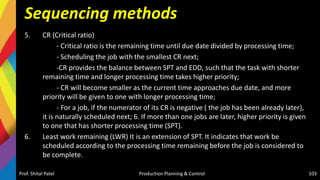
5. CR (Critical ratio)
- Critical ratio is the remaining time until due date divided by processing time;
- Scheduling the job with the smallest CR next;
-CR provides the balance between SPT and EDD, such that the task with shorter
remaining time and longer processing time takes higher priority;
- CR will become smaller as the current time approaches due date, and more
priority will be given to one with longer processing time;
- For a job, if the numerator of its CR is negative ( the job has been already later),
it is naturally scheduled next; 6. If more than one jobs are later, higher priority is given
to one that has shorter processing time (SPT).
6. Least work remaining (LWR) It is an extension of SPT. It indicates that work be
scheduled according to the processing time remaining before the job is considered to
be complete.
Prof. Shital Patel Production Planning & Control 103
Sequencing methods
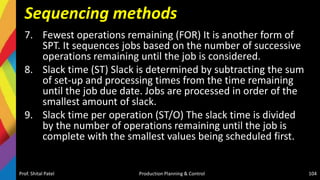
7. Fewest operations remaining (FOR) It is another form of
SPT. It sequences jobs based on the number of successive
operations remaining until the job is considered.
8. Slack time (ST) Slack is determined by subtracting the sum
of set-up and processing times from the time remaining
until the job due date. Jobs are processed in order of the
smallest amount of slack.
9. Slack time per operation (ST/O) The slack time is divided
by the number of operations remaining until the job is
complete with the smallest values being scheduled first.
Prof. Shital Patel Production Planning & Control 104
Sequencing methods
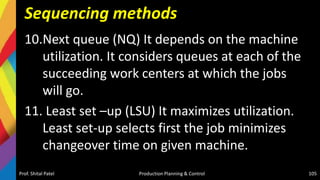
10.Next queue (NQ) It depends on the machine
utilization. It considers queues at each of the
succeeding work centers at which the jobs
will go.
11. Least set –up (LSU) It maximizes utilization.
Least set-up selects first the job minimizes
changeover time on given machine.
Prof. Shital Patel Production Planning & Control 105
Sequencing – Example 1
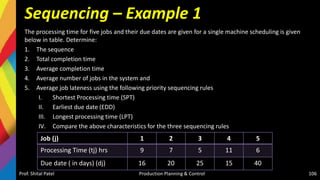
The processing time for five jobs and their due dates are given for a single machine scheduling is given
below in table. Determine:
1. The sequence
2. Total completion time
3. Average completion time
4. Average number of jobs in the system and
5. Average job lateness using the following priority sequencing rules
I. Shortest Processing time (SPT)
II. Earliest due date (EDD)
III. Longest processing time (LPT)
IV. Compare the above characteristics for the three sequencing rules
Prof. Shital Patel Production Planning & Control 106
Job (j) 1 2 3 4 5
Processing Time (tj) hrs 9 7 5 11 6
Due date ( in days) (dj) 16 20 25 15 40
Sequencing – Solution 1
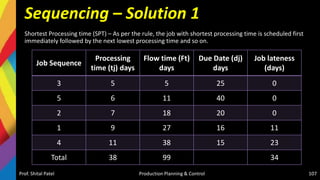
Shortest Processing time (SPT) – As per the rule, the job with shortest processing time is scheduled first
immediately followed by the next lowest processing time and so on.
Prof. Shital Patel Production Planning & Control 107
Job Sequence
Processing
time (tj) days
Flow time (Ft)
days
Due Date (dj)
days
Job lateness
(days)
3 5 5 25 0
5 6 11 40 0
2 7 18 20 0
1 9 27 16 11
4 11 38 15 23
Total 38 99 34
Sequencing – Solution 1
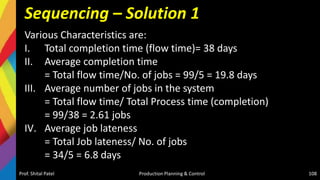
Various Characteristics are:
I. Total completion time (flow time)= 38 days
II. Average completion time
= Total flow time/No. of jobs = 99/5 = 19.8 days
III. Average number of jobs in the system
= Total flow time/ Total Process time (completion)
= 99/38 = 2.61 jobs
IV. Average job lateness
= Total Job lateness/ No. of jobs
= 34/5 = 6.8 days
Prof. Shital Patel Production Planning & Control 108
Sequencing – Solution 1
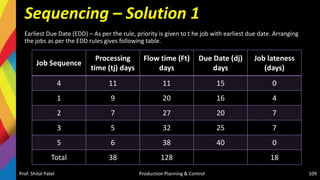
Earliest Due Date (EDD) – As per the rule, priority is given to t he job with earliest due date. Arranging
the jobs as per the EDD rules gives following table.
Prof. Shital Patel Production Planning & Control 109
Job Sequence
Processing
time (tj) days
Flow time (Ft)
days
Due Date (dj)
days
Job lateness
(days)
4 11 11 15 0
1 9 20 16 4
2 7 27 20 7
3 5 32 25 7
5 6 38 40 0
Total 38 128 18
Sequencing – Solution 1
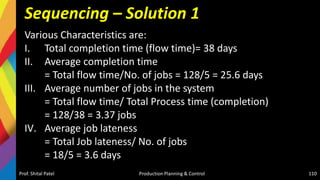
Various Characteristics are:
I. Total completion time (flow time)= 38 days
II. Average completion time
= Total flow time/No. of jobs = 128/5 = 25.6 days
III. Average number of jobs in the system
= Total flow time/ Total Process time (completion)
= 128/38 = 3.37 jobs
IV. Average job lateness
= Total Job lateness/ No. of jobs
= 18/5 = 3.6 days
Prof. Shital Patel Production Planning & Control 110
Sequencing – Solution 1
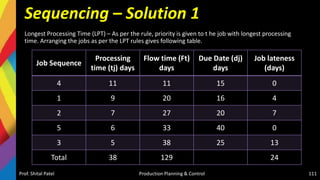
Longest Processing Time (LPT) – As per the rule, priority is given to t he job with longest processing
time. Arranging the jobs as per the LPT rules gives following table.
Prof. Shital Patel Production Planning & Control 111
Job Sequence
Processing
time (tj) days
Flow time (Ft)
days
Due Date (dj)
days
Job lateness
(days)
4 11 11 15 0
1 9 20 16 4
2 7 27 20 7
5 6 33 40 0
3 5 38 25 13
Total 38 129 24
Sequencing – Solution 1
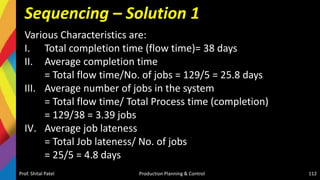
Various Characteristics are:
I. Total completion time (flow time)= 38 days
II. Average completion time
= Total flow time/No. of jobs = 129/5 = 25.8 days
III. Average number of jobs in the system
= Total flow time/ Total Process time (completion)
= 129/38 = 3.39 jobs
IV. Average job lateness
= Total Job lateness/ No. of jobs
= 25/5 = 4.8 days
Prof. Shital Patel Production Planning & Control 112
Sequencing – Solution 1
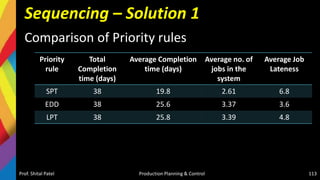
Comparison of Priority rules
Prof. Shital Patel Production Planning & Control 113
Priority
rule
Total
Completion
time (days)
Average Completion
time (days)
Average no. of
jobs in the
system
Average Job
Lateness
SPT 38 19.8 2.61 6.8
EDD 38 25.6 3.37 3.6
LPT 38 25.8 3.39 4.8
Sequencing – Example 2
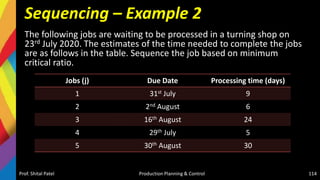
The following jobs are waiting to be processed in a turning shop on
23rd July 2020. The estimates of the time needed to complete the jobs
are as follows in the table. Sequence the job based on minimum
critical ratio.
Prof. Shital Patel Production Planning & Control 114
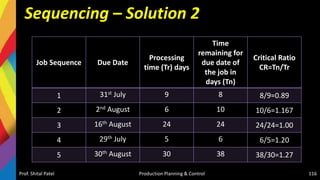
Jobs (j) Due Date Processing time (days)
1 31st July 9
2 2nd August 6
3 16th August 24
4 29th July 5
5 30th August 30
Sequencing – Solution 2
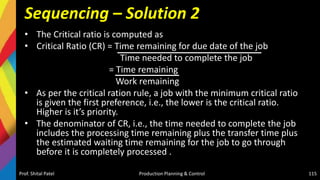
• The Critical ratio is computed as
• Critical Ratio (CR) = Time remaining for due date of the job
Time needed to complete the job
= Time remaining
Work remaining
• As per the critical ration rule, a job with the minimum critical ratio
is given the first preference, i.e., the lower is the critical ratio.
Higher is it’s priority.
• The denominator of CR, i.e., the time needed to complete the job
includes the processing time remaining plus the transfer time plus
the estimated waiting time remaining for the job to go through
before it is completely processed .
Prof. Shital Patel Production Planning & Control 115
Sequencing – Solution 2
Prof. Shital Patel Production Planning & Control 116
Job Sequence Due Date
Processing
time (Tr) days
Time
remaining for
due date of
the job in
days (Tn)
Critical Ratio
CR=Tn/Tr
1 31st July 9 8 8/9=0.89
2 2nd August 6 10 10/6=1.167
3 16th August 24 24 24/24=1.00
4 29th July 5 6 6/5=1.20
5 30th August 30 38 38/30=1.27
Sequencing – Solution 2
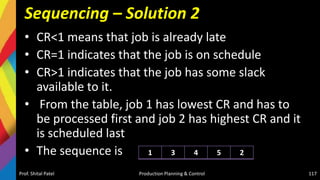
• CR<1 means that job is already late
• CR=1 indicates that the job is on schedule
• CR>1 indicates that the job has some slack
available to it.
• From the table, job 1 has lowest CR and has to
be processed first and job 2 has highest CR and it
is scheduled last
• The sequence is
Prof. Shital Patel Production Planning & Control 117
1 3 4 5 2
Expediting and Control
• Control phase is effected by dispatching, inspection and expediting
materials control, analysis of work-in-process. Finally, evaluation makes
the PPC cycle complete and corrective actions are taken through a
feedback from analysis. A good communication, and feedback system is
essential to enhance and ensure effectiveness of PPC.
• Expediting: This is the control tool that keeps a close observation on the
progress of the work. It is logical step after dispatching which is called
‘follow-up’. It coordinates extensively to execute the production plan.
• Expediting is a process of tracking a job’s progress and taking special
actions to move it through the facility. In tracking a job’s progress, special
action may be needed to keep the job moving through the facility on time.
Manufacturing or service operations disruptions-equipments breakdowns,
unavailable materials, last-minute priority changes, require managers to
deviate from plans and schedules and expedite an important job on a
special handling basis.
Prof. Shital Patel Production Planning & Control 118
Progress report
• Progressing function can be divided into three
parts, i.e., follow up of materials, follow up of
work-in-process and follow up of assembly.
• The duties include: (a) Identification of
bottlenecks and delays and interruptions because
of which the production schedule may be
disrupted. (b) To devise action plans (remedies)
for correcting the errors. (c) To see that
production rate is in line with schedule.
Prof. Shital Patel Production Planning & Control 119
Dispatching
• It is concerned with starting the processes.
• It gives necessary authority to start a particular work,
which has already being planned under Routing and
scheduling.
• For starting the work, essential orders and instructions
are given. Therefore, the complete definition of
dispatching → "Released of order and instructions for
the starting of production for any item in accordance
with the route sheet and scheduled chart.
Prof. Shital Patel Production Planning & Control 120
Function of Dispatching
1. After dispatching is done, required materials are
moved from stores to m/c(s) and from operation to
operation.
2. Authorizes to take work in hand as per schedule.
3. To distribute m/c loading and schedule charts route
sheets and other necessary instructions and forms.
4. To issue inspection orders, clearly stating the type of
inspection required at various stages.
5. To order too section for issuing proper tools, jigs,
fixtures and other essential articles.
Prof. Shital Patel Production Planning & Control 121
Forms used in Dispatching
Following are some of the more common forms used in dispatching.
1. Work orders: while starting the production, work orders are issued to
departments to commence the desired lot of product.
2. Time cards: Each operator is supplied with this card in which he mentions the
time taken by each operation and other necessary information's. there are
helpful for wage payment.
3. Inspection Tickets: These tickets are sent to the inspection department which
shows the quality of work required and stages at which inspection is to be
carried out.
4. Move Tickets: These tickets are used for authorizing over the movement of
material from store to shop and from operation to operation.
5. Tool & Equipment Tickets: It authorizes the tool department that new tools,
gauges, jigs, fixtures and other required equipment may be issued to shop.
Prof. Shital Patel Production Planning & Control 122
Johnson’s Algorithm
• The general sequencing problem is stated as ‘N’
jobs (1,2,3….n) to be processed through ‘M’
machines (m1,m2,m3….mn) at a time by following ,
order of processing (precedence) and a given
processing time, with minimizing elapsed time.
• Johnson’s algorithm is the technique for
minimizing completion time for a group of jobs to
be processed in optimal sequence.
Prof. Shital Patel Production Planning & Control 123
Johnson’s Algorithm
Johnson’s algorithm is used for:
1. N jobs and 2 machines
2. N jobs and 3 machines
Assumptions -
1. No machines can process more than one job at a time
2. Processing times are independent of processing job
3. Each job once started once one machine is continued till
completion on it
4. Time involved in moving a job from one machine to another is
negligibly small
Prof. Shital Patel Production Planning & Control 124
Johnson’s Algorithm
Steps:
1. List time required to process each job at each machine. Set up a
one-dimensional matrix to represent desired sequence with # of
slots equal to # of jobs.
2. Select smallest processing time at either machine.
– If that time is on machine 1, put the job as near to beginning of
sequence as possible.
– If smallest time occurs on machine 2, put the job as near to the
end of the sequence as possible. Remove the job from the list.
3. Remove the job from the list.
4. Repeat steps 2-3 until all slots in matrix are filled & all jobs are
sequenced.
Prof. Shital Patel Production Planning & Control 125
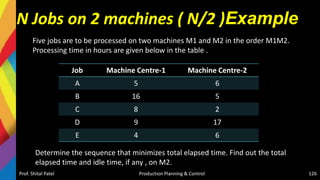
N Jobs on 2 machines ( N/2 )Example
Job Machine Centre-1 Machine Centre-2
A 5 6
B 16 5
C 8 2
D 9 17
E 4 6
Prof. Shital Patel Production Planning & Control 126
Five jobs are to be processed on two machines M1 and M2 in the order M1M2.
Processing time in hours are given below in the table .
Determine the sequence that minimizes total elapsed time. Find out the total
elapsed time and idle time, if any , on M2.
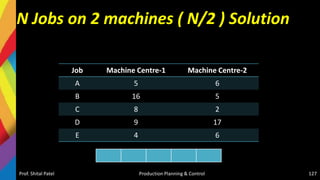
N Jobs on 2 machines ( N/2 ) Solution
Job Machine Centre-1 Machine Centre-2
A 5 6
B 16 5
C 8 2
D 9 17
E 4 6
Prof. Shital Patel Production Planning & Control 127
N Jobs on 2 machines ( N/2 ) Solution
Job Machine Centre-1 Machine Centre-2
A 5 6
B 16 5
C 8 2
D 9 17
E 4 6
Prof. Shital Patel Production Planning & Control 128
C
The minimum processing time, 2, is given by Job C on Machine 2.
So, Schedule Job C in the end.
N Jobs on 2 machines ( N/2 ) Solution
Job Machine Centre-1 Machine Centre-2
A 5 6
B 16 5
C 8 2
D 9 17
E 4 6
Prof. Shital Patel Production Planning & Control 129
C
The minimum processing time, 2, is given by Job C on Machine 2.
So, Schedule Job C in the end.
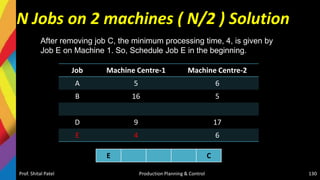
N Jobs on 2 machines ( N/2 ) Solution
Job Machine Centre-1 Machine Centre-2
A 5 6
B 16 5
D 9 17
E 4 6
Prof. Shital Patel Production Planning & Control 130
E C
After removing job C, the minimum processing time, 4, is given by
Job E on Machine 1. So, Schedule Job E in the beginning.
N Jobs on 2 machines ( N/2 ) Solution
Job Machine Centre-1 Machine Centre-2
A 5 6
B 16 5
D 9 17
Prof. Shital Patel Production Planning & Control 131
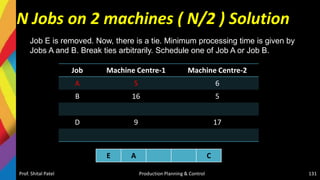
E A C
Job E is removed. Now, there is a tie. Minimum processing time is given by
Jobs A and B. Break ties arbitrarily. Schedule one of Job A or Job B.
N Jobs on 2 machines ( N/2 ) Solution
Job Machine Centre-1 Machine Centre-2
B 16 5
D 9 17
Prof. Shital Patel Production Planning & Control 132
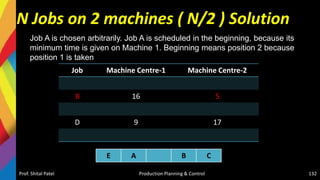
E A B C
Job A is chosen arbitrarily. Job A is scheduled in the beginning, because its
minimum time is given on Machine 1. Beginning means position 2 because
position 1 is taken
N Jobs on 2 machines ( N/2 ) Solution
Job Machine Centre-1 Machine Centre-2
D 9 17
Prof. Shital Patel Production Planning & Control 133
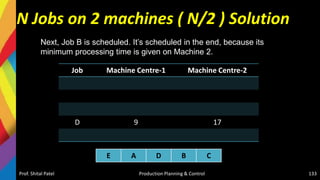
E A D B C
Next, Job B is scheduled. It’s scheduled in the end, because its
minimum processing time is given on Machine 2.
N Jobs on 2 machines ( N/2 ) Solution
Prof. Shital Patel Production Planning & Control 134
E A D B C
The sequencing is complete after assigning the remaining Job D to
the remaining position. Next, the make span is computed.
N Jobs on 2 machines ( N/2) Solution
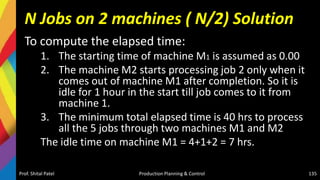
To compute the elapsed time:
1. The starting time of machine M1 is assumed as 0.00
2. The machine M2 starts processing job 2 only when it
comes out of machine M1 after completion. So it is
idle for 1 hour in the start till job comes to it from
machine 1.
3. The minimum total elapsed time is 40 hrs to process
all the 5 jobs through two machines M1 and M2
The idle time on machine M1 = 4+1+2 = 7 hrs.
Prof. Shital Patel Production Planning & Control 135
N Jobs on 2 machines ( N/2) Solution
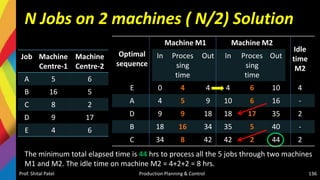
Prof. Shital Patel Production Planning & Control 136
Optimal
sequence
Machine M1 Machine M2
Idle
time
M2
In Proces
sing
time
Out In Proces
sing
time
Out
E 0 4 4 4 6 10 4
A 4 5 9 10 6 16 -
D 9 9 18 18 17 35 2
B 18 16 34 35 5 40 -
C 34 8 42 42 2 44 2
Job Machine
Centre-1
Machine
Centre-2
A 5 6
B 16 5
C 8 2
D 9 17
E 4 6
The minimum total elapsed time is 44 hrs to process all the 5 jobs through two machines
M1 and M2. The idle time on machine M2 = 4+2+2 = 8 hrs.
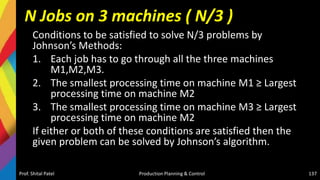
N Jobs on 3 machines ( N/3 )
Conditions to be satisfied to solve N/3 problems by
Johnson’s Methods:
1. Each job has to go through all the three machines
M1,M2,M3.
2. The smallest processing time on machine M1 ≥ Largest
processing time on machine M2
3. The smallest processing time on machine M3 ≥ Largest
processing time on machine M2
If either or both of these conditions are satisfied then the
given problem can be solved by Johnson’s algorithm.
Prof. Shital Patel Production Planning & Control 137
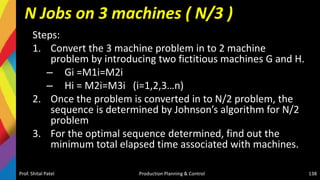
N Jobs on 3 machines ( N/3 )
Steps:
1. Convert the 3 machine problem in to 2 machine
problem by introducing two fictitious machines G and H.
– Gi =M1i=M2i
– Hi = M2i=M3i (i=1,2,3…n)
2. Once the problem is converted in to N/2 problem, the
sequence is determined by Johnson’s algorithm for N/2
problem
3. For the optimal sequence determined, find out the
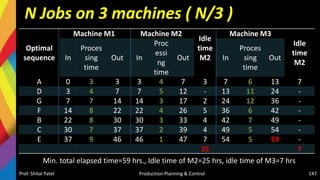
minimum total elapsed time associated with machines.
Prof. Shital Patel Production Planning & Control 138
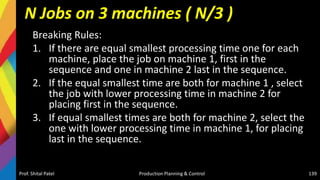
N Jobs on 3 machines ( N/3 )
Breaking Rules:
1. If there are equal smallest processing time one for each
machine, place the job on machine 1, first in the
sequence and one in machine 2 last in the sequence.
2. If the equal smallest time are both for machine 1 , select
the job with lower processing time in machine 2 for
placing first in the sequence.
3. If equal smallest times are both for machine 2, select the
one with lower processing time in machine 1, for placing
last in the sequence.
Prof. Shital Patel Production Planning & Control 139
N Jobs on 3 machines ( N/3 )
Prof. Shital Patel Production Planning & Control 140
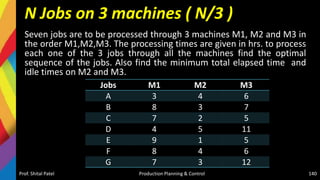
Seven jobs are to be processed through 3 machines M1, M2 and M3 in
the order M1,M2,M3. The processing times are given in hrs. to process
each one of the 3 jobs through all the machines find the optimal
sequence of the jobs. Also find the minimum total elapsed time and
idle times on M2 and M3.
Jobs M1 M2 M3
A 3 4 6
B 8 3 7
C 7 2 5
D 4 5 11
E 9 1 5
F 8 4 6
G 7 3 12
N Jobs on 3 machines ( N/3 )
Prof. Shital Patel Production Planning & Control 141
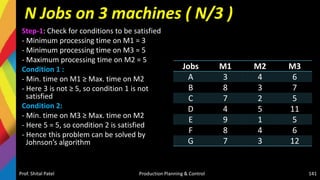
Step-1: Check for conditions to be satisfied
- Minimum processing time on M1 = 3
- Minimum processing time on M3 = 5
- Maximum processing time on M2 = 5
Condition 1 :
- Min. time on M1 ≥ Max. time on M2
- Here 3 is not ≥ 5, so condition 1 is not
satisfied
Condition 2:
- Min. time on M3 ≥ Max. time on M2
- Here 5 = 5, so condition 2 is satisfied
- Hence this problem can be solved by
Johnson’s algorithm
Jobs M1 M2 M3
A 3 4 6
B 8 3 7
C 7 2 5
D 4 5 11
E 9 1 5
F 8 4 6
G 7 3 12
N Jobs on 3 machines ( N/3 )
Prof. Shital Patel Production Planning & Control 142
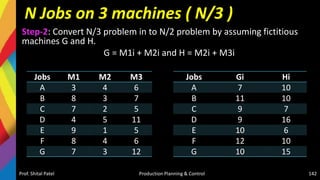
Step-2: Convert N/3 problem in to N/2 problem by assuming fictitious
machines G and H.
G = M1i + M2i and H = M2i + M3i
Jobs Gi Hi
A 7 10
B 11 10
C 9 7
D 9 16
E 10 6
F 12 10
G 10 15
Jobs M1 M2 M3
A 3 4 6
B 8 3 7
C 7 2 5
D 4 5 11
E 9 1 5
F 8 4 6
G 7 3 12
N Jobs on 3 machines ( N/3 )
Prof. Shital Patel Production Planning & Control 143
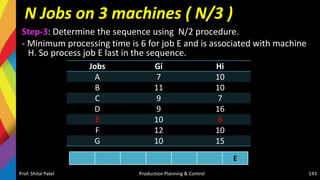
Step-3: Determine the sequence using N/2 procedure.
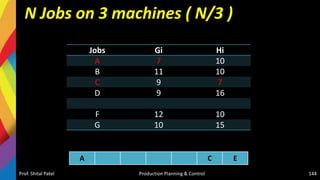
- Minimum processing time is 6 for job E and is associated with machine
H. So process job E last in the sequence.
Jobs Gi Hi
A 7 10
B 11 10
C 9 7
D 9 16
E 10 6
F 12 10
G 10 15
E
N Jobs on 3 machines ( N/3 )
Prof. Shital Patel Production Planning & Control 144
Jobs Gi Hi
A 7 10
B 11 10
C 9 7
D 9 16
F 12 10
G 10 15
A C E
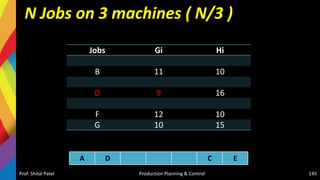
N Jobs on 3 machines ( N/3 )
Prof. Shital Patel Production Planning & Control 145
Jobs Gi Hi
B 11 10
D 9 16
F 12 10
G 10 15
A D C E
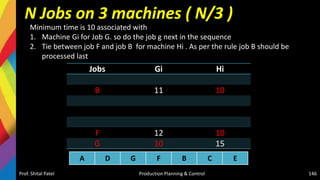
N Jobs on 3 machines ( N/3 )
Prof. Shital Patel Production Planning & Control 146
Jobs Gi Hi
B 11 10
F 12 10
G 10 15
A D G F B C E
Minimum time is 10 associated with
1. Machine Gi for Job G. so do the job g next in the sequence
2. Tie between job F and job B for machine Hi . As per the rule job B should be
processed last
N Jobs on 3 machines ( N/3 )
Prof. Shital Patel Production Planning & Control 147
Optimal
sequence
Machine M1 Machine M2
Idle
time
M2
Machine M3
Idle
time
M2
In
Proces
sing
time
Out In
Proc
essi
ng
time
Out In
Proces
sing
time
Out
A 0 3 3 3 4 7 3 7 6 13 7
D 3 4 7 7 5 12 - 13 11 24 -
G 7 7 14 14 3 17 2 24 12 36 -
F 14 8 22 22 4 26 5 36 6 42 -
B 22 8 30 30 3 33 4 42 7 49 -
C 30 7 37 37 2 39 4 49 5 54 -
E 37 9 46 46 1 47 7 54 5 59 -
25 7
Min. total elapsed time=59 hrs., Idle time of M2=25 hrs, idle time of M3=7 hrs
2 Jobs on M machines ( 2/m )
• For these types of problems, there are two jobs J1, J2
each of which has to be processed on m machines M1,
M2, …, Mm with different sequences of machines for
processing each of the jobs.
• Each machine can perform only one job at a time. The
exact or expected processing times on all the given
machines are known.
• The objective is to find a sequence of processing the
jobs, which minimizes the total elapsed time from the
start of the first job to the completion of the last job.
Prof. Shital Patel Production Planning & Control 148
2 Jobs on M machines ( 2/m )
• A problem of this type can be solved with the help of
graphical method.
• We have to use the following steps in this method:
• Step 1:Represent the processing times of job 1 on different
machines along the x-axis and processing times of job 2 on
different machines along the y-axis.
• Step 2: Draw the vertical/horizontal lines through
processing times as given in Step 1 and shade the common
area for processing of two jobs on the same machine at
different times since each machine can perform only one
job at a time.
Prof. Shital Patel Production Planning & Control 149
2 Jobs on M machines ( 2/m )
• Step 3: Starting from the origin, we move diagonally,
horizontally or vertically through various stages of
completion of the processing of both the jobs through
different machines at the same time until all the processing
times are finished. If both the jobs are being processed
simultaneously at different machines at the same time, we
move diagonally. If Job 2 is under process at any machine
and Job 1 is idle, i.e., Job 1 is waiting to be processed at the
same machine through which Job 2 is being processed, we
move vertically; and we move horizontally when Job 1 is
being processed and Job 2 is idle.
Prof. Shital Patel Production Planning & Control 150
2 Jobs on M machines ( 2/m )
• Step 4: An optimal sequence for the jobs is the shortest line
consisting of combinations of horizontal, vertical and diagonal (45 )
lines from the origin. Since both the jobs are being processed
simultaneously on the diagonal line, effort should be made to select
a path on which diagonal movement is maximum.
• So, we first try to move diagonally but keep in mind that diagonal
movement through the blocked out (shaded) areas is not allowed
since both the jobs cannot be processed simultaneously on a
machine. Then horizontal or vertical movement is chosen keeping in
view that total elapsed time should be minimum. The elapsed time
can be obtained by adding the idle time for either job to the
processing time for that job.
Prof. Shital Patel Production Planning & Control 151
2 Jobs on M machines -Example
• A machine shop has five machines A, B, C, D and E. Two jobs must
be processed through each of these machines. The time (in hours)
taken on each of these machines and the necessary sequence of
jobs through the shops are given in table below.
• Use the graphical method to obtain the total minimum elapsed
time.
Prof. Shital Patel Production Planning & Control 152
Job 1
Sequence A B C D E
Time 2 4 3 6 6
Job 2
Sequence C A D E B
Time 4 6 3 3 6
2 Jobs on M machines -Solution
• We are given the job sequences and processing time of
2 jobs at 5 machines. We follow the graphical method
to find the minimum total elapsed time from starting
the first job at the first machine to completion of the
second job at the last machine.
• We first represent the processing time of job 1 on
different machines, i.e, 2, 4, 3, 6, 6 along the x-axis and
the processing time of job 2, i.e., 4, 6, 3, 3, 6 along the
y-axis.
Prof. Shital Patel Production Planning & Control 153
2 Jobs on M machines -Solution
• Then we draw the vertical lines through processing times of Job 1. We draw the first
vertical line at 2 hrs, the second at 2 + 4 = 6 hrs, the third at 6 + 3 = 9 hrs, and so on.
• Similarly, we draw the horizontal lines through processing times of Job 2. We draw
the horizontal lines at 4, 10, 13, 16 and 22 hrs in this case. We now shade the
common area for processing of jobs 1 and 2 on one machine at the same time as
each machine can perform only one job at a time.
In this case we find the common areas to be:
i. between 0 to 2 hours on the x-axis and 4 to 10 hours on the y-axis for machine A,
ii. between 2 to 6 hours on the x-axis and 16 to 22 hours on the y-axis for machine B,
iii. between 6 to 9 hours on the x-axis and 0 to 4 hours on the y-axis for machine C,
iv. between 9 to 15 hours on the x-axis and 10 to 13 hours on the y-axis for machine D,
v. between 15 to 21 hours in the x-axis and 13 to 16 hours on the y-axis for machine E.
Prof. Shital Patel Production Planning & Control 154
2 Jobs on M machines -Solution
22
21
20
B 19
18
17
16
E 15
14
13
D 12
11
10
9
8
A 7
6
5
4
3
C 2
1
0
1 2 3 4 5 6 7 8 9 10 11 12 13 14 15 16 17 18 19 20 21
A B C D E
Prof. Shital Patel Production Planning & Control 155
Total Idle time for
Job 1 is 13-9 = 4 hrs.
Total Idle time for
Job 2 is 21-18 = 3 hrs.
The total elapsed time for
Job 1 is 21 + 4 = 25 hours.
The total elapsed time for
job 2 is 22 + 3 = 25 hours
Job 2 idle
Job 1
Job 2
Job 1 idle
18
9
13
21
45°
2 Jobs on M machines -Solution
• We now have to find an optimal sequence for processing of the jobs 1 and 2, i.e., the shortest
line consisting of combinations of horizontal, vertical and diagonal (45°) lines from the origin.
For this, we start from the origin and move diagonally first up to the point (9, 9) since both
the jobs 1 and 2 are being processed simultaneously.
• After being processed through machines A, B and C, job 1 becomes idle since job 2 is being
processed in machine A and it is then being processed in machine D. Therefore, we move
vertically which means Job 2 is under process and Job 1 is idle. The idle time for job 1 is 4
hours in this case.
• Again we move diagonally up to the point (18, 22) since both the jobs 1 and 2 are being
processed simultaneously. At this stage, job 2 is completed but job 1 is being processed
through machine E. Therefore, we move horizontally, which means Job 1 is being processed
and Job 2 is idle. The idle time for job 2 is 3 hours since job 1 is processed through machine E
between 15 to 21 hours.
• In this case, the idle time for job 1 is found to be 4 hours. Therefore, the total elapsed time
for Job 1 is 21 + 4 = 25 hours. Similarly, the idle time for job 2 is seen to be 3 hours when job
1 was under processing between 18 to 21 hrs and the processing for job 2 had been
completed. Therefore, the total elapsed time for job 2 is 22 + 3 = 25
Prof. Shital Patel Production Planning & Control 156
2 Jobs on M machines -Practice
1. Using the graphical method, calculate the minimum time needed
to process job 1 and job 2 on five machines A, B, C, D and E, that
is, for each machine find the job which should be done first. Also
calculate the total time needed to complete both jobs.
1. Job 1 Sequence : A B C D E Time (in hrs) : 1 2 3 5 1
2. Job 2 Sequence : C A D E B Time (in hrs) : 3 4 2 1 5
2. Use the graphical method to minimize the time required to
process the following jobs on the machines, that is, for each
machine specify the job that should be done first. Also calculate
the total elapsed time for completing both jobs.
1. Job 1 Sequence : A B C D E Time (in hrs) : 6 8 4 12 3
2. Job 2 Sequence : B C A D E Time (in hrs) : 10 8 6 4 12
Prof. Shital Patel Production Planning & Control 157
Jackson Algorithm (n/m)
• We often come across with the n jobs to sequence on m
machines or men or
work centers in practice.
• However it is not very difficult to sequence in such case.
• The method we apply here is based on the Jackson’s
conditions as explained here.
• Let there be n jobs, of which each is to be processed
through m work centers/machines Say
W1, W2, W3, . . . Wm
Prof. Shital Patel Production Planning & Control 158
Steps- Jackson Algorithm (n/m)
• Step 1- Find minimum process time of W1 and Wm series, and maximum process time of all
the middle series.
• Step 2 - Check whether
Minimum of W1 series ≥ Maximum of middle series.
Minimum of Wm series ≥ Maximum of middle series.
• Step 3 - If the equations of step 2 are not satisfied, the method fails. Otherwise move to
next step.
• Step 4 - Convert m Work center problem to two-work center problem by two fictitious
machines say A and B.
A = The algebraic sum of process time of W1 and all corresponding timings of the mediocre
series.
B = The algebraic sum of process time of Wm and all corresponding timings of the mediocre
series.
(However in general practice we can find the sequence by taking the timings of W1
and Wm if the sums of the mediocre series are fixed positive constants).
Prof. Shital Patel Production Planning & Control 159
Numerical- Jackson Algorithm
Five machine parts are to be reassembled
after yearly maintenance in the order P, Q,
R, S, and T on four machines A, B, C and D.
Find the optimal sequence for the
machines when passing is not allowed of
which the repair time (in hours) is given
below. Also find the total elapsed time, and
individual idle times for the repairmen on
each machine and machine part. (Consider
that the machine will be handed over to the
production department immediately after
reassembling all the parts).
Prof. Shital Patel Production Planning & Control 160
7 5 2 3 9
6 6 4 5 10
5 4 5 6 8
8 3 3 2 6
Solution-Jackson Algorithm (n/m)
Checking Sequencing algorithm rules :
Minimum repair time of P series [Minimum (tP,j)] = (tP,C) = 5
Minimum repair time of T series [Minimum (tT,j)] = (tT,D) = 6
And maximum repair time of Q, R, S series [Maximum (tQ,j tR,j tS,j)] = {6,
5, 6}, respectively.
Since the condition Minimum (tT,j) > = Maximum (tQ,j tR,j tS,j) is satisfied,
the given problem can be converted into a four jobs and two machines
(say X and Y) problem as
–tX,j = (tP,j + tQ,j + tR,j + TS,j )
– tY,j = (tQ,j + tR,j + tS,j + TT,j )
Prof. Shital Patel Production Planning & Control 161
17 21 20 16
19 25 23 14
Solution- Jackson Algorithm (n/m)
• Now, using the optimal sequence algorithm, the following optimal
sequence can be obtained.
• The total elapsed time corresponding to the above sequence can be
computed as shown in the following table, using the individual
processing times as given in the original problem :
Prof. Shital Patel Production Planning & Control 162
0-7 7-12 12-14 14-17 17-26
7-12 12-16 16-21 21-27 27-35
12-18 18-24 24-28 28-33 35-45
18-26 26-29 29-32 33-35 45-51
Solution- Jackson Algorithm (n/m)
• From the above table, it can be understood that the minimum
total elapsed time is 51 hours.
• The idle times for the man who reassembles the machine parts
are as follows :
For P = 51 – 26 = 25 hrs.
For Q = 7 + (18 – 16) + (26 – 24) + (51 – 29) = 33 hrs.
For R =12 + (16 – 14) + (24 – 21) + (29 – 28) + (51 – 32) = 37 hrs.
For S = 14 + (21 – 17) + (28 – 27) + (51 – 35) = 34 hrs.
For T = 17 +(27 – 26) = 18 hrs.
Prof. Shital Patel Production Planning & Control 163
Solution- Jackson Algorithm (n/m)
• The idle times for the repairmen working on the machines
are as follows :
• For A = No idle time and will be handed over after 26
hours.
• For B = 7 idle hrs and will be handed over after 35 hours.
• For C = 12 + (35 – 33) = 14 idle hrs and will be handed over
after 45 hours.
• For D = 18 + (33 – 32) + (45 – 35) = 29 idle hrs and will be
handed over after 51 hours.
Prof. Shital Patel Production Planning & Control 164
Practice- Jackson Algorithm (n/m)
A mechanic has to assemble 5 machines, in
which each assembly takes three stages, for
which he employed three persons. The
sequence of the stages is fixed as stage I,
stage II and stage III. Determine the optimal
sequence for the machines to be assembled
to minimize the time elapsed from the start of
first machine the end of last machine. The
time required, in days for each machine at
each stage is given in the following matrix.
Also find the time that the mechanic could
promise to deliver each machine. If the
mechanic can de-link a person from the
present process if his stage work is completed
or not started, what will be the net idle time
that the process demands?
Prof. Shital Patel Production Planning & Control 165
Machine
Code
Stage
1
Stage
2
Stage
3
M0235988 6 8 15
K0242115 16 10 18
V6566573 14 2 10
G3042721 10 4 12
S6567763 8 6 20
Practice- Jackson Algorithm (n/m)
There are 5 spare parts made, each of which must go through machines M1,
M2, M3 in order M1, M3, M2. Processing times are given below.
(i) Determine the optimal sequence, total elapsed time and idle time of
each machine. If it can be processed by the sub-contract services by three
outside(ii) parties, P1, P2 and P3 to process on M1, M2 and M3 respectively,
schedule the parties optimally, under the conditions that the parties may be
called on any day but the contract once started should be continued till the
last job of the respective party is completed and the payment should be made
for the process delays also. (iii) What will be the amounts paid to each party if
it costs Rs. 10/- for each working hour and Rs. 5/- for each waiting hour?
Prof. Shital Patel Production Planning & Control 166
Spare Part 1 2 3 4 5
M1 8 5 4 6 5
M2 10 13 11 10 12
M3 6 2 9 7 4
Practice- Jackson Algorithm (n/m)
• Find the sequence that minimizes the total elapsed time in hrs to
complete the following jobs on 3 machines. Prepare Gantt chart.
Prof. Shital Patel Production Planning & Control 167
Spare Part A B C D E
M1 3 4 7 5 2
M2 3 8 2 1 5
M3 5 8 10 7 6
• Find the sequence that minimizes total machining time. The data
is :
Tasks A B C D E F
Time on Machine 1 4 9 8 5 10 9
Time on Machine 2 5 4 3 6 2 5
Time on Machine 3 7 8 6 12 6 7
Practice- Jackson Algorithm (n/m)
• Find the sequence that minimizes total elapsed time
Prof. Shital Patel Production Planning & Control 168
Tasks A B C D E F G
Time on Machine 1 3 8 7 4 9 8 7
Time on Machine 2 4 3 2 5 1 4 3
Time on Machine 3 6 7 5 11 5 6 12
• i. Draw the network for the activities stated
above
• ii. Identify the Critical Path
• iii. What is Total Project duration and associated
cost.
• iv. If the duration of project to be reduced by 1
week, which activity or activities duration to be
reduced? What will be the total project cost?
Prof. Shital Patel Production Planning & Control
16
9

5.Production Scheduling and Sequencing.pptx

  • 1.
  • 2.
    Content • 5.1 Scheduling:Inputs for scheduling, loading and scheduling devices, factors influencing scheduling, scheduling techniques, use of Gantt Charts and basic scheduling problems. Project scheduling by using elements of network analysis –PERT & CPM, cost analysis & crashing, resource leveling • 5.2 Sequencing: Product sequencing, dispatching, progress report & expediting and control. Johnson’s Rule for optimal sequence of N jobs on 2 machine. Process n Jobs on 3 Machines (n/3 problem) and Jackson Algorithm. Processing of 2 Jobs on m Machine (2/m) problem Prof. Shital Patel 2 Production Planning & Control
  • 3.
    Prof. Shital PatelProduction Planning & Control 3 Aggregate Planning Master Production Schedule Material Requirement Planning Scheduling Long term plan is broken down in master production schedules for shorter time period comprising of the complete information about the quantity and time of different products to be produced. On the basis of Master production schedule, demand for the raw material, components etc (known as secondary demand) are estimated under the material requirement planning system. Finally, very short term schedules are prepared which establish both the timing and the use of resources within a firm. Keeping in view the estimated future demand of the final product, aggregate planning is done for long time horizon usually for 1-3 years.
  • 4.
    Scheduling • Inputs forscheduling • Loading and scheduling devices • Factors influencing scheduling • Scheduling techniques • Use of Gantt Charts • Basic scheduling problems. • Project scheduling by using elements of network analysis – PERT & CPM – Cost analysis & crashing – Resource leveling Prof. Shital Patel Production Planning & Control 4
  • 5.
    Introduction - Scheduling •Scheduling process involves the decision making regarding the allocation of available capacity or resources. Thus, the process can be called as time-phased plans or schedule of activities. • Scheduling is concerned with preparation of machine loads and fixation of starting and completion dates for each of the operations. Machines have to be loaded according to their capability of performing the given task and according to their capacity. Thus the duties include: – Loading, the machines as per their capability and capacity. – Determining the start and completion times for each operation. – To coordinate with sales department regarding delivery schedules. • Detailed scheduling determines start times, finish times and work assignments for all jobs at each work centre. Calendar times are specified when job orders, employees, and materials (inputs), as well as job completion (outputs), should occur at each work centre. By estimating how long each job will take to complete and when it is due, schedulers can establish start and finish dates and develop the detailed schedule. Prof. Shital Patel Production Planning & Control 5
  • 6.
    Introduction • The production-schedulesare developed by performing the following functions: – Loading – Sequencing – Scheduling • A production schedule is the time table that specifies the times at which the jobs in a production department will be processed on various machines. • The schedule gives the starting and ending times of each job on the machines on which the job has to be processed. • Last stage of planning before production occurs. Prof. Shital Patel Production Planning & Control 6
  • 7.
    Objectives of scheduling •Meet customer due dates • Minimize job lateness • Minimize response time • Minimize completion time • Minimize time in the system • Minimize overtime • Maximize machine or labor utilization • Minimize idle time • Minimize work-in-process inventory Prof. Shital Patel Production Planning & Control 7
  • 8.
    Scheduling Operations • ProcessIndustry – Linear programming – EOQ with non-instantaneous replenishment • Mass Production – Assembly line balancing • Project – Project –scheduling techniques (PERT, CPM) • Batch Production – Aggregate planning – Master scheduling – Material requirements planning (MRP) – Capacity requirements planning (CRP) Prof. Shital Patel Production Planning & Control 8
  • 9.
    Inputs for scheduling 1.Bill of Material (BOM) & Blue prints (Drawings) – shows kind of item required and detailed work to be carried out. 2. Master Production Schedule (MPS) – shows priority and quantity of finished products , due dates, quantity of raw materials 3. Route sheet – shows operations and machines to be scheduled and processing times 4. Inventory Records – shows availability of materials & tools and time required for procurement of items not in stock. 5. Machine-Load chart – shows the quantity of work already scheduled on various machines and the amount of spare (remaining) capacity available for use. Prof. Shital Patel Production Planning & Control 9
  • 10.
    Loading • Machine loadingis the process of converting operation schedule into practices in conjunctions with routing. • This process is assigning specific jobs to machines, men, or work centers based on relative priorities and capacity utilization. • Loading ensures maximum possible utilization of productive facilities and avoid bottleneck in production. • It‘s important to either overloading or under loading the facilities, work centers or machines to ensure maximum utilization of resources. Prof. Shital Patel Production Planning & Control 10
  • 11.
    Loading and schedulingdevices • Loading devices – Machine load chart • Scheduling devices – Gantt charts – Milestone chart – Progress chart – Networks – Earned values – Line of balance Prof. Shital Patel Production Planning & Control 11
  • 12.
    Factors influencing scheduling ExternalFactors 1. Customers demand 2. Customers delivery dates 3. Stock of goods already lying with the dealers & retailers. Internal Factors 1. Stock of finished good with firm 2. Time interval to manufacture each component, subassembly and then assembly. 3. Availability of equipments & machinery their capacity & specification. 4. Availability of materials 5. Availability of manpower 6. Manufacturing facilities – Power, MH devices, work-bench area 7. Feasibility of economic production run - EOQ Prof. Shital Patel Production Planning & Control 12
  • 13.
    Scheduling Approaches There aremainly two types of approaches which are commonly used: 1. Forward scheduling: In forward scheduling, the scheduler schedules all activities forward in time. – (a) Jobs are given earliest available time slot in operation; – (b) Usually excessive WIP results. 2. Backward scheduling: In backward scheduling, the scheduler begins with a planned date and moves backward in time. – (a) Start with due date and work backward through operations reviewing lead times; – (b) Less WIP but must have accurate lead time. Prof. Shital Patel Production Planning & Control 13
  • 14.
    Scheduling techniques • Graphs- –Gantt Chart Job shop • Diagram- – Network diagram – CPM – PERT Prof. Shital Patel Production Planning & Control 14
  • 15.
    Gantt Charts • AGantt chart is a type of bar chart that illustrates a project schedule, named after its inventor, Henry Gantt • This chart lists the tasks to be performed on the vertical axis, and time intervals on the horizontal axis • The Gantt progress chart graphically displays the current status of each job or activity relative to its scheduled completion date • To illustrate the relationship between project activities & time • To show the multiple project activities on one chart • To provide a simple & easy to understand representation of project scheduling Prof. Shital Patel Production Planning & Control 15
  • 16.
    Gantt Charts -sample Prof. Shital Patel Production Planning & Control 16
  • 17.
    Steps to Creatinga Gantt Chart 1. Determine Project start date and deadline 2. Gather all information surrounding the list of activities within a project – the Work Breakdown Structure may be useful for this 3. Determine how long each activity will take 4. Evaluate what activities are dependant on others 5. Create Graph shell including the timeline and list of activities 6. Using either Forward Scheduling or Backward Scheduling Begin to add bars ensuring to include dependencies and the full duration for each activity Prof. Shital Patel Production Planning & Control 17
  • 18.
    Gantt Chart- Example Considera project on market survey of households. Do the following for this project- – a) Enumerate all the activities – b) Write down the logical sequence of the activities (in terms of immediate predecessors). – c) Get the estimate for the time required by each activity. – d) Draw Gantt chart. Prof. Shital Patel Production Planning & Control 18
  • 19.
    Gantt Chart- Solution ActivityDescription Immed iate Predec essor Durat ion (days ) A Plan Survey - 3 B Hire Personnel A 5 C Design Questionnaire A 10 D Train Personnel B 7 E Select Household C,D 4 F Print Questionnaire C 5 G Conduct Survey E,F 15 H Analyze Results G 5 Prof. Shital Patel Production Planning & Control 19 Time Activities 5 1o 15 20 25 30 35 40 Plan Survey Hire Personnel Design Questionnaire Train Personnel Select Household Print Questionnaire Conduct Survey Analyze Results
  • 20.
    Advantages of GanttChart • A useful tool for displaying time-based information within a project • Very simple to create • They provide a useful overview of project activities, a good starting point for project planning • The charts are widely used and understood • There exists several PC software packages that allow you to build Gantt Charts Prof. Shital Patel Production Planning & Control 20
  • 21.
    Limitations of GanttChart • It does not help identifying the key activities which are important for project completion in time. • It does not permit identification of important stages in the completion of the project. • The time (duration) estimates of the activities are made well in advance, and therefore, are likely to involve considerable amount of uncertainty. But uncertainties cannot be taken into account in scheduling activities using a Gantt chart. • Utility of this chart becomes limited, especially in projects having a large number of activities. • The Gantt Chart does not explain the reasoning behind the chosen duration of each activity • The Gantt Chart is very difficult to update when changes to the project plan take place. This makes it time consuming and results in long-term planning being very difficult • Gantt Charts encourage a one-step approach to planning – this prevents flexibility in project planning • As Gantt Charts are difficult to update manually, they can often become obsolete • The charts do not consider project costs or resources. Prof. Shital Patel Production Planning & Control 21
  • 22.
    Basic scheduling problems •Bar Chart • Network analysis consisting of three different closely resembling methods. namely : – Precedence diagram method (PDM) – Critical Path Method (CPM) – Program evaluation and review technique (PERT) • Line of Balance (LOB) Prof. Shital Patel Production Planning & Control 22
  • 23.
    Project What is aproject? Project is an interrelated set of activities that has a definite starting and ending point resulting in to an unique product. Few examples of project are- – Constructing a bridge, dam, highway or building – Producing an aero plane, missile or rocket – Introducing a new product – Installation of a large computer system – Construction of a ship – Maintenance of major equipment/plant – Commissioning of a power plant – Conducting national election Prof. Shital Patel Production Planning & Control 23
  • 24.
    Steps in Projectscheduling Managing a project (regardless of its size and complexity) requires identifying every activity to be undertaken and planning- when each activity must begin and end in order to complete the overall project in time. Typically all projects involve the following steps: – Description of the project – Development of network diagram – Insertion of time of starting/ending of each activity – Analysis of the network diagram. – Development of the project plan – Exception of the project – Periodically assessment of the progress of project Prof. Shital Patel Production Planning & Control 24
  • 25.
    Project scheduling • Networkanalysis – CPM - Critical Path Method – PERT – Program Evaluation & Review Technique • Crashing Prof. Shital Patel Production Planning & Control 25
  • 26.
    Terminologies used innetwork diagram • Activity: An activity means work/job. it is a time consuming process. it is represented by an arrow (→) in the network diagram as Tail → head “A” is called an Activity • Event : An event is a specific instant of time → marks the "start“ and "end" of an activity Tail Event Head Event Prof. Shital Patel Production Planning & Control 26 I J A I J A
  • 27.
    • Duration (d): Duration is the estimated or actual time required to complete a task or an activity. • Predecessor activity: Activities that must be completed immediately prior to the start of another activity are called predecessor activities. • Successor activity : Activities that cannot be started until one or more of other activities are completed but immediately succeed them are called successor activities. • Dummy activity: An activity which does not consume any resource but merely depicts the dependence of one activity on other is called dummy activity. It is introduced in a network when two or more parallel activities have the same start and finish nodes. Shown by dotted arrow line. Prof. Shital Patel Production Planning & Control 27
  • 28.
     Serial activitiesflow from one to the next  Concurrent activities are accomplished together. Prof. Shital Patel Production Planning & Control 28  Merge activities have two or more immediate predecessor  Burst activities have two or more successor activities i j A k B i j A n B l D E k C m F l j B k C i A i j B k C l A
  • 29.
    • Total projecttime: Time to complete the project. In other words, it is the duration of critical path. • Earliest start time (ESi): It is the earliest possible time at which an activity can start. it is calculated by moving from 1st to last event in the network diagram. • Latest start time (LS) : It is the latest possible time by which an activity can start. • Earliest finish time (EFj) : It is the earliest possible time at which an activity can finished/end. • Latest finish time (LFi) : It is the last event time of the head event. It is calculated by moving backward in the network diagram. • Float/slack : Slack is with reference to an event. Float is with reference to an activity. • Total float : (Latest finish time- Earliest start time) – Activity duration • Free float : (Earliest finish time- Earliest start time) – Activity duration. • Critical path: the longest possible continuous pathway taken from the initial event to the terminal event. It determines the total calendar time required for the project; and, therefore, any time delays along the critical path will delay the reaching of the terminal event by at least the same amount. • Critical activity: An activity that has total float equal to zero. An activity with zero float is not necessarily on the critical path since its path may not be the longest. Prof. Shital Patel Production Planning & Control 29
  • 30.
    Float/Slack  It maybe observed that for every critical activity in a network, the earliest start and latest start time are the same.  This is so since the critical activities cannot be scheduled later than their earliest schedule time without delaying the total project duration, they do not have any flexibility in scheduling.  Since there exists only one path through the network that is the longest i.e critical path , the other paths must either be equal or shorter.  However, non-critical activities do have some flexibility i.e. these activities can be delayed for some time without affecting the project duration.  Therefore, there are activities that can be completed before the time when they are actually needed.  The time between the scheduled completion date and the required date to meet critical path is referred as the slack/float time.  The activities on the critical path have zero slack/float time, i.e. any delay in these activities will delay the project completion. Prof. Shital Patel Production Planning & Control 30
  • 31.
     This flexibilityis termed as slack in case of an event and as float in case of an activity  Slack is used with PERT and Float is used with CPM  The terms "slack" and "float" are often used interchangeably. However, the essential difference between the terms is that slack is typically associated with inactivity, while float is associated with activity. Slack time allows an activity to start later than originally planned, while float time allows an activity to take longer than originally planned.  The activities on the critical path have zero slack/float time, i.e. any delay in these activities will delay the project completion.  The use of slack/float time provides better resource scheduling.  It is also used as warning sign i.e. if available slack begins to decrease then activity is taking longer than anticipated. Prof. Shital Patel Production Planning & Control 31
  • 32.
     Positive slackwould indicate ahead of schedule; negative slack would indicate behind schedule; and zero slack would indicate on schedule.  Thus, the difference between the length of a given path and the length of the critical path is known as slack/float. Knowing where slack/float is located helps managers to prioritize allocation of scarce resources and direct their efforts to control activities.  Hence , float or slack is a measure of the excess time and resources available to complete a task.  It is the amount of time that a project task can be delayed without causing a delay in any subsequent tasks (free float) or the whole project (total float).  Independent Float : It is the amount of time by which the start of an activity can be delayed without affecting earliest start time of an immediate following activities assuming that the preceding activity has finished at its latest finish time. = (EST of head event – LST of tail event) – Activity duration. Prof. Shital Patel Production Planning & Control 32
  • 33.
    Prof. Shital PatelProduction Planning & Control 33 ESi LSi EFj LFj Tail Event i Start Head Event j Finish i j Duration d Activity Total Float + d Free Float + d Independent Float + d
  • 34.
    AOA vs. AON ActivitiesOn Arc (AOA)- Arrows are used to represent activities or tasks. Nodes represent starting and ending points of activities Prof. Shital Patel Production Planning & Control 34 E C D B F Activities On Node (AON)- Nodes are used to represent activities or tasks, while arrows represent precedence relationships. C E D B F
  • 35.
    Forward Pass  Forwardpass determines the earliest times (ES- Early Start) each activity can begin and the earliest it can be completed (EF- Early Finish).  There are three steps for applying the forward pass:  Add all activity times along each path as we move through the network (ES + d = EF)  Carry the EF time to the activity nodes immediately succeeding the recently completed node. That EF becomes the ES of the next node, unless the succeeding node is a merge point  At a merge point, the largest preceding EF becomes the ES for that node (because the earliest the successor can begin is when all preceding activities have been completed) Prof. Shital Patel Production Planning & Control 35
  • 36.
    Backward Pass  Thegoal of the backward pass is to determine each activity's Late Start (LS) and Late Finish (LF) times.  There are three steps for applying the backward pass:  Subtract activity times along each path through the network (LF – d = LS).  Carry back the LS time to the activity nodes immediately preceding the successor node. That LS becomes the LF of the next node, unless the preceding node is a burst point.  In the case of a burst point, the smallest succeeding LS becomes the LF for that node (because the latest the predecessor can finish is when any one of the successor activities should start) Prof. Shital Patel Production Planning & Control 36
  • 37.
    Project scheduling -network analysis Guidelines for Network Construction- • The network should have a unique starting node (tail event) and unique completion node (head event). • No activity should be represented by more than one arrow (→) in the network. • No two activities should have the same starting node and same ending node. • The flow of the diagram should be from left to right. • Dummy activity is an imaginary activity indicating precedence relationship only. duration of dummy activity is zero. • The length of arrow bear no relationship to activity time. • The arrow in a network identifies the logical condition of dependence. • The direction of arrow indicates the direction of work flow. Prof. Shital Patel Production Planning & Control 37 • All networks are constructed logically or based on the principal of dependency. • No event can be reached in a project before the completion of precedence activity. • Every activity in the network should be completed to reach the objective. • No set of activities should form a circular loop. Arrows should not be crossed unless it is completely unavoidable. • Arrows should be kept straight & not curved or bent. • Angle between arrows should as large as possible. • Each activity must have a tail or head event.. • Once the diagram is complete the nodes should be numbered from left to right. It should then be possible to address each activity uniquely by its tail & head event.
  • 38.
    Example- AON Activity PredecessorDuration A - 2 B - 6 C - 4 D A 3 E C 5 F A 4 G B,D,E 2 Prof. Shital Patel Production Planning & Control 38 Start A 2 C 4 End F 4 G 2 D 3 B 6 E 5
  • 39.
    Example- Forward Pass Prof.Shital Patel Production Planning & Control 39 Start A 2 C 4 End F 4 G 2 D 3 B 6 E 5 11 11 9 11 4 9 6 0 4 0 0 2 0 0 2 6 2 5 Max of 5,6,9 Max of 6,11
  • 40.
    Example- Backward Pass Prof.Shital Patel Production Planning & Control 40 Start A 2 C 4 End F 4 G 2 D 3 B 6 E 5 7 4 4 0 0 0 6 3 6 4 9 9 11 11 11 9 9 11 11 11 Min of 6,7 Min of 0,3,4
  • 41.
    Example- Summary Prof. ShitalPatel Production Planning & Control 41 Start A 2 C 4 End F 4 G 2 D 3 B 6 E 5 7 4 4 0 0 0 6 3 6 4 9 9 11 11 11 9 9 11 11 9 11 11 4 9 6 0 4 0 0 2 0 0 2 6 2 5 Min of 6,7
  • 42.
    Example- EST,EFT,LST,LFT Prof. ShitalPatel Production Planning & Control 42 Start 0 0 0 0 A 0 2 2 4 6 F 2 4 6 7 11 D 2 3 5 6 9 B 0 6 6 3 9 C 0 4 4 0 4 E 4 5 9 4 9 G 9 2 11 9 11 END 11 11 11 Task Name EST DR EFT LST TF LFT EST = Earliest start time EFT = Earliest finish time LST = Latest start time LFT = Latest finish time DR = Duration TF = Total Float
  • 43.
    CPM- Critical PathMethod Prof. Shital Patel Production Planning & Control 43 Start 0 0 0 0 A 0 2 2 4 6 F 2 4 6 7 11 D 2 3 5 6 9 B 0 6 6 3 9 C 0 4 4 0 4 E 4 5 9 4 9 G 9 2 11 9 11 End 11 11 11 11 Path 1-: Start-A-F-End = 6 days Path 2-: Start-A-D-G-End = 7 days Path 3-: Start-B-G-End = 8 days Path 4-: Start-C-E-G-End = 11 days [CRITICAL PATH]
  • 44.
    SLACK Calculation Activity DurationEST EFT LST LFT SLACK (ST-ST or FT-FT) A 2 0 2 4 6 4 B 6 0 6 3 9 3 C 4 0 4 0 4 0 D 3 2 5 6 9 4 E 5 4 9 4 9 0 F 4 2 6 7 11 5 G 2 9 11 9 11 0 Prof. Shital Patel Production Planning & Control 44 Always slack is calculated for AON network
  • 45.
    Example- AOA A projectschedule has the characteristics shown in table. Construct the network and locate the critical path. Calculate the various time estimates and floats. Prof. Shital Patel Production Planning & Control 45 Activity Duration 1-2 2 1-4 2 1-7 1 2-3 4 3-6 1 4-5 5 4-8 8 5-6 4 6-9 3 7-8 5 8-9 5
  • 46.
    Solution- AOA Prof. ShitalPatel Production Planning & Control 46 Activity Duration 1-2 2 1-4 2 1-7 1 2-3 4 3-6 1 4-5 5 4-8 8 5-6 4 6-9 3 7-8 5 8-9 5 4 1 2 3 6 9 4 5 7 8 2 2 1 1 5 8 4 3 5 5
  • 47.
    Prof. Shital PatelProduction Planning & Control 47 • Earliest and Latest time calculation • Critical path – 1-4-8-9 • Project Duration= 15 days 4 1 2 3 6 9 4 5 7 8 2 2 1 1 5 8 4 3 5 5 0 0 2 7 2 2 1 5 6 11 7 8 11 12 10 10 15 15
  • 48.
    Activity Duration EST EFT (EST+Du) LST (LFT-Du) LFT Total float Free float FF Independent float 1-2 2 0 2 5 7 5 0 0 1-4 2 0 2 0 2 0 0 0 1-7 1 0 1 4 5 4 0 0 2-3 4 2 6 7 11 5 0 -5 3-6 1 6 7 11 12 5 4 -1 4-5 5 2 7 3 8 1 0 -1 4-8 8 2 10 2 10 0 0 0 5-6 4 7 11 8 12 1 0 -1 6-9 3 11 14 12 15 1 1 0 7-8 5 1 6 5 10 4 4 0 8-9 5 10 15 10 15 0 0 0 Prof. Shital Patel Production Planning & Control 48 0 0 0 0 Du 0 0 0 0 Du
  • 49.
    Prof. Shital PatelProduction Planning & Control 49 3 6 6 11 11 12 • Total Float = (Lj-Ei)-Dij = (12-6)-1= 5 • Free Float = (Ej-Ei)- Dij = (11-6)-1 = 4 • Independent Float = (Ej-Li)-Dij= (11-11)-1 = -1 Ei Li Ej Lj 1
  • 50.
    Advantages of CPM •It shows the graphical view of the project. • It discovers and makes dependencies visible. • It helps in project planning, scheduling, and controlling. • It helps in contingency planning. • It shows the critical path, and identifies critical activities requiring special attention. • It helps you assign the float to activities and flexibility to float activities. • It shows you where you need to take action to bring project back on track. • To shorten the planned critical path of a project by: – Pruning (Trimming and cutting) critical path activities – “Fast tracking" (To do more things in the same time in order to finish a job earlier than normal or planned.) – “Crashing the critical path" (Shortening the durations of critical path activities by adding resources). Prof. Shital Patel Production Planning & Control 50
  • 51.
    Limitations of CPM •Because the critical path method is an optimal planning tool, it always assumes that all resources are available for the project at all times. • It does not consider resource dependencies. • There are chances of misusing float or slack. • Less attention on non-critical activities, though sometimes they may also become critical activities. • Projects based on the critical path often fail to be completed within the approved time duration. Prof. Shital Patel Production Planning & Control 51
  • 52.
    PERT PERT planning involvesthe following steps: 1. Identify the specific activities and milestones. 2. Determine the proper sequence of the activities. 3. Construct a network diagram. 4. Estimate the time required for each activity. 5. Determine the critical path. 6. Update the PERT chart as the project progresses. Prof. Shital Patel Production Planning & Control 52
  • 53.
    Activity Time • Optimistictime: The minimum possible time required to accomplish an activity (to) or a path (O), assuming everything proceeds better than is normally expected • Pessimistic time: The maximum possible time required to accomplish an activity (tp) or a path (P), assuming everything goes wrong (but excluding major catastrophes). • Most likely time: The best estimate of the time required to accomplish an activity (tm) or a path (M), assuming everything proceeds as normal. • Expected time: The best estimate of the time required to accomplish an activity (te) or a path (TE), accounting for the fact that things don't always proceed as normal (the implication being that the expected time is the average time the task would require if the task were repeated on a number of occasions over an extended period of time. te=(to+4tm+tp)÷6 Prof. Shital Patel Production Planning & Control 53
  • 54.
    PERT- Probability tocomplete project • In order to find out the project duration, the expected task time for each activity is to be determined using the formula te = to + 4tm + tp 6 In order to find out the probability of completion in a given day, standard deviation (σ) for the critical path is to be determined using the formula σ2= tp-to 2 6 • We assume that the distribution for the total duration of project is normal. Then the std normal variate for desired time(scheduled Time) D is given by Z= Scheduled Time (D)- Expected Time (Te) = σ Prof. Shital Patel Production Planning & Control 54
  • 55.
    Normal Distribution Prof. ShitalPatel Production Planning & Control 55 σ σ σ σ σ σ •We know that the project duration for Critical Path (by network construction), we call it Te. •We also know to calculate the SD for the Critical Path. •We are to find the probability of completing the project at a certain duration we call this D. Tm To Tp
  • 56.
    Prof. Shital PatelProduction Planning & Control 56
  • 57.
    Z-Probability Prof. Shital PatelProduction Planning & Control 57
  • 58.
    Example of PERT Aproject consists of the following activities and time estimates. Prof. Shital Patel Production Planning & Control 58 Activity Optimistic time (to),day Pessimistic time (tp), day Most likely time (tm), day a) What is the project duration? b) What is the probability that the project will be completed in 27 days?
  • 59.
    Solution of PERT •In order to find out the project duration, the expected task time for each activity is to be determined using the formula te = to + 4tm + tp 6 In order to find out the probability of completion in a given day, standard deviation (σ) for the critical path is to be determined using the formula σ2= tp-to 2 6 So the required data are presented in the table of next slide Prof. Shital Patel Production Planning & Control 59
  • 60.
    Solution of PERT Sothe required data are presented in the Following Prof. Shital Patel Production Planning & Control 60 Activity to tp tm te σ2
  • 61.
    Solution of PERT Usingthe expected time (te) value, the network is drawn as shown below. Prof. Shital Patel Production Planning & Control 61 1 2 3 4 5 6 7 7 5 4 6 7 14 11 5 11 Path: 1-2-5-7=7+5+4=16 1-2-6-7=7+11+5=23 1-3-6-7=6+7+5=18 1-4-7=14+11=25 Hence, Critical path is 1-4-7=25 days
  • 62.
    Solution-PERT a) 1-4-7 iscritical path. The duration of project = 14+11= 25 days. b) The sum of variances along the critical path = 16+16 = 32. Now the standard deviation, σ = √ σ2 = √32 = 5.656 Expected project duration, Te = 25 days Prof. Shital Patel Production Planning & Control 62
  • 63.
    Solution-PERT • Given D= 27 day. • With reference to Normal Distribution Curve Prof. Shital Patel Production Planning & Control 63 -ve +ve 0
  • 64.
    Solution-PERT • From NormalDistribution Table, for Z = 0.35, the fraction of (shadow) area = 0.637 i.e., 63.68% • So probability of completion of project in 27 days is 63.68% • [Note: If probability of completion of project will be given and the due date (D) will be asked to find out, then backward calculation can give the result]. Prof. Shital Patel Production Planning & Control 64
  • 65.
    Advantages of PERT •PERT (Program Evaluation and Review Technique) compels managers to plan, which helps them see how the pieces fit together. • Each subordinate manger has to plan the events for which he or she is responsible. • It concentrates on critical elements that may need correction. • It makes possible a kind of forward-looking control. • The network system with its subsystems enables managers to aim reports and pressure for action at the right spot and level in the organization structure at the right time. Prof. Shital Patel Production Planning & Control 65
  • 66.
    Limitations of PERT •Because of its emphasis on “activity-time” to its operation, PERT is not useful when no reasonable estimates of time schedule can be made. • Another disadvantage has been its emphasis on time only but not on costs. Prof. Shital Patel Production Planning & Control 66
  • 67.
    Differences bet PERT& CPM Sl No. PERT CPM 1. PERT is a probabilistic model with uncertainty in activity duration. activity duration is calculated from to, tp & tm by relation te = (to+4tm+tp)/6 CPM is a deterministic model with well known activity duration 2. It is an event oriented approach It is an activity oriented approach 3. PERT terminology uses word like network diagram event and slack CPM terminology sues word like arrow diagram nodes and floats 4. The use of dummy activity is required for representing the proper sequencing No dummy activity 5. PERT basically does not demarcate between critical and noncritical activity CPM maks the critical activity 6. PERT is applied in projects where resources are always available CPM in applied to projects where minimum overall cost is the prime importance. 7. PERT is suitable in defense project & R &D, where activity time can't be readily predicted 7. Suitable for plant maintenance, civil construction projects etc. where activity duration is known. Prof. Shital Patel Production Planning & Control 67
  • 68.
    Cost Analysis • Generallycosts are divided into two – direct costs – indirect costs • Direct costs- Direct costs are associated with the physical construction of the project including – Materials, – Equipment, – Labor and – Subcontractor (if exists) • Indirect costs - They are generally broken down into two categories: − head office overhead and − general conditions (project or site overhead) Prof. Shital Patel Production Planning & Control 68
  • 69.
    Crashing • Crashing anactivity refers to taking special costly measures to reduce the duration of an activity below its normal value. • These special measures might include using overtime, hiring additional temporary help, using special time- saving materials, obtaining special equipment, etc. • Crashing the project refers to crashing a number of activities in order to reduce the duration of the project below its normal value. Prof. Shital Patel Production Planning & Control 69
  • 70.
    Crashing • Crashing aproject means the process of accelerating an activity or multiple activities to shorten the overall duration of a project. • By adding additional people, equipment, or man- hours, a project manager can shorten an activity’s duration. • If the activity affected is critical, the project will be shortened as well. • Activities are crashed for different reasons: – An activity may need to be completed by a specific date for contractual reasons. – Some activities can be accomplished more economically during a certain time of the year, encouraging managers to accelerate preceding activities. Prof. Shital Patel Production Planning & Control 70
  • 71.
    Crashing Steps Crashing ofa network can be done in following steps: • 1. Critical path: – Find the normal critical path and identify the critical activity. • 2. Cost slope: – Calculate the cost slope for the different activities by using the formula. – Cost slope = [Crash cost-Normal cost]/[Normal time- Crash time] – The cost slope indicates the extra cost required to expedite an activity per unit time. • 3. Ranking: – Rank the activities in the ascending order of cost slope . The activity having the minimum cost slope have to be crashed first, crash the selected activity to its minimum duration. Prof. Shital Patel Production Planning & Control 71
  • 72.
    Crashing Steps • 4.Crashing: – Crash the activities in the critical path as per the ranking i.e., activity having lower cost slope would be crashed first to the maximum extent possible. Calculate the new direct cost by cumulative adding the cost or crashing to the normal cost. • 5. Parallel crashing: – As the critical path duration is reduced by the crashing in step 3, other paths also become critical, i.e., we get parallel critical path. This means that project duration can be reduced duly by simultaneous crashing or activity on the parallel critical path. • 6. Total cost: – Crashing as per steps 3 and 4, one reaches a point when further crashing is either not possible or does not result in the reduction or crashing or project duration. For the different project durations total cost is found up to total cost is got by adding corresponding fixed cost to the direct cost, and the direct cost is got by adding the expediting crashing cost commutative to the normal cost. Prof. Shital Patel Production Planning & Control 72
  • 73.
    Cost Slop Slop =Crash Cost-Normal Cost Normal Time-Crash Time Direct Cost = Direct cost of previous Crashing + [Crashing Cost slop X Crashing Time] of current crashing Prof. Shital Patel Production Planning & Control 73 Activity Cost Time Crash Cost Normal Cost Normal Time Crash Time Crashed Activity Normal Activity Actual Cost Curve
  • 74.
    Crashing- Example The followingtable gives data on normal cost and time, crash cost and time for a project. The indirect cost is Rs. 160/day. Determine optimum project duration and corresponding minimum cost. Prof. Shital Patel Production Planning & Control 74 Activity Normal Crash Time Cost Time Cost 1-2 3 360 2 400 2-3 6 1440 4 1620 2-4 9 2160 5 2380 2-5 7 1120 5 1600 3-4 8 400 4 800 4-5 5 1600 3 1770 5-6 3 480 2 760
  • 75.
    Network Diagram Prof. ShitalPatel Production Planning & Control 75 1 2 3 4 5 6 0 0 3 3 9 9 17 17 22 22 25 25 3 6 9 8 7 5 3 Project Duration-25 Total Cost= Direct Cost + [Indirect Cost X Duration] = 7560 + [160 X 25] = 11,560/-
  • 76.
    Time Projection LineDiagram 0 1 2 3 4 5 6 7 8 9 10 11 12 13 14 15 16 17 18 19 20 21 22 23 24 25 1 2 3 4 5 6 2 4 * 2 5 * Prof. Shital Patel Production Planning & Control 76
  • 77.
    Crashing- Solution Prof. ShitalPatel Production Planning & Control 77 Activity Normal Crash Slop=∆C/∆T Time Cost Time Cost 1-2 3 360 2 400 40 2-3 6 1440 4 1620 90 2-4 9 2160 5 2380 55 2-5 7 1120 5 1600 240 3-4 8 400 4 800 100 4-5 5 1600 3 1770 85 5-6 3 480 2 760 280 1 2 3 4 5 Total Normal Cost = 7560
  • 78.
    Crashing- Solution 1. CrashingActivity 1-2: As min. slop is 40 for activity 1-2, we will Crash it first Prof. Shital Patel Production Planning & Control 78 1 2 3 4 5 6 0 0 2 2 8 8 16 16 21 21 24 24 3 6 9 8 7 5 2 Project Duration-24 Total Cost = {Direct Cost + [Crash Cost Slop X Crash Duration]} + [Indirect Cost X Duration] = {7560 + [40 X 1] } + [160 X 24] = 7600 + 3840 = 11,440/-
  • 79.
    Crashing- Solution 2. CrashingActivity 4-5: As next min. slop is 85 for activity 4-5, we will Crash it now Prof. Shital Patel Production Planning & Control 79 1 2 3 4 5 6 0 0 2 2 8 8 16 16 19 19 22 22 2 6 9 8 7 5 3 Project Duration-22 Total Cost = [ Direct Cost of previous crashing + [Crash Cost X Crash time]} + [Indirect Cost X Duration] = {7600 + [85 X 2]} + [160 X 22] = 7770 + 3520 = 11,290/- 3
  • 80.
    Crashing- Solution 3. CrashingActivity 2-3: As next min. slop is 90 for activity 2-3, we will Crash it now Prof. Shital Patel Production Planning & Control 80 1 2 3 4 5 6 0 0 2 2 6 6 14 14 17 17 20 20 2 6 9 8 7 3 3 4 Project Duration-20 Total Cost = [ Direct Cost of previous crashing + [Crash Cost X Crash time]} + [Indirect Cost X Duration] = {7770 + [90 X 2]} + [160 X 20] = 7950 + 3200 = 11,150/-
  • 81.
    Crashing- Solution 4. CrashingActivity 3-4: As next min. slop is 100 for activity 3-4, we will Crash it now. If we crash 3-4 fully by 4 days then CP will be changed. Therefore to maintain original CP containing 3-4, we will crash it by 3 days only Prof. Shital Patel Production Planning & Control 81 1 2 3 4 5 6 0 0 2 2 6 6 11 11 14 14 17 17 2 4 9 8 7 3 3 5 Project Duration-17 Total Cost = [ Direct Cost of previous crashing + [Crash Cost X Crash time]} + [Indirect Cost X Duration] = {7950 + [100 X 3]} + [160 X 17] = 8250 + 2720 = 10,970/-
  • 82.
    Crashing- Solution 5. CrashingActivity 2-4 & 3-4: If we crash 2-3 & 3-4 simultaneously by 1 day then total cost (100+55=155) which is less than indirect cost 160. so we can crash both together Prof. Shital Patel Production Planning & Control 82 1 2 3 4 5 6 0 0 2 2 6 6 10 10 13 13 16 16 2 4 9 5 7 3 3 4 8 Project Duration-16 Total Cost = [ Direct Cost of previous crashing + [Crash Cost X Crash time]} + [Indirect Cost X Duration] = {8250 + [155 X 1]} + [160 X 16] = 8405 + 2560 = 10,965/-
  • 83.
    Crashing- Solution 6. CrashingActivity 5-6: As next min. slop is 280 for activity 5-6, we will Crash it now. Prof. Shital Patel Production Planning & Control 83 1 2 3 4 5 6 0 0 2 2 6 6 10 10 13 13 15 15 2 4 8 4 7 3 3 2 Project Duration-15 Total Cost = [ Direct Cost of previous crashing + [Crash Cost X Crash time]} + [Indirect Cost X Duration] = {8405 + [280 X 1]} + [160 X 15] = 8685 + 2400 = 11,085/-
  • 84.
    Crashing- Solution Crashed Activity Days saved Project duration Direct project cost Overheads 160Xduration Total project cost None - 25 7560 4000 11650 1-2 1 24 7600 3840 11440 4-5 2 22 7770 3520 11250 2-3 2 20 7950 3200 11150 3-4 3 17 8250 2720 10970 3-4, 2-4 1 16 8405 2560 10965 5-6 1 15 8685 2400 11085 Prof. Shital Patel Production Planning & Control 84
  • 85.
    Crashing- Solution 11,600 11,500 11,400 11,300 11,200 11,100 11,000 10,900 10,800 15 1617 18 19 20 21 22 23 24 23 24 25 Prof. Shital Patel Production Planning & Control 85 Optimum
  • 86.
    Resource Leveling • Resourceleveling is a technique used to examine unbalanced use of resources (usually people or equipment) over time, and for resolving over-allocations or conflicts resulting from scheduling certain tasks simultaneously. Such conflicts are: – more resources such as machines or people are needed are available, or – a specific person is needed in both tasks, the tasks will have be rescheduled concurrently or even sequentially to manage the constraint. • It is used to balance the workload of primary resources over course of the project[s], usually at the expense of one of traditional triple constraints (time, cost, scope) Prof. Shital Patel Production Planning & Control 86
  • 87.
    Resource Leveling • Resourceleveling helps an organization to make use of the available resources to the maximum. The idea behind resource leveling is to reduce wastage of resources i.e., to stop over-allocation of resources. Resource leveling techniques provide a means of distributing resource usage over time to minimize the period-by-period variations in manpower, equipment, or money expended. • The essential idea of resource leveling centers about the rescheduling of activities within the limits of available float to achieve better distribution of resource usage. Prof. Shital Patel Production Planning & Control 87
  • 88.
    Resource Leveling -Example Asubcontractor needs to install flooring in two areas: Area 1: This area has old vinyl tile that must be removed and replaced with new vinyl tile. Area 2: This area has a concrete slab that needs to be topped with ceramic tile. This simple project is broken into the activities shown in the following table, Prof. Shital Patel Production Planning & Control 88 Activity Description Predecessor Duration Worker A Purchase and deliver material - 5 2 B Remove old vinyl tile - 7 4 C Install ceramic tile A 3 3 D Install new vinyl tile A,B 5 3 E Clean-up inspect C,D 2 2
  • 89.
    Resource Leveling -Solution 1. Draw the precedence network and perform the CPM calculations. 2. Allocate the required resources, then level them so that the subcontractor does not use more than six laborers at any time. 3. Find ways to improve the labor usage profile. For the sake of simplicity, assume that any laborer can perform any task. Prof. Shital Patel Production Planning & Control 89
  • 90.
    Resource Leveling -Solution Network diagram Prof. Shital Patel Production Planning & Control 90 0,7 7,12 Start A,5 B,7 C,3 D,5 E,2 0,5 2,7 5,8 9,12 0,7 7,12 12,14 12,14 0,0 0,0
  • 91.
    Prof. Shital PatelProduction Planning & Control 91 Start A,5 B,7 C,3 D,5 E,2 0,5 2,7 5,8 9,12 0,7 0,7 7,12 12,14 7,12 12,14 0,0 0,0 A 2 2 2 2 2 B 4 4 4 4 4 4 4 C 3 3 3 D 3 3 3 3 3 E 2 2 1 2 3 4 5 6 7 8 9 10 11 12 13 14 Days 6 6 6 6 6 7 7 6 3 3 3 3 2 2 Labour Critical Float Float for A is 2 Days Float for C is 4 Days Gantt Chart
  • 92.
    Resource Profile ofExample Prof. Shital Patel Production Planning & Control 92 7 6 5 4 3 2 1 1 2 3 4 5 6 7 8 9 10 11 12 13 14 Days 6 6 6 6 6 7 7 6 3 3 3 3 2 2 Labour
  • 93.
    Resource Profile ofExample Prof. Shital Patel Production Planning & Control 93 7 6 5 4 3 2 1 1 2 3 4 5 6 7 8 9 10 11 12 13 14 Days 6 6 6 6 6 7 7 6 3 3 3 3 2 2 Labour Does not use more than six laborers
  • 94.
    Prof. Shital PatelProduction Planning & Control 94 Start A,5 B,7 C,3 D,5 E,2 0,5 2,7 5,8 9,12 0,7 0,7 7,12 12,14 7,12 12,14 0,0 0,0 A 2 2 2 2 2 B 4 4 4 4 4 4 4 C 3 3 3 D 3 3 3 3 3 E 2 2 1 2 3 4 5 6 7 8 9 10 11 12 13 14 Days 6 6 6 6 6 4 4 6 6 6 3 3 2 2 Labour Critical Float Float for A is 2weeks Float for C is 4weeks Gantt Chart Does not use more than six laborers ≤ 6 laborers
  • 95.
    Resource Profile ofExample Prof. Shital Patel Production Planning & Control 95 7 6 5 4 3 2 1 1 2 3 4 5 6 7 8 9 10 11 12 13 14 Days 6 6 6 6 6 4 4 6 6 3 3 3 2 2 Labour Does not use more than six laborers
  • 96.
    Sequencing • Product sequencing •Dispatching • Progress report & expediting and control. • Johnson’s Rule for optimal sequence of – N jobs on 2 machine – Process n Jobs on 3 Machines (n/3 problem) and – Jackson Algorithm – Processing of 2 Jobs on m Machine (2/m) problem Prof. Shital Patel Production Planning & Control 96
  • 97.
    Product sequencing • Sequencing:the process of determining the job order on machines or work centers – Also known as priority sequencing • Priority rules: the rules used in obtaining a job sequence – Can be simple or complex – Can use one or more pieces of information – Common rules shown on next slide Prof. Shital Patel Production Planning & Control 97
  • 98.
    Priority Rules forJob Sequencing • Prioritize jobs assigned to a resource • If no order specified use first-come first- served (FCFS) • Many other sequencing rules exist • Each attempts to achieve to an objective Prof. Shital Patel Production Planning & Control 98
  • 99.
    Sequencing Rules 1. FCFS- first-come, first-served 2. LCFS - last come, first served 3. SPT - shortest processing time 4. EDD - earliest due date 5. CR - critical ratio 6. LWR - Least Work remaining 7. FOR – Fewest Operation Remaining 8. SL – Slack Time 9. ST/O - Slack time per operation 10. NQ – Next Queue 11. LSU - Least set –up Prof. Shital Patel Production Planning & Control 99
  • 100.
    1. FCFS -first come, first served Prof. Shital Patel Production Planning & Control 100 IN OUT -Jobs are processed in the sequence in which they entered the shop - The simplest and nature way of sequencing as in queuing of a bank
  • 101.
    2. LCFS -last come, first served Prof. Shital Patel Production Planning & Control 101 IN OUT
  • 102.
    Sequencing methods 3. SPT(shortest processing time) – Jobs are sequenced in increasing order of their processing time – The job with shortest processing time is first, the one with the next shortest processing time is second, and so on 4. EDD (earliest due date) - Jackson Algorithm – Jobs are sequenced in increasing order of their due dates – The job with earliest due date is first, the one with the next earliest due date is second, and so on Prof. Shital Patel Production Planning & Control 102
  • 103.
    Sequencing methods 5. CR(Critical ratio) - Critical ratio is the remaining time until due date divided by processing time; - Scheduling the job with the smallest CR next; -CR provides the balance between SPT and EDD, such that the task with shorter remaining time and longer processing time takes higher priority; - CR will become smaller as the current time approaches due date, and more priority will be given to one with longer processing time; - For a job, if the numerator of its CR is negative ( the job has been already later), it is naturally scheduled next; 6. If more than one jobs are later, higher priority is given to one that has shorter processing time (SPT). 6. Least work remaining (LWR) It is an extension of SPT. It indicates that work be scheduled according to the processing time remaining before the job is considered to be complete. Prof. Shital Patel Production Planning & Control 103
  • 104.
    Sequencing methods 7. Fewestoperations remaining (FOR) It is another form of SPT. It sequences jobs based on the number of successive operations remaining until the job is considered. 8. Slack time (ST) Slack is determined by subtracting the sum of set-up and processing times from the time remaining until the job due date. Jobs are processed in order of the smallest amount of slack. 9. Slack time per operation (ST/O) The slack time is divided by the number of operations remaining until the job is complete with the smallest values being scheduled first. Prof. Shital Patel Production Planning & Control 104
  • 105.
    Sequencing methods 10.Next queue(NQ) It depends on the machine utilization. It considers queues at each of the succeeding work centers at which the jobs will go. 11. Least set –up (LSU) It maximizes utilization. Least set-up selects first the job minimizes changeover time on given machine. Prof. Shital Patel Production Planning & Control 105
  • 106.
    Sequencing – Example1 The processing time for five jobs and their due dates are given for a single machine scheduling is given below in table. Determine: 1. The sequence 2. Total completion time 3. Average completion time 4. Average number of jobs in the system and 5. Average job lateness using the following priority sequencing rules I. Shortest Processing time (SPT) II. Earliest due date (EDD) III. Longest processing time (LPT) IV. Compare the above characteristics for the three sequencing rules Prof. Shital Patel Production Planning & Control 106 Job (j) 1 2 3 4 5 Processing Time (tj) hrs 9 7 5 11 6 Due date ( in days) (dj) 16 20 25 15 40
  • 107.
    Sequencing – Solution1 Shortest Processing time (SPT) – As per the rule, the job with shortest processing time is scheduled first immediately followed by the next lowest processing time and so on. Prof. Shital Patel Production Planning & Control 107 Job Sequence Processing time (tj) days Flow time (Ft) days Due Date (dj) days Job lateness (days) 3 5 5 25 0 5 6 11 40 0 2 7 18 20 0 1 9 27 16 11 4 11 38 15 23 Total 38 99 34
  • 108.
    Sequencing – Solution1 Various Characteristics are: I. Total completion time (flow time)= 38 days II. Average completion time = Total flow time/No. of jobs = 99/5 = 19.8 days III. Average number of jobs in the system = Total flow time/ Total Process time (completion) = 99/38 = 2.61 jobs IV. Average job lateness = Total Job lateness/ No. of jobs = 34/5 = 6.8 days Prof. Shital Patel Production Planning & Control 108
  • 109.
    Sequencing – Solution1 Earliest Due Date (EDD) – As per the rule, priority is given to t he job with earliest due date. Arranging the jobs as per the EDD rules gives following table. Prof. Shital Patel Production Planning & Control 109 Job Sequence Processing time (tj) days Flow time (Ft) days Due Date (dj) days Job lateness (days) 4 11 11 15 0 1 9 20 16 4 2 7 27 20 7 3 5 32 25 7 5 6 38 40 0 Total 38 128 18
  • 110.
    Sequencing – Solution1 Various Characteristics are: I. Total completion time (flow time)= 38 days II. Average completion time = Total flow time/No. of jobs = 128/5 = 25.6 days III. Average number of jobs in the system = Total flow time/ Total Process time (completion) = 128/38 = 3.37 jobs IV. Average job lateness = Total Job lateness/ No. of jobs = 18/5 = 3.6 days Prof. Shital Patel Production Planning & Control 110
  • 111.
    Sequencing – Solution1 Longest Processing Time (LPT) – As per the rule, priority is given to t he job with longest processing time. Arranging the jobs as per the LPT rules gives following table. Prof. Shital Patel Production Planning & Control 111 Job Sequence Processing time (tj) days Flow time (Ft) days Due Date (dj) days Job lateness (days) 4 11 11 15 0 1 9 20 16 4 2 7 27 20 7 5 6 33 40 0 3 5 38 25 13 Total 38 129 24
  • 112.
    Sequencing – Solution1 Various Characteristics are: I. Total completion time (flow time)= 38 days II. Average completion time = Total flow time/No. of jobs = 129/5 = 25.8 days III. Average number of jobs in the system = Total flow time/ Total Process time (completion) = 129/38 = 3.39 jobs IV. Average job lateness = Total Job lateness/ No. of jobs = 25/5 = 4.8 days Prof. Shital Patel Production Planning & Control 112
  • 113.
    Sequencing – Solution1 Comparison of Priority rules Prof. Shital Patel Production Planning & Control 113 Priority rule Total Completion time (days) Average Completion time (days) Average no. of jobs in the system Average Job Lateness SPT 38 19.8 2.61 6.8 EDD 38 25.6 3.37 3.6 LPT 38 25.8 3.39 4.8
  • 114.
    Sequencing – Example2 The following jobs are waiting to be processed in a turning shop on 23rd July 2020. The estimates of the time needed to complete the jobs are as follows in the table. Sequence the job based on minimum critical ratio. Prof. Shital Patel Production Planning & Control 114 Jobs (j) Due Date Processing time (days) 1 31st July 9 2 2nd August 6 3 16th August 24 4 29th July 5 5 30th August 30
  • 115.
    Sequencing – Solution2 • The Critical ratio is computed as • Critical Ratio (CR) = Time remaining for due date of the job Time needed to complete the job = Time remaining Work remaining • As per the critical ration rule, a job with the minimum critical ratio is given the first preference, i.e., the lower is the critical ratio. Higher is it’s priority. • The denominator of CR, i.e., the time needed to complete the job includes the processing time remaining plus the transfer time plus the estimated waiting time remaining for the job to go through before it is completely processed . Prof. Shital Patel Production Planning & Control 115
  • 116.
    Sequencing – Solution2 Prof. Shital Patel Production Planning & Control 116 Job Sequence Due Date Processing time (Tr) days Time remaining for due date of the job in days (Tn) Critical Ratio CR=Tn/Tr 1 31st July 9 8 8/9=0.89 2 2nd August 6 10 10/6=1.167 3 16th August 24 24 24/24=1.00 4 29th July 5 6 6/5=1.20 5 30th August 30 38 38/30=1.27
  • 117.
    Sequencing – Solution2 • CR<1 means that job is already late • CR=1 indicates that the job is on schedule • CR>1 indicates that the job has some slack available to it. • From the table, job 1 has lowest CR and has to be processed first and job 2 has highest CR and it is scheduled last • The sequence is Prof. Shital Patel Production Planning & Control 117 1 3 4 5 2
  • 118.
    Expediting and Control •Control phase is effected by dispatching, inspection and expediting materials control, analysis of work-in-process. Finally, evaluation makes the PPC cycle complete and corrective actions are taken through a feedback from analysis. A good communication, and feedback system is essential to enhance and ensure effectiveness of PPC. • Expediting: This is the control tool that keeps a close observation on the progress of the work. It is logical step after dispatching which is called ‘follow-up’. It coordinates extensively to execute the production plan. • Expediting is a process of tracking a job’s progress and taking special actions to move it through the facility. In tracking a job’s progress, special action may be needed to keep the job moving through the facility on time. Manufacturing or service operations disruptions-equipments breakdowns, unavailable materials, last-minute priority changes, require managers to deviate from plans and schedules and expedite an important job on a special handling basis. Prof. Shital Patel Production Planning & Control 118
  • 119.
    Progress report • Progressingfunction can be divided into three parts, i.e., follow up of materials, follow up of work-in-process and follow up of assembly. • The duties include: (a) Identification of bottlenecks and delays and interruptions because of which the production schedule may be disrupted. (b) To devise action plans (remedies) for correcting the errors. (c) To see that production rate is in line with schedule. Prof. Shital Patel Production Planning & Control 119
  • 120.
    Dispatching • It isconcerned with starting the processes. • It gives necessary authority to start a particular work, which has already being planned under Routing and scheduling. • For starting the work, essential orders and instructions are given. Therefore, the complete definition of dispatching → "Released of order and instructions for the starting of production for any item in accordance with the route sheet and scheduled chart. Prof. Shital Patel Production Planning & Control 120
  • 121.
    Function of Dispatching 1.After dispatching is done, required materials are moved from stores to m/c(s) and from operation to operation. 2. Authorizes to take work in hand as per schedule. 3. To distribute m/c loading and schedule charts route sheets and other necessary instructions and forms. 4. To issue inspection orders, clearly stating the type of inspection required at various stages. 5. To order too section for issuing proper tools, jigs, fixtures and other essential articles. Prof. Shital Patel Production Planning & Control 121
  • 122.
    Forms used inDispatching Following are some of the more common forms used in dispatching. 1. Work orders: while starting the production, work orders are issued to departments to commence the desired lot of product. 2. Time cards: Each operator is supplied with this card in which he mentions the time taken by each operation and other necessary information's. there are helpful for wage payment. 3. Inspection Tickets: These tickets are sent to the inspection department which shows the quality of work required and stages at which inspection is to be carried out. 4. Move Tickets: These tickets are used for authorizing over the movement of material from store to shop and from operation to operation. 5. Tool & Equipment Tickets: It authorizes the tool department that new tools, gauges, jigs, fixtures and other required equipment may be issued to shop. Prof. Shital Patel Production Planning & Control 122
  • 123.
    Johnson’s Algorithm • Thegeneral sequencing problem is stated as ‘N’ jobs (1,2,3….n) to be processed through ‘M’ machines (m1,m2,m3….mn) at a time by following , order of processing (precedence) and a given processing time, with minimizing elapsed time. • Johnson’s algorithm is the technique for minimizing completion time for a group of jobs to be processed in optimal sequence. Prof. Shital Patel Production Planning & Control 123
  • 124.
    Johnson’s Algorithm Johnson’s algorithmis used for: 1. N jobs and 2 machines 2. N jobs and 3 machines Assumptions - 1. No machines can process more than one job at a time 2. Processing times are independent of processing job 3. Each job once started once one machine is continued till completion on it 4. Time involved in moving a job from one machine to another is negligibly small Prof. Shital Patel Production Planning & Control 124
  • 125.
    Johnson’s Algorithm Steps: 1. Listtime required to process each job at each machine. Set up a one-dimensional matrix to represent desired sequence with # of slots equal to # of jobs. 2. Select smallest processing time at either machine. – If that time is on machine 1, put the job as near to beginning of sequence as possible. – If smallest time occurs on machine 2, put the job as near to the end of the sequence as possible. Remove the job from the list. 3. Remove the job from the list. 4. Repeat steps 2-3 until all slots in matrix are filled & all jobs are sequenced. Prof. Shital Patel Production Planning & Control 125
  • 126.
    N Jobs on2 machines ( N/2 )Example Job Machine Centre-1 Machine Centre-2 A 5 6 B 16 5 C 8 2 D 9 17 E 4 6 Prof. Shital Patel Production Planning & Control 126 Five jobs are to be processed on two machines M1 and M2 in the order M1M2. Processing time in hours are given below in the table . Determine the sequence that minimizes total elapsed time. Find out the total elapsed time and idle time, if any , on M2.
  • 127.
    N Jobs on2 machines ( N/2 ) Solution Job Machine Centre-1 Machine Centre-2 A 5 6 B 16 5 C 8 2 D 9 17 E 4 6 Prof. Shital Patel Production Planning & Control 127
  • 128.
    N Jobs on2 machines ( N/2 ) Solution Job Machine Centre-1 Machine Centre-2 A 5 6 B 16 5 C 8 2 D 9 17 E 4 6 Prof. Shital Patel Production Planning & Control 128 C The minimum processing time, 2, is given by Job C on Machine 2. So, Schedule Job C in the end.
  • 129.
    N Jobs on2 machines ( N/2 ) Solution Job Machine Centre-1 Machine Centre-2 A 5 6 B 16 5 C 8 2 D 9 17 E 4 6 Prof. Shital Patel Production Planning & Control 129 C The minimum processing time, 2, is given by Job C on Machine 2. So, Schedule Job C in the end.
  • 130.
    N Jobs on2 machines ( N/2 ) Solution Job Machine Centre-1 Machine Centre-2 A 5 6 B 16 5 D 9 17 E 4 6 Prof. Shital Patel Production Planning & Control 130 E C After removing job C, the minimum processing time, 4, is given by Job E on Machine 1. So, Schedule Job E in the beginning.
  • 131.
    N Jobs on2 machines ( N/2 ) Solution Job Machine Centre-1 Machine Centre-2 A 5 6 B 16 5 D 9 17 Prof. Shital Patel Production Planning & Control 131 E A C Job E is removed. Now, there is a tie. Minimum processing time is given by Jobs A and B. Break ties arbitrarily. Schedule one of Job A or Job B.
  • 132.
    N Jobs on2 machines ( N/2 ) Solution Job Machine Centre-1 Machine Centre-2 B 16 5 D 9 17 Prof. Shital Patel Production Planning & Control 132 E A B C Job A is chosen arbitrarily. Job A is scheduled in the beginning, because its minimum time is given on Machine 1. Beginning means position 2 because position 1 is taken
  • 133.
    N Jobs on2 machines ( N/2 ) Solution Job Machine Centre-1 Machine Centre-2 D 9 17 Prof. Shital Patel Production Planning & Control 133 E A D B C Next, Job B is scheduled. It’s scheduled in the end, because its minimum processing time is given on Machine 2.
  • 134.
    N Jobs on2 machines ( N/2 ) Solution Prof. Shital Patel Production Planning & Control 134 E A D B C The sequencing is complete after assigning the remaining Job D to the remaining position. Next, the make span is computed.
  • 135.
    N Jobs on2 machines ( N/2) Solution To compute the elapsed time: 1. The starting time of machine M1 is assumed as 0.00 2. The machine M2 starts processing job 2 only when it comes out of machine M1 after completion. So it is idle for 1 hour in the start till job comes to it from machine 1. 3. The minimum total elapsed time is 40 hrs to process all the 5 jobs through two machines M1 and M2 The idle time on machine M1 = 4+1+2 = 7 hrs. Prof. Shital Patel Production Planning & Control 135
  • 136.
    N Jobs on2 machines ( N/2) Solution Prof. Shital Patel Production Planning & Control 136 Optimal sequence Machine M1 Machine M2 Idle time M2 In Proces sing time Out In Proces sing time Out E 0 4 4 4 6 10 4 A 4 5 9 10 6 16 - D 9 9 18 18 17 35 2 B 18 16 34 35 5 40 - C 34 8 42 42 2 44 2 Job Machine Centre-1 Machine Centre-2 A 5 6 B 16 5 C 8 2 D 9 17 E 4 6 The minimum total elapsed time is 44 hrs to process all the 5 jobs through two machines M1 and M2. The idle time on machine M2 = 4+2+2 = 8 hrs.
  • 137.
    N Jobs on3 machines ( N/3 ) Conditions to be satisfied to solve N/3 problems by Johnson’s Methods: 1. Each job has to go through all the three machines M1,M2,M3. 2. The smallest processing time on machine M1 ≥ Largest processing time on machine M2 3. The smallest processing time on machine M3 ≥ Largest processing time on machine M2 If either or both of these conditions are satisfied then the given problem can be solved by Johnson’s algorithm. Prof. Shital Patel Production Planning & Control 137
  • 138.
    N Jobs on3 machines ( N/3 ) Steps: 1. Convert the 3 machine problem in to 2 machine problem by introducing two fictitious machines G and H. – Gi =M1i=M2i – Hi = M2i=M3i (i=1,2,3…n) 2. Once the problem is converted in to N/2 problem, the sequence is determined by Johnson’s algorithm for N/2 problem 3. For the optimal sequence determined, find out the minimum total elapsed time associated with machines. Prof. Shital Patel Production Planning & Control 138
  • 139.
    N Jobs on3 machines ( N/3 ) Breaking Rules: 1. If there are equal smallest processing time one for each machine, place the job on machine 1, first in the sequence and one in machine 2 last in the sequence. 2. If the equal smallest time are both for machine 1 , select the job with lower processing time in machine 2 for placing first in the sequence. 3. If equal smallest times are both for machine 2, select the one with lower processing time in machine 1, for placing last in the sequence. Prof. Shital Patel Production Planning & Control 139
  • 140.
    N Jobs on3 machines ( N/3 ) Prof. Shital Patel Production Planning & Control 140 Seven jobs are to be processed through 3 machines M1, M2 and M3 in the order M1,M2,M3. The processing times are given in hrs. to process each one of the 3 jobs through all the machines find the optimal sequence of the jobs. Also find the minimum total elapsed time and idle times on M2 and M3. Jobs M1 M2 M3 A 3 4 6 B 8 3 7 C 7 2 5 D 4 5 11 E 9 1 5 F 8 4 6 G 7 3 12
  • 141.
    N Jobs on3 machines ( N/3 ) Prof. Shital Patel Production Planning & Control 141 Step-1: Check for conditions to be satisfied - Minimum processing time on M1 = 3 - Minimum processing time on M3 = 5 - Maximum processing time on M2 = 5 Condition 1 : - Min. time on M1 ≥ Max. time on M2 - Here 3 is not ≥ 5, so condition 1 is not satisfied Condition 2: - Min. time on M3 ≥ Max. time on M2 - Here 5 = 5, so condition 2 is satisfied - Hence this problem can be solved by Johnson’s algorithm Jobs M1 M2 M3 A 3 4 6 B 8 3 7 C 7 2 5 D 4 5 11 E 9 1 5 F 8 4 6 G 7 3 12
  • 142.
    N Jobs on3 machines ( N/3 ) Prof. Shital Patel Production Planning & Control 142 Step-2: Convert N/3 problem in to N/2 problem by assuming fictitious machines G and H. G = M1i + M2i and H = M2i + M3i Jobs Gi Hi A 7 10 B 11 10 C 9 7 D 9 16 E 10 6 F 12 10 G 10 15 Jobs M1 M2 M3 A 3 4 6 B 8 3 7 C 7 2 5 D 4 5 11 E 9 1 5 F 8 4 6 G 7 3 12
  • 143.
    N Jobs on3 machines ( N/3 ) Prof. Shital Patel Production Planning & Control 143 Step-3: Determine the sequence using N/2 procedure. - Minimum processing time is 6 for job E and is associated with machine H. So process job E last in the sequence. Jobs Gi Hi A 7 10 B 11 10 C 9 7 D 9 16 E 10 6 F 12 10 G 10 15 E
  • 144.
    N Jobs on3 machines ( N/3 ) Prof. Shital Patel Production Planning & Control 144 Jobs Gi Hi A 7 10 B 11 10 C 9 7 D 9 16 F 12 10 G 10 15 A C E
  • 145.
    N Jobs on3 machines ( N/3 ) Prof. Shital Patel Production Planning & Control 145 Jobs Gi Hi B 11 10 D 9 16 F 12 10 G 10 15 A D C E
  • 146.
    N Jobs on3 machines ( N/3 ) Prof. Shital Patel Production Planning & Control 146 Jobs Gi Hi B 11 10 F 12 10 G 10 15 A D G F B C E Minimum time is 10 associated with 1. Machine Gi for Job G. so do the job g next in the sequence 2. Tie between job F and job B for machine Hi . As per the rule job B should be processed last
  • 147.
    N Jobs on3 machines ( N/3 ) Prof. Shital Patel Production Planning & Control 147 Optimal sequence Machine M1 Machine M2 Idle time M2 Machine M3 Idle time M2 In Proces sing time Out In Proc essi ng time Out In Proces sing time Out A 0 3 3 3 4 7 3 7 6 13 7 D 3 4 7 7 5 12 - 13 11 24 - G 7 7 14 14 3 17 2 24 12 36 - F 14 8 22 22 4 26 5 36 6 42 - B 22 8 30 30 3 33 4 42 7 49 - C 30 7 37 37 2 39 4 49 5 54 - E 37 9 46 46 1 47 7 54 5 59 - 25 7 Min. total elapsed time=59 hrs., Idle time of M2=25 hrs, idle time of M3=7 hrs
  • 148.
    2 Jobs onM machines ( 2/m ) • For these types of problems, there are two jobs J1, J2 each of which has to be processed on m machines M1, M2, …, Mm with different sequences of machines for processing each of the jobs. • Each machine can perform only one job at a time. The exact or expected processing times on all the given machines are known. • The objective is to find a sequence of processing the jobs, which minimizes the total elapsed time from the start of the first job to the completion of the last job. Prof. Shital Patel Production Planning & Control 148
  • 149.
    2 Jobs onM machines ( 2/m ) • A problem of this type can be solved with the help of graphical method. • We have to use the following steps in this method: • Step 1:Represent the processing times of job 1 on different machines along the x-axis and processing times of job 2 on different machines along the y-axis. • Step 2: Draw the vertical/horizontal lines through processing times as given in Step 1 and shade the common area for processing of two jobs on the same machine at different times since each machine can perform only one job at a time. Prof. Shital Patel Production Planning & Control 149
  • 150.
    2 Jobs onM machines ( 2/m ) • Step 3: Starting from the origin, we move diagonally, horizontally or vertically through various stages of completion of the processing of both the jobs through different machines at the same time until all the processing times are finished. If both the jobs are being processed simultaneously at different machines at the same time, we move diagonally. If Job 2 is under process at any machine and Job 1 is idle, i.e., Job 1 is waiting to be processed at the same machine through which Job 2 is being processed, we move vertically; and we move horizontally when Job 1 is being processed and Job 2 is idle. Prof. Shital Patel Production Planning & Control 150
  • 151.
    2 Jobs onM machines ( 2/m ) • Step 4: An optimal sequence for the jobs is the shortest line consisting of combinations of horizontal, vertical and diagonal (45 ) lines from the origin. Since both the jobs are being processed simultaneously on the diagonal line, effort should be made to select a path on which diagonal movement is maximum. • So, we first try to move diagonally but keep in mind that diagonal movement through the blocked out (shaded) areas is not allowed since both the jobs cannot be processed simultaneously on a machine. Then horizontal or vertical movement is chosen keeping in view that total elapsed time should be minimum. The elapsed time can be obtained by adding the idle time for either job to the processing time for that job. Prof. Shital Patel Production Planning & Control 151
  • 152.
    2 Jobs onM machines -Example • A machine shop has five machines A, B, C, D and E. Two jobs must be processed through each of these machines. The time (in hours) taken on each of these machines and the necessary sequence of jobs through the shops are given in table below. • Use the graphical method to obtain the total minimum elapsed time. Prof. Shital Patel Production Planning & Control 152 Job 1 Sequence A B C D E Time 2 4 3 6 6 Job 2 Sequence C A D E B Time 4 6 3 3 6
  • 153.
    2 Jobs onM machines -Solution • We are given the job sequences and processing time of 2 jobs at 5 machines. We follow the graphical method to find the minimum total elapsed time from starting the first job at the first machine to completion of the second job at the last machine. • We first represent the processing time of job 1 on different machines, i.e, 2, 4, 3, 6, 6 along the x-axis and the processing time of job 2, i.e., 4, 6, 3, 3, 6 along the y-axis. Prof. Shital Patel Production Planning & Control 153
  • 154.
    2 Jobs onM machines -Solution • Then we draw the vertical lines through processing times of Job 1. We draw the first vertical line at 2 hrs, the second at 2 + 4 = 6 hrs, the third at 6 + 3 = 9 hrs, and so on. • Similarly, we draw the horizontal lines through processing times of Job 2. We draw the horizontal lines at 4, 10, 13, 16 and 22 hrs in this case. We now shade the common area for processing of jobs 1 and 2 on one machine at the same time as each machine can perform only one job at a time. In this case we find the common areas to be: i. between 0 to 2 hours on the x-axis and 4 to 10 hours on the y-axis for machine A, ii. between 2 to 6 hours on the x-axis and 16 to 22 hours on the y-axis for machine B, iii. between 6 to 9 hours on the x-axis and 0 to 4 hours on the y-axis for machine C, iv. between 9 to 15 hours on the x-axis and 10 to 13 hours on the y-axis for machine D, v. between 15 to 21 hours in the x-axis and 13 to 16 hours on the y-axis for machine E. Prof. Shital Patel Production Planning & Control 154
  • 155.
    2 Jobs onM machines -Solution 22 21 20 B 19 18 17 16 E 15 14 13 D 12 11 10 9 8 A 7 6 5 4 3 C 2 1 0 1 2 3 4 5 6 7 8 9 10 11 12 13 14 15 16 17 18 19 20 21 A B C D E Prof. Shital Patel Production Planning & Control 155 Total Idle time for Job 1 is 13-9 = 4 hrs. Total Idle time for Job 2 is 21-18 = 3 hrs. The total elapsed time for Job 1 is 21 + 4 = 25 hours. The total elapsed time for job 2 is 22 + 3 = 25 hours Job 2 idle Job 1 Job 2 Job 1 idle 18 9 13 21 45°
  • 156.
    2 Jobs onM machines -Solution • We now have to find an optimal sequence for processing of the jobs 1 and 2, i.e., the shortest line consisting of combinations of horizontal, vertical and diagonal (45°) lines from the origin. For this, we start from the origin and move diagonally first up to the point (9, 9) since both the jobs 1 and 2 are being processed simultaneously. • After being processed through machines A, B and C, job 1 becomes idle since job 2 is being processed in machine A and it is then being processed in machine D. Therefore, we move vertically which means Job 2 is under process and Job 1 is idle. The idle time for job 1 is 4 hours in this case. • Again we move diagonally up to the point (18, 22) since both the jobs 1 and 2 are being processed simultaneously. At this stage, job 2 is completed but job 1 is being processed through machine E. Therefore, we move horizontally, which means Job 1 is being processed and Job 2 is idle. The idle time for job 2 is 3 hours since job 1 is processed through machine E between 15 to 21 hours. • In this case, the idle time for job 1 is found to be 4 hours. Therefore, the total elapsed time for Job 1 is 21 + 4 = 25 hours. Similarly, the idle time for job 2 is seen to be 3 hours when job 1 was under processing between 18 to 21 hrs and the processing for job 2 had been completed. Therefore, the total elapsed time for job 2 is 22 + 3 = 25 Prof. Shital Patel Production Planning & Control 156
  • 157.
    2 Jobs onM machines -Practice 1. Using the graphical method, calculate the minimum time needed to process job 1 and job 2 on five machines A, B, C, D and E, that is, for each machine find the job which should be done first. Also calculate the total time needed to complete both jobs. 1. Job 1 Sequence : A B C D E Time (in hrs) : 1 2 3 5 1 2. Job 2 Sequence : C A D E B Time (in hrs) : 3 4 2 1 5 2. Use the graphical method to minimize the time required to process the following jobs on the machines, that is, for each machine specify the job that should be done first. Also calculate the total elapsed time for completing both jobs. 1. Job 1 Sequence : A B C D E Time (in hrs) : 6 8 4 12 3 2. Job 2 Sequence : B C A D E Time (in hrs) : 10 8 6 4 12 Prof. Shital Patel Production Planning & Control 157
  • 158.
    Jackson Algorithm (n/m) •We often come across with the n jobs to sequence on m machines or men or work centers in practice. • However it is not very difficult to sequence in such case. • The method we apply here is based on the Jackson’s conditions as explained here. • Let there be n jobs, of which each is to be processed through m work centers/machines Say W1, W2, W3, . . . Wm Prof. Shital Patel Production Planning & Control 158
  • 159.
    Steps- Jackson Algorithm(n/m) • Step 1- Find minimum process time of W1 and Wm series, and maximum process time of all the middle series. • Step 2 - Check whether Minimum of W1 series ≥ Maximum of middle series. Minimum of Wm series ≥ Maximum of middle series. • Step 3 - If the equations of step 2 are not satisfied, the method fails. Otherwise move to next step. • Step 4 - Convert m Work center problem to two-work center problem by two fictitious machines say A and B. A = The algebraic sum of process time of W1 and all corresponding timings of the mediocre series. B = The algebraic sum of process time of Wm and all corresponding timings of the mediocre series. (However in general practice we can find the sequence by taking the timings of W1 and Wm if the sums of the mediocre series are fixed positive constants). Prof. Shital Patel Production Planning & Control 159
  • 160.
    Numerical- Jackson Algorithm Fivemachine parts are to be reassembled after yearly maintenance in the order P, Q, R, S, and T on four machines A, B, C and D. Find the optimal sequence for the machines when passing is not allowed of which the repair time (in hours) is given below. Also find the total elapsed time, and individual idle times for the repairmen on each machine and machine part. (Consider that the machine will be handed over to the production department immediately after reassembling all the parts). Prof. Shital Patel Production Planning & Control 160 7 5 2 3 9 6 6 4 5 10 5 4 5 6 8 8 3 3 2 6
  • 161.
    Solution-Jackson Algorithm (n/m) CheckingSequencing algorithm rules : Minimum repair time of P series [Minimum (tP,j)] = (tP,C) = 5 Minimum repair time of T series [Minimum (tT,j)] = (tT,D) = 6 And maximum repair time of Q, R, S series [Maximum (tQ,j tR,j tS,j)] = {6, 5, 6}, respectively. Since the condition Minimum (tT,j) > = Maximum (tQ,j tR,j tS,j) is satisfied, the given problem can be converted into a four jobs and two machines (say X and Y) problem as –tX,j = (tP,j + tQ,j + tR,j + TS,j ) – tY,j = (tQ,j + tR,j + tS,j + TT,j ) Prof. Shital Patel Production Planning & Control 161 17 21 20 16 19 25 23 14
  • 162.
    Solution- Jackson Algorithm(n/m) • Now, using the optimal sequence algorithm, the following optimal sequence can be obtained. • The total elapsed time corresponding to the above sequence can be computed as shown in the following table, using the individual processing times as given in the original problem : Prof. Shital Patel Production Planning & Control 162 0-7 7-12 12-14 14-17 17-26 7-12 12-16 16-21 21-27 27-35 12-18 18-24 24-28 28-33 35-45 18-26 26-29 29-32 33-35 45-51
  • 163.
    Solution- Jackson Algorithm(n/m) • From the above table, it can be understood that the minimum total elapsed time is 51 hours. • The idle times for the man who reassembles the machine parts are as follows : For P = 51 – 26 = 25 hrs. For Q = 7 + (18 – 16) + (26 – 24) + (51 – 29) = 33 hrs. For R =12 + (16 – 14) + (24 – 21) + (29 – 28) + (51 – 32) = 37 hrs. For S = 14 + (21 – 17) + (28 – 27) + (51 – 35) = 34 hrs. For T = 17 +(27 – 26) = 18 hrs. Prof. Shital Patel Production Planning & Control 163
  • 164.
    Solution- Jackson Algorithm(n/m) • The idle times for the repairmen working on the machines are as follows : • For A = No idle time and will be handed over after 26 hours. • For B = 7 idle hrs and will be handed over after 35 hours. • For C = 12 + (35 – 33) = 14 idle hrs and will be handed over after 45 hours. • For D = 18 + (33 – 32) + (45 – 35) = 29 idle hrs and will be handed over after 51 hours. Prof. Shital Patel Production Planning & Control 164
  • 165.
    Practice- Jackson Algorithm(n/m) A mechanic has to assemble 5 machines, in which each assembly takes three stages, for which he employed three persons. The sequence of the stages is fixed as stage I, stage II and stage III. Determine the optimal sequence for the machines to be assembled to minimize the time elapsed from the start of first machine the end of last machine. The time required, in days for each machine at each stage is given in the following matrix. Also find the time that the mechanic could promise to deliver each machine. If the mechanic can de-link a person from the present process if his stage work is completed or not started, what will be the net idle time that the process demands? Prof. Shital Patel Production Planning & Control 165 Machine Code Stage 1 Stage 2 Stage 3 M0235988 6 8 15 K0242115 16 10 18 V6566573 14 2 10 G3042721 10 4 12 S6567763 8 6 20
  • 166.
    Practice- Jackson Algorithm(n/m) There are 5 spare parts made, each of which must go through machines M1, M2, M3 in order M1, M3, M2. Processing times are given below. (i) Determine the optimal sequence, total elapsed time and idle time of each machine. If it can be processed by the sub-contract services by three outside(ii) parties, P1, P2 and P3 to process on M1, M2 and M3 respectively, schedule the parties optimally, under the conditions that the parties may be called on any day but the contract once started should be continued till the last job of the respective party is completed and the payment should be made for the process delays also. (iii) What will be the amounts paid to each party if it costs Rs. 10/- for each working hour and Rs. 5/- for each waiting hour? Prof. Shital Patel Production Planning & Control 166 Spare Part 1 2 3 4 5 M1 8 5 4 6 5 M2 10 13 11 10 12 M3 6 2 9 7 4
  • 167.
    Practice- Jackson Algorithm(n/m) • Find the sequence that minimizes the total elapsed time in hrs to complete the following jobs on 3 machines. Prepare Gantt chart. Prof. Shital Patel Production Planning & Control 167 Spare Part A B C D E M1 3 4 7 5 2 M2 3 8 2 1 5 M3 5 8 10 7 6 • Find the sequence that minimizes total machining time. The data is : Tasks A B C D E F Time on Machine 1 4 9 8 5 10 9 Time on Machine 2 5 4 3 6 2 5 Time on Machine 3 7 8 6 12 6 7
  • 168.
    Practice- Jackson Algorithm(n/m) • Find the sequence that minimizes total elapsed time Prof. Shital Patel Production Planning & Control 168 Tasks A B C D E F G Time on Machine 1 3 8 7 4 9 8 7 Time on Machine 2 4 3 2 5 1 4 3 Time on Machine 3 6 7 5 11 5 6 12
  • 169.
    • i. Drawthe network for the activities stated above • ii. Identify the Critical Path • iii. What is Total Project duration and associated cost. • iv. If the duration of project to be reduced by 1 week, which activity or activities duration to be reduced? What will be the total project cost? Prof. Shital Patel Production Planning & Control 16 9

Editor's Notes

  • #56 https://www.youtube.com/watch?v=h2OZGx3qnaU
  • #87 https://www.youtube.com/watch?v=lv_iBbmh25E&list=PLK7ISGC4aoxaG5b-7i6SB6uyzzgbe5Ftc
  • #88 https://www.youtube.com/watch?v=NjihSDb-uaA&list=PLK7ISGC4aoxaG5b-7i6SB6uyzzgbe5Ftc&index=2