CBA103 – Operations Management and
Total Quality Management
RESOURCE MANAGEMENT
Resource Management- deals with the
planning, execution, and control of all the
resources that are used to produce goods or
provide services in a value chain.
Resources include:
➔ Materials, equipment, facilities,
information, technical knowledge
and skills, and PEOPLE.
Objectives of Resource Management
● to maximize profits and customer
satisfaction;
● to minimize costs; and
● maximize benefits to their
stakeholders.
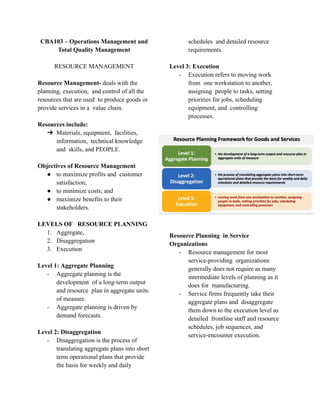
LEVELS OF RESOURCE PLANNING
1. Aggregate,
2. Disaggregation
3. Execution
Level 1: Aggregate Planning
- Aggregate planning is the
development of a long-term output
and resource plan in aggregate units
of measure.
- Aggregate planning is driven by
demand forecasts.
Level 2: Disaggregation
- Disaggregation is the process of
translating aggregate plans into short
term operational plans that provide
the basis for weekly and daily
schedules and detailed resource
requirements.
Level 3: Execution
- Execution refers to moving work
from one workstation to another,
assigning people to tasks, setting
priorities for jobs, scheduling
equipment, and controlling
processes.
Resource Planning in Service
Organizations
- Resource management for most
service-providing organizations
generally does not require as many
intermediate levels of planning as it
does for manufacturing.
- Service firms frequently take their
aggregate plans and disaggregate
them down to the execution level as
detailed frontline staff and resource
schedules, job sequences, and
service-encounter execution.
Enterprise Resource Planning
ERP integrates all aspects of a business –
accounting, customer relationship
management, supply chain management,
manufacturing, sales, human resource–into
a unified information system, and they
provide more timely analysis and reporting
of sales, customer, inventory,
manufacturing, human resource, and
accounting data.
ERP systems usually consist of different
modules that can be implemented
individually so that each department still has
a level of autonomy, but they are combined
into an integrated operating system.
Two Prominent Vendors of ERP Software
1. Systems Applications and
Products or (SAP), is a widely-used
ERP software. SAP creates a
centralized system for businesses
that enables every department to
access and share common data to
create a better work environment for
every employee in the company.
2. Oracle ERP system is a
comprehensive software for
managing business processes and
functions, real-time reporting,
business intelligence, and business
decisions.
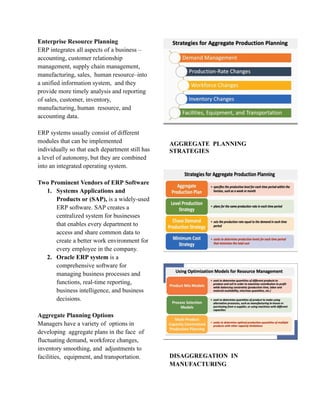
Aggregate Planning Options
Managers have a variety of options in
developing aggregate plans in the face of
fluctuating demand, workforce changes,
inventory smoothing, and adjustments to
facilities, equipment, and transportation.
AGGREGATE PLANNING
STRATEGIES
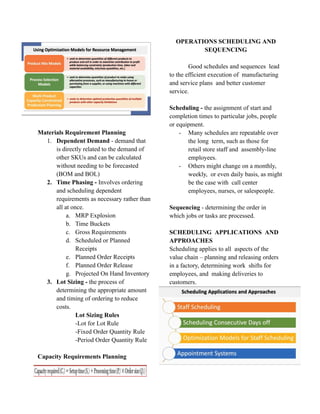
DISAGGREGATION IN
MANUFACTURING
Materials Requirement Planning
1. Dependent Demand - demand that
is directly related to the demand of
other SKUs and can be calculated
without needing to be forecasted
(BOM and BOL)
2. Time Phasing - Involves ordering
and scheduling dependent
requirements as necessary rather than
all at once.
a. MRP Explosion
b. Time Buckets
c. Gross Requirements
d. Scheduled or Planned
Receipts
e. Planned Order Receipts
f. Planned Order Release
g. Projected On Hand Inventory
3. Lot Sizing - the process of
determining the appropriate amount
and timing of ordering to reduce
costs.
Lot Sizing Rules
-Lot for Lot Rule
-Fixed Order Quantity Rule
-Period Order Quantity Rule
Capacity Requirements Planning
OPERATIONS SCHEDULING AND
SEQUENCING
Good schedules and sequences lead
to the efficient execution of manufacturing
and service plans and better customer
service.
Scheduling - the assignment of start and
completion times to particular jobs, people
or equipment.
- Many schedules are repeatable over
the long term, such as those for
retail store staff and assembly-line
employees.
- Others might change on a monthly,
weekly, or even daily basis, as might
be the case with call center
employees, nurses, or salespeople.
Sequencing - determining the order in
which jobs or tasks are processed.
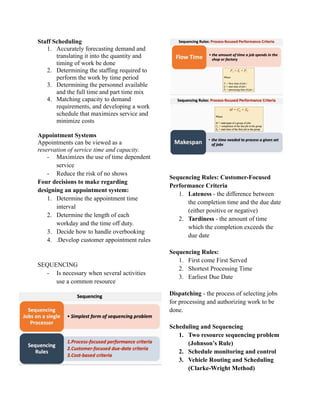
SCHEDULING APPLICATIONS AND
APPROACHES
Scheduling applies to all aspects of the
value chain – planning and releasing orders
in a factory, determining work shifts for
employees, and making deliveries to
customers.
Staff Scheduling
1. Accurately forecasting demand and
translating it into the quantity and
timing of work be done
2. Determining the staffing required to
perform the work by time period
3. Determining the personnel available
and the full time and part time mix
4. Matching capacity to demand
requirements, and developing a work
schedule that maximizes service and
minimize costs
Appointment Systems
Appointments can be viewed as a
reservation of service time and capacity.
- Maximizes the use of time dependent
service
- Reduce the risk of no shows
Four decisions to make regarding
designing an appointment system:
1. Determine the appointment time
interval
2. Determine the length of each
workday and the time off duty.
3. Decide how to handle overbooking
4. .Develop customer appointment rules
SEQUENCING
- Is necessary when several activities
use a common resource
Sequencing Rules: Customer-Focused
Performance Criteria
1. Lateness - the difference between
the completion time and the due date
(either positive or negative)
2. Tardiness - the amount of time
which the completion exceeds the
due date
Sequencing Rules:
1. First come First Served
2. Shortest Processing Time
3. Earliest Due Date
Dispatching - the process of selecting jobs
for processing and authorizing work to be
done.
Scheduling and Sequencing
1. Two resource sequencing problem
(Johnson’s Rule)
2. Schedule monitoring and control
3. Vehicle Routing and Scheduling
(Clarke-Wright Method)
Schedule Monitoring and Control
In scheduling environments that
change rapidly, organizations must have the
capability to closely monitor and adjust
schedules as necessary
Short-term capacity fluctuations also
necessitate changes in schedules. Factors
affecting short-term capacity include
absenteeism, labor performance, equipment
failures, tooling problems, labor turnover,
and material shortages. They are inevitable
and unavoidable. Some alternatives
available to operations managers for coping
with capacity shortages are overtime,
short-term subcontracting, alternate process
routing, and reallocations of the workforce.
Gantt (Bar) Charts - are useful tools for
monitoring planned schedules.
Vehicle Routing and Scheduling
A common scheduling problem in
logistics involves determining routes from a
central depot or warehouse to many
customers.
Clarke-Wright Heuristic Method - this
procedure starts by assuming that each
customer is serviced individually from the
depot, and then seeks to combine customers
into larger routes to reduce the total travel
time and remain within the capacity
restrictions.
1. Compute the savings for all pairs of
customers.
2. Find the pair of customers with the
largest savings, and determine if
there is sufficient capacity to link
these customers together. If so,
construct a new route by combining
them. If not, try the next largest , and
so on.
3. Continue to apply step 2 as long as
the next largest savings is positive.
When all positive savings have been
considered, stop.
LEAN OPERATING SYSTEMS
Lean Thinking - refers to approaches that
focus on the elimination of waste in all
forms, and smooth, efficient flow of
materials and information throughout the
value chain to obtain faster customer
response, higher quality and lower costs
Principles of Lean Operating Systems
1. Elimination of Waste - the goal is
zero waste in all value-creation and
support processes in the entire value
chain.
- Any activity, material or
operation that does not add
value to an organization is
considered WASTE.
7 Sources of WASTE
1. Overproduction
2. Waiting Time
3. Transportation
4. Processing
5. Inventory
6. Motion
7. Production Defects
2. Increased Speed and Response -
lean operating systems focus on
quick and efficient responses in
designing and getting goods and
services to market, producing to
customer demand and delivery
requirements, etc.
3. Improved Quality - eliminating the
sources of defects and errors in all
processes in the value chain greatly
improves speed, reduces variability
and supports the notion of
continuous flow.
4. Reduced Costs - important objective
of Lean enterprise.
Lean Tools and Approaches
1. 5S - are derived from japanese terms:
seiri (sort), seiton (set in order), seiso
(shine), seiketsu (standardize), and
shitsuke (sustain).
2. Visual Controls - indicators for
operating activities that are placed in
plain sight of all employees so that
everyone can quickly and easily
understand the status and
performance of the work system.
3. SMED (Single Minute Exchange
Dies) - refers to the quick setup or
changeover of tooling and fixtures in
processes so that multiple products
in smaller batches can be run on the
same equipment.
4. Batch and Single Piece Flow
a. Batch - the process of
producing large quantities of
items as a group before they
are transferred to the next
operation.
b. Single Piece Flow - is the
concept of ideally using batch
sizes of one
5. Quality and Continuous
Improvement - developing quality
at the source.
6. Total Productive Maintenance
(TPM) - focused on ensuring that
operating systems will perform their
intended function reliably
a. TPM seeks to:
i. Maximize overall
equipment
ii. Create worker
“ownership” of the
equipment
iii. Foster continuous
efforts to improve
equipment operation
- TPM has been called “lean
maintenance - is more than
preventing failures of
equipment and processes; it
now includes maintenance
and backup systems for
software and electronic
network systems”
Lean Six Sigma
- Lean tools might be applied to
streamline an order entry process.
- Six Sigma tools might be used to
drill down to the root cause of the
problems and identify a solution.
Difference between Lean Production and
Six Sigma
- Lean production addresses visible
problems in processes; for example,
inventory, material flow, and safety.
Six Sigma is more concerned with
less visible problems; for example,
variation in performance.
- Lean tools are more intuitive and
easier to apply by anybody in the
workplace, whereas many Six Sigma
tools require advanced training and
expertise of specialists, particularly
in statistical analysis, commonly
called Black Belts and Master Black
Belts.
Just in Time (JIT)- was introduced at
Toyota during the 1950s to 1960s to address
the challenge of coordinating successive
production activities.
Just in Time Systems
1. Push system - produces finished
goods inventory in advance of
customer demand using a forecast of
sales (traditional)
2. Pull System - employees at a given
operation go to the source of
required parts, such as machining or
subassembly, and withdraw the units
as they need them (basis for JIT)
3. Kanban - a flag or piece of paper
that contains all relevant information
for an order.
4. Takt Time - the production rate for
one good or service based on the rate
of sales.
PROJECT MANAGEMENT
Project - a temporary and often customized
initiative that consists of many smaller tasks
and activities that must be coordinated and
completed to finish the entire initiative on
time and within budget.
- Requires systematic management
Project Management - involves all
activities associated with planning,
scheduling, and controlling processes.
- Good project management ensures
that an organization’s resources are
used efficiently and effectively
- Project management skills are also
essential to coordinate the multiple
project disciplines needed to
successfully accomplish the project
with complete or partial
sustainability objectives.
In many firms, projects are the major
value-creation process, and the major
activities in the value chain revolve around
projects.
The Scope of Project Management:
Project Life Cycle
1. Define
2. Plan
3. Organize
4. Control
5. Close
Responsibilities of Project Managers:
➔ Build an effective team
➔ Manage the relationships
➔ Sufficient technical expertise
The Scope of Project Management:
Project Managers
1. Manage people individually and as a
project team
2. Reinforce the commitment and
excitement of the project team
3. Keep everyone informed
4. Build agreements and consensus
among the team
5. Empower the project team
Organizational Structure
- Pure project
- Pure Functional
- Matrix
Techniques for Planning, Scheduling, and
Controlling Projects
1. Project Definition
a. Activities - discrete tasks
b. Immediate Predecessors -
activities that must be
completed immediately
c. Work Breakdown Structure
(WBS) - a hierarchical tree of
end items that will be
accomplished by the project
team during the project
d. Project Network - a set of
circles or boxes called nodes,
which represent activities,
and a set of arrows called
arcs, which define the
precedence relationships
between activities.
2. Resource Planning -
a. The Critical Path Method -
is an approach to scheduling
and controlling project
activities
b. Critical Path - is the
sequence of activities that
takes the longest time and
defines the total project
completion time.
c. CPM assumes the
following:
i. The project network
defines a correct
sequence of work in
terms of technology
and workflow.
ii. Activities are
assumed to be
independent of one
another, with clearly
defined start and
finish dates.
iii. The activity time
estimates are accurate
and stable. • Once an
activity is started, it
continues
uninterrupted until it
is completed
3. Project Scheduling
4. Project Control
a. Schedule - specifies when
activities are to be performed
b. Managers must monitor the
performance of the project
and take corrective action
when needed.
Gantt Chart - is defined as a graphical
representation of activity against time; it
helps project professionals monitor progress.
Gantt charts are essentially task scheduling
tools: project management timelines and
tasks are converted into horizontal bars
(also called Gantt bars) to form a bar chart.
Time / Cost Trade Offs
- Crashing a Project - refers to
reducing the total time to complete
the project to meet a revised due date
- Crash Time is the shortest possible
time in which the activity can be
realistically completed
- Crash Cost is the total additional
cost associated with completing an
activity in its crash time rather than
in its normal time.
Uncertainty in Project Management;
PERT
PERT (Project Evaluation and Review
Technique) - developed as a means of
handling the uncertainties in activity
completion times.
- Optimistic Time - the activity time
if everything progresses in an ideal
manner
- Most Probable Time - most likely
activity under normal conditions
- Pessimistic Time - the activity time
if significant breakdowns and/or
delays occur
INTRODUCTION TO QUALITY
MANAGEMENT
Quality - meeting or exceeding customer’s
expectations.
Quality of Conformance - the extent to
which a process is able to deliver output that
conforms to the design specifications.
Specifications - targets and tolerances
determined by the designers of goods
/services.
Service quality - consistently meeting or
exceeding customer’s expectations (external
focus)
SERVQUAL
1. Reliability
2. Responsiveness
3. Competence
4. Access
5. Courtesy
6. Communication
7. Credibility
8. Security
9. Knowing the Customer
10. Tangibles
Quality can be defined from 6 diff.
perspectives:
1. Transcendent - to rise above or
extend notably beyond ordinary
limits
2. Product - quantity of some product
attribute
3. User - fitness for intended use
4. Value - relationship of product
benefits to price
5. Manufacturing - conformance to
specifications
6. Customer - meeting or exceeding
customer expectations.
Integrating Quality Perspectives in the
Value Chain
different quality perspectives at different
points in the value chain are important to
ultimately create and deliver goods and
services that will satisfy customers’ needs
and expectations
Understanding Quality
- Total Principles
1. Focus on customers and
stakeholders
2. Process focus supported by
continuous improvement and
learning
3. Participation and teamwork
by everyone in the
organization
QUALITY MANAGEMENT - systematic
policies, methods and procedures used to
ensure that goods and services are produced
with appropriate levels of quality to meet the
needs of customers.
TQM - is a people focused management
system that aims at continual increase in
customer satisfaction at continually lower
real cost.
Early Management Failures
reasons for TQM failures were most-often
rooted in flawed organizational approaches
and management systems, such as poor
quality strategies or good strategies that
were poorly executed, and not because of
the underlying principles of quality
management
Performance Excellence can be defined as
an integrated approach to organizational
performance management that results in:
1. delivery of ever-improving value
to customers and stakeholders,
contributing to ongoing
organizational success
2. improvement of overall
organizational effectiveness and
capabilities, and
3. learning for the organization and
for people in the workforce
Globalization of Quality
➔ The global marketplace and
domestic and international
competition have made organizations
around the world realize that their
survival depends on high quality.
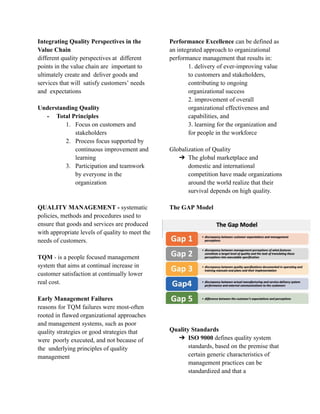
The GAP Model
Quality Standards
➔ ISO 9000 defines quality system
standards, based on the premise that
certain generic characteristics of
management practices can be
standardized and that a
well-designed, well implemented and
carefully managed quality system
provides confidence that the outputs
will meet customer expectations and
requirements.
➔ Principles:
◆ Customer Focus
◆ Leadership
◆ Engagement of People
◆ Process of Approach
◆ Improvement
◆ Evidence-based Decisions
◆ Relationship Management
Six Sigma - a business improvement
approach that seeks to find and eliminate
causes of defects and errors in
manufacturing and service processes by
focusing on outputs that are critical to
customers, resulting in a clear financial
return.
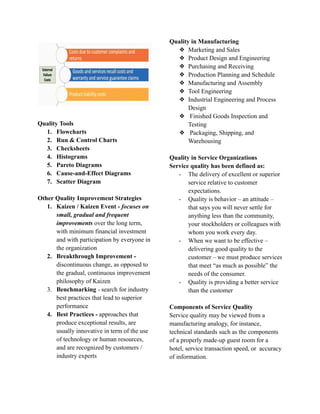
Defect - any mistake or error that is passed
on to the customer.
Unit of Work - the output of a process or an
individual process step
Implementing Six Sigma
1. Define
2. Measure
3. Analyze
4. Improve
5. Control
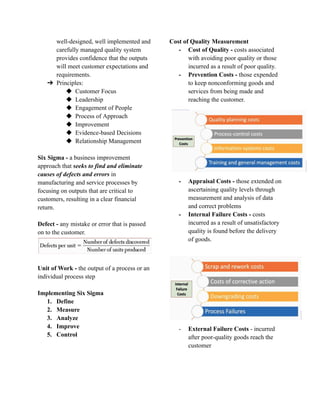
Cost of Quality Measurement
- Cost of Quality - costs associated
with avoiding poor quality or those
incurred as a result of poor quality.
- Prevention Costs - those expended
to keep nonconforming goods and
services from being made and
reaching the customer.
- Appraisal Costs - those extended on
ascertaining quality levels through
measurement and analysis of data
and correct problems
- Internal Failure Costs - costs
incurred as a result of unsatisfactory
quality is found before the delivery
of goods.
- External Failure Costs - incurred
after poor-quality goods reach the
customer
Quality Tools
1. Flowcharts
2. Run & Control Charts
3. Checksheets
4. Histograms
5. Pareto Diagrams
6. Cause-and-Effect Diagrams
7. Scatter Diagram
Other Quality Improvement Strategies
1. Kaizen / Kaizen Event - focuses on
small, gradual and frequent
improvements over the long term,
with minimum financial investment
and with participation by everyone in
the organization
2. Breakthrough Improvement -
discontinuous change, as opposed to
the gradual, continuous improvement
philosophy of Kaizen
3. Benchmarking - search for industry
best practices that lead to superior
performance
4. Best Practices - approaches that
produce exceptional results, are
usually innovative in term of the use
of technology or human resources,
and are recognized by customers /
industry experts
Quality in Manufacturing
❖ Marketing and Sales
❖ Product Design and Engineering
❖ Purchasing and Receiving
❖ Production Planning and Schedule
❖ Manufacturing and Assembly
❖ Tool Engineering
❖ Industrial Engineering and Process
Design
❖ Finished Goods Inspection and
Testing
❖ Packaging, Shipping, and
Warehousing
Quality in Service Organizations
Service quality has been defined as:
- The delivery of excellent or superior
service relative to customer
expectations.
- Quality is behavior – an attitude –
that says you will never settle for
anything less than the community,
your stockholders or colleagues with
whom you work every day.
- When we want to be effective –
delivering good quality to the
customer – we must produce services
that meet “as much as possible” the
needs of the consumer.
- Quality is providing a better service
than the customer
Components of Service Quality
Service quality may be viewed from a
manufacturing analogy, for instance,
technical standards such as the components
of a properly made-up guest room for a
hotel, service transaction speed, or accuracy
of information.
The two most important drivers of service
quality are: PEOPLE and TECHNOLOGY
Quality in Business Support Functions
In addition to manufacturing and service
activities, other business support activities
are necessary for achieving quality. Some of
these activities are:
- Finance and Accounting
- Legal Services
- Quality Assurance
Quality and Competitive Advantage
A strong competitive advantage provides
customer value, leads to financial success
and business sustainability, and is difficult
for competitors to copy.
PIMS research found the following:
- Product quality is an important
determinant of business profitability.
o Businesses that offer
premium-quality products and
services usually have large market
shares and were early entrants into
their markets.
- Quality is positively and
significantly related to a higher
return on investment for almost all
kinds of products and market
situations. o Instituting a strategy of
quality improvement usually leads to
increased market share, but at the
cost of reduced short-run
profitability.
- High-quality producers can usually
charge premium prices.
Quality and Personal Values
- organizations are asking employees
to take more responsibility for
acting as the point of contact
between the organization and the
customer, to be team players, and to
provide better customer service.

Operations Management | FINANCIAL MANAGEMENT

  • 1.
    CBA103 – OperationsManagement and Total Quality Management RESOURCE MANAGEMENT Resource Management- deals with the planning, execution, and control of all the resources that are used to produce goods or provide services in a value chain. Resources include: ➔ Materials, equipment, facilities, information, technical knowledge and skills, and PEOPLE. Objectives of Resource Management ● to maximize profits and customer satisfaction; ● to minimize costs; and ● maximize benefits to their stakeholders. LEVELS OF RESOURCE PLANNING 1. Aggregate, 2. Disaggregation 3. Execution Level 1: Aggregate Planning - Aggregate planning is the development of a long-term output and resource plan in aggregate units of measure. - Aggregate planning is driven by demand forecasts. Level 2: Disaggregation - Disaggregation is the process of translating aggregate plans into short term operational plans that provide the basis for weekly and daily schedules and detailed resource requirements. Level 3: Execution - Execution refers to moving work from one workstation to another, assigning people to tasks, setting priorities for jobs, scheduling equipment, and controlling processes. Resource Planning in Service Organizations - Resource management for most service-providing organizations generally does not require as many intermediate levels of planning as it does for manufacturing. - Service firms frequently take their aggregate plans and disaggregate them down to the execution level as detailed frontline staff and resource schedules, job sequences, and service-encounter execution.
  • 2.
    Enterprise Resource Planning ERPintegrates all aspects of a business – accounting, customer relationship management, supply chain management, manufacturing, sales, human resource–into a unified information system, and they provide more timely analysis and reporting of sales, customer, inventory, manufacturing, human resource, and accounting data. ERP systems usually consist of different modules that can be implemented individually so that each department still has a level of autonomy, but they are combined into an integrated operating system. Two Prominent Vendors of ERP Software 1. Systems Applications and Products or (SAP), is a widely-used ERP software. SAP creates a centralized system for businesses that enables every department to access and share common data to create a better work environment for every employee in the company. 2. Oracle ERP system is a comprehensive software for managing business processes and functions, real-time reporting, business intelligence, and business decisions. Aggregate Planning Options Managers have a variety of options in developing aggregate plans in the face of fluctuating demand, workforce changes, inventory smoothing, and adjustments to facilities, equipment, and transportation. AGGREGATE PLANNING STRATEGIES DISAGGREGATION IN MANUFACTURING
  • 3.
    Materials Requirement Planning 1.Dependent Demand - demand that is directly related to the demand of other SKUs and can be calculated without needing to be forecasted (BOM and BOL) 2. Time Phasing - Involves ordering and scheduling dependent requirements as necessary rather than all at once. a. MRP Explosion b. Time Buckets c. Gross Requirements d. Scheduled or Planned Receipts e. Planned Order Receipts f. Planned Order Release g. Projected On Hand Inventory 3. Lot Sizing - the process of determining the appropriate amount and timing of ordering to reduce costs. Lot Sizing Rules -Lot for Lot Rule -Fixed Order Quantity Rule -Period Order Quantity Rule Capacity Requirements Planning OPERATIONS SCHEDULING AND SEQUENCING Good schedules and sequences lead to the efficient execution of manufacturing and service plans and better customer service. Scheduling - the assignment of start and completion times to particular jobs, people or equipment. - Many schedules are repeatable over the long term, such as those for retail store staff and assembly-line employees. - Others might change on a monthly, weekly, or even daily basis, as might be the case with call center employees, nurses, or salespeople. Sequencing - determining the order in which jobs or tasks are processed. SCHEDULING APPLICATIONS AND APPROACHES Scheduling applies to all aspects of the value chain – planning and releasing orders in a factory, determining work shifts for employees, and making deliveries to customers.
  • 4.
    Staff Scheduling 1. Accuratelyforecasting demand and translating it into the quantity and timing of work be done 2. Determining the staffing required to perform the work by time period 3. Determining the personnel available and the full time and part time mix 4. Matching capacity to demand requirements, and developing a work schedule that maximizes service and minimize costs Appointment Systems Appointments can be viewed as a reservation of service time and capacity. - Maximizes the use of time dependent service - Reduce the risk of no shows Four decisions to make regarding designing an appointment system: 1. Determine the appointment time interval 2. Determine the length of each workday and the time off duty. 3. Decide how to handle overbooking 4. .Develop customer appointment rules SEQUENCING - Is necessary when several activities use a common resource Sequencing Rules: Customer-Focused Performance Criteria 1. Lateness - the difference between the completion time and the due date (either positive or negative) 2. Tardiness - the amount of time which the completion exceeds the due date Sequencing Rules: 1. First come First Served 2. Shortest Processing Time 3. Earliest Due Date Dispatching - the process of selecting jobs for processing and authorizing work to be done. Scheduling and Sequencing 1. Two resource sequencing problem (Johnson’s Rule) 2. Schedule monitoring and control 3. Vehicle Routing and Scheduling (Clarke-Wright Method)
  • 5.
    Schedule Monitoring andControl In scheduling environments that change rapidly, organizations must have the capability to closely monitor and adjust schedules as necessary Short-term capacity fluctuations also necessitate changes in schedules. Factors affecting short-term capacity include absenteeism, labor performance, equipment failures, tooling problems, labor turnover, and material shortages. They are inevitable and unavoidable. Some alternatives available to operations managers for coping with capacity shortages are overtime, short-term subcontracting, alternate process routing, and reallocations of the workforce. Gantt (Bar) Charts - are useful tools for monitoring planned schedules. Vehicle Routing and Scheduling A common scheduling problem in logistics involves determining routes from a central depot or warehouse to many customers. Clarke-Wright Heuristic Method - this procedure starts by assuming that each customer is serviced individually from the depot, and then seeks to combine customers into larger routes to reduce the total travel time and remain within the capacity restrictions. 1. Compute the savings for all pairs of customers. 2. Find the pair of customers with the largest savings, and determine if there is sufficient capacity to link these customers together. If so, construct a new route by combining them. If not, try the next largest , and so on. 3. Continue to apply step 2 as long as the next largest savings is positive. When all positive savings have been considered, stop. LEAN OPERATING SYSTEMS Lean Thinking - refers to approaches that focus on the elimination of waste in all forms, and smooth, efficient flow of materials and information throughout the value chain to obtain faster customer response, higher quality and lower costs Principles of Lean Operating Systems 1. Elimination of Waste - the goal is zero waste in all value-creation and support processes in the entire value chain. - Any activity, material or operation that does not add value to an organization is considered WASTE. 7 Sources of WASTE 1. Overproduction 2. Waiting Time 3. Transportation 4. Processing 5. Inventory 6. Motion 7. Production Defects 2. Increased Speed and Response - lean operating systems focus on quick and efficient responses in designing and getting goods and
  • 6.
    services to market,producing to customer demand and delivery requirements, etc. 3. Improved Quality - eliminating the sources of defects and errors in all processes in the value chain greatly improves speed, reduces variability and supports the notion of continuous flow. 4. Reduced Costs - important objective of Lean enterprise. Lean Tools and Approaches 1. 5S - are derived from japanese terms: seiri (sort), seiton (set in order), seiso (shine), seiketsu (standardize), and shitsuke (sustain). 2. Visual Controls - indicators for operating activities that are placed in plain sight of all employees so that everyone can quickly and easily understand the status and performance of the work system. 3. SMED (Single Minute Exchange Dies) - refers to the quick setup or changeover of tooling and fixtures in processes so that multiple products in smaller batches can be run on the same equipment. 4. Batch and Single Piece Flow a. Batch - the process of producing large quantities of items as a group before they are transferred to the next operation. b. Single Piece Flow - is the concept of ideally using batch sizes of one 5. Quality and Continuous Improvement - developing quality at the source. 6. Total Productive Maintenance (TPM) - focused on ensuring that operating systems will perform their intended function reliably a. TPM seeks to: i. Maximize overall equipment ii. Create worker “ownership” of the equipment iii. Foster continuous efforts to improve equipment operation - TPM has been called “lean maintenance - is more than preventing failures of equipment and processes; it now includes maintenance and backup systems for software and electronic network systems” Lean Six Sigma - Lean tools might be applied to streamline an order entry process. - Six Sigma tools might be used to drill down to the root cause of the problems and identify a solution. Difference between Lean Production and Six Sigma - Lean production addresses visible problems in processes; for example, inventory, material flow, and safety. Six Sigma is more concerned with
  • 7.
    less visible problems;for example, variation in performance. - Lean tools are more intuitive and easier to apply by anybody in the workplace, whereas many Six Sigma tools require advanced training and expertise of specialists, particularly in statistical analysis, commonly called Black Belts and Master Black Belts. Just in Time (JIT)- was introduced at Toyota during the 1950s to 1960s to address the challenge of coordinating successive production activities. Just in Time Systems 1. Push system - produces finished goods inventory in advance of customer demand using a forecast of sales (traditional) 2. Pull System - employees at a given operation go to the source of required parts, such as machining or subassembly, and withdraw the units as they need them (basis for JIT) 3. Kanban - a flag or piece of paper that contains all relevant information for an order. 4. Takt Time - the production rate for one good or service based on the rate of sales. PROJECT MANAGEMENT Project - a temporary and often customized initiative that consists of many smaller tasks and activities that must be coordinated and completed to finish the entire initiative on time and within budget. - Requires systematic management Project Management - involves all activities associated with planning, scheduling, and controlling processes. - Good project management ensures that an organization’s resources are used efficiently and effectively - Project management skills are also essential to coordinate the multiple project disciplines needed to successfully accomplish the project with complete or partial sustainability objectives. In many firms, projects are the major value-creation process, and the major activities in the value chain revolve around projects. The Scope of Project Management: Project Life Cycle 1. Define 2. Plan 3. Organize 4. Control 5. Close Responsibilities of Project Managers: ➔ Build an effective team ➔ Manage the relationships ➔ Sufficient technical expertise
  • 8.
    The Scope ofProject Management: Project Managers 1. Manage people individually and as a project team 2. Reinforce the commitment and excitement of the project team 3. Keep everyone informed 4. Build agreements and consensus among the team 5. Empower the project team Organizational Structure - Pure project - Pure Functional - Matrix Techniques for Planning, Scheduling, and Controlling Projects 1. Project Definition a. Activities - discrete tasks b. Immediate Predecessors - activities that must be completed immediately c. Work Breakdown Structure (WBS) - a hierarchical tree of end items that will be accomplished by the project team during the project d. Project Network - a set of circles or boxes called nodes, which represent activities, and a set of arrows called arcs, which define the precedence relationships between activities. 2. Resource Planning - a. The Critical Path Method - is an approach to scheduling and controlling project activities b. Critical Path - is the sequence of activities that takes the longest time and defines the total project completion time. c. CPM assumes the following: i. The project network defines a correct sequence of work in terms of technology and workflow. ii. Activities are assumed to be independent of one another, with clearly defined start and finish dates. iii. The activity time estimates are accurate and stable. • Once an activity is started, it continues uninterrupted until it is completed 3. Project Scheduling 4. Project Control a. Schedule - specifies when activities are to be performed b. Managers must monitor the performance of the project and take corrective action when needed. Gantt Chart - is defined as a graphical representation of activity against time; it helps project professionals monitor progress. Gantt charts are essentially task scheduling tools: project management timelines and
  • 9.
    tasks are convertedinto horizontal bars (also called Gantt bars) to form a bar chart. Time / Cost Trade Offs - Crashing a Project - refers to reducing the total time to complete the project to meet a revised due date - Crash Time is the shortest possible time in which the activity can be realistically completed - Crash Cost is the total additional cost associated with completing an activity in its crash time rather than in its normal time. Uncertainty in Project Management; PERT PERT (Project Evaluation and Review Technique) - developed as a means of handling the uncertainties in activity completion times. - Optimistic Time - the activity time if everything progresses in an ideal manner - Most Probable Time - most likely activity under normal conditions - Pessimistic Time - the activity time if significant breakdowns and/or delays occur INTRODUCTION TO QUALITY MANAGEMENT Quality - meeting or exceeding customer’s expectations. Quality of Conformance - the extent to which a process is able to deliver output that conforms to the design specifications. Specifications - targets and tolerances determined by the designers of goods /services. Service quality - consistently meeting or exceeding customer’s expectations (external focus) SERVQUAL 1. Reliability 2. Responsiveness 3. Competence 4. Access 5. Courtesy 6. Communication 7. Credibility 8. Security 9. Knowing the Customer 10. Tangibles Quality can be defined from 6 diff. perspectives: 1. Transcendent - to rise above or extend notably beyond ordinary limits 2. Product - quantity of some product attribute 3. User - fitness for intended use 4. Value - relationship of product benefits to price 5. Manufacturing - conformance to specifications 6. Customer - meeting or exceeding customer expectations.
  • 10.
    Integrating Quality Perspectivesin the Value Chain different quality perspectives at different points in the value chain are important to ultimately create and deliver goods and services that will satisfy customers’ needs and expectations Understanding Quality - Total Principles 1. Focus on customers and stakeholders 2. Process focus supported by continuous improvement and learning 3. Participation and teamwork by everyone in the organization QUALITY MANAGEMENT - systematic policies, methods and procedures used to ensure that goods and services are produced with appropriate levels of quality to meet the needs of customers. TQM - is a people focused management system that aims at continual increase in customer satisfaction at continually lower real cost. Early Management Failures reasons for TQM failures were most-often rooted in flawed organizational approaches and management systems, such as poor quality strategies or good strategies that were poorly executed, and not because of the underlying principles of quality management Performance Excellence can be defined as an integrated approach to organizational performance management that results in: 1. delivery of ever-improving value to customers and stakeholders, contributing to ongoing organizational success 2. improvement of overall organizational effectiveness and capabilities, and 3. learning for the organization and for people in the workforce Globalization of Quality ➔ The global marketplace and domestic and international competition have made organizations around the world realize that their survival depends on high quality. The GAP Model Quality Standards ➔ ISO 9000 defines quality system standards, based on the premise that certain generic characteristics of management practices can be standardized and that a
  • 11.
    well-designed, well implementedand carefully managed quality system provides confidence that the outputs will meet customer expectations and requirements. ➔ Principles: ◆ Customer Focus ◆ Leadership ◆ Engagement of People ◆ Process of Approach ◆ Improvement ◆ Evidence-based Decisions ◆ Relationship Management Six Sigma - a business improvement approach that seeks to find and eliminate causes of defects and errors in manufacturing and service processes by focusing on outputs that are critical to customers, resulting in a clear financial return. Defect - any mistake or error that is passed on to the customer. Unit of Work - the output of a process or an individual process step Implementing Six Sigma 1. Define 2. Measure 3. Analyze 4. Improve 5. Control Cost of Quality Measurement - Cost of Quality - costs associated with avoiding poor quality or those incurred as a result of poor quality. - Prevention Costs - those expended to keep nonconforming goods and services from being made and reaching the customer. - Appraisal Costs - those extended on ascertaining quality levels through measurement and analysis of data and correct problems - Internal Failure Costs - costs incurred as a result of unsatisfactory quality is found before the delivery of goods. - External Failure Costs - incurred after poor-quality goods reach the customer
  • 12.
    Quality Tools 1. Flowcharts 2.Run & Control Charts 3. Checksheets 4. Histograms 5. Pareto Diagrams 6. Cause-and-Effect Diagrams 7. Scatter Diagram Other Quality Improvement Strategies 1. Kaizen / Kaizen Event - focuses on small, gradual and frequent improvements over the long term, with minimum financial investment and with participation by everyone in the organization 2. Breakthrough Improvement - discontinuous change, as opposed to the gradual, continuous improvement philosophy of Kaizen 3. Benchmarking - search for industry best practices that lead to superior performance 4. Best Practices - approaches that produce exceptional results, are usually innovative in term of the use of technology or human resources, and are recognized by customers / industry experts Quality in Manufacturing ❖ Marketing and Sales ❖ Product Design and Engineering ❖ Purchasing and Receiving ❖ Production Planning and Schedule ❖ Manufacturing and Assembly ❖ Tool Engineering ❖ Industrial Engineering and Process Design ❖ Finished Goods Inspection and Testing ❖ Packaging, Shipping, and Warehousing Quality in Service Organizations Service quality has been defined as: - The delivery of excellent or superior service relative to customer expectations. - Quality is behavior – an attitude – that says you will never settle for anything less than the community, your stockholders or colleagues with whom you work every day. - When we want to be effective – delivering good quality to the customer – we must produce services that meet “as much as possible” the needs of the consumer. - Quality is providing a better service than the customer Components of Service Quality Service quality may be viewed from a manufacturing analogy, for instance, technical standards such as the components of a properly made-up guest room for a hotel, service transaction speed, or accuracy of information.
  • 13.
    The two mostimportant drivers of service quality are: PEOPLE and TECHNOLOGY Quality in Business Support Functions In addition to manufacturing and service activities, other business support activities are necessary for achieving quality. Some of these activities are: - Finance and Accounting - Legal Services - Quality Assurance Quality and Competitive Advantage A strong competitive advantage provides customer value, leads to financial success and business sustainability, and is difficult for competitors to copy. PIMS research found the following: - Product quality is an important determinant of business profitability. o Businesses that offer premium-quality products and services usually have large market shares and were early entrants into their markets. - Quality is positively and significantly related to a higher return on investment for almost all kinds of products and market situations. o Instituting a strategy of quality improvement usually leads to increased market share, but at the cost of reduced short-run profitability. - High-quality producers can usually charge premium prices. Quality and Personal Values - organizations are asking employees to take more responsibility for acting as the point of contact between the organization and the customer, to be team players, and to provide better customer service.