Production Management
Chapter -7
111-56-03
Production planning
 Production planning is the act of
developing a guide for the design and
production of a given product or service.
Production planning helps organizations
make the production process as efficient as
possible. Production planning originated to
optimize the manufacturing process, and
today its general logic is applied in various
forms to design, production and delivery of
software as well.
Objectives of production planning
 1. Effective utilization of all the resources in the organisation
2. Steady flow of production process without any hurdles / bottlenecks
3. Estimate the resources – men, machinery and material requirements for
the future
4. Ensures optimum inventory level, without blocking the organization’s
resources
5. Co-ordinates activities of various departments

6. Minimize wastage of raw materials
7. Improves the labour productivity
8. Helps to capture the market
9. Provides a better work environment
10. Facilitates quality improvement
11. Results in consumer satisfaction
12. Reduces the production costs
Factors to be considered in production
planning
 External factors:
 State of demand in the market:
 Specifications of the customer order:
 Competitive situation in the market:
 Requirements and availability of materials:
 Technological change:
 Government Policy:
 Legal control over business:
 Availability and skills of the workforce:
 Prevailing political situation:
Internal factors:
 Production policy of the company
 Machine capacity:
 Provisions of contract with the workers:
 Production system/process used by the firm:
 Desired productivity and profitability
 Strategical aspects of production:
 Financial ability of the firm:
 Timing of different production operations
Classification of production
planning:
 Continuous production planning:
 Intermittent production planning:
 Batch production planning:
 Project planning:
Importance of production
planning:
 Better Service to Customers:
 Fewer Rush Orders :
 Better Control of Inventory :
 More Effective Use of Equipment :
 Reduced Idle Time :
 Improved Plant Morale :
 Good public image:
 Lower capital requirements:
Tools of production planning
 Demand forecasting:
 Linear programming:
 Benchmarking:
 Production budgeting:
 Break-even analysis:
 Network analysis:
 SWOT analysis:
 Simulation:
Production control
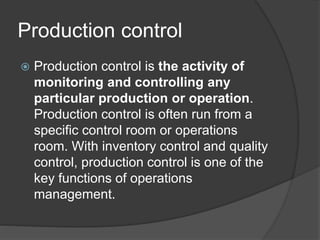
 Production control is the activity of
monitoring and controlling any
particular production or operation.
Production control is often run from a
specific control room or operations
room. With inventory control and quality
control, production control is one of the
key functions of operations
management.
Objectives of Production
Control
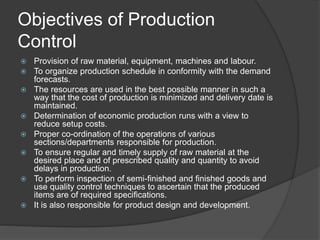
 Provision of raw material, equipment, machines and labour.
 To organize production schedule in conformity with the demand
forecasts.
 The resources are used in the best possible manner in such a
way that the cost of production is minimized and delivery date is
maintained.
 Determination of economic production runs with a view to
reduce setup costs.
 Proper co-ordination of the operations of various
sections/departments responsible for production.
 To ensure regular and timely supply of raw material at the
desired place and of prescribed quality and quantity to avoid
delays in production.
 To perform inspection of semi-finished and finished goods and
use quality control techniques to ascertain that the produced
items are of required specifications.
 It is also responsible for product design and development.
Important Aspects of Production
Control:
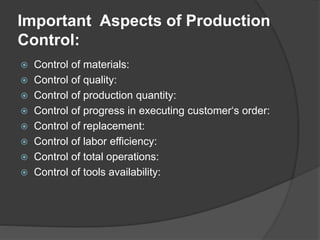
 Control of materials:
 Control of quality:
 Control of production quantity:
 Control of progress in executing customer‘s order:
 Control of replacement:
 Control of labor efficiency:
 Control of total operations:
 Control of tools availability:
Mechanism of Production
Control
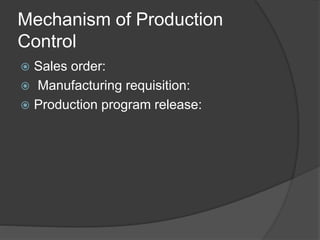
 Sales order:
 Manufacturing requisition:
 Production program release:
Types of Production Control
 Order control:
 Flow control:
 Load control:
 Block control:
Functional Aspects of
Production Control:
We know that production control is a
functional process comprising of
routing,scheduling, dispatching and
expediting to help perform the
production operations systematically as
per the production plans formulated by a
firm.An attempt will now made to
highlight these production control
functions.
Routing:
 Routing is the first step in production
planning and control. Routing can be
defined as the process of deciding the
path (route) of work and the
sequence of operations.
Steps in routing:
 Know the product and its parts:
 Gather information about the capacity of machines and
equipments:
 Learn about the availability of human resource:
 Determine the production process and sequence of
operations:
 Estimate the proportion of rejected item:
 Determine the production lot size:
 Identify the alternative methods of production:
 Find out the best production route:
 Preparation of contro lforms:
Factors influencing routing:
 Study of the product:
 Study of the plantlayout:
 Evaluation of production methods:
 Analysis of human element:
 Financial strength of the firm:
 Availability of materials:
 Periodic production target and stipulated
delivery date:
 Jobsatisfaction:
 Quality aspect:
Thank you everyone

Production planning & control

  • 1.
  • 2.
    Production planning  Productionplanning is the act of developing a guide for the design and production of a given product or service. Production planning helps organizations make the production process as efficient as possible. Production planning originated to optimize the manufacturing process, and today its general logic is applied in various forms to design, production and delivery of software as well.
  • 3.
    Objectives of productionplanning  1. Effective utilization of all the resources in the organisation 2. Steady flow of production process without any hurdles / bottlenecks 3. Estimate the resources – men, machinery and material requirements for the future 4. Ensures optimum inventory level, without blocking the organization’s resources 5. Co-ordinates activities of various departments  6. Minimize wastage of raw materials 7. Improves the labour productivity 8. Helps to capture the market 9. Provides a better work environment 10. Facilitates quality improvement 11. Results in consumer satisfaction 12. Reduces the production costs
  • 4.
    Factors to beconsidered in production planning  External factors:  State of demand in the market:  Specifications of the customer order:  Competitive situation in the market:  Requirements and availability of materials:  Technological change:  Government Policy:  Legal control over business:  Availability and skills of the workforce:  Prevailing political situation:
  • 5.
    Internal factors:  Productionpolicy of the company  Machine capacity:  Provisions of contract with the workers:  Production system/process used by the firm:  Desired productivity and profitability  Strategical aspects of production:  Financial ability of the firm:  Timing of different production operations
  • 6.
    Classification of production planning: Continuous production planning:  Intermittent production planning:  Batch production planning:  Project planning:
  • 7.
    Importance of production planning: Better Service to Customers:  Fewer Rush Orders :  Better Control of Inventory :  More Effective Use of Equipment :  Reduced Idle Time :  Improved Plant Morale :  Good public image:  Lower capital requirements:
  • 8.
    Tools of productionplanning  Demand forecasting:  Linear programming:  Benchmarking:  Production budgeting:  Break-even analysis:  Network analysis:  SWOT analysis:  Simulation:
  • 9.
    Production control  Productioncontrol is the activity of monitoring and controlling any particular production or operation. Production control is often run from a specific control room or operations room. With inventory control and quality control, production control is one of the key functions of operations management.
  • 10.
    Objectives of Production Control Provision of raw material, equipment, machines and labour.  To organize production schedule in conformity with the demand forecasts.  The resources are used in the best possible manner in such a way that the cost of production is minimized and delivery date is maintained.  Determination of economic production runs with a view to reduce setup costs.  Proper co-ordination of the operations of various sections/departments responsible for production.  To ensure regular and timely supply of raw material at the desired place and of prescribed quality and quantity to avoid delays in production.  To perform inspection of semi-finished and finished goods and use quality control techniques to ascertain that the produced items are of required specifications.  It is also responsible for product design and development.
  • 11.
    Important Aspects ofProduction Control:  Control of materials:  Control of quality:  Control of production quantity:  Control of progress in executing customer‘s order:  Control of replacement:  Control of labor efficiency:  Control of total operations:  Control of tools availability:
  • 12.
    Mechanism of Production Control Sales order:  Manufacturing requisition:  Production program release:
  • 13.
    Types of ProductionControl  Order control:  Flow control:  Load control:  Block control:
  • 14.
    Functional Aspects of ProductionControl: We know that production control is a functional process comprising of routing,scheduling, dispatching and expediting to help perform the production operations systematically as per the production plans formulated by a firm.An attempt will now made to highlight these production control functions.
  • 15.
    Routing:  Routing isthe first step in production planning and control. Routing can be defined as the process of deciding the path (route) of work and the sequence of operations.
  • 16.
    Steps in routing: Know the product and its parts:  Gather information about the capacity of machines and equipments:  Learn about the availability of human resource:  Determine the production process and sequence of operations:  Estimate the proportion of rejected item:  Determine the production lot size:  Identify the alternative methods of production:  Find out the best production route:  Preparation of contro lforms:
  • 17.
    Factors influencing routing: Study of the product:  Study of the plantlayout:  Evaluation of production methods:  Analysis of human element:  Financial strength of the firm:  Availability of materials:  Periodic production target and stipulated delivery date:  Jobsatisfaction:  Quality aspect:
  • 18.